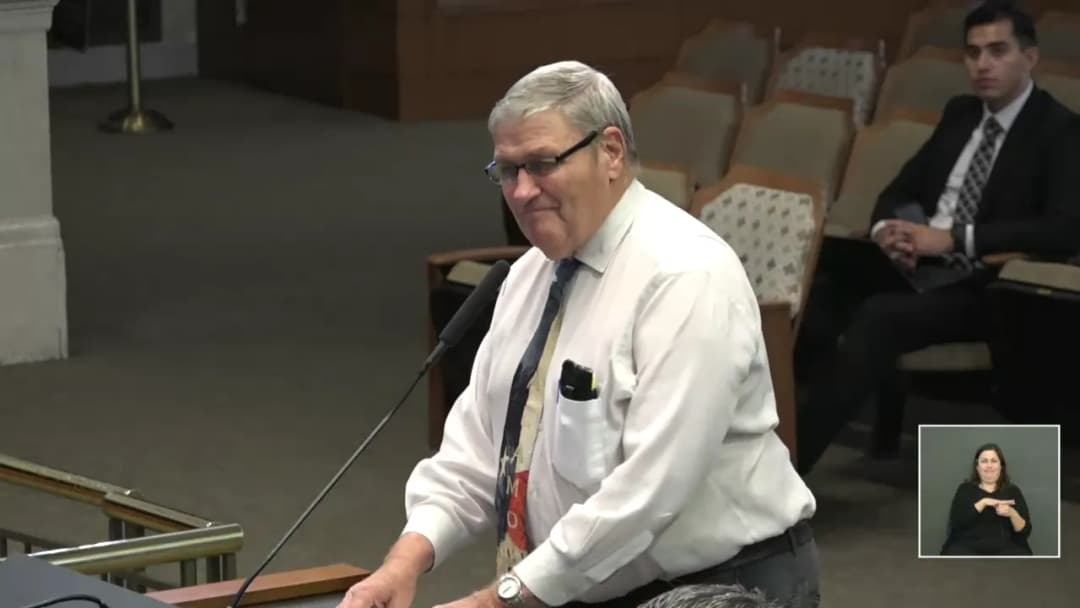
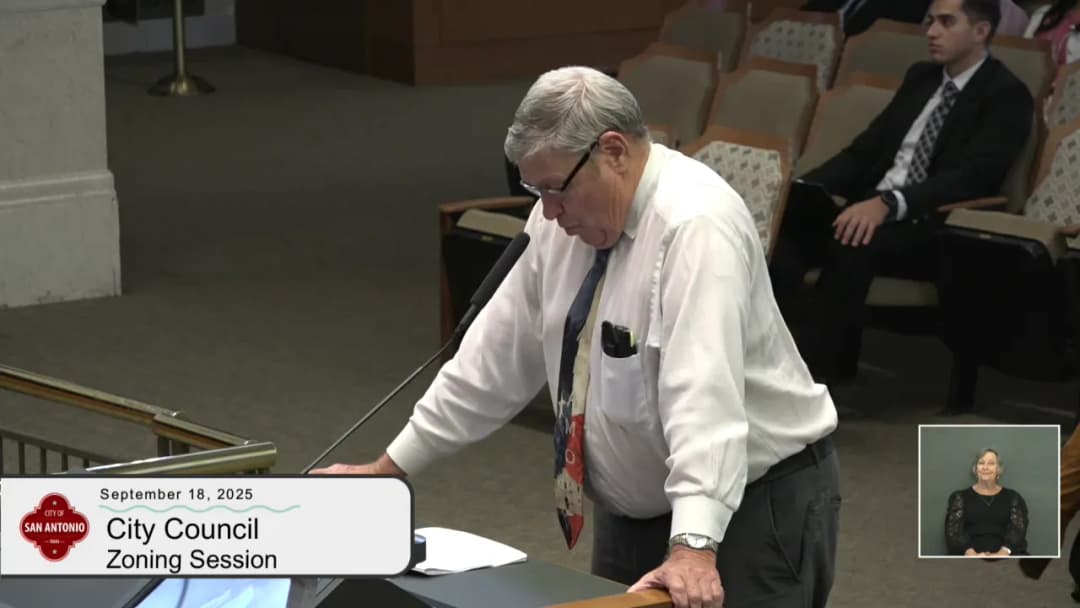
The City of San Antonio Zoning and Land Use Session convened on Thursday, September 18, 2025 at 2:48 PM. Mayor Jones presided with quorum present. The meeting addressed several zoning and land use items, including continuations, consent agenda approvals, and individual item decisions. Consent Calendar - Items 1, 2, 4, 5, 6, 7, 8, 9, 12, 13, 19, 20, and 22 were approved unanimously by a single motion and second, following public comments. Item 12 (battery storage on Marbach Road) and items 1 and 2 (alcohol variances near schools) drew public opposition but no council discussion before approval. Public Comments & Testimony - Cemetery rezoning (Items 3, 10, 14, 15 continued to Oct. 2): Several speakers opposed the proposed cemetery in District 3. Mary Ann Smith stated she had 66 white households, 230 digital signatures, and at least 6 property owners within 200 feet in opposition, totaling 897 families. She also cited opposition from neighborhood associations and the Southside ISD Board of Trustees. Andrew Nichols argued cemeteries pay no property or sales taxes under Texas Property Code 1117, shifting the tax burden to neighbors, and called it a disservice to a community needing development. Maite Goudino opposed due to lack of tax revenue and proximity to her children's school, collecting additional signatures. Teresa Cantu said there are already 250 cemeteries in Bexar County and 20 in District 3, and the community needs a library and recreation center instead. Julian Cruz, a real estate agent, noted he had majority of neighbors within 200 feet opposed, and the Southside ISD Board voted against the cemetery; he urged the council to vote no immediately rather than continue. - Consent agenda items: Jack Finger spoke on several items. He opposed battery storage (Item 12) across from single-family residences on Marbach Road, citing potential chemical contamination and lack of buffer. He also opposed alcohol variances (Items 1 and 2) within 300 feet of Carroll Bell Education Center on Pleasanton Road and Great Hearts Northern Oaks School on Bulverde Road, respectively. - Item 16 (alcohol sales change on Historic Old Highway 90): Jack Finger spoke against the change because it would allow alcohol sales in a previously established non-alcoholic corridor. Discussion Items - Items to continue: Items 3, 10, 14, and 15 (all related to a cemetery rezoning) were continued to October 2, 2025, after public testimony. Item 23 was continued to October 16, 2025, with no public speakers. Council members made motions without further discussion. - Consent agenda: No council discussion occurred; the public comments were heard before the vote. - Item 11 (8802 Troy Drive, oversized vehicle storage): Staff and Zoning Commission recommended denial. Councilmember Viagran (District 3) noted the case was previously continued to allow dialogue, but no dialogue occurred, and she made a motion to deny. - Item 16 (318 Historic Old Highway 90, change to allow alcohol sales): Staff recommended denial; Zoning Commission recommended approval. Councilmember Castillo (District 5) stated the Los Hardenes Neighborhood Association was in support and praised the applicant's presentation, then made a motion to approve. - Items 17 and 18 (117 Raymond Street, plan amendment and rezoning): Staff, Planning Commission, and Zoning Commission recommended approval. However, 21.51% of notified property owners returned opposition, requiring a supermajority vote. Councilmember Castillo noted the attendance was insufficient for supermajority and motioned to continue to October 2, 2025. Key Outcomes - Items continued: Items 3, 10, 14, 15 continued to October 2, 2025; Item 23 continued to October 16, 2025. Motions carried unanimously. - Consent agenda approved: Items 1, 2, 4, 5, 6, 7, 8, 9, 12, 13, 19, 20, 22 passed on a single vote. - Item 11 denied: Motion to deny (which is a yes vote for denial) passed. - Item 16 approved: Motion to approve passed. - Items 17 and 18 continued to October 2, 2025, due to insufficient votes for a supermajority. - Item 21 was withdrawn before the meeting. - The meeting adjourned at 3:21 PM.
Public Meetings - San Antonio, Texas
Public Meetings - San Antonio, TexasThe Zoning Board (City Council sitting as the Board) met on Thursday, September 18, 2025, at 2:48 PM. The meeting included the withdrawal of one item, postponements of several items, public testimony on a proposed cemetery and other zoning cases, and decisions on individual agenda items. Consent Calendar - The consent agenda, originally consisting of items 11, 16, 17, and 18 plus all remaining items, was approved by motion (items 1, 2, 4, 5, 6, 7, 8, 9, 12, 13, 19, 20, 23) after hearing public comment on items 1, 2, and 12. Public Comments & Testimony - Mary Smith (resident of Kenton Road): Presented a petition with 606 signatures and opposition from 87 families, the Vía Coronado Neighborhood Association, Mission Rich, and the cemetery board, urging denial of a zoning change for a cemetery (item 921, later withdrawn/postponed). - Andrew Nichols (applicant for the cemetery): Argued that cemeteries do not pay property taxes, shrinking the tax base; criticized that the community in District 3 deserves better development and noted the lack of tax revenue from the cemetery. - Jack Finger (public speaker): Called attention to items 3, 10, 14, and 15 (later postponed). Opposed item 3 (alcohol variance near a high school in District 1) and item 15 (duplex-to-quadplex change in District 4, noting lack of notice). Opposed item 12 (battery storage near residences in District 4), items 1 and 2 (alcohol variances near schools in Districts 2 and 1). Urged denial of item 11 (vehicle storage in District 3) citing staff recommendation and neighborhood opposition. - Maite Goudino (homeowner and mother): Opposed the cemetery, stating it provides no tax revenue; collected signatures from the community; noted 20 cemeteries already in District 3. - Teresa Cantú (resident): Opposed the cemetery, citing that there are 250 cemeteries in Bexar County and 20 in District 3; called for a library, recreation center, and tutoring instead; argued the area has been redlined since 1954. - Julian Cruz (real estate agent): Opposed the cemetery, stating it provides no property tax income; urged an immediate vote against it; noted other cemeteries with space within five miles. Discussion Items - Item 11 (8802 Troy Drive – change from R4 to C-2CD with airport overlay for large vehicle storage): Staff recommended denial; 22 notices sent, 2 opposed within 200 feet. Councilmember Villagrán moved to deny, citing neighborhood opposition. Motion passed. - Item 16 (C-2NA to C-2, allowing alcohol sales on Old Highway 90 in a non-alcohol corridor): Staff recommended denial; Zoning Commission recommended approval; 15 notices, 2 in favor, none opposed; Los Jardines Neighborhood Association supported. Councilmember Castillo moved to approve. Motion passed. - Items 17 & 18 (1.17 Raymond Street – comprehensive plan amendment and rezoning from low-density residential to low-density mixed-use): Staff and commission recommended approval; 41 notices, 1 in favor, 8 opposed (3 outside 200 ft); required supermajority but did not meet threshold. Councilmember Castillo moved to postpone to October 2. Motion passed. Key Outcomes - Withdrawal: Agenda item 921 was withdrawn and not considered. - Postponements: Items 3, 10, 14, and 15 were postponed to October 2, 2025. Item 23 was postponed to October 16, 2025. Items 17 and 18 were postponed to October 2, 2025. - Consent Agenda Approval: The consent agenda (items 1, 2, 4, 5, 6, 7, 8, 9, 12, 13, 19, 20, 23) was approved by motion. - Item 11 Denied: Motion to deny vehicle storage rezoning passed. - Item 16 Approved: Motion to approve alcohol sales rezoning passed. - Meeting Adjourned: The meeting concluded at 3:21 PM.
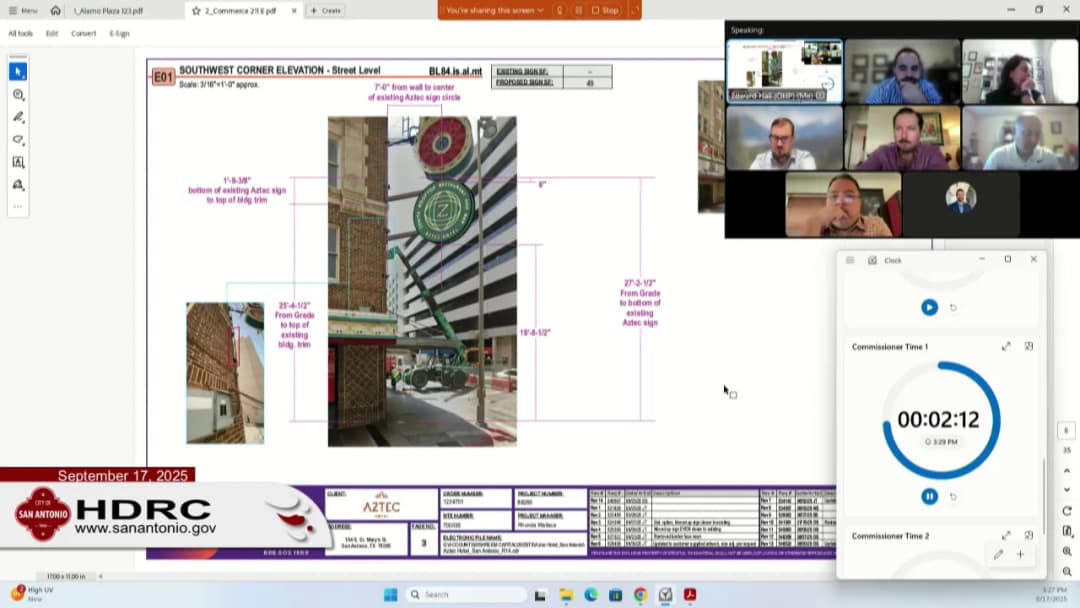
The Historic and Design Review Commission (HDRC) met on September 17, 2025, with Chairman J. Maurice Gibbs presiding and a quorum present. The meeting included approval of prior minutes, a consent agenda, public comments, and discussion of six items, including three digital billboard proposals that were referred to the Development Review Committee (DRC). Consent Calendar - Items 3 (430 East Commerce) and 7 (103 West Magnolia) were approved unanimously with staff stipulations. Items 1, 2, 4, 5, and 6 were pulled for discussion. Public Comments & Testimony - Patty Zion (representing the Conservation Society of San Antonio) opposed items 4, 5, and 6, arguing that the proposed digital billboards violate the sign code (Chapter 28 of the UDC), the City Council-approved Digital Media and Arts pilot program (lack of permanent art element), and do not provide for removal at program end. She stated the billboards fail to align with existing architecture and detract from the downtown streetscape. - Kathleen Trinchard opposed digital billboards in historic downtown, citing a city survey where over 70% of respondents were negative, and expressing concerns about safety and compatibility with beautification efforts. - Patricia Cratchett (voicemail) urged disapproval of items 4–6, calling digital billboards trashy, unsafe distractions, harmful to migratory birds (San Antonio is a Bird City Texas), and noting that the art component would be minimal. - Susan (voicemail) urged rejection of items 4–6, arguing they violate Rio 3 guidelines for traditional design, damage historic fabric, and harm tourism, film industry, and bird migration. Discussion Items - Item 1 – 123 Alamo Plaza: Proposed signage for a business logo. Commissioner Velasquez initiated discussion, arguing the sign was too large and intruded into architectural details. The applicant (Gregory Kitt, Apex Sign Group) noted it is the company's logo and had been reduced from larger options through DRC review. Staff clarified the sign met guidelines at 50 sq. ft. The commission voted to approve as presented (10-0). - Item 2 – (Aztec Theatre building) Rooftop Restaurant Sign: Commissioner Velasquez raised concerns that the proposed sign (southwest corner) tried to mimic the historic Aztec marquee. Commissioners Group, Fetzer, Cervantes, and others agreed it should be lowered, centered on the second story brick band, and reduced in size to avoid mimicking the Aztec sign. The applicant (Rhonda Wallace) agreed to modifications. Motion to approve with staff stipulations and an added stipulation to lower, center, and reduce the sign passed (10-0). - Item 4 – 101 Bowie Street (Digital Billboard): Commissioner Velasquez pulled for discussion due to the sign cantilevering above the parapet with no relation to building details. The applicant (Yumna, Orange Barrel) explained they aligned the bottom with a belt course and noted visibility constraints from trees. Discussion ensued about structural supports, branding, and pilot program rules. Commissioner Group moved to refer to DRC for further discussion on size, proportion, and site visibility. Motion passed unanimously. - Item 5 – 506 South St. Mary’s (Digital Billboard): Commissioner Fetzer questioned the curved sign on a cubic building and location confusion. The applicant (Ashley Fairmon) confirmed the southwest corner location and supported DRC referral. Commissioner Group moved to refer to DRC. Motion passed unanimously. - Item 6 – 105 Auditorium Circle (Digital Billboard): Commissioner Velasquez expressed concern about the impact on the historic Municipal Auditorium and surrounding sacred space. Debate occurred about whether the property (a historic landmark) prohibited the sign under the ordinance (Section 12: no display on historic designated structures). Commissioner Group moved to refer to DRC for detailed discussion on architectural impact and visibility. Motion passed unanimously. Commissioners also debated the commission's purview regarding the city council-approved ordinance. Key Outcomes - Items 1 and 2: Approved with stipulations (votes 10-0). - Items 4, 5, and 6: Each referred to the Development Review Committee (DRC) for further deliberation on architectural appropriateness, placement, size, and visibility. - Meeting adjourned after the final case.
The City Council convened a budget work session at 2:03 p.m. on Wednesday, September 17, 2025, to discuss potential amendments to the FY26 proposed budget. The budget director presented six general fund amendments totaling approximately $11.5 million over two years, with revenue enhancements including an increase to the parks environmental fee and a maximum food/beverage fee increase. Council members debated priorities, including across-the-board employee raises, additional police officers, delegate agency funding, and infrastructure investments. Discussion Items - Employee Compensation: Proposed amendments included a $750 base salary increase and 2% across-the-board cost of living adjustment for all city employees. Mayor suggested capping the pay increase to those earning under $100,000 to save $1.4 million, affecting 760 employees (9% of workforce). Councilmember Via Gran and others opposed the cap, advocating for equitable treatment. The final consensus supported the full across-the-board increase. - Public Safety: An amendment funded 15 additional patrol officers (total 40) at $3.1 million over two years. Councilmember White and Spears pushed for 65 officers, citing a staffing study and the city's 60/40 proactive time goal. Councilmember Corr and others questioned the number, suggesting a policy discussion on officer deployment. The city manager noted the proposed budget already included $2 million in overtime reductions. No final decision on the officer count was made; the issue was deferred for further conversation. - Infrastructure and Programs: Restored funding of $500,000 for radar feedback and flashing stop signs, $1 million for minor home repairs, and $3 million in one-time funding for street lights. A position for the vacant buildings program was added to Development Services, funded by increased fees (residential fee from $250 to $400; commercial from $750 to $900). Councilmember Castellon Ghiano expressed concern about diverting funds from the SA Forward violent crime reduction plan. - Delegate Agencies: Discussion centered on funding for agencies such as Big Mama Safe House ($144,000 new funding), For Her ($91,000), Rape Crisis Center ($56,000), and American Gateways ($50,000). City Manager clarified that most would be discretionary funding, with some considered core services. Councilmembers expressed support, though some urged prioritizing core city services. - Alamo Promise: The amendment proposed moving Alamo Promise funding ($3 million) to the Ready to Work program in FY26, with data reporting requirements. Alamo Colleges representative Priscilla Camacho noted that job placement data is not available at scale but offered transfer data. Council supported the shift with adjustments to reporting timelines. - Revenue Enhancements: To fund amendments, the city proposed increasing the parks environmental fee from $1.50 to $2.00 per month (generating $4 million/year) and raising food/beverage permit fees to the state maximum of 20% of gross sales (raising $433,000). Mayor directed the $433,000 to Metro Health for mental health support, TB control, and language access. Councilmember Corr suggested a smaller fee increase ($0.25), but the broader fee increase remained. Councilmember Castillo requested outreach to small businesses before finalizing. Key Outcomes - Employee Compensation: Maintained the $750 base increase and 2% across-the-board raise for all city employees (no cap). - Police Officers: The proposed 15 additional officers were left for further policy discussion; no vote was taken on the number. - Vacant Buildings Program Funded: A senior code officer position added to Development Services, funded by increased vacant building registration fees. - Delegate Agencies Funded: For Her and Rape Crisis Center funded via 8-month contracts from reserve; American Gateways ($50,000) and Big Mama Safe House ($144,000) funded as new, discretionary items. - Alamo Promise: Moved to Ready to Work funding with semi-annual data reporting on demographics, graduation rates, and transfer data (job placement data to be included when available from the state). - Revenue Increases: Parks environmental fee increased by $0.50/month; food/beverage permit fees raised to state maximum, with $433,000 allocated to Metro Health for mental health and TB services. - Infrastructure: Radar signs, flashing stop signs, minor repairs, street lights, and book festival restoration (via Visit SA partnership) were included. - Next Steps: Staff will prepare a revised budget amendment memo incorporating discussed adjustments for adoption on September 18, 2025.
The San Antonio City Council met on September 17, 2025, from 2:03 PM to 4:03 PM for a budget work session to discuss proposed amendments to the fiscal year 2026 budget. City staff presented six amendments including base salary increases, additional police officers, traffic signal and radar funding, and revenue enhancements such as an environmental fee increase. Council members debated priorities among employee compensation, public safety staffing, affordable housing, support for delegate agencies, and health programs. The session concluded with the city manager summarizing adjustments based on council input, with a final budget vote scheduled for the following day. Discussion: Salary and Compensation - Council reviewed a proposed 2% salary increase with a $550 base pay raise, later adjusted to $750 for employees funded by restricted funds. The mayor suggested restricting the 2% increase to employees earning $100,000 or less, affecting 760 employees and saving $1.4 million. Councilmember Villagran strongly opposed this restriction, arguing that employees who have not received raises in over a decade deserve the full increase. Councilmember Galván supported the $750 increase for all employees to help them keep up with inflation. Discussion: Police Staffing - The proposed budget includes adding 15 new patrol officers (bringing total new officers to 40) at a cost of $3.4 million over three years, short of the previous goal of 65 officers. Councilmember White expressed disappointment, citing a UTSA study that recommended more patrol time to deter crime. Councilmember Cor suggested reviewing the strategic goal for patrol officers through the public safety committee. Councilmember Castillo supported adding officers but wanted a broader discussion on which units best address policy goals. Councilmember Alderete Gavito pushed for more officers, noting community demand for visible police presence. Mayor Jones and others noted that some officers are currently funded through overtime, and that reducing overtime could help pay for additional hires. The city manager confirmed that the 40-officer target was a council goal and that the final decision would require further conversation. Discussion: Traffic Signals and Radar - The budget restores $500 million (as stated in the transcript; likely a transcription error for $500,000) for installing traffic signals and new radar. Councilmember Cor requested that the radar funding be considered separately due to its importance for traffic safety. Discussion: Environmental Fee Increase - A proposed $0.50 increase in the environmental fee would generate $4 million annually. Councilmember Cor recommended a $0.25 increase instead to reduce the burden on residents. Councilmember White opposed any fee increase, stating that residents already pay enough. Councilmember Mungía supported the full $0.50 increase over five years as a necessary revenue source. The issue was left for further deliberation. Discussion: Alamo Promise and Ready to Work - The budget includes funding for Alamo Promise using Ready to Work dollars, but council members expressed concerns about metrics. Priscila Camacho of Alamo Colleges explained that job placement data is unavailable from the Texas Workforce Commission and recommended focusing on graduation and transfer rates instead. Councilmember Cor emphasized the need to track outcomes separately. The city manager confirmed that Alamo Promise results would be reported separately from Ready to Work metrics. Discussion: Vacant Building Program - A $95,000 position for a dedicated code officer to enforce vacant building regulations was discussed. Councilmember Castillo Anguiano supported the program, noting that vacant lots and buildings are linked to criminal activity in her district. Councilmember Alderete Gavito also supported the program. The fee for vacant residential properties was proposed at $250 but could be increased to $400 to fund the position. Discussion: Delegate Agencies - Several council members advocated for funding specific delegate agencies: Big Mama Safe House ($144,000 new), American Gateways ($50,000 additional), the Crisis Center (funded through a separate process), and Safe House. Councilmember Villagran highlighted that these agencies serve critical needs such as domestic violence support and immigrant services. Councilmember White suggested that a 2.5% reduction across all delegate agency funding ($24 million total) could free up $600,000 for other priorities like police. Councilmember Castillo argued that these agencies reduce 911 calls and complement public safety. The city manager noted that only about $4.8 million (20%) of the total is discretionary; the rest is for core services like homelessness and health. Discussion: Metro Health and Mental Health - The mayor requested $433,000 for Metro Health to expand mental health services, tuberculosis control, and clinic hours (36,000 additional hours). Dr. Jacob confirmed that the funding could be used to address gaps. Councilmember Galván supported these health investments. Councilmember Mungía asked for background information on transferring some youth programs from Metro Health to the Department of Human Services for consistency. Discussion: Food and Beverage Fee - A 20% increase in the food and beverage business permit fee was debated. Dr. Jacob explained that due to state law changes, many businesses would actually see a reduction compared to previous dual-license fees. Councilmember Villagran expressed concern that additional increases could hurt small businesses already struggling with inflation. Councilmember Gallavan suggested the matter be reviewed by a committee in the future. Key Outcomes - The council did not take a final vote but directed the city manager to prepare a revised budget reflecting: - The 2% salary increase with a $750 base for all employees (no restriction to those under $100,000). - Inclusion of 40 new police officers (15 patrol) with a commitment to review the patrol officer goal in committee. - Restoration of $1 million for minor home repair programs. - $95,000 for a vacant building code officer, funded by increased vacant property fees. - Funding for Alamo Promise with separate reporting on student outcomes. - Continued funding for delegate agencies: Big Mama Safe House ($144,000), American Gateways ($50,000), and others as discussed. - $433,000 for Metro Health programs (mental health, tuberculosis, clinic hours). - The environmental fee increase left at $0.50 pending further discussion. - The traffic signal and radar funding retained as proposed. - The mayor noted that the final ordinance may require adjustments. The budget is set for approval at the next meeting on September 18, 2025.
The San Antonio Historic Review and Design Commission (HDRC) met on Wednesday, September 17, 2025, at 3:00 PM to consider certificates of appropriateness for signage and digital billboard proposals. The meeting included public comments, approval of minutes, and decisions on several agenda items, with a focus on the appropriateness of digital signs in historic districts. Consent Calendar - Minutes from September 3, 2025: Approved unanimously (11-0). - Items 3 and 7: Approved as part of the consent calendar after items 1, 2, 4, 5, and 6 were pulled for discussion. The approved items were at 430 E Commerce and 103 West Magnolia; certificates of appropriateness will be prepared and emailed within 10 days. Public Comments & Testimony - Paris Simons (San Antonio Conservation Society): Spoke in opposition to items 4 (2025-225, 1.01 Louis Stream), 5 (106 South St. Mary's), and 6 (105 Auditorium Circle). Argued that the proposed digital signs are not aligned with architectural guidelines, violate Article 205 regarding removal provisions, and lack a permanent element for the pilot program's end. Also noted that the council's pilot program does not contain provisions for removal after the pilot ends. - Kathleen Churchard: Opposed digital signage near historic centers. Cited a city survey where 70% of respondents were negative. Stated that a council member also opposes the proposal. Expressed concerns that digital signs conflict with efforts to attract residents downtown and with tree preservation. Called the proposal a "Trojan horse" for bypassing the UDC (Unified Development Code). - Patricia Paches (voicemail): Strongly opposed digital signs, arguing they add more screens to public life, harm migratory birds, and contradict efforts to protect the natural corridor and promote art. Urged the commission to reject the project. - Susan D. (voicemail, address 007 Riverson): Opposed items 4, 5, and 6, stating that replacing historic protected areas with digital signs would cause "miserable damage" to the downtown environment and residents. Asked the commission to vote against these items. Discussion Items Item 1: Alamo Plaza Sign (430 E Commerce) - Commissioner Velázquez raised concerns about the sign's proportion and placement on the facade, noting it appeared too large and intruded into window areas. He suggested the sign should be aligned lower on the building. - Staff clarified that the sign is 50 square feet, the maximum allowed by code, and that the design was reduced from larger proposals through previous subcommittee meetings. The logo is the business's marketing design. - Commissioner Galloway supported approval as proposed, noting the commission is not to design but to review against guidelines. Commissioner Cervantes asked about alignment with the building's overhang; staff confirmed the sign is consistent with guidelines after revisions. - Motion: To approve the item as presented with staff stipulations. Vote: 11-0 in favor. The motion passed. Item 2: Aztec Theatre Rooftop Restaurant Sign - Commissioner Velázquez expressed concern that the proposed sign's location, just inches from the historic Aztec theatre sign, creates a false dialogue and challenges the architectural jewel. He suggested moving it further away, centering it, or reducing its size so it does not appear as part of the original sign. - Commissioner Fetzer agreed the sign should be lowered and centered between the awning and stone band, or made smaller to avoid connection with the Aztec sign. - Commissioner Cervantes suggested moving it near the corner at a 45-degree angle to separate it from the main sign. - Commissioner Galloway supported a lower placement centered on the second story windows. - Motion: To approve with staff stipulations and additional requirements: move the sign lower and center it between the brick of the second floor, and reduce its size so it does not visually attach to the Aztec sign. Vote: 11-0 in favor. The motion passed. Items 4, 5, and 6: Digital Signage Pilot Program Proposals - All three items were pulled from consent for discussion. The applicants (Anna Behrman and architect) presented for item 4 (1.01 Louis Stream sign on Buena Vista Street). They chose the location for visibility from the highway while avoiding the Riverwalk. The sign would be mounted above the parapet with a steel frame. They are open to refinements, including a thinner frame and a rear mural for hotel guests. The company name on the sign is for contact purposes during weather events. - Staff (Parish, from Engineering) explained the pilot program, approved by City Council in July 2025. The program allows up to three digital signs per district (eight districts total), with a maximum of 25% of facade area. These three applications are among the first. The commission's role is to recommend appropriateness; final permits will be issued later. The program does not require removal of signs after the pilot ends, but triggers under code could lead to removal. The digital media ordinance (Chapter 28) governs content and lighting; lumens limits are in place. - Commissioners raised concerns about the scale, alignment, and impact on historic buildings. Commissioner Velázquez noted that the Auditorium Circle area is a sacred space with rich architecture, and the digital signs represent a cultural shift. He argued that even if the building is not historic, the context matters. Commissioner Grook questioned the program's distribution and whether signs could be concentrated in one district. Commissioner Cervantes supported referring to the Design Review Committee (DRC) for deeper discussion of appropriateness. - Commissioner Fetzer noted that the sign on item 4 (Buena Vista) does not align with building elements and appears as an add-on. He moved to refer item 4 to DRC. The motion passed (11-0). - For item 5 (106 South St. Mary's), similar concerns were raised about the rectilinear sign on a cubic building and its relationship to surrounding historic structures. Commissioner Fetzer moved to refer to DRC; the motion passed (11-0). - For item 6 (105 Auditorium Circle), the sign is proposed on a non-contributing addition to a historic monument. Commissioner Velázquez emphasized the need for a thoughtful design that respects the site's sacred nature and does not just replicate Times Square. He supported DRC referral to explore artistic integration. Commissioner Sabino noted that the building is a historic monument, and the addition is non-contributing but still within the historic district. The motion to refer to DRC passed (11-0). Key Outcomes - Minutes approved (11-0). - Items 3 and 7 approved on consent (11-0). - Item 1 (Alamo Plaza sign) approved with staff stipulations (11-0). - Item 2 (Aztec Theatre sign) approved with additional stipulations: move lower, center between second floor brick, reduce size to avoid visual connection with historic sign (11-0). - Items 4, 5, and 6 (digital signage pilot program) each referred to the Design Review Committee (DRC) for further discussion on appropriateness, design, alignment with building elements, and impact on historic districts (all 11-0). The DRC will consider site plans, visibility, and potential artistic integration. The meeting adjourned after all agenda items were addressed.
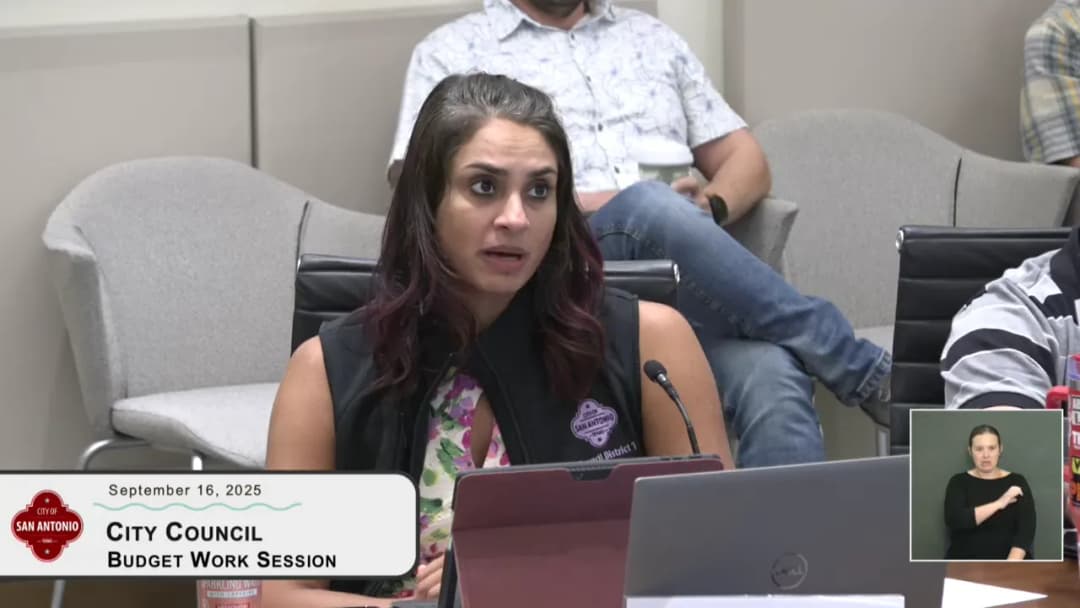
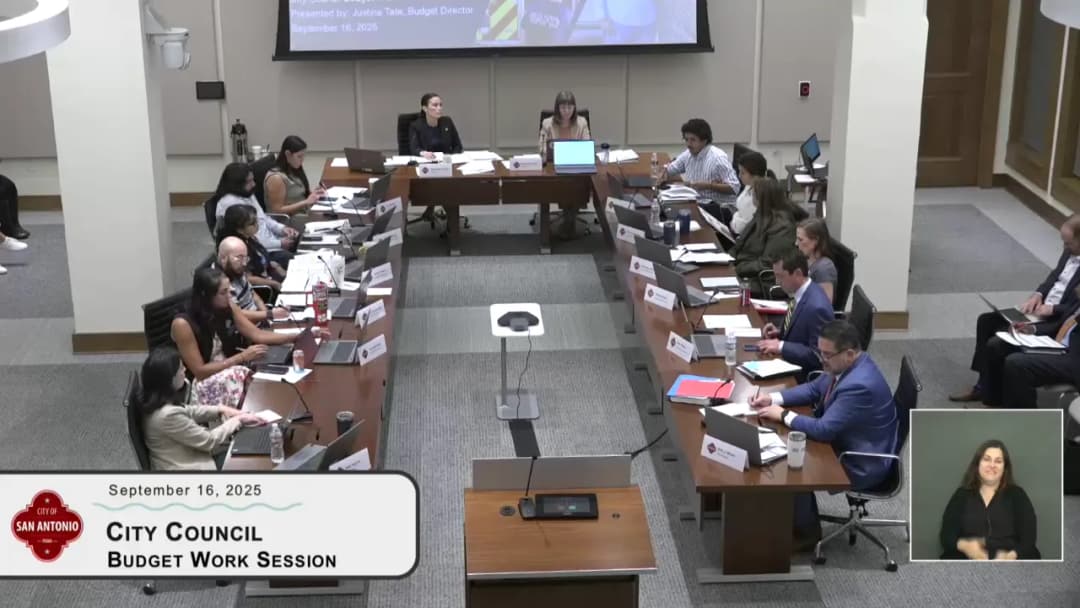
The City of San Antonio held a budget work session on Tuesday, September 16, 2025, at 2:02 PM, to deliberate on potential amendments to the Fiscal Year 2026 proposed budget. The meeting focused on a list of amendments presented by Budget Director Justina Tate, including employee compensation increases, public safety investments, and adjustments to various programs. Councilmembers expressed their priorities, with significant debate around funding for 40 additional police officers versus other public safety and community service needs. No formal votes were taken; the discussion will inform a revised amendment memo to be prepared for the next work session. Discussion Items - Employee Compensation Increase (Amendment 1): Proposed adding $750 to base salary for city employees, equivalent to approximately 2% across-the-board increase. Most councilmembers expressed support, with discussion on possibly limiting the increase to those earning under $100,000. - Traffic Safety Signs (Amendment 2): Restore funding for 60 radar feedback signs and 70 flashing stop signs. Councilmember Corr prioritized this over officer hiring, citing neighborhood speeding concerns. - Police Officer Hiring (Amendment 3): Add 40 new patrol officers (from 25 proposed to 65 total). Councilmembers Spears and White strongly supported, noting a promise to citizens and Chief McManus's 60-40 patrol-to-staff ratio goal. Opponents (e.g., Councilmember Mungia, Councilman Castillo-Anguiano) argued for holistic public safety and noted 69 current vacancies in SAPD. Some suggested scaling to 10-15 officers instead. - Minor Repair Program (Amendment 4): Restore $1 million to increase the minor repair budget from $7M to $8M. Supported by many, with interest in prioritizing minor over major repairs. - SA Book Festival (Amendment 5): Add $50,000 to reach $247,725. Broad support. - Small Business Construction Grant (Amendment 6): Restore $1.4 million. Councilmembers Corr and Alderete-Gavito expressed concerns about program effectiveness and suggested pausing funding. - Vacant Building Program (Amendment 7): Restore one position in Office of Historic Preservation. Council supported with preference to move position to Development Services Department for broader enforcement. - Street Lights (Amendment 8): $3 million one-time from community safety reserves. Supported as addressing crime and illegal dumping, though some noted potential conflict with Phase III of the Violent Crime Reduction Plan. - Big Mama Safe House (Amendment 9): $144,000. Councilwoman Villa-Gran wanted more detail on usage; others supported as it aids police and public safety. - Delegate Agency Increases (Amendments 10-13): Proposed increases for American Gateway ($50,000), Family Violence Prevention Services ($125,000 and designated agency status), Alamo Area Rape Crisis (amount not specified). Debate over whether to wait for the competitive delegate agency review in October. Councilwoman Spears and White opposed cherry-picking; Councilman Mungia and Councilwoman Castillo supported honoring prior communications. - Mental Health & Language Access (Amendment 15): $500,000 for mental health, $150,000 for TB work, $10,000 for language access (corrected from earlier slide). Supported as addressing critical public health needs. - SA Kids Breathe (Amendment 16): Increase by $300,000 (50%) to $900,000. Supported. - TURS/Revenue Amendments: Proposed funding for Prosper West, pet deposit assistance, MLK Commemorative, and UT San Antonio feasibility study. Councilmembers generally agreed these should first go through the respective TURS boards for process consistency. - Reductions & Revenue Enhancements: Proposed elimination of $3M Inner City Incentive Fund (split over two years) and moving $1.9M Alamo Promise funding to Ready-to-Work. Revenue enhancement: increase Parks Environmental Fee by $0.50 (from $1.50 to $2) to generate $4M. Councilmember Galvan suggested exploring other fees (detention pond, stormwater). Some councilmembers opposed new fees on residents. - Alamo Promise Transition: Discussion on moving funding to Ready-to-Work stream, with concerns about additional paperwork for students. Director Mike offered streamlined forms; council requested even simpler process. - Future Fiscal Challenges: Staff highlighted an $8 million cliff in FY2027 due to expiring federal 1115 waiver, impacting Metro Health programs like Healthy Neighborhoods, Stand-Up SA, and diabetes prevention. Key Outcomes - The city manager and budget office will prepare an updated amendment memo incorporating feedback from the session, to be distributed by evening of September 16, with further follow-up the morning of September 17. - Several councilmembers requested additional data: cost breakdown for 10 officers vs. 40, analysis of the NOW Clinic usage by first responders, clarification on Big Mama Safe House budget, and vacancy/retention data for SAPD. - Consensus emerged to refer TURS-related amendments to the respective boards before council action. - The next budget work session will be held on September 17, 2025, to finalize amendments before the September 18 vote. - No final decisions were made; the session was informational and preparatory for the next meeting.
The San Antonio City Council held a budget work session on September 16, 2025, to discuss potential amendments to the proposed Fiscal Year 2026 budget. The overall proposed budget is $4 billion, including a $1.6 billion general fund. Staff presented a list of potential amendments, reductions, and revenue enhancements, while council members debated priorities including employee compensation, public safety, housing, and social services. No formal votes were taken; staff will refine the amendment list based on comments and continue discussions on September 17. Discussion Items - Employee Compensation: Staff proposed a $750 (2%) base salary increase. All speakers expressed support, emphasizing fair wages for municipal workers. - Police Hiring (Item 3): The proposal to increase new officer funding from 25 to 65 officers generated extensive debate. Supporters (Council members Spears, White, Alderete-Gavito, Mesa González, and others) argued it was a fulfillment of public safety promises and critical for a growing city. Opponents or cautious members (Council members Villagrán, Galván, Castillo, and the Mayor noted the high cost of recurring salaries, existing vacancies (69), and the need to balance with other services. Some suggested scaling back to 10–15 or 40 officers. Councilmember White strongly advocated for the full 65, citing police chief’s recommendation and UTSA study. - Program Restorations: Staff proposed restoring funding for major repairs (+$1M), the Book Festival, the small business fund, a vacant buildings program position, street lights ($3M), and various social service agencies. Council members generally supported these, with some questioning the vacant buildings role and expressing a desire to see efficiency. - Delegated Agencies (Items 10–13): Funding for American Gateway, Big Mama Safe House, family violence prevention, and a rape crisis center was proposed using the delegated agency reserve. Several council members (Villagrán, White, Alderete-Gavito) opposed bypassing the competitive process, calling for consistency. Others (Mesa González, Core) supported honoring prior commitments. Staff clarified that items 10,12,13 would reduce the pool for future competitive awards, while item 11 combined existing contracts. - TIRZ Amendments: Proposed funding for Prosper West, a pet deposit pilot, MLK commemoration, and a CSS study. Multiple council members (Villagrán, Core, Alderete-Gavito, Mesa González) insisted these should first go through the TIRZ committee for consistency. - Alamo Promise/Ready to Work: Debated whether to require Alamo Promise students to also complete Ready to Work forms. Most council members favored simplifying the process to avoid burdening students. Councilmember White and others supported keeping the requirement for tracking outcomes. - Revenue Enhancements: A proposed $0.50 increase to the park environmental fee (generating $4M) was widely supported as a way to free up general fund dollars. Some council members also discussed other fee options (e.g., development fees) and the need for long-term revenue. - Metro Health and Federal Funding: The Mayor and members noted upcoming federal funding cliffs (e.g., 1150 waiver expiring Sept 2026) that will create major challenges for FY27. They emphasized monitoring programs and exploring shared revenue opportunities. Key Outcomes - The work session concluded with no votes taken. Council members provided direction for staff to refine the amendment list. - Staff committed to providing updated materials on the evening of September 16 and the morning of September 17, with a follow-up work session scheduled for the afternoon of September 17. - Key areas of consensus: support for employee compensation, broad backing for some police expansion (exact number unresolved), and a preference for using TIRZ committees for related amendments. Significant disagreement remained on the extent of police hiring, funding for American Gateway, and using the delegated agency reserve for specific organizations.
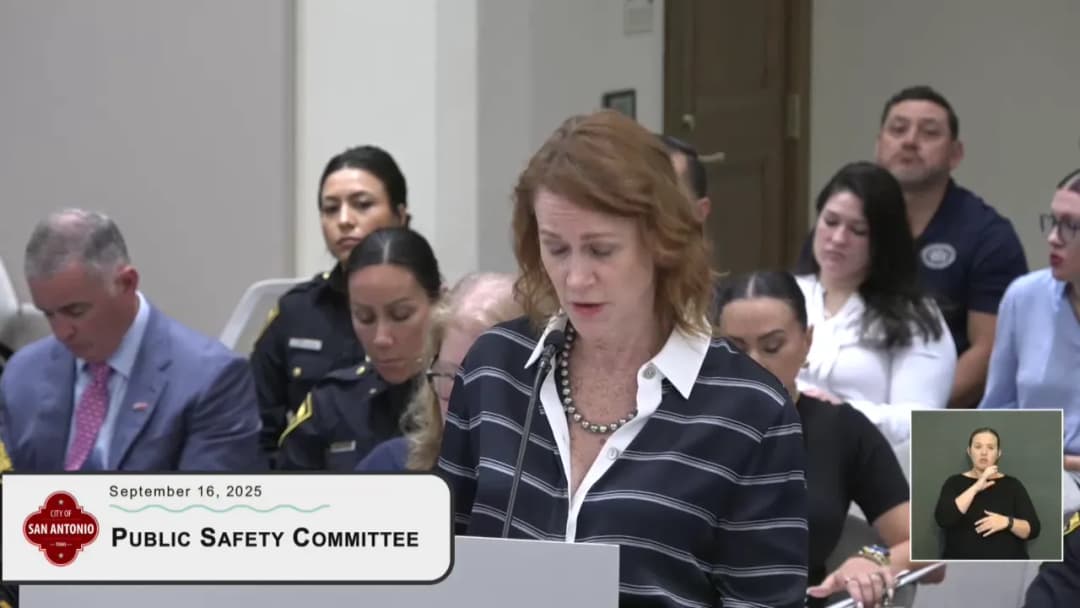
The San Antonio Public Safety Committee met on September 16, 2025, from 10:03 AM to 11:16 AM. The meeting focused on setting the committee's strategic priorities for the term, establishing two new subcommittees (Interpersonal Violence and Elder Abuse), and receiving detailed overviews of current city programs addressing domestic violence and elder abuse. The committee also approved the minutes from their prior meeting. Consent Calendar - The committee unanimously approved the minutes from the May 19, 2025, meeting. Public Comments & Testimony - One member of the public addressed the committee regarding the treatment of unhoused residents by the San Antonio Police Department (SAPD). The speaker alleged that officer training consists of simple computer modules rather than effective preparation, and that officers engage in harassment and intimidation during operations referred to as "human sweeps." The speaker also stated that complaints submitted to Internal Affairs have not resulted in any follow-up. Discussion Items - Committee Charge and Subcommittees: The Chair opened the meeting by reading the mayor's charge for the committee. The committee established an Interpersonal Violence Subcommittee (served by the Chair and Councilmember Castillo) and an Elder Abuse Subcommittee (served by Councilmember Castillo Angiano, Councilmember McKee Rodriguez, and Councilmember Spears). Members discussed priorities for the current term, including conducting a streetlight gap analysis, the upcoming fire department needs assessment, enhancing mental health resources for first responders, the Good Neighbor Program, placemaking and vacant lot activation to reduce violent crime, and Crime Prevention Through Environmental Design (CPTED). The committee agreed to bring refined subcommittee goals and focus areas back for the November meeting. - Domestic Violence Program Overview: Erica Haler Stevenson, Violence Prevention Administrator for Metro Health, presented the city's comprehensive approach to domestic violence. The presentation covered the involvement of over nine city departments and a shift from a law enforcement-driven response to a victim-centered public health approach. Key data highlighted included: nearly 10,000 people served annually through crisis advocacy and case management; SAPD requiring 24 hours of family violence training (double the state mandate); family violence homicides decreasing from a high of 30 in 2020 to 22 in 2024; and $1.3 million in Human Services delegate agency funding for six programs. Councilmembers discussed the need for recidivism tracking for offenders, qualitative survivor case studies, the correlation between youth violence and domestic violence, funding cuts to specific delegate agencies (Stand Up SA and Big Mama Safe House), and the complexity of deriving actionable policy from raw crime data. - Elder Abuse Program Overview: Melody Woosley, Director of Human Services, and Assistant Chief Justice Almay of SAPD presented current city efforts to address elder abuse. Key statistics included that only 1 in 24 cases of elder abuse is estimated to be reported, and 1 in 10 older adults in Bexar County are affected annually. Financial crimes and property theft are the most common offenses, with 387 theft cases year-to-date in 2025 nearly matching the total for 2024. Family members were identified as perpetrators in 47% of reported incidents. The city has certified over 6,900 employees in the APS "Don't Look Away" training and is the only major city police department in the nation with a trauma-informed care certification. Discussion included exploring an ordinance to regulate door-to-door solicitors (modeled after Benton, Texas), auto-enrolling seniors in Do Not Call registries, connecting family members with addiction issues to zero-cost resources, and expanding outreach to socially isolated seniors through resource fairs and town halls. Key Outcomes - Approved the minutes from the May 19, 2025, meeting without objection. - Established the Interpersonal Violence and Elder Abuse subcommittees with assigned members. - Scheduled presentations on street lighting and the fire department needs assessment for the October agenda. - Set a deadline for the November meeting to present specific goals and work plans for the two new subcommittees.
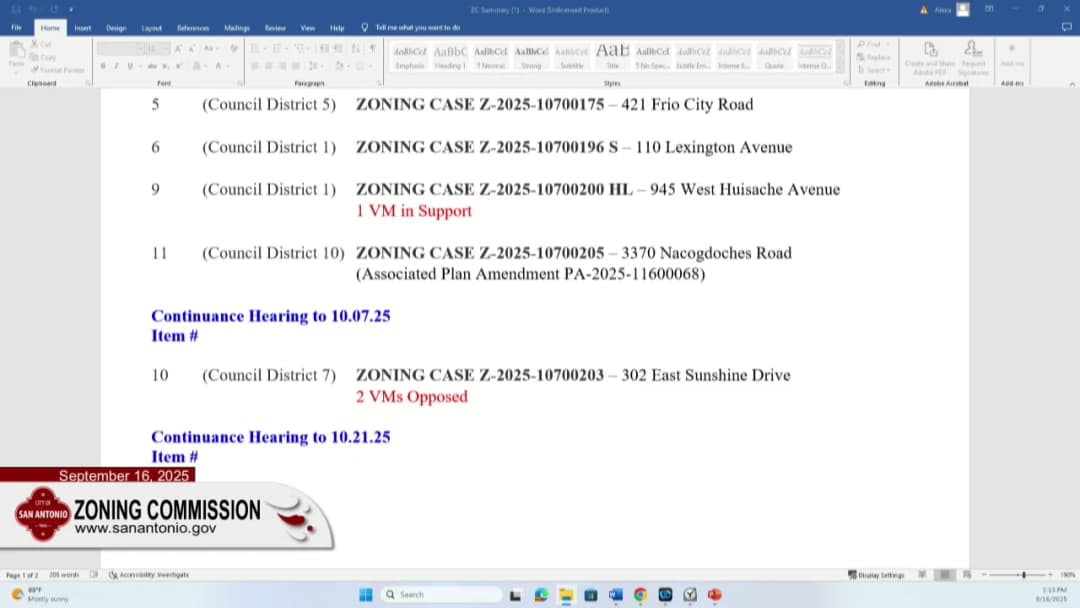
The San Antonio Zoning Commission met on September 16, 2025, at 1:00 PM, chaired by John Bustamante. The commission considered a consent docket, a continuance request, and two individual rezoning cases. Key actions included approval of an assisted living facility and a wireless communication tower with reduced setback, both over staff recommendations of denial. Consent Calendar - Items 3, 4 (as amended), 5, 6, 9, 11 – Approved unanimously. Item 4 was amended to remove 3851 Kuleba Road from the proposed changes. Notices: Item 3 (11 notices, 0 favor/oppose), Item 4 (152 notices, 0 favor/oppose, Kulibra Park Neighborhood Association in support), Item 5 (27 notices, 1 favor), Item 6 (27 notices, 0 favor/oppose, Beacon Hill Area Neighborhood Association in favor), Item 9 (no details provided), Item 11 (13 notices, 0 favor/oppose). A voicemail in support of a historic landmark designation (related to item 6) was received from the Beacon Hill Neighborhood Association. Continuance Hearing - Item 10 – Request to change zoning at 302 East Sunshine Drive (barbershop). Two voicemails opposed, citing traffic and neighborhood character concerns. Commissioner Sipes moved to continue to the October 7, 2025, Zoning Commission meeting; motion carried unanimously. Public Comments & Testimony - Consent items: One voicemail from Beacon Hill Neighborhood Association in support of historic landmark designation (item 6). - Continuance item 10: Two voicemails from residents (Janet Hernandez and O Sires Can 2) opposed to the commercial zoning change. - Item 12 (Purit Avenue tower): Paige Johnson, representing AT&T, spoke in support of the wireless tower application. Discussion Items - Item 2 (South Beal Street) – Applicant Charles Talbert requested rezoning from R5 to MF-25 for a 12-unit development at 1714 & 1730 South Beal Street. Proposed use: ground-floor assisted living (4 units) and upper-floor short-term rentals for medical professionals. Staff recommended denial, citing density incongruent with surrounding single-family homes. The property backs up to a park, which commissioners cited as a mitigating factor. The El Charo Neighborhood Association supported the request. After discussion, the commission voted 8-1 (Commissioner Kelly dissenting) to approve. - Item 12 (Purit Avenue) – Applicant Hubinger requested rezoning from R5 to RM5S with a Specific Use Authorization for a wireless communication tower and a reduced setback (196.5 feet instead of the required 200 feet from the nearest residential structure). The site is a triangular lot bordered by I-35 and commercial uses. Staff recommended denial due to the setback variance and potential commercial encroachment. The applicant amended the plan to slide the monopole 10 feet further back (from 166 to 196.5 feet) to comply with RM5 rear setbacks. The tower will serve multiple carriers and include FirstNet for first responders. No opposition was recorded from Collins Gardens Neighborhood Association. The commission approved unanimously as amended. Key Outcomes - Consent items 3, 4 (as amended), 5, 6, 9, 11 – Approved; forwarded to City Council. - Item 10 – Continued to October 7, 2025 Zoning Commission meeting. - Item 2 – Approved (8-1); forwarded to City Council. - Item 12 – Approved as amended (unanimous); forwarded to City Council. - Minutes – Approved by acclamation. - Announcement: Vice chair election to be held at the next meeting (October 7).