Browse by city
Date range
Search help

Search titles, summaries, topics and stored transcripts together. Keywords may match separately; put the whole query in double quotes for a phrase. Matching follows word analysis, so punctuation is not exact. Both dates are included. Documents are not searched.

SHOWING 681–690 ENTRIES
681
SEP 2, 2025 · SAN ANTONIO, TEXAS · CITY COUNCIL
San Antonio City Council Budget Work Session – Airport and Development Services – September 2, 2025

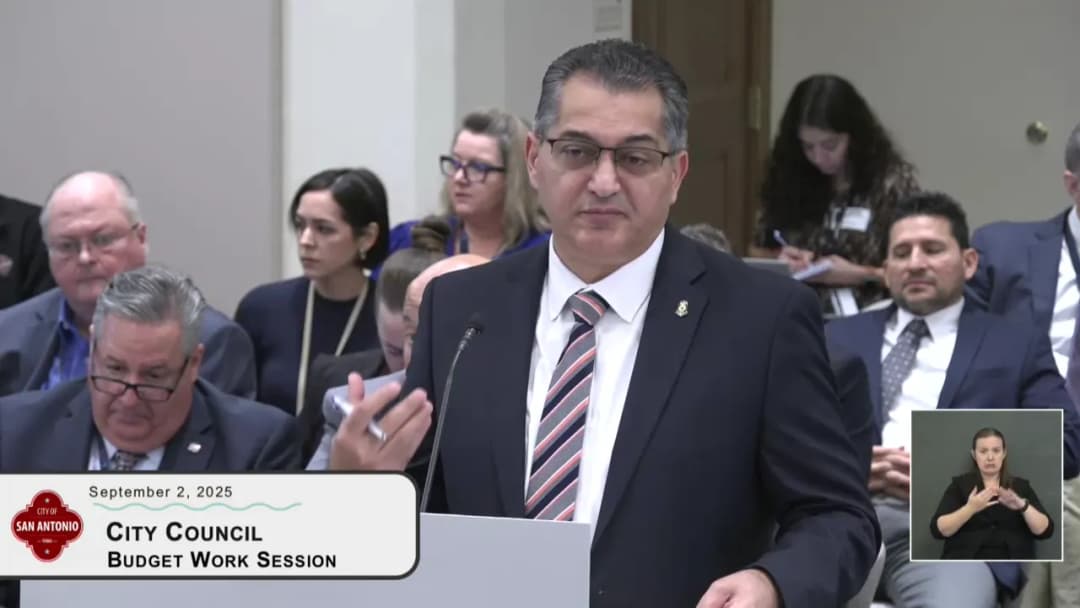
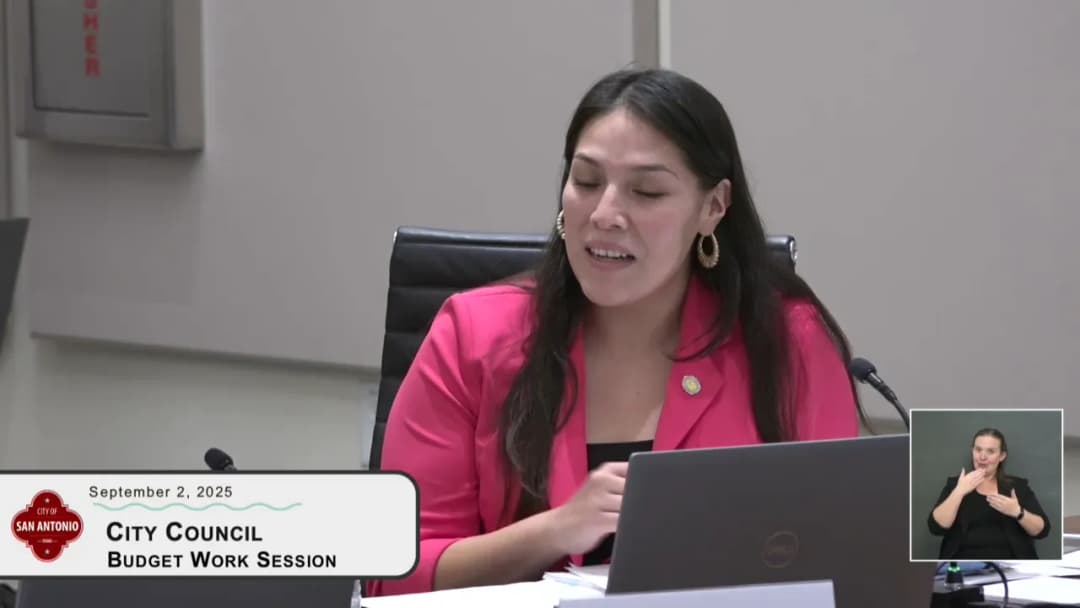
The San Antonio City Council convened a budget work session on Tuesday, September 2, 2025, at 9 a.m. to hear presentations on the proposed Fiscal Year 2026 budgets for the Airport and Development Services departments. The meeting included detailed overviews of departmental operations, financials, capital projects, and program updates. Council members posed questions, expressed support for various initiatives, and proposed potential amendments to the budget. The meeting recessed into executive session at 11:30 a.m. and reconvened briefly in open session at 12:38 p.m., with no official action taken, before adjourning at 12:39 p.m. Airport (San Antonio International Airport & Stinson Municipal Airport) Presentation - Presenter: Jesus Sines, Director of Airports. - Overview: The airport is an enterprise fund funded by tenant/passenger fees and federal grants. It serves 11 million passengers annually, supporting 55,000 jobs with a $7 billion economic impact. - Proposed FY26 Budget: Operating & Maintenance (O&M) proposed at $169.4 million (4% growth from $163.9 million adopted in FY25). O&M expense up 2% to $107 million. Over $30 million will be transferred to the Capital Improvement Fund. No position increases are requested. - Capital Projects: $648 million in capital spending, including the Terminal Development Program (new terminal with 18 gates, 900,000 sq ft, 40,000 sq ft concessions, new FIS customs facility). Construction is on scope, schedule, and budget; 600+ pylons installed; guaranteed maximum price targeted at 90% design. Other projects: Terminal A gate expansion (completing Dec 2025), new public safety building (opening Oct 2025), ground transportation center (adding 2,000+ parking spaces, completion 2027), and reconfiguration of Terminals A & B. - Air Service: 48 nonstop destinations; 11 new destinations added since 2022 (4 in Mexico); 1.7 million passenger increase since 2022. Airfare gap with Austin narrowed to $0.11. Five new nonstop destinations added in 2025. 36-month strategy exceeded projections by 1.6 million passengers. - Concessions: Three new packages approved; local brands like 2M BBQ, Panda Express, Popeyes, Southerleigh coming to terminals in 2025-2026. - Parking: Frictionless parking launched (world first); real-time shuttle tracking; 3-hour parking and short-term garage with preferred reserve launching in 2026. - Grants: $272 million awarded since 2020; $65.5 million awarded in 2025 to date; targeting $86.3 million in 2026. - Safety: FAA inspections with zero discrepancies three years in a row; first airport to implement Runway Improvement Protection through Situational Awareness. - Customer Service: Satisfaction target 4.2 (current 4.18); 90%+ efficiency in TSA and Customs processing. - Stinson Airport: New master plan completed; focus on EVTOL (electric vertical takeoff/landing), distribution, manufacturing. Projects include runway overlay, drainage, taxi lane. Development Services (DSD) Presentation - Presenter: Amin Tomas, Director of Development Services. - Mission: Partnering with community to build and maintain a safer San Antonio. - Accreditations: ISO rating of 1 for commercial, 2 for residential (highest in Texas); International Accreditation Services (first in Texas for code enforcement, zero corrective actions in 2024). - Proposed FY26 Budget: Total $69.3 million ($18.5 million general fund for code enforcement, $48.8 million enterprise fund for development). 7% reduction from prior year; 42 positions frozen (33 currently vacant) to control expenses. - Permit Activity: Commercial permits stabilizing; residential permits declined since 2023 due to interest rates. FY26 forecast small dip. Average processing times: commercial 29 days (209 days total including customer time), residential 15 days. - Plan Review: Completed 3,700+ residential and 2,200+ commercial permits year-to-date; 18,700 walk-ins; 167,000 customer interactions. - Building Inspections: 210,000 inspections; 99% completed within scheduled time. - Land Development: 147 major plats, 267 minor plats, 491 zoning verification letters. - Code Enforcement (General Fund): 90% compliance rate within 45 days (target exceeded); proactive rate 76% (target 65%); 62,598 graffiti abatements year-to-date. - Fee Increases Proposed: Junkyard license (first update since 2012) to $1,000/year; donation containers to $240 (last updated 2009); dangerous/vacant lot abatement admin fee to $250 (last updated 2010); absentee property owner permit to $500 (last updated 2013). Estimated $200,000 revenue increase. - Programs: - Short-Term Rentals: 3,278 permitted units; dedicated code officer conducted 1,400 investigations, 448 violations, 82% compliance. Top violations: operating without permit or delinquent hotel occupancy tax. - Residential Street Lights: Since 2022, $8.8 million allocated; 927 lights installed, 107 pending; 3,241 lights still needed (estimated $27.8-$32.4 million). Proposed $2 million for FY26 (approx. 200 solar lights at $8,500-$10,000 each). Program now uses solar lights avoiding need for right-of-way easements. - Proactive Apartment Inspection Program: Since 2023, 61,000 inspections of 2,031 complexes; 49 (2.4%) had violations requiring program enrollment; 24 graduated, 25 actively working on corrections. Annual cost $100,000. - Senior Assistance Pilot Program: For elderly/disabled with fixed income; $100,000 citywide first-come-first-served; 57 households completed (avg cost $1,700). Funds nearly exhausted. - Code Enforcement Strategic Plan: Consultant hired; community listening sessions held in all districts; final report expected in 1-2 weeks; presentation to PCDC in October, then B session December, A session January 2026. Discussion Items - Council Member Comments & Questions: - Councilwoman Mungia asked about senior assistance program costs and proposed partnership with Solid Waste for mulch. Supported street light funding increase and inquired about permit timeline comparisons (San Antonio 209 days vs. San Diego 176 days). - Councilwoman Alderete commended airport achievements and DSD fee increases. Supported proactive apartment inspection and senior assistance program. Asked about FIS fee (increase to $12.50). - Councilwoman Corr noted airport resiliency and requested $3 million from the Community Safety Fund (UTSA crime plan) to add to street light budget. Asked about customer satisfaction decrease (4.25 to 4.18) and suggested prioritizing street lights near schools and bus stops. Asked for data on code enforcement case closure accuracy. - Councilwoman Castillo supported fee increases for dangerous premises and absentee owners, suggested exploring higher increase for metal recycling licenses. Asked about tree mitigation fund replenishment and requested infographics on permitting process. Appreciated accessibility efforts at airport (sensory rooms, sunflower program). - Councilman White expressed concern about code enforcement cases marked closed but unresolved; discussed permit processing frustrations from developers and requested review of fees and timelines. Asked about commercial permit decline. - Councilwoman Meza Gonzalez asked for history of non-airline revenue and requested info on jobs from terminal development. Supported street light funding increase. Asked about short-term rental compliance and state law changes. - Councilman Viegran praised Stinson airport's historic and economic role. Encouraged local branding and merchandise at airport concessions. Asked about code enforcement performance metrics and requested more staff for DSD. Suggested regulating home-based businesses (renting pools, parking for events). - Councilwoman Galvan asked about DSD connecting seniors to other assistance programs, supported street light funding, inquired about cluster mailboxes and code enforcement communication improvements. - Councilwoman Castillo Angiano requested breakdown of DBE participation in airport contracts and asked about impact of 42 frozen positions on service delivery. Requested equity impact analysis. - Councilwoman Spears echoed developer frustrations on permitting times (209 days commercial). Asked about coordination with utilities to avoid construction delays. Expressed concern over stormwater management and floods. Requested follow-up on code enforcement strategic plan in her district. - Councilwoman Mesa Gonzalez asked about hotel occupancy tax from short-term rentals ($9.1 million projected). Asked about number of District 8 apartments in proactive inspection program. Noted zero seniors from her district using senior assistance program and requested better communication. - Mayor Jones asked about federal grant reimbursement status (no funds lost), JSX air service updates (under NDA), ride-share fee ($2.50 each way staying on airport property), and Stinson development. Questioned DSD's ability to handle increased demand after state law changes. Requested comparison of fees with other cities and cautioned against disproportionate impact on small businesses. Key Outcomes - No formal votes were taken; the work session was informational in preparation for budget adoption. - Council members expressed support for several proposed amendments to be considered in the budget process: - Additional $3 million for residential street lights from the Community Safety Fund (proposed by Councilwoman Corr, supported by several members). - Increased funding for the Senior Assistance Program and exploration of long-term solutions (e.g., mulching partnerships). - Higher fee increases for metal recycling/auto parts licenses and vacant/absentee properties (supported by Councilwoman Castillo and others). - Review of permitting processes to reduce delays and costs for developers (raised by Councilman White and Councilwoman Spears). - Continued focus on DBE participation and accessibility at the airport. - Directives: - Airport staff to provide historical non-airline revenue data, DBE reports, and updated info on federal grants. - DSD to provide breakdown of frozen positions, service impact analysis, and comparative fee data with other cities. - Code Enforcement strategic plan to be presented to PCDC in October. - Next Steps: Budget will be further discussed in upcoming sessions; council may propose formal amendments before final adoption.
PUBLIC SAFETY 20% · AIRPORT INFRASTRUCTURE 17% · DEVELOPMENT SERVICES 10% · BUDGET 9%
682
SEP 2, 2025 · SAN ANTONIO, TEXAS · CITY COUNCIL
San Antonio Budget Work Session on Convention, Arts & Culture, and Tourism – September 2, 2025

The City of San Antonio held a budget work session on September 2, 2025, from 2:00 p.m. to 4:25 p.m. to discuss proposed fiscal year 2026 budgets for the Convention and Sports Facilities Department, Department of Arts and Culture, and Visit San Antonio, funded primarily by the Hotel Occupancy Tax (HOT). Presentations covered revenue trends, economic impacts, competitive challenges, and proposed investments. Hotel Occupancy Tax Overview (by Justina Tate) - Current HOT rate is 16.75%, with the city receiving 9%. Collections recovered by fiscal year 2023 at 99.7% of pre-pandemic levels. Fiscal year 2025 is projected to see a 6.4% increase over 2024, driven by short-term rental compliance. Fiscal year 2026 projects a 2.8% increase. Convention and Sports Facilities (by Patricia Musquis Cantor) - Facilities include the Henry B. Gonzalez Convention Center (1.6 million square feet, 260 events/year, $364 million direct spending in 2024), Alamo Dome (65,000 seats, 120 event days/year, 1 million attendance), and Carver Community Cultural Center. - Convention center occupancy is 73–74%, above practical maximum capacity; Alamo Dome has only 49 open dates to sell in fiscal year 2025, indicating capacity. - Expenses have increased $8.5 million at the convention center and $8.7 million at the Alamo Dome since fiscal year 2019 due to salaries, maintenance, and utilities. Alamo Dome made its first profit in over two decades in fiscal year 2023 ($21 million revenue vs. $19.7 million expenses). Fiscal year 2026 estimated HOT transfer of $11.5 million. - Proposed total budget is $91.9 million, including $59.2 million for operations, $2.9 million for hosting obligations, and $23.3 million in capital projects. Capital projects include $8.3 million for elevator/escalator replacement, $3.9 million for HVAC renovations, $2.1 million for West Building Park Entrance Remodel, $1.5 million for fire panel replacement, and $700,000 for upgrades to the Lila Cockrell Theater. - Revenue enhancements: 3% increase in facility rental fees (estimated $39,000), facility access fee increase from $1–2 to $3–5 per ticket, and $278,000 in efficiency savings from zero-based budgeting. - Urgency: Competing Texas cities (Dallas, Austin, Houston) are investing billions in convention center transformations. The booking window requires an expansion announcement soon to capture 2030–2035 business. Alamo Dome no longer meets NCAA standards for Final Four. Department of Arts and Culture (by Crystal Jones) - Economic impact: $5.1 billion annually, creating over 20,000 direct jobs. Proposed fiscal year 2026 budget is $13.5 million from HOT plus $500,000 from the general fund (flat from fiscal year 2025). 65% goes directly to artists and nonprofits. - Grants: $6.2 million to 41 nonprofits for operational support; $874,000 to be allocated in fall 2025; $158,000 for 25 event grants; $495,000 for 54 artist grants ($7,500–$15,000 each). - Public art: 30th anniversary in 2026; 50 projects ongoing through 2028; 7 dedications planned in Districts 1, 3, 5, and 10; 8 pieces incorporating shade; 22 maintenance projects. - Cultural events: 26 department events with 35,000 attendees, 87 artists showcased. - Film and music: State film incentive ($300 billion over 10 years); local film incentive at 7.5% rebate. Planning to refresh local incentive and explore media production development zones. Make Music Day featured 40+ artists. - Artist development: Partnership with Artists Thrive (March 2026) and Artist Inc. Express (June 2026). Visit San Antonio (by Mario Bass) - Total visitation: 39 million in 2024 (nearly pre-pandemic levels). Regional domestic visitors make up 78% (29 million), meeting attendees 5.7 million, international 2.4 million (15% increase over 2023). - Economic impact: $21.5 billion in 2023 (record). Directly generated $1.4 billion by VSA efforts. Return on investment: $33 for every $1 spent ($42 million budget). - Group booking pace is strong for 2025–2029 but drops for 2030–2032 due to competitors' new convention centers. Potential group business of $900 million if expansion occurs. - Proposed fiscal year 2026 budget is essentially flat to fiscal year 2025. - Key performance indicators: forecasting to achieve or exceed all fiscal year 2025 KPIs except sales leads (still 98% above pre-pandemic averages). - Community: 912 members (80% non-hotel), 150,000 hospitality professionals (1 in 8 employees). San Antonio Hospitality Foundation raised $100,000 for scholarships. Council Discussion and Questions - Mayor Jones requested data supporting the "build it and they will come" assumption, specifically on group business decline from 7.1 million in 2019 to 5.7 million in 2024 (a 20% decrease), and a breakdown of capital project urgency and opportunity costs. - Councilwomen and councilmen discussed regional visitor trends (majority from Texas, 25% from Houston), need to market niche assets (boxing, conjunto, military, arts), improving riverwalk infrastructure and ADA accessibility, and enhancing small business engagement. - Councilwoman Villagran emphasized transportation connectivity, marketing the city's story, and prioritizing convention center expansion, land bridge, and arena. - Councilwoman Spears asked about reducing construction disruptions, Alamo Dome funding structure (MERP, SALOC loans), and data on HOT-funded arts by district. - Councilwoman Alvaradejo-Gavito requested comparison of HOT rates across cities and average spend per visitor type. - Councilman Castillo Anguiano asked about citywide occupancy rates and local hotel rentals by San Antonians. - Councilman Mesa Gonzalez requested a breakdown of hospitality workforce by geographic origin and commute methods, and clarification on VSA other revenue ($2.7 million from membership and riverwalk activation). - Councilman Mungia asked about PFZ financing for competitor convention centers and riverwalk investment concerns. - Several members praised arts programs, public art, and film incentives, and expressed support for continued investment. Key Outcomes - Council requested additional data and written responses on: capital project urgency/opportunity cost, HOT rates comparison, group business decline causes, economic impact of grantee programming, hotel occupancy breakeven rates, case studies for attracting high-end travelers, and breakdowns by district and visitor type. - Department of Arts and Culture will provide information on HOT-funded arts by district, public art locations, and ROI data. - Visit San Antonio will provide data on visitor spending by type, hotel employee geographic distribution, and marketing campaign details. - Proposed budgets remain under consideration; amendments may be brought forward in fall regarding film incentive refresh and riverwalk strategic planning. - No votes were taken during this work session.

TOURISM 45% · ARTS AND CULTURE 28% · BUDGET 7% · PUBLIC ENGAGEMENT 7%
683
SEP 2, 2025 · SAN ANTONIO, TEXAS · COUNCIL COMMITTEES
San Antonio Audit Committee Meeting - September 2, 2025

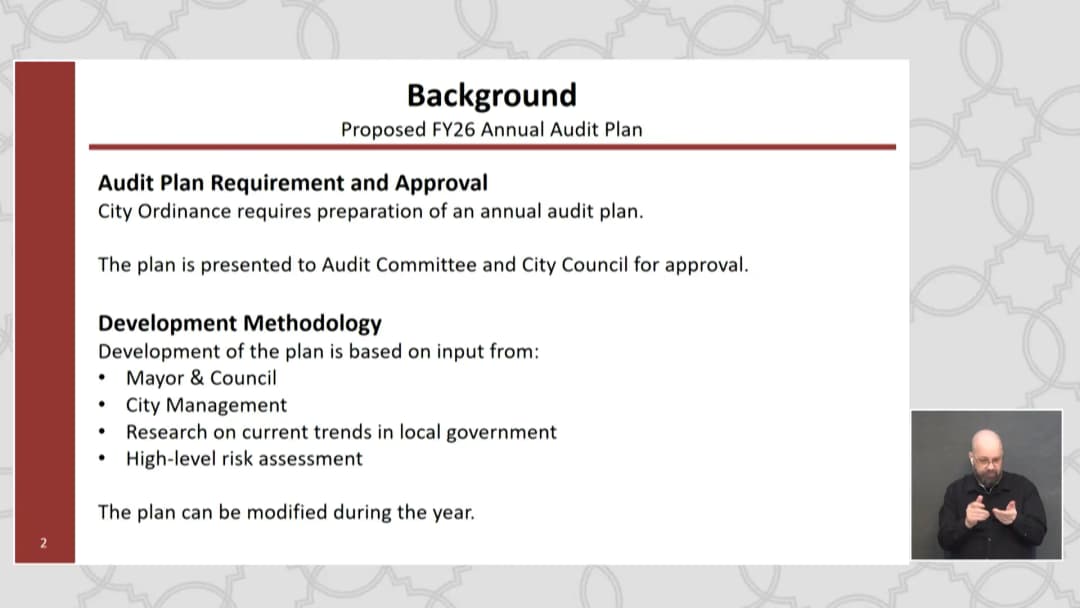
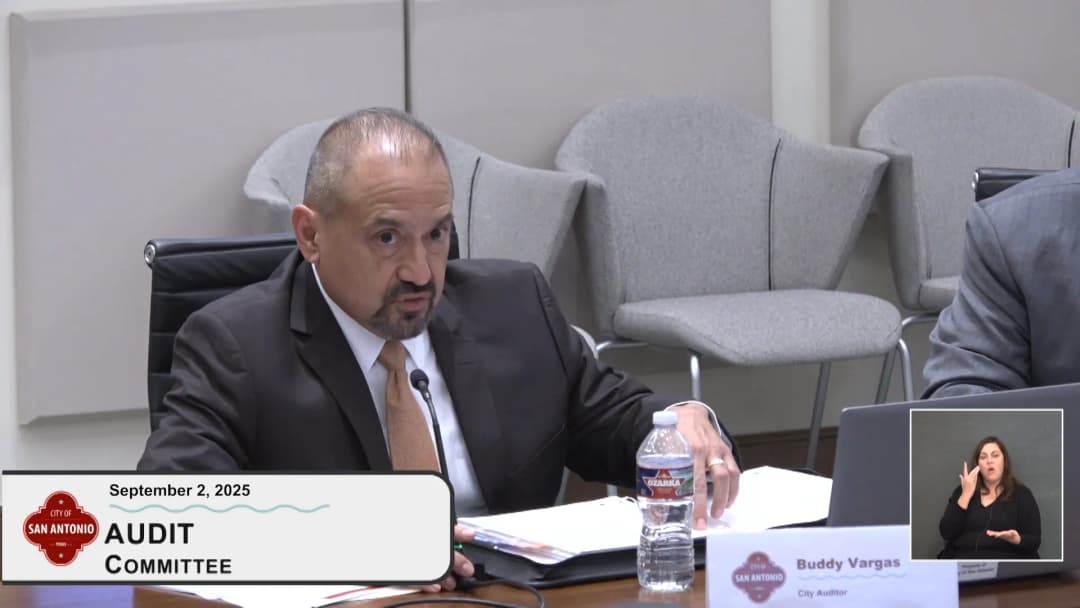
The Audit Committee of the City of San Antonio met on September 2, 2025, at 1:01 PM. The meeting was called to order with a quorum present. The committee approved the minutes from the previous meeting, addressed the consent agenda, and discussed two major audit items: the Greater SATX audit and the Finance P Card program audit. The committee also received a briefing on the proposed 2026 annual audit plan. Consent Calendar - The minutes of the previous meeting were approved unanimously. - Four final internal audit reports were on the consent agenda. Item 3 (Greater SATX audit) was pulled for discussion by a committee member. The remaining items were approved by voice vote. Public Comments & Testimony - No members of the public signed up to speak. Discussion Items Greater SATX Audit (Item 3) - A committee member expressed significant concerns about the audit's conclusion that the Economic Development Department's service agreement with Greater SATX is appropriately monitored. The audit noted that the department cannot sufficiently validate Greater SATX performance metrics because Greater SATX does not provide sufficient supporting documentation for validation. The committee member noted that many of the businesses counted as "wins" are non-incentive businesses with no documentation requirements, making it difficult to determine if the city is getting value for its funding. - The committee decided to move this item to the next audit committee meeting to allow Greater SATX to present, given their recent leadership change and to allow new committee members to be briefed. A motion to move the item to the next meeting passed by voice vote. Finance P Card Program Audit (Item 6) - Abigail Esteves, audit manager, presented the results. The objective was to determine if the P Card program was managed in accordance with policies and procedures. The audit found that finance had adequate controls for provisioning participants and ensuring accurate payments, but identified opportunities for improvement in policies, transaction monitoring, and card controls. - Key findings included: an outdated user guide; 45% of sampled transactions lacked required supporting documentation; 44% of transactions in unapproved transaction reports remained unapproved for three or more months; 1,644 potentially questionable transactions; hundreds of purchases exceeding $3,000 that should have been under contract; 123 cardholders with limits significantly above actual spending; and employees who had separated from the city still had active cards for an average of 99 days (seven cards still active, though no purchases were made on them). - Finance agreed with the recommendations and developed corrective action plans with a tentative completion date of June 2025. Finance Director Troy and Deputy Finance Director Ben addressed the committee, explaining that many issues were transitional due to a system conversion from Wells Fargo to Chase. They stated that all 1,644 potentially unallowed transactions were reviewed and no disallowed costs were found, but acknowledged the need for better documentation and controls. A new program guide is being issued, and a strengthened process for terminating card access upon employee separation has been implemented. - Committee members, particularly Councilmember White, raised concerns about the adequacy of monitoring given the volume of issues. The committee discussed the need for more frequent audits of this high-risk program. Proposed 2026 Annual Audit Plan (Item 7, Briefing) - Buddy Vargas, City Auditor, presented the proposed plan for the 2026 fiscal year. The plan is developed through input from management and council, a high-level risk assessment, and prioritization of audits that add value and address revenue and expenditure challenges due to the city's budget shortfall. - The plan includes 32 performance audits, 3 consulting projects, special project requests, follow-up work, and data analysis. Approximately 10 audits have a significant revenue component. New areas include audits related to flooding safety and the new Homeless Services Department. The plan also includes a workforce development audit (Project Quest) and a homeless services and strategies audit. - Two audits from the 2025 plan were postponed and rolled over: aviation parking operations and SAP upgrade. Two audits were removed: CCDO parking operations (due to pending RFP) and LGC audit (low risk). - The committee discussed the plan, with Councilmember Mesa Gonzalez requesting a column showing the last audit date for each department. Councilmember White thanked the team for the work, emphasizing the importance of oversight during budget deficits. Key Outcomes - Greater SATX Audit (Item 3): Moved to the next audit committee meeting (date not specified) for further discussion with Greater SATX representatives. The city auditor was directed to brief the new committee members on the issue. - Finance P Card Program Audit (Item 6): Approved by voice vote. The committee noted the corrective actions and expressed expectation for more frequent follow-up audits. - Proposed 2026 Annual Audit Plan (Item 7): The committee voted to send the plan to the October 9, 2025 A Session of City Council for approval. The motion passed by voice vote. The plan will be updated with a matrix showing the last audit date for each department. - The meeting adjourned at 1:35 PM.

AUDIT 76% · PROCEDURAL 16% · HOMELESSNESS 5% · PROCUREMENT AND CONTRACTING 3%
684
SEP 2, 2025 · SAN ANTONIO, TEXAS · COUNCIL COMMITTEES
San Antonio Audit Committee Meeting - September 2, 2025

The Audit Committee convened on September 2, 2025, at 1:01 PM with quorum present. The meeting included approval of prior meeting minutes, a consent agenda, discussion of a deferred audit of Greater SATX, presentation of the P Card audit, and an overview of the 2026 audit plan. Consent Calendar - Minutes from the previous meeting were approved by voice vote. - The consent agenda was approved, with the exception of Item 3 (Greater SATX audit), which was pulled for individual discussion. Public Comments & Testimony - No public comments were made. Discussion Items - Item 3: Greater SATX Audit - Councilmember Mesa Gonzalez raised concerns about the audit's executive summary stating the agreement is monitored appropriately, while deeper findings indicated the Economic Development Department could not validate Greater SATX's metrics due to insufficient supporting documentation. She emphasized the need for accountability for organizations receiving city funds. The item was deferred to the next meeting, with a motion and second approved, to allow the new committee member to be briefed and to invite Greater SATX to present. - Item 6: P Card Audit - Abigail Esteves presented findings from the audit of the Purchasing Card (P Card) program. The audit reviewed compliance with policies and procedures, identifying several issues: approximately 45% of transactions lacked required supporting documentation, 44% of transactions were unapproved for over three months, 1,640 transactions exceeded $3,000 without justification, 123 users had credit limits above their spending, and seven former employees still had active cards (though no unauthorized purchases were made). The audit concluded the program had controls but needed improvements in policy updates, monitoring, and access management. Councilmember White expressed concern that the executive summary characterized the program as adequately monitored despite these issues. The City's audit director explained the audit assessed overall compliance rather than effectiveness, noting that 26,000 transactions (averaging under $300) occur annually. Finance officials confirmed that no improper use was found, and corrective actions are underway, including strengthening termination processes. The committee accepted the audit report with a motion and second, and it was noted that follow-up would occur. - Item 7: 2026 Audit Plan Overview - City Auditor Vary Varas presented a draft audit plan for fiscal year 2026, emphasizing a risk-based approach and the need to add value amid budget deficits. The plan includes 32 audits and 3 consultant projects (totaling 35), focusing on revenue, safety (including flood-related audits), homeless services, and workforce development. Some audits were deferred from 2025, such as airport parking operations (due to ongoing process changes) and a police department audit (phase 1 just implemented). The plan is scheduled for City Council approval on October 9. Councilmember White requested that the final plan include a column showing the last audit date for each department and whether it is a new or follow-up audit. A motion to forward the plan to the City Council meeting on October 9 was approved. Key Outcomes - Minutes and Consent Agenda: Approved by voice vote, except Item 3 pulled. - Greater SATX Audit: Deferred to the next meeting (motion carried). - P Card Audit: Accepted; corrective actions underway; follow-up scheduled within a year (motion carried). - 2026 Audit Plan: Approved for presentation to City Council on October 9, with a request to add audit history details (motion carried). - Meeting adjourned at 1:35 PM.

AUDIT 72% · PROCEDURAL 25% · WORKFORCE DEVELOPMENT 3%
685
AUG 27, 2025 · SAN ANTONIO, TEXAS · BOARDS & COMMISSIONS
San Antonio Planning Commission Meeting - August 27, 2025

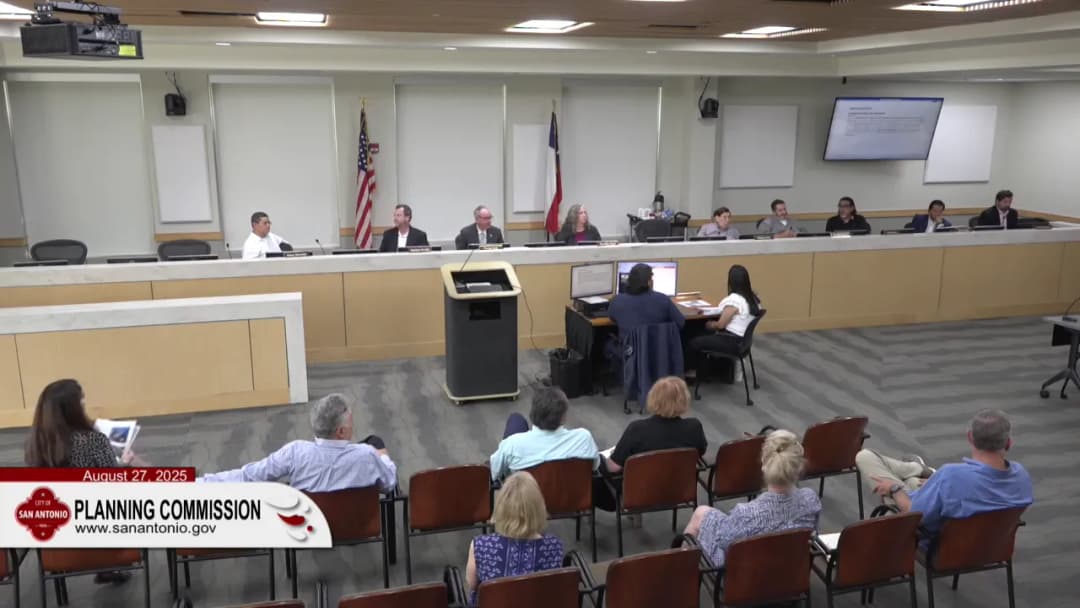
The San Antonio Planning Commission convened on August 27, 2025, at 2:00 PM with a quorum present. The meeting covered the consent agenda and a single contested individual hearing item (Item 13) regarding a plan amendment for a micro wedding venue in the Camp Bullis Extra-Territorial Jurisdiction (ETJ). Consent Calendar - The consent agenda was approved unanimously (8-0). Commissioners Orion and Bustamante recused themselves from consent items 6 and 11, respectively, and left the room during that portion of the meeting. Public Comments & Testimony This section covers Item 13, which received extensive public testimony. - Staff Presentation (Clayton Wallace): Staff recommended denial of a request to amend the Camp Bullis ETJ military protection plan from Low Density Residential to Community Commercial for an 8.5-acre property at 8860 Cross Mountain Trail. Staff cited concerns that community commercial allows detrimental uses (e.g., oil change shops, liquor stores, tire sales) that cannot be controlled through zoning. Of the notices mailed to nearby properties, 48 opposed the request and 8 supported it. Joint Base San Antonio (JBSA) reviewed the plan and had no objection. - Applicant (Emily Weissler, representing owners Rico & Genevieve Zayas): The applicant argued the amendment is a limited scope change tied to the military protection plan, distinct from traditional zoning. The property operates a micro wedding venue (Vineyo 88) with a capacity of 120 people and has operated for over a year without complaints or incidents. They emphasized the low traffic (1-1.5 weddings/month), low water usage (property is not irrigated), and a willingness to enter restrictive covenants to permanently limit future commercial uses. The owners stated they were initially told by the county the use was allowed because they resided on the property. - Public Speakers (All Opposed): - Sheila Gomez Mira (22626 East Range): 22-23 year resident. Opposed, citing the loss of the area's quietness, nature, and dark skies. Raised concerns about noise, lighting, and traffic. - George Richmond (22830 Central Prairie): 37-year resident. Strongly objected, citing water well drought impacts, traffic increases, and the incompatibility of commercial use with the one-to-three-acre lot community. Argued commercial use would destroy the community environment. - Edward Butler (8830 Cross Mountain Trail): Adjacent neighbor. Described the area as a high-value wooded retreat where homes range from $500,000 to $2 million. Called a commercial enterprise "anathema" and highlighted road safety issues on the single-lane road. - Robin Butler (8830 Cross Mountain Trail): 27-year resident. Testified to hearing loud music from the venue and witnessing frequent vehicle accidents on the dangerous curves. - Mary Massey (23724 Up Mountain Trail): 32-year resident. Opposed for safety (reporting drunk drivers leaving the venue), infrastructure overload, reduced property values ($5,000 vs. $11,000 property tax), and loss of aesthetics. - Richard Camaro (23137 Adams Crossing): Raised safety concerns about limited sight distance on the two-lane, winding road with no shoulders. - Natalie Nathan (23225 Eagle Gap): 13-year resident. Emotional testimony opposing the disruption of a family-oriented, animal-friendly sanctuary. Concerned about the potential expansion of commercial activities and marketing of glamping. - Lee Ryle (9015 Cross Mountain Trail): 34-year resident. Cited a dramatic increase in traffic and a major accident involving a rebar truck. Warned against the 'slippery slope' of allowing commercial zoning in the residential area. - Applicant Rebuttal: Reiterated the venue is low-traffic and low-water usage. The owner (Genevieve Zayas) stated events stop at 10 PM, there have been no noise complaints, and it is their forever home. They requested support for the amendment. Discussion Items - Item 13: Camp Bullis ETJ Military Protection Plan Amendment (8860 Cross Mountain Trail) The commission extensively debated the request. Key points included: - Conflict between Existing Use and Potential Uses: Commissioners expressed concern that approving 'Community Commercial' could allow intensive commercial uses (gas stations, liquor stores) in the future if the property is sold. The applicant offered to enter restrictive covenants to limit uses, but commissioners noted this is not a binding zoning tool under the city's purview. - Jurisdictional Complexity: The property is in the ETJ, outside city limits. The city's authority derives solely from the military installation protection plan. The county fire marshal is the primary permitting authority. - Deed Restrictions / HOA: Commissioner Orion noted the property might be subject to deed restrictions from the Cross Mountain subdivision HOA, given a prior replat from Unit 1. The applicant asserted the 8.5-acre venue lot is not subject to those HOA restrictions. Commissioner Orion requested this be thoroughly clarified if the item returned. - Continuance Proposed: Commissioners Mylam and Bustamante suggested the item be continued to allow the applicant time to work with the community and the HOA on restrictive covenants. Key Outcomes - Item 13 (Plan Amendment): The Planning Commission voted unanimously (9-0) to continue this item to the September 24, 2025 meeting. The continuance was intended to allow the applicant additional time to work with the HOA and neighboring property owners to establish restrictive covenants addressing community concerns and to clarify deed restriction issues raised by the commission.

ZONING AND LAND USE 55% · COMMUNITY ENGAGEMENT 21% · PROCEDURAL 14% · TRANSPORTATION SAFETY 4%
686
AUG 27, 2025 · SAN ANTONIO, TEXAS · CITY COUNCIL
San Antonio City Council Budget Work Session - August 27, 2025

The San Antonio City Council held a budget work session on August 27, 2025, to receive presentations on the Debt Management Plan, the newly formed Capital Delivery Department, and the Public Works Department. Staff presented the city's debt capacity, capital project delivery focus, and maintenance programs, and council members provided feedback on bond program frequency, stormwater revenue bonds, and the need for improved communication and project delivery. Discussion Items - Debt Management Plan (Troy Elliott, CFO): The city's current debt capacity for a future general obligation bond is approximately $500 million, down from $1.2 billion in 2022 due to declining property values. The debt service tax rate has been held at 21 cents since 2004. Staff discussed options to increase capacity: adjusting the bond program frequency (e.g., every 3-4 years instead of 5), potentially increasing the debt service tax rate, or using stormwater revenue bonds for drainage projects. The next bond election is currently planned for May 2027, but staff are evaluating a possible move to 2026. A sensitivity analysis will be conducted to stress-test assumptions. - Capital Delivery Department (Mike Shannon): The department was reorganized from Public Works to focus solely on capital project delivery (bond programs). Priorities include delivering projects on time and within budget, improving stakeholder communication, and enhancing cost estimating. The current 2022 bond program (1.2 billion, 187 projects) is 49% complete or under construction as of July 2025, with 91% expected to be under construction or complete by September 2026. Staff highlighted the need for better communication with residents and businesses, and improved coordination with utility companies. - Public Works Department (Razi Hosseini): The proposed FY2026 budget is $303 million with 698 positions, including $122.4 million for street maintenance (1,464 projects), $17 million for sidewalks (21 miles of gap sidewalk), and $11.5 million for stormwater emergency repairs (including damage from June 2025 floods). Staff presented the Infrastructure Management Program (IMP) and noted a reduction of $11 million in general fund support. Council members expressed concern over the reduction in CIP and NAMP funding and requested future restoration. Key Outcomes - Council members broadly supported exploring the use of stormwater revenue bonds to increase drainage project capacity, with staff to return with analysis within 30-45 days. - Council members expressed interest in more frequent, smaller bond programs (every 3-4 years) rather than five-year cycles. - Staff will conduct sensitivity analysis on debt assumptions and bring back options regarding the debt service tax rate. - Capital Delivery will develop metrics for project delivery and communication, and present a communication plan to the Transportation and Infrastructure Committee. - Council members requested a follow-up memo detailing the bond program status, stormwater fee rates, and a breakdown of projects in the hazard mitigation action plan. - No formal votes were taken; the meeting adjourned to executive session and later reconvened to adjourn without action.

INFRASTRUCTURE 41% · DEBT MANAGEMENT 19% · BUDGET 8% · ENGINEERING AND INFRASTRUCTURE 6%
687
AUG 27, 2025 · SAN ANTONIO, TEXAS · CITY COUNCIL
San Antonio City Council Budget Work Session - August 27, 2025: Debt Management, Capital Delivery, and Public Works

The San Antonio City Council held a budget work session on August 27, 2025, from 2:09 PM to 5:20 PM, followed by an executive session that concluded at 5:58 PM. The meeting focused on the city's debt management plan, the newly created Capital Delivery Department, and the Public Works Department's proposed FY2026 budget. Key discussions included the potential for more frequent bond programs, the use of stormwater revenue bonds, and the impact of state property tax legislation. Council members provided feedback on project delivery, communication, and infrastructure priorities. Debt Management Plan (Presented by Troy Elliott, Chief Financial Officer, and Jeff Coy, Assistant City Manager) - The city maintains a debt service tax rate of 21 cents per $100 valuation, unchanged since 2004. - San Antonio holds the highest bond ratings: AAA from Moody's and S&P, AA+ from Fitch. - Total outstanding tax-supported debt stands at $469 million, with additional debt for the convention center ($537 million), airport ($286 million), and other obligations. - On August 14, 2025, the city issued $221.6 million in general obligation bonds and $126.4 million in certificates of obligation, totaling $402 million. The issuance generated $3.3 million in savings and attracted new investors. - The current debt plan assumes a 20-year average life, with a conservative 2.8% property value growth projection. - A proposed state bill (Senate Bill 10, amended by the House) could limit property tax revenue growth to 2.5% per year without voter approval, affecting future capacity. The bill is expected to be signed by the governor and take effect January 1, 2026. - The city has a $25 million debt service reserve fund as a buffer. - Staff recommended exploring more frequent bond elections (every 3-4 years instead of 5) to better align with market conditions and capacity. - The stormwater revenue bond (currently $24.5 million with a remaining life of about 2.2 years) could be refinanced or restructured to free up additional capacity for drainage projects. Capital Delivery Department Reorganization (Presented by Mike Shannon, Director of Capital Delivery) - The department was created by splitting Public Works into two entities: Capital Delivery (188 positions) and Public Works (698 positions). - Capital Delivery focuses on large capital projects, aiming to deliver on time and within budget. - Three priorities: 1) Deliver projects on time and within budget; 2) Achieve excellence in communication with stakeholders; 3) Improve cost estimation through standardized tools and processes. - A consultant study (Rabba Kirchner) recommended the separation and ongoing improvements. - The FY2026 budget includes $22 million for capital projects and $21 million for streets. Public Works Department Budget and Infrastructure Programs (Presented by Rasi, Director of Public Works) - Proposed FY2026 total budget: $303 million, including $117 million for capital projects and $76.6 million for traffic engineering and operations. - Street maintenance: $122.6 million for an estimated 1,400 projects. The program uses a 50% condition-based and 50% size-based formula. - Sidewalk program: $17 million to build 21 miles of new sidewalks and repair 5 miles, resulting in 34 usable miles. A $1.8 million, 3-year sidewalk condition assessment is underway. - Alley service: 952 service alleys exist; 412 are currently unserved. Phase 2 and 3 will complete 120 and 20 alleys respectively by FY2026, with a preventive maintenance program to follow. - Traffic safety: $1 million for 12 school zone improvements, $1 million for traffic calming, $3.15 million for new traffic signals, and $1.5 million for signal communication upgrades. - Drainage and stormwater: $11.45 million for repairs to damaged roads and drainage systems, plus $3.7 million for design of five projects. The stormwater fee has not been increased since 2020. - The city has completed 11 of 100 drainage projects from the 2025 Hazard Mitigation Plan, with $21 million in total damage from the June 13 storms (city and county share). Key Outcomes - Council members expressed support for more frequent bond elections (every 3-4 years) to improve project delivery and align with capacity. - Staff will return in 30-45 days with a detailed analysis of stormwater revenue bond restructuring options. - Staff will conduct sensitivity analysis on bond capacity under different property value growth and interest rate scenarios. - The Capital Delivery Department will prioritize improving communication with residents and stakeholders, including a new dashboard for project tracking. - Council requested exploration of incentives and penalties for contractor performance, as well as improved coordination with utility companies (CPS Energy, SAWS, Texas DOT). - The Public Works Department will continue to refine its street and sidewalk condition assessments and explore more durable materials (e.g., concrete) where feasible. - No formal votes were taken; the session was for discussion and feedback. The next step is finalization of the FY2026 budget and further dialogue on the 2027 bond program.

INFRASTRUCTURE 28% · BUDGET 20% · DEBT MANAGEMENT 14% · PUBLIC ENGAGEMENT 14%
688
AUG 27, 2025 · SAN ANTONIO, TEXAS · BOARDS & COMMISSIONS
San Antonio Planning Commission Hearing on Camp Bullis ETJ Land Use Amendment - August 27, 2025

The San Antonio Planning Commission met on August 27, 2025 at 2:00 PM to consider a consent agenda and a public hearing on a petition to amend the land use plan for the protected extraterritorial jurisdiction (ETJ) of Camp Bullis. The meeting concluded at 2:58 PM with a unanimous vote to postpone the item to September 24, 2025. Consent Calendar - The consent agenda was approved unanimously by a voice vote of all commissioners present (Profit, Sigo, Sánchez, García, De Susi, López, Maylon, Cherpec). The consent agenda included routine approvals for which staff recommended approval. Public Comments & Testimony - Sheila Gómez (22626 East Range) spoke against the amendment, citing loss of rural character, nighttime light pollution, increased traffic, and the potential for commercial uses like liquor stores. She noted that the community moved there for low-density residential living. - George Richmond (22830 Central Prairie), a 77-year resident, strongly opposed, stating the area is quiet and low-density. He raised concerns about traffic safety on Cross Mountain Trail, including a recent multi-vehicle accident, and noted that the area is under drought and cannot support high-volume water use. - Edward Butler (8830 Cross Mountain Trails) described the area as remote with 2-acre minimum lots and homes valued $500k-$2M. He argued that a C2 commercial designation could allow gas stations, liquor stores, and other incompatible uses. He noted the narrow roads cannot accommodate large delivery trucks. - Robin Butler (same address) opposed, stating that the existing event venue already generates noise from music that disrupts outdoor enjoyment. She also raised traffic and accident concerns. - Mary Massie (address 23742) opposed citing traffic safety (including drunk drivers from the venue), inadequate infrastructure, reduced county tax revenue (venue pays $5,000/year vs. her home at $11,000/year), decreased property values, and aesthetic impacts. - Richard Camargo (address 237) opposed due to traffic safety on winding roads and insufficient road capacity for commercial traffic. - Natalie Nathan (address 23225) opposed emotionally, stating she moved there for the natural beauty and wildlife. She expressed confusion about why a commercial venue should be allowed in a residential area and noted that the venue is marketed for camping and parties, which would disrupt the community. - Riley (Cross Mountain Trail, 44-year resident) opposed due to traffic, a recent truck rollover incident, environmental hazards (oil spills), and risks to wildlife (deer, rabbits, hogs, etc.). He stated that changing to C2 would allow any commercial use in the future. - A total of 46 written oppositions were noted by the commission, in addition to the oral testimony. Discussion Items - Applicant Presentation: Emily Wise (representing the owners) and owners Genevi Sáez and Lon Sáez presented the request. They own an 8.5-acre property at 8860 Cross Mountain Trail with an existing event venue (micro-wedding venue) that has been operating for about a year. The property is in the Camp Bullis ETJ, requiring a land use compatibility certificate. The owners seek to amend the land use plan to commercial to allow continued operation. They argued the venue is small (one wedding per month, 6,600 sq ft improvements), very controlled, and has caused no noise complaints. They are willing to enter restrictive covenants to limit future uses (e.g., no liquor stores, gas stations). They stated they have had conversations with neighbors. - Commissioner Questions: - Commissioner Mizuki asked about the operational history and why they are seeking an amendment now. The owner explained that a recent change in military zone regulations required a compatibility certificate, prompting the application. They have been operating without permit but are now seeking compliance. - Commissioner Bustamante asked about HOA restrictions. The property may not be subject to the Cross Mountain HOA because it is a separate lot (Volume 9223, Page 42) created outside Unit 1. However, Commissioner Orien noted that the property might have been part of Unit 1 and subject to restrictive covenants that prohibit commercial use. Staff clarified the planning department created this use category in 2019. - Commissioner García asked about the Air Force response; staff stated that the military must provide a letter of non-objection before proceeding. - Commissioner Orien requested clarification on whether the property is bound by existing HOA restrictions and suggested the applicant go through the HOA process. - The commission also noted that changing to C2 would allow a wide range of commercial uses not limited to events, even if the current owner intends to keep it as a venue. - Postponement Motion: Commissioner Bustamante moved to postpone the item to September 24, 2025 to allow the applicant to discuss with neighbors, clarify HOA restrictions, and explore restrictive covenants. The motion was seconded by Commissioner Mizuki and passed unanimously. Key Outcomes - Vote: All commissioners present voted yes on the motion to postpone (Bustamante, Mizuki, Sánchez, García, López, Maylon, Orien, Profit, and Chair Peck). - Next Steps: The public hearing on item 13 is continued to the September 24, 2025 meeting of the San Antonio Planning Commission. The applicant is expected to provide additional documentation on HOA status and restrictive covenants, and to continue engaging with the community. - The consent agenda was approved unanimously earlier in the meeting.

ZONING AND LAND USE 44% · PROCEDURAL 21% · COMMUNITY ENGAGEMENT 18% · TRAFFIC IMPACT ANALYSIS 17%
689
AUG 26, 2025 · SAN ANTONIO, TEXAS · CITY COUNCIL
San Antonio City Council Budget Hearings for DHS, Metro Health, and Library - August 26, 2025

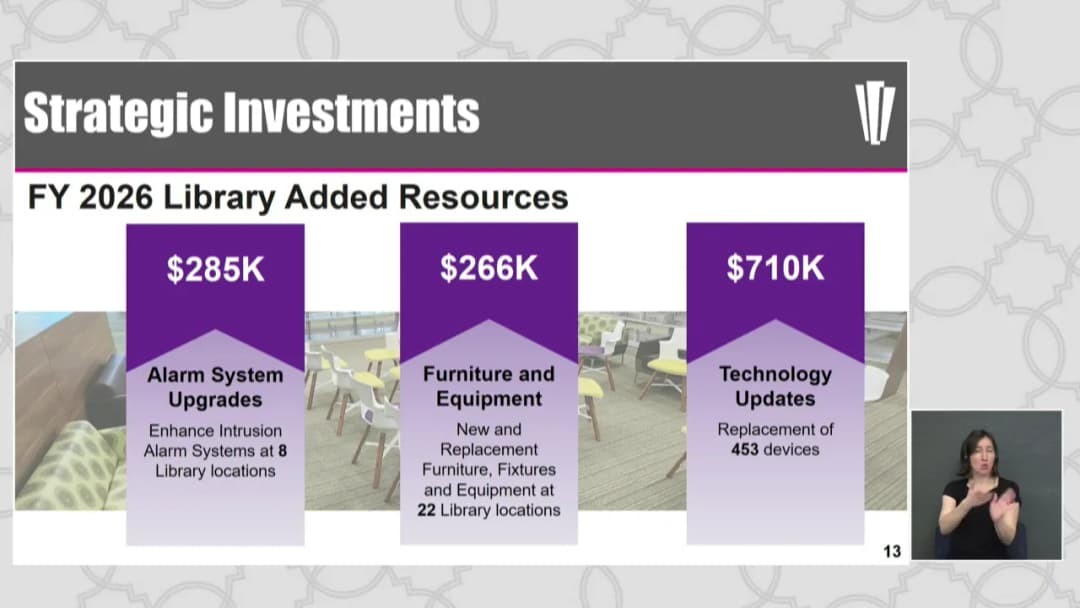
The San Antonio City Council held a morning budget hearing on August 26, 2025, to review proposed budgets for the Department of Human Services (DHS), Metro Health, and the San Antonio Public Library for fiscal year 2026. Presenters included DHS Director Melanie (last name not stated), Metro Health Director Dr. Claude Jacob, and Library Director Sugar de Gusami, along with their teams. Council members discussed funding priorities, service reductions, fee changes, and expressed support or concerns over various proposals. No votes were taken; the session was informational. Discussion Items - Department of Human Services (DHS): Melanie presented a proposed FY2026 budget of $94.8 million with 350 full-time equivalents. The budget includes $42.2 million from the general fund for programs and operations, $52.4 million from state and federal funds. The department serves over 1,700 children and families through early education, adult nutrition sites, and financial stability programs. A comprehensive review (CBR) identified $630,000 in efficiencies by consolidating funding and reducing agencia delegada budgets by $5,000 each. Four nutrition sites with low attendance will be closed, transferring 230 participants to more robust adult centers. The department proposed a new four-year contracting cycle for delegated agencies to provide stability, with competitive funding cycles beginning in late 2025. - Metro Health: Dr. Jacob presented a proposed FY2026 budget of $79.2 million with 593 positions, including $32.7 million in grants. The budget has nearly doubled since 2019 due to the SA Forward Plan investments. The department outlined $2.2 million in restructuring savings by eliminating vacant positions, reducing sick-leave payout programs, and streamlining contracts. Changes include eliminating four positions at the Bexar County Re-Entry Center and three non-profits, and transferring three positions to DHS. The department also proposed new fee schedules for food establishment permits, moving from a per-employee to a gross-sales-based structure (e.g., $400 for establishments with 1-10 employees, up to $850 for those with over $150,000 in sales). A one-time $150 fee for mobile vendors and a $52 fee for change of ownership were also proposed. The fee changes are expected to take effect in December 2025. Dr. Jacob emphasized maintaining core public health services despite fiscal challenges. - San Antonio Public Library: Director de Gusami presented a proposed FY2026 budget of $58 million, with $55.4 million from the general fund. The budget includes $7.3 million for collection materials, $21.2 million for staff, $6.6 million for technology, and $11.6 million for facilities. The library plans to invest in security system upgrades, furniture replacement, and technology refreshes. The department identified $450,000 in efficiencies by eliminating eight positions through restructuring, with no impact on service levels. Library Board President (speaker not named) praised the library's community impact and noted a 96% customer satisfaction rate. She highlighted a recent book return from 1943 as a testament to the library's trusted role. Public Comments & Testimony - A representative (likely from Big Mama’s Safe House, though name not given) urged the council to include funding for their organization in the proposed budget, emphasizing their work with youth up to age 24 in violence prevention and services for foster youth. They argued that investing in such programs is a moral and public safety necessity. Key Outcomes - Council members directed DHS to provide a district-level breakdown of services (e.g., domestic violence, vaccinations, food assistance) to better understand community needs. - Several council members expressed support for a cost-of-living adjustment (COLA) for city employees, citing rising living costs. - Council members raised concerns about four-year contracts for delegated agencies; some preferred two or three-year terms with mid-term reviews to allow for flexibility. The matter will be revisited in October. - The council discussed the San Antonio Book Festival funding reduction (from $150,000 to $50,000) and suggested exploring alternative funding sources such as hotel occupancy taxes or partnerships with other departments. - Council members requested more detailed analysis on how federal funding changes (e.g., Medicaid unwinding, EPA rollbacks) might impact vulnerable populations, particularly seniors and children. - Metro Health was asked to provide data on asthma-related emergency visits in schools and to monitor the impact of new food establishment fees on small businesses. - The council directed DHS and Metro Health to coordinate with the county and other partners to reduce duplication and improve efficiency in delegated services.

PUBLIC HEALTH 28% · BUDGET 19% · PUBLIC LIBRARIES 16% · SENIOR SERVICES 5%
690
AUG 26, 2025 · SAN ANTONIO, TEXAS · BOARDS & COMMISSIONS
Southern Edwards Plateau HCP Committee Meeting – August 26, 2025

The Southern Edwards Plateau Habitat Conservation Plan (HCP) Coordinating Committee convened on August 26, 2025, with a quorum present. The meeting addressed two memoranda of understanding (MOUs) for the purchase and transfer of Golden-cheeked Warbler (GCW) conservation credits from third-party conservation banks, and approved the minutes from a prior meeting. No public comments were received. Discussion Items Item 1 – MOU with EBX GCW LLC The committee discussed and approved an updated MOU between the City of San Antonio, Bexar County, and EBX GCW LLC for the purchase and transfer of GCW conservation credits from the Vecina Lente Ranch Conservation Bank. The MOU sets the minimum price at $7,500 per credit, with annual increases of $500, and a one-year term renewable for up to two additional years. Staff noted that the per-credit fee was previously $4,000 and was raised to $7,500 earlier in 2025. The committee approved the motion unanimously (4 ayes). Item 2 – MOU with Bandera Conservation Corridor LLC The committee similarly approved an MOU with Bandera Conservation Corridor LLC for GCW credits from the Bandera Conservation Corridor Conservation Bank. The terms are identical: $7,500 per credit, $500 annual increase, one-year term with two automatic renewals. The motion passed unanimously (4 ayes). Item 3 – Approval of Minutes The committee approved the minutes of the previous meeting after a request to correct a typo in the presenter's name (Lauren). The minutes were approved by voice vote with no opposition. Key Outcomes - Item 1 (EBX GCW MOU): Approved unanimously (4 ayes). - Item 2 (Bandera Conservation Corridor MOU): Approved unanimously (4 ayes). - Item 3 (Minutes): Approved with a correction to the spelling of Lauren's name. - The meeting adjourned at 3:36 PM.

CONSERVATION CREDITS 70% · PROCEDURAL 30%
OPENPUBLICA · PUBLIC MEETING INDEXUPDATED DAILY · openpublica.com