Browse by city
Date range
Search help

Search titles, summaries, topics and stored transcripts together. Keywords may match separately; put the whole query in double quotes for a phrase. Matching follows word analysis, so punctuation is not exact. Both dates are included. Documents are not searched.

SHOWING 981–990 ENTRIES
981
AUG 11, 2017 · SAN DIEGO, CALIFORNIA · LAND USE & HOUSING COMMITTEE
Smart Growth and Land Use Committee Special Meeting on Qualcomm Stadium Future - August 11, 2017

The Smart Growth and Land Use Committee held a special meeting on August 11, 2017, to receive an informational report from the Mayor's Office on current and potential future uses of the Qualcomm Stadium property. Members present included Chair Sherman, Vice Chair Alvarez, Councilmember Gomez, and Councilmember Kate. The meeting included presentations, public testimony, and committee discussion, with no formal votes taken. Presentations - Sibel Thompson, Director of Real Estate Assets, presented current stadium operations: 568 events are scheduled through December 31, 2018, including 21 interior events (primarily San Diego State games, Holiday Bowl, concerts, soccer) and 547 exterior events (RV and auto sales, autocross, swap meets, cultural events). The FY18 budget includes $3.7 million in personnel expenses and $7 million in non-personnel expenses. Anticipated revenue is about $3.5 million, including an additional $500,000 for suite and advertising revenue, with a projected net loss of about $7.2 million. - Jack Straw, Mayor's Director of Land Use and Economic Development Policy, provided an update on the Mission Valley Community Plan update process. The process began in June 2015; phases 1–3 (existing conditions, visioning, alternatives) are complete, and phase 4 (community review and plan development) is underway. Staff has held 22 community meetings and 3 workshops, with another workshop this weekend. Expected completion is the end of 2018. Public Comments & Testimony - Corey Briggs: Submitted written questions and argued the presentation lacked detail on potential future uses. He urged the committee to direct the mayor to identify public purposes for the Soccer City proposal and any sale to San Diego State or other public agencies, and to seek legal analysis on the city's authority and Surplus Lands Act compliance. - Robert McNamara: Stated the budget should include debt service and TOT transfers; the stadium cannot be considered surplus due to scheduled events and the pending citizens' initiative. He supported placing the soccer plan on the November 2018 ballot to allow more options, and expressed interest in seeing a San Diego State proposal. - Joe La Cava (Public Land/Public Vote coalition): Encouraged the city to explore all options for the 230+ acres of city-owned land, consider competing proposals, and involve the Mission Valley Planning Group in discussions. He emphasized that competition yields the best results for the public. - Mike Stepner (Professor, New School of Architecture): Called for an open, inclusive process to develop a vision and criteria to evaluate the highest and best use of the site. He cited Uptown District and NTC as successful examples of large-scale redevelopment planning. Discussion Items - Vice Chair Alvarez requested a per-event cost and revenue breakdown, information on costs associated with the community plan update specific to the Qualcomm site, and asked who from the city helped draft the citizens' initiative. He requested a City Attorney analysis of Municipal Code Section 22.0907 regarding council authority to sell city land to public agencies. - Councilmember Gomez asked about contract terms with San Diego State and the Bowl Association (staff stated contracts run through December 2018; other agreements are individual permits that can be terminated sooner). He questioned whether the planning department had directed staff not to discuss Qualcomm in the community plan update (staff said no such direction). He expressed concern about not including the initiative as an alternative in the plan update, stressed the need for a "Plan B," and suggested creating a subgroup to develop a site-specific vision. - Councilmember Kate referenced a recent City Attorney memo and asked for a summary. Deputy City Attorney Melissa Abels explained: Council Policy 710 gives the mayor authority to determine surplus property and initiate sales; council can authorize sales; Charter Section 221 applies to sales over 80 contiguous acres, with exceptions for sales to a government agency for a bona fide governmental purpose or a previous public vote; "governmental purpose" is not defined in the charter but traditionally includes roads, schools, parks, and public safety facilities. - Chair Sherman noted the community plan update serves as a "Plan B" to the citizens' initiative, requested the event cost/revenue breakdown, and clarified that the City Attorney would need to analyze any specific action that might interfere with the pending initiative. Key Outcomes - No formal motions or votes were taken; the item was informational. - The City Attorney's Office agreed to provide an analysis of Municipal Code Section 22.0907 and to address questions submitted by the public and committee members at a future meeting. - Staff were asked to provide follow-up information on event-level revenues and costs, and the costs associated with the community plan update for the Qualcomm site. - The next special meeting was scheduled for Thursday, September 21, 2017, at 2 p.m.

LAND USE AND PLANNING 45% · PUBLIC ENGAGEMENT 37% · PUBLIC COMMENT 13% · REAL ESTATE 5%
982
AUG 3, 2017 · SAN DIEGO, CALIFORNIA · ECONOMIC DEVELOPMENT & INTERGOVERNMENTAL RELATIONS COMMITTEE
San Diego City Economic Development and Intergovernmental Relations Committee Meeting – August 3, 2017

The Economic Development and Intergovernmental Relations Committee (Chair Zapf, Councilmembers Bree, Kersey, and Alvarez) met on August 3, 2017, to receive informational updates from the Port of San Diego, the Governor's Office of Business and Economic Development (GoBiz), the San Diego Regional Economic Development Corporation (EDC), and the San Diego Military Advisory Council (SDMAC). No formal action was taken on these items; the committee approved the record of action from the July 23 meeting by unanimous consent. Consent Calendar - Approved the record of action from the July 23, 2017 meeting by unanimous consent, with no items pulled for discussion. Public Comments & Testimony - Martha Welch, a member of the public, spoke during non-agenda public comment about the Metropolitan Transit System (MTS). She expressed opposition to recent MTS bus and trolley service changes, saying the Route 11 bus change was the "worst one" and that changes to other routes were not properly communicated. She stated that seniors cannot purchase round-trip trolley tickets, that there are inadequate restroom facilities at transit stations, and that accessibility for walkers and wheelchair users at the America Plaza stop is poor. She said MTS actions were "not right" and called for more consideration of riders. Discussion Items Port of San Diego Report - Port Commissioners Rafael Castellanos, Marshall Merrifield, and Michael Zuquet presented an overview of Port initiatives and economic impacts. - Economic impact: The Port generates an annual economic impact of $8.3 billion (direct and indirect), up from $7.7 billion in 2013. Direct economic impact on tidelands was $5.43 billion in 2015, a 6% increase over 2013. The Port supports nearly 44,000 jobs; 31,000 (70%) are in tourism/commercial industries, and 13,000 (30%) are industrial/maritime. The working waterfront and tourism/commercial sectors each contribute about $2.7 billion in direct output. - Coronado Bay Bridge lighting: The capital campaign has raised $1.2 million in cash and pledges; total project cost is estimated at $6–8 million, with an additional $2 million for an operations/maintenance fund. Commissioner Merrifield said the goal is to complete lighting by 2019, the bridge's 50th anniversary. Phase 2 begins next week with artist Peter Frank under contract. - Blue Economy Incubator: The Port has made four investments totaling $750,000: Red Line Chemical ($165,000, copper-removal pilot with 85% success rate), Rentunder ($140,000, boat wash capturing copper), Swell Advantage ($100,000, marina dock-management app), and Acacia Pacific Aquaculture ($350,000, oyster nursery barge). Commissioner Merrifield said the Port receives royalty arrangements, not equity. - Pond 20 mitigation bank: 80+ acres in Councilmember Alvarez's district are slated for wetlands and mitigation; a consultant is studying feasibility of a mitigation bank. The Port expects a recommendation in 4–6 months. Councilmember Alvarez noted the Otay Mesa border project requires 5–7 acres of wetland mitigation and could be a potential user. - Portside Pier: $20 million redevelopment; demolition begins this year, construction next year, opening summer 2019. It will include two full-service restaurants and fast-casual dining. - Cruise business: About 250,000 cruise passengers are expected this year, up from recent years but below the 2008 peak of 1 million. Disney has 17 cruises scheduled this year, up from 2 in 2014; each cruise ship call contributes about $2 million in direct spending. - Cargo terminal modernization: A $24 million project at the 10th Avenue Marine Terminal, with $10 million in Tiger grant funding, will demolish a 1950s-era shed, improve stormwater filtration, and modernize rail systems. Phase 1 demolition completes by October 2018; completion expected in 2020. Dole Fresh Fruit imports about 180 million bananas per month through the terminal. - Commissioners also discussed the Central Embarcadero redevelopment and Harbor Island projects. Committee members asked clarifying questions about bridge lighting costs, the public art fund, Pond 20 mitigation credits, the Blue Economy fund, Fifth Avenue Landing timeline, and port financial contributions to the Chula Vista convention center project. Councilmember Alvarez acknowledged the port's work on the 10th Avenue Terminal and asked about a water-access proposal at Cesar Chavez Park. Councilmember Bree praised the Blue Economy incubator and noted new hotels will add TOT revenue. Councilmember Kersey asked about the port's legal obligation to review Fifth Avenue Landing; the Vice Chairman explained the history and that the port is obligated to review but not approve. California Competes Tax Credit Program - Sid Varakra, Deputy Director for External Affairs at GoBiz, and Jesse Gype of the San Diego Regional EDC reported on the state's California Competes tax credit program and other business resources. - Varakra outlined GoBiz services: business investment, permitting, international trade missions (including an October Mexico mission), workforce development (Cascade grant for cyber workforce retraining), zero-emission vehicle infrastructure, and innovation hubs. - Gype provided program statistics: Since the program's establishment four years ago, 98 San Diego County companies have won credits (47 small, 51 large); about 75% of the credit value went to San Diego city businesses. The county has outperformed LA County, which has 106 credits despite a population four times larger. Total credits awarded to county companies are $40 million over a five-year period. City of San Diego companies have pledged to create 5,791 jobs (2,535 small, 3,256 large), $162 million in new investment, and over $1 billion in wages. - Gype noted the program is set to sunset at the end of this year, and EDC is advocating for an extension. He asked the committee to consider supporting the program. - Councilmember Alvarez asked about geographic distribution of credits, particularly in high-unemployment areas. Gype said there is a map available and noted three Barrio Logan companies have won, including NASCO, BAE, and a brewery. He acknowledged the need for more outreach to small businesses and high-need areas. - Councilmember Kersey asked about outreach methods; Gype and Varakra explained workshops, partnerships with EDC and city economic development, and suggested inserts in business license renewals. Councilmember Kersey recommended working with the city's economic development department on that. - Councilmember Bree asked about common questions to GoBiz (workforce, utilities/incentives) and whether the program favors certain sectors. Gype said it is proportional to the economy, with tech/manufacturing common but no industry favoritism. BRAC (Base Realignment and Closure) Report - Dennis Dubard, President of SDMAC and General Dynamics NASSCO, and Jesse Gype of EDC reported on the military's economic impact and BRAC likelihood. - Military impact: Defense spending generates $44 billion in gross regional product and 1 in 5 jobs in San Diego County. There are 134,000 military and DOD civilian personnel. Naval Base San Diego homeports 55 ships, expected to grow to 70 by 2025. An aircraft carrier has an economic value of about $770 million. San Diego contains 67% of the military training airspace in the country. - BRAC history: California has been hit hardest, absorbing 54% of total BRAC cuts (93,000 jobs, 30 installations closed). San Diego has fared better due to unique training ranges and infrastructure. The likelihood of a BRAC in FY18 is now under 10%, but it could be authorized in 2019 or 2020; once authorized, the process takes about three years. - EDC and SDMAC lead "Operation San Diego," a 14-entity coalition for military advocacy. They maintain a lobbying presence in D.C. and have strong relationships, including with the new assistant secretary of defense for installations and environment. - Councilmember Bree asked about job losses; Dubard said San Diego has been a net winner but exact numbers weren't provided. Councilmember Kersey asked about MCRD consolidation; Dubard said the Marine Corps has no plans to close MCRD San Diego. Key Outcomes - No formal action was taken on any discussion item; the meeting was informational. - The committee approved the July 23 record of action. - GoBiz and EDC will explore outreach to businesses via city business license renewal inserts, following Councilmember Kersey's suggestion. - Port commissioners committed to following up with Councilmember Alvarez on the Cesar Chavez Park water-access proposal and the Barrio Logan bridge-lighting estimates.

ECONOMIC DEVELOPMENT 31% · PORTS AND MARITIME 24% · MILITARY AFFAIRS 14% · PUBLIC PRIVATE PARTNERSHIPS 7%
983
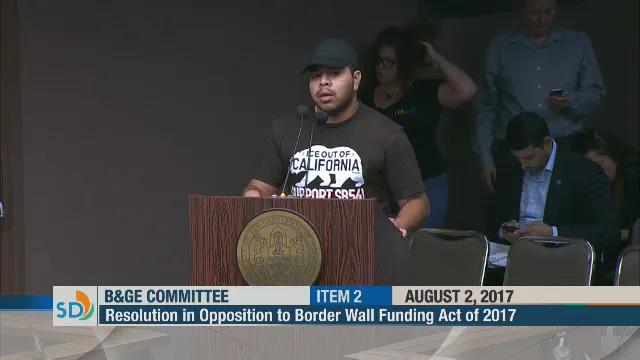
AUG 2, 2017 · SAN DIEGO, CALIFORNIA · BUDGET & GOVERNMENT EFFICIENCY COMMITTEE
San Diego Budget and Government Efficiency Committee Meeting – August 2, 2017

The Budget and Government Efficiency Committee met on August 2, 2017, to approve the record of actions from the June 21 meeting, review the fiscal year 2018 Statement of Budgetary Principles, consider a resolution opposing the border wall and related divestment, and receive an informational briefing on personnel expenditure budgeting and pension costs. Consent Calendar - The committee record of actions from the June 21, 2017 meeting was approved unanimously, with no items pulled for discussion. Public Comments & Testimony - Non-agenda public comment: Catherine Rhodes from Point Loma criticized city policies on policing, homelessness, and the loss of single-room occupancy units. She urged the city to file a lawsuit regarding homeless possessions and noted $54 million in pre-2010 housing bonds sitting unused. - On the Statement of Budgetary Principles: Ms. Rhodes spoke in opposition, suggesting that the city is hiding financial information about certain funds and recommending that staff contact the county auditor-controller about the redevelopment property tax trust fund. - On the border wall resolution: More than 30 public speakers testified, nearly all in support. Speakers represented the San Diego LGBT Community Center, Assemblymember Gonzalez Fletcher's office, San Diego Indivisible, the San Diego Regional Chamber of Commerce, the San Diego County Democratic Party, labor unions, faith groups, immigrant rights organizations, and many community members. They argued the wall would harm the binational economy, environment, and community; that border crossings already cause billions in losses; and that funds would be better spent on infrastructure, housing, education, and health care. One speaker, Catherine Rhodes, offered a different perspective, suggesting that money for replacement fencing could be used for infrastructure like Smugglers Gulch. Thirteen additional people submitted speaker slips in favor of the resolution without speaking. Discussion Items - Item 1: FY2018 Statement of Budgetary Principles. Christiana Gagger from the Office of the Independent Budget Analyst (IBA) presented IBA Report 17-28. She explained that the principles clarify budgetary authority between the mayor and council, require quarterly budget monitoring, a five-year financial outlook, and communication of service-level changes. Councilmember Gomez asked whether quarterly performance measure updates could be implemented and requested that the principles be presented earlier in the budget cycle to guide budget discussions. The committee recommended council approval. - Item 2: Resolution opposing the border wall and divestment. Gloria Cruz Cardenas from Councilmember Gomez's office presented the resolution opposing Executive Order 13767 and H.R. 1813. The resolution also called for identifying and divesting from companies involved in building the border wall. Councilmember Gomez noted that over $72 billion comes through the border and stressed the importance of binational ties. Councilmember Kate opposed the resolution, particularly the divestment clause, calling it government overreach. Councilmember Sherman also opposed, arguing the city should focus on local issues. Chair Bree supported the resolution. The vote was 2–2, so the resolution will go to the full city council in September without a committee recommendation. - Item 3: Personnel expenditure budget process, vacancy factor, and ADC. Tracy McCraner, Director of Financial Management, and Matt Vespe presented an informational overview. Key statistics included: FY2018 citywide personnel expenditures of $784.2 million in salaries and $618.6 million in fringe; the general fund personnel budget is $547.1 million in salaries and $438 million in fringe, making up nearly 70% of the general fund. Police and fire account for over 50% of the general fund, with PE making up 86% and 85% of their budgets respectively. For FY2017, the general fund had $53.5 million in overtime and $30.3 million in budgeted vacancy savings. Total salary and wage expenditures were $536.4 million as of July 26. The city's pension payment increased from $261 million in FY2017 to $324 million in FY2018, driven largely by actuarial changes. The presentation also discussed pension projections to 2037, Proposition B defined contribution costs, and Proposition H infrastructure funding. Councilmember Gomez requested a breakdown of overtime by department, and Councilmember Sherman asked for an updated pension projection chart. Key Outcomes - The committee recommended council approval of the FY2018 Statement of Budgetary Principles (motion by Chair Bree, seconded by Councilmember Gomez, approved unanimously). - The border wall resolution received a 2–2 vote and will be forwarded to the full city council without a recommendation. - The personnel expenditure presentation was informational; no formal action was taken. Staff will provide requested follow-up information on overtime by department and updated pension projections.

BUDGET 21% · IMMIGRATION 21% · BORDER COMMUNITIES 16% · PENSION FUNDING 9%
984
AUG 2, 2017 · SAN DIEGO, CALIFORNIA · ACTIVE TRANSPORTATION & INFRASTRUCTURE COMMITTEE
Infrastructure Committee Meeting: August 2, 2017 – Park & Balboa Park Condition Assessments

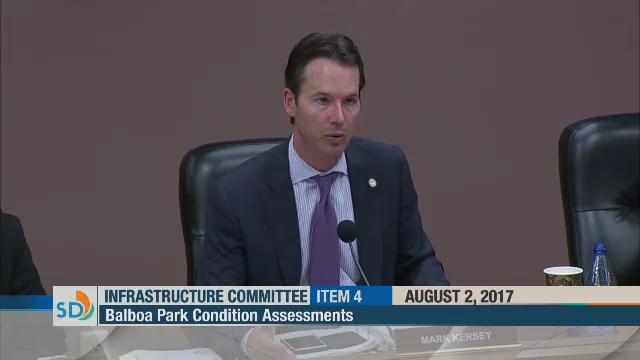
The Infrastructure Committee met on August 2, 2017, with a full committee present (Vice Chair Ward, Councilmembers Zaf and Gomez). The meeting covered non-agenda public comment, a consent agenda item, an action item on utility agreements for the Mid Coast Corridor Transit Project, and two informational reports on park condition assessments and Balboa Park asset conditions. Decisions included unanimous approval of the consent agenda and the utility agreement amendment. Consent Calendar - Approved minutes from the July 12, 2017, meeting. - Motion by Vice Chair Ward, seconded by Councilmember Zaf, to approve the consent agenda (public works contracts for construction management services related to environmental services). Vice Chair Ward noted the city’s reliance on private contracts due to unfilled public works positions (173 added in FY17) and requested a future report on contract performance. The motion carried unanimously. Public Comments & Testimony - Martha Welch (non-agenda public comment, 2 minutes): Expressed strong opposition to using private companies for road repairs, asserting that quality will decline and that the city is not addressing potholes adequately. Cited specific examples of cracked roads and potholes, including on Broadway. - Tomas Herrera Misler (CEO/President, Balboa Park Conservancy, speaking on park condition assessment): Expressed appreciation for the study but surprise at Balboa Park’s low PCI score of 5 (good condition). Noted that only 416 of 1,200 acres were assessed, raised concerns about loss of trees, poor signage, uneven sidewalks, and heavy usage (5th busiest urban park in the U.S.). Urged the committee to consider the park’s unique status as a national historic landmark and economic driver, and to allocate resources accordingly. - Peter Kamiski (Executive Director, Balboa Park Cultural Partnership, speaking on Balboa Park condition assessment): Stated that the $79.2 million facility condition index figure is insufficient and does not account for ADA compliance, seismic retrofitting, or operational needs. Provided a packet with additional analysis showing 17% more priorities. Emphasized the need for a higher standard for Balboa Park’s historic buildings. Discussion Items - Item 2 – First Amendment to Wet Utility Agreements with SANDAG (Action Item): Presented by Abby Palosi (Assistant Deputy Director, Public Works). The amendment increases the Mid Coast Corridor Transit Project agreement from $3.9M to $5.2M (due to bid results) and the heavy rail (Elvira to Marina double track) agreement from $9.1M to $11.27M (due to bid results and added scope). Vice Chair Ward expressed frustration that the city must absorb relocation costs but accepted the explanation that the city only pays for relocations where it lacked prior rights or for betterments. Motion to approve carried unanimously. - Item 3 – FY16 Interim Park Amenity Condition Assessment Report (Informational): Presented by Andy Field (Assistant Director, Park and Recreation) and Jim Winter. The report covers 76 of 250 parks (1,200 acres) assessed, including 75 community/neighborhood parks and Balboa Park. The Park Condition Index (PCI) uses a scale similar to the Facility Condition Index (FCI). The average PCI for assessed parks is 16 (good). Balboa Park scored 5 (good), community parks 15 (good), neighborhood parks 21 (fair). The total backlog for park amenities in the 76 parks is $25 million, plus $79 million for Balboa Park buildings (from FCI). The report is interim; remaining parks will be assessed by 2019. Discussion highlighted the need to consider equity, ADA triggers, and the fact that the PCI does not capture improvements or code upgrades. Councilmember Gomez requested detailed park-by-park data. - Item 4 – Balboa Park Condition Assessment Report (Informational): Presented by James Nagelboard (Public Works Director) and Naveen Anton. The report consolidates data on 118 buildings (average FCI 18, $79.2M needed to reach target FCI of 15/20), park amenities (416 acres, PCI good, no additional investment needed based on target PCI of 15), and water/sewer pipelines (31 miles city-owned, 3.3 miles of water lines replaced, 3.6 miles scheduled, 8.5 miles assessed as non-priority). Vice Chair Ward noted that the $79.2M does not include ADA, seismic upgrades, or improvements; a multiplier of 1.5 would bring the cost to $120M. Councilmember Zaf questioned the Starlight Bowl and Botanical Garden costs. Councilmember Gomez asked about lease maintenance tracking. The committee acknowledged the need for a comprehensive asset management plan and ongoing investment. Key Outcomes - Consent Agenda: Approved unanimously (no roll call noted). - Item 2 (Action): Approved unanimously to forward to full council. - Items 3 and 4 (Informational): No action taken; reports accepted as information. Staff committed to providing detailed park-by-park data and further updates as assessments continue. The committee emphasized the need for a clear roadmap for Balboa Park and broader asset management, with attention to equity, ADA, and life-safety priorities.

MISCELLANEOUS 29% · PARKS AND RECREATION 19% · PUBLIC WORKS 11% · NULL 11%
985
JUL 28, 2017 · SAN DIEGO, CALIFORNIA · ENVIRONMENT COMMITTEE
Environment Committee Meeting - July 28, 2017: Bike Plan, Litter Abatement, School Lead Testing

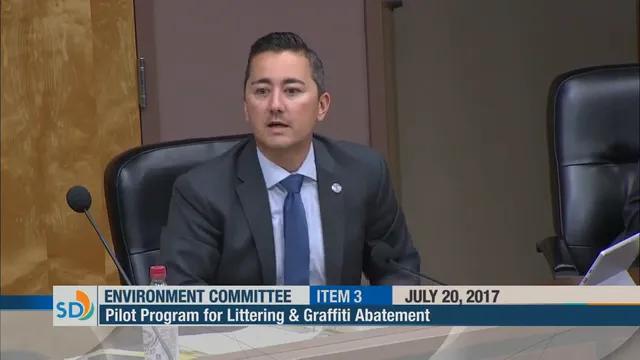
The Environment Committee met on July 28, 2017, to discuss the bicycle master plan strategic implementation, a pilot program for litter and graffiti abatement, and an update on lead testing in schools. The committee approved consent items and heard public comments on community choice energy and waste issues. Consent Calendar - Unanimously approved the record of action items from the June 29, 2017 meeting. - Approved two consent items (no additional details provided). Public Comments & Testimony - Sophie Wolfram (Climate Action Campaign) expressed strong support for community choice energy, citing a feasibility study showing rates competitive with SDG&E, potential for over $50 million annual revenue for clean energy initiatives, and benefits for achieving climate action plan goals. - Martha Welch (public comment) expressed concern about rising garbage costs and lack of street recycling in San Diego, urging the city to improve recycling services. - Patricia Murphy (San Diego 350) expressed support for community choice energy, highlighting its potential for more renewable energy at lower cost, economic development, green jobs, and consumer choice. Discussion Items 1. Bicycle Master Plan Strategic Implementation Plan - Staff Presentation: Linda Morabian (Deputy Director, Transportation Engineering) and Brian Genovese (Senior Traffic Engineer) presented staff responses to the Bike Advisory Committee's (BAC) strategic implementation plan. Staff agreed with 24 of 32 tasks, partially agreed or disagreed with 8 tasks related to budget, staffing, and feasibility. Key disagreements included completing high-priority projects by 2020 (estimated $77 million), updating the bicycle master plan (pre-dates climate action plan and Vision Zero), and dedicating 6% of transportation funding to bike projects. - BAC Chair Andy Hanshaw emphasized the need for accelerated implementation, protected bike networks, and prioritization of Vision Zero corridors and underserved communities. He noted the plan's alignment with climate action goals and the downtown mobility plan. - Public Comment (Sophie Wolfram) reiterated concerns about outdated bicycle master plan not aligning with climate action targets and lack of firm funding commitment. She urged integration of mode share targets and updated planning documents. - Committee Questions: Councilmembers asked about ridership tracking (counters being installed, challenges with vendors), costs of bike elements in resurfacing projects (approximately 10% additional), funding sources (grants sought, $10 million in FY18), and the need for a safe routes to school coordinator. - Councilmember Alvarez stressed the need for measurable metrics (mode share, greenhouse gas reductions) and accountability. He questioned whether updating the bicycle master plan would help align with climate action plan targets. 2. Litter and Graffiti Abatement Pilot Program - Staff Presentation: Darren Greenhall (Assistant Director, Environmental Services Dept.) presented the 12-month pilot program (FY 2018, $800,000) targeting nine neighborhoods. Early results (May-July): collected 126 tons of waste, 736 bulky items, 250 mattresses, and various appliances. Crews operate Monday-Friday with two four-person teams; graffiti abatement coordinated with Streets Division (over 300 reports, 150 abatements to date). - Public Comment: Jim Varnador (City Heights Town Council) supported the program and requested focus on alleys in City Heights, urging future budget expansion. - Committee Questions: Councilmembers discussed selection criteria (hot spots, complaint data), potential expansion, data tracking by neighborhood, coordination with existing maintenance assessment districts and community cleanups, and enforcement against illegal dumping. Councilmember Alvarez requested a mid-year update for budget planning. 3. Lead Testing in Schools Update - Staff Presentation: Peter Broom (Deputy Director, Public Utilities) reported that San Diego Public Utilities completed sampling at 236 schools (198 San Diego Unified, 38 others) ahead of schedule, representing 47% of county requests and 20% of statewide requests. Of 1,115 samples, only five exceeded the action level of 15 parts per billion, from four schools (Emerson Elementary, San Diego Co-op 2, Smythe Elementary, and one in San Ysidro School District). City costs to date: $480,000 (88% labor); estimated total $905,000. City will seek state reimbursement via a test claim. - Committee Questions: Councilmembers probed costs (rate-payer dollars), timeline for state reimbursement (uncertain), workload for remaining schools (140 requests possible by 2019), and potential annual testing legislation. Staff noted they have not costed annual testing but will share data with Assemblymember Gonzalez Fletcher to inform policy. Key Outcomes - Bicycle Master Plan: The committee directed the Bike Advisory Committee to incorporate staff analysis and committee comments and return with a final strategic implementation plan at the September meeting for potential action and recommendation to full council. - Litter Abatement Pilot: No action required; staff will provide a mid-year update to the committee to inform future budget decisions. - Lead Testing: No action required; informational item. City will continue to sample upon request and pursue state reimbursement.

ACTIVE TRANSPORTATION 22% · PUBLIC WORKS 20% · BICYCLE INFRASTRUCTURE 18% · WATER AND WASTEWATER MANAGEMENT 10%
986
JUL 27, 2017 · SAN DIEGO, CALIFORNIA · RULES COMMITTEE
San Diego City Rules Committee Meeting - July 27, 2017

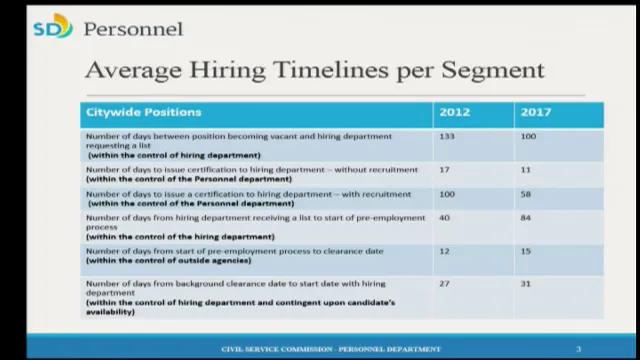
The San Diego City Council Rules Committee met on July 27, 2017, at 9:00 AM. Committee members Bree, Kate, and Vice Chair Kercy were present; Councilmember Ward was absent. The meeting covered a consent calendar, public comments, and several discussion items including a proposed charter amendment on hiring, reorganization of city boards and commissions, and responses to a grand jury report on San Diego Unified School District elections. Votes were taken on each item. Consent Calendar - Approval of Minutes: The committee record of actions from June 7, 2017, was approved by unanimous consent. No items were pulled for discussion. - Item 1: During public comment, Martha Welch spoke in opposition to the removal of the civil engineers department, arguing that civil engineers are essential for road construction and maintenance. Francine Maxwell suggested creating a housing department and a human services department, citing dissatisfaction with Civic San Diego. After public comment, the committee re-voted on item 1, which passed unanimously. - Item 2: Senior Deputy City Attorney Priscilla Degard noted two clarifying edits to a policy: changing "in most cases" to "depending upon the matter" and correcting "little confidential information" to "no confidential information that is material." The item was then voted on and passed unanimously. Public Comments & Testimony - Non-Agenda Public Comment: Martha Welch spoke about a 50-year rule on buildings, expressing concern that it could lead to displacement of low-income seniors from older buildings like Lutheran Tower and West Mirror. Francine Maxwell raised concerns about the lack of transparency and progress on Proposition G (Citizen's Review Board and Community Advisory Board), asserting that the mayor's office has not implemented needed changes and that the public cannot even learn how many have applied for an outside attorney. - Item 3 (Charter Amendment): Rodney Fowler, president of Local 127, opposed the amendment, stating the current system ensures independent oversight and warning against politicizing hiring. Joe Cloverdale, a civil service commissioner, argued the proposal would undermine a fair, non-political hiring process established over eight decades and cautioned against following other cities. Chris Vanels of Teamsters 911 opposed, blaming poor employee morale and retention on city management, not the personnel department. - Item 6 (Grand Jury Report): Numerous speakers—including Francine Maxwell, Tamra Hurley, Kaim Jackson (San Diego Unified School District representative, in support of the IBA response), Robert McNamara, William Ponder, Smith, Lorraine Burley, Jeffrey Bennett, Daniel Shemhovsky, Dwayne Harvey, Tasha Williamson, Philip LeBird, Karen, Lily Higman, Mits Lee, and Michelle Anderson—expressed positions mostly in favor of the grand jury's recommendations for term limits and subdistrict-only elections. Many criticized the school board for lack of transparency, responsiveness, and representation. The district representative argued the current system does not harm diversity and that the board is committed to its work. Discussion Items - Item 3: Charter Amendment on Hiring Process (Vice Chair Kercy) - Vice Chair Kercy introduced a proposal to separate the hiring function from the Civil Service Commission and place it under mayoral control, arguing the current charter language (since 1931) slows hiring. Lee Friedman and Elizabeth Spillane presented, noting that other large California cities (San Francisco, Los Angeles, San Jose) have separated these functions. They requested a motion to draft language for the June 2018 ballot. - Personnel Director Hadi Deghani and Deputy Director Doug Edwards updated the committee on recent improvements, including reduced days to issue certifications (from 17 to 11 days) and increased recruitments (from 203 to 333). They also noted that hiring departments control 64% of the onboarding process. - Committee Chair Cole expressed concerns about lack of fiscal and operational information and the potential for political influence, making a motion to continue the item to a future rules committee with a request for a more defined report. Councilmember Bree seconded. Vice Chair Kercy expressed willingness to continue discussions. The motion passed unanimously. - Item 4: International Affairs Board Reorganization - Joel Day, Executive Director of the International Affairs Board, presented proposed changes to expand the board from 11 to 17 members, including nine council district representatives and eight from civic organizations (e.g., SANDAG, Port Commission, Airport Authority). The board would also become advisory to the council, not just the mayor. Deputy City Attorney Sharon Spivak raised a concern about quorum language differing from other boards, but noted willingness to work on language. Councilmember Kate made a motion to forward to the full council after legal review, seconded by Councilmember Bree. The motion passed unanimously. - Item 5: Consolidation of Boards into Human Relations Commission - Francis Barraza and Joel Day presented a proposal to merge the Commission for Women, Senior Affairs Advisory Board, and Youth Commission into the Human Relations Commission (HRC), which would add subcommittees for protected classes. Francine Maxwell spoke in favor but urged retaining the youth commission for youth perspectives. The city attorney requested legal review as part of any motion. Councilmember Kate moved to forward with city attorney review; seconded by Councilmember Bree. The motion passed unanimously. - Item 6: Grand Jury Report on SDUSD Elections - Lisa Byrne from the IBA presented the proposed response to the grand jury report, which found issues with the election process and recommended term limits, subdistrict-only elections, and a runoff change. The IBA proposed agreeing wholly or partially to findings and not implementing some recommendations. During public comment, many speakers urged full adoption of the grand jury's recommendations. Councilmember Kate proposed an amendment to change finding four to "agree," but the motion maker retained the original motion. The committee vote was 2-2 (Chair Cole and Councilmember Bree in favor of the original motion; Vice Chair Kercy and Councilmember Kate opposed). The item will go to the full council without recommendation. Key Outcomes - Consent Calendar: Items 1 and 2 approved unanimously after public comment and staff clarifications. - Item 3: Continued to a future rules committee meeting; requested fiscal and operational analysis. - Item 4: Forwarded to full council with direction for city attorney legal review. - Item 5: Forwarded to full council with direction for city attorney legal review. - Item 6: Sent to full council without recommendation due to a 2-2 tie vote. - Next Meeting: The next Rules Committee meeting is scheduled for October 4, 2017.

EDUCATION 19% · HUMAN RESOURCES 17% · SCHOOL DISTRICTS 14% · BOARDS AND COMMISSIONS 9%
987
JUL 26, 2017 · SAN DIEGO, CALIFORNIA · AUDIT COMMITTEE
San Diego City Council Audit Committee Meeting - July 26, 2017

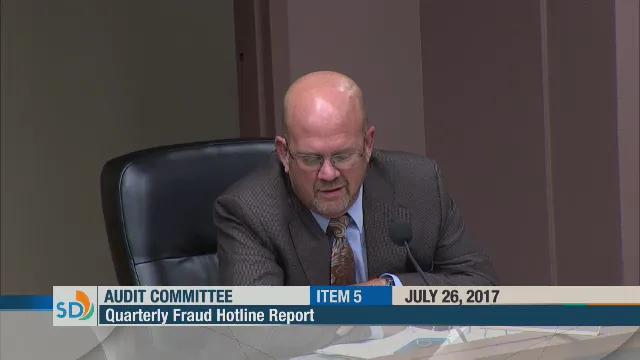
The Audit Committee met on July 26, 2017, to review the City Auditor's monthly activity report, a performance audit on street repaving quality management, the FY 2018 audit work plans (including IT), and the quarterly fraud hotline report. The committee accepted all reports and recommendations, forwarding them to City Council. The meeting also included public comments and a closed session for the City Auditor's performance evaluation. Consent Calendar - Approved the June 14, 2017 meeting minutes by unanimous consent. Public Comments & Testimony - Martha Welsh (member of the public) spoke on two items. First, she expressed concern about the lack of performance audits and financial transparency, stating the city is "hiding the money" without them. Second, she expressed support for the street repaving audit, citing widespread cracks and potholes, and advocated for different approaches to road maintenance. Discussion Items - Monthly Activity Report (Item 1) – City Auditor Eduardo Luna presented updates on issued audits, including the street repaving audit and FY 2018 risk assessments. Committee members questioned audit hours, budgeting, and efficiency. Auditor Luna explained that audits continue beyond budgeted hours to cover critical issues. Councilmember Sherman requested data on audits exceeding budgets and a breakdown of fieldwork progress. The report was information-only. - Performance Audit on Street Repaving Quality Management (Item 2) – Supervising Auditor Chris Kaim and staff presented findings: resident engineers met qualifications, but quality control documentation was lacking, making it difficult to verify specifications and diagnose early deterioration. They reviewed 3,800 repaved blocks; 244 declined from good to fair sooner than expected. Recommendations included requiring contractor quality control plans and analyzing underperforming streets. Transportation & Stormwater Director Christy Fatherman and City Engineer James Nagelvoort responded, agreeing with recommendations and noting 94% of repaved streets performed as expected. They discussed factors like subgrade issues, trenching, and the 2012 change in trench repair standards. The committee accepted the report and forwarded it to City Council. - FY 2018 Citywide Risk Assessment and Audit Work Plan (Item 3) – Auditor Luna presented 22 projects, including carryovers and new audits. He noted a request to defer the public liability audit and proposed replacing it with a community planning process audit. Committee members discussed carryover hours, audit budgeting, and the human capital audit. They requested more detailed reporting on actual vs. budgeted hours. The committee approved the plan with the substitution. - FY 2018 IT Risk Assessment and Audit Work Plan (Item 4) – Principal IT Auditor Steve Gomez presented the plan, including two new audits (disaster recovery preparedness and City Hub security). Carryover audits included the Excel implementation and police data security. Councilmember Sherman asked about the delayed Excel audit, citing staffing changes. The committee accepted the plan. - Quarterly Fraud Hotline Report (Q4 FY 2017) (Item 5) – Fraud Investigator Andy Horita reported a marked increase in complaints (203 in FY17, up from 120 in FY16). During Q4, 53 complaints were received; 38 were city-related. Two city auditor investigations were substantiated, resulting in public reports (theft of recreation fees and false vendor statements). Four department investigations were substantiated. Six additional investigations led to corrective actions. Committee members discussed trends, case outcomes, and disciplinary actions. The committee accepted the report. Key Outcomes - Approved minutes of June 14, 2017. - Accepted the street repaving performance audit and authorized the auditor to present it to City Council (unanimous). - Accepted the FY 2018 Annual Citywide Risk Assessment and Audit Work Plan, with the revision to replace the public liability audit with the community planning group audit (unanimous). - Accepted the FY 2018 IT Risk Assessment and Audit Work Plan (unanimous). - Accepted the Q4 FY 2017 Fraud Hotline Report (unanimous). - Moved to closed session for a public employee performance evaluation of the City Auditor. (Note: No agenda or minutes were available; the summary is based solely on the raw transcript.)

AUDIT FOLLOW-UP 28% · ROAD MAINTENANCE 18% · FRAUD PREVENTION 10% · PROCEDURAL 8%
988
JUL 26, 2017 · SAN DIEGO, CALIFORNIA · LAND USE & HOUSING COMMITTEE
Smart Growth and Land Use Committee Meeting - July 26, 2017

The Smart Growth and Land Use Committee of the San Diego City Council met on July 26, 2017, to discuss and act on several items including community parking district budgets, a parks master plan, a housing scorecard, and a comprehensive housing action plan. The meeting was chaired by Councilmember Sherman, with Councilmembers Gomez, Alvarez, and Kate present. The committee approved consent agenda items and the community parking district plans with amendments, forwarded the parks master plan agreement to the full council with conditions, and received informational reports on housing and a housing action plan. Consent Calendar - Approval of Minutes: The minutes from the June 14, 2017 meeting were approved by unanimous consent. - Consent Agenda (Item 2): The committee approved the consent agenda item related to code amendments. Councilmember Gomez noted the need to explore code changes for tiny homes for homelessness. Councilmember Alvarez raised questions about plumbing code and window setbacks for accessory dwelling units. The item passed unanimously on a motion by Councilmember Gomez, seconded by Vice Chair Alvarez. Public Comments & Testimony - Non-Agenda Public Speakers: - Lori Saldania: Expressed concern about the Linda Vista Mobile Home Park on city-owned land, where a private for-profit management company is increasing land lease payments, making it unaffordable for residents on fixed incomes. Requested an audit of city real estate holdings to ensure affordability. - Catherine Rhodes: Criticized the city for a rise in homelessness and deaths, alleging the San Diego Housing Commission sits on $32 million in federal HUD funds. Urged the use of Chargers Park for homeless services, citing the city attorney's legal opinion that the mayor can lease property without council approval. - Martha Sullivan: Highlighted challenges for mixed-use building owners regarding inconsistent city services (water rates, trash pickup) and recommended standardizing the city's approach to encourage live-work arrangements. - Barbara Gordon: Asked the city to regulate marijuana advertising (signs, billboards) to protect youth, claiming permitted pot shops are not being discreet as promised. - Susan Wilcox: Urged careful interpretation of regulations for pot shop applicants, noting that some former illegal operators are applying for permits and that the 50% rule for sensitive use facilities is being misapplied. - Martha Welch: Pointed out that many new expensive apartment buildings are being constructed while affordable housing is needed, and noted vacancies in existing luxury buildings. - Consent Agenda Speaker (Martha Sullivan): Recommended that the Development Services Department expand its stakeholder list for code revisions to include tenant and consumer groups, not just industry and regulators. - Community Parking District (Item 2): - Catherine Rhodes (in favor): Supported the districts but opposed the city attorney's legal interpretation that restricts use of parking meter revenue; argued that state law allows broader uses. Requested clearer fund balance reporting. - Ben Nichols (in opposition): Opposed the use of parking district funds for Sandag's bike lane project in Hillcrest, which removes parking. He argued that using parking meter money to pay for amenities after parking is removed is antithetical to the districts' purpose. - Housing Scorecard (Item 5): - Catherine Rhodes: Criticized the city and Housing Commission for not tracking destroyed affordable housing units as required by the housing element; claimed seniors were unlawfully displaced without relocation assistance. - Housing Action Plan (Item 4): - Catherine Rhodes (in favor): Supported the plan and noted 275 hepatitis A cases, 187 hospitalizations, and 7 deaths due to lack of sanitation for homeless; urged use of Chargers Park for tiny homes and shelters. - Ellis Rose (in favor): Strongly supported the plan, especially the diversity of bridge housing and shelter options; recommended expanding nonprofit service providers. - Lori Saldania (in favor): Supported the plan and urged partnership with the San Diego Community College District to address student homelessness and food insecurity, emphasizing wraparound services. - Jeannie Crescenzo (in favor): Supported the plan but stressed the need to include extremely low-income households (30% AMI); suggested rent control for companion units and long-term leases for SROs to prevent Airbnb use. Disagreed with 99-year affordability terms. - Ann Baron (in favor): Supported rent control, use of empty Navy housing, and cooperative housing models; urged tiny shelters and transitional housing. - Stephen Russell (in favor): Supported fee deferrals to leverage tax credits, supported AB 1505 for inclusionary housing clarity, recommended a preservation coordinator, and suggested MTS parking lots for affordable housing. Strongly supported a 2018 housing bond measure. - Juan Del Rio (in favor): Supported the plan but cautioned against city government competing with market-rate developers; recommended focusing on very low-income households and using a per-unit fee rate instead of per square foot. - David Modi (opposition): Opposed the plan due to concerns about eroding development impact fees and the lack of a clear infrastructure financing model; noted that Talmadge has three to four times its fair share of affordable housing without adequate park space. - Bora Winkle (neutral/caution): Representing the Building Industry Association, he cautioned that new reforms may reduce building before increasing it; urged focus on middle-income housing to stop the bleeding into affordable categories; opposed doubling inclusionary fees. Discussion Items - Community Parking District FY2018 Plans and Budgets (Item 2): Staff presented proposed budgets for downtown, uptown, mid-city, old town, and Pacific Beach districts. Key discussions included the use of parking meter revenue for Sandag bikeway maintenance in Bankers Hill (not Hillcrest), angle parking conversions, and the need for better utilization data via a new sensor pilot. Councilmember Gomez moved an amendment to remove $5,000 for the SR-15 parking lot improvements in mid-city, add funding for I-15 bridge deck improvements, and include projects in District 9 (parklet, angle parking, crosswalks, shade trees). The motion passed unanimously. - Parks Master Plan Agreement (Item 3): Staff recommended approval of a $1.4 million contract with AECOM for a three-year citywide parks master plan, the first since 1956. Goals include addressing park deficits in older communities and revisiting the 2.8 acres per thousand standard. Councilmembers expressed the need for multiple plan options (not just one) for council decision, multilingual outreach, and ensuring options are contractually included. Vice Chair Alvarez moved staff recommendation with added multilingual language and commitment to work on option language before council. The motion passed unanimously. - San Diego Regional Chamber of Commerce Housing Scorecard (Item 5): Sean Caraffin presented the scorecard, showing the region is on pace to produce only 50% of needed housing units by 2020. For the City of San Diego, the projected completion is 45,000 units against a need of 88,000. The city produced only 52 moderate-income units from 2010-2016. Over 57% of renters and 41% of homeowners with mortgages spend more than 30% of income on housing. Net out-migration, especially of families and seniors, is occurring; inflow of millennials is lower than competitor metros. - Housing Action Plan (Item 4): Councilmember Gomez and staff presented a seven-initiative plan addressing companion unit fee reduction, SROs and micro-units, inclusionary housing fee study, preservation coordinator for at-risk units, interim housing solutions study (tiny homes, motel conversions, sanctioned campsites), evaluation of city-owned land for housing, FAR-based zoning, a grant coordinator for state funds, and a potential 2018 housing bond measure. Committee members expressed broad support, with specific interest in micro-unit permitting, fee deferrals for tax credits, tracking loss of affordable units, and a new funding measure. No formal vote was taken; the item was for discussion and feedback. Key Outcomes - Consent Calendar: Approved unanimously. - Community Parking District Annual Plans: Approved with Councilmember Gomez's amendment (removal of SR-15 parking lot funding, addition of I-15 bridge deck funding, and inclusion of District 9 projects). Vote: unanimous. - Parks Master Plan Agreement: Recommended to full council for approval, with direction to add multilingual outreach language and to work on ensuring multiple plan options are contractually required. Vote: unanimous. - Housing Scorecard: Received as information; no action taken. - Housing Action Plan: Received as information; next steps include a letter to the mayor on companion unit fees, supporting the homeless committee's interim housing study, and returning to the committee in October with details on FAR-based incentives.

AFFORDABLE HOUSING 34% · PARKS AND RECREATION 13% · PARKING MANAGEMENT 12% · HOMELESSNESS 10%
989
JUL 19, 2017 · SAN DIEGO, CALIFORNIA · PUBLIC SAFETY & LIVABLE NEIGHBORHOODS COMMITTEE
Public Safety and Livable Neighborhoods Committee Meeting - July 19, 2017

The Public Safety and Livable Neighborhoods Committee met on July 19, 2017, at 10:00 AM. The committee, consisting of Chair Kate, Councilmembers Zaf and Ward (Vice Chair Bree absent), addressed several agenda items including a contract modification for the Computer-Aided Dispatch (CAD) replacement project, updates on the implementation of PERF recommendations, the police department's five-year plan, Vision Zero, and the Human Relations Commission annual report. Public comments covered EMS worker conditions, police staffing, towing contract transparency, and pedestrian safety. Consent Calendar - The committee unanimously adopted the record of action items from the June 28, 2017 meeting. Public Comments & Testimony - Daniel Smyovsky: Stated he is running for City Council District 2, calling for objectivity and bringing people together. - Joseph Ross (speaking also for Ahmed Al-Atas): Requested modification to AB 263 to require EMS contract holders (like AMR) to match fire department policies on lights and sirens for non-emergency (Level 3) calls, arguing that current practices overuse lights and sirens, endanger workers, and reduce break time; urged committee to contact state legislators. - Martha Welch: Expressed concern about police staffing levels, noting stations closed and patrol cars with only one officer; argued that understaffing compromises public safety and that funds are diverted to pensions. - Sapphire Blackwood: Raised concerns about towing bid contracts (RFSQ procedures) not being reviewed in over 20 years; called for transparency, lower fees, and public access to contract award criteria. - Jared Solar: Reported spending over $800 in towing fees and requested transparency in contract awards and a hold on new awards. - Andrea Reyes: Spent over $1,500 on towing fees and echoed calls for transparency and a hold on contract awards. - Luis Huerta: Spent over $400 on towing fees and requested transparency and a hold on awards. - Beryl Foreman (El Cajon Boulevard Business Improvement Association): Urged immediate changes on El Cajon Boulevard, the second most dangerous corridor, citing deaths and near-misses; highlighted dense developments and schools along the corridor. - Paige Colburn Hargis (Trauma Research Education Foundation): Reported that from January to September 2016, San Diego County trauma centers cared for 563 pedestrian-injury patients, with 100 in critical condition; pedestrian injuries are a leading cause and appear to be rising; offered to share data. - Dan Fesperman (Community Health Improvement Partners): Urged prioritizing engineering as the most effective strategy; called for greater transparency on goals and data. - Maya Rosas (Circulate San Diego): Recommend prioritizing engineering, reconvening the Vision Zero Task Force as a standalone entity meeting bi-monthly, and providing public collision data on a website. - Kathleen Ferrier (National Vision Zero Network): Cited success in cities like New York (26% reduction in deaths) and Seattle; urged measurable goals, evaluation, and transparency; noted that many listed projects are not Vision Zero-specific. - Andy Hanshaw (San Diego County Bicycle Coalition): Supported Vision Zero; asked for emphasis on engineering on Vision Zero corridors and pursuit of grants for protected bike lanes. Discussion Items 1. Computer-Aided Dispatch (CAD) Replacement Project (Action Item) - Steve Chen (SDPD Information Systems Administrator) presented an update. The legacy CAD system is being replaced via a project approved in 2013. Intergraph (Hexagon) was selected in December 2015. Out of 3,211 functionality requirements, 18 gaps were identified and resolved. The team has completed hardware/software installation, configuration workshops, and acceptance testing. Dispatcher training is underway; go-live is planned for October 2017. Additional functionality (iDispatcher) was discovered for call takers. A contract modification of approximately $461,000 was requested, including a $25,000 credit from prior change orders, plus an anticipated $110,000 for future needs; total funding remains within allocated capital project funds. Motion by Councilmember Ward, seconded, passed unanimously. 2. Police Department Response to PERF Recommendations (Information Item) - Chief Shelley Zimmerman reported that all 40 PERF recommendations are now implemented. The final seven relate to the Early Identification Intervention System (EIS), which uses IAPRO Blue Team software to monitor employee performance. Systems include automated alerts, monthly supervisor reviews, and documented interventions. The department has contracted with PERF director to share completion reports. - Brian Marvel (POA President) praised implementation but noted staffing shortages: 30 open sergeant positions (10% of budgeted), 96 open detective positions (29%), and only 1,817 actual sworn officers as of July 1, 2017 (lowest since 2000). He warned that understaffing undermines supervision and accountability, and urged immediate action. 3. Police Department Five-Year Plan Status (Information Item) - Chief Zimmerman detailed progress since the original 2012 plan. As of FY18, the department added 70.5 budgeted sworn FTE (needs 89 more to reach 2009 levels) and 61 civilian FTE (needs 39 more). Current sworn staffing is 1,817. Facility needs include elevator modernization ($1.7M), energy management ($4.5M), traffic division replacement, backup dispatch center (up to $1.1M), police range ($7M), training facility study ($250K), SWAT/canine facility study ($250K), and EVOC site in Otay Mesa (city committed up to $5M). Equipment: 1,280 body cameras deployed; helicopter fleet study completed; Motorola portable radios need replacement (3,000 units at $5,500 each, $1.6M/year). Total projected costs: $26.4M (FY19), $15M (FY20), $9.9M (FY21). - The IBA noted additional FY18 budget items: $3M for overtime, $4M for recruitment/retention compensation, $350K for marketing, $150K for retention study, $100K for salary survey, $200K for AB 953 implementation, and $500K for sexual assault kit testing. - Brian Marvel reiterated the staffing crisis, noting a net loss of 12 officers over five years, attrition exceeding hiring, and 600 officers retiring within five years. He urged the committee to prioritize police funding and reopen contract negotiations. 4. Vision Zero Strategic Implementation Plan Update (Information Item) - Alejandra Gavaldon (Mayor's Director of Infrastructure and Water Policy) introduced the update. Engineering (Linda Moradkhan): Training on complete streets, University Avenue project advanced (construction expected 2021, $5.4M grant received), transportation strategic plan consultant selected, street design manual updated with NACTO (National Association of City Transportation Officials) guidelines, citywide crash analysis grant ($250K) to identify high-crash locations, and $12M in capital projects allocated for safety. Enforcement (Captain Ramos): $219K grant from Office of Traffic Safety for pedestrian/bike safety; $100K from STEP grant for enforcement details; two details per month conducted along El Cajon Boulevard and University Avenue; fatalities year-to-date are 22 (down from 29 in same period 2016). Education (Katie Keats): Media campaign launching September 2017; Vision Zero expositions planned per council district; collaboration with school district for 'Heads Up' campaign; focus on awareness and distracted behaviors. - Committee members discussed progress on corridors, measurable outcomes, enforcement targeting, and the need for a Vision Zero website with accessible data. 5. Human Relations Commission Annual Report (Information Item) - Chair Steph Gross and Executive Director Joel Day presented the report. In 2016, the commission co-sponsored the All People's Breakfast, attended over 200 events, and contributed to San Diego receiving a perfect 100-point rating on the Human Rights Campaign Municipal Equality Index. The 2017-2019 work plan includes 30 tactics under five strategies: collaborate, educate, advocate, investigate, and mediate. Outcomes include higher profile, 60% increase in activities, and deeper partnerships. - Committee members praised the report and emphasized the importance of outreach to diverse communities, including language access. Key Outcomes - Motion passed (unanimous): Approval of change orders (approx. $571,000 total) for the Computer-Aided Dispatch replacement project with Intergraph/Hexagon. - Staffing concerns noted: Police department staffing at 1,817 sworn officers (lowest since 2000); 600 retirements expected in five years; POA urged immediate action to reopen contract negotiations. - All 40 PERF recommendations implemented as confirmed by Police Chief; report to be shared with PERF director. - Five-year plan update received; projected needs of $26.4M (FY19), $15M (FY20), $9.9M (FY21) for sworn positions, civilian positions, facilities, and equipment. - Vision Zero update received; fatalities decreased to 22 year-to-date from 29 in 2016; media campaign launching September; committee requested measurable outcomes and public data dashboard. - Human Relations Commission annual report received; noted increased community engagement and planned outreach to non-English-speaking communities. - Next meeting scheduled for September 18, 2017 at 9:00 AM.

PUBLIC SAFETY 24% · PUBLIC COMMENT 17% · MISCELLANEOUS 14% · POLICE OVERSIGHT 13%
990
JUL 13, 2017 · SAN DIEGO, CALIFORNIA · ECONOMIC DEVELOPMENT & INTERGOVERNMENTAL RELATIONS COMMITTEE
San Diego City Council Committee Meeting on Federal Update and Economic Forecast – July 13, 2017

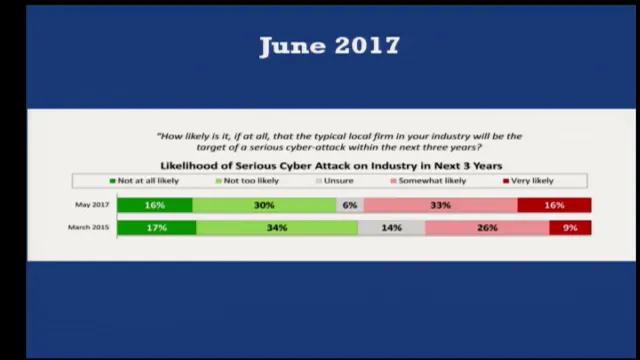
The committee met to receive a federal legislative update from the Mayor's Office and Squire Patton Boggs, followed by a presentation from the San Diego Regional Chamber of Commerce on the county business forecast. Both items were informational; no votes were taken. The meeting also included approval of prior minutes, non-agenda public comment, and a welcome to visiting students from Taiwan. Consent Calendar - The meeting minutes from June 15, 2017, were approved by unanimous consent with no changes or comments. Public Comments & Testimony - Lon Jefferson (Commissioner, CEO C) introduced himself and stated that commissioners are working to build healthy relationships with the council and committees. - Marcel (last name not given) read from a Caber book and expressed concerns about housing rules, stating that most housing comes from economic development and that HUD money goes to them. He criticized the rules for making it hard to move into housing, citing the Talmud Gateway project as an example where only seniors can enter. Discussion Items Federal Legislative Update (Presented by Pam Welsh, Cameron Simmons, Patrick Witteller) - Pam Welsh provided an overview of 2017 federal actions, including the completion of FY17 budget, executive orders, and withdrawal from international agreements. She reported that all of San Diego's FY17 appropriations priorities were successful, notably the Urban Area Security Initiative (UASI) which secured $16 million for San Diego (ranked 9th nationally). - For FY18, the city's requests include continued funding for UASI, the US-Mexico border water infrastructure program, transportation priorities (Mid Coast Corridor, Otay Mesa port of entry, southbound truck route), Pure Water (WIFIA program), Point Loma wastewater waiver, and homelessness funding formula reform. - Welsh noted that the city has submitted a letter of intent for Pure Water under the WIFIA program, and is optimistic about being selected. The Point Loma waiver renewal process is ongoing; the current waiver is good for five years. - On the border wall, the House included $1.6 billion in its FY18 bill, but Senate Democrats oppose it. The city continues to engage with DHS and CBP on border wall prototypes. - Regarding immigration, the city opposes HR 1813 (fees on remittance transfers) and is monitoring Kate's Law (mandatory minimums for deported immigrants who commit crimes). - Councilmember Kersey asked about the municipal bond tax exemption, infrastructure/tax reform linkage, and marijuana banking. Welsh stated that the municipal bond exemption remains a concern but is a top priority for city associations. On repatriation, she noted bipartisan support. On marijuana banking, Congressman Vargas is aware but no concrete action. - Councilmember Alvarez asked about the Tijuana River Valley and San Diego River levy feasibility studies, which will be authorized through the Water Resources Development Act. He also noted concerns about lack of action by IBWC. - Councilmember Bry asked about the likelihood of Pure Water being selected for WIFIA; Welsh said they are very optimistic, with EPA viewing it as a poster child. - Councilmember Zapf expressed frustration that many issues (e.g., medical device tax, repatriation, CDBG) have been discussed for years without resolution. She asked about the federal law requiring cruise ships to cross an international border, which hurts San Diego's cruise business (each ship worth about $2 million). Welsh said she would look into it. San Diego County Business Forecast (Presented by Sean Carefin, Vice President, San Diego Regional Chamber of Commerce) - Carefin presented results from the Chamber's monthly business outlook survey, which includes a Business Outlook Index. The index has been in positive territory since late 2013, with the highest levels in early 2014. Recent dips were tied to events like the minimum wage increase and the election. The most recent June 2017 survey (200 businesses) found that nearly half of businesses (up from 35% two years ago) believe a serious cyber attack is somewhat or very likely in the next three years. - In May 2017, after the gas tax increase, businesses in negatively impacted industries opposed it, while 3% saw a positive impact. In April, the top challenge for small businesses was government regulations, taxes, or fees (31%), followed by the minimum wage increase (16%) and cost of health care (11%). - In February, large businesses were more likely to have disaster recovery plans than small businesses. In December 2016, 32% of businesses did not see workforce health programs as important. In November 2016, most businesses reported participating in corporate social responsibility. - A slide from August 2016 showed that businesses overwhelmingly believe housing is too expensive; employers see it as a major issue for attracting and retaining talent. - Councilmember Bry asked about the profile of chamber members (mostly small businesses, stratified across sectors) and whether the survey asks what businesses like about San Diego. Carefin said yes, and can provide those results. - Councilmember Alvarez asked about regional breakdowns; the survey is cross-tabulated by geography. He noted a dip in October 2016—Carefin said it was likely due to election uncertainty. Alvarez also noted that some South County chambers are not participating, and he would share the invitation. - Councilmember Kersey asked why housing is not listed among the top challenges in the April slide. Carefin noted that a separate July 2016 survey found that the number one issue for employers was retaining/attracting talent, and the top reason was housing. Kersey suggested adding housing to the list of challenges. - Councilmember Zapf observed that the index's highest point was in early 2014 and has not recovered, possibly due to the presidential campaign. She noted that the survey results align with what she hears from small businesses about regulations, taxes, and minimum wage. Key Outcomes - No decisions or votes were taken. The committee received both reports as informational. No referrals or directives were issued. Additional Notes - The committee welcomed 24 high school students from Taichung, Taiwan, who were visiting City Hall. President Jong Wong introduced the group. - The meeting was adjourned after the second item.

FEDERAL AFFAIRS 27% · ECONOMIC DEVELOPMENT 22% · TOURISM 8% · IMMIGRATION 7%
OPENPUBLICA · PUBLIC MEETING INDEXUPDATED DAILY · openpublica.com