The Infrastructure Committee of the San Diego City Council met on Wednesday, October 25, 2017 at 2:00 PM in Council Chambers. The meeting covered design standardization updates, the Fiscal Year 2017 State of the CIP report, contract amendments for the I AM San Diego project, the Ocean Beach Pier structural evaluation, the West Mission Bay Drive Bridge replacement, and budget revisions for various CIP projects. All items were approved unanimously, with one recusal. Public Comments & Testimony - Martha Welch (non-agenda speaker) expressed concerns about poor road conditions, lack of compliance, and the use of private contractors versus city staff, stating that roads are not lasting as long as they should. - Ricky Granowitz spoke in strong support of the design standardization effort, noting she had advocated for it for 20 years and urging the committee to move it forward and expand to tot lots. Consent Calendar - The committee approved the consent agenda unanimously, which included: - Award of a Second Amendment to the consultant agreement with Tran Consulting Engineers (TCE) for design and construction support of Navajo Pump Station. - Seventh Amendment to the agreement with Dokken Engineering for the State Route 163 and Friars Road Interchange Project – Phase 1. Discussion Items - Design Standardization Streamlining Effort (Informational): Staff presented completed templates for fire stations, comfort stations (restrooms), and shade structures. The goal is to reduce costs, delivery time, and unpredictability. Fire station templates are already in use at two stations; comfort stations and shade structures have not yet been built. Councilmembers expressed support but raised concerns about the estimated cost ($500,000) and timeline (2.5 years) for an eight-stall comfort station. - Fiscal Year 2017 State of the CIP Report (Informational): The city expended $495 million on CIP projects, the highest in ten years. Key metrics: 33 miles of water main replaced (cumulative 95.2 miles against a 5-year goal of 175 miles), 266.3 miles of roads repaired/replaced (cumulative 595.9 miles toward the 1,000-mile pledge). The committee discussed capacity, the need for general fund facility investment, and challenges with project communication and coordination. - Authorization to Execute First Amendment with Deloitte Consulting LLP for I AM San Diego Project (Discussion): The committee approved a $2.78 million amendment to extend the contract to May 31, 2018, for systems integrator consulting services. The project aims to replace 28 legacy systems with one integrated asset management system. The total project cost is $54 million over three years. Councilmembers questioned the value but were assured a positive return on investment over 15 years. - Ocean Beach Pier Structural Evaluation – First Amendment with Moffatt & Nichol (Discussion): The committee approved the first amendment to evaluate the pier's structural condition, determine useful life, and develop long-term strategies (repair, retrofit, or replacement). The pier is 51 years old and has not had structural repairs since 1991. - West Mission Bay Drive Bridge – Authorization of Construction Contract, Accept Federal Funds, and Related Agreements (Discussion): The committee approved accepting up to $140 million in federal funds (88% federal, 12% local match) for the bridge replacement. The project will widen the bridge from four to six lanes, add bike lanes, and improve pedestrian access. Construction is expected to begin in early 2018 and finish in fall 2021. - Appropriations of Additional Funding and Budget Revisions to Various CIP Projects (Discussion): The committee approved $2.7 million in budget revisions, moving funds from projects with excess cash to ten projects in need of additional funding for award or completion. Vice Chair Ward recused himself due to a conflict of interest. Key Outcomes - Consent agenda approved unanimously (Councilmember Zap absent). - Design standardization update: received as information; no vote required. - State of the CIP report: received as information; no vote required. - First Amendment with Deloitte (I AM San Diego): motion by Vice Chair Ward, seconded by Councilmember Gomez, approved unanimously (4-0). - Ocean Beach Pier Structural Evaluation amendment: motion by Councilmember Zap, seconded by Councilmember Gomez, approved unanimously (4-0). - West Mission Bay Drive Bridge item: motion by Councilmember Zap, seconded by Vice Chair Ward, approved unanimously (4-0). - Appropriations and budget revisions: motion by Councilmember Zap, seconded by Councilmember Gomez, approved unanimously (3-0, with Vice Chair Ward recused). - Next meeting scheduled for Monday, November 13, 2017.
Public Meetings - San Diego, California
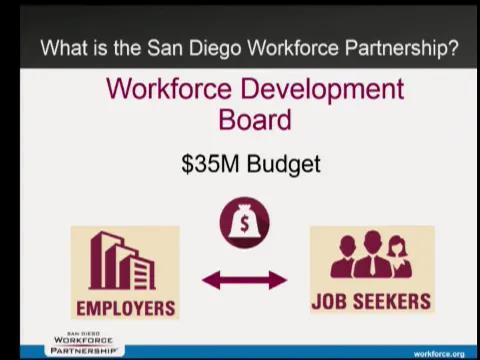
Public Meetings - San Diego, CaliforniaThis meeting of the Economic Development and Intergovernmental Relations Committee took place on October 19, 2017. The committee received informational reports from the Economic Development Department, the San Diego Convention Center Corporation and Tourism Authority, and the San Diego Workforce Partnership. Discussions centered on business retention and expansion, convention center performance and the need for expansion, and a re-entry employment program for formerly incarcerated individuals. No formal votes were taken. Consent Calendar - The record of action from the August 3, 2017 meeting was approved by unanimous consent without discussion. Public Comments & Testimony - Martha Wells spoke during non-agenda public comment. She expressed frustration that no comments were allowed on the CAFR (Comprehensive Annual Financial Report), stating, "You're hiding something because we couldn't make comments on that." She also criticized MTS for removing benches on Broadway, leaving only rings, and for changing bus routes that inconvenience riders. Discussion Items - Economic Development Department Report – Lydia Moreno (Deputy Director) and Christina Bibler (Manager of Business Expansion, Attraction and Retention) presented highlights of FY17 activities. Key points included: - Five Guaranteed Water for Industry certifications awarded. - Creation of a water sewer capacity bank approved December 2016, expected launch in FY18. - Innovation economy accounts for 25% of regional GDP ($55 billion), 6,600 companies. - Storefront Improvement Program completed 22 rebates, reached 1,000th facade improvement, and ran out of money for the first time. - Business walks: 562 surveys completed in Hillcrest, College Area, Morena, and Alcohol Boulevard. Top concerns from businesses were homelessness, safety, and trash. - 2,920 business assists provided during the fiscal year. - Councilmember Barbara Bry asked about specific permitting issues; Christina Bibler noted that staff provide education and handholding, especially for manufacturing and logistics. Councilember Mark Kersey inquired about relationships with the county and about the Guaranteed Water program. He also highlighted homeless/safety concerns from business walks and noted that workforce housing shortages could deter companies like Amazon. - Convention Center Update – Gil Cabrera (Vice Chair, acting Chair), Rip Rippeto (President & CEO, San Diego Convention Center Corporation), and Joe Terzi (President & CEO, San Diego Tourism Authority) presented FY17 results: - 149 events generated $1.1 billion in economic impact. - Hotel and sales tax revenues were highest since FY08, providing $25.4 million to the city's general fund. - 899,000 attendees (4th highest ever). - 66 primary events, including a record 21 medical citywides with 199,000 attendees. - Top event by tax revenue: Comic-Con ($3 million+). - Building occupancy reached 75.5% (2nd highest ever); functionally full above 70%. - All-time record facility revenue of $41 million. - Booked into 2035; 70% of available space for next 10 years already sold. - Lost business: 2 million room nights lost, 65-66% due to lack of space/preferred dates. - Capital expenditures increased; new sales pavilion under construction with $25.5 million loan from Infrastructure Bank. - Net ROI to city: $8.7 million (52%) after all city costs. - Joe Terzi noted that without expansion, booking cycles will decline. He expressed hope for a citizens' initiative on expansion. Homelessness and Hepatitis A outbreak were discussed as concerns, but meeting planners have not yet cancelled. - Councilmembers praised the report and stressed the need for expansion to continue economic growth. - San Diego Workforce Partnership Re-Entry Works Program – Kristen Walker (Manager of Adult Programs) presented: - Program costs average $1,700 per participant annually, compared to $76,000 per year to house one inmate. - Two job centers in jails (East Mesa and Las Colinas) provide pre-release job readiness, cognitive behavioral therapy, and post-release case management. - East Mesa job center served 1,000 participants; recidivism rate for those receiving services is 8%, well below the DOL target of 22%. - Stories shared of individuals transformed by employment, including a man who served 28 years and now works at a hotel. - Funding: Sheriff's Department contributed $150,000; Workforce Partnership matched $150,000 for continued operation. Federal DOL grant is expiring; Las Colinas has one more year. - Councilmembers Bry and Kersey expressed strong support, noted lack of state funding accompanying Proposition 47/57 reforms, and urged continued advocacy and city hiring of formerly incarcerated individuals. Key Outcomes - All items were informational; no formal votes or directives were taken. - The committee was reminded that the next meeting is scheduled for November 9, 2017.
The City Council Audit Committee met on October 18, 2017, with quorum consisting of Council Member Sherman, Audit Committee Members Ricardo Valdivia and Tom Hebrank, along with Deputy City Attorney Priscilla Dugard, new Controller Scott Clark, City Auditor Eduardo Luna, and IBA representative Lisa Bern. The committee approved the July 26, 2017 meeting minutes, heard public comment, and reviewed four audit reports and the fraud hotline activity report, all of which were unanimously accepted. Public Comments & Testimony Martha Welch expressed frustration with the lack of financial audits, stating that performance audits do not provide sufficient transparency. She also alluded to issues with the city's handling of information regarding Mission Bay and overall government openness. City Auditor's Monthly Activity Report Eduardo Luna presented the monthly activity report, summarizing reports issued since July 2017, including audits of Mission Bay Fund, Central Stores, Lifeguard Tower, charitable activities, and IT security. He noted that several audits are in progress and that the office is meeting its work plan. New staff member Dr. Joseph Pisick was introduced. No action was required. Central Stores Physical Inventory Audit Representatives from MGO (Miyuki Freeman, Stephen Moreno) presented the agreed-upon procedures audit for FY2017. Physical inventories at Central Stores 1 and 2 showed a net discrepancy of $4,996 against a total inventory value of $1.7 million (less than 1%). All prior year recommendations have been addressed. Committee member Tom Hebrank noted that 1 in 4 items in Store 1 and 1 in 5 items in Store 2 had miscounts, but the net impact was minimal. The report was unanimously accepted. Mission Bay and San Diego Regional Park Improvement Funds Audit (FY2016) Deputy City Auditor Danielle Knighton presented the audit. FY2016 adjusted Mission Bay revenues totaled over $29 million, with $9.6 million subject to allocation. The San Diego Regional Parks Improvement Fund received $2.5 million, and the Mission Bay Improvement Fund received $7.1 million. Ending balances were $29.6 million and $12.8 million respectively. Discussion covered changes due to Measure J (effective December 2016), adjustments for Mission Bay RV Resort and Camp Lamplight revenue, and a Verizon lease issue. Two recommendations were made and management agreed to implement. The report was unanimously accepted. La Jolla Children's Pool Lifeguard Station Performance Audit Chris Kime presented the audit, which was initiated due to concerns about cost overruns and quality. The project's original budget of $2.7 million escalated to $4.3 million (a 21% increase), and construction took three years. Delays were attributed to changes in design, lifeguard requests, and seal pupping season moratoriums. Quality issues included rusting of exterior steel. Three recommendations were made to improve project scoping and oversight. Public Works is implementing them and presented a plan to standardize future fire station and comfort station designs. The report was unanimously accepted and forwarded to the City Council. Fraud Hotline Activity Report (FY2018 Q1) Investigator Andy Jorida reported 55 complaints received in Q1, with 32 closed and 52 open at quarter end. Four investigations were substantiated, including a city employee using city time for charity, inappropriate attire, a non-emergency vehicle driving 98 mph, and a speed monitor placement error. Corrective actions were taken. Discussion included concerns about GPS monitoring of city vehicles and the need for proactive oversight. The number of cases continues to trend upward. The report was unanimously accepted. Key Outcomes - All four audit reports and the fraud hotline report were accepted by unanimous votes (4-0). - The committee did not take action on the monthly activity report as it was informational. - The lifeguard station audit was forwarded to the full City Council.
The meeting began with approval of minutes from September 24, 2017, by unanimous consent. Two non-agenda public speakers addressed the committee, followed by a consent agenda passage. The primary discussions focused on two informational items: the Planning Department's CEQA compliance checklist (Section 15183) and Development Services' update on the Affordable Infill and Sustainable Expedite Program. Consent Calendar - Approval of minutes from September 24, 2017, was approved by unanimous consent. - The consent agenda was approved unanimously upon a motion by Councilmember Alvarez and second by Councilmember Kate. Public Comments & Testimony - Martha Welch: Expressed frustration with the lack of family-sized housing (citing only one-bedroom and studio units in new developments like Talmadge and Cyprus), criticized the city for not using its own property (e.g., old library) for affordable housing, stated that the housing market is saturated with expensive units, and called for innovative solutions for homelessness. - Kathleen Lippett (representing San Diegans for Safe Neighborhoods): Criticized the policy building process for marijuana cultivation/manufacturing permits as not open or transparent, noting a citywide cap of 40 with no district limits (disproportionately affecting areas like District 6 and Sorrento Valley). She argued that eliminating the 1,000-foot distance requirement from youth-serving institutions and other pot shops is problematic, and highlighted the nexus between marijuana-related businesses and increased drug abuse, homelessness, and hepatitis. - Howard Blackson (public speaker on CEQA item): Supported the checklist work, recommended reviewing the city's significance determination thresholds (most defined in the 1990s) and creating two tiers (transit priority urban areas vs. suburban areas). - Jeff Forrest (land use partner at Shepard Mullen, board member for Commercial Developers Association): Congratulated the city on the CEQA checklist, predicted San Diego would become an envied expediter in California, and cited housing crisis statistics: building permits for only 50% of allocated housing, average home cost over $600,000, average rent over $1,400, 41% of homeowners and 57% of renters spending over 30% of income on housing. Discussion Items CEQA Streamlining Checklist (Section 15183) - Presentation by Jeff Murphy (Planning Director) and Alyssa Mudo (Deputy Director): The checklist is for projects consistent with recently adopted Community Plan Update (CPU) Program EIRs. It streamlines CEQA compliance by tiering off program EIRs, reducing processing time by several months and saving costs. Projects must be located within a CPU area (eight updated so far: Ocean Beach, Otay Mesa, Southeastern, Canto, San Ysidro, Golden Hill, North Park, Uptown, plus Grantville). The checklist is a new city-prepared document that determines if a project has no new significant impacts beyond the program EIR. Public review is not required, saving about three months. Mitigation measures from the program EIR are carried forward. The checklist also incorporates tiering from the Climate Action Plan Program EIR for greenhouse gas emissions. - Councilmember Alvarez raised questions about density bonus projects (which are not automatically covered under 15183 because they exceed land use zoning) and the possibility of allowing temporary residential use of commercial ground floors in mixed-use zones. He suggested maximizing environmental review coverage in future CPU updates. - Councilmember Gomez expressed concerns about balancing fast-tracking projects with community needs (e.g., parking deficits). Staff clarified that parking is not a CEQA impact but secondary effects are analyzed. The significance threshold update, especially for transportation (VMT), is planned for mid-2018, with other thresholds to follow. The checklist is separate from parking standard reductions. - The item was informational; the committee considered itself informed. Affordable Infill and Sustainable Expedite Program Update - Presentation by Elise Lowe (Deputy Director, Development Services) and Jeff Peterson: The program has a 14-year history, aiming to reduce permitting time by 50%. Recent changes: new eligibility criteria reflect city strategic objectives (e.g., increased affordable housing, sustainability). Key updates: 100% affordable housing projects get fee waivers; projects in the Promise Zone (federal designation) qualify; minimum threshold increases from 4 to 5 units (starting October 20, 2017); sustainable projects must meet tier one and tier two measures of California Green Building Code (Title 24). Program performance: 419 applications since 2003 (20,534 proposed units, 3,351 affordable, 3,943 sustainable). Of 315 approved residential projects, 23% included affordable housing, 76% were sustainable. 2017 applications dropped due to reinstated minimum threshold of 4 units in December 2016. Average fee collected: $7,843; total fees $3.5 million. Processing time goal (50% faster) was met 69% of the time in a 2016 audit; the department is working to improve. - Councilmember Gomez asked about sustainable tiers and how to shift focus toward more units. Staff noted the new eligibility is designed to increase affordable housing, but Development Services cannot control market demand. - Councilmember Alvarez highlighted the Promise Zone eligibility (any development), asked about mixed-use projects (fees only waived for residential portion of 100% affordable projects), and noted the change from process four to process two for qualifying deviations (community notification still required). He requested that the chair consider reviewing affordable mixed-use incentives. - Chairman Sherman commented that sustainable requirements are now standard, suggesting the program might better focus on affordable and market-rate housing. The item was informational; the committee considered itself informed. Key Outcomes - The committee approved the minutes and consent agenda unanimously. - Both informational items were received without formal action; the committee considered itself informed. No votes were taken on the substantive matters. - Next meeting scheduled for Wednesday, November 8, 2017, at 2 p.m. in committee chambers.
The San Diego City Council Rules Committee meeting on October 4, 2017, addressed four agenda items: proposed changes to sidewalk repair liability policy (Council Policy 200-12), a campaign finance amendment requiring principal officers of independent committees to sign a form, amendments to the ballot measure process (Council Policy 21), and updates to the city's campaign finance code. The committee voted unanimously on motions for each item, including directives for further analysis and referrals to the full council. Consent Calendar - The committee approved the record of actions from July 27, 2017, by unanimous consent, with no items pulled for discussion. Public Comments & Testimony - On item 3 (Council Policy 21 amendments), Jay Powell, a founding member of San Diegans for Managed Growth, expressed support for the City Attorney's proposal but requested that updates to Section 630 (related to the 1985 Prop A land use initiative) be addressed as a companion item, with proper noticing to stakeholders. He noted that Section 630 refers to odd-year elections and needs updating. Discussion Items Item 1: Proposed Changes to Council Policy 200-12 (Sidewalk Repair Liability) - City Attorney George Schaefer warned that shifting sidewalk repair liability to the city and imposing a 90-day repair deadline would increase litigation risk. He stated that 35-50% of new cases are dangerous condition cases (mostly sidewalk related), with 110-120 claims annually and over $10 million in payouts from FY2013-2017. He recommended a study before implementation. - Kevin Smith, Chief of Policy for Council District 8, presented the proposed revisions: shifting repair costs to the city unless damage is caused by a property owner, requiring city repair within 90 days of notice, and eliminating the 50-50 cost share program. He noted that a 2015 sidewalk condition assessment identified 85,000 damaged locations at a cost of $52.7 million, now reduced to $38.8 million unfunded. He cited a $5 million settlement as an example of potential savings. - Vice Chair Kersey expressed concern about creating an unfunded liability without a funding source. He moved to have the IBA, city attorney, and staff conduct a financial and legal analysis of the proposed changes, including a look-back at past liability. He also suggested allocating infrastructure funds from Prop H for sidewalk repair. - Councilmember Ward seconded the motion and questioned the comparison between liability fund payouts and infrastructure dollars. He noted that the 50-50 program has a $300,000 annual budget that is not fully used. He also asked about the city's current obligations and repair timelines. - Councilmember Bree supported the motion and emphasized the need to educate property owners about the 50-50 program. - Councilmember Kate asked about the evaluation and repair timeline; Transportation and Stormwater Director Chris McFadden explained that slicing contracts (for defects under 1.5 inches) take 4-6 weeks, while full panel replacements may take 2-3 years due to backlogs. - The motion passed unanimously. Item 2: Amendment to Campaign Laws – Principal Officer Acknowledgment Form - Stacey Fulhorst, Executive Director of the Ethics Commission, proposed requiring principal officers of independent committees to sign a one-page form acknowledging their duties. This was prompted by situations where individuals were listed without knowledge or consent, or did not understand their responsibilities. - Vice Chair Kergy suggested that the state Fair Political Practices Commission (FPPC) should amend the state form, rather than creating a local form. He moved to have the Ethics Commission send a letter to the FPPC conveying the committee's support for the change. - Councilmember Ward seconded, but also asked if the Ethics Commission could send a notice to listed principal officers as an administrative action. Fulhorst said they could partially address it. The motion passed unanimously. Item 3: Proposed Amendments to Council Policy 21 (Ballot Measure Process) - City Attorney Sharon Spivak proposed adding a second committee hearing to allow more time for legal review, drafting, and public input for ballot measures generated by the city (not citizens' initiatives). The policy encourages early submission and provides for 120 days of review. - Councilmember Ward moved to forward the item to the full city council. Councilmember Kate seconded. Discussion included questions about timelines for the June 2018 ballot (deadline March 9, 2018) and the need for early submission. The IBA questioned whether the timeline for June 2018 would allow two hearings. The motion passed unanimously. Item 4: Proposed Amendments to Chapter 2, Article 7, Division 6 (Ballots for Candidates) - City Clerk Elizabeth Maland proposed updates to the municipal code, including removing detailed formatting requirements to City Clerk Administrative Guidelines, allowing electronic submission of candidate photos and statements, and updating language for legal compliance. She also requested a future discussion on charging candidates for printing candidate statements (Section 27.0627), to return in July 2018. - Councilmember Ward moved to accept the recommendations but amended the motion to remove restrictions on the use of bullets, italics, underlines, bold, and all capital letters in candidate statements, arguing these tools help convey key points. He noted that symbols and excessive formatting could be restricted. - Vice Chair Kersey seconded and noted a minor typographical issue in the proposed ordinance. The motion passed unanimously. Key Outcomes - Item 1: Motion passed unanimously directing the IBA, city attorney, and staff to conduct a financial and legal analysis of the proposed sidewalk policy changes, including a look-back at past liability. The item will return to the Infrastructure Committee. - Item 2: Motion passed unanimously for the Ethics Commission to send a letter to the FPPC requesting amendment of the state Form 410 to include a signature line for principal officers, and to provide notice to listed officers. - Item 3: Motion passed unanimously to forward the proposed amendments to Council Policy 21 to the full city council for approval. - Item 4: Motion passed unanimously to forward the proposed municipal code updates (with the amendment removing formatting restrictions) to the full city council, and to direct the City Clerk to return in July 2018 for a discussion on candidate statement fees.
The Public Safety and Livable Neighborhoods Committee met on October 4, 2017, at 2:00 PM in the City Council Chambers. The meeting covered updates on the hepatitis A outbreak, a proposed amendment to the EMS transport contract, an anchoring prohibition at Zuniga Jetty Shoal, a ShotSpotter technology pilot evaluation, and an IBA report on police helicopter maintenance costs. All agenda items were addressed, with two items forwarded to the full City Council for action. Consent Calendar - The record of action items from September 18, 2017, was adopted by unanimous consent with no items pulled. Public Comments & Testimony - Francine Maxwell (4th District resident) urged the committee to request the mayor ask pastors to organize free laundry days for homeless individuals, noting laundromat owners willing to participate with city incentives. - Aaron Bizac (former EMS professional) supported the AMR contract amendments but advocated for future competitive bidding. - Alexandra Barron-Torres (Downtown San Diego Partnership) thanked AMR for donating 2,000 hepatitis A vaccinations and nursing services to at-risk populations. - Kara McElliott (San Diego Project Heartbeat) praised AMR's community support for CPR and AED programs, including Sidewalk CPR Day and school initiatives. - William Purno (Central Region Prevention Coalition) criticized the lack of community hearings on marijuana retail sales and highlighted public safety concerns. Discussion Items - Fourth Amendment to EMS Transport Contract with AMR (Rural/Metro) - Fire Chief Brian Fennessey and consultant Stuart Gary presented operational changes: revised dispatch protocols, adjusted response time compliance, and a plan to end the current contract early with a rebid process. AMR requested a 24% rate increase to address financial losses, but offered a phased approach. - The Office of the Independent Budget Analyst (IBA) clarified the proposed contract already included the full 24% increase and suggested the committee could bifurcate rate and operational issues. - Public speakers supported AMR's community contributions, including hepatitis A vaccination efforts and CPR training. - Outcome: The committee unanimously voted to forward the item to the City Council with a recommendation to approve the operational changes and a phased rate increase as requested by AMR. - Amendment to Municipal Code to Prevent Anchoring at Zuniga Jetty Shoal - Fire Chief Fennessey and Deputy Chief Ghaemmaghami presented the amendment to prohibit anchoring in the Zuniga Jetty Shoal area to protect a sensitive eelgrass habitat and navigation safety. Similar to an existing prohibition at Ballast Point. - No public speakers. - Outcome: A motion by Councilmember Ward, seconded by Vice Chair Bree, to forward the draft ordinance to the City Council passed unanimously. Information Items - Update on County and City Efforts to Combat the Hepatitis A Outbreak - Dr. Wilma Wooten (County Health Officer) and Stacy Lamedico (Assistant COO) reported on vaccination, sanitation, and education efforts. Since the outbreak declaration in September, over 100,000 vaccinations were administered via outreach teams, mobile units, and jails. The county activated a Level 2 emergency operations center and provided disinfection guidance to cities. Discussion focused on regional coordination, cleaning of public spaces, and the importance of rapid hospital reporting. - ShotSpotter Technologies Project Update - Chief Charlie Zimmerman and Captain Terrence Charlotte presented results of a one-year pilot in Southeastern Division. ShotSpotter detected 72% of gunfire incidents (vs. 22% by 911 calls), reducing average response time to 72 seconds (down from 6 minutes via 911). Community feedback was positive, with 83% of surveyed residents supporting expansion. The program costs $5,000 per square mile annually. No committee action required. - IBA Report on Police Helicopter Maintenance Costs (Report 17-32) - IBA staff presented a comparison of contract maintenance (via Rotorcraft Support Inc.) vs. city employee mechanics. While city mechanic hourly rates are lower, total costs would not necessarily decrease due to the need for additional administrative support. The report was informational; no action was taken. Oversight will occur during the FY 2019 budget process. Key Outcomes - EMS Contract Amendment: Forwarded to City Council with approval of operational changes and phased 24% rate increase (unanimous vote). - Zuniga Jetty Anchoring Prohibition: Forwarded to City Council for ordinance adoption (unanimous vote). - Hepatitis A Update: Received as information; committee urged continued regional coordination. - ShotSpotter Update: Received as information; no committee action. - Helicopter Maintenance Costs: Received as information; no committee action.
The Environment Committee of the San Diego City Council met on September 29, 2017, at 2:00 PM in Council Chambers. The meeting covered a range of environmental and infrastructure topics, including approvals for Pure Water financing, updates on climate change research, a detailed discussion on Community Choice Aggregation (CCA), and endorsements for the Bicycle Master Plan implementation. The meeting was adjourned at approximately 5:30 PM. Consent Calendar - Item 1: Approved an agreement with UC San Diego's Scripps Institution of Oceanography for continued support of real-time ocean observing systems for the Point Loma and South Bay Ocean Outfalls. Approved unanimously. Public Comments & Testimony - Non-Agenda Public Comment: Daniel Smyakowski spoke about community choice energy and his campaigns, as well as homeless encampments along the river that are contaminating the water and environment. He emphasized the need for cleanup before the rainy season. Discussion Items - Items 3 & 4: Pure Water Program SRF Loans (Water and Wastewater Systems) – Staff presented a request to authorize applications for Clean Water State Revolving Fund (SRF) loans for eight projects (five for water totaling $759 million; three for wastewater totaling $508 million). These loans would fund up to 100% of project costs plus 10% contingency. The Pure Water Program aims to provide 30 million gallons per day by fiscal year 2022. Staff also noted that the EPA had invited the city to apply for a WIFIA loan of up to $492 million as a supplementary funding source. Councilmember Sherman made a motion to approve, seconded by Councilmember Cate. Both items passed unanimously. - Item 5: Climate Change Research Update from Scripps Institution of Oceanography – Dr. Veerabhadran Ramanathan presented on global climate projections, warning of a 1-in-20 chance of catastrophic climate change by 2050, and urging local adaptation measures such as white rooftops and urban forestry. Dr. Helen Amanda Fricker presented on sea level rise, noting a 98% probability of at least one foot of sea level rise by 2100 in La Jolla, and a 3% chance of five feet. She emphasized the need for long-term planning for coastal infrastructure. This was an informational item; no action was taken. - Item 6: 100% Renewable Energy Pathway Update (CCA Feasibility Study) – Staff and consultants presented the CCA feasibility study, which concluded that a CCA is feasible and could offer competitive rates, though not at 100% renewable on day one. The study projected the CCA could work towards 80% renewable within a few years and potentially 100% over time. Public comments were extensive, with strong opinions both for and against moving forward. Dr. Lynn Reaser, representing Point Loma Nazarene University, questioned the study's assumptions and warned of financial risks, citing the collapse of a Chicago CCA and rising exit fees. Frank Orta from Sempra Services emphasized the need to understand costs and reduce emissions through new renewable projects. Supporters, including representatives from Climate Action Campaign and San Diego 350, urged moving forward to achieve 100% renewable energy and invest in communities. Staff noted they would continue research and return with a full package of options in December. - Item 7: San Francisco's Community Choice Aggregation Presentation – Barbara Hale, Assistant General Manager of San Francisco's Power Enterprise, presented on San Francisco's CCA program, Clean Power SF. She reported that the program has served 93 megawatts peak, has an opt-out rate of 3.4%, and offers a default product with 40% renewable content at rates slightly lower than PG&E's. She noted that CCA programs can enter long-term contracts for new renewable projects and highlighted examples of community reinvestment. This was informational; no action was taken. - Item 2: Bicycle Advisory Committee's Strategic Implementation Plan – The committee recommended an implementation plan for the Bicycle Master Plan, containing six objectives and 30 tasks covering engineering, education, enforcement, encouragement, and evaluation. Public speakers supported the plan, urging the city to move forward to improve safety and increase ridership. Councilmember Ward made a motion to approve, seconded by Councilmember Sherman. The item passed unanimously. - Item 9: Winter Storm Preparation and Channel Prioritization – Staff presented the annual report on the Master Storm Water System Maintenance Program and channel prioritization. They identified 187 channels inspected, with Nestor Creek and Tijuana River Valley maintenance planned. The public, including Clarissa Falcon and Melanie Cohn, expressed support for the program and urged faster permitting, especially for the Dunhill and Roselle Street channels. This was informational; no action was taken. Key Outcomes - Approved the agreement with Scripps Institution of Oceanography (unanimous). - Approved SRF loan applications for Pure Water Program (water and wastewater) with two unanimous votes. - Approved the Bicycle Advisory Committee's Strategic Implementation Plan (unanimous). - No votes were taken on information items (Items 5, 6, 7, 9). - Staff will continue research on CCA and return with a recommendation in December. - The next Environment Committee meeting is scheduled for November 2, 2017. Notes - The meeting was originally scheduled for 2:00 PM but was moved to 9:00 AM to accommodate the lengthy agenda. The agenda listed the meeting at 2:00 PM, but the transcript indicates it began at 9:00 AM, which is the time provided in the instructions. The discrepancy is noted. - The Sustainable Energy Advisory Board report was postponed to the November 2 meeting.
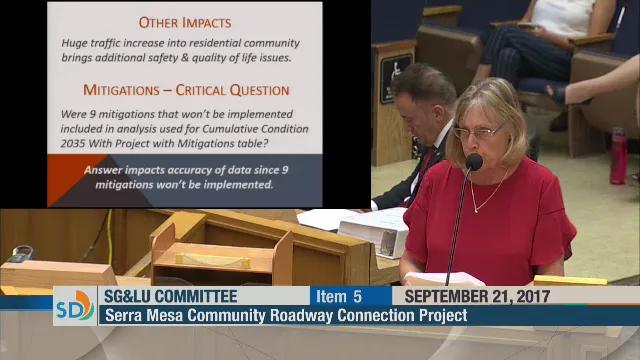
The Smart Growth and Land Use Committee of the San Diego City Council met on September 21, 2017, to discuss several significant items, including a housing production goals report, companion unit (ADU) fees, and a proposed road connection in the Serra Mesa community. The committee voted unanimously to recommend approval of the Serra Mesa Community Plan Amendment for the Phyllis Place/Franklin Ridge Road connection, moving it to the full City Council. Consent Calendar - Item 1: Approved a consent item related to a bike lane and parking mitigation project on University Avenue. The motion by Councilmember Kate, seconded by Councilmember Gomez, passed unanimously after public speakers (Jerry Trussell, Executive Director of the Uptown Community Parking District, and Josh Clark, District 3 representative for the Bicycle Advisory Committee) expressed appreciation for the city's efforts. Public Comments & Testimony - Martha Welch: Expressed concern about housing development in downtown San Diego, stating that too many studios and one-bedroom units are being built, while family-sized units are lacking. She argued that recent housing is "not smart growth" and that buildings remain empty. - Carol Green: Opposed the expansion of commercial marijuana facilities, citing the police chief's concerns about increased homelessness and negative community impacts. She urged the committee to prioritize community health and safety over industry profits. - Kathleen Lippett (from San Diego's for Safe Neighborhoods): Criticized the City Council for ignoring the police chief's warnings and for supporting marijuana commercialization, which she argued would exacerbate crime and homelessness. - Stephen Russell (from an unnamed housing advocacy group): Expressed strong support for the Housing Commission's report and recommended a local affordable housing bond, noting that state funds would require matching local resources. Discussion Items Housing Production Objectives and Targets - The San Diego Housing Commission presented a report titled "Addressing the Housing Affordability Crisis: San Diego Housing Production Objectives 2018–2028." The report recommends that San Diego produce between 17,000 and 24,000 housing units annually to meet the 10-year need, which includes a backlog not accounted for in regional housing assessments. - The report identified five main sources for potential housing units: transit-area rezoning, redevelopment of underutilized parcels, adaptation of disused light industrial zones (including MTS parking lots), infill on vacant lots, and accessory dwelling units (companion units). - Analysis showed that approximately 40% of potential housing capacity exists in five central neighborhoods: Mira Mesa, Mission Valley, City Heights, North Park, and Uptown. - The report also outlined six opportunities to unlock additional housing production, including changing parking requirements, moving to floor-area-ratio (FAR) zoning, improving development services capacity, and creating a cross-departmental grants working group. - Councilmember Gomez expressed support for the report but called for a follow-up focusing on housing affordability, specifically for low-income residents, because he does not believe market-rate construction alone will solve the crisis. - Vice Chair Alvarez echoed the need for targeted affordable housing, noting that the report's numbers must be accompanied by strategic decisions to ensure housing is accessible to those who need it most. Companion Unit (ADU) Fees - Planning Department staff presented an informational item on companion unit fees, at the council's request, to consider a two-year pilot program to reduce fees. - The report identified 11 fees across three departments (Development Services, Public Utilities, and Planning). Nine fees are city fees that could be waived; two fees (school fees and the Regional Transportation Congestion Improvement Program (RTCIP) fee) are outside city jurisdiction. - Presentation noted that current fees for a hypothetical 1,200-square-foot new detached companion unit total approximately $29,975. If all city fees were removed, the fee would drop to about $6,000, with a potential general fund cost of $1.4 million (based on assumptions). - Public speakers expressed support for fee reduction, including Mary Leiden (Housing You Matters), Jared Bassler, Joan Ward, David Gadski, and Christy Little Mar. Joan Ward questioned the RTCIP exemption and asked for clarification from SANDAG. - Councilmember Gomez proposed bringing an action item to the full City Council to reduce fees, specifically to exempt companion units from development impact fees (DIFs) for a two-year pilot. She noted that guest quarters (10 permitted annually) outpace companion units (likely 10 per year) because guest quarters are cheaper. - The chair committed to working with the city attorney to draft resolutions for council action, sending a letter to SANDAG to request clarification on RTCIP exemptions, and exploring the possibility of waiving school fees. Serra Mesa Community Plan Amendment for Phyllis Place Road Connection (Item 4) - Staff Presentation: Planning staff recommended approval of a community plan amendment to add a 460-foot, four-lane road connection between Phyllis Place and Franklin Ridge Road, connecting Serra Mesa to Mission Valley (at Civita) and improving access to I-805. The project was initiated in 2008 as part of the Quarry Falls (now Civita) project approval. The road would not create new trips but would redistribute existing traffic, reduce VMT and GHG emissions, and improve police/fire response and evacuation. - Public Testimony: Numerous speakers presented both in support and opposition. Supporters included former Councilmember Jim Madaffer, representatives from H.G. Fenton, LCG Friars, Circulate San Diego, and several homeowners associations (High Park, Escala, and others). They cited safety (emergency access), connectivity, reduced congestion on Mission Center and Friars Roads, and regional benefit. Opponents included the Serra Mesa Planning Group, residents of Abbott's Hill, and the Save Civita group. They raised concerns about pedestrian safety, increased traffic on residential streets, failure to achieve emergency access improvements, questionable VMT analysis, and the impact on the local park and school. - Committee Discussion: Chair Sherman made a motion to approve staff's recommendation, stressing public safety and the road's regional benefit. He noted that Civita residents signed leases indicating the road was a possibility. Fire Marshal Perry emphasized the critical need for a second access route. Councilmember Kate seconded the motion. Councilmember Alvarez requested that the EIR be amended to explicitly note bike lanes and street design manual compliance, and that drawings of the lane transition be provided to council. Key Outcomes - Housing Report: Accepted as informational; no formal vote. - Companion Unit Fees: No formal vote; the chair committed to bringing an action item to the full City Council to reduce fees, likely exempting companion units from DIFs, and to send a letter to SANDAG about RTCIP fee exemptions. - Serra Mesa Road Connection: The committee voted unanimously (5-0) to recommend that the City Council certify the EIR and approve the Serra Mesa Community Plan Amendment. The vote included a directive to amend the EIR to ensure bike lanes and street design manual standards are included in mitigation measures, and to provide additional engineering drawings to the council before final action.
The Infrastructure Committee of the San Diego City Council met on September 20, 2017, at 2:00 P.M. in Council Chambers. The meeting was chaired by Chair Kirsey, with Vice Chair Ward, Councilmember Zaf, and Councilmember Gomez present, along with City Attorney representative Mark Mercer, IBA representative Jillian Cassie, Mayor's representative Alejandra, and committee consultant Lee Friedman. The committee addressed three discussion items: a $6.1 million pipeline design agreement, a reallocation of park improvement funds for Chollas Lake playgrounds, and a $1.2 million library design consultant agreement. All three items were approved unanimously, and the meeting lasted approximately 24 minutes. Consent Calendar - No consent agenda items were presented at this meeting. - The committee approved the meeting minutes from August 2, 2017, as distributed, without objection. Public Comments & Testimony - Martha Welch, speaking during non-agenda public comment, expressed strong frustration about road conditions and potholes throughout the city, alleging that the city repeatedly promises residents that roads will be paved "next year" or "next summer" but never follows through, and that easier roads get paved while worse ones are neglected. She also claimed the city lacks sufficient in-house workers due to pension concerns and questioned whether a library project she had heard about would actually appear on the agenda. - During the Chollas Lake playground item, Ms. Welch expressed support for the project, stating she was glad to see it moving forward and that she has a personal connection to the lake. Discussion Items - Agreement with Kennedy/Jenks Consultants, Inc. for Alvarado 2nd Pipeline Extension (H166752): Deputy Director Akron Bassione and Assistant Deputy Director Abby Palisade of the Public Works Department presented a request to approve a $6.1 million agreement with Kennedy/Jenks Consultants, Inc. for design, environmental, and construction support services. The project includes a brand-new 48-inch and 30-inch pipeline starting at West Michim Bay Drive and extending along SeaWorld Drive, Hazard Center Drive, and Friars Road to the east side of I-805, plus replacement of a 16-inch asbestos cement pipe along Friars Road. The total project is estimated at approximately $53 million, including about $42 million in construction hard costs and $10.9 million in soft costs. Design is expected to take two years (completing late 2019), followed by approximately six months to bid and award the construction contract, with construction anticipated to take up to two and a half years, completing by 2023. Vice Chair Ward raised questions about the timeline, which presenters attributed to the project's roughly 10-mile length, three freeway crossings, two railroad crossings, fault analysis, and extensive permitting requirements. Ward also asked about the replacement pipe material; presenters confirmed the asbestos cement pipe would be replaced with PVC pipe, which has an expected lifespan of about 75 years. Staff noted that because the construction contract will exceed $30 million, they will return to the committee for approval before awarding it. - Reallocation of Regional Park Improvement Funds from L18001 Chollas Lake Improvements to S14002 Chollas Lake Park Playground Improvements: Assistant Director Andy Field of the Parks and Recreation Department presented a request to reallocate approximately $300,000 from the Chollas Lake Improvements project (L18001) to the Chollas Lake Park Playground Improvements project (S14002). The playground project includes new playgrounds at Gloria's Mesa (ages 2-5 and 5-12) and at Friday's Gate (all ages), replacing very old equipment. The first two playgrounds at Gloria's Mesa are fully funded and already slated to begin construction. The reallocation would fund the Friday's Gate playground, which the community views as an essential increment, while leaving $200,000 in the improvements project for future work. The improvements project is intended to bring electrical power and security lighting to the lake, which currently has no power on its entire eastern edge, plus solar panels and other improvements. The Regional Park Improvement Oversight Committee approved the reallocation during the summer. Councilmember Gomez expressed familiarity with the area and support for directing resources to it. - Consultant Agreement with Architects Hanna Gabriel Wells for Pacific Highlands Ranch Branch Library: Acting Deputy Director Elif Chitin of the Public Works Department's Architectural Engineering Parks Division presented a request to award a $1.2 million consultant agreement with Architects Hanna Gabriel Wells for design and construction support services for a new library. The library will be approximately 18,000 square feet on a 1.5-acre site, including a large community meeting room, teen and children's areas, study rooms, a catering (warm-up) kitchen, and patio and exterior seating areas. The library will serve the Pacific Highlands Ranch, Black Mountain Ranch, Tory Highlands, and Del Mar Mesa communities, located immediately north of Highway 56 and east of Highway 5, near Carmel Mountain Road, directly across from a community park. The estimated total project budget is just over $19 million, funded by FBA (Facilities Benefit Assessment) funds received in increments. Design is scheduled to begin in fall 2017, with construction documents advertised in summer 2019, construction starting in winter 2019-2020, and completion estimated in summer 2021. Chair Kirsey asked about the city managing developer-funded projects; project officer Cynthia Meinhart explained that city-managed projects are typically more efficient and cost-effective because developers managing projects still require city oversight, making it more expensive. Regarding the catering kitchen, Meinhart clarified that a warm-up kitchen avoids the extensive county permitting requirements (including grease traps) associated with full food preparation kitchens. Key Outcomes - Approved the agreement with Kennedy/Jenks Consultants, Inc. for design and construction support services for the Alvarado 2nd Pipeline Extension, in the amount of $6.1 million, including a 10% contingency. Motion by Vice Chair Ward, seconded by Councilmember Gomez; carried unanimously. - Approved the reallocation of Regional Park Improvement Funds from L18001 Chollas Lake Improvements to S14002 Chollas Lake Park Playground Improvements, in the amount of approximately $300,000. Motion by Councilmember Gomez, seconded by Vice Chair Ward; carried unanimously. - Approved the consultant agreement with Architects Hanna Gabriel Wells for design services for the Pacific Highlands Ranch Branch Library, in the amount of $1.2 million. Motion by Vice Chair Ward, seconded by Councilmember Gomez; carried unanimously. - The next Infrastructure Committee meeting was scheduled for October 25, 2017.
The Public Safety and Livable Neighborhoods Committee met on Monday, September 18, 2017, at 2:00 p.m. in Council Chambers. The committee approved a consent item and a discussion item, and received informational presentations on the San Diego Police Department's Canine Unit, the Family Justice Center, the Wildfire Outlook for fall 2017, the Connections Housing annual status update, and the Play All Day Parks Program. Public testimony focused on cannabis delivery regulations and alternative sourcing of police service dogs. Consent Calendar - Fiscal Year 2017 Urban Area Security Initiative Grant Program: Approved unanimously. (Councilmember Zap motioned, Councilmember Ward seconded.) Public Comments & Testimony - Cannabis Delivery Regulation: Several speakers addressed the committee about independent cannabis delivery services. Elizabeth Wilhelm, president of the San Diego Cannabis Delivery Alliance, expressed support for sensible regulations to close the black market and ensure safe access. She requested the committee place discussion of independent cannabis delivery on a future agenda. Sam Humead, also a board member of the alliance, echoed the request and submitted information packets to committee members. Both speakers emphasized the need to keep medicated drivers off the road and to require product testing. - Rescue Dogs for Police Work: A speaker (Grace Batoonis) presented a video and information about nonprofit organizations (Universal Canine, Search Dog Foundation) that provide highly trained rescue dogs at no cost to law enforcement and fire departments. She urged the city to consider using such dogs to save taxpayer money and reduce shelter overcrowding. Discussion Items - Revisions to the Citizen Participation Plan for U.S. Department of Housing and Urban Development Programs: The committee moved this item without a presentation. A member of the public expressed support but did not wish to speak. The committee approved the revisions unanimously on a motion by Councilmember Zap, seconded by Vice Chair Bree. - San Diego Police Department Canine Unit Update (Informational): Assistant Chief Chuck Kay, Lieutenant Darrell Hoover, and Officer Larry Adair provided a detailed overview. The unit was formed in 1984 after a high officer murder rate; it expanded to 52 teams by 2000, but was reduced to 27 in 2010 due to budget constraints. Currently there are 33 canine teams. Key data: from 2013 to 2016, canine calls for service increased to 21,429 in 2016, with 3,222 deployments and 86 bites (a 2.7% bite rate versus a federal court standard of 20%). Persons-in-crisis calls increased 35% and assaults on officers increased 86% over the same period. The unit also partnered with Johns Hopkins and DHS on mobile odor detection dogs for large events. Councilmembers asked about training for mental health crisis situations, the definition of deployments vs. interventions, and funding (police dogs are purchased by the San Diego Police Foundation at $12,500 each). The unit's public information officer, Officer Adair, conducts over 60 community events per year. - San Diego Police Department Family Justice Center Update (Informational): Lieutenant Misty Sedrin presented. Highlights included a new countywide strangulation protocol and a 30-second PSA on strangulation (English and Spanish). A survivors advisory board was formed to provide input and share testimonies. Adrian, a male survivor from the immigrant and LGBT communities, gave a powerful testimony about escaping domestic violence with the center's help. Data showed domestic violence reported crimes decreased 37% from 2002 to 2016, and domestic violence homicides dropped from 36 (1985, pop. 875,000) to 6 (2016, pop. 1.4 million). Contacts from outside the city are about one-third of total visits. Councilmembers discussed funding, noting the city is the primary funder and the county provides some in-kind services. There are preliminary discussions about transferring management of the center from the Police Department to the City Attorney's Office. Councilmember Zap emphasized the city's policy that victims and witnesses can come forward without fear of immigration status checks. - Wildfire Outlook 2017 – September through November (Informational): Fire Chief Brian Fennessey and Deputy Chief Doug Perry presented. Despite a wet winter, heavy grass crop and five years of drought have created critical fuel conditions. The city has 82 type 1 engines, 12 type 3 wildland engines, two helicopters (only night-capable in the county), and a SDG&E helitanker. The "Ready, Set, Go!" program was explained, emphasizing early evacuation. The city inspects 13,000 homes annually but has 45,000-46,000 interface homes, resulting in a 3.7-year inspection cycle. Staffing of seven brush inspectors would ideally be increased to fifteen to achieve 18-month cycles. Councilmember Ward requested more information on high-risk areas in his district. Councilmember Zap shared a personal story of not evacuating during a wildfire and urged the public to leave early. - Connections Housing Annual Status Update (1250 Sixth Avenue) (Informational): James Alexander (Civic San Diego) and Jonathan Costillo (PATH) presented. The facility includes 150 transitional beds, 73 permanent supportive housing (PSH) units, and health/social services. The conditional use permit (CUP) requires a neighborhood advisory committee, 24/7 security, and outreach within a quarter-mile radius. Compliance has been maintained. PSH retention is 92%, and transitional bed success (moving to permanent housing) is over 65%. Councilmember Ward asked about expanding the service radius and converting transitional beds to PSH; PATH is open to exploring those options but noted no specific challenges with the CUP. Councilmember Bree and Chair Keat asked about expansion beyond downtown; PATH confirmed they are seeking opportunities in other parts of the city to avoid concentrating services. - Play All Day Parks Program (Informational): Robin Schifflet (Planning) and Lee Dogaroff (San Diego Unified School District) presented. The program will add over 45 new joint use parks in five to ten years, expanding the existing 79 joint use sites. Three parks have opened (Wegaforth, Montgomery, Angier), nine more are scheduled to open by FY 2019. The school district designs and constructs the fields (funded by Propositions S and Z), and the city maintains them. Operating costs average $60,000 per park per year, with gates locked at dusk. Councilmember Zapp asked about maintenance responsibilities and security. Chair Keat inquired about the timeline; from general development plan to completion is about three years. Key Outcomes - Consent Agenda (FY17 UASI Grant): Approved unanimously. - Revisions to the Citizen Participation Plan: Approved unanimously. - Cannabis Delivery Regulation: No formal action taken, but the committee received the public request to place the topic on a future agenda. - All other items (Canine Unit, Family Justice Center, Wildfire Outlook, Connections Housing, Play All Day Parks): Received as informational; no votes were taken.