Browse by city
Date range
Search help

Search titles, summaries, topics and stored transcripts together. Keywords may match separately; put the whole query in double quotes for a phrase. Matching follows word analysis, so punctuation is not exact. Both dates are included. Documents are not searched.

SHOWING 231–240 ENTRIES
231
FEB 10, 2026 · SAN FRANCISCO, CALIFORNIA · PUBLIC UTILITIES COMMISSION
San Francisco PUC Meeting: Budgets, Audit, and Contracts Approved on February 10, 2026

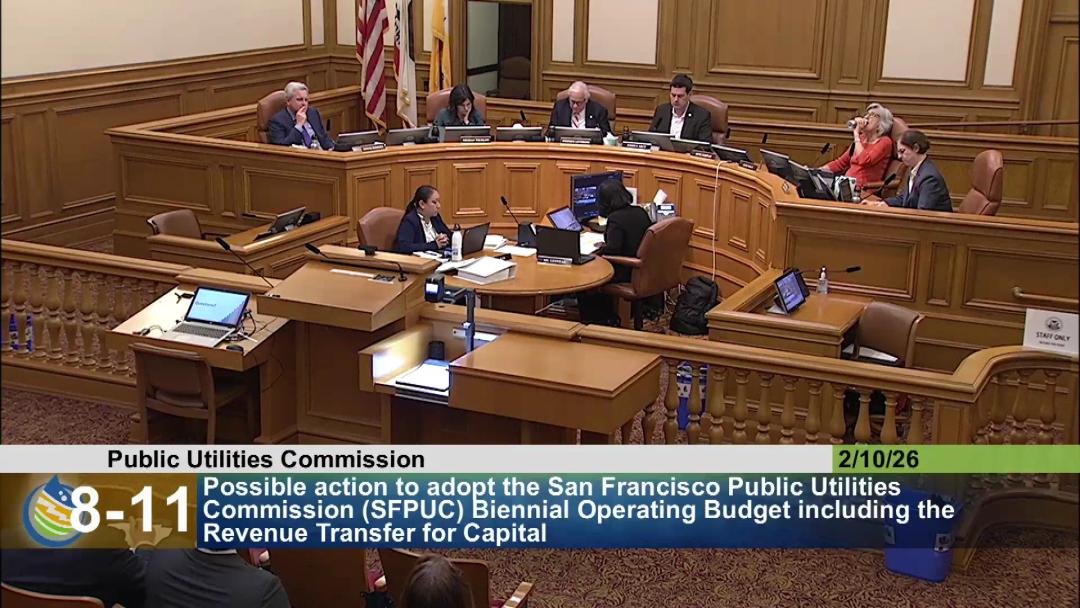
The San Francisco Public Utilities Commission (SFPUC) met on February 10, 2026, beginning at 9:45 AM, with a quorum present (President Arce, Vice President Leveroni, Commissioners Stacey and Thurlow; Commissioner Jamdar excused). The meeting included a land acknowledgment, approval of prior minutes, general public comment, a report on audited financial statements, approval of consent calendar, and major actions on the biennial operating and capital budgets, 10-year capital and financial plans, a water supply assessment, and a contract award for nutrient reduction at the Southeast Water Pollution Control Plant. Consent Calendar - Item 7: Amendment number one to specified contracts for project scheduling and cost control staff augmentation services was approved unanimously (4-0-1 excused). Public Comments & Testimony - General Public Comment: - Francisco DaCosta criticized the commission for not taking the precautionary principle seriously and alleged that three employees were traumatized, vowing to take the matter to the inspector. - Demetrius Williams (President, San Francisco Hyperlocal Building Trades Contractors Collective) expressed support for SFPUC projects but demanded local contracts and community benefits for Bayview-Hunters Point, noting billions are being outsourced. - Oscar James (native resident, homeowner) echoed the call for local contracts and training opportunities for youth. - Rhonda Sterling (Vice President, Bayview-Hunters Point Coordinating Council) argued that the SFPUC disparity study must drive real change, citing the Step 7 project awarded to PCL as an example where local firms are limited. She urged carved-out scopes of work and formal community engagement before procurement decisions. - Bob Hall presented testing data showing toxic chemicals (metals, DEHP) in runoff from artificial turf fields (Beach Chalet, South Sunset, Garfield Square), urging the commission to inform the public and stop spreading artificial turf. - Susan Mullaney requested testing of rainwater runoff from Beach Chalet and Minnie and Lovey Ward fields for PFAS (using EPA method 1621) and 6-PPD quinone (using EPA method 1634), citing toxicity to aquatic life and human health concerns. - Public Comments on Budget Items (8-11): - Steven Rinaldi (Vice Mayor, Millbrae) opposed approval of the Millbrae Operations Center portion of the capital plan, arguing the alternative analysis was insufficient, the cost near $500 million was staggering, and the design abandons transit-first policy. He urged deferring approval until a proper analysis is done. - Tom Smagel (Bosca) noted Bosca's review of the 10-year CIP, supporting adoption but flagging significant future work (approx. $10.1 billion for reservoirs/dams) and emphasizing continued engagement with Millbrae. - Ann Schneider (former mayor, Millbrae; Bosca representative) detailed how the Millbrae campus project was not included in prior SFPUC documents and expressed concern that removing a revenue-producing property (Orchard Supply Hardware) would impact Millbrae's ability to pursue recycled water and hurt ratepayers. - Tom Williams (City Manager, Millbrae) requested removal of the Millbrae Operations Center from the budget, stating insufficient alternatives analysis and that closing OSH Hardware would cost jobs and lose revenue, directly contradicting SFPUC's mission. - Peter Jack Meyer (Policy Director, Yosemite Rivers Alliance) criticized the deferral of alternative water supply projects, claiming staff manipulated the commission and that the commission should lead independent of staff. He referenced a 2022 request for comparison of demand projections. - Dennis Williams, Jr. (Community-based developer, Fillmore CDC) urged the commission to enforce inclusion in contracting, asking for public reporting by race and firm size, direct contracting for Black-led firms, and early community input. - Dave Warner acknowledged the budget increases and lower demand projections, supported deferral of alternative water supply, and requested the commission change the planning process to have more influence earlier. - Public Comments on Item 13 (Contract Award): - Demetrius Williams expressed support for the nutrient reduction project but stressed the need for community contractors to be engaged by PCL, referencing past fights with Sutton/Walsh and WebCorp. - Oscar James echoed the call for prime contractors to attend hyperlocal meetings and provide bidding opportunities. Discussion Items - Item 6 – Fiscal Year 2024-25 Audited Financial Statements: Deputy CFO Vivian Chen reported that external auditor MGO issued unmodified (clean) opinions on all three enterprise financial statements (water, wastewater, Hetch Hetchy water and power, clean power) with no material misstatements or internal control deficiencies. The Annual Comprehensive Financial Report was issued December 10, 2025, and the SFPUC has received the GFOA Certificate of Achievement for Excellence in Financial Reporting every year since 2009. Audit partner Annie Louis confirmed no findings to report and highlighted two new accounting standards (GASB 101) implemented in FY 2024-25. Commissioners thanked staff for transparency. - Items 8-11 – Budget and Financial Plans: Presenters Ms. Dooney (for operating/capital budgets) and Erin Corvanova (Financial Planning Director, for 10-year financial plan) provided details: - Operating Budget (Item 8): Proposed $2,166,698,799 for FY 2026-27 and $2,344,066,873 for FY 2027-28. Drivers include debt service ($687M), power purchase (decreasing slightly), personnel costs with 37 new FTEs (mostly temporary to permanent), and ongoing costs for new facilities and community programs. - Capital Budget (Item 9): Requests $1,163,787,041 (FY26-27) and $1,316,552,550 (FY27-28), with bond authorizations of $551.9M (water), $1,165.7M (wastewater), $138.2M (power). Commissioner Stacey asked about discrepancies between bond authorizations and capital budget; staff explained that bond authorizations include financing costs and overlapping Hetchy water/power/joint projects. - 10-Year Capital Plan (Item 10): Totaling $12,558,987,332 through FY 2035-36. Staff emphasized that $3.5B was cut from earlier versions to prioritize critical projects. Commissioner Stacey expressed disappointment in deferral of alternative water supply projects but acknowledged the tough trade-offs. - 10-Year Financial Plan (Item 11): Corvanova detailed assumptions: conservative water sales forecasts (adjusted down from baseline, factoring in conservation and population trends), expense growth (6% for fringe benefits), debt financing assumed at 3.5-4% short-term, 6% long-term, and aggressive pursuit of low-cost loans (e.g., WIFIA) but not counted on. Key projections: - Water: 7% rate increases for retail in each of next two years; wastewater: 15% and 14.5% increases. - Average customer combined bill projected to exceed affordability policy targets from FY 2034-2044, then return below due to income growth. - Customer Assistance Program (CAP) participants are projected to remain under 5% of income through 20-year period. - Hetch Hetchy Power: 7% retail rate increase next year; average bill projected to rise from $98 to $209 over 10 years. - CleanPowerSF: 20-25% rate decrease effective March 1, 2026, approved earlier. Commissioner Thurlow asked about conservatism in demand forecasts; staff explained they adjust down from planning department and wholesale customer projections to between low and baseline scenarios. Vice President Leveroni asked about the spike in water volumes; staff attributed it to housing growth assumptions, adjusted down. President Arce expressed appreciation for the work to reduce near-term rate impacts and buy time for long-term solutions. General Manager Herrera clarified that the Millbrae Operations Center is not being approved today; it will come separately later, and he provided a letter detailing ongoing engagement with Millbrae, noting that SFPUC does pay property taxes there. - Item 12 – Water Supply Assessment for Mattson Block Project: AGM Steve Ritchie presented the assessment for a 3.5-acre block bounded by Market, Main, Mission, and Beale Streets. The assessment is a CEQA requirement, not project approval. Commissioners approved without discussion. - Item 13 – Award of Progressive Design-Build Contract DB-141 for Southeast Water Pollution Control Plant Nutrient Reduction: Principal Project Manager Jignesh Desai presented the request to award to Jacobs/PCL SF Joint Venture (initial pre-construction services of $192.7M; total contract budget up to $1B; duration 4,850 days, pre-construction 1,460 days). The project is driven by a Regional Water Board nutrient permit after harmful algal blooms in 2022-2023. Procurement used 75% qualifications / 25% cost evaluation. Two proposers; Jacobs/PCL scored higher on written and oral proposals but lower on cost. A protest from Sunt Construction was denied. Commissioner Thurlow asked about the pipeline; staff noted it's the largest wastewater PDB in the country, only two qualified proposers. Commissioner Stacey asked about price differential; staff explained the cost component used a plug number for direct costs, and the higher technical score outweighed the price difference. President Arce noted the close score (4.4 pts out of 1000). Commissioners discussed the importance of LBE requirements and asked about tracking actual outcomes. Algie from CMD confirmed LBE data is posted on the SFPUC website and closeout memos are in commission packets. President Arce requested a more aggregated user-friendly dashboard. - Item 15 – Items Initiated by Commissioners: President Arce initiated a request to improve access to completed project LBE data (projected vs. actual), asking staff to report back. Key Outcomes - Unanimous Approvals (all 4-0-1 excused): - Minutes of January 27, 2026 (Item 3). - Consent calendar (Item 7). - Biennial operating budget (Item 8). - Two-year capital budget (Item 9). - 10-year capital plan (Item 10). - 10-year financial plan (Item 11). - Water supply assessment for Mattson Block project (Item 12). - Award of Progressive Design-Build contract DB-141 to Jacobs/PCL JV (Item 13). - Directives: - General Manager confirmed commitment to continue engagement with City of Millbrae on the Millbrae Operations Center; no approval of that project today. - Staff to report back on improving public access to historical LBE compliance data. - Next Steps: Rates for water, wastewater, and Hetch Hetchy Power will be adopted in spring 2026. The nutrient reduction project will proceed with pre-construction; construction will only commence after CEQA approval by the commission.
ENGINEERING AND INFRASTRUCTURE 54% · ECONOMIC DEVELOPMENT 15% · MISCELLANEOUS 11% · PROCEDURAL 9%
232
FEB 9, 2026 · SAN FRANCISCO, CALIFORNIA · RULES COMMITTEE
San Francisco Board of Supervisors Rules Committee Meeting (February 9, 2026)

The Rules Committee met on February 9, 2026 (broadcast via SFGovTV) to advance several ordinances and appointments to the full Board of Supervisors, including: (1) an Administrative Code update affecting Fire Department leadership qualifications and physician selection authority, (2) creation of a Fisherman’s Wharf Entertainment Zone, (3) an appointment to the In-Home Supportive Services (IHSS) Public Authority, (4) multiple appointments of Supervisor Chen to outside bodies/commissions, and (5) an ordinance restricting unauthorized use of City property and clarifying that civil immigration enforcement is not a City purpose. All committee actions were approved without objection on 3–0 votes (Walton, Sherrill, Mandelman). Public Comments & Testimony - Item 2 (Fisherman’s Wharf Entertainment Zone): - Bree Maughan, Executive Director, Fisherman’s Wharf Community Benefit District (CBD), expressed support for the entertainment zone, stating that while visitorship is rising, it is not translating into revenue for small businesses, and that entertainment zones have become economic drivers. - Item 8 (City property use / civil immigration enforcement): - Lucia Obregon, Director, SF Latino Parity and Equity Coalition (representing 20 organizations serving Spanish-speaking residents), expressed support, describing the ordinance as a trust-building message to migrant residents and a “first step.” - Carolyn Goosen, San Francisco Public Defender’s Office, expressed strong support, arguing the ordinance helps ensure City spaces are safe and welcoming, and that immigration enforcement presence near public spaces chills service access. - Annie Lee, Chinese for Affirmative Action, expressed support, stating Chinatown is predominantly immigrant (she stated “four out of every five” residents are immigrants) and that immigrant communities are fearful of federal immigration enforcement. - Paloma Tracy, SF Latino Parity and Equity Coalition, expressed support, emphasizing community involvement and the ordinance as an initial step to reduce fear and protect long-term outcomes for immigrant communities. - Items 1, 3, 4–7: No public speakers. Discussion Items - Administrative Code amendments: Fire Department deputy chief qualifications and physician selection (Item 1) - Presenter: Fire Chief Dean Crispin, San Francisco Fire Department. - Project description (qualifications change): Chief Crispin described updating qualifications for the Deputy Chief of Emergency Medical Services (EMS) and Community Paramedicine (a position created around 2020, and vacant following the retirement of Deputy Chief Simon Pang). The change was described as expanding eligibility to a broader pool—particularly including battalion chiefs (frontline incident commanders)—while still requiring prior service as a paramedic within the department. - Rationale stated by Chief Crispin: - Current code limited the pool largely to certain EMS/community paramedicine ranks, excluding battalion chiefs. - Succession planning and disaster response needs require command experience; battalion chiefs have incident command experience. - The change was described as needed “for right now” to allow selection from a wider range of candidates. - Project description (physician selection authority): Chief Crispin stated the City Attorney advised that the Administrative Code conflicted with the City Charter because the Charter provides that the department head has authority to select/replace the department physician. He stated the Fire Commission planned to develop rules of order for a hiring process (described as a panel interview including the chief, a commission member, and a third party) should a physician opening occur. - Committee questions: - President Rafael Mandelman asked about the history and justification for having a third deputy chief position; Chief Crispin responded that the EMS/community paramedicine portfolio requires full-time leadership. - Vice-Chair Steven Sherrill asked about the paramedic-service requirement and whether the change was aimed at recruitment now or future; Chief Crispin said the main need is immediate. - Ordinance creating the Fisherman’s Wharf Entertainment Zone (Item 2) - Presenter: Tita Bell Hill, Chief of Staff to Supervisor Danny Sauter. - Project description: Establishes the Fisherman’s Wharf Entertainment Zone spanning multiple street segments including (as read into the record) Powell, Embarcadero, Taylor, Jefferson, Beach, Polk, North Point, Larkin, and Al Scoma Way, and affirms the Planning Department’s CEQA determination. - Rationale stated: Following the pandemic, storefront vacancies and reduced street energy prompted the CBD to pursue an entertainment zone to enable events and activations intended to increase foot traffic and support local businesses (including through “to-go alcoholic beverages” as described). - Examples of proposed programming (project description): Wharf Fest (chowder competition), retail/dining showcase, “Pier Party at the Wharf” concert series, fresh fish market, expos, farmer’s/craft/night markets, and bar crawls. - Committee actions during discussion: President Mandelman and Vice-Chair Sherrill requested to be added as co-sponsors. - Appointments: IHSS Public Authority (Item 3) - Applicant: Keontae Clark. - Applicant statement: Clark said they currently serve on the Mayor’s Disability Council (MDC) and wished to accept the IHSS Public Authority appointment to serve the community; stated they are a San Francisco native. - Appointments of Supervisor Chen (Items 4–7, heard together) - Project description: Motions to appoint Supervisor Chen to: - California Association of Counties (alternate; term ending December 1, 2026 or end of her BOS term) - Children’s Family First Commission (member; term ending October 8, 2026 or end of her BOS term) - SFO Community Roundtable (member; indefinite term or end of her BOS term) - Association of Bay Area Governments (ABAG) Executive Board (alternate; term ending June 30, 2027 or end of her BOS term) - Ordinance restricting unauthorized use of City property; stating civil immigration enforcement is not a City purpose (Item 8) - Presenter: Supervisor Bilal Mahmood. - Project description: The ordinance would (1) prohibit use of City property without authorization except for uses traditionally available to the public, (2) prohibit City officials/employees from authorizing uses that disrupt operations or discourage access to services unless furthering a City purpose, (3) state that civil immigration enforcement is not a City purpose, and (4) authorize the City Attorney to bring a cause of action against unlawful/unauthorized uses. - Rationale stated by Supervisor Mahmood: Immigration enforcement activity near public facilities creates a chilling effect (missed medical appointments, kids missing school, avoidance of benefits, reluctance to report crimes), undermining public health and safety. He also described regional alignment, naming Santa Clara County, San Jose, the city of Santa Clara, Oakland, and Richmond as jurisdictions taking steps to align with this model. - Committee comment: Chair Supervisor Shimon Walton emphasized San Francisco’s sanctuary-city stance and stated that immigration enforcement is not a City purpose. Key Outcomes - Item 1 (Fire Department Administrative Code changes): Moved to the full Board with recommendation; vote 3–0 (Walton, Sherrill, Mandelman), without objection. - Item 2 (Fisherman’s Wharf Entertainment Zone + CEQA affirmation): Moved to the full Board with recommendation; vote 3–0, without objection. Mandelman and Sherrill added as co-sponsors during the item. - Item 3 (IHSS Public Authority appointment): Recommended Keontae Clark for appointment (term ending March 1, 2028); forwarded to the full Board with recommendation; vote 3–0, without objection. - Items 4–7 (Supervisor Chen appointments): Approved as a package and forwarded to the full Board with recommendation; vote 3–0, without objection. - Recess: The committee took a two-minute recess mid-meeting. - Item 8 (City property use / civil immigration enforcement not a City purpose): Moved to the full Board as a committee report with positive recommendation (requested committee report noted by the Clerk); vote 3–0, without objection. - Adjournment: The Chair adjourned after the Clerk confirmed there was no further business.

PERSONNEL MATTERS 39% · COMMUNITY ENGAGEMENT 38% · ECONOMIC DEVELOPMENT 21% · PROCEDURAL 2%
233
FEB 9, 2026 · SAN FRANCISCO, CALIFORNIA · LAND USE AND TRANSPORTATION COMMITTEE
San Francisco Board of Supervisors Land Use and Transportation Committee Regular Meeting (February 9, 2026)

The Land Use and Transportation Committee met on February 9, 2026 and heard four items: (1) an ordinance to allow certain movie theaters that operate as bona fide eating places to offer entertainment and sell alcohol (including specific provisions affecting the Upper Fillmore), (2) a resolution to add a commemorative street name on Joy Street honoring Tianfu Wu, and (3–4) actions to advance the Twin Peaks Promenade Project via a street vacation and an interdepartmental transfer to Recreation and Park. Items acted on were noted as expected to appear on a future Board of Supervisors agenda, with specific scheduling actions taken for the Twin Peaks items. Public Comments & Testimony - Clay Theater / Upper Fillmore ordinance (Item 1) - Cody Allen, Executive Director, Upper Fillmore Revitalization Project (project sponsor for rehabilitation/reactivation of the historic Clay Theater), expressed support for the ordinance, stating it would enhance the theater’s viability and allow community use of the lobby with refreshments (including wine/beer) for extended hours. - Ted Gerke (introduced as director/operator of the Clay Theater), expressed support for the ordinance, describing independent theaters’ need to adapt and serve as community “third places.” He stated the Clay Theater planned “500 screenings a year” plus conversations and performances, and that reliable operating hours seven days a week would help sustain the venue. - Commemorative street name Tianfu Wu Wei (Item 2) - Leanne Ma, on behalf of Donaldina Cameron House, expressed strong support for commemoratively naming Joy Street as Tianfu Wu Wei, framing it as honoring Tianfu Wu and the broader legacy of Chinese women and girls connected to the area and Cameron House’s history. - Twin Peaks Promenade street vacation/transfer (Items 3–4) - George Wooding, President of Midtown Terrace, expressed concern/opposition and requested a continuance, stating Midtown Terrace had not been adequately engaged, and raising concerns about traffic, congestion, and public safety issues (including references to increased squatting, car theft, and burglaries after traffic pattern changes). He also asserted SFMTA had claimed engagement that he said did not occur. Discussion Items - Item 1 — Ordinance: alcohol sales & entertainment at certain movie theaters (incl. Upper Fillmore) - Chair Marina Melgar noted the item had been continued two weeks earlier due to substantive amendments; staff support was available (Lorenzo Rosas present for questions). - The committee advanced the ordinance to the full Board with a positive recommendation. - Item 2 — Resolution: commemorative street name “Tianfu Wu Wei” on Joy Street (between Clay and Sacramento) - Supervisor Danny Sauter (District 3) presented the item, describing Tianfu Wu’s contributions to women’s rights and anti-trafficking work in Chinatown and her connection to Cameron House history. - Vice Chair Cheyenne Chen stated support, citing historical context (late 1800s/early 1900s) and noting Tianfu Wu worked to rescue hundreds of Asian women and girls from sex and human trafficking. - Chair Melgar requested to be added as a co-sponsor. - The committee advanced the resolution to the full Board with a positive recommendation. - Items 3 & 4 — Twin Peaks Promenade Project: street vacation + conditional vacation/transfer to Recreation and Park - Chris Towns, Planner, San Francisco Recreation and Park Department, presented: - Twin Peaks described as a 31-acre Rec and Park open space. - The project is linked to prior Board approvals of multiple state grants totaling about $4.25 million. - Timeline/history cited: multi-use trail (2013–2014); crosswalks (2015); SFMTA “Figure 8 redesign planning study” (2016–2020) leading to permanent closure of the eastern alignment (2020); trail improvements Phase I (2017) and Phase II completed (2025). - Promenade construction targeted to begin summer 2026 and be completed by early 2027. - The street vacation would transfer the decommissioned eastern alignment from Public Works jurisdiction to Rec and Park, redesignating it for recreation/open space purposes while retaining right-of-way status to accommodate an existing franchise agreement. - An associated interdepartmental transfer included Assessor’s Block 2643, Lot 041 from Public Works to Rec and Park. - Chair Melgar discussed prior pandemic-era traffic changes, reported there had been an increase in crime, and emphasized multi-department jurisdiction challenges at Twin Peaks. She stated she would co-sponsor the items. - Stacey Bradley, Director of Capital and Planning, Rec and Park, responded to concerns about outreach, stating the effort began in 2015 with multiple rounds of engagement and that the street vacation was needed to keep the area as open space in perpetuity consistent with grant requirements. - The committee amended the resolution of intent to set a Committee of the Whole hearing date and advanced both items with specific recommendations (see outcomes). Key Outcomes - Item 1 (Movie theaters / alcohol & entertainment ordinance): Recommended to the full Board as a committee report with a positive recommendation, vote 3-0 (Chen aye; Mahmood aye; Melgar aye). - Item 2 (Commemorative street name Tianfu Wu Wei on Joy Street): Recommended to the full Board with a positive recommendation, vote 3-0. - Item 3 (Twin Peaks Promenade — resolution of intent / hearing date): - Amended to insert March 17, 2026 as the Committee of the Whole hearing date. - Recommended to the full Board as a committee report with a positive recommendation (as amended), vote 3-0. - Item 4 (Twin Peaks Promenade — ordinance for conditional vacation + transfer): Sent forward without recommendation for Board consideration on March 17, 2026 (aligned with the Committee of the Whole hearing), vote 3-0. Meeting adjourned after concluding business.

COMMUNITY ENGAGEMENT 41% · PARKS AND RECREATION 36% · PROCEDURAL 14% · ECONOMIC DEVELOPMENT 9%
234
FEB 5, 2026 · SAN FRANCISCO, CALIFORNIA · GOVERNMENT AUDIT AND OVERSIGHT COMMITTEE
Government Audit and Oversight Committee Meeting - February 5, 2026

The San Francisco Board of Supervisors' Government Audit and Oversight Committee convened on February 5, 2026, chaired by Supervisor Jackie Fielder with Vice Chair Danny Sauter present. The meeting addressed two primary items: a hearing request regarding private developer financial commitments in the Mission District and approval of a regional security grant memorandum of understanding. Opening and Procedural Matters - Chair Supervisor Jackie Fielder called the meeting to order with Vice Chair Danny Sauter present - Committee Clerk Monique Creighton provided standard procedural announcements - Public comment procedures were outlined for both in-person and written submissions - Items acted upon were scheduled to appear on the February 24, 2026 Board of Supervisors agenda Item 1: Mission District Developer Financial Commitments Hearing - Hearing concerns financial commitments by private developers for housing developments at 2000-2070 Bryant Street and 681 Florida Street in the Mission District - Specifically addresses a $500,000 capital funding commitment for tenant improvements to the community arts space at 681 Florida Street - The hearing request was originally introduced on October 21, 2025 - Chair Fielder rescheduled the hearing to February 19, 2026 - Written and electronic notices were sent to private developers: Mr. Nick Podell (Nick Podell Company, San Francisco), Mr. John Cooper, and Mr. Kevin Straub (JRE Partners, New York City) - As of February 5, 2026, none of the developers responded to inquiries - The committee voted unanimously (3-0) to direct the clerk to prepare and issue a subpoena to Nick Podell to appear for testimony at the February 19th meeting - No subpoenas were issued to Cooper and Straub as they are outside the board's jurisdiction - The item was continued to the February 19, 2026 committee meeting (unanimous 3-0 vote) - No public comment was received on this item Item 2: Bay Area Urban Area Security Initiative (UASI) Memorandum of Understanding - Resolution retroactively approving an MOU with cities of Oakland and San Jose and nine Bay Area counties (Alameda, Contra Costa, Marin, Monterey, San Mateo, Santa Clara, and Sonoma) - The MOU establishes governance structures and procedures for federal Urban Area Security Initiative (UASI) grant funds - Agreement period: December 1, 2025 through November 30, 2030 - San Francisco serves as the primary grantee and fiscal agent for UASI grant funds for the Bay Area - Mekyung Kim Molina, General Manager of Bay Area UASI, presented: - Bay Area UASI has existed since 2006 - Mission: prepare for, combat, and respond to terrorist attacks - Works with all 12 Bay Area counties across 14 jurisdictions - Approval Authority Board meets quarterly with members appointed by their respective boards of supervisors - Funding flows from Department of Homeland Security (DHS) through California Office of Emergency Services (Cal OES) to six UASIs statewide - Deputy City Attorney Brad Rossi confirmed a pending lawsuit against the federal government related to DHS funding conditions concerning immigration enforcement and other policy areas; injunctions have been entered and the lawsuit is currently on appeal - The committee voted unanimously (3-0) to forward the item to the full Board of Supervisors with positive recommendation - No public comment was received on this item Key Outcomes - Subpoena authorized for Nick Podell to compel testimony at February 19, 2026 hearing regarding unfulfilled developer commitments - Bay Area UASI MOU approved for forwarding to full Board with positive recommendation, ensuring San Francisco's continued role as fiscal agent for regional security grants through November 30, 2030 - Meeting adjourned with no additional business

MISCELLANEOUS 34% · PROCEDURAL 27% · AFFORDABLE HOUSING 25% · PENDING LITIGATION 14%
235
FEB 5, 2026 · SAN FRANCISCO, CALIFORNIA · PUBLIC UTILITIES COMMISSION
San Francisco Public Utilities Commission Wastewater Enterprise Budget and Capital Plan Public Hearing

This meeting focused on the presentation and discussion of the Wastewater Enterprise's operating and capital budgets for fiscal years 2027-2028, featuring comprehensive reviews of major infrastructure investments, regulatory compliance initiatives, and rate affordability considerations. Meeting Overview The commission convened to review the Wastewater Enterprise's proposed budgets totaling approximately $5.9 billion over 10 years in capital investments, alongside significant operating budget increases driven primarily by debt service obligations. Assistant General Manager Joel Prather presented detailed plans for maintaining San Francisco's combined sewer system while balancing ratepayer affordability with regulatory compliance and infrastructure reliability needs. Opening and Land Acknowledgment President Arce opened the meeting with a land acknowledgment recognizing the Muwekma Ohlone tribe as the original inhabitants and stewards of the lands where the SFPUC operates. The commission acknowledged the ongoing partnership with the Muwekma Ohlone people and their continued presence in Bay Area communities. Wastewater Enterprise Operating Budget (Item 3A-I) Enterprise Overview and Mission AGM Prather outlined the Wastewater Enterprise's core mission to protect public health and water quality in the Bay and Ocean. The enterprise operates: - San Francisco's only combined sewer system on the California coast (one of three on the West Coast alongside Portland and Seattle, and one of over 700 nationwide) - Three wet weather treatment plants and one wet weather treatment facility - 36 pump stations (increased by four in the past year due to Treasure Island asset transfers) - Eight transport and storage facilities with 200 million gallons capacity - Over 240 green infrastructure installations - 25,000 catch basins connected to 1,000 miles of pipes - Treatment capacity of approximately 34.6 billion gallons of wastewater annually - Over 500 staff positions across eight divisions Major Operating Budget Changes The operating budget presentation highlighted several significant cost drivers: Debt Service Increase: $139 million increase representing the largest year-over-year cost driver for the entire PUC budget. Deputy CFO Laura Bush explained this increase results from bonds issued for major capital projects (including SSIP projects at Southeast Plant) that are now coming due. The PUC typically capitalizes interest for two years after bond issuance, and these obligations are now becoming active. New Staff Positions: Five temporary-to-permanent position conversions (no net new positions added): - 1824 Capital Lead (Admin) - 0923 Training Workforce Manager (Admin) - 1840 Management Assistant (Admin) - Two 5620 Regulatory Specialists (Regulatory Compliance Division) These conversions are effectively budget-neutral as the temporary positions were already funded, with costs offset through attrition savings adjustments. BDFP Project Support Costs: - $1.8 million one-time purchase for furnishings and non-process equipment (desks, chairs, laboratory equipment, forklifts, shuttle lifts) - $2.6 million annual increase (starting FY28) for additional 2.6 megawatts of power needs - $1.5 million annual increase (starting FY28) for expanded chemical requirements - Costs absorbed in FY27 during testing and startup phases Biogas Utilization Facility: $1.35 million annual increase (starting FY28) for additional 1.6 megawatts of power, plus $1 million annual O&M service contract for five years to operate the new biogas scrubbing system. Other Operating Costs: - $1.3 million for cost of living increases - $4 million for new power requirements - $2 million for furnishings - $2 million for new laboratory equipment at Southeast Plant for regulatory compliance - $500,000 ongoing funding for Southeast Community Center events and programming (eliminating reliance on add-back funding) - $712,000 annually for Foxborough DCS (Distributed Control System) maintenance support contract Division Structure AGM Prather introduced division managers who stood for recognition: - Operations (Angela Chung): Operates treatment and pumping facilities - Maintenance (Michael Maravilla, absent): Maintains pumping and treatment facility assets - Engineering (Joe Wong): Supports all divisions and construction projects - Collections (Linda Candelaria): Manages gravity sewers and pre-treatment/industrial users programs - Business Strategy and Performance (Elaine Leeming): Handles HR, budget, and admin functions (Matt Brown recognized for budget work) - Enterprise Capital Planning (George Engel, absent; represented by Emma Mack): Infrastructure planning and capital project coordination - Urban Watershed Planning (Sarah Minnick): Green infrastructure and development areas - Regulatory Compliance (Amy Chastain): State and federal regulatory interactions and reporting Enterprise Goals and Performance AGM Prather highlighted key enterprise achievements: - Meeting all regulatory requirements with plans for future compliance - Strengthening employee core competencies (recent employee survey achieved new high marks for participation and favorability) - Minimizing asset failures and maximizing runtime for uninterrupted 24/7 service - Fiscally responsible resource management Wastewater Enterprise Capital Budget (Item 3B-I) Capital Plan Overview and Prioritization The 10-year capital plan totals $5.9 billion, down from $7.4 billion proposed in September 2024—a 20% reduction ($1.5 billion in deferrals) achieved through rigorous prioritization balancing ratepayer affordability with service reliability and regulatory requirements. Prioritization Framework: Projects evaluated based on: - Regulatory compliance - Health and safety - Environmental risk - Operational reliability and risk of failure - Stormwater management and climate resilience - Systematic vulnerabilities Key Context: San Francisco has the second-highest construction costs in the world (after New York City, ahead of Zurich, Switzerland), significantly impacting capital project expenses. Major Capital Projects 1. Southeast Plant (SEP) Nutrient Reduction Project Total Budget: $1.47 billion (appropriations FY27-36: $1.42 billion; project extends beyond 10 years) Purpose: Reduce nutrient levels in Southeast Plant effluent to improve Bay water quality and prevent algal blooms (like the severe 2022 summer bloom that spread across the Bay causing dead fish and unsightly conditions). Project Approach: - Progressive design-build contract for early contractor involvement - Improves constructability, phasing, and allows scope refinement - Reduces risk of costly redesigns and change orders - Maintains complete plant operability throughout construction (similar to Headworks project) - Meets/exceeds city local hiring and local business requirements Timeline: Commission to review project approval next week as first step in progressive design-build process. Water Board permit requirements drive this compliance project. Note: Project is independent of Southeast Outfall project; nutrient reduction requirements apply regardless of outfall location. 2. Cleanup and Abatement Order (CAO) Projects Projects: Lower Alamany and Folsom Street improvements Purpose: Meet San Francisco Regional Water Quality Control Board cleanup and abatement order; provide sewer improvements, flooding mitigation, additional stormwater storage and conveyance. Components: - Lower Alamany Project: New sewer tunnel and improvements (currently at bid, award anticipated shortly) - Folsom Project: New sewer tunnel, enlarged sewer box, and improvements (underway with various stages of planning, approval, and construction) - Wawona Sewer Upgrade: Completed in 2024 (third CAO project); no flooding experienced in subsequent winters, demonstrating project success 3. Channel Street Force Main Reliability Purpose: Ensure reliability of critical asset transporting 100% of sewage and stormwater from northeast San Francisco to Southeast Plant. Age: Over 50 years old Approach: - Inspection and condition assessment - Rehabilitation projects - Redundancy/alternative conveyance options - Channel Street Intertie Project (in progress): Diverts dry weather flows from Cesar Chavez Street to Southeast Plant, providing redundancy for southern portion and enabling inspection - Northern section similar effort planned 4. West Side Force Main Reliability Purpose: Ensure reliability of asset transporting 100% of influent from West Side Pump Station to Oceanside Treatment Plant. Age: Over 30 years old Status: Currently in planning phase with condition assessment underway 5. Southeast Outfall and Booster Pump Station Replacement Total Budget: $1.98 billion (appropriations FY27-36: $154 million) Age: Original infrastructure built in 1967 (over 70 years old for some components) Timeline: Construction intentionally scheduled beyond 10-year window to avoid overlap with other major projects (particularly nutrient reduction) and minimize ratepayer impact. Current Activities: - Planning phase initiated - Interim condition assessment and rehabilitation of existing infrastructure - Coordination with Port of San Francisco waterfront sea level rise efforts and Army Corps engagement - Project location at Islais Creek edge makes coordination with waterfront projects critical Future Capacity: Will increase booster station capacity to discharge 100% of Southeast Plant effluent to deep water outfall offshore. 6. Ocean Beach Climate Adaptation Project Purpose: Comprehensive shoreline protection addressing erosion threatening critical wastewater assets including: - Lake Merced Transport and Storage Facility - West Side Pump Station and force main - Oceanside Treatment Plant Partners: California Coastal Commission, Recreation and Parks, SF Zoo, SFMTA, federal partners Components: - Buried seawall for asset protection - Beach access trail - Rerouting Great Highway traffic to Slope Boulevard and Skyline (away from narrow coastal section) - Beach sand replenishment for improved beach health Compliance: Part of California Coastal Commission requirements; multi-benefit project. 7. Oceanside Plant-wide Facility Capacity Improvements Purpose: Consolidate multiple interrelated improvements into coordinated effort addressing: - Seismic reliability - Primary and secondary treatment - Solids handling and odor control Objectives: - Build capacity to meet current demands - Accommodate potential future increased flows to Oceanside Plant - Prepare for proposed tens of thousands of new residential units on San Francisco's west side - Build redundancy and reliability into current processes - Plan for future improvements as needed Rationale: Advance planning necessary as treatment capacity cannot be quickly adjusted; requires years-long lead time. 8. Biosolids Digester Facilities Project (BDFP) Total Budget: $2.84 billion (70% complete) Status: Construction over 70% complete; process equipment, piping, mechanical, electrical, and plumbing installed; biogas utilization facility construction begun. Timeline: - Commissioning and testing equipment begins 2025 - Full testing and operational startup early 2027 - Final budget presentation (potentially last appearance in budget cycle) Benefits: - Upgrades Southeast Treatment Plant's largest solids processing system - Enhances facility capacity and sustainability - Produces Class A biosolids (applicable to all crops including human consumption, vs. current Class B applicable only to non-human consumption crops) - Meets more stringent regulatory compliance measures - Replaces digesters designed in 1940s, built in 1950s 9. Repair and Replacement (R&R) Programs Scope: 1,000 miles of sewer mains requiring continuous investment Activities: - Inspection and cleaning - Rehabilitation - Replacement - Alternative construction methods (no-dig linings and other procedures) - Treatment facilities and pump station R&R for projects larger than in-house maintenance capacity but smaller than full bid projects Goal: Enable quicker project activation for urgent repair needs. Major Project Deferrals AGM Prather emphasized deferrals are not deletions—all projects remain necessary for long-term system sustainability: 1. Southeast Treatment Plant South Campus Reason: High-level planning for post-BDFP campus repurposing requires more integrated affordability analysis before formal capital plan development. Status: Proceeding with small investment in environmental planning to inform future decisions for 1950s-era digester facility area. 2. Judah Twin Sewer Project Reason: Tied to SFMTA rail work on Judah Street; MTA lacks committed start date. Status: Deferred pending MTA project timeline clarity. 3. Pump Station and Force Main Condition Assessments Reason: Previous planning based on 2014 data; significant maintenance and R&R work completed since then necessitates data refresh. Status: Conducting new condition assessments for pump stations and majority of force mains to inform future project decisions (may result in R&R, in-house maintenance, or future capital projects). Revenue vs. Debt Funding Financial Planning Director Aaron Corvinova explained the balance between revenue-funded capital and debt-funded capital: - Some projects legally must be revenue-funded - Long-term projects with longer lifecycles better suited for bond funding - Balancing considers affordability, rate increases, and financial policies including capital financing policy mandates - Agency-wide slight increase in revenue funding overall - Wastewater's large capital investments moved up in planning cycle required increased debt funding in 10-year period due to earlier spending needs - Approximately 75% of 10-year CIP will be debt-funded Financial Policy Compliance Deputy CFO Laura Bush confirmed: - $139 million debt service increase anticipated and planned for years in advance - Multiple financial policies guide sustainable financial management - Debt service coverage (funds available to pay debt obligations) remains healthy throughout 10-year projection - Conservative assumptions include 6% interest rate on future revenue bonds (typically come in lower, producing savings) - Savings from refinancing or lower interest costs may apply to ratepayer relief or additional projects depending on future decisions Commissioner Questions and Discussion Operating Budget Questions Commissioner Stacy inquired about "attrition savings" shown in budget proposals. Budget Director Anna Dooning explained this technical budgetary term represents natural savings from attrition/turnover, modified to offset costs of temporary-to-permanent position conversions. The approach is budget-neutral as temporary positions were already funded. Stacy noted concern that attrition savings could disappear if vacant positions are filled; finance staff confirmed continuous quarterly analysis and right-sizing to ensure adequate budget for filling vacancies. Commissioner Thurlow asked about declining revenue-funded capital trends. Financial Planning Director Corvinova explained revenue and debt funding are balanced independently based on project appropriateness, affordability, rate impacts, and financial policies. Wastewater's increased debt funding reflects large capital investments moved earlier in planning cycle. Vice President Leveroni sought clarification on $139 million debt service increase. Deputy CFO Bush explained this represents the largest PUC budget cost driver year-over-year, resulting from bonds issued for completed or near-complete projects (primarily SSIP) with two-year capitalized interest periods now expiring. Leveroni confirmed comfort level with impact on bond ratings; Bush affirmed no surprises, with financial policies ensuring sustainable management and healthy debt service coverage throughout 10-year projections. Discussion of potential refinancing savings and whether they'd reduce debt or fund projects; staff noted savings could support ratepayer relief or additional projects depending on future commission decisions. Capital Budget Questions Commissioner Stacy appreciated deferral examples and noted affordability limits drive stringent budget processes. She questioned: - Program Management costs (bar chart): Confirmed as balance of city staff (PUC, Public Works) and consultants providing needed expertise - Nutrient Reduction year-four cost decline: AGM Prather and AGM Robinson explained progressive design-build front-loads planning/contractor engagement, with potential lull as contractor designs before construction ramps up - Nutrient project impact on outfall project: Confirmed projects are independent; nutrient reduction addresses dry weather flow pollutant levels regardless of outfall location Vice President Leveroni questioned: - Progressive design-build for future projects: AGM Robinson explained varying delivery methods selected based on "right method, right project, right time, right team, right location" analysis; some additional progressive design-build projects in development, with nutrient reduction being largest currently - BDFP 70% complete vs. remaining appropriations: AGM Robinson clarified appropriations represent authority to spend (not spending plan); most BDFP funds already appropriated; remaining appropriations complete the project - Seawall repair at Fisherman's Wharf: Confirmed as Port project not affecting SFPUC outfalls; other Port projects may impact SFPUC outfalls in future Commissioner Thurlow asked about total project budgets and uncertainty: AGM Robinson explained contingencies vary by project stage per American Association for Cost Estimating standards—up to 100% (or -50%) at early concept stage, decreasing through design, with minimal contingency during construction (especially design-bid-build with hard contractor bids). Higher contingencies applied to projects further out in capital plan; lower for projects in construction. Commissioner Jamdar clarified Southeast Bay Outfall budget ($1.98 billion total, $154 million appropriations over decade, minimal bar chart representation): Confirmed construction intentionally scheduled beyond 10-year window to avoid overlapping with major projects like nutrient reduction, minimizing ratepayer impact. Not a deferred project; planning active with interim condition assessment and rehabilitation ongoing. Timing also coordinates with Port waterfront sea level rise efforts and potential Army Corps engagement given Islais Creek location. President Arce's Comments President Arce commended AGM Prather and team for transparently prioritizing affordability while delivering core services. He highlighted the 20% capital plan reduction ($1.5 billion in deferrals from $7.4B to $5.9B) as critical to addressing rate concerns and helping lower projected rate increases, particularly in near-term, buying time for long-term solutions. Arce emphasized the line-by-line itemized project list demonstrates transparency in decision-making and noted four key cost drivers the enterprise navigates: 1. Second-highest construction costs in the world (after New York) 2. Debt service costs (including interest rates) 3. Increasing regulatory requirements 4. Decreased federal support (likely to continue under current administration) Arce praised AGM Prather's career trajectory from hands-on field work to leadership, expressing full confidence in presented decisions. He acknowledged the entire agency's collaborative effort (finance, infrastructure, wastewater teams, General Manager Herrera) in achieving the budget balancing act. Public Comment Francisco DaCosta provided comments on both operating and capital budgets, emphasizing: - Importance of informing residents, particularly in District 10/Bayview-Hunters Point - Criticized lack of transparency and accountability, claiming millions wasted - Referenced controller's office audits from 2002-2022, suggesting poor ratings - Questioned why taxpayers are "left out" as budget grew from $6 billion to $15 billion (anticipating $25 billion) - Raised concerns about employee treatment and firing of "decent and hardworking" employees - Indicated issues may come before San Francisco Inspector General - Expressed frustration about artificial turf chemicals and commission responsiveness to public health concerns - Noted need to fight for rights at all levels given federal political situation - Used inappropriate language (addressed by President Arce with reminder about language policy) - Emphasized San Francisco as Muwekma Ohlone land with educated population deserving better regarding health impacts on vulnerable populations Key Outcomes - Operating Budget: Commission received presentation on Wastewater Enterprise operating budget featuring $139 million debt service increase (largest PUC cost driver), five temporary-to-permanent position conversions, and significant new costs for BDFP operations and biogas facility - Capital Budget: Commission received presentation on $5.9 billion 10-year capital plan, reduced 20% from September 2024 proposal through strategic deferrals prioritizing affordability - Major Projects Highlighted: Nutrient reduction ($1.47B), Channel Street force main reliability, Southeast Outfall replacement ($1.98B), Ocean Beach climate adaptation, Oceanside capacity improvements, BDFP completion (70% done) - Affordability Focus: Staff demonstrated commitment to balancing ratepayer affordability with regulatory compliance and infrastructure reliability through rigorous prioritization framework - Transparency: Detailed line-by-line project listing and clear explanations of deferrals, cost drivers, and decision-making processes provided - Next Steps: Nutrient reduction progressive design-build project to come before commission for approval the following week; quarterly hiring plans continue monitoring position fills against budget; capital plan implementation proceeds with ongoing coordination across enterprises The meeting adjourned following public comment with no formal votes taken (informational hearing only).

ENGINEERING AND INFRASTRUCTURE 84% · PROCEDURAL 6% · PERSONNEL MATTERS 5% · COMMUNITY ENGAGEMENT 4%
236
FEB 4, 2026 · SAN FRANCISCO, CALIFORNIA · BUDGET AND FINANCE COMMITTEE
San Francisco Budget and Finance Committee Meeting - February 4, 2026

The Budget and Finance Committee convened on February 4, 2026, with Chair Supervisor Connie Chan, Vice Chair Supervisor Matt Dorsey, and Member Supervisor Danny Sauter in attendance. The meeting addressed critical funding priorities, child care expansion, downtown revitalization initiatives, and public safety programs. Opening and Introductions Chair Chan called the meeting to order and thanked SFGovTV for broadcasting. Clerk Brent Haliba provided procedural announcements, noting that items acted upon would appear on the February 10th Board of Supervisors agenda unless otherwise stated. District 10 Safety Plan Funding The committee unanimously approved Item 1: an ordinance appropriating $250,000 to the Department of Children, Youth, and Their Families (DCYF) for District 10's safety plan. This funding supports services at HOPE SF sites, violence prevention events, safe passages, school responses, and assistance to youth and residents impacted by violence in fiscal year 2025-2026. Tracy Gallardo, representing Supervisor Shimon Walton, explained the community-driven safety plan addresses rising youth violence through twice-yearly safety town hall meetings. Baby Prop C and Child Care Expansion Proposition C Fund Balance and Universal Child Care Item 2 was a comprehensive hearing on Proposition C (June 2018) reserve fund balance totaling $572.5 million at the conclusion of fiscal year 2024-2025. The hearing examined Mayor Lurie's announcement expanding child care subsidies to families earning up to 200% of Area Median Income (AMI)—approximately $312,000 annually for a family of four. Key Points from Director Ingrid Mesquita (Department of Early Childhood): - Current Enrollment: Nearly 10,000 children enrolled, with over half in infant/toddler care - Subsidy Structure: Families earning up to 150% AMI receive 100% tuition discount; those earning 150-200% AMI will receive 50% discount (approximately $18,000 annually for infant care) - Implementation Timeline: Fall 2026 enrollment for expanded eligibility - Workforce Support: $60 million reserve for salary support; average stipend of $12,000 for assistant teachers and $16,000 for family child care providers - Capacity Expansion: Adding 400-600 infant/toddler spaces annually; targeting 2,200 minimum new children over 10 years with 50 new facilities - Geographic Focus: Currently 75% of infant/toddler care capacity on east side; expanding to west side neighborhoods Financial Projections and Sustainability Concerns The Controller's Office reported Prop C commercial rent tax revenue declined from $490 million (fiscal 2021) to averaging $190 million (fiscal 2022-2024), with projections falling to $142.8 million by fiscal year 2030. Annual program expenditures range from $207-235 million, creating a structural deficit projected to begin in 2033. Spending Plan: - One-time programs: $347 million over 10 years (facilities, workforce development) - Ongoing programs deficit spending: $346.6 million over 10 years - Total fund balance: $572.5 million to be spent down by approximately 2035 Committee Concerns: Chair Chan expressed concerns about fiscal sustainability, noting the city is "spending future dollars as if on credit card" without clear revenue sources. She cited uncertainties around federal funding (Head Start cuts, $5 billion in withheld California funds) and requested: - Two budget scenarios for fiscal year 2028: one with $145-190 million revenue, one with $230-250 million spending - Comprehensive reserve strategy for federal funding cuts - Clearer metrics on uptake rates and profit thresholds Supervisor Melgar emphasized the need for: - Strategic planning balancing expansion with sustainability - Geographic and cultural equity in service delivery - Different subsidy models beyond current income thresholds - Integration with public K-12 education system Special Needs and Workforce Development Public commenters, including early childhood special educators, highlighted critical gaps: - Children with less than 33% developmental delay receive no services - Need for on-site special educators, speech therapists, and occupational therapists at every location - 40-60% of classrooms post-pandemic have children with identified needs - Transition to SFUSD special education takes up to 1.5 years The hearing was filed without objection, with the understanding that comprehensive budget discussions would continue in June 2026. Food Vendor Regulation and Compact Mobile Food Operations Item 3 addressed an ordinance aligning San Francisco with Senate Bill 972 (effective January 1, 2023), establishing definitions and fees for Compact Mobile Food Operations (CMFOs). The legislation defines three risk categories: CMFO Categories: 1. Low Risk: Pre-packaged non-potentially hazardous foods (chips, bottled drinks, whole fruit) 2. Moderate Risk: Pre-packaged potentially hazardous foods, limited preparation excluding raw meat/poultry/fish (coffee carts, fruit carts, tamales) 3. High Risk: Limited preparation including raw meat/poultry/fish (halal carts) Proposed Fees (subsequently waived through amendments): - Initially $778 for both low and high-risk mobile food facilities - Committee amendments waived all city department license and permit fees for CMFOs Community Concerns: More than 20 street vendors and advocates testified, raising critical issues: - Economic barriers: Commissary kitchen costs approximately $2,000; carts cost $8,000-18,000 - Displacement risks: Enforcement begins immediately upon ordinance passage without adequate support infrastructure - Super Bowl impact: Vendors suspended from working during Super Bowl week, losing critical income - MECO (Micro Enterprise Home Kitchen Operations): Strong advocacy for implementing MECO program simultaneously to reduce costs Supervisor Jackie Fielder questioned enforcement priorities and support mechanisms. Department of Public Health confirmed enforcement is complaint-based and that all food facilities require commissary kitchens under state law. Office of Economic and Workforce Development (OEWD) representative Rafael Moreno described coordination efforts with Office of Small Business providing one-stop support in multiple languages, building on Mission Street vendor pilot program success. Committee Action: Chair Chan continued the item to the February 11, 2026 meeting after accepting substantive amendments, requesting City Attorney analysis of potential exemptions for home kitchens until MECO program implementation. The committee expressed support for vendor pathways while acknowledging brick-and-mortar business concerns and space limitations. Hearst Hotel Development Incentive Agreement Item 4 approved a hotel development incentive agreement providing up to $40 million (net present value) over 20 years to Bespoke Hospitality LLC for converting the historic Hearst Building at Third and Market from 70% vacant office space to a hotel with approximately 150 jobs. Incentive Structure: - 89.3% rebate of Transient Occupancy Tax (TOT) generated by hotel for 20 years - City retains 10.7% TOT dedicated to arts and culture (Prop E, 2018) - Firm cap of $40 million; agreement ends early if cap reached or after 20 years - No city financial risk if hotel underperforms Economic Projections: - Property tax increase: More than tenfold compared to office use - General Fund benefit: $577,000 annually during incentive period; $3.1 million annually after - Economic activity: $32.6 million annually direct; $42.6 million with multiplier effects - Construction jobs: 309 total (259 direct) - Hotel jobs: 100 on-site (hotel, restaurant, retail) Critical Timeline: Project must secure $30 million state historic tax credit by April 2026 deadline or lose funding to another municipality. Project entitled since 2019; certificate of occupancy required within five years or incentive reduces/eliminates. Committee Concerns: Chair Chan expressed broader concerns about downtown revitalization approach, noting multiple recent incentives: - Downtown Revitalization Financing Plan: $610 million tax increment - Conversion impact fees waived: Commercial to residential - Inclusionary requirements waived: Commercial to residential conversions - 447 Battery (Mission and Market Octavia): $85 million fee waiver Chair Chan requested Office of Economic and Workforce Development provide comprehensive downtown revitalization vision in single presentation rather than "piecemealing project by project," including updates on San Francisco Mall closure and Macy's men's department. She sought clearer profit threshold clauses protecting city interests. The committee forwarded the ordinance to the full board without recommendation (3-0 vote) to allow broader policy discussion, though Vice Chair Dorsey expressed strong support, calling it essential for downtown investment and architectural heritage preservation. California Department of Justice Tobacco Grant Item 6 (called out of order) retroactively authorized San Francisco Police Department to accept and expend $1,119,862 from California Department of Justice's 2025 Tobacco Grant Program (funded through Proposition 56, 2016). Grant period: November 21, 2025 - June 30, 2029. Funding supports SFPD's Drug Market Agency Coordination Center (DMACC) for civil and criminal enforcement against tobacco law violators, particularly regarding licensing, taxation, and sales to minors. SFPD has not expended funds; retroactive approval necessary due to November 21, 2025 start date. Approved unanimously with recommendation (3-0). Reset Center Contract for Substance Use Intervention Item 7 approved a professional services contract with Connections California LLC to operate the Reset Center at 444 6th Street—a safe alternative to jail for individuals arrested for public intoxication or drug use. Contract Terms: - Duration: February 1, 2026 - March 31, 2028 (2 years, 2 months) with one-year option - Total amount: $14.5 million ($1.4 million tied to performance incentives) - Annual cost: $6.3-6.6 million depending on performance objectives - Capacity: 25 clients at a time; 24/7 operations - Staffing: 6 staff per shift (registered nurse, case manager, behavioral health specialist, peer support specialists) plus 2 sheriff deputies Performance Objectives: - 75% of officers report significantly reduced booking times vs. jail - 90% of individuals remain until sober - 20% of those who sober elect to remain for continued services - 25% connected to health/social services at discharge Budget Concerns: Budget Legislative Analyst noted only $3.1 million budgeted in DPH for fiscal year 2026-27, creating $3.2 million unfunded gap. Third fiscal year (2027-28) approximately $5.2 million completely unfunded. Public intoxication arrests increased 66% in 2025 compared to 2023-2024 average. Chair Chan and Supervisor Sauter expressed concerns about lack of identified funding beyond first year. Chair Chan requested second and third fiscal year funding be placed on reserve during June budget process, requiring Sheriff's Office to return to committee with results and accountability measures before release. Vice Chair Dorsey strongly supported the program, calling it "the single most important drug policy innovation San Francisco has made since the advent of the fentanyl crisis," emphasizing accountability measures missing from previous approaches and potential to reduce police booking time from several hours to 15 minutes. Public Comment Concerns: Treatment on Demand Coalition and advocates questioned: - Why law enforcement rather than DPH leads public health intervention - Adequacy of medical services and withdrawal management for fentanyl-dependent individuals - Transportation and follow-up service connections after discharge - Consultation with National Sobering Collaborative - Cost-effectiveness: $280,000 per year per chair vs. $35,000 for rental subsidies with support services Approved unanimously with recommendation (3-0), with understanding Sheriff's Office returns in budget process to address funding gaps and demonstrate results. SFPUC Lake Merced Real Estate Agreements Item 5 approved terms for San Francisco Public Utilities Commission agreements with City of Daly City for the Vista Grande Drainage Basin Improvement Project at Lake Merced: Agreements: 1. License amendment extension: 5 additional years (total 10 years, 4 months) for habitat mitigation monitoring; additional use fee $23,500 (total $51,000) 2. 50-year lease: Construct, operate, maintain SFPUC overflow facilities; total use fee $2,000 3. Purchase and sale agreement: Quitclaim two existing tunnel easements; sell five stormwater facility easements; purchase price $71,000 4. Total combined amount: $97,000 Project Background: Lake Merced water levels historically declined due to dam construction disconnecting lake from ocean, creek diversions, groundwater pumping, and drought. Vista Grande Canal and Tunnel (built 1897) lack adequate capacity during large storms, causing Daly City flooding and uncontrolled overflow into Lake Merced. Project replaces tunnel with larger diameter to increase capacity and includes inlet pipeline allowing SFPUC to remove water preventing overflow. All agreements at appraised fair market value per Chapter 23, Administrative Code. Approved unanimously with recommendation (3-0). Tax-Defaulted Property Auction Authorization Item 8 authorized Tax Collector to sell 13 tax-defaulted properties at public and sealed bid auction. Properties delinquent for 9 years (state law requires sale). Of 200,000+ city parcels, these represent tiny fraction. Treasurer and Tax Collector's Office conducted extensive outreach: - Regular mailings to property and related addresses throughout default period - Mailings to neighboring parcels for properties without known contacts - Sheriff deputy in-person notifications at occupied properties - Coordination with Adult Protective Services, Mayor's Office of Housing and Community Development, Homeownership SF, and social services for financial counseling and legal assistance Committee Action: Amended list to remove two inhabited properties in District 11 at Supervisor Chin's request: - 674 Moscow Street - 41 Sears Street Public auction: April 20, 2026; Sealed bid auction: May 14, 2026 Approved unanimously as amended with recommendation (3-0). Emergency Alarm Fee Refund Procedures Item 9 amended Police Code to revise procedures for alarm companies and users to claim refunds of overpaid alarm fees. Creates clear process mirroring business tax refund procedures. Background: Alarm companies typically pay city upfront for customer permits annually. Customers occasionally added, removed, or canceled throughout year, especially during bulk renewals, leading to overpayments. Current code unclear on refund process, resulting in balances sitting on city books without clear path to refund. Ordinance creates clear timeline for requesting refunds, reduces confusion, aligns with standard refund procedures. No new fees; no changes to payment amounts. Approved unanimously with recommendation (3-0). Board of Supervisors Budget Guidelines (FY 2026-27 and 2027-28) Item 10 reviewed and approved budget guidelines for Board of Supervisors and Clerk of the Board annual budget. General Fund Requests: 1. Assessment Appeals Board (AAB): - Convert three 1406 Senior Clerk positions to permanent; annualize salary/fringe: $469,939 - Annualize higher stipends for AAB members - Justification: AAB managing 16,000+ appeal applications with 8 FTEs vs. 6,000 applications with 5 FTEs during 2009-2012 downturn; staff working nights/weekends; 16 hearings weekly (vs. 11 previously); projected 8,700 new applications July-September 2026; high volume expected through 2030 2. Budget Legislative Analyst COLA 3. LAFCO (Local Agency Formation Commission) placeholder: $445,158 (to be reviewed June 2026) Total General Fund Requests: - FY 2026-27: $152,651 - FY 2027-28: $733,466 (increased due to AAB annualization) Non-General Fund Request: - Appropriate $27,320 special revenue from Prop J Outreach Fund (accumulated savings from prior years when city departments paid outreach advertising from general fund budgets) Safety and Communications Concerns: Chair Chan raised critical infrastructure issues following recent power outage: - Potential loss of landline phones if Voice Over Internet Protocol (VOIP) transition proceeds - Satellite phone equipment maintenance and expansion (currently 2 per office; 3 other staff per office lack radios) - Need for mapping which electrical plugs connect to emergency generator - Interest in Starlink satellite internet systems for emergency communications Clerk of the Board Angela Calvillo reported: - Meeting with Department of Technology director to resolve phone number retention under VOIP - Department of Emergency Management provided 800 megahertz radios for supervisors, chiefs of staff, and clerk - Applied for UASI (Urban Areas Security Initiative) funding for additional radios (denied last year, reapplying) - Investigating Starlink satellite systems for internet access - Satellite phones available at each district office Chair Chan requested two additional budget line items for safety measures: 1. Maintaining landline access independent of internet for disaster communications 2. Expanded satellite phone equipment and security measures Clerk authorized to submit proposed budget to Mayor's Budget Office and Controller's Office. Committee will review updates and placeholders during Board's budget phase in June-July 2026. Approved unanimously (3-0); hearing filed. Key Outcomes - District 10 Safety Plan: $250,000 approved for violence prevention and youth services - Child Care Expansion: Committee filed hearing on $572.5 million Prop C fund balance and expansion to 200% AMI families; requested comprehensive fiscal sustainability analysis and reserve strategy for June budget; acknowledged need for geographic equity, special needs services, and workforce support - Food Vendor Regulations: Continued to February 11 with amendments waiving all CMFO fees; Chair requested City Attorney analysis of home kitchen exemptions until MECO implementation - Hearst Hotel Incentive: $40 million TOT incentive forwarded without recommendation for full board policy discussion; Chair requested comprehensive downtown revitalization presentation from OEWD - Tobacco Grant: $1.1 million grant approved for SFPD DMACC operations - Reset Center: $14.5 million contract approved with direction to place second and third year funding on reserve pending results presentation - Lake Merced Agreements: $97,000 total SFPUC real estate agreements approved - Tax Auction: Authorized sale of 11 properties (2 removed per Supervisor Chin) - Alarm Fee Refunds: Clarified refund procedures - Board Budget: $152,651 (FY 26-27) and $733,466 (FY 27-28) budget guidelines approved; clerk authorized to submit proposed budget The meeting adjourned after completing all business. Items approved are expected to appear on the February 10, 2026 Board of Supervisors agenda unless otherwise stated.

ECONOMIC DEVELOPMENT 32% · EARLY CHILDHOOD EDUCATION 27% · COMMUNITY ENGAGEMENT 13% · MISCELLANEOUS 10%
237
FEB 4, 2026 · SAN FRANCISCO, CALIFORNIA · POLICE COMMISSION
San Francisco Police Commission Meeting – February 5, 2026

This meeting addressed critical public safety concerns, reviewed crime trends, discussed language access services for limited English proficient (LEP) residents, and examined use of force oversight procedures. Opening and Roll Call The meeting began with the Pledge of Allegiance and roll call. Present were Commissioners Tecky, Scott, Leung, Yee, Elias, Vice President Benedicto, and President Clay. Also attending were Chief Derek Liu (SFPD) and Executive Director Paul Henderson (Department of Police Accountability). General Public Comment Multiple community members addressed ongoing concerns: - Jennifer Deb Wagner (League of Women Voters) urged improved communication with working group participants, requesting proactive outreach when policies are agendized after community involvement. - Chantel advocated for facial recognition technology in homicide investigations, citing delays in solving her son's murder case (occurred approximately 18 months prior). She emphasized that San Francisco's lack of facial recognition hampers investigations. - Paulette Abra Casa continued her years-long advocacy for justice for her son Aubrey Abra Casa, murdered August 14, 2006. His case remains unsolved despite her persistent attendance at commission meetings. The anonymous tip line (415-575-4444) was announced for anyone with information. Consent Calendar The commission unanimously approved (7-0) receiving and filing SFPD's Family Code 6228 quarterly report, the sexual assault evidence kit semi-annual report (July 1-December 31, 2025), and SFPD/DPA's document protocol report for Q4 2025. Chief's Report – Crime Trends Chief Liu presented crime statistics as of February 1, 2026: Overall Crime Trends (Year-to-Date 2026 vs. 2025) - Part 1 crimes: Down 37% - Total violent crimes: Down 26% - Homicides: 3 incidents in 2026 vs. 1 in 2025 (200% increase) - Gun violence: Down 29% - Rapes: Down 20% - Assaults: Down 26% (assaults by firearm down 30%) - Robberies: Down 28% (robberies by firearm down 52%) - Human trafficking: Down 25% (3 incidents vs. 4) - Total property crimes: Down 39% - Burglaries: Down 44% - Motor vehicle theft: Down 44% - Larceny theft: Down 36% - Auto burglaries: Down 44% Week-Over-Week Analysis Chief Liu noted increases in certain categories, explaining: - Robberies: A series along Muni lines with similar MOs is under investigation. Some reports were incorrectly classified as robberies rather than shoplifting. - Human trafficking: Increase due to targeted operations (Super Bowl-related enforcement). - Burglaries: Four additional incidents (47 vs. 43), no common pattern identified. Significant Incidents Homicide: One reported homicide during the period with two non-fatal victims, bringing the 2026 total to three homicides. Shootings: - January 26, 2026 (2:02 a.m.): Security guard at Ninth Circuit discharged weapon in self-defense against subject with knife at 7th and Stevenson (Tenderloin). Subject transported with non-life-threatening injuries, booked for assault with deadly weapon. - January 27, 2026 (3:42 a.m.): Shooting at Eddie and Larkin (Tenderloin) with one victim transported in stable condition. Subject not in custody. - January 27, 2026 (6:25 p.m.): Self-inflicted fatal gunshot in Sussex, Ingleside. - January 30, 2026 (5:13 p.m.): Homicide at Golden Gate and Laguna (Northern District). Three juvenile victims shot; one 15-year-old female (Renee Good/Mabry family) died from injuries, two survived. Two subjects arrested February 2, 2026. Investigation ongoing. - Eight firearm-related incidents resulted in 10 victims year-to-date. Major Arrests - August 5, 2024 Mission District homicide: Arrest made for shooting at 20th and Shotwell. - January 15, 2026 homicide: Arrest made for incident at 16th and San Bruno. - Human Trafficking Operations: Multiple arrests made in conjunction with DA's office and Human Trafficking Task Force during Super Bowl week. Major Events - Super Bowl week operations underway with all officer days off canceled. - First Amendment march (January 30) from Dolores Park to Civic Center related to ICE demonstrations; no arrests. - Sideshow incident (January 31) at Pier 30; arctic drones deployed, one driver arrested, vehicle impounded. Commissioners acknowledged the Mabry family and other families affected by gun violence, with Commissioner Scott organizing a moment of silence. DPA Director's Report Executive Director Henderson reported: Digitalization Project - Completed scanning historical files from early 1980s (decades of records now digitally preserved) - Electronic file tags being verified for searchable accuracy - Next phase: Migration to secure cloud storage - Project on schedule to complete by fiscal year end (June 2026) - Full compliance with federal deadline of April 24, 2026 achieved Audit - December 2025 audit completed on opportunities to strengthen use of force oversight - First independent review since DOJ's 2016 assessment - Recommendations focus on documentation, clarifying review expectations, reinforcing objectivity, and using data to inform training Staffing - Paul Verone joined as newest investigator (started February 2, 2026), filling year-long vacancy - Senior Investigator Candace Carpenter present at meeting Commission Reports Commissioners reported on recent activities: - Vice President Benedicto thanked Commissioner Scott for co-organizing a vigil with Speaker Emerita Nancy Pelosi and Third Baptist Church honoring Renee Good and Alex Precci (murdered in Minneapolis), expressing solidarity with immigrant communities facing current federal actions. - Commissioner Scott emphasized the importance of community engagement and announced plans to bring commission meetings to community locations. - Commissioner Yee reported attending Black History Month celebration hosted by Mayor Lurie and Supervisor Juan with San Francisco African American Historical Cultural Society. DGO 5.20 Language Access Services – Tabled The commission engaged in extensive discussion regarding proposed revisions to Department General Order 5.20 on Language Access Services. This became the meeting's most substantial agenda item. Background Aja Steeves (Policy Development Division Manager) presented updates to DGO 5.20, last updated in 2007. The working group met July-December 2024, capturing approximately 70 recommendations. Key legal frameworks include: - Title VI (federal): Prohibits discrimination; agencies receiving federal funding must provide language access - Damali Electori Bilingual Services Act (state): Requires local processes for LEP services - Chapter 91 (SF Administrative Code): Mandates compliance reporting and designee determination Notable Changes - Expanded training to all public-facing employees (previously focused on sworn members) - Consolidated reporting to align with Chapter 91 requirements (21 required data sets) - Expanded resources for non-criminal incidents (consensual encounters, directions) - Required officers to proactively determine primary and preferred languages - Introduced two new edits (presented day of meeting): - Miranda admonition language clarification (page 3) - Exigent circumstances language refinement (page 4) Tools Demonstrated Language Indicator App (Insight/LanguageLine): - Available on all department-issued phones - Contains over 100 languages - Shows top 10 most-used languages for quick access - Officers use for immediate interpretation services Visor Cards (in development for DGO 5.23): - Dual-sided cards for traffic citations - One side: deaf/hard of hearing signs - Other side: top 10 languages - Fits in tag books for foot patrol officers Community Concerns Extensive public comment revealed significant issues with the revision process: Chinese for Affirmative Action/Language Access Network concerns: - Working group draft (February 2025) substantially revised without adequate community consultation - Critical language and procedures removed from working group version - Department responses characterized as dismissive - Confusion over DPA discipline statistics initially reported as 21-22% related to language access (later clarified these were intake cases requiring translators, not discipline cases) Community Testimony (20+ speakers): - Domestic violence survivors described children forced to translate during abuse incidents - Service providers (Asian Women's Shelter, SOMCAN, Carecen, Poder) shared cases where language barriers prevented crime reporting or worsened trauma - Advocates noted San Francisco's 20% LEP population requires robust protections - Legal services (Justice and Diversity Center) warned current draft harms immigrant communities, particularly amid federal immigration enforcement climate - Day laborers and domestic workers emphasized need for professional interpreters in domestic violence cases Systemic Issues Identified: - Working group participants felt their six months of work was dismissed - No notification to working group when policy was agendized - Changes made without explaining rationale to community stakeholders - Lack of transparency in concurrence process Commission Response President Clay emphasized: - Trust is essential; "a system without trust is no system at all" - DGO has been operating under 2007 version with five supplemental bulletins over 12 years - Need for comprehensive, reasonable guidance for officers serving all community members - Importance of community input given long delays Vice President Benedicto's Motion: Based on extensive working group experience and concerns about process breakdown, moved to: 1. Table discussion of DGO 5.20 2. Direct department to meet with Language Access Network members 3. Consider restoring elements from February 2025 working group draft 4. Return to commission no earlier than April 8, 2026 Commissioners unanimously supported additional time for community engagement (7-0 vote). Commissioner Elias recommended improved working group communication protocols, including: - Updating public grids when changes occur post-working group - Notifying working group members of changes (not days before commission meetings) - Providing adequate time for community and commission review Ms. Steeves acknowledged process improvements since 2024, including: - Dedicated Working Group Management Assistant for community outreach - Enhanced facilitation processes - Better communication loops (while respecting Brown Act constraints) DPA Use of Force Audit Presentation Director of Audits Steve Flaherty presented "Opportunities Exist to Strengthen Use of Force Oversight" (December 2025 audit). Audit Scope First independent review of SFPD's use of force oversight since DOJ's 2016 assessment. Evaluated effectiveness of monitoring processes, including incident review, trend analysis, and documentation. Reviewed 994 supervisor evaluations completed May 2024-March 2025. Key Findings Finding 1: Supervisor Evaluations - 99% of force found within policy; 1% pending investigation - SFPD does not require supervisors to document reasoning behind compliance determinations - Evaluation form designed as data collection tool, limiting documentation of analysis - Comments field optional; completed only 18% of time (when present, often restated review steps) - No defined review process for lieutenants/captains who sign 99% of evaluations - System allows self-evaluation (prohibited by policy but not enforced by software): - Officers evaluated their own force in several instances - Two cases where officer who used force served as second-level reviewer - 19 instances where single individual submitted and closed evaluation - DGO 5.01 doesn't address whether officers who used force can participate in later review stages Finding 2: Data Usage for Training - May 2024 transition to Benchmark Analytics disrupted data access - First data extract received approximately five months post-transition - Persistent data quality issues throughout audit period (e.g., duplicate officer names) - Training division lacks direct access to aggregate use of force data - No formal procedures for systematic data analysis despite DGO 5.01 requirement - Unit performing analysis has no documented procedures for frequency or how findings inform training Finding 3: Reporting and Auditing - No formal procedures for consistent Cal DOJ reporting (9 incidents reported May 2024-March 2025) - DGO 5.01 doesn't reference Cal DOJ requirements or assign reporting responsibility - Duplicative data entry: evaluation form and separate log capture nearly identical information - Use of force log (required since pre-2016) not actively used; department hasn't assessed if still necessary Recommendations 14 recommendations issued to strengthen: 1. Consistency, thoroughness, and objectivity of evaluations 2. Use of data to inform training 3. Effectiveness of oversight practices Several recommendations call for DGO 5.01 updates regarding: - Defining lieutenant/captain review responsibilities - Formalizing Cal DOJ reporting procedures - Removing use of force log if no longer necessary Department Response SFPD response (signed by Interim Chief Yep, adopted by Chief Liu): - Concurred: 2 recommendations - Partially concurred: 7 recommendations (many related to Benchmark transition) - Did not concur: 5 recommendations (largely because already implemented or addressed through existing options) Commander Jack Hart provided detailed context: - Two issues immediately fixed during audit (use of force briefings to chief now biweekly; software reminders for investigative steps) - Unit order in development for Cal DOJ reporting compliance (Government Code 12525.2) - Department-wide email sent reminding officers of prohibition on self-evaluation - Working to implement software flags preventing inappropriate sign-offs - Substantive disagreement on one recommendation (2): requiring explicit, quantified documentation of force reviewer thought process (department argues objective reasonableness based on totality of circumstances is difficult to quantify) Technology Transition Assistant Chief Jones announced transition from Benchmark to Axon Standards: - Kickoff meeting scheduled for following week - Will consolidate use of force, Early Intervention System (EIS), and internal affairs - Stop data transitioning to different interim vendor until Axon ready - Integration with body-worn cameras, report writing, and records management systems - Expected completion: calendar year 2026 (estimated July, pending confirmation) - De-siloing systems anticipated to significantly improve efficiency Commission Discussion President Clay emphasized importance of: - Objective, transparent documentation reviewable by external parties - Mandated data fields with system-level enforcement (red flags for incomplete entries) - Better technology preventing human error in oversight processes Vice President Benedicto: - Commended DPA for accessible, award-worthy audit reports - Requested clarification on policy changes needed - Suggested mid-cycle review after Axon Standards implementation to reassess four Benchmark-related recommendations - Emphasized value of collaborative approach over adversarial letter exchanges Director Henderson focused on moving forward constructively: - Emphasized updates more important than dwelling on disagreements - Opportunities to address neglected issues with fresh start under new administration - Focus on solutions rather than "pointing fingers across the fence" President Clay thanked DPA for comprehensive audit, noting it provides valuable guidance for Chief Liu's new administration as they implement new systems. Closed Session The commission voted 6-0 (Commissioner Elias absent for vote) to enter closed session pursuant to California Government Code Section 54957B and San Francisco Administrative Code Section 67.10. Upon return, voted 6-0 not to disclose closed session discussions. Key Outcomes and Next Steps 1. DGO 5.20 Language Access Services: Tabled until April 8, 2026. Department directed to meet with Language Access Network to discuss restoring elements from working group draft. 2. Use of Force Oversight: Department implementing immediate fixes (software reminders, regular chief briefings), developing unit order for Cal DOJ reporting, and transitioning to Axon Standards by mid-2026. 3. Technology Improvements: Comprehensive move away from Benchmark Analytics to integrated Axon platform expected to resolve data quality, accessibility, and oversight issues identified in audit. 4. Community Engagement: Commission emphasized need for transparent working group processes, timely notification of policy changes, and meaningful incorporation of community expertise, particularly for immigrant communities facing current federal enforcement climate. 5. Crime Trends: Overall crime down significantly year-over-year despite increase in homicides (3 vs. 1). Enhanced enforcement during Super Bowl week with all officer days off canceled.

COMMUNITY ENGAGEMENT 60% · POLICE OVERSIGHT 19% · TECHNOLOGY AND INNOVATION 7% · MISCELLANEOUS 7%
238
FEB 3, 2026 · SAN FRANCISCO, CALIFORNIA · BOARD OF SUPERVISORS
San Francisco Board of Supervisors Regular Meeting (February 3, 2026)

The Board of Supervisors met on February 3, 2026 (regular meeting; proceedings referenced times including 2:20 p.m., 2:30 p.m. special order, and multiple 3:00 p.m. special orders). All 11 supervisors were present at roll call; Supervisor Cheryl was later excused for the remainder of the meeting due to other obligations. Major actions included final passage of multiple ordinances, approval of grant acceptances and major contracts, creation of a downtown tax-increment financing district, submission of a June 2, 2026 charter amendment on lifetime term limits to voters, and three major appeal hearings (a parcel map appeal tied to an SB35 senior housing project; a CEQA appeal of the SFO Recommended Airport Development Plan EIR; and an appeal of a conditional use permit for autonomous-vehicle fleet charging that the sponsor withdrew). The meeting also featured Black History Month commendations and extensive general public comment focused on gender-affirming care and tenant displacement after the December 12, 2025 fire at 50 Golden Gate. Consent Calendar - Items 1–8: Approved on consent with 11-0 (noted as “There are 11 ayes”); the ordinances on consent were finally passed. Unfinished Business - Items 9–10 (Capital Expenditure Plan & GO Bond Election): - Item 9 amended reporting for the capital expenditure plan to shift reporting from odd years to even years, with the next report due March 1, 2028. - Item 10 called a special election on Tuesday, June 2, 2026 for a proposition to incur up to $535 million in general obligation bond debt for ESER facilities, and consolidated that special election. - Supervisor Wong cited USGS: a 72% chance of a magnitude 6.7+ earthquake in the region within 30 years, and argued the bond would help fund seismic work including the Taraval Police Station (described as over 110 years old). - Both items were finally passed without objection. Discussion Items - Item 11 (Hydrogen fueling station permitting / Building Code): Finally passed 9-2, with Supervisors Chan and Fielder voting no. - Item 12 (Charter amendment—Mayor/Supervisor term limits: consecutive → lifetime; June 2, 2026 election): - Supervisor Walton asked whether California Government Code §36502 (1996) requiring term-limit changes to apply prospectively would constrain San Francisco. - Deputy City Attorney Brad Russi stated the statute does not apply to San Francisco due to home rule authority; San Francisco could apply lifetime limits to current and past officeholders. - The charter amendment was ordered submitted to voters on June 2, 2026 by a vote of 7-4 (no votes included Walton, Chan, Chen, Mandelman per the roll call as transcribed). - Item 13 (Access Line Tax applied to VoIP): Passed on first reading, 11-0. - Items 14–15 (Mayor’s Office grants): - Item 14: $7 million Bloomberg Philanthropies grant to fund the Mayor’s Office of Innovation (Jan 1, 2026–Dec 31, 2028) and create four grant-funded full-time positions (classes 0931, 1053, 1054, 1043) in the Office of the City Administrator. - Item 15: $700,000 Tipping Point Community grant (retroactive authorization) for a Director of Strategic Partnerships (Jan 20, 2026–July 1, 2028). - Supervisor Chan moved to amend Item 14 to make it retroactive (seconded by Dorsey). Item 14 passed on first reading and Item 15 was adopted without objection. - Items 16–18 (India Basin Shoreline Park grants—Rec & Park): Adopted without objection. - Item 16: $1.1 million Measure AA grant; requires continued public recreation operation for 20 years after completion. - Item 17: $2 million EPA Brownfield Cleanup Program grant; term estimated Oct 1, 2025–Oct 31, 2029. - Item 18: $3 million grant increase from CA State Coastal Conservancy for new total $8.6 million. - Item 19 (SFMTA towing contract—Texco LLC): Approved 10th amendment increasing contract by $22.1 million to total $158.8 million; extended term 9 months plus up to six 1-month extensions; potential term Apr 1, 2016–Jun 30, 2027. Adopted without objection. - Item 20 (Downtown Revitalization & Economic Recovery Financing District / EIFD): - Action established the district, approved the financing plan (division of taxes), and authorized filing a judicial validation action. - Concerns raised: - Supervisor Fielder opposed, stating the plan “diverts $610 million in taxpayer revenue into private hands” for market-rate development and exempts the first 1.5 million square feet of conversions from affordability requirements; stated it could incentivize luxury apartments. - Supervisor Chan opposed, citing lack of transparency about the “48 properties” referenced in analysis; stated projected $610 million over 45 years and uncertainty about General Fund impacts; voted no. - Supervisor Chen opposed, stating the 5% below-market-rate requirement was “irresponsible,” and said promised community conversations about affordable housing/community stabilization had not occurred. - Support/defense: - Supervisor Dorsey supported; stated program sunsets in 2032, projects must be approved by the district board, and annual reporting is required. - Supervisor Sauter supported; framed choice as “empty offices” vs “new homes,” and stated state legislative groundwork (Phil Ting). - Supervisor Melgar supported; argued downtown historically 60% of tax base and changes in retail (pre-pandemic) necessitate action; noted plan only works if assessments increase. - Property-list dispute: - Supervisor Walton asked why the 48 candidate properties could not be identified. - OEWD (Jacob Bentliff) said consultants produced only a high-level estimate, not a site-specific list; number came from an exercise based on factors like building age, vacancy, class, and floorplates. - Vote: Adopted 7-4 with no votes from Walton, Chan, Fielder (and one additional “no” in the roll call as transcribed). 2:30 p.m. Special Order — Commendations - District 10 (Supervisor Walton) commended Paul Belezane Jr., community leader/CEO providing transitional housing and youth anti-violence/softball mentorship programs. - District 5 (Supervisor Mahmood) commended Victoria “Vicki” Lee for 47 years at Glide Memorial Church; remarks by Marvin K. White, Minister of Celebration. - District 4 (Supervisor Wong) commended St. Ignatius College Preparatory Wildcats for the school’s first state football championship; remarks by team captain David DeLucci/DeLuke (as transcribed). Additional Legislative Actions (Selected) - Item 21 (DPH contract—HealthRight 360): Adopted 10-0 (with Supervisor Wong noted absent at vote). Extended term to July 1, 2024–June 30, 2028; increased by $28.6 million to total $38.6 million. - Item 22 (Waterfront Resilience Program—Jacobs Engineering): Approved professional services agreement $40 million for 5 years (Mar 2, 2026–Mar 1, 2031) with a 5-year extension option. - Item 23 (Port emergency declaration—Pier 68 Dry Dock 2): Emergency repairs estimated $10 million; adopted without objection. - Item 24 (State Pro-Housing Incentive Program grant): $1.5 million grant; adopted without objection. - Item 25 (Planning Code—allow parking up to two operable vehicles in certain driveway areas): Passed on first reading without objection. Supervisor Wong supported as a practical change for west-side neighborhoods; noted unanimous Planning Commission support. - Item 31 (Tenderloin Retail Hours Restriction Pilot expansion to Tenderloin and parts of SoMa; extend pilot): - Would expand restricted-area rules prohibiting certain retail establishments from being open to the public 12:00 a.m.–5:00 a.m. (or 2:00 a.m.–5:00 a.m. for ABC-regulated businesses) and extend duration to 18 months from the ordinance’s effective date (replacing prior expiration of July 2026). - Supervisor Fielder opposed, stating it scapegoats small businesses and may displace crime. - Supervisor Dorsey supported, citing an independent study finding a 56% reduction in drug-related crime and stating it found “no evidence of displacement.” - Supervisor Mahmood supported; cited the same 56% reduction and emphasized the measure as temporary. - Supervisor Walton opposed, citing revenue loss and lack of a mitigation plan for impacted businesses. - Vote: Passed on first reading, 8-2 (no votes: Walton, Fielder). Appeal Hearings (3:00 p.m. Special Orders) SB35 Parcel Map Appeal — 3333 Mission St / 190 Coleridge St (Items 33–36) - Subject: DPW decision (Nov 7, 2025) approving a tentative parcel map for a three-lot vertical subdivision tied to a mixed-use condominium configuration (described as 5 residential and 10 commercial condos) at 3333 Mission and 190 Coleridge. - Appellants’ positions: - Don Lucchese and neighbors stated they support affordable senior housing but opposed a proposed park reduction described as over 42% smaller; cited a neighborhood petition with 360 signatures and said SB35 limited meaningful negotiation. - Supporters of appeal raised: park value to community, traffic/loading-zone turnaround concerns on one-way Coleridge, and desire to “rezone the park parcel” to increase open space. - City department testimony: - Public Works (Elias French) said subdivision review is technical and does not cover park/building design; map complied with Subdivision Map Act. - Planning (Audrey Maloney/Muriloni) stated the subdivision does not reduce park size itself; it reflects reconfiguration already approved under SB35; state law (SB35/SB423) limits local discretion. - City Attorney (Brad Russi) stated Board’s review is limited to map compliance. - Sponsor testimony: - BHNC CEO Gina Dacus supported project, describing 70 units of 100% affordable senior housing, a 1,000 sq. ft. community room, and park redesign preserving 3,885 sq. ft. of park space while removing 2,835 sq. ft. of “concrete and bushes”; stated park is privately operated and closed since 2020 due to safety/maintenance. - Land use counsel Lauren Chang argued the appeal was time-barred under SB35 timelines and inconsistent with streamlined ministerial approval. - Board action: - Supervisor Fielder moved to approve DPW decision (Item 34) and table Items 35–36; emphasized design issues are not within appeal scope. - Vote: 11-0 to approve Item 34 and table Items 35–36. CEQA Appeal — SFO Recommended Airport Development Plan (RADP) Final EIR (Items 37–40) - Appellant: City of Palo Alto (Rick Jarvis, CEQA counsel) argued the EIR failed to analyze future (2045) aircraft noise impacts over Palo Alto and challenged the EIR’s use of a 2045 baseline. - Public comment in support: - Jennifer Landesman (Palo Alto resident) described lived impacts since flight-path changes around 2014–2015 and criticized lack of monitoring/roundtable participation. - Planning Department response: - Planning (Kei Zushi) stated RADP is a 20-year plan through 2045; EIR is programmatic; project does not change runway capacity or flight paths (FAA-controlled) and thus does not induce additional aircraft operations. - Planning referenced SB 131 (2025) regarding improper CEQA use for delay/competitive leverage. - Airport/project sponsor: - SFO Environmental Affairs Manager Audrey Park described SFO as 13th busiest U.S. airport, serving 50+ million passengers, contributing $58 million to SF General Fund in FY 2024–25, and planning for facilities sized to 71 million passengers; emphasized no runway changes. - Recondo (Steve Culberson) stated runway capacity is the constraint; cited historical operations 470,000 annually and capacity 505,000 annually. - Board action: - Motion to affirm Planning Commission certification (Item 38) and table Items 39–40. - Vote: 10-0 (with Supervisor Cheryl excused) to approve Item 38 and table Items 39–40. Conditional Use Appeal — 825 Sansome St Fleet EV Charging (Items 41–44) - Sponsor withdrawal: Tesla confirmed it was withdrawing and not proceeding. - Appellant: represented by Peter Ziblatt (and Mark Gleason for Teamsters), argued fleet charging/autonomous taxi charging has externalities and warranted conditional-use scrutiny; stated location near Jackson Square/Barbary Coast was inappropriate. - Board action: - Supervisor Sauter moved to grant the appeal and disapprove the CU authorization (Item 43, 8-vote threshold) because the project was no longer active; tabled Items 42 and 44. - Vote: 10-0 (Supervisor Cheryl excused) to approve Item 43 (as amended) and table Items 42 and 44. Public Comments & Testimony - Gender-affirming care (Item 49 later adopted): Multiple speakers from San Francisco Community Health Center, Lyon-Martin Community Health Services, nurses, parents/advocates, and transgender youth urged passage of a resolution reaffirming access to gender-affirming care and criticized health systems’ perceived preemptive service reductions; several requested that the resolution be paired with tangible budget and policy actions. - Fire displacement (Item 51 later adopted): Numerous displaced tenants from 50 Golden Gate urged stronger city displacement assistance, higher asset limits (speakers contrasted the existing $30,000 asset cap with a proposed $130,000 Medi-Cal limit for an individual), more staffing, and language access; speakers also called for holding the property manager/owner accountable. - Additional general public comment included concerns about public safety and fentanyl impacts, and calls for youth violence prevention investments. Key Outcomes - Consent items (1–8): Approved 11-0. - Capital plan reporting shift + GO bond election: Items 9–10 finally passed; bond measure up to $535 million set for June 2, 2026 special election. - Hydrogen fueling station permitting: Item 11 finally passed 9-2 (Chan, Fielder no). - Lifetime term limits charter amendment: Item 12 submitted to voters (June 2, 2026) on a 7-4 vote. - Downtown EIFD: Item 20 adopted 7-4, with debate centered on projected $610 million diversion over 45 years, affordability exemptions (including 1.5 million sq. ft.), and transparency about “48 properties.” - SB35 map appeal (3333 Mission/190 Coleridge): Board approved DPW decision and tabled disapproval motions 11-0, concluding design concerns were outside the map appeal’s legal scope. - SFO RADP EIR appeal: Board affirmed the EIR certification 10-0 (Cheryl excused). - 825 Sansome conditional use appeal: Board disapproved the CU authorization after Tesla withdrew, 10-0 (Cheryl excused). - Tenderloin/SoMa Retail Hours Restriction Pilot expansion: Item 31 passed first reading 8-2. - Adoption Without Committee Reference: - Item 49: Resolution reaffirming access to gender-affirming care adopted (amended to direct transmittal to leadership of Sutter Health, Kaiser Permanente, UCSF Health, Stanford Medicine). - Item 51: Resolution urging strengthened fire displacement response adopted. - Item 52: Supported AB 1633 (private detention facility tax; revenues to Due Process for All Fund); adopted. - Item 53: Black History Month resolution adopted. - In Memoriam: Meeting adjourned in memory of Michael B. Freeman, longtime SFGovTV production/operations supervisor (requested by Board President Mandelman on behalf of the full Board).

AFFORDABLE HOUSING 19% · PUBLIC HEALTH 14% · COMMUNITY ENGAGEMENT 13% · ENGINEERING AND INFRASTRUCTURE 11%
239
FEB 2, 2026 · SAN FRANCISCO, CALIFORNIA · RULES COMMITTEE
San Francisco Rules Committee Meeting - February 2, 2026

The Rules Committee convened on February 2, 2026, chaired by Supervisor Shimon Walton, with Vice Chair Supervisor Stephen Sherrill and President Mandelman in attendance. The meeting addressed three key items including cultural district expansion, appointments to oversight bodies, and public transparency initiatives. Opening and Introductions The meeting was called to order with standard protocols announced by the committee clerk. Public comment procedures were outlined, with options for in-person, email, and written submissions. Items acted upon were scheduled to appear on the Board of Supervisors' agenda for February 10, 2026. Castro LGBTQ Cultural District Boundary Expansion Ordinance Approval: The committee considered an ordinance to expand the Castro LGBTQ Cultural District boundaries to include the DuBose Triangle neighborhood. Key Historical Context: - DuBose Triangle has significant LGBTQ history dating back to the late 1960s - After the 1967 Summer of Love, LGBTQ individuals moved from the Haight to Castro and Eureka Valley - Harvey Milk lived at 24 Henry Street in DuBose Triangle before opening his camera store on Castro Street in 1972 - Scott's Pit, the first lesbian biker bar, operated at 10 Sanchez Street from 1970-1984 - According to the 2020 census, DuBose Triangle had the largest concentration of LGBTQ residents in the Greater Bay Area Planning Department Presentation: Alex Westhoff from the Planning Department explained that the Castro LGBTQ Cultural District is one of 10 cultural districts defined in Administrative Code Section 107. The district completed its Cultural, History, Housing, and Economic Sustainability Strategies (CHESS) report in 2024. The Historic Preservation Commission passed a resolution supporting the expansion on November 19, 2025. Public Support: Tina Valentina Aguirre, Executive Director of the Castro LGBTQ Cultural District, and board member M. Rocket testified in support, emphasizing the importance of centering diverse LGBTQ voices including lesbians, people of color, and trans folks. The expansion received support from the DuBose Triangle Neighborhood Association. Outcome: The ordinance was forwarded to the full Board with positive recommendation, passing unanimously. Sunshine Ordinance Task Force Appointment Seat 10 Appointment: The committee considered appointments to the Sunshine Ordinance Task Force for a term ending April 27, 2026. Applicant Interview: Joseph Sanghiardi, a District 8 resident, presented his qualifications. He shared his background growing up in Tulsa, Oklahoma, where he witnessed government dysfunction compared to the transparency in neighboring Oklahoma City. Sanghiardi emphasized his belief in government accountability and transparency as tools to build public confidence. Committee Discussion: President Mandelman acknowledged the significant time commitment required for this role and emphasized the importance of balancing public transparency with preventing harassment of government workers. He expressed confidence that Sanghiardi understood this balance. Outcome: Joseph Sanghiardi was unanimously forwarded to the full Board with positive recommendation for Seat 10. Our City, Our Home Oversight Committee Appointment Seat 4 Appointment: The committee considered appointments to the Our City, Our Home Oversight Committee for a term ending April 22, 2027. Applicant Qualifications: Lashanti Woods, a San Francisco native with 14 years of property management experience, presented her credentials. She currently serves as general manager of a permanent supportive housing property and works daily with DPH, SHSH, the Continuum of Care, SFHA, and MOHCD. Professional Credentials: - National Center for Housing Management Tax Credit Specialist - Graduate of the Curious Supervisor Development Program - Certified Community Health Worker - Recognized as one of 100 Successful Women in Business Woods emphasized her frontline experience and commitment to providing real-time data and insights to strengthen programs supporting unhoused and formerly unhoused populations. Committee Discussion: President Mandelman noted that Woods had been seeking this appointment for some time and acknowledged taking extra time to meet with applicants. He highlighted the importance of Proposition C funding as the city's largest annual funding source for homelessness programs and praised Woods' relevant experience in permanent supportive housing. Outcome: Lashanti Woods was unanimously forwarded to the full Board with positive recommendation for Seat 4. Key Outcomes - Castro LGBTQ Cultural District expansion approved unanimously to include DuBose Triangle - Joseph Sanghiardi recommended for Sunshine Ordinance Task Force Seat 10 - Lashanti Woods recommended for Our City, Our Home Oversight Committee Seat 4 - All items scheduled to appear before the full Board of Supervisors on February 10, 2026 - Meeting adjourned with acknowledgment of Black History Month

COMMUNITY ENGAGEMENT 46% · HOMELESSNESS 29% · PERSONNEL MATTERS 24% · PROCEDURAL 1%
240
FEB 2, 2026 · SAN FRANCISCO, CALIFORNIA · LAND USE AND TRANSPORTATION COMMITTEE
San Francisco Land Use and Transportation Committee Meeting - February 2, 2026

This meeting, chaired by Supervisor Mirna Melgar and joined by Vice Chair Supervisor Cheyenne Chen and Supervisor Bilal Mahmoud, addressed three historic preservation and land use matters affecting San Francisco neighborhoods. Historic District Designations The committee unanimously approved two landmark district designations in the Mission Dolores neighborhood: - Allard Alley Early Residential Historic District: Contains 21 properties centered on Allard Alley and Lander Street between 15th, 16th, and Dolores Streets. Buildings date from 1890-1910 and feature Italianate, Classical Revival, and Queen Anne architectural styles. - Chula Abbey Early Residential Historic District: Comprises 52 buildings centered on Chula Lane and Abbey Street at 17th Streets, including mostly residential buildings plus two mixed-use structures. The majority were constructed prior to 1906 in Folk Victorian, Italianate, Classical Revival, and Queen Anne styles, with a period of significance from 1865-1910. Both districts illustrate how the 1906 earthquake and fires impacted development in the Mission Dolores neighborhood. The Historic Preservation Commission approved both designations on October 15, 2025, and the Planning Commission found them consistent with the general plan on October 23, 2025. The process took many years and involved extensive community outreach by the Mission Dolores Neighborhood Association, with Peter Lewis noting he worked on this since founding the current association in 2005. Both items were forwarded to the full Board of Supervisors as committee reports for consideration on February 3, 2026. Edge Hill Land Swap and Street Vacation The committee approved with amendments a complex land swap involving: - Street vacation of portions of Moraga and Noriega Avenues - Rezoning from public open space to RH2/40X residential - Exchange of five lots on Kensington Way (currently privately owned) for city-owned parcels Background: Edge Hill Mountain is composed of unstable Franciscan chert and has a documented 74-year history of landslides (1960s-1990s). The process began under Supervisor Norman Yee when neighbors raised concerns about potential development of five lots requiring excavation into the unstable hillside. Supervisor Melgar worked with the Department of Real Estate to identify comparable city-owned land suitable for development that wouldn't pose health and safety risks. Process Complexity: The legislation notes that state laws governing land swaps have become significantly more complex since earlier Edge Hill swaps decades ago. The city conducted two appraisals on both properties and, as required by state law, offered the city-owned land to non-profit affordable housing developers twice with no takers due to the small lot sizes. Amendments: The committee approved several clarifying amendments to update parcel descriptions and zoning designations, with additional non-substantive amendments reserved to address departmental jurisdictional issues before any escrow closes. Public Comments Supporting the Land Swap: - Community Action to Rescue Edge Hill (CARE) submitted a petition with 233 signatures and support from 29 neighborhood groups - Elizabeth Mayer noted 200 people attended initial planning hearings in 2019 - Geologist George Burwasser (License 7151) testified about the fragile nature of Edge Hill's interbedded chert and shale, explaining that excavation causes destabilization - Glenn Gullmus, 40-year Kensington resident and former publisher, described a previous 100-ton landslide that damaged homes up to the second floor - Edge Hill Ways Neighborhood Association board members expressed full support, citing safety concerns and the one-lane nature of Kensington Way Concerns Raised: - A retired tax attorney questioned the structure as a like-kind exchange, suggesting it benefits the private developer by avoiding approximately $3.5 million in capital gains taxes - Laura Swaminathan noted her own four-year, $500,000 process through the Structural Advisory Committee and argued that properly engineered foundations stabilize slopes rather than destabilize them. She expressed concern about reducing buildable lots from 10 to 5, potentially costing the city $5 million in equity and $250,000 in annual property tax revenue - Frank Chen raised concerns about bedroom windows adjacent to the proposed sidewalk vacation and storm sewer abandonment that could create drainage issues on his property Key Outcomes - Both historic district designations forwarded to the full Board as committee reports (3-0 votes) - Land swap ordinance approved as amended and forwarded to the full Board with positive recommendation (3-0 votes) - Committee emphasized that approval only authorizes the land swap; any future development requires separate review and compliance with all city codes - All setback requirements, zoning, and bulk height restrictions remain unchanged for swapped parcels - Developer must independently secure any easements or access to public improvements

ENGINEERING AND INFRASTRUCTURE 46% · COMMUNITY ENGAGEMENT 18% · PROCEDURAL 14% · AFFORDABLE HOUSING 9%
OPENPUBLICA · PUBLIC MEETING INDEXUPDATED DAILY · openpublica.com