Browse by city
Date range
Search help

Search titles, summaries, topics and stored transcripts together. Keywords may match separately; put the whole query in double quotes for a phrase. Matching follows word analysis, so punctuation is not exact. Both dates are included. Documents are not searched.

SHOWING 241–250 ENTRIES
241
JAN 29, 2026 · SAN FRANCISCO, CALIFORNIA · PLANNING COMMISSION
San Francisco Planning Commission Regular Hearing - January 29, 2026

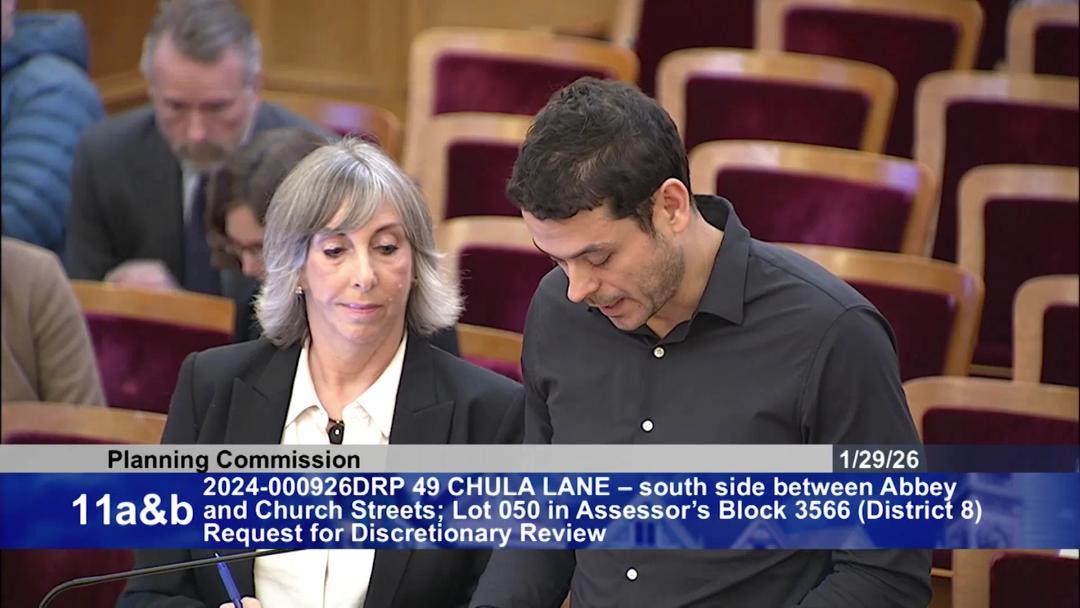
The San Francisco Planning Commission convened for its regular hearing on January 29, 2026, addressing several significant planning matters including special use districts, conditional use authorizations, discretionary reviews, and the election of new commission leadership. Opening and Commission Leadership Election The meeting began with roll call confirming attendance: President Soh, Vice President Moore, Commissioners Braun, Campbell, Imperial, and McGarry were present, with Commissioner Williams absent. Following approval of the January 15, 2026 meeting minutes (6-0), the Commission conducted its annual officer elections. President Soh reflected on the 18-19 months of service, emphasizing progress, cultural shift, and fair conduct. Commissioner McGarry motioned to elect Commissioner Campbell as President and Commissioner Moore as Vice President, which passed unanimously 6-0. Outgoing President Soh was commended for "daring optimism" and effective leadership during a transformative period. Director's Announcements and Legislative Updates Director Phillips announced the Planning Department hosted retired Chronicle urban design critic John King for staff discussions, demonstrating the team's commitment to continued learning. The department will present budget updates on February 12th, including information about permit center unification with DBI and potential mayoral budget cuts, while confirming no anticipated layoffs. Legislative Affairs Manager Audrey Merloni reported on Board of Supervisors activities, including unanimous approval of Code Corrections Ordinance amendments, movie theater alcohol sales ordinance modifications (continuing to February 9th), and driveway parking ordinance approval. Supervisor Mandelman initiated 27 landmark designations for District 8 as part of the family zoning plan's phase two. Public Comments on Housing Element Implementation Multiple community members and representatives from SOMCAN and the Race and Equity in Planning Coalition raised concerns about Housing Element Action 8.1.0—the "Affordable Housing Circuit Breaker." Speakers noted the January 2026 deadline for triggering additional city funding and land banking strategies when the city falls behind pro rata affordable housing production goals. Zachary Friel questioned what the Interagency Housing Element Implementation Committee and Planning Department are doing to implement this action. Teresa Dulalas and Kristin Evans emphasized the community's expectation for accountability, transparency, and enforceable commitments for affordable housing production. Director Phillips responded that the committee has begun formal meetings as of January 2026, drawing on previous Affordable Housing Leadership Council recommendations and OEWD/MOSED EIFD analysis. She noted that due to low market-rate production, the city has not triggered the specific pro rata threshold mentioned in the housing element, though the broader circuit breaker provisions remain under consideration. Commissioners Imperial and Braun requested informational hearings on housing element implementation to provide public transparency on affordable housing progress, timelines, and the committee's work. Item 8: 2245-2255 Post Street - Holocaust Center Special Use District and Conditional Use Authorization The Commission unanimously approved (6-0) planning code and zoning map amendments to create the 2245 Special Use District, along with a conditional use authorization for the Holocaust Center redevelopment project. The project involves demolishing two adjacent buildings and constructing a new four-story, approximately 60-foot tall building for Jewish Family and Children's Services' Holocaust Center. The 2245 SUD allows exceptions for non-residential use size limits, floor area ratio, bulk limits, active use requirements, street frontage controls, and other provisions to support the center's expanded cultural, educational, and archival programming while providing adequate security. The new facility will include public exhibition spaces, lecture hall, library, offices, conference spaces, and archive center. The project includes no vehicular parking, 14 Class 1 and 4 Class 2 bicycle spaces, construction of a bulb-out with security bollards, removal of four street trees with addition of two new trees, and lengthening of an existing passenger loading zone. Project Director Karen Payson explained the Holocaust Center, founded in 1979, currently occupies 6,400 square feet at 2245 Post. The expanded facility will accommodate on-site educational programs currently conducted off-site, serving students throughout Northern California and teachers statewide. Commissioner Imperial noted the Jewish community's history in the Fillmore area, calling the project "timely." Vice President Moore praised the "grounded building" design balancing transparency with security needs. Commissioner McGarry highlighted the quality contractor (Cahill Construction) and anticipated local hire benefits. Item 9: 1732 Terrebell Street - Conditional Use Authorization (Denied 5-1) The Commission denied (5-1, with President Campbell dissenting) a conditional use authorization to remove an approximately 956-square-foot dwelling unit and merge it with ground floor commercial space (Parkside Day Spa). The property, developed in 1925, historically contained both ground floor commercial space and a residential unit. Permits filed in 2011 misrepresented existing conditions, failing to disclose the residential unit to establish massage use. A 2017 enforcement case revealed unauthorized removal of the dwelling unit. Permit records documented a 2001 residential eviction for breach of lease, confirming residential occupancy. Planning staff recommended denial based on Housing Element objectives discouraging loss of existing units during San Francisco's housing shortage. Staff Architect Kurt Bowden noted approval would result in "net loss of housing in an amenity-rich area." Property owner John Tom, who purchased the property in 2001, argued the unit hasn't existed as configured since the 1960s, and that creating proper fire-rated separation would require substantial square footage loss from the commercial space (12% overall, 50% of existing spa rooms cut in half). The commercial tenant's representative stated no physical dwelling unit exists to remove. Commissioner Imperial confirmed rent board records documented residential tenancy as of 2001. Commissioner Braun noted plans were already approved in 2019 to restore the unit, and moved to deny the application, emphasizing the importance of preserving housing from a General Plan and Housing Element perspective. The motion passed 5-1. President Campbell dissented, acknowledging the difficulty of reinstating the unit given required storefront construction, rated corridor, and impact on small business operations. She suggested a compromise requiring minimum one unit addition upon future property sale/redevelopment, but ultimately voted against the majority. Item 10: 61 Royal Lane - Conditional Use Authorization (Approved 6-0) The Commission unanimously approved (6-0) a conditional use authorization to demolish a 534-square-foot unauthorized dwelling unit in an accessory building and construct a new three-story building with one dwelling unit and one accessory dwelling unit (ADU) under the state ADU program. The RH-1 zoned property in District 11's Priority Equity Geography includes an existing detached single-family home that will remain. The unauthorized unit was previously approved for legalization under Planning Code Section 207.3 but the permit was not issued. A buyout agreement was filed in 2020 and the unit has been vacant since 2021. The new building will include a 2,172-square-foot main unit (four bedrooms) occupying second and third floors with private decks, and an 826-square-foot ADU (two bedrooms) on the first floor. The project provides two bicycle spaces and one off-street parking space, complying with RH-1 and Priority Equity Geography SUD controls. Neighbors raised concerns about privacy impacts, narrow street width (11 feet on Royal Lane), limited emergency vehicle access, construction impacts, and neighborhood character compatibility. One resident noted 30+ years of residence with concerns about views into living spaces. Project architect Alex Nier noted the design provides 10-foot front setbacks on ground and second floors with additional 10-foot setback on third floor—"much more than typical on that street." Planning staff confirmed the project meets all objective design standards and will undergo subsequent fire department review for life safety requirements. Commissioner Braun, acknowledging neighbor concerns, stated the Housing Accountability Act limits ability to adjust projects meeting existing regulations. He noted the three-story design with setbacks represents "reasonable fit for the site" on the triangular mid-block parcel, and fire safety review will address access concerns. Vice President Moore requested better three-dimensional context documentation for future similar projects but supported reasonable densification under current Housing Accountability Act rules. Item 11: 49 Chula Lane - Discretionary Review and Variance (Approved 6-0) The Commission unanimously voted (6-0) to not take discretionary review and approve a vertical addition and deck to a two-story single-family building in the California Register eligible Chula Abbey Early Residential Historic District. The Zoning Administrator granted the associated variance with standard conditions. The project adds a third story to the existing 2,222-square-foot, three-bedroom, three-bath home at the 26-foot-wide by 85-foot-deep key lot, creating approximately 3,000 square feet total (increasing from three to four bedrooms). The DR requester, Louis Kobo of adjacent 10-12 Abbey Street, raised concerns about shadow impacts on his rear yard and studio unit (12 Abbey), scale inconsistency with the predominant two-story district, and light/air impacts. Project architect Lei Vu explained the north-facing site on narrow 14-foot Chula Lane is constrained by 51 Chula Lane to the west (spanning entire lot depth with 13 property line windows) and three-four story properties on Abbey Street to south and east. Building vertically rather than horizontally preserves essential open space for neighbors. The design includes 15-foot setback from front facade, asymmetrical gabled roof with 7'6" plate height on east side (reduced from original proposal), and deck setback from east property line. Seasonal sun studies showed no shadow impact from 9 a.m. to 2 p.m. year-round, with minor late afternoon impacts after 3 p.m. confined to winter months. Five support letters were received from immediate neighbors including 51 Chula Lane and Abbey Street residents. Zoning Administrator Corey Teague explained the variance was required because the original 2009 variance was granted partially on rationale of horizontal expansion, and the current vertical proposal represents different approach. The original variance protected 51 Chula Lane's interests by avoiding western expansion. President Campbell stated the "incredibly thoughtful and very modest" addition fits well with adjacent buildings, calling it "code-compliant" without "exceptional and extraordinary circumstances" warranting discretionary review. Vice President Moore supported the project but requested the applicant consider modifying the trapezoidal/triangular windows under the gable to rectangular windows more consistent with the historic district character, noting this wouldn't impact project realization but would improve historic compatibility. The motion to approve included this consideration. Item 12: 727 Madrid Street - Discretionary Review (Denied 6-0) The Commission unanimously voted (6-0) to not take discretionary review and approve construction of two rear decks (first and second floor) at a two-story over basement two-family building, complying with Notice of Violation 2022-93386. The 25-foot-wide by 100-foot-deep downsloping lot contains a Category B eligible resource built in 1910. DR requester Ida Eng of 735 Madrid Street (southwest neighbor) raised concerns about residential design guideline compliance regarding mid-block open space scale, light, and privacy preservation. She proposed replacing previous at-grade deck and stairs in-kind, or alternatively reducing deck footprint to 8-foot depth with increased side setbacks. Engineer/designer Albert Urrutia explained the lower deck extends 13.5 feet from rear wall (10 feet above grade) and upper deck extends 8 feet, with 5'4" setback from south property line and 4 feet from north. The additional depth on lower deck accommodates spiral stairs, effectively creating 8-foot deck on west side adjacent to Ms. Eng's property. Property owners Armando and Mary Martinez, native San Franciscans together 52 years, are building the decks for their children and future generations, creating stable multi-generational housing. Staff Architect David Winslow determined deck sizes are not excessive, are well within buildable rear yard area, and are articulated with side setbacks respecting mid-block open space scale and neighbor privacy. The distance between properties and view angles do not rise to exceptional/extraordinary circumstances but rather demonstrate "extremely common place and expected circumstance of property rights within the city." Ms. Eng raised concerns about plan discrepancies with as-built conditions, inaccurate Sanborn maps, and a DBI inspector's September 2025 comment questioning legality. Mr. Urrutia confirmed the plans match the existing half-complete deck measured on-site. Commissioner Braun confirmed DBI's final sign-off would verify plan compliance. Commissioner McGarry moved to deny the DR request, finding no exceptional circumstances. Commissioner Braun agreed this represents a "pretty common situation" anticipated by design guidelines without extreme privacy issues. Key Outcomes - New Commission leadership elected: President Campbell and Vice President Moore - Holocaust Center SUD and project unanimously approved, enabling expanded educational and cultural programming - Dwelling unit removal at 1732 Terrebell denied 5-1, prioritizing housing preservation - Two-unit project at 61 Royal Lane approved 6-0 under Housing Accountability Act - 49 Chula Lane vertical addition approved 6-0 with variance, including consideration for window modifications - 727 Madrid Street rear decks approved 6-0 - Commission requested informational hearings on Housing Element implementation and Affordable Housing Circuit Breaker accountability
AFFORDABLE HOUSING 27% · COMMUNITY ENGAGEMENT 21% · LAND USE 18% · ENGINEERING AND INFRASTRUCTURE 17%
242
JAN 29, 2026 · SAN FRANCISCO, CALIFORNIA · PUBLIC UTILITIES COMMISSION
San Francisco Public Utilities Commission Water Enterprise and Hetch Hetchy Budget Workshop - February 4, 2026

This special meeting focused on the San Francisco Public Utilities Commission's water enterprise operating budget and 10-year capital improvement plan, covering fiscal years 2026-27 through 2035-36. Opening and Land Acknowledgment President Arce opened the meeting by acknowledging that the SFPUC owns and stewards unceded lands within the ethno-historic territory of the Muwekma Ohlone tribe. The commission recognizes these Aboriginal lands and the SFPUC's working partnership with the Muwekma Ohlone tribe established since the agency's founding in 1932. Commission Attendance - Present: President Arce, Vice President Leveroni, Commissioners Jamdar, Stacey, and Thurlow Water System Overview Assistant General Manager Steve Ritchie presented comprehensive information about the water system serving 2.7 million people across the Bay Area. The system includes: - Eight major reservoirs (three in the Sierra Nevada, two in Alameda County, three on the Peninsula) - Infrastructure spanning from Yosemite National Park to San Francisco - 1,260 miles of water mains in San Francisco - Service to 21 wholesale customers, with 60% relying on the system for more than 60% of their drinking water Management Changes Ritchie introduced new division managers: - Adam Mazurkiewicz: New manager of Hetch Hetchy Water and Power Division (replacing Margaret Hannaford, retired January 9th) - Ryan Gabriel: New manager of Water Supply and Treatment Division (replacing Angela Chung) - Both were promoted from operations manager positions Operating Budget Overview (FY 26-28) The water enterprise operating budget totals approximately $750 million for FY26, increasing to $783 million over the two-year period with 870 FTEs. Key Budget Components - Salary and benefits increases: $17.7 million due to cost of living agreements - New positions: 12 FTEs total - 5 temporary-to-permanent conversions (budget neutral) - 7 new positions supporting infrastructure and facility management - 4 positions specifically for the new Sonol Ozone Water Treatment Facility (to be operational in approximately 3 years) - Total cost of new positions: $2.3 million in FY27, $3.1 million in FY28 Hetch Hetchy Water Budget Highlights - Major increase in revenue-funded capital: $28.7 million - Salary and benefit increases: $5.6 million - Converting 5 temporary positions to permanent - Increased payments to partner agencies including Don Pedro Recreation, Tuolumne County, USGS, National Park Service, and irrigation districts - WEC-NERC compliance costs: $0.7 million in FY27, $1.4 million in FY28 Operating Priorities and Challenges The commission identified eight Level of Service Goals adopted in December 2023, covering: - Drinking water quality - Regional and in-city seismic reliability - Regional and in-city delivery reliability - Water supply - Environmental stewardship - Sustainability Major Challenges: - Aging infrastructure: System components over 100 years old, with the oldest dam dating to 1866 - Tuolumne River improvements: Balancing water supply reliability with environmental restoration - Staffing constraints: Historically restrained increases despite growing technological complexity - Regulatory compliance: Increased dam safety requirements following 2017 Oroville incident - Cross-connection control: New state regulations - WEC-NERC compliance: Growing electricity reliability regulations since 2008 10-Year Capital Improvement Plan ($2.5 Billion) The commission reviewed three separate capital plans totaling approximately $2.5 billion over 10 years: - Local water system: $1.25 billion (10-year), $313 million (2-year) - Regional water system: $1.25 billion (10-year), $264 million (2-year) - Hetch Hetchy water: Separate plan with mixed water and power funding Financial Strategy Deputy CFO Laura Bush explained: - Water Enterprise debt service represents approximately 50% of the operating budget - Current revenue-funded capital: 40% (exceeding the 15-30% policy target) - Debt service coverage maintained above 1.2 (internal target), exceeding the 1.1 commission policy and 1.0 bond indenture minimum - 30-year debt burden from $4.8 billion Water System Improvement Program (2002-present) constrains current capital spending Capital Planning Approach The SFPUC is planning across three time horizons: - First 10 years: $2.5 billion in prioritized projects - Second 10 years: Additional deferred projects - Third 10 years: Extended planning for $10 billion in total identified needs ($6.8 billion local/regional, $3.3 billion Hetch Hetchy) Ritchie emphasized that project deferrals, not cancellations, are the strategy: "For a water system that has assets that are just getting older, cancelling a project isn't in the cards. It's just a matter of when you're going to have to do it." Major Capital Projects Operations Centers The SFPUC operates four major operations centers: 1. San Francisco Water Division (1990 Newcomb, relocating to 2000 Marin) 2. Millbrae Operations Center (regional operations) 3. Sunol Yard (East Bay operations) 4. Moccasin (Hetch Hetchy system operations) In-City Headquarters Project (2000 Marin) - Total budget: $418 million - 10-year plan allocation: $114 million (remaining funds already appropriated) - Status: Construction started late 2024 - Completion: Expected 2029 - Features: Four-story administration building and six-story parking garage Millbrae Operations Center Improvements - Total budget: $428 million - 10-year plan: $365 million - Two-year budget: $57 million - Purpose: Consolidate staff from seismically unsafe Rollins Road building in Burlingame, replace outdated water quality laboratory, replace unsafe shop buildings - Status: Controversial - requires full site including current Outdoor Supply Hardware (OSH) location - OSH lease: Extended twice (one-year extensions in 2026 and 2027) from original 2020 five-year lease Rationale for full site use: - Water quality staff coordination and efficiency - Laboratory proximity for sampling staff - Accommodation for 40 additional vehicles - Regional operations hub serving Peninsula area Regional Water Treatment Projects Sunol Valley Ozone Facility: - Total budget: $326 million - 10-year plan: $84 million (substantial funds already appropriated) - Status: In construction - Completion: Expected 2030 - Purpose: Control taste and odor compounds - Staffing: 4 new positions in current budget to prepare for operations Sunol Short-Term Improvements: - Within existing treatment plant footprint - Ongoing facility improvements Tesla Ultraviolet Treatment Facility: - Budget: $40 million - Purpose: Increase reliability, upgrade backup power systems - Note: Original facility completed 2011; technology obsolescence requiring complete control system replacement Harry Tracy Water Treatment Plant (San Bruno): - Phase 3 budget: $30 million - Purpose: Rehabilitate chemical delivery facilities Dam Safety Projects (High Priority) Three major dam projects totaling $1.4 billion in anticipated costs: 1. Turner Dam (1964): $776 million 2. San Andreas Dam (1875): $380 million 3. Pilarcitos Dam (1866): $190 million Current approach: - 10-year plan allocation: Only $44 million for interim measures - Strategy: Phased improvements and interim projects to extend timelines - DSOD coordination: Division of Safety of Dams encouraged interim projects that provide quick benefits - Current restrictions: Two reservoirs (Pilarcitos and San Andreas) operating with water level restrictions - Pilarcitos status: Only dam in SFPUC system rated "poor" by DSOD (vs. "fair" or "satisfactory") Interim measures focus: - Emergency release capabilities - Outlet structure improvements - Projects that can upgrade ratings without full reconstruction Local Water Conveyance and Distribution Main Replacement Program: - 10-year allocation: Approximately $500 million - Scope: Ongoing replacement of 1,260 miles of water mains in San Francisco - Current cost: $6 million per mile (increased from $2-3 million historically) - Two-year budget: Carefully managed with 9 projects ready for bid - Strategy: Staff must prove project readiness before appropriation - Status: 2 projects already out to bid, third following soon Potable Emergency Firefighting Water System (PEFWS): - Dual-purpose system for normal water supply and emergency firefighting - Funded partially by ratepayer funds and General Obligation bonds - New earthquake response bond measure approved by Board of Supervisors for upcoming ballot Advanced Meter Infrastructure (AMI) and Meters Components: - Water meters: Physical plumbing infrastructure - AMI: Electronic reading and data transmission systems Projects: - Small meter replacement (5/8 inch household meters) - Large meter replacement (3-10 inch for commercial customers) - Manifold services renewal: Converting multi-meter manifolds to single meters - Current action: Replacing 5,000 MTU (meter transmission units) immediately to prevent failures - Near-term: AMI Refresh and Renew program for 50,000 units - Strategic review: Evaluating whether to continue current AMI system or convert to newer technology Note on meter accuracy: 2015 meter replacement resulted in average 3-4% bill increases due to improved accuracy of new meters. Hetch Hetchy Major Projects Moccasin Penstock Rehabilitation: - Total budget: $533 million (largest Hetch Hetchy project) - Status: Penstocks constructed 1925 (100+ years old) - Completion: Needs assessment and alternatives analysis complete - Construction timeline: Expected to begin FY32, complete FY36 - Alternatives under review: New pipes down hillside vs. shaft and tunnel system - Recent development: Acquired property completing right-of-way control O'Shaughnessy Dam Outlet Works Phase 2: - Phase 1: Completed preparatory work - Phase 2 scope: Replace 100+ year old needle valves and butterfly valve in dam face, improve slide gates, drum gates, diversion tunnel and pipeline - Challenge: Valves embedded in concrete dam structure (constructed 1923) Moccasin Dam Long-Term Improvements: - Trigger: Major 2018 flood event highlighted atmospheric river risks - Scope: Construct new auxiliary spillway with adequate flow capacity - Status: 35% design complete - Construction timeline: Begin in 3-4 years, complete 2033 San Joaquin Pipelines Valve and Safe Entry Improvements: - Total budget: $157.8 million - 10-year plan: $29.1 million (substantial funds already spent) - Scope: Four contracts installing cross-connections and safe entry access - Method: Installing removable spool pieces for pipeline lockout during maintenance Alternative Water Supply Projects Peninsula Pure Water Program: - Total estimated budget: Approximately $700 million - Partnership: Silicon Valley Clean Water (Redwood City area) - Technology: Indirect potable reuse - treat wastewater to high standards, store in Crystal Springs Reservoir for months before filtering at Harry Tracy Water Treatment Plant - Status: Active project in capital plan Pure Water SF Proof of Concept: - Total estimated budget: Approximately $100 million - Location: Future site at 1990 Newcomb (after Water Division relocates) - Technology: Direct potable reuse demonstration facility - Purpose: Prove technology for treating wastewater to drinking water standards without environmental buffer - Regulatory requirement: Demonstration facility required before direct potable reuse implementation - Timeline: Planning money in first 10 years, construction in second 10 years - Context: San Diego and Los Angeles Metropolitan Water District pursuing similar approaches Strategic Approach: Unlike previous budget cycles, SFPUC not proposing significant regional alternative water supply spending beyond Peninsula Pure Water (in year 10), recognizing regulatory uncertainty around Bay-Delta Plan. Public Comments and Controversies Millbrae Operations Center Opposition Vice Mayor Steven Rinaldi and former Mayor/BAWSCA representative Ann Schneider testified strongly against the project: Concerns raised: - Cost: $428-500 million described as excessive - Rate impacts: Double-digit water and wastewater rate increases anticipated; BAWSCA ratepayers lack clarity on CIP impacts - Lost revenue: $1 million annually from OSH and KFC tenant displacement, 50 employees affected - Land use inefficiency: Surface parking contradicts SFPUC's transit-first policy (reduced parking at 525 Golden Gate headquarters) - Location context: 10-minute walk from Millbrae Transit Center (BART, Caltrain, SamTrans, SFO access) - Community coordination: No consultation with Millbrae or San Mateo County; SFPUC staff unfamiliar with county's decade-long Grand Boulevard transit-oriented design plan - Premature actions: RFQ issued for art projects before project approval - Environmental justice: Millbrae as "overburdened community" hosting regional infrastructure (SFO, BART, Caltrain, high-speed rail, PG&E) - Historical impacts: SFO built on Millbrae land, eliminating bay access and 100 years of economic development, leaving Millbrae as one of lowest revenue-generating cities in San Mateo County - AB 1628 compliance: State law requiring meaningful involvement in land use decisions not followed Request: Halt project, bring Millbrae and BAWSCA to table for collaboration BAWSCA Comments Tom Francis (representing General Manager Tom Smogul) submitted letter highlighting: Dam Safety: - Required work on dams in years beyond 10-year CIP is "extensive and costly" - Deferral ability requires ongoing DSOD engagement - Concern about long-term financial impacts Alternative Water Supplies: - Supports budgeting approach limiting regional alternative supply spending (aside from Peninsula Pure Water in year 10) - Recognizes regulatory uncertainty around Bay-Delta Plan - Notes public may miss that significant alternative supply costs are beyond 10-year cycle Millbrae Project: - Questions whether scope and timing represent most cost-effective approach - Requested additional information on project evolution over time - Emphasized facility serves water supply reliability, water quality, and emergency purposes SFPUC Response to Millbrae Concerns AGM Ritchie addressed: - Detailed information being compiled to answer Millbrae's questions - OSH lease extended for second one-year period (signed just before meeting) - Civic Design Review Board issued RFQ for community art (information shared with Millbrae) - Project modifications: Wellness center eliminated approximately 6 months ago to control costs - Rationale for consolidation: Water quality staff efficiency, laboratory proximity, vehicle accommodation, elimination of seismic risk at Rollins Road President Arce commentary: - Emphasized SFPUC's strong track record of achieving consensus (approximately 99% of decisions) - Acknowledged current lack of consensus on Millbrae project - Attended Millbrae City Council presentation firsthand - Urged continued efforts to achieve consensus or come as close as possible - Stressed importance of understanding "breadth, magnitude, identity, character" of opposition - Referenced General Manager Herrera's statement: "try as we might, we can't always achieve consensus" Design Drought and Water Supply Planning President Arce raised question about revisiting design drought scenario in context of capital planning and rate affordability. General Manager Herrera responded: - Committed to comprehensive focus on water supply planning this year - Multiple drivers: Urban Water Management Plans due, Bay-Delta Plan negotiations, Healthy Rivers and Landscapes discussions - Will present analysis results to Commission later in 2026 - Analysis will cover water supply planning, demand management, and impact on capital decisions Historical context: - Former GM Andy Moran stated he "can't agree with any comment that our design drought operating rule is overly conservative" - Ongoing advocacy from stakeholders to revisit assumptions Financial Policies and Debt Management Capital Financing Policy: - Requires 15-30% of CIP be revenue-funded (not debt-funded) - Water Enterprise currently at 40%, exceeding policy target - Significant reduction in debt reliance over time Debt Service Coverage Policy: - Bond indenture minimum: 1.0x coverage - Commission policy: 1.1x coverage - Internal planning target: 1.2x coverage - Used by credit rating agencies to assess financial health Current debt situation: - Approximately 50% of water operating budget pays existing debt service - Water System Improvement Program (WSIP) debt creating 30-year burden - WSIP tripled water rates as anticipated and accepted by wholesale customers - Debt service will begin declining as 30-year bonds mature - Strategic balance required between revenue funding and bond funding going forward Key Outcomes and Next Steps Commission Direction - Continue dialogue with Millbrae and BAWSCA on operations center - Address detailed questions from stakeholders - Pursue consensus where possible while recognizing constraints - Review water supply planning and design drought scenario later in 2026 - 10-year financial plan coming to Commission February 10, 2026 Meeting Continuation - Motion passed unanimously to continue special meeting to Thursday, February 5, 2026 at 1:30 PM in Room 408, City Hall - Commission will review wastewater enterprise capital program at continued meeting Staffing Priorities - Prepare 4 positions for Sunol Ozone Facility operations (3 years ahead of completion) - Fill 12 new FTE positions across water quality, supply/treatment, natural resources - Continue addressing technological complexity with adequate staffing Project Delivery Focus - Accelerate main replacement projects (9 projects ready, 2 already bid, third following) - Complete construction at 2000 Marin headquarters (2029) - Advance Sunol Ozone Facility construction (2030 completion) - Implement dam safety interim measures - Progress Moccasin Penstock alternatives analysis - Advance O'Shaughnessy Dam outlet works design Long-Term Planning Horizon - Extended planning to "third 10 years" (unprecedented) - Recognition that $10 billion in needs cannot be addressed simultaneously - Deferral strategy for lower-priority projects while maintaining system reliability - Ongoing risk-based prioritization, especially for Hetch Hetchy linear system

ENGINEERING AND INFRASTRUCTURE 74% · PERSONNEL MATTERS 9% · LAND USE 7% · COMMUNITY ENGAGEMENT 4%
243
JAN 28, 2026 · SAN FRANCISCO, CALIFORNIA · BUDGET AND FINANCE COMMITTEE
San Francisco Budget and Finance Committee Meeting - January 28, 2026

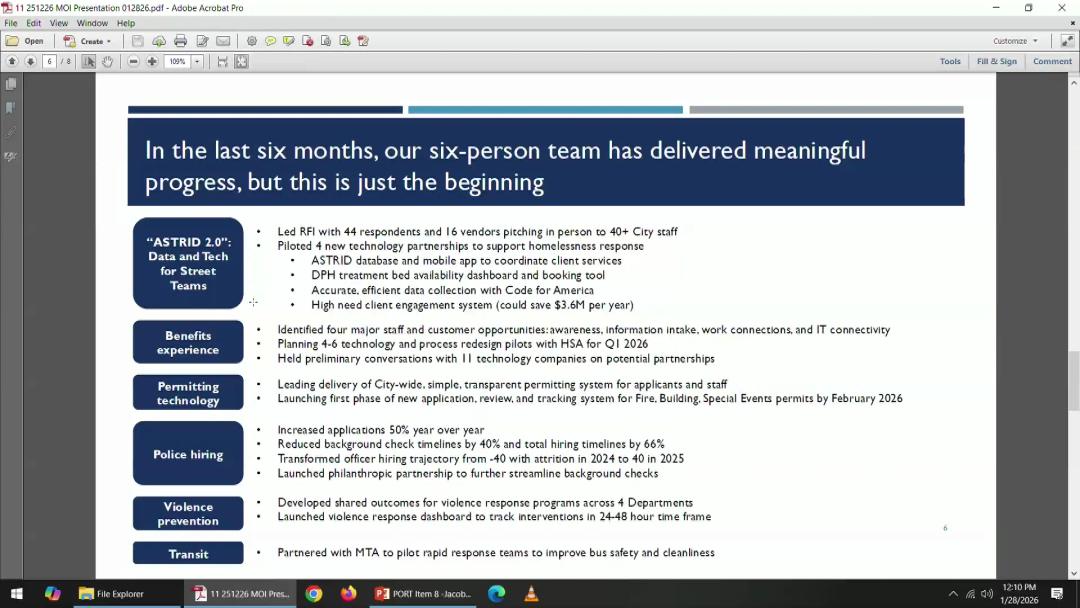
The Budget and Finance Committee, chaired by Supervisor Connie Chan with Vice Chair Matt Dorsey and Member Danny Sauter, convened to review multiple grant acceptances, contract amendments, and major city initiatives totaling over $200 million in funding. Opening and Introductions The meeting opened with standard procedural announcements. All items acted upon were expected to appear on the Board of Supervisors agenda for February 3rd. The committee established that department presentations would precede Budget and Legislative Analyst reports for all items. Consent Calendar Item 1: ProHousing Incentive Program Grant ($1.5 Million) The Mayor's Office of Housing and Community Development received approval to accept $1.5 million from the California Department of Housing and Community Development's ProHousing Incentive Program. San Francisco earned its pro-housing designation in October 2024, recognizing policies like inclusionary zoning and no minimum parking requirements. Funds will support affordable housing construction at either 967 Mission (senior housing) or 835 Turk (106 affordable units), with final determination pending other state funding notifications. The grant term extends through June 30, 2029. The item passed unanimously with positive recommendation. Item 2: Access Line Tax Modernization The committee approved an ordinance revising how the access line tax applies to voice over internet protocol (VoIP) services. The technical change requires collection based on the lower of either the number of telephone numbers provided or the number of simultaneous calls possible, rather than just counting phone numbers. The Office of Treasurer and Tax Collector confirmed no significant revenue impact is projected. This modernization provides flexibility for telecommunications companies operating over internet services. The ordinance passed unanimously with positive recommendation. Major Contracts and Agreements Item 3: HealthRite 360 Contract Amendment ($38.6 Million) Department of Public Health received approval for a two-year extension through June 30, 2028, increasing the contract value by $28.6 million to $38.6 million total. The contract funds two critical programs: Acceptance Place (10 beds for LGBTQ men with substance use disorders at 890 Hayes Street, serving 53 clients in FY 24-25) and withdrawal management services (20 beds at 815 Buena Vista, serving 793 clients in FY 24-25). The programs provide 30-90 day residential treatment and 5-7 day withdrawal management with medical services. Both programs meet contract obligations, though bed rates are slightly higher than comparable DPH services. The extension allows DPH to reprocure the entire portfolio to harmonize rates. The resolution passed unanimously, with supervisors noting the importance of opioid treatment programs despite costs, as alternatives are more expensive. Item 4: SFMTA Towing Contract Extension ($158.8 Million) The committee approved extending SFMTA's contract with Texco LLC for towing, storage, and disposal of abandoned and illegally parked vehicles by up to 15 months through June 30, 2027, increasing total contract value by $22.1 million to $158.8 million. The contract began April 1, 2016, making this an 11-year, 3-month total term requiring Board approval. SFMTA is conducting a comprehensive competitive solicitation process, including a Request for Information issued in July 2025 to identify 10% cost savings in the fixed monthly management fee (approximately two-thirds of contract costs). The agency tows approximately 40,000 vehicles annually. The Budget and Legislative Analyst noted fiscal year 24-25 showed an $8.4 million deficit driven by low-income waivers and police department waivers, funded by transit revenues. Public comment raised concerns about "poverty tows" for expired registration (third most common reason) and impacts on low-income residents and those living in vehicles. Chair Chan requested data on large vehicle tows under the new RV enforcement policy before full Board consideration. The resolution passed unanimously. Recreation and Parks Grants Items 5-7: India Basin Shoreline Park Funding ($6.24 Million) The committee approved three grant acceptances for India Basin Shoreline Park totaling $6.24 million: - Item 5: $1.15 million from San Francisco Bay Restoration Authority Measure AA (retroactive, agreement signed December 18, 2025) requiring 20-year public recreation maintenance - Item 6: $2 million from U.S. Environmental Protection Agency Brownfield Cleanup Program (retroactive, October 1, 2025 - October 31, 2029) for environmental remediation - Item 7: $3.09 million increase to existing California State Coastal Conservancy grant (total now $8.59 million) extending performance period through December 31, 2048, funding gravel beach, boathouse, and floating dock The project represents Phase III of the India Basin Waterfront Initiative serving Bayview-Hunters Point. Phases I and II (900-innis remediation and park construction) completed October 2024. Phase III groundbreaking occurred August 19, 2025, with completion anticipated early 2028. The funds primarily support shoreline work scheduled for 2027. Chair Chan requested before-and-after photos and detailed project scope be added to the legislative file before February 3rd Board consideration. All three resolutions passed unanimously, with Item 5 amended to reflect retroactive status. Port of San Francisco Items Item 8: Waterfront Resilience Program Advisory Services ($40 Million) The Port received approval for a five-year, $40 million contract with Jacobs Engineering for program advisory services supporting the Waterfront Resilience Program, with one five-year extension option. The contract supports a federal flood study with the Army Corps of Engineers that began in 2018 as a 3-year, $3 million effort but has grown to 8.2 years and $19.2 million under Corps direction. The study's recommended plan costs $13.5 billion (2024 estimate) to raise the shoreline by 1.5-3.5 feet for sea level rise adaptation, with potential 65% federal funding if Congress authorizes the project via the Water Resources Development Act expected late 2026. The contract provides program management, environmental support, Army Corps technical services, design/engineering, communications, and finance/legislative support. Despite 90 pre-proposal conference attendees, only one proposal was received, attributed to state conflict-of-interest provisions preventing firms from reviewing their own work. Jacobs has 26% LBE participation across 39 consultants and six years of program experience. The January 2026 king tides reached 8.8 feet, demonstrating current flood risk at the Embarcadero's low point where BART and Muni infrastructure is exposed. The Port accepted the Budget and Legislative Analyst recommendation to adopt contractor evaluation practices. The resolution passed unanimously. Item 9: Dry Dock Emergency Repairs ($10 Million) The committee approved an emergency declaration for immediate repairs to stabilize Dry Dock Number 2 at Pier 68. The 55-year-old, 900-foot steel floating dry dock began taking on water and listing during November 2025 storms, requiring 24/7 pump operation. The Port had been seeking disposal solutions since operator BAE abandoned the shipyard in 2017. Emergency contract work totals $8.6 million ($8.1 million construction, $500,000 Department of Public Works) plus $1.8 million contingency. The broader project scope includes $61.2 million total for removing both dry docks at Pier 68: $18.5 million previously appropriated, $1.5 million existing Port funds, and $41.2 million anticipated in FY 26-27 budget. The Port will use short-term Harbor Fund reserves initially, returning funds to original purposes (parks and open space improvements) upon appropriation approval. Emergency work began under notice to proceed, with formal Board approval required per city procedures. The resolution passed unanimously with Controller's Office amendments adding funding source details and signature lines. Economic Development Initiatives Item 10: Downtown Revitalization Financing District ($610 Million) The committee approved establishing the Downtown Revitalization and Economic Recovery Financing District under AB 2488, creating a tax increment financing program to incentivize office-to-residential conversions. The district encompasses Financial District, Union Square, Mid-Market, Civic Center, and parts of SoMa, with projects required to be 60% residential in areas allowing residential/mixed-use. Bay Area Economics identified 1,300 eligible parcels with 48 likely conversion candidates potentially creating 4,400 units housing 7,000 new residents. The financing plan allocates 65% of the city's property tax increment (maximum $610 million over 45 years, with $1.2 billion hard cap) as incentive payments over 30 years to enrolled projects. Projects must enroll by December 2032. Affordability requirements mandate 5% very low-income or 10% low-income units (rental) or 10% moderate-income (ownership) after the first 1.5 million square feet, unless local inclusionary requirements are higher. Labor standards include prevailing wages for all projects, registered apprentice programs and healthcare for 50+ unit projects, and skilled/trained union labor for buildings over 85 feet. The fiscal impact analysis projects negative $170,000 to positive $11,000 per project annually to the general fund, depending on service cost methodology. Using adaptive reuse analysis accounting for existing downtown infrastructure generates positive impact; traditional methodology shows negative impact. Total economic activity estimated at $133 million if all projects proceed. Public testimony included strong support from labor (Carpenters Local 22), developers (Emerald Fund, which completed 418-unit conversion at 100 Van Ness), Housing Action Coalition, Bay Area Council, San Francisco Chamber of Commerce, and SPUR, citing successful models in New York City (12,000+ conversions), Chicago, and Denver. The Budget and Legislative Analyst recommended capping subsidies at 15-20% of project costs to limit taxpayer exposure for primarily market-rate housing and ensuring administrative costs for the Clerk and Controller are funded starting FY 26-27 (estimated couple hundred thousand dollars). Chair Chan requested the list of 48 identified properties be added to the legislative file and emphasized the district board should consider project labor agreement requirements and subsidy caps. The resolution passed unanimously with strong support from Vice Chair Dorsey (co-sponsor) and Supervisor Sauter (district board chair). Mayor's Office Initiatives Item 11: Bloomberg Philanthropies Grant - Office of Innovation ($7 Million) The committee approved accepting $7 million from Bloomberg Philanthropies to fund the Mayor's Office of Innovation for three calendar years (January 2026-December 2028), creating four new positions and funding five existing positions (total 10-person team, with one position in Department of Technology budget). This represents Bloomberg's largest-ever grant to any city innovation office globally. The grant requires 30% match ($2.3 million): half through fundraising, half through related existing general fund spending. Fundraising discussions have begun but no commitments secured to date. The four new positions include: Service Design Leader (outcomes-based contracting for billions in nonprofit partnerships), Designer (homelessness and HR-1 response), Data Scientist (public safety and capital project delivery), and Product Manager (innovation ecosystem engagement). The Budget and Legislative Analyst identified a $300,000 annual funding gap if all positions reach top salary steps, though the Mayor's Office expects actual salaries will fit within the grant. A three-month gap ($900,000) is projected for September 2028, but Bloomberg allows flexibility to push expenses to grant end. Key projects include: - Homelessness response: Mobile app coordinating Fire, HSH, DPH, and emergency management services; shelter bed matching system (replacing 10-call process); high-need client analysis for ER frequent users (multiple monthly visits) targeting long-term placement to save millions annually. Project completion expected by end of 2026. - HR-1 Medicaid/SNAP compliance: Addressing tens of thousands of San Franciscans at risk of losing benefits starting July 2026 due to federal work requirements; connecting recipients to exemptions, work documentation, volunteer opportunities, and employment - Permitting modernization: Single online citywide system launching February 13, 2026, for remodeling, commercial improvements, fire safety, and special events, eliminating 4-8 hour wait times - Police hiring: 50% increase in applicants (2025 vs 2024), 66% reduction in hiring timeline, net gain of 40 officers in 2025 (compared to 40-officer loss in 2024) through process redesign and digital marketing - Violence prevention: Reduced incident reporting lag from 9 days to 24-48 hours through new integrated data tools - Transit improvements: Proactive cleaning for most-complained-about lines building support for fall 2026 revenue measures Chair Chan emphasized grant-funded positions must be fully funded by grants without general fund support, requesting organizational chart before full Board consideration and clarifying no individual data sharing with Bloomberg occurs (only aggregated statistics). Vice Chair Dorsey highlighted critical importance of Medicaid sustainability work, noting H.R. 1 could cause 1.6 million nationwide (including many San Franciscans in substance use treatment) to lose coverage effective January 1, 2027. Supervisor Sauter inquired about Bloomberg engagement structure (monthly meetings, bi-annual peer city connections). The ordinance passed unanimously. Item 12: Tipping Point Community Grant - Strategic Partnerships ($700,000) The committee approved accepting $700,000 from Tipping Point Community to fund a Director of Strategic Partnerships position for 2.5 years (full funding for calendar years 2026-2027, 50% funding for 2028, with remaining 50% from Mayor's Office budget). The position authority exists but was previously unfunded. Cynthia Wong, a North Beach resident with experience at Chan Zuckerberg Initiative, LISC Bay Area, and Seattle Foundation, will fill the role. The position aims to strengthen public-private partnerships across housing, homelessness, economic recovery, and government effectiveness, similar to positions in other major cities and previously in Mayor Lee's administration. Chair Chan requested Ms. Wong's resume be added to the legislative file given the retroactive nature and emphasized the position should help track behest payment waivers and donor contacts to provide transparency for ongoing waiver evaluations. She anticipated the position would inform the budget process by identifying fundraising priorities and goals for items like the Immigration Defense Fund that could be funded outside public sources. Public comment from People's Budget Coalition raised concerns about privatizing city government functions and disparities between funding community engagement versus direct services, noting DPH providers facing $17 million cuts. The resolution passed unanimously as amended with retroactive language. Key Outcomes All items passed unanimously with positive recommendation to the full Board of Supervisors. The meeting demonstrated significant investment in affordable housing, infrastructure resilience, downtown revitalization, and innovation initiatives. Total funding approved or authorized exceeded $200 million across grants, contracts, and financing districts. Key amendments included retroactive language for several grants and Controller's Office technical corrections. The committee requested additional documentation (property lists, organizational charts, resumes, photos) be added to legislative files before February 3rd Board consideration. Several items highlighted ongoing concerns about general fund impacts, sustainability of grant-funded positions, labor standards, and equitable distribution of resources between market-rate development incentives and direct services for vulnerable populations.

ENGINEERING AND INFRASTRUCTURE 16% · TECHNOLOGY AND INNOVATION 14% · ECONOMIC DEVELOPMENT 13% · TRANSPORTATION SAFETY 11%
244
JAN 27, 2026 · SAN FRANCISCO, CALIFORNIA · PORT COMMISSION
San Francisco Port Commission Meeting - January 27, 2026

This meeting addressed the Port's fiscal challenges, executive director recruitment, and strategic priorities as the organization navigates post-pandemic economic conditions while maintaining its role as steward of San Francisco's seven-and-a-half-mile waterfront. Opening and Procedural Items The meeting opened with a roll call confirming all five commissioners present: President Gail Gilman, Vice President Stephen Englund, and Commissioners Willie Adams, Stephen Lee, and Ken McNeely. The commission unanimously approved minutes from the January 13, 2026 meeting. The Port acknowledged the Ramatush Ohlone people as the original inhabitants and indigenous stewards of the San Francisco Peninsula, affirming their unceded ancestral homeland and sovereign rights as First Peoples. Fiscal Year 2026-27 and 2027-28 Biennial Budget Priorities Financial Context and Challenges Acting Executive Director Michael Martin framed the budget presentation by noting the Port's unique moment in history. While revenues have recovered to pre-pandemic levels, expenditures are now growing faster than revenues—a concerning trend driven by inflation, tariffs, and decreased international tourism. The Port faces a $1.9 billion unfunded capital need out of a total $2.6 billion identified in the 10-year capital plan. Interim Deputy Director of Finance and Administration Megan Wallace presented detailed financial projections showing that while the Port maintained operating profits during the 2010s boom, the gap between revenues and expenditures has significantly narrowed. The Port operates as an enterprise department without general fund support, generating its own revenues while contributing approximately $40 million annually in work orders to other city departments. Alignment with Citywide Priorities The Port's budget aligns with Mayor Daniel Lurie's core priorities: - Affordability and livability for families - Creating clean and safe environments - Partnering with public transit agencies (MTA and SF Bay Ferry) - Modernizing systems and improving efficiency - Building economic strength While the city faces a $900 million general fund deficit requiring $400 million in ongoing savings, the Port's budget remains balanced but with diminishing net operating income that threatens future capital investments. Strategic Budget Priorities The Port identified several key investment areas: 1. Day-to-Day Operations: Maintaining staffing for the maintenance division to keep public spaces clean, safe, and welcoming; modernizing permitting and property management systems 2. Revenue Generation: Stabilizing revenue-generating assets while investing in parks, open space, arts, culture, and events; advancing major initiatives including Fisherman's Wharf Forward, Mission Rock, Pier 70, and Seawall Lot 330 3. Resilience and Sustainability: Addressing flood and seismic risks; pursuing zero-emission fleet transitions; improving water quality and biodiversity 4. Equity and Engagement: Expanding public access; strengthening community and tenant engagement; improving transparency and accountability Future Strategy Discussions Martin announced upcoming presentations on: - Lease process efficiency improvements and delegated authority - A blue-green incubator for early-stage maritime and environmental companies - Feasibility analysis for upgrading Pier 80 as a home port cruise terminal with shore power - February 10 detailed budget presentation - Strategic plan update - Rapid structural assessment program annual update - Comprehensive facility condition assessment Commissioner Discussion Commissioner McNeely asked about how interdepartmental work orders appear in the budget and whether capital allocation prioritizes return on investment. Martin explained that while some prioritization considers ROI, many critical investments like roof repairs don't generate direct revenue but prevent future deterioration and costs. Commissioner Lee emphasized the need for smaller, more affordable spaces to attract local entrepreneurs rather than only large corporate tenants. He advocated for subdividing spaces during maintenance projects and adding revenue-generating kiosks near parks to support small businesses. Commissioner Adams acknowledged the Port's role in "navigating economic pressure" and emphasized that despite public perception, the Port is not wealthy like other major ports. He stressed the importance of clearly communicating the Port's financial realities to the public. Vice President Englund appreciated the framing of the "in-between economy" and urged consideration of state priorities alongside city priorities, emphasizing the Port's role in championing initiatives like the blue-green economy and partnerships with sister ports. President Gilman emphasized maintaining economic diversity to ensure the waterfront serves all San Franciscans, from those seeking $8 lunches to $38 meals, creating an inclusive environment beyond tourism. Executive Director Recruitment Process Search Firm Presentation Julia Morse, Vice President of Public Sector Practice at Berkeley Search Consultants, presented an overview of the recruitment process for the new Port Director. Berkeley Search, a Bay Area firm with 36 years of experience, was selected to conduct this international search. The firm has: - Developed and posted a comprehensive candidate profile and job announcement - Posted the position on 15 job boards including LinkedIn, government-focused sites, diversity boards, and professional associations like the American Association of Port Authorities - Conducted outreach to 400+ contacts internationally - Received approximately 150 inquiries to date - Set an application deadline of February 20, 2026 - Scheduled interviews for March and April 2026 - Projected a final offer shortly after interviews conclude Morse emphasized that recruiting is "a people business" involving major life decisions for candidates and critical leadership decisions for the organization. Public Comment Ellen Chonk, co-chair of the Port's Maritime Commerce Advisory Committee, provided the only public comment, emphasizing three essential themes the next director must understand: 1. The Port IS the City: The Port represents the birth and history of San Francisco; without the Port, there would be no city 2. People as the Largest Cargo: The Port's primary asset is people—workers, passengers, tenants, visitors, and staff 3. Relationships Matter: The director must build strong relationships with city leadership, the bay environment, the community, and especially Port staff Commissioner Input Commissioner Lee stressed the importance of hiring a "people person" with small business knowledge, as the Port relies on serving people rather than traditional cargo operations. Commissioner McNeely expressed confidence in Berkeley Search's process and agreed about the critical importance of people skills. Commissioner Adams called this "one of the biggest decisions" the Commission will make this year, emphasizing the need for a visionary leader who can manage 250+ staff, work with commissioners, serve as the face and voice of the Port, and "hit the ground running" during challenging times. He noted that "leadership is when everything goes wrong" and expressed disappointment at limited public attendance for such an important decision. Vice President Englund emphasized seeking a candidate who is "100% dedicated" and focused on the work rather than viewing the position as a stepping stone, demonstrating commitment to stay present through daily challenges. President Gilman encouraged public participation through the survey (deadline February 16, 2026) and emphasized that commissioners are "just people" serving as stewards of the waterfront under the Burton Act public trust. She highlighted the need for a leader who can handle both strategic vision and hands-on work, someone who will "clean up the orange juice and plug in the power cord if they need to." Key Outcomes and Next Steps - February 10, 2026: Detailed budget presentation with line items, revenue trends, and staffing alignment - February 16, 2026: Deadline for public input survey on executive director search - February 20, 2026: Application deadline for Port Director position - February 23, 2026: Port budget submission to Mayor's Office - February 24, 2026: Port Commission formal budget approval - March-April 2026: Executive director candidate interviews - April 2026: Budget presentation to Capital Planning Committee - May 2026: Mayor's budget introduction to Board of Supervisors Closing Statement President Gilman closed the meeting with a powerful statement establishing a new tradition: until violent federal government actions against citizens exercising First Amendment rights cease, the Port Commission will close each meeting in memoriam. She specifically honored Renee Good and Alex Petty, who lost their lives exercising their rights to peaceful assembly and protest against government actions they viewed as "unfair, unjust, racist, and wrong." She expressed hope that no additional names would need to be added in future meetings.

ECONOMIC DEVELOPMENT 37% · PERSONNEL MATTERS 32% · ENGINEERING AND INFRASTRUCTURE 17% · PROCEDURAL 6%
245
JAN 27, 2026 · SAN FRANCISCO, CALIFORNIA · BOARD OF SUPERVISORS
San Francisco Board of Supervisors Regular Meeting - January 27, 2026

The San Francisco Board of Supervisors convened on January 27, 2026, for a regular meeting covering legislative matters, public safety initiatives, housing development, community recognition, and policy resolutions. Opening and Procedural Matters The meeting began at approximately 2:00 PM with all 11 supervisors present: Chan, Chen, Dorsey, Fielder, Mahmood, Mandelman, Melgar, Sauter, Cheryl, Walton, and Wong. The Board acknowledged the unseated ancestral homeland of the Ramitush Ohlone people and approved December 16, 2025 meeting minutes. Consent Calendar and Legislative Actions The Board passed several ordinances on first reading without objection: Bond and Capital Financing - Item 3: Appropriated approximately $9 billion in revenue bond proceeds for Airport Commission capital improvements for fiscal years 2025-2026 - Items 4-7: Amended the 10-year capital expenditure plan (FY 2026-2035) and authorized a $535 million general obligation bond for the June 2, 2026 ballot to fund: - Emergency firefighting water system (EFWS) - Police and fire facilities infrastructure - Municipal Railway bus storage at Petrareo Yard - Earthquake and public safety improvements - The bond allows landlords to pass through 50% of resulting property tax increases to residential tenants Film Commission Updates - Item 8: Updated the Film Commission's fee structure, expanded tax-exempt entity definitions, revised film rebate amounts, and authorized licensing agreements for Film SF logo merchandise Department of Public Health Grants - Items 9-10: Retroactively accepted gifts totaling approximately $605,000, including $77,000 from EPIC Systems Corporation for federally qualified health centers and $528,000 in COVID-19 test kits - Items 11-12: Authorized HIV/AIDS Emergency Relief Grant continuation ($15.5 million, March 1, 2026 - February 28, 2027) and NIH grant increase ($24,000) for hard-to-reach populations research Parks and Recreation - Item 13: Accepted $1.62 million in grants from Trust for Public Land and Theodore and Frances Jabal Philanthropic Fund for Koshland Park improvements Enhanced Infrastructure Financing Districts (EIFDs) - Items 14-15: Approved infrastructure financing plans for: - EIFD District No. 2 (Stonestown): Supervisor Melgar expressed gratitude for finally delivering senior housing, open space, and affordable housing after lengthy development timeline - EIFD District No. 3: Both include division of taxes and judicial validation actions Legal Settlements - Items 17-19: Authorized settlements totaling approximately $77.1 million: - $6 million to Stephanie York, James Edward Brown, and Kayla Briars for personal injury/wrongful death caused by city tree - $71.1 million to General Motors Company for gross receipts tax refunds, penalties, and interest - Settlement with Microsoft Corporation for gross receipts and homelessness tax refunds Other Legislative Items - Item 20: Approved Ocean Avenue Community Benefit District management agreement (Supervisor Wong recused himself due to prior board representation) - Item 21: Amended building code to create permitting process for hydrogen fueling station equipment (passed 9-2, with Supervisors Chan and Fielder voting no due to environmental justice concerns about fossil fuel infrastructure) - Item 22: Approved Human Services Agency annual surveillance report for call recording technology - Item 23: Reappointed Dimitri Terry Cornett to Small Business Commission (term ending January 6, 2030) Special Recognitions and Commendations The Board recognized several community leaders and organizations: Friends of Alta Plaza Park (District 2) Supervisor Cheryl commended the Friends of Alta Plaza Park for achieving 501(c)(3) certification. Founded in 2002, the group raised $1.5 million for playground facilities. Following the Parks Alliance dissolution, they reconstituted their board and are working on playground resurfacing. Board members include President Anu Sharma, Treasurer Greg Scott, Secretary Anita Dents, and others. Professor Grace Yu (District 3) Supervisor Sauter honored Professor Yu ("Yu Losey"), the last remaining Cantonese instructor at City College of San Francisco, who has taught since 1978. She received degrees from National Taiwan University, UC Berkeley (comparative literature), and NYU (bilingual education). Her work supports the Save Cantonese movement, which established a nine-unit certificate program after threats of program elimination. Supervisors Wong and Chen emphasized the importance of Cantonese instruction for public servants to serve immigrant and senior communities. Ricardo Peña (District 9, Posthumous) Supervisor Fielder posthumously honored Ricardo Peña of Mishcoatl, who passed away in December 2025. For over 20 years, he served the Mission District as an artist, business owner, and "Aztec warrior of love." He led Grupo Mishcoatl Anahuac, taught Danza Azteca classes at Mission Cultural Center, volunteered with Calle 24, and distributed food during the pandemic at Mission Food Hub. He is survived by wife Connie, children Xochitl and Cuauhtémoc. Aaron Starr (District 8) Supervisor Mandelman honored Aaron Starr upon his retirement after 20 years with the Planning Department. Starting as an intern in June 2001, he became Manager of Legislative Affairs in 2014. Major achievements include: - Code Reorganization Project standardizing planning code definitions - Cannabis land use controls framework - Restaurant Rationalization Ordinance (reduced eating/drinking establishment definitions from 13 to 3) - Drafted Proposition H and Constraints Reduction Ordinance - Completed nearly 700 individual planning cases Multiple supervisors praised his expertise, humor, and ability to navigate complex political processes while maintaining integrity. Committee of the Whole: Mission Bay South Block 4 East Public Hearing on Redevelopment Plan Amendment The Board convened as Committee of the Whole for a special order at 3:00 PM to consider amendments to the Mission Bay South Redevelopment Project. Item 25 (Philip Wong, OCII): Approved amendments for Block 4 East Phase 2: - Increased maximum building height from 160 feet to 250 feet - Increased allowable affordable dwelling units by 250 units - Total project: 398 units (165 in Phase 1 complete/under construction, additional units in Phase 2) - 80 units reserved for families experiencing homelessness (Local Operating Subsidy Program) - Unit mix: 25% one-bedroom, 50% two-bedroom, 25% three-bedroom, plus five four-bedroom and two five-bedroom units - Developers: Curtis Development and Bayview Senior Services - Timeline: Phase 1 construction early 2027 (completion 2029); Phase 2 construction early 2028 (completion 2030) - Exempt from CEQA under Assembly Bill 1449 (100% affordable housing exemption) Public comment raised concerns about community contractor inclusion and ensuring local economic participation. The ordinance passed on first reading 11-0. Major Policy Debates Term Limits Charter Amendment (Item 26) Supervisor Mahmood introduced a charter amendment for the June 2, 2026 ballot to change term limits for Mayor and Board of Supervisors from consecutive to lifetime limits (two terms total). Arguments in favor (Mahmood, Melgar, Wong, Dorsey): - Closes loophole allowing politicians to return after a "bye" term - Enables generational change and new leadership - Board of Supervisors and Mayor are "people's house" positions requiring no special qualifications - Sends message about democratic principles during national crisis - Similar to presidential term limits fixing original Constitutional intent Arguments against (Walton, Chan, Chen): - "Solution in search of a problem" - very few former supervisors/mayors have successfully returned after term break - Should apply to all elected officials if principle is allowing opportunities for new leadership - Current system allows voters maximum choice - Lacks data demonstrating need - Anti-democratic to limit voter options Supervisor Walton's Amendment (failed 4-7): Proposed extending lifetime two-term limits to: - Assessor-Recorder - City Attorney - District Attorney - Public Defender - Sheriff - Treasurer - Board of Education members - City College Board of Trustees members Supervisors Walton, Chan, Chen, and Fielder voted yes; amendment failed. The original charter amendment was continued to February 3, 2026 on 8-3 vote (Walton, Chan, Fielder voting no). Supervisor Mandelman expressed opposition to both the amendment and the underlying change, stating term limits are "at best a necessary evil" that prevent voters from choosing experienced candidates. New Business and Resolutions Introduced Gender-Affirming Health Care (Supervisor Chan) Introduced resolution reaffirming San Francisco's commitment to transgender, gender nonconforming, intersex, and two-spirit residents' access to medically necessary gender-affirming care. Responds to December 2025 Centers for Medicare and Medicaid Services proposed rules restricting youth gender-affirming care and Kaiser's announcement halting youth gender-affirming surgeries. Resolution demands health care providers and insurers prioritize people over preemptive policy changes. Immigration Court Closure (Supervisor Chen) Introduced resolution condemning imminent closure of San Francisco Immigration Court on Montgomery Street by January 2027. Court began 2025 with 21 judges, now has only 4 remaining after 13 were fired and 4 retired. Approximately 120,000 cases remain pending. Closure threatens due process and access to legal aid for asylum seekers. ICE Accountability (Supervisor Chen, Item 29) Resolution condemning Immigration and Customs Enforcement for actions leading to loss of life, calling for: - Third-party investigation of all deaths resulting from ICE officer actions - Moratorium on ICE detention until investigation and corrective action - Reaffirmation of sanctuary city policies Cited nine people killed by ICE in 2026 to date, including Renee Good (January 7) and Alex Jeffrey Preti (January 24), both killed in Minneapolis. Resolution adopted unanimously. Drug Court Oversight Hearing (Supervisor Dorsey) Called for Public Safety and Neighborhood Services Committee hearing on drug court effectiveness following San Francisco Chronicle investigation findings: - Drug court cases more than tripled since 2023 - Defendants with violent crime charges (attempted murder, armed robbery, assault with deadly weapon) increasingly diverted to program originally designed for low-level nonviolent offenses - 259 participants terminated and sent back to criminal court vs. 134 successful completions - Treatment capacity bottlenecks: some defendants wait up to four months in jail for treatment slot Hearing will include District Attorney Brooke Jenkins, Department of Public Health, Sheriff Paul Miyamoto, and potentially Superior Court representatives. Market Street Vision Hearing (Supervisor Mahmood) Called for hearing on Market Street's future following: - Removal of Muni Route 6 from Market Street - Reduction of Routes 5 and 9 service - Decision to allow Waymo and certain rideshare vehicles for pickups/drop-offs (done without SFMTA Board or Board of Supervisors approval) Since Market Street went car-free in 2020, injury collisions are down 40%. However, Better Market Street infrastructure project has been scaled back due to financial constraints. Hearing seeks transparency on transportation vision and public process. Clean Streets and Fair Wages Act (Supervisor Melgar) Introduced ordinance applying prevailing wage and payroll tax transparency rules to street cleaning contracts: - Addresses contractors billing city nearly $200/hour while paying poverty wages - Prioritizes nearly 400 trained public street cleaning workers (Laborers Local 261) - Requires fair wages and accounting transparency for publicly-funded contracts - Aims to improve service quality, worker compensation, and cost efficiency State Education Funding (Supervisor Melgar, co-sponsored by Chen, Chan, Fielder, Wong) Introduced resolution calling on Governor and state legislature to fully invest in public education. Responds to: - Governor's proposed budget withholding $5.6 billion in Proposition 98 funds - At least 18 educator units statewide at contract negotiation impasse, including San Francisco's UESF - Educator shortage crisis and divestment in public education Urges city departments to support SFUSD in addressing unhoused family population and immigration enforcement concerns. Public Comment Highlights Cigarette Filter Ban Advocacy Multiple speakers advocated for banning plastic cigarette filter sales: - Barbara Bella, Vince Ewan, Brian Davis: Cigarette butts comprise 53% of San Francisco litter by quantity - Filters are cellulose acetate plastic breaking down into 15,000 microplastic fibers each - Leach 7,000+ toxic chemicals including nicotine, arsenic, lead - No health benefit; term "filter" is marketing by big tobacco - Santa Cruz City, County, and Capitola passed bans taking effect January 2027 - Presented letter signed by 23 nonprofits and 5,400+ petition signatures requesting SF Health Code 19Q amendment Hayes Street Closure Violations Richard Johnson (HVSAFE): Two years of permit with 59 weeks of violations. SFMTA not enforcing due to political pressure from supervisor and mayor. Group received legal threats for documenting violations. Developer Inclusion in Public Projects Dennis Williams Jr. (Fillmore Community Development Corporation, SF Hyperlocal Building Trades Contractors Collective): Requested hearing on developer-level participation in city-supported redevelopment projects. Local minority-led developers structurally excluded from ownership, co-development authority, and long-term economic participation despite involvement in planning processes. Submitted four written submissions and draft resolution. Transit and Housing Issues - Complaints about Muni service quality and funding concerns - Homelessness visibility and need for effective shelter programs - ICE enforcement concerns and sanctuary city protections - Latin Rock Mural House landmark designation request (Richard Segovia, 25th and York) Healthcare Workers on Gender-Affirming Care Sydney Simpson (registered nurse): Strong support for Supervisor Chan's resolution protecting transgender youth healthcare access. Noted approximately 35,000 city workers and families receive Kaiser coverage under city contract. In Memoriam The Board adjourned in memory of: - Chu Chang Yao Hoon (age 107): One of oldest San Franciscans, matriarch with 16 grandchildren and 19 great-grandchildren - Ruth Verlin Davis (born October 21, 1932): Licensed vocational nurse for 34 years, Providence Baptist Church leader, co-founded homeless shelter program feeding unhoused individuals - Jose Bernardo Cuellar (Dr. Loco): Professor Emeritus of Latina/Latino Studies at SF State University, leader of Dr. Loco's Rockin' Jalapeño Band, researcher of ancient Mesoamerican wind instruments, worked with Harvard's Peabody Museum - Alex Jeffrey Preti (age 37): ICU nurse at Minneapolis VA Medical Center, killed by U.S. Border Patrol agents on January 24, 2026 (full board memorial) Key Outcomes - Approved $9 billion airport bond appropriation and $535 million earthquake/public safety bond for June 2026 ballot - Advanced Mission Bay South affordable housing development with increased density (250 additional units, 250-foot height) - Recognized community leaders in parks stewardship, education, cultural preservation, and public service - Adopted resolution condemning ICE actions and reaffirming sanctuary city commitment - Continued controversial term limits charter amendment to February 3, 2026 after rejecting expansion to all elected offices - Introduced multiple policy initiatives addressing education funding, immigration court closure, gender-affirming healthcare, and street cleaning labor standards - Established oversight hearings on drug court effectiveness and Market Street transportation vision The meeting adjourned after addressing all business items and recognizing community concerns through extensive public comment.

COMMUNITY ENGAGEMENT 16% · CHARTER AMENDMENTS 14% · PUBLIC HEALTH 11% · LAND USE 10%
246
JAN 27, 2026 · SAN FRANCISCO, CALIFORNIA · PUBLIC UTILITIES COMMISSION
San Francisco Public Utilities Commission Meeting - January 27, 2026

This meeting addressed critical water supply agreements, wholesale customer relationships, rate adjustments for Clean Power SF, and pipeline safety improvements. The Commission engaged in substantive discussions about balancing ratepayer affordability with infrastructure needs and renewable energy goals. Opening and Introductions The meeting opened with acknowledgment of the Muwekma Ohlone Tribe's ancestral lands and the SFPUC's partnership with the tribe. The Commission approved amended minutes from the January 13, 2026 meeting, clarifying that no action was taken during the prior closed session. Consent Calendar The Commission approved consent calendar items 7A, 7B, 7D, and 7E, removing item 7C from consideration. Item 7B included four wastewater and stormwater service contracts totaling approximately $32 million over five years for condition assessment, collection system renewal planning, low-impact design, stormwater policy planning, and organizational development. Commissioner Stacey sought clarification on the broad scope of these as-needed contracts. Wholesale Water Supply Agreement and BAWSUA Overview Allison Costuma and Steve Ritchie presented a comprehensive overview of the SFPUC's relationship with 26 wholesale customers through the Bay Area Water Supply and Conservation Agency (BAWSUA). Key points included: - Supply Assurance: The Water Supply Agreement guarantees 184 million gallons per day (MGD) to wholesale customers (excluding San Jose and Santa Clara, who are interruptible customers) - Customer Purchases: Wholesale customers purchase approximately two-thirds of the Regional Water System's water and pay for two-thirds of system costs - Individual Supply Guarantees (ISGs): 23 wholesale customers have individual supply guarantees negotiated among themselves following 1970s litigation - 2023-24 Reality: Current purchases are well below ISGs for most customers, with projected 2050 purchases showing significant unused capacity for agencies like Palo Alto and Redwood City - Conservation Success: Wholesale customers demonstrated substantial demand reduction since 1999, with many achieving double-digit percentage decreases in per capita water use Commissioner Stacey raised concerns about the gap between demand and ISGs creating planning uncertainty and potentially disincentivizing alternative water supply development. The contract expires in 2034 with two five-year extension options. BAWSUA Demand Study Presentation BOSCA CEO Tom Smegal presented the agency's 2025 demand study findings: - Projected 2050 Demand: 222 MGD total for wholesale customers, with 148 MGD from the SFPUC system—well below the 184 MGD supply assurance - Dramatic Conservation: Despite 30% projected population growth, demand remains relatively flat due to passive conservation (appliance turnover) and active conservation programs - Per Capita Reduction: Regional residential use projected to decline to 44 gallons per capita per day by 2050 - Scenario Analysis: Sensitivity analysis showed demand could range from 157 MGD (low scenario) to 266 MGD (high scenario) by 2050 - Alternative Supply Projects: Approximately 70 projects identified since 2022, primarily recycled water and groundwater initiatives Smegal raised concerns about "demand hardening"—the potential inability to achieve additional 20% reductions during droughts as conservation becomes more aggressive. Commissioner Stacey emphasized that this underscores the importance of alternative water supplies for dry-year resilience. Public commenters Peter Drechmeier and Dave Warner challenged some assumptions, noting historical overestimation of demand projections and questioning evidence for demand hardening. General Manager's Water Planning Announcement General Manager Dennis Herrera announced plans for comprehensive presentations later in 2026 on water supply planning scenarios, including: - Water availability under different conditions - Healthy Rivers and Landscapes Bay Delta Alternative impacts - Design drought length review - Operational considerations - Financial impact analysis of demand scenarios Commissioners expressed appreciation for this forward-looking analysis. Public Hearing: Written Objections Process for Rate Changes Deputy CFO Laura Bush presented new rules implementing 2023 state legislation establishing an administrative exhaustion of remedies process for water and sewer rates. The rules require: - Ratepayers may submit written objections raising substantive legal concerns within 45 days of Proposition 218 notice - SFPUC must provide written responses before adopting rates - Objections become a prerequisite to legal challenges The Commission unanimously approved these transparency-enhancing rules. Public Hearing: Clean Power SF Rate Adjustments Matthew Freiberg, Rates Manager, presented a proposal for a mid-year 25% rate decrease for residential and large commercial customers, and 20% for other customer classes, effective March 1, 2026. Key factors: Drivers: - PG&E increased delivery charges by 6% and the Power Charge Indifference Adjustment (PCIA) by approximately 400% on January 1, 2026, significantly increasing customer bills - Clean Power SF's power supply costs declined significantly, building fund balance faster than projected - Current fund balance: 262 days cash on hand (target: 180 days; minimum: 150 days) Bill Impacts: - Despite the rate decrease, Clean Power SF customers will experience bills approximately $11 higher than PG&E customers through 2026 due to the PCIA differential - The PCIA differential is projected to decrease in January 2027, bringing bills more in line - Typical residential customer generation bills would decrease from $36/month to $27/month Future Rate Path: - Rate increases of 8.5% projected for fiscal year 2029 and subsequent years - Even with increases, generation bills won't return to current levels until 2031 - Customers projected to save over $300 cumulatively over 10 years compared to the previous "wait and see" approach Commissioners asked about customer retention concerns. Staff noted Clean Power SF maintains a 5% opt-out rate—among the lowest for CCAs—because customers value the broader proposition beyond price, including local and greener power. The Commission unanimously approved the rate adjustments. Public Hearing: Solar Net Billing Tariff (NBT) - CONTINUED Andrew Bevington, Clean Power SF Customer Solutions Manager, presented a proposal to transition from Net Energy Metering (NEM) 2.0 to a Solar Billing Plan (also called Net Billing Tariff or NEM 3.0) effective August 2026. This item generated extensive discussion and public opposition. Current System (NEM 2.0): - Customers compensated at retail generation rates for solar energy exported to grid - Clean Power SF pays approximately three times wholesale market value for midday solar exports - Creates incentive to export rather than use energy onsite Proposed Changes: - Compensation based on CPUC-approved Avoided Cost Calculator (ACC), reflecting hourly wholesale market value - Additional local energy credit for San Francisco-specific generation value - Equity credit for low-income CARE/FERA customers - Customers still charged retail rates for grid consumption, incentivizing onsite use and battery storage Scope: - Applies only to systems approved after April 2023 (aligning with PG&E's NBT transition) or on NEM for 20+ years - Affects 741 of 13,000-14,000 total NEM customers - Average monthly impact: approximately $21.16 for typical E-ELEC customers Policy Rationale (Staff): - Aligns compensation with market value and long-term grid needs - Incentivizes battery storage and shifting consumption to evening hours - Supports 100% clean energy 24/7 goals - Avoids cross-subsidization where all ratepayers overpay for solar exports - Consistent with other Bay Area CCAs (Clean Power SF is the only one not yet adopting NBT) Public Opposition: The proposal faced significant opposition from solar industry representatives and customers: - 116 public comments received, majority opposed - Solar contractors Charles Adams (Albion Power), J.P. Rappaniani (Citro Power), and Janine Cotter (Luminalt) testified that: - The ACC has been challenged at the California Supreme Court (voted down 12-0) for not accounting for true distributed generation value - NBT similar to CPUC policy that "cratered" the state solar industry - Rooftop solar provides unique local generation, transmission/distribution benefits, and environmental advantages over utility-scale solar - San Francisco's situation differs from statewide data; local generation comprises only 5% of potential load - Proposal increases reliance on PG&E infrastructure and remote solar credits rather than local generation - Federal tax credit elimination (30%) already impacting industry - Customer Natalie Shuttleworth emphasized rooftop solar reduces distribution needs and urged clear battery incentives before approval Commissioner Discussion: Commissioner Stacey initially supported the proposal, emphasizing: - 20-year grandfathering protects early adopters - Alignment with other CCAs and PG&E reduces confusion - Addresses cross-subsidization concerns - Forward-looking policy encouraging optimal grid use and battery storage President Arce expressed serious concerns: - Surprised by extent of opposition (116 comments, mostly opposed) - Insufficient time to review opposition letters (not included in meeting file) - SFPUC's usual practice of bringing consensus items to Commission - Wants to see advocacy community (Sierra Club, etc.) positions - Concerned about replicating CPUC's controversial NEM 3.0 approach Staff Response: Michael Himes (Deputy AGM for Power) clarified: - Clean Power SF only provides generation supply; PG&E compensates for transmission/distribution benefits - ACC methodology is sound for generation avoided costs - Local energy credit added to account for San Francisco's transmission constraints - Retail compensation is unsustainable at scale (would require rate increases for all customers) - Supports local solar through other means (GoSolar SF invested $30M; battery incentive program in development) - Year-long stakeholder engagement conducted Outcome: President Arce requested the item be pulled for additional work, expressing discomfort voting on contentious policy without adequate review of opposition concerns. General Manager Herrera agreed to pull the item but declined to set a date certain, committing to provide a timeline at the next regularly scheduled meeting. Additional public noticing will occur before the item returns. Commissioners Jamdar and Thurlow requested details on the forthcoming battery incentive program. Commissioner Stacey requested tracking of solar installation trends following any policy change, noting the Rate Fairness Board made similar recommendations. San Joaquin Pipeline Contract Duration Extension Project Manager Jimmy Leung requested approval to increase duration contingency by 208 calendar days for contract HH-1009, San Joaquin Pipeline Valve and Safe Entry Improvements, Phase 3, Tesla Surge Tower with Mountain Cascade Incorporated. Background: - San Joaquin Pipelines are the Regional Water System backbone, with some over 90 years old - Project constructs surge tower at Tesla Portal to protect pipelines and workers during valve operations - Tower completed in August 2025 Issue: - One month after completion, a one-inch PVC sampling line ruptured - Post-incident investigation determined permanent replacement with stainless steel necessary - Repair must occur during current winter system shutdown for safety and reliability Request: - Increase duration contingency from 557 to 765 calendar days (208-day increase) - No cost contingency increase required; work can be completed within existing budget The Commission unanimously approved the extension. Public Comments Francisco DaCosta urged commissioners to conduct specific assessments of water and sewer systems, noting concerns about reservoir standards, excess chlorination, and water spills. He emphasized the need for expert consultants to inform commissioners. Jean L. described a year-long broken water meter transponder issue costing hundreds of dollars monthly, with SFPUC estimating usage and doubling her bill. She called for adequate staffing and equipment to address widespread meter issues and reasonable payback timelines. Closed Session The Commission met in closed session to discuss matters referenced in Item 15. Following closed session, the Commission announced it was recommending approval of the referenced item and voted not to disclose closed session discussion. Key Outcomes - Wholesale Water Agreement: Commission received comprehensive overview of complex multi-party agreements expiring in 2034, with recognition that amendments may be needed sooner - Clean Power SF Rates: Approved 25% residential/large commercial rate decrease and 20% other customer decrease effective March 1, 2026 - Solar Net Billing: Item pulled for additional stakeholder work after significant public opposition; no vote taken - Pipeline Safety: Approved 208-day contract extension for Tesla Surge Tower sampling line replacement - Transparency Rules: Approved new written objections process for rate-setting procedures The meeting adjourned following closed session announcements.

ENGINEERING AND INFRASTRUCTURE 88% · PROCEDURAL 8% · PUBLIC HEALTH 1% · TECHNOLOGY AND INNOVATION 1%
247
JAN 26, 2026 · SAN FRANCISCO, CALIFORNIA · RULES COMMITTEE
San Francisco Rules Committee Meeting - January 26, 2026: Term Limits Charter Amendment

The Rules Committee convened on January 26, 2026, chaired by Supervisor Shimon Walton, with Vice Chair Supervisor Cheryl, President Mandelman, and Supervisor Mahmoud present. The committee discussed a proposed charter amendment to change term limits for the Mayor and Board of Supervisors from consecutive to lifetime limits. Main Discussion: Charter Amendment on Term Limits Supervisor Mahmoud's Proposal: - Introduced a charter amendment to change the current two-term limit for Mayor and Board of Supervisors from consecutive terms to lifetime term limits - The measure would close a "loophole" that currently allows officials to serve two terms, take a gap, and return indefinitely - Argued this would provide opportunities for new generation of leadership and send a message to Washington regarding presidential term limits - Noted that a majority of the current Board of Supervisors are millennials, demonstrating the value of new leadership - The amendment is scheduled for the June 2, 2026 ballot Chair Walton's Counter-Proposal: - Proposed amendments to extend lifetime term limits to ALL elected San Francisco officials, including: - Assessor Recorder - City Attorney - District Attorney - Public Defender - Sheriff - Treasurer - Board of Education members - City College Board of Trustees - Argued that if term limits are beneficial for Mayor and Supervisors, they should apply to all elected offices - Criticized the measure as "a solution in search of a problem," noting only one supervisor (Aaron Peskin in 2015) has successfully returned after being termed out in the 28 years since term limits were established in 1998 - Expressed concern about focusing on this issue while the city faces a billion-dollar projected deficit and $300+ million MTA deficit President Mandelman's Position: - Expressed ambivalence about term limits, viewing them as "inherently anti-democratic" because they restrict voter choice - Acknowledged the power of incumbency but noted recent elections show incumbents can be defeated - Argued that eight years is too short and suggested 12-year lifetime limits (matching state legislature) would be more appropriate - Stated he believes experience makes officials better at their jobs over time - Indicated he would not support the measure but would allow it to move forward to the full Board Public Comment Six members of the public spoke in favor of the charter amendment: - Adriana Zhang (former San Francisco Youth Commission Chair): Argued the measure restores the original promise of 1998 term limits and levels the playing field for young candidates - Ren Fitzgerald: Emphasized that closing the loophole would bring new ideas and solutions to city problems - Ruth Ferguson (City College Trustee, speaking personally): Stated that the current loophole undermines the 1996 voter mandate for term limits - Austin Milford-Rosales: Connected the issue to national concerns about leaders serving too long - Kudrit Kuntilis (Vice Chair, SF Immigrant Rights Commission): Argued that democracy erodes when politics becomes accessible only to insiders All speakers emphasized the importance of creating opportunities for new leadership, particularly young people and first-time candidates. Key Outcomes Vote on Chair Walton's Amendments (extending term limits to all elected officials): - Supervisor Cheryl: No - President Mandelman: No - Chair Walton: Aye - Result: Motion FAILED (1-2) Vote to forward to Board of Supervisors without recommendation: - Supervisor Cheryl: Aye - President Mandelman: Aye - Chair Walton: No - Result: Motion PASSED (2-1, Walton dissenting) The charter amendment will appear before the full Board of Supervisors on February 3, 2026, without a committee recommendation. A majority of the Board has already signed on as author or co-sponsors, suggesting likely passage to the June 2, 2026 ballot. Additional Context - Current term limits were established by San Francisco voters in 1998 - The city attorney's interpretation allowed termed-out officials to return after skipping a term, which proponents call a "loophole" - Supervisor Mahmoud noted that preliminary conversations with unions representing employees under other elected officials showed they were not in favor of extending term limits to those positions - The measure is expected to appear on the Board of Supervisors agenda for February 3, 2026

CHARTER AMENDMENTS 95% · PROCEDURAL 5%
248
JAN 26, 2026 · SAN FRANCISCO, CALIFORNIA · LAND USE AND TRANSPORTATION COMMITTEE
Land Use and Transportation Committee Meeting - January 26, 2026

The Land Use and Transportation Committee of the San Francisco Board of Supervisors convened on January 26, 2026, chaired by Supervisor Myrna Melgar, with Vice Chair Supervisor Cheyenne Chen and Supervisor Bilal Mahmoud. The meeting addressed airport navigation easements, planning code amendments, Central Subway performance, and commemorative street naming. Opening and Introductions The meeting began with technical difficulties before formally opening. Chair Melgar acknowledged committee members and staff, including committee clerk Elisa Samara and SFGovTV representative Kalina Mendoza. Items acted upon were expected to appear on the Board of Supervisors' agenda for February 3rd, 2026. Airport Navigation Easements (Items 1-2) Ayanna Volek from SFO Airport presented two resolutions authorizing acceptance of navigation easements at no cost to the city: - 180 El Camino Real, South San Francisco: A mixed-use residential development within the 70-decibel Community Noise Equivalent Level (CNEL) contour. The San Mateo County Airport Land Use Commission initially found the project incompatible with the Airport Land Use Compatibility Plan (ALUCP), but the City of South San Francisco overruled this finding. - 413 Alita Way, unincorporated San Mateo County: An accessory dwelling unit within the 70 dB CNEL contour, continuously zoned residential since 2012. Minor amendments were presented correcting planning letter dates in both files. The committee unanimously approved both items as amended with positive recommendations. Planning Code Corrections (Item 3) Lisa Gluckstein from the Planning Department presented an ordinance making various clarifying and typographical changes to the planning code, including prohibiting massage establishments and massage practitioner uses as accessory uses to residential properties. The Planning Commission unanimously approved the item on October 23, 2025, with modifications. Additional technical amendments were presented to correct references and reflect recent legislative changes. The committee unanimously approved the item as amended. Movie Theater Alcohol Sales (Item 4) Lorenzo Rosas from Supervisor Cheryl's office presented an ordinance allowing movie theaters operating as bona fide eating places to sell beer, wine, and/or liquor on-site. The legislation specifically exempts movie theaters from gross receipts thresholds applied to other eating establishments and includes provisions for the Clay Theater in the Upper Fillmore Neighborhood Commercial District. Key amendments presented: - Removed "fixed" from the movie theater definition - Removed language requiring 150 fixed seats and ABC license type 41 for the Clay Theater - Allowed broader programming offerings with Entertainment Commission authorization - Most significantly, changed "by ticketed customers" to allow on-site consumption "to ticketed and non-ticketed guests" for the Upper Fillmore NCD only Supervisor Chen praised the legislation for supporting neighborhood theaters while establishing controls to prevent alcohol sales to minors. The Fillmore Merchant Association and Pacific Heights Resident Association expressed support following extensive community outreach. The committee unanimously approved amendments and continued the item to the February 9th meeting due to the substantive nature of the changes. Driveway Parking Legalization (Item 5) Lisa Gluckstein presented an ordinance permitting parking of up to two operable vehicles in driveways located in required front setbacks. Currently, the planning code prohibits such parking, requiring all off-street residential parking to be screened and enclosed. The prohibition dates back to the 1979 downzoning ordinance. Key provisions: - Up to two operable vehicles allowed - Boats, trailers, RVs, mobile homes, and buses remain prohibited - No encroachment on public right-of-way permitted - Parking explicitly allowed where garages converted to ADUs or junior ADUs - Parking limited to the vehicular path between curb cut and authorized parking area The Planning Commission unanimously recommended approval on October 23rd with modifications. Public comment from Livable City raised concerns about pedestrian safety, curb cuts creating hazards, and the loss of green front yard spaces. Tom Adulovich noted that a child was killed in Hayes Valley by a car pulling out of a driveway. Chair Melgar and Supervisor Chen supported the legislation as addressing constituent concerns and accommodating the reality of car-dependent households, particularly on the west side. Both acknowledged the legislation doesn't incentivize additional parking but legalizes existing common practices. Concerns about undermining bicycle infrastructure projects were addressed, with staff noting that curb cut removal requirements remain for non-ADU garage conversions. The committee unanimously approved the amendments and sent the item forward with a positive recommendation. Stephen Tennis Way Commemorative Street Naming (Item 6) Supervisor Mahmoud presented a resolution adding the commemorative street name "Stephen Tennis Way" to the 200 block of Eddy Street in the Tenderloin, recognizing Stephen Tennis' decades of service as a Safe Passage corner captain. Tennis guided thousands of children safely through the streets of the Tenderloin until his passing in late 2024. This represents the first commemorative street renaming for an individual in the Tenderloin neighborhood. Jaime Valoria, a Tenderloin resident, provided supportive public comment, noting Tennis was one of the first people he worked with over 10 years ago and praising his positive community presence. The committee unanimously approved the resolution with a positive recommendation. Maiden Lane Activation (Item 7) Supervisor Danny Sauter presented a resolution updating permissions for Maiden Lane activation in Union Square. The alley has been closed to vehicular traffic during daytime hours since 1973. The resolution: - Updates the designated entity from Union Square Association (ceased 2010) to Union Square Alliance - Places street closure authority with SFMTA per charter mandate - Urges SFMTA to modify street closure hours - Delegates authority to Public Works to administratively amend encroachment permits - Allows additional activations beyond tables and chairs, including temporary art installations, stages, speakers, and lighting - Permits food and beverage vendors Marissa Rodriguez, CEO of Union Square Alliance, expressed strong support and described a recent successful "Latinas Forever" celebration featuring drag shows. An amendment was requested to change the closure time from 10 p.m. to 8 p.m. (rather than the initially proposed 9 p.m.) to accommodate Recology's collection schedule and minimize late-night disturbance to residents. The committee unanimously approved the amendment and sent the item forward with a positive recommendation. Central Subway Hearing (Item 8) Supervisor Sauter called a comprehensive hearing examining the Central Subway's current performance and future extension possibilities. The Central Subway opened in November 2022 after more than two decades of planning and community advocacy. Current Performance Sean Kennedy, SFMTA Chief Planning and Delivery Officer, reported: Ridership Success: - Second highest rail ridership of any rail line at over 20,000 riders daily - 63% of southbound trips start in the central subway - 70% of northbound trips end in the central subway - Ridership on routes 30 and 45 north of Washington Street increased, while ridership south of Washington remained stable, indicating the subway induced new transit trips rather than simply shifting existing riders Operational Challenges: Surface Portion (3rd Street): - 45-minute travel time from 4th and King to Sunnydale - 68 traffic signals along the route - Over 20 locations allow left turns in front of trains - Approximately 20% of travel time spent at traffic signals Recent Improvements: - Transit lane on 4th Street Bridge (implemented 2 years ago) saved 20% travel time between Barrie and King Street (approximately 1 minute) - Pilot project of new cloud-based transit signal priority at five signals from Barrie to Brannon showed up to 35% travel time improvement - Rolling out improved signal priority to all 68 intersections over the next several months - Phase two (channel to 20th Street) expected within two months - Complete rollout to Sunnydale in 4-6 months Vertical Transportation: - Initial 18 months experienced significant elevator and escalator reliability issues - Last six months showed dramatic improvement to high 80s-low 90% uptime, matching system-wide average - Target remains 100% given 100-120 foot station depth - Improved diagnostic processes, on-site parts storage, and faster deployment of specialty services Retail Spaces: - Two retail kiosks remain unleased - Close to leasing one space - Second space experiencing flooding issues during heavy rain, preventing marketing for lease Chair Melgar questioned the "magic number" for increasing train frequency. Kennedy explained current frequency is 10 minutes most of the day, 20 minutes evening, 12 minutes weekends, with trains at approximately 60% crush load capacity (220 passengers on two-car trains). The threshold for adding service is typically 85% crush load capacity, but financial constraints prevent near-term frequency increases. Additional trains are deployed for Chase Center events. Supervisor Chen expressed concerns about active curb cuts impacting pedestrian safety and bicycle infrastructure development, particularly along high-injury network corridors like Alamany Boulevard. Kennedy explained that garage-to-ADU conversions represent a policy choice to incentivize housing creation, while other garage conversions still require curb cut removal. Future Extension Planning Kennedy presented the Central Subway extension as one of five transit network expansion priorities identified in the 2020 Connect SF transit strategy, alongside: - Caltrain/High-Speed Rail portal to Salesforce Transit Center (already advancing) - Geary corridor improvements - 19th Avenue/West Side subway - Mission Bay/Potrero connectivity Key facts about the extension: - The tunnel boring machine was extracted at Columbus and Filbert in North Beach (next to Piazza Pellegrini, the old Pagoda Theater) - Approximately half a mile of tunnel already excavated to North Beach - 2020 cost estimate: $1.6 billion for one-mile extension (2020 dollars) - Original Central Subway estimate: $650 million; actual cost: over $2 billion - Planning work began in 2018 but paused during the pandemic Albert Ho, Central Subway Program Director, identified key lessons from construction: - Contracting methodology: Originally planned seven separate contracts, consolidated to one mega-contract due to limited competition. This created efficiencies but also problems with contractor Tutor Perini. - Scope stability: 22 years of development with frequent stops and starts increased scope creep and cost creep - Station depth: Deeper stations significantly increased costs compared to original $700 million estimate for shallower configuration - Recommendation: Define scope early and maintain consistency Rachel Hyatt, SFCTA Deputy Director for Planning, outlined the long-range planning process: Project Status: - Conceptual phase, between strategic planning and alternatives analysis - 2015 concept study (158 pages) showed strong ridership projections and federal funding competitiveness - 2018 alternatives analysis began but paused during pandemic - $370,000 remaining in allocated Prop L funding - Estimated $1 million needed to complete alternatives analysis - Multi-million dollar environmental review would follow Funding Competitiveness: Federal Transit Administration Capital Investment Grant criteria: - Project Justification (San Francisco typically scores well): Mobility/ridership, travel time improvements, environmental benefits, congestion relief, land use support - Local Financial Commitment (critical focus area): Ability to operate and maintain long-term, minimum dollar-for-dollar local match for capital costs Creative Funding Examples: - Salesforce Transit Center used special district with land value capture from downtown development - Similar creative approaches needed for Central Subway extension Next Steps: - Complete alternatives analysis study (approximately $600,000 additional funding needed beyond $370,000 allocated) - Compete for One Bay Area Grant Program regional funding - SFTP minor update coming summer 2026 to address fiscal crisis and post-COVID travel patterns - MTC's Plan Bay Area major update launching later in 2026 - Demonstrate local commitment and prioritization to position for federal funding when administration changes Supervisor Sauter raised questions about: - SB 71 CEQA exemptions: Staff will research applicability (potentially expires 2030, creating urgency) - Phasing options: Strongly suggested studying North Beach station separately from full Fisherman's Wharf extension to reduce scope and timeline - Community engagement process: How to restart planning work and involve public Public Comments on Central Subway Approximately 40 members of the public provided comment, with overwhelming support for the extension: Key Themes: Marina/Presidio Extension Support: - Multiple speakers noted original 2018 alternatives extended through Marina to Presidio - Marina residents highlighted poor existing bus service and mobility challenges - Urged coordination with District 2 Supervisor Stephen Cheryl Immediate North Beach Station: - Strong advocacy for building North Beach station first before full Fisherman's Wharf extension - Multiple references to the burnt-out building at Powell and Union (659 Union Street) as ideal station location - Emphasis on tunnel already excavated to North Beach, reducing costs - Vladimir presented renderings proposing "Phase 3A" with station entrance in pedestrian plaza on Powell between Union and Columbus - Concerns about requiring Chinatown residents to walk through crowded, difficult streets, especially for people with mobility challenges - Alan Thorpe emphasized not "boiling the ocean" and focusing on achievable North Beach station rather than waiting for full marina extension Economic Benefits: - Scott Kettner (Pier 39 President/CEO): 24 million visitors projected 2026, spending $10 billion; majority visit Fisherman's Wharf/North Beach; 2,500 employees at Pier 39 alone need transit access - Caitlin Thresher (Fisherman's Wharf CBD): 13 million international/domestic visitors annually; international visitors expect world-class transit; nearly 1 million business-related commutes annually; district currently only 5% residential but prime location for family zoning plan density - Christine Gaudenzi (SF Travel Association): Convention competitiveness requires demonstrating transit improvements; media coverage requires "what's new" stories; visitor experience critical - Multiple small business owners and entertainment venue operators emphasized employee transit access challenges Resident Perspectives: - North Beach residents without cars described difficulty reaching neighborhood, especially late at night for hospitality workers - Young professionals and families cited transit access as factor in staying in San Francisco vs. relocating to East Bay - Marina residents noted 30-minute headways and unreliable service - Multiple speakers emphasized "single-seat ride" importance—every transfer significantly reduces ridership Technical/Cost Control: - Ramey Tan (architect): Criticized Tutor Perini selection, known for change orders (SFO International Terminal $300M to $660M); recommended design-build delivery method - Robert Hoffman (infrastructure analyst): Reviewed 20+ years of project documents; noted lack of systematic cost control analysis; Chinatown station $400M, Moscone $180M vs. Milan automated stations $5-10M; urged evidence-based cost control - Joseph noted Second Avenue Subway in NYC cost $4.5 billion for 1.8 miles, three stations; emphasized waiting increases costs - David urged incremental approach: build institutional knowledge through frequent smaller projects rather than generational mega-projects with decades between - Seamus (materials engineer) urged speed prioritization over cost; started construction age 8, now 24, hopes to ride before age 40 Equity and System-Wide Perspective: - Jaime Villoria (SF Transit Riders): Supports long-term thinking but urged not forgetting Bayview needs, Red Transit Lanes, signal priorities, and Islais Creek Bridge replacement impact (T will be cut off for two years) - Dylan Fabris (SF Transit Riders): Extension should leverage existing infrastructure like Fort Mason tunnel; don't forget other proposed projects (Portal, Geary, 19th Avenue) - Jim Chappell: Emphasized vision over cost; BART, Muni Metro, airport, T-line all started without funding; Geary was teed up in 1990s but Bayview had stronger vision and constituency Opposition/Concerns: - Tom Adulovich (Livable City): Criticized trading safer streets and green spaces for parking; curb cuts create pedestrian hazards (child killed in Hayes Valley); should incentivize driveway/garage removal, not preservation - Lance Carnes: Warned against alignment near bay due to sea level rise threats to Market Street subway; suggested drilling through Russian Hill for marina access - John He (Chinatown TRIP): Noted original 40-year-old concept extended to Marina Green; connectivity vision from Candlestick to North Beach remains valuable Operational Issues: - Multiple speakers noted Union Square and Chinatown stations lack exterior signage - Vladimir urged "vacant to vibrant" retail activation - Andrew Goldbronson: Compared T's mixed-traffic 3rd Street section unfavorably to 49-Geary's dedicated lanes; urged same treatment for T - Shbam Naik: Noted new northbound Stockton/Washington bus stop shows transfer demand despite uncomfortable conditions; demonstrates unmet demand Key Outcomes Items Approved: - Airport navigation easements (Items 1-2): Approved as amended unanimously - Planning code corrections (Item 3): Approved as amended unanimously - Movie theater alcohol sales (Item 4): Amended and continued to February 9, 2026 - Driveway parking legalization (Item 5): Approved as amended unanimously with positive recommendation - Stephen Tennis Way street naming (Item 6): Approved unanimously with positive recommendation - Maiden Lane activation (Item 7): Approved as amended (8 p.m. closure) unanimously with positive recommendation - Central Subway hearing (Item 8): Filed unanimously Central Subway Next Steps: Supervisor Sauter committed to: 1. Restarting the 2018 alternatives analysis study using existing $370,000 Prop L allocation plus approximately $600,000 additional funding 2. Maintaining continuous planning momentum rather than waiting for federal funding climate to improve 3. Preparing comprehensive case for federal funding competition when Washington administration changes 4. Exploring phased approach with North Beach station potentially advancing ahead of full Fisherman's Wharf extension 5. Coordinating with SFCTA on upcoming SFTP update (summer 2026) and MTC Plan Bay Area update (launching late 2026) 6. Community engagement process to be developed as planning work resumes Acknowledged Priorities: - Near-term: Transit signal priority rollout on 3rd Street (4-6 months), vertical transportation reliability improvements to 100%, retail space activation - Mid-term: Complete alternatives analysis, secure environmental review funding, demonstrate local financial commitment - Long-term: Position project competitively for Federal Transit Administration Capital Investment Grant program Supervisor Chen emphasized balancing extension planning with immediate Muni operational challenges, construction impact concerns on small businesses, and the need for long-term operating revenue. Chair Melgar left the meeting early for urgent matters, with Supervisor Sauter assuming chair duties for the Central Subway hearing portion. The meeting adjourned after the Central Subway hearing, which featured the most extensive public engagement of any item on the agenda.

ENGINEERING AND INFRASTRUCTURE 69% · LAND USE 18% · ECONOMIC DEVELOPMENT 7% · COMMUNITY ENGAGEMENT 4%
249
JAN 23, 2026 · SAN FRANCISCO, CALIFORNIA · PUBLIC UTILITIES COMMISSION
San Francisco Public Utilities Commission Budget Hearing - Power Enterprise Operating and Capital Budget

The San Francisco Public Utilities Commission convened on January 23, 2026, for a comprehensive budget hearing focused on the Power Enterprise, including Hetch Hetchy Power and Clean Power SF programs. Opening and Land Acknowledgment President Arce opened the meeting with roll call, confirming a quorum with all commissioners present. The Commission acknowledged the unceded lands of the Muwekma Ohlone tribe and recognized the working partnership established with the SFPUC since its founding in 1932. Power Enterprise Overview Assistant General Manager Barbara Hale presented the Power Enterprise budget, serving approximately 388,000 retail customer accounts with 75% of San Francisco's electricity. The enterprise operates two distinct programs: Hetch Hetchy Power Program - Publicly owned utility serving 8,000 accounts including Muni, SFO, SF General Hospital, and growing residential/commercial customers - Projected $262 million budget - Expected to save customers $64 million in fiscal year 2026-27 ($33 million for general fund departments, $31 million for enterprise departments and commercial customers) - Growing from 2,122 meters in 2021 to projected 8,453 meters by 2027 Clean Power SF Program - Community choice aggregation serving 380,000+ accounts (residents and businesses) - $444 million budget - Has saved San Franciscans approximately $120 million since 2022 - Facing competitive headwinds from increasing PG&E exit fees and shifting cost structures Operating Budget Highlights Clean Power SF Operating Budget Customer Programs ($6.8 million increase): - Transportation electrification initiatives including e-bike incentives through partnership with 13 local bike shops - Building electrification programs with bill credits for water heating, HVAC, and cooking appliances - Enhanced support for income-qualified households - New residential battery storage incentive program to complement GoSolar SF - Workforce development through local solar installer programs Strategic Analysis: - New principal strategic analysis manager position for enterprise risk management - Battery optimization software funding for utility-scale storage systems Hetch Hetchy Operating Budget Engineering and Field Operations: - Spare parts inventory for resilience and outage reduction - Equipment including drones and docking stations for inspections - Vehicle replacements to eliminate rentals - New permanent analyst position for pole attachments (converting from temporary) - Increased demands from telecommunications carriers for antenna systems Customer Programs: - Similar decarbonization programs as Clean Power SF - Revamped upgrade savings program Capital Plan Management ($1.4 million): - Enterprise capital lead position (Catherine Spaulding) converting from temporary to permanent - Enterprise budget lead position conversion - Improvements to support infrastructure division partnership Energy Data Systems: - $1.4 million for Hetch Hetchy electric billing system improvements - Migration to cloud infrastructure - Customer web portal (My Account) upgrades - Conversion of temporary IS business analyst to permanent position Customer Support: - Two positions for customer engagement team - Two utility service representative positions for Customer Service Bureau - Salesforce system software upgrades Capital Budget and 10-Year Plan The Power Enterprise achieved a significant $204 million reduction in the two-year capital budget compared to prior plans, limiting rate pressure while maintaining essential investments. The total 10-year capital plan for Power is $2.2 billion of the SFPUC's total $12.6 billion plan. Major Capital Projects Spear Street Substation: - Serves Port, SF Bay Ferry, and Cordia carbon-free steam loads - Two possible routes from PG&E Potrero substation: water route or land route - Full cost borne by Power with proportionate cost recovery through transmission/distribution connections Large Load Substation One: - Application received from customer - Competing with PG&E for service - Decision expected within months - Costs and timeline subject to change Bay Corridor Transmission Distribution (BCTD) Backup Loop ($233 million over 10 years): - Reliability project allowing power rerouting during faults - Serves Southeast Treatment Plant and Mission Rock redevelopment including Visa Global headquarters West Side Substation: - Addresses projected load growth on San Francisco's west side - Will serve facilities like Oceanside Plant requiring additional power feeds Grid Connections: - Zero funding requested in first two years due to existing appropriations - Funds utility portion of interconnections to customer buildings - Example: SF Water Division headquarters at 2000 Marin Redevelopment Projects: - Distribution backbone for Treasure Island and Hope SF projects - Sunnydale Hope SF project recently energized in 2025 SFO Substation: - Improvements to two existing substations serving San Francisco International Airport - Driven by electrification of airport operations - Additional substation planned (SFO-funded) for redundancy Carbon-Free Steam Project: - Partnership with Cordia to convert steam generation from natural gas to electricity - Serves historic downtown and Civic Center buildings including City Hall - High priority in Climate Action Plan - Cost-share project with PG&E and Cordia - Cordia will become Hetch Hetchy Power customer - More cost-effective than individual building electrification Public Power Expansion ($24 million increase over 10 years): - Planning and engineering work for PG&E asset acquisition - Context: City currently pays $25 million annually in wholesale distribution charges to PG&E - Additional $10 million per year in dispute-related costs since 2018 - $43 million in additional project costs due to delays - $27 million in lost gross revenue from inability to connect customers - Benefits include clean energy, affordable rates, improved reliability and accountability Rate Projections Clean Power SF Rates - Formal rate hearing scheduled for Tuesday, January 28, 2026 - Proposed 20-25% generation rate decrease in March 2026 - Average 10-year increase of 1.4-2.1%, well below inflation - Rate cuts designed to maintain cost competitiveness with PG&E amid regulatory cost shifts - Using reserves to absorb PG&E cost increases - Projected 8.5% increase in 2028 to maintain competitiveness Hetch Hetchy Rates - Right-sized capital plan enables lower short-term rate increases than previously projected - Residential bills decreased from last year's projections - 10-year average rate increase of 5.8% (unchanged from prior projections) Climate Action Plan Alignment The Power Enterprise budget directly supports San Francisco's Climate Action Plan through: Energy Supply: - 100% renewable electricity provision - Local workforce development and training - Community connections Buildings (Zero Emission Goal): - Bill credits for gas-to-electric conversions - Electrification roadmaps for affordable housing - Carbon-free steam capital investment Transportation (100% Zero Emission Vehicle Goal): - EV charger incentive programs - E-bike program expansion - Expanded electrical infrastructure - SFO substation improvements for airport electrification - California Energy Commission approved 24 additional public EV fast charging stations at SFO (announced during meeting) PG&E Grid Acquisition Benefits: - Ensures 100% renewable electricity for all San Franciscans - Reduces rates by eliminating executive compensation and profit margins - Accelerates electrification through direct grid control - Improves reliability and capacity Public Comments Francisco DaCosta addressed the Commission regarding a blackout incident in 2002 near Napoleon Street, emphasizing the need for SFPUC accountability and transparency. He noted that SFPUC was responsible for a power outage that lasted eight hours and occurred twice, and mentioned ongoing litigation between PG&E and SFPUC. Key Outcomes - Total Budget: Power Enterprise ratepayers will fund $571 million in operating expenses and capital investments (26% of agency's $2.2 billion total budget) - Cost Savings: $204 million reduction in two-year capital budget provides significant rate relief - Customer Growth: Hetch Hetchy customer accounts projected to grow from 2,122 (2021) to 8,453 (2027) - Partnership Recognition: Sierra Club expressed strong support for e-bike program - Staffing: Multiple position conversions from temporary to permanent for capital planning, customer service, and technical analysis - Next Steps: Clean Power SF rate hearing scheduled for January 28, 2026; meeting continued to special session on January 29, 2026 The Commission thanked AGM Hale and the Power Enterprise team, including Chi Ao, Michael Himes, Catherine Spaulding, Pam Husing, and the supporting staff of Michael Clark, Emily Wang, and Cody Hicks for their comprehensive presentation and ongoing work delivering clean, affordable energy to San Francisco.

ENGINEERING AND INFRASTRUCTURE 89% · TECHNOLOGY AND INNOVATION 6% · PROCEDURAL 5%
250
JAN 22, 2026 · SAN FRANCISCO, CALIFORNIA · PLANNING COMMISSION
San Francisco Planning Commission Meeting - January 22, 2026

The San Francisco Planning Commission convened on January 22, 2026, to address multiple planning matters including budget presentations, legislative amendments, and development project reviews. The meeting featured significant discussions on departmental reorganization, budget challenges, and state housing law applications. Opening and Procedural Matters Commission President Soh called the meeting to order with all seven commissioners present: President Soh, Vice President Moore, and Commissioners Braun, Campbell, McGarry, Williams, and Imperial. The commission approved continuances for several items, including: - Item 1 (77 Broad Street): Continued to February 12, 2026 - Item 2 (2785 San Bruno Avenue): Indefinitely continued - Item 6 (Election of Officers): Continued to January 29, 2026 - Item 12 (2620 20th Street): Continued to February 19, 2026 The consent calendar item for 760 Bryant Street conditional use authorization passed unanimously 7-0. Commission Matters and Department Updates Commissioner Imperial thanked staff for following up on autonomous vehicle (AV) traffic analysis research from the San Francisco County Transportation Authority (SFCTA). He emphasized the need for more data from AV companies to better assess traffic impacts and inform planning decisions about AV parking placement in neighborhoods. Director's Announcements The director announced a major organizational change: the Mayor's office initiated a process to unify the Permit Center, Planning Department, and Department of Building Inspection (DBI). Over the next 30 days, 20 positions from the Permit Center and 20 IT positions from DBI will transfer to the Planning Department. This transfer will come with its own revenue through work orders and will not impact the current budget presentation. Historic Preservation Commission Update The Historic Preservation Commission considered its first batch of landmarks related to the family zoning plan, with multiple landmarks sponsored by Supervisor Mandelman. Two were continued to February at the property owner's request, and the commission initiated amendments to the Compton's Cafeteria landmark designation. Fiscal Years 2026-2028 Budget and Work Program Deborah from the Planning Department presented the proposed budget, emphasizing fiscal responsibility amid challenging revenue projections. Budget Overview Revenue Challenges: - The city faces continued budget deficits with expenditures projected to outpace revenues citywide - No specific general fund reduction target has been assigned to the Planning Department yet - Fee revenue is expected to remain consistent with current year levels - Major grant funding decline: Previous budget cycles included high-dollar grants that are no longer available - Confirmed grants for upcoming budget: Ocean Protection Council ($735,000), HUD Pro Housing ($1.5 million), and National Park Service ($40,000) - Any additional grants would require Board of Supervisors approval through accept-and-expend processes Fee Collection Improvement: The department implemented a significant change to collect 100% of fees for most building permit reviews upfront, versus the previous 25% upfront and 75% at issue. This change was legislated in November 2025 and helps stabilize revenue flow. Expenditure Breakdown: - 74-76% salary and fringe benefits (personnel costs) - Overhead costs controlled by Controller's Office - IT equipment request: Equipment out of maintenance since 2018, requested multiple years, considered necessary for infrastructure - Interdepartmental services charges from other departments Organizational Restructuring The department announced several organizational changes to improve efficiency: Division Name Changes: - Current Planning → Development Review - Citywide Planning + Community Equity Team → Community Planning - Environmental Planning (retained name) Environmental Review Integration: Lisa Gibson (Environmental Review Officer) and Liz Wadi explained a strategic reorganization: - Moving to Development Review: Staff handling intake environmental screening (2 positions), cultural resources staff (3 positions joining 18 historic preservation staff already in current planning), and staff handling lower-tier environmental reviews (exemptions, CPEs, GPEs, Neg Decs) - Remaining in Environmental Planning: Public projects (which haven't benefited from housing streamlining) and complex Environmental Impact Reports (EIRs) requiring specialized expertise - Goal: Create seamless integration where development review and environmental review can eventually be handled by the same planner through cross-training, with embedded environmental experts on development review teams Equity Team Reorganization: - Three FTE positions dedicated to equity work serving the entire department - Leadership under Lisa Gibson - Focus on internal departmental racial and social equity work, external community engagement, and equity council support - Community liaison and planning work integrated into Community Planning division - Phase 2 equity plan adopted in June 2025, with next update to Office of Racial Equity due spring 2026 Vacancy Management Strategy The director explained a cautious approach to filling vacancies as protection against potential future cuts and layoffs. Positions are only being filled if fundamentally required, with the department holding strategic vacancies (including one in environmental review following Liz White's departure) until clarity on potential mayoral budget cuts. Commissioner Feedback Commissioners unanimously supported the budget approach: - Commissioner Moore: Praised the department's "steady hand on the helm" and fiscal responsibility - Commissioner Braun: Requested more frequent updates on equity plan implementation beyond once yearly, emphasized importance of tracking priorities and understanding general fund competition - Commissioner Imperial: Supported cross-collaborative functions, expressed concern about community liaison positions remaining vacant, requested twice-yearly or year-end updates on plan implementation progress (similar to family zoning plan updates) - Commissioner Williams: Emphasized importance of racial and social equity centering in housing element work, requested more frequent equity updates than annually - Commissioner McGarry: Noted optimistic outlook with "2026 is teed up" based on construction industry feedback, praised the cross-training efficiency model - President Soh: Acknowledged federal/state grant cuts (noting climate change funding shifts), expressed hope for local tax revenue growth, thanked staff for maintaining focus on equity, community programs, housing policy, and housing element implementation despite challenges The budget will return to the commission in February for formal endorsement after Historic Preservation Commission review. Limited Commercial Uses Planning Code Amendments (Case 2025-010671 PCA) Supervisor Jackie Fielder's office introduced legislation to allow limited commercial use (LCU) businesses to make minor expansions. Background and Intent Anna Herrera from Supervisor Fielder's office explained the legislation arose from Casa Maria's situation—a beloved 20-year neighborhood grocery store at 23rd and South Van Ness in the Mission District's Calle 24 Latino Cultural District. The store serves low-income families and seniors with fresh produce, meat, and Latin American food staples. The owner, Socorro Arana (known as "Coco"), operates seven days a week and needed to legalize a rear yard structure containing refrigerators that the business has relied on since opening. Without this space, the store would close. Under current code, LCUs cannot be "enlarged, expanded, or intensified." The proposed ordinance creates a path for expansions while prohibiting residential conversions or demolitions. Key Provisions - Allows LCU expansions while maintaining non-residential use size limits - Emphasizes no residential conversions or demolitions (per Section 317) - Allows expansions into required rear yards through Zoning Administrator review (outside variance hearing process) - Administrative review process replaces variance requirement Staff Recommendations Veronica Flores presented three recommended modifications, all supported by the supervisor: 1. Housing Services Protection: - Require applicants/property owners to submit affidavits identifying existing housing services (off-street parking, laundry facilities, storage areas) - Confirm tenant notification of any housing service relocations - Document just compensation for removed services - Similar to existing local ADU program requirements 2. Zoning Administrator Review Criteria: - Establish clear thresholds for evaluating rear yard expansion requests - Consider: loss of open space, demonstrated practical difficulty for LCU, additional flexibility for corner lots - Address minor expansions not triggering Section 317 thresholds - Include considerations for noise and bright lights (added per Commissioner Moore's request) 3. Primary Unit Protection: - Prohibit expansions into any portion of residential units - Prevent reduction of residential unit square footage - Address impacts beyond complete removal/elimination covered by Section 317 Public Support Socorro Arana testified about Casa Maria's 20-year service to the community, selling culturally relevant foods at discounts to low-income families, serving customers from babies to seniors, and operating 365 days a year. He emphasized the back space is essential for refrigerators keeping food fresh. Susana Rojas, Executive Director of Calle 24 Latino Cultural District, testified that Casa Maria is "not just a store" but "part of daily life and the fabric of our community," serving as a trusted neighborhood anchor for working families, seniors, and long-time residents. She emphasized the legislation protects legacy small businesses, prevents displacement, and keeps cultural districts vibrant and accessible. Commissioner Discussion Commissioners unanimously supported the legislation: - Commissioner Braun: Appreciated the move toward greater acknowledgement of mixed-use areas, noted this aligns with previous corner store legislation supporting walkable community anchors - Commissioner Campbell: Called it an opportunity to "right a wrong" for outdated code affecting LCUs citywide, moved to adopt with staff modifications - Commissioner Williams: Expressed full support, acknowledged Casa Maria's service to the community but requested more than once-yearly updates on equity work - Commissioner Moore: Supported detailed modifications, raised concerns about noise from garbage removal, loading, and bright lights affecting adjacent residential bedrooms, especially during off-hours - President Soh: Praised Mission District's walkable fabric with corner grocery stores on every block, emphasized importance of maintaining neighborhood vibrancy, requested consideration of numeric square footage limits similar to ADU regulations for clarity and streamlining Zoning Administrator Corey Teague confirmed the administrative review would consider housing services impacts, open space impacts, need versus want assessment, and impacts on adjacent properties, all as part of the project application rather than a separate variance process. The commission voted unanimously 7-0 to adopt a recommendation of approval with staff modifications. 329 Bryant Street Housing Development Project (Case 2025-011852 PPS) Steve Allen from Stanton Architecture presented an informational pre-application for a residential tower under SB 330 (to lock in planning code) and SB 423 (housing development project). Project Details - Location: 329 Bryant Street, surrounded by Bryant Street (north), Federal Street, and Rincon Alley; adjacent to Bay Bridge off-ramp from Fremont Street - Base units: 130 units - Using state density bonus: 100% increase requesting additional 130 units - Total units: 260 units - Height: 33 stories - Below grade: 3 stories below Bryant Street with parking - Parking: 139 stalls (approximately 0.5 spaces per unit) - Bicycles: 313 bicycle spaces noted by public Public Opposition Three residents spoke with significant concerns: Sue Bushnell raised traffic impacts, noting Bryant Street, 2nd Street, and 3rd Street Bay Bridge approaches are "a nightmare" during evening rush and baseball games. She questioned how 139 parking spaces serve 260 units, noting residential parking in the area is already a nightmare. She asked how neighborhood concerns are addressed and residents kept informed. Masha Geller (resident at 301 Bryant) detailed: - Building would be less than 15 feet from her kitchen window, extending into it by about 15 feet - Lot is less than half an acre—too small for building of this size - Federal Street and Rincon Alley serve as de facto Bay Bridge approach (illegal left turn everyone makes) - Bryant Street is HOV-only Bay Bridge approach (not enforced) - The intersection received 4,000+ speeding tickets when cameras installed—more than anywhere else in city - Heavy traffic from Chase Center, Oracle Park, Embarcadero events, Ferry Building - No commercial level/corner store planned—residents will use all 139 cars and 313 bikes - Concerns about crane placement, building materials storage, protection of Rincon Alley's 36-year historic paving registry - Adjacent buildings affected: 200 Brannon, One Federal, Bayside Village - "Does not fit the character of South Park" Commissioner and Staff Response Commissioner Moore clarified for the public that under SB 423 and SB 330, the Planning Commission is only advisory and cannot approve or deny the project. She compared the submission unfavorably to a recent 555 Battery Street SB 330 project, stating this presentation "falls short" of fully explaining the project, particularly ground floor operations and treatment of two adjoining historic buildings (middle building to be demolished is not contributory, but other two are). Commissioner Braun encouraged project sponsor to refine based on input and continue community engagement, noting staff hasn't reviewed yet and environmental analysis may identify traffic/congestion issues. He questioned the lack of three-bedroom affordable units in the packet. Project sponsor clarified the three-bedroom affordable unit omission was an oversight—deed restrictions would be proportionally spread across unit types as required. Commissioner Braun advocated for reducing the parking ratio further (currently 0.5 spaces/unit) to discourage single-occupant vehicle travel, noting this benefits both sustainability and addresses community traffic concerns, while acknowledging marketability considerations for condos. Commissioner Williams reiterated frustration with SB 423/330 removing local authority as an "unintended consequence," emphasizing the importance of community say in neighborhood development. He encouraged the project sponsor to be "sensitive to concerns of the community" and listen to neighbors to "foster goodwill." Commissioner Moore identified a likely typo in project documents listing 220 affordable units and 40 market rate units (should be reversed). The ministerial process will proceed based on compliance with objective planning code requirements and state laws. Key Outcomes - Budget FY 2026-2028: Informational presentation received; will return for endorsement in February after HPC review - Limited Commercial Uses Expansion: Unanimously recommended for approval 7-0 with three staff modifications protecting housing services, establishing ZA review criteria, and preventing residential unit reductions - 329 Bryant Street: Informational pre-application received with significant community concerns documented; ministerial review to proceed under state housing laws - Departmental reorganization: Environmental review functions partially integrated into development review; community equity and citywide planning unified; strategic vacancy management to avoid layoffs

LAND USE 45% · MISCELLANEOUS 15% · COMMUNITY ENGAGEMENT 10% · PROCEDURAL 9%
OPENPUBLICA · PUBLIC MEETING INDEXUPDATED DAILY · openpublica.com