Browse by city
Date range
Search help

Search titles, summaries, topics and stored transcripts together. Keywords may match separately; put the whole query in double quotes for a phrase. Matching follows word analysis, so punctuation is not exact. Both dates are included. Documents are not searched.

SHOWING 131–140 ENTRIES
131
MAR 3, 2026 · SAN JOSE, CALIFORNIA · CITY COUNCIL
San Jose City Council Meeting - March 3, 2026: Proclamations, Audits, Encampment Policy, Measure T, Climate Plan

The San Jose City Council met on March 3, 2026, at 9:45 AM. The meeting opened with a Pledge of Allegiance and an invocation by the Rainbow Women's Chorus, followed by ceremonial proclamations declaring March as Women's History Month and Youth Arts Month. The council then considered several agenda items, including an audit of sewer rates, revisions to the reasonable accommodation and property impound processes for encampment abatements, the Measure T Citizens Oversight Committee annual report, and adoption of the Climate Adaptation and Resilience Plan. All items passed unanimously. Ceremonial Items - Women's History Month Proclamation: The council recognized March as Women's History Month, honoring contributions of women in San Jose, including former mayors and city employees. City Manager Jennifer McGuire spoke about the importance of women in city leadership. - Youth Arts Month Proclamation: Councilmember Campos presented the proclamation, emphasizing the role of arts in youth development. Joy Murieta, executive director of Kids in Common, spoke about the benefits of arts for youth well-being. Item 3.3 – Audit of Sewer Rates (City Auditor Report) City Auditor Joe Royce presented an audit of the sewer rate-setting process, finding three areas for improvement: rate model assumptions should be updated, formal reserve policies should be developed, and documentation and transparency should be enhanced. The report included six recommendations. The council accepted the audit report unanimously. Item 3.4 – Reasonable Accommodation Process and Personal Property Impound Handling Staff from Parks, Recreation and Neighborhood Services (PRNS) and the Office of Racial and Social Equity presented revisions to the property impound standard operating procedure and a review of the reasonable accommodation process for encampment abatements. - Key Revisions: The proposed policy reduces storage time for personal property from 90 days to 30 days, and for bulk items from 30 days to 14 days. The city will deliver stored property to owners within 72 hours of a claim. The policy clarifies what items are stored (e.g., IDs, medications, operable bikes) and what is not (e.g., biohazards, trash, perishables). Staff will increase photo/video documentation and require biannual training for all personnel, including contractors. - Public Comments: Several speakers expressed concerns about the current system. Speakers included: - Sandy Perry (Unhoused Response Group): Cited low approval rates for reasonable accommodations (8%) and low property recovery rates (6%). Called for a civilian review board and cessation of sweeps without prior outreach. - John Betts (SOS Survivors of the Street): Supported the need for constitutional treatment and accountability. - Amanda Cole (SOS): Questioned the justification for sweeps and suggested alternative solutions like navigation centers. - Emma (Surge): Uplifted recommendations from the Law Foundation and noted that at Columbus Park, many people were not given opportunity to keep belongings. Called for input from people with lived experience and a delay in sweeps until policy is revised. - Mary Itsoff (Surge): Stated the policy lacks adequate notice and oversight. - Sean: Called for a well-thought-out policy and independent civilian oversight board. - Obadiah: Shared personal experience as a homeless resident, thanked staff, and urged that people be treated with dignity. - Council Discussion: Councilmember Campos asked about centralized tracking, incorporation of lived experience, interaction with vehicle towing policies, and appeals processes. Staff stated that an appeals process does not exist for property impound, but noted flexibility in storage times. Councilmember Kamei inquired about the ratio of city staff to contractors (currently 1:1, shifting to more city staff) and training consistency. Councilmember Ortiz asked about handling residents with mental illness or families with children; staff described the accommodation process and availability of therapeutic specialists. - Motion and Vote: Councilmember Campos moved to accept the staff recommendation and request an implementation update at the June Neighborhood Services and Education Committee (NSE) meeting. The motion passed unanimously. Item 3.5 – Measure T Citizens Oversight Committee Annual Report Nick Cochran, chair of the oversight committee, presented the annual report for fiscal year ending June 30, 2025. Key highlights: - Paving: The city has paved 516 miles of roads, exceeding the original target of 420 miles, with 163 miles still planned. This was achieved with less money than budgeted due to operational efficiencies and leveraging other funds. - Public Safety: Of 10 originally scoped projects, 3 are completed, 4 are under construction (with allocated funds sufficient), and 3 remain in design: 911 call center upgrades (awarded recently), Fire Station 36, and police administration building upgrades. $14.5 million in unallocated reserves remain. The committee recommended that the council rank-order these three projects to avoid incomplete projects if funds fall short. - Vacancies: Several seats on the oversight committee are unfilled, including citywide positions and District 10, which could affect quorum. - Public Comment: Brian Darby suggested incorporating amateur radio into emergency planning. - Council Discussion: Councilmember Kamei praised the paving results and moved to accept the report. Vice Mayor Foley noted the importance of the paving and asked about vacancies. Councilmember Dorn asked about costs for the remaining public safety projects; staff noted a detailed report would come in three weeks. Councilmember Cohen asked about Fire Station 23; staff said land acquisition is moving forward but construction funding is not yet identified. - Vote: The motion to accept the report passed unanimously. Item 6.1 – Climate Adaptation and Resilience Plan (CARP) Laurie Mitchell, director of the Energy Department, presented the plan, developed with a $650,000 state grant. The plan addresses five climate hazards: flooding, extreme heat, sea level rise, wildfire, and drought. It includes 19 measures and 62 implementation strategies across four categories: knowledge, governance/policy, structural, and communications. The plan was informed by stakeholder engagement including working groups, surveys, and community meetings. Staff recommended adoption and incorporation into annual Climate Smart updates. - Public Comment: Lena Drape from the Santa Clara Valley Open Space Authority expressed support for the plan, emphasizing nature-based solutions. - Council Discussion: Councilmember Dorn moved to accept the plan. No further discussion. The motion passed unanimously. Open Forum - Brian Darby requested a city-recognized day for victims of crime, noting that many feel unsupported after property crimes. He left materials with the clerk. Key Outcomes - Item 3.3: Unanimously accepted the sewer rate audit report. - Item 3.4: Unanimously approved the revised personal property impound standard operating procedure and directed staff to return with an implementation update at the June NSE meeting. - Item 3.5: Unanimously accepted the Measure T oversight committee annual report. - Item 6.1: Unanimously adopted the Climate Adaptation and Resilience Plan.
HOMELESSNESS 32% · ENGINEERING AND INFRASTRUCTURE 17% · PUBLIC SAFETY 11% · PROCEDURAL 9%
132
FEB 25, 2026 · SAN JOSE, CALIFORNIA · PLANNING COMMISSION
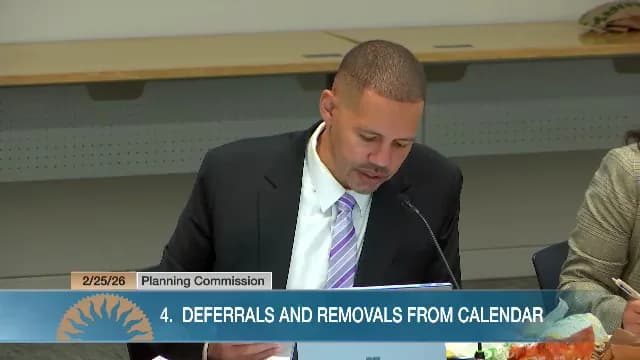
San Jose Planning Commission Meeting – February 25, 2026

The San Jose Planning Commission met on February 25, 2026, at 3:00 PM UTC (local evening session) under Chair Carlos Rosario. Ten commissioners were present, constituting a quorum. The meeting covered consent calendar approvals, updates from the City Council on recent appeals, and a preview of an upcoming study session on missing middle housing. No public hearings or referrals were addressed. Consent Calendar - The consent calendar (items A, B, and D) was approved unanimously (10 yes, 1 absent) after a staff amendment to Condition 5 of permit CP25-029. The amendment clarified that alcohol consumption on the premises (a supermarket at 1600 Saratoga Avenue, Westgate Center) must conform to the permittee's ABC licenses, and no other open alcoholic beverages will be permitted. This allows for alcohol sampling when appropriate. Good and Welfare / City Council Reports - Commissioner reported on the February 10 City Council meeting: approval of the 2026 weed abatement commencement report, and an administrative hearing upholding the Planning Commission's denial of a conditional use permit at 1692 Story Road. - On February 24, the City Council denied two appeals: one against a site development permit at 2334 Lundy Avenue (project allowed to proceed) and another against a plan development permit amendment at 1123 Coleman Avenue (PayPal Park), allowing that project to move forward. - Staff announced that the next General Plan for Your Review Task Force meeting will be held on March 4, 2026, at 6:30 PM, focusing on missing middle housing. The memorandum will be posted on February 26, and slides will be posted on February 28. Key Outcomes - Consent calendar approved with amendment (10 yes, 1 absent). - No public hearing items or referrals were considered. - Meeting adjourned at 7:15 PM.

PROCEDURAL 97% · AFFORDABLE HOUSING 3%
133
FEB 25, 2026 · SAN JOSE, CALIFORNIA · PLANNING COMMISSION
Joint Planning and Housing Commission Study Session on Housing Element Progress - February 25, 2026

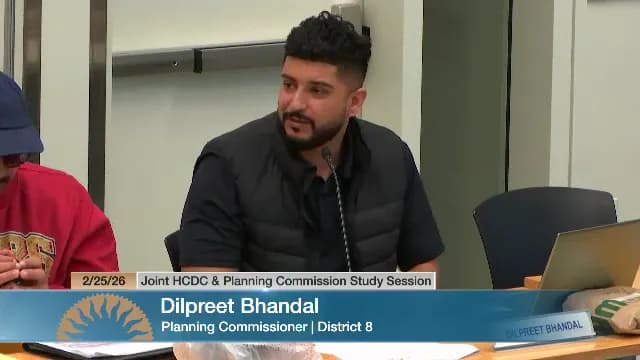
On February 25, 2026, the San Jose Planning Commission and Housing Commission held a joint study session to receive the 2025 Housing Element Annual Progress Report and the Housing Catalyst Team Work Plan. The meeting included presentations from staff on housing production progress towards the 2023-2031 Regional Housing Needs Allocation (RHNA) goals, updates on various housing programs and policies, and discussion of market conditions and development challenges. No formal votes were taken. Public Comments & Testimony - A speaker from the Senior Commission representing District 3 expressed that affordable housing is not truly affordable for seniors, citing a personal rent increase from $1,469 to $1,688 per month and noting that income requirements (2.5 times rent) make housing inaccessible. She suggested using a different word than “affordable” and highlighted the difficulty of living in San Jose for seniors. Discussion Items - Housing Element Annual Progress Report: Staff presented RHNA progress for the sixth cycle (2023-2031). Over 2023-2025, San Jose permitted approximately 17% of its 62,200-unit goal, with production falling short of annual targets across all income categories. Moderate-income units saw higher production due to market rate units counted in that category. Compared to peers, San Diego (25% through 50% of cycle) and Sacramento (27% through 50%) performed better, which staff attributed to lower development costs and different policy frameworks. - Housing Catalyst Team Work Plan Updates: Staff highlighted completed programs, including SB9 changes allowing additional housing types in historic areas and R2 zones, and group home zoning ordinance changes (both approved January 2026). Ongoing work includes the General Plan Four-Year Review (due June 2026), the small multifamily housing program (P35, allowing 4-10 units in lower-density areas), evaluation of the urban village planning process (P40), and revision of planning permit conditions for state law compliance (P41, anticipated fall 2026). - Market Conditions and Incentive Programs: Sarah Fields, Deputy Director of Housing, noted moderate price softening but persistent affordability challenges. The Multifamily Housing Incentive Program and Downtown Residential Incentive Program (including office-to-residential conversion) were extended by City Council on January 27, 2026. Staff also discussed the housing continuum, preservation efforts (e.g., $1.6 million city funds and $2 million congressional earmark for soft-story retrofits), updates to the inclusionary housing ordinance, and the linkage of land to capital feasibility study for entitled units. - Commissioner Questions and Debate: Commissioner Cantrell criticized the cost of development study for using a “unicorn” two-acre rectangular site model that does not represent most of San Jose, questioning its usefulness. Staff defended the study as a reasonable approximation, noting it also examines real project performance. Other questions addressed SB9 low uptake (due to owner-occupancy requirements), the need for cooperative/limited equity housing models, the urban village planning process to prevent past issues, and the desire for materials to be sent in advance of future meetings. Key Outcomes - No formal votes were taken; this was a study session for feedback only. - City Council will hear the Housing Element Annual Progress Report and Housing Catalyst Team Work Plan on March 24, 2026. - Staff acknowledged feedback to provide materials ahead of meetings and to allow more time for future joint study sessions. - Commissioners requested that future joint sessions be scheduled for longer durations to accommodate questions from both commissions.

AFFORDABLE HOUSING 80% · PROCEDURAL 12% · HOMELESSNESS 3% · MUNICIPAL FINANCE 3%
134
FEB 25, 2026 · SAN JOSE, CALIFORNIA · PLANNING COMMISSION
Planning Director Hearing - February 25, 2026: Consent Calendar Approvals for Retaining Wall and Subdivision

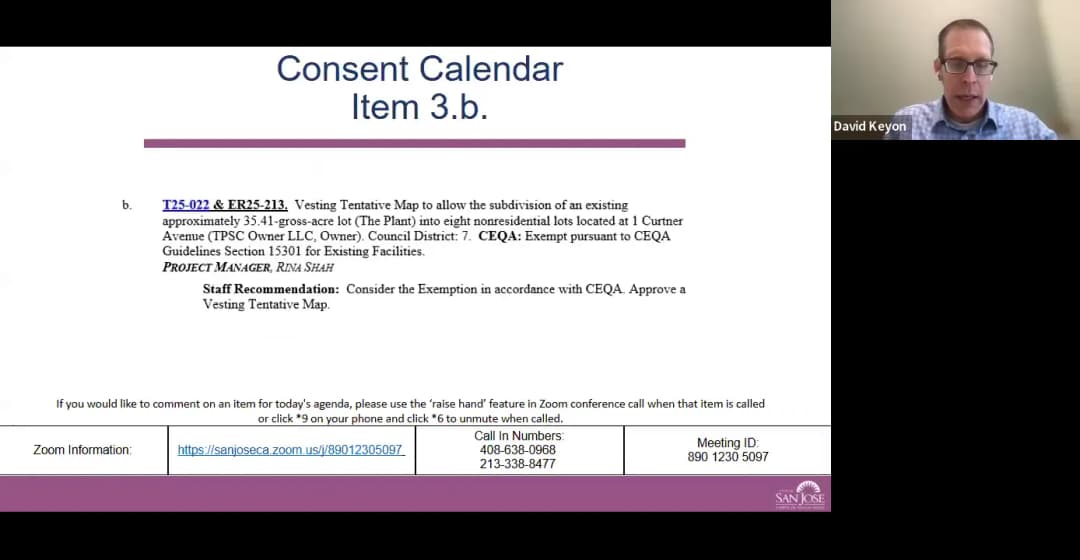
The Planning Director Hearing for February 25, 2026, was called to order by Hearing Officer David Kean, acting on behalf of Director Christopher Burton. The meeting was held via Zoom. No items were deferred, and the agenda consisted solely of a consent calendar with two routine items. There were no public hearing items. Both consent items were approved without public comment or discussion. Consent Calendar - Item 3A (SP25024 / ER25229): A special use permit to allow construction of a replacement three-foot-high retaining wall and an existing four-foot-high retaining wall adjacent to a pool in the rear yard of a single-family house on a 0.32-acre site at 1391 Hillcrest Drive. Staff recommended approval, finding the project exempt from CEQA. The item was approved. - Item 3B (T25022 / ER25213): A vesting tentative map to subdivide an existing 35.41-acre lot into eight non-residential lots at 1 Kirtner Avenue. Staff recommended approval, finding the project exempt from CEQA. The item was approved. Key Outcomes - Both consent calendar items were approved by the hearing officer as routine actions with no public testimony or objections.

PROCEDURAL 85% · LAND USE 15%
135
FEB 25, 2026 · SAN JOSE, CALIFORNIA · CITY COUNCIL
San Jose Rules Committee Meeting Summary – February 25, 2026

The San Jose Rules and Open Government Committee met on February 25, 2026, at 2:00 PM and adjourned at 2:23 PM. The committee reviewed upcoming council meeting agendas, received a report on committee roles and responsibilities, and considered a workload analysis for the Coyote Valley Corridor Study. The meeting also included public comments on the corridor study and a public forum on commission stipends. Consent Calendar - The committee approved consent items for the March 3, 2026 meeting, which included the sewer rate setting audit report, reasonable accommodation process, personal property impound handling, and the Measure T community oversight committee annual report. - The committee also approved consent items for the March 10, 2026 meeting, including the City of San Jose Investment Policy, City Council Focus Area Status Report, and items on ALPR data usage protocol and police department overtime spending. - The full consent agenda was approved unanimously (5-0). Public Comments & Testimony - Coyote Valley Corridor Study – Environmental Concerns: Four speakers addressed the committee: - Allie Victorine (District 7 resident, avid user of Coyote Creek Park chain) expressed concerns about the draft study, specifically the proposed reduction of the riparian setback from 100 feet to 20 feet, inadequate analysis of effects on wildlife, and impacts on the unique hydrology of the Coyote Valley. She asked that the draft report not be assigned to a council agenda until errors are fixed and key analyses completed. - Jean Dresden acknowledged the council’s concern about community awareness and supported staff's recommendation for an information memo to memorialize work done and work yet to be done, while noting other priorities like SB 79 and the general plan review. - Alice Kaufman (Policy and Advocacy Director for Green Foothills) agreed with the draft's characterization as

PROCEDURAL 64% · CLIMATE AND ENVIRONMENT 24% · MUNICIPAL FINANCE 8% · COMMUNITY ENGAGEMENT 4%
136
FEB 24, 2026 · SAN JOSE, CALIFORNIA · CITY COUNCIL
San Jose City Council Meeting – February 24, 2026: Approvals, Appeals, and Workforce Hearing

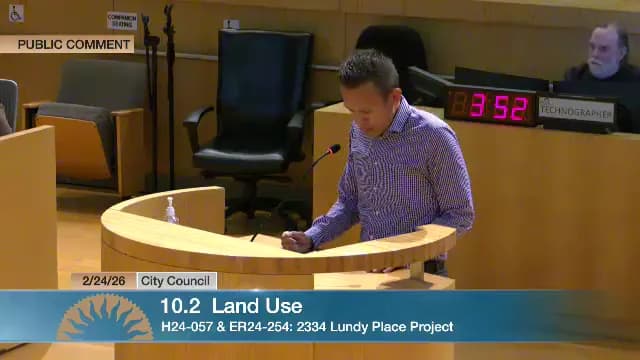
The San Jose City Council met on February 24, 2026, to address a wide-ranging agenda including ceremonial recognitions, consent calendar items, business improvement district establishments, affordable housing funding, a new workforce housing program, two land-use appeals, and a public hearing on city vacancies and retention. The meeting featured extensive public testimony and council deliberation, resulting in several unanimous approvals and one split vote. Ceremonial Items - Pajama Plus Project: Recognized for donating 1,000 pairs of pajamas and essentials to children in need in 2025. Councilmember Campos presented the commendation; co-founders Libby and Pally spoke about their mission. - SJ Sharkey Commendation: Honored the San Jose Sharks mascot for being inducted into the Mascot Hall of Fame and named NHL Mascot of the Year in 2025. Chris Shea from Shark Sports & Entertainment accepted. Consent Calendar - Item 2.8: Pulled for separate vote due to Councilmember Mulcahy's recusal (owner/tenant of retail building). Approved 10-0 with one recusal. - Remaining consent items: Approved unanimously after one public comment (Brian Darby urged careful spending). Public Comments & Testimony - Item 10.2 (2334 Lundy Avenue appeal): Multiple residents from the adjacent Lundy Place neighborhood spoke in opposition, citing noise, traffic, safety, and air quality concerns. They argued the environmental review was insufficient and requested a full Environmental Impact Report. Several Milpitas and San Jose residents, union representatives, and business owners spoke in support, emphasizing job creation, economic revitalization, and the developer’s track record. - Item 10.3 (PayPal Park concerts appeal): Matthew Bright, representing the New Hall Neighborhood Association, argued the environmental addendum was flawed, the proposed noise monitoring self-regulated by the applicant was inadequate, and that a supplemental EIR should be required. He urged real-time independent monitoring. Dozens of speakers supported the permit, including former councilmember Dev Davis, small business owners, hospitality representatives, the Chamber of Commerce, and the Bay Area Host Committee, citing economic benefits and the venue’s suitability. - Item 3.4 (Vacancies and retention): Public comments included Carlos Murillo (airport engineer) who credited union negotiations for improved pay and retention, and Brian Darby who requested a day recognizing crime victims. Discussion Items - City Manager’s Report (Item 3.1): Recognized Planning, Building, and Code Enforcement (PBCE) for launching “Pop-Up Permits” at libraries and community centers, and for the “Best Prepared Designer” program (250 projects passed final inspection since 2023). PBCE staff stood to be recognized. - Item 5.1 (King Road Affordable Housing Grant): Councilmember Duan presented a memorandum to improve bus stop spacing, safety, and community outreach. Councilmembers discussed prescriptive language; staff confirmed the grant acceptance does not mandate specific design choices. Motion passed unanimously. - Item 8.1 (Alameda BID): Councilmember Mulcahy explained the deferral allowed addressing concerns from home-based businesses, resulting in their removal from the BID. Approved unanimously. - Item 8.2 (Story Road BID): Public comments raised safety and homelessness concerns. Councilmember Duan expressed support. Report accepted unanimously. - Item 8.3 (East Santa Clara Senior Affordable Housing): Eric Soliman (Housing Director) presented 68 units for seniors at 30-60% AMI, leveraging HUD 202 funds. Councilmember Tordillos moved approval; passed unanimously. - Item 8.4 (Trillium Senior Apartments): 62 additional affordable units (30-50% AMI) funded with 9% tax credits and city gap financing. Approved unanimously. - Item 8.5 (Lower Income Voucher and Equity Program – LIVE): New program to master-lease distressed assets downtown, providing affordable units at 80% AMI with a preference for public employees. Councilmember Casey’s memo proposed prioritizing 50 units for SJPD, but legal concerns over “exclusive use” were raised. Councilmember Tordillos suggested “preference” instead. After debate, Vice Mayor Foley offered a substitute motion to adopt staff recommendation and refer the preference proposals to the city attorney for a legal opinion on fair housing. Passed 8-3 (Ortiz, Duan, Casey dissenting). - Item 10.2 (2334 Lundy Avenue appeal): Councilmember Cohen noted the site is zoned for industrial use, the adjacent KB Homes were built with disclosures, and the developer’s plans for advanced manufacturing could bring jobs. Motion to deny the appeal and uphold director’s approval passed unanimously. - Item 10.3 (PayPal Park concerts appeal): Councilmember Mulcahy moved to deny the appeal and approve the permit with amendments: remove monitoring point LT4, require monthly soundboard reporting, bring baseline study reports to CED within 90 days of first concerts, and require one follow-up study in year two. Motion passed unanimously. - Item 3.4 (Public Hearing on Vacancies): Staff reported a citywide vacancy rate of 9.06% (down from 9.95% the prior year), praising reduced turnover and innovative recruitment. IAFF highlighted a 23% paramedic vacancy and requested targeted recruitment at FCTC events. A coalition of unions (IFPTE Local 21 and MEF-AFSCME) credited the 2023 contract for improvements but warned of mixed signals from the city (e.g., hiring freezes, large event spending). They urged sustained investment in compensation, remote work flexibility, and pension parity. Councilmembers thanked both sides and acknowledged budget challenges. Key Outcomes - Item 8.5: Substitute motion passed 8-3; staff recommendation adopted (LIVE program approved). City attorney to return with legal analysis on proposed preferences. - Items 10.2 and 10.3: Both appeals denied; director’s approvals upheld with minor modifications (item 10.3 only). - Items 3.3, 5.1, 8.1, 8.2, 8.3, 8.4: All approved unanimously. - Item 3.4: Staff report accepted; council directed administration to follow up on data points raised. - City Manager’s Report: Recognized PBCE efforts.

AFFORDABLE HOUSING 20% · PERSONNEL MATTERS 19% · CLIMATE AND ENVIRONMENT 16% · ECONOMIC DEVELOPMENT 14%
137
FEB 23, 2026 · SAN JOSE, CALIFORNIA · CITY COUNCIL
Community and Economic Development Committee Meeting - February 23, 2026

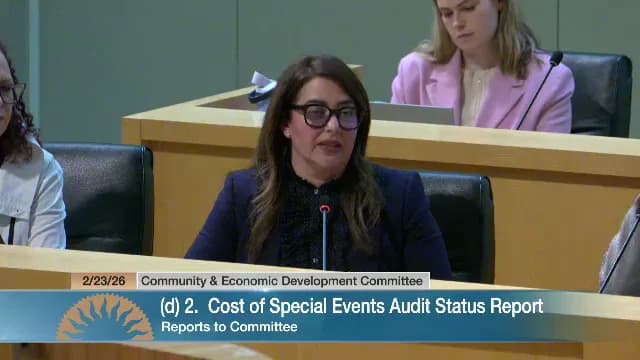
The committee met to receive status reports on housing production, special events permitting, entertainment zones, and economic development activities. All reports were accepted unanimously with no public comments. Housing Catalyst Team Work Plan Status Report - Staff (Jared Ferguson, Eric Sullivan, Chris Burton) presented progress on the housing catalyst work plan, including a feasibility analysis of 31,000 entitled units across 103 projects. They reported that two-thirds of projects are infeasible under current economic conditions due to build types like towers. The 2025 RHNA progress showed 7,775 units as the annual goal, with actual permits in moderate and above-moderate categories. Cumulative progress through December 2025 was reviewed. - Councilmember Ortiz questioned the effectiveness of urban villages and suggested embedding development incentives. Director Chris Burton noted that urban villages preserve commercial land and that many state mandates consume planning capacity. Ortiz also inquired about fee deferral timelines; staff indicated an update by fall 2026. - Councilmember Mulcahy asked about the feasibility study methodology. Eric Sullivan explained it overlays build types with the cost of residential development and will be refined with developer surveys and rent schedules. - Councilmember Kamei raised concerns about blight from entitled projects that are not built (60% infeasible) and asked about entitlement extensions. Burton stated that extensions now require a hearing process and that a vacant building ordinance applies. - Motion to accept the report and cross-reference to city council passed unanimously. Cost of Special Events Audit Status Report - Staff (Carrie Adams Hapner, Melina Iglesias) presented an update on implementing audit recommendation 4, focusing on permitting coordination and timely invoicing. They are evaluating a consolidated software system estimated at $25,000–$45,000 annual subscription, with a target implementation by June 2027. The police department already uses e-proval. Interim improvements include website updates and clearer guidelines. - Councilmember Mulcahy asked about cost modeling certainty and variability. Iglesias explained that permit fees are fixed but labor costs vary by event elements; a cost calculator is planned. Mulcahy also asked about cost-benefit analysis; staff said it will be part of the budget request. - Councilmember Kamei asked about timeline and triaging permit applications. Iglesias described a workflow that shows only relevant permits based on event elements. Kamei urged faster implementation given upcoming FIFA events. - Motion to accept the report passed unanimously. Entertainment Zone Status Report - Staff (Carrie Adams Hapner, Melina Iglesias, Captain Torres, Captain Bible) reported on implementation of eight entertainment zones. The Super Bowl weekend activation saw an estimated 48,000 attendees; several San Pedro businesses reported one of their highest-grossing weekends. Lessons learned included the need for clearer boundaries, signage, standardized beverage containers, and more business training. - Councilmember Ortiz asked about readiness for FIFA World Cup and coordination across multiple activations. Staff expressed confidence and noted ongoing discussions with business districts, including Alum Rock. Ortiz also asked about public safety capacity; Captain Torres explained that resource allocation considers active duty, secondary employment, and reserve officers. - Councilmember Kamei asked about zone delineation. Iglesias described signage, private security, and ambassadors. Kamei suggested painted ground markings. - Councilmember Mulcahy raised the issue of cup materials, noting that aluminum cups are more recyclable but are not allowed under state law (no glass or aluminum). He requested a legislative referral to the IGR team to change that. Staff indicated they would evaluate. Mulcahy also emphasized the importance of distinguishable cups for security and branding. - Motion to accept the report passed unanimously. Economic Development Activity Semi-Annual Report - Staff (Carlos Velasquez) presented notable accomplishments since October 2025: Super Bowl weekend activations, Hometown Heroes exhibition, Invisible Skies performance (nearly 2,000 participants), business openings (Entre Comales, Guitar Wars, Tostiq), small business grants (up to $10,000), cannabis equity program (10 selected, 8 with leases), Shop Local campaign (23,000 visits), corporate outreach including Equinix data center ($2.5 million annual utility tax), foreign trade zone growth (11 companies, 7 pending), and new staff hires. - No questions or motions required; the report was accepted unanimously. Key Outcomes - All four reports accepted unanimously. - Staff directed to cross-reference the housing catalyst work plan report to the full city council. - Staff to evaluate a legislative referral regarding aluminum cups for entertainment zones. - Next CED meeting scheduled in approximately two months.

AFFORDABLE HOUSING 34% · ECONOMIC DEVELOPMENT 26% · PUBLIC SAFETY 13% · TECHNOLOGY AND INNOVATION 10%
138
FEB 19, 2026 · SAN JOSE, CALIFORNIA · CITY COUNCIL
San José Public Safety, Finance & Strategic Support Committee - February 19, 2026

The Public Safety, Finance, and Strategic Support Committee of the San José City Council met on February 19, 2026 to review the second quarterly investment management report, consider changes to the city’s investment policy, receive annual reports from the Fire Department on communications and emergency medical services, and examine the status of the Neighborhood Quality of Life Team (NQL) and the Enhanced Engagement Program. The meeting featured extensive public testimony and unanimous votes on all agenda items, including a directive for additional financial analysis on potential divestment options. Public Comments & Testimony - Investment Policy (Items D1/D5): A large group of community members urged the committee to adopt an ethical investment policy that would permanently divest city funds from corporations tied to U.S. Immigration and Customs Enforcement (ICE), the prison‑industrial complex, and Israel’s military operations in Gaza. Speakers cited comparable policies in Dublin, Albany, and Alameda County. Several noted that the city’s 2020 fossil‑fuel divestment had no negative financial impact. One speaker, representing Jewish Voice for Peace, stated the city invests in Caterpillar, Alphabet, Microsoft, Honeywell, and Amazon, which together supplied $38.465 million to the Israeli government and military. Another speaker, a retired Green Beret who served in Gaza, testified to witnessing the use of technology from these companies in targeting civilians. A single speaker opposed divestment, arguing that international politics are beyond the city’s scope and that many Silicon Valley companies have ties to Israel. - Neighborhood Quality of Life Team (Item D4): Dozens of speakers—including formerly unhoused individuals, advocates, and members of the Real Coalition—criticized the NQL team’s enforcement‑oriented approach, alleging harassment, property destruction, and lack of trauma‑informed care. They called for replacing police with social workers, therapists, and people with lived experience. Some speakers described arrests and towing of RVs without adequate notice. A representative of the Silicon Valley Council of Nonprofits noted that after eight months, the program has not documented any permanent housing throughputs. Several speakers appealed directly to housing and PRNS officials to meet with individuals facing displacement from RV sites. Discussion Items - Quarterly Investment Report (D1 & D5): The Finance Department presented the second‑quarter investment report as of December 31, 2025. Key statistics: portfolio size $2.5 billion, earned interest yield 4.018%, weighted average maturity 713 days, fiscal‑year‑to‑date net income ≈$53 million, and zero policy exceptions. Portfolio allocation: 45% U.S. government securities, 44% credit sectors (corporate notes, municipal bonds, ABS, MBS), 7% in short‑term liquidity (LAIF/JPA). The General Fund (13% of portfolio) decreased by $40 million during the quarter. Staff noted that the portfolio’s yield is exceeding LAIF and catching up to the BofA 1‑3 year index. Staff also highlighted $54 million in delinquent accounts and ongoing collection improvement efforts. Councilmember Kamei requested that when the item goes to the full Council on March 10, staff provide analysis of three divestment options for companies mentioned by the public (Caterpillar, Alphabet, Microsoft, Honeywell, Amazon): (1) no new investments, (2) restructure and divest over time at maturity, and (3) immediate withdrawal. Staff indicated they could produce that analysis by March 10. - Fire Department Communication Annual Report (D2): The Fire Chief and Communications Division Manager presented data for FY 2024‑25. The department received 911 calls in 35 languages. Key metrics: call volume increased 19.14% since FY 2021 and 54.68% since FY 2011‑12. The call‑answer time standard (90% within 15 seconds) was not met due to dispatcher availability; the abandoned call rate rose from 7.76% to 10.26% over the same period. A reorganization approved in the FY 2025‑26 budget added 1.0 FTE (two new public safety communication specialist positions). The team filled all permanent dispatcher vacancies in August 2024, thanks to a new recruitment plan. Staff noted future capacity improvements from a nine‑console expansion funded by Measure T. - Fire Department Emergency Medical Services Annual Report (D3): The Fire Chief and Deputy Chief reported that the department responded to over 111,000 calls in FY 2024‑25, of which 61% were medical calls (68,492). Notable trends: a 111% increase in abdominal pain impressions, a 19% decrease in alcohol‑related responses, and a 33% decrease in overdose responses. Due to a county paramedic shortage, firefighters provided 1,518 rescue‑medic transports and 2,132 patient escorts. The department is evaluating a community paramedicine program to connect patients to appropriate resources and reduce repeat 911 calls. On first‑responder fees (implemented January 2026), staff said implementation has been seamless and revenues will take time to materialize. Regarding the county’s pending RFP for ambulance services, the Chief expressed concern that a future exclusive‑operating‑area model could increase workload on the fire department and slow response times. - Neighborhood Quality of Life Team (D4): The Police Department, PRNS, and Housing Department presented jointly. The NQL team, formed in May 2025, is a centralized unit of hand‑selected officers focusing on proactive patrols, enforcement in no‑encampment zones, and coordination with outreach. For Q2 FY 2025‑26, the team made 474 contacts with unhoused individuals, supported 49 abatement operations, and offered services 435 times (with 45 acceptances and only 3 direct transports to services). Enforcement types: roughly half misdemeanors, one‑third municipal code violations. Staff highlighted the arrest of a serial arsonist responsible for dozens of fires. PRNS reported that 25 miles of no‑encampment zones are established along waterways and near interim housing sites, but monitoring frequency has dropped to every 7‑10 days due to staffing constraints, resulting in over 100 re‑encampments in FY 2025‑26. The Housing Department described the new Enhanced Engagement Program, which reorganizes outreach into five quadrants and a downtown pilot, using a GIS mapping strategy to track engagements and connect individuals to the city’s expanded shelter system (2,000+ beds across 21 sites). Data‑sharing limitations between PD’s system and the county’s Homeless Management Information System (HMIS) were acknowledged; staff are working on a solution through the downtown pilot. Councilmember Kamei requested that future reports include unduplicated counts and a breakdown of warnings vs. arrests. Key Outcomes - D1 – Quarterly Investment Report: Moved to the March 10, 2026 City Council meeting for full adoption. Motion passed unanimously. - D5 – City Investment Policy: Moved to the March 10, 2026 City Council meeting for consideration and adoption, with a request that staff provide expanded analysis on divestment scenarios (no new investments, restructuring over time, immediate withdrawal) for the five companies raised in public testimony. Motion passed unanimously. - D2 – Fire Communication Annual Report: Accepted unanimously. - D3 – Fire EMS Annual Report: Accepted unanimously. - D4 – Neighborhood Quality of Life Team and Enhanced Engagement Program Status Report: Accepted unanimously. The committee directed staff to: (1) analyze ways to amend the county contract or develop an internal process to share data between PD and the Housing Department; (2) consider the concerns raised in the Real Coalition’s letter when evaluating the program moving forward. Councilmember Kamei also requested future data on unduplicated contacts and a numeric breakdown of warnings vs. arrests.

HOMELESSNESS 36% · MUNICIPAL FINANCE 33% · PUBLIC SAFETY 26% · COMMUNITY ENGAGEMENT 3%
139
FEB 18, 2026 · SAN JOSE, CALIFORNIA · CITY COUNCIL
San Jose Rules Committee Reviews Coyote Valley Corridor Study on February 18, 2026

The Rules and Open Government Committee of the San Jose City Council met on February 18, 2026, at 2:00 PM with a quorum present (Councilmembers Candelas and Foley among others, with voice votes due to a computer system issue preventing video). The committee reviewed upcoming council agendas, approved a consent calendar, and discussed a memo on the Coyote Valley Corridor study, ultimately voting to have staff produce a workload analysis before bringing the item back. Agenda Reviews for February 24 and March 3 Council Meetings - For the February 24 council meeting (closed session at 9:30 AM, regular session at 1:30 PM), the committee approved the agenda with an adjustment: item 3.4 will be the first item heard after 3:00 PM rather than a strict time certain, to avoid interrupting ongoing discussions. Motion passed 5-0. - For the March 3 council meeting (closed session at 9:30 AM, regular session at 1:30 PM), the agenda was approved without public comment. Motion passed 5-0. Consent Calendar - The committee approved the consent calendar (five or six routine items) with no public comment. Motion passed 5-0. Discussion Items C1: Coyote Valley Corridor Study Memo Councilmember Campos introduced a memo requesting that the Coyote Valley Corridor study be placed on a future city council agenda as a consent item to recognize the work already done and acknowledge the indefinite pause. The memo was co-signed by Vice Mayor Foley and the Mayor. Public Comments & Testimony Three speakers provided testimony: - Chris Marcese (representing the Marcese and Jung families) thanked city staff for their work on the Monterey Road Corridor study, expressed hope that the council would assist longtime landowners, and noted that the study had been on the right track before being indefinitely deferred. - Jerry DeYoung (planning consultant for property owners) expressed frustration that the study was paused about halfway through, and pointed out that the council had simultaneously rezoned properties to planned development zoning, leaving landowners in a potentially worse condition. He urged the council to hear more about the study's status and potential next steps. - Norm Mattione (attorney for property owners) described the distinct character of the eastern side of the Monterey Road Corridor (small parcels, mostly 5–11 acres, annexations dating back 50 years) and the landowners' desire for viable uses, including residential development for family use. He noted the study is suspended, not terminated, and worth revisiting. Committee Deliberation Vice Mayor Foley acknowledged the community's frustration and moved to approve the memo but requested a workload analysis from staff to determine the effort needed to produce a draft study. Staff (Lee) clarified that no draft study exists—only preliminary survey work—and that producing a draft would require considerable resources. The committee clarified that the intent is to memorialize work done to date, not to restart the full study including CEQA analysis. Councilmembers expressed a desire for clarity on what exists and what next steps would require. Key Outcomes - The committee approved the motion (5-0) to have staff return next week with a workload analysis outlining the time and resources needed to write up the work already completed. The item will be revisited after that analysis. - The meeting adjourned at 2:23 PM.

ENGINEERING AND INFRASTRUCTURE 38% · COMMUNITY ENGAGEMENT 33% · PROCEDURAL 20% · AFFORDABLE HOUSING 5%
140
FEB 12, 2026 · SAN JOSE, CALIFORNIA · CITY COUNCIL
Neighborhood Services and Education Committee Meeting - February 12, 2026

The Neighborhood Services and Education Committee met on February 12, 2026, to receive and discuss several reports, including the Children and Youth Services Master Plan, Citywide Sustainable Park Maintenance, Childcare Policy Opportunities, and the Family, Friends, and Neighbors (FFN) Caregiver Support Network. Committee members heard public testimony and unanimously approved all items. Public Comments & Testimony - On the Childcare Policy Opportunities Status Report: Jariah Haug (Build the Future), Vanessa Tapia (South Bay Labor Council), La Cuesta Padre de, Eduvija Ramirez (childcare provider and CHOC/United union member), and others spoke in support of childcare investment and urged adoption of Councilmember Campos’ memo to make childcare a focus area. Speakers highlighted childcare as essential economic infrastructure and called for continued city leadership. - On the Family, Friends, and Neighbors (FFN) Caregiver Support Network: Eleven speakers expressed strong support for continuing the FFN program. Speakers included Eula Itemoto (First 5 Santa Clara County), Sona Grover (Catholic Charities), Deo Agustin (childcare provider and CCPU member), Paula Perez (Parent Voices), Alba Vivas (childcare provider), Michael Vega (Sacred Heart Community Service), Carmen Gallegos, Maria Wong, Angelica Ramos-Allen (Grail Family Services), Liliana Camacho (Parent Voices), and Veronica Mador. They described the program as a critical support for informal caregivers, especially for immigrant and working-class families, providing training, navigation, and pathways to licensure. They urged the committee not to eliminate the program. - On the Citywide Sustainable Park Maintenance Report: Ken Brennan, Parks Commissioner for District 10, spoke as a resident. He argued that before seeking new revenue, the city should address productivity and operational efficiency within the maintenance system, citing observable shortcomings in staff deployment and oversight. Discussion Items Children and Youth Services Master Plan Status Report Jill Bourne and Andrea Flores Shelton presented an update on the transition from planning to early implementation, focusing on the No Wrong Door approach, equity, and coordination with the county. Achievements included 83 youth receiving scholarships ($57,000) for summer programs in demonstration sites (Santee, Seven Trees, Poco Way, Mayfair). Cross-departmental training for staff in those neighborhoods is planned for March and April 2026. Councilmembers Ortiz, Campos, and Vice Chair Duan praised the work, with Chair Ortiz emphasizing the importance of early intervention to reduce future costs. Councilmember Campos moved to accept the report; motion passed unanimously. Citywide Sustainable Park Maintenance Annual Report Avi Otam, Tori O’Reilly, and Claire Sione presented park condition assessment data. Under traditional standards, parks averaged 85%; under higher standards reflecting community expectations, 78%. Deferred maintenance backlog exceeds $550 million. Park maintenance staffing decreased 19% since 2003 while parkland increased 22%. A statistically valid voter survey (September 2025) showed most voters value parks but want better maintenance of restrooms and weed control. The department will move to using higher standards exclusively and integrate Healthy Places Index data. Councilmember Casey questioned efficiency tracking; staff described GPS monitoring, daily logs, and monthly reviews. Councilmember Ortiz asked about specific parks in District 5 (Hillview, Mayfair, Sylvia Cassell) and the gap between traditional and high-standard scores. Staff explained irrigation issues and rodent problems contribute. Vice Chair Duan suggested dynamic deployment of resources to areas of greatest need. Councilmember Campos moved to accept the report; motion passed unanimously. Childcare Policy Opportunities Status Report Peter Hamilton presented a high-level survey of city actions on childcare, covering direct service (PRNS preschool, after-school programs), subsidies (scholarships, affordable housing childcare), zoning (state-mandated exemptions), and training programs (FFN, Boost). He compared San Jose’s efforts to San Francisco, New Mexico, and Michigan. Councilmembers discussed the need for a thorough needs assessment and questioned the comparison with San Francisco (a city-county). Councilmember Casey asked for examples of comparable non-county cities. Councilmember Campos moved to accept the report and refer it to the March 17 City Council meeting for consideration of including childcare in the “Growing Our Economy” focus area. Motion passed unanimously. Family, Friends, and Neighbors (FFN) Caregiver Support Network Status Report Jill Bourne and Ann Grabowski reported that the FFN program, launched in 2021, provides training, navigation, and college coursework to informal caregivers. The adopted 2025-26 budget eliminates the program’s three staffing positions effective July 1, 2026. The library will attempt to embed some components in other programming. Public comment overwhelmingly opposed the elimination. Councilmember Campos noted the program is a model for other cities and moved to accept the status report. Motion passed unanimously. Key Outcomes - The committee unanimously accepted the Children and Youth Services Master Plan status report. - The committee unanimously accepted the Citywide Sustainable Park Maintenance Annual Report. - The committee unanimously accepted the Childcare Policy Opportunities Status Report and referred it to the March 17, 2026 City Council meeting with a recommendation to consider adding childcare to the “Growing Our Economy” focus area. - The committee unanimously accepted the FFN Caregiver Support Network Status Report.

COMMUNITY ENGAGEMENT 37% · PARKS AND RECREATION 37% · ECONOMIC DEVELOPMENT 14% · PROCEDURAL 4%
OPENPUBLICA · PUBLIC MEETING INDEXUPDATED DAILY · openpublica.com