Browse by city
Date range
Search help

Search titles, summaries, topics and stored transcripts together. Keywords may match separately; put the whole query in double quotes for a phrase. Matching follows word analysis, so punctuation is not exact. Both dates are included. Documents are not searched.

SHOWING 141–150 ENTRIES
141
FEB 11, 2026 · SAN JOSE, CALIFORNIA · PLANNING COMMISSION
Planning Director Hearing of February 11, 2026: Approval of Consent Calendar for 906 Pine Street

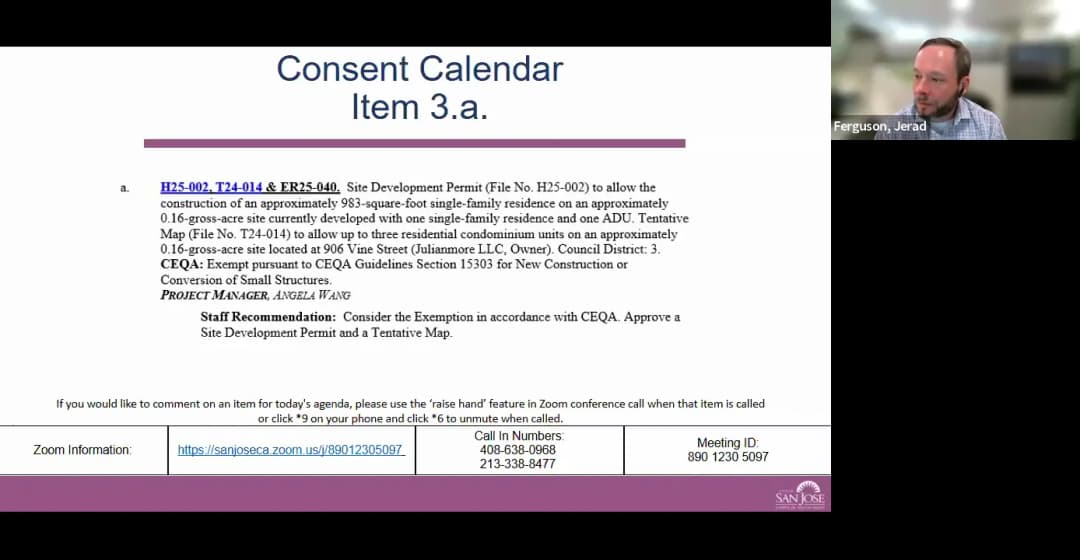
The Planning Director hearing for February 11, 2026, was called to order by Hearing Officer Jared Ferguson, acting on behalf of Director Christopher Burton. The meeting was conducted via Zoom and addressed one consent calendar item, which was approved without public comment or discussion. Consent Calendar - H25-002, T24-014, ER25-040 – Site development permit to construct an approximately 983-square-foot single-family residence on a 0.6-gross-acre lot currently developed with one single-family home and one ADU, along with a tentative map to allow up to three residential condominium units at 906 Pine Street (Council District 3). The project was found exempt from CEQA under Section 15303 (new construction and conversion of small structures). Staff recommended approval. No members of the public requested to speak, and the item was approved as part of the consent calendar. Key Outcomes - The consent calendar was approved, authorizing the site development permit and tentative map for 906 Pine Street. The Planning Director’s action is final unless appealed per Title 20 (zoning permits) and Title 21 (environmental review) of the Municipal Code. No public hearing items were on the agenda; the meeting concluded immediately thereafter.

PROCEDURAL 100%
142
FEB 11, 2026 · SAN JOSE, CALIFORNIA · PLANNING COMMISSION
San Jose Planning Commission Special Study Session on SB 79 - February 11, 2026

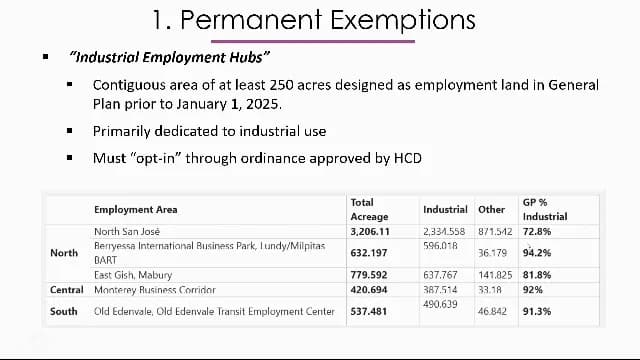
On February 11, 2026, the San Jose Planning Commission held a special study session to review Senate Bill 79, which sets new statewide standards for transit-oriented development (TOD). The meeting was chaired by Carlos Rosario and began with roll call, establishing a quorum of seven commissioners. No public comments were submitted for non-agendized items. Principal Planner Jared Ferguson presented an overview of SB 79, its implications for San Jose, and potential exemption options. Discussion Items - SB 79 Overview: Ferguson explained that SB 79, effective July 1, 2026, supersedes local zoning to allow residential development on all sites permitting residential and commercial uses within a half-mile radius of defined TOD stops. San Jose has 56 such stations (10 Tier 1, 46 Tier 2), impacting over 40,000 parcels. Tier 1 includes heavy rail (e.g., Caltrain, BART) with maximum densities from 50 to 150 dwelling units per acre and heights up to 85 feet. Tier 2 includes light rail and BRT with densities from 30 to 80 units per acre and heights up to 55 feet. Projects with 11+ units require on-site affordable housing, and sites under rent control (e.g., mobile home parks) are ineligible. - Exemption Options: Ferguson detailed three exemption pathways: - Industrial Employment Hubs: Permanent exemption for contiguous industrial areas ≥250 acres. Five areas qualify (e.g., North San Jose, Berryessa International Business Park). - Walking Path Exemption: Sites with no walking path <1 mile from a TOD stop; an estimated 2,000+ parcels may qualify, but further analysis is needed. - Delayed Effectuation: Temporary exemption requiring at least one-third of sites to allow 50% of SB 79 density and overall zone to average 75% of that density. Staff analysis of three representative stations (Berryessa BART, Tamien, Snell) showed none met both criteria, making a delay unlikely. - Alternative Plan (Alt Plan): Permanent modification requiring equal or greater net zoned capacity citywide; staff deemed this infeasible in the near term without comprehensive upzoning. - Commissioner Questions: - Commissioner Oliverio questioned HCD’s interpretation of “realistic capacity” and noted that SB 79 could theoretically meet the city’s housing element obligations. He also asked about SB 677 (an expansion of SB 79) and appealability of SB 79 projects (site development permits appealable to Planning Commission, or City Council if an EIR is involved). - Commissioner Young sought clarification on TCAC maps (used for tax credit allocation), the likelihood of delayed effectuation, and the real-world impact on a typical R1 lot within a half-mile radius. Ferguson responded that while a four-story building could be theoretical on a single lot, practical challenges (lot size, economics) make such rapid change unlikely, with slower uptake expected. - Commissioner Casey noted that most parcels are already developed, so new units would come from infill or redevelopment rather than vacant land. - Commissioner Cantrell asked about North San Jose’s industrial land; Ferguson confirmed that while some overlays allow housing, the industrial employment hub exemption would protect core industrial areas. Key Outcomes - Immediate Action: Staff will proceed with an ordinance to exempt industrial employment hubs, targeting a Planning Commission hearing on March 11, 2026, and City Council adoption on March 17, 2026, to ensure effectiveness before July 1, 2026. - Further Analysis: City Council requested staff to return with: - Analysis of CEQA processes for historic resources under AB 130 exemptions. - An ordinance to increase minimum densities downtown above the 30 dwelling units per acre default. - No Formal Vote: The study session was advisory only; no formal action was taken by the Commission.

AFFORDABLE HOUSING 83% · PROCEDURAL 10% · ECONOMIC DEVELOPMENT 7%
143
FEB 11, 2026 · SAN JOSE, CALIFORNIA · CITY COUNCIL
San Jose City Council Rules Committee Meeting - February 11, 2026

The San Jose City Council Rules Committee met on February 11, 2026, with a quorum present (Foley, Kamei, Cohen). The meeting focused on approving the February 24 city council agenda, reviewing consent items, and discussing a development fee framework. No public comments were made during any session. The committee adopted the agenda and consent calendar unanimously and accepted a staff update on the scale development fee framework. Consent Calendar - Two consent items were approved unanimously with no public comment. Public Comments & Testimony - No public comments were received at any point during the meeting. Discussion Items - Agenda Review (February 24, 2026): The committee reviewed the upcoming council agenda, including a closed session at 9:30 a.m., regular session at 1:30 p.m., and consent items on pages 4-6. Notable items include annual summary of labor negotiations (Item 3.3), public hearing on city vacancies and recruitment, affordable housing funding agreements, and two land use appeals. A council member requested a time certain for Item 3.3 to allow community partners to provide input, but the committee tabled the discussion to the next rules meeting, noting the short agenda and potential scheduling difficulties. - Multi-Signer Memo and Exploration of Scale Development Fee Framework: This item had been heard previously. Staff confirmed the workload analysis is greenlit and the work is already under the staff work plan. The committee accepted the update with no further questions, and it will proceed without needing full council approval. Key Outcomes - The February 24 council agenda was adopted unanimously (5-0). - The consent calendar was approved unanimously (5-0). - The development fee framework update was accepted and will move forward as part of staff’s work plan. - The request to set a time certain for Item 3.3 was deferred to the next rules committee meeting. - The meeting adjourned at 2:05 p.m.

PROCEDURAL 69% · ENGINEERING AND INFRASTRUCTURE 31%
144
FEB 10, 2026 · SAN JOSE, CALIFORNIA · CITY COUNCIL
San Jose City Council Meeting – February 10, 2026: Mid-Year Budget, TOT Ballot Measure, and Appeals

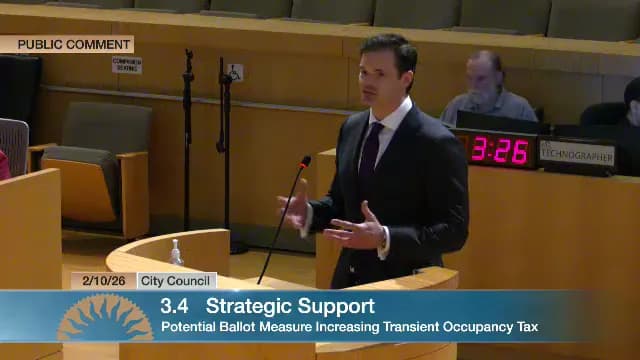
The San Jose City Council met on February 10, 2026, to address a full agenda including the mid-year budget review, a proposed ballot measure to increase the Transient Occupancy Tax (TOT), approval of San Jose Clean Energy rates, and an appeal of a denied conditional use permit for a late-night restaurant. The meeting opened with ceremonial proclamations for Vietnamese New Year (Tet), American Heart Month, and Black History Month, as well as an invocation by Jamal Williams, co-chair of the Sawa Bona Collective, who highlighted challenges facing the Black community in San Jose. The council also adjourned in memory of retired San Jose Fire Department Battalion Chief Ken Heredia. Consent Calendar - The consent calendar was approved unanimously without any items pulled for discussion. Public Comments & Testimony - Item 3.4 (TOT Increase): Multiple speakers, including representatives from the Bay Area Glass Institute, San Jose Arts Advocates, the San Jose Museum of Art, and the Silicon Valley Chamber of Commerce, urged the council to include arts and cultural funding in the ballot measure or to reinvest a portion of TOT revenue into the arts and experience economy. Speakers from Working Partnerships USA and IFPTE Local 21 supported the memo to explore business tax modernization. The California Apartment Association opposed a gross receipts business tax, citing impacts on housing costs. - Item 10.2 (After Bar & Grill CUP Appeal): The property manager and a community member spoke in support of the applicant, emphasizing ongoing safety improvements at the Tropicana Shopping Center and the importance of supporting small businesses. - Open Forum: One resident spoke about experiencing homelessness due to a landlord’s alleged constructive eviction. Discussion Items - Mid-Year Budget Review (Item 3.3): Budget Director Jim Shannon presented a mid-year outlook showing a projected $15–20 million revenue shortfall in the general fund, driven by lower property tax and utility tax revenues. To offset this, the city manager recommended $16.6 million in expenditure reductions, including pausing the opening of the Police Training Center and Fire Station 32, defunding the emergency medical services field coordination program (Med 30), and absorbing salary/benefits reserves. Councilmembers debated a memo from Councilmembers Dwan, Campos, Candelas, and Ortiz requesting extensive data on homelessness spending and county costs. After discussion, the council amended the motion to request a two-year lookback on city-side data (items B, D, E, F, H) to be presented at a May budget study session, with a staff referral to the county for additional information. The motion also directed staff to prioritize funding for mobile integrated health care and community paramedic pilot programs as part of legislative advocacy. - Potential TOT Ballot Measure (Item 3.4): Staff recommended placing a measure on the June 2026 ballot to increase the general fund portion of the TOT from 4% to 6%, generating an estimated $10 million annually. Polling indicated soft support (55%). Councilmembers discussed the need to protect arts funding and avoid business tax increases. A substitute motion to approve the staff recommendation (TOT increase only) passed unanimously. The council also agreed to receive a status report on business tax modernization via a Manager’s Budget Addendum (MBA) in May. - San Jose Clean Energy 2026 Rates (Item 6.1): Staff proposed lowering rates by 18% (total savings of $92 million for customers) while maintaining 62% renewable content. The decrease was achieved by using $108 million from reserves to offset a 470% increase in the Power Charge Indifference Adjustment (PCIA) fee charged by PG&E. Councilmembers expressed frustration with the PCIA and urged continued advocacy for reform. The resolution passed unanimously. - Weed Abatement Public Hearing (Item 8.1): Two property owners requested removal from the weed abatement list, citing recent compliance. County staff explained the three-year inspection process. The council approved the staff recommendation to adopt the abatement report. - Appeal of Planning Commission Denial for After Bar & Grill (Item 10.2): The applicant sought a conditional use permit to extend operating hours until 2 a.m. on weekends. Staff and the San Jose Police Department opposed, citing a documented history of violations (including serving alcohol after midnight, locked fire exits, and noise complaints) despite prior opportunities to correct. The Planning Commission had unanimously denied the permit. After debate, a substitute motion to uphold the denial passed 7–4 (Cohen, Ortiz, Dwan, Casey dissenting). The applicant can reapply after demonstrating consistent compliance. Key Outcomes - The mid-year budget adjustments were approved, including $16.6 million in expenditure reductions and a directive for staff to present city homelessness data at the May budget study session. - The council voted to place a 2% TOT increase on the June 2026 ballot (simple majority required). - San Jose Clean Energy’s 2026 rate reduction and renewable energy content were approved. - The weed abatement report was adopted. - The appeal for the late-night use permit at 1692 Story Road was denied, upholding the Planning Commission’s decision. - The council adjourned in memory of Ken Heredia.

ECONOMIC DEVELOPMENT 43% · HOMELESSNESS 13% · PROCEDURAL 10% · LATE NIGHT USES 10%
145
FEB 9, 2026 · SAN JOSE, CALIFORNIA · CITY COUNCIL
San Jose T&E Committee Meeting - February 9, 2026

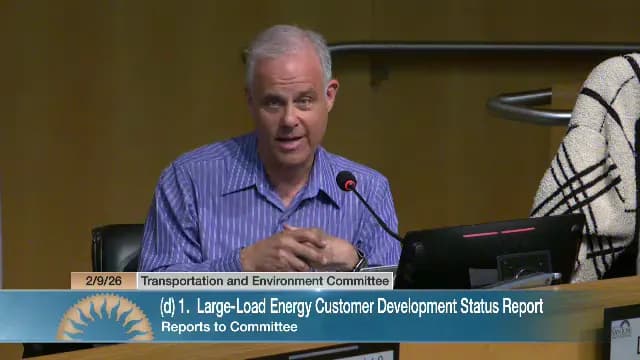
The Transportation and Environment Committee (T&E) met on February 9, 2026, from approximately 9:30 AM. The agenda included four substantive items: (1) an update on the Climate Advisory Commission work plan (considered on consent), (2) a large load energy customer development status report, (3) the Climate Adaptation and Resilience Plan, (4) a citywide pavement conditions update, and (5) a sewer rate setting audit report. The committee also heard public comments and an open forum item. All items were approved unanimously (5-0). Consent Calendar - The committee voted unanimously (4-0 initially, then 5-0) to add the Climate Advisory Commission work plan update to the consent calendar and then adopted it without discussion or public comment. Public Comments & Testimony - Item 2 – Large Load Energy Customers: Two speakers addressed concerns. A lifelong San Jose resident (Alina) criticized the lack of study on public health and environmental impacts, noting that the EIR for the South Bay Great Oaks facility showed no recycled water use and that 36 diesel generators would be installed. She raised issues of cumulative health impacts. Michan Allgood, an AI ethicist and South Bay resident, expressed concern about air quality and water scarcity, critiquing the sufficiency of the environmental review process and urging the city to exercise oversight. - Item 3 – Climate Adaptation and Resilience Plan: Anne Ferris, representing the Bicycle and Pedestrian Advisory Committee (BPAC), urged prioritizing shaded infrastructure for pedestrians and flood control along major bicycle pathways. Jordan Moldale (District 3 resident) supported the plan and stressed the economic incentives for climate-positive investments. - Item 4 – Pavement Conditions: Anne Ferris again spoke, emphasizing using repaving opportunities for safer street design (daylighting, narrower lanes, multimodal expansion). Jordan Moldale recommended using SB1 gas tax funds for Vision Zero and bike projects, and asked about flush crosswalks as a cost-saving ADA design. - Open Forum: Jordan Moldale reported traffic safety issues during downtown events (March Madness, World Cup), suggesting more bicycle and motorcycle enforcement. Discussion Items Large Load Energy Customer Development Status Report - Staff (Erica Grafo, Assistant to the City Manager) presented a status update. Key points: Two large load projects energized by June 2026 (on time); three projects in building plan review; two projects in planning entitlement (goal of five may not be met). The city tracks 12 projects under the PG&E implementation agreement; PG&E is on schedule for the remaining 10 by 2030. LS Power transmission projects are on track. Data centers generate $3–7 million annually in utility user tax for a 50-99 MW facility. Environmental requirements (CEQA, water supply, recycled water, renewable energy) were summarized. - Councilmember Ortiz questioned water monitoring, generator runtime, and rate impacts on residents. Staff (Jeff Provinzano, Chris Bowden) responded: water supply available; generator runtime is limited by air permits and monitored by the Bay Area Air Quality Management District; cost allocation is through CPUC Rule 30, which places most costs on developers. Ortiz requested a study session on data centers; the city manager offered to consider both a study session and an annual council report. Chair Cohen supported the idea. - The item was approved 5-0. Climate Adaptation and Resilience Plan - Staff (Lori Michelle, Julie Benavente, Jeff Provinzano, Michael Gonzalez) presented the plan. A vulnerability assessment identified key hazards: flooding (most impactful to infrastructure), extreme heat, sea level rise, wildfire smoke, and drought. The plan includes 62 strategies across four categories (knowledge, governance/policy, structural, communications). Extensive community engagement was conducted. Current grant-funded activities include a resiliency hub at Roosevelt Community Center and a sub-regional shoreline adaptation plan. - Councilmember Tordillas highlighted the importance of shaded infrastructure and resilient building design. Councilmember Ortiz moved approval. - The committee approved the plan 5-0, to be cross-referenced to the March 3, 2026 City Council meeting. Citywide Pavement Conditions, Funding, and Maintenance Program - Staff (John Risto, Jennifer Sagan, Frank Parshidi) reported the city’s Pavement Condition Index (PCI) is 73 overall (up from 63 ten years ago). Local streets PCI is 74; major streets PCI is 71. Annual funding need to maintain PCI at 70 is $66.3 million. Due to Measure T sunset in 2028, projected funding will drop, causing a deferred maintenance backlog of $673 million by 2036. The 2026 pipeline includes 201 miles of paving (60 miles from winter suspension), 20 projects totaling $50 million for local streets. Innovations include low-carbon concrete (40% reduction in CO2), permeable pavement pilots, and CapeSeal treatment. - Vice Mayor Foley asked about ADA ramp requirements (federal PROWAG guidelines currently on hold). Staff confirmed current ramps comply with existing ADA standards. Foley moved approval. - The item was approved 5-0. Sewer Rate Setting Audit Report - City Auditor Joe Royce presented three findings: (1) ESD should review assumptions in its rate model (a 2015 study found mismatched strength parameters; sampling has just begun); (2) develop formal reserve policies; (3) improve transparency (sampling frequency documentation and web page updates). Six recommendations. ESD Director Jeff Provinzano accepted the recommendations. - Vice Mayor Foley moved acceptance and cross-reference to council. Passed 5-0. Key Outcomes - All four agenda items were approved unanimously (5-0). - The Climate Adaptation and Resilience Plan will go to the full City Council on March 3, 2026. - The Sewer Rate Setting Audit report will be presented to council on March 3, 2026. - The committee signaled support for an annual council report or study session on data centers to address environmental and ratepayer concerns.

CLIMATE AND ENVIRONMENT 29% · TRANSPORTATION 24% · TECHNOLOGY AND INNOVATION 17% · ECONOMIC DEVELOPMENT 8%
146
FEB 9, 2026 · SAN JOSE, CALIFORNIA · CITY COUNCIL
Transportation and Environment Committee Meeting – February 9, 2026

The Transportation and Environment Committee of the San José City Council met on February 9, 2026, to discuss and take action on several items including an update on large load energy customer development, the Climate Adaptation and Resilience Plan, the citywide pavement condition and maintenance program, and a sewer rate setting audit. The committee also held a consent calendar and open forum. Consent Calendar - The committee voted to approve an update to the Climate Advisory Commission work plan as part of the consent calendar. The item was moved to the consent calendar after initial discussion and adopted unanimously (4-0). Public Comments & Testimony - Alina, a lifelong San José resident, expressed concerns about the lack of study and public engagement on public health and environmental impacts of data centers. She noted that the Environmental Impact Report for the South Bay Great Oaks facility showed recycled water was not feasible and that 36 diesel generators were installed. She urged the city to consider cumulative health impacts. - Mashika Allgood, an AI ethicist and South Bay resident, raised concerns about air quality and water scarcity from large-scale AI data center build-outs. She stated that the city cannot rely blindly on environmental reviews and urged the committee to exercise oversight. - Anne Ferris, representing the Bicycle and Pedestrian Advisory Committee, expressed support for the Climate Adaptation and Resilience Plan but urged prioritization of shaded pedestrian infrastructure and flood control along major bicycle pathways. - Jordan Muldow, a District 3 resident, supported the Climate Adaptation and Resilience Plan and emphasized the need for funding, shade, and flood protection. He also commented on the pavement program, urging mode shift to reduce road maintenance costs and advocating for Vision Zero and bike plan projects funded by SB1 gas tax. - Anne Ferris also commented on the pavement program, urging that Measure T funds be used for street safety improvements, including daylighting, narrowed lanes, and protected bike lanes, and that repaving be aligned with climate goals. - Jordan Muldow, during open forum, reported traffic safety issues during downtown events and requested more motorcycle and bicycle enforcement officers. Discussion Items Large Load Energy Customer Development Status Report - Staff presented the status of large load energy customer development, including the PG&E implementation agreement signed July 2025, goals to energize three large projects by June 2026, and fiscal benefits. Data centers provide significant utility user tax revenue without adding traffic or major service demands. Environmental regulations such as CEQA, recycled water requirements, and air quality rules were highlighted. - Councilmember Ortiz asked about water monitoring, generator runtime, and cost allocation to prevent ratepayer burden. Staff responded that water supply is sufficient, generator use is limited and monitored by the Bay Area Air Quality Management District, and that Rule 30 before the CPUC ensures data centers pay for their infrastructure. Councilmember Ortiz requested a study session or annual report to inform the public. - Chair Cohen suggested a standing annual report to council. The committee approved the report unanimously (5-0). Climate Adaptation and Resilience Plan (CARP) - Staff presented the CARP, which identifies hazards (flooding, extreme heat, sea level rise, wildfire smoke) and outlines 19 measures and 62 implementation strategies. The plan was developed with state funding and community engagement. - Public comment highlighted the need for shaded infrastructure and flood-resilient bicycle paths. - Councilmember Tordios praised strategies that address both mitigation and adaptation, such as improved thermal envelopes in buildings. - The committee approved the plan (5-0) and directed it to be cross-referenced to the March 3, 2026 city council meeting. Citywide Pavement Conditions, Funding, and Maintenance Program - Staff reported that the city's combined Pavement Condition Index (PCI) is 73, up from 63 ten years ago. Current annual funding needed to maintain PCI 70 is $66.3 million, but with Measure T sunsetting in 2028, funding will decrease. The deferred maintenance backlog is projected to reach $673 million in 10 years. - The 2026 program includes 201 miles of paving, with emphasis on residential streets and use of low-carbon concrete and permeable pavement. - Public comment urged using repaving as an opportunity for safer street design and alignment with climate goals. - Vice Mayor Foley asked about ADA ramp regulations (PROWAG) and the feasibility of flush crosswalks. Staff noted PROWAG is on pause and flush crosswalks are expensive. - The committee approved the report (5-0). Sewer Rate Setting Audit Report - The City Auditor presented findings that the Environmental Services Department should review rate model assumptions, develop formal reserve policies, and improve transparency. Six recommendations were made. - ESD staff accepted the recommendations. - No public comment. The committee accepted the report (5-0) and cross-referenced it to the March 3, 2026 city council meeting. Key Outcomes - All agenda items passed unanimously. The work plan item was adopted under the consent calendar (4-0). - The large load energy report was approved, with direction to consider a study session or annual report on data centers. - The Climate Adaptation and Resilience Plan was approved (5-0) and will go to full council on March 3, 2026. - The pavement program report was approved (5-0). - The sewer rate audit was accepted (5-0) and will go to full council on March 3, 2026.

ENGINEERING AND INFRASTRUCTURE 43% · TECHNOLOGY AND INNOVATION 15% · MUNICIPAL FINANCE 14% · TRANSPORTATION SAFETY 14%
147
FEB 5, 2026 · SAN JOSE, CALIFORNIA · CITY COUNCIL
San Jose City Council Budget Study Session on 2026-2027 Priorities - February 5, 2026

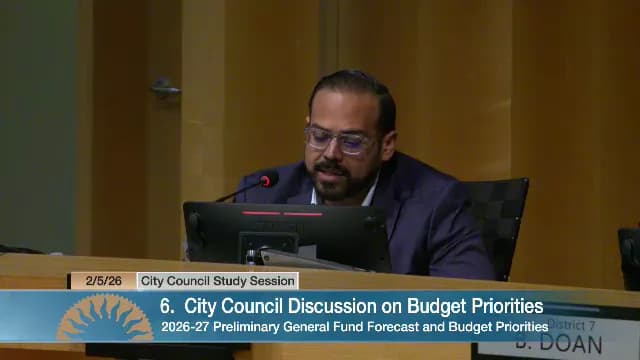
The San Jose City Council held a study session on February 5, 2026, to discuss the Preliminary General Fund Forecast and Budget Priorities for fiscal year 2026-2027. The session focused on setting priorities to address a projected ongoing general fund shortfall of $55 to $65 million. Mayor Matt Mahan opened the meeting, emphasizing that the session was about providing direction for the March budget message, not final decisions. City Manager Jennifer McGuire, Budget Director Jim Shannon, and Assistant City Manager Lee Wilcox presented an overview of economic conditions, revenue estimates, expenditure drivers, community priorities, and potential budget balancing strategies. Council members then shared their perspectives on service priorities, potential reductions, and structural changes. The meeting concluded with public comments. Public Comments & Testimony - Jeremy Baruse (Amigos de Guadalupe Center for Justice and Empowerment) urged the council to preserve $1 million in funding for immigration services, citing that individuals with legal representation are 10 times more likely to have positive outcomes. He noted recent victories and asked the city to fundraise for these services as Councilmember Ortiz is doing for the East San Jose revitalization plan. - Ms. Rayan Mendoza (Amigos de Guadalupe) read a statement from a community member who feared speaking publicly due to immigration enforcement concerns. The statement requested that the city prioritize and fully fund the remaining $500,000 for immigration legal services, describing it as hope and protection for families. - Shannon Zhang (Silicon Valley Council of Nonprofits/Real Coalition) praised the revised budget principles, especially transparency and public engagement, and urged the council to center racial equity commitments. She called for preserving services amidst the affordability crisis deepened by federal actions. - Chris Rodriguez questioned the year-over-year increases in the police budget (now $600 million vs. $500 million five years ago) and suggested looking for efficiencies there to fund other priorities like immigration support. - Heine Gonzales (Tetral Committee/SOMOS Mayfair) asked for investments in worker cooperatives to support excluded workers and create community wealth, especially in light of attacks on immigrant families. - Demaris Estrada (SOMOS Mayfair) highlighted the need for dignified, sustainable, and healthy living conditions in East San Jose, noting that the benefits of Silicon Valley prosperity have not flowed to that community. - Guadalupe Perez (Tetral Committee/SOMOS Mayfair) emphasized that excluded workers have contributed to economic growth but lack prosperity. She supported the East San Jose revitalization plan and called for economic justice and stability for workers. Discussion Items - Vice Mayor Foley emphasized focusing on core services (public safety, libraries, crossing guards, Vision Zero) and avoiding layoffs. She supported maintaining current focus areas and suggested exploring efficiencies, reducing duplicative services, and using one-time funds carefully. She also advocated for alternative funding for the automated speed camera program and offsetting any new programs with cuts. - Councilmember Ortiz outlined priorities for East San Jose: public safety (maintaining Project HOPE and crime intervention), youth intervention (New Hope for Youth, City Peace Project), accountability for blighted properties, and affordability. She noted a soft commitment from philanthropic partners to fund half of the East San Jose Economic Revitalization Framework and asked the city to contribute the other half. - Councilmember Candelas stressed protecting youth programming, placemaking (Viva Parks), library hours, and senior nutrition programs. He suggested finding efficiencies in the Beautify program and in encampment management/coordination with the county. He proposed adding a focus area on families, youth, and seniors. - Councilmember Kamei emphasized community and public safety as top priorities. He urged awareness of state raids on local revenue (e.g., sales tax changes, ERAF litigation) and suggested exploring new revenue streams. He called for streamlining processes in code enforcement, parking enforcement, and other areas to reduce bureaucracy and improve efficiency. - Councilmember Mulcahy advocated for focusing on top resident concerns: homelessness, traffic safety, cleanliness, public safety, and affordability. He supported evaluating programs by measurable outcomes and suggested scaling back or delaying initiatives that still need evaluation. He called for better interjurisdictional agreements to reduce wasted coordination costs, and urged using technology and partnerships to redesign programs. He questioned the relevance of historical headcount comparisons. - Councilmember Campos emphasized youth intervention as part of community safety. She suggested narrowing the neighborhood cleanup focus area and refining the homelessness focus area to include prevention, as current EIH spending is unsustainable. She recommended preserving youth programs, libraries, and safe routes to schools. She called for rethinking the budget to address the affordability crisis and invest in children, families, and seniors. - Councilmember Tordios highlighted the need for improving city bureaucracy efficiency, citing a previous "Bureaucracy Busters" program. He supported expanding ministerial permitting and streamlining code enforcement processes. He also encouraged technology investments in parking enforcement, traffic safety, and code enforcement to allow staff to do more with less. - Councilmember Duan prioritized children and youth services (New Hope, City Peace Project), library services, affordable housing, and support for immigrant communities. He advocated for optimizing EIH services by speeding up transfers to permanent housing and holding other levels of government accountable for reimbursement. - Councilmember Campos (additional remarks) again stressed the importance of effectuating the Children and Youth Master Plan and noted public comments supporting immigrant protections and climate goals. She challenged the council to reimagine a budget that reflects the affordability crisis. - Councilmember Kamei (additional remarks) cautioned against cutting quality-of-life services like arts, music, and sports, and suggested a two-year transition for reductions to smooth impacts. He expressed optimism about upcoming events (city's 250th anniversary, Olympic soccer in 2027) and noted that the council has pushed for new revenue streams. - Mayor Mahan closed the discussion by highlighting positive trends: a 37% increase in trust in City Hall, crime down over 20%, unsheltered homelessness down about a third, and strong resident satisfaction. He noted competitive advantages in power-ready sites for data centers and a growing experience economy. He thanked council members for their input and staff for their work. Key Outcomes - No formal votes or decisions were made; the session was designed to gather direction for the Mayor's March budget message. - The Mayor and administration will use council feedback to inform the March budget message, which will be deliberated on March 17, 2026. - The city will release a formal five-year forecast on March 2, 2026. - The budget process will continue with study sessions, public hearings, and community budget meetings, leading to final adoption in late June 2026. - Council members emphasized the need for a balanced approach that protects core services, finds efficiencies, minimizes layoffs, and uses two-year implementation where possible.

MUNICIPAL FINANCE 52% · HOMELESSNESS 14% · ECONOMIC DEVELOPMENT 9% · COMMUNITY ENGAGEMENT 5%
148
FEB 4, 2026 · SAN JOSE, CALIFORNIA · CITY COUNCIL
Rules and Open Government Committee Meeting - February 4, 2026: Agenda Review, Consent, and AB 1633

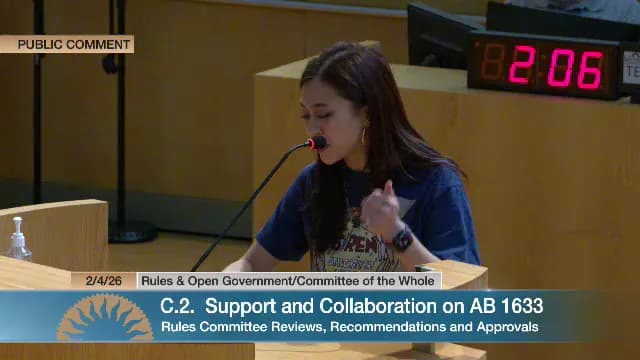
The Rules and Open Government Committee met on February 4, 2026, starting at 10:00 AM, with Chair Candelas presiding and members Duan, Foley, Cohen present (Kamei absent). The committee reviewed the February 10 council agenda, approved consent items, deferred one consent item due to staff availability, and unanimously approved a memo supporting Assembly Bill 1633 and similar legislation. Consent Calendar - Council Agenda (Feb 10): Approved 4-0 with adoption of the agenda (closed session at 9:30 AM, regular session at 1:30 PM, evening session canceled). Consent items ran from page 6 to pages 7-8. - Committee Consent Items: Two items were approved 4-0 without public comment. - Item C1: Deferred to the next Rules Committee meeting (February 11, 2026) at the request of administration, due to senior staff splitting time between City Hall and the Emergency Operations Center. Public Comments & Testimony - Lucila Ortiz (Working Partnerships/IPEN): Expressed strong support for the memo backing AB 1633, emphasizing the need for local barriers against inhumane treatment in private detention centers given federal inaction. - Kimberly Wu (SIREN): Shared a personal story of a relative detained by ICE and described the horrific conditions in private facilities. She detailed that AB 1633 imposes a 50% tax on corporations operating private detention facilities, reinvesting funds in legal services, and argued the tax is high because it reflects the cost of profiting from suffering and is legally defensible. - Akemi Flynn (IPEN/Amigos): Thanked the committee for its leadership and noted that San Jose's model had helped Santa Clara pass an "ICE-free zones" policy, urging continued support for the memo. Discussion Items - Support for AB 1633 (Assemblymember Matt Haney): Councilmember Ortiz presented a memo co-signed by Councilmembers Campos, Candelas, and Cohen, calling on the city to support AB 1633, which creates financial accountability for private detention facilities contracting with ICE. The memo also supports other aligned state legislation. Councilmember Candelas spoke in support, noting his family's immigrant background and the bill's alignment with city values. Councilmember Dewan emphasized the bill's fit with fairness, accountability, and investing in people. Chair Cohen expressed pride in the city’s proactive efforts to protect communities from federal abuses. Key Outcomes - Agenda approval: Motion carried 4-0. - Consent items: Motion carried 4-0. - Item C1 deferral: Deferred to next week’s Rules meeting. - Support for AB 1633: The committee (4-0) unanimously approved the memo endorsing AB 1633 and similar legislation, moving it to the full council for consideration. - Adjournment: The meeting adjourned at 2:10 PM.

MUNICIPAL FINANCE 62% · PROCEDURAL 38%
149
FEB 3, 2026 · SAN JOSE, CALIFORNIA · CITY COUNCIL
San Jose City Council Meeting - February 3, 2026

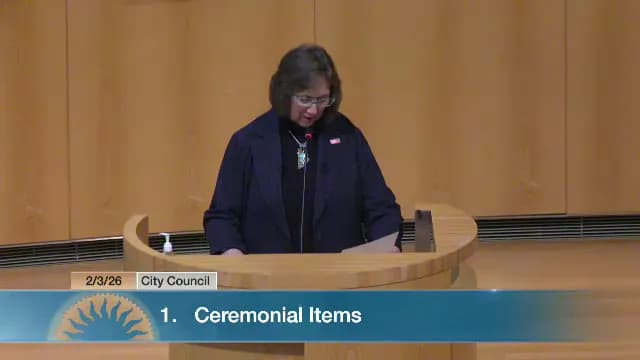
The San Jose City Council met on February 3, 2026, to consider a range of items including commendations, ceremonial recognitions, amendments to gaming regulations, and the creation of two new Business Improvement Districts (BIDs). All votes were unanimous. The meeting also included public comments on unrelated matters. Consent Calendar - The consent calendar was approved unanimously with no items pulled or public comment. Public Comments & Testimony - Mary Ng (Opportunities for Change) spoke during the Story Road BID discussion, but her comments were unrelated to the agenda item; she requested awareness for her transitional housing program and urged inclusion of high-density housing in the corridor. - Paul (President, Story Business Association) urged approval of the Story Road BID, emphasizing the need for stable funding to support small businesses and the Vietnamese community. - Mimi Hernandez, Helen Masamori, Osvaldo Moreno, and Cynthia Velasquez spoke in support of the Alum Rock Santa Clara Street BID, highlighting the corridor's cultural significance and the need for safety, cleanliness, and marketing investments. - Jim Gray (resident) complained about RV parking on Akron Way blocking emergency lanes and ineffective 311 response. - Ted Scarlett described a constructive eviction and landlord harassment after a drunk driving accident, requesting emergency housing. - Raymond Goins (individual capacity) condemned a January 21, 2026 police shooting in downtown San Jose, calling for accountability and citing past incidents. Discussion Items - Commendations & Ceremonial Items: - Invocation by Richard Konda (Asian Law Alliance) honoring Fred Korematsu Day of Civil Liberties and the Constitution (January 30). Konda and Jordan Tachibana (Korematsu Institute) spoke about Korematsu's legacy and urged opposition to mass deportations and ICE actions. - Proclamation of February 4 as National Girls and Women in Sports Day, presented to Bay Area Women's Sports Initiative (BOSSI) and Love the Game softball team. Speakers included Councilmember Candelas and Dana Weintraub (BOSSI). - Recognition of Alan Gumby Marquez for his service as interim CEO of the San Jose Downtown Association, presented by Councilmember Torraios with remarks from Adolfo Gomez (Downtown Association Board Chair). - Recognition of Officer Michael Jaycox for proactive policing that led to the arrest of a heavily armed suspect in a vandalism case, presented by Councilmember Casey. - Adjournment in Memory of Roma Dawson: Councilmember Kamei and Kathy Sutherland (on behalf of Cindy Chavez) honored Roma Dawson, a former League of Women Voters leader and Housing Commission member, who passed away December 6, 2025. - Item 4.1 – Amendment to Title 16 Gaming Control: Police Chief Paul Joseph and Gaming Administrator Kirill Yermanov presented amendments to streamline regulations: extend crime reporting time limits, expand betting layout from 10 to 20 squares per player, repeal continuous presence limitation, remove 4-tournament limit, and allow complimentary food/drinks. Motion by Councilmember Duan passed unanimously. - Item 5.1 – Actions Related to 10180 San Jose City New Taxiway Victor Phase 3A: Motion by Councilmember Mulcahy passed unanimously. - Item 8.1 – Story Road Business Improvement District (BID): Presentation by Jen Baker, Vic Farley, and Min Tran (Office of Economic Development). The proposed BID covers 434 businesses in Little Saigon, with a tiered assessment (base $350, 18 large retailers pay proportionally) projected to generate $129,185 annually for safety, beautification, marketing, and administration. Motion by Councilmember Duan passed unanimously. - Item 8.2 – Alum Rock Santa Clara Street Business Improvement District: Public hearing held; no written protests received. Speakers supported the BID. Motion by Councilmember Ortiz passed unanimously. Key Outcomes - Deferral: Item 8.3 was deferred to February 24, 2026 (motion by Councilmember Mulcahy, passed unanimously). - Votes: All items (consent calendar, gaming amendment, taxiway, Story Road BID, Alum Rock BID) were approved unanimously. - Next Steps: The Story Road BID assessments will begin July 2026 pending final ordinance readings. The Alum Rock BID will proceed to a final vote later in February.

MISCELLANEOUS 31% · ECONOMIC DEVELOPMENT 20% · PROCEDURAL 15% · PUBLIC SAFETY 13%
150
JAN 28, 2026 · SAN JOSE, CALIFORNIA · PLANNING COMMISSION
San Jose Planning Commission Meeting - January 28, 2026

The Planning Commission convened on January 28, 2026, at 2:30 PM under Vice Chair Lisa Bickford. The meeting covered a deferral, consent calendar approvals, council reports, and scheduling of future study sessions. No public hearing items or public comments on non-agendized items were presented. Consent Calendar - Approved the action minutes from the January 14, 2026 meeting by unanimous vote. - Approved CP25-011 and ER25-096, a conditional use permit for a new potable water pump station, unanimously. Discussion Items - Deferral: CP25-001 and ER25-007 (utility facility at 0 Skyview Drive, San Jose Water Company) were unanimously deferred to the February 11, 2026 meeting, with renotification due to a newly added variance application. - City Council Reports: Deputy Director Manira Sandir reported on council actions: January 13, 2026 – Habitat Plan amendments (moving forward with environmental analysis) and mega-ordinance amendments (state law housing changes) approved; January 27, 2026 – Council provided direction on SB 79 implementation (exempting industrial hubs like North San Jose and Edenvale, one-mile walking path properties, evaluating historic resources, and exploring minimum densities downtown). Upcoming appeals: February 10, 2026 – appeal of the denied After Bar & Grill late-night permit; February 24, 2026 – appeals related to PayPal Park concerts and an industrial use on London Avenue. - Commissioner Casey raised concerns about the Fay development foreclosure (50% occupancy, lack of parking cited) and requested post-occupancy success metrics for approved developments. Staff noted market conditions and parking dependence on financing, and agreed to investigate. - Commissioner Cantrell emphasized evaluating the cost of capital for the Fay project. - General Plan Update: Staff noted the next meeting of the Planning Commission as task force on March 4, 2026, focusing on small multifamily and missing middle housing, with open houses expected after consultants are contracted. Key Outcomes - Deferral and Consent Calendar: Both approved unanimously. - No formal actions on other agenda items. - Scheduled Study Sessions: February 11, 2026 (SB 79, 5:30 PM) and February 25, 2026 (joint with Housing Commission on Housing Catalyst Work Plan, 5:30-7:00 PM, Room 118-120). - Staff directed to explore post-occupancy metrics for development performance.

AFFORDABLE HOUSING 55% · PROCEDURAL 34% · ENGINEERING AND INFRASTRUCTURE 9% · MUNICIPAL FINANCE 2%
OPENPUBLICA · PUBLIC MEETING INDEXUPDATED DAILY · openpublica.com