Browse by city
Date range
Search help

Search titles, summaries, topics and stored transcripts together. Keywords may match separately; put the whole query in double quotes for a phrase. Matching follows word analysis, so punctuation is not exact. Both dates are included. Documents are not searched.

SHOWING 151–160 ENTRIES
151
JAN 28, 2026 · SAN JOSE, CALIFORNIA · CITY COUNCIL
Rules and Open Government Committee Meeting - January 28, 2026

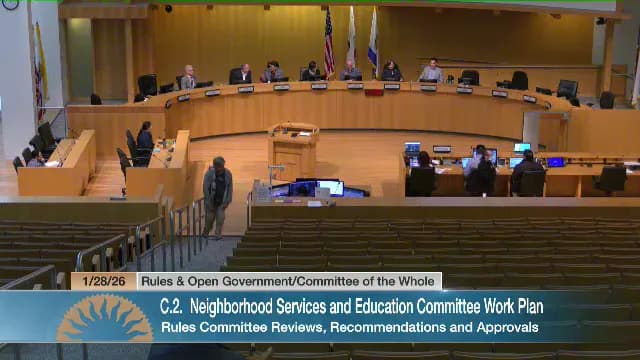
The Rules and Open Government Committee convened on January 28, 2026, with a quorum present (Councilmembers Candelas, Duan, Foley, Kame, and Cohen). The committee reviewed upcoming council agendas, approved consent items, and discussed the Children's Youth Service Master Plan and Latino Health Assessment, including a workload analysis. The meeting adjourned at 2:29 PM. Consent Calendar - February 3, 2026 Agenda: Approved 5-0, with an ad sheet item (receipt of gifts related to SJ26) moved to a standalone item for transparency instead of consent. The item authorizes city officials to accept tickets and other gifts exceeding $50 during Super Bowl events, to be reported to the state. - February 10, 2026 Agenda: Approved 5-0, including a mid-year budget review for 2025-26, a potential transit occupancy tax ballot measure, and an administrative hearing on an appeal at Story Road. Evening session recommended cancelled. - Consent Calendar (current meeting): Approved 5-0, comprising six items. Public Comments & Testimony - Larry: Spoke on the mid-year budget review, urging new economic models to avoid service cuts and rate increases, citing transportation sector challenges in California. - Blair Beekman: Addressed Bay-Uwasi (Bay Area Urban Areas Security Initiative) public oversight, criticizing federal agencies for reducing transparency. Also commented on Oakland's FLOC program and encouraged local peace initiatives. Discussion Items - Children's Youth Service Master Plan and Latino Health Assessment: Councilmember Campos presented recommendations from a joint NSE and CSFC meeting (December 10, 2025). Vice Mayor Foley raised process concerns—the workload analysis had bypassed the Rules Committee's typical role. Staff clarified that standing committees cannot direct staff work; a rules resolution memorandum will address this. After debate, the committee moved to approve the workload analysis with green-light items moving forward and yellow-light items (1A, B, C concerning budget addenda) deferred to the March budget message process. The motion also directed the city manager and attorney to provide a verbal update on the rules resolution. Motion passed 5-0. - Updated Work Plan for NSE: Approved 5-0 as a companion item to the previous discussion. Key Outcomes - Approved February 3 agenda with SJ26 gifts as a standalone item (5-0). - Approved February 10 agenda (5-0). - Approved consent calendar for current meeting (5-0). - Approved workload analysis for Children's Youth Master Plan with conditions, deferring budget addenda (5-0). - Approved updated NSE work plan (5-0). - Committee adjourned at 2:29 PM.

PROCEDURAL 56% · CHILD CARE 17% · MUNICIPAL FINANCE 17% · TECHNOLOGY AND INNOVATION 7%
152
JAN 27, 2026 · SAN JOSE, CALIFORNIA · CITY COUNCIL
San Jose City Council Meeting - January 27, 2026: Housing, Transit, and Policy Updates

The San Jose City Council met on January 27, 2026, to discuss a range of housing and development policies, including updates on city services, transit-oriented development incentives, downtown residential incentives, multifamily housing incentives, inclusionary housing ordinance amendments, mobile home rent ordinance changes, and a seismic retrofit pilot program. The meeting included ceremonial recognitions, public comments, and multiple votes. Consent Calendar - Items 2.7 and 2.10 were pulled for individual discussion. Item 2.7 (appointment of Pat Waite to a citywide commission) was supported by Councilmember Candelas. Item 2.10 (Sokoway Farmhouse acquisition) was recognized by Councilmember Kamei. The consent calendar as a whole was approved unanimously. Public Comments & Testimony - Item 3.3 (Annual Report on City Services): No public comments. - Item 8.1 (SB 79 – Transit-Oriented Development): Speakers included Toronto Crane (VTA) requesting further coordination; Allison Singalani (SV@Home) supporting staff recommendations but opposing deferral of historic resources exemption; Jeanette Holdsworth supporting a memo for increased density; Allie Saperman (Housing Action Coalition) urging broad application of TOD standards; Greg (Young Dems/DSA) supporting the ordinance; Josh Burrows opposing broad exemptions. Mike Sodergren (Preservation Action Council) supported Councilmember Mulcahy’s memo. - Item 8.2 (Downtown Residential Incentive Program): Approximately 30 speakers. Supporters included developers (Hanover, Republic Urban), business groups (Chamber, Downtown Association), and labor unions (Building Trades, Sheet Metal Workers) who urged inclusion of prevailing wage and apprenticeship requirements. Opponents, including community advocates, called for deeper affordability and public benefit requirements. - Item 8.3 (Multifamily Housing Incentive Program Extension): Speakers largely supportive, including developers, Housing Action Coalition, and Chamber. Some residents urged focus on lower-income housing. - Item 8.4 (Inclusionary Housing Ordinance Amendments): Over 55 speakers. Many residents and advocacy groups (REAL Coalition, SURJ, CIREN, SV@Home) opposed weakening affordability levels, supported Councilmember Candelas’ memo to defer for more data. Developers and business groups supported staff proposal and Mayor’s memo. - Item 8.6 (Mobile Home Park Ordinance Amendments): Over 60 speakers. The majority of mobile home residents opposed vacancy decontrol and capital improvement pass-throughs, citing loss of affordability and equity. Park owners and industry groups supported the amendments as necessary for long-term viability. Councilmember Duan and Campos memos opposing most changes were supported by residents. - Item 8.5 (Soft Story Seismic Retrofit Pilot): No public comments. Discussion Items - Item 3.3 – Annual Report on City Services FY2024‑2025: City Auditor Joe Royce presented. Highlights: 55% of residents rated quality of life good/excellent; 59% satisfied with city services. Priority 1 police response averaged 8.1 minutes (target 6). Fire response to priority incidents met 63% of target (80%). Housing production at 28% of annual regional goal. Homeless count estimated 6,500. 1,400 households assisted into housing. Satisfaction with SJ311 declined to 64%. Council members discussed demographic shifts, police response times, and budget challenges. - Item 8.1 – SB 79 Implementation: Staff (Chris Burton, Jared Ferguson) outlined complex regulations. Key proposals: exempt industrial employment lands (e.g., North San Jose) from SB 79 via ordinance by March; delay exemption for historic resources; evaluate higher density minimums in downtown. Council debated timing and staff capacity. Approved the joint memo (Mayor, Tordios, Campos, Cohen) with friendly amendment from Candelas to require staff to return in March with analysis on AB 130 impacts on historic resources. - Item 8.2 – Downtown Residential Incentive Program: Staff proposed expanding program to office-to-residential conversions and waiving fees for first 500 units. Council debated labor standards and timelines. A joint memo (Mayor, Vice Mayor Foley, Tordios) and an alternative memo (Candelas, Kamei) were merged. Approved with amendments: timeline for phase one (500 units) set to December 2027; direction to explore workforce benefits (healthcare, lifeguard) and return with analysis. Vote: unanimous (11‑0). - Item 8.3 – Multifamily Housing Incentive Program Extension: Staff recommended extending Phase 1 incentives to additional units. Council approved extension of the program without a hard sunset, adding 3,600 units eligible for 50% construction tax reduction. Vote: unanimous (11‑0). - Item 8.4 – Inclusionary Housing Ordinance (IHO) Amendments: Staff proposed raising AMI bands (60‑80%), shortening affordability term to 55 years, and adding a surplus credit system. Substitute motion by Candelas (to defer) failed 8‑3. Underlying motion (joint memo from Mayor, Tordios, Kamei, Campos, Cohen plus memos from Mulcahy and Ortiz) passed 9‑2. Key changes: eliminate 110% AMI tier, add 50% AMI option at 7% of units, retain 30% AMI option at 5%, keep 99‑year affordability (amended to 55 by Casey’s friendly amendment), exempt projects under 20 units from density requirements, and direct staff to report back on alternative funding options. - Item 8.6 – Mobile Home Rent Ordinance (MRO) Amendments: Staff recommended partial vacancy decontrol (10% increase upon sale), capital improvement pass-through, and resident protections. Substitute motion by Vice Mayor Foley (to defer and conduct joint outreach) passed 10‑1 (Duan opposed). The item will return in fall 2026 with analysis of the 10% decontrol impact and alternatives. State-mandated changes (AB 2782) will be implemented immediately. - Item 8.5 – Soft Story Seismic Retrofit Pilot Program: Staff presented a $1 million pilot (plus $600k administrative) to fund voluntary retrofits of up to 15‑20 buildings, using low‑interest loans and grants. Approved unanimously. The pilot will test outreach and data collection for a future FEMA grant. Key Outcomes - Consent Calendar: Approved 11‑0. - Item 3.3: Report received and filed. - Item 8.1: Approved joint memo with amendment to staff; industrial land exemption ordinance to return in March. - Item 8.2: Approved expansion of downtown residential incentive program with December 2027 timeline for phase one; staff to explore workforce benefits. - Item 8.3: Approved extension of multifamily housing incentive program; 3,600 additional units eligible. - Item 8.4: Approved IHO amendments as modified (9‑2); 30% AMI option retained at 5%; affordability term changed to 55 years; 20‑unit threshold for density exemption; staff to report on alternative funding for affordable housing. - Item 8.6: Deferred major MRO changes to fall 2026; immediate compliance with state law; joint outreach with residents and park owners ordered. - Item 8.5: Approved soft story retrofit pilot program (11‑0). - Adjournment: Meeting adjourned in memory of Max Ryan, a Housing Department employee tragically killed in 2025.

AFFORDABLE HOUSING 76% · PROCEDURAL 4% · COMMUNITY ENGAGEMENT 4% · HOMELESSNESS 4%
153
JAN 21, 2026 · SAN JOSE, CALIFORNIA · PLANNING COMMISSION
San Jose Planning Commission General Plan Four-Year Review Task Force Meeting – January 21, 2026

This was the third meeting of the 2025-2026 General Plan four-year review, with the Planning Commission serving as the task force. Chair Carlos Rosario presided. Staff presented an update on public outreach, discussed residential capacity background, and introduced four recommended strategies to increase housing capacity. The task force heard public testimony and deliberated on growth area boundaries, density targets, and equity considerations. No formal votes were taken; staff will return in April with more detailed analysis. Public Comments & Testimony - Robert Swierk (VTA Principal Planner) – Expressed support for increasing housing capacity near high-quality bus corridors and emphasized the importance of streamlining transit-oriented development. Recommended consolidating urban village plans and considering the jobs-to-employed-residence ratio. - Robert Wood (Teachers/Students representative) – Stated that changes are too marginal and that the city needs bigger actions, noting a gap between nominal capacity in housing element proposals and realistic development potential. - Jeff Santucci (Construction manager, Winchester corridor resident) – Questioned whether the city has coordinated with Santa Clara on pedestrian safety improvements on Winchester Boulevard, arguing the corridor may not be viable for new growth without addressing existing traffic and safety issues. - Ben White (Winchester corridor resident) – Opposed rezoning the Winchester corridor, asserting that increased density leads to more litter, noise, and petty crime, negatively affecting existing homeowners’ quality of life. - Lindy Hayes (Concerned Cory Neighbors) – Recommended that if the Winchester corridor is rezoned, it should be designated mixed-use neighborhood (MUN) rather than higher density, to remain consistent with the existing character. Noted the neighborhood's racial diversity. - Delores Nelson (Cory Neighborhood Group) – Urged comprehensive traffic studies before any zoning changes, citing dangerous intersections, pedestrian hazards, emergency response time delays, and parking shortages near the Winchester/Heading intersection. - Ken Hittleman (Cory Neighborhood Association) – Noted the absence of neighborhood associations from staff’s stakeholder outreach list and invited staff to present at neighborhood meetings. Supported mixed-use neighborhood designation. - Daniel Mai (NovoTech) – Asked how to identify developers in proposed growth areas to collaborate on affordable internet infrastructure. - Jessica (Cory neighborhood resident) – Raised concerns about privacy, quiet neighborhood character, and solar panel shading if high-rise towers are built next to single-family homes. - Kelly Arardi (VCI Director of Entitlements, developer of former 17-story proposal on Winchester) – Acknowledged the community’s input and stated the developer is working on a new, smaller proposal (eight stories) and continuing dialogue with staff and neighbors. Discussion Items - Public Outreach Update (Sanita Ghoshal, Planner 4) – Staff reported that informational videos, a December webinar (29 participants, Spanish/Vietnamese interpretation), and stakeholder meetings (including Youth Commission and interdepartmental TAC) have taken place. An interactive online platform (Conveo) will launch in February, and four in-person open houses are planned with an outreach consultant. - Residential Capacity Background – The 2011 General Plan 2040 planned for 120,000 housing units and 320,000 jobs. To date, 57,000 units are built/entitled, plus 44,800 in the housing element site inventory, leaving 18,000 units of remaining capacity. Staff recommends increasing capacity to between 30,000 and 60,000 units to prepare for the next Regional Housing Needs Allocation (RHNA) cycle (7th cycle, estimated to begin 2027-28) and to accommodate state mandates like the housing element programs P40 (urban village planning) and P35 (missing middle). - Strategy 1: New Growth Areas – Staff identified six potential new growth areas along high-quality bus lines (66, 73, 77, 61, 22/522, 60) with a proposed two-block depth from the corridor. Many commissioners (Young, Bigford, Escobar, Bickford, Cantrell) argued this is too conservative and called for a layered approach (e.g., two-, four-, and six-block depths with decreasing density further in). Commissioner Young suggested half-mile radii (six blocks or more) to align with SB 79. Several noted the proposed areas are concentrated in north-central San Jose, unfairly burdening certain districts, and asked for more equitable geographic distribution. Staff agreed to return with analysis for both two- and six-block depths and to explore additional growth area criteria, including high VMT areas and equity overlays (redlining data). - Strategy 2: Missing Middle State Housing Laws – Staff highlighted SB 9, SB 684, SB 1123, and ADU law updates as separate tracks that will be presented in more detail at the March task force meeting. Commissioner Young suggested increasing the RN density beyond 16 dwelling units per acre, but staff noted that further density above 16 would be addressed through the missing middle framework. - Strategy 3: Residential Neighborhood (RN) Density Increase – Staff proposed updating the RN designation to allow up to 16 dwelling units per acre citywide without the current prevailing density requirement. Commissioners noted this could yield significant capacity but requested demographic and redlining overlays to ensure equitable distribution. - Strategy 4: Targeted General Plan Amendments – Staff is evaluating three site types: (1) Neighborhood Community Commercial (NCC) parcels with long-standing residential uses (80 parcels, 500 units potential), (2) Mixed-Use Commercial (MUC) sites where commercial requirements are often not viable, and (3) Public Quasi-Public (PQP) lands (schools, churches) where affordable housing could be allowed. Commissioner Borosio cautioned against over-relying on school land sales due to long-term enrollment cycles. Staff clarified that most interest comes from the institutions themselves, not the city. - SB 79 (Abundant and Affordable Homes Near Transit Act) – Effective July 2026, this law will allow densities up to 160 dwelling units per acre within half-mile of qualifying transit (rail, BRT), potentially overlapping with many proposed growth areas. Staff is still analyzing its implications and presented a draft SB 79 map. Several commissioners questioned its impact on historic resources and conservation areas; staff noted that some protections remain under CEQA and the historic preservation ordinance. Key Outcomes - Staff will return at the April task force meeting with: (1) refined residential capacity numbers, (2) analysis of growth area depths (two-block, four-block, six-block options), (3) an equity overlay (redlining/racial demographics) for proposed growth areas, (4) a more detailed assessment of SB 79 impacts on each strategy, (5) a proposal for a citywide missing middle framework (to be presented first at the March meeting), and (6) evaluation of potential growth areas in underserved parts of the city (e.g., South San Jose, District 9/10) using alternative transit or land use criteria. - Staff will conduct a straw poll at a future meeting to gauge commissioner consensus on growth area depth and geographic distribution. - No formal votes or decisions were made; the task force will continue to refine recommended strategies for eventual City Council action.

AFFORDABLE HOUSING 65% · PROCEDURAL 17% · COMMUNITY ENGAGEMENT 7% · TRANSPORTATION SAFETY 5%
154
JAN 21, 2026 · SAN JOSE, CALIFORNIA · PLANNING COMMISSION
San Jose Planning Director's Hearing - January 21, 2026: Tree Removal Permit Approved

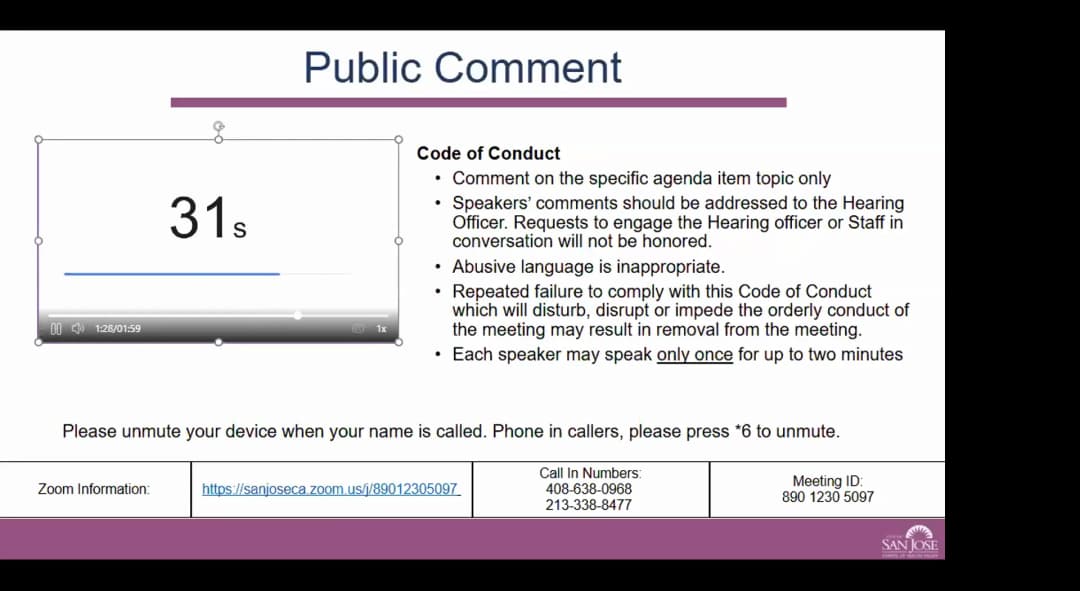
The Planning Director's Hearing, held via Zoom on January 21, 2026, was presided over by Hearing Officer John Tu. The meeting addressed routine consent calendar items and one public hearing item regarding a live tree removal permit for a coast live oak tree at 1489 Saratoga Avenue. After public testimony and deliberation, the hearing officer approved the permit. Consent Calendar - SP 24-044 and ER 24-252: Approved to allow expansion of a legal non-conforming single-family house at 525 Monero Avenue, from 868 sq ft to 1,541 sq ft, with CEQA exemption. - T22-019 and ER22-132: Approved to subdivide an approximately 0.58 gross acre lot into three residential lots on Memorial Drive, with CEQA exemption. Public Comments & Testimony - Tree Removal Permit (TR25-373) for 1489 Saratoga Avenue: Multiple members of the public spoke in opposition to the removal of a 176-inch circumference coast live oak. Key points included: - The tree provides critical habitat, shade, cooling, flood mitigation, and biodiversity benefits as a native keystone species. - Replacement with a non-native tree (Chinese elm) is inadequate. - The city's Community Forest Management Plan emphasizes preserving large, mature trees. - Feasible design alternatives (e.g., shifting driveway, using structural soil, transplanting) were not exhausted according to a consulting arborist. - Flooding risks may increase without the tree. - Applicant (Kevin, owner's representative) : Supported approval, stating that alternatives were explored with an arborist and are not feasible due to root sensitivity and code compliance. The driveway location is dictated by site constraints (cul-de-sac, lot narrowing). - Staff (Laura Miners, Planning Supervisor) : Recommended approval, noting the city arborist agreed no feasible redesign could save the tree. Discussion Items - TR25-373 – Live Tree Removal Permit: The permit seeks to remove one coast live oak (176 inches circumference) located in the footprint of a proposed driveway for a new single-family house. Staff determined the tree is on private property, not a street tree. The applicant must replace with one tree per city code. CEQA exemption (Section 15301) was applied. The hearing officer acknowledged public concerns but found that the code allows removal when preservation is infeasible, and the city arborist concurred. Alternate designs (e.g., one-car garage, transplanting) were deemed impractical or likely to fail. Key Outcomes - Approved: The live tree removal permit (TR25-373) was approved by Hearing Officer John Tu. The decision is based on staff findings that no feasible alternative exists to retain the tree while allowing a code-compliant single-family home. The replacement tree requirement (one native or non-native tree per code) applies. The approval can be appealed per Title 20 of the San Jose Municipal Code. - The consent calendar items were approved as presented without public comment. - Hearing adjourned at 9:38 AM.

ENVIRONMENTAL PROTECTION 55% · LAND USE 30% · PUBLIC ENGAGEMENT 15%
155
JAN 21, 2026 · SAN JOSE, CALIFORNIA · CITY COUNCIL
San José Rules Committee Meeting – January 21, 2026

The Rules and Open Government Committee met on January 21, 2026, at 2:00 PM to review upcoming City Council agendas, approve routine consent items, and discuss two memos: one proposing a development fee framework and another outlining the process for the budget forecast and priority study session. The committee voted unanimously on all items, including a modification to the January 27 council agenda regarding the timing of the mobile home rent ordinance discussion. Agenda Review - January 27, 2026 City Council Agenda: The committee discussed moving item 8.6 (proposed amendment to the mobile home rent ordinance) to a "not before 6:00 PM" time certain, with a revised order to hear it before item 8.5 (soft story seismic retrofit pilot program) but no earlier than 6:00 PM. The motion carried 5-0. - February 3, 2026 City Council Agenda: The committee approved the agenda without changes (motion carried 5-0). Consent Calendar - Two items on consent were approved unanimously (5-0) with no public comment. Public Comments & Testimony - Blair Beekman spoke on several topics: (1) Suggested the city could learn from San Diego's implementation of Senate Bill 79 for housing development, noting lower construction costs there. (2) Expressed general support for the development fee memo (C-1), saying flexibility and consistency would be welcomed. (3) Urged the city to take a balanced approach to budget deficits, similar to Oakland, and emphasized maintaining social services. (4) In open forum, raised concerns about administration model changes at the Valley Transportation Authority (VTA) and urged transparency and public process. He also criticized the Trump administration and praised San Francisco Mayor Mahan's efforts on crime issues. - Jean Dresden (park advocate) opposed deferring park impact fees to certificate of occupancy without a full report. She argued that park fees are already discounted, deferral lowers their value, and some projects have entered bankruptcy—making fee collection uncertain. She requested that the topic go to priority setting to weigh workload against other mandates like SB 79. Discussion Items - Memo C-1 – Development Fee Framework (Councilmembers Ortiz, Cohen, Mulcahy, Casey): Councilmember Ortiz introduced three proposals from the 2025 cost of development study: (1) a sliding-scale fee framework based on project size, affordability, public benefit, and location; (2) deferring development impact fees and public works off-site fees from entitlement/permit to certificate of occupancy (not waiving fees); and (3) aligning affordable housing funding cycles with the state’s business cycle. Councilmember Foley, a co-author, supported moving the item to workload analysis, noting that similar issues have been discussed for years without progress. The committee voted 5-0 to refer the memo to workload analysis for further consideration. - Mayor’s Memo – Budget Forecast and Priority Study Session Process: The committee reviewed the memo outlining the process for the February 5, 2026 budget study session. No substantive discussion occurred; the memo was approved (motion carried 5-0). Key Outcomes - January 27 Council Agenda: Amended to set item 8.6 (mobile home rent ordinance) as "not to be heard before 6:00 PM" and to adjust the order so it is heard before item 8.5 (soft story seismic retrofit) but not earlier than 6:00 PM. Motion carried 5-0. - February 3 Council Agenda: Approved as presented (5-0). - Consent Calendar: Approved (5-0). - Memo C-1 (Development Fees): Referred to workload analysis (5-0). - Mayor’s Budget Memo: Approved (5-0). - The meeting adjourned at 2:24 PM.

AFFORDABLE HOUSING 55% · FISCAL SUSTAINABILITY 15% · ENGINEERING AND INFRASTRUCTURE 8% · PARKS AND RECREATION 8%
156
JAN 14, 2026 · SAN JOSE, CALIFORNIA · PLANNING COMMISSION
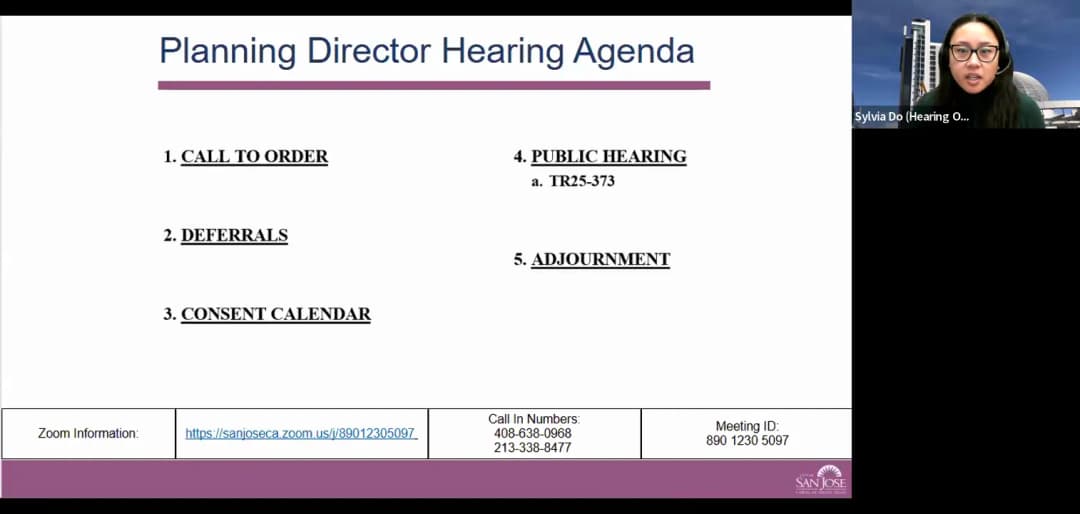
Planning Director Hearing of January 14, 2026: Deferral of Tree Removal Permit

Introductory paragraph: The Planning Director Hearing for January 14, 2026, was called to order by Hearing Officer Sylvia Doe. The meeting was conducted via Zoom. The sole substantive action was the deferral of one agenda item to a future date. Consent Calendar No items were listed on the consent calendar. Public Comments & Testimony No public comments were made. Discussion Items - Deferral of Tree Removal Permit (TR25-373): Staff requested a deferral for the live tree removal permit located at 1489 Saratoga Avenue to the next Planning Director Hearing on January 21, 2026. The city arborist and applicant were coordinated, and neighbors had been informed. Hearing Officer Sylvia Doe approved the deferral as recommended. Key Outcomes - Item 4A (Tree Removal Permit TR25-373) was deferred to January 21, 2026. - The meeting adjourned at 9:06 AM.

LAND USE 60% · PUBLIC ENGAGEMENT 30% · ENVIRONMENTAL PROTECTION 10%
157
JAN 14, 2026 · SAN JOSE, CALIFORNIA · PLANNING COMMISSION
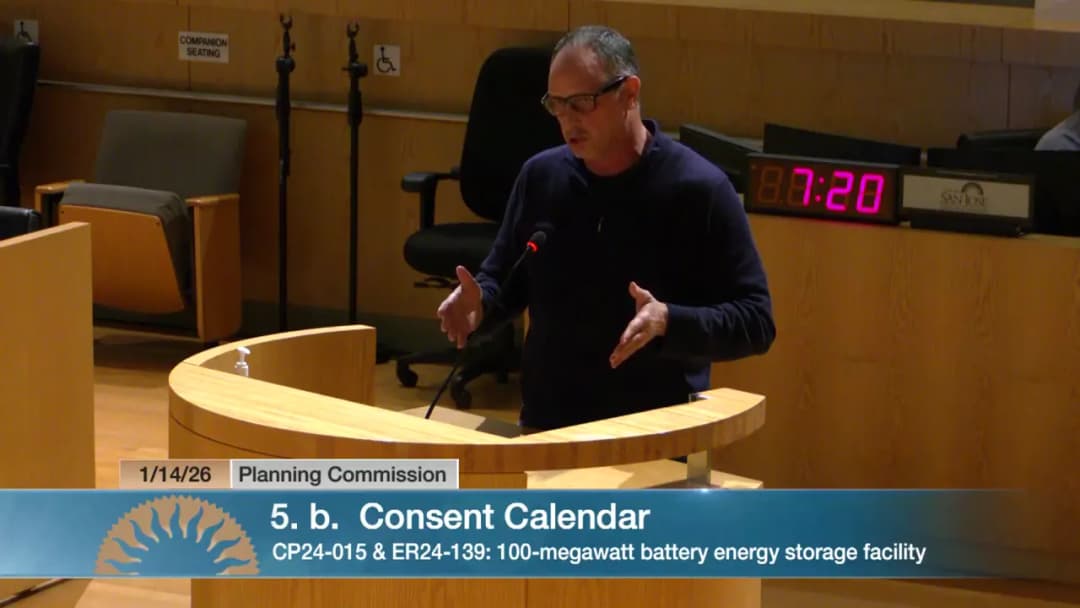
San Jose Planning Commission Meeting – January 14, 2026: Battery Storage Facility Approval

The San Jose Planning Commission met on January 14, 2026, to consider a conditional use permit for a 100‑megawatt battery energy storage facility and to receive updates on city planning matters. The commission unanimously approved the permit after hearing from the applicant and the San Jose Fire Department, and also discussed upcoming policy items and a joint study session with the Housing Commission. Consent Calendar - Approval of Minutes (December 10, 2025): The commission approved the consent calendar (excluding item 5B) by a 10‑0 vote (one absent). Item 5B (CP24‑15 / ER24‑139) was pulled for separate consideration. Public Comments & Testimony - No public speakers appeared for the consent calendar or for the battery storage facility item. No public comment was offered during the non‑agendized public comment period. Discussion Items - Conditional Use Permit CP24‑15 / ER24‑139 – Battery Energy Storage Facility - Location: 6150 San Ignacio Avenue, approximately 700 feet southeast of Great Oaks Boulevard, on a 5.5‑acre site currently used for vehicle storage. - Proposal: Installation of a 100‑megawatt battery energy storage facility (battery modules, inverters, collector substation) with extended construction hours (Saturdays 8 a.m. – 5 p.m.). No demolition or tree removal. - Staff Presentation (Cora McNaughton): The project is consistent with the Combined Industrial Commercial General Plan designation and IP (Industrial Park) zoning. Staff recommended approval, citing a CEQA exemption under Section 15183 (consistent with Envision San Jose 2040 General Plan EIR). No public questions had been received. - Applicant Presentation (Max Christian, New Leaf Energy): Christian described the project’s role in grid stabilization (charging from surplus solar midday, discharging during peak evening hours). He contrasted the proposed system with the 2025 Moss Landing fire, emphasizing that modern systems use containerized modules (40 batteries per 20‑ft container), active cooling, remote monitoring, and chemical suppression. He stated that post‑2022 codes (NFPA 855) and new CPUC/CEC rules make a Moss Landing‑type event impossible at this facility. - Fire Department Testimony (Deputy Fire Chief James Dobson): Dobson confirmed that San Jose requires large‑scale fire testing to ensure no unit‑to‑unit propagation. He stated that while a fire in a single unit cannot be ruled out, the design would contain any fire to the unit of origin. He noted that San Jose is a national leader in energy storage safety requirements. - Commissioner Questions: Commissioner Young asked about the applicant’s experience and safety record (no fires at their facilities). Commissioner Bickford inquired about existing battery plants in San Jose; Dobson noted that data centers use similar systems and that the city applies the same rigorous testing. Christian clarified that each container holds about 5 megawatts. Key Outcomes - Motion to Approve: Commissioner Young moved to approve the conditional use permit; seconded by Commissioner Casey. - Vote: 10‑0 (one absent). All commissioners voted yes. - CEQA Exemption: The commission accepted the staff‑recommended CEQA exemption. Reports and Referrals - Good and Welfare (Planning Staff): - Upcoming City Council items (January 27): Multifamily Housing Incentive Program, Inclusionary Housing Ordinance, and SB 79 implementation options. - Appeals: Tropicana CUP (denied Nov 19, 2025) tentatively scheduled for City Council February 10, 2026; PayPal Stadium concert expansion appeal also pending. - Email access issues noted for Commissioners Cantrell and Bandal. - Joint study session with Housing Commission planned for late February or early March 2026 to discuss the Housing Catalyst Work Plan. - Follow‑up on Downtown West Development Agreement (John Tu, Division Manager): - Staff confirmed that the $1 million community benefit fund for the Gardner Community Center was provided by Google (Downtown West) as required. The Parks, Recreation and Neighborhood Services (PRNS) department recommended awarding a three‑year contract to Catholic Charities, which the City Council approved on December 16, 2025. Commissioner Cantrell asked about PRNS’s authority; staff noted that the City Council ultimately authorized the use of funds. Adjournment The meeting adjourned at 7:40 p.m.

TECHNOLOGY AND INNOVATION 55% · PUBLIC SAFETY 15% · LAND USE 10% · ENGINEERING AND INFRASTRUCTURE 6%
158
JAN 14, 2026 · SAN JOSE, CALIFORNIA · PLANNING COMMISSION
San Jose Planning Commission Study Session on Cost of Development Study - January 14, 2026

This was a special study session of the San Jose Planning Commission, held on January 14, 2026, to review the city's Cost of Development Study. The study, led by the Housing Department in partnership with Planning, Building and Code Enforcement and the Office of Economic Development, analyzed the feasibility of market-rate and affordable housing development across different building types and areas of the city. The session lasted approximately one hour, starting at the beginning of the meeting and preceding the regular agenda at 6:30 PM. City staff presented findings, followed by extensive commissioner questions and discussion. Discussion Items - Cost of Development Study Presentation: Eric Sullivan, Director of Housing, presented the study, which was based on hypothetical pro formas for five building types: townhomes, stack flats, podiums, wraps, and towers. The study looked at four growth areas: downtown, west, north, and southeast. Key findings: townhomes and stack flats are generally financially feasible, while podiums, wraps, and towers face significant challenges even with fee waivers. Market-rate rents in San Jose are lower than in neighboring cities (e.g., Cupertino, Sunnyvale, Santa Clara), while construction costs are similar. Taxes and fees impact per-unit costs by $37,000 to $72,000. For affordable housing, San Jose's cost per square foot is higher than the Bay Area average, partly due to a focus on extremely low-income units. The city has produced about 40% of all affordable housing in the Bay Area. Staff noted limited local tools to incentivize development, with options including fee waivers, streamlining processes, and incentive programs like the Multifamily Housing Incentive Program. - Commissioner Questions and Comments: Several commissioners asked for clarification on data, assumptions, and implications. Commissioner Casey questioned why podium costs were lower in West San Jose versus other areas, with staff explaining variations in land costs, rents, and municipal fees. Commissioner Cowell requested a separate briefing on jargon and asked about actionable recommendations for the commission. Commissioner Bandol asked whether the city should build feasible townhomes/stack flats now or wait for higher-density projects; staff noted the tension between immediate supply and long-term density goals. Commissioner Borosio asked about alternative approaches beyond fee waivers and their impact on services; staff mentioned process streamlining (e.g., ministerial approval) but acknowledged limited levers. Commissioner Cantrell asked about timing for more clarity on policy adjustments and whether rezoning single-family areas is on the table; staff pointed to ongoing work on SB 9 expansion and the four-year general plan review. Commissioner Cantrell also questioned whether the trade-off is framed as housing vs. services or housing vs. housing, and asked about council's appetite for reducing services to boost housing. Key Outcomes - The presentation was informational only; no votes or formal actions were taken. - Staff noted upcoming actions: a January 27, 2026 council item on downtown office-to-residential conversions and expansion of the multifamily incentive program, which could produce about 500 units. - The study will inform the Planning Commission's role as the task force for the General Plan four-year review, particularly on land use policies for missing middle housing and residential capacity. - Commissioners expressed a desire for more detailed data by council district and for continued discussion on balancing immediate housing production with long-term density goals. - The meeting recessed for 10 minutes at 6:45 PM before the regular agenda began.

AFFORDABLE HOUSING 35% · LAND USE 25% · FISCAL SUSTAINABILITY 15% · ECONOMIC DEVELOPMENT 10%
159
JAN 14, 2026 · SAN JOSE, CALIFORNIA · CITY COUNCIL
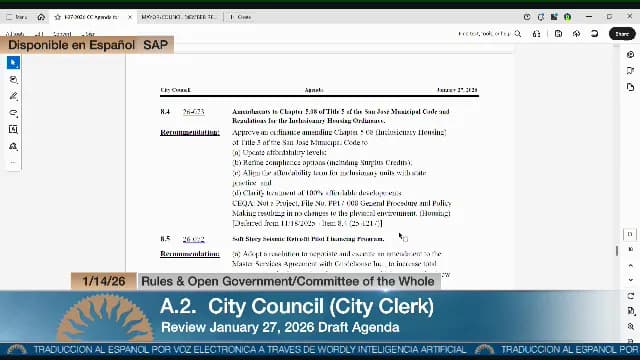
San José Rules and Open Government Committee Meeting - January 14, 2026

The Rules and Open Government Committee met on January 14, 2026, at 2:00 PM. The meeting included roll call (quorum present with 4 members), first review of the January 27 agenda, approval of the consent calendar, and one public comment during open forum. The committee approved the agenda with an ad sheet and directed staff to set a time certain for item 8.6 (mobile home rent ordinance) at the next rules meeting. Consent Calendar - The committee approved the consent calendar (4 items) by a vote of 4-0 with no public comment. Public Comments & Testimony - Ryan, a member of the public, spoke during open forum. He proposed establishing a city-recognized day or ceremony to acknowledge victims of all crimes, from theft to violent crime, stating that victims lose their sense of safety and that existing events like Summer Night Out do not cover this. He noted he had previously raised the issue and sent emails. No committee response or action was taken on this proposal. Discussion Items - January 27 Agenda Review: The committee reviewed the draft agenda for January 27, 2026. Notable items include: consent calendar (pages 5-9), Section 3 (annual report on city services), and Section 8 items: update on SB 798 implementation, downtown residential incentive program (commercial to residential conversion), extension of multifamily housing incentive, amendment to inclusionary housing ordinance, soft story seismic retrofit pilot program, and amendment to mobile home rent ordinance (Item 8.6). No land use items. The committee discussed conflicting requests regarding the timing of Item 8.6 (some wanted it immediately after consent, another requested 6 PM). Members agreed to confer with constituents and set a time certain at the next rules meeting. - The committee approved the agenda as amended by the ad sheet, with the note on Item 8.6 scheduling, by a vote of 4-0. Key Outcomes - Approved the January 27 agenda (with ad sheet) by a 4-0 vote, pending final scheduling of Item 8.6 at the next rules meeting. - Approved the consent calendar (4 items) by a 4-0 vote. - Directed staff to report back at the next rules meeting (January 21, 2026) with a recommendation for a time certain for Item 8.6 (mobile home rent ordinance amendment). - Meeting adjourned at 2:05 PM.

AFFORDABLE HOUSING 55% · PUBLIC ENGAGEMENT 15% · PUBLIC SAFETY 15% · ENGINEERING AND INFRASTRUCTURE 10%
160
JAN 13, 2026 · SAN JOSE, CALIFORNIA · CITY COUNCIL
San Jose City Council Meeting – January 13, 2026: Immigration Policy, Legislative Priorities, and Community Recognitions

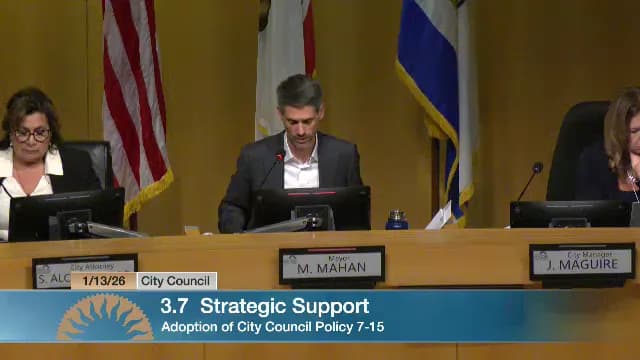
The San Jose City Council held its first meeting of 2026 on January 13, 2026. The meeting opened with a Pledge of Allegiance and an invocation by Senior Sergeant Cadet Carolina Regalado of the SJPD Cadet Program. Ceremonial items included proclamations for National Human Trafficking Awareness Month and the 10th anniversary of Keep Coyote Creek Beautiful, as well as recognition of Muwekma Ohlone Middle School's family reading night. The meeting was adjourned in memory of longtime volunteer Kenneth John Kelly. Major actions included the unanimous adoption of a policy prohibiting the use of city property for civil immigration enforcement, approval of the 2026 legislative program with a new position supporting HR 630 (the Neighbors Not Enemies Act), and acceptance of the Team San Jose annual performance audit. Consent Calendar - Consent calendar adopted unanimously, including routine approvals. One member of the public spoke about a permit encroachment request related to a disabled brother's trailer, urging the city to add training on constitutional protections for homeless individuals' property. - Land use consent also adopted unanimously. Public Comments & Testimony - On the consent calendar: A resident requested that the city add training on constitutional protections regarding personal property of homeless individuals, citing her disabled brother's situation. - On items 3.5 & 3.6 (IGR report and Legislative Program): Three speakers—Susan Hayasa (co-founder of San Jose Nikkei Resisters), Victoria Takeda (Japantown Neighborhood Association), and Jordan Moldau (District 3 resident/volunteer)—urged the city to support HR 630, the Neighbors Not Enemies Act, which would repeal the Alien Enemies Act of 1798. They emphasized the historical misuse of the act against Japanese Americans and its current impact on immigrant communities. - On item 3.7 (policy prohibiting ICE staging on city property): Multiple speakers (Drew Siegler, Azazel Holmquist, Kim Guptill, Karen, Lori Ketcher, Cindy Bautista, Michelle Coleman, Janela Ardonias, Jeremy Berruce, Raina, Kimberly Wu, Emma, Lucila Ortiz, and Joy Murrieta) expressed strong support for the policy, citing recent incidents of ICE violence and the need to protect immigrant families, constitutional rights, and community trust. They represented organizations such as SURJ Santa Clara County, PASOS, SIREN, IPEN, Amigos de Guadalupe, and Working Partnerships USA. - Open forum: Two speakers addressed highway lighting issues (Highway 87 and 101) and historic preservation (Bank of Italy building, Dole tower), and a second speaker raised concerns about ICE operations on public transit during upcoming Super Bowl and World Cup events. Discussion Items - Team San Jose Annual Performance Audit (Item 3.4): City Auditor Joe Royce presented the audit for FY 2024-25. Team San Jose met all five performance targets: gross operating results, 133,500 booked hotel room nights, estimated $95 million economic impact, 97% theater occupancy, and 97% customer satisfaction. The city qualifies for a $300,000 performance-based fee. Council members Cohen, Mahan, Mulcahy, and others discussed the need for better metrics (e.g., convention center utilization, comparative analysis) and the tension between setting stretch goals and conservative budgeting. The audit was accepted unanimously. - Intergovernmental Relations Report and 2026 Legislative Program (Items 3.5 & 3.6): The IGR team (Han Kang, Steve Stamos, Nicholas Ochoa) presented the fall 2025 report and the 2026 legislative program. Highlights included $7.5 million in federal earmarks, successful state advocacy on abandoned shopping carts and copper theft, and the governor's budget proposal including $500 million for HHAPP (down from previous years). The 2026 program focuses on five unchanged priorities with new concepts: raising the threshold for abandoned RVs, incentivizing condo construction, CEQA exemption for Diridon Station, a statewide AI framework, and preserving local control. Council members discussed the need for balanced data center policies, support for HR 630, and funding for public safety during major sporting events. The report was accepted (unanimous), and the legislative program was approved unanimously with a friendly amendment from Vice Mayor Foley to add support for HR 630. - Policy Prohibiting City Property Use for Civil Immigration Enforcement (Item 3.7): Deputy City Manager Angel Rios presented the staff-recommended policy (Council Policy 7-15) prohibiting the use of city-owned or controlled parking lots, vacant lots, garages, and open spaces as staging areas for civil immigration enforcement. The policy arose from a Council direction in October 2025. Council members Ortiz, Candelas, and Kamei led the initiative. After extensive public comment, the council debated its scope: Vice Mayor Foley asked whether it covers all city properties (parks, libraries, etc.); staff confirmed the principles apply broadly and that signage and access controls will be implemented. The policy was adopted unanimously. Key Outcomes - Consent Calendar and Land Use Consent – Approved unanimously. - Settlement (Item 3.3) – Approved unanimously. - Team San Jose Performance Audit – Accepted unanimously. The report was accepted; the $300,000 performance-based fee is authorized. - IGR Report (3.5) – Accepted unanimously by voice vote (one initial machine error corrected). - 2026 Legislative Program (3.6) – Approved unanimously with a friendly amendment to include support for HR 630 (Neighbors Not Enemies Act). - Legal Services Contract (6.1), Design-Build Contract (6.2), Emergency Repairs (6.3) – All approved unanimously. - Alameda Business Improvement District (8.1) – Approved unanimously after discussion about outreach to home-based businesses. - Policy on ICE Staging (3.7) – Adopted unanimously. Implementation will include standardized signage, access controls, and reporting procedures. - Alum Rock Business Improvement District (8.2) – Approved unanimously. - First Substantial Amendment to FY 2025-2026 Annual Action Plan (8.3) – Approved unanimously; includes funding for La Placita in East San Jose and pedestrian/traffic safety improvements using CDBG funds.

PUBLIC SAFETY 35% · PROCEDURAL 14% · ECONOMIC DEVELOPMENT 12% · COMMUNITY ENGAGEMENT 10%
OPENPUBLICA · PUBLIC MEETING INDEXUPDATED DAILY · openpublica.com