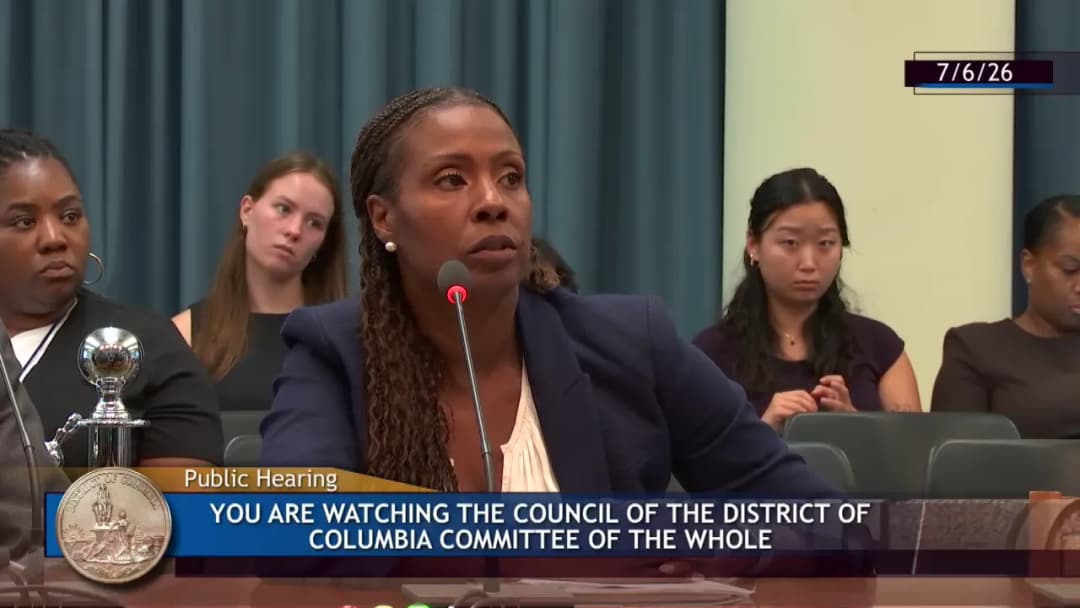
On Thursday, July 9, 2026, at 12:16 PM, the Committee as a Whole of the Council of the District of Columbia held a public roundtable in Room 412 of the Johnny Wilson Building to consider PR 26-747, the Public Charter School Board Anna K. Smith confirmation resolution of 2026, introduced at the mayor's request on June 17, 2026. The purpose was to confirm the mayor's nomination of Anna K. Smith to fill a vacant seat on the Public Charter School Board for the remainder of an unexpired term ending February 24, 2030. Chairman Phil Mendelson presided. Testimony in Support - Shukrat Adamo Finian, Chair of the DC Public Charter School Board, testified in strong support of Anna Smith's nomination. She thanked Mayor Bowser for the nomination and praised the mayor's record on education, stating that academic achievement has improved and the charter sector has matured under her administration. She highlighted Ms. Smith's diverse background as a teacher, administrator, parent, and advocate, including service as interim deputy mayor of education and as a trustee at Two Rivers Public Charter School, and expressed confidence that Ms. Smith would bring valuable perspectives, particularly in workforce development. Discussion with Nominee - Anna K. Smith appeared before the committee and offered opening testimony. She described her career in public service, starting as a public school teacher in Miami-Dade County, working under three DC mayors, and currently serving as a board trustee at Two Rivers Public Charter School. She emphasized her commitment to accountability, good governance, and student outcomes. She acknowledged that if confirmed, she would resign from the Two Rivers board to avoid conflicts of interest. - Chairman Mendelson asked standard questions regarding time commitment, conflicts of interest, and outstanding liabilities. Ms. Smith confirmed she could meet time requirements, had no conflicts (but would recuse herself as needed), and had no outstanding liabilities. - When asked about challenges facing the charter sector, Ms. Smith cited declining enrollment (noting the first drop in pre-K My School DC lottery this year), continued recovery from the pandemic, and the need to plan for demographic changes while maintaining academic outcomes. - On the Public Charter School Board's role in improving academic achievement, Ms. Smith described it as a "critical friend" that uses the ASPIRE framework to hold schools accountable and provide support, rather than dictating to individual charter schools. - Chairman Mendelson raised the topic of the Eagle Academy sudden closure and the board's subsequent adoption of a school reorganization policy (formerly called mergers and acquisitions). Ms. Smith acknowledged she was not yet deeply familiar with the policy but expressed willingness to learn and bring her perspective to prevent similar disruptions. Key Outcomes - The record will remain open for public comment until 5:00 PM on Monday, July 13, 2026. - No vote was taken at the roundtable; the committee will consider testimony before deciding whether to recommend confirmation. - The roundtable adjourned at 12:36 PM.
Public Meetings - Washington, District Of Columbia
Public Meetings - Washington, District Of ColumbiaThe Committee on Transportation and the Environment, chaired by Councilmember Charles Allen, held a public roundtable on July 9, 2026, to receive feedback on a revised draft of Bill 26-58, the Recycling, Refund, and Litter Reduction Amendment Act (the "bottle bill"). The meeting featured testimony from environmental advocates, local brewers and distillers, beverage wholesalers, retailers, and subject matter experts. No votes were taken; the hearing was for informational and deliberative purposes. Public Comments & Testimony - Christy Petchi (Just Zero) expressed full support for the bill, calling it "excellent and thoughtful." She emphasized that a 10-cent deposit is the right starting point and urged retention of the automatic deposit increase mechanism (stricken in the revised draft) to avoid the stagnation seen in Massachusetts and New York. - Ginny Farrell (New York State Assembly) supported the bill, noting that New York's 5-cent deposit yields 70% redemption, but 10-cent states achieve over 90%. She highlighted that deposit systems produce higher-quality recyclables than single-stream recycling. - Brendan Williams Keith (DC Association of Beverage Alcohol Wholesalers) strongly opposed the bill, citing a cost study estimating $57.6 million in startup costs and $38 million in annual operating costs. He argued the program would impose disproportionate burdens on local distributors and expose the district to fraud and solvency risks. - Mary Donovan (Elevated Insights Group) presented her cost study (funded by the DC beverage wholesalers), estimating $57M startup and $38M annual costs, with fraud risks of 10-50% leading to losses of $5.7M to $28.5M. She noted the study did not include savings from litter reduction. - Jordan Cotton (Cotton & Reed Distillery) supported the bill's goals but expressed concerns about compliance burdens on small producers. He requested exemption from stewardship organization membership fees and clear representation on the board. - Steve Carnes (DC Brau Brewing) raised concerns about the cost of DC-specific labeling and asked for clarity on redemption exemptions for on-premises consumption. - Thor Cheston (Right Proper Brewing Company) opposed the bill, stating that the combined costs of commercial real estate, taxes, and regulatory compliance already create a difficult environment. He argued the bill would disproportionately harm local manufacturers who represent only 0.33% of beverage containers sold in DC. - Chris Williams (Anacostia Watershed Society) strongly supported the bill, citing that bottle bills reduce beverage container litter by 69-84% and overall litter by 30-64%. He noted that 60-70% of trash collected from the Anacostia River is recyclable containers. - Laura Nunn (Friends of Kingman and Heritage Islands) supported the bill, emphasizing its environmental justice benefits and potential to create green jobs. She highlighted that bottle bills empower youth and provide income for canners. - Susan Shore (Sierra Club DC) supported the bill and urged restoration of the automatic deposit increase mechanism to prevent long-term decline in redemption rates. - Tiffany Harvey (MD, DE, DC Beverage Association) opposed the bill, citing fraud risks, border issues, and the availability of alternative approaches like extended producer responsibility. She noted that neighboring states (Maryland, Virginia) have rejected similar bills. - Bree Deatley (American Beverage Association) opposed the bill, arguing that DC's unique geography (surrounded by non-deposit states) makes fraud inevitable. She cited Connecticut's experience where border fraud led to emergency legislation and redemption rates exceeding 100%. - Sean Townsend (Restaurant Association Metropolitan Washington) acknowledged improvements in the revised draft but remained concerned about costs passed down to restaurants and operational uncertainties around container collection. - Mary Quillian (Mr. Henry's Restaurant) supported the bill's goals but worried about logistics for restaurants to recover deposits, including storage, sanitation, and lack of clear collection pathways. - Vanessa Batters Thompson (DC Appleseed) supported the bill, arguing it does not increase consumer beverage prices (citing a 2011 Massachusetts study) and would boost tourism and green jobs. - Jim Connolly (Anacostia Watershed Society/real estate professional) supported the bill, noting that litter negatively impacts property values and community perception. - Mike Smaha (Can Manufacturers Institute) supported the concept but recommended a phased deposit increase and placing deposit information on the can label rather than the lid. He also suggested returning more unredeemed deposits to the stewardship organization to fund fraud prevention. - Brian Vickers (Glass Packaging Institute) supported the bill, noting that deposit systems provide the cleanest glass for recycling, reducing energy use and landfill costs. Discussion Items - Revised Draft Overview (Councilmember Allen): The revised draft exempts restaurants, hotels, bars, and retailers <2,000 sq. ft. from on-site redemption; caps daily redemptions at 250; exempts distributors selling <2 million containers from registration fees; and increases DOEE authority over collection standards. The automatic deposit increase mechanism was removed. - Deposit Increase Mechanism: Multiple witnesses (Petchi, Shore, Thompson) urged restoration of the mechanism allowing DOEE to raise the deposit if redemption targets are missed for two consecutive years, arguing it prevents stagnation seen in other states. Opponents (Donovan, Deatley) warned of fraud and cost implications. - Fraud Prevention: Witnesses discussed cross-border fraud risks, with Deatley estimating potential redemption rates exceeding 100%. The 250-container daily cap was debated as insufficient by some and overly restrictive by canners. - Impact on Small Businesses: Local brewers and distillers expressed concerns about labeling, UPC requirements, and cash flow. Councilmember Allen acknowledged the challenges and committed to further engagement. - Cost Analysis: The cost study by Donovan was contested; supporters noted the absence of savings from reduced litter and street cleaning. DPW spends $20 million annually on litter cleanup. - Environmental Benefits: Williams testified that 60-70% of trash in the Anacostia River is recyclable containers, and the district faces potential MS4 permit fines of up to $64,000/day. Key Outcomes - No Votes Taken: The roundtable was for information gathering; no formal action was taken. - Next Steps: The committee will continue to work with stakeholders, especially small businesses and distributors, to refine the bill. Written testimony is due by July 23, 2026. - DOEE Monitoring: DOEE representatives were present throughout the hearing to inform implementation planning. - Revised Draft Retained: The committee will consider further amendments based on testimony, including potential restoration of the automatic deposit increase mechanism and additional relief for small manufacturers.
The Committee on Human Services, chaired by Councilmember Fruman, held a public roundtable on July 8, 2026, at 1:08 p.m. in Room 500 of the John A. Wilson Building to consider two confirmation resolutions for the District of Columbia Board of Library Trustees: PR 26-0671 (Denise Rolark Barnes) and PR 26-0672 (Mary Early). The board oversees 26 libraries and consists of nine unpaid residents appointed by the mayor and confirmed by the council, with two current vacancies. Public Comments & Testimony - Robert Benson Branham, President Emeritus of the DC Federation of Civic Associations, spoke in strong support of Denise Rolark Barnes, calling her “highly accomplished, distinctive, and distinguished” and urging the committee to confirm her “appropriately and swiftly.” Discussion Items - Denise Rolark Barnes (Ward 8 resident, publisher of the Washington Informer) testified about her background, including her family’s 61-year-old community newspaper, her work with the Washington Informer Charities (sponsor of the DC Citywide Spelling Bee entering its 45th year with nearly 45,000 participants), and her experience on boards such as Events DC. She noted her love of reading since childhood, her current library card, and expressed interest in serving on the facilities, contracts review, or programs/partnerships/performance committees. She affirmed she would recuse herself from any decisions involving the Informer. Chair Fruman discussed challenges with e-book availability and library usage in underserved communities. - Mary Early (Ward 6 resident, artist and director of Hemphill Artworks) testified about her four years on the library’s Arts Advisory Council, her studio practice, and her board service with arts organizations. She highlighted the importance of making arts and culture inclusive and expressed interest in the programs, partnerships, and performance committee. She described her use of the Southwest branch library and digital resources, and discussed challenges including technology changes and the need for equitable programming. She said she would recuse herself if conflicts arose from her Arts Advisory Council role. Key Outcomes - Chair Fruman indicated the committee intends to act quickly on both nominations, stating “it is certainly the intention of the committee to act quickly on these nominations.” - Written testimony for the record may be submitted via the council’s electronic hearing management system until the close of business on Wednesday, July 22, 2026. - No formal vote was taken during the roundtable; the confirmations will proceed to a future committee vote and then to the full council.
On Wednesday, July 8, 2026, at 11:35 a.m., the Committee on Health, chaired by At-Large Councilmember Christina Henderson, held a public roundtable on the state of maternal and infant health in the District of Columbia. The meeting focused on the mayor's FY27 budget proposal, which included over $3 million in cuts to maternal and early childhood public health initiatives, and the most recent perinatal and infant mortality report from DC Health (2018–2024) showing concerning trends such as increases in severe maternal morbidity, marijuana use in pregnancy, and preterm birth rates. The committee heard from public witnesses, health professionals, and government officials. Public Comments & Testimony - Crystal Jackson (Queen Mama Doula Services, Ward 8 Health Council) testified that the Medicaid doula benefit exists but implementation is incomplete, with doulas struggling with enrollment, credentialing, billing, and reimbursement. She urged sustained public investment in community-based implementation organizations rather than temporary grants. - Leah Caslis (Children's Law Center) noted improvements in some perinatal indicators (decreased teen birth, preterm birth, low birth weight, infant mortality) but highlighted persistent racial and geographic disparities. She stressed the need for consistent, up-to-date data and better doula access for Medicaid beneficiaries, advocating for a centralized hub to support doulas and non-clinical workers. - Rodrigo Stein (La Clinica del Pueblo) presented findings from a perinatal community health needs assessment showing social and structural barriers (stress, financial insecurity, limited social connection, fear of partners). He reported that pre-pregnancy diabetes among Latina mothers doubled and preterm birth increased 30% from 2019–2023. He urged sustained investments in FQHCs and community health centers. - Dr. Kate Sugarman (Doctors for Camp Closure) opposed the closure of postpartum unit 5F at MedStar Washington Hospital Center, noting that African American women make up 90% of pregnancy-related deaths despite 50% of births. She called for strengthening the unit and pressuring MedStar to fulfill its charity care obligation (currently 1% vs required 3%). - Dr. Rochelle Logan (DC Primary Care Association) presented March of Dimes 2025 report card showing DC worsened on every measure. Preterm birth rates: white mothers decreased 10%, Black mothers increased 18%, Latina mothers increased 23%. She urged authorizing community health centers to certify presumptive eligibility for pregnant patients. - Shanita Edwards (OABI Natural Healing) emphasized the need for a coordinated system east of the river and called for sustained support for Ward 8 Health Council and organizations providing doula care, including for incarcerated mothers. - Tambra Stevenson (WANDA) argued nutrition is a core maternal health infrastructure, not an add-on. She described a pilot program (Nourish Maternal Food as Medicine) that provided culturally relevant nutrition education to birth workers, and urged DC Health and DHCF to incorporate food as medicine into maternal health strategy. - Corinne Golston (nurse, Washington Hospital Center) opposed the postpartum unit closure, noting that one in three DC babies are born at WHC, and the unit averages 200–250 deliveries per month. She highlighted the need for space for mothers grieving stillbirths or pregnancy loss. - Justin Palmer (DC Hospital Association) updated on the DC Perinatal Quality Collaborative (PQC), which has increased adoption of quantified blood loss measurement from 69.8% (Q4 2023) to 92.8% (Q3 2025) and launched Count the Kicks (stillbirth prevention) with 83% engagement growth. The PQC is also implementing a perinatal mental health safety bundle with over 100 participants from 10 organizations. - Jaren Hill Lockridge (Dreaming Out Loud, Ward 8 Health Council) called maternal mortality a crisis affecting mothers who survive and those afraid to have children. She advocated for maternal food is medicine initiatives east of the river, embedding doula support at Cedar Hill and Children's National. - Liz O'Donnell (Aelea in Action) discussed stillbirth prevention through Count the Kicks and the need for standardized perinatal bereavement care. She noted her organization provides bereavement packages to almost every DC hospital except Cedar Hill, which she is trying to connect with. - Nandy Janja (mother, community advocate) shared personal experience with postpartum depression, financial insecurity, and lack of paid leave. She recommended expanded postpartum support to one full year, recognizing dental care as medically necessary, and investing in workforce reentry for postpartum mothers. - Dr. Lauren Messinger (Mary Center) raised concerns about insurance coverage gaps (Medicaid marked inactive, causing months of missed prenatal care), formulary changes limiting insulin and glucose monitoring supplies, and increased uninsured patients seeking emergency care. She stressed the importance of funding social services. - Laura Brown (First Shift Justice Project) highlighted employment-related barriers: pregnant workers denied reasonable accommodations or paid leave. She advocated for portable DC paid leave benefits and expanded reach of pregnancy centering programs. - Amy Sawyer (Sibley Memorial Hospital) described the Maternal Health Access Program (MHAP), which has enrolled over 1,000 patients (38% from Wards 7 & 8, 57% Black, 40% Hispanic). She called for policies incentivizing closed-loop communication between hospitals, FQHCs, and social support organizations. - Dr. Angela Thomas (MedStar Health) presented Safe Baby Safe Moms data: since 2020, over 53,000 patients served, 16,000 babies delivered. Patients receiving SBSM prenatal care had significantly lower odds of very low birth weight, low birth weight, preterm birth, and severe maternal morbidity compared to those receiving care elsewhere. - Dr. Tamika Agusti (MedStar Washington Hospital Center) acknowledged the decision to close one of two postpartum units due to declining birth rates but stated services are not changing. She reported that diversion hours have decreased overall, though the hospital is seeing an increase in hypertensive disorders (preeclampsia with severe features) and complex cases. Discussion Items - Councilmember Henderson questioned witnesses about doula credentialing challenges, data timeliness, nutrition integration, the postpartum unit closure, and trends in hypertension and preeclampsia. - Health officials Sarah Beckwith (DC Health) and Melissa Byrd (DHCF) presented data: 43.4% of DC births funded by Medicaid; declines in infant mortality but persistent racial disparities; 24 doula beneficiaries in 2025 (up from 6) but only 43 doulas enrolled and only 4 billing. They outlined initiatives including the Transforming Maternal Health (TeMA) model ($17 million over 10 years), a public awareness campaign (launch October 2026), preterm birth reduction RFA requiring transportation and perinatal navigation, and planned regulations for hospital discharge standards ("Baby's Bill") expected in 2027. - Committee discussed presumptive eligibility, coverage transitions for pregnant women losing Medicaid, and the need for faster maternal mortality data. The Office of the Chief Medical Examiner's 2024 report used 2022 data. Key Outcomes - No votes were taken; the roundtable was for information gathering. - Councilmember Henderson noted plans to follow up with DC Health and DHCF on data dashboards, eligibility transitions, doula implementation, and the postpartum unit closure. - Written testimony will be accepted through Wednesday, July 22, 2026, at 5 p.m. - The committee will reconvene on Monday, July 12, 2026, at 1:30 p.m. for a joint hearing on rodent abatement legislation.
The Committee on Health, chaired by at-large Councilmember Christina Henderson, met on July 8, 2026, at 11:07 AM to consider and vote on five bills. The meeting saw a quorum present, including Councilmembers Charles Allen (Ward 6), Zachary Parker (Ward 5), and Brianna Doe (Ward 1). All five bills passed unanimously after brief discussion. The meeting adjourned at 11:23 AM. Discussion Items Bill 26-47 – Funeral Services Modernization Amendment Act of 2026 - Introduced by Chairman Phil Mendelson on January 13, 2025, as the Funeral Director's Licensing Reform Amendment Act of 2025. It was initially referred to the Committee on Business and Economic Development before being re-referred to the Committee on Health in February 2026 following oversight transfer of the Board of Funeral Directors. - The bill modernizes the District’s funeral services regulatory framework, which has remained largely unchanged for over 40 years, by creating separate licenses for funeral directors and embalmers. The committee print made several improvements: maintaining the apprenticeship framework, broadening recognition of accredited educational programs, aligning National Board examination requirements with distinct competencies, removing an overly restrictive reciprocity requirement for experienced professionals moving to the District, and clarifying supervision requirements. - The Office of the Chief Financial Officer (OCFO) confirmed sufficient funds. The bill passed unanimously. Bill 26-181 – Short-Term Disability Insurance Benefit Protection Clarification Amendment Act of 2026 - Introduced in March 2025 by Councilmember Janice Lewis George and co-introduced by Councilmembers Allen, Doe, Parker, and Robert White. Originally referred to the Committee on Business and Economic Development, it was re-referred to the Committee on Health and the Committee of the Whole in March 2026 after oversight of the Department of Insurance, Securities and Banking (DISB) transferred. - The bill permanently codifies provisions in effect since 2021 through emergency and temporary legislation. It amends the Universal Paid Leave Amendment Act of 2016 to prohibit insurers from offsetting short-term disability benefits based on paid leave benefits received under the Universal Paid Leave program, regardless of policy jurisdiction. It also amends insurance trade laws to enforce the prohibition. DISB testified in support, noting they have only received five complaints on short-term disability in the last five years. No fiscal impact statement was attached because the bill will be marked up in the Committee of the Whole on July 14, 2026. OCFO confirmed sufficient funds. Passed unanimously. Bill 26-427 – Cybersecurity Accountability Act of 2026 - Introduced by Chairman Phil Mendelson on October 8, 2025. Originally referred to the Committee on Business and Economic Development, then re-referred to the Committee on Health in March 2026 after DISB transfer. - The bill updates cybersecurity notification protocols for insurers, requiring them to report cybersecurity events to DISB. It establishes standards for data security, including investigating and notifying DISB of events, and security measures for non-public information transmitted over external networks or stored on portable devices. Violations are subject to fines up to $25,000. The committee print clarified DISB’s authority, established notification mandates for licensees in multiple jurisdictions, and expanded risk assessments to include personally identifiable information. DISB testified in support. OCFO confirmed sufficient funds. Passed unanimously. Bill 26-444 – Food Policy Council Procurement Amendment Act of 2026 - Introduced on October 22, 2025 by Councilmembers Zachary Parker, Christina Henderson, Freeman, Lewis George, and Pinto. Referred to the Committee on Health. - The District spends over $62 million annually on food across agencies (schools, recreation centers, correctional facilities, senior centers, etc.), but procurement is siloed with insufficient oversight. The bill gives the Office of Food Policy (OFP) authority to oversee food procurement, advise agencies, collaborate with the Office of Contract and Procurement (OCP), consolidate purchasing data, and develop procurement standards. The reporting requirement changes from annual to once every three years to align with other jurisdictions. OFP is moving from the Office of Planning to DC Health on October 1, 2026. The committee print expands the scope of food-procuring agencies (excluding vending machine or one-off catering purchases), includes nonprofit vendors in OCP outreach (suggested by DC Central Kitchen), and requires covered agencies to share procurement data with OFP. Councilmember Parker spoke in support, noting the restoration of the Food Policy Council in the FY27 budget and the importance of aligning with environmental, social, health, and economic goals. Chair Henderson noted OFP currently has three FTEs (including an interim director and a federal grant-funded position) and that DC Health will recruit a permanent director. OCFO confirmed sufficient funds. Passed unanimously. Bill 26-547 – Posthumous Care Modernization Amendment Act of 2026 - Introduced on December 15, 2025, by then-Councilmember Kenyon McDuffie as the Green Death Care Option Amendment Act of 2025. Initially referred to the Committee on Business and Economic Development, then re-referred to the Committee on Health in March 2026. - The bill authorizes alkaline hydrolysis (water cremation or aquamation) as an additional lawful method of disposition, offering environmental benefits such as reduced energy consumption and greenhouse gas emissions compared to traditional flame cremation. Over 20 states, including Maryland, already permit the practice. The committee print renamed the bill and removed provisions expanding the Board of Funeral Directors (those were included in Bill 26-47). OCFO confirmed sufficient funds. Passed unanimously. Key Outcomes - All five bills (26-47, 26-181, 26-427, 26-444, 26-547) passed unanimously by voice vote. - The bills will be considered by the Committee of the Whole on Tuesday, July 14, 2026. - The meeting adjourned at 11:23 AM, with the next Committee on Health meeting scheduled for 11:30 AM for a maternal health roundtable.
The Committee on Transportation and the Environment, chaired by Councilmember Charles Allen, met on Wednesday, July 8, 2026 at 10:15 AM in Room 120 of the John A. Wilson Building and via Zoom. A quorum was present with Councilmembers Charles Allen, Donnie Crawford, and Christina Henderson, and Councilmember Zachary Parker joined later. The committee considered and voted on four bills related to micromobility safety, personal delivery robot weight limits, Washington Commanders license plates, and commercial driver's licenses. Discussion Items - Bill 26-244 – Micromobility Fire Safety Standards Act of 2025: Chair Allen noted that shared micromobility device miles traveled in DC grew from 1.6 million in 2019 to 16.6 million in 2025, but lithium-ion battery fires pose serious risks. The bill requires electric bikes, scooters, and traction batteries sold or rented in DC to be certified to UL or EN safety standards by Nationally Recognized Testing Laboratories (NRTLs) or ISO/IEC accredited labs. A certification mark must be displayed, with exemptions for shared fleet devices (upon documentation to DDOT) and secondhand sales. - Bill 26-245 – Personal Delivery Device Weight Limit Amendment Act of 2025: Chair Allen explained the rise in food delivery demand and the potential for semi-autonomous personal delivery devices (PDDs) to reduce congestion. The bill raises the PDD weight limit from 90 pounds to no more than 275 pounds (excluding cargo) and allows DDOT to set higher limits through rulemaking. - Bill 26-548 – Washington Commanders Motor Vehicle Identification Tags Amendment Act of 2025: The bill authorizes specialty license plates for the Washington Commanders NFL team. Councilmember Crawford asked about the design process; Chair Allen stated that DMV works with the team using trademarked logos. A $25 application fee and $20 annual display fee would be deposited into the DC State Athletic Activities Programs and Office Fund. - Bill 26-554 – Commercial Driver’s License Amendment Act of 2025: Chair Allen noted that approximately 8,500 DC residents hold active CDLs. The bill updates DC’s CDL program to comply with federal standards. The transcript ends before a vote is recorded, so the outcome of this bill is not available from the source. Key Outcomes - Bill 26-244: Passed unanimously by voice vote. - Bill 26-245: Passed unanimously by voice vote. - Bill 26-548: Passed unanimously by voice vote. - Bill 26-554: Introduced and described; no vote is captured in the transcript. The meeting likely continued but the record is incomplete. The committee approved three bills with unanimous consent and began consideration of a fourth.
On July 7, 2026, the Committee of the Whole of the Council of the District of Columbia, chaired by Phil Mendelson, held a public hearing on Bill 26-493, the Strengthening Tenant Receivership and Oversight for Neighborhood Growth (Strong Homes Amendment Act). The hearing began at 3:13 PM and concluded at 5:33 PM in Room 412 of the Johnny Wilson Building. The bill, introduced by Councilmember Robert White and co-introduced by several other councilmembers, aims to amend the Tenant Receivership Act, the construction codes, and the business organizations code to address chronic neglect by landlords, expedite the appointment of receivers, and provide stronger enforcement tools. The record will remain open until 5:00 PM on Tuesday, July 21, 2026. Public Comments & Testimony - Farrah Fosse (Empower DC): Urged support for the bill and emphasized the need for dedicated funding of at least $10 million per year for the Tenant Receivership Abatement Fund. She noted that the current receivership process is underfunded and often leads to displacement, and recommended adding tenant voice to the process, including applying TOPA (Tenant Opportunity to Purchase Act) to receivership sales. - Sunny Desai (Legal Counsel for the Elderly): Supported the bill as a step forward but called for an affirmative right to rent escrow so tenants can seek repairs without waiting for an eviction case. He cited the example of a 72-year-old client who endured unsafe conditions for years before obtaining relief. - Eric Jones (Apartment and Office Building Association, AOBA): Expressed concerns about rebuttable presumptions, lien superiority, and the ability of a receiver to sell properties at fair market value. He urged the committee to clarify these provisions to avoid unintended consequences for responsible landlords. - Denise Hunter and Nathan Hondreau (Empower DC tenant leaders): Shared personal experiences of living in deplorable conditions at Capitol Vista, including mold, pests, and lack of heat. They urged passage of the Strong Homes Act and dedicated funding of $10 million per year for the receivership fund, as well as earlier intervention by the Department of Buildings. - Bill Slover (Court-appointed receiver): Stated that the greatest obstacle to successful receivership is lack of funding. He supported many provisions of the bill but stressed that without dedicated capital and immediate bridge funding upon appointment, receivers cannot perform their duties. He noted that receivers often have to advance personal funds or face delays. - Jeffrey Levine (Small landlord): Raised concerns about government accountability, citing a hypothetical scenario where a landlord cannot complete repairs because DOB inspectors are denied entry. He asked for clear policies on repeated denied inspections and stronger notice provisions (e.g., not just email) before receivership is pursued. - Beverly Smith (Benning Park resident): Supported the bill and called for tenant voice in the process, including subjecting sales to TOPA and giving weight to tenant association recommendations. She requested $10 million annual funding for the receivership fund. - Eleanor Hart (DC for Democracy): Expressed enthusiastic support for the bill and urged passage of complementary legislation, including the Lien Act, Clean Act, and Mean Act, to strengthen tenant protections. - Jen Baker (2M Tenants Association): Described ongoing conditions at 2M apartments, including broken elevators, garage doors, and repeated heat failures. She supported the bill and stressed the need for tenant voice and dedicated funding of $10 million per year. - Gabe Murnoff (Volunteer with Empower DC): Supported the bill but advocated for tenant voice in the receivership process, dedicated funding of $10 million annually, and earlier DOB intervention. He also supported complementary legislation. - Cameron King (DC Association of Realtors): Agreed that bad actors should be addressed but cautioned that the bill’s expansion of receivership powers could inadvertently affect small landlords facing financial difficulties. He urged the committee to include strategies to help struggling good-faith owners rather than relying solely on takeover. Discussion Items - Funding for the Tenant Receivership Abatement Fund: Chairman Mendelson and Councilmember White pressed OAG officials on the fund’s status. Brendan Downs (OAG) confirmed that the fund currently has no money, having been used only twice (Foster House and one other case). The fund has a statutory cap of $2 million and is replenished only through excess restitution or owner repayments, which is slow. OAG expressed openness to discussing additional funding mechanisms. - Rebuttal Presumption and Abatement Plans: Councilmember White questioned how the bill would speed up the process. OAG officials explained that removing the owner’s ability to delay by proposing an abatement plan and creating a rebuttable presumption for receivership after a failed preliminary injunction would shorten timelines. They cited the Marbury Plaza case, where a lawsuit filed in July 2021 did not result in a receiver until early 2024. - Tenant Voice: Several witnesses and councilmembers discussed the need to give tenants a formal role in the receivership process, such as through TOPA or requiring court weight to tenant association recommendations. No specific mechanism was finalized, but the topic was noted for further work. - Sales of Receivership Properties: The bill allows the court to order a sale to a qualified buyer with a detailed abatement plan. OAG noted this would help when owners lack funds or act in bad faith. - DOB Capacity: Keith Parsons (DOB) stated that the bill would not likely require additional inspection capacity, as the number of receivership cases is small (about six per year). He confirmed that DOB is equipped to track and enforce commitments from purchasers. Key Outcomes - The record will remain open until 5:00 PM on Tuesday, July 21, 2026, for written testimony. - Councilmember White expressed willingness to work with stakeholders, including AOBA and small landlords, on technical aspects such as lien superiority and rebuttable presumptions. - Chairman Mendelson and Councilmember White acknowledged the need for additional funding for the Tenant Receivership Abatement Fund and committed to exploring options, including appropriations or restructuring revenue sources. - The committee noted that further refinement of tenant voice provisions and early intervention by DOB would be considered as the bill moves forward. - No votes were taken; the hearing was a fact-finding session.
This was an additional meeting of the Council of the District of Columbia, held on Tuesday, July 7, 2026, at 11:40 AM in the council chambers. Chair Phil Mendelson presided. The sole agenda item was the final reading of Bill 26-661, the Fiscal Year 2027 Budget Support Act (BSA), along with its emergency version and declaration. The council considered and voted on multiple amendments, with the BSA ultimately passing unanimously on both permanent and emergency bases. The meeting adjourned at 1:48 PM. Discussion Items - Oral Amendment (Chair Mendelson): A technical correction to subtitle 2I, line 1589, changing a section reference from 302 to 302A. Accepted without objection. - Councilmember Allen Amendment 1 – DC Water PIF Sunset: Proposed to sunset the increased public inconvenience fee (PIF) for DC Water beginning October 1, 2030, to prevent costs from being passed to ratepayers. After discussion, accepted without objection. - Councilmember Allen Amendment 2 – Telework Exemptions for PSC and OPC: Exempted the Public Service Commission and Office of People's Council from the mayor's telework policy, allowing them to maintain existing policies. Accepted without objection. - Councilmember Robert White Amendment – $50 Weekly Pilot Program: Increased the eligibility threshold for participating schools from 40% to 60% at-risk enrollment to focus limited funds on schools with highest need. Accepted without objection. - Councilmember Lewis George Amendment 1 – Restore Paid Leave Benefits: Restored the maximum duration of paid family leave and medical leave to 12 weeks each beginning October 1, 2030, reversing a temporary reduction. Accepted without objection. - Councilmember Lewis George Amendment 2 – Collective Bargaining on Telework: Preserved the ability for unions to negotiate telework policies through future collective bargaining, rather than barring such negotiations. Accepted without objection. - Councilmember Lewis George Amendment 3 – Rock Creek Tennis Center Oversight: Required quarterly updates from the Deputy Mayor for Planning and Economic Development on repairs and impacts on residents. Accepted without objection. - Councilmember Lewis George Amendment 4 – Striking Inclusionary Zoning Income Verification Change: Removed a subtitle that would have shifted income verification back to the private market, citing past problems. Accepted without objection. - Councilmember Pinto and Crawford Amendment – U Street Parking Zone Funds: Sought to set aside $100,000 from the Greater U Street Performance Parking Zone for existing main street clean teams. After debate, a roll call vote resulted in 6 yes and 7 no, so the amendment failed. - Councilmember Crawford Amendment – Park Morton Project Extension: Extended a deadline for specified site use requirements to December 20, 2029, with an oral amendment from Councilmember Nadeau to reference Zoning Commission Order 16-11. Accepted without objection. - Councilmember Felder Amendments (1, 2, 3) – CBE Definition Corrections: Three technical amendments to update the definition of certified business enterprise to match existing DC law, applying to workforce housing, former federal properties, and Wamada joint development. Accepted without objection. - Councilmember Trayon White Amendment – Ratepayer Relief from PIF Sunset: Sought to require that any rate increases resulting from the PIF also expire with the PIF. Chair Mendelson ruled the amendment out of order, stating the council cannot set water rates. A motion to recess to revise the language failed on a voice vote. Key Outcomes - The amendment in the nature of a substitute (as amended) was adopted unanimously by voice vote. - Bill 26-661, the Fiscal Year 2027 Budget Support Act, as amended, was passed on final reading unanimously. - PR 26-758, the emergency declaration resolution, was adopted unanimously. - Bill 26-724, the emergency version of the BSA conforming to the permanent bill, was passed unanimously. - The meeting concluded with thanks to staff and announcement of the next additional meeting on July 14, 2026.
The Council of the District of Columbia, Committee as a Whole, held a public hearing on Bill 26-403, which aims to improve educational continuity for students in foster care, detention, or incarceration. Chair Phil Mendelson presided, and Councilmember Zachary Parker, the bill's author, gave an opening statement. The hearing featured three expert witnesses, a panel of public witnesses, and government representatives from DYRS and OSSE. Key issues included the need for uniform credit transfer, transition planning, enforcement, and fiscal feasibility. Consent Calendar - None. Public Comments & Testimony - Danielle Robinette (Children's Law Center): Supported the bill, citing that nearly 100% of her foster care clients in high school lose credits during transitions. She emphasized that current MOAs are not enforceable and lack uniform procedures for transcript evaluations, leading to arbitrary credit decisions and delays. - Dr. Felicia Hayward (Maya Angelou C4 Foundation): Supported the bill, noting that youth in detention often lose partial credits when transferring schools. She highlighted that receiving schools frequently do not accept credits earned in secure facilities, discouraging students from continuing their education. - Paul Beach (Bellwether): Supported the bill, drawing on Nebraska's experience. He recommended establishing clear accountability for transition planning, ensuring complete records transfer, and creating a dispute-resolution process for credit determinations. He noted that few states have comprehensive frameworks like Bill 26-403. - Noah Doherty (DC Charter School Alliance): Supported the bill's purpose but urged more clarity on definitions (e.g., "awaiting placement") and more flexibility in transition team composition to avoid scheduling delays. He stressed the need for robust data infrastructure to support credit transfer. - Caterina Semanova (Public Defender Service): Supported the bill, noting that youth leaving DYRS often face weeks of waiting for school enrollment. She advocated for a point of contact at each school (not just LEA) and for requiring schools to allow dual enrollment to prevent unenrollment during detention. - Taylor Bell (School Justice Project): Supported the bill, arguing that MOAs have failed because staff are not trained on them and because they lack enforcement. She noted that the Nebraska system cost about $300,000 in startup costs and that DC has about 9,600 students in care, compared to Nebraska's 2,200 adjudicated youth. - Dee Dee Davis (Solo Practitioner): Supported the bill, citing that nearly 100% of her high school clients face credit issues. She highlighted the importance of interim educational services for students in highly specialized placements and dual enrollment to maintain continuity. - Rachel Russo (School Justice Project): Shared the story of "Kevin," a client who believed he had enough credits to graduate but was missing core requirements because partial credits from out-of-state placements were not transferred. She argued the bill would prevent such outcomes. - Megan Conway (Children's Law Center): Described a client, "Maria," who completed coursework at a PRTF but received no credit because DCPS did not accept the online platform used. She stressed that advance planning through transition teams could have prevented this loss. - Maria Boyer (Advocates for Justice and Education): Supported the bill, noting that a uniform course catalog would benefit all DC students, not just those in care. She shared a case where a student was denied graduation because of differing definitions of a biology lab credit across LEAs. - Kyla Woods (Open City Advocates): Supported the bill, noting that nearly every placement change for her clients results in lost credits. She affirmed that education reduces recidivism and that partial credit stacking is critical. Discussion Items - Enforcement and MOAs: Chair Mendelson questioned why new legislation is needed if previous MOAs were not followed. Witnesses and advocates noted that MOAs are not enforceable by students, lack remedies, and are often unknown to frontline staff. Government witnesses argued that MOAs can be effective within existing federal special education law but acknowledged gaps for students without disabilities. - Timelines: The bill requires enrollment within two days of a placement change. DYRS requested a five-day timeline, arguing that shorter timelines are unrealistic given court processes and that they already achieve five-day enrollment. Councilmember Parker noted that Virginia uses a two-day standard. OSSE stressed the need to clearly define which student population the timeline applies to. - Costs and Staffing: DYRS stated it would need at least seven additional FTEs to implement the bill, citing expanded responsibilities for transition planning and coordination across agencies. Chair Mendelson and Councilmember Parker questioned whether the agency is adequately resourced, given that DYRS testified earlier that its budget was sufficient. Advocates argued that the bill would save money by ensuring credits count and reducing recidivism. - Data Infrastructure: OSSE discussed existing course data collection and the possibility of a "digital backpack" to transfer student records in real time. OSSE noted that a statewide SIS would be a multi-year effort, while a digital backpack could be phased in. The chair asked about barriers to timely data transfer; OSSE cited lack of a central system and resource limitations. - Transition Planning: The bill mandates transition teams for students moving between placements. DYRS raised concerns about convening such teams within seven days for securely detained youth, who often stay only a few days. Advocates emphasized that transition planning would reduce enrollment delays and lost credits. - Dual Enrollment: Dee Dee Davis and others recommended dual enrollment (maintaining enrollment at the home LEA while in a secure facility) to simplify records transfer and ensure re-entry. Councilmember Parker noted potential challenges with school counts but saw merit in the idea. Key Outcomes - No votes were taken; the bill remains under consideration. - The record for the hearing will close at 5 p.m. on Monday, July 20, 2026. Written testimony received by then will be included. - Government witnesses (DYRS and OSSE) recommended that the committee not advance the bill as currently written and instead pursue a collaborative process with agencies to develop a phased implementation plan with identified funding and realistic timelines. - Councilmember Parker and Chair Mendelson expressed frustration over six years of inaction following a similar hearing in 2020, and indicated they expect progress on the bill, noting that the bill's framework has broad support from advocates and aligns with recent recommendations from the Students in the Care of DC Coordinating Committee.
On July 6, 2026, the Council of the District of Columbia's Committee as a Whole held a public hearing on Bill 26-592, the "Lottery Preference for Families Impacted by School Closures Amendment Act of 2026." The hearing was chaired by Councilmember Phil Mendelson and began at 4:42 PM in Room 412 of the John A. Wilson Building. The bill, introduced by Councilmembers Zachary Parker and Matt Frumin, would require public charter schools to offer an admissions preference in the citywide school lottery to students whose schools closed in the current or preceding school year. The record will close on July 20, 2026. Eight public witnesses and two government witnesses testified. Consent Calendar - No consent calendar items were discussed. Public Comments & Testimony - Elizabeth Mitchell (Parent, MySchool DC Parent Advisory Council – personal capacity): Opposed the bill, arguing it undermines lottery fairness, privileges charters over DCPS, and creates an entitlement to charter seats. Stated the PAC (18 of 23 members) signed a letter opposing the legislation. - Anne Herr (DC Charter School Alliance): Supported the bill's intent but raised concerns: mandatory nature is unprecedented, applies only to charters (not DCPS), and lacks resources for receiving schools. Recommended aligning with the voluntary Equitable Access Preference model and consulting stakeholders. - Alexandra Sumbana (DCPS parent, former PAC member – personal capacity): Opposed the bill, stating it disrupts the lottery's impartiality, harms by-right DCPS schools, and does not address root causes of closures. Emphasized the PAC letter opposing the bill. - Margie Yeager (Education Forward DC): Supported intent but opposed mandatory, charter-only preference. Recommended a voluntary cross-sector preference with resources and capacity requirements, modeled after the Equitable Access Preference. - Chelsea Coffin (DC Policy Center): Noted closures may increase due to accountability shifts and enrollment declines. Recommended allowing charter LEAs to opt in, and urged consultation with DCPS. Suggested one-time funding for receiving schools. - Daniela Anello (DC Bilingual Public Charter School): Shared experience absorbing 100 students from a closed school, requiring significant resources. Opposed mandatory preference without funding and planning, and urged consideration of interaction with existing preferences. - Shannon Hodge (KIPP DC Public Schools, Common Lottery Board member): Raised four concerns: receiving schools need resources (not just obligations), charter sector should not stand alone (DCPS should be included), the legislation doesn't account for scale of closures, and it bypassed established deliberative process. Recommended funding, equal application, and stakeholder consultation. Government Witnesses - Melody Sampson (Chief School Performance Officer, DC Public Charter School Board – PCSB): Testified that PCSB supports an optional enrollment preference but opposes the bill's mandatory requirement. Highlighted improvements: earlier closure decisions before lottery deadlines, new school reorganization policy approved in June 2026. Stated charter closures averaged 1.6 per year over the past 15 years. - Megan Doe (Executive Director, MySchool DC Lottery, OSSE): Strongly urged council not to advance the bill. Cited circumvention of established stakeholder engagement process, opposition from the Parent Advisory Council, and unprecedented mandatory nature. Raised textual concerns about two-year preference and lack of clarity on mergers/acquisitions. Stated all previous preferences (e.g., Equitable Access) were developed through extensive consultation and voluntary adoption. Discussion Items - Councilmember Parker: Questioned witnesses on whether making the preference voluntary (like Equitable Access) would address opposition. Several witnesses suggested that voluntary approach still needs careful design and stakeholder input. Discussed equity concerns: disadvantaged families often less able to navigate lottery. Noted that PCSB's accountability pause may lead to more closures. - Councilmember Frumin: Emphasized likely future closures due to overcapacity and declining enrollment. Argued the bill is needed to protect families. Questioned PCSB on sector planning and potential cross-sector mergers. PCSB noted its new reorganization policy but does not address cross-sector transfers. Key Outcomes - No vote was taken; the hearing was for testimony only. - The record remains open until July 20, 2026, for written comments. - Councilmembers indicated the bill will likely be amended based on feedback, with strong support for making the preference voluntary, applying it to both sectors, and providing resources to receiving schools. - Government witnesses urged council not to advance the bill in its current form and to instead follow established consultative processes. - PCSB highlighted recent policy changes aimed at reducing untimely closures, but Councilmember Frumin stressed that future closures are inevitable and need a proactive approach.