Browse by city
Date range
Search help

Search titles, summaries, topics and stored transcripts together. Keywords may match separately; put the whole query in double quotes for a phrase. Matching follows word analysis, so punctuation is not exact. Both dates are included. Documents are not searched.

SHOWING 171–180 ENTRIES
171
JAN 26, 2026 · ALAMEDA COUNTY, CALIFORNIA · BOARD OF SUPERVISORS
Alameda County Health Committee Meeting: Measure A1 Expenditure Plan and AHS Reduction in Force Update - January 26, 2026

The Alameda County Board of Supervisors Health Committee met on January 26, 2026, to discuss two major items: an expenditure plan for Measure A1 program income and an informational update from the Alameda Health System (AHS) regarding its financial status, the impact of federal HR1 cuts, and a planned reduction in force (RIF). The meeting included extensive public testimony from healthcare workers, patients, and community members opposing the AHS layoffs. Measure A1 Program Income Expenditure Plan - Staff presented a plan to allocate $33.4 million in program income from Measure A1 bond proceeds to four areas: affordable rental development ($24 million earmarked for Broadway properties), a Care First Jails Last revolving loan fund ($8.5 million), the SHIFT small-scale development program, and an ADU loan program. - Discussion included geographic distribution of prior funds (Oakland received over 50% of rental development funds), prioritization of shovel-ready projects, and the need to support emerging developers. - Public speakers from housing organizations and advocacy groups expressed strong support for the plan, particularly the Care First Jails Last and SHIFT components. - Supervisor Miley moved to approve the expenditure plan and direct staff to develop programs and contracts for full board approval; Supervisor Tam seconded. The motion passed. Alameda Health System Informational Update and Reduction in Force - AHS CEO James Jackson and staff presented financials showing year-to-date net income of $5.5 million but projected deficits due to federal HR1 cuts (estimated $100-$150 million annual revenue reduction by 2028) and state budget pressures. - The RIF originally targeted 247 positions, reduced to 229 after 73 employees accepted voluntary separation or retirement. Layoff notices were sent in December and January, with effective date March 9, 2026. - Public testimony overwhelmingly opposed the layoffs, with over 60 speakers including doctors, nurses, therapists, and patients describing the impact on patient safety, mental health services, and essential care. Speakers criticized AHS management for lack of transparency, inadequate bargaining with unions, and failure to consider alternatives. The union claimed to have identified $40 million in savings that management ignored. - Board members expressed concern and commitment to work with AHS and the county administrator to mitigate impacts. Supervisor Miley noted the upcoming Bilson hearing on February 25, 2026, as the appropriate venue for further discussion and potential direction. Key Outcomes - Measure A1: The committee approved the program income expenditure plan and directed staff to develop programs and contracts for full board consideration. - AHS Reduction in Force: No formal action was taken; the item was informational. The committee scheduled a Bilson hearing for February 25, 2026, to further examine proposed service reductions and explore collaborative solutions.

HEALTHCARE SERVICES 31% · PERSONNEL MATTERS 18% · MENTAL HEALTH AWARENESS 15% · AFFORDABLE HOUSING 14%
172
JAN 22, 2026 · ALAMEDA COUNTY, CALIFORNIA · BOARD OF SUPERVISORS
East Noble Citizen Advisory Council Meeting - January 22, 2026

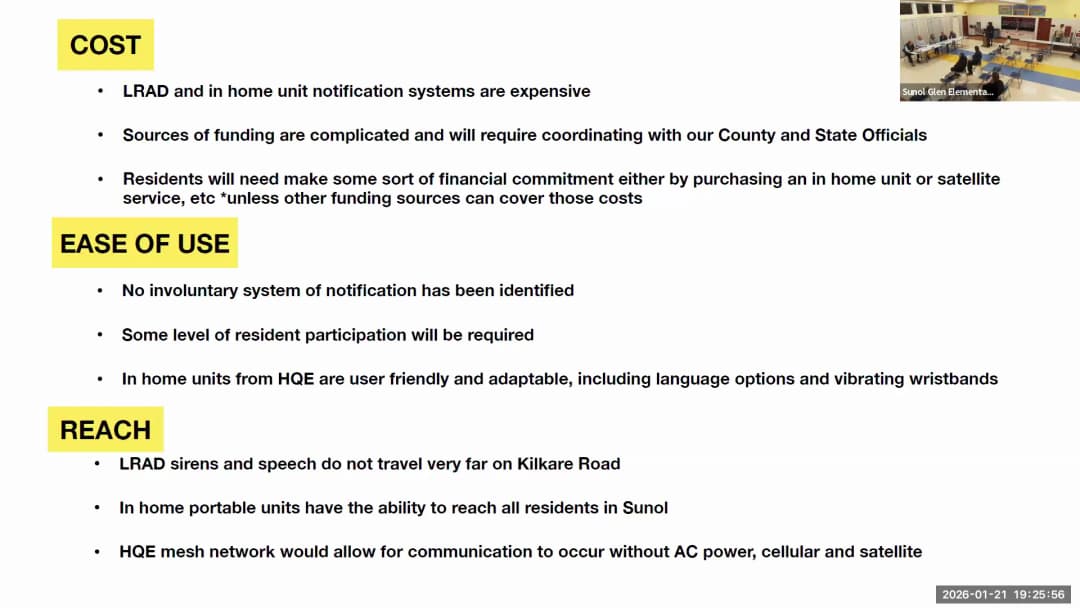
The East Noble Citizen Advisory Council (CAC) met on Thursday, January 22, 2026, at 6:30 PM in Sunol, California. Chair Connie DeGrange presided. The meeting covered law enforcement updates, fire safety, downtown revitalization, pedestrian improvements, and an in-depth presentation on emergency notification systems for the community. Supervisor David Halbert gave opening remarks, welcoming new member Ian and highlighting the agenda. Public Comments & Testimony - No public comments were made at the start of the meeting. Later, a resident (unidentified) expressed appreciation for sheriff's presence on Kilcare Road but raised concerns about speeding drivers, especially during school rush hours, and reported near head-on collisions on Foothill Road due to illegal passing. Law Enforcement Monthly Updates - Alameda County Sheriff's Office (Sergeant Petrini): Reported 65 calls for service since the last meeting (November 2025). Deputies conducted 60 proactive stops and 128 patrol/business checks. No major incidents. A resident commended the sheriff’s presence during Hanukkah and Train of Lights events. - California Highway Patrol (CHP): The officer reported the office is shorthanded due to promotions, transfers, and a reduction in academy classes (from every 10 weeks to three classes per year). Currently five officers are down (three injured, two on maternity leave). Expects five new officers by June 2026 but will be training them, reducing road enforcement temporarily. The officer agreed to increase patrols on Kilcare Road during morning school hours. - Discussion on traffic issues at the 680/84 interchange: fewer accidents noted, possibly due to improved flow after the northbound 680 two-lane connector opened. The CHP officer will request Caltrans to re-evaluate signal timing during peak commute and school hours, as the current timing causes backups on Main Street. Fire Safety Update - Alameda County Fire Department (Chief Terra): Reported 54 calls for service since November, 91% of which were EMS-related, plus one dumpster fire. The area was relatively quiet. - Fire Safety / Defensible Space (Denise, Fire Safe Group): Announced a grant modification (through Diablo Fire Safe Council) funding 10 days of an arborist with a five-person crew to create defensible space along Kilcare Road. Work will start in February, removing dead branches and clearing for emergency vehicle access. Additionally, a CalFire grant to Alameda County Fire Department for a shaded fuel break on Kilcare Road is expected to start in March. Downtown Revitalization Work Group (Wayfinding Sign) - Progress update: The prototype wayfinding sign is near installation. The sign design was developed with local artists and community input (Tom Harlan). The sign will be placed across from the former Bosco's, on the sidewalk near the mini parking lot by the park. Once installed, it will seek community feedback. The sign will list locations of interest, not businesses. The group is finalizing the purchase order and expects the sign maker to be paid soon. Pedestrian-Friendly Main Street Update (Amber Lowe, Alameda County Public Works) - Public Works is finalizing an RFP to update the Pedestrian and Bicycle Master Plan and ADA Transition Plan. Contract approval is expected in February, with community outreach (including CAC meetings) likely by summer. - Speed survey results (May 27-29, 2025) on Bond and Main Streets showed 85th percentile speeds of 23-28 mph, indicating most drivers comply. However, speeding on Kilcare Road remains a concern, especially from non-residents cutting through. Public Works will conduct an Engineering Traffic Survey (ETS) on Foothill Road from B Street to mile marker 6.7 to confirm the 25 mph speed limit and allow enforcement. A speed limit sign on the western terminus of Foothill has already been installed. - Regarding crosswalks on Main Street: Lowe suggested keeping pedestrians on the sidewalk side rather than crossing near the island, to improve safety. Temporary pavement marking options may be considered to guide pedestrians. For the missing two streetlights in front of the Bosco's building, Lowe will investigate whether the original bases have power and if replacement poles are available from the 2012 project inventory. Installing new lights may require a separate power application. Emergency Notification Systems Presentation (Denise, with Brent from Alameda County OES) - Background: Sunol is in a high fire hazard zone (99% of homes at risk), has poor cell coverage, a multilingual and hearing-impaired population, and many visitors. The goal is to find a passive, reliable notification system. - Research: Two companies were evaluated: Genesis Protect (LRAD sirens, zone-based) and HQE Safe Network (mesh system using low-frequency radio). A siren test by Genesis showed poor sound penetration in Sunol’s terrain; voice messages were unintelligible beyond a short distance (e.g., near Little Brown Church, but not at Elliston). Nine HQE sirens would be needed to cover Sunol (at an estimated cost of $100,000–$250,000 per siren, plus maintenance). In-home units (HQE) cost $150–200 each and create a mesh network independent of cellular or grid power, with 10-day battery life and features for the hearing impaired (vibrating wristband). - Expert Input (Brent, Alameda County OES): He cautioned against investing heavily in sirens due to rapid technological changes (e.g., satellite-to-phone services already available via T-Mobile, with Verizon coming in 2026). He recommended exploring micro cell towers on existing utility poles to improve cellular coverage, which would enhance existing alert systems like AC Alert. He also noted that sirens require ongoing maintenance ($34,000+/year in Marin) and are difficult to manage across fragmented systems. He suggested the county develop standards and avoid vendor lock-in. Community members expressed interest in low-tech backups (e.g., AM radios) and mesh networks for two-way communication. - Next Steps: The CAC will investigate micro cell tower options with cell providers. Brent will provide contacts. The group will continue to monitor technology developments (e.g., satellite direct-to-phone) before making large investments. 2025 Year in Review (Connie DeGrange) - Accomplishments included: feasibility study for septic system (costs expected soon), prototype wayfinding sign progress, support for Sunol School’s 100th anniversary, bulky waste drop-off day, fire safety picnic and home hardening presentation, participation in Senator McNerney’s roundtable, successful reopening of the Pleasanton Ridge gate, facilitating Niles Canyon Railway ticket fundraiser, pushing PG&E pipeline relocation for quarry revegetation/salmon habitat, and multiple town halls on flooding, senior services, budgets, and building permits. Key Outcomes - Approval of Minutes: The minutes from the October 15, 2025 meeting were approved on a motion and second. Councilmember McLean abstained (noted as not present at the time of vote, though present at roll call). - Date Change for Next Meeting: To accommodate a speaker from Zone 7 (Valerie Prior), the February meeting date may be moved. Chair DeGrange will coordinate with Valerie and propose a new date (possibly the second or fourth week). - Law Enforcement Follow-Up: CHP will increase patrols on Kilcare Road during morning school hours; Caltrans will be asked to re-evaluate signal timing on Main Street/84 during peak and school hours. - Traffic Safety: Public Works will conduct an Engineering Traffic Survey on Foothill Road to confirm the 25 mph speed limit. The two missing streetlights will be investigated for replacement. - Emergency Notification: The CAC will pursue discussions with cell providers about micro cell towers. No immediate purchase of sirens or mesh systems; will monitor satellite-to-phone developments.

PUBLIC SAFETY 53% · TRANSPORTATION SAFETY 8% · ACTIVE TRANSPORTATION 8% · TECHNOLOGY AND INNOVATION 8%
173
JAN 21, 2026 · ALAMEDA COUNTY, CALIFORNIA · BOARD OF SUPERVISORS
Brown Act Training and Special Council Meeting - January 21, 2026

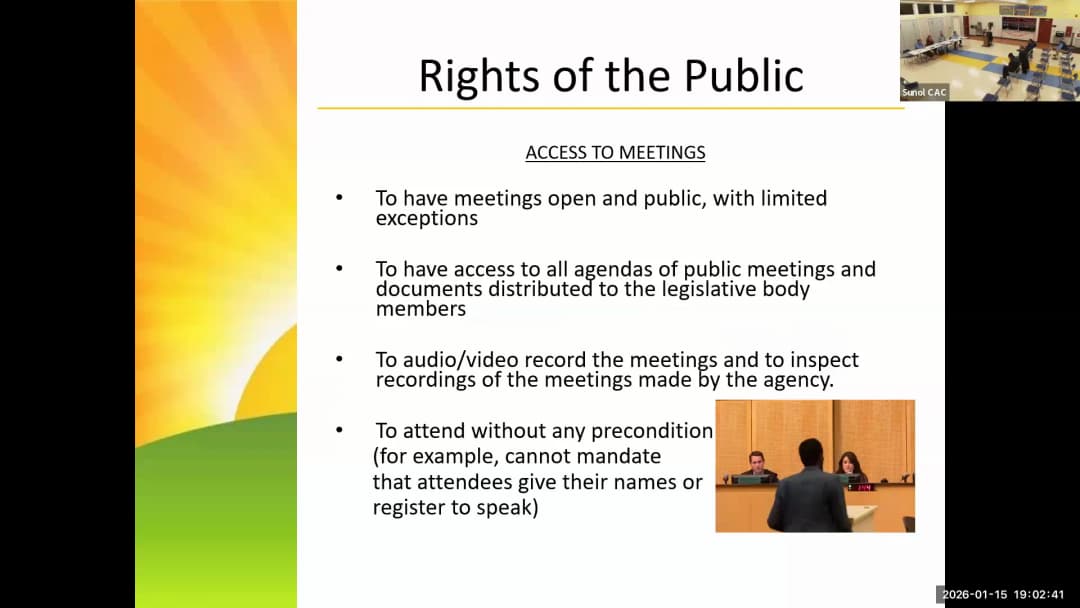
The Sunol Citizens Advisory Council (SCAC) held a special meeting on January 21, 2026, at 6:30 PM (Timezone not specified) for a Brown Act training led by Deputy County Counsel Melanie O'Brien. The meeting began with introductions of incoming council member Ian McLean and farewell to departing staff member Shibana. The training covered key Brown Act requirements, including open meeting rules, unlawful serial meetings, teleconferencing changes under SB 707 (effective January 2026), public comment procedures, agenda requirements, and consequences of violations, including potential criminal liability. Council members and public speakers engaged in discussion about applying these rules to their historically informal, town hall‑style meetings. Public Comments & Testimony - A long‑time resident expressed support for the new Brown Act rules regarding unruly speakers, noting the community’s reliance on the council as a go‑between with the Board of Supervisors. He asked about changes to speaker identification procedures; the chair clarified that speaker cards are requested but not mandatory. - Another speaker found the training’s guidance that “council members should avoid engaging in a back and forth with the public” concerning, stating it undermines transparency. Deputy Counsel O’Brien clarified that such engagement is not prohibited but is not required, and advised that managing public comment time equitably is the primary concern. - A speaker asked whether a member of the public could use a Public Records Act request to investigate potential Brown Act violations. Deputy Counsel O’Brien declined to advise the public, directing the speaker to private counsel. - Council member‑elect Ian McLean asked about one‑on‑one conversations with constituents regarding ongoing issues. The chair and deputy counsel explained that such discussions are permissible as long as no quorum is involved and the member does not use intermediaries to convey opinions to other members. Discussion Items - Brown Act Training (Item 12M): Deputy Counsel O’Brien presented the following topics: - Open Meeting Rule: All meetings must be open to the public; exceptions are narrowly construed. - Unlawful Meetings: Pre‑meetings, post‑meetings, and serial meetings (including “hub‑and‑spoke” and inadvertent chains of communication) are prohibited. Examples included parking‑lot discussions and using staff to pass opinions. - Social Media: Members may use social media to answer questions or solicit input, but may not deliberate, react (e.g., “likes”) to other members’ posts, or share opinions that could create an unlawful meeting. - Teleconferencing: Three options exist (traditional, just cause, disability accommodation). Traditional teleconferencing requires posting the remote location on the agenda and allowing public access. Just cause teleconferencing (including illness, caregiving, or two meetings per year for other reasons) requires a quorum in person and disclosure of the statutory basis. A new “eligible subsidiary body” (ESB) category allows entirely remote meetings if the Board of Supervisors authorizes it, with findings renewed every six months. - Agenda Requirements: Descriptions must be specific enough for a reasonable person to understand the item. Action items should clearly state the potential action. General announcements and requests to agendize future items do not need to be on the agenda. - Public Comment: The public has the right to speak on agenda items (specific comment) and on other matters within the council’s jurisdiction (general comment). Reasonable time limits may be set. Unruly speakers may be warned and, if necessary, excluded. - Consequences of Violations: Violations can invalidate actions, expose the county to attorney fees, and result in misdemeanor charges for members who intentionally deprive the public of information. - Council Q&A on Implementation: Council members raised questions about how to write agenda descriptions that telegraph potential actions without predisposing outcomes, and how to use ad hoc subcommittees (less than a quorum) to develop recommendations outside noticed meetings. Deputy Counsel O’Brien suggested using ad hoc subcommittees to work on issues and bring specific action items to a future meeting. She also offered to provide resources on subcommittee formation. - Microphone and Accessibility: The chair acknowledged the need for better amplification for public speakers, noting that a microphone was lost after a system change. The council agreed to explore adding a speaker microphone. Key Outcomes - No votes, motions, or formal actions were taken during this special training meeting. - The council acknowledged that it must transition from a town‑hall style to a more structured business meeting format to comply with the Brown Act, while still seeking community engagement. - The council will consider forming ad hoc subcommittees to expedite work on specific issues without violating the Brown Act. - Staff will investigate reinstalling a microphone for public speakers to improve audibility.

PROCEDURAL 93% · PUBLIC ENGAGEMENT 7%
174
JAN 21, 2026 · ALAMEDA COUNTY, CALIFORNIA · BOARD OF SUPERVISORS
Castro Valley Municipal Advisory Council Meeting - January 21, 2026: Bike Lane Debate and Recommendations

The Castro Valley Municipal Advisory Council (MAC) held its general purpose meeting on January 21, 2026. The primary agenda item was a discussion and recommendation to the Alameda County Board of Supervisors Transportation and Planning Committee regarding the bike lanes on Castro Valley Boulevard, including parking impacts and a utilization study. The meeting also included public comments, approval of previous minutes, and council announcements. Consent Calendar - Approval of November 17, 2025 Minutes: Approved unanimously. - Approval of December 15, 2025 Minutes: Approved as amended to reflect that due to noticing concerns, the council's decision on the bike lane item was not forwarded to the Transportation and Planning Committee. Public Comments & Testimony - Gary Wolf: Announced his candidacy for East Bay Municipal Utility District (EBMUD) director, citing issues of water affordability, truck traffic, and renewable energy. He distributed business cards and offered to answer questions. - CHP Officer Pabs: Reported December 2025 statistics for Castro Valley: 214 traffic citations, 10 DUI arrests, 28 injury crashes, 39 non-injury crashes, 2 stolen vehicles recovered. Announced upcoming educational programs: Age Well Drive Smart (Feb 10, 12:30 PM at CV Library) and Start Smart for youth (Feb 10, 6 PM at CHP Hayward). Also noted National Passenger Safety Week (Jan 19-23). - Matt Turner: Expressed concern about Caltrans studying opening the scenic portion of I-580 to big rig traffic, which could add 5.5 million extra truck miles annually and increase cut-through traffic on Crow Canyon Road. He urged the MAC to get involved in the technical advisory committee meetings. - Public Comment on Bike Lanes (multiple speakers): The majority of speakers supported keeping the bike lanes, citing safety for cyclists (especially children and seniors), climate action, and the need for safe routes to school and BART. Several speakers noted that the bike lane usage study was a baseline and that usage would increase over time. Some speakers opposed removal, arguing that parking concerns were overstated and that businesses had ample off-street parking. A few speakers raised concerns about parking impacts on specific businesses, particularly the burrito shop and Thai restaurant, and called for a compromise. One speaker (Bruce King) criticized the lack of documentation and noted that businesses like HL Peninsula and May May have large parking lots. Another speaker (Robert Prince, Bike East Bay) warned of liability if the bike lane is removed, citing a lawsuit in Indian Wells. Several youth and parents spoke about the dangers of biking without lanes. Discussion Items - Bike Lane Utilization Study and Recommendations: Daniel Desenberg, Director of Public Works, presented a summary of the Castro Valley Boulevard Class II bike lane evaluation. The study, conducted over 16 days in October 2025, recorded an average of 22-51 bicycles per day at eight locations, with maximum daily counts up to 89. Desenberg emphasized that the bike lane provides a safety separation from 21,000-30,000 daily vehicles and aligns with the county's bike/ped master plan. He recommended continued monitoring and no immediate removal, noting that the design is a balanced compromise that retained over 90% of on-street parking. - Council Discussion: Councilmembers debated the trade-offs between bike safety and business parking needs. Councilmember Davis (a registered traffic engineer) proposed alternatives such as shared lane markings (broken white lines) for specific areas and time-of-day parking (bike lane 8 AM-4 PM, parking otherwise). Councilmember Thomas expressed concern for small businesses like the burrito shop and Thai restaurant, and suggested a parking structure as a long-term solution. Councilmember Mota emphasized safety but wanted options for businesses. Councilmember Fiebig sought a compromise. Councilmember DeVinny argued that the bike lane benefits a small group and that parking loss affects many businesses and residents; he favored restoring parking but was open to exploring shared designs. Vice Chair Mulgrew noted that the community should have been consulted before implementation and supported studying alternatives. - Public Works Director Response: Desenberg strongly opposed removing the bike lane, citing safety and liability risks. He stated that piecemeal or shared lane designs would create additional safety hazards and that the current design is optimal. He recommended allowing at least one year of data collection before making changes, and encouraged businesses to propose their own solutions. Key Outcomes - Motion and Vote: Councilmember Davis moved that Public Works be instructed to work with area businesses to identify needed parking spaces and modify signing/striping to create shared parking and bike lane areas, and to facilitate on-street parking at specific locations between 4 PM and 8 AM. The motion was seconded and passed unanimously (6-0, with Chair Moore excused). The motion included a friendly amendment to set a six-month timeframe for Public Works to report back. - Other Announcements: Councilmember Thomas requested an agenda item on streamlining business permits in unincorporated areas. Councilmember Fiebig asked for an update on the All-MAC meeting and follow-up. Councilmember Davis inquired about county policies on privately owned bus benches with advertising; staff will investigate. Councilmember Thomas also asked about garbage can maintenance; staff noted CVSAN recently installed new cans.

ACTIVE TRANSPORTATION 56% · TRANSPORTATION SAFETY 17% · ECONOMIC DEVELOPMENT 9% · PROCEDURAL 6%
175
JAN 15, 2026 · ALAMEDA COUNTY, CALIFORNIA · BOARD OF SUPERVISORS
Eden Area MAC Meeting – January 15, 2026: EJ Implementation & Health Status Reports

The Eden Area Municipal Advisory Council (MAC) met on January 15, 2026, at 6:00 PM and adjourned at 8:40 PM. The meeting featured public comments, a deferral of the December minutes, presentations on the first annual Environmental Justice (EJ) Element implementation report and a Health Status Report for the EJ priority communities, followed by council feedback. Public Comments & Testimony - Officer Roger Jen Pabst (CHP) reported December statistics for the Eden area: 320 traffic citations, 20 vehicles towed/stored, 6 DUI arrests, 1 felony arrest, 5 misdemeanor arrests, 17 parking citations, 42 non‑injury crashes, 26 injury crashes, and 2 recovered stolen vehicles. He noted no fatal crashes during the holiday enforcement periods and announced seven new officers reporting February 16. He also urged pedestrian safety after two pedestrian crashes that day. - Michael Moore expressed concern about a motorized quad driver recklessly driving and an Alameda County Sheriff’s deputy declining to pursue because “chasing him is just gonna cause an accident.” He stated, “That needs to change.” - Chuck Meadows encouraged support for preserving the Sky West property (at the edge of the jurisdiction) as open space, citing its importance for wildlife and the community. He noted that a presentation by Mimi Dean the previous night had drawn a packed room. - Gary Wolf announced his candidacy for the East Bay Municipal Utility District (EBMUD) board on the November 2026 ballot, citing issues of water affordability, truck traffic, renewable energy, and drought management. He distributed contact information and stated he would listen and represent the community. - Sandra Arculetta urged the MAC to establish a dedicated youth commission for the unincorporated area, noting that existing youth leaders would benefit from a pipeline to MAC seats and county commissions. - Mimi Dean highlighted a 2011 airport layout plan that designated the Sky West Golf Course as a buffer zone for San Lorenzo, arguing that development there would violate environmental justice principles. She volunteered to present her research to the MAC. - Anna Rasquiza (Resources for Community Development) thanked the planning department and health department for the EJ element and health status report, emphasizing that the EJ element provides a powerful tool for advancing equity. - Michael Freed (Cherryland) urged immediate implementation of the EJ element, especially regarding Sky West, and encouraged the council to fill vacant seats. - Brooklyn Marcado supported a youth advisory council for unincorporated areas and suggested youth seats on the MAC. - Rennie Waggy supported trails and advocated for East Bay Regional Park District to consider Sky West. - Gary Wolf (later) noted that EBMUD’s Community Assistance Program (CAP) is vastly undersubscribed: 33,000 households qualify but only 11,000 have signed up, and he urged outreach. - Michael Moore (later) criticized the lack of progress on many EJ initiatives, calling the completion rate “a 90% failure,” and questioned how new drug threats are being addressed. Discussion Items Approval of Minutes (December 9, 2025) - Councilmember Taylor questioned the accuracy of a quote attributed to Officer Pabst in the minutes. Staff clarified that the minutes are not a word‑for‑word transcript and that corrections require reviewing the video. Councilmember Stanley suggested including summaries of public comments, not just names. A typo was also noted (page five). - Motion to defer the minutes until the next meeting to allow review of the video and consider improvements. The motion passed unanimously (6‑0). Environmental Justice Element – First Annual Implementation Report - Allie Abbers and Celestia Josefino (Planning Department) presented the draft report covering August 2024 to September 2025. Key points: - 162 actions; 58 are ongoing core functions. Of the 104 discrete actions, 9.6% were implemented, 7.7% showed significant progress, 56.7% were in progress, and 26% had not yet started. - Implementation across all seven goal areas; no goal area had zero progress. - Barriers included lack of dedicated funding/staff and shifting priorities. - Highlights included code enforcement forms in Spanish/English/Chinese, a child care needs assessment, improvements to healthy food access (mini‑grants up to $25,000 each), and the official USPS place names change for Ashland, Cherryland, Hayward Acres, Fairview, Castro Valley, and San Lorenzo. - Planned year‑two actions: strengthen the technical advisory committee, enhance community engagement (surveys, annual community meetings), publish an online companion guide, update baseline health data, and refine reporting tools. - Council feedback: Requests for quarterly updates (rather than annual), better community engagement and translation access (e.g., Spanish translation of meetings), inclusion of partner agencies like HARD and fire department for accountability, and connecting EJ implementation to budget prioritization processes. Concerns were raised about actions not yet started (e.g., air pollution exposure zone ordinance, urban greening master plan, economic development strategic plan). Councilmember Weidler urged acceleration of projects like the San Lorenzo Creekway Trail and coordination with Hayward on the Sky West buffer. Health Status Report for EJ Priority Communities - Dr. Nicholas Moss, Sandy Galvez, and Dr. Julia Rafeman (Alameda County Public Health) presented data on demographics, social determinants of health, and health outcomes for the EJ area (Ashland, Cherryland, Hayward Acres, San Lorenzo, southwestern Castro Valley) compared to the county overall. - Demographics: EJ area is 42% Latino (vs. 23% countywide); Pacific Islander and American Indian populations are larger than county proportions. - Social conditions: African American children are 7 times more likely to live in poverty than white children. 13% of EJ area residents live in overcrowded housing (1.8 times the county rate). 86% high school completion rate in the EJ area vs. 92% countywide (Cherryland: 72%). - Health inequities: 15‑year life expectancy gap by race/ethnicity countywide. Life expectancy in Hayward Acres (75.2 years) vs. Piedmont (87.7 years). Middle‑aged (45–74) mortality in the EJ area is 49% higher than the county, driven by heart disease (62% higher) and cancer (30% higher). - Asthma and mental health: Stark inequities by race/ethnicity; 45% of transgender youth and 30% of LGB youth reported considering suicide. - The report is required every three years under the EJ element. - Council feedback: Council members noted the data validates lived experiences and requested future reports include maternal health outcomes, disability data, senior‑specific data, trends over time, and actionable items tied to specific EJ actions. Dr. Moss agreed to follow up on infant outcomes and share links to prior board presentations on disability and older adults. Councilmember Stanley suggested comparing EJ area data to county trends to gauge progress. Key Outcomes - Minutes deferred to the next MAC meeting (February 2026) to verify a quote and consider adding public‑comment summaries. - EJ Implementation Report: Informational item taken under advisement; planning staff will incorporate MAC feedback (quarterly updates, stronger community engagement, translation, inclusion of partner agencies, acceleration of high‑priority actions) into the final report to the Board of Supervisors. - Health Status Report: Informational item; health department will follow up with additional data on maternal/infant outcomes, disability, and seniors. Council encouraged using the data to inform EJ implementation and broader county policies. - No formal votes were taken on either report. Meeting adjourned at 8:40 PM. Councilmember Announcements - Councilmember Taylor reminded attendees to verify their congressional district after Proposition 50, as many in unincorporated areas may have changed. - Councilmember Roll requested updates from staff on a pending language access policy and suggested that public‑comment summaries be included in future minutes to capture valuable community input (e.g., Gary Wolf’s EBMUD CAP program). Chair Weidler noted agreement.

PUBLIC HEALTH SERVICES 32% · COMMUNITY ENGAGEMENT 19% · ENVIRONMENTAL PROTECTION 16% · PROCEDURAL 7%
176
JAN 15, 2026 · ALAMEDA COUNTY, CALIFORNIA · BOARD OF SUPERVISORS
Alameda County Act for All Committee Meeting on ICE Response Plan and ICE-Free Zones - January 15, 2026

The Alameda County Together for All (Act for All) ad hoc committee, chaired by Supervisor Fortunato Bass and Vice Chair Supervisor Marquez, held its first meeting of 2026 on January 15, 2026, from approximately 3:00 PM. The meeting focused on two policy proposals: developing a coordinated county response plan for increased immigration enforcement activities and establishing ICE-free zones on county-owned or controlled properties. Committee members heard presentations from the General Services Agency, Sheriff's Office, District Attorney's Office, Probation Department, and Public Defender's Office, followed by extensive public comment. The committee voted unanimously to advance both proposals to the full Board of Supervisors for consideration at the January 27, 2026 meeting. Public Comments & Testimony - Over 30 members of the public spoke, nearly all expressing strong support for the resolutions. Many speakers urged the committee to include stronger language prohibiting county resources (services, personnel) from being used for immigration enforcement, not just physical property. - Multiple speakers called for a board statement opposing the potential opening of an ICE detention center at the former FCI Dublin women's prison, citing its history of abuse. Several noted that ICE activity increases near detention centers. - Several speakers raised concerns about the use of AI surveillance tools (e.g., Flock, Palantir, Cellulite) by local law enforcement that may share data with ICE, and urged the county to address this. - Speakers from organizations such as SIREN, ACCE, First Unitarian Church of Oakland, Filipinos for Justice, and community members shared personal stories of fear and violence, referencing the killings of Renee Good and Keith Porter by ICE agents. Some requested a declaration of a state of emergency. - A few speakers questioned the county's participation in the SCAP program, which provides federal reimbursement for housing undocumented immigrants convicted of certain crimes. Discussion Items - Framing & Overview: Chair Fortunato Bass and Vice Chair Marquez provided opening remarks, summarizing the committee's 2025 accomplishments (allocating $7.5 million for immigrant and refugee services) and describing the current crisis—increased ICE violence, firing of 100 immigration judges, and court closures. They outlined the two proposals: 1) a response plan for ICE enforcement, building on Santa Clara County's model, and 2) an ICE-free zones policy restricting use of county property for enforcement. - General Services Agency (GSA) - Director Kemberley Gasway: Reported that GSA has already begun posting signage in county buildings designating authorized personnel-only areas. She noted existing 24/7 emergency communication protocols and said training for security guards on judicial warrants and ICE encounters would be completed within 30 days. An inventory of county-owned properties (including vacant lots and parking lots) is available on the county website. - Sheriff Sonia Sanchez: Reaffirmed that the Sheriff's Office does not honor ICE civil detainers, only criminal warrants. She stated that plainclothes federal agents undermine public safety and that her office will respond to calls from the community to verify if individuals claiming to be law enforcement are legitimate. She discussed ongoing coordination with city police chiefs and noted that court security is a state facility under the Judicial Council, which recently issued a directive that is being reviewed for implementation. - District Attorney Ursula Jones Dixon (via Zoom): Stated that her office does not ask about immigration status victims or defendants, does not cooperate with ICE, and does not allow ICE into DA offices. She is reviewing a new court directive and plans to consult with the California Attorney General's office for guidance. - Probation Department - Chief Brian Ford and Deputy Director Albert Banuelos: Presented their policies, emphasizing zero cooperation with ICE since 2022 (zero holds, transfers, interviews). They outlined legal frameworks (Trust Act, SB 54, etc.), mandatory staff training, and annual Truth Act reports. They noted that all ICE inquiries are routed to executive leadership, and staff wear identifiers to avoid misidentification. They recommended countywide coordinated training and alignment across departments. - Public Defender Brendan Woods: Expressed full support for the proposals, describing the current climate as a "state of emergency." He highlighted that six of his clients have been arrested by ICE near courthouses since September, including a pregnant 19-year-old. He criticized the court for not involving the Public Defender in discussions about court directives and called for stronger protections. Key Outcomes - The committee voted unanimously (Supervisors Marquez and Fortunato Bass) to forward both proposals to the full Board of Supervisors for the January 27, 2026 meeting, with a request that it be a set matter requiring a majority vote. - The motion directs the County Administrator to: - Create a response plan for immigration enforcement activity, including convening public safety agencies, an interagency meeting, coordinated training, reporting, and scenario planning. - Bring the response plan to the Board for consideration at the next meeting after approval. - Implement the ICE-free zones resolution immediately, restricting use of county-owned or controlled properties for immigration enforcement, with procedures for reporting any federal attempts to use such properties. - The committee also directed staff to explore including a policy statement opposing the use of FCI Dublin as an ICE detention center and to report back at the next Act for All meeting. - An update on the response plan is expected at the February 10, 2026 Board meeting, and a progress report on ICE-free zones implementation will be presented at the next Act for All meeting on February 5, 2026. - Chair Fortunato Bass committed to following up on the SCAP program and requested an update from the Sheriff at a subsequent meeting.

PUBLIC SAFETY 85% · COMMUNITY ENGAGEMENT 8% · PUBLIC HEALTH SERVICES 2% · TECHNOLOGY AND INNOVATION 2%
177
JAN 13, 2026 · ALAMEDA COUNTY, CALIFORNIA · BOARD OF SUPERVISORS
Alameda County Board of Supervisors Meeting – January 13, 2026

The Alameda County Board of Supervisors met on Tuesday, January 13, 2026, at 9:30 AM to address a full agenda including annual investment policy approval, public hearings, and closed session settlements. The meeting featured extensive public comment and board debate on the ethical investment policy (Item 47), which had been approved in October 2025 but held pending an independent peer review. Board members also heard updates on affordable housing, pretrial services, and alternative response programs, and honored the legacy of cannabis advocate Rich Lee. Votes were taken on multiple items, and closed session settlements were announced. Consent Calendar - The board approved the minutes from meetings on December 26, December 9, October 3, and July 22, 2025 (corrected), via a roll call vote (5-0). - The consent calendar, including numerous routine items, was moved by Supervisor Tam, seconded by Supervisor Miley, and approved unanimously. Public Comments & Testimony Item 47 – Ethical Investment Policy - Ranjeep Tate (Alliance of South Asians Taking Action, Hindus for Human Rights, JVP Bay Area) urged immediate implementation without further consultant review, citing continued violence in Gaza and stating that delaying the policy is “despicable.” - Ed Romano (E-Spay DSA) argued that the Treasury Oversight Committee (TOC) had already validated the policy’s financial impact is negligible, and called the delay a “rudimentary misunderstanding.” - Emily (United Methodist clergy, Interfaith for Palestine) stated that the October 3 vote to require a consultant was an “obvious and blatant attempt to sideline” community values and urged rescission of that decision. - A Berkeley mom (did not give full name) opposed the policy, citing fiduciary responsibility and asking the board to “remove the appendix.” - JB Liebovich (Oakland Jewish Alliance) asked the board to decline approval or clarify whether prior conditions were satisfied, noting that tensions at the October meeting led to his being escorted out. - Chris Moore claimed the December 11 TOC meeting lacked minutes or video (potential Brown Act violation) and argued that restricting investments always reduces returns, harming the county. - Peter Bernhardt (Albany resident) supported the policy, stating that Albany passed similar policies and that the county should move to implementation. - Tim Drew (East Bay DSA) supported the policy and noted the TOC was “perplexed” by the delay. - Bob Johnson (Friends of Wadi Fiking Circle) rebutted claims of reduced returns, citing examples like the United Methodist pension fund, and accused opponents of being influenced by an out-of-state Christian Zionist group. - Ruth Laurie Weinstock (taxpayer) applauded the treasurer and urged immediate implementation. - Um Helda Polson (Alameda Families and Friends for Collective Liberation) accused Supervisor Halbert of aligning with Christians United for Israel (CUFI) and asked why an out-of-state religious group influences local policy. - Michael Yoshi (Pastor Emeritus, Bay Area Divest) urged implementation, noting the policy already contains fiduciary safeguards. - Eve (Jewish resident) supported the policy, stating it is critical for safety of all residents. - Keiko Kubo (Sudo for Solidarity) asked the board to implement the policy immediately. - A caller representing a supermajority coalition opposed the policy, calling it a “political experiment” and urging fiscal responsibility. - LG (Jewish Oakland resident) opposed the policy, arguing it is anti-Semitic to single out Israel and that the treasurer’s actions are biased. - Brandon Vesley (Jewish Voice for Peace Bay Area) supported the policy, stating that returns and values are not mutually exclusive. - A caller (name not given) opposed the policy, accusing Treasurer Levy of supporting anti-Semitism by defending Richmond Mayor Martinez. - Mona (Muslim resident, DSA) called the October 3 delay a “sabotage” and urged immediate implementation. - A speaker (name not given) urged rejection of the human rights criterion, calling it vague and ideologically driven. Item 37 – 430 Broadway Affordable Housing - Nate Hanson (Related California) supported the lease disposition agreement, highlighting nearly 200 affordable units for seniors and families. - Sharon Lai (East Bay Asian Local Development Corporation) thanked the board and noted that 75% of the program’s population are extremely low-income seniors, with 25% permanent supportive housing. Item 71 – Alameda Health System Governance - Debbie (SCA 1021) supported state legislation for increased transparency and public governance, referencing recent harmful cuts. - Ronica Palacios (Eligibility Specialist, interim president of AHS chapter) spoke on behalf of 4,000 members in support of sound financial governance. Non-Agendized Item – HIV Emergency Federal Funds - Holly Calhoun (Project Open Hand) requested the release of $1.2 million in federal Ending the HIV Epidemic funds, noting that if not spent by February 28, 2026, the funds must be returned to the federal government. - David Gonzalez (Asian Health Services) echoed the urgency and criticized the health department for not releasing already-awarded funds. Discussion Items Item 47 – Treasurer’s Annual Investment Policy and Ethical Investment Appendix - Treasurer Levy presented the policy, noting minor additions (CalFit pool, collateralized mortgage-backed securities) and the inclusion of the ethical investment policy as an appendix, which was approved by the board in October 2025 but not yet implemented. - President Halbert questioned the need to include the appendix before the peer review is complete, suggesting it be held until after review. - Supervisor Miley expressed concerns about the 10% revenue threshold for discouraged investments, the use of UN Guiding Principles on Business and Human Rights, and the need for due diligence through the peer review process. He emphasized the board’s fiduciary responsibility. - Supervisor Tam stated her original position was to adopt the policy as presented and opposed further delay. - Supervisor Marquez moved to approve the policy as presented (including the appendix), noting that the appendix explicitly states it will not be implemented until board approval after peer review. The motion was seconded by Supervisor Fortunato Bass. - After discussion, the board voted: Supervisor Marquez (aye), Supervisor Tam (abstain), Supervisor Miley (aye), Supervisor Fortunato Bass (aye), President Halbert (abstain). The motion passed 3-0-2. Item 32 – Air Quality Violations - Supervisor Tam inquired about citations for boiler emissions violations. General Services Director Kimberly Gasway explained that one boiler was decommissioned, a missing log was replaced, and an unregistered boiler was addressed. The county negotiated a fine and committed to a 90-day audit of all boilers. Item 48 – Pretrial Services Waiver - Supervisor Marquez clarified that the waiver of competitive bidding for a community-based organization was done due to urgency, following a joint board letter in December 2024. Chief Probation Officer Brian Ford confirmed the process was opened to two bidders and one selected. Item 59 – Cardea Health Alternative Response Program - Supervisor Tam asked about program effectiveness. Fire Chief William McDonald reported that 60% of the time the unit responds alone, reducing police involvement and emergency room visits. The program has reduced repeat 911 calls, but funding challenges remain. Commendation for Rich Lee - Supervisor Miley presented a posthumous commendation for Rich Lee, founder of Oaksterdam University, who educated over 100,000 individuals from 116 countries and was instrumental in cannabis policy reform. Dale Skye Jones (Executive Chancellor, Oaksterdam) and Jeff Jones accepted the award. Key Outcomes - Item 47 (Annual Investment Policy): Approved as presented (3-0-2, with Tam and Halbert abstaining). The ethical investment appendix is included but will not be implemented until the board provides final approval after a peer review. The peer review RFP process is expected to take 4-6 months. - Consent Calendar and Mass Motion: Approved unanimously (5-0). - Item 39 (Salary Ordinance): Second reading waived and adopted (5-0). - Closed Session Settlements: Reported settlements for three cases: Natividad et al ($75,000), another case ($65,000), and Luo VQ sex et al ($45,000), all authorized on December 16, 2025. Additionally, the board authorized retention of conflict counsel in the case Randall v. County of Alameda (vote 5-0). - Next Steps: The ad hoc finance committee will meet on January 21, 2026, to review the draft RFP for the independent review of the ethical investment policy. A status update will be provided at the January 26 board meeting.

FISCAL SUSTAINABILITY 46% · PROCEDURAL 19% · CANNABIS REGULATION 7% · PUBLIC ENGAGEMENT 5%
178
JAN 13, 2026 · ALAMEDA COUNTY, CALIFORNIA · BOARD OF SUPERVISORS
Alameda County PAL Committee Meeting – January 13, 2026

On January 13, 2026, the Personnel Administration and Legislation (PAL) Committee of the Alameda County Board of Supervisors convened to receive federal and state legislative updates and to consider positions on proposed bills. The meeting featured detailed briefings on the federal budget outlook, ACA tax credit negotiations, and the California governor’s budget proposal, including the fiscal impacts of federal HR1. The committee also voted to recommend positions on three bills to the full Board. Discussion Items - Federal Legislative Update (CJ Lake & John): The update covered the status of the continuing resolution (CR) expiring January 30, 2026. The House passed a three-bill spending package (commerce, justice, science; interior, environment; energy and water) with broad bipartisan support; the Senate is expected to take it up. A second package including financial services, state foreign operations, and homeland security stalled after homeland security was pulled due to political tensions. Leadership may pursue a short-term or full-year CR for remaining bills (defense, labor/HHS/education, transportation/HUD, homeland security). A government shutdown was considered unlikely – only a handful of moderate Democrats had crossed the aisle previously, and there is no clear policy reason for a shutdown now. On health care, the House passed a three-year extension of ACA premium tax credits (230-196, with 17 Republicans joining all Democrats). The Senate is unlikely to pass that version; instead, bipartisan senators are negotiating a narrower package: a two-year extension with retroactive provisions, policy changes (eligibility gaps, minimum premium contributions), potential Health Savings Account diversions, and potential inclusion of Hyde Amendment language. The Hyde Amendment remains a red line for Democrats, complicating negotiations. Lawmakers also aim to address rising health costs, insurance market reforms, and pharmacy benefit manager legislation. The federal funding freeze (affecting Social Services Block Grant, TANF, child care block grant) was discussed. California joined a lawsuit; a federal judge temporarily blocked the freeze on Friday, January 9, for 14 days. The administration also requested additional justification from states for child care spending. - State Legislative Update (Amy Costa, Full Moon Strategies): The California Governor’s proposed 2026-27 budget totals $348.9 billion all funds ($248.3 billion general fund) with $23 billion in reserves. The budget shows a $20.9 billion operating deficit in the budget year and projected deficits through 2029-30. General fund revenues are projected to be $42 billion higher through mid-2027 but concentrated in the technology sector. The governor addressed a $2.9 billion shortfall in the budget year. Notably, the budget includes no additional county cost sharing or backfills for the impacts of federal HR1, which the state estimates will cost $1.4 billion. The MCO tax assumption requires CMS approval; if denied, a hole will need plugging at the May revise. Medi-Cal remains the largest general fund expenditure ($196.7 billion in 2025-26, $222 billion in 2026-27) with reduced caseload due to HR1. No funding is provided for increased county administrative costs (redeterminations, work requirements). The budget also proposes a $233.6 million general fund reduction by shifting IHSS cost growth to counties starting in 2027-28. CalFresh changes under HR1 increase state costs by $300 million; the budget includes $38.2 million general fund to offset federal reductions, with county administrative costs rising by $149 million starting October 2026. Attorney General Bonta announced he will not run for governor in 2026 and will seek re-election as AG, citing federal actions. - Request for Legislation Positions: The committee reviewed three bills: - SB 811 (informational): Oppose – continues county’s position on SB 404 (number change). - AB 617 (Miley request): Support – licensure and oversight for contracted organizations providing in-home respite/personal assistance; exemption for non-medical facilities. - SB 434 (Miley request): Support – requires safe discharge plan upon eviction notice from a residential care facility for the elderly. Key Outcomes - The committee voted unanimously (Supervisors Fortunatabas and Tam aye) to advance the recommended positions: support for AB 617 and SB 434, and oppose for SB 811, to the full Board of Supervisors. - No public comments were made on any agenda item or non-agendized matters.

FISCAL SUSTAINABILITY 57% · HEALTHCARE SERVICES 43%
179
JAN 12, 2026 · ALAMEDA COUNTY, CALIFORNIA · BOARD OF SUPERVISORS
Alameda County Health Committee Meeting – January 12, 2026

The Health Committee convened on January 12, 2026, with Supervisors Miley (Chair) and Tam present. Two informational items were discussed: an update on the homelessness state of emergency and the upcoming 2026 point-in-time count. Public comments also highlighted urgent delays in releasing federal Ending the HIV Epidemic (EHE) funds. Homeless State of Emergency Update - Director Jonathan Russell (Alameda County Health, Housing and Homelessness Services) reported that in FY 2024‑25, $435 million in total funds (federal, state, local) were dedicated to homelessness, with roughly 50% from the county and 50% from cities. For the first time in ten years, the 2025 point-in-time count showed a 3% reduction overall and an 11% reduction in unsheltered homelessness. - Director Michelle Sterrett (HCD) described the creation of a site‑assessment toolkit for cities, noting that identifying sites for interim uses remains challenging, especially in Oakland, where council‑member approval is required for each site. She contrasted Oakland with Sacramento, where site selection is delegated to the city manager, streamlining the process. - Challenges highlighted: - Inflow vs. outflow: each year, over 4,000 people exit homelessness into permanent housing, but more than 4,000 newly enter homelessness. - Funding uncertainty: up to $60 million in federal HUD funding for Alameda County is at risk due to proposed federal policy changes; state funding is largely one‑time. - Administrative constraints: contracting and hiring processes have not been significantly expedited under the state of emergency, despite the declaration. - Supervisor Miley expressed deep frustration that the emergency declaration had not produced faster results in procurement and hiring. He pressed for transitioning the Housing and Homelessness Services unit into a full department within the agency to improve efficiency. - Interim Agency Director Chaudry agreed to develop a proposal and plan for making HH a department, with an update expected by spring 2026. - New interim housing: 300 beds are coming online through low‑cost leases of existing hotels and buildings, primarily serving individuals with high and complex needs. A 25‑bed winter shelter for transition‑age youth opened December 31, 2025. - The Home Together Fund (Measure W) is projected to provide an average of $153 million per year over eight years, with about one‑third directed to shelter, 37% to permanent housing, and 15% to prevention. $10 million per year in prevention investments could eliminate returns to homelessness from the current system. Public Comments & Testimony - Gloria Crow (East Oakland resident, former Public Health commissioner) called for better city‑county coordination, more beds addressing substance use and mental health, and clearer public reporting on Measure W outcomes. - Derek Barnes (East Bay Rental Housing Association) urged the county to fund rehabilitation of vacant private‑market units as a low‑cost way to increase housing stock for higher‑functioning unhoused individuals. - Five speakers (Gloria Crow, David Gonzalez, Yamini, Holly Calhoun, Sammy Lubega) addressed the delay in releasing $1.2 million in federal Ending the HIV Epidemic (EHE) funds. They warned that if funds are not spent by February 23, 2026, they will revert to the federal government, and called for immediate disbursement and greater transparency in county contracting processes. Point‑in‑Time Count Update - The 2026 point‑in‑time count will take place January 22, 2026. As of the meeting date, nearly 1,000 volunteers had signed up, with a goal of 1,200–1,300 (similar to 2024). 1,300 known locations of unsheltered homelessness have been mapped. - The count includes a voluntary survey covering demographics, disabling conditions (60% of unsheltered individuals reported at least one), and causes of homelessness. - Supervisor Miley noted that the count is critical for resource allocation, and the committee expressed hope that new investments from Measure W will show continued progress. Key Outcomes - Directive: The agency director was asked to bring back a formal proposal to transition Housing and Homelessness Services into a department, with a timeline for spring 2026. The committee emphasized that this restructuring is essential to expedite contracting, hiring, and overall implementation of the homelessness response. - Urged: Continued use of the state of emergency to seek administrative flexibilities; if board action is needed, the committee offered support. - Acknowledged: The committee heard the public comments on the delayed EHE funds and directed the agency to resolve the issue immediately, though no formal vote was taken. - Next steps: A performance report on Home Together Year 4 is expected in early February 2026, and the updated Home Together 2030 plan will be presented to the committee and board in summer 2026.

HOMELESSNESS 82% · PUBLIC HEALTH SERVICES 6% · HEALTHCARE SERVICES 4% · AFFORDABLE HOUSING 2%
180
JAN 12, 2026 · ALAMEDA COUNTY, CALIFORNIA · BOARD OF SUPERVISORS
Fairview MAC Meeting - January 12, 2026: Sheriff, Sidewalks, and AT&T Tower

The Fairview Municipal Advisory Council (MAC) met on January 12, 2026, at 6:45 PM. The meeting included a law enforcement update from the CHP and ACSO, a progress report on sidewalk projects, a public hearing and vote on an AT&T wireless facility, and updates on the fireworks ordinance. Key outcomes included the denial of a conditional use permit for an 80-foot monopine and recognition of ongoing efforts to improve pedestrian safety and communications infrastructure. Public Comments & Testimony - Gary Wolfe announced his candidacy for Director of the East Bay Municipal Utility District, highlighting his 40 years of experience in water-related issues and his website Wolf4Water.org. - Vanya Taylor requested that guidelines be changed to allow community review and feedback before approvals on major projects, noting that large proposals often surface around holidays. She also expressed frustration that the community was not informed of the right to appeal Board of Supervisors decisions. - Brenda (phone) urged the MAC to accelerate the fireworks ordinance, noting that neighboring jurisdictions already have enforceable rules and that illegal fireworks remain a problem in Fairview. - Dale Silva opposed new sidewalks, arguing they erode the rural character, but supported the speed bumps on D Street. - Kathy Langley (phone) recounted her seven-year effort to get sidewalks on D Street, criticized the county for lack of transparency compared to previous staff, and noted delays in relocating utility poles. - Jane Sylvester opposed the AT&T monopine due to visual impact, safety concerns with access on Winfeld Road, and the need for more screening trees. - Vanya Taylor (again) objected to the 80-foot height of the proposed monopine, stating it would obstruct views and is out of character for the single-family neighborhood. - Bob Clark (phone) outlined the four findings required for a conditional use permit, arguing the project fails on public need, compatibility, public welfare, and zoning compliance. Discussion Items Annual Update from Alameda County Sheriff's Office - Deputy Lana Carson and Deputy Nicholas Ligorio presented an overview of the CORE (Community Oriented Response and Engagement) division, highlighting community activities (e.g., holiday toy drive, deputies on ice), community enforcement (e.g., firearms and marijuana plant seizures from traffic stops), and community cleanups led by Deputy Heidi Burbank. They also described partnerships with behavioral health, the CARES Navigation Center, and diversion programs. - Crime Statistics (Fairview, 2024 vs. 2025): - Crimes against persons: minor increase (50 to 53, +6%). Forcible sex offenses unchanged (3 each); aggravated assault down 17% (12 to 10); criminal threats doubled (3 to 6); kidnapping/abduction up 200% (1 to 3), but all were false imprisonment incidents.<br - Property crimes: down 8% overall. Robberies down 88% (8 to 1); burglaries down 44% (9 to 5); larceny/theft up 34% (53 to 71, partly due to holiday package theft); motor vehicle theft down 40% (43 to 26).<br - Societal crimes: down 7%. Disorderly conduct down 78%; drug/narcotic violations up; trespassing down 33%; weapon law violations down 50%. - Council members asked about causes for reductions; deputies cited technology and air support but lacked data to prove causality. Staffing is improving with recent academy classes of 30–50 recruits. Public Works Update: D Street and Second Street Sidewalk Projects - Amber Lowe reported that the D Street sidewalk improvement project (1.1 miles) is nearly complete; final striping is scheduled for late January/early February 2026, weather permitting. Remaining work includes utility pole relocation and punch-list items.<br The Second Street sidewalk project (0.8 mile, 380 working days) is moving into construction; contract award is set for January 13, 2026. A virtual public meeting was held in February 2025; individual property owners will be contacted.<br- Councilmember Philbin strongly criticized the lack of communication on Second Street, stating the one virtual meeting provided insufficient detail, and requested a public hearing with maps showing individual property impacts. Member Higgins noted missing signs on D Street and requested evaluation of the Madero's intersection. Vice Chair Rhodes highlighted dangerous intersections at D Street and Fairview Avenue, and asked about parking removal (public works clarified parking is largely maintained, with some spaces removed for daylighting).<br- Council members and public praised the D Street sidewalks for improving pedestrian safety and increasing usage. Conditional Use Permit for AT&T Wireless Monopine (Item 3 – Action Item) - Pat (Planner) presented a proposal for an 80-foot monopine (camouflaged as a tree) on a commercial parcel at 2637 East Avenue, within 150 feet of an existing T-Mobile facility on a PGE tower—short of the required 1,000-foot separation. Staff recommended approval to the Board of Zoning Adjustment.<br- AT&T agent Nick Tagis argued the site was the best available after other options failed (no room on the PGE tower, unwilling private property owners). He emphasized the need to serve one-third of the community (AT&T customers), especially for emergency communications, and addressed health concerns by distinguishing non-ionizing radiation from ionizing radiation, noting international standards.<br- Council members and public raised concerns: visual impact, noise from the backup generator, potential health effects, safety of access on Winfeld Road, accountability for radiofrequency emissions monitoring, and the waiver of the 1,000-foot separation. Bob Clark argued the permit fails all four required findings.<br- Vote on motion to deny the conditional use permit: Passed 3–1 (Higgins, Philbin, Rhodes in favor; Englin opposed). Key Outcomes - The conditional use permit for the AT&T monopine was denied (3–1), citing concerns about compatibility, safety, and community opposition. The denial will be forwarded to the Board of Zoning Adjustment.<br- Fireworks ordinance update: The subcommittee reports that the Sheriff's Department is still refining enforcement language (e.g., primary vs. secondary evidence, fines). Goal remains to have an ordinance finalized by July 4, 2026. A presentation to the MAC is expected within the next month.<br- Schedule change: The regular MAC meeting in June 2026 will move from Tuesday, June 2, to Thursday, June 4, due to the primary election using the room. - Council member Philbin announced the annual Veterans Celebration on Sunday, November 8, 2026, at Lone Tree Cemetery.

PUBLIC SAFETY 20% · ENGINEERING AND INFRASTRUCTURE 19% · TECHNOLOGY AND INNOVATION 17% · TRANSPORTATION SAFETY 10%
OPENPUBLICA · PUBLIC MEETING INDEXUPDATED DAILY · openpublica.com