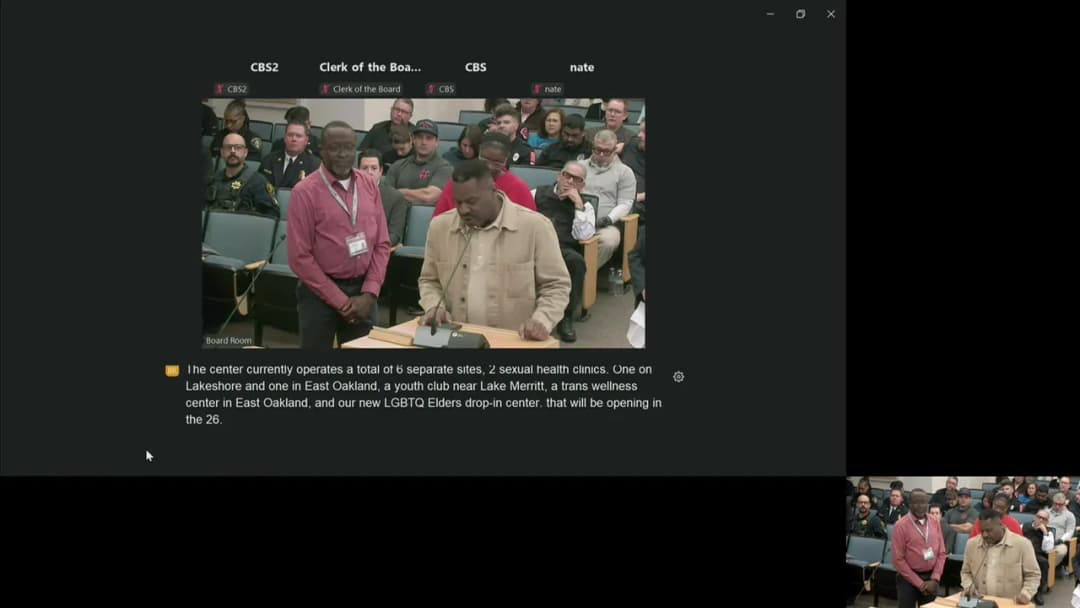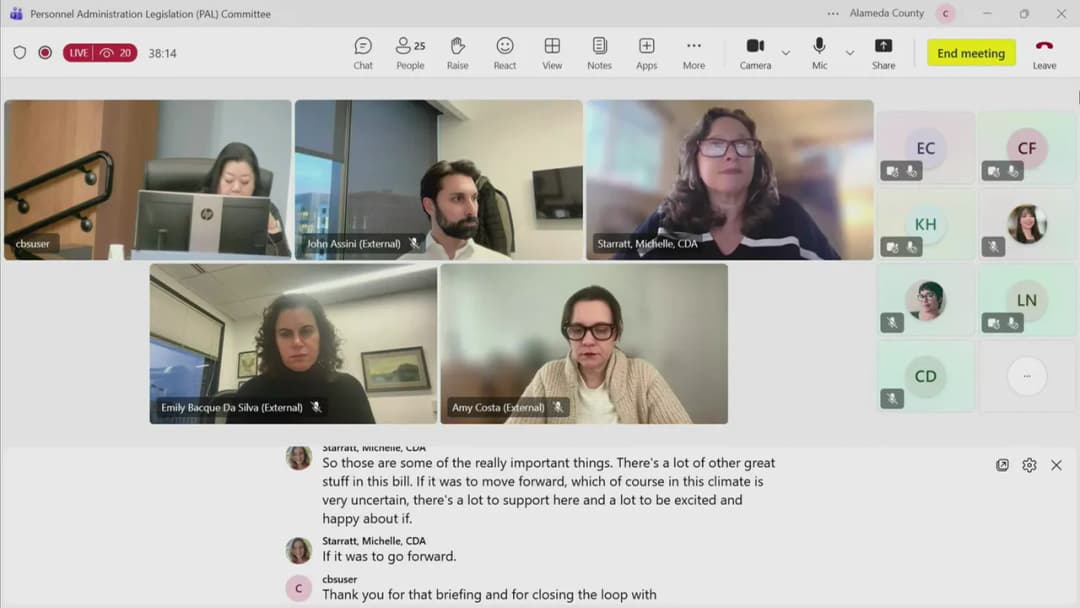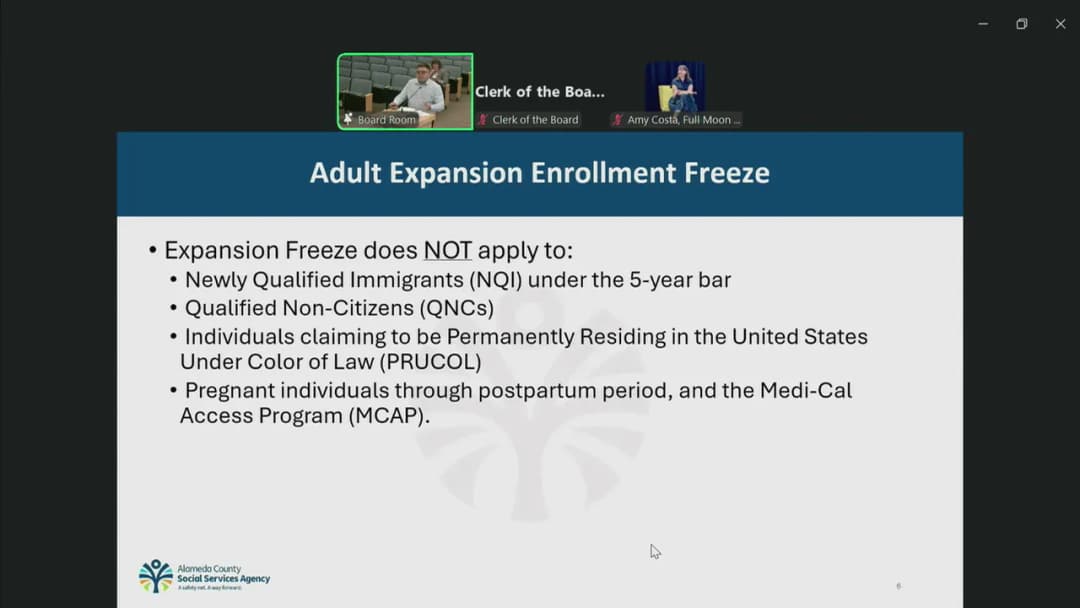
This special joint meeting of the Alameda County Board of Supervisors' Social Service and Health Committee focused on the impacts of federal HR1 and state budget proposals on county health and social services. The meeting featured three informational presentations: a backbone agencies update, a state budget overview, and detailed analysis of policy changes affecting Medi-Cal for non-citizens. No formal votes were taken; the session was informational and planning-oriented. Public Comments & Testimony - Andy Martinez-Patterson (CEO, Alameda Health Consortium/Community Health Center Network) thanked the board for commitment to the safety net, emphasized the need for unified system coordination, and noted that FQHCs face $188 million in cuts. He supported the backbone coordination efforts. - Casey (Alameda Health System employee) asked about the impact of Prop 63 (MHSA) within the context of the budget and its use at John George. - Tony Panetta (Chief Impact Officer, Alameda Health Consortium) expressed disappointment that the state budget kept cuts to clinic enhanced payment rates for immigrants remaining in Medi-Cal and noted that asylum seekers, refugees, and victims of human trafficking would be treated as unsatisfactory immigration status holders effective October 2026, limiting them to restricted Medi-Cal. - Kathy Rodriguez (resident near Llewellyn Explosion in Hayward) raised off-topic safety concerns about a commercial property and county ordinance violations. Discussion Items 1. Backbone Agencies Update (Anika Chowder, Interim Director, AC Health; Andrea Ford, Director, SSA) - Presented the coordination structure among AC Health, SSA, key health partners (Alameda Alliance, Alameda Health System, Clinic Consortium), and community providers (CPAG). - Highlighted policy tracking, advocacy (opposing public charge changes, PFAS rollback, gender-affirming care restrictions), and weekly federal policy updates. - Reported on outreach for UIS (unsatisfactory immigration status) population: supported over 1,500 people, resulting in 418 referrals to enrollment assistance specialists. Used texting campaigns, postcards (88,000 sent by Alliance, 5% response rate), and promotoras. - Discussed Measure W funding ($2.5 million) for Medicaid outreach: a year-long public information campaign and enhanced outreach through CBO partners. - Supervisor Miley asked about evaluation of UIS outreach; staff noted no baseline N but considered 418 new enrollments positive. Supervisor Tam asked about work requirements planning; staff noted CalFresh ABOD implementation in June 2026 (presentation next month) and Medi-Cal work requirements guidance expected June/July 2026. - Supervisor Fortunato Bass expressed concern about meeting proliferation and urged minimizing meetings to allow staff to focus on work. 2. Governor's January Budget Proposal (Amy Costa, Full Moon Strategies; Hannah Hamilton, SSA; Jessica Blakemore, AC Health) - Amy Costa presented state budget overview: total budget $348.9 billion, general fund $248.3 billion. Revenues $42.3 billion above projections, but driven by volatile AI stocks. Operational deficit of $20.9 billion. Governor proposed $23 billion in reserves. MCO tax extension assumption critical; if denied, creates significant hole. State estimates $1.4 billion increased cost from HR1 in budget year, mostly Medi-Cal and CalFresh, with no backfill for county administrative costs. - Hannah Hamilton detailed social services impacts: CalFresh administrative cost increase of $382 million (state/county share shift to 25/75); SSA share estimated $8.8 million, total $24.9 million. No line item for benefit payment cost sharing (potential $2 billion if state error rate 10%). IHSS: $233.6 million cost shift to counties starting FY27-28; Alameda County gets 8% admin increase but $5 million net county cost increase for CFCO. CalWorks: single allocation increase of $2.6 million for Alameda County. Realignment funds only 2% increase, below COLA. Federal funding freeze on TANF (CalWorks) temporarily blocked by federal judge; 23,300 individuals enrolled in CalWorks in Alameda County. - Jessica Blakemore covered health/homelessness impacts: Budget maintains Medi-Cal eligibility changes for UIS; reduces rates for UAS Medical patients at FQHCs effective July 1, 2026. No additional resources for indigent programs. MCO tax long-term revenue limited. Behavioral health: Prop 1 shifts, $4 billion to counties, but prevention funding reduced. Mobile crisis benefit: enhanced federal funding ends 2026; state proposes optional benefit shifting non-federal share to counties. Homelessness: $500 million for HAP round 7 contingent on accountability; $200 million for transitional rent from MCO tax. - Supervisor Miley asked for worst-case scenario estimates; staff noted it's too early to quantify. Supervisor Tam requested that future briefings include best/worst case to inform Measure W allocation. 3. Federal and State Policy Changes Affecting Medi-Cal for Non-Citizens (Juan Matania, SSA; Dr. Kathleen Clanon, AC Health) - Juan Matania presented four major changes: 1. Enrollment freeze for UIS individuals (effective Jan 1, 2026): New enrollments for adults 19+ paused; current enrollees (51,200 as of Dec 2025) grandfathered unless they lose eligibility for 3 months. Breakdown by district, gender, top countries of origin. 2. Reduction in dental benefits for UIS (July 1, 2026): Full scope dental removed for adults 19+; emergency dental only. Affects 74,000 individuals (including DACA, parolees, LPRs under 5-year bar). 3. Redefinition of qualified non-citizens (Oct 1, 2026, from HR1): Only LPRs, Cuban/Haitian entrants, COFA migrants remain QNCs. Excludes refugees, asylees, battered non-citizens, etc. Affects 10,600 current enrollees. State budget may fund full scope without dental for those excluded, contingent on final budget. 4. Premiums for certain UIS adults (July 1, 2027): $30/month premium for adults 19-59 with UIS to keep full scope (no dental); non-payment leads to restricted scope. Affects 57,600 current enrollees. - Data provided by supervisorial district, age, gender, and top countries of origin. - Outreach efforts: Health Navigators Project with 7 CBOs; healthyac.org website with interactive map. - Dr. Kathleen Clanon discussed Health PAC (indigent care program): Currently 2,600 enrollees (income 138-200% FPL), budget $70 million/year. Section 17000 obligates county to provide care for medically indigent. If Medi-Cal enrollment drops from 407,000 to projected 240,000 by 2028 (per Alameda Alliance CEO Matt Woodrough), Health PAC could see increased demand. However, cost of care is much higher than current Health PAC budget; sustainability concerns. Discretion exists in defining eligibility and services, but long-standing policies may limit abrupt changes. - Matt Woodrough (Alameda Alliance CEO) added: 407,000 total Medi-Cal enrollees; 7,000 UIS drop in January (preliminary); projected drop to 240,000 by 2028 if all changes implemented. MCO tax cap will significantly reduce hospital directed payments, affecting AHS. - Supervisor Miley raised concerns about potential incentives for people to choose Health PAC over Medi-Cal to avoid work requirements, and about attracting residents from other counties. Staff noted they will monitor choices but may not know reasons. Supervisor Tam noted Health PAC is a limited county program, not equivalent to Medi-Cal. Key Outcomes - No formal votes or decisions were taken; all items were informational. - Staff will return monthly to the joint committee with updates on HR1 implementation, data on enrollment impacts, and further analysis of state budget developments. - Next month's meeting will include a presentation on CalFresh ABOD (work requirements) implementation. - The board directed staff to provide best-case and worst-case scenario estimates for budget impacts to inform Measure W allocation. - Staff will continue coordination with state and federal advocates, monitor legal challenges, and refine outreach strategies for upcoming policy changes. - The committee acknowledged the need to minimize excessive meetings to allow staff to focus on implementation work.
Public Meetings - Alameda County, California
Public Meetings - Alameda County, CaliforniaThe Alameda County Agricultural Fair Association Ad Hoc Committee met on January 12, 2026, at 2:00 PM. The meeting covered a range of topics including hotel development, permitting issues, capital improvements, stormwater compliance, governance transparency, and the 2025 fair performance. A significant portion of the meeting was devoted to public comments and discussion regarding the future of horse racing at the fairgrounds. Hotel and Land Surplus Act (Item 1) - Gordon Galvin presented an update on a proposed hotel development on fairgrounds property. The project stalled in 2018 due to the Surplus Land Act and labor requirements. A new developer has approached the fair association, but the revenue potential is lower (estimated $200,000 annually vs. previous $450,000). The county's General Services Agency Director Kimberly Gassaway noted that a ground lease would exceed the fair association's contract term and that the Surplus Land Act requires careful navigation to avoid triggering affordable housing requirements. The county is exploring a "safe harbor" process with state regulators. Supervisor Miley emphasized the need for a clear path forward and suggested staff-to-staff meetings to develop a blueprint. Footsall Complex Update (Item 2) - Chuck Moore reported on a soccer field project by Ballistic United Soccer Club. The project required a conditional use permit from the City of Pleasanton, which then required county inspection. The permitting process took over a year and cost the club approximately $25,000 for engineering drawings, delaying their season. Moore expressed frustration that the process was overly burdensome for a simple fence and netting on an existing parking lot. The committee agreed to improve communication and resume quarterly staff-to-staff meetings to avoid similar issues. 2025 Capital Improvement/Marketing Plan (Item 3) - The committee reviewed the 2025 capital plan and the proposed 2026 plan. Many 2025 projects were put on hold due to financial constraints from the loss of GSR racing. The 2026 plan includes projects such as fire suppression replacement in Building A, connecting wash racks to sewer, and a grandstand plaza with a historical walk. The fair association reported $8.4 million cash on hand as of October 2025. Supervisor Halbert requested that future capital plans be presented in a meeting format rather than as attachments to agendas. Stormwater Compliance (Item 5) - Jerome Hovin provided an update on stormwater compliance efforts. The fairgrounds was classified as a CAFO (Concentrated Animal Feeding Operation) due to having more than 500 horses for 45 days, but that classification ended when horses left. The association has installed Triton filters in storm drains and is waiting for two qualified rain events to test water quality. A plan to build covered wash racks connected to sewer is in engineering. The committee discussed contingency plans for handling more than 500 horses, with some disagreement about the feasibility of retention ponds. Public commenter David Elliott asked about testing locations. Fair Association Operation Governance (Item 6) - This item focused on communication issues between the fair association and the county. Chair Chuck Moore raised concerns about a cease and desist letter sent by the county on November 28, 2025, regarding alleged modifications to the racetrack. Moore stated the information was erroneous and came from a closed session discussion that was not confidential. Supervisor Halbert advocated for greater transparency, including posting meeting agendas and minutes online, allowing public Zoom access, and providing closed session topics. The committee agreed to develop a communication improvement plan and resume quarterly staff-to-staff meetings. Public commenters criticized the board for lack of transparency and disrespectful treatment of the public. 2025 Alameda County Fair Review (Item 7) - The fair association presented a review of the 2025 fair. Key statistics: total fair attendance was 410,000 (up 12.9% from 2024 but down from 2023's 445,000). Fair profit was $4.3 million (vs. $4.5 million in 2024). Total revenue for the year was $30.08 million, with operating income of $5.11 million. The fair raised $390,000 at the garden party, collected 15,000 pints of blood, and 5,400 pounds of food for the food bank. The junior livestock auction raised nearly $1.3 million. Public commenters questioned attendance figures and reported lower vendor sales, attributing the decline to the absence of horse racing. 2026 Alameda County Fair Proposal (Item 8) - The committee reviewed the 2026 fair budget and plans. The fair will run June 19 to July 12, 2026, with a "Blue Ribbon" theme and a focus on the 250th anniversary of the United States. Planned attractions include monster trucks, arena cross, tractor pulls, demo derby, and concerts (Beach Boys, Tower of Power, Twist on Taylor, Metallica tribute). The budget projects fair profit of $4.566 million on revenue of $14.8 million. Total year operating profit is budgeted at $1.594 million. A major discussion ensued about the absence of horse racing. Several public commenters urged the board to reinstate horse racing, citing contractual obligations and cultural heritage. Board members explained that the previous operator (GSR) went bankrupt, causing significant losses, and that proposals from Bernal Park Racing were not viable due to revenue-sharing demands. Supervisor Miley expressed strong support for horse racing and requested a detailed explanation of why it cannot be done without losing money. The committee agreed to further discuss the matter in closed session. Key Outcomes - The committee directed staff to develop a communication improvement plan and resume quarterly staff-to-staff meetings. - The county will explore a "safe harbor" process with state regulators for the hotel project. - The fair association will present future capital plans in a meeting format. - The committee will hold a closed session to discuss contractual obligations and the feasibility of horse racing. - No formal votes were taken; all items were informational.
The Alameda County Board of Supervisors held a planning meeting on Thursday, January 8, 2026, at 9:45 AM. The meeting was called to order with four supervisors present (Marquez, Tam, Miley, Haubert) and one excused (Fortunato Bas). The board approved the previous meeting's minutes, adopted a consent calendar item, passed zoning ordinance amendments for accessory dwelling units, debated a continuance request for two related appeal items, and heard public input on Measure D. Consent Calendar - Item 3: Record of Cost Abatement and Authorization of Assessment Liens – Approved unanimously by roll call vote (4-0). Second Reading of Zoning Ordinance Amendments - Item 4: Amendments to Zoning Ordinance for Accessory Dwelling Units (ADUs) and Junior ADUs – The board waived full second reading and adopted the ordinance unanimously (4-0). This action updates multiple sections of the County Zoning Ordinance to comply with state law. Public Comments & Testimony - On the continuance request (Items 5 & 6): - The appellant's attorney (Chuck Meadows) and the appellant (Chuck Meadows) strongly opposed another continuance, citing a pattern of repeated delays since 2019, including multiple continuances before the Board of Zoning Adjustments (BZA) and a no-show at the last BZA hearing. They stated the original morning court conflict had been resolved. - Matt Turner (unincorporated resident) argued that justice delayed is justice denied and urged the board not to continue the items. - Michelle (appears to represent the other party, the appellants? Actually she requested the continuance) spoke in favor of a continuance, citing attorney trial conflicts, difficulties for witnesses, and additional evidence from recent storms that was not yet assembled. She requested a continuance to the March 12 planning meeting (later clarified to March 5). - On Measure D (public input for non-agenda items): - Kelly Abrew criticized the board for procedural manipulation, suggesting public comments are sometimes rescheduled to disadvantage certain speakers. - Griffin B. Miller (unincorporated resident) asked the board to advance a 2026 ballot measure to modernize Measure D by allowing smaller agricultural parcel sizes, arguing the current rules harm young farmers and the wine industry. - Jerry D. Miller (Griffin's father) stated that Measure D has failed to enhance agriculture and requested a ballot measure to allow amendments without frequent ballot initiatives. - RM (online speaker) argued that Measure D's restrictions prevent agricultural evolution and diversification, pushing land toward non-agricultural uses. - David Nagerian (Alameda County Farm Bureau president, farmer) described how Measure D blocks small, affordable agricultural parcels needed by new farmers. - Janessa Hoffman expressed strong concerns that Measure D is crippling agriculture and requested amendments to allow agritourism and other revenue streams. - Matt Turner (online) cautioned against reducing minimum parcel sizes to five acres, warning it would create luxury estates rather than genuine farming operations. Discussion Items - Items 5 & 6: Reconsideration of Appeals (Related Matters) – The board considered a request from the appellants to continue both items to a later date. After public comment and deliberation: - The board discussed options including a special meeting on January 27, 2026, but ultimately decided to continue to the next planning meeting on March 5, 2026, to allow all parties adequate time to prepare and be represented. - The motion was made by Supervisor Tam, seconded by Supervisor Miley, citing an abundance of caution for due process. Key Outcomes - Approved minutes of December 11, 2025 (unanimous). - Adopted consent calendar Item 3 (unanimous). - Adopted zoning ordinance amendments for ADUs and JADUs (Item 4) (unanimous). - Granted continuance of Items 5 & 6 to the date certain of March 5, 2026 (4-0, one excused). The board noted this would be a de novo hearing and that no further continuances would be granted absent extraordinary circumstances. - Received public input on Measure D; no formal action taken. Adjournment The meeting adjourned after public input with no further business.
The Transportation Planning Committee of Alameda County met on January 6, 2026, with Supervisors Miley and Howard present. The agenda included three action items: an ordinance to create a Pedestrian, Bicycle, and Trails Advisory Commission; formation of a Measure X Bond Oversight Committee for fire station projects; and two general plan amendments to the Safety Element and Open Space Element. Public comments on non-agenda items were heard first. Public Comments & Testimony - Gerald B. Miller expressed support for enhancing agriculture under Measure D, arguing the measure has failed its stated goal. - Griffin Miller advocated for reducing minimum agricultural parcel sizes to improve housing access for working families and new farmers. - Kelly criticized the meeting's handling of public comment scheduling and urged adherence to Measure D, suggesting vertical development as an alternative. - Another caller supported agritourism and ancillary agricultural uses as necessary for farm viability. - Bruce King (Friends of San Lorenzo Creek) highlighted flood control risks after a failed benefit assessment vote and urged a public plan. Discussion Items Item 1: Pedestrian, Bicycle, and Trails Advisory Commission - Valerie Arkin (Supervisor Miley's office) presented a draft ordinance to replace the current committee with a commission appointed by the Board of Supervisors, with 7 members from districts with unincorporated areas. The commission would advise directly on bike/pedestrian/trails issues. Feedback from MACs and the public included concerns about representation, commission proliferation, and the need for balanced mobility perspectives. - Supervisor Miley supported the commission but acknowledged concerns about too many boards. Supervisor Halbert suggested more work is needed, including a report on the current committee's effectiveness, before advancing. The item was not forwarded to the full board; instead, a future informational report was requested. Item 2: Formation of Measure X Bond Oversight Committee (Alameda County Fire Department) - Fire Chief Willie McDonald and Deputy Chief Eric Moore presented the need for a Measure X Bond Oversight Committee to review expenditures from the $90 million bond passed in 2020. Phase 1 projects (Stations 7, 22, 31) are underway; Phase 2 (Stations 26, 24) is expected by 2028. Proposed committee structure: 7 members appointed by each supervisor (2 for District 4) with relevant expertise. - Supervisor Miley expressed concern about funding for Phase 2 stations but supported formation. The committee approved motions to form the oversight committee and forward to full board. Vote: 2 ayes (Miley, Howard). Item 3: General Plan Amendments – Safety Element and Open Space Element - Ali Abers (Planning Department) presented two amendments: (A) Safety Element updates to comply with state laws (SB 379, SB 99, AB 1409, etc.) including flood control and fire policies; (B) Open Space Element appendix to comply with SB 1425 on equitable access and climate resilience. Both had been vetted through MACs, Planning Commission, and Calfire. - Supervisor Miley raised concerns about countywide flood and fire hazards beyond Sunol, and questioned a hazardous tree ordinance recommendation from Eden MAC. He and Supervisor Halbert agreed to change language from "adopt" to "consider." The committee approved forwarding both amendments to the full board with that modification. Vote: unanimous. Key Outcomes - The pedestrian/bicycle/trails commission item was not advanced; a future informational report on the existing committee was directed. - The Measure X Bond Oversight Committee was approved for formation and will go to the full board. - The General Plan amendments (Safety and Open Space elements) were recommended for full board approval with the tree ordinance language changed from "adopt" to "consider."
The Personnel Administration and Legislation (PAL) Committee of the Alameda County Board of Supervisors met on Monday, January 5, 2026, at 1:30 PM. The meeting featured federal and state legislative updates, an action item on proposed amendments to the Health and Safety Code regarding governance of the Alameda Health System (AHS), and public comments. Consent Calendar - No consent calendar items were listed or discussed. Public Comments & Testimony - John Lizzie Pulland (public commenter) expressed concern that the proposal for AHS governance reform lacks detail. He noted that over 300 AHS staff have been laid off and questioned the intent of the reform, particularly whether the county would use its finances to meet its obligation to provide health care. He urged the committee to share more about the intent and how the reform would address short- and long-term problems. - Casey (AHS employee) spoke extemporaneously after their written comment was not read aloud. They expressed deep concern about preemptive layoffs at AHS, which they stated were budgeted through June 2026 but feel "shaky" and poorly communicated to managers. They warned that cuts to outpatient services (speech, behavioral, and physical therapy) would severely reduce patient care. They encouraged the Board of Supervisors to delay layoffs until after June, hoping that a potential takeover by the Board could spare over 300 jobs. Federal Legislative Update (presented by CJ Lake and Emily) - Congressional schedule: The Senate returned January 5; the House returns January 6 for the second session of the 119th Congress. - FY26 appropriations: The continuing resolution expires January 30, leaving 3.5 weeks for Congress to pass remaining FY26 appropriations bills or another CR. Three additional bills (Interior/Environment, Commerce/Justice/Science, Energy/Water) were released January 5; the House will likely vote Thursday, Senate next week. Six bills remain, including Labor/HHS/Defense. The defense bill was previously close to agreement, but operations in Venezuela last weekend may complicate passage. - FY27 appropriations: Members have started opening portals for programmatic and congressionally directed spending requests. - Local earmark: Congressman Swalwell included $1 million for the county's Livermore Sewer Extension Project in the House bill; the full amount was included in the final package. Public Works has been notified. - Enhanced premium tax credits: Expired January 1, 2026. The House passed a discharge petition seeking a straight three-year extension (retroactive) with every Democrat and a few moderate Republicans. Passage is expected in the House but not the Senate (a similar three-year extension failed there in December). This creates potential legislative pathways for broader health care policy. - 340B drug pilot program: A federal judge ruled officials did not sufficiently consider the impact on safety net hospitals; the program (scheduled to take effect January 1) has been paused. Emily noted she has been in conversation with Health Care Services on this. - Child care funding freeze: Supervisor Fortunato Bass asked about a freeze on child care money to states due to alleged abuse in Minnesota. CJ Lake had no new information but noted HHS paused federal funding to child care centers, which has been part of a "right‑wing environment." The California Department of Social Services believes the county is fine until March. - ACA subsidy impacts: Supervisor Fortunato Bass noted that even if extended, premiums are already affected as of January 1. CJ Lake said there is no certainty on timing; he noted that a bipartisan approach (e.g., Licardo legislation) would be difficult to pass with a Republican majority, though moderate Republicans in purple districts may support it. State Legislative Update (presented by Amy Costup, Full Moon Strategies) - Legislature reconvenes: The Assembly met January 5; Senate begins at 2 PM. New Senate President Pro Tem Monique Lamone announced leadership and committee changes: Senator Angelique Ashby (Majority Leader), Senator John Laird (Budget Chair), Senator Cervantes (Appropriations Chair). Senator Argyen (Alameda County) retains chairmanships of Housing and Public Safety. Most new committee roles begin in February. - Delegation appointments: Senator Wahab (Business, Professions, and Economic Development Chair), Senator McNirney (Revenue and Taxation Chair), Senator Grayson (Banking and Financial Institutions Chair). - Health care policy dominates 2026: HR1 (signed July 2025) dramatically alters health care financing, causing funding shortfalls. Active ballot initiatives are circulating to extend existing revenues (Prop 30/55) and create new ones (e.g., billionaire tax). Labor unions and providers are gearing up for battles over revenue to offset projected $30 billion in health care losses from HR1 and state budget cuts to Medi‑Cal dental/vision and coverage for undocumented immigrants. - Governor's stance: Governor Newsom has expressed opposition to the billionaire tax, saying it could put California at a competitive disadvantage with other states. He drew a strong rebuke from labor union leader Lorena Gonzalez, who insisted unions are unified. He has not publicly weighed in on other revenue measures; his budget is expected to be released Friday. - Medicaid data sharing with ICE: A federal judge ruled on December 29, 2025, that the Trump administration can resume sharing basic personal information (citizenship, immigration status, address, phone number, date of birth, Medicaid ID) from Medicaid records with ICE starting January 6. Sensitive health records are barred. California and 21 other states had sued to prevent this. Officials argue the policy undermines trust and may deter undocumented immigrants from seeking care. - Litigation track record: California has filed 52 lawsuits during Trump's second term, winning or settling about 80%, claiming $168 billion in benefits. Some losses include limits on nationwide injunctions, environmental regulations, firearm laws, and transgender protections. - Upcoming: State of the State address later this week, followed by the governor's budget release on Friday. - Affordability: Amy noted that affordability remains a dominant theme in the legislature, making some legislators "skittish" about new revenue measures. Discussion Items - Action Item: Proposed amendments to the Health and Safety Code regarding AHS governance - Motion: Supervisor Tam (Chair) and Supervisor Miley proposed forwarding a legislative measure to the full Board of Supervisors that seeks amendments to the Health and Safety Code to implement recommendations from the ad hoc committee on the governance of Alameda Health Systems. - Options: The legislation would allow the board to implement either Option A (hybrid governance: Board of Supervisors handles AHS budget and hiring/firing of CEO; trustees oversee operations) or Option B (Board of Supervisors appoints one of its own to the Board of Trustees). - Co‑sponsorship: Jeanette Dong (Chief Public Affairs Officer, AHS) requested to co‑sponsor the legislation, emphasizing partnership and finishing the ad hoc committee's work. - Clarifications: Supervisor Fortunato Bass asked about language in section five of the proposal allowing the hospital authority to operate through corporations, joint ventures, or partnerships while maintaining the private character of private hospitals. Jeanette Dong explained this addresses AHS's acquisition of St. Rose (private) to take advantage of IGT and fiscal federal leverage. Supervisor Fortunato Bass expressed concern that this could inadvertently allow privatization of public parts of the system and requested the language be made clearer. - Role of Alameda Healthcare District: The Alameda Healthcare District (governing Alameda Hospital) has a JPA with the AHS Board of Trustees, not the county, and that relationship must be reflected in the Health and Safety Code amendments. - Legal review: Scott Dickey (County Counsel's office) confirmed that the board selected Option A as the direction for the legislation, allowing the board to decide whether to be the governing body or appoint others. The language about joint ventures/partnerships exists to allow absorption of other hospital facilities without losing private character for IGT benefits. - Legislative process: All language will be drafted by legislative council; the bill must be in print for 30 days before action, providing time for public review. - Public comments on this item: John Lizzie Pulland expressed concern about the lack of detail; Casey (AHS employee) urged delaying layoffs until after June and highlighted severe cuts to outpatient services. Key Outcomes - Motion passed: The committee voted to forward the proposed amendments to the Health and Safety Code to the full Board of Supervisors. The vote was: Supervisor Fortunato Bass (yes), Supervisor Tam (yes). The motion carried. The full board will take up the matter at its next meeting. - Next steps for AHS governance legislation: The county will work with a state legislative sponsor to fine-tune language; the bill will be drafted by legislative council and must be in print for 30 days before action. - Continued monitoring: The committee will keep track of federal child care funding freeze, ACA subsidy extension efforts, and state revenue measures (including the billionaire tax and extension of existing Prop 30/55 revenues). - Adjournment: The meeting adjourned after taking roll call of attendees.
The Alameda County Health and Public Protection Committees held a special joint meeting on December 18, 2025, to review the county's violence prevention strategy through a public health lens. Chair Supervisor Marquez presided, joined by Supervisor Tam and Supervisor Miley (participating remotely as a community member due to an agenda address issue). The meeting featured presentations from the Alameda County Public Health Department's Office of Violence Prevention (OVP) and five community-based organizations (CBOs) highlighting prevention, intervention, and healing efforts. The board reaffirmed its commitment to sustained investment, noting the recent unanimous approval of $3 million annually for three years (Measure C) to strengthen countywide violence prevention. Public Comments & Testimony - Supervisor Miley, speaking as a community member, expressed strong support for the work presented and underscored that violence prevention must be continuous and adequately funded. He called for sustained investment in CBOs, particularly those focusing on Oakland, and emphasized the importance of resilient communities, community-oriented policing, and cross-sector collaboration. Discussion Items - Office of Violence Prevention (OVP) Update: Kristen Clopton, OVP Manager, presented data on homicide trends, suicide rates, domestic violence deaths (23 in 2024, highest since 2017), and reported hate crimes. She highlighted that firearm homicides in Alameda County have decreased during periods of active community violence intervention. OVP funds 14 grantees using $3.84 million in ARPA dollars, with contracts through October/November 2026. A data development agenda includes a public violence prevention dashboard and a fatality review team in early 2026. - Destiny Arts Center: Mike Lee (Deputy Director) and Tess Fai (Martial Arts Director) described their 37-year-old program using movement arts and the "Warriors Code" (love, care, respect, responsibility, honor, peace) to build resilience in youth aged 3–24. 100% of teaching artists are trained in trauma-informed and nonviolent communication; 75% of participants are matched with mentors; youth report improved self-regulation and confidence. - Roots Community Health: Jamaica Sowell and Dr. Noha Abalada presented the 40 by 40 place-based strategy in East Oakland, focusing on intensive life navigation for individuals aged 35+ involved in violence. 100% of participants received a healthcare follow-up plan; 95% did not engage in retaliatory violence. They emphasized community data trusts and a learning system driven by resident priorities (gun violence, behavioral health, traffic safety, illegal dumping). Dr. Abalada noted risks from potential Medi-Cal cuts and called for low-barrier access points. - Youth Alive: Dr. Joseph Griffin described the hospital-based violence intervention program (Caught in the Crossfire) at four trauma centers. In 2024, 112 hospital safety assessments were conducted; in 2025 (year-to-date) 120 assessments were delivered. Counseling hours increased from over 2,000 (2024) to over 3,000 (2025). Less than 1% of survivors served were re-injured by violence. A case study illustrated how OVP funding helped a 23-year-old gunshot survivor achieve housing, employment, and sobriety. - Asian Health Services (AHS) and Bay Well Health: Robert Phillips (Bay Well CEO), Two Quats (AHS), Ben Wong, and Jeannie Chen presented the Asian-Black Healing Project, which included over 1,000 interviews/focus groups and a survey. Key findings: 98% of Bay Well respondents (predominantly Black) saw violence as a serious issue; 88% of Asian respondents saw anti-Asian violence as serious. Joint food distributions, cultural celebrations, and lay mental health counseling (60+ hours of training) reached over 1,000 community members. Policy recommendations included increasing mental health access, multiracial collaboration, and deep investment in a public health framework. Key Outcomes - The board acknowledged the presentations as informational; no formal votes were taken. - Chair Marquez confirmed the board’s November 18, 2025, unanimous approval of $3 million annually for three years (Measure C) for violence prevention, with OVP to conduct a procurement for CBO contracts in 2026 and add four new OVP positions. - OVP expects to launch a fatality review team in early 2026, modeled after existing county review teams. - The next Public Protection Committee meeting will be in February 2026 (no January meeting). - The meeting adjourned in memory of Coach John Beam and David Hearst, longtime Alameda County Public Health Commissioner.
This regular meeting of the Alameda County Board of Supervisors on December 16, 2025, began with board remarks, public comment, and unanimous approval of the consent calendar. Key agenda items included a resolution on language access, the sheriff's annual military equipment report, and a decision on an interim ambulance service provider. The board also heard extensive public testimony regarding a recent explosion on East Welling Boulevard, approved several ordinances, and received updates on HIV/AIDS awareness and immigrant community impacts. Board Remarks & Moment of Silence - Supervisor Tam thanked first responders for their response to a December 11 fire in Ashland and mutual aid to Washington. She adjourned the meeting in memory of Rob Reiner, a key architect of Proposition 10, and celebrated Hanukkah while denouncing recent anti-Semitic acts in San Lorenzo. - Supervisor Marquez requested a status update on the Ashland explosion, noting Red Cross support for displaced residents. - Supervisor Fortunato Bass thanked community partners for holiday drives and wished a peaceful holiday. - President Halbert acknowledged the bitter-sweet holiday, referencing the Hayward explosion, the murder of Ashlyn, and the death of Rob Reiner, as well as an attack in Australia. He reported over 500 toys collected at his event. - The board observed a moment of silence for Rob Reiner and victims of the Australia incident before adjourning. Consent Calendar - The board approved items 72 through 89 (without item 79) on a unanimous roll call vote (4-0, Supervisor Miley excused). Public Comments & Testimony - On agenda items (excluding set matters): - Ranji Tate (Alliance of South Asians Taking Action/JVP) spoke in support of item 45, urging redelegation of investment authority to the treasurer and criticizing delays on the ethical investment policy. - Ben Wong and Winnie Mai (Asian Health Services) supported the language access resolution (item 27), sharing patient stories about the importance of linguistically and culturally concordant care. - Jake Peterson (Jewish Voice for Peace, District 5) supported item 45, calling attacks on the treasurer anti-Semitic and financially illiterate. - Laura Calvert (Spectrum Community Services) strongly supported item 2, a one-time investment for LIHEAP and weatherization, emphasizing its role in homelessness prevention. - P. Say Finnith (Korean Community Center of the East Bay) supported the language access resolution, noting the crisis during COVID for Korean-speaking communities. - Davida Scott thanked the county library system for 44 placements and provided updates on Thanksgiving and Christmas drives. - Buffalo spoke on item 11, criticizing eviction practices at a low-income housing building for seniors with disabilities. - Julia Liao (Asian Health Services) supported the language access resolution, citing the county's linguistic diversity and the need for culturally responsive communication. - On items not on the agenda (regarding the East Welling Boulevard explosion): - Fourteen speakers (residents, business owners, and property owners) expressed concerns about the construction project, the explosion, lack of evacuation, property damage, and safety issues. They criticized PG&E and county oversight, and requested mental health support for traumatized residents. President Halbert acknowledged their comments but noted the item was not agendized. Closed Session Report - County counsel reported: - In Crane Ridge Vineyard Owners Association, the board authorized settlement of $150,000 (unanimous, all five supervisors) on October 14, 2025. - In California v Trump and Watson v Republican National Committee, the board authorized filing an amicus brief (4-0, Supervisor Miley excused). Discussion Items Item 11 – Ambulance Services Contract Policy - The board approved a resolution adopting an ambulance services contract policy per Health and Safety Code §1797.230. The policy includes employment retention requirements, financial proof, and diversity/equity efforts. Supervisor Marquez asked for clarification, and the interim AC Health Director explained it memorializes existing practices to comply with 2022 state law. Item 27 – Language Access Resolution - Supervisor Tam and Marquez presented a board letter affirming the county's commitment to equitable language access. Tam noted that Alameda County is the fourth most diverse in California, with 46% of immigrants speaking a language other than English. The resolution directs the CAO to compile a one-year language access utilization report and present annual reports to the board. Supervisor Marquez highlighted that District 2 is 45.9% foreign-born. The resolution was approved as part of the mass motion. Item 47 – FY 2026-27 Budget Development Strategy - Supervisor Fortunato Bass commended the county administrator for submitting the proposed budget by May 30 (two weeks earlier than usual) to allow more public and board deliberation. Approved as part of mass motion. Item 64 – Community Wildfire Protection Plan Update - Supervisor Fortunato Bass gave visibility to the updated plan, noting community engagement. Fire Chief thanked stakeholders and highlighted fuel mitigation and home hardening. Approved as part of mass motion. Item 70 – HIV and AIDS Awareness Month Proclamation - Supervisor Tam proclaimed December 2025 as HIV and AIDS Awareness Month, citing data: 9,667 people living with HIV in the Oakland Transitional Grant Area, with disparities among Black and Latino communities. Representatives from Oakland LGBTQ Community Center, Bay Area Community Health, and Public Health Department accepted the proclamation and urged continued funding and commitment. Item 70.1 – Sheriff's Annual Military Equipment Report - Captain Dan Brody presented the report required by AB 481. Key points: no policy violations or complaints; top used equipment includes Bearcat armored vehicle (38 uses) and drones (756 deployments). The sheriff requested approval for additional pepperball launchers (8 new VXR extended-range) and projectiles (up to 6,000 each of three types, plus 4,000 additional for previous items due to a clerical error), and a replacement armored vehicle. - Public comment: Several speakers (American Friends Service Committee, community members) urged the board to reject the increase, arguing it contradicts last year's one-for-one replacement promise and that scatter shot munitions should be banned. They noted pepperball can fire up to 10 rounds per second and pose risks in crowd settings. - Board discussion: - Supervisor Tam asked about community engagement (only two attendees at October 21 meeting in Cherryland) and the canceled PPC meeting due to federal activity. The sheriff noted no complaints were received. - Supervisor Fortunato Bass inquired about scatter shot munitions; the sheriff said they are actively exploring alternatives and may phase them out. Commander Clippinger gave examples of their potential use in hostage/barricade situations. - Supervisor Marquez expressed concern about the large inventory increase given the current federal environment and made a substitute motion to approve the baseline inventory from last year (i.e., no increase). - Supervisor Halbert made a motion to accept the report as presented, citing trust in the sheriff's judgment and need for training and mutual aid. - Vote on substitute motion (Marquez): Failed 2-3 (Marquez and Fortunato Bass in favor; Tam, Miley, Halbert against). - Vote on original motion (Halbert): Passed 3-2 (Tam, Miley, Halbert in favor; Marquez, Fortunato Bass against). Item 71 – Ambulance Transport Provider Interim Contract - Interim Health Director Anika Chowdry and EMS Director Lori McFadden presented two options: - Option A1: Extend the current Falk contract for two years (through June 2028) with an option for one additional year. Maintains status quo, no innovations can be mandated. - Option A2: Award AMR a three-year contract with a six-month transition (starting Jan 2026) and full service by July 2026, including innovations like nurse navigation, behavioral health training, and population-specific performance measures. - Staff clarified that under current Falk contract, innovations cannot be mandated. Fire Chief McDonald offered to implement a nurse consultation service at dispatch, but staff noted it would be less comprehensive than AMR's program. - Public comment: 17 in-person and 3 online speakers. Falk supporters (including paramedics, EMTs, labor unions, and firefighter associations) emphasized stability, workforce continuity, and risks of transition. AMR supporters highlighted their experience, innovation capabilities, and independent scoring of their proposal as best. Several speakers mentioned potential disruptions to patient care. - Board discussion: - Supervisor Fortunato Bass moved to approve Option A1 (Falk extension) with an amendment by Supervisor Marquez that the six-month updates on alternate system design come to the full board. - Supervisor Marquez seconded, noting consistency with her past positions and the need for stability before designing a new system. - Supervisor Tam and Miley expressed support for the motion, citing the fire department's willingness to start innovations. - President Halbert supported the motion but clarified he does not want to specify which entity should report on innovations. - Vote: Unanimous (5-0) to approve Option A1 with the amendment. Item 71.1 – Alameda County Together for All Ad Hoc Committee Update - Supervisor Fortunato Bass provided an informational update on the November 6 meeting, which focused on impacts of federal immigration enforcement on AAPI communities. She noted that 18% of ICE arrests in the first half of 2025 were of Asian/Southeast Asian individuals. The full board received the packet materials. Key Outcomes - Closed Session Settlements: Authorized $150,000 settlement in Crane Ridge Vineyard (unanimous) and authorized amicus brief in California v Trump and Watson v RNC (4-0). - Consent Calendar: Approved items 72-89 (except 79) unanimously. - Mass Motion: Approved all items (2-11, etc.) including the ambulance policy, language access resolution, budget strategy, and wildfire plan (4-0, Miley excused). - Ordinances: Approved item 31 (pre-election residency), 37A/B (salary amendments), 38A/B (obsolete classifications), 45 (investment authority), 51A/B (CIO and ROV recruitment), 65A/B (fire department salaries), 66 (traffic code), and 67A/B (building codes) — all on 4-0 votes (Miley excused). - Sheriff's Military Equipment Report: Approved as presented (including increased munitions) on a 3-2 vote. - Ambulance Interim Provider: Approved extension of Falk contract for two years plus one optional year, with direction to explore alternate system designs and report to full board every six months (unanimous). - Future Reports: The CAO will prepare a one-year language access utilization report; the EMS agency will report on alternate system design every six months to the full board; the sheriff will continue annual reports.
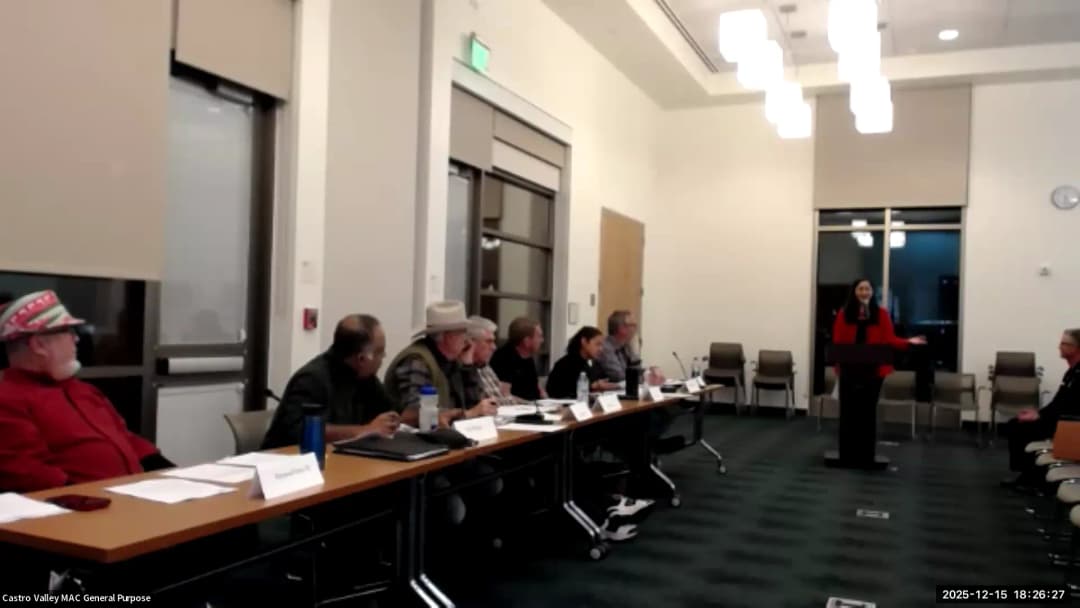
The Castro Valley Municipal Advisory Council (MAC) met on December 16, 2025, to discuss routine business, public art projects, and a contentious proposal regarding bike lanes on East Castro Valley Boulevard. The meeting included a presentation from the California Highway Patrol, public comment on multiple topics, and a vote to remove a buffered bike lane and restore parking pending a community process. Consent Calendar - No consent calendar items were listed or acted upon. Public Comments & Testimony - CHP Officer (non-agenda item): Reported November statistics for unincorporated roadways: 238 traffic citations, 5 DUI arrests, 3 misdemeanor arrests, 17 injury crashes, 36 non-injury crashes, 1 stolen vehicle recovered, 20 cars towed/stored. Officers participated in Thanksgiving enforcement (no fatal crashes) and the Castor Valley tree lighting. Upcoming: toy distribution on December 16 for Chips for Kids, and reminder that December is National Impaired Driving Month. - Resident (in person): Requested that the board agendize the issue of unused Clear Channel park benches along Castro Valley Boulevard that attract trash and encampments. Also requested agendizing the issue of neighbor comments not being incorporated into planning decisions, citing a vegetation problem on an adjacent parcel where trees will grow into a sound wall. - Callie (online): Criticized that CHP traffic safety reports are not on the agenda but suggested the supervisor’s office could fix that. Noted that a 2016 traffic safety report for Crow Canyon Road was updated in June 2024, stating four roundabouts would be designed by December 2025; expressed concern about ongoing fatalities on Crow Canyon Road. - 17+ speakers on the bike lane agenda item (see Discussion Items). Discussion Items Public Art Projects for Fire Stations 7 and 25 - Rachel Ossajim (Director, Alameda County Arts Commission) and Deputy Chief Eric Moore presented final artist recommendations for two Measure X fire station projects: Fire Station 7 (Palomaris Hills) – artist David Burke, theme celebrating natural beauty and firefighter role; Fire Station 25 (San Miguel Avenue) – artist Josh Powell, theme celebrating community and fire department history. The selection process involved community committees, public input (101 comments for Station 7, 139 for Station 25), and multiple MAC presentations. The artworks will be printed on durable porcelain enamel on steel. Budget is on target. The motion to approve the art projects passed unanimously. - Council comments: Commended the process and outreach. Some members requested future emphasis on local artists. Questions addressed artwork durability, maintenance, and revisions before final installation. Castro Valley Bike Lane Utilization Report - Daniel Will Dessenbet (Director, Public Works Agency) presented a study of the class II buffered bike lane installed on East Castro Valley Boulevard (Redwood Road to Five Canyons). The lane was identified in the 2019 Bicycle Pedestrian Master Plan and was implemented during road resurfacing, removing 35 on-street parking spaces (12 north side, 23 south side). - Bike count methodology: Pneumatic tubes counted bikes over 16 days in October. Average daily bike volume ranged from 22 to 51 across eight locations; maximum observed was 89 on one Thursday. Car ADT is approximately 21,000. - Public comment: Approximately 20 speakers supported keeping the bike lanes, citing safety for cyclists, especially children and seniors, reduced traffic congestion, support for local businesses, and connectivity to BART. Approximately 9 speakers opposed, representing property owners and merchants who claimed the parking removal harmed retail viability, surprised businesses, and was based on insufficient data. Some suggested alternative bike lane designs or partial parking restoration. - Council deliberation: Members discussed the need for compromise, the lack of upfront community outreach, the desire for a data-driven decision, and the potential for a hybrid approach (site-specific parking restoration). A substitute motion to keep bike lanes but restore parking at affected business locations failed. Key Outcomes - Art projects approved: Motion to approve Alameda County Arts Commission public art for Fire Stations 7 and 25 passed unanimously. - Bike lane motion: A motion to remove the buffered bike lane and restore parking, pending a restart of the process with full community and business input, passed 5–2. The motion directs Transportation and Planning to return the boulevard to its prior state and to bring the matter back for robust public engagement before any future decision on bike lanes. - Minutes continued: Approval of November 17, 2025 minutes was continued because council members had not received the document in advance.
The Personnel Administration and Legislation (PAL) Committee of the Alameda County Board of Supervisors met on Monday, December 15, 2025, at approximately 1:15 PM. Supervisors Portonato Bass and Lena Tam were present, forming a quorum. The meeting covered federal and state legislative updates, requests for positions on pending legislation and proposed rulemakings, and public testimony. Consent Calendar - No consent calendar items were listed. Public Comments & Testimony - Federal Legislative Update: No public comments. - Housing Boom Act: No public comments. - SB 684 (Climate Superfund): Multiple speakers urged the committee to support the bill: - Joan Cardalino (Indivisible East Bay) emphasized potential revenue of $150 billion over 20 years, equating to roughly $130 million per year for each California county. - Lynn Griffith noted that supporters represent the broader public while opposition comes from groups concerned about income impacts. - Kate Harrison (former Berkeley City Council) highlighted the bill's focus on disadvantaged communities and climate impacts. - Heather McLeod (Youth Power Climate Action) stated that youth in several cities have passed resolutions supporting the bill. - Rod Fujita (Indivisible East Bay, climate scientist) pointed to the county's vulnerability to climate change and the need for resilience funding. - Steve (affiliation not given) noted that over 20 jurisdictions, including San Francisco and Los Angeles, have passed supporting resolutions. - Non-Agendized Items: No public comments. Discussion Items 1. Federal Legislative Update – CJ Lake and Emily reported on the final week of Congress in 2025. Key topics: - ACA Premium Tax Credits: Negotiations stalled; the House may vote on the "Lower Health Care Premiums for All Americans Act," which does not extend expiring credits. Two discharge petitions (Fitzpatrick, Kiggans) failed to gain traction. Premium increases expected in January 2026. - SPEED Act: A bill to streamline NEPA permitting for energy projects; unclear prospects. - Appropriations: Continuing resolution expires January 30, 2026; potential for another CR. - NDAA: Passed House, headed to Senate. - Housing Boom Act: Senator Schiff's bill; House companion by Rep. Simon may see tweaks before introduction. 2. Housing Boom Act (Building Occupancy Opportunities for Millions Act) – Michelle Sterrett (Community Development) highlighted expansion of the Low-Income Housing Tax Credit (LIHTC), rental assistance via Section 8, and a new HUD fair housing office. Alameda County has 90 projects awaiting tax credits. Supervisors expressed support; no public comments. 3. State Legislative Update – Amy Costa (Full Moon Strategies) reported: - California lost jobs for the fourth straight month; unemployment rose to 5.6%. - Attorney General Bonta joined a multistate lawsuit challenging a $100,000 fee on H1B visa petitions. - Bay Area transit funding: Senator Wiener criticized the administration's proposal to use long-term project funds for operating shortfalls; a stopgap needed by January 2026. - Governor Newsom launched the Public Health Network Innovation Exchange, bringing on former CDC officials. 4. SB 684 (Climate Superfund) – Jessica Blake Moore (Alameda County Health) explained the bill would require major oil and gas companies to pay into a statewide fund for climate damages and resilience, modeled on New York and Vermont laws. The bill is a two-year measure; its authors may not move it forward, but a companion exists in the Assembly. Supervisor Fortunato Bass requested time to meet with coalition members before taking a position. The committee agreed to bring the item back to the next PAL meeting in January 2026. Key Outcomes - Vote on Legislative Positions – Supervisor Fortunato Bass moved, and Supervisor Tam seconded, to forward the following three items to the full Board of Supervisors with recommended positions: 1. Support for the Housing Boom Act (S. 1234 or similar). 2. Oppose the proposed rulemaking on public charge ground of inadmissibility. 3. Oppose the proposed rulemaking on PFAS data reporting and recordkeeping under TSCA. The motion passed unanimously (2-0). - Deferral of SB 684 – The committee deferred action on SB 684 to the next PAL meeting (tentatively January 12 or 19, 2026) to allow Supervisor Fortunato Bass to meet with constituents and coalitions. - Next Steps: The committee will continue to monitor federal and state legislation; staff will report back on SB 684 and other items as needed.
The meeting was called to order at approximately 10:00 AM with President Halbert presiding. Supervisors Marquez, Tam, and Halbert were present; Supervisors Miley and Fortunato Bas were excused. The board approved routine items, adopted two ordinances (one amending the San Lorenzo Village Center Specific Plan for a fire station, and one updating ADU/JADU regulations to comply with state law), and approved a funding request from the Sonol Citizens Advisory Committee. Items 7 and 8 were continued to January 8, 2026. Consent Calendar - Approval of Minutes (November 13, 2025 Planning Meeting): Approved by a vote of 3–0 (Ayes: Marquez, Tam, Halbert; Excused: Miley, Fortunato Bas). - Consent Calendar Item – Record of Cost Abatement and Authorized Assessment Liens: Approved by a vote of 3–0 (same roll call). Discussion Items - Second Reading – Ordinance Amending the San Lorenzo Village Center Specific Plan (Item 4): Staff reported that the amendment would permit one publicly owned fire station in subarea 5A and waive site development review for fire stations under 10,000 sq. ft. and 50 ft. height. The board waived the full second reading and adopted the ordinance, with no public comment. Vote: 3–0. - First Reading – Zoning Ordinance Amendments for ADUs and JADUs (Item 5): Staff presented updates to bring the county into compliance with a State HCD letter (April 2025) and 2026 state legislation. Key changes included aligning parking requirements with state law (e.g., no parking for state-protected ADUs) and deleting references to the rural secondary-unit policy (which remains in effect separately). The planning commission recommended approval on December 1, 2025. A late comment letter from the California Housing Defense Fund prompted a minor clarification regarding parking exemptions for state-protected ADUs; that amendment was incorporated. The board adopted the first reading as amended. Vote: 3–0. - Funding Request – Sonol Citizens Advisory Committee (Item 6): The board approved $204.62 for a pivoting monitor and mount. Vote: 3–0. (Supervisor Miley voted via remote but was listed as excused; the transcript shows all three present voted aye.) Key Outcomes - All three voting items passed unanimously (3–0). - Items 7 and 8 were continued to January 8, 2026, due to ongoing negotiations and a pending court date among the parties. - The ADU ordinance amendment includes a specific clarification that state-protected ADUs (per Gov. Code §66323) are exempt from on-site parking requirements. - The rural secondary-unit policy remains in effect despite being removed from the ordinance text.