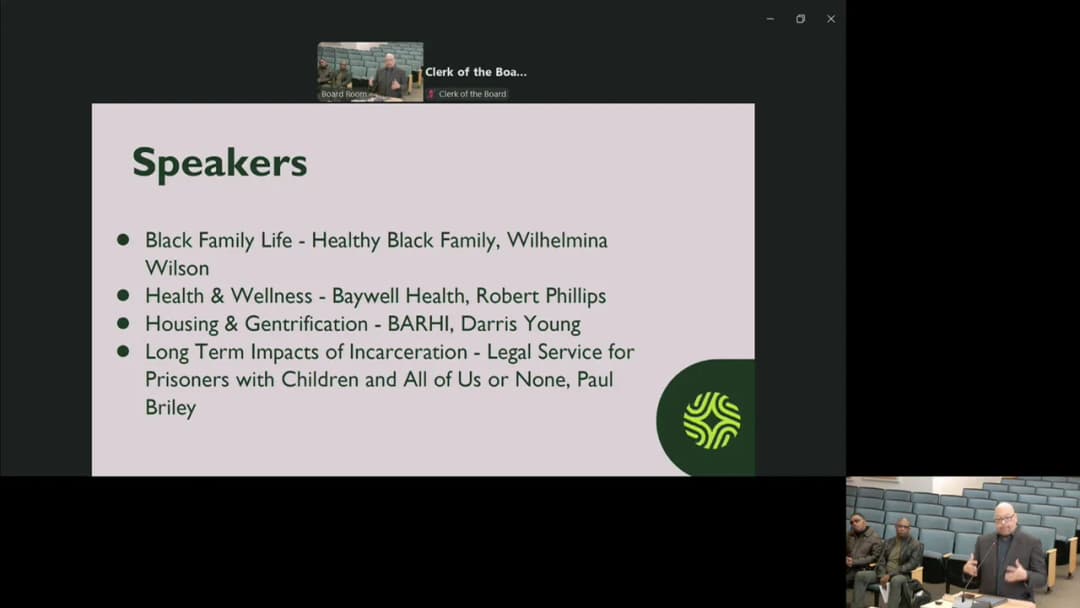
The Health Committee received an informational presentation on the African-American Health and Wellness Council, which is working to advance holistic wellness and address disparities in the African American community. The meeting featured detailed reports from community leaders, public comments, and a discussion of next steps to institutionalize the council and expand culturally affirming services. Public Comments & Testimony - Supervisor Miley (participating as a member of the public due to being out of state) expressed strong support for the African American focus and the action agenda. He noted the county’s many ongoing efforts but acknowledged a need for more holistic, unified, and targeted coordination. He also proposed exploring naming the African American Wellness Hub after Supervisor Carson. - Omawali Fowles (Association of Black Psychologists, former Berkeley health commissioner) requested a financial set-aside of 5.5% to 8.5% of the mental health budget for the African American hub and advocated for satellite mental health offices using African treatment models. He shared a client anecdote illustrating barriers to culturally competent care. Discussion Items - Presentation on the African-American Health and Wellness Council: Carol Burton (CEO, Jewel Consulting) described the council’s purpose—to advance holistic wellness in the African American community by promoting policies, funding, and innovations that integrate mental, emotional, physical, and spiritual health. She reviewed findings from a rapid landscape analysis involving 30 organizations, two community focus groups, surveys, and stakeholder interviews. Key stressors identified were work/financial stress (top), racism/discrimination, and social isolation. Over 80% of respondents indicated they think about these stressors often. Gaps included fragmented data, unsustained funding for culturally rooted programs, and limited coordination. - Wilhelmina Wilson (Executive Director, Healthy Black Families) emphasized the need for intentional, family-centered investments in resilience, healing, and cultural continuity. She cited data showing a decline in Berkeley’s Black population from 30% to 6.9% and noted the priority on affordable home ownership over affordable housing. - Robert Phillips (CEO, Baywell Health, formerly West Oakland Health) highlighted persistent health disparities: a Black child in West/East Oakland can expect to live almost 15 years less than a child in the hills, and Black mothers are 3–4 times more likely to die in childbirth. He warned that upcoming policy changes (e.g., Medicaid work rules, coverage cuts) will exacerbate these inequities. He called for making community-oriented health models the norm and treating the council, Black FQHCs, and wellness hubs as permanent resources. - Darish Young (Director, BARHII) focused on housing as the top driver of health disparities. He noted that Black Oaklanders comprise 70% of the city’s unhoused population and advocated for a Black Housing Fund. He linked mass incarceration to gentrification and called for bold, equity-focused steps beyond conversation. - Paul Briley (Executive Director, Legal Services for Prisoners with Children) argued that the criminal justice system identifies individuals as the problem rather than addressing root causes such as lack of housing, employment, and healthcare. He stated that crime is a last option, not a first choice. - Update on African American Wellness Center: Dr. Tribble (Alameda County Health) reported that over $30 million has been approved by the board for the center. A design-build process is underway, with an African American Wellness Subadvisory Committee formed to ensure culturally affirming design and services. Over 25 listening sessions have been held in the past three years; community input is being integrated into programming and building aesthetics. - Supervisor Tam and Director Anika Ta provided additional data: approximately 59,000 (12%) of Medi-Cal enrollees in the county identify as Black or African American. The county is working on re-entry supports through CalAIM and is focusing prevention efforts via Measure W to address upstream causes of homelessness. Key Outcomes - No formal votes were taken as the item was informational. - Supervisor Tam affirmed the county’s commitment to equity in resource allocation, referencing recent increases in violence prevention funding via Measure C in high-need areas (Oakland, Hayward). - Supervisor Miley expressed intent to work with the council on the action agenda and explore naming the African American Wellness Hub after Supervisor Carson. - The council’s call to action asked the Board of Supervisors to commit resources, political will, and institutional support to institutionalize a permanent African American Health and Wellness Council, launch a countywide community engagement process, and ensure equal access to essential services. - Next steps include formalizing the council’s structure and continuing coordination between county departments and community partners.
Public Meetings - Alameda County, California
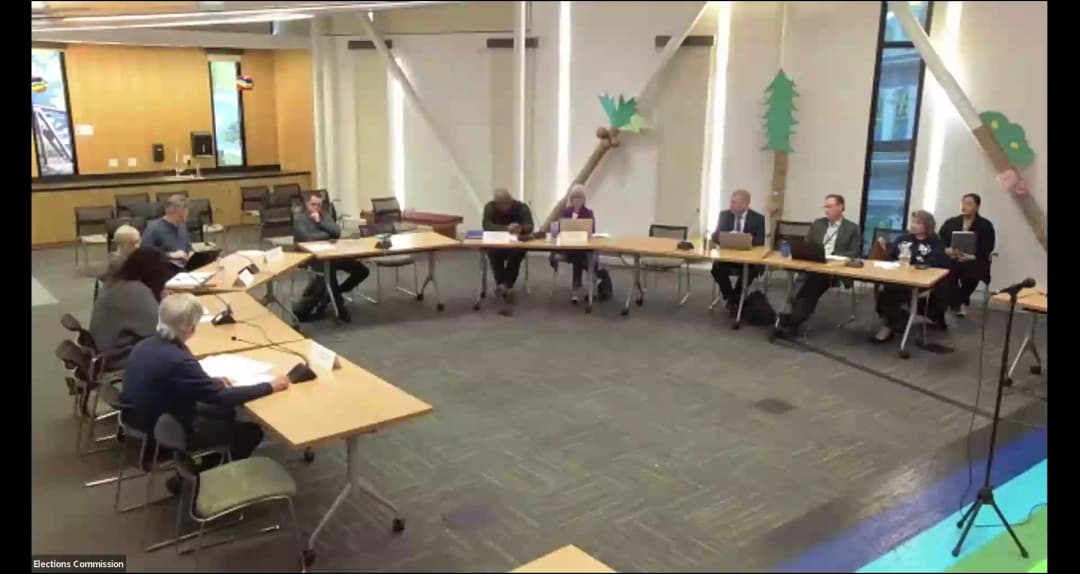
Public Meetings - Alameda County, CaliforniaThe commission met on November 24, 2025, to discuss post-election updates, committee reports, and upcoming elections. Key actions included approving October minutes, recommending a new commissioner, creating a post-election assessment committee, and urging the Registrar of Voters to develop a technical solution for youth voting in vote centers by November 2026. The next meeting is scheduled for January 15, 2026. Consent Calendar - Minutes Approval: The minutes from the October 2025 meeting (pages 4–7) were approved by acclamation without objection. Announcements - No December 2025 meeting; the next meeting will be January 15, 2026, when new officers will be elected (President Lindsay is termed out). - Commissioner Zarbre’s term ended and she chose not to continue, leaving two open seats: seat 6 (impacted community) and seat 13 (voting rights organization). The commission will ask the Board of Supervisors for help filling seat 13. Public Comments & Testimony - John Guerrero (public comment): Appreciated the release of cash vote records with each update. Noted that in this election, vote-by-mail ballots counted by election night rose to about 50% (up from 40% in previous elections). Expressed strong opposition to intermixing youth voting (16- and 17-year-old pre-registered voters in Oakland and Berkeley) with the countywide vote center system, arguing that software integration risks bugs and could jeopardize certification of the November 2026 election. Urged the commission not to pressure vendors to implement that integration. Discussion Items - Registrar of Voters’ Monthly Update (Item 7): Staff reported on the November 4, 2025, statewide special election and Washington Township health care district election. Turnout: Alameda County 52.5% (507,873 ballots cast from 966,534 registered voters) vs. statewide 50%. The official canvas continues, with about 3,366 ballots still needing signature curing. The one percent manual tally was completed. Discussion included signature verification training, the curing process (letters, calls, emails), and the Department of Justice’s request for unredacted voter registration data (no official request received). The commission asked about a public post-election debrief; staff indicated internal reviews are not typically made public but major issues are reported to the state. - Voting Participation Committee (8A): Commissioner Seabrook reported the committee is redefining its focus and will create a mission statement at its next meeting (January 2026). Commissioners emphasized it is a long-term project and they will look at other counties’ models. - Nomination Committee (8A): Commissioner Fam presented candidate Alexandra “Sasha” Hernandez for seat 6 (impacted community). Hernandez has experience advising poll workers, ran for Oakland School Board, serves on the Alameda County Language Advisory Committee, and is executive director of Somos Familia. The commission voted unanimously (7-0) to recommend her to the Board of Supervisors. - Youth Participation Committee (8A): The new committee has a tentative meeting on December 1, 2025. Goals include working with the ROV to expand youth pre-registration and voting, partnering with school districts, and reaching youth in juvenile justice and foster systems. - Post-Election Assessment (8B1): The commission created an ad hoc committee (Commissioners Butter, Wagner, and Fam) to draft an assessment report for the January 2026 meeting. Commissioners shared feedback: positive comments on early voting promotion, billboard “thank you for voting” ads, smooth vote-by-mail experience; one complaint about late voter information guides; and observation that vote centers had steady flow on election day. - Recruitment for ROV Position (8B2): Discussion on the upcoming vacancy (Registrar of Voters). The commission will send a letter to the Board of Supervisors offering assistance and encouraging commissioners and the public to spread the word about the job opening. No formal action taken. - Youth Voting in Vote Centers (8B3): The commission discussed the need for a technological solution allowing pre-registered 16- and 17-year-olds in Oakland and Berkeley to vote in person at vote centers. The ROV is already in conversations with vendors (DIMS and No Ink) but cannot meet a June 2026 deadline; the next applicable election is November 2026. The commission voted unanimously (7-0) to encourage the ROV to work with its vendors to develop that solution by November 2026. Key Outcomes - Approved October 2025 minutes by acclamation. - Recommended Alexandra “Sasha” Hernandez to the Board of Supervisors to fill seat 6 (vote: 7-0). - Created a Post-Election Assessment Ad Hoc Committee (Butter, Wagner, Fam) to report at the January 2026 meeting (vote: 7-0). - Passed a motion encouraging the ROV to work with its vendors to enable pre-registered youth to vote in vote centers by the November 2026 election (vote: 7-0). - Directed the President to send a letter to the Board of Supervisors offering assistance with the ROV recruitment. - Next meeting: January 15, 2026, at 5:15 p.m. (no meeting in December 2025).
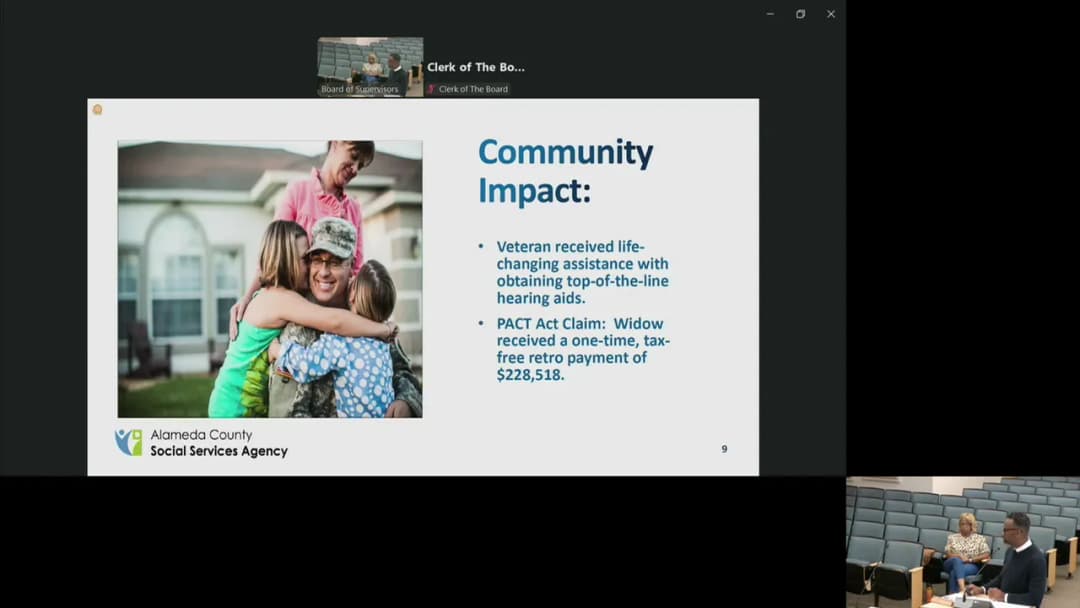
The Alameda County Board of Supervisors Social Services Committee met on Monday, November 24, 2025, with Supervisors Fortunato Bass and Tam present. The meeting included an update on the county's response to the federal government shutdown and the annual presentation from the County Veterans Service Officer, Anthony Simpson. No public comments were provided. Government Shutdown Update - Agency Director Andrea Ford reported that in response to the government shutdown, the Social Services Agency partnered with the Alameda County Community Food Bank to distribute food at four self-sufficiency centers as pop-up sites, operating through November 14, 2025, when the shutdown ended. The Enterprise self-sufficiency center operated a food truck concept and had the most activity, distributing approximately 10,000 pounds of food per day. - Regarding LIHEAP funding, Ford noted that due to restored federal funding, the county will return to the board on December 9, 2025, with a plan for Spectrum Community Services to spend $3 million in Measure W funds. The federal government has not yet sent funding to the state. - Ford also mentioned that HR1 impacts include the CalFresh ABOD work requirement (still on hold pending federal guidance) and Medi-Cal for UIS population (effective January 2026). Annual Update from County Veterans Service Officer - Anthony Simpson, Alameda County Veterans Service Officer, presented an overview of the office's mission, services, and accomplishments. He highlighted specialized training in benefits such as special monthly compensation (e.g., aid and attendance), debt management and waivers, Dependency Indemnity Compensation (DIC), vocational readiness, and apportionment for families of incarcerated veterans. - Simpson reported that with a team of five veteran service officers, the office achieved 138 in-person contacts, responded to over 42 telephone calls and emails, and completed two outreach events in the past month alone. - He cited two notable successes: a veteran who received high-quality hearing aids after seeking help at an outreach event, and a widow who received a retroactive DIC payment of $228,018 (plus $1,648 monthly) due to the PACT Act of 2022. - Future plans include a countywide newsletter, virtual appointments (using a new QMATIC contract), targeted outreach to underserved areas, and a standalone office in Hayward. The Hayward office renovations are complete, with technological equipment being installed as of November 14, 2025; opening is expected by end of 2025. - Simpson discussed satellite outreach at libraries in Pleasanton and Union City, providing confidential spaces. He noted that the Pleasanton event had low turnout due to the government shutdown affecting publicity, but two January events are scheduled. - Supervisor Tam asked about a planned VA clinic at Alameda Point, which Simpson could not address but offered to follow up. Key Outcomes - No formal votes were taken during the meeting. - The committee received the updates and will consider the LIHEAP/Measure W funding allocation for Spectrum Community Services on December 9, 2025. - The board acknowledged the veterans services office's progress and plans, including the upcoming Hayward office opening and expansion of virtual services. - Supervisor Tam requested a follow-up on the status of the Alameda Point VA clinic project.
The committee convened to receive updates on federal and state legislative issues, including the Affordable Care Act, the California budget outlook, and pending litigation on SNAP and Medicaid data sharing. No public comments were made, and no votes were taken. Federal Legislative Update - CJ Lake reported that Congress is out for Thanksgiving and will return December 1. The main topic is the expiring ACA enhanced premium tax credits. Negotiations are stalled; a December 31 deadline looms. The White House briefly floated a two-year extension limiting subsidies to 700% of FPL and requiring minimum premiums, but it was quickly abandoned after Republican opposition. The path forward remains unclear. - FY26 appropriations: Congress is working on a minibus; federal funding expires January 30. The Education Department's potential closure complicates the Labor-HHS bill. - DHS proposed a new public charge rule allowing case-by-case assessments; comments are being drafted by the County (Jessica Blake Mara confirmed a collaborative comment letter is in progress). State Legislative Update - Amy Costa presented the LAO's fiscal outlook for FY26-27: an $18 billion deficit, $5 billion worse than previously anticipated. Revenue growth is being consumed by Prop 98 (K-14) and Prop 2 (reserves). Structural deficits of $35 billion persist. Medi-Cal and CalFresh costs are rising due to higher caseload and HR1 impacts. - Question from Supervisor Bass: Potential revenue bills? Amy noted initiatives for a billionaire tax and Prop 30/55 extension are in circulation, but legislative solutions require a two-thirds vote. - Lawsuits: California Attorney General Bonta joined 21 states to challenge USDA guidance on SNAP eligibility for certain non-citizens. Also, a federal judge is considering lifting an injunction on sharing Medicaid data with ICE; California leads a coalition opposing the transfer. Data from California has already been shared. Key Outcomes - No formal votes or decisions were taken. - The committee heard reports and will continue to monitor federal and state developments. - A comment letter on the public charge rule is being prepared. - The meeting was adjourned.
This regular meeting of the Sunol Citizens Advisory Council (CAC) was held on November 21, 2025, at 9:45 AM. Key topics included public comments on demolition and tree removal, updates from law enforcement and fire agencies, progress on fire safety and downtown revitalization projects, a detailed presentation on downtown wastewater treatment alternatives, a variance request, flood control governance and infrastructure, and amendments to the County General Plan’s Open Space and Safety Elements. Several votes were taken, including approval of the variance and forwarding of both general plan amendments. Public Comments & Testimony - Andrew Turnbull (self-represented, resident of Sunol for 26 years) expressed concern about demolition of a barn on a neighboring property that may have released lead‑based paint contamination near a school. He noted the Alameda County Health Department issued a cease‑and‑desist, and that code enforcement and the building department are involved. He also mentioned two heritage oak trees were cut down on the same property, with rounds showing no disease. - During discussion of the Safety Element, a member of the public urged the council to vote on the proposed December meeting cancellation (see below). Discussion Items 1. Updates from Alameda County Sheriff’s Office & Fire Department - Sheriff’s Office (Sgt. Landers via phone): Since the last meeting, 32 calls for service, 43 proactive stops, and 74 business checks were conducted. A second motor deputy has completed training and will be back on patrol; full staffing expected after the first of the year. Deputies will be present at the Train of Lights event. - Alameda County Fire Department (Chief Terra): 27 calls for service, all medical except one canceled en route. The department is transitioning from fire season to winter storm preparation. Chip Pickles (CalFire Santa Clara Unit) reported that on December 8th staffing will drop from 16 engines to 9 for winter preparedness; one Type 3 engine will remain at Sunol station. CalFire completed 178 defensible space inspections along Kilkare Road; 3 homes failed (2 referred to enforcement, 1 due to deceased owner). Next year inspections will cover the entire Sunol SRA area. 2. Progress Reports - Fire Safety Work Group (Denise Cantromos & Rosemary): After researching emergency notification systems in other California communities, the group is testing a siren system from Genesis. A trial run will be held Saturday, December 6, 2025, at 11:00 AM at the Kilkare Clubhouse parking lot. The test will help determine audibility and community interest. Funding is being explored with Senator McNerney’s office. Additionally, a CalFire grant for tree work along Kilkare Road (using bucket trucks and climbers) is expected to start soon; a separate grant from CalFire will support crew‑based groundwork. Both projects aim to improve evacuation and fire access. - Tree Advisory (Jim O’Laughlin): 22 trees were planted on the first work day and 5 more on the following week, totaling 27 trees in the park at the creek edge. - Downtown Revitalization Work Group: The letter for funding has been approved by the board; next steps are being discussed. Signs for home identification are being produced by the Sunol Business Guild as a fundraiser. 3. Council & Staff Comments - Connie (CAC Chair): Reported that Caltrans responded to a previous letter about bridge flooding, stating that modeling showed the bridge is not the problem—the issue occurs when Arroyo de la Laguna meets Alameda Creek. The council decided to send a follow‑up letter noting that visual observations on flood day do not match Caltrans’ modeling. She also raised concerns about the Sunol Superstop Station conditional use permit: the county staff had indicated water/septic issues were resolved by August 29, but follow‑up revealed they were not. The applicant requested a one‑year extension. The council expressed disappointment and agreed to send a formal letter to the Planning Director. Additionally, two heritage oak trees were cut down on the same property where the barn demolition occurred; the council discussed revisiting a tree ordinance. - Lindsay (District 1 Office): Announced a Town Hall on On‑Site Wastewater Treatment Systems (OWTS) on Thursday, December 4, 2025, 6:00–7:30 PM at this location. Over a dozen Boy Scouts filled hundreds of sandbags at the Kilkare Road station; residents may take them freely. A Holiday Toy & Food Drive is set for December 11, 2025, 6:00–8:00 PM at the Farmhouse (Pleasanton Fairgrounds). A three‑month pilot program with CityServe will provide transportation for Sunol seniors to the Pleasanton Senior Center (free lunch included) on Thursdays in February, Wednesdays in March, and flexible call‑in in April. Volunteer drivers are needed. 4. Downtown On‑Site Wastewater Treatment System Project Alternatives Lilia and Norm from Questa Engineering presented seven alternatives for managing wastewater in the downtown Sunol study area (red outline from Elliston Winery to Tyler Ranch). Key findings: 18% of parcels have up‑to‑code systems; 35% have systems not up to code; 47% have no documentation. Alternatives: - 1 & 2: No project or a wastewater management program (coordinated upgrades). - 3 & 4: Add public restrooms at Niles Canyon parcel and Depot Gardens, connecting to existing or expanded leach field. - 5, 6, & 7: Full community wastewater systems with collection, treatment (either conventional gravity sewer or effluent sewer), and disposal on the Bond Street parcel and Depot Gardens. Treatment options include MBR (tertiary, removes PFOS) or Advantex (secondary). The full project would take at least 5–10 years. Costs will be presented in the next memo (Memo 4, early 2026). A resident asked whether to install a new septic now; staff advised installing a compliant tank that could connect later. 5. Variance – 621 Kilkare Road Maral Esmaili (Planner) presented a request for a 10‑foot encroachment into the required 30‑foot front yard setback (resulting in a 20‑foot setback) to allow a 220 sq. ft. front addition and kitchen expansion. The existing house (built 1949) is already non‑conforming at 20 ft. Staff recommended approval, noting the addition stays under the existing roofline and preserves green space. Rodrigo Ordoña (Planning Director) explained that setbacks provide rural character, privacy, and open space. The council voted unanimously to recommend approval to the East County Board of Zoning Adjustment. 6. General Plan Amendments – Open Space Element (SB 1425) Ally Abers (Planning) reported that a comprehensive review found existing General Plan policies already satisfy SB 1425 requirements for equitable open space access, climate resilience, and rewilding. An appendix will compile relevant policies by reference. The project is CEQA‑exempt. The council voted unanimously to forward the amendments to the Planning Commission with a recommendation for adoption. 7. Flood Control Presentation Lindsay gave an extensive overview of flood control governance in Sunol. Key points: - Zone 7 Water Agency is the flood control agency for Sunol (dependent special district with its own elected board). It owns 37 miles of flood channels, but none in Sunol. It is funded by 1.68% of the county’s 1% property tax (approx. $100,000/year from Sunol) and developer fees. The county Board of Supervisors has no authority over Zone 7’s decisions. - Alameda County Flood Control District covers western areas only. - Caltrans plans to replace the Highway 84 bridge over Arroyo de la Laguna; construction will begin summer 2026 over three summers. - The County Public Works Agency provides sandbags and maintains roads/culverts. - A new pilot program will cover permit fees for watercourse work on private property. - The County Hazard Mitigation Plan will be updated in 2026; community engagement will begin in January. Zone 7 is also updating its comprehensive flood management plan (town halls likely in January/February 2026). - A resident (Ken) expressed frustration that Zone 7 collects taxes but performs no flood control work in Sunol, and that upstream development increases flood volume and rate. The council acknowledged the need for continued pressure. 8. General Plan Amendments – Safety Element Ally Abers presented the November 2025 draft. Changes since the February 2024 CAC meeting include: - Expanded discussion of flood control districts (Zone 7 and Alameda County Flood Control) and a map showing Sunol in Zone 7. - New policies (P24–P28): empowering property owners with flood risk info; continuing county collaboration with agencies; requiring input from Sunol in the hazard mitigation plan update; urging Zone 7 to engage Sunol residents in its flood management plan; supporting transfer of Chain of Lakes quarry to Zone 7 for water storage/flood detention after mining ceases. - Updated fire hazard maps per CalFire’s new LRA maps. - Policy on redundant emergency notification systems. - The council’s previous three recommendations (creek recognition, annual progress report, inclusion of large public land owners) are maintained. The council voted unanimously to forward the draft Safety Element to the Planning Commission with a recommendation for adoption. Key Outcomes - Variance (621 Kilkare Road): Unanimously approved to recommend approval to the East County Board of Zoning Adjustment. - Open Space Element Amendments: Unanimously forwarded to the Planning Commission. - Safety Element Amendments: Unanimously forwarded to the Planning Commission (with prior recommendations retained). - 2026 Meeting Schedule: Approved as presented (no meetings in August or December). - December 17 Brown Act Training Meeting: Motion to cancel passed 3‑0‑1 (Harrison abstained). The training will be rescheduled for January 2026. - August 2025 Meeting Minutes: Approved with an amendment to include East Bay Regional Parks’ statement about emergency route unsuitability and water line vulnerability. - September 2025 Meeting Minutes: Approved with an amendment adding a follow‑up note that a sponsor was found for Wayne Campiati’s transportation and that he has since passed away.
The Alameda County Board of Supervisors Public Protection Committee convened for its annual state of the jail hearing on Thursday, November 20, 2025, from approximately 11:15 AM to after 1 PM. Chaired by Supervisor Elisa Marquez, the meeting featured four informational presentations: an updated jail population analysis by Wendy Ware of the JFA Institute, a state of the jail update from Lieutenant Daniel Murphy, the Title 15 inspection report for 2025 from Alameda County Health, and an Adult Forensic Behavioral Health (AFBH) update from Director Juan Taizan. The committee heard public comments on each item and highlighted significant progress in programming, therapeutic services, and suicide prevention, while noting ongoing challenges in nutrition and data integration. Public Comments & Testimony - Richard Spiegelman (Interfaith Coalition for Justice and Our Jails) praised the data but requested future community input into data questions, integration of behavioral health data, and identification of areas for program evaluation. - Alice Fellard (psychiatrist) remarked on jails functioning as hospitals and described observing deputies treating incarcerated people respectfully but noted the lack of privacy during psychiatric consultations. - Terry Dunn (Interfaith Coalition) asked how the Sheriff's Office will continue the population analysis in the future and who will be responsible for data collection. - Mickey Duxberry (Welcome Home Project) emphasized the importance of mentors and psychological/spiritual transformation, citing interviews with formerly incarcerated individuals; he also commended the culture change at the jail. - Alison Monroe (FASME) asked if data breaks out individuals waiting for restoration to competency (IST) and the average wait time for transfer to Napa. - Brian Bloom (Mental Health Advisory Board Chair) urged a more critical definition of recidivism (reoffending vs. re-incarceration) and proposed focusing on programmatic interventions. - Lonnie (public commenter) congratulated presenters, asked about housing availability post-release and interaction with the housing department, and inquired whether outdoor spaces will include large fields like San Quentin. - Myrna Schwartz (Interfaith Coalition) asked whether AFBH clinicians communicate with defense attorneys and court clinical managers for timely referrals to behavioral health courts, and what proportion of the 170 IST diversion (EASE) program clients transitioned to community-based treatment vs. state hospitals. - Carrie (Restore Oakland) affirmed that jail is not appropriate for mental health/substance abuse issues, urged prioritization of community-based care and diversion, and recommended ending the contract with Wellpath. Discussion Items - Jail Population Analysis (Wendy Ware): - Alameda County’s population is growing, especially males 15-34. Violent and property crime spiked in 2023 but decreased in 2024, though aggravated assault remains elevated. Jail bookings remain below pre-COVID levels, and the average daily jail population has steadily declined to about 1,600-1,700. The sitting population is 94% male, 45% Black, 34% Hispanic, with 66% held for violent felonies. Average length of stay is 25 days (national average 42). 58% of release events occur within 3 days. High utilizers (3+ bookings/year) account for 20% of releases but only 1,500 individuals. Recidivism (return to jail within a year) is 48-50%; recidivism increases with longer sentences. Prop 36 has had minimal impact in Alameda County so far. - State of the Jail Update (Lt. Daniel Murphy): - Consent decree: 188 provisions; 40 no longer monitored; 194 additional deputies needed; 61 graduates expected in next 6 months. Construction includes outdoor recreation areas, network infrastructure (900 cameras), cell softening, Michael Foley Operations Center, and conversion of living spaces to confidential clinical spaces. New programs: Juilliard music composition, Freedom Breeders entrepreneurship, Armour food handler certification (with a formerly incarcerated instructor), LiUNA pre-apprenticeship (75 graduates, 22 in union). Use of force decreased 21% each year for 2 years; 68% of force incidents were Category 1 (no injuries). Strategic Response Team deployed 17 times; 9 resolved without force. 319 lives saved from July 2024 to June 2025 (164 medical, 135 self-harm, 6 assault, 14 overdoses). Reentry: Transition center saw 4,032 individuals; 108 classes offered weekly. - Title 15 Inspection Report (Dr. Nicholas Moss & Antonio Galard): - Inspection on April 15, 2025, population 1,640. Medical/mental health compliance met but recommendations made on quality improvement program and syringe tracking. Nutritional health: multiple noncompliance findings (food palatability, fruit/vegetable amounts, menu substitutions, stored food, serving trays, portion consistency, special diet management). Two of six 2024 recommendations corrected; others converted to findings. Environmental Health: minor kitchen violations (missing tile, leaking faucet) repaired during inspection; water samples negative for E. coli; overall sanitation compliant. - Adult Forensic Behavioral Health Update (Director Juan Taizan): - AFBH now serves 75% of the jail population at any time; 24/7 assessments for all bookings. Staffed 115 FTEs (75% filled). 30% of incarcerated individuals in therapeutic housing units across 5 pods. No suicide in over 2 years due to enhanced precautions, daily interagency huddles, and monthly suicide prevention meetings. 170 clients served in the EASE program (IST diversion), with 4-5 week average placement time. Post-release: Safe Landing (6 beds), Diversion Triage Center in Pleasanton, direct referrals to Horizon Treatment Services. Key Outcomes - No formal votes were taken as all items were informational. - The committee acknowledged significant progress in jail programming, therapeutic services, and suicide prevention. - Chair Marquez committed to tracking the Title 15 nutritional findings and the status of the Mazars health services audit contract at monthly meetings with the Sheriff. - Supervisor Marquez noted upcoming meetings: December 18, 2025, joint public protection and health committee meeting on county violence prevention; a future joint meeting in January 2026 to discuss the RFP for the medical contract at Santa Rita Jail. - The Sheriff’s Office indicated they have not yet discussed continued data analysis with Wendy Ware but are exploring an AI group to build on her foundation; the committee expressed support for continuing the working relationship.
The Alameda County Board of Supervisors convened on Tuesday, November 18, 2025, at 9:30 AM. Supervisors Marquez and Miley were excused initially; quorum was established with Supervisors Tam, Fortunato Bass, and President Halbert present. The meeting included board remarks, public comment, approval of minutes, a closed session, proclamations, a consent calendar, and discussion of several agenda items. The board also honored the memory of Coach John Beam, who was fatally shot on November 14. Consent Calendar - Approved minutes of previous meetings. - Approved consent calendar items 101 to 116, with items 104 and 111 pulled. Later, a mass motion approved items 2–94 (excluding 16, 61, and others) with a contingency on item 71 (agreements requiring county counsel approval). - Item 21 (Supervisor Fortunato Bass's first allocation of $100,000 to Oakland LGBTQ Community Center from EV 2036) was noted with praise. - Item 28 (MOU and data use agreement with Georgetown University’s Better Government Lab) was explained as a no-cost academic research partnership to analyze Medicaid data churn under HR1. - Item 29 ($50,000 allocation to Spark Point program in Fremont for tax preparation and financial coaching) highlighted. - Item 30 (Measure C pediatric portion) included an additional $4 million for violence prevention, following health committee recommendations. Supervisors emphasized using data-driven, public health approaches and coordination with cities. Public Comments & Testimony - Carol Mayhar and Laura Calvert (Spectrum Community Services) spoke in strong support of item 16, requesting approval of $3 million in Measure W funding for LIHEAP. They noted that 70% of applicants are turned away due to insufficient federal funds, and that PG&E rates have risen 70% since 2020. They emphasized that utility shutoffs threaten housing stability. - Multiple speakers (Democratic Socialists of America, Jewish Voice for Peace, UAW Local 2320, and others) supported items 106 and 107 (Treasurer’s investment reports) and urged immediate implementation of the Ethical Investment Policy (EIP). They argued that continued investment in companies like Lockheed Martin and Palantir fuels genocide and human rights abuses. Several requested a public update on the EIP timeline. - Chris Moore opposed EIP implementation, claiming Treasurer Levy changed benchmarks and that a study is needed before adopting a policy that could reduce returns. He supported Measure W funding for LIHEAP. - Caitlin Chan (Legal Assistance for Seniors) requested approval of item 5 (contract amendment for services already delivered). - Samuel Raimi spoke on items 15, 25, and 31, expressing concern about affordable housing and homelessness among seniors. - Public comment on non-agendized items (after closed session) included several speakers again urging EIP implementation, rejecting opposition as based on non-expert opinion. Discussion Items - Item 16 – LIHEAP Funding (Spectrum Community Services): The board heard updates that federal LIHEAP funds were stable (no cut), but the state’s 2026 plan may reduce Alameda County’s allocation due to a change in methodology favoring colder regions. Spectrum’s Laura Calvert clarified that direct utility payments (not reflected in the county contract) are $3.766 million annually. The board debated whether to proceed with the $3 million Measure W allocation despite no federal cut. Supervisors Marquez and Miley supported continued allocation to address unmet need (70% of applicants turned away) and high energy burdens. Supervisor Tan questioned the departure from the original condition (backfill for cuts). The social services agency recommended a revised scope of work consistent with Measure W guidelines. A motion by Supervisor Marquez, seconded by Fortunato Bass, passed (4-0, President Halbert excused) to bring item 16 back on December 9, 2025, with a proposed revised scope. - Item 61 – Transportation Contract: Supervisor Miley pulled this item, questioning the low number of bidders and the low score (273 points) of a Washington, D.C.-based vendor. General Services and agency directors explained that the contract involves specialized assisted transportation requiring EMS and mental health skills, not just driving. The contract total is $378,880 over three years. The board continued the item to the December 9 meeting for additional detail on scope and logistics. - Closed Session Report: County counsel reported two settlements: RT vs. County of Alameda ($750,000, vote on May 17, 2025) and IH vs. County of Alameda ($750,000, vote on July 8, 2025). Both votes were unanimous (Supervisors Miley, Halbert, Tam, Marquez, Fortunato Bass). Proclamations and Commendations - Item 95 – All California Day: President Halbert presented a proclamation designating November 9 as All California Day to honor shared history with Baja California and Baja California Sur. Assemblymember’s staff presented a framed resolution. - Item 96 – Clerk of the Board Week (Nov 17–21): Proclamation recognizing the clerk’s office; Cheryl Perkins accepted. - Item 97 – Sikh Awareness and Appreciation Month (November 2025): President Halbert noted the proclamation; also recognized Union City Mayor Gary Singh. - Item 98 – Women’s Cancer Resource Center Month (November 25): Supervisors Fortunato Bass and Miley honored 39 years of service; WCRC representatives noted supporting 30,000 women in total. - Item 99 – National Diabetes Month (November 2025): Supervisor Miley presented the proclamation; Annette Laverty (Alameda County Nutrition Services) reported that the diabetes program served 800 residents last fiscal year, with 90% of participants reducing A1C. - Item 100 – Roots Community Health Commendation: Supervisors Miley and Tam commended Roots for its Young People’s Wellness Center opening October 22, 2025; Dr. Noha Aboelata accepted, emphasizing low-barrier integrated services for youth 13–26. Key Outcomes - Approved: Consent calendar (with pulled items), minutes, mass motion for items 2–94 (with contingency on item 71), salary ordinance (item 62), fire code ordinances (items 74 and 81). - Continued: Item 16 (LIHEAP) to December 9, 2025, with direction to staff to bring back a revised scope of work consistent with Measure W essential services criteria. Item 61 (transportation contract) to December 9, 2025, for more details. - Adjourned in Memory: The board adjourned the meeting in memory of Coach John Beam, with extended remarks from Supervisors Tam, Miley, Fortunato Bass, Marquez, and Halbert. A moment of silence was observed. The board recessed into closed session after the morning session and reconvened in the afternoon for the remainder of the agenda.
Note: The raw transcript identifies the meeting as November 12, 2025, but the instruction states the meeting took place on November 18, 2025. This summary uses the date provided in the instruction. The Alameda County Reparations Commission (ACRC) met on November 18, 2025, with a quorum present. Commissioners in attendance: Barry, Dones, Gardner, Gore, Hersken, Knowles, McClendon, Sass, Small. Excused: Brazil, Berlison, Triplett, Varla. The meeting was called to order, and public comments were none. Consent Calendar - Approval of Minutes: The minutes from the October 8, 2025, commission meeting were approved. Commissioner Gardner abstained; all other voting commissioners voted in favor. Public Comments & Testimony - No members of the public spoke during the public comment period. Discussion Items - Project Management Update (ECC): Letitia from ECC presented a handout detailing subcommittee tasks and milestones from September to November. Accomplishments included the launch of LinkedIn, Facebook, and Instagram pages; a customized website with built-in RSVP; paid ads promoting the November 15 listening session; and initial survey collection (30–40 responses, aiming for 400). Subcommittee chairs reported on progress: Administration & Budget organized vendor flow and invoices; Data, Analysis & Reporting (DAR) began analyzing in‑person surveys and planned a new general‑public survey focused on wealth dissolution. - November 15 Listening Session Logistics: The session, hosted at Taylor Memorial Church in partnership with the Berkeley Bay Area chapter of Delta Sigma Theta, faced logistical challenges. Food could not be served in the sanctuary; the fellowship hall was occupied by the Delta meeting until about 12:30–12:45 PM. Commissioners debated whether to serve food before or after the program. A straw poll (raised hands) showed six commissioners in favor of serving after the program (at 3 PM) and two in favor of before. The commission also discussed childcare availability, vendor coordination gaps, and registration table setup. It was confirmed that the caterer could access the fellowship hall at 12:45 PM, and the Delta chapter president agreed to support the after‑event serving plan. - Auxiliary & Supplemental Events: A community partnership form was introduced to facilitate pop‑up and virtual listening sessions. Commissioners were encouraged to use the form when partnering with local organizations to increase survey reach. The possibility of virtual sessions was noted for future consideration. - Budget Variance & Reallocation: Vice Chair McClendon presented the budget summary. The Board of Supervisors approved a total $500,000 budget. The original itemized amount was $306,430; approximately $193,570 remains to be allocated to reach the full amount. Current balance as of the meeting was $397,405.17. The Admin & Budget team recommended distributing the additional funds to enhance outreach (e.g., pop‑up tables, First Fridays, Santa Rita jail, Black Joy events) and to increase survey collection. Commissioners reviewed sample swag (t‑shirts, hats, cups, canopies) intended for giveaways. It was emphasized that the budget is fluid and commissioners may reallocate between line items without creating new ones. - Initial Recommendations for Draft Action Plan: Commissioner Small presented a spreadsheet tool derived from the state task force’s 13‑chapter report and the five reparation principles (restitution, compensation, satisfaction, non‑repetition, etc.). Commissioners were asked to individually review the tool and submit their own prioritized domains. After discussion, the commission decided to allow subcommittees to review the tool during the week of December 1–3, 2025, and provide feedback. A motion to proceed with this timeline was made, seconded, and approved via roll call (aye: Burleson, Barry, Hursken, Knowles, Sass, McClendon, Gore, Gardner, Dones; abstain: Small). Key Outcomes - Minutes of October 8, 2025, were approved. - The November 15 listening session will serve food at 3 PM after the program concludes; the run‑of‑show will be updated accordingly. - The budget presentation confirmed $397,405.17 unspent and authorized fluid reallocation among line items. - Commissioners will use the state task force recommendation tool individually and through subcommittees by early December; subcommittees are to meet during the week of December 1–3 to share initial feedback. - Meeting adjourned.
The Castro Valley MAC held its regular meeting on November 18, 2025. Key items included an update from the California Highway Patrol (CHP), a detailed discussion on sidewalk vending enforcement, and a presentation on the Higher Avenue Sidewalk Improvement Project. The council also approved minutes from October 20, 2025, and the 2026 meeting schedule. Consent Calendar - Approval of Minutes (October 20, 2025): The council unanimously approved the minutes from the previous meeting. Public Comments & Testimony - Non-Agenda Public Comment: A resident on James Avenue expressed concerns about recent road work at the Redwood Road intersection, stating lane narrowing has made the area congested and dangerous for both cars and pedestrians. The speaker questioned investing in curb bump-outs instead of sidewalks on busy walking routes like James Avenue. Discussion Items CHP Update (Officer Jim Pabst) - Officer Pabst presented statistics comparing October 2025 to October 2024: traffic citations issued 286 (down from 460, partly due to a special enforcement unit officer transfer); DUI arrests remained steady; injury crashes improved slightly; non-injury crashes remained similar; abandoned stolen vehicles increased from 0 to 3. - A Halloween maximum enforcement period resulted in 24 DUI arrests in 12 hours (CHP Hayward led the state in arrests). A pedestrian enforcement operation on Lake Chabot Road issued 27 citations in 2 hours and 15 minutes, with the decoy officer nearly hit several times. - Officer Pabst noted ongoing efforts to address trespassing on state property related to unhoused individuals, collaboration with the Alameda County Sheriff's Office, and upcoming holiday enforcement periods (Nov 26-30, December impaired driving prevention). - Council members and public speakers raised concerns about school pickup/drop-off safety on Crow Canyon Road, pedestrian visibility at night, school bus stop sign violations, e-bike dangers, tailgating, and the need for crosswalk beacons. Officer Pabst provided contact information for traffic complaints. Sidewalk Vending Update - Parade Organizer (Mel Speed): Reported that the Light Parade (Nov 1, 2025) had 72 entries, 53 street vendors, and 13 authorized food vendors, but was overrun by roughly five times as many unauthorized vendors selling food and balloons. Authorized vendors paid $189-$211 to participate; unauthorized vendors faced no enforcement. Mel urged action. - Chamber of Commerce (Gary Slate): Expressed support for the proposed sidewalk vending ordinance but raised concerns about enforcement, identification of vendors, and safety issues (open flames under canopies). He noted that unauthorized vendors often use aggressive language and that a warning given at an event should not reset the violation count if the vendor returns the same night. - Code Enforcement (Holly Felix): Provided an ordinance status update: adopted Sept 11, 2025; amendments passed first and second readings in October/November; public hearing set for Nov 18, 2025; full enforcement expected January 2026 with outreach, permitting, and administrative fines. Fines: warning, $100, $200, $500 for subsequent violations; without a permit: warning, $250, $500, $1,000. Enforcement team includes Environmental Health, Code Enforcement, and Sheriff's Office. Since January 2025, 29 inspections have been conducted. At the Light Parade, one unauthorized taco vendor was shut down; other vendors were asked to leave. A repeat taco vendor on Castro Valley Blvd. and Redwood Road has had food confiscated multiple times (dates listed) but continues to operate. The presenter noted that the vendor is part of an organized operation with ties to Sacramento. Environmental Health (Valerie Strother) added that staff resources are strained and that confiscation of food alone is not deterring violators; larger equipment confiscation is needed but requires collaboration with Public Works and secure storage. - Council and Public Comments: Resident Ken Carboni expressed frustration that similar complaints have been made for over three years with little action. Matt Turner noted that vendors are part of organized groups, not individual entrepreneurs. Council members voiced strong dissatisfaction with the lack of effective enforcement, calling for a coordinated task force, confiscation of equipment, and adequate staffing/funding. A motion was made and passed unanimously (7-0) requesting the Board of Supervisors to make sidewalk vending ordinance enforcement a priority in Castro Valley, levying maximum fines and other allowable measures. Higher Avenue Sidewalk Improvement Project - Public Works Presentation (Carl): Presented four design alternatives for Higher Avenue between Redwood Road and Center Street. Goals: improve walkability, add bike facilities, enhance traffic safety. Alternatives: 1) Class II bike lanes on both sides; 2) Buffered bike lane with parking removed on one side; 3) Class IV separated bike lane (non-standard, higher cost $2M+); 4) Uphill bike lane with downhill shareow. Recommended Alternative 1 due to lower cost, standard compliance, retention of existing accessible sidewalks, and fewer driveway conflicts. - Public Comments: Several residents spoke in favor of Alternative 3 (separated bike lane) for safety, citing high vehicle speeds and school traffic. Others supported Alternative 1 but criticized proposed bulb-outs at Forest and Alana, calling them dangerous and traffic-impeding. A resident on Higher expressed concern about driveway grades and stormwater. Council members debated alternatives: some supported Alternative 1 with modifications (remove bulb-outs, widen travel lanes to 11 feet throughout), while others preferred Alternative 3 but acknowledged cost implications. Councilmember Davini (traffic engineer) argued Alternative 1 is safe and standard. Director Daniel indicated willingness to remove bulb-outs and consider widening lanes. - Motion: A motion to endorse Alternative 1 with removal of bulb-outs and 11-foot travel lanes throughout was made and passed unanimously (7-0). Key Outcomes - Motion on Sidewalk Vending: Unanimously approved (7-0) a request to the Board of Supervisors to prioritize enforcement in Castro Valley and impose maximum fines and penalties. - Motion on Higher Avenue Project: Unanimously approved (7-0) to recommend Alternative 1 with modifications: no bulb-outs and 11-foot lanes throughout the corridor. - Approval of 2026 Meeting Schedule: Unanimously approved. - Next Steps: The sidewalk vending ordinance public hearing is scheduled for November 18, 2025. The Higher Avenue project is expected to be advertised in January 2026, with construction beginning June 2026.
Date: November 17, 2025 (Monday) – Evening meeting. Committee: Board of Supervisors Procurement and Contracting Committee. Present: Supervisor Marquez, Supervisor Nate Miley. Quorum achieved. The committee met four to five times annually, with this being the last meeting of the calendar year. The agenda covered General Services Agency (GSA) items, an Auditor-Controller procurement report, and an update on the disparity study. Key decisions included advancing a wage-theft mitigation policy to the full board and directing further research on collective bargaining requirements for certain contract categories. Public Comments & Testimony - Alex Garcia (Political Organizer, SEIU USW): Urged the county to adopt a collective bargaining agreement (CBA) requirement for security contractors, emphasizing that state law only protects the county from wage theft liability when workers are under a CBA. Cited examples from Sacramento, Palo Alto, Mountain View, and San Mateo County. - Zaid Elamin (Security officer with 19 years experience in Oakland): Supported a CBA requirement, describing union protections for workers and oversight for the county. Discussion Items Item 1A – Labor Code 238.5/AB 520: Policy to Mitigate Wage Theft Liability - Presentation by Kimberly Gassaway (Director, GSA): Explained that AB 520 (effective Jan 1, 2024) makes public agencies jointly and severally liable for wage theft by contractors providing property services (janitorial, security, landscaping, gardening) or long-term care staffing unless the contractor has a CBA expressly waiving that liability. No such CBAs were found. - Proposed policy includes pre-award screening for wage theft judgments, contractor certifications, contract clauses requiring indemnification and notice of claims, and enforcement (suspension, termination, debarment). - Discussion: Supervisors Marquez and Miley asked about scope. The policy originally listed long-term care; staff clarified it covers all property services (security, landscaping, gardening) and long-term care. Supervisor Miley pushed for expanding collective bargaining requirements, especially for security contracts. County Counsel (Kathy Leam, Andrea Weddle) noted legal concerns about requiring union CBAs and the need for careful analysis. Supervisor Miley suggested a two-phase approach: adopt the proposed policy now, then research CBA requirements and report back in spring 2026. Supervisor Marquez concurred. - Outcome: Motion by Supervisor Miley, seconded by Supervisor Marquez, to forward the wage-theft policy to the full board and direct staff to research CBA requirements for property services and long-term care contracts, with a report back at the spring 2026 committee meeting. Passed. Item 1B – GSA Quarterly Procurement Report (July–September 2025) - Kimberly Gassaway presented: GSA administered 33 formal procurements totaling $18M (64% to SLBE firms). 319 new SLEB waivers ($116.5M) were approved. 98 sole source exceptions ($10.4M), 70 exemptions ($10.5M), and 33 piggybacks ($14M). Construction: 15 informal contracts ($1.3M, 83% local); formal construction awards ($160M) included a progressive design-build at Santa Rita jail ($129M, non-local). Project Stabilization Agreement data: cumulative countywide 471,131 hours; 49% local (goal 40%); 17% apprentice (state goal 20%); 40% disadvantaged worker (on target). GSA held outreach events and contractor assistance. - Discussion: No public speakers. Supervisor Miley noted improvement in local contracting and asked about the East Bay Interagency Alliance (EBIA) – staff will provide an update at a future meeting. Item 1C – Informal Construction Procurement (GSA Building Maintenance) - Doug Bond (Deputy Director) reviewed: After a 2022 qualified contractors list and alignment with state code (informal bidding limit $220,000), local contractor participation increased from 52% (2022) to 65% (2025). In 2025 (10 months), 100% of contracts between $75k–$220k went to local contractors. Outreach efforts include trade journals, chambers of commerce, and the Bob Breakfast with Public Works. - Discussion: No public speakers. Supervisor Marquez asked for future reports to include examples of contract types. Supervisor Miley praised the improvement. Item 1D – Contractor Technical Assistance Program (CTAP) by Merriweather & Williams - Jennifer Elmore (Merriweather & Williams) presented: CTAP (under contract since 2008) provides free coaching, bonding assistance, and loans to small, local, and emerging contractors. Program results (Nov 2024–Nov 2025): 32,600 hours of technical assistance, 5 bond transactions, 80 contractor opportunities, 20 seminars, 11 program management meetings. Success story: Phantom Builders (Beshoy Metri) – first county contract. National recognition as a model program. Bond default rate: <1% (industry avg 25%); loan default rate: 0%. - Discussion: Supervisor Marquez asked for a flyer to promote the program; Merriweather & Williams agreed. Supervisor Miley praised the program and asked for annual updates to the committee. Item 2 – Auditor-Controller County Procurement Report (July 1, 2009 – June 30, 2025) - Melissa Wilk (Auditor-Controller) reported: Total payments up to $500k: $2.36B, 60% local, 48% MWBE/SLEB. Including payments over $500k: $5.3B total, 53% local, 35% MWBE/SLEB. Provided breakdown by category (construction, A&E, professional services, goods and services). Also gave an update on the East Bay Interagency Alliance (EBIA) – revived after COVID, two outreach events held, another planned at Hayward Library. - Discussion: No public speakers. Supervisor Marquez requested a simplified five-year trend chart; Auditor agreed to prepare one for the next committee meeting (late Jan/early Feb 2026). Supervisor Miley asked about historical trends and local contractor performance. Item 3 – Disparity Study Update - Andrea Weddle (Chief Assistant County Counsel) reported: The disparity study (Mason Tillman & Associates) began in September 2020, covering 2017–2020 data. County Counsel has reviewed chapters 1–8; four chapters remain. Key disagreements with Mason Tillman over legal analysis, including application of recent U.S. Supreme Court rulings. The contract has expired; a time-only extension is expected. The full board will be briefed in closed session “very soon” (possibly before end of 2025). - Discussion: No public speakers. Supervisor Miley expressed frustration with delays (study period now 5+ years old). Supervisor Marquez noted that the committee last received an update in December 2024. Both supervisors emphasized urgency. Key Outcomes 1. Item 1A Motion (Miley/Marquez): Advance the wage-theft mitigation policy (covering property services and long-term care contracts) to the full Board of Supervisors for adoption. Direct staff to research collective bargaining agreement requirements for those contract categories and return to the committee in spring 2026. Unanimously approved. 2. Item 1D: GSA and Merriweather & Williams to create a promotional flyer for the Contractor Technical Assistance Program for use by supervisors. 3. Item 2: Auditor-Controller to develop a five-year trend chart for procurement data by the next committee meeting (late January/early February 2026). 4. Item 3: County Counsel to arrange a closed-session briefing for the full Board of Supervisors on the disparity study legal disputes, soon (before end of 2025 anticipated). The committee will receive a report back in 2026 on progress. Next Meeting: Scheduled for late January or early February 2026 (date to be set by the clerk).