Browse by city
Date range
Search help

Search titles, summaries, topics and stored transcripts together. Keywords may match separately; put the whole query in double quotes for a phrase. Matching follows word analysis, so punctuation is not exact. Both dates are included. Documents are not searched.

SHOWING 4551–4560 ENTRIES
4551
SEP 23, 2026 · SAN ANTONIO, TEXAS · COUNCIL COMMITTEES
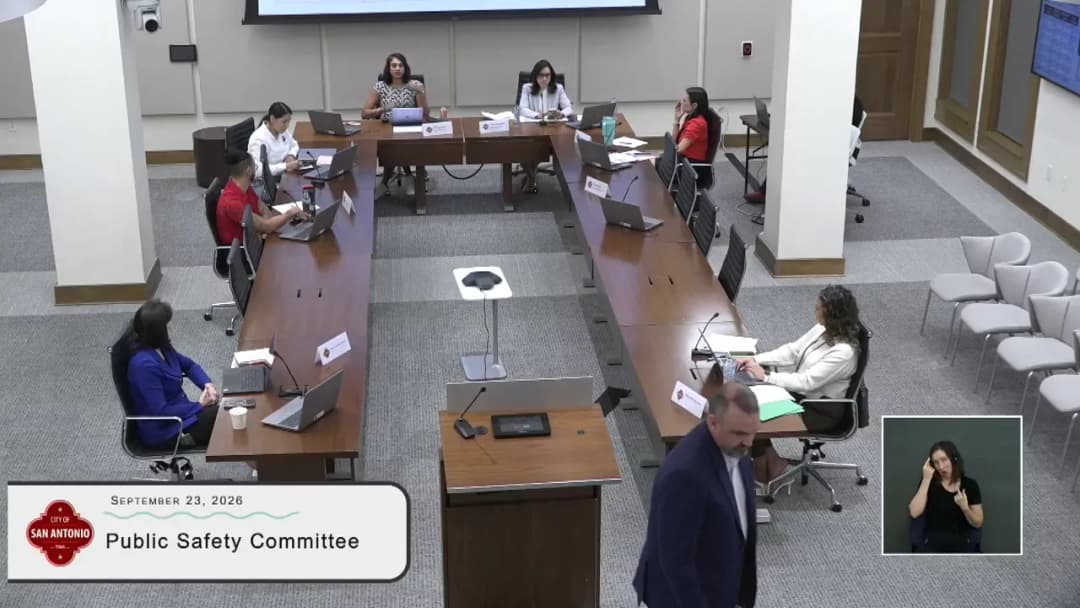
San Antonio Public Safety Committee Meeting - September 23, 2026

The San Antonio Public Safety Committee met on September 23, 2026, at 2:08 p.m., chaired by Chair Core. The committee approved the previous meeting's minutes and received staff briefings on elder abuse and interpersonal violence prevention, a motel safety task force, the residential streetlight gap program, and Animal Care Services performance metrics. The meeting adjourned at approximately 4:03 p.m. Consent Calendar - The committee approved the minutes from the August 31 public safety committee meeting by voice vote, with no opposition or abstentions. Public Comments & Testimony - Vicki, a community advocate and ACS ambassador advocate, stated that city-sponsored spay/neuter contractors reported high no-show rates, leading contractors to request refundable deposits. She said her open records request did not yield data sufficient to calculate no-show rates, and she argued that the city is missing spay/neuter goals because people do not show up for appointments, not because of surgeon availability. She noted that advocates such as John Bachman say more than 100,000 spay/neuter surgeries per year may be needed, and she questioned how critical animal calls are closed. Discussion Items Elder Abuse and Interpersonal Violence Subcommittee Updates - Jessica De Volina, Deputy Human Services Director, and Rebecca Flores, Education Program Administrator, presented progress on the elder abuse subcommittee and the interpersonal violence prevention pilot. - Elder abuse actions in FY 2026 included: expanding "Don't Look Away" training to 10 city departments, smartphone scam training, enrolling older adults in the federal Do Not Call registry, distributing English/Spanish resource guides and no-solicitation signs, launching PSAs and newsletters, partnering with SAPD, Bexar County, Adult Protective Services, and the Bexar County Senior Justice Assessment Center, and commissioning a status of older adults report expected to be presented to the committee in November. - Statistics shared: about 5,000 city staff trained; roughly 500 senior center classes provided through September; benefits navigators helped nearly 500 older adults in FY 2026, with top needs of housing security, financial security, and health care access; a financial counselor worked with 107 older adults; and about 20 cases were referred to outside partners for abuse, neglect, fraud, or exploitation. - On the youth interpersonal violence pilot, DHS partnered with SAISD to embed Project Worth in 16 elementary and middle schools located in Council Districts 2 and 3, in zip codes with higher youth crime rates. Youth crime citywide increased from 1,372 crimes in 2022 to 1,617 in 2025, with District 2 highest, followed by Districts 3, 4, and 5. SAISD counselors will implement the seven-based curriculum during the school day; students select a sixth module, DHS teen ambassadors developed facilitation toolkits, and SAPD SAFE officers will support recognition efforts. - Councilmember Castillo expressed strong support for both initiatives, citing a door-to-door water heater scam and recent youth incidents in District 5, and suggested integrating peer mentors with lived experience from Big Mama Safe House and connecting ACS services to senior pet owners. Councilmember Spears praised the senior center trainings and the in-school pilot, asked about outcome tracking and targeting outreach based on scam/fraud data, and requested that the Do Not Call registry information be shared with field offices and 311. Safe Lodging Partnership Task Force Briefing - Maria Vargas Yates, Director of the Integrated Community Safety Office (ICSO), presented findings in response to a Council Consideration Request submitted in May 2026 by Council District 2 and heard in June 2026. The CCR asked for motel operator engagement, evidence-based intervention review, safety standards and incentives, a pilot program, displacement risk assessment, and a community engagement plan. - ICSO identified 150 motels in San Antonio using exterior-opening room access, median daily rate of $65, median 39 rooms, and median 1.17 acres. Key findings using police, 311, code, and property data from October 2023 to June 2026 include: lower-price motels show more police, 311, and offense activity; motels built 1970-1990 show more activity; motel activity tracks citywide trends; and no relationship was found between ownership type and public safety outcomes. - Eight motels received a minimum of 24 hotspot "doses" (15 minutes of high-visibility patrol) as part of 18 treatment plans, totaling about 2,900 doses from 2023 to June 2026. Q Bed Living received about 1,200 doses in 2024-2025 and entered a DART agreement in November 2025. - Offense comparisons at motels versus citywide: prostitution occurred at 19 times the citywide rate, unauthorized use of vehicle at 3.5 times, and sexual assault at 4.33 times. Compared to similar apartments controlling for size, price, age, and location, motel police calls and offenses showed no real difference, but arrests remained at two times the rate, partly tied to wanted-person offenses at 1.7 times the citywide rate. - Evidence-based program research: voluntary motel safety programs, such as Chula Vista's, were less successful; many cities moved to ordinance-based call-for-service ratios tied to certificates of occupancy, causing some motels to close. Staff noted concern that such standards can encourage operators to suppress calls, particularly domestic violence reports. The presentation emphasized that motels are a low-barrier housing option with no deposits, background checks, income proof, or credit checks, including for justice-involved residents. - Next steps: ICSO will lead an internal department task force including police, code, human services, PBEST, neighborhood housing, and homeless services; engage motel owners and the community in fall and winter; and return with feedback and preliminary recommendations in the January-February timeframe. No formal action was requested. - Councilmember McKee Rodriguez, the CCR sponsor, praised the work; Councilmember Spears asked about and supported a team-based approach; Councilmember Castillo invited ICSO to present to the Roosevelt Neighborhood Association and asked about a timeline for an ordinance if a pilot is unsuccessful, with staff indicating a pilot would need at least six months. Castillo and Chair Core suggested facade improvement grants, lighting, and economic development incentives, and asked about collecting data on local residents using motels. Residential Streetlight Gap Program Briefing - Emine Tomaz, Director of Development Services, presented an update on the residential streetlight gap program created in FY 2022 to install lights in residential areas built before current codes, prioritizing high-crime and low-visibility areas. - The program received $13.88 million over five years. To date, 1,508 lights have been installed out of 2,059 authorized locations; about $900,000 is encumbered for roughly 90 additional lights, and $179,000 remains as a buffer. Staff estimated about 1,625 lights total once remaining funds are used and about 2,700 warranted lights still need funding. The program has closed about 35% of the identified gaps. An online dashboard allows sorting by council district and installation status. - Council discussion focused on how warrant calculations under the current code do not always match community demand. Councilmember McKee Rodriguez asked for a possible evolution using crime data, school locations, and 311 requests, including a request-a-light portal. Chair Core described using CIP funds for about 45 solar and electric lights at roughly $9,200 each near high-walk areas such as schools, parks, libraries, and entertainment districts, while noting that neighbors sometimes reject lights. Councilmember Spears noted some neighborhoods prefer dark skies, and Councilmember Castillo noted two pending lights in District 5 were denied by residents and asked if they could be relocated. - Staff agreed to provide a 311 list of requested and warranted lights and discussed UDC code amendment opportunities. The committee asked staff to return in January or February with a revamped program proposal, including UDC recommendations around schools and high-density public spaces. Animal Care Services Performance Metrics - John Gary, Animal Care Services director, presented FY 2026 performance metrics. Critical call response is nearly 94%, with a next-year goal of 98% and July and August at 98%. Dangerous dog compliance was 72.4%, described as a fluctuating snapshot. Severe bite cases worked were at 100% and moderate at roughly 98%. Live release rate is nearly 88%, the highest in the last three years. Spay/neuter goal was just over 41,000 surgeries; the city will fall slightly short, with about $6 million spent annually on spay/neuter and an estimated 30% no-show rate at off-site clinics. - Gary cited a national veterinarian shortage as the main reason for the shortfall and said ACS is recruiting at Texas A&M, working with a veterinarian recruiter, and offering a vacant full-time veterinarian position with starting salary around $120,000 to $160,000 and a $30,000 sign-on bonus. He also noted a free-roaming dog study with Southwest Research Institute is scheduled for October and November, with results expected in December; the 2019 study estimated 34,000 to 35,000 free-roaming dogs. - Councilmember McKee Rodriguez asked for intake data disaggregated by mechanism (officer pickup, resident drop-off, owner surrender), spay/neuter categories, critical call details, and Houston and Dallas benchmark comparisons. Councilmember Spears asked about no-show follow-up, transportation assistance through the COSA program, mobile spay/neuter options, and which metric is most concerning, which Gary identified as capacity and live release. Councilmember Castillo supported exploring a modest refundable deposit and transportation or pickup options. Chair Core asked about veterinary recruitment strategy and tuition reimbursement ideas. Key Outcomes - The committee approved the August 31 minutes. - Elder abuse and interpersonal violence update: no action required; staff will return in November with the status of older adults report and continue the school pilot. - Safe lodging task force: no action required; ICSO will return in the January-February timeframe with engagement feedback and preliminary recommendations, with possible Council input on a pilot and ordinance direction. - Streetlight gap program: no action; DSD will share 311 warranted light data and return in January or February with a revamped program proposal and UDC amendment recommendations. - Animal Care Services: John Gary will return in October with disaggregated intake data, spay/neuter no-show and category data, critical call information, Houston and Dallas comparisons, and an update on the free-roaming dog survey timeline.
PUBLIC SAFETY 50% · ANIMAL WELFARE 17% · LIGHTING REGULATIONS 12% · YOUTH PROGRAMS 11%
4552
SEP 23, 2026 · SAN ANTONIO, TEXAS · BOARDS & COMMISSIONS
San Antonio Planning Commission Meeting – September 23, 2026

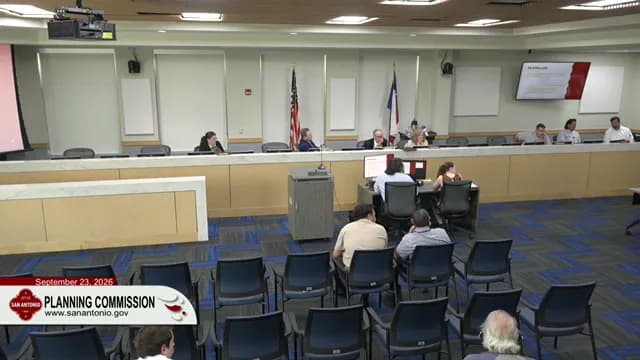
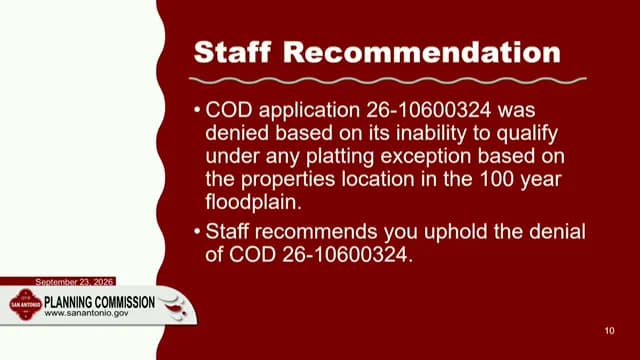
The San Antonio Planning Commission met on Wednesday, September 23, 2026, at 2:00 PM to consider consent agenda items, three land-use cases, and one appeal. The meeting lasted approximately one hour and concluded at 3:00 PM. Commissioner Peck presided. A quorum was present. Consent Calendar - All agenda items except items 11, 12, 13, and 17 were approved under a single consent motion. Item 9 was withdrawn. Item 12 was postponed but a separate postponement was needed for Item 2, which was heard individually. The consent vote passed unanimously. Public Comments & Testimony - Item 3 (Subdivision Plat): Sonia Samples, owner at 4106 Daven Heads, opposed a subdivision plat at the intersection of Eisenhower and Kingston, citing inadequate parking, blocked access to mailboxes, and emergency vehicle access concerns. She requested denial. - Item 13 (Mixed-Use Plan Amendment): Jessica Morales, resident at 144 West Hart, opposed the Gonzava Medical Group’s parking garage project, describing 40 years of traffic, construction, and parking problems despite existing no-parking signs. She asked for denial. - Item 11 (Plan Amendment – Industrial Use): No public testimony opposed the request; the applicant’s representative, A. Brown, noted changes including a 25-foot buffer and conversations with the neighborhood association. - Item 17 (Appeal): The appellant’s engineer, Edgar Muñoz, argued that the code prohibits a dwelling unit in the floodplain, not a lot, and that the proposed house would sit outside the regulated flood study area. No public comments were made in opposition. Discussion Items - Item 11 – Plan Amendment for 142 Gambler Road: A request to reclassify a lot from industrial to light-industrial/IDZ3 within the Arena East Side Community Plan, to allow commercial parking, entertainment, equipment sales, and storage. Staff recommended denial because industrial use was inappropriate for the area, but the applicant proposed a 25-foot buffer and held multiple discussions with the neighborhood association. The commission approved the request. - Item 13 – Plan Amendment for South Placenton Road: A request to change the land-use designation from low-density residential to mixed-use on 35 notified properties (2 opposed, 1 in favor) to allow a parking garage for Gonzava Medical Group. Staff recommended approval, finding the mixed-use designation consistent with surrounding areas. The commission approved. - Item 17 – Appeal of Determination for 3599 West Woodlawn Avenue: An appeal of the staff’s denial of a Certificate of Determination for a single-family lot partly within a 100-year flood study area. Staff argued that under UDC Section 35-430(c)(6), no dwelling unit is allowed in the regulatory floodplain without a subdivision plat, and the lot’s configuration does not qualify for the “one dwelling unit” exception. The applicant contended the code says “dwelling unit” not “lot,” and the structure would be built outside the flood study boundary. Commissioners debated the intent of the 2015 UDC amendments, with some supporting the staff’s strict interpretation and others favoring the applicant’s plain-language reading. No motion to approve, deny, or postpone obtained the required five votes; thus the appeal was not granted, leaving the staff’s denial in effect. Key Outcomes - Item 11 – Approved: Motion by Commissioner Siegel, second by Commissioner Profit, to support the applicant’s request. Vote: 6–0 (all in favor). - Item 12 – Postponed: Motion to continue the item to October 14, 2026. Vote: unanimous. - Item 13 – Approved: Motion by Commissioner Profit, second by Commissioner Lopez. Vote: 6–0 (all in favor). - Item 17 – Appeal Not Granted: - Motion to approve the applicant’s request (approve the Certificate) failed 3–4 (yes: Oren, Lopez, Siegel; no: Miller, Profit, Bustamante? Actually vote listed: Oren yes, Lopez yes, Miller no, Siegel yes, Profit no, Peck? The chair said motion failed; count appears to be 3–3? But requirement is 5 votes for passage.) - Motion to deny the appeal failed 3–4 (yes: Profit, Miller, Peck; no: Lopez, Oren, Bustamante, Siegel). - Motion to postpone to October 14 failed 3–3 (yes: Bustamante, Oren, Siegel; no: Miller, Profit, Peck; Lopez not recorded). - Because no action achieved a majority, the appeal was deemed denied. The applicant may resubmit with a new $200 fee. - Next Steps: The commission adjourned at 3:00 PM. No staff report was presented.

ZONING AND LAND USE 68% · FLOODING 13% · PROCEDURAL 10% · PUBLIC ENGAGEMENT 9%
4553
SEP 23, 2026 · SAN ANTONIO, TEXAS · BOARDS & COMMISSIONS
San Antonio Planning Commission Meeting Summary - September 23, 2026

The San Antonio Planning Commission met on Wednesday, September 23, 2026, at 2:00 p.m. to consider several agenda items, including a consent agenda, a plan amendment for a light industrial use, a plan amendment for a parking garage, and an appeal of a certificate of determination. The meeting adjourned at 3:00 p.m. with decisions on multiple items. Consent Calendar - The consent agenda included items recommended for approval by staff with no public opposition or need for detailed discussion. Items were approved in a single motion with a roll call vote. All commissioners present voted in favor: Commissioner Profit, Miller, Lopez, Orion, Siegel, and Chair Peck. Commissioner Bustamante recused himself from item 2 prior to the vote. Public Comments & Testimony - Item 3 (Plat approval at 4102 Eisenhower Road): Sonia Samples, a homeowner at 4106 Diamond Head, opposed further commercial development on the property. She cited visual blight (semi-trailers, storage containers), inadequate parking leading to blocked driveways and mailboxes, traffic congestion during events, and safety hazards for emergency vehicle access. She urged the commission to deny the request. Staff noted the plat met all code requirements with no variances and was required by law to be approved. The consent agenda passed. - Item 13 (Plan amendment at 717 Pleasanton Road): Jessica Morales, a resident of 144 West Hart, opposed the rezoning and parking garage proposal by Gonzaba Medical Group. She stated that for 40 years the medical group had caused parking and traffic problems in the neighborhood, bought out senior neighbors' properties, and that construction had been ongoing. She requested peace and opposed all further development. The applicant's representative, Patrick Christensen, apologized and noted the parking garage was intended to reduce street parking; he promised to relay concerns to Gonzaba. Discussion Items - Item 11 – Arena District East Side Community Plan Amendment (142 Gembler Road): Staff recommended denial of a request to amend the land use designation from community commercial to light industrial, citing encroachment into a residential area. The applicant (Vanessa Wertzer) presented a revised site plan with a 25-foot landscape buffer and noted discussions with the United Homeowners Improvement Association (UHIA), which supported the change. The commission voted to support the applicant's request. Motion by Commissioner Siegel, second by Commissioner Profit. Roll call: Siegel (yes), Profit (yes), Lopez (yes), Miller (yes), Orion (yes), Bustamante (yes), Chair Peck (yes). Motion passed 7-0. - Item 12 – Continuance: The commission voted to continue item 12 to the October 14, 2026 meeting. Motion by Commissioner Miller, second by Commissioner Profit. Roll call: Miller (yes), Profit (yes), Lopez (yes), Orion (yes), Bustamante (aye), Siegel (yes), Chair Peck (yes). Passed. - Item 13 – South Central Community Plan Amendment (717 Pleasanton Road): Staff recommended approval of a mixed-use land use designation to allow a parking garage for Gonzaba Medical Group. The applicant noted the property currently had split designations and needed a cohesive plan for the parking structure. After public testimony, the commission voted to approve. Motion by Commissioner Profit, second by Commissioner Lopez. Roll call: Profit (yes), Lopez (yes), Miller (yes), Orion (yes), Bustamante (yes), Siegel (yes), Chair Peck (yes). Passed 7-0. - Item 17 – Appeal of Certificate of Determination (3599 West Woodlawn Avenue): The applicant, represented by Edgar Munoz, appealed staff’s denial of a certificate of determination for a new single-family home on an antiquated lot in the 100-year floodplain. The applicant argued that the dwelling unit itself would not be located in the floodplain, citing UDC Section 35-430(C)(6)(G) which states no dwelling unit shall be located in the regulatory floodplain. Staff maintained that habitable uses in the floodplain always require platting, and that the certificate is tied to the lot, not a specific building plan. Stormwater staff noted platting would establish floodplain easements and ensure safe access. After extensive debate, a motion to approve the applicant’s request failed 3-4 (Commissioners Orion, Lopez, Siegel in favor; Miller, Profit, Peck opposed; Bustamante absent? Actually roll call: Lopez yes, Miller no, Siegel yes, Profit no, Peck no. That’s 3 yes, 3 no? The chair clarified five votes required for approval. Motion to deny the appeal also failed 3-4 (Profit yes, Miller yes, Lopez no, Orion no, Bustamante no, Siegel no, Peck yes). A motion to continue to October 14 failed 4-3 (Bustamante aye, Orion yes, Lopez yes, Miller no, Siegel yes, Profit no, Peck no – again needing five votes). As a result, staff’s administrative denial stood. Key Outcomes - Consent calendar approved unanimously. - Item 11 approved (7-0) – plan amendment to light industrial with modifications. - Item 12 continued to October 14, 2026. - Item 13 approved (7-0) – plan amendment to mixed use for parking garage. - Item 17 appeal denied – no motion received five votes; staff’s denial of the certificate of determination stands. The applicant may submit a new application. The meeting adjourned at 3:00 p.m.

ZONING AND LAND USE 62% · PROCEDURAL 16% · FLOODING 12% · PLANNING 5%
4554
SEP 23, 2026 · DALLAS, TEXAS · CITY COUNCIL
Dallas City Council Meeting – September 23, 2026: Land Acquisition, Budget Amendments, Zoning Debates, and Street Name Change Controversy

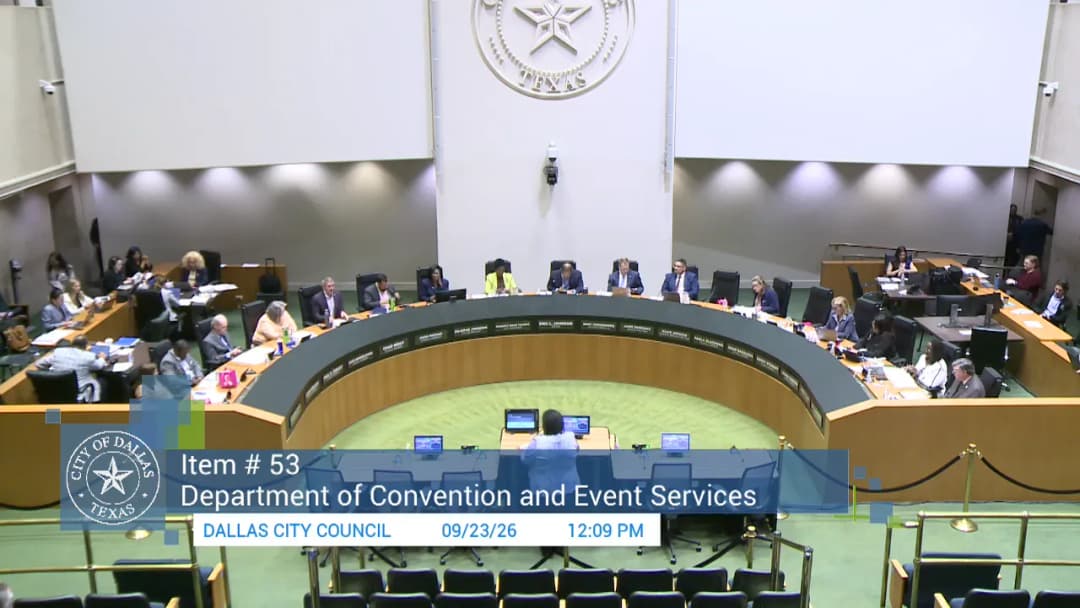
The Dallas City Council met on Wednesday, September 23, 2026, at 9:23 AM in the Council Chambers. The meeting included special recognitions, public comments, consent agenda approvals, individual consideration items, and public hearings on zoning and street name changes. Key actions included approval of the Cadillac Heights land acquisition (item 26), denial of a facilities condition assessment contract (item 27), adoption of the FY 2025-26 budget amendment (item 41), and passage of a $2.68 million convention center management extension (item 53). A controversial street name change for North Harwood Street to 'Exchange Place' failed to reach the required 12 votes and was held under advisement until October 14, 2026. The zoning case Z11 for 37 patio homes on Walnut Hill Lane was approved after a motion to reduce height to 30 feet failed, with a final vote of 9-5. Consent Calendar - Items 2–47 were approved with deletions (items 6 and 8 removed) and corrections. Notable approvals include: - Item 2: $1,355,395 for the MVCPA Catalytic Converter Theft Prevention Grant (including $227,026 local match). - Item 9: $5,147,500 contract renewal with The Bridge for homeless shelter services. - Item 17: $28,008,458 for the Dallas Zoo Safari Trail Project Phase I (includes $18,383,458 in capital gifts and $9,625,000 from bonds). - Item 20: $1,188,662 TIF development agreement for The Highlands Village project in the Skillman Corridor. - Item 39: $2,658,246 for design of Jefferson Complete Street from Hampton to Polk. - Item 41 (after pull): FY 2025-26 budget amendment authorizing transfers and appropriations totaling $5,967,988,552. - Item 42 (after pull): Deferred to December 9, 2026, a forgivable loan for The Stewpot. - Item 47: $326,099 grant for South Dallas Drug Court Expansion. Public Comments & Testimony - Shanita Cleveland urged the council to save Dallas City Hall, stop employee furloughs, address flock camera surveillance, and fix potholes, stating the city belongs to its people. - Catherine Parker opposed the rezoning of Preston Royal Shopping Center, asking the council to consider long-term consequences for neighborhoods and listen to longtime residents. - William Hopkins spoke for 29 years about lead contamination in West Dallas, claiming the city ignored deaths from lead exposure and alleging a cover-up involving officials. - Trinity EK invited council members to participate in 'Week Without Driving' (October 1–8) and to attend a meeting without cars on October 7. - Nora Soto demanded consent items 2 and 4 be pulled, accusing the council of using grant funds for flock cameras despite public opposition, and criticized the city's handling of West Dallas lead issues. - Barrett Johnston (on item 2) asked for separate votes on items 2 and 4, citing that state grants for auto theft could fund flock cameras; he also thanked the mayor for creating a 'socialist sanctuary.' - Anan Mantherum (on item 9) spoke in support of The Bridge shelter, reporting 6,311 unduplicated day shelter guests (105% of goal), 2,480 night shelter guests (149%), and 585 housed (156%), but noted 100–150 people are turned away nightly. - Multiple speakers on Z11 (Walnut Hill patio homes) uniformly requested a 30-foot height limit and two-story maximum, citing compatibility, traffic, and precedent concerns. 85% of a neighborhood survey (271 respondents) opposed the plan. - On PH3 (alcohol variance), church members opposed a mixed-beverage permit for a restaurant 16 feet from Stephen Temple Church, citing parking, safety, and disruption. The owner argued her business would improve the area. - On Z10 (South Dallas zoning), Julie Sackaton urged denial, stating the request exceeded the recently adopted PD 595 framework and would dwarf historic buildings. Discussion Items - Item 26 – Cadillac Heights Land Acquisition: The council debated $800,500 for three dwellings and two vacant lots (28,178 sq ft) for a future city service center, funded by 2006 bond proceeds originally for a police academy. Councilmembers Mendelson and Ridley questioned the repurposing, lack of a plan, and impact on displaced residents. Deputy Mayor Pro Tem Johnson and Councilmember Moreno supported it as a long-term community benefit. The item passed 9-5. - Item 27 – Facilities Condition Assessment: A motion to deny the $3,493,200 contract with Tetra Tech succeeded. Councilmember Mendelson argued using bond funds for a report was fiscally irresponsible and noted the previous assessment (2017) was outdated. No further action was taken. - Item 41 – Budget Amendment: Councilmember Mendelson questioned the use of ARPA funds for general fund expenses and highlighted $491 million in debt service. The amendment passed without opposition after clarification that $103.4 million was previously approved capital. - Item 42 – Stewpot Loan: Deferred to December 9, 2026, at the request of staff and First Presbyterian Church. - Item 53 – Convention Center Management Extension: A $2,675,479 five-month extension with Global Spectrum (OVG) passed 8-6 after debate. Critics cited poor performance at Fair Park; supporters emphasized a smooth transition to new management and retention of 24 conventions. - Z11 – Walnut Hill PD: Councilmember Willis proposed a motion with a 30-foot height limit for lots adjacent to the church (lot 3), but not for all units. Councilmember Mendelson moved to amend requiring all structures to be 30 feet/two stories, 19 guest parking spaces, and 16.8% open space. After amendment to the amendment (striking the 30-foot limit), the final motion passed 9-5, allowing 37 homes with four live-story units in the southeast corner (up to 36 feet). - PH1 – Street Name Change: A proposal to rename a segment of North Harwood Street to 'Exchange Place' failed 9-10 (12 required). A motion to hold under advisement until October 14 passed 8-6. - Z10 – South Dallas Zoning: The council voted to deny the request for MU-3 or FWMU-5 zoning, following the Planning Commission recommendation. Councilmember Basildúa cited lack of concrete plans and community opposition. Key Outcomes - Votes & Decisions: - Item 26 (land acquisition) passed 9-5. - Item 27 (facilities assessment) denied by voice vote. - Item 41 (budget amendment) approved by voice vote. - Item 53 (convention center extension) passed 8-6. - Z11 (Walnut Hill PD) approved 9-5. - PH1 (street name change) failed to reach 12 votes; held under advisement until October 14. - Z10 (South Dallas zoning) denied by voice vote. - PH3 (alcohol variance) held under advisement until October 14. - Directives: - Staff to provide a full briefing on Cadillac Heights plans to full council. - City Manager to report on homeless service investments financials. - Convention and Event Services to transition OVG sub-vendor contracts to Visit Dallas or direct city management by February 2027. - Referrals: None. - Next Steps: Deferred items will return on October 14, 2026 (PH1, PH3) and December 9, 2026 (item 42).

ZONING 30% · REAL ESTATE MANAGEMENT 10% · PUBLIC SAFETY 9% · PROCEDURAL 7%
4555
SEP 23, 2026 · CARMEL, INDIANA · CITY COUNCIL
Carmel Central DORA Committee Meeting Summary – September 23, 2026

The Carmel Central DORA (Designated Outdoor Refreshment Area) Committee met on September 23, 2026, to consider two proposed additions to the program's approved cup options. Both items were introduced by local business representatives and were approved unanimously. The committee also discussed sidewalk markers and a DORA map graphic. Consent Calendar - No consent calendar was presented. The meeting had two action items, both handled as discussion/vote items. Public Comments & Testimony - No members of the public attended the meeting. The chair noted there were no complaints, marking a positive contrast to earlier DORA program meetings at council. Discussion: Hot Beverage Cup (Hotel Carmichael) - Jamie Hopwood, Area General Manager for Quarry Hospitality and Hotel Carmichael, formally requested approval to introduce a new insulated, double-walled cup for hot beverages. He explained that the current aluminum cup is unsafe for hot liquids because the beverage overheats the metal and can burn the consumer. He noted that inserts and sleeves (koozies) were considered but did not solve the problem. - Committee discussion included concerns about multiple cup SKUs, cost, and enforcement. One member (representing Fork and Ale) shared their experience using koozies and double-cupping for hot toddies and mulled drinks, but questioned whether an additional cup would undermine the program's branding and enforcement. They suggested possibly using one universal cup for all seasons. - The committee emphasized that any new cup must be clearly identifiable as a DORA cup, with the DORA logo visible (no sleeves covering it). The Police Department confirmed they would need clear communication about approved cup designs for enforcement. - A motion was made and seconded to approve the exploration of a clearly identified, double-walled, 12-ounce hot beverage cup with a lid, with pricing and sourcing details to be provided by the applicant. The motion passed unanimously (all ayes, no nays). - Timeline: Jamie Hopwood indicated a need to have the cup by November 15, 2026. The committee requested multiple quotes from different vendors (e.g., GFS, Cisco) and noted the typical 6–8 week print job turnaround. Discussion: Smaller Aluminum Cup for Wine (Wine and Rhyme) - Madeline (representing Wine and Rhyme) presented a request for a smaller aluminum DORA cup (9-ounce or 12-ounce) to address the issue of serving 6-ounce and 8-ounce wine pours in the existing 16-ounce cup. She explained that the current cup makes pours appear short, leading to customer complaints and staff overpouring, which risks over-serving alcohol. - She displayed samples of the new 9-ounce and 12-ounce aluminum cups (which Ball now offers). She stated a preference for the 9-ounce but remained open to the 12-ounce if other businesses preferred it. - Committee members discussed alternatives such as pouring in front of guests or using a craft, but Madeline noted these are time-consuming during busy periods. Members noted that adding a smaller cup is not an enforcement issue but could create warehousing/ordering challenges for distributors (minimum orders of 10,000 cups). - One member suggested exploring a bulk purchase or local warehousing solution to reduce costs. Another brought up the idea of using stickers on generic cups, but the committee noted this was previously rejected by the council. - A motion was made and seconded to explore the opportunity for a 9-ounce metal DORA cup. The motion passed unanimously. Key Outcomes - Unanimous approval to pursue a hot beverage cup: clearly identified, double-walled, 12-ounce, with a lid. The applicant (Hotel Carmichael) will provide pricing, sourcing, and timeline details to the committee, with a target completion date of November 15, 2026. - Unanimous approval to pursue a smaller 9-ounce aluminum DORA cup (with the option to consider 12-ounce if other businesses prefer). Wine and Rhyme will gather pricing and vendor details, and the committee will coordinate with city staff for website updates and distribution. - Both decisions were exploratory in nature – final adoption will occur after pricing and logistics are presented to the committee. - The committee also discussed sidewalk markers (some thermoplastic replacements were installed on a trial basis) and a DORA map graphic, noting that the city's website already has a map that businesses can print for customers. Next Steps - Hotel Carmichael and Wine and Rhyme will gather vendor quotes and supply chain information for their respective cup proposals. - The committee will receive updates via email and will revisit final approvals once details are available. - City staff will be involved in updating the DORA cup list on the website and communicating approved designs to the police department. Meeting adjourned.

FOOD AND BEVERAGE TAX 78% · PROCUREMENT 14% · PROCEDURAL 8%
4556
SEP 23, 2026 · NEW YORK CITY, NEW YORK · CITY COUNCIL
Oversight Hearing on Gender-Affirming Care for Transgender and Nonbinary Youth – September 23, 2026

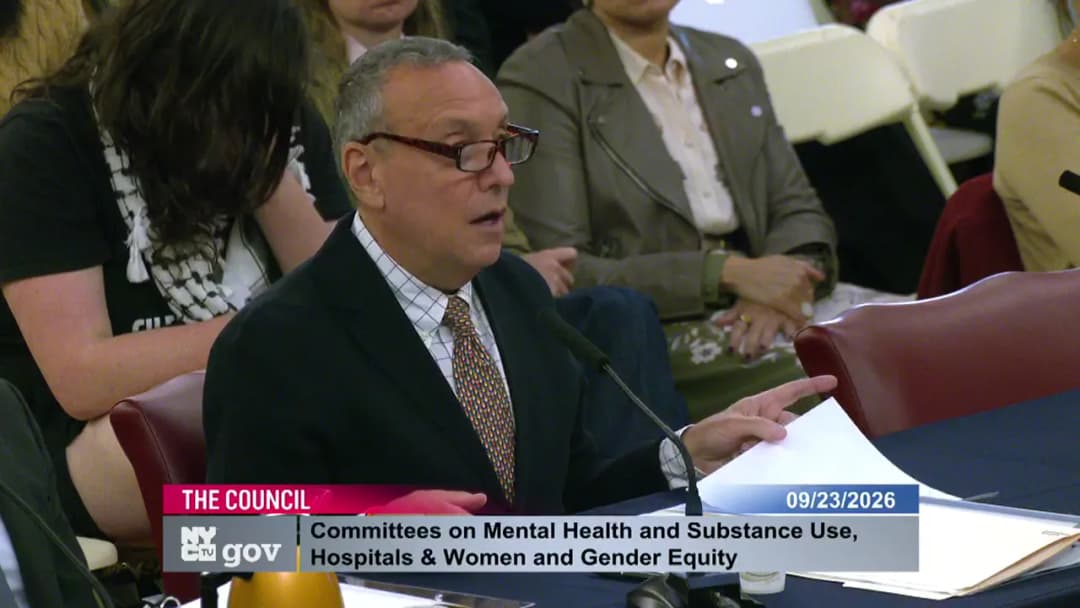
On September 23, 2026, the New York City Council Committees on Hospitals (Chair Mercedes Narcisse), Mental Health and Substance Use (Chair Tiffany Cabán), and Women and Gender Equity (Chair Amanda Farías) held a joint oversight hearing on access to gender-affirming care and associated mental health outcomes for transgender and nonbinary youth. The hearing featured testimony from city administration, advocates, and community members, and considered three pieces of legislation: Int. 0949-2026, Res. 0208-2026, and Res. 0547-2026. Public Comments & Testimony - Multiple community members and advocates testified in strong support of the three bills, emphasizing that gender-affirming care is life-saving, evidence-based health care. - Youth and parents shared personal stories of struggling to find affirming care, experiencing interruptions in care due to hospital capitulations (Mount Sinai, NYU Langone, and New York Presbyterian), and the mental health toll of federal attacks. - Speakers raised concerns about the proposed resource map in Int. 0949-2026, noting potential privacy and safety risks for providers and patients. - Several organizations—including New York Transgender Advocacy Group, Make the Road NY, NYCLU, Legal Aid Society, Planned Parenthood of Greater NY, and Girls for Gender Equity—supported the resolutions and urged expanded access to care, mental health services, and stronger privacy protections. Discussion Items - Administration Testimony: Taylor Brown, Director of the Mayor's Office of LGBTQIA+ Affairs, testified that the administration opposes federal attacks and announced a $15 million investment over three years to protect and expand youth gender-affirming care, including a direct care access fund, a call/chat line, and research. Dr. Andrew Wallach and Dr. Omar Fital from NYC Health + Hospitals described their system's eight Pride Health Centers, telehealth capacity, and culturally responsive care, affirming that they have not changed their scope of practice. - DOHMH Testimony: Assistant Commissioner Marnie Davidoff presented data from the 2023 Youth Risk Behavior Survey showing that transgender (42%), nonbinary (38%), and questioning (28%) high school students reported suicidal ideation at significantly higher rates than cisgender peers (16%). She stated that DOHMH views access to gender-affirming care as a suicide prevention strategy, and noted the agency's family peer support programs and training for providers. - Legislative Discussion: Councilmembers quizzed administration on the accuracy and updating of the NYC Health Map, continuity of care for patients discharged from private hospitals, and mental health capacity. The administration supported Int. 0949-2026 but raised technical clarifications. Res. 0208 and Res. 0547 were discussed as critical to expanding anti-bias training and establishing a state gender-affirming care access program. - Public Advocate Remarks: Jumaane Williams spoke in support of the bills and urged the city to strengthen provider training, ensure insurance coverage, and protect patient privacy. Key Outcomes - Oversight Hearing: The hearing was held and filed by the Committee on Hospitals. - Int. 0949-2026: Hearing held, laid over by committee. - Res. 0208-2026: Hearing held, laid over by committee. - Res. 0547-2026: Hearing held; an amendment (Proposed Res. No. 547-A) was proposed and adopted by committee; then the amended resolution was laid over. - All three pieces of legislation remain pending for future committee action. Written testimony may be submitted for 72 hours post-hearing. - The council committed to continued collaboration with the administration and community to protect and expand access to gender-affirming care for transgender and nonbinary youth.

LGBTQ+ 70% · MENTAL HEALTH AWARENESS 11% · PUBLIC HEALTH 11% · HOMELESSNESS 2%
4557
SEP 23, 2026 · NEW YORK CITY, NEW YORK · CITY COUNCIL
Oversight on Mental Health Care in NYC Jails and Three Introductions – September 23, 2026

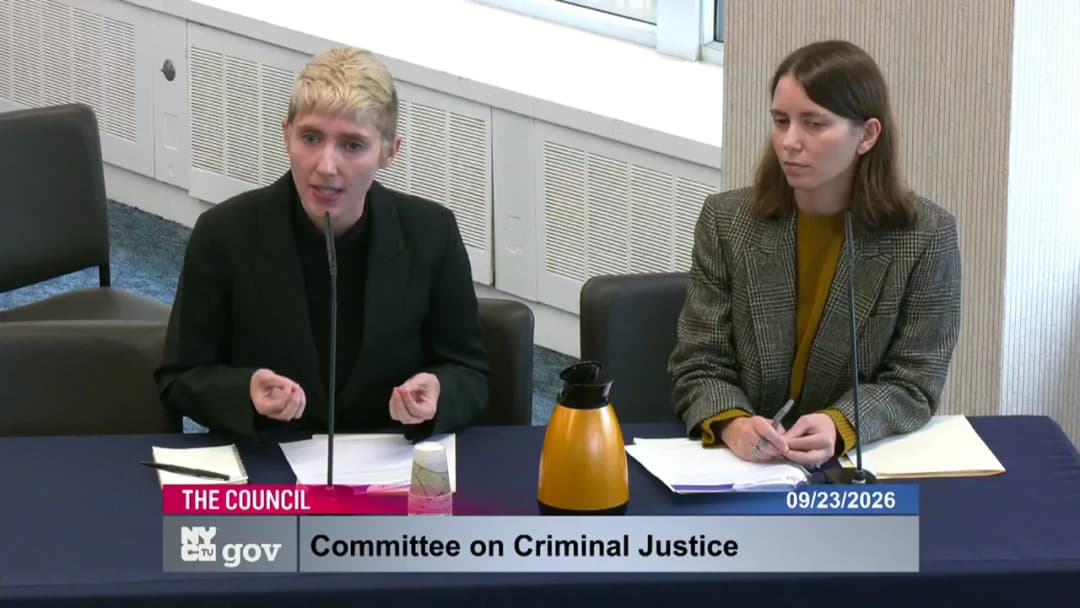
The New York City Council Committee on Criminal Justice, chaired by Selvena N. Brooks-Powers, held a hearing on September 23, 2026, to examine mental health care in city jails, including specialized housing, medication access, discharge planning, and the impact of lock-ins. The committee also heard three introductions: Int 0133 (extending the TGNC/NBI task force), Int 0453 (mental health referrals for children visiting incarcerated individuals), and Int 0809 (policies for medical needs during lock-ins). All three introductions were laid over by the committee. Public Comments & Testimony - Legal Aid Society (Barbara Hamilton): Reported that clients with serious mental illness are often deadlocked (isolated) for extended periods without meaningful treatment, citing a client deadlocked for about a year (on and off) as of spring 2026, and another in a PACE unit denied recreation and basic hygiene supplies. Contradicted DOC’s sworn testimony that deadlocking is not occurring. - New York County Defender Services (Raji Deyat Mangalum): Shared success stories of two clients diverted to community-based treatment via alternative-to-incarceration (ATI) courts, urging the council to support the Treatment Court Expansion Act to divert more people from jail. - Task Force Advocates (Ethan Lowe, Lucas Marquez, Rachel Golden, Maya Zelkind, Camila Ruda): Expressed strong support for Int 0133 with amendments to strengthen task force independence, and urged passage of Int 0134 (gender-aligned housing protections). Testimony from a formerly incarcerated trans woman described repeated sexual assault and denial of gender-aligned housing. - Freedom Agenda (Darren Mack): Called for immediate investments in community-based housing and mental health services, noting that 49.6% of people leaving Rikers with a mental health diagnosis return within a year. Supported Int 0134. - Independent Rikers Commission (Zachary Katzen Nelson): Criticized DOC for failing to implement new deadlocking prevention measures beyond telling staff to stop, and noted that crisis intervention training has fallen apart. - Osborne Association (Tereny Garamella): Opposed Int 0453 as written, arguing DOC should not assess children’s mental health; instead, community-based resources should be made available at visiting areas. - Women’s Prison Association (Miriam Goodman): Opposed Int 0453, stating that trauma-responsive care cannot be provided by the correctional system; invested in community-based providers. - CACES (Nadia Chite): Described a client released without a needed long-acting injectable, Medicaid set to inactive, and no prescription sent to a pharmacy – highlighting systemic failures in discharge planning. - Justice for Families (Janet Bocanegra): Strongly opposed Int 0453, warning that assessments could lead to child welfare involvement; urged investment in community resources. - Exalt Youth (Giselle Castro): Supported all three introductions but emphasized need for multi-year flexible contracts for frontline organizations. - Other speakers (Urban Justice Center, Make the Road New York, Exodus Transitional Community, Children of Promise NYC, and individuals with lived experience): Generally supported Int 0133 and Int 0134, opposed Int 0453 as written, and called for expanded community-based mental health services, better discharge planning, and diversion from jail. Discussion Items - Oversight – Mental Health Care in City Jails: Chair Brooks-Powers opened with statistics: 60% of people in city jails have a documented mental health need, and approximately 1 in 5 has a serious mental illness (SMI). Dr. Otanakar (CHS) testified that 61% of patients receive mental health services and 22% have SMI. He described the continuum of care: general population (outpatient model), 17 Mental Observation (MO) units (629 patients), STEP, and 10 PACE units (including a 20-bed unit at Bellevue). CHS reported that about 10% of mental health appointments are missed due to non-production (no escort, alarm, lockdown). IBO presented analysis: of 19,000 discharges in FY26, 58% had a history of mental illness, 30% had both mental illness and homelessness, and 93% of TGNC/NBI individuals had mental illness history. Councilmembers questioned DOC and CHS on housing placements, medication access, the 83% increase in SMI since 2022, and the impact of lockdowns on care. - Int 0133 – Extending the TGNC/NBI Task Force: Councilmember Cabán sponsored the bill to extend the task force. She noted that trans, non-binary, and intersex individuals face discrimination and violence in DOC custody. Advocates supported the bill but urged amendments to ensure independent administration, meaningful agency participation, and transparency. DOC expressed support for the task force but had not implemented key recommendations (e.g., automatic independent review of housing denials). DOC data showed 106 denials out of 231 applications for gender-aligned housing in FY26. - Int 0453 – Mental Health Services for Children Visiting Incarcerated Individuals: Councilmember Stevens sponsored the bill, sharing a personal story of a young person who needed support after a parent’s incarceration. DOC stated it does not believe it is the best agency to deliver these services, and advocates strongly opposed the bill as written, warning of potential surveillance and child welfare involvement. The bill was laid over. - Int 0809 – Medical Needs During Lock-Ins: Chair Brooks-Powers sponsored the bill. DOC testified that 0.1% of missed medical appointments in 2026 were due to lock-ins, but the department could not provide granular data on lock-in frequency or duration. CHS said it works to reschedule missed appointments. Chair expressed frustration that DOC came without data to inform the legislation. - Deadlocking Allegations: DOC testified that deadlocking (isolating individuals in cells, often without access to care) is not occurring and that any past allegations were investigated. However, Legal Aid testified that in 2026 they have clients who have been deadlocked, citing ongoing court proceedings. This direct contradiction was noted. - Discharge Planning and Compliance: CHS reported it is close to full staffing of social workers (only one vacancy), but IBO and advocates noted persistent gaps in ensuring released individuals have medication, Medicaid, and community appointments. The Brad H. settlement remains a concern. Key Outcomes - All three introductions (Int 0133, Int 0453, Int 0809) were laid over by the committee (no vote taken). The committee will consider further amendments and testimony. - Chair Brooks-Powers publicly requested that all agencies submit testimony at least 24 hours in advance of future hearings, expressing frustration that the administration failed to do so for this hearing, impeding meaningful preparation. - The committee will follow up on deadlocking allegations after Legal Aid provided information about current court orders and clients in isolation. - DOC committed to providing additional data on lock-in frequency, duration, and reasons, as well as on the clinic production dashboard pilot. - Multiple public testimonies urged the council to pass Int 0134 (gender-aligned housing protections), which was not on today’s agenda but was referenced as a priority by advocates and co-sponsored by the chair.

MENTAL HEALTH AWARENESS 53% · CRIMINAL JUSTICE REFORM 16% · LGBTQ+ 10% · PUBLIC SAFETY 9%
4558
SEP 23, 2026 · NEW YORK CITY, NEW YORK · CITY COUNCIL
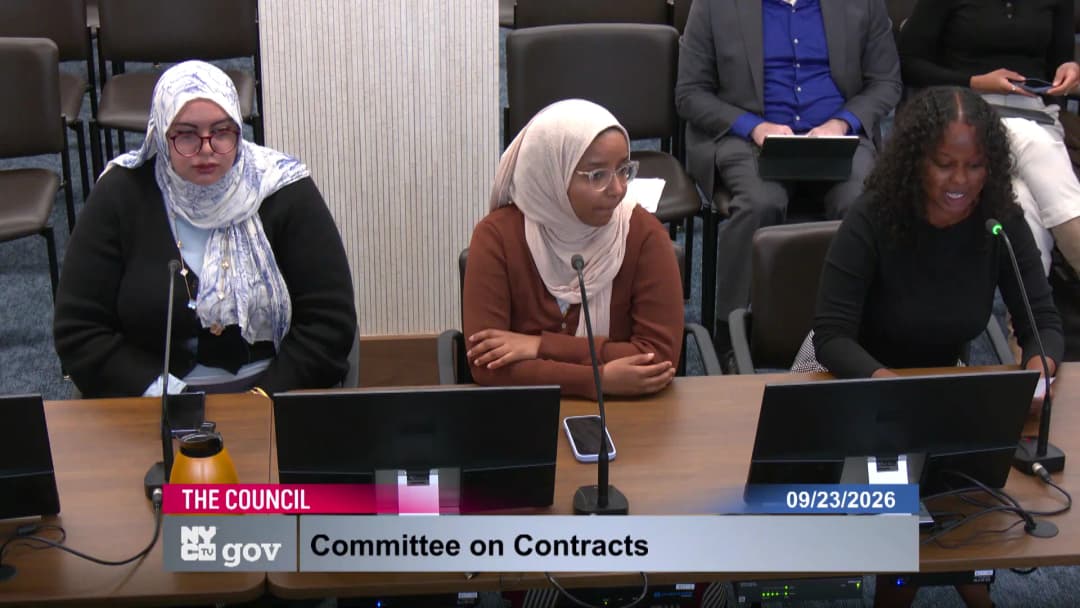
New York City Council Committee on Contracts Holds Oversight Hearing on M/WBE Utilization and Considers Four Bills - September 23, 2026

On September 23, 2026, the New York City Council Committee on Contracts, chaired by Lincoln Restler, held an oversight hearing on minority- and women-owned business enterprise (M/WBE) utilization in city contracts. The committee also considered four introduced bills: Intro 208 (adding Middle Eastern and North African Americans to disparity studies), Intro 694 (requiring targeted agency outreach when utilization goals are missed), Intro 834 (requiring reporting on subcontracts for human services contracts), and Intro 896 (prohibiting city agencies from procuring non-compostable single-use cups). Present were Councilmembers Restler, Brewer, Stevens, Vernikov, and Farías (sponsor of Intro 694). All introductions were heard and laid over. Public Comments & Testimony - Rana Abdelhamid (Malika, Queens-based organization): Testified in support of Intro 208, urging codification of MENA inclusion in disparity studies to ensure data collection and accountability regardless of administration changes. - Ikrama Romaim (Women’s Empowerment Coalition of NYC): Supported Intro 208, emphasizing that data on MENA-owned businesses is needed to understand disparities and tailor support. - Bayadir Mohammed Osman (Muslim Community Network): Shared a personal story of her father’s bodega and stressed that MENA businesses are invisible in current data, leading to missed opportunities. - Naima Tahir (Arab American Family Support Center): Highlighted that the latest disparity study did not separately identify MENA firms, masking barriers. She urged passage of Intro 208. - Matt Gove (Surfrider Foundation): Testified in support of Intro 896 but warned that allowing compostable cups as a substitute creates a loophole; recommended requiring reusable cups instead. - Eve Fox (Story of Stuff Project): Opposed the compostable exemption in Intro 896, citing health risks from PFAS and bioplastics, climate footprint, and lack of composting infrastructure. - Vicky Abugalium (Story of Stuff Project / Reusable NYC Coalition): Urged removal of compostable language and replacement with reuse systems, such as water bottle refill stations in city buildings. - Yakob Yatsi Liel (Association of Black Contractors): Criticized the M/WBE program as a “mechanism of disenfranchisement,” called for reform, and requested that future hearings include testimony from affected small businesses. - Tanisha Heard (Bronx Chamber of Commerce): Expressed full support for Intros 208 and 694, noting the growing MENA community in the Bronx and the need for stronger outreach when goals are missed. Discussion Items Oversight of M/WBE Utilization Chair Restler opened with data showing that in FY25, M/WBEs received only 5% of total city contracting spend ($2.44 billion out of $46 billion). Among contracts subject to Local Law 174, the share of contract value fell from 17% in FY24 to 8% in FY25. Black-owned firms accounted for 7% of M/WBE contracts, Latino-owned firms 7.9%, black women 1.17%, and Latinas 1.22%. Average M/WBE contract value was $750,000 versus $3.65 million for white-male-owned firms. About 65% of M/WBE contracts were registered retroactively. Since FY22, nearly $33 billion in contracts subject to Local Law 174 had no subcontract records; only 9% of prime contracts had subcontract data. Chief Business and Diversity Officer Michael Garner testified on the administration’s achievements, including achieving the city’s aspirational 30% goal for agencies under Local Law 1 for two consecutive years, $6.9 billion in M/WBE contracts citywide in FY25, and $28 billion over four years. He noted the introduction of the B2G platform to capture real-time prime and subcontract payments from all agencies, including the “big five” non-mayoral entities. Discussion focused on: - The sharp decline in contract value share from FY24 to FY25 (from 17% to 8%). Chair Restler pressed for an explanation; Garner promised to follow up. - The disparity in contract size between M/WBEs and white-male-owned firms. Garner cited access to capital, bonding, and contract bundling as factors, and cited a new $400 million contract awarded to an Hispanic-owned firm (Intercom Security Systems) as progress. - Subcontract reporting failures: Chair Restler noted that 20 agencies reported zero subcontract data over four years. Garner said his office is now directly engaging agency commissioners and monitoring compliance; a report from Mox is expected soon. - The new B2G platform: Garner and Deputy Dwight Flynn explained it will aggregate data from FMS and Passport to provide near-real-time reporting on M/WBE awards and payments. Chair Restler questioned why Passport itself could not be used; Mox Director (John) noted that the “big five” agencies operate under different governance and that B2G allows a single dashboard. The system is expected to go live this fiscal year. - The underrepresentation of Black- and Latino-owned firms and especially women of color. Councilmember Stevens pressed for specific policies and timelines, noting that of 1,000+ M/WBE contracts, only one went to a black woman and one to a Latina. Garner acknowledged the need for improvement and committed to monthly meetings with agencies and a new roundtable on women-owned firms. Councilmember Farías questioned the effectiveness of current improvement plans and outreach. - Councilmember Brewer asked about the complexity of the certification process and the share of certified firms that actually win contracts. The committee discussed that only about 22% of certified M/WBEs (2,478 of 11,382) entered new contracts in FY25. SBS Chief of Staff Harris Khan noted that 76% of firms that won contracts had received SBS services, and that a streamlined state-city certification portal is under discussion. Legislative Deliberations - Intro 208 (MENA inclusion): Garner stated the administration supports the goal of evaluating disparities and looks forward to further conversation. Public testimony strongly supported the bill. - Intro 694 (agency outreach): Support from the administration in principle; Mox supports the intention. Councilmember Farías (sponsor) emphasized that agencies failing to meet goals must conduct targeted outreach to the specific M/WBE categories where they fall short. - Intro 834 (subcontract reporting for human services): Garner said Passport already captures the required information, but Chair Restler expressed skepticism given the low reporting rates (9%) and said the bill would remain necessary unless compliance improves dramatically. - Intro 896 (non-compostable cups): Mox is evaluating the bill. Public witnesses urged removal of the compostable exception, citing health and environmental risks. Chair Restler noted the bill would be shared with sponsor Councilmember Epstein. Administration Responses to Key Questions - Garner confirmed that 33% of certified M/WBEs are Black, 19% Hispanic, 23% Asian, and 26% white women. Women constitute 55% of the program. - On agency accountability: The administration holds weekly “M/WBE CompSTAT” meetings with agencies to review metrics and address barriers. - On certification challenges: Khan described ongoing work to streamline with the state and noted that state-certified firms can receive a city decision within a month. - Garner’s office has 13–14 staff, plus agency M/WBE officers who report to him. Key Outcomes - All four introduced bills (Ints 208, 694, 834, 896) were heard and laid over by the committee. No votes were taken. - Chair Restler outlined three major priorities: (1) drastically improve contracting with Black- and Latino-owned firms, especially black women and Latinas; (2) systematically collect and publish subcontract data to capture true M/WBE participation; and (3) create a deliberate pipeline to help small M/WBE firms win larger prime contracts. - The committee will continue to work with the administration on subcontract reporting improvements, B2G implementation, and targeted outreach. - Chair Restler committed to including more M/WBE firms and advocacy groups in future oversight hearings.

MINORITY AND WOMEN OWNED BUSINESSES 17% · TECHNOLOGY AND INNOVATION 16% · SMALL BUSINESS 12% · INTERAGENCY COORDINATION 9%
4559
SEP 23, 2026 · NEW YORK CITY, NEW YORK · CITY COUNCIL
NYC Council Subcommittee on Zoning and Franchises Meeting – September 23, 2026

The Subcommittee on Zoning and Franchises of the New York City Council met on Wednesday, September 23, 2026, at 10:00 AM in Hearing Room 3, 250 Broadway. Chair Farah N. Louis presided. Members present were Carr, Encarnación, Farías, Felder, Salaam, Sanchez, and Thomas-Henry; Schulman was absent; Councilmember Ariola also attended. The committee took no final votes. Three scheduled votes were laid over/deferred, and two public hearings were held on preconsidered rezoning applications. No members of the public testified. Laid-Over Votes and Deferrals - The sidewalk café application LU 0141-2026 by Tedo de Esquina NYC Corp, doing business as Cali Tajadas Bakery & Restaurant, at 45-18 104th Street, Corona, Queens (Community District 4, Council District 21), was scheduled for a vote but laid over until the next day. Its public hearing had been held on September 22, 2026, and Chair Louis stated the hearing remained closed. - LU 0123-2026 and LU 0124-2026 (158-06 Northern Boulevard Rezoning, Northern 158 Holdings LLC, Queens Community District 7, Council District 20) were laid over/deferred without a vote. The application would amend the Zoning Map to change areas from R2 and R5B to R7A, eliminate a C1-2 overlay, establish a C2-4 overlay, and create a Mandatory Inclusionary Housing (MIH) area. - LU 0127-2026 and LU 0128-2026 (21-31 46th Avenue Rezoning, 21-31 Holdings LLC, Queens Community District 2, Council District 26) were laid over/deferred without a vote. The application would change an M1-4/R6B district to R7X, establish a C2-5 overlay, and create an MIH area. - The minutes record these applications as deferred; Chair Louis described the votes as laid over until tomorrow. Public Comments & Testimony - No members of the public signed up to testify in person or remotely on either hearing topic. The Chair made final calls for testimony before closing both hearings. No members of the public addressed the sidewalk café application on September 23. - Written testimony was accepted by email to land use testimony at council.nyc.gov up to three days after closure of the relevant hearing. Hearing: 1455 Coney Island Avenue Rezoning (T2026-2576 / T2026-2577) - This preconsidered application by Prospect Park Land LLC would rezone 1455 Coney Island Avenue, Brooklyn (Community District 14, Council District 44), from an R5 district with a C2-3 overlay to a C4-5D district, and would establish an MIH area. The applicant, represented by Eric Palatnik and architect Anthony Hadziwano, proposed a nine-story, 95-foot-tall, approximately 157,000-square-foot long-term care facility with 300 beds: 240 skilled-nursing beds and 60 assisted-living beds. The applicant cited a FAR of 5.56 and, at different points in the hearing, 28 or 38 parking spaces, plus 55 bicycle spaces. - The site previously contained a long-term care facility in a repurposed bowling alley, which was demolished about five years ago; the lot is now vacant. The applicant said the height and density would be consistent with nearby R7A zoning and smaller than some as-of-right buildings on Coney Island Avenue, including a 148-foot-tall medical building nearby. - The applicant acknowledged that the proposed nonprofit operator, Sephardic Nursing Home, had its contract terminated before Labor Day. The property owner, Centers Healthcare, a for-profit long-term care provider, would develop and operate the facility if negotiations to restore the contract fail. Councilmembers expressed concern about the owner's lack of direct participation, the difficulty of guaranteeing a nonprofit operator, the adequacy of parking, and the possibility that floors could be used for short-term rehabilitation rather than permanent long-term care. Councilmember Felder said Community Board 14 approved the project in good faith as a nonprofit and that the board was now concerned. The applicant said he had updated the district manager and that negotiations were continuing. - The Chair asked about job creation; the applicant estimated roughly 100–150 construction jobs and said operations would hire entry-level staff, with a shuttle bus for employees, residents, and visitors. - The public hearing was closed, and T2026-2576/T2026-2577 were laid over by the committee. Hearing: 135-27 Sapphire Street Rezoning (T2026-2578 / T2026-2579) - This preconsidered application by 135 Sapphire LLC would rezone 135-27 Sapphire Street, Queens (Community District 10, Council District 32), from R4 to R6A and would establish an MIH area. The applicant team, including Richard Lobel and Danielle Drake, proposed a six-story-plus-cellar residential building with roughly 186,000 square feet, 268 dwelling units, 118 parking spaces, and a total height of 65 feet. MIH Option 1 would provide 67 affordable units. The Chair's opening remarks said MIH would require up to 80 permanently affordable apartments; the applicant's presentation specified 67. - The applicant said Queens Community Board 10 voted 29–1 in favor, and that the Queens Borough President and City Planning supported the application. The site is largely undeveloped under R4 zoning dating to 1961. The rezoning would extend an existing R6A district on the block, following a February 2026 rezoning nearby and the Linden Boulevard rezoning. - The design includes a setback sixth floor, green buffers, and cellar-level parking and storage in a flood-prone area. The team said the building was coordinated with the Jewel Streets neighborhood plan and was designed to remain operational if DOT raises street grades by 2 to 10 feet, with a knockout panel and a permeable Gabion wall system. Preliminary sewer analysis submitted to DEP shows existing infrastructure can support the building, subject to a sewer extension along 149th Avenue; a catch basin the team recommended has already been installed. - Councilmember Ariola expressed full support, praised the applicant's community engagement, and called the project a best practice. - The public hearing was closed, and T2026-2578/T2026-2579 were laid over by the committee. Key Outcomes - No votes were taken on any application at this meeting. - The sidewalk café, 158-06 Northern Boulevard, and 21-31 46th Avenue items were laid over/deferred until the next day. - Both public hearings were held and closed, with no public testimony. - The sidewalk café hearing remained closed from the prior day, with no additional testimony. - Both preconsidered applications (1455 Coney Island Avenue and 135-27 Sapphire Street) were laid over by the committee. - The 1455 Coney Island Avenue applicant said negotiations between Centers Healthcare and Sephardic Nursing Home would continue, with a goal of reporting a resolution before final council action; Councilmembers directed the applicant to re-engage Community Board 14.

ZONING AND LAND USE 61% · PUBLIC HOUSING 9% · PROCEDURAL 8% · SENIOR SERVICES 8%
4560
SEP 23, 2026 · NEW YORK CITY, NEW YORK · CITY COUNCIL
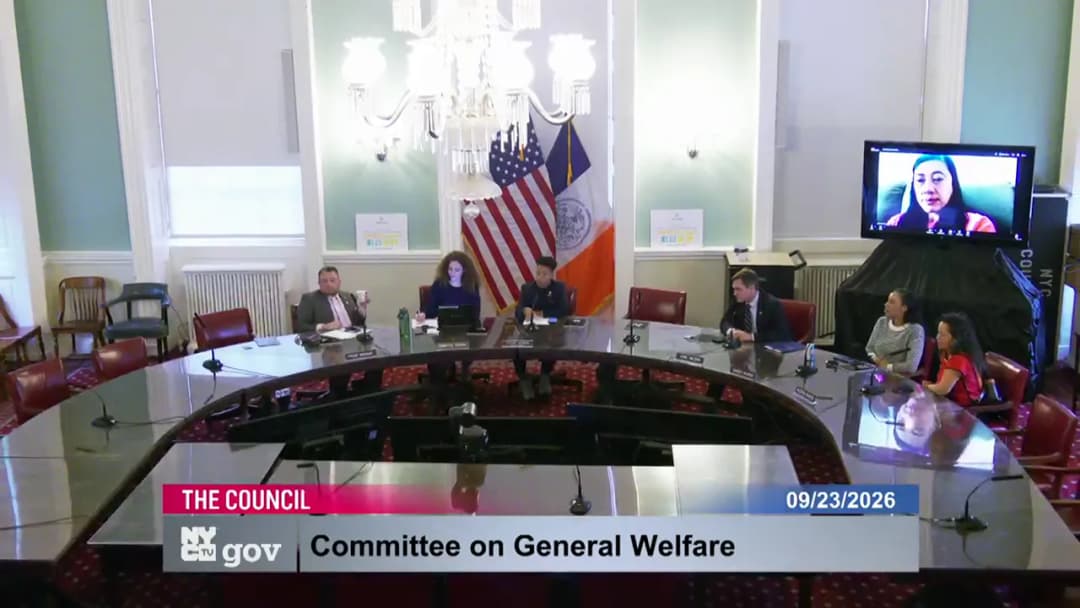
Committee on General Welfare Hearing on Fair Fares Streamlining - September 23, 2026

The New York City Council's Committee on General Welfare, chaired by Crystal Hudson, met on September 23, 2026 at 1:00 PM in Committee Room at City Hall to consider Introduction 0248-2026-A, a local law to streamline enrollment of eligible individuals in the Fair Fares program. The committee heard testimony, considered amendments, and ultimately approved the measure by a vote of 6-0. Discussion Items - Int. No. 248-A – A local law to amend the administrative code of the city of New York in relation to streamlining enrollment of eligible individuals in Fair Fares. The committee held a hearing on the proposed introduction, which had been previously introduced and amended. A fiscal impact statement and supporting testimony from prior hearings were included in the record. Key Outcomes - The committee voted to approve Int. No. 248-A by a roll call vote: Affirmative – Chair Hudson, Councilmembers Avilés, Morano, Nurse, Ung, Wilson (6); Absent – Councilmember Mealy (1). No votes in the negative or abstentions. The motion was adopted, and the meeting was adjourned.

PROCEDURAL 100%
OPENPUBLICA · PUBLIC MEETING INDEXUPDATED DAILY · openpublica.com