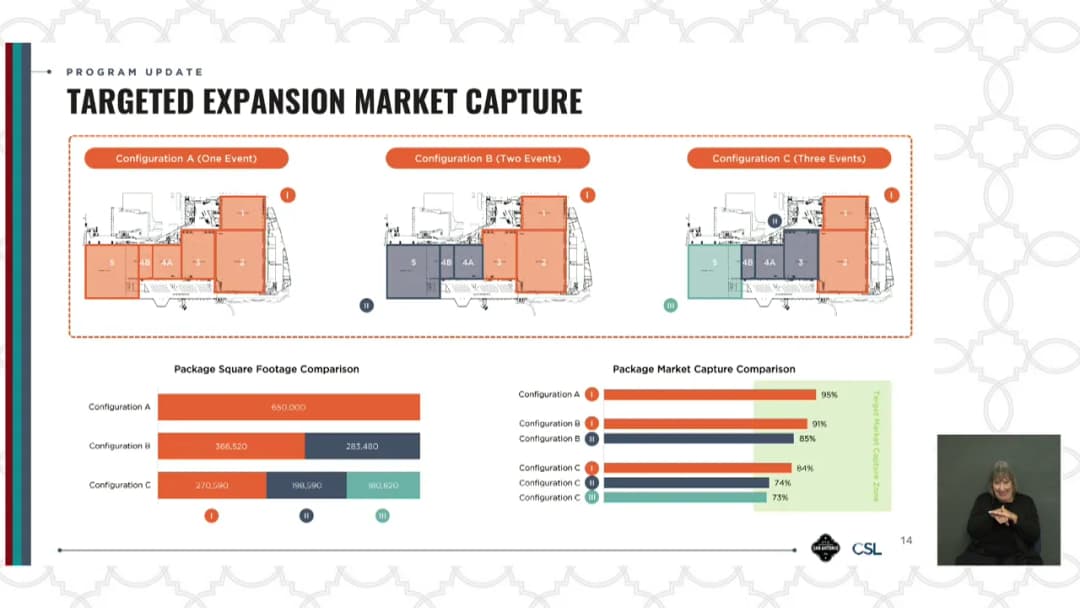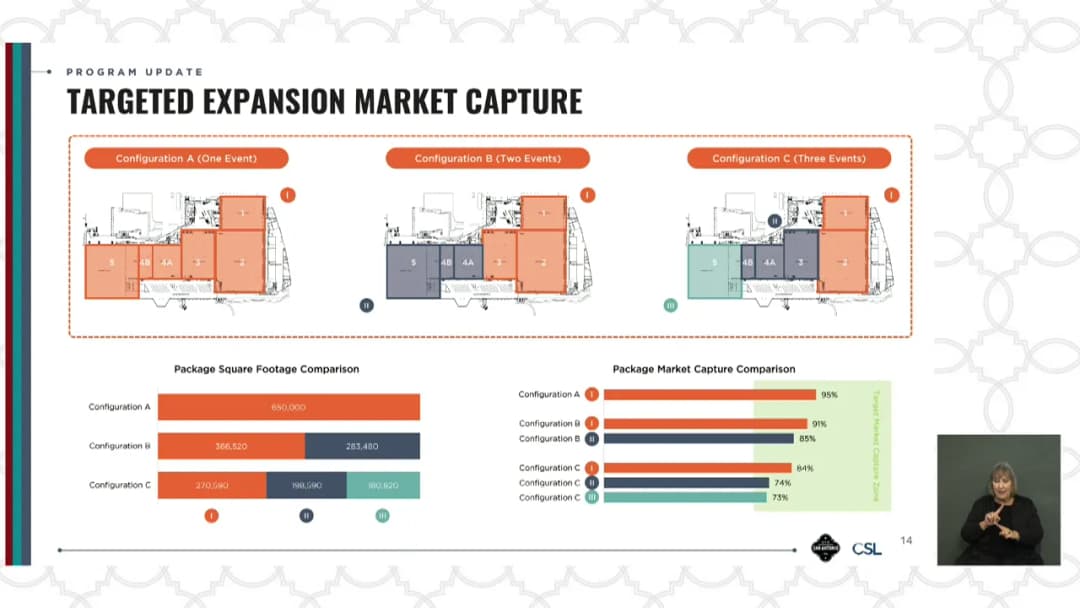
The City of San Antonio B session, called to order at 2:03 p.m. on Wednesday, October 28, 2026, provided a comprehensive update on the proposed downtown sports and entertainment district. Presentations covered the convention center expansion feasibility study, Alamo Dome capital improvement plan, financing updates, district cost of services study, mobility and accessibility study, exploratory procurements, community engagement, and next steps. Council members discussed financial assumptions, phasing, revenue projections, and community benefits. Convention Center Expansion Feasibility - Michael Lockwood of Populous presented the feasibility study for expanding the Henry B. Gonzalez Convention Center. The current exhibit hall occupancy is at 75%, exceeding the 70% practical maximum that signals a need for expansion. Current total sellable inventory is 728,000 sq ft (514,000 exhibit, 94,000 ballroom, 120,000 meeting). The recommended targeted expansion would grow to 650,000 sq ft contiguous exhibit space, add a 50,000 sq ft ballroom, and increase meeting space to 143,000 sq ft, at a total project cost of $850 million. Phasing is possible: Phase 1 ($700 million) includes full exhibit hall expansion and flexible ballroom designed to double as meeting space; Phase 2 ($150 million) adds 36,000 sq ft of meeting rooms. The expansion would put San Antonio in the top 10 nationally for contiguous exhibit space. Market capture analysis shows configuration A (full facility) captures 95% of market share; configuration B (two events) captures 85–91% each. - Mary O from Visit San Antonio presented booking pace data. Compared to 2017–2019 benchmark years, future bookings for 2031–2033 show a significant deficit (e.g., 96,000 room nights behind for 2031, 62,000 for 2032, 86,000 for 2033) due to competing convention center expansions in other Texas cities. The study identifies 74 additional groups representing $718 million in potential economic impact that could be pursued with the expansion. Alamo Dome Improvements - Ben outlined a proposed $125 million capital investment over 10 years for the Alamo Dome, focusing on technology systems, equipment, and end-of-life replacements. This replaces the previously assumed $100 million plan. The investment supports operations through the early 2030s, positioning the city to make a decision around 2035 on a major renovation or continued investment. Financial Update - Ben presented the financing structure for the arena ($489 million city contribution) using Spurs arena lease, property taxes from guaranteed development, ground leases, and project financing zone (PFZ) state revenues. The PFZ baseline revenue projection totals $1.923 billion over 30 years at a 4.6% compound annual growth rate. The model assumes approximately 1,160 additional hotel rooms by 2029, with historical growth of about 225 rooms per year. The base model produces about $1.2 million in estimated annual incremental general fund revenue, and about $1.0 million in annual recurring service costs, resulting in a nearly break-even position ($163,000 positive). Revenue sources include sales tax, mixed beverage tax, CPS Energy, and SAWS. The PFZ revenue starts small (projected $2.5M in 2026, actual closer to $1M) and grows to $157.6M by 2055. - Key assumptions: city hotel tax compound annual growth rate of 3.5% (base), with stress scenarios from 2.75% to 4.3%; interest rates from 3–4% on earnings to 5–7% on debt. District Cost of Services Study - Troy Elliott reviewed the study by MuniCap and ESI, evaluating the financial impact of the sports and entertainment district (arena, Wood Courthouse venue, convention center expansion, mixed-use private development). The model projects incremental general fund revenues and service costs, assuming full built-out district (Phase 1 and 2 private development, arena operational, Wood Courthouse operational, convention center expanded). Estimated annual incremental revenue: $1.2 million; estimated annual general fund costs: $1.0 million, primarily from mixed-use development and Hemisphere Park maintenance. Venue costs are allocated back to events/venues to avoid general fund impact. The model allows for dynamic adjustments based on event types and concurrency. Mobility & Accessibility Study - Shannon Miller presented the downtown accessibility and mobility study led by Walker consultants. Key findings: downtown does not lack parking supply (over 30,000 public spaces), but challenges stem from single-occupancy vehicle dependence, uneven parking utilization, event-day congestion, and lack of integrated information. Emerging recommendations: improve parking discovery and wayfinding, optimize event parking supply through coordination and pricing, strengthen multimodal access (VIA transit, ride-share, park-and-ride), and implement demand management strategies. A separate Reconnecting Communities grant is studying improved connections across I-37 between the East Side and downtown. Final reports expected early 2027. Exploratory Procurements & P3 Opportunities - Staff proposed issuing solicitations in spring 2027 for: (1) P3 opportunities for the
The Public Meeting Index
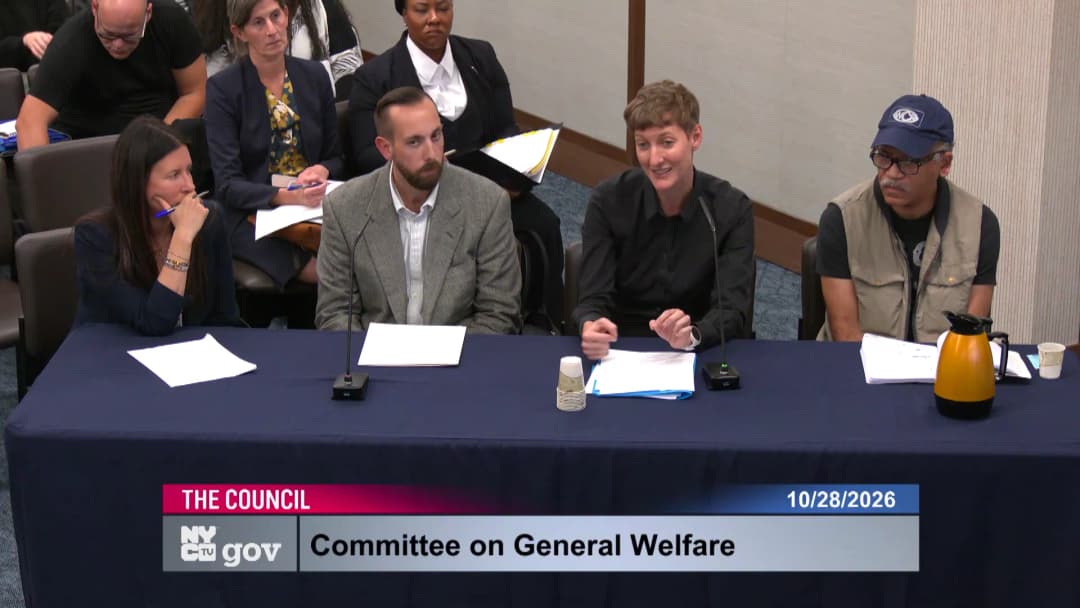
The Public Meeting IndexThe New York City Council Committee on General Welfare, chaired by Crystal Hudson, met at 1:00 PM on Wednesday, October 28, 2026, in Hearing Room 3 at 250 Broadway for an oversight hearing on shelter safety and to consider two transparency bills. Members present included Hudson, Avilés, Morano, Nurse, Ung, and Wilson; Councilmember Brewer and Public Advocate Williams also attended. The committee heard from a formerly homeless panel, public witnesses, and Department of Social Services and Department of Homeless Services leadership, then laid over both proposed bills. Oversight Overview - Chair Hudson said more than 83,000 people slept in New York City shelters the prior Sunday, across more than 500 shelters serving single adults, adult families, and families with children, mostly operated by contracted nonprofits. She framed safety as including physical security, facility conditions, trauma, and dignity, citing the multi-year repair delay at the Borden Avenue veterans residence as an example of administrative barriers. - Public Advocate Williams said 83,000 people resided in shelters as of October 2026, including 51,000 families with children. He cited a women's shelter where priority-one incidents rose from 123 in 2019 to 208 in 2024 and said its FY25 priority-one rate was more than double the citywide average for single adult shelters. He urged passage of Intro 387 and supported Intro 99. - Councilmember Brewer, sponsor of Intro 99, said the bill would require the Department of Homeless Services to report annually on how often families with children are placed in shelters in the same or an adjoining zip code as their last address, broken down by borough and whether the family has children under age three. She emphasized keeping children near their schools to reduce absenteeism. Public Comments & Testimony - Former shelter residents with the Coalition for the Homeless Community Leadership Collective described staff disrespect, ignored medical emergencies, forced exposure to cold, mice and flooding, lack of privacy, unsafe commutes, and grievances going unanswered. Francisco Insfran recounted staff failing to intervene in a fight and ignoring requests, and said he often had to translate for Spanish-speaking residents. A panelist suggested an independent grievance lockbox. - Coalition for the Homeless government affairs director Alison Milke said DHS oversight is failing and that residents file twice as many complaints to the coalition hotline about staff mistreatment as about safety concerns. She said DHS's roughly 31,000 complaint count is a vast undercount because evening and weekend non-urgent complaints are routed to 311 and are not reported to the ombudsman's office. - WIN vice president Chris Mann, whose organization shelters nearly 7,000 people including 3,800 children each night, said about 40% of families were placed in a different borough from their youngest child's school. He strongly supported Intro 99 and also urged the council to address PATH intake delays and pass Intros 816 and 232. - NYLAG director Deb Berkman said safety transfers usually require legal intervention and that some clients are forced into street homelessness rather than remain in unsafe shelters. She supported Intro 99 and stronger provider accountability. - Richard Flores, a shelter resident, alleged unreported crimes at shelters and called for federal investigations. - Additional witnesses included Viviana de Jesus, Jorge Jimenez, Lauren Napier, Clifton Williams, Calvin Michael, Wendy Bruno, Hannah Mercurious, Helen Strom, and Grace Busser. Their testimony described abusive or retaliatory staff, unresponsive grievance processes, theft, unsafe physical conditions, lack of on-site medical personnel, absence of air conditioning, stalking victims being unable to access domestic violence shelters, and police or ACS involvement deterring residents from seeking help. Several witnesses supported Intro 99 and housing-first approaches. Bronx Defenders attorney Grace Busser raised concerns that Intro 387 as written would emphasize policing; she said the organization could support it if reporting distinguished allegations from substantiated findings, separated resident-vs-staff incidents, and identified which incidents led to police response. Agency Testimony and Discussion - DSS Commissioner Aaron Dalton, joined by DHS First Deputy Commissioner Christine Fellini and Deputy Commissioner for Shelter Security Bavante Priester, outlined safety operations: around-the-clock security, risk-based assessments, cameras and access controls, 352 DHS peace officers, provider assistance unit training, and trauma-informed customer service training for over 15,000 staff under Local Law 49. Dalton cited 2,654 safety transfers in FY26, up from 2,625 in FY25. - Agency data: serious violent incidents in single-adult shelters fell to 2.8 per 1,000 residents in FY25 from 4.8 in FY22, and family shelter rates remained below 1 per 1,000. Complaints about discrimination, assault, and harassment rose 19%, and complaints about staff-client interactions rose 46%. The shelter death rate fell from about 11 per 1,000 in FY22 to 3.5 in FY25; deaths fell from 512 to 305 while the shelter population nearly doubled. Overdoses accounted for 40% of all deaths and 42 of 73 shelter deaths in FY25. - Facilities: 365 standard shelters averaged fewer than four open violations each, with only one in ten high-priority. Approximately 169 flexible-capacity sites, mostly commercial hotels, averaged about 42 open violations each; DHS said that number partly reflects residential code standards applied to non-residential buildings and does not always indicate an active safety hazard. DHS has 55 city- and state-owned buildings, with a FY27 capital budget of $106 million for 102 projects across 38 shelters; eight projects were complete and 31 were in active construction. - On Intro 99, DHS said it already tracks borough-level school continuity: 62.9% of families were initially placed in the borough of their youngest school-age child, and over 80% were in that borough over the duration of their stay. DHS said it would work with the council on zip-code-level reporting and noted that domestic violence cases may require placement away from a prior address. - On Intro 387, DHS said it shares the goal of transparency and already reports to state oversight bodies and through the Mayor's Management Report, but it cannot publish some security information disaggregated by individual shelter because of confidentiality concerns. - Member questions covered flexible-capacity shelter violations, Tillery Street Women's Shelter improvements under its new operator BRC, grievance and ombudsman procedures, training compliance, staffing ratios, mental health staffing, housing specialist ratios, air conditioning reporting, peace officer retention, and Rikers release planning. Key Outcomes - Oversight hearing T2026-2629 on shelter safety was held and filed by the committee. - Intro 0099-2026, requiring DHS to report on family shelter placements by zip code, was heard and laid over by the committee. - Intro 0387-2026, requiring annual critical incident and security reporting, was heard and laid over by the committee. - DHS committed to follow up in writing on multiple data requests, including shelter demographics, older adult and substance-use population data, grievance and incident breakdowns, training compliance, language-capability tracking, and FY26 security budget figures. - Written testimony was accepted for 72 hours after the hearing by email to testimony@council.nyc.gov.
The Houston City Council Service Delivery Committee met in hybrid mode on Wednesday, October 28, 2026, beginning at 2 p.m. Chair Tarsha Jackson presided. The meeting featured a presentation by Margarita Gardea, administrative manager for the Mayor's Office of Adult Literacy (MOL), on efforts to improve adult literacy in Houston. No agenda or minutes were available; this summary is based on the meeting transcript. Public Comments & Testimony - Marilyn White, a public speaker, shared her experience attending a digital literacy class with her 82-year-old mother. She praised the instructor and the library, and said they donated to Wesley Community Center to help purchase computers. She also expressed concern that when classes are run through partner organizations, the sign-up process should explain the full agenda, because some sessions covered financial literacy rather than the expected computer skills. Discussion Items - Ms. Gardea stated that nationally 48 million adults read below the sixth-grade level, adults with low literacy are more than two times more likely to face unemployment and significantly lower earnings, and nearly one in three adults in Harris County struggle with basic and/or digital literacy skills. - She described MOL's vision and its role to enhance, engage, build, and support adult literacy across four functional areas: health, financial, basic, and digital literacy. - In 2021, MOL and the Barbara Bush Foundation created the Houston Adult Literacy Blueprint, which established seven goals, including awareness, comprehensive systems, multi-generational learning, workforce skills, digital resources, shared data practices, and sustainable resources. - From January to August, MOL's four digital lab partners delivered 63 classes serving 1,071 adults. Ms. Gardea highlighted a digital literacy class for seniors at A. Leaf Regional Library and a financial class at Young Library, both developed after community requests. - In the Kashmir Gardens area, MOL partnered with Kashmir Library and Wesley Community Center to provide a three-week digital skills course; adult learners received a new laptop upon completion. - A GED class at Cashmere Neighborhood Library launched in June 2026, with 37 students currently enrolled and a graduation planned for December. Ms. Gardea said a retired-teacher volunteer was being placed to help the 9 to 10 students who still needed to pass the math section. - In September, MOL and Houston Community College hosted a family literacy event at the North Forest campus, with more than 30 vendors and 66 participants. - MOL has developed a centralized data intake system and a volunteer program. Ms. Gardea said 25 volunteers have signed up for MOL and all are vetted and trained before working with adult learners. - Councilmember Alcorn asked how residents learn about programs and how volunteers are trained. Ms. Gardea said libraries refer residents to MOL, and volunteers receive structured training, with curricula and resources provided by partners for GED support. - Councilmember Ramirez asked about location selection, outcome measurements, attendance accommodations, and funding. Ms. Gardea said locations are based on intake data and partner and library input; outcome tracking was not previously available, but new pathways will allow follow-up; and a mother and daughter who missed a session were offered a makeup class. - Director Gaw said MOL receives approximately $400,000 annually. She noted that ARPA funds helped purchase technology and support services, but the ARPA grant ends this year. She said MOL intends to continue services through volunteers and by pursuing grants. - Councilmember Selena's office asked about eligibility requirements. Ms. Gardea said services are free, open to all adults 18 and older, and not targeted to specific demographics. Key Outcomes - The committee received the presentation and asked follow-up questions; no formal vote or ordinance was considered. - Director Gaw committed to provide a written breakdown of MOL funding sources after a question about whether the funding comes from the general fund or grants. - MOL identified upcoming strategic priorities: expand citywide literacy awareness in all council districts, add more multi-generational learning opportunities, build workforce-aligned pathways and referral systems, strengthen partnerships, expand volunteer development, and pursue grants for long-term growth. - The meeting adjourned after one public comment; the next Service Delivery Committee meeting will be announced by email.
The New York City Council Committee on Hospitals, chaired by Council Member Mercedes Narcisse, held an oversight hearing on Wednesday, October 28, 2026, at 1:00 PM to examine Health + Hospitals’ NYC Care program and access to health care for uninsured New Yorkers. The hearing featured testimony from Dr. Ted Long (Chief Medical Officer, NYC Health + Hospitals) and Dr. Jonathan Jimenez (Executive Director, NYC Care), followed by public testimony. Key topics included enrollment trends, operational barriers, chronic disease outcomes, the impact of federal HR1 cuts, and capacity planning. The hearing was held and filed; no votes were taken. Public Comments & Testimony - Jane Mee (Director of Policy, Community Health Care Association of New York State - CHCANYS): Representing federally qualified health centers (FQHCs), Ms. Mee noted that New York City health centers provided 631,000 uninsured visits in 2025, incurring $92 million in uncompensated care. She projected a tripling of uninsured patients due to HR1 and urged the Council to accelerate implementation of Int. 1668-A to expand NYC Care to FQHCs and dedicate resources to affordable coordinated care. - Carmen Garcia (Community Health Worker Supervisor, Make the Road New York): Ms. Garcia described her organization’s role as a NYC Care navigator, having helped over 1,000 enrollees. She highlighted a case of a patient who accessed care through NYC Care and was diagnosed with diabetes. She called for strong internal policies at H+H to protect immigrant patients and emphasized the importance of community-based organizations as trusted messengers. Discussion Items - NYC Care Enrollment and Decline: Dr. Long reported 125,766 members as of October 23, 2026, down from a peak of 150,000. The decline was attributed to New York State expanding Medicaid to low-income individuals aged 65+ regardless of immigration status, allowing many to transition from NYC Care to Medicaid. Dr. Long stressed that these patients remain in H+H care. - Enrollment Process and Barriers: Three enrollment pathways were described: phone (via MyChart), in-person at H+H facilities, and through 20 contracted community-based organizations. Barriers include lack of phone/internet access and missing documents. The call center number 646-NYC-CARE was repeatedly highlighted. - Primary Care Access: More than 90% of new NYC Care enrollees have been offered a primary care appointment within 14 days since 2019. Dr. Long detailed efforts to reduce no-shows through timed SMS reminders and 10-day appointment releases. - Chronic Disease Outcomes: A peer-reviewed study (Journal of General Internal Medicine, 2025) found no difference in diabetes and hypertension control between new NYC Care enrollees and new Medicaid enrollees. Within six months, 73% of new hypertensive enrollees and 53% of new diabetic enrollees showed significant improvement. NYC Care was estimated to have saved 1,569 lives. - Impact of HR1 and Essential Plan Changes: Approximately 450,000 New Yorkers lost Essential Plan coverage on July 1, 2026. Of these, about 60% found alternative insurance, including thousands who enrolled in NYC Care. Dr. Long warned that Medicaid work requirements and recertification starting January 1, 2027, could cause a crisis, with up to 900,000 New Yorkers at risk of losing Medicaid. H+H has sent 400,000 emails to patients and is bolstering financial counseling and care teams. - Budget and Capacity: The NYC Care program has a $100 million annual budget, unchanged since a few years after launch. Dr. Long stated that H+H could immediately absorb 15,000–20,000 new patients across primary care, but capacity is not infinite. He noted ongoing communication with OMB about funding needs. - Language Access: The 646-NYC-CARE line provides telephonic interpretation in 300+ languages. Most commonly requested languages are Spanish, Chinese dialects, French, and Polish. H+H monitors no-show rates by population to identify language barriers but reported no notable trends. - Specialty Care Access: Top five specialties after primary care are OB/GYN, eye care, dental, cardiology, and podiatry. Wait times vary by specialty; H+H uses e-consults (20% resolved without an in-person visit), workforce planning, and contact center optimization to manage demand. - Outreach and Awareness: Top referral sources are friends/family, healthcare providers, CBOs, and online ads. H+H uses a branded truck, social media influencers, and consulate partnerships. Drs. Long and Jimenez requested continued support from Council Members to spread the word and host enrollment events. - Transportation and Social Needs: Transportation is not a covered benefit, and H+H does not currently track no-show reasons attributable to transportation. Dr. Jimenez highlighted the DME benefit launched in 2025 (over 2,500 members used it). Social needs screening is integrated; about 25% of NYC Care members screen positive for food/housing instability and are connected to care coordination. - Integration with Other H+H Programs: Dr. Long mentioned the SHOW (Street Health Outreach and Wellness) program (expanding 50% this year), safety net clinics (Bellevue, Lincoln, Woodhull, Elmhurst), and Housing for Health (housed 1,800 patients, built 400 units on H+H land). He also noted that H+H is exploring a system-wide volunteer program to help patients meet Medicaid work requirements. - Maimonides Takeover: Council Member Felder questioned the financial viability of absorbing Maimonides Medical Center given enhanced Medicaid rate assumptions and potential enrollment declines. Dr. Long acknowledged the concern and promised to provide written projections. Key Outcomes - The committee held the oversight hearing; the matter was filed for further action. - H+H committed to providing the Council with data on telehealth utilization, NYC Care distribution by geography, specialty wait times, and the impact of HR1. - Drs. Long and Jimenez encouraged Council Members to help promote NYC Care at community events and via communications, with a focus on the 646-NYC-CARE hotline. - No legislative votes were taken; the hearing served as fact-finding in advance of anticipated coverage disruptions in 2027.
On October 28, 2026, the San Antonio City Council received a detailed briefing on the proposed downtown sports and entertainment district. The session covered the convention center expansion feasibility study, financial operating models, a cost of service analysis, a downtown mobility and accessibility study, and updates on community engagement and the Alamo Dome. The discussions emphasized phasing the massive project and managing financial risks contingent on economic conditions and state funding. Discussion Items - Convention Center Expansion (Michael Apple / Populos): Presenters highlighted historic occupancy rates, noting the Henry B. González Convention Center reached 75% occupancy in both 2018 and 2025, which they indicated triggers the need for expansion. The current facility has 514,000 sq ft of exhibition space, 94,000 sq ft for events, and 120,000 sq ft for meetings. The proposed expansion targets 650,000 sq ft of exhibition, 144,000 sq ft for events, and 143,000 sq ft for meetings. The total project cost is estimated at $850 million. A phased approach was proposed: Phase 1 at $700 million (exhibition and event hall expansion) and Phase 2 at $150 million (additional meeting space and accessibility improvements). The design aims to integrate with the Riverwalk and Hemisfair. Councilmember Core noted the difficulty navigating the current layout and stressed the need for a design that connects better with the arena and Hemisfair. - Financial & Operating Model (Ben / Troy Ellis): Staff presented a constrained fiscal landscape. The financing strategy relies on Arena PFC, surplus from the 2% city and 7% general Hotel Occupancy Tax (HOT), and bond proceeds. The PFC base model projects $1.9 billion for the district, down from a prior state estimate of $2.5 billion. The Alamo Dome requires $125 million in capital over 10 years, with a major renovation decision deferred to 2035. Staff are exploring additional revenue streams from rights, sponsorships, parking, district improvements, concessions, and TNC fees. Councilmember Galván expressed concern about relying on optimistic PFC and occupancy rate projections and asked what happens if targets are missed. Staff acknowledged the need to provide explicit contingency scenarios. - Cost of Service Study (Troy Ellis): The study models the net fiscal impact on the general fund once the arena, convention center expansion, and mixed-use development are fully operational (full buildout assumed by 2042). The base model estimates $1.2 million in annual net new tax revenue to the general fund, offsetting the service costs for police, traffic, and parks. The model accounts for concurrent events and is designed to be dynamic. Councilmember Viagran asked for detailed premises documentation so the community can understand the model's assumptions. Councilmember Castillo questioned how service costs would be allocated to events. - Mobility & Accessibility Study (Shannon Miller): A key preliminary finding stated there is no immediate need for a new large parking structure. The study focuses on improving wayfinding, implementing dynamic pricing, integrating parking and transit technology, and shifting behavior away from single-occupancy vehicles toward transit, micromobility, and ride-sharing. The implementation strategy is due in early 2027. Councilmember Viagran raised concerns about east side connectivity and traffic management, emphasizing integration with existing transit (VIA) and neighborhoods. Councilmember Core stressed the need for better pedestrian and bike connectivity along the Salado Creek. - Reconnecting Communities & Engagement (Shannon Miller): Staff are conducting an I-37 connectivity study to link the east side with downtown, with a final plan expected in Spring 2027. A 33-member community consultant committee is being formed. A new public web dashboard tracking project budgets, funding sources, and timelines will launch in early 2027. Councilmember Viagran stressed the importance of connecting cultural districts like Market Square to the new district. - Exploratory RFPs and Future Options: Staff proposed issuing exploratory RFPs in 2027 for the Good Courthouse and Nova Street sites. For the Alamo Dome, which has an annual operating deficit of $3 to $5 million, the city will explore operational partnerships with the private sector to close the deficit. Councilmember Castillo requested that community benefits agreements, worker retention, and affordable housing be central considerations in any private partnership proposals. Key Outcomes - Staff received direction to proceed with exploratory RFPs for the Alamo Dome, Good Courthouse, and Nova Street developments, with results expected back in fall 2027. - The convention center expansion RFP is planned for Spring 2027, with design selection and bond financing targeted for late 2028 (bond issuance is expected to occur after the arena financing in September 2028). - Council requested detailed documentation of the financial model premises (PFC, Tiers, occupancy rates, hotel room growth assumptions) for transparency. Staff committed to providing a clear summary of how the models work and what the key assumptions are. - The mobility implementation strategy will be finalized in early 2027, explicitly excluding new large parking structures in the near term. - The East Side community reconnection plan will be finalized in Spring 2027. - Staff committed to aligning the construction timelines of the new arena and the convention center expansion to seek logistical and economic efficiencies. - Councilmembers Galván, Viagran, and M. González expressed the need for robust risk mitigation strategies if PFC/Tier revenues underperform or if costs increase, with staff agreeing to stress-test the models and provide clear contingency scenarios.
The San Antonio Planning Commission convened on October 28, 2026, for a regular meeting that included a consent calendar and four items on the individual hearing agenda. Actions included approvals of a continuance request and three zoning cases, all over staff's recommendations for denial on the contested items. The meeting adjourned at 2:33 PM. Consent Calendar - Commissioner Profit moved approval of the combined hearing agenda, seconded by Commissioner Cooper. The motion passed unanimously by roll call vote. Commissioner Bustamante recused from items 3 and 5. Public Comments & Testimony - Item 11 (403 F Street): Sherman Henson of 503 Hampton Street spoke in opposition to the proposed zoning change, expressing concerns about neighborhood compatibility, property values, tax impacts, safety, and a discrepancy in the address listed on public notices. Discussion Items - Item 10 (7510 Tesla Road): The Commission unanimously approved a three-week continuance to the November 18, 2026 meeting. - Item 11 (403 F Street) – Workforce Housing Rezoning: Planner Sean Sheley presented the request to rezone from Urban Low Density Residential to Medium Density Residential (MF-33). Staff noted 36 notices were mailed (4 in support, 1 opposed) and recommended denial, supporting MF-18 due to the area's low-density character. The applicant proposed a 50% affordable workforce housing development, arguing MF-33 or MF-25 was needed to offset $1.2 million in infrastructure costs. Commissioners supported the workforce housing concept and the MF-25 compromise. The motion passed unanimously. - Item 14 (1359 West Kings Highway) – Mixed Use Rezoning: Planner Sheley presented a request to rezone from ULDR to Mixed Use (IDZ-3) for a construction material storage facility. Staff noted 25 notices were mailed (0 in favor, 1 opposed) and recommended denial. Applicant Eduardo Castillo argued the space was needed for his business. The Commission voted unanimously to approve. - Item 15 (322 Yale Avenue) – Additional Dwelling Unit Rezoning: Planner Sheley presented a request to rezone from ULDR to MDR (IDZ-1) for a second dwelling unit. Staff noted 32 notices were mailed (0 in favor, 0 opposed) and recommended denial due to limited access. The applicant stated the rezoning was strictly required for smaller setbacks for parking. Commissioners commended the applicant's rehabilitation efforts. The motion passed unanimously. Key Outcomes - Consent Agenda: Approved unanimously. - Item 13: Withdrawn. - Item 10 (Continuance): Approved unanimously. New hearing date set for November 18, 2026. - Item 11 (403 F Street Zoning): Motion by Commissioner Orion, second by Commissioner Profit. Approved unanimously, contrary to staff's recommendation for denial. - Item 14 (1359 W Kings Hwy Zoning): Motion by Commissioner DeSucci, second by Commissioner Miller. Approved unanimously, contrary to staff's recommendation for denial. - Item 15 (322 Yale Ave Zoning): Motion by Commissioner Profit, second by Commissioner Cooper. Approved unanimously, contrary to staff's recommendation for denial.
The Dallas City Council met on Wednesday, October 28, 2026, at 9:02 a.m. in Council Chambers at Dallas City Hall, with Mayor Eric L. Johnson presiding. The meeting included special recognitions, public comments, a 46-item consent agenda, pulled consent items, individual consideration items, zoning cases, public hearings, and appointments. The meeting recessed into executive session at 11:45 a.m. for the city auditor and inspector general appointments and reconvened at 1:30 p.m., adjourning at 2:28 p.m. A roll call during Item 25 recorded Mayor Johnson as absent, though he presided at the start and end of the meeting. Special Recognitions - Councilmember Gay Denell Willis recognized Breast Cancer Awareness Month and Color the World Orange Day for Complex Regional Pain Syndrome (CRPS); Miller Kerr, founder of Burning Hope, shared her personal CRPS journey. - Councilmember Paula Blackman recognized October as Archives Month and honored John Slight and the City archives team. Consent Calendar - The consent agenda (Items 2–47) was approved with the exception of pulled items 19, 20, 25, and 26. Corrections/clarifications were noted for Items 4, 5, and 30 (Item 30 clarified that the aggregate principal amount is not to exceed $312 million). - Approved consent items included grants for sexual assault evidence testing ($1,250,670), peace officer mental health ($80,992.36), diesel emissions reduction ($3,076,296 total including local match), veterans programs ($273,000), Klyde Warren Park Phase 2 interlocal amendment, airport projects, multiple Vision Zero traffic signal projects, several bond ordinances, procurement agreements, and three lawsuit settlements. Public Comments & Testimony - Kathy McCann (District 13 resident) opposed the scale of the Preston Royal development, citing traffic congestion and light pollution; she asked council to restrict height and unit count. - William Hopkins raised concerns about lead in Oak Cliff water and alleged the city mishandled the West Dallas lead settlement. - DeVera Dawkins requested council mediation regarding noise from Rodeo Code business operations. - Valerie Eton demanded an end to all city cooperation with ICE, no DPD immigration enforcement, and removal of Flock cameras. - Edwin Ingram, Chelsea Novak, Emily Garcia, and later Kayla Monsor spoke about The Museum School of East Dallas, describing a two-and-a-half-week displacement and approximately $50,000 in fire-watch costs; they asked the city to allow third-party fire watch at $35/hour and reimburse the school. - Richard Brown (District 13 resident) said the Preston Royal rezoning request "fails" compatibility, scale, and traffic tests; he asked council to reject it and require a better plan. - Stephen McFadden and Magid Keloff, representatives for a vehicle storage business at C.F. Hawn Freeway, asked council to approve a zoning path to keep the site operating, citing no opposition from neighbors and highway separation from residences. - West Mockingbird (representing property owner) spoke on Z10, explaining the PD amendment would fix a CO issue for AutoNation and CarStar Redbird. - Brynn Stotz, applicant representative for Z11, described a proposed welding school and additional conditions agreed with Councilmember Blair. - Edward Broadway, Dr. Dinah Marks, Dr. Barbara Bookman, and Reverend Roger Russell supported the ceremonial street topper "Dr. Curtis W. Wallace" on Roseland Avenue. - Linthicum Darden, Rain Wolfe, and Alice Maxwell demanded the city ban ICE flights from Dallas Love Field, end ICE collaboration, and stop DPD immigration enforcement. - LaCoria London criticized DPD/SWAT response to a 20-year-old's suicide on a bridge, called for an elected police chief, and urged a no vote on the upcoming bond. Discussion Items - Item 25 (DPD Law Enforcement Training Center sponsorship toolkit and donations): After extended debate, council divided the question. A motion to defer the toolkit to November 10, 2026, with a November 4 briefing failed 5–9 (one absent). Council then adopted the sponsorship toolkit with an amendment (moved by Councilmember Willis) allowing naming/sponsorship agreements for a duration of up to 20 years following substantial completion. Council then accepted the QuikTrip Corporation and W.W. Caruth Foundation funds (up to $17.5 million) via Communities Foundation of Texas and established appropriations. - Item 26 (CMAR Supplemental Agreement No. 2 with Swinerton Builders): Approved a GMP 2 of $158,616,112 (including $3,840,944 contingency) for the DPD LETC at UNT Dallas, increasing the total CMAR contract price from $29,007,276 to $49,007,276, with only $20 million currently appropriated. Councilmember Blackman voted no. - Item 19 (Dallas Streetcar O&M): Council approved $2,807,875.34 in FY2027 operating and maintenance disbursement to DART. Councilmembers West and Moreno supported it; Councilmember Mendelson called the subsidy "a terrible deal," citing ridership below 500/day and a $17 per ride each way subsidy; Councilmembers Roth and Ridley noted the need to explore alternative funding. Staff said an O&M study is due in Q1 2027 and a recurring federal subsidy may reduce future costs. - Item 20 (Dallas Streetcar connection to McKinney Avenue Transit Authority): Approved a professional engineering services contract with AECOM for $1,096,786.68. - Items 49 and 50 (State and Federal Legislative Programs): Deferred until after full council briefings. - Item 51 (McKinney Ave/Cole Ave Two-way Conversion): Approved a $3,552,041 professional services contract with Halff Associates, releasing remaining encumbered funds from the terminated Kimley-Horn contract. - Item 54 (Service pins donation): Approved acceptance of $10,000 anonymous donation for employee service pins; several council members expressed gratitude and noted the budget had cut this funding. Zoning Cases and Public Hearings - Zoning consent (Z1–Z3, Z5–Z7): Approved, with changes including removing coin-operated amusement prohibition on Z2, allowing agricultural uses by right on Z3, and removing height/density/parking requirements on Z5. - Z4 (2704 Elm Street live music venue): Approved with a three-year SUP and eligibility for a two-year automatic renewal. - Z8 (C.F. Hawn Freeway commercial service district): Denied on a motion by Councilmember Blair. - Z9 (Seaton Drive and Humphrey Drive duplex): Denied without prejudice. - Z10 (4201 West Camp Wisdom Road): Approved as recommended by CPC, with an added change allowing agricultural uses by right. - Z11 (10600 C.F. Hawn Freeway welding school): Approved subject to conditions requiring 4-inch caliber trees every 60 feet along northern/eastern property lines and secure monthly scrap-metal pickup. - PH1: Approved ceremonial street name "Dr. Curtis W. Wallace" as a street topper on Roseland Avenue. - PH2 (North Harwood Street name change to "Exchange Place"): Held under advisement until December 9, 2026. Appointments - Item 56: Council appointed John Proven as City Auditor for a two-year term, with an annual base salary of $220,000, effective January 4, 2027. - Item 57: Council appointed Baron Eliason as Inspector General for a two-year term, with an annual base salary of $191,200 (transcribed as "1912"), effective October 28, 2026. Deputy Mayor Pro Tem Maxie Johnson opposed, calling the process a "dog and pony show" because only the interim inspector general met all qualifications. Key Outcomes - Approved consent agenda items 2–18, 21–24, and 27–47, with corrections noted. - Adopted the DPD LETC sponsorship toolkit with an "up to 20 years" duration and accepted $17.5 million in donations. - Approved Item 26 CMAR increase for the DPD LETC project. - Approved streetcar O&M funding and AECOM planning contract. - Deferred state and federal legislative programs. - Approved the McKinney/Cole two-way conversion design contract. - Approved zoning actions as listed above. - Appointed John Proven as City Auditor and Baron Eliason as Inspector General. - No appointments were made for boards and commissions (Item 48).
The San Antonio commission met on October 28, 2026, beginning with roll call and a quorum. The chair described a combined consent agenda and an individual hearing agenda. Although the chair initially said item 14 had been withdrawn, the commission later heard and voted on item 14. Consent Calendar - The combined consent agenda was approved by roll-call vote. Commissioner Profe made the motion and Commissioner Cooper seconded it; staff had recommended approval without detailed discussion. Public Comments & Testimony - A speaker registered for item 9, Clay Consent, was not present when the item was called. - Item 11 – Sherman Henson (503 Hampton Street) expressed concerns: the street name appeared misidentified in the documents, the project could increase property taxes, sidewalks were missing nearby, and he did not know which neighbors had been consulted. He asked how the added density would benefit the existing neighborhood. - No public comments were heard for items 14 or 15. Discussion Items - Item 10 – Continuation request: The applicant requested a two-week continuance to November 18 for the matter at 7510. The commission voted to continue the item to the next meeting. - Item 11 – Residential density request: Planning staff reported four notifications in favor, one in opposition, and no response from the homeowners association. Staff said the property, sized from 5,000 to more than 20,000 square feet, was in a dense area, located more than 2,000 feet from principal arterials, and recommended denial as inconsistent with the area development plan. Applicant Jay Michael Jeffers, representing the owner, said the proposal would create workforce housing with 50% affordable and 50% market-rate units, cited construction costs of about $1.2 million, and said he had engaged the adjacent homeowners association and neighbors. He requested MF-33 zoning and said he could accept MF-25 if needed, describing 0.7 parking spaces per residence, buffers, sidewalks, and professional management. In response to Henson, Jeffers said the project would add sidewalks, clean existing walkways, and serve teachers, firefighters, and similar workers. Commissioners expressed support for quality workforce housing and good-neighbor design. The commission voted to approve the request. - Item 14 – West Kennes Highway area zoning request: Staff reported zero notifications in favor, one in opposition, and no HOA response. The request was from R-5 to IC-3 high-intensity use, with permitted uses for flexible office and office in a home. Staff recommended denial because the proposed mixed-use/storage use was not appropriate for an established residential area. Applicant Eduardo Castillo, representing his daughter, said he needed rear storage for construction materials while renovating the vacant property, not a commercial warehouse, and pointed to nearby commercial and mixed uses. Commissioner questions explored accessory dwelling/storage options and access. The commission voted to approve the applicant's request despite staff's recommendation. - Item 15 – Future land use and density request: Staff said the request would change low-intensity urban residential to medium-density residential, with no HOA response, and recommended denial because the use was not appropriate and the property had only one entrance. The applicant said he had spent three years renovating an abandoned house, wanted two tenant parking spaces and rear access, and was requesting the higher intensity only for rear modifications. Commissioners praised the rehabilitation of an abandoned property. The commission voted to approve the request. Key Outcomes - Consent agenda approved. - Item 10: continued to November 18. - Item 11: approved, contrary to staff recommendation; no no votes appear in the transcript. - Item 14: approved, contrary to staff recommendation; no no votes appear in the transcript. - Item 15: approved, contrary to staff recommendation; no no votes appear in the transcript. - No director's report was presented; the meeting adjourned at 2:33 p.m.
The Committee on Governmental Operations, State & Federal Legislation, chaired by Council Member Gale A. Brewer, convened on October 28, 2026, to conduct an oversight hearing on the Mayor's Office of Ethnic & Community Media (MOECM) and city advertising spending. The committee also heard testimony and voted to lay over a package of good government bills (Intros 1127-B, 1128, 1129) sponsored by Council Member Williams and pre-considered legislation (T2026-2722) by Chair Brewer regarding a working group on communication technologies. Public Comments & Testimony - Mona Davids (NY Coalition of Ethnic and Community Media): Stated publishers endured nine months without leadership or a point of contact in MOECM. Proposed extensive amendments to Local Law 83, including making the office independent, mandating quarterly public reporting, prohibiting political favoritism in ad allocation, and strengthening enforcement of the 50% spending mandate. - Eleanor Tatum (New York Amsterdam News): Attributed the decline in ethnic media advertising to the six contracted advertising agencies, whom she accused of ignoring local print and web outlets in favor of easy placements. She underscored that the new Executive Director is not responsible for the failures of the prior eight months. - Esmitra Khalida (URL Media / Epicenter NYC): Noted that advertising spending has fallen dramatically since the law was passed and that counting out-of-scope spending inflates compliance figures. Requested clear implementation plans, quarterly outlet-level reporting, and modernization of how the city measures campaign value beyond simple impressions. - Bob Henley (WBAI Pacifica Radio): Detailed severe financial struggles for his station, alleging a preference by the administration for paid influencers over established community media. - Abu Sidjahate (Staten Island Immigrant Council): Stated that African ethnic media outlets are being overlooked for city advertising funding and urged the city to publish clear, accessible data on advertising allocations. - Walter Sanchez (Queens Ledger / Wave of Rockaway): Argued that advertising agencies do not know local publishers and favor outlets that do not represent genuine community journalism. - Rachel Faust (Reinvent Albany) and Ben Weinberg (Citizens Union): Urged the Council to pass records retention legislation for instant messaging, hold a dedicated hearing on FOIL compliance, and require disclosure for all government-funded influencer campaigns. They supported the good government bills on the agenda. - Terry Wisdom (Harlem Network News): Expressed frustration at the lack of access to funding and requested to be actively involved in planning how ethnic media is supported. Discussion Items - Oversight of MOECM and Government Advertising Spending (T2026-2608): The committee extensively questioned the newly appointed Executive Director of MOECM, Mazin Sidahmed. Chair Brewer, Speaker Menin, and committee members expressed deep concern over the drastic drop in city advertising spending from $260 million (FY22) to $28.8 million (FY24), and that spending on ethnic media fell from a peak of $23.1 million (FY22) to $7 million (FY24). Council Member Restler highlighted a discrepancy in the FY25 report, stating that while 57% of in-scope spending went to ethnic media, $18 million of the $31 million total was out-of-scope (social media, bus shelters), making the actual percentage 24%. Council Member Morano questioned the inherent conflict of MOECM being housed under the Mayor's Director of Communications and the loophole allowing out-of-scope spending (influencers, social media) to circumvent the 50% mandate. Mr. Sidahmed stated he was the sole staff member, had no data immediately available on current ad spending, and committed to updating the website and publishing the FY26 report by the end of the calendar year. - Legislative Package (Intros 1127-B, 1128, 1129) – Council Member Williams: Council Member Williams presented a set of good government reforms. Intro 1127-B amends or repeals 25 reporting provisions in the City Charter and Administrative Code. Intro 1128 establishes a uniform default date for agency reports. Intro 1129 creates a process for agencies to certify compliance with operational requirements. The committee heard testimony and laid over all three items. Intro 1127 was amended by the committee prior to the layover. - Pre-Considered Legislation (T2026-2722) – Chair Brewer: Chair Brewer introduced a bill requiring DORIS to form a working group to study city agencies' use of instant messaging platforms and make recommendations on record retention. The bill was heard and laid over. Key Outcomes - The committee filed the oversight hearing on MOECM and government advertising spending (T2026-2608). - Intro 1127-2026 was amended by the committee and laid over as Intro 1127-2026-B. - Intros 1128-2026 and 1129-2026 were heard and laid over by the committee. - Pre-considered Intro T2026-2722 was heard and laid over by the committee. - Executive Director Sidahmed committed to immediately updating the MOECM website, aggregating FY26 advertising data, and reporting back to the Council with a plan. - Several Council Members committed to working with the new director to strengthen enforcement of Local Law 83 and address loopholes in advertising spending transparency.
Syracuse City held a work session on 2026-10-27, followed by a special business meeting. Councilmember Julie Robertson was excused to attend a mosquito abatement conference; Councilmember Abe Pollard arrived later. The work session included public comment, planning discussions, public works and administrative items, and informational reports. No formal votes were taken during the work session; the council later unanimously moved into closed session for personnel and land sale matters. Public Comments & Testimony - Kale Gurney, of 1557 West 1390 South, spoke on behalf of Ruth of Tomorrow Club, an environmentalist school group, and asked the council to consider placing a community garden proposal on a future agenda. He cited a 2025 systematic review of 37 studies by researchers at the University of Glitter in Discover Sustainability, which found community gardens contribute to environmental stewardship, social cohesion, and public health, and he noted green spaces are shrinking in fast-growing cities. - A written comment from a resident was read into the record regarding the transportation utility fee study. The resident, who has lived in Syracuse for about seven years, said streets in the neighborhood had not been crack sealed in that time. The comment cited study findings that about 14% of city lane miles are in poor condition and could grow to 25% over 10 years if annual maintenance funding remains about $1.5 million. The resident asked the council to identify a pavement condition goal, the funding needed, how existing transportation revenues factor in, whether a formal preventive maintenance schedule would be established, and how fee revenue and pavement conditions would be reported annually. The resident also urged the council to consider whether sales tax growth and other transportation revenues could offset the fee and favored a structure that can decrease when other revenues improve rather than becoming a fixed charge. Planning Items - Rezone request at 2617 South 3000 West: Staff reported that the planning commission recommended approval of a request to change the property from A1 to R3. The property is small and bordered largely by R1 development to the north and other non-residential uses; R3 would allow roughly 8,000-square-foot lots and about four units per acre. Public comments at the planning commission hearing were mixed, with objections from neighbors about growth, traffic, and changes to the current horse property. Councilmembers noted the area is truly R1 and that density should decrease farther from the city center. Council agreed to continue the application with a recommendation for residential zoning, with the exact R1 versus R3 density to be decided at the November business meeting. - General Plan update: The mayor outlined three possible targeted amendments: highway-impacted properties, a few properties mapped as A1 despite being developed and taxed as R1, and the city's density zone structure. A councilmember said the current General Plan, about seven years old, feels outdated, including references to 2008 building data and the West Davis corridor. Staff noted state law requires planning commission involvement and a new connectivity element by July of next year. Council leaned toward a piecemeal approach in the short term. The mayor will work with staff to propose a section-by-section plan for a November work session. Police Department - Crossing guard program update: Police Chief Alex Davis presented an annual review process for crossing guard staffing. The program previously added four positions, and the city wants to align staffing with current student use, school routes, traffic volume, and conditions, especially as school boundaries change. A scoring matrix will guide staffing decisions and identify roadway deficiencies. The update was informational and required no vote. Public Works Items - Irrigation water code amendment: The council discussed amending Municipal Code Section 10.8.10.90 to allow a 100% fee-in-lieu for water shares only when a city-owned property is being transferred for development. The state constitution prohibits cities from selling water shares to private developers, and the city has already absorbed water shares on properties such as the Elmatador property and the hot triangle. The amendment is intended to avoid holding up development because water shares are effectively unavailable. The item was placed on a future consent agenda. - Drinking water source protection plan: Staff reviewed a renewal required every six years; the current plan expires this year. The renewal updates the inventory of businesses near city wells and continues notification and contamination-prevention measures. It will go to a business meeting for resolution. - Water conservation plan: Staff reviewed a five-year renewal required by state law and needed for grant funding. It covers city and resident indoor and outdoor conservation efforts, public outreach, and secondary water metering. It will be placed on the November business meeting agenda for resolution. Transportation Utility Fee Study - Robert and Jeremy Searle of Methods Consulting presented an updated study. State law under Utah Code 10-6-134 requires a fee based on trips generated by land use, a reasonable relationship to service, evidence of inadequate existing funding, and different rates for categories. The city evaluated every property using ITE trip generation. Single-family homes generate about 91,000 trips per day, about 49% of city trips, so they would pay 49% of the needed fee. At an annual funding level of $3 million, the single-family fee would be about $12.18 per month; at $1.5 million, about $6 per month with 25% of roads in poor condition; at $3.5 million, about $14 per month with 10% in poor condition. The consultants recommended about $3 million, keeping roughly 12% of roads in poor condition. - Council asked about commercial versus institutional trip costs, verification of contested trip counts, effects on business recruitment, and fairness of rates. Staff said businesses can challenge their category with data using a variance process, and churches would not be exempt under the new law. A county-approved fifth-quarter transportation sales tax would generate an estimated $271,000 per year, far below the shortfall. - The mayor responded to the public comment by saying the city has a documented rotating crack-sealing schedule and a five-year rolling roads plan. The council took no action and will fold the transportation utility fee discussion into the November budget process. Administrative Items - Phone system replacement: Staff recommended replacing the city phone system because it is at end of life and no longer receives support or patches. The proposed contract award will be presented at the November meeting. - City investment policy: Staff proposed a policy to invest excess funds outside the Utah Public Treasurer's investment pool under the Money Management Act, using laddered conservative investments and an investment advisor. The current state pool earns about 4% interest, and the city currently has about $30 to $40 million not immediately needed. Council discussed risk, oversight, quarterly written reports, and mayor sign-off. Discussion and potential action are scheduled for November. - Personnel policies: Proposed amendments to the personnel policies and procedures manual were reviewed. Most are minor or reflect state law changes, with a few substantive updates such as half-day Fridays and holiday conformity. The amendments will be placed on the next business meeting for a vote. - Significant parcel definition: Staff proposed replacing the existing surplus property definition with a dollar threshold for what counts as a significant parcel of real property under state law. Staff suggested a $100,000 to $200,000 range. Council discussed how the threshold affects whether surplus remnant parcels can be sold directly to neighbors or must go through public process. No number was set; the item will return for action. - Privacy Policy Act compliance: Staff proposed amending Title 2 to designate the Administrative Services Director as chief privacy officer under Utah's Privacy Policy Act. The item was placed on a future consent agenda. Mayor's Informational Report - The mayor reported that the Wasatch Front Regional Council approved 103 station area plans, including 109,600 dwelling units near rail stations. The state's estimated housing shortage had been 90,000 units, later reduced to 30,000. Syracuse has no rail station. - The mayor reported that the city's recycling event was the largest ever held in Utah, recycling 24,281 pounds and beating the previous record by 5,691 pounds. Records included 105 mattresses, 87 tires, 83 bicycles, and 253 cars; 91.7% of participating cars came from Syracuse's two ZIP codes. There were 10 to 15 volunteers and 10 vendors. - The mayor reported third-quarter grant recommendations to the county commission: $46,921,640 was requested and $30,832,000 recommended, with Syracuse recommended to receive $10.5 million for the 2700 South and 3000 West roundabout and roadway improvements. Key Outcomes - The zoning application for 2617 South 3000 West will move forward as a residential zoning recommendation; the council will decide between R1 and R3 at the November business meeting. - The mayor will prepare a General Plan update approach with staff for November discussion. - Irrigation code, privacy officer designation, personnel policy, water source protection, conservation plan, phone system award, investment policy, and surplus property threshold items were scheduled for future consent or business meeting action. - The council unanimously voted to enter closed session for personnel and land sale matters.