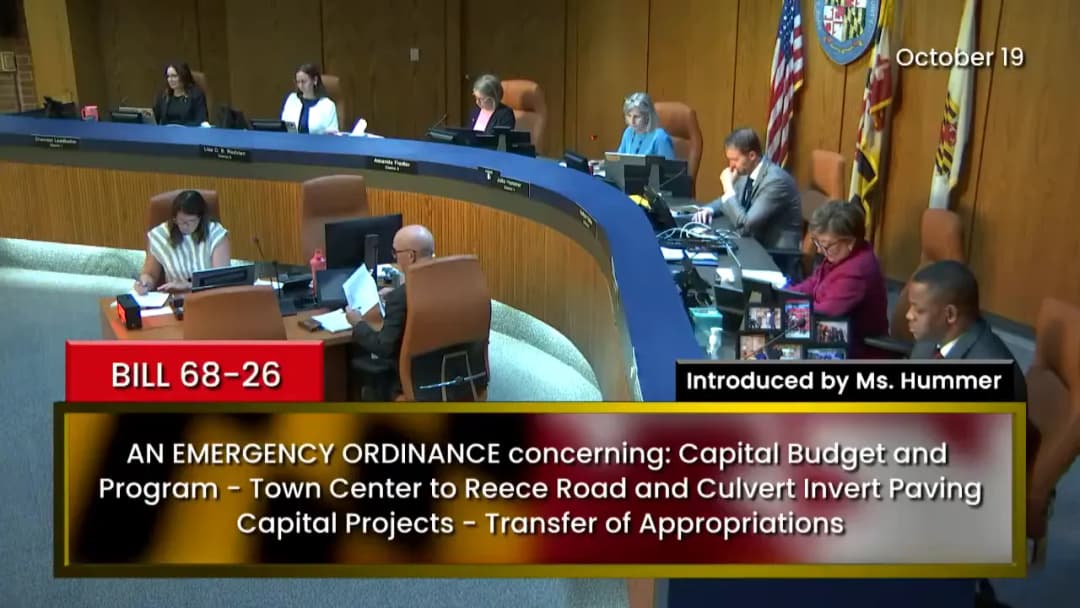
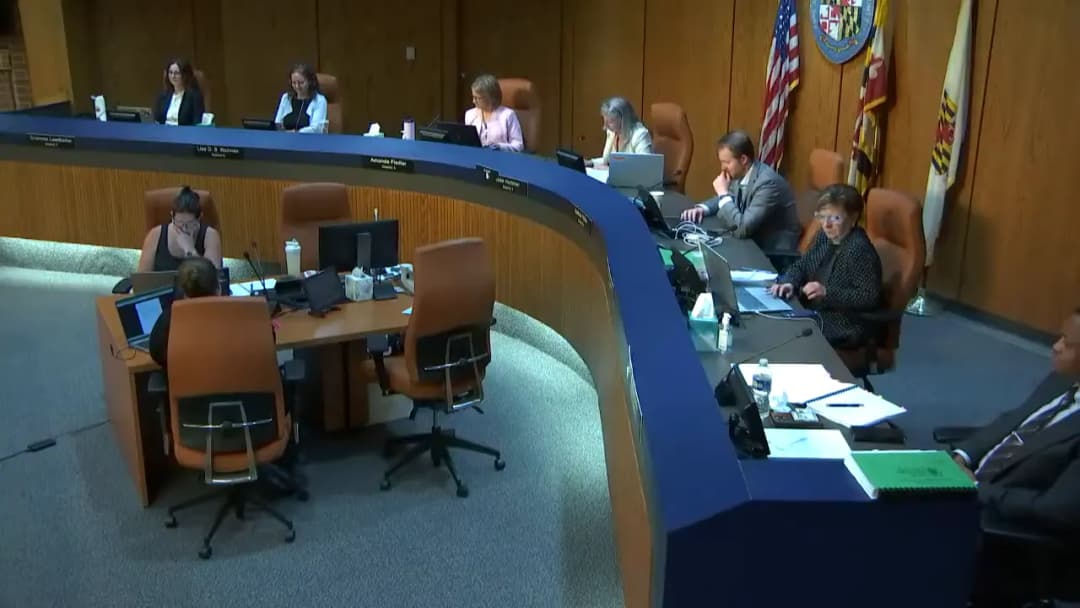
The Anne Arundel County Council held its final legislative session of the 2023-2026 term on Monday, October 19, 2026, beginning in the evening and crossing midnight. The council recognized outgoing members, heard extensive public comment, approved routine and personnel measures, adopted ethics and surveillance oversight resolutions, defeated the comprehensive Article 18 zoning rewrite, and adjourned to December 7, 2026. Consent Calendar (Routine Approvals) - The minutes of the October 5, 2026 legislative session were approved as read. - Resolution 36 was withdrawn at the administration's request. - Bill 68-26, an emergency ordinance transferring capital appropriations from the Town Center to Reese Road and Culvert Invert Paving projects, passed 7-0. - Bill 75-26, a supplementary appropriations and technical correction ordinance, passed 7-0. - Resolutions 34-26 (FY2028 school construction capital improvement request support), 35-26 (NPDES Phase 1 MS4 financial assurance plan), and 37-26 (student member to the Human Relations Commission) were adopted 7-0. Public Comments & Testimony - Kurt Svensson (Arnold) opposed ballot Question A, arguing it would transfer final fiscal authority over labor agreements to an unelected arbitrator, and criticized recent charter amendments and the council pay increase. - Colin Nemhard (Glen Burnie) warned against lawmaking by rhetoric and said workforce families deserve thriving neighborhoods, not overcrowded schools and roads. - Matt Minahan (Growth Action Network) thanked the council, praised accomplishments, and listed unfinished priorities including impact fees, lower residential density, higher affordable-housing yield than 10-15%, and a rechartered Planning Advisory Board. - Corey Malinowski and Michael Brown raised cybersecurity oversight. Brown said the county's second breach in 18 months was discovered August 28, 2026, 45 days after a council briefing, and cited the proposed $4.3 million IT spending increase after the first breach. - Stephen Stern, Liz Glass, Michael Glass, and Jody Goldsmith described an anti-Semitic incident at an Annapolis City Council meeting. Goldsmith said a poll found 21% of Americans and 35% of adults ages 18-34 consider anti-Semitism a legitimate form of protest, and urged adoption of the IHRA definition and continued protection of Jewish residents. - Sarah McIntyre (South River Youth Association) requested permanent lighting for practice fields, saying her organization pays about $9,000 per year for temporary generator lights for 10 football teams. - Casey Cameron (Anne Arundel County Professional Firefighters Local 1563) said starting firefighters will now earn less than the county council president and urged competitive wages, staffing, and resources. - Michael Lofton and David Dickerson advocated for public acquisition and partnership for the Discovery Village site, citing nearly 3,600 boat launches this year and plans for marine education and community space. - Tom Weddle (Gambrills) opposed continued rezoning/development near the MARC station, saying elected officials should represent current residents, not developers or people who may move there in the future. - Other speakers expressed solidarity with Jewish residents and thanked outgoing members for their service. Discussion Items - Bill 61-26 as amended (Article 18 zoning update): The administration called it a long-awaited cleanup of a complicated code last comprehensively reviewed in 2005. Councilman Volkey questioned provisions that make the Planning and Zoning Officer the interpreter of the code and require consistency with Plan 2040. Councilwoman Fiedler noted her amendment requiring an owner to be present for inspections was not adopted. Public testimony was overwhelmingly opposed: farmers, small-business owners, the Southern Anne Arundel Chamber of Commerce, and residents cited the 240-plus-page size, right-of-entry language, accessory-structure caps, agritourism definitions, food-truck restrictions, infrastructure impacts, and a rushed process. Supporters included the Anne Arundel County Farm Bureau and Growth Action Network, who said the bill had been improved and many fears were based on existing law. One speaker, Elizabeth Rossborg, said there were 42 in-person opponents, more than 50 online opponents, and 3 proponents. Council members disagreed sharply about 'misinformation'; Chair Hummer and Councilwoman Rodvian said the bill did not change certain provisions, and the Fourth Amendment still limits inspections. Councilman Volkey argued nearly 100 amendments were never considered and the bill was not ready. The bill was defeated 0-7. - Bill 65-26 as amended (campaign contribution disclosure and comprehensive zoning integrity): This ethics bill added disclosure/integrity requirements for certain zoning-related campaign contributions. Public testimony included supporters asking for a 24-month lookback and coverage of family members/lobbyists, while the Anne Arundel County Association of Realtors opposed it. The council passed it 7-0. - Bill 66-26 as amended (ethics enforcement): This bill allowed the Ethics Commission to levy fines up to $5,000. It passed 7-0. - Bill 67-26 as amended (BWI mixed-use overlay): Councilman Smith said it followed prior community conversations, while the administration opposed it because the Region 1 plan called for a sector study first. It passed 7-0. - Bill 69-26 (personnel reclassifications): The bill reclassified three vacant positions, including moving a health department role to a deputy health officer. Councilman Volkey voted no, citing the loss of a crisis intervention counselor and the increased cost of the new $147,000 position. It passed 6-1. - Bill 70-26 as amended (optional concept plan): This created an optional concept-plan step for development review. Critics, including Growth Action Network and Greater Severna Park Council, said it lacked deadlines, weakened stormwater review, and reduced public accountability; supporters said it would improve early community input and help smaller developers. It passed 4-3, with Ledbetter, Volkey, and Fiedler voting no. - Bill 71-26 (Neighborhood Preservation and Environmental Protection Act): Councilman Volkey proposed removing triplexes, fourplexes, and multifamily uses from single-family districts and repealing certain density increases from the 2024 Housing Attainability Act. The administration opposed it. Public testimony was split: housing advocates and realtors opposed, while some neighborhood residents supported it. After the hearing closed, the chair announced that midnight had ended legislative time, so no vote could occur. Councilwoman Pickard said she would have voted no, and Councilwoman Rodvian raised concerns about housing affordability for the next generation. - Resolution 38-26 (automatic license plate readers): The council suspended rules to consider this resolution, which urges the incoming council to review police ALPR/Flock camera policies. It was adopted 7-0. Key Outcomes - Bill 61-26 (Article 18 zoning update): defeated 0-7. - Bill 65-26: passed 7-0. - Bill 66-26: passed 7-0. - Bill 67-26: passed 7-0. - Bill 69-26: passed 6-1. - Bill 70-26: passed 4-3. - Bill 71-26: no vote; not reached before the midnight cutoff. - Resolution 38-26 adopted 7-0; Resolutions 34-26, 35-26, and 37-26 adopted 7-0; Resolution 36 withdrawn. - The council adjourned to Monday, December 7, 2026, at 5 p.m. for the new council swearing-in and 7 p.m. legislative session.
Public Meetings - Anne Arundel County, Maryland
Public Meetings - Anne Arundel County, MarylandThe Anne Arundel County Liquor Board convened on October 13, 2026, with one commissioner present. No agenda or minutes were available for this meeting; the following summary is drawn from the transcript. Board counsel made administrative announcements, five cases were postponed (two during the session), and one license transfer was heard and approved. Administrative Announcements - Board counsel noted that transcripts are maintained electronically and serve as the official record, available for review online or by appointment. - Counsel stated that with only one commissioner sitting, any applicant or licensee may request a postponement, and such a request will be granted. - Counsel reminded the public that commissioners will recuse themselves when conflicts arise; anyone who believes a conflict exists should raise it when a case is called. - For administrative efficiency, counsel would rule on admissibility of evidence and objections on behalf of the chair. - Three previously scheduled cases were announced as postponed: International Entertainment Group LLC d/b/a Catherine's; Papa's Restaurant and Sports Bar, Inc. d/b/a Papa's restaurant and sports bar; and Sharangpur Inc. d/b/a Reno's Market. Postponements Granted - Affiliated On Cigar LLC d/b/a Affiliation Cigar, a Class D tavern with on-sale beer, wine, and liquor, appeared without Secretary Pernel Williams, who was reported ill. Because no excusal had been requested, the case would normally have been postponed with a cooperation charge; however, because the hearing had not started and one commissioner was sitting, the board offered and the licensees requested a postponement, which was granted without a cooperation charge. - TGI Fridays of Annapolis d/b/a TGI Fridays, a Class B restaurant with on/off beer, wine, and liquor at 2582 Solomon's Island Road, Annapolis, faced two violations: Rules and Regs Chapter 3, Section 3.02 (cooperation) and Section 4.16 (unauthorized conduct), based on Notice of Violation 1403 dated August 13, 2026. Required party Jennifer Rote was absent and no excusal had been requested. The board offered a postponement to avoid a cooperation citation; the licensee requested and received the postponement. - Dorothea Holbuleck, appearing for TGI Fridays, expressed frustration, saying she had been addressing the matter for a year and a half, felt "held hostage" as a licensee, was ready to pick up the licenses, and was being ignored by the law firm handling the transfer. Board counsel offered to obtain the law firm's information and reach out to encourage action. License Transfer: 47875 LLC d/b/a Elbow Room - The applicant, 47875 LLC, owner Sivon Eversley, sought transfer of a Class H restaurant BWL license, with general entertainment restricted to two musicians and a Sunday license, from EMKO Inc. d/b/a Money's Place at 1641 Route 3 North, Crofton, Maryland. - Melvin J. Kadenski testified in support, stating that the license had been active for quite some time, no changes were planned, the business would be run the same way, and the prospective owners would be on the premises whenever the business was open. He described the applicants as a young couple and noted that Mr. Kaz had 20 years in the business with no problems. - Sherek Matthews, prospective licensee, confirmed that the business would keep the same hours, 11 a.m. to 2 a.m., that the televisions are color, and that the applicants hold no interest in other licenses. - The commissioner approved the transfer. Key Outcomes - Affiliated On Cigar LLC d/b/a Affiliation Cigar was postponed without a cooperation charge. - TGI Fridays of Annapolis d/b/a TGI Fridays was postponed without a cooperation charge. - The transfer of the Money's Place license to 47875 LLC d/b/a Elbow Room was approved. - Board counsel offered to contact the law firm involved in the TGI Fridays transfer on behalf of the licensee.
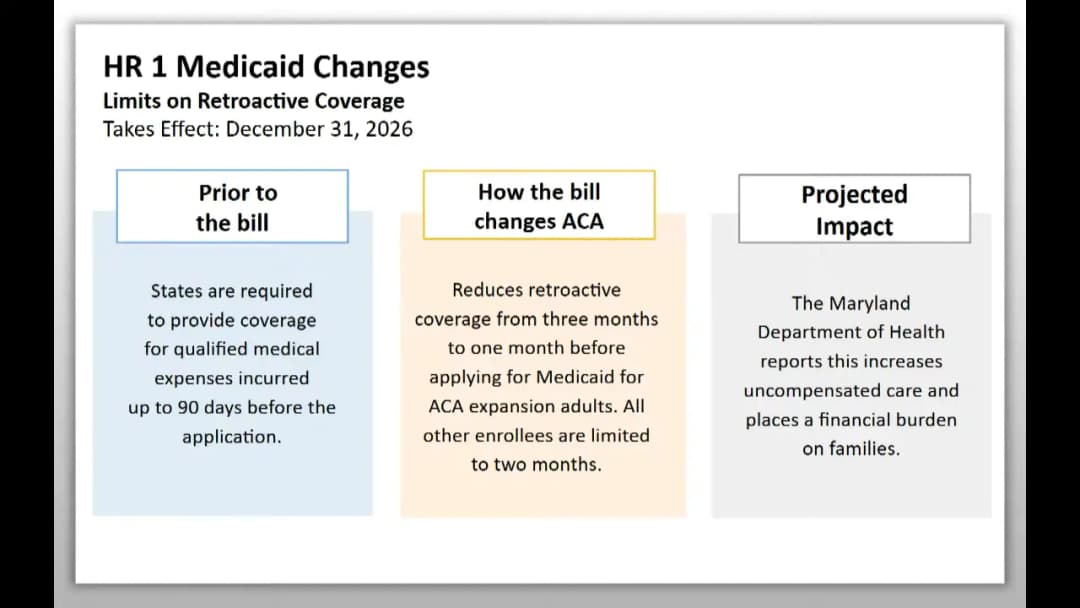
The Anne Arundel County Council held its final work session of the session on October 13, 2026, discussing a transfer bill, cottage homes residency requirements, the Board of Education's capital plan, a stormwater financial assurance plan, and a complex contract amendment for a brownfield redevelopment in Glen Burnie. Following the work session, the council convened as the Board of Health to hear an extensive update from the Department of Health. Consent Calendar - Bill 76-24 (Transfer Bill): Budget Officer Chris Trumbauer presented a non-controversial transfer bill correcting accounting for a state grant pass-through to Annapolis and backfilling Empire Towers grant funds. The council had no questions. Discussion Items - Bill 76-26 (Cottage Homes County Residency Requirement): Councilmember Rodvian introduced an amendment to require cottage homes to give purchasing preference to county residents for the first 20 years, mirroring MPDU requirements. Chauncey Hall (AACDS) confirmed the county's intent to align the programs. The council supported the measure. - Resolution 34-26 (Board of Education Capital Improvement Program): The council discussed the annual resolution supporting state IAC funding applications. Councilmember Rodvian expressed concerns about a proposed feasibility study for a standalone PVA high school, questioning equity, transportation logistics, and the impact on existing school arts programs versus a centralized hub. Jeff Hagen (AACPS) explained the study is exploratory and part of a parallel track alongside other capital projects. Councilmember Picker noted the Glen Burnie High School feasibility study did not lead to immediate construction. - Resolution 35-26 (NPDES Financial Assurance Plan): Eric Michelson (DPW) presented the required plan. Councilmember Volke questioned projected fee increases (3-5%) given the county is ahead of acreage targets and running a revenue surplus. The administration confirmed the plan forecasts needs but does not legally bind future councils to specific rate levels, as rates are set annually in the budget process. - Resolution 36-26 (County Property 7409 Baltimore Annapolis Blvd - Sawmill Creek Redevelopment): This item generated extensive debate. The administration requested an amendment to reduce density (townhomes replacing mix), allow 15% unit flexibility, and extend the feasibility period to January 31, 2027, citing methane contamination, unsuitable soils, and title issues. Councilmember Volke argued the original contract expired on July 9, 2026, the county lacked authority for a unilateral extension, no notice to proceed was issued, and the deposit should have been returned. He characterized the request as a new contract requiring a new appraisal and developer financial transparency. The Office of Law maintained the contract could be revived and that the parties acted in good faith pending council ratification. Councilmember Picker strongly supported the partnership, framing the environmental remediation and affordable housing benefits as critical, and thanked the developer for not walking away from the complex site. Councilmember Fiedler questioned the adequacy of the timeline, MPDU percentages, and the long-term methane mitigation plan. The administration committed to providing appraisals and soil data before the October 19th vote. Public Comments & Testimony - No oral public comments were made during the work session or Board of Health meeting. Key Outcomes - No formal votes were taken on the legislative items, as the session was a work session. Final votes are scheduled for the legislative session on October 19, 2026. - The council directed the administration to provide appraisals, soil gas data, and a financial framework for the 7409 project before the vote. - Board of Health Meeting: The meeting was informational. Dr. Tony Geddon and Dr. Bada highlighted the impending Medicaid changes (work requirements, semi-annual renewals), new programs (maternal peer support, expanded sexual health clinics serving 207 clients with over 95% walk-in rate, overdose loss survivor support), and data on vaccination rates and county health indicators. No formal board actions were taken.
The Anne Arundel County Council held a public hearing on the proposed Fiscal Year 2027 County General and Board of Education budget. The meeting began with the invocation, pledge of allegiance, and the reading of the titles of 14 budget-related bills. Chris Trumbauer, County Budget Officer, presented a comprehensive overview of the executive's proposal, followed by presentations from library CEO Skip Ald and school board CFO Matt Stanski. Dozens of public speakers testified, focusing primarily on education funding, food bank support, library staffing, security grants for nonprofits, and animal shelter needs. No votes were taken; the hearing closed with adjournment. Presentations - Chris Trumbauer, Budget Officer: The proposed FY27 general fund increases by $176 million (3.3% over current year; 5.9% after adjusting for fund balance) to a total of $1.317 billion. The budget is balanced with no structural deficit, and includes an additional $5.7 million contingency for federal funding impacts. The county executive recommends a property tax rate of 96.8 cents per $100 of assessed value, a 0.9 cent decrease from the current 97.7 cents, using a state provision to fund education. Local income tax rates remain unchanged. School funding reaches a record $1.054 billion, a $72.9 million increase, funding a 2.25% COLA and step increases for educators, all state blueprint requirements, and 26 new special education positions. Public safety includes staffing the police real-time information center and adding 21 firefighters. Health and human services: $2 million for the County Food Bank, expansion of gun violence intervention to Brooklyn Park, and two new REACH positions. Library funding increases by $1.1 million; community college by $2.4 million. Utility rates increase: solid waste fee up 10%, water/sewer up 9% (average annual residential bill estimated at $1,033, still among lowest regionally), stormwater fee unchanged. The six-year capital improvement program is within debt affordability guidelines, focusing on completing existing projects and fully funding school construction. - Skip Ald, CEO, Anne Arundel County Public Library: Of 602,000 county residents, 321,209 hold library cards, with 200,000 active users. The library system leads Maryland in children's programs, database downloads, and interlibrary loans, yet its per capita funding of $57 is the lowest among six suburban Baltimore systems. Key requests: a maintenance mechanic position, a performance measures and data analyst position (currently filled by a Maryland Service Corps employee whose contract ends in June), and continued support for three Maryland Service Corps positions. Capital projects include a $4.7 million renovation of Brooklyn Park Library and a feasibility study for a new Mountain Road library. - Matt Stanski, CFO, Anne Arundel County Public Schools: The county executive's proposal provides $72.8 million in new funding (7.4% increase), the largest dollar and percentage increase in 20 years. This funds a 2.25% COLA and step increase for all employees, meets state blueprint mandates, opens a new early childhood center at Carver, and a new charter high school (New Village Academy) in the Annapolis Mall. It also includes 26.8 special education positions. Stanski noted the school board has a list of unfunded requests should the council find additional resources. Public Comments & Testimony - Christy Giuliano (AACPS math teacher, step 25+): Urged raising the property tax back to the current rate or higher to fund at least a 3% COLA for educators. She described a 5.7% gap between cumulative COLAs (17%) and national inflation (22.7%) over five years, and noted a 14.7% higher cost of living in the county. Her rent increases have exceeded her raises. - Brian Daig (Edgewater resident, Food Bank board chair): Asked the council to preserve the full $2,727,097 funding for the Food Bank, citing rising demand and the organization's role in helping families avoid trade-offs between food and other essentials. - Jeremiah Batoukin (local business owner, Food Bank board member): Emphasized that food insecurity affects working families, not just those in poverty, and described long lines at monthly pantries that reflect immediate impacts of federal policy changes. He noted 51,000 neighbors served but 66,000 food insecure residents, leaving a 15,000-person gap. - Lindsay Alamey (Food Bank director of community programs): Reported that in March, the Food Bank served over 15,500 households (highest monthly total outside the November SNAP pause) and distributes an average of 400,000 pounds of food monthly. She urged maintaining the $2.727 million allocation. - Christopher Cano (SEIU Local 500, political director): Urged full funding for Anne Arundel Community College, noting that adjunct faculty teach a significant share of courses and are central to student success, especially for low-income and first-generation students. Inadequate funding would disproportionately harm vulnerable communities. - August Wickman (library data analyst, Maryland Service Corps): Explained that the data analyst position supports efficiency across the library system, from digital operations to community health initiatives (e.g., gun safety lock distribution, COVID-19 response). Her contract ends in June; she asked for permanent funding. - Linda Adamson (St. Luke's Episcopal Church volunteer): Supported food bank funding, describing clients who often have working adults and line up hours before the weekly one-hour pantry opening. Fresh food from grocery stores is especially popular. - Donna Weingarten (St. Luke's volunteer): Emphasized the positive atmosphere at the pantry and the partnership with the Food Bank, whose deliveries are met with enthusiasm from volunteers and clients. - Lauren Bloom (rector, St. Luke's): Stressed that nutrition affects learning, work, and senior well-being. The Food Bank provides the bulk of what the pantry distributes; she anticipates increased need due to federal cuts. - Christina Corona (TAC president): Noted the budget funds only 26 of 82.2 requested special education positions (including teachers, SLPs, PTs, OTs, and TAs) and does not fund English language development teachers, counselors, psychologists, social workers, or PPWs. She asked the council to maintain the current property tax rate (raising $9 million more) to fund a 3% COLA and additional staffing. - Jonathan Goldsmith (president, Jewish Federation of Annapolis and the Chesapeake): Proposed a $250,000 pilot program for security grants to faith organizations and nonprofits, capped at $15,000 per organization, arguing it would make a meaningful difference. He noted that county executive Pittman had declined a larger request as too costly. - Joe Tulin (Annapolis resident): Supported the security grant pilot, citing rising hate crimes: 113 anti-LGBTQ incidents in Maryland over four years (four in Annapolis), an 18% increase in anti-Latino hate crimes nationally from 2024-2025, and 73% of LGBTQ centers experiencing threats. Latino churches spend up to 50% of annual budgets on security. - Linda Maser (Animal Welfare Council chair): Supported the full animal services budget of $5.281 million, including $530,000 for a concept design study for a new shelter (current facility deemed inadequate) and an adoption coordinator position to improve placement of harder-to-adopt animals. - Sarah Gillen (AACPS special educator, Odenton): Asked the council to keep the property tax rate unchanged to fund a 3% COLA and all 82.2 special education positions. She described working 10-hour days plus weekend hours, and having to reduce a second job to meet student needs. - Benjamin Tuck (Chinese teacher, Annapolis High): Highlighted a hiring freeze on custodians and cafeteria workers, leaving students unable to eat lunch within 25 minutes and custodians cleaning 36 classrooms nightly with short staff. He urged fully funding special education positions (82.2) and a 3% COLA. - Elizabeth Ruddy (sixth grade math teacher, Crofton): Thanked the council for past budget support but urged them to increase property taxes to current levels to fund additional positions and a higher COLA, as education faces federal attacks. - Richard Otten (adjunct faculty, AACC; SEIU Local 500): Asked for full funding of the community college budget to support adjunct compensation, as the college president indicated a compensation pool below what was expected. Adjuncts teach about half of all classes. - Mike Shire (Fraternal Order of Police): Asked for support for police staffing and facilities, noting the newest academy class had a failure rate exceeding 10% due to maintained standards, and described mold and sewage issues at the academy, Northern District station, and CID building. - Dr. Margaret Turner (Annapolis Pediatrics): Reported that 11% of county children are food insecure and that screening in her practice shows drastic increases. She emphasized the long-term return on investment from feeding children (higher test scores, lower healthcare costs). - Paul Higgins (Woodholm Community Association president): Requested continued funding for the Jumpers Hall Road connector project, specifically for right-of-way acquisition and design completion (currently at 60% design). He noted the budget package number remains largely unchanged but land acquisition remains uncertain. - Liz Glass (Jewish Federation board member): Described personal experience with security costs at Temple Beth Shalom, where armed guards are now present for all services. She noted that Maryland hate crimes against Jewish people tripled in the past year and urged a security grant pilot. - Deanna Edmonds (second grade teacher): Supported special education staffing, noting that caseloads at her school are double the manageable level despite increased staffing each year. - Carolyn Matthews (Arnold resident, Food Bank volunteer): Asked to preserve the $2.7 million Food Bank funding. She described the mobile food pantry serving all areas of the county, where a two-hour distribution often runs over to serve everyone. The pantry allows choice and has no income gatekeeping. Key Outcomes - No formal votes were taken on the budget; the meeting was a public hearing for testimony. The council will deliberate and vote at a later date. - A motion to adjourn was passed unanimously. Meeting adjourned at an unspecified time, with the next legislative session scheduled for May 18, 2026, at 7 p.m. (Note: the transcript states "May eighteenth, 2025," which conflicts with the meeting year of 2026; the intended date is likely May 18, 2026.)
The Anne Arundel County Council met on May 13, 2026, to continue department budget presentations for Fiscal Year 2027. Presentations were heard from the Circuit Court, Department of Social Services, Orphan's Court, Board of License Commissioners, Arundel Community Development Services, Anne Arundel Workforce Development Corporation, Anne Arundel Economic Development Corporation, and the Partnership for Children, Youth and Families. Councilmembers asked questions on security, staffing, caseloads, and program impacts. No formal votes were taken; the meeting recessed until a 7:00 p.m. public hearing. Discussion Items Circuit Court - Judge Donna Schaefer, Administrative Judge, reported that the court is in its 13th year of electronic case management (MDEC) with a smooth major update. Case time standards: civil non-family cases (resolved within 18 months) met 92.7% of the time; criminal cases (180 days) and juvenile cases (90 days) met 98.2% of the time. Security remains a priority: over 60 recommendations from two assessments, with a new multi-agency threat reporting protocol. The FY2027 budget is a 2% increase, with one new position (drug court) converted from contractual to merit. Councilmember Fulk asked about using non-sworn personnel for courtroom security; Judge Schaefer noted the court supports any security improvements but that decisions rest with the Sheriff. Department of Social Services - Director Rachel (full name not provided) presented. The department’s budget accounts for less than 1% of county spending but delivers over $15 million in economic benefits. Key metrics: kin foster placements rose to 38% (goal of 48%); in-home services kept 97% of children safely at home; FIA caseload of 799:1 (second highest in state); 376 job placements at average $20/hour; 48,000 children received summer meals; 35,000 new applications for economic assistance in FY25. Requests include conversion of three community program positions to merit and $120,000 in county funds to support informal kin families (in partnership with Partnership for Children, Youth and Families). Councilmember Ravi noted the high caseload and praised the department’s work. Orphan's Court - Judge Gibson (full name not provided) reported that the court has eliminated a prior backlog and implemented virtual/hybrid hearings. The budget request is decreased from last year because prior funds for a courtroom overhaul were used. A COLA for positions is needed (not funded); a safety issue in a hallway behind judicial chambers (20-foot drop) has not been addressed by facilities. Councilmember Smith thanked the judge for her service; this was her final budget. Board of License Commissioners (Liquor Board) - Edward Aronson, Janet Gagnan, and Chairman Wayne Harris presented. The board is fully funded by license fees, which have not increased in 16 years. They consistently return a surplus to the general fund. FY2027 request includes modest increases for legislative compliance (new state law adds two commissioners, total of five) and long-overdue salary adjustments for inspectors (some unchanged since 2007). A new licensee portal and orientation have been launched. Councilmember Fulk noted salaries are set by state law and asked for a follow-up email on current vs. proposed salaries. Arundel Community Development Services (ACDS) - Anne (full name not provided) presented. The Affordable Housing Trust Fund receives roughly $10 million annually; 75% supports capital projects for affordable rental/ownership, 20% for operating programs and tenant-based rental assistance. In the last year, 10 rental projects closed; 19 projects in pipeline requesting $34 million for 1,900 affordable units. Down payment assistance and the Moving Home program (tenant exiting homelessness) have high success rates. Approximately 500 evictions prevented in the last 1.5 years. The Community Reinvestment Repair Fund increased from $852,000 in FY26 to $3.6 million in FY27 due to accumulated cannabis licensing fees. Councilmember Fulk inquired about a fire department request for Life Pack 35s through video lottery terminal (VLT) funds; ACDS explained that VLT funds are restricted to projects within a three-mile radius of the casino, and the fire department request was countywide, so it was not funded. Councilmember Smith urged that VLT funds not supplant county operational responsibilities. Anne Arundel Workforce Development Corporation - Kirkland Murray, President/CEO, reported that the corporation focuses on jobs, business pipeline, and future workforce. Key stats: 15,295 middle school and 12,800 high school students served in marking period three; 277 business events; 360 applications for only 89 summer intern slots; 150 re-entry residents received services; 29 entered occupational training. The FY27 budget request is $725,000 (personnel $413k, fringe $119k, participants $48k, etc.). Murray thanked the council for additional SNAP funding. No questions from council. Anne Arundel Economic Development Corporation (AAEDC) - Amy Gowan, President/CEO, presented. The agency launched its first strategic plan in 2025, updated mission to include revitalization. FY27 request is $2.89 million base plus $112,000 for COLA and CPI adjustment. New initiatives: attendance at Select USA and RSA cybersecurity conference; a new website with resource hub and site selection tool; the first RUNDOWNZ expo (300+ attendees); phase two feasibility study for a regional agricultural meat processing facility (requested $30,000 increase); and a new financial coaching program. In Glen Burnie, a $100,000 county investment leveraged $900,000 in outside investment. The Enough Act initiative in Brooklyn Park has achieved an 8% reduction in poverty; the agency is leading implementation of 81 actions from the General Development Plan and region plans. Councilmember Fiedler praised the agency's work in District 2, noting a potential $4 million federal earmark for the town center. Partnership for Children, Youth and Families - Pam Brown, President/CEO, celebrated the agency’s 30th anniversary. It has 48 employees and uses a collective impact model. Key initiatives: the Enough Act in Brooklyn Park (official) and three unofficial Enough zones in Maryland City/Laurel, Annapolis, and South County; a pilot Flourishing Families program (funded by O’Neill Foundation) to move homeless families to wealth building. Data: 8% poverty reduction in Brooklyn Park; served almost 300 families in FY25; project 500+ more families needing services in FY26-27. FY27 requests funded in the county executive’s proposed budget: $520,000 for administrative positions (scaffolding), additional $500,000 for the food bank (total $2 million pass-through), and $152,000 for the HOP program (unaccompanied homeless youth). Requests not funded: additional $1 million for client assistance in housing trust fund (they negotiated down), and $120,000 for a 3% deferred compensation match for staff (all contractual employees). Brown expressed concern that many long-serving staff cannot retire and asked the next administration to consider retirement benefits. Councilmember Ravi and Slutsky asked clarifying questions about unfunded items and deferred compensation structure. Key Outcomes - No formal votes were taken on the individual budgets or any resolutions during this session. The presentations were informational, with councilmembers asking questions and offering comments. - The meeting concluded with a motion by Councilmember Smith to recess until the 7:00 p.m. public hearing, which was seconded and carried unanimously. - Several councilmembers expressed appreciation for the work of each department and noted the tight fiscal environment for FY2027.
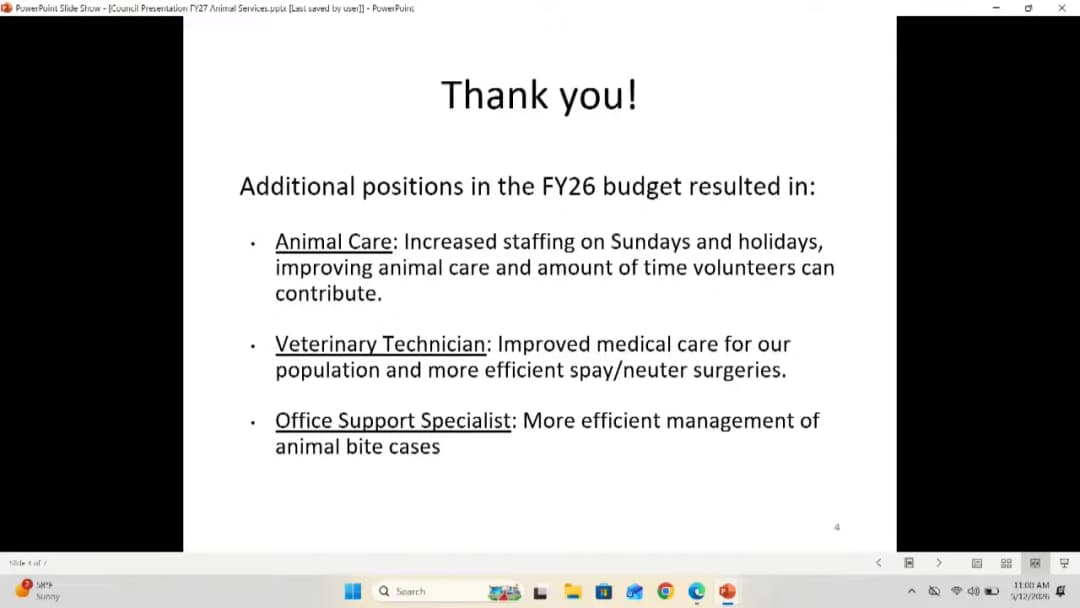
The meeting started with the Board of Health, where Health Officer Dr. Gednert answered follow-up questions from an April 14 presentation. The Board then adjourned, and the County Council convened for FY2027 budget presentations from the Departments of Health, Aging and Disabilities, Police, Animal Services, Fire, Sheriff, Detention Facilities, and Emergency Management. Board of Health - Question & Answer Session - Mumps: Maryland reported 43 cases; specific vaccination history is unknown, but the MMR vaccine is 80–90% effective. Hospitalization severity is reduced by vaccination. - School-Based Health Centers: A student-only model is proposed for the pilot, with the health department as administrative sponsor and a clinical partner via RFP. Broader community models require new buildings and larger operations. - Staffing: Challenges include a hybrid state/county workforce, salary competitiveness, and limited continuing education funds. Progress has been made on school nurse salaries and retirement benefits. - School Health Turnover: Overall turnover is 27% (lower than 2023–2024 peaks). Health assistants have higher turnover due to certification changes. Vacancies are filled in 5–6 days due to active recruiting. - Medicaid Navigator Positions: Five positions are needed to handle increased walk-ins from Medicaid redeterminations due to HR1 changes. - Commercial Kitchens: Two plan reviewers conduct on-site inspections and plan reviews. Businesses can also submit photos and schedule pre-application meetings. - Cannabis Data (through March 2026): Hospital visits for ages 15–19 have increased since legalization in 2023. Presentations include vomiting, lethargy, odd behavior, and slowed heart rate. The health department runs campaigns, peer education, and a youth video contest. Self-report surveys show increased use. - Follow-up Discussion: Councilmember Rodvian asked about the nature of hospitalizations. Councilmember Fiedler asked about tracking long-term mental health effects and teen access (commonly reported as “someone gave it to me”). Councilmember Rodvian raised concerns about rising violent behaviors in pre-K through first grade; the health department is coordinating with schools but notes a shortage of therapists for young children. Department of Health - FY2027 Operating and Capital Budget - Dr. Gednert presented the proposed budget (Marika Hannem from budget office also present). - Operating requests include: - $267,300 for five Medicaid eligibility and enrollment specialists (three specialists, one lead, one office clerk lead) to manage HR1 changes. - $167,800 for two medical billing positions (manager and specialist), expected to generate $340,000 in additional revenue. - $335,100 for violence interruption expansion: $245,000 one-time for North County (Brooklyn Park) training and database; $90,000 recurring for West County Man Up program. - $124,300 for two REACH program case managers to serve up to 1,000 new uninsured members. - $439,600 for seven school health FTEs for new AACPS schools (two preschools, a facility split, and New Village Academy). - $404,800 for JUUL settlement–funded smoking cessation initiatives. - Capital requests: $3,000,000 for septic system enhancements, $80,000 for the Failed Sewage and Private Well Fund, $150,000 for the Demo Building Code program. - Grant funding appears $8 million lower due to a new methodology appropriating at 75% of the last award; the budget will be trued up when official awards are received. Department of Aging and Disabilities - FY2027 Operating Budget - Director Krissa Kelly stated the department served over 18,000 residents with 572,000 units of service in 25 programs at 23 locations. - Highlights: Easy Travel Access program (door-to-door transport), Arnold Senior Activity Center renovation (completion July–August 2026), expanded dementia care navigation, and increased veteran services. - Councilmember Folkey asked about Pasadena Senior Center space and a possible shared site with the library; Director Kelly noted interest but deferred to community input. - Councilmember Smith remarked that the department receives 0.6% of the county budget while serving 17% of the population (65+), calling the gap unsustainable. Police Department - FY2027 Operating and Capital Budget - Chief and Henry Farrell presented. - Operating budget $246.1 million: Increase driven by $9 million countywide pay package, $1 million for nine new positions, and $2.6 million in contractual services (including $400,000 for helicopter engine overhaul required by FAA at 2,000 flight hours). - New positions (nine): Forensic firearms examiner, school resource officer, central records program specialist, and six for the Real-Time Information Center (RTIC): three public safety analysts, two officers, one sergeant. - Capital: $29.3 million for the Northern District Police Station; $27.3 million for construction in FY27. - Cameras: The speed/red-light camera program has vendor performance issues and is revenue neutral; the county will re-bid independently. - Crime: 2025 saw declines in all tracked categories; homicides were 10 with one added from Baltimore. - Councilmember Volkey questioned the helium cost and camera program; Chief reported community feedback that the RTIC deters criminals. Animal Services - FY2027 Operating and Capital Budget - Director Claudia reported an 86.9% live release rate (highest ever) and above‑national‑average pet redemption. - Highlights: Paws Around Town program, Shelter Buddy software, online dog licensing. - Operating requests: A Management Aid to coordinate adoptions and an Adoptions Coordinator to improve matching and follow-up. - Capital: $530,000 for concept design and site selection for a new shelter. - Councilmember Volkey suggested a shared government services site in Pasadena; Director expressed interest. Fire Department - FY2027 Operating and Capital Budget - Chief Wolford presented. - Operating requests include: - 21 new positions (truck staffing to eliminate cross‑staffing at Galesville, start January 2027). - Life Pack 35 replacement: $2.5 million for 54 units, replacing outdated Life Pack 15s due to technology and support changes. - Medication and medical supply: After Anne Arundel Medical Center and Baltimore Washington Medical Center stopped restocking, the department must create an in‑house pharmacy; requests include a program manager and stock specialist, plus vending machines. Council expressed strong frustration and requested direct dialogue with hospital leadership. - Mobile Integrated Health program continuation as hospitals withdrew funding; program reduces high‑utilizer 911 calls. - Apparatus replacement: $; plan with 3‑year lead times and rising costs. - Pediatric response system, ballistic vests, rope replacement, and other gear for new hires. - Capital projects: Crownsville (open), Galesville (finishing), training academy, Cape Sinclair (under construction), Arundel ($30 million), Watch Apple, Jessup ($35.6 million). Councilmember Smith questioned high costs relative to recent builds in other counties; Chief cited inflation, environmental issues, and specialized firefighter health features. - Councilmember Volkey asked about the hiring timeline (positions start mid‑year for budgeting), Life Pack grant opportunities, and the medication restock crisis. Sheriff’s Office - FY2027 Operating Budget - Sheriff Sescar presented. - A warrant deep dive reduced workable warrants from 14,867 to 679 by removing out‑of‑county, filed, no‑address, detained, and deceased individuals. - Operating requests: - Five additional deputies for courthouse security due to HB 492 (effective July 2027), which requires “best efforts” to staff courtrooms. Sheriff argued proactive need; Councilmember Volkey noted the law does not set a strict minimum. - Eleven civilian constables for civil process service: total cost $1,094,000 ($607,000 recurring). - Discussion included using Special Police Officers (SPOs) as a cost‑effective alternative for courtrooms; Sheriff prefers deputies for training and safety. Department of Detention Facilities - FY2027 Operating and Capital Budget - Superintendent Klein reported staff vacancies down to 7%, no grievances in over 14 months. - Challenges: Maryland Department of Health continues to violate state law by not accepting individuals found not criminally responsible for court‑ordered hospitalization. The county is holding 14 people 800+ days past the legal limit at an estimated cost of $240,000. A Maryland Supreme Court case is pending. - Capital requests: $650,000 for detention center renovations (kitchen floor, fencing, painting); $664,000 for Ordnance Road re‑entry hub; continued work on Central Holding parking lot. - Councilmember Rodvian asked about on‑site medical care: full‑time nurses, med techs, and first responder training for all staff. Office of Emergency Management - FY2027 Operating and Capital Budget - Director Emmerich noted federal grant uncertainty: FY25 awards have not been received; grants support 50% of OEM staffing. - Capital: Consolidated 911/EOC building at the fire training academy site. FY27 request increase for water main, technology, and inflation. The county has already obtained a $3.5 million federal earmark for technology. - OEM is also working on cyber coordination, continuity of operations, and social resilience programs. Key Outcomes and Next Steps - No votes were taken on budget presentations; the council will continue deliberations. - The Board of Health session was adjourned after the Q&A. - The County Council adjourned until May 13, 2026 at 2:00 PM for further department presentations, followed by a public hearing on the FY27 budget at 7:00 PM. - Multiple information requests (cost breakdowns, medication restock detail, Life Pack service timeline, and hospital partnership discussions) were made by council members and will be provided by the departments.
The Anne Arundel County Council held a budget meeting on May 11, 2026, to hear presentations from several county departments regarding their Fiscal Year 2027 budget requests. The meeting included presentations from Anne Arundel Community College, Anne Arundel County Public Libraries, Anne Arundel County Public Schools (AACPS) covering operating and capital budgets, the State's Attorney's Office, the Board of Elections, the County Executive's Office/Chief Administrative Officer, and the Office of Law. Council members discussed funding levels, challenges, and unmet needs across these agencies. Anne Arundel Community College (AACC) - AACC requested that the council maintain the county executive's proposed $2.4 million increase in county funding, bringing the total operating budget increase to $5.7 million. The college reduced its planned compensation pool from 6% to 4% to offset a $2.4 million reduction in county funding. Council members noted that the college has historically done more with less relative to other county units. Councilman Smith highlighted that state funding (CAD funding) has fallen short of the intended one-third share; AACC estimated they would have received an additional $5 million if CAD were fully funded. The college also requested $3.7 million for relocating the math program to the Careers Building, which the planning advisory board did not fund. Council members expressed support for the college's efforts and acknowledged the challenges in attracting and retaining faculty in skilled trades and other high-demand fields. Anne Arundel County Public Libraries (AACPL) - AACPL presented its budget, noting that per-capita funding remains low compared to other Central Maryland library systems. The library board highlighted that 88% of county residents have library cards. The county executive's proposed budget includes $375,000 per year for library renovations in the final year of the CIP, plus $425,000 in state legislative bond initiatives for signage, privacy pods, and renovations at Severna Park Library. A $4.7 million renovation of the Brooklyn Park library was funded. The library also requested a maintenance mechanic position ($58,757) and funding for the Maryland Corps Host Partner Program ($101,946 for three positions). Council members discussed the feasibility study for a new Mountain Road library and renovations at Deal, Crofton, and Linthicum. Mr. Auld, the library director, will be retiring. Anne Arundel County Public Schools (AACPS) - Operating Budget - AACPS presented its operating budget, with a proposed increase of $72.8 million from the county (the largest dollar increase ever) and $19 million from the state. The superintendent highlighted accomplishments: 5-star school ratings increased 36%, 13% of schools are five-star (vs. 7% state average), teacher vacancies dropped from 180 to 26, and national board-certified teacher retention is high. Despite the increase, unmet needs were noted: school-based supports, technology (chromebook replacement cliff), bilingual facilitators, and special education grant replacements. Council members expressed concern about sustainability given rising health care costs (health insurance fund needing $13 million, but actual claims up 9.5%) and state funding challenges. The health insurance fund reserve is projected to decline. On the capital side, Southern High School lacks a second gym, which was cited as an equity issue. The county executive funded a field house at Chesapeake High School but not at Arundel High School. Council members discussed the possibility of using leftover funds to accelerate the Arundel field house. State's Attorney's Office - The State's Attorney's Office requested no additional funding, noting they stayed within budget and secured $5 million in competitive federal and state grants to support victim advocates and other programs. They highlighted successes including a murder conviction and community outreach programs. The office is nearly fully staffed with only 2-3 attorney openings. Board of Elections - The Board of Elections presented its FY2027 budget, noting preparations for the gubernatorial primary and general elections. They projected 53% turnout for the general election, with 27% mail-in ballots. They are recruiting 2,100 election judges. New implementations include a training app, enhanced ballot drop box security, and new voting systems (poll books and voting machines) to be used by 2028. The cost will be shared 50% state, 50% local. Councilman Volkey raised concerns about pre-election canvassing starting June 1 potentially allowing public observation of vote totals before election day. The board noted that observers must sign NDAs. County Executive's Office / Chief Administrative Officer (CAO) - The CAO budget presentation noted a net decrease of $15 million largely due to one-time grants in FY2026 (YMCA library partnership, Annapolis welcome center). New grants include additional funding for the welcome center, Maryland Hall, film festival, shock trauma, toys for tots, and a city of Annapolis medic pilot. The CAO contingency fund increased from $14 million to $16 million, representing 0.29% of the general fund. The budget office indicated the fund is typically fully spent down via fourth-quarter transfers. Council members asked about a security grants program for houses of worship; the county executive decided not to create a new program, citing existing police support. Office of Law - The Office of Law presented a budget largely unchanged, with 37 staff (24 attorneys). They handle government operations, litigation, and human services. Notable: 33 cases under the Maryland Child Victim Act against the Board of Education are being defended. They requested favorable review. Key Outcomes - No formal votes were taken on budget items during this hearing. The council heard presentations and will continue budget deliberations at subsequent meetings. The meeting adjourned at approximately 2:00 PM with a break for lunch, and the council will reconvene on May 12, 2026, at 9:00 AM to sit as the Board of Health and continue budget presentations.
On May 4, 2026, the Anne Arundel County Council held its legislative session, presided over by Chair Hummer. The source material did not include an agenda or minutes. The Council approved prior minutes, introduced two resolutions, heard public testimony on several bills, passed supplementary appropriations and National Business Park North financial district measures, acted on multiple Region 5 rezoning amendments, and advanced a cannabis dispensary siting bill. Several bills were continued to May 18, 2026, and the Council adjourned to May 11, 2026, at 10 a.m. for FY27 budget department presentations. Consent Calendar / Routine Approvals - The Council approved, as read, the minutes of the April 20, 2026 legislative session and closed session, after a motion that partial reading constitutes reading of the whole. - No bills were introduced. Resolutions 1026 and 1126 were introduced, endorsing Maryland Economic Development Assistance Fund financial assistance to Holly Poultry Incorporated and Intuitive Machines LLC, respectively. - Councilmember Fiedler was added as cosponsor to Bill 1926. Public Comments & Testimony Open Invitation - A resident referred to in the transcript as Mr. Namharn/Nimhard commended County Executive Pittman for publicly supporting Councilwoman Lisa Ryan’s bill to keep developer money out of politics, noted that bill was voted down 5-2, and argued the Pittman administration’s apology for slavery should be backed by action on Freetown residents’ concerns about developer exploitation. He cited preservation of 47 acres in Annapolis at the cost of 76 townhouses and said twice as many townhouses are proposed in half as much land in Freetown. - Kurt Svenson of Arnold spoke about written testimony on impact fees, drawing on 25 years as the county government’s impact fee subject matter expert. He said an impact fee bill would be introduced as “a political gesture” and called on the Council to confront examples of government capture. - Jan Randall was told her comments concerned the Region 5 agenda item and would be heard when the Council reached that item. Region 5 Bills 1726 and 1826 - The joint public hearing on Bill 1726 and Bill 1826 received 2 online testimony pieces for Bill 1726 and 14 for Bill 1826. Councilmember Rodbyan asked testifiers to identify the property they were discussing. - Jim Holman of Myers Station Road opposed additional Two Rivers homes, referencing 377 proposed additional homes on top of 2,060 already approved. He urged the Council to adopt the bills without developer-driven amendments and to follow the Region 5 advisory committee and Planning and Zoning recommendations. - Laura Murray of Two Rivers said she is preparing an application concerning St. John’s AME Zion Baptist Church as a potential Underground Railroad and African American historical resource. She asked the Council to defer approval or impose binding conditions until historic/archaeological review, including a Phase I survey and traffic impact study, because the church is about 2.5 miles from the proposed development and shares an overburdened access road. - Judy Wagner of Two Rivers supported the provision in Bill 1826 rezoning parcel O from R2 to open space in the Two Rivers PUD and urged the Council to consult the Office of Law on the county’s legal authority to reconcile the zoning map with the PUD. - William Staffi and owner Don Ord, representing Aztec Electric/Colonial Electric at 697 Maryland Route 3 North, asked the Council to correct a tax-map error dating to a 1940s deed and retain C2 zoning; they said they were not requesting any upzoning. - Jan Randall argued the county should enforce the contract she signed with the Two Rivers developers, saying they promised her home and open space in parcels N and O. She said 377 additional homes would be non-contiguous, conflict with rural agricultural zoning of one dwelling per 20 acres, and add traffic to a state-designated level two protected road. - Mark Gast of Myers Station Road said Two Rivers builders had violated covenants and promises, and he cited traffic, police, fire, school capacity, power outages, and wastewater capacity concerns. He asked the Council to oppose the amendments. - Sarah Matthews of 2401 Queen Mitchell Road supported Councilwoman Ledbetter’s amendment to rezone her property to C2 commercial office, asking for the same designation as the neighboring Goddard School property because Queen Mitchell Road has already become a commercial corridor. - Regis Fale of Grace Ford Road said the developer’s past dishonesty did not warrant future approvals and described overbuilding, traffic on emergency roads, and disregard for covenants. - Manisha Farake and Mehu Kareck, owners of the Goddard School at 2404 Queen Mitchell Road, requested full C2 zoning for their split-zoned lot. They said they had operated the school for 15 years, notified neighbors by letter, and received no opposition. - A sixth-generation farmer at 575 Graceford Road, whose 100-acre farm is in a farm preserve, opposed the proposed density and asked council members to visit Route 3 and the surrounding area before approving more homes. - Karen Eggloff supported Councilmember Fiedler’s amendment to keep the family property at 876 Maple Road at its existing C1 zoning instead of being downzoned to RLD. She said the family has owned the land for more than 100 years. - Brenda Fernandez supported the OPZ and Planning Advisory Board recommendation for R1 zoning for 2419 Blooming Way and requested a survey before any higher density because the property’s feasibility report did not cover access, which she said is controlled by another owner and created fire and ambulance access risks. Bill 1926 - One online testimony piece was received for Bill 1926, the daycare tax credit bill. No one spoke at the public hearing. Bill 2926 - Six online testimony pieces were received for Bill 2926, the cannabis dispensary siting bill. Public speakers included: - Eddie Pounds, attorney and lobbyist for Vital Dispensary at 91 Ritchie Highway in Pasadena, said the dispensary is a social equity licensee, was purchased about four months earlier for $3 million, is making interior-only renovations, and is working with the nearby church. He cautioned the Council not to adopt a measurement standard that conflicts with state code provisions governing alcohol retail stores, which he said use entryway-to-entryway measurement. - Reverend John Knupp of Pasadena United Methodist Church supported the bill. He said the church has operated there since 1958, hosts the Pasadena Early Learning Center serving more than 60 children daily, and has a playground just under 300 feet from the proposed dispensary property. He noted state distance requirements for cannabis were cut in half from 1,000 feet for liquor stores to 500 feet. - Jeff Kubick of Dalesway Drive supported the bill and said it was harder to open a liquor store or plasma center than a cannabis dispensary. He noted the 2023 bill that reduced restrictions was unanimous. - Dr. Alexander Dix, clinical director for Vital Dispensary, presented scientific counterpoints, saying no lethal dose of cannabis has been established, cannabis dependence rates are lower than alcohol or tobacco, teen cannabis use has declined, and dispensaries verify IDs. - Jennifer Jackson of Pasadena said she has supported and visited licensed dispensaries, but opposed this site near schools and homes, agreed with the 100-foot residential buffer, and criticized Vital’s community outreach. - Steve Clark of Dalesway Drive supported the bill, argued security cameras showed a need for buffers, and said state law lacked a clear definition of how the 500-foot distance is measured. - Barbara Clark, a registered nurse, supported the bill and cited a December 1, 2025 Washington State Institute for Public Policy study concluding that people living near licensed marijuana stores were more likely to be diagnosed with cannabis use disorder, including a 13% higher likelihood for ages 12-20. - Brian Riley of Pasadena United Methodist Church raised concerns about public notice and the proximity of the proposed dispensary to a church-operated daycare, saying even perceived risk could affect families’ choices. - Lara Stumpfall expressed concerns about cannabis odor from an existing dispensary and exposure to children, youth, and people in addiction recovery near the proposed site. - Mike Stumfall said the Council should strengthen regulations to the full extent state law allows, not loosen them, and questioned whether an outright property purchase showed too much legal gray area. - Lee Augsberger, executive pastor of Severna Park Evangelical Presbyterian Church at 114 Ritchie Highway, supported the bill. He said his church has hundreds of weekend participants, child programs, a homeschool co-op, and a food pantry, and he stated the proposed site is 448 feet door-to-door from the church building. Discussion Items Bill 2626 — National Business Park North Special Taxing District Boundary Modification - Administration representative Ethan Hunt said the bill adds newly acquired parcels to the tax increment financing district. - Jacob Hoffner of Arnold raised concerns about COPT, describing it as a $3.6 billion corporation, noting large asset-manager ownership, and mentioning roughly $56 million in annual AWS payments to COPT. He framed the decision as part of broader wealth concentration. - Councilmember Smith supported the bill, saying businesses in National Business Park North support Fort Meade, the National Security Agency, and U.S. Cyber Command. - The bill passed 6-1, with Councilmember Rodbyan voting no. Resolution 626 — National Business Park North Development District Boundary Amendment - This companion resolution amended the development district boundaries. No public testimony was received, and the resolution was adopted 6-1, with Councilmember Rodbyan voting no. Bill 2726 — National Business Park North Refunding Bonds - Administration said the bond issuance recitals had to be amended because the tax district boundaries changed. - Jacob Hoffner again spoke, asking for accountability and visibility rather than asking the Council to vote no. - Councilmember Volkey noted the 24.5-acre addition tracks a project for two data storage centers and a parking garage and tied it to a prior resolution studying data and energy use. - The bill passed 7-0. Bill 2526 — Current Expense Budget Supplementary Appropriations - The bill appropriated $10,515,000 from unappropriated fund balance and transferred $8,098,900 from CAO contingency, for a total of $18,613,900. - Allocations included $10 million to the Self Insurance Fund, $515,000 to the Workforce Development Corporation, $1.22 million in personal services for public works, $5,520,400 in contractual services, $1,305,800 in supplies and materials, and $50,000 in personal services for the partnership for children, youth, and families. - Councilmember Volkey confirmed that about $8 million related to emergency “ICE Mageddon” work by contractors and DPW. - Susan Harold of Central Services said the Self Insurance Fund needed $10 million primarily because of rising workers’ compensation claims, including a 7% increase in claims and a 17% increase in cost, plus medical inflation, higher payroll, and Child Victims Act cases. She said five non-workers’ compensation claims, including a cyber incident, were above the typical two to three. - The bill passed 7-0. Bills 1726 and 1826 — Region 5 General Development Plan and Comprehensive Zoning - Administration said these bills adopt the Region 5 plan and comprehensive rezoning, the last of nine regions rezoned over about two and a half years. - The Council considered six amendments to each bill. The following amendments were adopted: - Amendments 3 and 6 (876 Maple Road) retained commercial land use and C1 zoning rather than the recommended RLD; adopted 7-0 each. - Amendments 4 and 7 (814 Maryland Route 3 South) changed planned land use from mixed use to commercial and zoning from MXD to C3/C4, removing the mixed-use development policy area overlay; adopted 7-0 each. - Amendments 5 and 8 (697 Maryland Route 3 North) corrected the Aztec Electric property’s planned land use to commercial and zoning to C2; adopted 7-0 each. - Amendments 6 and 9 (2404 Queen Mitchell Road) changed planned land use to commercial and zoning to C2 for the Goddard School property; adopted 7-0 each. - Amendment 7 to Bill 1726, which would have changed the Meyer Station Road parcel’s land use from rural to low-density residential and its development policy area to neighborhood preservation, was defeated 0-7. OPZ objected, citing Plan 2040 goals, rural character, traffic and flooding concerns, and water-quality protections. Councilmember Volkey suggested keeping the rural land-use designation while allowing a narrower zoning change. - Amendment 10 to Bill 1826 then changed part of the same Meyer Station Road parcel from RA to R1 while leaving the rural land-use designation in place; it was adopted 6-1, with Councilmember Smith voting no. OPZ reiterated its objection. - Amendments 8 and 11 (2401 Queen Mitchell Road) changed planned land use to commercial and zoning to C2; adopted 7-0 each. - Bills 1726 and 1826, as amended, were continued to May 18, 2026. Bill 1926 — Real Property Tax Credit for Daycare Centers - The sponsor said the bill supports child and adult daycare businesses by providing a real property tax credit of up to $4,000 over 10 years in Anne Arundel County, citing the state Comptroller’s State of the Economy series on challenges facing the child care industry. - Administration expressed support. All councilmembers became cosponsors. The bill passed 7-0. Bill 2826 — C4 Accessory Apartment Dwelling Units - Councilmember Volkey said the bill adds as a permitted use in the C4 zoning district an accessory apartment dwelling unit, which is already permitted in C1, C2, and C3, provided the entrance is separate from the commercial use. - Administration said it was comfortable with the bill. No public testimony was received. The bill passed 7-0. Bill 2926 — Cannabis Dispensary Conditional Use Requirements - Councilmember Volkey said the bill was community-driven and would add county setback requirements for licensed dispensaries, growers, and processors of cannabis: 500 feet from schools, playgrounds, recreation centers, libraries, public parks, places of worship, licensed child care centers, and registered family child care homes; 100 feet from residential-use properties; and separation from other dispensaries. - The Office of Law raised a legal concern about the proposed half-mile dispensary-to-dispensary separation, so Councilmember Volkey offered Amendment 1 to change it to 1,000 feet. - Administration opposed the bill. Jansen Evelyn and others argued it was a countywide response to one Pasadena siting conflict, departed from the framework unanimously adopted in 2023 under Bill 5623, and that lot-line-to-lot-line measurements or a 100-foot residential buffer would reduce available sites and create a checkerboard effect in mixed-use areas. Administration preferred lot-line-to-entryway measurement and said 10 licensed dispensaries currently operate in the county. - Amendment 1 was adopted 7-0. Bill 2926 as amended was continued to May 18, 2026. Resolution 926 — Selection of Independent Auditor - The resolution selected SC&H Group as the independent certified public accountants to perform the financial audit for fiscal year 2026. - No public testimony was received. The resolution was adopted by voice vote. Key Outcomes - Passed/adopted: Bill 2626 (6-1), Resolution 626 (6-1), Bill 2726 (7-0), Bill 2526 (7-0), Bill 1926 (7-0), Bill 2826 (7-0), and Resolution 926 (voice vote). - Defeated: Amendment 7 to Bill 1726 (0-7). - Continued to May 18, 2026: Bills 1726 and 1826 as amended, and Bill 2926 as amended. - The Council adjourned to May 11, 2026, at 10 a.m. for FY27 budget department presentations.
On May 1, 2026, the Anne Arundel County Council convened for a full-day session focused on the proposed Fiscal Year 2027 budget. County Executive Steuart Pittman delivered his final budget address, followed by reports from the Public Advisory Board (PAB) and the Spending Affordability Committee, and a detailed presentation from Budget Officer Chris Trumbauer. The council will hold public hearings and make adjustments before adoption. Public Comments & Testimony - No public testimony was taken during this session; the County Executive noted the presence of residents and public servants and thanked them for their engagement. Discussion Items - County Executive Budget Address: Exec. Pittman presented a $2.577 billion operating budget proposal for FY27, emphasizing investments in education, public safety, human services, and infrastructure. Key proposals included: lowering the property tax rate to 96.8 cents per $100 (0.6 cents above the Charter tax cap, generating $6.1 million for education), maintaining the 2% homestead credit, and funding a 2.25% cost-of-living adjustment for all bargaining units including teachers. He highlighted 21 new firefighter positions, nine new police positions (including six for the Real-Time Information Center), expanded Cure Violence program to Brooklyn Park, increased food bank funding from $1.5M to $2M, doubled the Office of Multicultural Affairs Family Protection Initiative, and added five Medicaid Navigator positions and two REACH case managers. He also noted $60 million transferred within the DPW utility fund to address wastewater flow and lift a moratorium. The capital budget stays within affordability, funding major projects and adding concept design for a new animal shelter, Crofton Skate Park, and College Parkway safety improvements. Exec. Pittman expressed commitment to leaving a "house in good order" for the next administration. - Public Advisory Board (PAB) Report: PAB Chair presented a unanimous recommendation for a capital budget of approximately $1.22 billion over six years (FY27-FY32), with FY27 capital spending at $354 million, under affordability by $7.3 million. The board advised "finish what you started," focusing on completing ongoing projects rather than launching many new initiatives. - Spending Affordability Committee Report: Dr. David Jippe, Chair, recommended a 4.7% growth limit for the FY27 operating budget (allowing $109.7 million in new spending) and a 4% growth limit for the capital budget ($98.1 million). The committee noted economic concerns including slowing job growth, mortgage rates above 6%, and inflation at 3.3% due in part to Middle East conflict. - Budget Officer Presentation: Chris Trumbauer provided a 76-slide briefing. He reported that FY26 revenue estimates were revised upward by $149.1 million, mostly due to higher income tax and investment income, reducing fund balance use to $35.9 million. For FY27, total general fund revenue is $2.577 billion, with $210 million from fund balance. Revenue growth is modest; income tax is projected to decrease slightly from FY26 revised estimates due to softening economy. Property tax rate decrease from 97.7¢ to 96.8¢. Trumbauer detailed expenditure growth driven by health insurance claims, gas/electric costs, and $4.2 million in state cost shifts. New positions include 21 firefighters, 9 police, and others for IT and DPW optimization. Debt service is within affordability limits. The rainy day fund is projected at $190 million (8% of revenues). Board of Education funding totals over $1.25 billion (half of the budget), with a $72.9 million increase over FY26 (including $26.6 million from state). Library funding increased by $1.1 million. Community college funding increased by $2.4 million. - Q&A: Council members asked about the property tax cap, fund balance usage, debt service projections, and compensation for teacher assistants. Budget Officer confirmed that if the council wished to cut $6.1 million to meet the tax cap, it could be done by reducing expenditures, but cautioned against using one-time funds for recurring costs. The council also discussed teacher assistant funding; the budget funds the superintendent's request but not the board's higher request for $18/hr. Key Outcomes - The County Executive's FY27 budget proposal was formally submitted to the council for review. - The Public Advisory Board's capital budget recommendation was received and accepted by the council without questions. - The Spending Affordability Committee's growth limits were noted. - The council introduced eight budget-related ordinances (Bill Nos. 32-26 through 39-26) concerning annual appropriations, tax levies, and special taxing districts. - The council recessed from approximately 11:00 AM to 1:00 PM and adjourned at the end of the session, with the next legislative session scheduled for Monday, May 4, 2026 at 7 PM.
The Anne Arundel County Council held a legislative session on April 20, 2026, covering a wide range of topics including proclamations, public comments, land use and zoning amendments, affordable housing tax credits, ethics reform, and a sewer moratorium. The session featured multiple public hearings, votes on resolutions and bills, and consideration of a veto override. Consent Calendar - Resolution 726 designating April 30, 2026 as National Therapy Animal Day was adopted unanimously (7-0) following a brief public hearing and comments from handlers. - Minutes of the April 6, 2026 legislative session were approved. Public Comments & Testimony - Invitation to Audience (Freetown community concerns): - Dayan McLaren Johnson (resident of Freetown) spoke about preserving the legacy of Freetown, one of the oldest Black communities in Anne Arundel County, opposing overdevelopment that disregards Plan 2040's designation of the area for neighborhood preservation. Emphasized 'Freetown is not just land, it's legacy.' - Deborah Spears (Freetown resident) expressed concern that building 177 homes to get only '30-something affordable homes' gives builders permission to disregard zoning rules and infrastructure capacity. - Beverly Giles, Pastor Jackie Bell, Colin Nemhart, and others testified against the scale of the development, citing traffic congestion on Route 3 and St. Stephen's Church Road, impact on schools, and incompatibility with the rural character of the community. - Kurt Svenson (retired county budget officer) testified on impact fee methodology, alleging government capture in the 2023 cost study that reduced attributed travel miles per home from 32 to 7.83 per day. - Public Hearing on Bills 1726 and 1826 (Region 5 Plan and Zoning): - Numerous residents spoke against proposed rezonings (e.g., 2419 Blooming Way, Brandy Farms, St. Stephen's Church Road area), arguing that higher densities (R5) contradict Plan 2040, would worsen traffic, strain infrastructure, and alter neighborhood character. They requested maintaining low-density (R1, RLD) zoning. - Speakers included Janice Delph, James LaRoc, Andrea Lauf, Jason Hay, Fred Circo, Oliver Bell, and others who described the rural nature, safety concerns, and cumulative impacts of nearby projects. - Nika Kelly asked about subdivision of family property on Evergreen Road to build additional homes. - Public Hearing on Bill 2326 (Campaign Contributions/Ethics): - Multiple speakers (Alpha Stevens for League of Women Voters, Mary Beth Love, Matt Johnston, Andy Plattner, James Kitchen, Kyle Nimhart, others) voiced strong support for the bill, calling it a good governance measure to increase transparency and reduce undue influence of developer money in land-use decisions. No opposition was voiced. Discussion Items - Resolution 826 (Electric Hybrid Bus Grant Appropriation): Ethan Hunt (Administration) requested appropriation of $900,551 federal grant to purchase one electric hybrid bus, replacing originally planned four buses due to supply chain and tariff delays. Council members discussed costs: county share $180,000 vs. estimated $350,000+ for a standard diesel bus. Concerns included high per-bus cost ($1M vs. $350,000 for diesel), delivery timeline (12-13 months), and whether hybrid options are preferable. Supporters cited maintenance savings (Ms. Rodvian noted her electric car's low costs) and environmental benefits, plus the need to retain federal funds. - Bill 926 (Battery Energy Storage Systems Zoning): Sponsored by Ms. Fiedler, the bill adds new use to zoning charts, aligned with state code. A public hearing had one speaker (Adam Dobitsky of Land and Liberty Coalition) in strong support, citing grid benefits, no cost to ratepayers, and revenue for county. - Amendments to Bills 1726 and 1826 (Region 5): - Amendment 4 to 1826 (Evergreen Road mining expansion): Changed zoning from RLD to RA to allow sand/gravel mining on 99 acres, reducing truck traffic by sourcing materials on-site. Administration noted some tree-clearing preempted by state law. Passed 6-1. - Amendment 2 to 1726 (Brandy Farms, 8.7 acres to R5): Failed 3-4 after extensive debate. Council members expressed difficulty: property owner wanted development after losing memory care facility; community opposed density. Some wished for R2 compromise but that option was not available. - Amendment 1 to 1726 and Amendment 3 to 1826 (Route 3 commercial rezoning): Later reconsidered and adopted unanimously after property owner obtained signatures from nearby residents, confirming support for the change to C4/C2 highway commercial for an auto restoration use. - Bills 2026, 2126, 2226 (PILOTs for Affordable Housing): Three PILOT agreements for affordable rental projects (Homes at Shelley, Glen Burnie; Odenton Junction 4 and 9) were approved, each with 40-year terms, 4% annual payment increases. Projects serve households at 30-80% AMI. All passed on similar 4-3 votes, with Ms. Ledbetter and Mr. Volkey in opposition consistently citing fiscal concerns. - Bill 2326 (Ethics: Campaign Contribution Limits): Sponsored by Ms. Rodvian, the bill would restrict contributions from developers when land-use decisions are pending. Administration and all testifiers supported it. However, the bill failed 2-5 (only Ms. Rodvian and Ms. Fiedler in support) after an amendment to delay effective date (to avoid affecting current election cycle) failed for lack of a second. - Bill 2426 (Sewer Moratorium): Sponsored by Mr. Volkey, aimed to codify a moratorium on new development due to sewer capacity issues. Administration argued it was unnecessary. The bill failed 3-4. - Veto Override: The council overrode the county executive's veto of Amendment 3 to Bill 426 (Governor Bridge Road rezoning from RA to RLD), which allows existing homes on the parcel but restricts further subdivision. Override passed unanimously (7-0). Key Outcomes - Resolution 726 adopted (7-0) recognizing April 30, 2026 as National Therapy Animal Day. - Resolution 826 adopted (5-2) appropriating grant funds for one electric hybrid bus. - Bill 926 adopted (7-0) zoning for battery energy storage systems. - Amendments to Region 5 bills: Amendment 4 to 1826 (mining expansion) adopted (6-1); Amendment 1 to 1726 and companion Amendment 3 to 1826 (Route 3 commercial) adopted (unanimous) after reconsideration; Amendment 2 to 1726 (Brandy Farms residential density) failed (3-4). The Region 5 plan and zoning bills as amended will be heard again on May 4, 2026. - PILOT bills: Bill 2026 (Shelley) passed 4-3; Bill 2126 (Odenton Jct 4) passed 4-3; Bill 2226 (Odenton Jct 9) passed 4-3. - Bill 2326 (ethics) failed 2-5. - Bill 2426 (sewer moratorium) failed 3-4. - Veto override of Amendment 3 to Bill 426 succeeded (7-0), implementing the council's zoning decision. - The council moved into closed session to discuss personnel matters.