Browse by city
Date range
Search help

Search titles, summaries, topics and stored transcripts together. Keywords may match separately; put the whole query in double quotes for a phrase. Matching follows word analysis, so punctuation is not exact. Both dates are included. Documents are not searched.

SHOWING 1–10 ENTRIES
01
OCT 19, 2026 · CARMEL, INDIANA · CITY COUNCIL
Carmel Finance Utilities and Rules Committee Meeting Summary - October 19, 2026

The Carmel Finance Utilities and Rules Committee met on Monday, October 19, 2026, at 3:31 PM. The committee considered two items: an ordinance regarding nonprofit organizations receiving city support (Ordinance D-2772-25) and a resolution to maintain the current property tax rate for 2027 (Resolution CC 10-05-26-02). The committee voted unanimously on both items. Ordinance D-2772-25: Non-Profit Oversight - Corporation Counsel Benjamin Legg presented analysis of the originally proposed ordinance. He noted that the definition of "affiliated entity" was overly broad, potentially encompassing many nonprofits that receive indirect city support (e.g., Rotary Club for CarmelFest). The ordinance would require nonprofits to amend their articles of incorporation to include a council appointee and have all other board members approved by the city council, which Legg argued may exceed the council's legal authority under Indiana Code and could deter nonprofits from partnering with the city. - Legg proposed an alternative: narrow the definition to organizations that are supporting organizations under IRC 509(a)(3) or community development corporations, and require only annual financial reporting. - Councillors Minor, Green, Rowell, and Ward all expressed agreement with Legg's concerns. Minor stated she researched Indiana Code 23-17 and consulted a nonprofit attorney, concluding the requirement to amend articles of incorporation would be an undue hardship. Green noted the ordinance was introduced hastily as a reaction to a past event and called it "bad government." Rowell said forcing nonprofits to change bylaws to partner with the city is difficult. - A motion was made by Councilor Royal to send the original ordinance back to the full council with a negative recommendation, seconded by Councilor Green. The motion passed unanimously. Resolution CC 10-05-26-02: Property Tax Rate for 2027 - CFO Zach presented the resolution to keep the 2027 property tax rate at 0.7783, the same as 2026. This is due to a 1.6% decline in net assessed value (down $199 million) resulting from changes in SEA 1. Holding the rate flat means the city will collect less property tax revenue (from approximately $92 million to approximately $90 million). - To compensate, the administration prioritized the operating levy to maximize local income tax (LIT) receipts, capturing an additional $3 million that would otherwise have gone to other communities. The debt levy will be supplemented with general fund dollars. The budget fully funds operations without increasing taxes. - Councillor Ward asked about the impact; Zach confirmed the budget is balanced. Councillor Minor praised the strategy of maximizing the max levy quotient. - A motion to send the resolution to full council with a positive recommendation was made by Councilor Minor, seconded by Councilor Ward, and passed unanimously. Adjournment The meeting adjourned at 3:31 PM.

NONPROFIT OVERSIGHT 51% · BUDGET EQUITY ANALYSIS 30% · LEGAL DEPARTMENT BUDGET 10% · DEBT MANAGEMENT 6%
02
OCT 19, 2026 · CARMEL, INDIANA · CITY COUNCIL
Carmel City Council Regular Meeting - October 19, 2026

The Carmel City Council met on Monday, October 19, 2026, at 6:00 p.m. in City Council Chambers. The meeting included approval of the amended agenda, invocation, Pledge of Allegiance, public comments, committee reports, adoption of the 2027 budget, discussion of a micromobility ordinance, and defeat of a nonprofit oversight ordinance. A report from the Center for the Performing Arts highlighted economic impact and parking challenges. Consent Calendar - Approval of Minutes from October 5, 2026 – Approved. - Claims, Payroll & General Claims – Approved: payroll $4,475,255.83, general claims $2,764.43, retirement $137,832.00. Public Comments & Testimony - William Lloyd (Carmel resident) – Opposed power-based restrictions in the micromobility ordinance, arguing the focus should be on behavior rather than vehicle specifications. Cited his experience with electric unicycles requiring higher power for stability. - Jack Feltman (Carmel resident) – Urged council to postpone the micromobility vote, citing that the public had insufficient time to review updated ordinance documents and that the land use committee meeting was held during fall break. Suggested enforcement alternatives using Indiana BMV penalties. - Karen Peyton (Small Business Administration) – Outlined SBA disaster assistance programs for individuals and businesses affected by the August storms, including physical damage loans and economic injury loans. Discussion Items Flood Recovery Update (Mayor) - Mayor reported on recovery from the August flood: damage assessments of structures in flood-impacted areas (Northwood Hills, Hazeldale Bridge area) were completed by Tetra Tech under Indiana Department of Homeland Security partnership. Under floodplain regulations, buildings with damage equal to or exceeding 50% of market value must be brought into compliance. Property owners will receive individualized letters with results and appeal information. Partnerships with Hamilton County Community Foundation and Clay Township Trustee office were highlighted; additional community support from Surve Village noted. 2027 Budget Adoption - Mayor's presentation: Held the city property tax rate steady at 77.83 cents per $100 of assessed value for the third year. Emphasized zero-based budgeting, increased road funding by nearly 100% since 2023, additional sworn police and fire positions, and continued investment in infrastructure and quality-of-life programs (arts, grants). Noted that state-mandated deductions will reduce city revenue despite flat rate. - Council comments: Several members praised the budget for maintaining services and a flat tax rate despite a challenging fiscal environment (declining assessed value growth). Councillor Locke voiced reservations about some items but acknowledged the necessity. - Key votes: - Ordinance D2848-26 (2027 budget) – Approved. - Resolution CC-10-05-26-02 (tax rate limit) – Approved. - Salary ordinances for city court, clerk, city employees, elected officials (D2849-26, D2850-26, D2851-26 as amended, D2852-26) – Approved. Center for the Performing Arts Report - Jeff McDermott (President/CEO) presented the economic impact ($23 million for Carmel; $27.4 million for Hamilton County), operational efficiency (cited Hyden report showing $581 per seat below peer average), and educational reach (over 25,000 participants in free/subsidized programs). Raised concerns about traffic and parking congestion during the Christkindlmarkt: holiday show attendance down 20% since 2023, revenue loss of $66,000, and increased attrition. Task force recommendations included a professional traffic/parking study, dedicated rideshare zone, and additional shuttle funding. Councillors expressed support and noted the need for long-term solutions. Micromobility Ordinance (D2843-26) - Councillor Joshi (Land Use Committee) summarized changes: added device examples, clarified that e-motos do not include e-bikes, revised dismount zone language to encourage caution, removed strict 3-foot passing requirement, and specified helmet standards. Public concern about document availability led to holding the item for further review. - Councillor Osin proposed an amendment setting a minimum age of 12 for Class 1/2 e-bikes. - Councillor Locke noted ongoing work to accommodate electric unicycles under appropriate subcategory. - The ordinance was held at the dais for additional public input and discussion. Nonprofit Support Ordinance (D2772-25) - Finance committee reported a unanimous negative recommendation. Corporation counsel Benjamin Legg outlined legal risks: the ordinance would require nonprofits receiving city funds to change their bylaws to include council representation and require council approval of board members, potentially conflicting with Indiana Nonprofit Corporation law. Councillors expressed concerns about overreach and disrespect to partners. A motion to adopt the ordinance failed unanimously. Key Outcomes - Approved 2027 budget and tax rate resolution (flat rate of 0.7783 per $100 AV). - Approved salary ordinances for court, clerk, employees, and elected officials, including an amendment to add a facility manager and a storm maintenance technician. - Held micromobility ordinance for further deliberation. - Defeated nonprofit oversight ordinance (motion failed). - Received reports from the Environmental Stewardship Committee (zero-waste subcommittee, sustainability fair) and the Center for the Performing Arts. - Announcements: Mayor’s Advisory Commission on Housing meets October 29; Back the Blue Bingo event on Friday (date unspecified) supports police food baskets.

COMMUNITY ENGAGEMENT 14% · PARKING MANAGEMENT 14% · PROCEDURAL 12% · ARTS AND CULTURE 11%
03
OCT 5, 2026 · CARMEL, INDIANA · CITY COUNCIL
Carmel Finance Utilities and Rules Committee Meeting Approves Brookshire Golf Course Fees on October 5, 2026

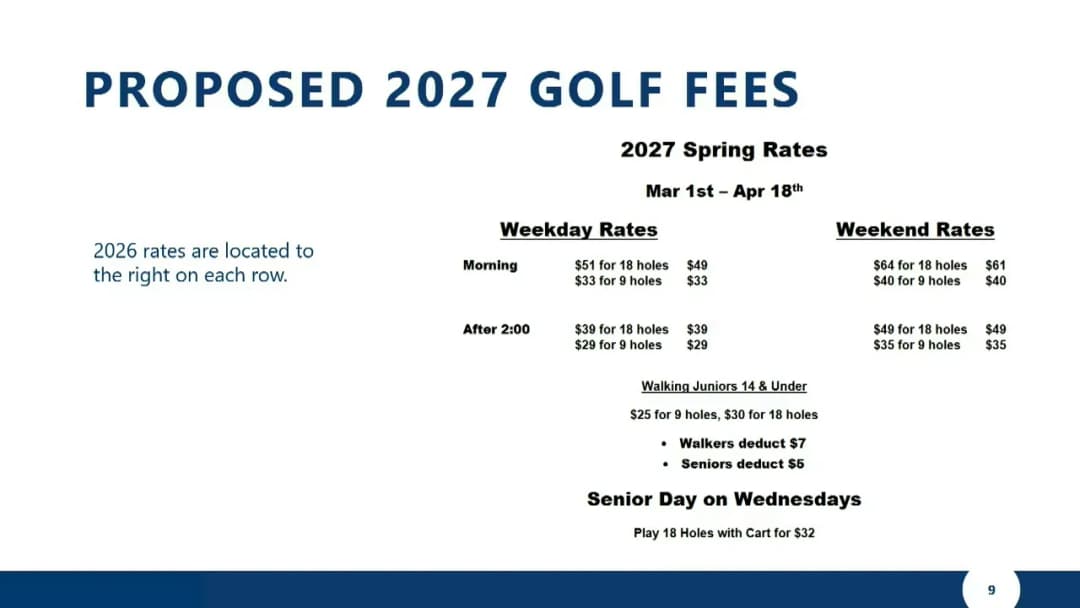
The Carmel Finance Utilities and Rules Committee met on Monday, October 5, 2026, at 4:56 p.m. to consider two agenda items: Ordinance D 2847-26, approving Brookshire Golf Course fees and rates for calendar year 2027, and Ordinance D 2772-25, adopting requirements for nonprofit organizations receiving public support from the city. The committee voted to advance the golf course ordinance to the full council with a positive recommendation, while the nonprofit ordinance was deferred to the next council meeting on October 19, 2026. Consent Calendar - None noted; both items were presented as regular agenda items. Public Comments & Testimony - No formal public comments were made during the meeting. Discussion Items - Brookshire Golf Course Rates (Ordinance D 2847-26) – Zach Jackson, CFO and controller for the city, presented the proposed rates for 2027, joined by Bob Higgins, golf course superintendent. Highlights included: - The course, established in 1971 as a private course, was purchased by the city in 2007 to prevent development and now operates as a standalone city department. - The current ordinance requires annual rate approval by November 1; the city code had last been updated in 2011, and the last rate review was in 2025 (with a significant rate increase). - Proposed rates show modest increases: roughly half of rates remain unchanged, and those increasing go up by $2–$3 for green and cart fees, and $25–$75 for membership fees. - The food and beverage vendor (MTS Collective, also known as Mustard Seed Collective) pays monthly rent, with additional fees for patio and simulator room usage; the snack bar vendor (Par Five Group LLC) pays monthly rent plus a share of sales over $30,000 per month. - A 2025 study by Carmel Clay Parks and Recreation recommended rate adjustments, improved marketing, and noted deferred maintenance issues, including an undersized parking lot and aging assets (notably a maintenance building from 1971). - Financial projections: 2026 revenues are on pace to be about $1.8 million, covering operating expenses for the first time in many years, achieving structural cost recovery. The 2027 budget forecasts revenue just under $2 million. - Council members expressed support for the modest increases, noting that last year’s larger rate increase helped catch up to market. Questions were raised about deferred maintenance (capital plan status) and the operation’s cost recovery structure; Jackson confirmed capital leases are excluded from operating expenses. - Councilman Rural supported the proposal, citing Bob Higgins’ leadership and the course’s improved financial performance. The committee discussed the possibility of aligning rate-setting with the budget cycle to better respond to market changes. - Nonprofit Organization Requirements (Ordinance D 2772-25) – The ordinance was briefly acknowledged but not discussed in detail; it was deferred to the next council meeting. Key Outcomes - The committee moved and seconded Ordinance D 2847-26, approving the 2027 Brookshire Golf Course fees and rates, with a positive recommendation to the full council. The motion passed unanimously (no dissenting votes noted). - Ordinance D 2772-25 was deferred to the next city council meeting on October 19, 2026, at 3 p.m. - The meeting adjourned at 4:56 p.m.

PARKS AND RECREATION 66% · PROCUREMENT 12% · FISCAL SUSTAINABILITY 11% · PROCEDURAL 7%
04
OCT 5, 2026 · CARMEL, INDIANA · CITY COUNCIL
Carmel City Council Meeting – October 5, 2026

The Carmel City Council held its regular meeting on Monday, October 5, 2026, beginning at approximately 6:30 p.m. The agenda included public comments on micromobility and parking enforcement, approval of consent items, committee reports, second reading and approval of Brookshire Golf Course fees, introduction of the 2027 budget and additional appropriations for Human Resources and the Fire Department, a resolution to transfer funds for fire department fuel, and the appointment of a new Historic Preservation Commission administrator. Consent Calendar - Minutes Approved: Minutes from the September 21 executive session and regular meeting were approved unanimously. - Claims and Payroll: Approved claims and payroll totaling $4,400,616.19 (general payroll), $9,716.84 (CFD bonus payroll), and $5,299.50 (general claims). Public Comments & Testimony - Jack Feldman (Carmel resident): Expressed continued concerns about the micromobility ordinance, urging the council to study successful programs like Springfield, Missouri’s enforcement system, and noted ongoing issues with the proposed dismount zone on the Monon Trail. He asked for more data and academic studies to guide improvements. - Allie Messler (resident): Raised multiple questions about the new parking enforcement system: - Where can residents find an official map and schedule of designated school zones? - Are parking restrictions enforced daily, school‑days only, or during specific hours? - How are guests, contractors, and caregivers supposed to obtain permits under the new Passport system? - Expressed privacy concerns: under the old system residents obtained stickers from the police department; now they must create a Passport account, upload vehicle registration and license, and have their license plate serve as a residential sticker. She questioned whether Carmel’s contract fully protects personal data shared with or processed by Passport, and whether the company could sell or share that data. - Banks Piller (fifth‑grade student, Mohawk Trails Elementary): Presented the Deputy Mayor’s report, highlighting community events: Carmel International Arts Festival (130+ artists), final neighborhood pop‑up celebrating Carmel’s 50th anniversary and Sophia Square’s 15th birthday, homecoming pep rally, Oktoberfest, and the upcoming Diwali celebration on October 10. Discussion Items - Micromobility Ordinance and Land Use Committee Rescheduling: Councilor Covens announced that the Land Use Committee meeting scheduled for Thursday, October 8 would be rescheduled to Thursday, October 15 at 6:30 p.m. at Carmel Public Library due to unavailability of two council members. - Brookshire Golf Course Fee Schedule (Ordinance D‑2847‑26): Councilor Taylor presented the finance committee’s unanimous positive recommendation. Superintendent Higgins and CFO Zach Jackson reported that course fee increases were “very nominal” (less than 2%, with over half unchanged). The course is expected to achieve 100% cost recovery for the first time. The ordinance was approved (second reading and final vote). - 2027 Budget Introduction (Ordinance D‑2848‑26): Introduced and held at the dais; a public hearing was opened and closed without comment. Further discussion is planned. - Additional Appropriation – Human Resources (Ordinance D‑2853‑26): CFO Zach Jackson explained the $416,000 appropriation: $336,000 for a projected workers’ compensation shortfall (increased claim costs, not claim volume) and $80,000 for salary/benefits gaps due to a part‑time addition and a temporary double fill. The council suspended rules and approved the ordinance unanimously. - Additional Appropriation – Fire Department (Ordinance D‑2854‑26): Fire Chief Joel Thacker detailed two needs: - $1.6 million for unscheduled overtime (covering vacation, sick leave, FMLA, and retirements). $1.5 million is available from a prior‑year purchase order; $100,000 is new money. - $350,000 for HVAC repairs: $295,000 for a complete replacement at Station 44 (built 2016 with ongoing issues) and $55,000 for repairs at Station 43. - Chief noted 17 retirements in 2026 and that the department needs 48 personnel daily to staff apparatus; overtime is often necessary due to vacancies and leave. He and CFO Jackson explained that fully staffing with 48 additional firefighters would cost about $7.2 million (salary/benefits), making overtime a cost‑effective option in many cases. - Councilors discussed the balance between overtime and hiring, concerns about firefighter fatigue (monitored via new health program), and the need for empirical data on staffing levels. The ordinance was approved after suspending rules. - Resolution – Fire Department Fund Transfer (R‑052601‑26): Approved a $158,000 transfer from existing appropriations for higher‑than‑anticipated diesel and gasoline costs. Moved and approved. - Tax Cap Resolution (R‑ of the Common Council): Introduced to direct the Department of Local Government Finance that the city’s tax rate will remain at 0.7783 per $100,000 assessed value for 2027. Referred to the Finance Committee. - Salary Ordinances (D‑2849‑26, D‑2850‑26, D‑2851‑26, D‑2852‑26): First readings held at the dais to be approved with the full budget. Set 2027 salaries for appointed officers/employees of the City Court, City Clerk, general city employees, and elected officials. - Historic Preservation Commission Administrator Appointment: Sam Burgess (Indiana Landmarks) was nominated and confirmed as the new administrator, replacing Mark DeLossi. The council voted to approve the appointment, with discussion about possibly updating the ordinance to allow naming an institution or designee; a committee review was suggested by year‑end. Key Outcomes - Approvals (all unanimous unless noted): - Consent agenda (minutes, claims/payroll). - Ordinance D‑2847‑26 (Brookshire Golf Course fees). - Ordinance D‑2853‑26 (HR additional appropriation $416,000). - Ordinance D‑2854‑26 (Fire Department additional appropriation $1.95 million). - Resolution R‑052601‑26 (Fire Department fund transfer $158,000). - Appointment of Sam Burgess as Historic Preservation Commission administrator. - Introductions / Held at Dais: - 2027 Budget (D‑2848‑26) – introduced, public hearing held. - Tax cap resolution – introduced, referred to Finance Committee. - Salary ordinances for court, clerk, city employees, and elected officials – introduced to be approved with budget. - Next Steps: - Land Use Committee rescheduled to October 15, 6:30 p.m. (Carmel Public Library) – will discuss micromobility ordinance. - Council expects administration to publish clear maps and enforcement hours for school zones before parking citations begin; privacy concerns with Passport to be addressed. - Fire Department overtime and staffing data to be further analyzed; council seeks empirical analysis of optimal staffing vs. overtime costs. - Historic Preservation Commission ordinance to be reviewed by committee with Sam Burgess’s assistance. Committee & Staff Reports (Highlights) - Redevelopment Commission (Henry Mostetsky): Provided updates on multiple projects: Monon Square North, Magnolia’s final buildings, Hamilton Crossing (Republic HQ and captive hotel), Presidium 3 (financing not yet closed), Icon on Maine (plaza opening TBD), Third Avenue Residences, Ardon Plaza, Heron Club, and North End Phase 2. Councilors raised concerns about sidewalk closures and pedestrian detours during construction; staff agreed to improve monitoring. - Historic Preservation Commission (Sam Burgess): Quarterly report noted attendance at state preservation conference, ongoing efforts to save the Blue School, certified local government compliance, and a draft of conservation district guidelines for North Rangeline Road. Two community engagement sessions with property owners are planned before year‑end. Staff changes confirmed; new administrator appointment followed.

FIRE DEPARTMENT OPERATIONS 22% · PROCEDURAL 13% · HISTORIC PRESERVATION 13% · BUDGET EQUITY ANALYSIS 11%
05
OCT 1, 2026 · CARMEL, INDIANA · CITY COUNCIL
Mayor's Advisory Commission on Food Access Meeting - October 1, 2026

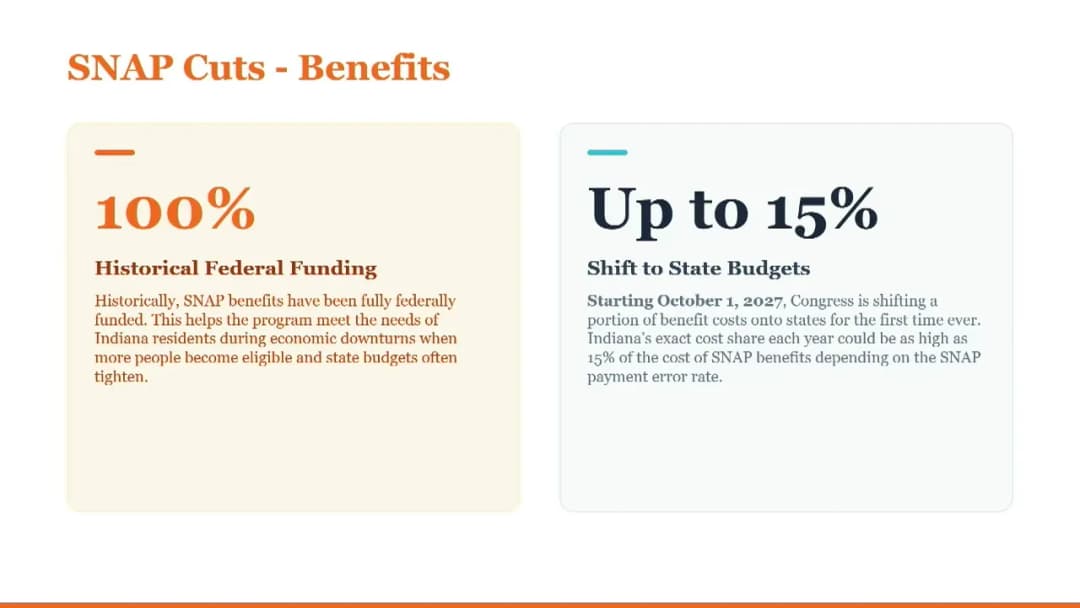
The Mayor's Advisory Commission on Food Access convened on October 1, 2026 at 7:30 a.m. The meeting included approval of minutes, an update on a tour of the Grace Care Center food bank, and presentations from two guest speakers: Aaron Goldstein of Share Our Strength (No Kid Hungry) and representatives from the Milk Bank. The commission discussed food insecurity, federal SNAP changes, infant nutrition, and community partnerships. Consent Calendar - Minutes Approval: The commission unanimously approved the minutes from the September 17, 2026 meeting, moved by Jay and seconded. Discussion Items - Grace Care Center Tour Update: Kevin reported on a tour organized for several commissioners of the Grace Care Center food bank. He noted the facility operates like a grocery store with client choice, has approximately 50 volunteers per shift, and includes a co-op, vehicle maintenance, and English classes. The on-site thrift store generates $130,000 annually to purchase food. Commissioners praised the comprehensive services. - Presentation by Aaron Goldstein (Share Our Strength / No Kid Hungry): - Goldstein provided national context: 16 million children receive federal nutrition programs, but 14 million remain food insecure. - He highlighted the Summer EBT (Sunbucks) program: Indiana participated only in summer 2024 (distributed to 650,000 kids) but opted out for 2027; 22% of Hamilton County children are eligible. The commission was urged to advocate for state opt-in. - He detailed the impact of HR1 on SNAP: $200 billion cut, requiring states to pay 75% of administrative costs (Indiana's share: $136 million/year) and up to 15% of benefit costs (Indiana's potential share: $139 million/year). Since HR1's adoption, 5 million people (including 1.5 million children) have lost SNAP access nationally; Indiana lost 11% of families. - He called on the commission to advocate for a two-year delay in HR1 implementation and to work with state legislators and Congress. - He announced that Mayor Finkam will become vice chair of the Mayor's Alliance to End Childhood Hunger (673 mayors) and that the Mayor's Action Fund (supported by Dollar Tree) provides grants for food access navigation, summer meals outreach, and stakeholder convenings. - Questions from commissioners: Jane asked about state flexibility to restrict SNAP eligibility (Goldstein: states can be more restrictive). Another commissioner asked about state legislator awareness; Goldstein stated associations (NGA, NCSL) are educating but urged direct outreach. Lisa asked about coalition partners; Goldstein noted National Grocers Association, National Dairy Council, and state farm bureaus are engaged. - Presentation by Lisa Bussey and Freedom Colby (The Milk Bank): - The Milk Bank is a local nonprofit (21 years old) that screens, processes, and dispenses donor human milk, distributing 300,000 feedings per month. They are registered as a food manufacturer with the FDA and accredited by the Human Milk Banking Association of North America. - They highlighted that infant food insecurity often goes unrecognized. Prematurity is a leading cause of infant death; donor milk can increase survival rates by 50–70% in NICU settings. In Indiana, all hospitals have donor milk available, and Carmel has two milk depots and two milk express sites. - A video was shown emphasizing the medical necessity and life-saving impact. - They discussed cost: hospitals pay a processing fee (every $1 invested saves $11); Medicaid in Indiana covers donor milk; the Milk Bank has a medical relief fund to eliminate financial barriers for families. - The greatest challenge is donor recruitment: they need 169 new donors per month (rising to 220 by November). Only a fraction of lactating women can donate (excess supply after infant's needs). - They noted partnerships with Gleaners food bank and WIC, but inventory constraints limit distribution to food pantries. They are open to collaboration on awareness and drives. - Questions: Commissioners asked about community outreach (digital, healthcare referrals, events). The chair requested that the Milk Bank send information on drop-off sites and donor needs for the commission's upcoming gap analysis report. Key Outcomes - Commission's Role in SNAP Advocacy: Commissioners will work with Mayor Finkam to contact state legislators (Rep. Wilburn and Sen. Lopez) to educate about the fiscal impacts of HR1 and advocate for a two-year delay. - Documenting Gaps: The commission plans to produce a year-end report identifying food access gaps and solutions; the Milk Bank will provide drop-off and donor recruitment information for inclusion. - Continued Engagement: The commission will explore collaborations with Share Our Strength and the Milk Bank for future initiatives, including potential grant applications to the Mayor's Action Fund.

FOOD INSECURITY 46% · FOOD ACCESS 44% · PUBLIC ENGAGEMENT 5% · PUBLIC HEALTH 3%
06
SEP 28, 2026 · CARMEL, INDIANA · CITY COUNCIL
Carmel City Council Budget Discussion Meeting - September 28, 2026

The Carmel City Council held a budget discussion meeting on September 28, 2026, to review the proposed 2027 budget. Department heads had posted presentations online on September 8, and this session was dedicated to councilors' questions. The meeting, which began at approximately 1:52 PM and ended around 3:45 PM, covered public safety, infrastructure, administration, and quality-of-life spending. Discussion Items Public Safety (CFD & CPD) - Flock cameras and surveillance: The mayor clarified that flock cameras are used only for license plate recognition tied to active cases, not general public surveillance. Councilor Jack requested segregating the line item for flock cameras to allow a reduction motion; staff noted the chart of accounts does not enable vendor-specific segregation but can provide transparent budgeted amounts. - Fleet maintenance centralization: Councilor Minar asked about moving CPD vehicle maintenance to the street department. Zach (Finance) explained that centralizing fleet management under street department will achieve economies of scale; CPD mechanics already moved into the street department budget. The street department will maintain all city vehicles except utilities and possibly CFD heavy equipment. No additional hires have been made yet; one vacant mechanic position exists. - Police staffing: Chief Sterling reported 163 sworn positions in 2025/26, with 157 filled and 6 vacant; two new positions added for 2027, target 165. Four retirements expected in Q1 2027. Six lateral hires to be sworn in November, additional new hires in January 2027. A staffing allocation study determined 165 is optimal; a middle shift (1:30 PM–midnight) will be introduced in 2027. - Police technology and force multiplier: The chief noted the drone first responder program responded to over 600 calls in 2026, arriving first on scene 46% of the time in an average of 1 minute 44 seconds. A civilian drone operator position is budgeted for 2027. Councilor Snyder cautioned against using “force multiplier” to imply fewer officers; the chief agreed technology is a tool, not a replacement. - Fire department overtime and staffing: Overtime was down to approximately $3.2 million in 2026 (from $4-5 million in prior years). For 2027, the base overtime budget appears higher because a $1.5 million carryover PO from 2026 is not repeated; an additional $100,000 request for 2026 will come to council in October. Fire staffing goal is 195 sworn; end of 2026 target 189, currently at 184. Six lateral hires starting October 2026, 12 cadets starting January 2027. Station 47 staffing is planned for 2028 (lateral/cadet hires in January 2028). - Firefighter shift schedule: CFD implemented a 48/96 schedule (48 on, 96 off) in July 2026 as a temporary trial through July 2027. Whoop bands track physiological data; results will be compared to baseline data taken before the switch. - Deferred compensation for public safety: Zach explained that fire and police unions elected to opt out of Social Security (except Medicare portion) in favor of additional deferred compensation. Starting January 1, 2026 for fire, and earlier for police, the employer and employee shares (totaling 12.5%) now go to deferred comp instead of Social Security. This reduces the city’s FICA line but increases deferred comp costs. - Ambulance fund and other equipment: Councilor Green noted a 213% increase in “other equipment” in the ambulance fund; staff will provide details later. Infrastructure (Streets & Engineering) - Stormwater program: Two new stormwater inspector positions were added. Street Commissioner Matt Botham said they will operate a new jet vac truck and camera van to move from reactive to preventative inspections, aiming for a 30% increase in proactive pipe inspection hours. Councilor Warren noted the budget for stormwater went from $973,000 in FY26 to $2.4 million in FY27, reflecting freed-up debt payments from a bond refinance. Brad (Engineering) noted the revenue for stormwater is flat; the higher budget is due to unspent prior year funds. - Paving program: Total paving for 2027 is $8.5 million, sourced from MVH ($3.4 million line item), wheel tax, surtax, and the new lane mile distribution fund. Councilor Rizal expressed concern that $8.5 million is insufficient to meet desired pavement condition index (PCI) goals, noting that a decade of underfunding and inflation has widened the gap. Matt Botham responded that the city’s average PCI is around 66 (scanned data), far above failure, and that maintenance techniques (mastic, liquid road rejuvenator) extend pavement life at lower cost. Councilor Warren countered that residents perceive road quality negatively despite structural soundness. - Fleet and facilities consolidation: Matt Botham outlined that the street department will absorb fleet maintenance and facilities management, growing to 79 FTEs (from 67). A lead technician will oversee police vehicle maintenance; a scheduler will manage preventative maintenance. They are exploring an in-house NAPA store partnership (as Fishers does) to reduce parts procurement delays. - Engineering dues: A jump in engineering dues from $2,000 to $58,000 is due to moving the MPO (Metropolitan Planning Organization) membership cost from the mayor’s office to engineering, where it more appropriately belongs. The fee is necessary to access federal grants. Financial & Administrative - Property tax levy and LIT: The budget assumes the same property tax rate of 0.7783. Due to SEA 1 deductions, the CNAV decreases from $12.4 billion to $12.2 billion. The city will set the operating levy at the max 4-6% increase to maximize local income tax (LIT) distributions, preserving about $3 million that would otherwise go to other Hamilton County communities. The general fund levy is $77 million, debt service levy $11.8 million, with $5.7 million from general fund to cover debt service shortfall. - General fund balance: Current balance $17.2 million. After a planned $5 million transfer for fire station 47, balance would be $12.2 million (8% of expenditures, above the 5% minimum). The appropriation request will come later, not in this budget. - HR budget: An additional $600,000 was added after video presentation for retiree health benefits. Councilor Snyder confirmed it is for long-term retiree health benefits. - Workers’ compensation: Increase driven by high-dollar claims (mental health, cancer from chemical exposure) rather than more claims. - Building permit fees: Director Hollibal noted that after a comprehensive fee update (first in decades), building permit revenue will be moved into a dedicated fund, reducing general fund support from $3.4 million to $1 million. - Change.org partnership: Mayor Finkham explained that change.org is providing a free citizen engagement platform (focus groups with 100 representative residents compensated by change.org, not the city). The first topic is “how to help local businesses.” Results will be shared with council and the community. Quality of Place (MAC, Brookshire, Parks) - MAC department reorganization: Interim Director Aaron described outreach coordinators (arts & culture, community, business outreach) to improve communication with businesses and community groups. A part-time position was added for event support. - Event sponsorship accounting: Councilor Green asked how donated sponsorship funds are tracked when event costs are lower than donation; staff explained it is tracked manually in spreadsheets and unused funds remain in the MAC gift fund designated for that purpose. For nonprofits, donors are encouraged to give directly. - Brookshire golf course: Cost recovery currently at 85% ($1.5 million revenue vs $1.7 million budgeted); on track to be self-sufficient, possibly better than expected. A fee schedule update will be discussed at the Finance Committee meeting on October 5. Key Outcomes - No formal votes were taken; the session was informational. - First reading of the 2027 budget is scheduled for October 5, 2026; adoption on October 19, 2026. - Council will consider a special appropriation for fire station 47 from general fund balance at a later date. - Staff will provide detailed breakdowns for police equipment (other equipment line), fire overtime trends, and stormwater program specifics. - The finance committee will discuss Brookshire fee schedule on October 5. - The change.org focus group results are pending and will be shared with council. - Several reappropriations (adjustments) are expected in the coming weeks; two are already queued for the October 5 meeting. - Fleet maintenance centralization will continue, with fire department heavy equipment evaluated after police fleet transition is complete.

ENGINEERING AND INFRASTRUCTURE 16% · PUBLIC SAFETY 14% · BUDGET EQUITY ANALYSIS 13% · FLEET MANAGEMENT 9%
07
SEP 23, 2026 · CARMEL, INDIANA · CITY COUNCIL
Carmel Senior Living Commission Meeting - September 23, 2026

The Mayor's Advisory Commission on Senior Living met on Wednesday, September 23, 2026, at 6:00 PM. Chair Carol Applegate led the meeting with members Anna Stout, Tammy Heaney, John Schuler, John O'Donnell, and Dave Morgan present. The commission reviewed the draft action plan for the age-friendly community designation, received transportation updates, and focused planning for the upcoming intergenerational connection conference. Discussion Items Action Plan Update Chair Applegate presented the draft action plan developed over the past few years. She noted it is not final and continues to be a working document. The plan includes sections on housing, transportation, civic engagement, community health, respect and social inclusion, and sustainability/emergency procedures (added after the recent flood). The application to the AARP for age-friendly community designation has been completed and submitted. AARP review in Washington D.C. is expected to take two to four weeks. Chair Applegate expressed hope for designation before the conference but acknowledged it is uncertain. Transportation Report John Schuler reported on a meeting with Hamilton County Express. Key developments: - In November, Roger McMichael will present a request to the school board to allow fueling of Hamilton County Express buses at the 126th Street fuel depot. The request is expected to pass without obstruction. - Several buses have high mileage (265,000 miles) and increasing repair costs. Commissioner Mark Herbrand will raise the issue at the next commissioner's meeting. The possibility of purchasing smaller retired Carmel buses (which have lower mileage) to expand the fleet was discussed. - A newspaper article promoting Hamilton County Express for seniors is pending. Once published, usage numbers can be tracked. - Regarding the conference, Hamilton County Express cannot reserve buses but will accommodate ride requests on a first-come, first-served basis. Conference Planning The conference theme is Intergenerational Connection. It will be held at University High School (Fairbanks Hall) on Thursday, October 17, 2026 (during fall break, so school is not in session). Layout includes first-floor classrooms (seating 24-30) and second-floor larger rooms (accessible by stairs). Parking is abundant on flat land. The agenda: - 9:00 AM: Registration, coffee, and sweets - 9:30-10:00 AM: Opening remarks by Mayor and Councilman Rich Taylor - 10:00 AM: Keynote speaker Dr. Carolyn Gurner, IU Kelley School of Business, focusing on intergenerational connection and later a breakout session on loneliness - 11:00 AM: Dr. Bastani on healthy living from a young age - Lunch donated by Traditions at Solano (box lunches) - Breakout sessions (seven confirmed, hoping for eight to ten): grandparenting, intergenerational housing, retired firefighter service, government involvement, neuroscience, yoga, AI, and possibly caregiving or memory loss support. - 3:00-4:00 PM: Summary session with storytelling from older and younger generations (e.g., a grandparent and a college-bound student). As of the meeting, only 35 people had registered. Last year's attendance was 185. Promotion efforts so far include an ad in the paper, an article scheduled for tomorrow, Carmel News, the city website, emails to last year's attendees (sent twice), and University High School's grandparent outreach. Chair Applegate asked each member to recruit at least 10 attendees. Members noted that walking people through the QR code registration helps, and providing specific conference details (rather than a generic flyer) increases interest. The registration system is RSVPi; texting was not used due to legal concerns but may be reconsidered. Budget - Total commission budget this year: $10,000; $7,800 remains unspent. - Leftover from last year's conference: $5,400. - Major expenses: keynote speaker ($3,000, negotiable), table/chair rental ($2,000 if over 90 attendees), food (minimal, with donations), AV equipment (provided free by school). - A $2,500 donation was received from a school trustee. Additional sponsorships are being sought from local businesses. Other - A recommendation was made to include the conference in city council meeting announcements and on the housing department website. - Chair Applegate shared a leftover ticket for the Art Garfunkel concert (postponed due to illness) for any member interested. Key Outcomes - The action plan will continue to be refined and reviewed at future meetings; no formal approval was taken. - The AARP application has been submitted; designation decision expected within 2-4 weeks. - Transportation efforts are progressing with Hamilton County Express; next meeting on October 14th. - The conference is scheduled for October 17th; members committed to promoting registration and seeking sponsorships. - No formal votes were taken during the meeting. Meeting adjourned at 6:38 PM.

SENIOR SERVICES 70% · PUBLIC ENGAGEMENT 19% · TRANSPORTATION SAFETY 4% · FISCAL SUSTAINABILITY 3%
08
SEP 23, 2026 · CARMEL, INDIANA · CITY COUNCIL
Carmel Central DORA Committee Meeting Summary – September 23, 2026

The Carmel Central DORA (Designated Outdoor Refreshment Area) Committee met on September 23, 2026, to consider two proposed additions to the program's approved cup options. Both items were introduced by local business representatives and were approved unanimously. The committee also discussed sidewalk markers and a DORA map graphic. Consent Calendar - No consent calendar was presented. The meeting had two action items, both handled as discussion/vote items. Public Comments & Testimony - No members of the public attended the meeting. The chair noted there were no complaints, marking a positive contrast to earlier DORA program meetings at council. Discussion: Hot Beverage Cup (Hotel Carmichael) - Jamie Hopwood, Area General Manager for Quarry Hospitality and Hotel Carmichael, formally requested approval to introduce a new insulated, double-walled cup for hot beverages. He explained that the current aluminum cup is unsafe for hot liquids because the beverage overheats the metal and can burn the consumer. He noted that inserts and sleeves (koozies) were considered but did not solve the problem. - Committee discussion included concerns about multiple cup SKUs, cost, and enforcement. One member (representing Fork and Ale) shared their experience using koozies and double-cupping for hot toddies and mulled drinks, but questioned whether an additional cup would undermine the program's branding and enforcement. They suggested possibly using one universal cup for all seasons. - The committee emphasized that any new cup must be clearly identifiable as a DORA cup, with the DORA logo visible (no sleeves covering it). The Police Department confirmed they would need clear communication about approved cup designs for enforcement. - A motion was made and seconded to approve the exploration of a clearly identified, double-walled, 12-ounce hot beverage cup with a lid, with pricing and sourcing details to be provided by the applicant. The motion passed unanimously (all ayes, no nays). - Timeline: Jamie Hopwood indicated a need to have the cup by November 15, 2026. The committee requested multiple quotes from different vendors (e.g., GFS, Cisco) and noted the typical 6–8 week print job turnaround. Discussion: Smaller Aluminum Cup for Wine (Wine and Rhyme) - Madeline (representing Wine and Rhyme) presented a request for a smaller aluminum DORA cup (9-ounce or 12-ounce) to address the issue of serving 6-ounce and 8-ounce wine pours in the existing 16-ounce cup. She explained that the current cup makes pours appear short, leading to customer complaints and staff overpouring, which risks over-serving alcohol. - She displayed samples of the new 9-ounce and 12-ounce aluminum cups (which Ball now offers). She stated a preference for the 9-ounce but remained open to the 12-ounce if other businesses preferred it. - Committee members discussed alternatives such as pouring in front of guests or using a craft, but Madeline noted these are time-consuming during busy periods. Members noted that adding a smaller cup is not an enforcement issue but could create warehousing/ordering challenges for distributors (minimum orders of 10,000 cups). - One member suggested exploring a bulk purchase or local warehousing solution to reduce costs. Another brought up the idea of using stickers on generic cups, but the committee noted this was previously rejected by the council. - A motion was made and seconded to explore the opportunity for a 9-ounce metal DORA cup. The motion passed unanimously. Key Outcomes - Unanimous approval to pursue a hot beverage cup: clearly identified, double-walled, 12-ounce, with a lid. The applicant (Hotel Carmichael) will provide pricing, sourcing, and timeline details to the committee, with a target completion date of November 15, 2026. - Unanimous approval to pursue a smaller 9-ounce aluminum DORA cup (with the option to consider 12-ounce if other businesses prefer). Wine and Rhyme will gather pricing and vendor details, and the committee will coordinate with city staff for website updates and distribution. - Both decisions were exploratory in nature – final adoption will occur after pricing and logistics are presented to the committee. - The committee also discussed sidewalk markers (some thermoplastic replacements were installed on a trial basis) and a DORA map graphic, noting that the city's website already has a map that businesses can print for customers. Next Steps - Hotel Carmichael and Wine and Rhyme will gather vendor quotes and supply chain information for their respective cup proposals. - The committee will receive updates via email and will revisit final approvals once details are available. - City staff will be involved in updating the DORA cup list on the website and communicating approved designs to the police department. Meeting adjourned.

FOOD AND BEVERAGE TAX 78% · PROCUREMENT 14% · PROCEDURAL 8%
09
SEP 21, 2026 · CARMEL, INDIANA · CITY COUNCIL
Carmel Common Council Meeting - September 21, 2026

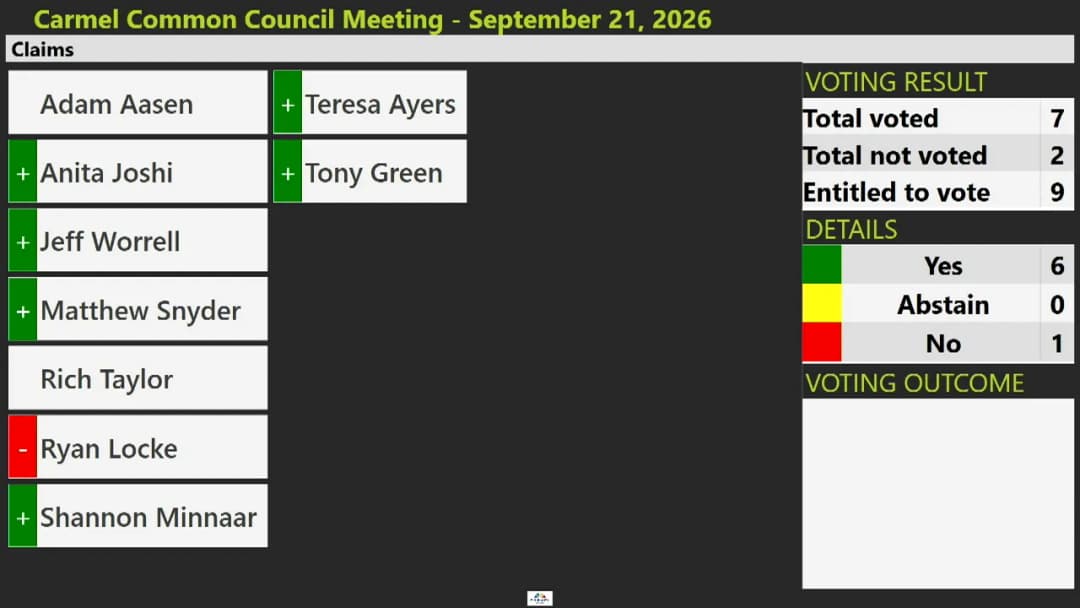
The Carmel Common Council met on Monday, September 21, 2026, at 7:00 PM in City Hall. The meeting included a full agenda with public comments on micromobility and surveillance, a FEMA update on August flood recovery, committee reports on the micromobility ordinance and Hotel Carmichael expansion, and passage of several routine items. Consent Calendar - Approved minutes from August 17 and September 3, 2026, meetings. - Approved claims and payroll: payroll $4,758,240.43; CFD bonus payroll $4,865.46; general claims $2,159,410.66; purchase card $31,590.01; wire transfers $3,219,674.14. - All consent items passed unanimously. Public Comments & Testimony - Jack Feldman (Carmel resident): Praised the 50th anniversary celebration; urged helmet requirements for minors on e-bikes and greater transparency in the budget for Flock camera contracts. - Rocky Griffith (Pendleton resident): Shared experience being pulled over while riding an electric unicycle; asked for clear legal pathways for EUCs and enforcement focused on behavior, not device capability. - Jason Selberg (Carmel resident, 20 years, representing Indianapolis PEV community): Supported micromobility safety goals but opposed relying on wattage or top speed as regulatory cutoffs; noted current ordinance prohibits unicycles on two wheels; urged future-proofing. - Chris Lloyd (Carmel resident, engineer, EUC rider): Explained that higher-wattage EUCs provide safety headroom for balance; argued regulation should target actual speed and behavior, not capability. - Council Carter (former council colleague): Criticized the proposed ordinance as too technical and lacking education; urged sending it back to committee to start with a clean slate and focus on stakeholder education before enforcement. - Bailey Sandlin (EUC rider): Demonstrated a 1,000-watt EUC; said the group no longer comes to Carmel due to restrictive rules; urged policing behavior over devices. - Kelly Nagy (Carmel resident): Advocated for native plant landscaping in city spaces; noted Westfield’s native plantings outpace Carmel; gave council copies of "Nature's Best Hope." - Ollie Dunn (Carmel High School senior, Mayor's Youth Council): Expressed concerns about Flock safety cameras; cited misuse in other cities (2,055 unauthorized searches by an Indiana deputy); called for oversight, transparency, and limits on data sharing. Discussion Items - Agenda Amendment: Council voted to add Item 15 (final disposition of the Chris Cunhamarket investigative report) and reorder the agenda. Motion passed. - Invocation / Yom Kippur Acknowledgment: Pastor Joe Smith led prayer; President Snyder recognized Yom Kippur. - Mayoral Comments (read by Council Minard): Mayor Finkam thanked city employees, partners, and private sector for flood response; recovery and rebuilding continue. - FEMA Presentation (Alan Wren): Outlined survivor road to recovery—file insurance first, then apply to FEMA at disasterassist.gov or 800-621-3362. Inspectors carry badges with registration numbers. FEMA covers lodging, rental, repair, replacement, and other needs; SBA loans up to $500,000 for property owners. - Council Comments: Council thanked Rotary Club for 50th anniversary celebration; recognized Carmel Clay Parks & Recreation’s 35th birthday and upcoming NRPA award. - Committee Reports: - Investigation Report (Council Locke): Moved to accept the Chris Cunhamarket investigative report as final and make it public. Motion passed. - Micromobility (Council Joshi): Provided update on ordinance changes (removed dismount zones, added helmet requirements for e-motos, worked with police). Held due to absence of city attorney and need to address electric unicycles. Council Austin proposed age minimum for e-bikes (e.g., 12+). Council Snyder clarified ordinance will return to committee for further work; no current item before council. - Redevelopment Update (Henry Mestetsky): Reported on Hotel Carmichael expansion—60 new rooms, enlarged ballroom, expanded lounge. City’s ownership share drops to 45% but equity grows by $5 million without new investment; guarantee reduced from $26M to $10.2M. New investor (hotel manager) contributing $2M. Council discussed valuation and potential sale after 2029. Key Outcomes - Ordinance D-2846-26 (Fund Repeals): First reading and immediate passage. Repeals nine defunct funds (e.g., Civic Square construction, lease rental, 2002 COET funds) with small balances moved to general fund. Approved unanimously. - Resolution CC-0921-2601 (Fund Balance Transfers): Transferred $63,244.95 from four funds to general fund. Approved. - Ordinance D-2847-26 (Berkshire Golf Course 2027 Fees): Introduced and referred to Finance and Rules Committee. - Agenda Add-on (Investigation Report): Accepted as final public record. - Micromobility Ordinance: Remains in committee; next land use meeting likely in October after attorney returns. - City Hall Ordinance: Still in committee; ongoing discussion. - Next Meeting: Finance/Rules Committee to meet October 5 at 4:30 PM.

MICROMOBILITY PLANNING 33% · PROCEDURAL 12% · ECONOMIC DEVELOPMENT 12% · BUDGET EQUITY ANALYSIS 10%
10
SEP 17, 2026 · CARMEL, INDIANA · CITY COUNCIL
Mayor's Advisory Commission on Food Access Meeting - September 17, 2026

The Mayor's Advisory Commission on Food Access held its fifth meeting on September 17, 2026, at 9:00 AM. The commission reviewed past minutes, heard presentations from the Hamilton County Health Department and Grace Care Center, and discussed future meeting plans and a final report timeline. Consent Calendar - Approved minutes from meetings on April 16, 2026, May 21, 2026, June 18, 2026, and July 2026. Motion made, seconded, and carried unanimously. Discussion Items - Future Meeting Schedule and Final Report: The commission discussed shifting the October meeting to October 1st to accommodate a presentation by Aaron Goldstein from Share Our Strength on childhood hunger. The November meeting (third Thursday) was tentatively kept, with a goal to finalize a report by December. Members agreed to prioritize action items and submit priorities to Cindy for inclusion in the final report. - Grant Update: Amanda reported that a grant application was submitted on August 20, 2026, with a decision expected in November 2026. Hamilton County Health Department Presentation - Shai Davis (Accreditation Coordinator) and Jim Ginder (Health Education Outreach Manager) presented. Key points: - Food insecurity in Hamilton County rose from 6% (2021) to 10% (2024), a 70% increase. - 80% of food-insecure households do not qualify for SNAP; the ALICE survival budget for a family of four is $80,000/year, while SNAP eligibility for a family of four is $41,800. - Stigma and lack of awareness are major barriers; the health department offers nutrition education, cooking classes, mobile clinic screenings, and a navigator service via navigatehamiltoncounty.org. - The department works with food pantries to provide on-site health screenings and destigmatize pantry use. - Commissioners discussed how to amplify these resources, including posting materials on the city's website and at public libraries. Grace Care Center Foundation Presentation - Kara Augsburger, President and CEO, presented. Key points: - Grace Care Center operates Hamilton County's largest food pantry, serving 12,000 people annually (about 600 families per week). 15% of clients are from Carmel zip codes. - The pantry uses a choice model (points instead of dollars) and offers wraparound services: financial coaching (co-op), English classes, zero-interest loans, free oil changes, and a mobile pantry. - In 2025, 2,500 new families sought help, often due to rising rent, food costs, and utilities. The pantry provides a budget stretcher of $400–$800/month per family. - Every dollar spent on food yields $14 in community value; $130,000 spent on food in 2025 resulted in $1.7 million in distributed food. - The co-op program has graduated over 100 families who no longer need food assistance. - Commissioners discussed the relational approach, volunteer structure, and the possibility of expanding hours (under strategic review for 2027). Key Outcomes - Unanimously approved minutes from four prior meetings. - Scheduled next meeting for October 1, 2026, with a presentation from Share Our Strength. - Commission members will submit prioritized action items to Cindy for the final report, aiming for completion by December 2026. - The city will explore linking to health department resources on its website and promoting them via libraries and social media.

FOOD INSECURITY 60% · PROCEDURAL 13% · PUBLIC HEALTH 13% · FOOD ACCESS 9%
0102
NEXT →
OPENPUBLICA · PUBLIC MEETING INDEXUPDATED DAILY · openpublica.com