Browse by city
Date range
Search help

Search titles, summaries, topics and stored transcripts together. Keywords may match separately; put the whole query in double quotes for a phrase. Matching follows word analysis, so punctuation is not exact. Both dates are included. Documents are not searched.

SHOWING 201–210 ENTRIES
201
FEB 10, 2026 · DENVER, COLORADO · MAYOR-COUNCIL MEETING
Mayor and City Council Joint Meeting: RNO Modernization Update and Executive Session - February 10, 2026

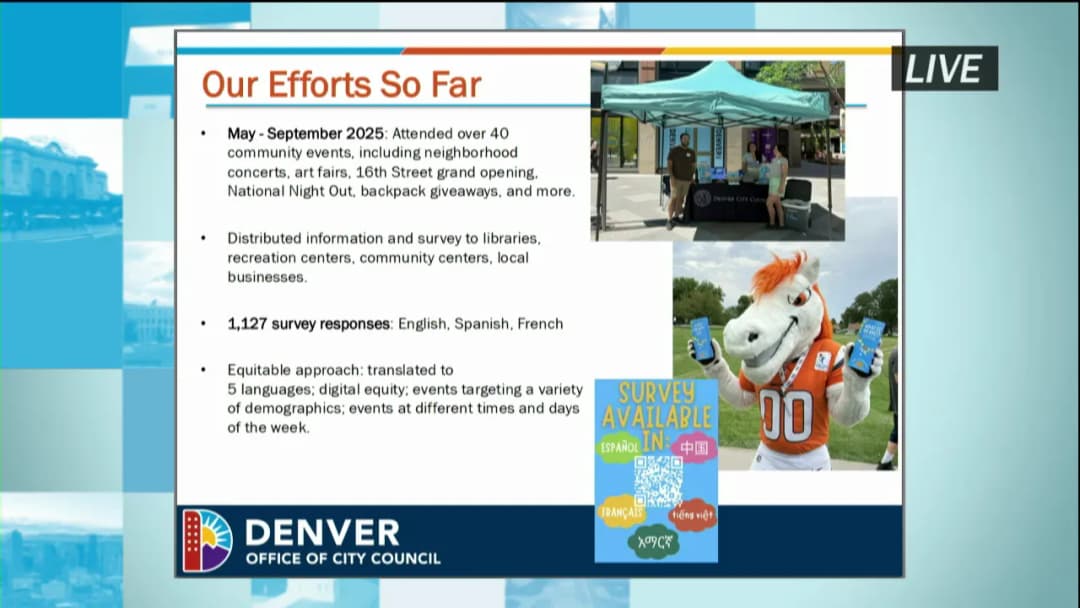
[Introductory paragraph summarizing the overall meeting.] The Mayor and Denver City Council held a joint meeting on February 10, 2026, featuring a presentation on the modernization of the Registered Neighborhood Organization (RNO) ordinance, followed by discussion and a motion to enter executive session for legal advice on pending litigation. Announcements - Councilwoman Amanda Sawyer (District 5) announced constituent hours on Friday, February 13, 1:00–2:30 p.m. at Athmar Park Library, and the annual District 5 Community Open House on February 10 at 5:30 p.m. at George Washington High School Library. - Councilman Gary Watson (District 9) thanked the community for attending the repass and life celebration for Dr. Daddio, noting his legacy as the owner of the first Black-owned radio station west of the Mississippi, and acknowledged the Mayor's attendance. Discussion Items - Mayor Johnston and Councilmembers introduced a presentation led by Councilmembers Amanda Sandoval and Serena Gonzalez-Gutierrez, and their staff (Masha Lior and Sina Jodri), on the RNO modernization effort. The RNO ordinance, created in the late 1970s, has not been updated. - The engagement process included over 40 community events from May to September 2025, five neighborhood engagement workshops (four in-person, one virtual), and surveys that received 1,127 responses in English, Spanish, and French. Feedback was also gathered from 20 city agencies and external partners. - Key themes from community input: awareness and access, communication infrastructure, equity and inclusion, governance and accountability, and support capacity and sustainability. - Councilwoman Alvidrez (District 7) expressed concern that outreach may have missed struggling RNOs in lower-income, working-class neighborhoods like Athmar Park, and recommended door-knocking and engaging with community benefit agreement participants (e.g., West East Neighborhood United). - Councilman Watson shared his experience as a former RNO president, emphasizing the need for city resources and support to reduce disparities between wealthier and lower-income neighborhoods. - Councilwoman Romero-Campbell (District 4) noted confusion between RNOs and HOAs in Southeast Denver, and that large areas lack any RNO or HOA, leaving residents disconnected. Key Outcomes - The final report with preliminary recommendations is expected to be published in March 2026 and will be presented to the Budget and Policy Committee. - After the report, community feedback will be gathered on the recommendations, followed by drafting of an ordinance. Councilmember briefings are planned for April–May 2026, with a vote targeted for summer 2026. - A motion was made and approved to enter executive session pursuant to DRMC 234, 6, and 7 to receive legal advice on pending litigation against the city. Note: No public comments or consent calendar items were present.
COMMUNITY ENGAGEMENT 74% · PROCEDURAL 16% · PENDING LITIGATION 6% · RACIAL EQUITY 4%
202
FEB 9, 2026 · DENVER, COLORADO · CITY COUNCIL
Denver City Council Meeting – February 9, 2026

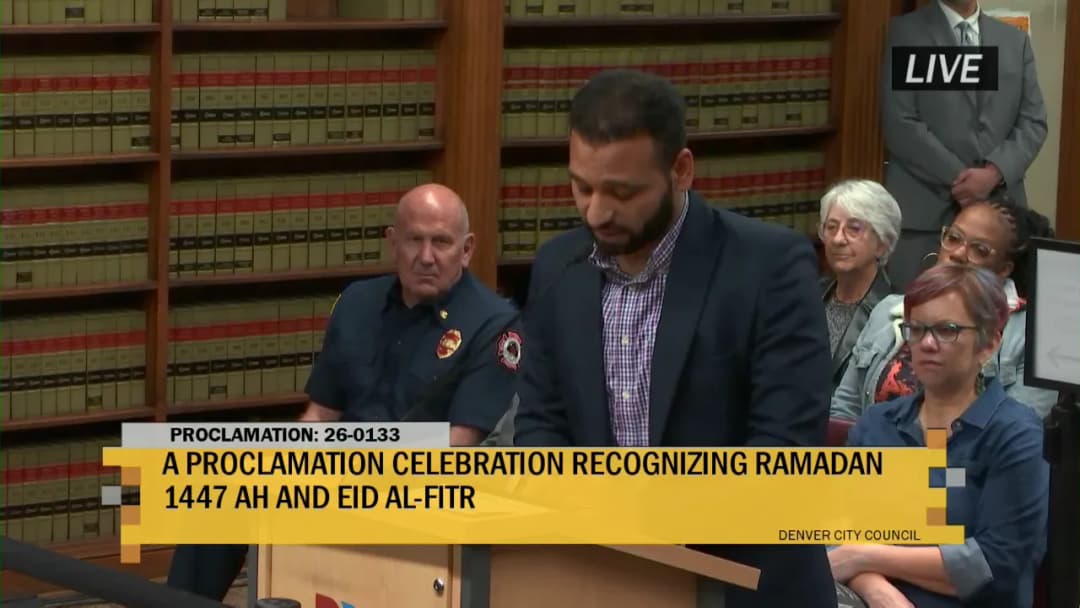
The Denver City Council convened in regular session on Monday, February 9, 2026, at 10:30 AM, with 13 members present. The meeting included council announcements, two proclamations honoring community leaders, a proclamation recognizing Ramadan and Eid al-Fitr, the adoption of multiple resolutions and bills, and two required public hearings on historic designation and a zoning change. Consent Calendar - Approval of the February 2, 2026 meeting minutes. - Block adoption of 16 resolutions and bills on final consideration (resolutions 25‑1944, 26‑0060, 26‑0059, 26‑0064, 26‑0073, 26‑0061, 26‑0063, 26‑0069, 26‑0070, 26‑0071, 26‑0065, 26‑0066, 26‑0068, 26‑0083, 26‑0005, and 26‑0022). Adopted with 13 ayes. Proclamations - Proclamation 26‑0131 – Honoring Keith Irfmeyer: Recognized Keith Irfmeyer for more than 30 years of service as Denver Assessor and his upcoming role as State Property Tax Administrator. Unanimously adopted (13 ayes). Acceptance by Mr. Irfmeyer, who praised his staff and expressed pride in working for Denver. - Proclamation 26‑0130 – Honoring the Late Denver Police Division Chief Hermedia Gordon: Celebrated Chief Gordon’s legacy as a trailblazer (first Black female homicide detective, first Black female division chief). Unanimously adopted (13 ayes). Acceptance by her daughter Deanna Gordon and Division Chief Megan Doach. - Proclamation 26‑0133 – Recognizing Ramadan 1447 AH and Eid al‑Fitr: Acknowledged the Muslim holy month beginning at sundown on February 17, 2026, and Eid al‑Fitr on March 19–20, 2026. Unanimously adopted (11 ayes). Acceptance by Imam Qalila of Downtown Denver Islamic Center, Imam Ali of Masjid Taqwa, community member Yahya, and Linda Barwan, who invited council to iftar meals. Public Comments & Testimony Public Hearing on Council Bill 26‑0056 (Historic Designation of 1555 N. Grant Street): - Jesse Paris (representing multiple community organizations) expressed support for the designation but called for honest acknowledgment of Denver’s racist history, including exclusion of Black residents from certain sites. Public Hearing on Council Bill 25‑2147 (Rezoning of 3050 Richard Allen Court): - Bob Schofield (Vice President of Campus Operations, Cross Purpose) explained the rezoning is needed to comply with a state behavioral health licensing requirement; the existing counseling services would not change. - Jason Jans (CEO/Founder, Cross Purpose) noted 1,650 program graduates and that the building was recently paid off. - Jesse Paris again voiced support for the rezoning, describing Cross Purpose as an asset to the community. - Jamie Horsfall (Clinical Director, Cross Purpose) reported that in the past year nearly 300 residents participated in counseling, with 1,400 sessions provided at no cost. - Jeremy Baumeister (program graduate) shared his personal success story, crediting Cross Purpose with job training and community. Discussion Items - Council Resolution 25‑2150 – Salvation Army Shelter Lease: Approved a third amendatory lease for a congregate shelter at 1901 29th Street in Five Points. Councilmember Lewis noted ongoing dissatisfaction with Salvation Army shelter operations but voted aye. Adopted with 10 ayes. - Council Bill 26‑0056 – Landmark Designation for 1555 N. Grant Street (Knights of Columbus Hall): Staff presented the application, highlighting the property’s significance as a USO site during WWII (hosting over half a million servicemembers), mid‑century modern architecture by John F. Milan, and innovative pre‑stressed concrete construction. The Landmark Preservation Commission recommended approval. Councilmembers Hines, Sandoval, Torres, and Cashman spoke in favor, emphasizing collaborative resolution of concerns about the parking lot. Unanimously adopted (11 ayes). - Council Bill 25‑2147 – Rezoning of 3050 Richard Allen Court (Cross Purpose): Staff explained the site is currently zoned R2A (former Chapter 59), which does not permit medical office use. The rezoning to EMX2X allows Cross Purpose to maintain its state‑licensed behavioral health counseling. Eight letters of support and a petition with 100 graduate testimonies were submitted. The Skyland Neighborhood Association supported the change. Councilmember Watson sponsored the bill. Unanimously adopted (11 ayes). Key Outcomes - Proclamation 26‑0131 adopted honoring Keith Irfmeyer. - Proclamation 26‑0130 adopted honoring Hermedia Gordon. - Proclamation 26‑0133 adopted recognizing Ramadan and Eid al‑Fitr. - Council Resolution 25‑2150 adopted (10 ayes) approving the Salvation Army shelter lease. - Block adoption of 16 resolutions and bills passed (13 ayes). - Council Bill 26‑0056 passed (11 ayes), designating 1555 N. Grant Street as a landmark. - Council Bill 25‑2147 passed (11 ayes), rezoning 3050 Richard Allen Court to EMX2X.

PROCEDURAL 23% · COMMUNITY ENGAGEMENT 16% · HISTORIC PRESERVATION 15% · RACIAL EQUITY 9%
203
FEB 4, 2026 · DENVER, COLORADO · COUNCIL COMMITTEES
Transportation and Infrastructure Committee Meeting - February 4, 2026: RTD Briefing and Welton Street Corridor Study

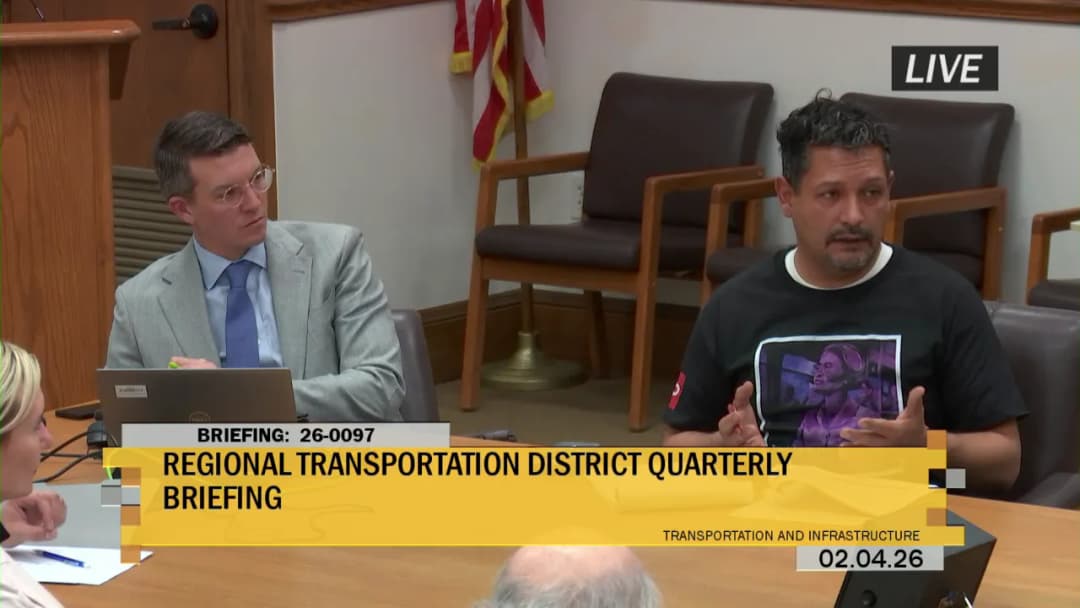
The Transportation and Infrastructure Committee of Denver City Council met on February 4, 2026, to receive two briefings: a quarterly update from the Regional Transportation District (RTD) and a presentation on the Welton Street Corridor Next Steps Mobility Study. The committee also advanced three consent items to the full council. Consent Calendar - Three consent items were moved forward to the full council without discussion. Discussion Items RTD Quarterly Briefing RTD officials presented on asset management, infrastructure investments, and legislative priorities. Deputy CEO Angel Peña emphasized a new approach to sequencing infrastructure work as a connected portfolio to reduce customer disruption. Key projects for 2026 include overhead wire replacement at Denver Union Station (single weekend in early spring), the Downtown Rail Reconstruction Project (with Welton Street as the last phase), and a bicycle/pedestrian bridge at Evans Station (partnering with Denver DOTI in summer). CFO Kelly Mackey reported RTD manages $9.3 billion in assets (nearly 50% depreciated), with $620 million in reserves, a $250 million annual deficit, and $1 billion in planned capital expenditures over five years. Deferred maintenance backlog is approximately $300 million. Debt service for 2026 is $191 million after prepaying $57 million in 2025. Government Relations Officer Michael Davies outlined legislative items: the RTD Accountability Committee report (released Jan 30, expected legislation sponsored by Sen. Ball), HB 26-1001 (development on RTD-owned land, no direct impact on RTD, board has not taken a position), HB 26-1065 (tax increment financing for transit-oriented development, subject to state approval), and the federal surface transportation reauthorization (expires Sept 30, 2026). Council members raised several issues: - Councilmember Alvarez expressed concern about youth safety on RTD after hearing high schoolers feel they need weapons. RTD Director Michael Guzman stated weapons are prohibited, emphasized the RTD Security Watch app for reporting incidents, and committed to engaging Denver Public Schools. - Councilmember Alvarez also asked about micro-transit vehicles for special events and safety improvements. Peña noted RTD is taking a holistic view of mobility. - Councilmember Flynn asked about HB 26-1001; RTD has not taken a position. He also questioned the Accountability Committee's recommendation to restructure the board from 15 elected members to 5 elected by districts. Guzman opposed the change, stating it bypasses public vote, called it "a move by the governor and current administration to get at funds they do not control," and noted Denver pays the most sales tax to RTD. - Flynn asked about workforce retention. Peña acknowledged challenges but said RTD is committed, and Davies agreed to provide a memo on recruitment efforts. - Councilmember Watson-Ode (Chair Lewis) asked about asset depreciation (based on asset life), debt service, and deferred maintenance. She suggested RTD look at Denver Airport's asset management system. - Councilmember Romero-Kemple requested updates on RTD land development at Colorado Station and Southmoor Station (Davies will follow up) and raised bus stop amenity deficiencies. Guzman noted the agency is conducting a bus stop infrastructure assessment, with a report due in June. Peña said it will require regional partnerships for funding. - Chair Lewis questioned the feasibility of 10-minute frequency on the Welton corridor, noting the single-track constraint, and cautioned against setting community expectations that may not be met. Welton Street Corridor Next Steps Mobility Study Councilmember Watson introduced the study, led by DOTI, which aims to deliver an actionable framework for transit, public space, green infrastructure, and business revitalization on Welton Street from Broadway (20th Ave) to 30th & Downing, including connection to 38th & Blake. DOTI's Elena McWhorter and David Kretzinger presented. A Community Advisory Group (CAG) will be formed by end of April. A consultant RFP will come to City Council in April-May; the study timeline is 15 months, with a final report in early 2027. The study will analyze alternatives to achieve the community's expectation of 10-minute frequency and connectivity to the A-line, while respecting historic and cultural heritage. Funding from DRCOG and FTA is being used. Chair Lewis pressed on the discrepancy between community expectations and RTD's technical constraints (single track, existing 15-minute service). She asked who is financially responsible for any track changes. Kretzinger said track replacement is RTD's responsibility; street and other infrastructure is Denver's; the joint decision will be informed by the study. Councilman Watson clarified that FastTracks funds are allocated specifically for the corridor and can be used for whatever alternative is chosen. Key Outcomes - The committee received both briefings as informational; no votes were taken on the presentations. - Three consent items were approved and sent to the full council. - RTD committed to follow up with a memo on workforce recruitment efforts and to provide updates on bus stop infrastructure assessment (report due June 2026). - DOTI will proceed with the Welton Street Corridor study, including consultant procurement and CAG formation. - Chair Lewis noted the need to align community expectations with technical realities.

ENGINEERING AND INFRASTRUCTURE 35% · PUBLIC ENGAGEMENT 13% · FISCAL SUSTAINABILITY 12% · EQUITY IN TRANSPORTATION 9%
204
FEB 4, 2026 · DENVER, COLORADO · COUNCIL COMMITTEES
Health and Safety Committee Meeting – February 4, 2026: Approval of Motorola CAD Contract and Amendment

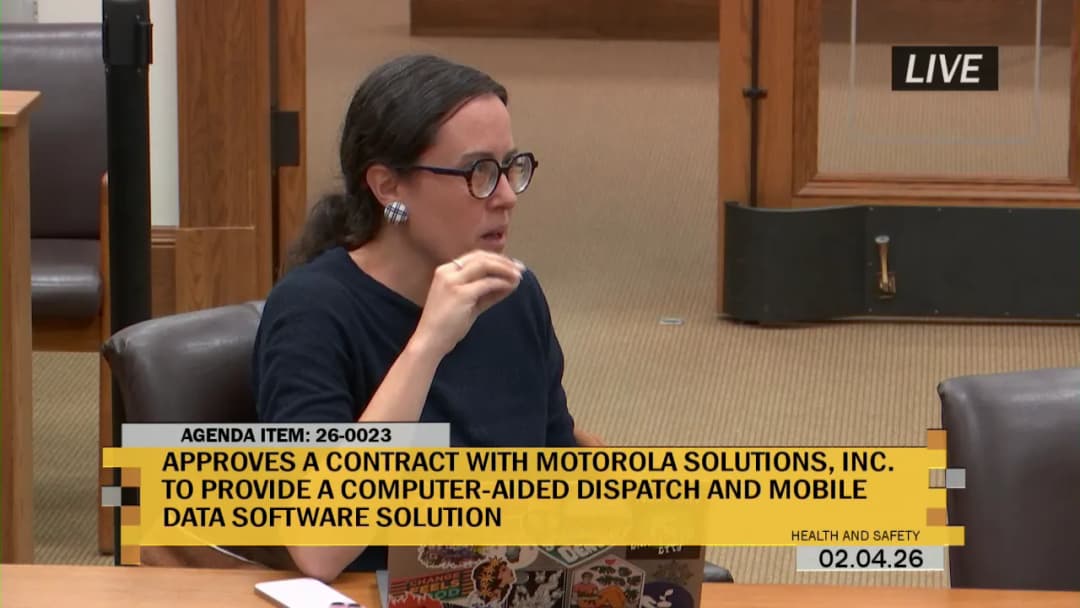
The Health and Safety Committee of the Denver City Council met on February 4, 2026, chaired by Councilmember Darrell Watson (District 9). The committee considered two action items as a block: a 13-year contract with Motorola Solutions for a new computer-aided dispatch (CAD) system valued at over $24 million, and an amendment to an existing contract with Mission Critical Partners for project management support. The new CAD system will replace a 23-year-old platform, unify Denver 911 and Denver International Airport dispatch operations, and support non-emergency reporting via mobile app and text. The committee voted unanimously to approve both items. Consent Calendar - Four consent agenda items were listed and none were pulled; the items were approved without discussion. Public Comments & Testimony - No public comment was offered during the meeting. Discussion Items - Presentation of the Motorola CAD Contract: Andrew Dameron, Director of Denver 911, presented alongside Paul Donaldson (Denver International Airport) and Jacob Witter (Denver 911 IT Manager). The new Premier 1 CAD system will replace the current system, which is no longer meeting needs and forces staff to adapt workflows around software limitations. The contract is for 13 years and includes cloud-native architecture, a no-cost option to move to full cloud deployment, and integration with 311's Salesforce system. The system will also support STAR (Support Team Assisted Response) by creating a dedicated dispatcher role for crisis response. - Key Statistics: Denver 911 created 1.5 million unique CAD incidents in 2025; the airport created 60,000. The RFP process began in December 2022, with selection in December 2024. Implementation is expected to take 12–18 months, with a go-live target in summer 2027. - Data Privacy: Motorola passed the city’s vendor risk assessment, and a new Colorado Attorney General provision limits federal law enforcement access to criminal justice data. - Funding: The contract is funded through the 911 trust fund, with costs split between Denver 911 and the airport based on workstation counts (exact split to be provided later). - Council Questions and Clarifications: - Councilmember Amanda Sawyer (District 5) praised recent 911 response times and asked about the transition’s impact on residents. Dameron confirmed the phone system is separate, so no service degradation will occur during implementation. - Councilmember Jamie Torres (District 3) asked about funding sources and resident benefits. Dameron noted the system will enable non-emergency reporting via app and text, reducing call volume and wait times. - Councilmember Diana Romero Campbell (District 4) asked about a recent shelter-in-place alert that erroneously went citywide. Dameron explained the alert system is separate from CAD, and the software issue has been resolved with the vendor. The committee also discussed future enhancements for alerting older adults. - Councilmember Kevin Flynn (District 2) inquired about the non-emergency line (720-913-2000), which handles 60% of call volume. Dameron said the new system will allow callers to receive links to text or online reporting while on hold. - Councilmember Sarah Parady (at-large) asked how the system will help STAR. Dameron described plans for a dedicated STAR dispatcher and a new citywide channel. - Councilmember Parady also relayed a question from absent Councilmember Serena Gonzales-Gutierrez about a system administrator position included in the contract. Dameron explained that a Motorola systems administrator is included for 13 years but is intended to be used only for the first three years to help the city’s IT team transition. Key Outcomes - Motion and Vote: Councilmember Sawyer moved to approve both action items as a block; Councilmember Flynn seconded. The committee voted unanimously by show of thumbs. The items will proceed to the full City Council for a vote. - Next Steps: The contract execution will begin the 12- to 18-month implementation. The committee requested additional information on the Airport’s cost split and on Jefferson County’s outcomes with similar non-emergency reporting tools.

TECHNOLOGY AND INNOVATION 56% · PUBLIC SAFETY 35% · FISCAL SUSTAINABILITY 7% · WORKFORCE DEVELOPMENT 2%
205
FEB 3, 2026 · DENVER, COLORADO · COUNCIL COMMITTEES
Denver CPH Committee Meeting – Feb 3, 2026: Rezoning & Property Tax Relief

This meeting of the Denver City Council's Community Planning and Housing Committee included two action items: a rezoning request at 385 South Zuni Street and a presentation on proposed changes to the Denver Property Tax Assistance Program. Both items received committee approval to advance to full council. Consent Calendar - No items were presented on the consent calendar. Public Comments & Testimony - No public comments were received or presented during the meeting. One councilmember noted an RNO concern about the rezoning property being adjacent to a cold weather shelter, but no formal testimony was given. Discussion Items - Rezoning at 385 South Zuni Street (Council District 7): Joe Green from Community Planning and Development presented the request to rezone the property from B1 with specific waivers (dating to 1984) to EMX3, a mixed-use district in the urban edge context allowing up to three stories. The applicant intends to use the existing building as a medical office; redevelopment would also be an option. The waivers had previously prohibited a range of uses, including medical clinics. Councilmember (District 7) expressed support, noting the neighborhood lacks social determinants of health, and raised a community concern about the city potentially acquiring the property for a shelter. Councilmember Torres confirmed the community center designation from Blueprint Denver continues. Councilmember Sawyer commented on the messy nature of old waiver lists. Planning Board had recommended approval unanimously on January 21, 2026. No public comments were received. - Property Tax Assistance Program Changes: Matt Walter (District 5 senior counsel), along with Melissa and Ian from the Department of Housing Stability (HOST), presented proposed ordinance changes. Key modifications include: lowering the homeowner age eligibility from 65 to 62, adding surviving spouses (not remarried) as a new category, raising the area median income (AMI) threshold for homeowners from 60% to 80%, and phasing out renters from the program by April 30, 2030. For renters remaining in the program, the AMI threshold would be unified at 30% and the age lowered to 62. The program budget for the 2025–2026 year is $4.9 million. Councilmembers discussed outreach, maps, the phase-out plan, and the need for future updates. Councilmember Torres requested a return to committee after a full year of data (by April 30, 2026) to assess impacts. Key Outcomes - Rezoning (385 S. Zuni St.): Motion to approve advanced to full council with a unanimous vote (thumbs up). Moved by Councilmember Alvedo? (District 7), seconded by Councilmember Sawyer. - Property Tax Assistance Program Changes: Motion to approve the ordinance changes and forward to full council passed unanimously. Moved by Councilmember Alvedra, seconded by Councilmember Lewis.

AFFORDABLE HOUSING 95% · COMMUNITY ENGAGEMENT 3% · PROCEDURAL 2%
206
FEB 3, 2026 · DENVER, COLORADO · COUNCIL COMMITTEES
Denver Parks, Arts and Culture Committee Receives SCFD Update on Reauthorization Plan (February 3, 2026)

This monthly meeting of the Denver City Council's Parks, Arts and Culture Committee featured a presentation from the Scientific and Cultural Facilities District (SCFD) on its 2028 reauthorization plan. The committee heard an overview of SCFD's history, funding structure, economic impact, and the five-phase process leading to a 2028 ballot measure. Council members expressed strong support for the district and raised questions about equity, collaboration among tiers, and outreach to smaller organizations. Consent Calendar - The committee had one item on the consent calendar. The chair noted it had not been called off, and the meeting was adjourned, implying the item was approved without discussion. Discussion Items - SCFD Presentation and Q&A - Andrea Alvo (Executive Director), Dana Mayo-Twani (Program Officer), and Tariana Navas-Nieves (Deputy Executive Director, Denver Arts and Venues) presented. - SCFD was created in the late 1980s during an economic downturn to preserve arts, culture, and science. It is funded by one-tenth of one cent sales tax (one penny per $10 spent) across a seven-county region. - In 2024, SCFD funded 304 organizations with $85 million in grants, generating $3.12 billion in economic activity (more than all Denver professional sports teams combined). - Denver County contributed $24.1 million in tax revenue in 2024, with residents engaging SCFD-funded partners 4.5 million times. Denver public schools all received cultural programming. - The tiered structure: Tier I (five large Denver institutions) receives 64% of funds; Tier II and III organizations go through eligibility and county cultural council recommendations. Denver County's Cultural Council (11 members, nine of color, including LGBTQ+ and disability representatives) recommended $3.5 million in grants last year. - Highlighted organizations: Lighthouse (Tier II, literary arts), Museo de las Americas (Tier III, youth leadership), and Denver Center for the Performing Arts (Tier I, new play development). - The reauthorization process: Statute expires in 2030; SCFD will go to ballot in November 2028. A five-phase plan is underway: Phase 1 (data analysis and stakeholder interviews by consultant GBSM, through Q2 2026), Phase 2 (district-wide listening tour with questionnaire), Phase 3 (develop proposal options), Phase 4 (consensus-building with advisory committee), Phase 5 (final board action and referral to General Assembly for bill drafting in 2027–28 session). CATS (Citizens for Arts to Zoo) will lead the campaign once the bill is signed. - Council members raised questions about equity between Tier I and smaller organizations, back-office support for Tier III groups, the ballot process (must be on each county's ballot), and the need for greater cross-tier collaboration. - Councilwoman Alvidrez emphasized the importance of uplifting local artists and ensuring economic mobility. Councilman Hines suggested requiring Tier I organizations to mentor Tier II/III groups or share board members. Councilman Watson asked how SCFD leverages the CBCA economic impact study; Tariana Navas-Nieves noted it informs the Cultural Council's decisions. - Councilwoman Perry shared a personal story linking a Tier I play (Cowboys and East Indians) to her Wyoming childhood. - Councilwoman Romero-Campbell asked about support for organizational capacity; staff noted technical assistance, resources, and a discretionary grant program. - Councilwoman Alvidrez expressed concern about Tier I influence and called for intentional inclusion of all tiers in reauthorization discussions. Key Outcomes - No formal votes were taken on the SCFD update; the presentation was received for informational purposes. - The consent calendar item was adopted by default (not called off). - Next steps: SCFD will continue Phase 1 stakeholder interviews through Q2 2026, followed by listening tours. A Day at the Capitol is scheduled for February 24, 2026. - Council members committed to participating in future stakeholder interviews and supporting equitable outreach.

ARTS AND CULTURE 85% · ECONOMIC DEVELOPMENT 5% · BUDGET EQUITY ANALYSIS 3% · PUBLIC ENGAGEMENT 2%
207
FEB 2, 2026 · DENVER, COLORADO · CITY COUNCIL
Denver City Council Meeting February 2, 2026: Proclamations, Settlements, and Equipment Votes

The Denver City Council met on Monday, February 2, 2026, for its weekly general session. The meeting began with the Pledge of Allegiance, a land acknowledgement, and roll call confirming 13 members present. Council approved the minutes of January 26 without correction. Several council members made announcements regarding upcoming community events, constituent services, and concerns about shelter closures and parks funding. Consent Calendar - Approval of the minutes of January 26, 2026. - Multiple resolutions and bills on final consideration were approved in a block vote of 13 ayes. These included Council Resolutions 26-0025 (master purchase order for parks and golf equipment with LLJMWT LLC), 26-0101 (settlement of $325,000 for a claim against the Denver Sheriff's Department), and various other items (listed as series 26-0006, 0028-0036, 0042-0045, 0037-0039, 0008, and proclamations from previous series). Discussion Items Council Resolution 26-0040 – Purchase Order for Robotic System Truck - Councilmember Lewis urged colleagues to vote down the resolution because the request needed to be resubmitted with the correct vendor subsidiary identified, which could not be done via amendment. - The resolution failed with 13 nays. Council Resolution 26-0101 – Settlement Payment of $325,000 - Councilmember Lewis provided context that this settlement brings the total taxpayer-funded settlements for 2026 to $325,000, drawn from a liability claims pool. He noted the importance of monitoring city spending, especially given the volume of settlements and an associated $300,000 contract amendment for outside legal counsel. - Councilmember Parity expressed openness to speaking with plaintiffs after litigation concludes. - The resolution was later adopted as part of the consent agenda. Council Resolution 26-0025 – Master Purchase Order for Parks and Golf Equipment - Councilmember Parity questioned Parks and Rec Director of Agronomy Pamela Smith about the shift from gas to electric equipment. Smith confirmed plans to purchase two electric greens mowers and a hybrid fairway mower this season, and noted exploration of robotic mowers. - Councilmember Gilmore asked about charging infrastructure alignment with planned maintenance facilities. Smith stated her team is conducting an audit and currently can accommodate electric equipment with standard 110-volt outlets, but future upgrades would require additional infrastructure. - The resolution was later adopted as part of the consent agenda. Key Outcomes - Council Resolution 26-0040 (purchase of Ford F600 Schwalm Talpa truck) failed with 13 nays. - Council Resolutions 26-0025 (Parks equipment contract) and 26-0101 ($325,000 settlement) were adopted unanimously as part of the consent calendar. - Proclamation 26-0100 (Black History Month honoring Blair Caldwell Library, Stiles Center, Black American West Museum, and Central Baptist Church) was adopted unanimously. Terry Gentry accepted on behalf of the organizations. - Proclamation 26-0099 (50th anniversary of Bienvenidos Food Bank) was adopted with 12 ayes. Greg and Scott Wolf accepted, thanking the council for recognizing the food bank's work. Public Comments & Testimony - No public testimony was heard during the regular meeting. A half-hour general public comment session was scheduled to begin at 5:30 p.m. following the regular session, but it was not included in the transcript. Announcements - Future public hearings were announced: Council Bill 26-0056 (designation of 1555 North Grant Street for preservation) on February 9, 2026, and Council Bill 26-0026 (zoning change on West 32nd Avenue) on March 3, 2026.

COMMUNITY ENGAGEMENT 24% · PROCEDURAL 20% · RACIAL EQUITY 16% · PARKS AND RECREATION 9%
208
JAN 28, 2026 · DENVER, COLORADO · COUNCIL COMMITTEES
South Platte River Committee Meeting – Jan 28, 2026: Pedestrian Bridge Contract

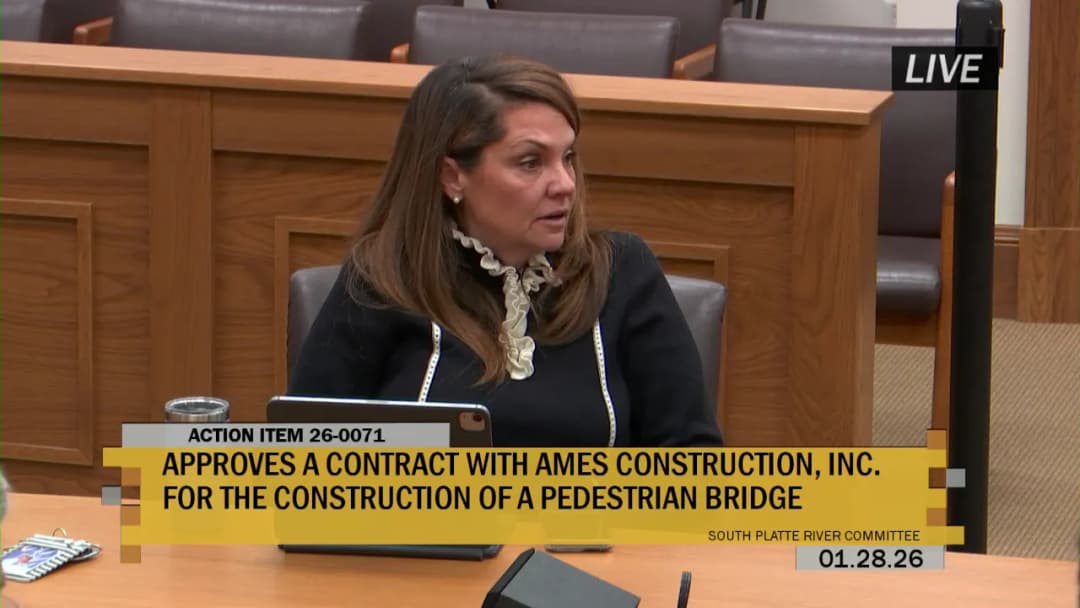
The South Platte River Committee of Denver City Council met to discuss and vote on a construction contract for a pedestrian bridge at the National Western Center campus. The committee also received updates on campus progress following the record-breaking 2026 Stock Show. The meeting was chaired by Councilwoman Jamie Torres. Discussion Items - National Western Center Campus Updates: Mike Bouchard (Executive Director, Mayor's Office of the National Western Center) and Sarah DiPietro (Program Director) presented. The 2026 Stock Show (120th anniversary) saw record attendance of over 750,000 visitors. The new Livestock Center (368,000 square feet, one of the largest city-built buildings in decades) debuted successfully, shifting the show's center of gravity to the new side of campus. Remaining projects include the Pedestrian Bridge (contract under review), the Betty Cram Drive Bridge and 48th Avenue Greenway (joint project with DOTI, procurement upcoming), the Marion Underpass (Denver bond project, design procurement starting), and planning for the “Triangle” area (10,000-seat arena, expo hall, renovation of the 1909 stadium, plus residential and mixed uses). A new coordination effort with DOTI maps and communicates all construction activities in Globeville and Elyria-Swansea neighborhoods to minimize impacts. - Pedestrian Bridge Construction Contract: The committee considered approval of a $12,742,210 construction contract with Ames Construction for a pedestrian bridge over nine railroad tracks (RTD, BNSF, DRIR) connecting the 49th & Brighton RTD station to the National Western Center campus. The single-span bridge is approximately 265 feet long, fully enclosed, with elevators and stair towers (five stories high on the west side, four on the east). It includes lighting, IT/fiber for security cameras and emergency call boxes, and a new pedestrian connection to Brighton Boulevard. Estimated construction period is 550 days after notice to proceed (expected late March 2026), with completion targeted by end of 2027, in time for the 2028 Stock Show. Federal funding comes from a USDOT Reconnecting Communities and Neighborhoods grant; only the pedestrian bridge portion was obligated (the other three components of the grant were rescinded by the One Big Beautiful Bill Act). - Elevator Reliability Concerns: Council President Sandoval and Councilman Hines raised strong concerns about the history of broken elevators on other city bridges (e.g., the 18th Street bridge, Millennium Bridge, Union Station area). They questioned how the elevators on this bridge would be maintained, noting that the National Western Center Authority (NWCA) will be responsible for operations and maintenance. Council President Sandoval requested a dedicated line item for elevator maintenance in the transfer to the NWCA, and suggested exploring ramp alternatives to avoid elevator reliance. Mike Bouchard noted that ramps were considered but constrained by space and utilities. Councilman Hines added that elevator lifespans are shortening, and broken elevators restrict access for people with disabilities and families with strollers. - MWBE/DBE Goals and Workforce: Councilwoman Alvidrez asked about minority/women-owned business enterprise (MWBE) and disadvantaged business enterprise (DBE) goals. Sarah DiPietro explained that the federal government issued an interim final rule removing DBE/MWBE goals on federally funded projects; after legal guidance, the city removed the goals. The contractor may voluntarily report utilization, and the committee requested a list of 18 subcontractors and their city certifications. Workforce requirements are standard (approximately 15% apprenticeship), per city ordinance. - Design, Tariffs, and Total Cost: Councilman Flynn asked about the design contract (part of a larger horizontal services contract with Merrick, amount to be provided). The 18-month construction timeline is conservative, partly due to long-lead materials and Buy America/Build America requirements. A tariff contingency line item is included in the contract. Total project cost is estimated at $23 million, including design and contingencies. Federal grant is $10 million, but the exact federal/local match percentage (approximately 42% federal / 58% local) will be confirmed. Key Outcomes - Vote: The committee unanimously approved a motion (by Councilman Hines, seconded by Councilman Watson) to advance the construction contract with Ames Construction for the pedestrian bridge at $12,742,210. All members present were in favor. - Follow-up Actions: - Provide the cost of the design contract for the bridge. - Confirm the exact federal/local funding split for the bridge project. - Supply a list of the 18 subcontractors along with their MWBE certifications. - Explore options for a dedicated elevator maintenance line item when the bridge is transferred to the National Western Center Authority.

ENGINEERING AND INFRASTRUCTURE 41% · FISCAL SUSTAINABILITY 16% · DISABILITY RIGHTS 16% · WORKFORCE DEVELOPMENT 11%
209
JAN 28, 2026 · DENVER, COLORADO · COUNCIL COMMITTEES
Health and Safety Committee Meeting: Surveillance Task Force Update – January 28, 2026

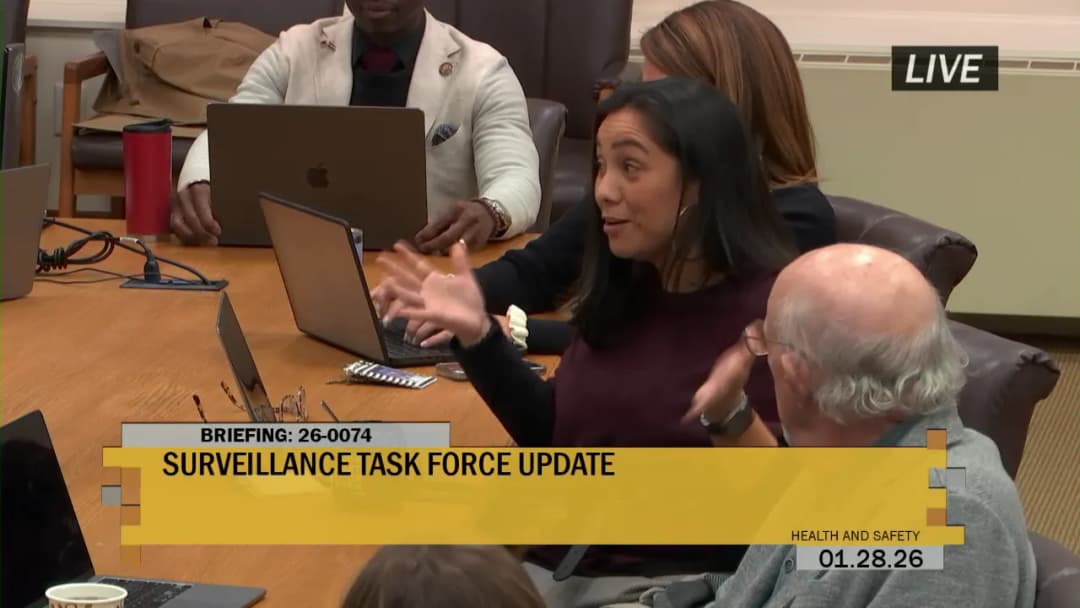
The Health and Safety Committee of the Denver City Council met on January 28, 2026, to receive an update on the Surveillance Technology Task Force. The meeting was chaired by Council Member Darrell Watson (District 9). The main agenda item was a briefing by Tim Hoffman (Director of Policy, Mayor's Office) and Tara Segura (Technology Services) on the task force's progress, including changes to the city's vendor risk assessment, ongoing work on data protection, and next steps toward a potential surveillance technology ordinance. Council members asked detailed questions about FLOCK data, data retention, contract oversight, and protections for sensitive locations such as reproductive health clinics. Consent Calendar - The chair noted two items on the consent calendar; none were pulled for discussion, and the items were approved without debate. Discussion Items - Task Force Update: Tim Hoffman presented the full membership list of the task force, which includes city council members, administration representatives, community groups, and academic experts. The task force's mission is to create a shared framework and clear standards for surveillance technology. So far, the group has catalogued current policies (e.g., vendor risk assessment, DPD Operations Manual Section 119), conducted a risk assessment identifying 18 risks (e.g., data breaches, misuse by federal agencies), and reviewed mitigation strategies. The task force has also surveyed ordinances from cities such as Seattle, New York, Madison, and Berkeley. - Changes to Vendor Risk Assessment: Tara Segura reported that technology services has expanded privacy-related questions in the vendor assessment, added language educating vendors about Denver's records retention obligations (different from GDPR), and implemented breach and remedy language in contracts. A new PII (Personally Identifiable Information) exhibit has been added to all data-related contracts, including a prohibition on sharing data with federal agencies for immigration enforcement. Ongoing vendor management improvements include annual assessments and an innovation portal for city employees. - Motorola 911 System Contract: Council Member Torres asked about applying task force lessons to the upcoming Motorola contract for the 911 system. Segura confirmed that Motorola agreed to all contract terms, including the PII exhibit and data access controls, and that the system will meet strict CJIS (Criminal Justice Information Systems) requirements. The data will be owned and controlled by the city. - Outstanding FLOCK Questions: Council Member Parity (online) raised outstanding questions about FLOCK's prior data disclosures, including whether FLOCK has ever responded to subpoenas or exigency requests involving Denver data, and requested a narrower review of search logs by Denver-area and federal agencies. Hoffman agreed to follow up with FLOCK. - Data Retention and Immigration Enforcement Concerns: Council Members Alvidrez, Romero-Campbell, and Chair Watson expressed concerns about the storage of license plate data for 30 days and potential misuse, particularly in light of increased federal immigration enforcement. Council Member Alvidrez asked whether the city can track current ICE activity and requested statistics on crimes solved with ALPRs. Chief (unidentified) confirmed that data on crime-solving outcomes can be provided. - Sensitive Locations: Chair Watson asked about protections for reproductive health clinics and other sensitive sites. Hoffman said the task force is planning to meet with reproductive rights groups. He noted that cameras are on public right-of-way and that any subpoenas for out-of-state abortion-related data would be denied per Denver and Colorado law. Council Member Gonzalez-Gutierrez supported including proximity requirements in a future ordinance. - Contract Oversight and Innovation: Council President Sandoval asked about ongoing contract monitoring and partnership with universities for subject matter expertise. Hoffman and Segura described annual vendor assessments, an innovation portal, and collaborations with DU and Bloomberg initiatives. Two professors currently serve on the task force. - Request for Council Review of Small Contracts: Council Member Gonzalez-Gutierrez requested that the administration voluntarily bring surveillance technology contracts under $500,000 (which do not require council approval) to council for review, citing the spirit of collaboration. Council Member Flynn added historical context: the FLOCK contract extension was handled below the threshold after the council voted down the original contract in May 2025, per an agreement with the mayor's office. Council President Sandoval disputed being part of that agreement. Key Outcomes - The task force will continue its line-by-line review of surveillance risks and potential ordinance language, aiming to present a more concrete proposal to the committee in one to two months. - Hoffman committed to follow up on outstanding FLOCK data requests, including subpoena history and search log details. - The administration will provide data on crimes solved using ALPRs and will explore providing information on ICE activity in Denver. - Technology services will proceed with the Motorola contract for the 911 system, incorporating the new data protections. - The task force will invite reproductive rights organizations to present their concerns at a future meeting. - No formal votes were taken; the meeting adjourned after the discussion.

TECHNOLOGY AND INNOVATION 83% · PUBLIC SAFETY 11% · PROCEDURAL 4% · COMMUNITY ENGAGEMENT 2%
210
JAN 28, 2026 · DENVER, COLORADO · COUNCIL COMMITTEES
Denver City Council Health and Safety Committee Briefing on Police/Sheriff Training and PACE Operations – Jan 28, 2026

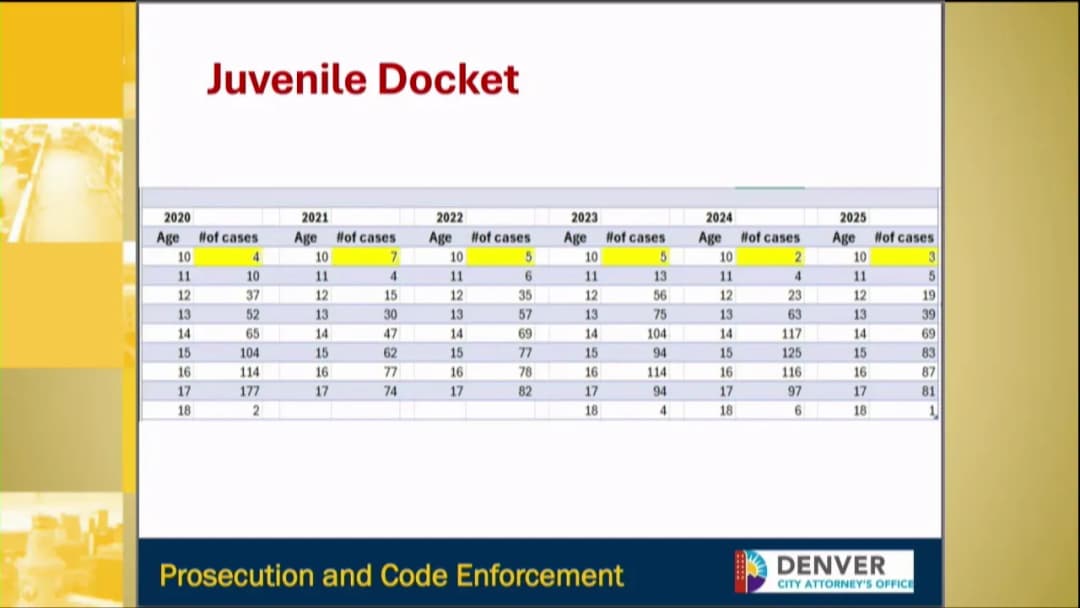
The Health and Safety Committee, chaired by Councilmember Darrell Watson, met on January 28, 2026, to receive two briefings: one from the Denver Police Department (DPD) and Denver Sheriff's Department (DSD) on continuing education and training, and another from the Prosecution and Code Enforcement (PACE) section of the City Attorney's Office on its operations, caseload, and victim services. Councilmembers asked questions and requested follow-up information. Briefing 1: Department of Safety Continuing Education - DPD and DSD presented on training requirements. DPD adheres to POST mandates (24 hours minimum annually, 12 in perishable skills like arrest control, driving, firearms) and exceeds them with programs like ABLE (active bystandership), crisis intervention, and annual supervisor training. DSD follows Triple Crown Accreditation (ACA, NCCHC, CALEA) requiring 40 hours per year. In 2025, DPD trained 1,462 officers. DSD runs 18–25 training sessions per quarter. - Challenges include limited facilities: DSD has two padded cells, aging mats, and three classrooms; DPD and DSD share a 15-stall range, creating scheduling bottlenecks. Both agencies schedule training a year ahead to minimize operational impact, but overtime and staff exhaustion are concerns. - Councilmember Torres asked how policy changes (e.g., from settlements or state law) are incorporated into training. DPD uses quarterly trends meetings with the independent monitor and can issue training bulletins within weeks. Councilmember Flynn raised concerns about staffing levels in the jail and whether training addresses low-staff situations. DSD noted it does not currently have specific training for that but will follow up. Councilmember Hinds requested sample training transcripts for officers at different experience levels. Councilmember Alvitres asked about mental health support (wellness team, peer support, Nicoletti partnership), online vs. in-person training, firearm training and ammunition costs (ammunition is budget-provided, not paid by officers), and autism training (to be provided offline). Briefing 2: PACE Presentation - Director Marlee Bordowski and team presented on PACE's charter functions: prosecuting municipal violations, licensing support, public nuisance abatement (PNAU), mental health commitments, ERPO (red flag) cases, and community partnerships. Key 2025 statistics: over 14,300 municipal case filings (up 2% from 2024), domestic violence cases at 2,529 (19% increase, a 10-year high), juvenile cases down 6% (attributed to alternative citation programs), 48 ERPO filings (statewide high), 1,300 mental health intervention cases, and 33 residences testing positive for meth contamination via DMAP partnership. - Linda Laughlin-Pettit discussed victim advocacy, including safety planning, protection orders, and collaboration with the DA's office for up-filing serious cases. She shared examples of severe DV cases (strangulation, threats). Reggie Newbine highlighted the juvenile docket, where most cases are assault or theft, and diversion is offered in about 90% of cases, with a high acceptance rate. - Councilmember Sawyer praised PACE's work on vacant building enforcement and nuisance abatement for street racing (e.g., crushing motorcycles involved in 'Kill the Streets'). Councilmember Parady expressed discomfort with the use of victim photos and quotes in slides, asking to remove case numbers (legal counsel to advise) and requested data on the percentage of PACE defendants experiencing homelessness (previously estimated at 54% in 2023, but PACE does not currently track that). Councilmember Alvitres asked about victim access to services (e.g., online protection orders) and reasons for the domestic violence increase (PACE noted ongoing collaborative efforts). Councilmember Flynn asked about meth contamination follow-up for displaced residents (DDPHE working on landlord requirements) and interagency collaboration challenges. Key Outcomes - No formal votes were taken. The committee received the briefings for informational purposes. - Follow-up items requested: Councilmember Parady requested data on homelessness among defendants and removal of case numbers from slides (pending legal review). Councilmember Flynn asked for details on meth abatement follow-up and interagency coordination. Councilmember Torres asked for information on training protocols for low-staffed jail situations. Councilmember Hinds requested sample training transcripts. DPD, DSD, and PACE committed to providing answers.

PUBLIC SAFETY 57% · MENTAL HEALTH AWARENESS 11% · COMMUNITY ENGAGEMENT 7% · WORKFORCE DEVELOPMENT 5%
OPENPUBLICA · PUBLIC MEETING INDEXUPDATED DAILY · openpublica.com