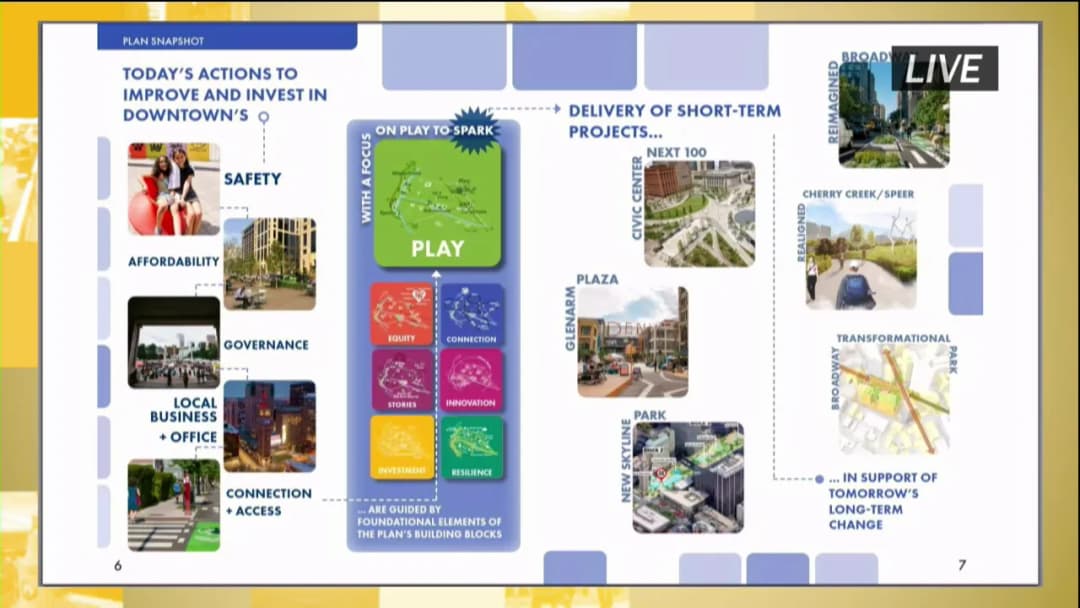
The South Platte River Committee of Denver City Council met on October 29, 2025, to discuss two major agenda items: the Downtown Denver Area Plan and amendments to the Ball Arena and River Mile development agreements. The meeting included presentations from city staff and partners, followed by council member questions and motions to advance both items to full council. Discussion Items Downtown Denver Area Plan - David Gaspers (Denver Community Planning and Development) and Courtney Garrett (President and CEO, Downtown Denver Partnership) presented the plan, which aims to transform downtown from a central business district to a central neighborhood district. The plan emphasizes "play" as a unifying theme, with near-term actions (e.g., reimagining Glenarm Plaza, Skyline Park investments) and long-term visions (e.g., reimagining Broadway and Speer Boulevard). - Community engagement included over 1,500 comments, with major themes of safety, affordability, job curation, mobility, and green space. The plan includes seven focus areas and a robust implementation matrix. - Council members raised questions and comments: - Councilwoman Alvidrez asked about public vs. private investment, safety services, and integration of children and daycare. She noted the need for a family-friendly downtown and public investment in schools or daycare. - Councilman Flynn expressed skepticism about the Speer Boulevard realignment, questioning cost-benefit and marginal gain. He requested documentation on purpose, need, and cost-benefit ratio. - Councilman Watson praised the plan and highlighted the Welton Street corridor and trunk transit concept (page 91), which explores replacing light rail with high-frequency bus lines to improve connectivity to Five Points. - Council President Sandoval emphasized the importance of consistent language across plans, specifically regarding the South Platte River. She confirmed that language she requested was included on page 82 of the plan. - Councilman Hines supported the plan, noting its focus on connectivity and the 5280 Trail, and stressed the need for child care in ground-floor activations. - Pro Tem Campbell noted the importance of a strong downtown for Southeast Denver residents who have choices for housing and recreation. - David Gaspers clarified that the plan does not change future land use maps from previous small area plans, and that Civic Center is fully covered by this plan. Ball Arena and River Mile Development Agreement Amendments - Steven Wilson (CPD), Andrew Johnson (Department of Housing Stability), and Reggie (Department of Finance) presented four related items: 1. Second amendment to the Ball Arena Development Agreement: addresses environmental requirements for a city-owned park and public access easements. 2. Amendment to the affordable housing compliance plan: adds a cap of 300 affordable units in two all-affordable towers to avoid concentration, aligning with the community benefits agreement. 3. Escrow management agreements for affordable housing linkage fees for both Ball Arena and River Mile projects. 4. Creation of a special revenue fund to manage escrow accounts held at ColoTrust. - Discussion included: - Councilman Flynn asked about the current status of affordable units; Andrew Johnson explained the cap was added (previously no limit) to limit size of deeply affordable (30% AMI) units in two towers. - Councilwoman Alvidrez inquired about the flow of linkage fee dollars into escrow and utilization timeline. Matt Mahoney (Kroenke Sports & Entertainment) stated phase one (entertainment district) will collect linkage fees from hotel and performance venue, but those funds cannot be used until phases two and three. The escrow agreement terminates June 30, 2050, after which unused funds revert to the affordable housing fund. - Councilman Hines asked about buildout timeline; Mahoney confirmed phase one construction starts next year with completion in 2029, and full Ball Arena site buildout projected by 2032. Phases two and three are not yet in active planning. - Andrew Johnson noted that linkage fees are reserved for the two all-affordable towers in phases two and three, serving as an incentive for development. Key Outcomes - Downtown Denver Area Plan: A motion to move the plan forward to full city council was made and seconded. The committee approved the motion without objection. - Ball Arena/River Mile Amendments: A motion to move all four items (development agreement amendment, compliance plan amendment, escrow agreements, special revenue fund) forward to full council was made by Councilman Watson and seconded. The committee approved the motion without objection. - Next steps: Both items are scheduled for full city council consideration on November 17, 2025.
Public Meetings - Denver, Colorado
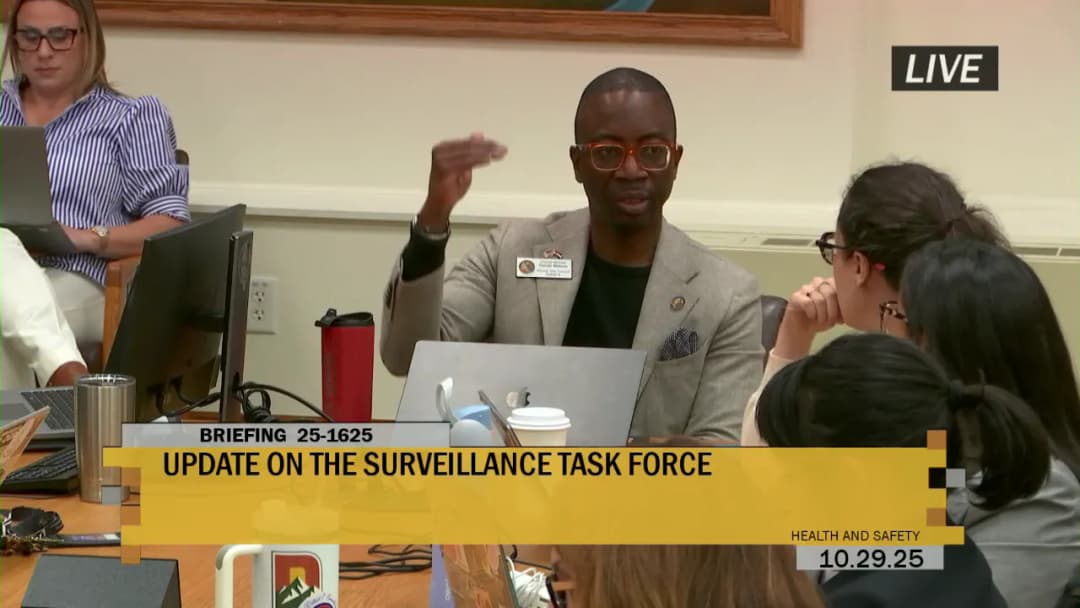
Public Meetings - Denver, ColoradoThis weekly meeting of the Denver City Council Health and Safety Committee, chaired by Councilmember Daryl Watson (District 9), convened on October 29, 2025 at 9:30 AM MT. The primary agenda item was a briefing on the surveillance technology task force update, presented by the Mayor's Office, Denver Police Department (DPD), and Technology Services (TS). The meeting also included a consent calendar with no items voted upon. Council members raised significant concerns about transparency, process, and the Flock automatic license plate reader (ALPR) contract extension. Consent Calendar - No items were voted on; the consent calendar was mentioned but not acted upon. Discussion Items - Surveillance Technology Task Force Update: Tim Hoffman (Mayor's Office Director of Policy) introduced the task force, formed in spring 2025 to study current surveillance technologies and propose rules/regulations. Commander Cliff Barnes (DPD) and Tara Sakura (TS) outlined the technology acquisition process, including vendor risk assessments, policy controls (Operations Manual Section 119), and data governance. - Flock ALPR Contract Extension: Hoffman acknowledged anger and frustration over the contract extension process but stated the mayor acted within charter authority. He detailed policy improvements: turning off national lookup (now Denver-only access), limiting search reasons via a drop-down menu, prohibiting immigration/enforcement and reproductive health searches, adding a $100,000 penalty for improper data disclosure, and automatic opt-out of new Flock programs. Chief Ron Thomas presented maps showing Flock's use in solving homicides, non-fatal shootings, and sex crimes across all council districts. He cited a 8% increase in homicide clearance rates (79% to 87%) and credited Flock with nine homicide suspect arrests during the pilot. - Council Member Feedback: Councilmembers Sarah Parady, Serena Gonzales-Gutierrez, and Kevin Flynn (task force members) expressed frustration with the task force's lack of agendas, materials, and influence on decisions. Parady noted the new contract terms were not shared with the task force. Council President Amanda Sandoval criticized the CEO's trust in ICE and homeland security. Councilmember Sawyer supported Flock but called for a comprehensive data privacy ordinance. Councilmember Alvidrez questioned legality, data retention, and the $100,000 penalty's adequacy. Councilmember Torres asked about sole-source contracting and requested an RFP for ALPR vendors. - Unanswered Questions: Councilmembers requested audits, search logs, MOUs with other jurisdictions, Flock's subpoena compliance, and details on data use for AI training. Hoffman confirmed the city is negotiating removal of the anonymized data clause (Section 4.3). Key Outcomes - Task Force Next Steps: Hoffman plans an interim report by January 2026. Councilmember Parady requested that future presentations be made to the task force before the full council to ensure collaboration. - Flock Contract: The mayor signed a no-cost extension under $500,000 avoiding council vote. Data access is restricted to DPD only; other jurisdictions must sign MOUs with Denver's standards. Council members expressed intent to explore ordinances for surveillance technology oversight. - Ongoing Concerns: Councilmembers will follow up on audit logs, contract language, subpoenas, and potential RFP for alternative ALPR providers. A visit to the Real-Time Crime Center was offered to councilmembers. - No Votes Cast: The meeting adjourned without any votes on consent or other items.
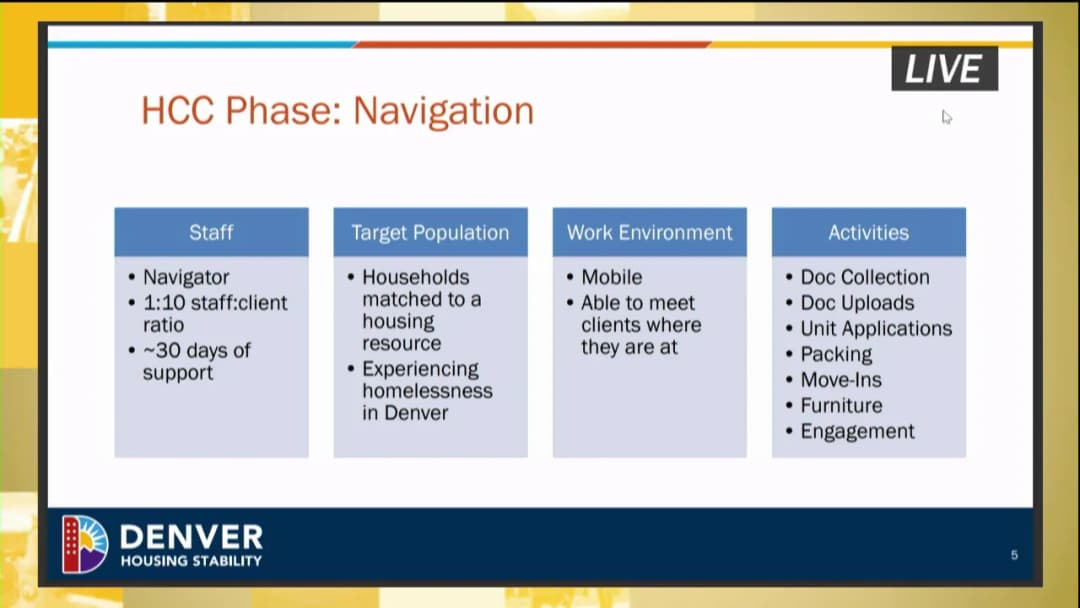
The Community Planning and Housing Committee of Denver City Council met on Tuesday, October 28, 2025, to review and approve contracts for eviction legal assistance and family homelessness services, and to receive a briefing on the Housing Central Command rehousing model. Key discussions centered on rising eviction filings, family homelessness waitlists, and resource constraints. Eviction Legal Assistance Contracts - Presented by: Melissa Tati, Director of Stability and Prevention, Department of Housing Stability (HOST). - Statistical context: Pre-COVID eviction filings averaged 8,800/year; filings rose post-pandemic. In 2024, over 3,300 households were served; 76% were at or below 30% area median income (AMI); 30% of clients were Black/African American. Of 22,000 eviction filings (Jan 2022–Jan 2024), 1,500 households (7%) accounted for 23% of filings (three or more evictions). - Contracts approved (all three-year): - Colorado Legal Services: $1,160,737 total (300 households/year, avg $1,267/household) – focus on subsidized housing. - Community Economic Defense Project (CEDP): $2,768,062.50 total (1,033 households/year, avg $871/household). - Colorado Poverty Law Project: $2,983,356 total (1,300 households/year, avg $746/household). - A fourth contract (Colorado Affordable Legal Services, $768,906) to be presented the following week. - Discussion: Councilmembers asked about cost per eviction ($800–$900), state law limitations on mandatory mediation (still not allowed in Colorado), geographic distribution of evictions, language access, and equity in service delivery. The committee approved the three contracts by consensus. Family Homelessness Services Contracts - Presented by: Jeff Kazutsky (Deputy Director for Shelter and Stability) and Rosie McQuigan (Family Program Officer), HOST. - Statistical context: Family homelessness increased 150% from 2022 to 2025. Unsheltered homelessness decreased 83% (point-in-time count found <20 families unsheltered). Family shelter beds grew from 194 (2022) to 303 (current). Waitlist: 230 families (893 individuals) as of October 4, 2025. In 2024, 242 families exited to housing vs. 159 in 2022. - Contracts reviewed (action items): Total of $10.5 million for 303 family shelter units, including: - Tamarack shelter: Provider switching from Salvation Army to Bayod Works on Jan 1, 2026 (three-year contract, slightly reduced budget). - Connection Center: Increased staffing from 8 to 16; narrow scope to families experiencing homelessness; added rapid resolution and cold-weather in-person intake. Cold weather vouchers served 506 unique families in 2024. - Other contracts (e.g., CCH, Salvation Army) with minor cost-of-living increases. - Discussion: Councilmembers raised concerns about connection center hours (currently 7 AM–9 PM weekdays, 7 AM–12 PM weekends) and suggested later weekend hours; lack of emergency congregate shelter for families; and the need for better data on outcomes and family demographics. The committee approved the contracts by consensus. Housing Central Command Briefing - Presented by: Evangeline Benja, Assistant Director of Homelessness Resolution, HOST. - Model: Crisis response with navigation, unit acquisition, and stabilization case management. In 2025, housed 351 of 399 goal (88%), averaging 39 days from referral to housing. 144 exits to permanent/stable housing; 182 households returned to shelter for continued work. - Contracts (for 2026, with three-year options): - CEDP (navigation): $1,243,974. - Colorado Coalition for the Homeless (stabilization): $2,083,248. - Housing Connector (unit acquisition/rent payment): $2,638,000. - Planned changes: Centralized navigation (4 navigators serving up to 400 households/year), increase stabilization case managers from 6 to 16, and expand unit inventory to 500 units. - Discussion: Councilmembers noted the program’s evolution, budget constraints (original ask was $15M, actual awards much less), and the need to align with overall HOST cuts. No vote required; briefing only. Key Outcomes - Approved by committee consensus: Three eviction legal assistance contracts (Colorado Legal Services, CEDP, Colorado Poverty Law Project) and all family homelessness shelter and connection center contracts (including Tamarack provider transition). - Next steps: Colorado Affordable Legal Services contract to be presented at next meeting. Housing Central Command contracts to be finalized and return for formal approval after budget details are set. - Directives: HOST to provide geographic eviction map, data on bedrooms in affordable housing pipeline, and evaluate extended connection center hours on weekends.
The Finance and Business Committee of Denver City Council met on Tuesday, October 28, 2025, starting at 10 a.m. The meeting covered three major action items: a proposed increase in fines for residential rental license violations, approval of 2026 budgets for general improvement districts (GIDs), business improvement districts (BIDs), and the tourism improvement district (TID), and the acquisition of Denver Pavilions by the Denver Downtown Development Authority (DDA). No consent items were considered. Public Comments & Testimony - Olivia Sanders (East Colfax Community Collective) expressed support for the rental license fine increase, stating it would better hold landlords accountable and improve housing conditions. - Joseph Aurora (small rental property owner) expressed general support but asked that the maximum $5,000 per day fine be targeted to larger owners, as it could harm small landlords. - Amy Cesario (Denver Metro Association of Realtors, representing 6,000 members) urged robust stakeholder engagement and education before implementing the fine, noting that $5,000 per day could be devastating for mom-and-pop housing providers. - Ada Altman (Denver Metro Tenants Union) strongly supported the increase, arguing that the current $999 maximum is negligible for corporate slumlords and that the fines should be used with scale against large out-of-state actors. - Andrew Hamrick (Apartment Association of Metro Denver, representing 1,074 communities and 128,331 units) opposed the fine increase, warning that a five-fold increase with daily computation could lead to disproportionally large penalties (e.g., $70,000 for a two-week issue) and discourage investment in rental housing. - Jordan Cotler (Colorado Poverty Law Project) supported the increase, stating that the current fine schedule does not deter bad actors, especially large corporate landlords, and that aligning fines with DDPHE will aid code compliance. Discussion Items 1. Residential Rental License Fine Increase Deputy Executive Director Erica Rogers, policy analysts Kelly Abrams Rivers and Abby Soysa, and city attorney Genevieve St. Ledger presented a proposal to amend Chapter 27, Article 8 of the Denver Revised Municipal Code to increase the maximum civil penalty for residential rental license violations from $999 to $5,000 per violation per day. This aligns with the fine authority of the Department of Public Health and Environment (DDPHE). Key data: As of October 20, 2025, there were 27,712 active licenses covering about 203,000 units. Since enforcement began, 3,258 warnings/citations were issued; only 24 operators (less than 1%) reached the third citation level. The department emphasized that the goal is compliance, not fines, and that the increased fine would be used as a last resort after warnings and lower fines. Council members discussed the per-property versus per-unit violation structure and the need for education. No opposition from committee members; the item was moved to full council. 2. 2026 Plans and Budgets for GIDs, BIDs, and TID Dennis Wujenick, capital planning analyst, presented the annual work plans and budgets for 12 business improvement districts (BIDs), 5 general improvement districts (GIDs), and the tourism improvement district (TID). The total proposed budgets varied by district, with most increasing slightly. Notable: Ballpark Denver GID (first year) projected $1.4 million in revenues. Downtown Denver BID’s budget decreased due to the winding down of the 16th Street Mall project. The TID projected $6.7 million for tourism marketing. Committee members asked about administrative cost flexibility, the revolving loan fund for new GIDs, and audit requirements. The block of budgets was moved to full council. 3. Denver Pavilions Acquisition Bill Mosier (Mayor's Office) and Donna Wilder (Department of Finance) presented the DDA’s proposal to acquire Denver Pavilions (a 350,000 sq ft retail/entertainment complex on the 16th Street Mall) for up to $45 million. The property currently has a $85 million loan in default; the acquisition price is $37 million. The DDA also plans to purchase two adjacent parking lots to unify the site. The property is about 60% occupied, with low foot traffic due to COVID-19 and 16th Street construction. The goal is to sell the property within 12-18 months after re-envisioning its use through community input. Council members expressed support, noting the opportunity to create a bookend for upper downtown. The committee approved moving to full council, with clarification that DDA funds are not general fund dollars. Key Outcomes - Motion to approve the residential rental license fine increase (move to full council) passed unanimously. - Motion to approve the 2026 plans and budgets for GIDs, BIDs, and TID (as a block) passed unanimously. - Motion to approve the DDA acquisition of Denver Pavilions (up to $45 million and move to full council) passed unanimously. The meeting adjourned at approximately 11:30 a.m.
The Budget and Policy Committee of the Denver City Council met on October 27, 2025, at 12:30 PM to receive two informational presentations: one on the concept of Civic Assemblies as a tool for community empowerment, and another on a proposal to allow parking citations to be mailed rather than affixed to vehicles. No formal votes were taken, but committee members raised substantive questions and concerns, and both items were deferred for future follow-up. Briefing on Civic Assemblies Councilmember Amanda Sandoval (Council President) introduced the briefing. Councilmember Candi Lewis, along with Rashawn Bliss (National Coalition for Dialogue and Liberation) and representatives from the Civic Canopy, National Civic League, Healthy Democracy, and American Public Trust, presented the concept of a Civic Assembly: a randomly selected, demographically representative group of residents who deliberate on a specific policy issue over multiple paid sessions and make recommendations by a 70% supermajority. Councilmember Lewis noted that a proposal for an affordable housing Civic Assembly is currently pending with the mayor's office. Committee members expressed a range of positions: - Councilmember Jaleh Heiny (District 10) described a similar effort in her district that had low turnout, and asked how to improve participation. Presenters emphasized the importance of real decision-making power, compensation, and proactive outreach. - Councilmember Jamie Torres asked how Civic Assemblies would relate to existing community advisory committees and the People’s Budget process. Presenters clarified that assemblies are meant to be binding on the specific issue, not merely advisory. - Councilmember Darrell Watson questioned whether an assembly could replace established expert advisory boards like the Housing Stability Strategic Advisors Board, and requested more examples of outcomes from other cities. - Councilmember Kevin Flynn voiced skepticism about the ability of randomly selected citizens with no prior expertise to make informed recommendations on complex issues like housing. - Councilmember Paul Cashman expressed general support for community empowerment but stressed the need for more data on past assemblies, including costs and implementation rates. - Council President Sandoval raised concerns about Denver’s strong-mayor form of government, noting that council can pass legislation but cannot compel the executive branch to implement assembly recommendations. She requested examples from cities with similar governance structures. Presenters responded by citing international examples (Ireland, Belgium, Oregon, Fort Collins) and noted that most decision-making bodies do implement at least a portion of assembly recommendations. They emphasized that the process builds trust and yields recommendations that enjoy broad public support. Discussion on Mailing Parking Citations Councilmember Paul Hines presented a proposal to amend Denver Revised Municipal Code § 54-788 to allow right-of-way enforcement agents the option to mail parking citations instead of affixing them to vehicles. Current law only permits mailing for moving violations (e.g., red light cameras). The proposal aimed to improve agent safety, reduce the need for specialized vehicles, and increase efficiency for high-volume violations like street sweeping. Adam Peter, interim director of Right-of-Way Enforcement, confirmed the change would be optional, not universal. Committee members raised numerous concerns: - Councilmember Kevin Flynn worried that delayed notice would hinder a recipient’s ability to contest a citation due to lost evidence or memory. - Councilmember Paul Cashman requested data on current citation costs, payment rates, dispute rates, and the financial impact of mailing. He also asked about enforcement of the 72-hour parking rule, which Mr. Peter said is now rarely enforced due to a 2023 code change. - Councilmember Jamie Torres asked about lessons from other municipalities and questioned how the proposal would enhance enforcement of accessible parking violations, particularly on private lots. - Councilmember Laura Vidads and Councilmember Alvidares echoed concerns about notice, especially for residents who do not check mail frequently or who have outdated addresses. They also noted the recent dissolution of the Parking Magistrate’s Office, leaving residents with no clear way to dispute tickets. - Council President Sandoval expressed concern that the proposal would shift work to lower-paid processing staff and that it could increase complaints, especially if license plate errors are common. She warned that a future administration could mandate 100% mail-in citations without the same evidence as photo enforcement. Councilmember Hines acknowledged the concerns, especially the timing of the proposal relative to the parking magistrate issue. He suggested that requiring photographic evidence for mailed citations could be considered. Committee members agreed the proposal needs further study, including data on citation locations and amounts, and a clearer understanding of the new dispute process. Key Outcomes - No votes were taken on either agenda item. - The Civic Assembly briefing is to be followed up with additional data, examples from strong-mayor cities, and the written proposal to be shared with all council members. Councilmember Lewis will offer further briefings. - The parking citation mailing proposal will return to the committee at a later date, after the Parking Magistrate situation is resolved and after Dottie (Right-of-Way Enforcement) provides data on citation locations, dollar amounts, and the new dispute process. Councilmember Hines will coordinate with committee staff for a future agenda slot. - The committee stood adjourned at approximately 2:15 PM.
The Denver City Council held its weekly general session, dominated by a lengthy public hearing on the mayor's proposed 2026 budget. The meeting also featured the adoption of two proclamations and the passage of numerous resolutions and bills in a block vote, following discussions on specific contracts and city spending. Consent Calendar - The council adopted multiple resolutions and bills in a block vote, including routine approvals for agreements and contracts related to affordable housing, street sweepers, landfill gas evaluation, airport cleaning services, and shelter operations. - Council Resolution 1488 (airport cleaning services contract with Wayne and Sons Enterprises Inc.) was postponed to November 10, 2025, for further review. Public Comments & Testimony - Opposition to Budget Cuts: Multiple speakers, including representatives from Youth on Record, New Cottage Arts, and the Struggle of Love Foundation, expressed strong opposition to proposed 50% cuts to the Office of Children's Affairs (OCA), stating it would devastate free after-school and summer programs that support youth mental health and safety. - Advocacy for Family Shelters: Representatives from House Keys Action Network Denver and families with lived experience pleaded for a $9 million budget amendment to create emergency family shelter, citing a waitlist of over 250 families and children sleeping in vehicles. - Support for Election Funding: Speakers from the League of Women Voters, election judges, and both Democratic and Republican party officials urged full restoration of the Clerk and Recorder's budget, warning that proposed cuts would close polling centers, reduce drop boxes, and undermine voter access, especially for Spanish-speaking communities. - Requests for Community Safety Grants: Advocates from the Colorado Criminal Justice Reform Coalition and allied organizations asked for a $5 million community-led safety grant program to fund violence prevention, youth mentoring, and victim services. - Concerns on Transportation Safety: Residents advocated for restored funding for Vision Zero and Safe Routes to School programs, criticizing the potential use of the Transportation and Mobility Special Revenue Fund for purposes like parking magistrates instead of street safety improvements. - Support for Specific Programs: Testimony included support for the Denver Basic Income Project, Denver Day Works program, Denver Immigrant Legal Services Fund, and the STAR program, with opposition to cuts in these areas. Discussion Items - Proclamation 1621 – United Airlines Flight 629 Victims Memorial Day: The council adopted a proclamation honoring the 70th anniversary of the 1955 bombing, reading the names of all 44 victims. Representatives from the Denver Police Museum accepted the proclamation, emphasizing the importance of remembering the individuals lost. - Proclamation 1622 – 50th Anniversary of Denver Interneighborhood Cooperation (INC): The council adopted a proclamation honoring INC and the city's Registered Neighborhood Organizations (RNOs). INC representatives accepted, discussing the organization's history and the recent loss of founder Michael Henry, while calling for greater investment in civic infrastructure. - Budget Questions and Staff Reports: Council members extensively questioned city staff, including the Budget Office and the Mayor's legislative director, on topics including: - The rationale and process for recent city layoffs. - The source of funding for the proposed soccer stadium agreement. - The legality and appropriateness of using the Transportation and Mobility Special Revenue Fund to pay for parking magistrates. - The status of "frozen" but budgeted positions in various departments, including the crime lab and the Clerk and Recorder's office. - Details on specific contracts, such as those for the Comfort Inn and Republic Plaza, and the HYPE youth program. - The city's bond rating and financial standing. Key Outcomes - Proclamations Adopted: Proclamations 1621 and 1622 were adopted unanimously by roll call vote. - Resolutions Adopted: All called-out resolutions were adopted in a block vote with a 12-0 tally, except for Resolution 1488 which was postponed. Resolution 1497 (Salvation Army shelter contract) was adopted with a 9-3 vote (Gonzalez Gutierrez, Lewis, and Parity voting no). - Budget Process Advanced: The required public hearing on the 2026 budget was closed. Council members have until November 3, 2025, to propose amendments, with a final vote scheduled for November 10, 2025. - Directives and Follow-ups: Council requested numerous follow-up reports from city staff on budget details, contract costs, legal opinions on fund usage, and program impacts, with answers to be provided to all council members and published publicly.
The South Platte River Committee convened on October 22, 2025, to receive a presentation from the River Sisters Congreso advocating for legal personhood for the South Platte River and the creation of a "turquoise necklace" of interconnected parks along its corridor. Committee members discussed the cultural, environmental, and legal implications of the proposal. Public Comments & Testimony - Nita Gonzalez, representing the River Sisters Congreso, expressed support for recognizing the South Platte River as a living relative and called for integrating cultural guardianship into river planning and embedding environmental equity into municipal policy. - Shannon Francis shared personal experiences from her indigenous community, emphasizing the importance of water as a relative and supporting the personhood framework to protect the river for future generations. - Tomas Lopez provided a cultural perspective, arguing that water has a spirit and should be treated as sacred, thus endorsing the personhood concept to restore a sacred relationship with the river. Discussion Items - Council members, including Councilwoman Alvirez and Councilman Hines, asked about the legal feasibility of granting personhood to the river, referencing international precedents like New Zealand and Bolivia, and sought clarity on how it fits into Western colonial legal systems. - Council President Sandoval suggested starting with a proclamation to formalize the city's values and then systematically update zoning codes, planning documents (e.g., Blueprint Denver), and involve indigenous commissions and community groups in decision-making. - Councilwoman Torres proposed coordinating with city departments, such as Parks and Recreation, and invited the River Sisters to future discussions, including a December 12th meeting on a proposed river overlay with Rocky Piero. - Other council members, like Councilwoman Parody and Councilman Watson, expressed curiosity and support, discussing practical steps such as park renaming and leveraging water attorney expertise to navigate legal complexities. Key Outcomes - The committee expressed broad support for the River Sisters' proposal, with council members committing to explore actionable steps, including drafting a proclamation and integrating the personhood framework into municipal policies and planning processes. - Next steps include attending a future committee meeting on December 12th to discuss a river overlay with Rocky Piero and continuing collaboration with the River Sisters on implementation strategies, such as creating a guardianship body to advocate for the river's rights.
The Health and Safety Committee convened on October 22, 2025, for a comprehensive briefing from the Office of Social Equity and Innovation (OSEI) regarding the Office of Neighborhood Safety (ONS). The presentation covered the restructuring of ONS, various youth-focused programs, data integration efforts, and community collaboration. Council members raised questions about budget implications, program eliminations, and the broader scope of neighborhood safety beyond youth services. Discussion Items - OSEI Briefing: Dr. Ben Sanders and his team presented on the creation of ONS from programs transferred from the Department of Safety. They emphasized a continuum of services, data-driven outcomes, and community engagement. - Youth Violence Prevention (YVP): Preston Adams discussed initiatives and grant funding for community-based organizations, expressing commitment to values-driven work. - Diversion Programs: Kevin Muango explained municipal juvenile diversion and the alternative citation program, highlighting reduced program durations and increased parental involvement. - Runaway and Anti-Trafficking Programs: Beth McNally outlined the Rani project and Denver Anti-Trafficking Alliance multidisciplinary team, focusing on prevention and collaboration. - HYPE and Safe City Youth Leadership: Teresa Kimmett Riley described programs for youth re-engagement and leadership, emphasizing transformation and empowerment. - Community Violence Solutions: Stefan Cummings talked about intervention services and safe haven activations, detailing efforts to prevent violence and build community trust. - Data Systems: Zach McDade highlighted modernized data infrastructure for evaluating program outcomes, aiming to measure true impact beyond outputs. - Council Q&A: Members expressed positions and concerns: - Councilmember Sawyer sought clarity on restructuring differences from previous presentations and questioned the youth-only focus of ONS. - Councilmember Gonzalez Gutierrez noted that programs were pre-existing and raised issues about budget eliminations for HYPE and access to alternative citation programs. - Councilmember Flynn inquired about the resonance of faith-based approaches with youth and the operational details of safe haven networks. Key Outcomes - OSEI agreed to provide follow-up briefings and written clarifications on organizational structure and budget details. - Council members requested improved coordination with other city agencies and a broader approach to neighborhood safety. - The committee emphasized the need for accurate budget book representations and ongoing program evaluations.
This informational meeting featured a detailed presentation from the Denver Housing Authority (DHA) on the Housing Choice Voucher (HCV) program, its critical role in providing housing stability, and the significant challenges posed by affordability and federal funding uncertainties. Committee members engaged in a lengthy Q&A session to better understand program operations and current pressures. Discussion Items - DHA Presentation on Housing Choice Vouchers: DHA executives, including CEO Joaquin Sintelumbea, Program Director Loretta Owens, and COO Joshua Crowley, provided an overview. They explained the distinction between tenant-based and project-based vouchers, emphasizing the program's goal of providing participant choice. DHA stated that the program assists over 19,000 individuals with a budget of $142 million in housing assistance payments, calling it an economic engine for local "mom and pop" landlords. - Affordability Crisis Context: DHA leadership framed the discussion within Denver's housing crisis, presenting data showing that a minimum-wage worker would need to work over 80 hours a week to afford a two-bedroom apartment at Fair Market Rent. They argued this represents a policy failure and stressed the moral imperative to close the gap between wages and housing costs. - Federal Funding and Program Changes: DHA reported operating under stricter HUD compliance guidelines since April 17, 2025, including reduced search times for voucher holders from 180 to 60 days. They discussed the impending sunset of Emergency Housing Vouchers in September 2026 and plans to transition remaining families to tenant-based vouchers. DHA also explained why a prior commitment to allocate 300 vouchers to the city over three years could not be fulfilled in 2025 due to HUD-imposed restrictions, but expressed hope to replenish them in 2026 based on fiscal progress. - Council Member Q&A: Council members Jamie Torres and others sought clarification on: - Fair Market Rent determination geography (Denver metro area). - Voucher utilization rates and project-based voucher bottlenecks (current utilization at 82%). - The impact of potential federal work requirements for other benefit programs (like SNAP) on voucher families. - DHA's role in landlord-tenant disputes and lease agreement standards. - The status of the federal budget shutdown and its minor current impact on DHA operations, thanks to reserves. - Expressions of Support: Council members, including Jamie Torres who shared a personal connection to the Section 8 program, and Pro Tem Romero Campbell, expressed strong appreciation for DHA's complex work and the program's vital role in preventing homelessness and stabilizing families. Key Outcomes - The meeting was informational with no formal action items or votes. - DHA committed to providing follow-up data on voucher termination rates due to the new 60-day search timeline and on eviction rates among voucher holders. - Committee members emphasized their role as supportive partners and requested ongoing communication regarding federal funding impacts.
On October 21, 2025, the Denver City Council's Governance and Intergovernmental Relations Committee held a meeting focused on a proposed ordinance to establish the framework for collective bargaining by city employees, as mandated by a voter-approved charter amendment. The meeting included a detailed presentation by the ordinance's sponsors, extensive public comment from unionized workers, and a council question-and-answer session. Public Comments & Testimony - Lauren Siegmiller (Denver Public Library Worker): Expressed strong support for the ordinance and shared a personal story highlighting the need for union protections, including a grievance process and better leave policies. - Peter Simon (Denver Public Library Workers United): Advocated for the union and requested that library management follow the Auditor's Office's lead by voluntarily recognizing the union to avoid a costly election. - Hannah Heredia (ASK ME union, DHS employee): Thanked the council for past support and urged the city to use the ordinance to rebuild trust with workers after recent layoffs, emphasizing the need for fairness and stability. - Jade Kelly (CWA Local 7799 President): Expressed support for the ordinance, calling for it to be a "gold standard," advocated for card-check recognition over elections, and requested a strengthening of provisions against temporary worker replacements during labor actions. - Michael Wallen (AFSCME Local 158 President): Expressed gratitude for the council's work on the ballot measure and acknowledged the challenging work environment for city employees. - Heather Burke (Adams County Human Services, AFSCME Local 3927 President): Spoke in solidarity, sharing that collective bargaining improved her workplace and urging Denver to allow open communication and the use of city email for union organizing. - Ronnie Houston (Teamsters): Expressed heartfelt gratitude to the council for their courage in supporting collective bargaining, stating it lifts workers into the middle class. Discussion Items - Ordinance Overview (Sponsors Parody & Torres): Presented the draft ordinance, explaining it fleshes out the charter amendment. Key components covered included definitions, bargaining unit determination, election procedures, payroll deductions, bargaining timelines, impasse resolution (mediation/arbitration), and unfair labor practice definitions. - Outstanding Issues: Sponsors noted a few items still under discussion, including the process for individual unfair labor practice complaints, details on employee release time for bargaining, and rules for mid-term contract bargaining. - Council Questions: - Councilmember Romero Campbell inquired about the negotiation schedule and its alignment with the city's budget cycle. - Councilmember Alvidrez asked about rules for union communication space and management misinformation, with staff confirming such acts would be unfair labor practices. - Council President Sandoval led a detailed discussion on the policy allowing city email use for union organizing, weighing its necessity for outreach against potential public records and monitoring risks. - Councilmember Watson asked about the cadence for new bargaining units (capped at five in the first five years for executive agencies) and expressed concern about budgeting for potential labor costs. Key Outcomes - The committee unanimously voted to move the proposed collective bargaining ordinance forward. - The ordinance is scheduled for a first reading on November 3rd and a second reading on November 10th. - Committee members agreed to use the existing five-member panel of arbitrators for the new process. - Sponsors committed to finalizing language on the few outstanding issues (individual unfair labor practice process, release time, mid-term bargaining) before the full council votes.