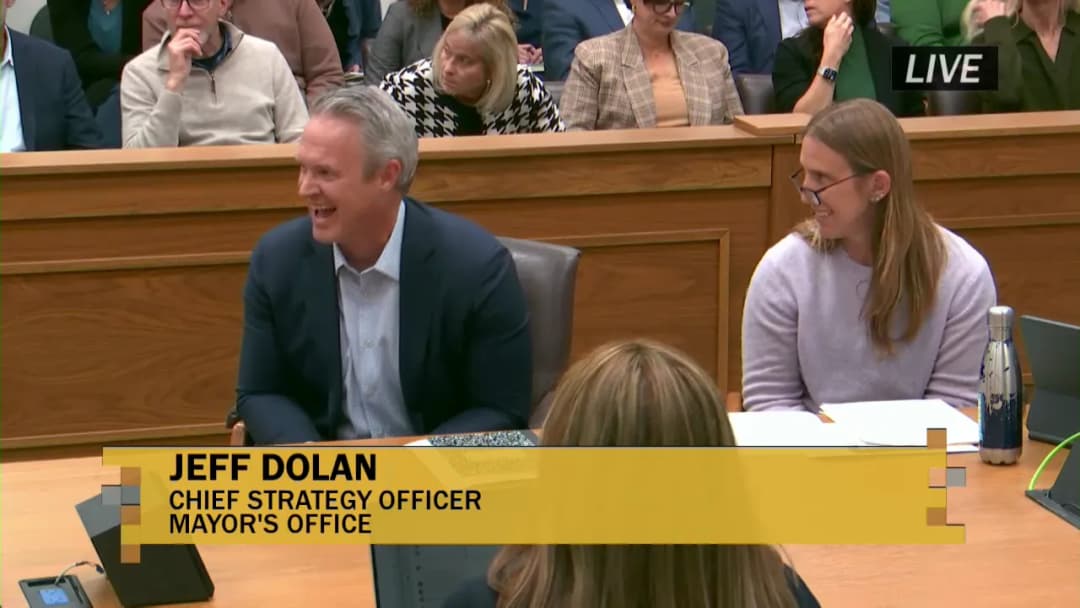
The South Platte River Committee of the Denver City Council met on November 12, 2025, to consider five action items related to the proposed Denver Summit FC soccer stadium at 709 South Delaware Street. The committee reviewed a rezoning request from CMX-16 to PUD G39 for a 6-acre site, along with amendments to Intergovernmental Agreements (IGAs), a stadium property agreement, and a capital budget appropriation. After extensive discussion, the committee voted to advance the rezoning to the full council and postponed the remaining four items to a future meeting. Public Comments & Testimony - Tony Lechuga (CPD) reported that as of the meeting, the city had received one letter of opposition (opposing the stadium as an unproductive use of the site) and 131 letters of support from neighbors and business owners, citing connectivity, activation of vacant land, and economic impact. - A letter from the Community Benefits Agreement (CBA) organization, representing registered neighborhood organizations (ROs), was included in council materials but not read aloud. The CBA negotiating team was present but declined to comment when invited by Councilmember Alvidrez. - Rob Cohen (Denver Summit FC owner) highlighted extensive community engagement: over 200 attendees at two town halls, a bilingual soccer clinic at Valverde Park with 130 kids, and 160 survey responses (40 in Spanish). Key community themes included transportation, jobs, and park connectivity. Discussion Items - Rezoning (Bill 25-1541): Tony Lechuga presented the request to rezone from CMX-16 to PUD G39, which would allow either a soccer stadium with customized rules (e.g., reduced setbacks, increased transparency, taller fencing, and special sign allowances) or development under existing CMX-16 standards if the stadium is not built. The PUD is based on the campus-entertainment district and aims to create a mixed-use, transit-oriented development. CPD staff determined the rezoning meets all eight review criteria (consistency with plans, public interest, etc.) and recommended approval. The Planning Board voted unanimously to recommend approval on October 15, 2025. - IGA Amendments (Bills 25-1553 and 25-1850): Thora Walter (Finance) explained that the 2017 IGA amendment adds the stadium to eligible TIFF projects and designates the North Pedestrian Bridge as a regional project (allowing use of regional mill levies). The 2025 IGA amendment provides city funding for the North Pedestrian Bridge and updates the TIFF waterfall to a 90-10 split (90% to district/developer, 10% to city) after pre-existing obligations are met. - Stadium Property Agreement (Bill 25-1552): Andrea Austin (team attorney) described the agreement as the mechanism to transfer $50 million from the city's Capital Improvement Fund to the Metropolitan District for on-site infrastructure, enabling property transfer and construction start in Q1 2026. Closing is targeted for year-end 2025, contingent on several steps including vacation of South Delaware Street and plat approval. - Capital Budget Appropriation (Bill 25-1554): Thora Walter presented a $50 million appropriation from Elevate bond interest earnings for stadium site infrastructure. An additional $20 million for off-site improvements (Vanderbilt Park East/West, trails) will be appropriated in future budgets. - Financial and Community Concerns: Council President Sandoval raised concerns about the vacation process, plat timeline, and lack of a finalized funding agreement showing specific allocations. Councilmember Parady questioned the economic impact study assumptions, noting stadium costs rose from $150-200 million to $300 million, and requested an updated analysis. Councilmember Alvidrez inquired about the fifth lane on Santa Fe, sustainability (all-electric stadium), and power grid impacts. Rob Cohen confirmed the stadium will be all-electric (likely second or third in the U.S.) and that Xcel Energy is addressing grid reliability. Key Outcomes - The committee voted to advance Bill 25-1541 (rezoning) to the full city council with a unanimous roll-call vote: Alvidrez (aye), Flynn (aye), Heinz (aye), Parady (aye), Sandoval (aye), Watson (aye), Torres (aye). - The committee voted to postpone Bills 25-1553, 25-1850, 25-1552, and 25-1554 to the South Platte River Committee meeting on December 10, 2025. The vote was also unanimous: Alvidrez (aye), Watson (aye), Torres (aye), with other members concurring (Flynn, Heinz, Parady, Sandoval). - Council President Sandoval requested that the city provide the completed funding agreement and updated cost estimates before the December 10 meeting. Councilmember Parady requested an updated economic impact analysis from the city economist. - The rezoning will proceed to first reading on November 17, 2025, with final vote scheduled for December 15, 2025.
Public Meetings - Denver, Colorado
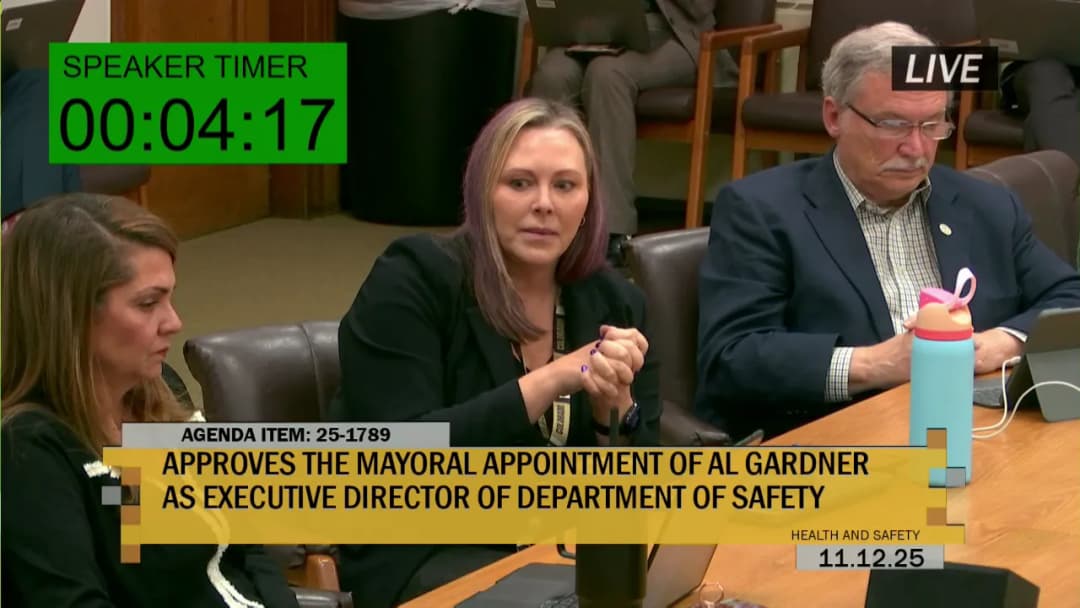
Public Meetings - Denver, ColoradoThe Health and Safety Committee of the Denver City Council met on November 12, 2025, at 9:30 AM to consider the mayoral appointment of Al Gardner as Executive Director of the Department of Safety. The meeting featured extensive questioning from council members regarding Gardner's qualifications, experience, and vision for public safety. After discussion, the committee voted to advance the appointment to the full City Council. Consent Calendar - Six consent agenda items not called out were passed unanimously without further discussion. Discussion Items - Mayoral Appointment of Al Gardner as Executive Director of Department of Safety: Councilmember Sawyer, who called the item off consent, expressed respect for the mayor's appointment authority but noted community concerns about Gardner lacking law enforcement, legal, or firefighting experience. She asked how he would build trust with paramilitary safety agencies and the community. Gardner responded that the position was intentionally designed for a civilian, citing historical precedent (six of the prior 16 managers also lacked law enforcement backgrounds). He highlighted his service on the Citizens Oversight Board and Civil Service Commission as providing insight into discipline systems, and emphasized his efforts to build trust by being honest with unions and spending time on ride-alongs and community visits. - Councilmember Flynn asked why a civilian is best for the role. Gardner analogized to civilian control of the military, stressed the value of a 360-degree perspective, and explained how his oversight and commission work inform a holistic approach to safety, including budget, discipline, and cross-departmental collaboration. - Councilmember Torres noted Gardner's trajectory from Citizens Oversight Board to General Services, and asked how those experiences inform his leadership. Gardner described volunteer service as a path to understanding city government, and cited General Services as giving him cross-functional relationships and a focus on "getting to yes." - Council President Pro Tempore Romero Campbell inquired about transferable skills from Gardner's 28-year technology and business career. Gardner detailed his work in multiple verticals, his ability to synthesize data, and his focus on operational efficiencies, technology roadmaps, and total cost of ownership for safety equipment. - Councilmember Cashman emphasized the need for a public health perspective, and Gardner affirmed his focus on prevention, community corrections, and gang intervention groups, citing the need to fund holistic safety rather than just enforcement. - Councilmember Perry asked for one specific change Gardner would make. He pointed to improving the discipline process by including more stakeholders at the table and enhancing budget forecasting and communication with the council. She also asked about his view on the city's Flock Safety contract; Gardner stressed the need for strong data governance, AI policy, and retention policies. - Councilmember Alvidrez expressed concerns about trust given recent administration actions (e.g., safety cameras, commission resignations) and asked how Gardner would rebuild trust. Gardner emphasized a forward-looking approach, internal collaboration first, and a shift from defensive to transparent communication. - Councilmember Lewis asked about community engagement with hard-to-reach groups. Gardner acknowledged the need for a targeted approach, including inviting skeptical community members into the Police Administration Building for dialogue. She also asked his philosophy on safety: he defined it holistically, emphasizing prevention and enforcement with humanity, and addressed the "defund the police" narrative by advocating for data-driven resource allocation that does not undercut enforcement but invests in root causes. - Council President Sandoval raised issues of trust between council and the administration, citing a budget decision that cut mental health funding without prior notification. She urged Gardner to proactively partner with council. Gardner pledged to honor that commitment and noted the importance of listening. - Councilmember Alvidrez asked who Gardner would turn to for scholarly advice. He named academic contacts at MSU and DU, and said he is relying on an academic to help create a safety roadmap to avoid internal bias. Key Outcomes - Councilmember Sawyer moved to approve the appointment of Al Gardner as Executive Director of the Department of Safety. The motion was seconded. - The committee voted by acclamation (thumbs up) to advance the item to the full City Council for final action. No opposing votes were noted. - The item was scheduled for action at the next full council meeting (week of November 17, 2025). - The other six consent agenda items passed unanimously.
The Budget and Policy Committee of Denver City Council met on November 10, 2025, to discuss two policy proposals: (1) potential updates to the Transportation Demand Management (TDM) ordinance to address overparking, and (2) proposed changes to the Property Tax Rebate Program to expand eligibility and improve outreach. No formal votes were taken; the discussions were intended to gather feedback for future actions. Discussion Items 1. Transportation Demand Management (TDM) Policy Update Councilmember Sawyer presented an overview of the current TDM ordinance, enacted in 2021, which requires certain projects to develop plans reducing single-occupancy vehicle trips. He noted challenges: the ordinance relies on outdated parking minimums as enforcement baselines (removed in a prior city council vote), RTD service limitations reduce eco‑pass effectiveness, and many projects continue to “overpark” (build more spaces than needed). He cited examples: 100 Cook (CMX‑5 office) required 136 spaces but built 216; 1145 South Broadway (470 units) required 428 but built 691, with units costing $50,000 each. A chart showed that while parking trends are decreasing overall, outliers still build excess parking. Councilmember Sawyer proposed considering a parking fee for extra spaces, but emphasized it is early-stage and suggested hiring a consultant to study context‑specific solutions. He did not recommend parking maximums immediately. Other councilmembers expressed varied views: Councilmember Flynn urged caution and suggested letting market trends work; Councilmember Alvidrez raised concerns about affordable housing coupling with parking, RTD station parking, and specific district issues (e.g., Highland/Sunnyside lack of transportation management associations). Councilmember Hines noted safe non‑car infrastructure is essential for mode shift and referenced past unfulfilled developer promises. Councilmember Watson asked about cost per unit for affordable housing, and Councilmember Sandoval highlighted heavy parking demand in Northwest Denver. No vote was taken; next steps may include hiring a consultant and further committee discussion. 2. Property Tax Rebate Program Policy Proposal Councilmembers Sawyer and Gilmore presented phase‑two updates to the Denver Property Tax Relief Program, which moved administration from DHS to HOST in 2025. The program provides partial refunds to qualifying residents (homeowners with disabilities, age 65+, with children; renters with disabilities or age 65+). Key statistics: average refund for 2024‑2025 was $1,148; for 2025‑2026 (May–Oct 2025) the average is about $1,200; 3,018 applications received since May 2025, with 1,047 approved. Proposed eligibility changes: lower homeowner age threshold from 65 to 62, increase AMI cap from 60% to 80%, add a category for surviving unmarried spouses, align renter income thresholds to 30% AMI across all household sizes, and consider phasing out renters by 2030 (redirecting funds to homeowners as a displacement‑prevention tool). Current beneficiaries are 57% renters, 43% homeowners. The program budget is $4.9 million for FY2026 (down from $6 million in prior years due to reallocation for migration response). Councilmembers discussed sunsetting renters given the availability of other rental assistance (e.g., TRUA), but noted such a move requires careful consideration. Councilmember Alvidrez asked about integration with MyFriendBen; Councilmember Espinoza questions on unspent rollover and caps; Councilmember Lewis noted the 10‑year occupancy requirement of state programs (not in the city program). Councilmember Gonzalez raised a question about whether landlords receiving the rebate could pass savings to renters. No vote was taken; the proposal is set for a February 3, 2025 committee meeting. Key Outcomes - No formal votes were taken on either agenda item. - Councilmember Sawyer will consider hiring a consultant to study TDM options and may bring back a refined proposal. - The Property Tax Rebate Policy will be brought to committee on February 3, 2026 for further discussion and potential ordinance amendments. - Council staff will follow up on questions about renter phase‑out, landlord pass‑throughs, and outreach improvements.
The Denver City Council met on Monday, November 10, 2025, for a general session that included a vote on the mayor's proposed 2026 budget, adoption of multiple resolutions and bills, public hearings, and proclamations honoring veterans, community leaders, and cultural events. The meeting featured extensive debate over budget transparency and collaboration, with a 6-6 tie vote on the budget. Consent Calendar - Approved a consent block of over 20 resolutions and bills, including settlement approvals (e.g., $40,000 payment to Judith Myers), contract extensions (e.g., Energy Outreach Colorado for home electrification), and various business improvement district (BID) budgets. Individual items were called out separately (see Discussion Items). Public Comments & Testimony - General Public Comment (5:00 PM session): No detailed content was provided in the transcript; the session was briefly acknowledged. - Public Hearing on Rezoning (CB 1445): One speaker, Jesse Paris (representing community organizations), opposed the rezoning of 890 N Grove Street from ESU-D to ERX-3. They argued the project would accelerate gentrification, increase property taxes, and displace long-term residents, and stated that the affordable housing agreement (one unit at 110% AMI) was insufficient. No other public comments were recorded. Discussion Items - 2026 Mayor's Proposed Budget Vote: Council members delivered extensive floor statements before the vote. Key positions: - No votes (6): Councilmembers Sawyer, Gilmore, Lewis, Cashman, Gonzalez Gutierrez, and Alvidrez cited lack of transparency, disrespect for independent agencies, insufficient collaboration, and the need for stronger investment in children's programs, mental health, and public health. Several noted that the budget would be enacted regardless of the council vote per charter. - Yes votes (6): Councilmembers Torres, Watson, Campbell, Flynn, Hines, and President Sandoval emphasized the importance of the $9.8 million in council-approved amendments (including funding for immigrant services, food summit, out-of-school time, auditor's office, community-led safety grants, and elections), accepted by the mayor. They stressed the need for continued collaboration and noted the challenging revenue environment. - Outcome: The vote tied 6-6, meaning the mayor's proposed 2026 budget was not adopted by council. However, per charter, the budget will still become law unless amended by the upcoming long bill (scheduled for final consideration on November 17, 2025). - Crossroads Shelter Agreement (CR 1372): Councilmember Watson questioned the Salvation Army about internal and external security plans for the 24/7 low-barrier emergency shelter. Councilmember Lewis voted no due to lack of confidence in the Salvation Army. Passed 9-2 (nays: Lewis, Gonzalez Gutierrez). - Business Improvement District Budgets: - Rhino BID (CB 1590): Councilmember Lewis asked about private security plans; staff noted no current plans but possibility of future pilot with ballpark ambassadors. Passed 9-0 (Lewis nay). - Downtown Denver BID (CB 1594): Lewis voted no due to concerns over private security oversight. Passed 9-0. - Colfax BID (CB 1596): Staff confirmed no armed security; outreach provided by Denver Dream Center. Passed 9-0 (Lewis aye). - Downtown Denver Area Plan (CB 1578): Councilmember Hines moved an amendment to strike “fourth” and replace with “seventh” and update the plan version, clarifying how overlapping area plans would be addressed. Amendment passed 10-0; bill published as amended. - Rezoning at 890 N Grove Street (CB 1445): City staff presented the proposal for a five-unit townhome project with a voluntary affordable housing plan (one unit at 110% AMI, three-bedroom). Councilmember Torres expressed support for leveraging affordability in West Denver. Passed 10-0. - Proclamations: - 25-1853: Veterans Day honoring Mile High Veterans and Leadership Veteran – adopted unanimously. - 25-1855: Dia de los Muertos Parade and Festival – adopted unanimously; emotional acceptance by founder Norberto Mohardin. - 25-1851: Greg Fiesel Day honoring retiring Colorado Rockies President – adopted unanimously; acceptance by Fiesel. Key Outcomes - Budget: The mayor's proposed 2026 budget failed on a 6-6 tie vote (not adopted by council). The long bill (final appropriation) will be considered on November 17, 2025. All 10 council amendments were accepted by the mayor. - Crossroads Shelter: Contract approved 9-2. - BID Budgets: Rhino, Downtown Denver, and Colfax BIDs published on 9-0 votes (Lewis voted nay on Rhino and Downtown Denver). - Downtown Area Plan: Amended and published for final consideration. - Rezoning: Approved 10-0 with affordable housing conditions. - Proclamations: All three adopted unanimously. - Next Meeting: November 17, 2025, at 10:30 AM for courtesy public hearing on downtown area plan and long bill vote.
The Transportation and Infrastructure Committee of Denver City Council met on Wednesday, November 5, 2025, from 1:00 PM to 2:55 PM. The agenda included 54 action items and five items on the consent calendar. Three major presentations were heard: on-call contracts for professional and construction services, a design contract amendment for the Police District 6 station, and an update on the Storm Drainage Master Plan. The on-call contracts were postponed to a future meeting, while the police station design amendment and storm drainage master plan were approved. Consent Calendar - The committee approved five items on the consent calendar with no items pulled for discussion. Discussion Items 1. On-Call Contracts for Professional Services and General Civil Construction - Presenter: Elena McWarter (Legislative Liaison, DOTI), Jennifer Williams (Engineer, Infrastructure), Ryan Crum (Engineer, Transportation Implementation) - Overview: The presentation covered the background and reprocurement of two on-call contract categories: professional services (14 categories, $206 million capacity, 45 firms selected) and general civil construction (1 category, $400 million capacity, 8 firms selected). Total combined maximum capacity is $600 million over three years, with a possible two-year extension. The contracts enable rapid deployment of subject matter expertise and support capital projects across city agencies. MWBE goals are 12% for construction and embedded in professional services. - Council Concerns: Councilman Hines expressed reservations about using on-call contracts for strategic projects, citing a past instance (5280 Trail bond project) where council oversight was bypassed. He argued that such projects should undergo competitive RFP processes to ensure transparency and innovation. Councilman Flynn requested a memo detailing the mini-bid process and suggested quarterly updates on on-call projects. Councilwoman Alvides questioned the low 12% MWBE goal for construction and called for a deeper review of how goals are set and enforced. Councilwoman Gilmore (via chat) asked about potential overspending and underspending; staff noted that historical utilization was about 50-55% of capacity. - Outcome: A motion to postpone the resolution to November 19, 2025, was made by Councilwoman Alvides, seconded by Councilman Hines, and passed. The committee will revisit the item. 2. Police District 6 Station – Design Contract Amendment - Presenters: Molly Scarborough (Programming Manager, Elevate and Rise Funds), Kara Saquino (Director, DOTI Vertical Construction), Commander Michelle Former (Equity, Diversity, and Inclusion Support Bureau) - Overview: Staff requested approval of a $674,000 amendment to the existing design contract with Roth Shepherd Architects. The funds cover redesign costs incurred while value-engineering the project to fit a constrained $54 million construction budget. The project involves demolishing the current station and building a new facility at Washington and Colfax, including a two-story parking garage, expanded interview rooms, sally port, recording equipment, ADA compliance, and a community room. Timeline: design completion in Q2 2026, construction start late 2026, occupancy by end of 2027. Officers will temporarily relocate to the police administration building (14-month transition) with minimal code upgrades. - Council Feedback: Councilman Hines strongly supported the project, noting the current station was never designed as a police facility and lacks ADA accessibility. He emphasized community engagement and balancing safety with transparency. Staff confirmed that floor plans would not be widely shared due to security concerns, but the community room design may involve public input. - Outcome: A motion to approve the amendment was made by Councilman Hines, seconded by Councilwoman Alvides, and passed. 3. Storm Drainage Master Plan Update - Presenters: Jungman (Engineering Specialist), Tom Blackman (Engineer Supervisor), Elena McWarter (Legislative Liaison), Bruce Johannik (Director of Environmental Team) – all from DOTI - Overview: The 2025 Storm Drainage Master Plan is now fully digital and publicly accessible via Denvergov.org/stormwater. It uses advanced 1D/2D modeling (first in the Front Range) to assess flood risk across 50% of the city, identifying over 200 potential improvement projects totaling $2 billion. The plan focuses on basins with recent CIP investments (e.g., Montclair, which saw 6-foot flood risk reduction) and four newly modeled gulches west of the South Platte River (Dry, Weir, Sanderson, Lakewood). The online tool includes interactive maps, educational content, and language access. The plan feeds into the one-water plan and six-year capital improvement plan for prioritization. - Council Questions: Councilwoman Alvides inquired about flooding in the Valverde area; staff noted an ongoing outfall system plan with Mile High Flood District and committed to providing a briefing. Councilman Hines praised the GIS integration and the award-winning nature of the project. Staff explained that project prioritization uses criteria such as multi-benefit value, funding partnerships, and equity. - Outcome: A motion to move the resolution forward was made by Councilwoman Alvides, seconded by Councilman Cashman, and passed. Key Outcomes - On-Call Contracts (Resolutions 25-1643 through 25-1687 and 25-1384 through 25-1391): Postponed to committee meeting on November 19, 2025, for further discussion. - Police District 6 Design Amendment (Resolution 25-1628?): Approved. - Storm Drainage Master Plan (Resolution 25-1628?): Approved. - Consent Calendar: Approved without objection.
The Health and Safety Committee of Denver City Council met on November 5, 2025, to consider the annual Denver Health Operating Agreement with the City and County of Denver for 2026 and to receive an update on Denver Health's spending from the 2Q sales tax. Chair Daryl Watson (District 9) presided. Council members present included Kevin Flynn, Amanda Sawyer, Paul Cashman, Jamie Torres, and At-Large member Seraphin Gonzalez. Council President Pro Tem Jamie Romero Campbell participated online. The operating agreement was the only action item; the committee voted to advance it to the full council. Consent Calendar - Nine consent items were listed; none were pulled, and they were approved unanimously without discussion. Discussion Items - Denver Health Operating Agreement (2026): Megan Parrizzo from the Department of Public Health and Environment (DDPHE) and Donna Lynn, CEO of Denver Health, presented the annual operating agreement. Key points included: - The 2026 budgeted amount is $69 million, down from $74 million in 2025, reflecting a $5 million reduction requested by the city as part of broader budget cuts. - Denver Health agreed to maintain all services without reductions in 2026 by absorbing the $5 million cut internally, but stated this is a one‑year measure and cannot be sustained in 2027. - Budget cuts affected seven service areas: Emergency Services Patrol ($558,000 reduction), Denver CARES (cut to $1, signaling intent to fund in 2027), Rocky Mountain Poison and Drug Center (fully cut), Treatment on Demand (fully cut), Southwest Clinic (Penya Clinic) capital support ($250,000 cut), and removal of a line item for jail medical services (non‑budget cleanup). The Park Hill Clinic capital loan repayment ends in 2025. - The $30.8 million medically indigent (MI) payment remained unchanged. - Council members expressed strong concern about cuts to addiction recovery and Denver CARES, and stressed the need to restore funding in 2027. Several members noted the city's overall budget stress and urged the mayor's office to avoid pressuring community partners. - Donna Lynn highlighted upcoming financial pressures: no increase in Medicaid proposed by the governor, potential federal subsidy cuts leading to 10 million uninsured nationally, and federal legislation (HR 1) that could cut Medicaid further. She warned of a “crisis looming” in 2027. - 2Q Sales Tax Spending Update: Donna Lynn and Stephanie Seiner presented how Denver Health is using the 2Q sales tax revenue (estimated at $64 million in 2025) across five mandated categories: emergency/trauma care, primary care, pediatric care, mental health, and substance use. Examples include: - Investing in surgical robots and a hybrid operating room. - Expanding radiology services to the Lowry and West Side clinics. - Adding a pediatric neurology nurse practitioner to reduce wait times. - Opening 12 new inpatient medical–psychiatric beds (IMAP) and expanding school‑based clinics, including a future clinic at the Sandoval campus. - Spending approximately $14 million on mental health services. - Council members asked about the reconciliation process if sales tax collections fall short; staff indicated a true‑up invoice system similar to the Caring for Denver fund. Council also discussed the need for transparent annual reporting on 2Q expenditures. Key Outcomes - Vote on Operating Agreement: A motion to approve the Denver Health Operating Agreement was made by Councilwoman Sawyer, seconded by Councilman Flynn, and passed committee unanimously. The agreement will proceed to the full City Council for final approval. - Directives and Next Steps: - The committee requested an interim update on the status of budget negotiations for the 2027 operating agreement, to be coordinated through the council president's office. - Council members emphasized that the $5 million reduction is viewed as a one‑time measure and that they expect restoration of funding in 2027. - Denver Health committed to maintaining all services despite the cut and to continue discussions with the city about malpractice costs and indirect support for jail health care. - A formal report on 2Q expenditures will be provided to council and made publicly available, with input from a third‑party consultant.
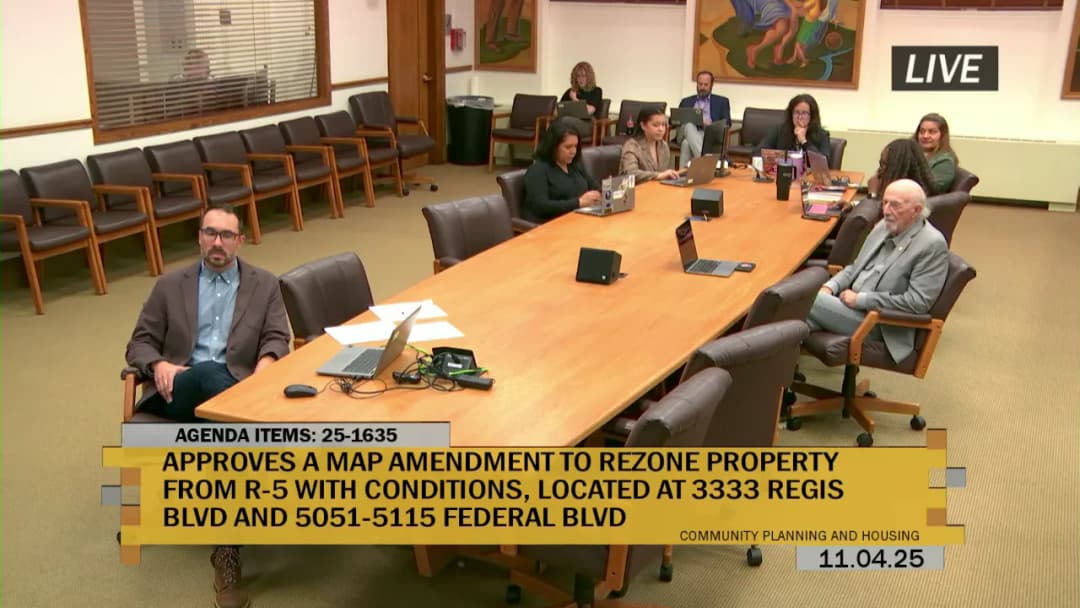
The Community Planning and Housing Committee met on the afternoon of November 4, 2025, to consider a package of building and fire code amendments—including single-stair provisions, wildland‑urban interface code adoption, and miscellaneous updates—and two rezoning applications for Regis University properties. All items were approved for referral to the full City Council. Consent Calendar - No consent calendar items were presented. Public Comments & Testimony - Max Nardo (Southwest Energy Efficiency Project, Housing Forward Colorado) spoke in support of the code reforms, urging the committee to remain open to increasing the permitted height of single-stair buildings to seven stories to maximize housing and affordability benefits. - Sean Jerznick (local architect, co‑chair AIA Colorado Housing Committee) supported the amendments, stating they would unlock smaller‑scale apartment buildings (10‑20 units) on urban lots where housing is in highest demand. - Robert Greer (eviction defense attorney) supported the proposals, citing Denver’s serious housing shortage, declining permit numbers, record evictions, and the need for subsidized housing. He also advocated for allowing seven‑story single‑stair buildings to leverage the EHA density bonus. - Jacob Wooden (Denver resident, North Park Hill) spoke in favor, emphasizing that single‑stair designs enable more missing‑middle housing, reduce environmental impact, and allow development on lots that are currently financially unviable. Discussion Items 1. Building and Fire Code Amendments (Ordinance) - Presentation: Eric Browning (Chief Building Official, CPD) and Chief DeBar (Denver Fire Department) presented a package of code updates: - Single‑Stair Buildings: Allows residential buildings up to five stories with a single stairway, subject to criteria: maximum 6,000 sq. ft. per story, up to four units per story, full sprinkler protection (NFPA 13), construction types I–IV (including Type III wood frame, which goes beyond state requirements), maximum stair width for simultaneous use, prohibitions on electrical outlets in stairwells, and emergency escape/rescue openings. A map shows eligible zone lots for five‑story buildings. The state’s 2025 HB 25‑1273 and draft 2027 International Building Code provisions were incorporated. - Wildland‑Urban Interface (WUI) Code: Adoption of state‑mandated fire‑intensity maps affecting a small number of parcels—mostly Denver International Airport land, 19 residential parcels in Montbello (Council District 1), and mountain parks. Requirements apply only when 25% or more of a roof or exterior wall is replaced; no retroactive impact. Insurers stated they do not use these maps for rate setting. - Miscellaneous Updates: Extended building permit expiration periods, alternative neighbor notification via property posting, exemption for modifications to wireless telecom facilities (per HB 25‑1056), simplified solar permitting, clarified energy code compliance for small commercial tenant spaces, and easier grease interceptor sizing for restaurants. - Council Questions & Discussion: - Councilmember Alvidres asked about safety of single stair if obstructed; Chief DeBar explained sprinklers, smoke control, defend‑in‑place strategy, and ladder access. Sprinkler systems would be NFPA 13 with backup provisions (fire pumps). Roof evacuation possible via apparatus. Review times: CPD expects minimal impact and will train staff. - Councilmember Flynn requested a memo to all council detailing: (a) the specific building code requirements for single‑stair vs. double‑stair buildings (e.g., pressurized stairwells, proximity of stair to units), (b) details on grease interceptor changes, and (c) the scope of telecom exemptions. Eric Browning agreed. - Councilmember Watson asked about external landscaping and fire‑truck access; Chief DeBar noted fire department will enforce setbacks and vegetation clearance during inspections and ongoing compliance. 2. Regis Campus Rezoning (Bill 25‑1636) - Presentation: Tony Lechuga (CPD) presented the rezoning of 62 acres of Regis University’s main campus from former Chapter 59 R‑5 to Campus Educational Institution 2 (EI‑2). The site is in Council District 1, surrounded by low‑scale residential. No development is proposed; the rezoning updates zoning to modern Denver Zoning Code and aligns with Comprehensive Plan 2040 and Blueprint Denver. Planning Board voted unanimously to recommend approval. No public opposition was received. - Committee Action: Motion to move to full council (Moved by Councilmember Alvidres, seconded by Council Pro Tem). Thumbs‑up approval from all committee members present and online. 3. Regis Town Center Planned Unit Development (Bill 25‑1635) - Presentation: Tony Lechuga presented the rezoning of 23 acres (eastern portion of Regis property) into a Planned Unit Development (PUD) with a base of UMX‑3 and customizations. The site includes existing strip mall commercial (former Kmart) and a McDonald’s. The PUD allows up to 75 feet (95 feet with incentives), re‑establishes a 20‑foot parkway setback along Federal Boulevard (from the current 10 feet), requires ground‑floor active uses along Federal, and permits campus‑like uses such as a hospital. No development plan is filed yet; a High Impact Development compliance plan will be required before site‑development approval. Large‑development review was completed. Planning Board voted unanimously to recommend approval. Letters received: Berkeley Regis United Neighbors (general comments, no support/opposition), Chaffee Park RNO (support), and 10 letters of support from neighbors. Council President Sandoval noted that the inclusion of Design Overlay 8 standards was a key community priority and that the hospital use will be monitored. - Committee Action: Motion to move to full council (Moved by Council Pro Tem, seconded by Councilmember Lewis). Thumbs‑up approval from all committee members present and online. Key Outcomes - Code Amendments (Single‑Stair, WUI, Miscellaneous): Approved by committee (voice vote, all in favor) to be placed on the November 17 City Council agenda for first reading, with final vote expected November 24. Effective date: end of 2025, aligning with the 2025 code cycle. Councilmember Flynn requested a detailed memo on single‑stair requirements, grease interceptors, and telecom exemptions. - Regis Campus Rezoning (Bill 25‑1636): Approved for referral to full City Council with a public hearing scheduled for early December. - Regis Town Center PUD (Bill 25‑1635): Approved for referral to full City Council with a public hearing scheduled for early December.
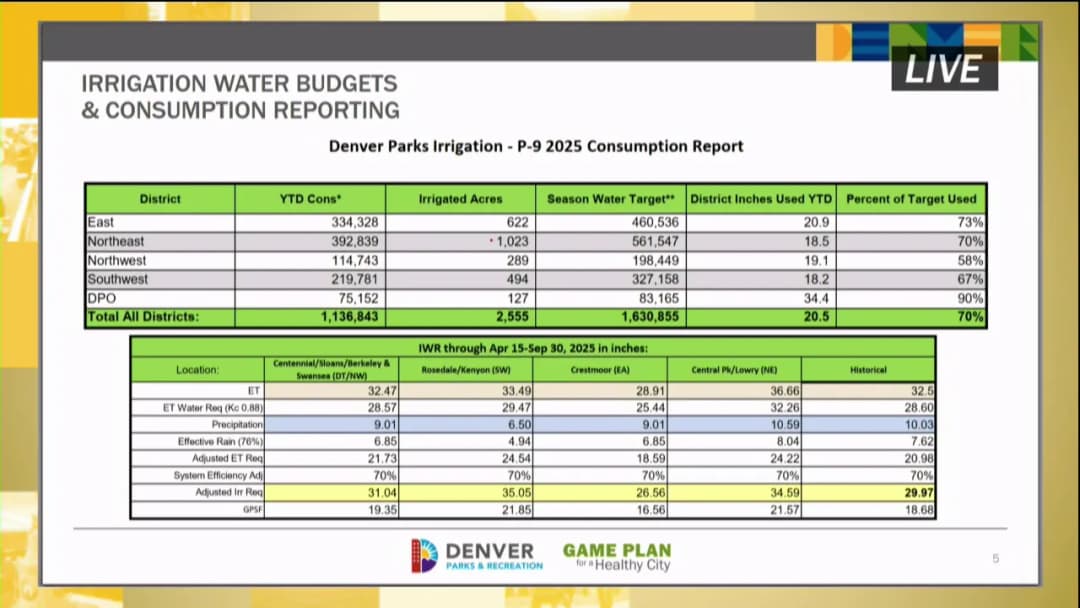
The Parks Arts and Culture Committee of Denver City Council met on November 4, 2025, to receive a presentation from Denver Parks and Recreation's Water Conservation team on irrigation infrastructure, central control technology, and water efficiency strategies. The presentation highlighted the department's efforts to manage a large irrigation system, reduce water use, and adapt to climate challenges. Council members asked questions about technology, infrastructure age, recycled water, and community engagement. Discussion Items - Presentation on Irrigation and Water Conservation: Damian Wetzel (Water Conservation Manager) and Lynn Fulton (Crew Lead) presented on the challenges of managing Denver's irrigation system, which uses over 2 billion gallons of water annually at a cost of over $5 million. The system includes 3,300 irrigated acres, 250,000 sprinkler heads, and 38 irrigation maintenance technicians. They noted that 85 parks have irrigation infrastructure over 40 years old, with 120 parks over 35 years and 40 parks over 50 years old. The team discussed the central control build-out (95% complete) with 700 smart irrigation controllers, a city weather network of 20 stations (8 full weather stations, 12 rain cups), and the ability to shut down irrigation during rain events, potentially saving 30 million gallons per full shutdown. They also highlighted the use of flow sensors, master valves, and the OpenGov Cartograph work order system. - Council Questions and Discussion: Council members asked about integration with old and new infrastructure, collaboration with Denver Water and golf courses, recycled water (purple pipe) usage, hydrozoning, tree canopy protection, vandalism prevention (plastic backflows), and plans for replacing aging systems. Councilwoman Lewis inquired about long-term water conservation planning and community education, referencing the "In Denver's Nature" initiative and native vegetation conversions. Councilman Heinz emphasized the need for citywide transition to native vegetation. Councilwoman Parody asked about CIP funding for old systems and solar-powered controllers. Councilwoman Romero Campbell asked about response times for resident complaints and the status of central control build-out funding. Key Outcomes - No formal votes or decisions were taken; the meeting was informational. - Council members requested follow-up information: Councilwoman Parody asked for details on CIP projects for aging irrigation systems; Councilwoman Lewis requested materials on water conservation and native vegetation to share with constituents; Councilman Heinz expressed support for expanding native vegetation conversions. - The Water Conservation team agreed to provide additional information through the committee's aide (Hazus) and to share the "In Denver's Nature" resources with the full council.
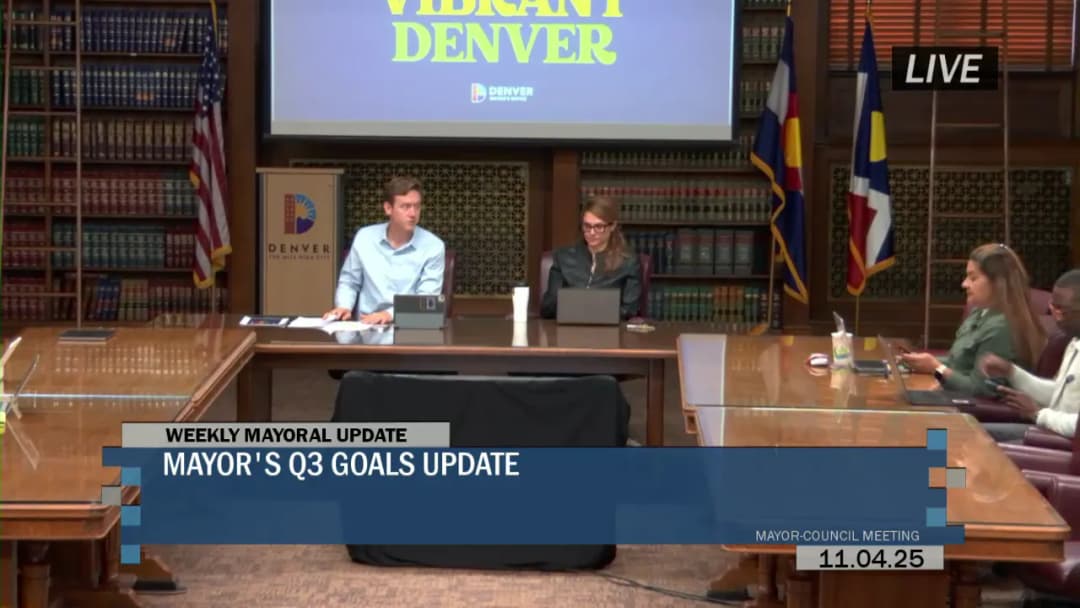
The Mayor and Denver City Council held their weekly joint meeting on November 4, 2025, starting at 4:30 PM. The meeting featured progress updates on 2025 citywide goals through Q3, public announcements, and motions to enter executive session for legal and real estate discussions. Announcements - Councilman Watson announced a November 5 community meeting on the Walton Mobility study at Glen Arm Rec Center from 5:30–7 PM, aimed at developing a transit-rich corridor. - Council Torres invited the public to Westwood’s Dia de los Muertos festival, with events from Friday through Sunday on Morrison Road. - A reminder was given that Election Day ballots were due November 4 by 7 PM, with same-day registration and replacement ballots available at service centers. Discussion Items Q3 2025 Citywide Goals Update The Mayor reported on six key goals: - Vibrant: The Vibrant Bond measure (60 projects) is on the ballot, with over 7,000 residents providing input at 50+ public meetings. 16th Street fully reopened. 61 new businesses opened downtown year-to-date, triple the 2023 average. - Safe: Shootings decreased beyond the 15% target. Year-to-date homicides down 47% (34 compared to 89 full-year in 2023). Non-fatal shootings down 22%. - Affordable: 1,700 affordable units created so far, on track for 3,000. An office-to-residential conversion program through the Downtown Denver Authority is adding 236 units. A property tax abatement pilot for middle-income housing could permit over 1,000 units. Units are income-restricted (rent ≤30% income). - All-In Mile High (homelessness): Over 2,000 people placed into transitional housing/shelter, exceeding the annual goal. However, 500 planned housing exits have been stalled due to lost federal and state vouchers (100 federal, 80 state) and a five-week HUD shutdown (273 units unprocessed). This may affect 2026 targets. - Climate Resilient: 1,500 heat pumps, EV chargers, and solar arrays installed; 2,800 under contract (ahead of 2,000 target). Tree planting at 81% progress. Water savings goal already met via native grass conversion. - Family Friendly: 52,000 kids served in out-of-school programming (on track for 60,000). 3,600 young people placed in jobs, exceeding 2,500 goal by 150%. Council Questions & Clarifications - Council Torres requested neighborhood-level crime statistics and better outreach to community organizations. - Councilwoman LV dress asked about the affordable housing pilot tax abatement: the abatement is approximately 10–12 years, with a 30-year deed restriction. No projected tax revenue loss because the units are new construction. - Councilman Watson asked about locations of climate initiatives; the Mayor clarified they are citywide incentives not limited to city property. - President Protown asked about family friendly programs; discussion included integrating data with Denver Public Schools to track dosage, duration, and outcomes. Downtown Denver Authority (DDA) Update Council President (also a DDA board member) thanked the DDA team and noted that two new board members—a downtown resident and a small business owner—have been added, bringing more diverse voices, including women of color. She emphasized that the DDA operates with separate funds and that project success will mirror the model used for Union Station, which was paid off 15 years early. She stressed adherence to the amended plan passed in December. Key Outcomes - The council received the Q3 update with acknowledgment of achievements and concerns about federal impacts on housing exits. Continued monitoring was noted. - A motion was made and seconded to enter executive session pursuant to DRMC 2-34A sections 3, 6, and 7 to receive legal advice and discuss potential settlement of pending litigation. The motion passed unanimously. - Following the DDA discussion, a second motion was made to enter executive session under DRMC 2-34A sections 3, 4, 6, and 7 for legal advice, settlement discussion, and real estate acquisition/sale/use. The motion passed, and the meeting entered executive session.
The Denver City Council convened on Monday, November 3, 2025, at 10:30 AM for a special session to consider 26 proposed amendments to the mayor's proposed 2026 budget. The meeting lasted over seven hours, featuring extensive debate on homelessness funding, police department budgets, independent agency autonomy, and election security. Council members voted on numerous amendments, resulting in several high-profile passes and failures. The meeting also included unanimous approval of late-filed resolutions related to SNAP benefit cuts. Consent Calendar - No consent calendar items were noted for the budget amendments. - A block of resolutions (including items 25-1504, 1542, 1547, etc.) was adopted unanimously by a 13-0 vote at the end of the meeting. Public Comments & Testimony - No public comments were taken during the budget amendment session; a separate half-hour public comment period was scheduled earlier in the evening. Discussion Items - Amendment 1 (Torres, Lewis, Parity, Gonzalez-Gutierrez): Transfer $379,038 from general contingency to the Auditor's Office to restore base budget cuts. Councilmember Torres argued it was a net-zero effect and necessary for independence. Approved 13-0. - Amendment 2 (Gonzalez-Gutierrez): Move $9 million from police recruits and services/supplies to the Department of Housing Stability (HOST) for unsheltered family homelessness. Supporters cited 240 unhoused families; opponents questioned impact on police response times and lack of a spending plan. Failed 5-8. - Amendment (Lewis): Transfer $2 million from police recruits to the Denver Basic Income Project. Councilmember Lewis highlighted 88% response rate and $600,000 in savings from reduced ER visits. Failed 5-8. - Amendment (Parity): Move four vacant street engagement team positions to HOST outreach. Debate focused on role differences. Failed 6-7. - Amendment (Parity): Provide $9 million for family shelter by cutting $5.7M in police recruits, $2.4M in personnel services, and $779,000 for helicopter lease. Proponents cited moral imperative; opponents argued cuts would hinder recruiting. Failed 5-8. - Amendment (Parity): Transfer $355,368 from SET to HOST outreach. Failed 6-7. - Amendment (Parity, Cashman, Alvidrez): Provide $1.6 million for Safe Routes to School from CIP contingency. Passed 13-0. - Amendment (Parity): Fund $500,000 for Broadway bike lane design from CIP contingency. Tied 6-6, failed. - Amendment (Parity, Cashman, Alvidrez): Restore $400,000 for Safe Routes to School personnel from DPD services/supplies. Failed 5-5 (tie= fail). - Amendment (Torres et al.): Allocate $3 million from Broncos Fund for youth safety grants. Passed 13-0. - Amendment (Lewis): Move $1.6 million from police recruits to sheriff's department for staffing. Failed 6-7. - Amendment (Lewis): Transfer $286,000 from DPD services/supplies to sheriff mental health programs. Passed 7-6. - Amendment (Parity): Fund $360,841 for medication-assisted treatment (MAT) in jail from holiday lights, greenhouse, and civic events cuts. Failed 4-9. - Amendment (Lewis, Parity, Alvidrez): Provide $2.7 million for election funding from general fund balance. Passed 13-0 after emotional debate. - Amendment (Lewis, Parity): Fund Denver Day Works with $550,000 from general contingency. Passed 13-0. - Amendment (Parity): Transfer $300,000 from business incentives to workforce readiness program (Work Ready). Passed 8-5. - Amendment (Sandoval): Move $80,280 from city council budget to STAR program for van Wi-Fi upgrades. Passed 13-0. - Amendment (Lewis, Cashman): Provide $500,000 for STAR from DPD and DOS services/supplies. Passed 10-3. - Amendment (Lewis, Gonzalez-Gutierrez): $400,000 for Denver Table food consortium. Failed 6-7. - Amendment (Torres, Cashman, Parity): $496,400 for out-of-school time programs from Broncos Fund. Passed 13-0. - Amendment (Lewis): $1.6 million for sheriff from police recruits. Failed 6-7. Key Outcomes - Approved (13-0): Auditor's Office restoration, Safe Routes to School ($1.6M), youth safety ($3M), election funding ($2.7M), Denver Day Works ($550K), STAR upgrades ($80K), out-of-school time programs ($496K), STAR operations ($500K), sheriff mental health ($286K), Work Ready ($300K). - Failed: Family shelter amendment ($9M), Denver Basic Income Project ($2M), SET transfers, helicopter lease cuts, MAT program, food consortium, sheriff staffing from police recruits, Broadway bike lane design, Safe Routes personnel. - The council also approved late-filed resolutions to redirect Healthy Food for Denver Kids funds to address SNAP benefit reductions (resolutions 1740-1743). - Multiple amendments were withdrawn or replaced, including Denver Day Works and youth violence prevention measures, to accommodate alternative funding sources. - The council expressed frustration with the budget process and called for a new collaborative approach in future years.