The Planning and Zoning Committee met on Tuesday, June 2, 2026, at 1:06 PM in Council Chambers and virtually, chaired by Vice Chair Scott Reed (due to Chair Andrew Owen attending virtually). The committee considered four pending legislative items, recommended two ordinances for approval, postponed one, and held one item. A quorum of 8 members was present. Consent Calendar - None Public Comments & Testimony - No formal public testimony was taken during the meeting; however, committee members referenced public comments and letters submitted prior to the meeting, including 31 support letters for the Chick-fil-A development (Item 4). Discussion Items - O-127-26 – Zoning at 3827 Poplar Level Road: A proposal to rezone a 0.22-acre property from single-family to multifamily to convert a five-bedroom house into a two-unit duplex via internal renovations. Julia Williams of the Office of Planning presented the Planning Commission's 7-1 recommendation for approval. Councilwoman Raymond noted that the neighborhood meeting had no objections and that current tenants supported the change. Chair Owen clarified the existing ADU would remain, and the conversion would create more affordable smaller units. The committee voted 8-0 to recommend approval. - O-137-26 – Areawide Zoning at 1901 R Payne Street: A proposal to rezone 3.09 acres from heavy industrial (M-2) to commercial-mixed use (CM) following multiple explosions at the Givaudan site, including two deadly ones. Chair Owen explained the downzoning was intended to prevent future heavy industrial use, adding flexibility for redevelopment. He noted the property owner (Givaudan) was given multiple opportunities to oppose the change but did not. Councilman Batshon expressed concern about government overreach and precedent, arguing the market should dictate the property's use. The committee voted 5-3 to recommend approval (Yes: Owen, Reed, Benson, Hudson, Batshon; No: Parrish-Wright, Raymond, Ruhe). - O-135-26 – Temporary Moratorium on Data Centers: Proposed by Councilwoman Chappell (D-15), this ordinance would impose a 180-day moratorium on rezoning, conditional use permits, and certain development plans for telecommunication hotels and data centers pending review by the Planning Commission. Councilwoman Chappell argued that the Planning Commission had missed multiple deadlines for releasing recommendations (originally due January 23, 2026) and that a moratorium was needed to proactively regulate these facilities. Councilwoman Parrish-Wright supported the moratorium, citing constituent concerns. Brian Davis of the Office of Planning stated that the commission expects to release a draft of recommendations the following week, noting delays due to state legislation and lack of precedent. Councilman Hudson moved to postpone the ordinance, suggesting that administrative action (keeping the ordinance in committee) could effectively halt any new applications without passing a moratorium. After a roll call, the motion to postpone passed 5-3 (Yes: Owen, Reed, Benson, Hudson, Batshon; No: Parrish-Wright, Raymond, Ruhe), effectively tabling the ordinance. - O-138-26 – Detailed District Development Plan at 9718 Dixie Highway and 5308 Citation Road: A proposal for a commercial development (Chick-fil-A restaurant) on 2.7 acres, including extending Fiesta Way to connect to Citation Road. The Planning Commission recommended approval 8-0. Councilman Batshon expressed support, noting the strong community backing (31 letters of support). Councilwoman Ruhe asked about traffic impacts on Fiesta Way; a traffic study was conducted but did not provide estimates for that road. The committee voted 8-0 to recommend approval. - O-140-26 – Digital Display Off-Premises Signs (Billboards): This item was held in committee at the request of the sponsor and was not discussed. Key Outcomes - O-127-26: Recommended for approval (8-0). Enactment No. 088-2026. Sent to Old Business for full Council on June 11, 2026. - O-137-26: Recommended for approval (5-3). Enactment No. 089-2026. Sent to Old Business. - O-135-26: Postponed (motion to postpone passed 5-3). The ordinance remains in committee. - O-138-26: Recommended for approval (8-0). Enactment No. 090-2026. Sent to Old Business. - O-140-26: Held in committee. - The meeting adjourned at 1:56 PM.
Public Meetings - Louisville, Kentucky
Public Meetings - Louisville, KentuckyThe Government Oversight/Audit and Appointments Committee met on June 2, 2026 at 5:00 PM in Council Chambers/Virtual, chaired by Councilwoman Donna Purvis. The meeting was called to order at 5:05 PM and adjourned at 5:35 PM. Of the 10 committee members, 7 were present (two attending virtually), and 3 were excused. The committee considered 11 agenda items, including pending legislation and multiple appointments to city boards. All appointments were recommended for approval and sent to the Consent Calendar for the Metro Council meeting on June 11, 2026. Pending Legislation - O-009-26 (SAFE Law): An ordinance to amend Louisville Metro Code of Ordinances Chapter 36 on police department policies, known as the Safety and Accountability for Everyone (SAFE) Law. This item remained held in committee; no action was taken. Bardstown Road Overlay District Board Appointments (Items 2–6) The committee considered five appointments/reappointments together. Althea Jackson from the Mayor's Office described the board's purpose: reviewing construction and development plans along the Bardstown Road corridor. The board consists of eight members with specific roles including architects and business owners. The appointees were: - Carole Yocum (appointment) – Architect with over 30 years of experience, filling a prescribed architect seat. - Alicia Ariatti (appointment) – Program manager, former Metro executive administrator overseeing $170 million in federal project funds. - Aaron Givhan (reappointment) – Real estate broker with 34 years of experience; unable to attend. - JonAnthony Floyed-Jackson (reappointment) – Senior architectural design coordinator with over 10 years of experience. - Kelly Estep (reappointment) – Co-owner of Carmichael’s Bookstore. Committee member Tammy Hawkins asked whether any appointees were developers; Althea Jackson clarified the board works with developers rather than developing themselves. A motion by Councilman Scott Reed, seconded by Vice Chair Ginny Mulvey-Woolridge, carried by voice vote; all five appointments were sent to the Consent Calendar. Civilian Review & Accountability Board Appointments (Items 7–9) The committee considered three appointments together. The board's purpose is to increase civilian involvement in investigating allegations of police misconduct with LMPD. Appointees: - Donald Marlin (appointment) – Loan officer with over 30 years of leadership experience in management and financial services. - Dr. Rasean Crawley (appointment) – Senior global sales and account management professional, nominated by the Interministerial Coalition. Committee member Kevin Bratcher commended Dr. Crawley for a clean political race and wholeheartedly recommended him. - Sarah Provancher (appointment) – Executive Director of the Jefferson County Republican Party, recently earned a law degree; plans to stay in political and election work. A motion by Vice Chair Mulvey-Woolridge, seconded by Councilman Anthony Piagentini, carried by voice vote; all three appointments were sent to the Consent Calendar. Human Relations Commission – Advocacy Board Appointment (Item 10) - Liz O'Sullivan (appointment) – Associate dean of admissions at Bellarmine University, with training in anti-bias and bystander intervention. A motion by Councilman Piagentini, seconded by Vice Chair Mulvey-Woolridge, carried by voice vote; the appointment was sent to the Consent Calendar. Jefferson County Extension Board Reappointment (Item 11) - Lisa Hite (reappointment) – Retired certified planner with over 40 years of experience, active in environmental trusts and neighborhood associations. She noted the board promotes agriculture, health, nutrition, and youth activities. A motion by Councilman Piagentini, seconded by Vice Chair Mulvey-Woolridge, carried by voice vote; the reappointment was sent to the Consent Calendar. Key Outcomes - All 10 appointments/reappointments were approved by voice vote and sent to the Consent Calendar for the full Metro Council meeting on June 11, 2026. - O-009-26 (SAFE Law) remained held in committee without action. - The meeting was adjourned at 5:35 PM.
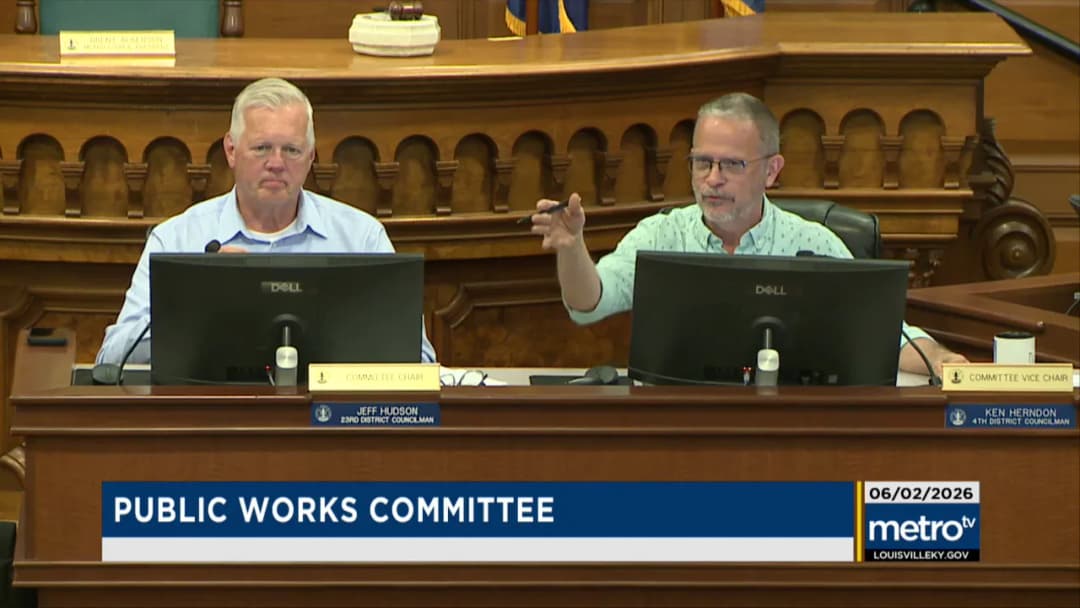
The Public Works Committee of the Louisville Metro Council met on June 2, 2026, at 4:00 PM (adjourned at 4:25 PM) in Council Chambers and virtually. Chair Jeff Hudson (R-23) presided with a quorum of eight members. The committee considered two pending ordinances and a slate of appointments to the Complete Streets Coalition (CSC). All items were held in committee after extensive discussion on the diversity requirements for the CSC appointments. No votes were taken. Pending Legislation - O-043-26 (Amending LMCO Chapter 112 on posting handbills/signs) – Held in committee without discussion. - O-133-26 (Amending LMCO Chapter 99 on noise regulation) – Held in committee without discussion. Discussion Items - Complete Streets Coalition Appointments: The committee reviewed fourteen appointments and reappointments to the CSC, including new members Kristi Ashby, Adam Stegemann, Brad Herschler, Mira Sullivan, and reappointments of Lucas Frazier, Anita Hall, Janet Heston, Patrick Smith, Joseph B. Spencer, Kenneth Thompson, Estela Valdez, Bill Wright, and others. Jeremy Chesler (Transportation Planner) and Wes Sydnor (Director of Public Works) described the CSC's role in reviewing transportation projects for multimodal accessibility. Chair Hudson noted that the CSC's composition (all white, all Democratic) did not comply with LMCO 32.001, which requires diversity in race, gender, political affiliation, and geography. Michael Spenlau (County Attorney's Office) confirmed that the current slate did not meet the ordinance's diversity requirements. Councilwoman Jennifer Chappell provided background on the CSC's creation in 2022 and its funding history. Deputy Mayor Nicole George clarified that the coalition was not intended to be defunct and that prior funding was one-time. After extended discussion, Chair Hudson decided to hold all appointments pending legal guidance on how to achieve the required diversity. - General Questions: Councilwoman Crystal Bast asked about bike lane usage; Jeremy Chesler explained that cyclists are not required to use bike lanes and may ride on the road. Key Outcomes - All appointments (Items 3–14) were held in committee, with no action taken. Chair Hudson apologized to the nominees and stated the hold was necessary to obtain a legal opinion from the County Attorney's Office on how to meet the diversity requirements of LMCO 32.001. - The two pending ordinances (O-043-26 and O-133-26) remain in committee. - Next steps: The committee will revisit the appointments once legal guidance is received; the action deadline for most items is October 23, 2026.
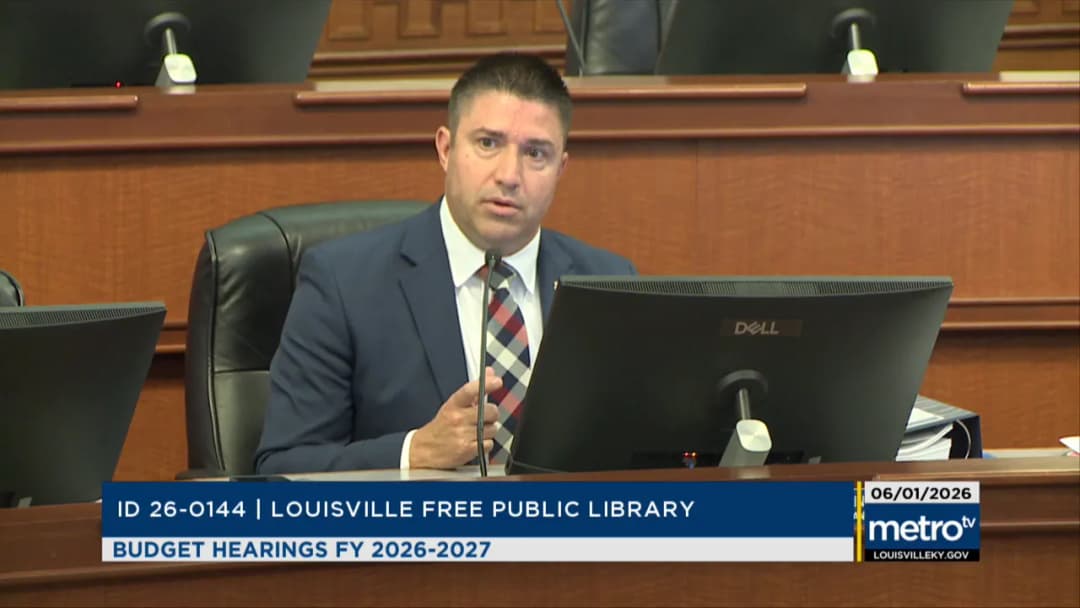
The Louisville Metro Budget Committee, chaired by Kevin Kramer (R-11), met at 3:03 p.m. on June 1, 2026, in Council Chambers and virtually for the ninth day of FY 2026-2027 budget hearings. A quorum of nine voting members was present; Ben Reno-Weber (D-8) was excused. Non-committee members Tammy Hawkins, JP Lyninger, Paula McCraney, and Dan Seum, Jr. also participated. The committee heard presentations from Metro Corrections, Louisville Metro Public Health and Wellness, and the Louisville Free Public Library. No votes were taken, and Chair Kramer adjourned the hearing at 5:52 p.m. Discussion Items Metro Corrections - Chief Jerry Collins said the FY27 Corrections proposal was about $69 million, including $64.7 million in general fund carry-forward, $843,000 in agency funds, and $3.7 million in federal and state funds. The $3.7 million reflects two new grants: a state opioid fund grant that was not approved and a pre-jail intervention contract with Metro matching funds. - The committee reviewed the ending of the corrections medical contract with YesCare after bankruptcy; Chief Collins said costs are going up slightly and an emergency-procured new vendor took over at midnight. - A $123,000 decrease in agency receipts was explained by OMB as a ledger correction moving about $214,000 to miscellaneous revenue. - Overtime is budgeted up $275,000. Corrections has 128 sworn and 33 civilian vacancies; attrition has fallen from about 16% to 11%. A recruit class graduates in early July and another starts in August. Sworn starting pay is just over $25 per hour; civilian pay starts just over $18 per hour. - Eliminations and cuts: the Day Reporting Center was eliminated because it averaged about 20 participants against capacity of 80, and the department said the HIP/home incarceration program was not eliminated. Misdemeanor intensive probation services for the state were cut from $500,000 to zero because the cost did not directly benefit the jail. Inmate welfare supplies increased to $437,000 due to price increases. Physician and food services were reduced by nearly $1 million through more in-house care and a vendor change. - The jail population was about 1,548 against a capacity of 1,375. Chief Collins described using dormitory overflow, safety risks, and classification challenges. Councilman Piagentini said a larger jail needs future discussion unless the city shrinks or crime stops, but it is not in this budget. - Councilman Lyninger noted jail population was lower in 2023-2024 and said diversion and faster court processing should be used to reduce pretrial detention; Chief Collins said a crime commission subcommittee is examining COVID-era practices. Councilmembers also discussed reimbursement from the Commonwealth, which is based on jail population. - Councilwoman Parrish-Wright praised the release program that gave about 280 incarcerated people backpacks with clothing, hygiene supplies, and resources. Councilwoman Chappell questioned whether programming cuts are consistent with investing in inmate quality of life. Louisville Metro Public Health and Wellness - Connie Mendel presented a proposed $46 million operating budget: $32.5 million in general funds, of which about $14.3 million (roughly 44%) pays for corrections medical services and another 4% goes to Family Health Centers, leaving about $17 million for Public Health and Wellness. - Revenue changes include a $1.5 million increase in miscellaneous revenue from opioid settlement funds and a $74,000 increase in agency receipts from improved medical billing and accounts receivable. - The $14.3 million corrections medical contract is budgeted in the health department even though Public Health has no oversight or vendor authority. Councilman Seum and Councilman Winkler questioned this arrangement. OMB said the placement is an administrative decision made years ago, not a statutory requirement, and committed to provide clarity. - Opioid funds: $1.7 million is proposed for two evaluation/reporting positions and $1.5 million for medication-assisted treatment in corrections. Officials said there is no current call for proposals; a report on 23 previously funded projects and their metrics will be shared. - Personnel services increase by $1.89 million despite a net decrease of two positions, mainly because of the ASME union contract. The department is converting contracted nursing to employees, with $10.7 million budgeted for employees versus $9.4 million for contracts, and expects savings because contract staff cost roughly twice as much. - Lead program: 452 children in Jefferson County currently have active lead poisoning; the department served 422 families, conducted 375 lead risk assessments, made 158 homes lead-safe, and tested 704 pregnant women for lead. - TB services: about 1,600 unique patients, 38 active TB cases, 609 latent cases, and 2,500 office visits. The department provides directly observed therapy and testing at shelters. - Family Health Centers' $478,000 increase supports a school-based clinic at PRP and pop-up clinics for uninsured patients. WIC funding is stable through FY27, but federal uncertainty caused staff stress. Healthy Start awaits another allocation later in the fall. Title 10 family planning grant was not renewed, and the department expects to offset about $74,000 through Medicaid billing. - Inspection fees cover about 50% of inspection program costs. The massage ordinance is supported by one FTE and has helped LMPD/ABC identify trafficking; no massage inspections had been conducted before the ordinance was enforced. - The Medical Reserve Corps oversight will return to the state under a regional model; services are not expected to be affected. Louisville Free Public Library - Director Heather Lowe presented a proposed $29.9 million operating budget and $6.2 million capital budget. FY26 state funds were revised to $2,048,700 for Fern Creek construction, with about $200,000 remaining; no new state funds are expected in FY27. - The library is requesting $500,000 more for materials; its total materials budget is $2.8 million including e-resources. Per-capita spending is about $3.66. Wait times decreased from 16 weeks to 9 weeks, and maximum waits from more than 40 days to about 20 days. Lowe said enhanced state standards would require $4.75 per capita, about $3.9 million. - The library union tentative agreement passed 80-17 on May 21, will be introduced as new business on the following Monday, and is expected to bring all employees to the LMG minimum wage. - Personnel changes: 13 part-time page positions are being reduced, mostly replaced by full-time positions; the library has a net gain of 16 FTE, many partial-year. Budget documents show part-time costs rising and full-time costs falling, and OMB agreed to provide a reconciliation. - Capital: $5.5 million is proposed for the Highlands-Shelby Park library land, adjacent park land, and a warm dark shell of about 8,400 square feet, expandable to 12,000 square feet of public space with a mezzanine. Total estimated project cost is about $8 million, with potential opening around mid-2028. Director Lowe said the neighborhood is losing library service, and lease alternatives were explored but would be significantly more expensive. - Councilmen Piagentini and Winkler challenged the project's cost and priority relative to Middletown, Shively, and other library needs. Piagentini said other communities contributed partnerships to rebuild libraries and asked the administration to seek local private partners or revisit the timing. Winkler requested the lease-versus-purchase cost comparison. - The library says $700,000 in general repairs is sufficient for the coming year. Security funding is down about $200,000 because of temporary closures of the main library and Highlands-Shelby Park. Discrepancies in equipment rental and professional services line items will be reconciled. - Council members requested per-square-foot branch usage data, including circulation and visitors, across library services. - Councilwoman Parrish-Wright said libraries are an extension of education and expressed willingness to pay more taxes for better library funding. Councilwoman Chappell praised libraries while raising questions about capital priorities. Key Outcomes - The committee took no formal votes; all three hearings were informational for the FY 2026-2027 recommended budget. - Follow-up items requested include: Corrections revenue and grant details; Public Health corrections-contract oversight and budget placement rationale, opioid fund project metrics, and staffing conversion reconciliation; Library personnel, equipment rental, professional services, lease-versus-purchase cost, and per-square-foot usage data. - Chair Kramer adjourned the meeting at 5:52 p.m. without objection. The next budget hearing is scheduled for Thursday, with technology services set for 5:00 p.m. after the regular budget meeting.
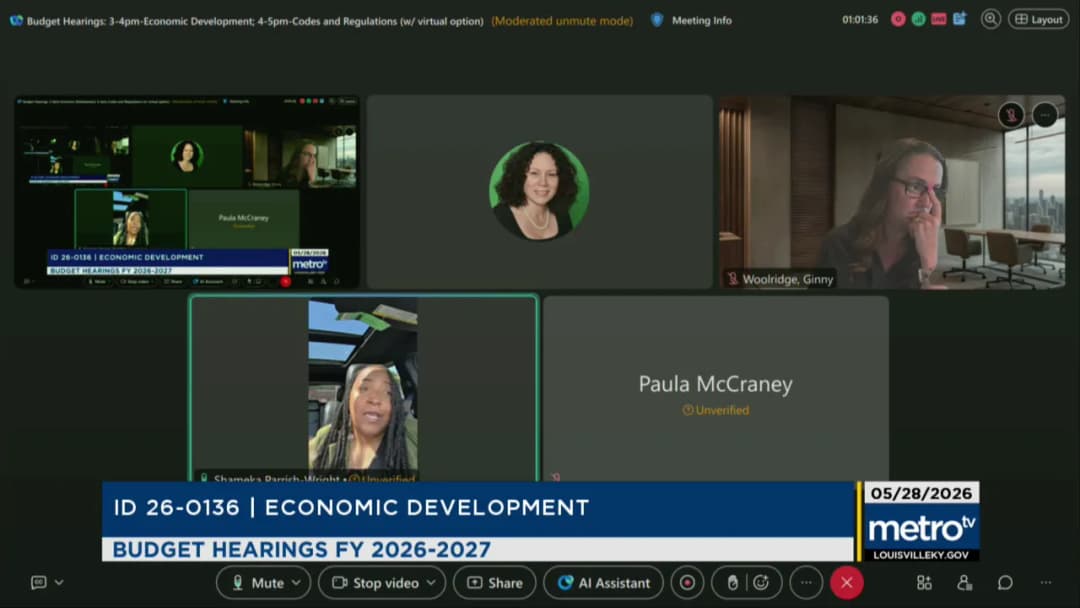
The Budget Committee of the Louisville Metro Council held a hearing on Thursday, May 28, 2026, at 3:06 PM, chaired by Councilman Kevin Kramer (R-11). The meeting focused on the proposed FY 2026-2027 budgets for the Economic Development department and the Codes and Regulations department. No votes were taken; the hearing consisted of department presentations and council member Q&A. Discussion Items Economic Development (ID 26-0136) - Sports Commission Funding: A proposed $1,170,000 increase to the Louisville Sports Commission, primarily attributed to hosting the 2028 Women's Gymnastics Trials. Jeff O'Brien, Executive Director of Economic Development, noted that this is an international event and that future funding levels for major events remain uncertain. - One Louisville/One Louisville Transition: A proposed $3 million allocation to One Louisville (merger of LEDA and GLI) includes $1.5 million in operational support and approximately $880,000 to cover seven positions transferring from Metro government to One Louisville. Six previously unfilled positions ($671,000) are also accounted for. Vice Chair Markus Winkler and Council Member Lyninger questioned the clarity of the personnel cost breakdown. - South End Fund: $3 million in capital funding was allocated in the previous year. As of the hearing, about $1 million in grants and loans had been deployed (e.g., Longhorn Steakhouse on Dixie Highway, Valley Dairy Freeze). Remaining funds ($2 million) are available for corridor investments. - METCO Loans: The program issued $4.1 million in FY24 (a record) and $2.3 million in FY25. Current portfolio is $17.8 million. Staffing shortages were resolved; improved accounting practices are expected to normalize lending at $2.5–3 million annually. - Other: Ambassador program (Block by Block) at $2.2 million – a 2% cost-of-living increase with no new areas. Sister Cities funding eliminated because a staff position now handles that work internally. - Committee Concerns: Councilmember Jennifer Chappell requested a detailed breakdown of how the $3 million to One Louisville is spent and expressed skepticism from her district. Councilmember Tammy Hawkins noted the lack of African American representation on the One Louisville executive committee. Councilmember Piagentini asked about possible 1% cuts. Codes and Regulations (ID 26-0137) - Personnel and Overtime: The proposed budget is $19.2 million. The department plans to eliminate 20 positions (12 filled, 8 vacant). Overtime is proposed at $615,000 (up 50% from FY26). Vice Chair Winkler and Councilmember Piagentini questioned the relationship between staff cuts and rising overtime, suggesting better budget discipline. - Vacant Lot Abatement and Graffiti: Vacant lot mowing covers approximately 1,300 private and 938 Metro-owned properties, with additional work orders totaling 17,585 cuts/cleanings projected for FY26. Graffiti abatement funding is $50,000 for supplies; four-person crews handle removals. - Contractual Services: A line item for temporary services rose from $18,500 in FY26 to $259,600 in FY27, attributed to contracted boardings and second-story work. - After-Hours Enforcement: Councilmembers Joseph and Hawkins requested funding for staggered shifts (after 5 PM) to address nuisance properties. Director Robinson noted that collective bargaining agreements would require negotiation. A targeted approach using overtime was suggested; committee asked for cost estimates for such operations. - Civil Penalties Revenue: Projected to increase by nearly $1 million due to improved collection on fines and liens. Councilmember Chappell questioned whether this is sustainable given staffing cuts. - Technology: GovStream AI tool is being introduced to streamline permit processes, funded through Metro Technology Services. - Committee Concerns: Councilmember Lyninger asked about resources to track LLC owners behind code violations. Councilmember Hawkins questioned the overlap between Codes and Regulations and Housing department on boarding/grass work (different property categories). Key Outcomes - No motions or votes were taken; the hearing was informational. - Committees requested additional data from both departments: detailed justification of One Louisville costs, breakdown of temporary services contract, after-hours enforcement cost estimates, and updated mowing lists by district. - The hearing adjourned at 5:01 PM, with the next hearings scheduled for Monday, June 1, 2026, covering Corrections, Public Health and Wellness, and Libraries.
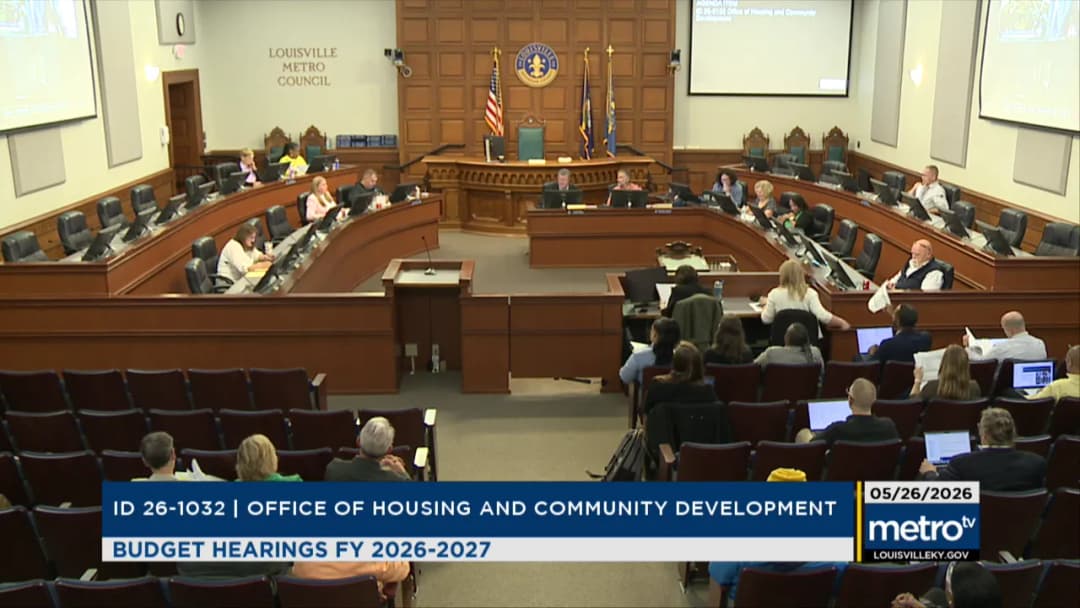
On Tuesday, May 26, 2026, the Louisville Metro Budget Committee convened at 3:04 PM in Council Chambers (with virtual participation) to review proposed budgets for the Office of Housing and Community Development and the Office of Violence Prevention. Chair Kevin Kramer presided. The meeting adjourned at 5:02 PM. No votes were taken; discussion focused on program details, funding levels, and departmental challenges. Office of Housing and Community Development - Section 108 Loan Program: Director Laura Grabowski explained that a $47 million line of credit (five times the CDBG allocation) is pending HUD approval for two years. Funds would support vacant property adaptive reuse, corridor redevelopment (e.g., Dixie Highway, Preston Highway, Broadway), and affordable housing development within CDBG rules. - Affordable Housing Goals: The mayor’s goal of 15,000 units (new or preserved) by end of 2026 currently stands at approximately 7,100 units completed or underway. A housing needs assessment identified a deficit of 36,000 affordable units. - Land Bank and Small Developer Loan Program: In FY26, the land bank sold over 100 properties (an 84% increase from FY25). The small developer loan program ($2 million proposed in FY27) has funded about 49 units to date (18 completed), with an additional 40-43 units expected. Some funds are forgivable; recycling rates were not provided. - CDBG Funding: FY27 CDBG allocation is $2.34 million, up from $1.84 million in FY26. The increase in administrative/planning costs (from 20% to 21.4%) is due to reclassification of residential services delivery (inspectors, intake) previously counted under homeowner preservation. - Capital Projects and MMY: 56 capital projects showed no budget change in the last year; OMB is reconciling outdated reports. For MMY (modular housing), no new funding is proposed in FY27; prior allocations ($500,000 loan and federal funds) have produced two completed houses through Family Scholar House, with three more in progress. - Home Repair: Approximately $1 million in block grant dollars is proposed for FY27. A needs assessment found 29,000 homes needing repair; current programs serve 200-250 houses per year. A new home repair network (United Way 211) received 400 calls in the first month, double expectations. - Other Programs: The healing place ($1.8 million opioid settlement funds) was reappropriated due to restrictions. The Muhammad Ali Center funding was not carried forward. Ramp and barrier removal funds ($500,000 unspent from prior years) will have an additional $200,000 proposed. Office of Violence Prevention - Get Busy Program: $350,000 in FY26 (ARP-funded) for middle school after-school activities is reduced to $150,000 in FY27 (split between Boys & Girls Club and Community Connections) to preserve other programs. - Community Violence Intervention (CVI) Sites: Currently 6 sites (Russell, Algonquin, Park Hill, California, Victory Park, Taylor Barrie, Newburgh). Director James Tatum noted that an additional $375,000 per site would allow opening sites in Chickasaw and Parkland (not in proposed budget). He emphasized that sustained violence reduction takes 5-7 years. - ARP Transition: Many ARP-funded programs (CVI sites, education hubs, anti-violence coalitions) are being absorbed into the general fund at reduced costs. The anti-violence coalition program is shifting to support existing grassroots groups instead of creating new ones. - Restorative Justice: $390,000 covered six months after ARP ended; FY27 includes $750,000 that also funds VOA supportive services and CVI sites. - Staffing and Burnout: Outreach workers often work 50-60 hours per week; additional funds for outreach coordinators could reduce overtime and improve coverage. - Food Expenditure: Food costs doubled from $32,800 in FY25 to $67,000 in FY26 (as of March), attributed to community engagement events and meetings. - Group Violence Intervention (GVI): Separate department with $543,000 budget and 2 employees; OVP does not oversee it. Councilwoman Hawkins noted the need for relocation services for families in immediate danger (currently outsourced to Joshua Community Connections). - Contract with Wonderland Company: $44,000 contract for facilitation training; Councilwoman Chappell raised concerns about the nature of services. - Newburgh Grant: $1.8 million DOJ grant (started July 2024) funds a CVI site and community-based grants; still being expended. Key Outcomes - No formal decisions or votes were taken; the hearing was for informational and questioning purposes. - Chair Kramer noted that the committee will meet again on Thursday, May 28, 2026, at 3:00 PM to continue budget hearings. - Council members requested additional data points: breakdown of land bank properties by district, list of vacant/abandoned properties, MMY hiring reports, CDBG fund reconciliation, and capital project status updates.
May 21, 2026, 3:01 p.m. – 5:30 p.m. The Budget Committee, chaired by Kevin Kramer (R‑11), held its sixth day of budget hearings for Fiscal Year 2026‑2027. The committee reviewed the proposed operating and capital budgets for three departments: Louisville Metro Fire Department, Emergency Services, and Louisville Metro Animal Services. The meeting was conducted in a hybrid format, with most members in chambers and Councilmembers Parrish‑Wright and Piagentini attending virtually. Ben Reno‑Weber was absent. Discussion Items Louisville Metro Fire Department - Chief Brian O’Neill addressed the department’s $85.6 million operating and $5.8 million capital budgets. - Station replacement (Engine 23): Land‑purchase issues have delayed the project; the first‑choice site was lost and a second site is being pursued. - Fleet condition: Of 31 front‑line apparatus, 9 are older than the NFPA 15‑year standard; 14 are due for replacement. Lead time for new apparatus is approximately 4 years. A sustainable model of purchasing 2 per year was discussed. - Overtime: Scheduled overtime is built into the 56‑hour work week. Unscheduled overtime has declined as vacancies dropped from 75 to 28, thanks to annual academy classes. Large‑scale events (e.g., Derby, flooding) can still cause overtime, but Churchill Downs and the State Fair Board reimburse those costs. - Facilities maintenance: Six active firehouses are over 100 years old. The department prioritizes full renovations (e.g., Engine 17, Engine 20) rather than piecemeal repairs. Roofs and HVAC are replaced on schedule. - Budget reductions: Decreases in contractual services ($262,900) and equipment capital outlay ($106,000) were attributed to re‑categorization of expenses rather than actual service cuts. Fuel costs are expected to exceed the reduced budget. - Grant match: A $93,800 port security grant from the Coast Guard is pending. - Bond accounting: Councilmember Piagentini questioned how fire‑related bond payments are allocated between the Urban Services District (USD) property tax and the general‑fund occupational tax. OMB Director Dunn explained that bonds are issued citywide, with a proportional expense calculated for the USD to offset occupational tax use. A follow‑up reconciliation was requested. - Workforce: Starting pay for a recruit is $67,000; after 5 years it reaches $78,000. One academy class (≈25 recruits) is held annually. - Third‑party staffing study: Chief O’Neill confirmed no outside study has been commissioned, but the department uses predictive software based on actual run data and social vulnerability index. - PFOS in gear: All new gear retains PFOS only in the outer layer; fully PFOS‑free gear is currently not cost‑effective or durable enough for widespread use. Emergency Services (Metro EMS)n- Executive Director Jody Meiman presented a $64 million operating and $4.4 million capital budget. - Drone as First Responder: The program has completed over 500 flights. Five pilots are being hired from this budget; 8 additional drone locations are planned, with partnerships with JCPS to use school sites. Drones have aided in locating suspects and rescue victims. - E MS staffing: Goal is 20 ambulances on the road daily. A recent recruit class of 31 is in field training. No comprehensive staffing study has been done, but turnover has improved. - Ambulance fleet: $1.5 million in the budget for new ambulances or refurbishments. Some vehicles are 10–15 years old but many are refurbished. - Suburban EMS billing: A $6 million allocation for suburban fire responses inside the Urban Services District is held in the OMB ‘general adjustments’ line. Councilmembers questioned whether this should be funded from USD property taxes rather than general funds. Director Meiman offered to share cross‑agency response statistics. - Radio infrastructure: A $20 million, multi‑year project to replace tower‑site equipment (some dating to 2006‑07) and upgrade to digital. Phased implementation will not disrupt operations. - Opioid settlement funds: EMS will receive $3.1 million for a deflection program and $2 million for call‑center expenses. - 911 center: Average answer time is 9 seconds (goal: 90% within 10 seconds). Eight new dispatcher positions were added but require 6–9 months to train. Text‑to‑911 and video‑sharing have been enabled. AI is being tested for non‑emergency call filtering through the 311 system. - 911 fee revenue: Landline‑based fees have declined; current annual revenue is approximately $4 million. Council members expressed interest in state legislative updates to address the shift to wireless. - Contractual services: A $2 million decrease requires further review to confirm it does not affect service levels. - If a 1% cut were needed: Director Meiman stated personnel and existing contracts leave little room without affecting operations. Louisville Metro Animal Services (LMAS)n- Director Andy McClinton presented a $6.5 million operating budget. - Employee turnover: Reduced from 36.5% (when director arrived) to 25%. Initiatives include monthly professional development days (closing the shelter for training), a 90‑day new‑hire orientation, and expanded training. - Budget savings: Delayed filling three adoption‑coordinator positions for three months to save $26,700, justified by historically high turnover in that role. Other staff and a temp agency will cover. - Receipts: Agency receipts budget was decreased by $300,000 because the department now budgets actuals rather than anticipated revenue. - Animal intake: 9,746 animals were taken in during 2025 (a record), but the live‑release rate was 93.7%, well above the national average. Fosters increased by 652 animals, and adoptions rose significantly. The shelter currently has 15–20 open kennels, but summer is the busy season. - Spay/neuter: A $178,800 budget for FY26 will be largely spent; FY27 budget is $0, relying on a third veterinarian (starting July) to reduce outsourcing costs. Director expressed comfort with this approach. - Owner surrender: Accepted by appointment. Emphasis on providing resources (pet pantry, medical vouchers, behavior support) to keep pets in homes. - Pet licensing: Switched to DocuPet in November 2025; licenses have increased by 1,200 over the prior period. Lifetime licenses ($25, with spay/neuter, microchip, and rabies requirements) are offered as an incentive. The department is focused on positive incentives rather than penalties. - Public confusion: LMAS is actively countering misinformation about Jefferson County Animal Control (a separate for‑profit entity) through social media and community outreach. - Future needs: Director expressed desire for a standalone website to improve user experience. - If a 1% cut were needed: Director would look to increase revenue rather than cut personnel. Key Outcomes - No formal votes were taken; hearings were informational. Budget recommendations will be incorporated into the full Metro Council budget process. - Several follow‑up items were requested: - OMB to provide a reconciliation of how Urban Services District property taxes offset bond payments for fire apparatus. - OMB to clarify the funding source and accounting for the $6 million suburban EMS billing allocation. - EMS to share cross‑agency response statistics and provide detailed fleet age and cost data. - LMAS to provide a cost‑per‑animal breakdown and a fee‑vs‑cost analysis. - The meeting adjourned at 5:30 p.m. without objection.
The Budget Committee held hearings on May 20, 2026, from 3:00 PM to 5:53 PM, to review the proposed FY2026-2027 budgets for Facilities and Fleet Management (F&F) and the Louisville Metro Police Department (LMPD). Committee members questioned department leaders on operational and capital budgets, staffing, technology, and strategic initiatives. No formal votes were taken. Discussion Items: Facilities and Fleet Management - Budget Overview: Mayor's recommended operating budget of approximately $61.5 million and capital budget of about $40.5 million. A reduction of $586,000 in utilities, custodial, equipment rental, and security services was achieved by removing the NEA Center, LMPD Fourth Division, and fiscal court buildings from the portfolio. Training budget reduced by $46,000 due to insufficient enrollment. Custodial services reduced from five to two days per week at some facilities, and City Hall security reduced from three guards to one after 5 p.m. - Vehicle Fleet: 38 Crown Victoria vehicles remain in the fleet. Replacement schedule and cost to be provided. A fleet dashboard tracks vehicle history, mileage, and maintenance. Deferred maintenance has decreased due to recent vehicle investments. - Belvedere Project: $15 million in the FY27 budget; total commitments exceed $100 million including state and local funds. Design not complete; demolition planned for fall 2026. Additional funding needed beyond this request. - Solar and Clean Energy: Energy innovation fund targets a six-year ROI; 15% earmarked for rooftop solar. Three solar projects completed (Fire Engine 8, Southwick Community Center, Iroquois Library) costing $310,000; Fern Creek Library solar project in construction ($340,000). The 2030 clean energy goal is not on track; utility-scale solutions needed. Downtown grid interconnection challenges with LGE. - Personnel: 176 filled positions as of April 1, 2026, with 194 funded positions (some unfunded vacancies to be reconciled). Director Sean Woods expressed intent to fill all funded vacancies promptly. - Response to 1% Cut Inquiry: Director Woods indicated potential for consolidating leased spaces (saving $140,000) and further reductions in custodial services. Discussion Items: Louisville Metro Police Department - Budget Overview: General fund appropriation increase of $16.9 million year-over-year, driven by salary adjustments, and transfer of contracts (Mark 43 reporting software, Flock ALPRs) from capital to operating. Proposed operating budget $269 million, 90% personnel. - Tow Lot: Partnership with Vehicle Management Solutions (VMS) since August 2025 improved efficiency, added capacity to 1,400 vehicles. Two funding accounts exist in Facilities and Fleet; disposition to be clarified. Approximately half of spaces used for evidentiary holds. - Staffing: Currently 1,000 sworn officers; staffing study recommends 1,136. FY27 budget includes 1,068 funded positions, with three planned recruit classes of 20 officers each. 51 recruits in academy, 24 expected to graduate soon. Recruit pay increased to be competitive. - Overtime: $66 million spent over three years. Majority volunteer for patrol shortage and investigations. No cap on overtime; contractual eight-hour rest period between shifts. Committee requested breakdown by division and specialty unit. - Technology: Star Chase pursuit management system to be piloted (16 vehicles, two per division). AI tools for pre-filling reports and body cam footage analysis under exploration. Co-responder model technology being developed with crisis triage workers. - Forfeiture Funds: State forfeiture funds $968,000; federal forfeiture funds $556,000 (not $4.3 million as initially indicated). Used for emergency purchases; committee requested reconciliation and clarity on eligible expenses. - Community Engagement: Citizen police academies ongoing; residency incentive program from Brianna Teller settlement unused. Churchill Downs reimbursement for Derby costs not pursued. - Response to 1% Cut Inquiry: Chief Humphrey stated cuts would impact technology investments and overtime, not personnel. Key Outcomes - Committee directed F&F to provide detailed information on Belvedere project commitments and planned expenditures. - Committee requested reconciliation of LMPD forfeiture fund balances and eligible uses for vehicle replacement. - Committee requested breakdown of LMPD overtime by division and specialty unit for FY26. - Committee requested follow-up on disposition of tow lot funding accounts (to be resolved with F&F). - Committee requested update on LMPD technology roadmap and AI implementation within six months. - No formal motions or votes were taken; the hearings were informational for budget preparation.
The Louisville Metro Council held its regular meeting on Thursday, May 14, 2026, at 6:06 PM in Council Chambers, adjourning at 7:34 PM. The meeting included recognitions, public addresses, approval of the consent calendar, debate and votes on several old business items, and introduction of new legislation. Consent Calendar - Approvals (unanimous, 24-0): The council approved minutes, committee minutes, and 22 items on the consent calendar. Key approvals included: - O-088-26: $10,000 from District 6 Neighborhood Development Funds (NDF) to Kentucky Shakespeare Inc. for the Kentucky Shakespeare Festival (May 27 – Aug 9, 2026). - O-090-26: $6,550 from District 6 NDF to Old Louisville Community Coalition for the 2026 Old Louisville Farmer’s Market (May 9 – Nov 14, 2026). - O-097-26: $39,650 ($9,912.50 each from Districts 12, 13, 14, 25) to Metro Parks for the Southwest Music Series (June 13, Aug 1, Sept 12, 2026). - O-092-26: Transfer of $4,000 from District 5 NDF to District 5 General Operations. - O-098-26: Transfer of $24,550 between District 6 capital projects. - R-040-26: Naming the corner of Roselane Street and South Hancock Street as “Fred T. Stoner, Sr. Way.” - O-099-26: Approval of the City of Glenview’s annexation of a portion of Orion Road. - Appointments and reappointments to various boards (Board of Zoning Adjustment, Juneteenth Jubilee Commission, KentuckianaWorks, Louisville Convention and Visitors Bureau, etc.). - R-041-26: Renaming Ballard Park to “Smoketown-Ballard Park.” - R-043-26: Acceptance of $6,500 in sponsorships from Humana, MSD, and Brown-Forman for Earth Fest. - O-074-26: Amendment to Louisville Metro Code Chapter 91 to remove certain restraint requirements for livestock. Public Comments & Testimony - Transgender Ordinance (Safe Haven) – Opposition: Three speakers (Kevin McClure, Dee Buscetto, and Joshua Allen) spoke against a proposed transgender ordinance not yet on the agenda. They argued it would harm transgender individuals by affirming a “confusing lifestyle,” cited studies on suicide rates in supportive countries, claimed it would endanger women in bathrooms, and stated it violated God’s design. A fourth speaker (Irina Batiste) attempted to offer compromise but was ruled out of order as a fourth opponent. The chair recognized three speakers on the opposition side only. - Other Topics: - Meshorn Daniels: Shared a personal grievance involving a workplace retaliation lawsuit. - James Elliott: Claimed LMPD mishandled his stolen vehicle case. - Pam Chancey: Requested support for First Hour Grief Recovery, a nonprofit serving grieving families (1,300 individuals across 74 zip codes). - Melissa Baere: Spoke in favor of the H.E.R.O. Run (Honor Earned Remembrance Ode), a Memorial Day week event supporting veterans. - Maria Gurren: Requested $150,000 budget funding for Imagination Library of Louisville, which mails free books monthly to over 21,000 children and has shown improved kindergarten readiness. - Daniel Cobble: Accused the Jefferson County Clerk of violating election laws and misappropriating funds, but was reminded not to electioneer. Discussion Items - O-071-26 (Reconsideration): Ordinance appropriating NDF for backpacks and school supplies for the First Neighborhood Place Back to School Festival (July 18, 2026). Originally passed April 23, but was reconsidered to add funds. After amendments (adding $1,000 from District 2, $1,000 from District 26, $250 from District 5), the total reached $13,450. Passed 24-0. - O-087-26 (Flock Cameras – District 26): Appropriated $26,600 from District 26 NDF to LMPD for a two-year lease and installation of four Flock cameras. Council President Ackerson spoke in favor. Passed 21-0 with 3 present (Parrish-Wright, Lyninger, Chappell). - O-094-26 (Flock Camera – District 20): Appropriated $6,650 from District 20 NDF to LMPD for one Flock camera near Grand Lakes Subdivision. Sponsored by Council Member Benson. Passed 21-0 with 3 present (same members). - O-089-26 (H.E.R.O. Run): Initially $1,000 from District 6 for Volunteers of America Mid-States’ May 30 H.E.R.O. Run supporting veterans. Amended to $10,000 with contributions from 22 districts. Passed 24-0 after amendments. - O-091-26 (Poorcastle Festival): Originally $2,000 from District 6 for the festival (May 15-17, 2026). Amended to $6,000 with additional funds from Districts 15, 3, 8, 21, 9, 13. Passed 24-0. - O-100-26 (Buy Local Fair): Appropriated $11,200 (after amendments) to Louisville Independent Business Alliance for the May 31, 2026 Buy Local Fair. Adjustments: reduced District 2 from $4,100 to $1,000, added funds from Districts 4, 21, 14, 13. Passed 24-0. - R-042-26 (Wieland Incentives): Resolution approving local incentives for Wieland North American, Inc. under KRS Chapter 154. Council Member Lyninger opposed, calling it a “corporate tax cut” during a tight budget. Council Members Reed and Piagentini argued it was a state program necessary for competitiveness. Passed by voice vote. Key Outcomes - Consent Calendar: Approved 24-0. - O-071-26: Passed as amended (total $13,450) 24-0. - O-087-26: Passed 21-0 (3 present). - O-094-26: Passed 21-0 (3 present). - O-089-26: Passed as amended (total $10,000) 24-0. - O-091-26: Passed as amended (total $6,000) 24-0. - O-100-26: Passed as amended (total $11,200) 24-0. - R-042-26: Adopted by voice vote. - New Business Introduced: 20 new items (O-107-26 through O-140-26, R-044-26 through R-057-26, O-144-26, O-148-26) were given first reading and assigned to respective committees. - Rule Change Notice: R-052-26, amending Council rules regarding presiding officers at committee meetings, received first reading.
The Budget Committee, chaired by Vice Chair Markus Winkler, held a hearing on the proposed FY2026-2027 budget on May 13, 2026, from 3:00 PM to 5:06 PM. The hearing focused on the Parks and Recreation department and the Louisville Zoo. No formal votes were taken; the committee heard presentations and asked questions. The recommended executive budget and budget hearing schedule were also presented for review. Parks and Recreation - Proposed Budget: $40.7 million operating and $25.3 million capital. - Iroquois Amphitheater: $1.7 million in restricted funding (carry forward from prior years). Committee members discussed using these funds for HVAC replacement ($550,000 proposed) and questioned the appropriate reserve level. Executive Director Michelle King noted the amphitheater's operating costs are variable and a reserve is prudent. Councilman Winkler requested annual operating cost data. - Golf Enterprise Fund: Revenue from golf operations (e.g., $1.5 million in deferred maintenance account) is reinvested into capital improvements. The budget does not assume fee increases from a pending ordinance. Councilman Piagentini noted that the enterprise fund covers golf positions, with the exception of the agronomist (now fully in the enterprise fund). - Special Event Rentals: Budgeted at $429,700 in FY26 but zero in FY27. Director Jason Canuel explained this reflects a change in accounting codes, not a reduction in activity. Councilwoman Chappell noted that the zero budget may be misleading and requested clarification. - Graffiti Supplies: $111,500 in FY26, zero in FY27. Canuel stated that costs are now coded to other supply accounts. - Deferred Maintenance: $3 million allocated in the mayor's proposed budget. Projects include Iroquois culvert replacement ($100,000), HVAC at Iroquois Amphitheater ($550,000), and other repairs. The department tracks needs by life safety and urgency, not by district. - Community Gardens: The department took over four gardens from the Extension Office, closed one at Blue Lick Park, and now manages three sites. A new position oversees urban agriculture programming. - Public Restrooms: Estimated cost for a new indestructible restroom is $400,000–$500,000. Annual operating costs were not provided but will be estimated. - Bathroom Inventory: Councilwoman Chappell requested a list of operable bathrooms. The department agreed to provide it. - Soil and Water Conservation District Funding: Reduced from $113,500 to about half. CFO Angela Dunn cited tough budgetary choices. Councilwoman Chappell expressed strong support for restoring funding, noting the district's elected officials and federal mandate. - Other Questions: Tree fee-in-lieu accounts, master plan prioritization, Ben Washer Park phasing, GG Moore Park funding, and the Belvedere (not a parks facility). Louisville Zoo - Proposed Budget: General fund appropriation decreased by approximately $440,812 (from about $7.1 million to $6.7 million). The overall budget is up due to increased self-generated revenue (75% of total). CFO Dunn stated the zoo's ability to generate revenue was a factor in the reduction. - Kentucky Trails Project: $77 million capital project. First phase (infrastructure, site work, water feature, bridges) underway with $30 million in hand. Second phase will depend on funding. The project is expected to increase attendance by 10–15% and generate $1.5–2 million in additional annual revenue, funding 20–30 new staff. No animal features in phase one. - Revenue and Attendance: The zoo is the number one paid attraction in the region, on track for 750,000+ visitors in FY26 (excluding Wild Lights). Dynamic pricing (implemented 2020) increased per-cap admission revenue by 5–8% annually. Membership conversions also increased. - Employee Turnover: Increased from 4.3% to 7.9% due to retirements and other departures. Director Maloney noted this is not a significant concern. - Elephants: The decision to send elephants to a sanctuary was based on animal welfare, not budget. Future elephants would require a multi-hundred-million-dollar habitat. - Other Topics: Online fee implementation, shark exhibit (on master plan but not near term), community engagement, and seasonal hiring age (policy restricts under 16). Key Outcomes - No votes were taken; the hearing was informational. - The committee will continue budget hearings with public input at 6:00 PM on May 13, 2026. - The meeting adjourned at 5:06 PM.