The Economic Development (ECON) Committee met on March 23, 2026, from 9:30 a.m. to 9:53 a.m. to consider Bill 7-26, which clarifies exemptions from county building code requirements for buildings or structures used exclusively for agricultural purposes. The bill was sponsored by Council President Fani-González, Council Vice President Balcombe, and Councilmember Luedtke. The committee heard from Legislative Attorney Ogorzalek, Director Scheffel of the Office of Agricultural Services, and Director Sabbakhan of the Department of Permitting Services (DPS). The committee recommended approval of the bill with a clarifying amendment, and the bill is tentatively scheduled for full Council action on April 7, 2026. Public Comments & Testimony - All public testimony received, both in person and written, was supportive of the bill. No specific speakers or organizations were named. Discussion Items - Definition of "agricultural purpose": The bill adds a definition taken from county zoning and agricultural easement codes, including business administration/management of agriculture and processing of agricultural products to prepare for market. - Exception to exemption: The bill adds an exception requiring a building permit for structures where customers or members of the public consume food or beverage, to ensure public safety. - Clarifying amendment: Staff proposed an amendment to ensure the bill does not conflict with Maryland Public Safety Article Section 12-508, which exempts certain agritourism structures (e.g., barns, stables) from occupancy permits. The amendment states that the new county permit requirement does not apply to structures already exempted under state law. - Dual-purpose buildings: Councilmember Balcombe raised concern about buildings with both production and tasting rooms. Staff and directors explained that separate uses within a structure may be treated as separate structures for permitting, depending on fire separation and design. The agricultural production side would not require a permit, but public consumption areas would. DPS coordinates with the Office of Agricultural Services on a case-by-case basis. - Residential use by farmers: Councilmember Luedtke asked whether a farmer's residence on agricultural land removes the property from exemption. Directors confirmed that a residence does not disqualify the property, as long as other thresholds (e.g., occupancy for agritourism) do not trigger a permit. - Controlled environment agriculture: Councilmember Sayles asked whether innovative practices like controlled environment agriculture qualify. Director Scheffel said they generally would, but it is case-specific. Key Outcomes - The committee unanimously approved Bill 7-26 as amended (motion by Councilmember Balcombe, second by Councilmember Sayles). - Next step: Full Council action tentatively scheduled for April 7, 2026.
Public Meetings - Montgomery County, Maryland
Public Meetings - Montgomery County, MarylandThe Economic Development (ECON) and Health and Human Services (HHS) Committees met jointly on March 19, 2026, from 1:30 p.m. to 1:36 p.m. to consider Bill 1-26, which would remove the requirement for the Office of Legislative Oversight (OLO) to produce an annual report on the impact of the county minimum wage. The committees voted unanimously to recommend enactment of the bill as introduced. Discussion Items - Bill 1-26, Human Rights and Civil Liberties - County Minimum Wage - Actual Impact Analysis - Amendments - Councilmember Fani-González (ECON Chair) explained the bill is a technical change to eliminate a reporting requirement that is no longer useful. The original report was intended to track economic impacts of the minimum wage increase, comparing Montgomery County to other jurisdictions. - OLO Director Cihlar and Senior Legislative Analyst Trombka provided additional context: two main reasons for the change are (1) the state of Maryland has revised its minimum wage law, making county-to-county comparisons less relevant, and (2) the federal government has stopped reporting several data points used in the report, making trend analysis impossible. The report consumes significant staff time for little use, as it has not been discussed with council members or the public in recent years. - Councilmember Sayles (HHS Chair) expressed support, noting that OLO should focus on more pressing fiscal and economic priorities, especially given federal data gaps. She also mentioned the county's reliance on quarterly reports from the Economic Development Corporation. - No public testimony was received. Key Outcomes - Motion: Councillmember Luedtke moved to approve Bill 1-26 as described; seconded by Councilmember Friedson. The motion passed unanimously (all members present voting in favor). - Next Step: Council action is tentatively scheduled for April 7, 2026. - The fiscal impact statement noted no anticipated net effect, with a possible de minimis decrease in OLO workload.
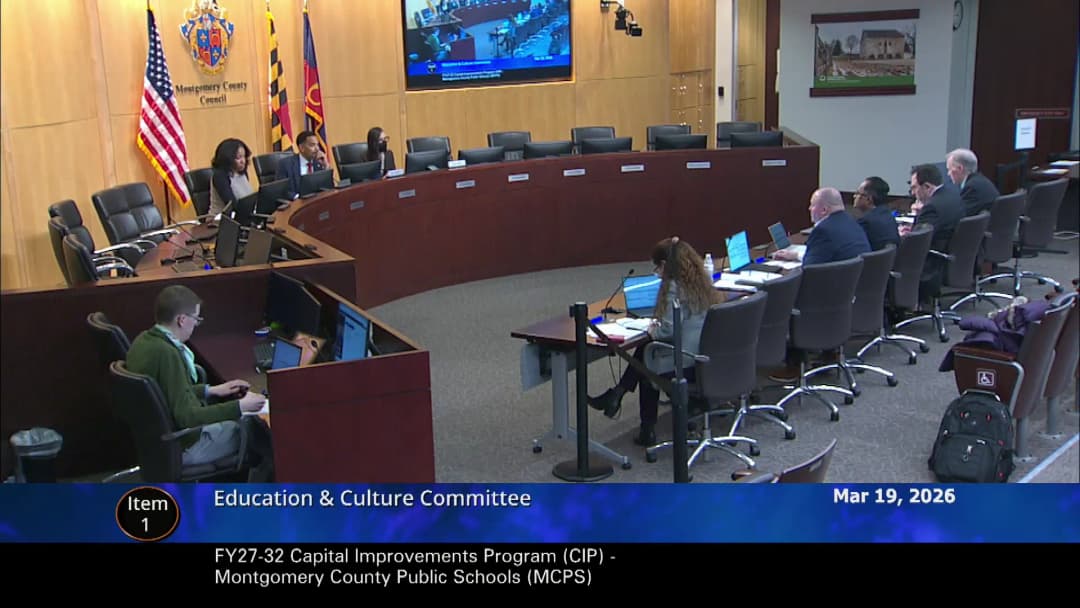
The Montgomery County Education and Culture Committee met on March 19, 2026, from 1:30 p.m. to 3:42 p.m. to review the Montgomery County Public Schools (MCPS) Fiscal Year 2027-2032 Capital Improvements Program (CIP). The meeting addressed a $440 million gap between the County Executive's assumed General Obligation (GO) bond issuance and the Council's approved Spending Affordability Guidelines (SAG), which will require further reconciliation. The Committee made preliminary approvals, modifications, and deferrals on dozens of projects, while expressing deep concern over unmet health and safety needs. Consent Calendar (Routine Approvals) - Bethesda-Chevy Chase/Walter Johnson Clusters ES (New): Removed from the CIP, as enrollment projections show combined utilization at 85% and no immediate capacity need. - Burtonsville ES Replacement: Approved as requested, with the project already under construction and opening August 2026. - Crown HS (New): Approved with technical adjustments; the project is on track for August 2027 opening, regardless of ongoing boundary discussions. - JoAnn Leleck ES at Broad Acres Replacement: Approved as under construction. - Northwood HS Addition/Facility Upgrade: Approved as under construction. - Charles W. Woodward HS Reopening: Approved with technical adjustments; project completion August 2027. - ADA Compliance, Alternative Education Programs, Asbestos Abatement, BMPI, Design and Construction Management, Emergency Replacement of Major Building Components, Fire Safety Upgrades, Healthy Schools, Materials Management Building Relocation, Planned Life-Cycle Asset Replacement (PLAR), Restroom Renovations, Stormwater Discharge and Water Quality Management, Sustainability Initiatives: All approved pending final reconciliation, with scenario A (non-recommended reductions) generally supported. Discussion Items - Sligo Creek ES Replacement: Removed from the CIP, consistent with the Board's scenario A and the County Executive's recommendation to keep the school on its current site pending further boundary study. - Major Capital Projects – Elementary: Approved delays for Cold Spring ES (reduced from three-year to two-year delay), Highland View ES (three-year delay), Burning Tree ES (one-year delay), and Piney Branch ES (one-year delay). Damascus ES, Twinbrook ES, and Whetstone ES were removed from the CIP as part of reprioritization. - Major Capital Projects – Secondary: Approved removals of Eastern MS capacity increase, Sligo MS (requested project removed), and deferral of Wootton HS and Magruder HS (removed). Eastern MS and Damascus HS were kept on schedule. - Central Office Headquarters (CESC Replacement): Revised expenditure schedule to reflect a potential public-private partnership (P3), with $10 million in FY30-32 and $270 million beyond six years. - Outdoor Play Space and Athletic Infrastructure: The Committee voted 2-1 (Councilmember Evans dissenting) to concur with the County Executive’s recommendation to remove $34.1 million for artificial turf fields, assuming natural grass instead. Councilmembers Jawando and Mink supported redirecting the savings to urgent HVAC needs. The motion directed MCPS to consult with the Board on reallocating the funds to HVAC, with legal clarification sought on whether the Council can add funding above the Board’s request. - Transportation and Regional Support Facilities: Delayed three years from the Board’s request, pending alternate bus storage solutions. Key Outcomes - Preliminary Approvals (pending final reconciliation): The Committee approved the Board's original requests for multiple projects, including those noted in the consent calendar. - Modifications and Delays: Several projects were delayed or removed to align with fiscal constraints. Cold Spring ES will see a two-year delay rather than three (Councilmember Jawando’s motion, passed unanimously). Sligo Creek ES replacement, Early Childhood Centers, and Holding School Improvements were removed. - Deferred Consideration: Relocatable Classrooms (pending supplemental appropriation from MCPS) and Technology Modernization (deferred for discussion with the MCPS operating budget). - Athletic Fields Reduction: 2-1 vote (Evans dissenting) to remove $34.1 million for artificial turf; strong committee preference to reallocate to HVAC needs. MCPS to explore and report back. - Next Steps: The full Council will review the MCPS CIP in mid-April, with final reconciliation expected in May 2026. The Committee emphasized that further reductions may be necessary to close the $440 million gap across all CIP components.
The Montgomery County Council's Government Operations and Fiscal Policy (GO) Committee met on Thursday, March 19, 2026, in the 3rd Floor Council Hearing Room in Rockville, Maryland, for a discussion-only session on the Advisory Workgroup Recommendations on Strategic Planning for County Grants. The agenda listed an 11:30 a.m. - 12:30 p.m. time slot, while the approved minutes record the meeting running from 10:32 a.m. to 11:40 a.m. Present were Chair Kate Stewart, Councilmember Shebra Evans, and Councilmember Sidney Katz. Participants included Bridget Howe (Nonprofit Montgomery), Kim Jones (Montgomery County Black Collective), Gabriel Albanos (Director, Department of Recreation), and Raphael Murphy (Director, Office of Grants Management), with Legislative Analyst Clemons Johnson. No formal votes were taken. Discussion Items - Background: Clemons Johnson explained that the workgroup was created by Resolution 20-780 in April 2025 after years of GO committee discussions about the transition to a new grant-making system, the community grants Non-Departmental Account (NDA), and legacy grants. The group met six times over seven to eight months. Its charge covered strategic plans for the community grants award process, legacy awards, and cost-sharing capital improvement grants. - Funding context: Johnson reported FY26 community grants NDA funding of $13.3 million, including $6.2 million for community grants, $4.7 million for legacy grants, $1 million for nonprofit technical assistance grants, $1 million for nonprofit resiliency centers (formerly incubator grants), and $389,000 for inflationary funds. The FY27 recommended budget is largely similar and will be discussed in April. - Community Grants Board: Bridget Howe recommended creating a board to identify funding priorities, contribute to the review process, and serve as an advisory body to the Office of Grants Management (OGM) to bring in community perspective. - Nonprofit Liaison: Kim Jones recommended creating a position in the County Executive's office to be a consistent, knowledgeable contact for the nonprofit sector, especially to help small, new, and underserved organizations navigate county processes. - Preserve the NDA: The workgroup recommended maintaining the community grants NDA as a flexible general fund to remain nimble and responsive to community needs, rather than moving funding into department base budgets. - Cost-sharing CIP: The group suggested restricting capital requests so they align with community needs and budget realities, and favor 'shovel-ready' projects. - Legacy grants: Jones said the workgroup recommended discontinuing legacy grants after a transition and rolling those funds into the broader community grants program. The recommendation was to notify grantees and provide a six-month allocation in FY27; Jones noted the county executive included a 12-month allocation in his proposed budget. The workgroup acknowledged the history and good intentions behind legacy grants, but favored regularly reviewed, competitive grants. - Equity and capacity building: The workgroup recommended improving access for smaller and underserved organizations, providing more technical assistance, and using a tiered structure so small and emerging nonprofits are not competing against larger, well-resourced organizations. - Staggered grant process: The recommendation is to stagger competitions so one-third of the pool competes each year, with three-year grants; the first new three-year cycle would begin July 2027 with a Notice of Funding Opportunity (NOFO) in November or December 2026. Priorities would be set by the community grants board, potentially by income/socioeconomic status, geography, or historically disenfranchised communities. The group also urged a clear distinction between programmatic funding and general operating support. - Capacity concerns: Howe and Albanos noted OGM and county departments are thinly staffed. Albanos said the Department of Recreation administers over 588 contracts and 24 grants with two full-time staff, limiting outcomes monitoring. Howe said OGM needs more resources and that departments are stretched. - Murphy's perspective: OGM Director Murphy said funding through the community grants NDA is less than 10% of county money that goes to the nonprofit community; most flows through department-based procurement contracts. He cautioned that setting separate priorities could duplicate or contradict department strategies, and cited the community reinvestment and repair fund as a pilot that illustrates the difficulty of priority-setting. He supported the tiered approach and stressed that OGM can move quickly once priorities and criteria are set; the main delays are program design and application review. He warned against repeating the FY24 open competition, which drew 311 applications and had 10 to 20 dollars requested for every dollar available. - Timeline concerns: Chair Stewart questioned whether a newly created community grants board could be stood up before the next NOFO, which is expected around October or November. Councilmember Evans asked about the infrastructure needed to support expansion. Councilmember Katz stressed the importance of providing resources and praised the workgroup's approach. Evans asked the advisory workgroup to continue if possible to help with outreach and smooth transitions. - Transition and outreach: Albanos suggested the recommendations could be advanced through the next county executive's transition team. Howe said Nonprofit Montgomery will host an 'ask me anything' session for members to explain the recommendations. Clemons Johnson noted the workgroup could continue because the enabling resolution has no sunset date; the council could revise or clarify its membership and scope. Key Outcomes - No formal votes or binding decisions were taken; the item was a discussion. - Chair Stewart indicated she was not inclined to end legacy grants before fully working out next steps, and that the county executive's proposed one-year extension would likely be continued during FY27 budget deliberations. - Staff and executive branch participants, including Director Albanos, were asked to work with council staff to identify next steps and possible partnership approaches. - The committee will revisit grant funding during FY27 budget discussions, specifically the community grants NDA and legacy grants. - Clemons Johnson will prepare options for the council regarding possible modification or extension of the advisory workgroup resolution.
The Education & Culture Committee and Government Operations & Fiscal Policy Committee met jointly on March 19, 2026, from 9:35 a.m. to 10:28 a.m. in the Council Hearing Room. The meeting was chaired by Councilmember Kate Stewart (GO) and co-chaired by Councilmember Will Jawando (EC). The committees discussed two interrelated items: an expedited bill to modernize the governance of the Arts and Humanities Council of Montgomery County (AHC) and a supplemental appropriation to cover outstanding obligations for the county’s cultural plan. Bill 10-26 – Arts and Humanities Council Amendments Discussion - Purpose: The bill updates the establishment, membership, and duties of the AHC, originally formed in 1976. It requires the council to designate a nonprofit entity as the AHC via resolution every five fiscal years, with power to revoke or suspend designation. The nonprofit must meet requirements including articles of incorporation, bylaws with open meetings act and MPIA adherence, a board of 11–15 members appointed by the county executive and confirmed by the council, and duties such as adopting a racial equity and social justice (RESJ) policy, overseeing grantmaking, conducting a countywide needs assessment every two years, and adopting a strategic plan every five years. - Staff Recommendations: Chief Legislative Attorney Wellons presented several amendments, which were adopted by consensus: 1. Require the RESJ policy to include a process for equitable grantmaking (per OLO recommendation). 2. Require the AHC to provide mandated reports to the County Council in addition to the County Executive. 3. Require bylaws to include ethics protections consistent with Chapter 19A of the County Code (conflict of interest, training, disclosures, recusals). 4. Technical corrections (lettering, chapter references, typo on lines 91-92). - Debate on Board Voting Rights: The bill as introduced gave two county government representatives (ex officio) full voting rights on the AHC board. Ms. Susan Jenkins, CEO of AHC, argued these representatives should be non-voting due to potential conflicts of interest (e.g., when voting on financial matters involving their employer). She cited concerns about government overreach and noted that board members with conflicts would need to recuse from financial decisions. The County Executive’s office (ACAO Cardona, Director Albornoz) supported voting membership, emphasizing accountability given that the county provides over 90% of AHC’s funding. They argued that voting ensures fiduciary responsibility and real-time collaboration. After discussion, Councilmembers Katz, Stewart, Evans, and Mink expressed support for keeping both representatives as voting members, noting the minority representation and the value of on-record accountability. A proposal to reduce to one voting member was considered but not adopted. The committee unanimously voted to keep the two voting members as introduced. Supplemental Appropriation 26-59 Discussion - Amount: $53,788 from General Fund Undesignated Reserves, requested to pay Metris Arts Consulting for work already completed on the county’s cultural strategic plan. - Context: The appropriation addresses a misuse (not misappropriation) of the Public Arts Trust fund for the cultural plan, as identified by an audit. The county and AHC did not initially recognize the restriction. Since the audit, AHC has wired back $527,000+ of remaining cash balance to the county. The county will continue working with auditors and AHC to determine if additional funds are needed for other cultural plan expenses. - Support: All parties (County Executive Office, Recreation Department, AHC) supported the appropriation as necessary to honor contractual commitments. The committee discussed the need to review the public arts trust statute to allow broader uses in line with contemporary public art practices. Key Outcomes - Bill 10-26: Approved as amended by unanimous voice vote of the joint committee. Final action by the full council will be scheduled later. - Supplemental Appropriation 26-59: Approved as submitted by the County Executive by unanimous voice vote. Final action by the full council will be scheduled later. - Future Actions: The committee directed the Executive branch to return with recommendations on updating the public arts trust statute to reflect current public art practices.
The Montgomery County Council met on Tuesday, March 17, 2026, from 9:15 a.m. to 2:49 p.m. in the Council Hearing Room, Rockville, Maryland. The meeting included a proclamation, approval of minutes, two district council zoning text amendments, a worksession on the FY27-32 Capital Improvements Program (CIP) covering transportation, environmental, housing, library, economic development, public safety, and WSSCWater projects, a consent calendar, a public hearing on a property disposition, introduction of three bills, and final enactment of four bills. A key procedural motion to schedule the "Unmask ICE Act" for immediate full-council action was defeated. Proclamation - Councilmember Glass presented a proclamation recognizing March 17 as National Theatre Day, highlighting the arts sector's $251 million annual economic contribution and over 5,000 jobs in Montgomery County. Representatives from local theaters spoke about upcoming productions and educational programs. General Business - Announcements: Clerk Tenenbaum announced public hearings on the FY27 Operating Budget and FY27-32 Public Services Program for April 7–9, 2026, at the Council Office Building. Registration required via website or phone. - Minutes: Approved the minutes of February 23 and February 24, 2026, without objection (Ms. Mink temporarily absent). District Council Session (9:35 a.m.) - ZTA 26-03 (Biohealth Priority Campus – Eligibility): Enacted unanimously (11-0) as recommended by the PHP Committee. Amendment lowered eligibility thresholds and added adaptive reuse of existing space (100,000 sq. ft.). A technical correction updated references from Corridor Cities Transitway to Corridor Connectors. Councilmember Sayles added as co-sponsor. - ZTA 26-04 (Mixed-Income Housing Community – Eligibility): Enacted unanimously (11-0) as recommended. Removed square footage requirement, increased required units, and added 4% Low-Income Housing Tax Credits (LIHTC) eligibility. Technical amendment included. Worksession – FY27-32 Capital Improvements Program (CIP) – Morning Session (9:45 a.m.) The council conducted straw votes on 15 CIP categories, approving all as recommended by committees, with some amendments. Final action will occur in May 2026. - Department of Transportation (Chair Glass): Approved with three changes: restored Summit Avenue Extension ($990,000 design in FY27; $22.5M total in FY31-32), added language for Observation Drive Extended (per Clarksburg Sector Plan), and added $14.3M beyond six years for Oak Drive/MD 27 Sidewalk. Councilmember Stewart noted BiPPA projects in Laytonsville area; MCDOT staff explained bridge reconstruction will include shared-use paths. - Conservation of Natural Resources – Storm Drains: Approved as submitted ($61.9M six-year program, funded by water quality protection bonds). - Stormwater Management: Approved as submitted ($244.6M six-year program, includes flood management and Wheaton Dam mitigation). - Recycling and Resource Management: Approved as submitted ($38.4M six-year). Councilmember Stewart expressed concern about the New Organics Processing Facility description tying it solely to the Sugarloaf Citizens Association agreement; requested exploring multiple sites. Councilmember Luedtke requested a copy of the existing agreement with SCA. - Revenue Authority (Chair Fani-González): Approved including amendments to the Montgomery County Airpark North End Hangar narrative. A joint committee worksession on airport operations planned for fall 2026. - Community Development and Housing (Chair Friedson): Approved three sub-projects; deferred Affordable Housing Acquisition and Preservation and Revitalization for Troubled Communities until reviewed with the operating budget. - Culture and Recreation – Public Libraries (Chair Jawando): Approved ($83M six-year, up $8.2M). Councilmember Friedson questioned Chevy Chase Library redevelopment; DGS Director Dice confirmed housing on site parking lot after library refurbishment (including ADA). Friedson requested public disclosure of housing yield, affordability levels, and cost analysis. - General Government – Economic Development (Chair Fani-González): Approved three projects: Institute for Health and Computing (new building, North Bethesda Metro), North Bethesda Metro Station Area redevelopment ($11.6M), and White Oak Science Gateway (funded by TIF). Motion on Bill 5-26 (Unmask ICE Act) Councilmember Jawando moved under Rule 5(e) to add a worksession and action on Bill 5-26 (Police – Mask or Facial Coverings Prohibited) to the March 24 Council agenda. After extensive debate (11:13 a.m. recess), the motion was defeated 4-7 (Friedson, Jawando, Sayles, Mink in favor; Fani-González, Luedtke, Stewart, Glass, Katz, Evans, Balcombe opposed). The bill remains scheduled for the Public Safety Committee on April 17, 2026. Multiple councilmembers expressed support for the legislation but opposed bypassing committee process. Consent Calendar (11:45 a.m.) Approved unanimously (11-0): - Acknowledged receipt of three Inspector General publications (Work Plan, MCPD invoice investigation, MCPS invoice investigation). - Introduced resolution for abandonment of public right-of-way at 2nd Avenue and Fenwick Lane (AB 758); TE worksession to be scheduled. - Introduced resolution for abandonment of public alley behind Bayard Boulevard (AB 782); action set for March 24, 2026. - Adopted Resolution 20-1065: Supplemental Appropriation 26-50 for Stormwater Management Retrofit ($11,327,000, long-term financing). - Adopted Resolution 20-1066: Confirmed appointments to Domestic Violence Coordinating Council (Sara Tennen, Michelle Maxberry, River Paganini). Public Hearing and Action – Property Disposition (1:30 p.m.) - Executive Order 208-25: Disposition of Wheaton MNCPPC Headquarters Retail property. Public hearing held and record closed. Adopted Resolution 20-1067 (10-0; Balcombe temporary absent). Legislative Session – Day 7 (1:30 p.m.) Bills for Introduction: - Bill 15-26 (Taxation – Property Tax Credits – Habitat for Humanity Rehabilitations): Introduced by Friedson. Would waive property taxes on Habitat for Humanity homes during construction. Councilmembers Glass, Jawando, Mink, Katz added as co-sponsors. Public hearing to be scheduled. - Expedited Bill 16-26 (Consumer Protection – Financial Exploitation Protection Act): Introduced by Stewart. Prohibits deceptive trade practices targeting vulnerable adults (age 68+) and permits voluntary mediation by Office of Consumer Protection. Councilmembers Katz, Mink, Jawando added as co-sponsors. Public hearing to be scheduled. - Bill 17-26 (Motor Vehicles and Traffic – Speed Monitoring Systems Authorized – Amendments): Introduced by Council President at request of County Executive. Authorizes speed cameras in school zones (20 mph) and on highways identified in Vision Zero plans. Councilmembers Luedtke, Jawando added as co-sponsors. Public hearing to be scheduled. Call of Bills for Final Reading: - Bill 28-24 (Employees’ Retirement System – Administration – Powers and Duties): Enacted as amended (10-0; Balcombe absent). Shifts authority for selecting actuary and setting actuarial assumptions from Chief Administrative Officer (CAO) to Board of Investment Trustees (BIT). Also gives BIT authority to hire/fire Executive Director (under merit system). Defeated County Executive’s amendments to retain status quo. Technical amendment clarified CRHBT board’s role on assumed rate of return. - Bill 2-26 (Taxation – Fuel-Energy Tax – Green Bank – Amendments): Enacted (10-0). Allows Montgomery County Green Bank to use fuel-energy tax revenue for resiliency activities (in addition to clean energy). Councilmember Sayles withdrew amendment for annual updates; existing law already requires annual report. - Expedited Bill 6-26 (Fire and Rescue – EMS Insurance Reimbursement – Use of Revenues): Enacted (10-0). Permits distribution of EMST funds to Montgomery County Volunteer Fire and Rescue Association (as LFRD representative) for specific uses; maintains 15% allocation to LFRDs. - Expedited Bill 11-26 (Fire and Rescue – LOSAP for Volunteers – Amendments): Enacted as amended (10-0). Increases length-of-service award payments by two 4% increases (retroactive to July 2024 and July 2025); expedited effective date included. Worksession – FY27-32 CIP (continued) – Afternoon Session (2:20 p.m.) - Judicial Security Improvements: Approved ($98,000 total; phase 2 security doors in Circuit Court North Tower). PS Committee recommended 2-0 (Mink absent). - Police: Approved as recommended by PS Committee (10-0; Glass temporarily absent). Three new projects: Records Management System ($1.7M), Body Armor ($4.4M for 1,346 sets), and 4th District Police Station ($40M, standalone reconstruction on current site). Postponed discussion on 4D station per County Executive amendment. Olney Satellite Station status changed to "active." - Correction and Rehabilitation: Approved as amended (10-0; Glass absent). Councilmember Evans motion to include racial equity considerations for Diversion Centers was supported without objection. Projects: New Justice Center ($104.6M) and Correctional Facility Refresh ($800,000). - WSSCWater: Approved as recommended by TE Committee, including mid-cycle update (10-0; Glass absent). Staff reported 1,934 water main breaks from July 1 to March 12, 2026 (1,456 in winter). WSSCWater CFO noted Potomac Interceptor repair cost responsibility with DC Water; federal funding may offset WSSC’s share. Councilmember Glass motion to approve mid-cycle update passed. Key Outcomes - ZTA 26-03 and 26-04 enacted unanimously, expanding expedited approval for biohealth and mixed-income housing projects. - Motion to fast-track Unmask ICE Act (Bill 5-26) defeated 4-7; bill remains in Public Safety Committee for April 17, 2026. - Four bills enacted: Bill 28-24 (retirement system governance), Bill 2-26 (Green Bank resilience), Expedited Bills 6-26 and 11-26 (fire/EMS funding and volunteer LOSAP increases). - CIP worksessions approved 13 categories (some with amendments) as straw votes; final adoption in May 2026. - Public hearing on Wheaton property disposition held and resolution adopted. - Three new bills introduced (Habitat for Humanity tax credit, financial exploitation protection, speed camera expansion); public hearings to be scheduled. - Consent calendar approved including Inspector General report acknowledgements and two right-of-way abandonment introductions. - The meeting adjourned at 2:49 p.m.
Public Safety Committee Meeting on Police Staffing and Accountability Board Report - March 16, 2026\n\nThe Montgomery County Public Safety Committee met on March 16, 2026, from 9:30 a.m. to 11:49 a.m. to discuss two major agenda items: an update on police staffing, including a patrol workload analysis and an investigative services bureau staffing study, and the Police Accountability Board's 2025 Annual Report. The meeting was recessed from 9:43 a.m. to 10:00 a.m. due to technical difficulties with the audio-video system. Councilmembers Sidney Katz (Chair), Dawn Luedtke, and Kristin Mink were present.\n\n Discussion Items: Police Staffing Update\n- Patrol Workload Analysis (Corona Solutions): Chief Yamada presented the newly received 350-page patrol analysis based on one year of CAD data, noting it had not yet undergone internal review. Key findings: countywide emergency response time average of 6.7 minutes (75% under 7.92 min, 90% under 11.47 min); non-emergency response times peaked at 36 minutes on Fridays; busiest day is Friday with 445 calls; 457 hours per week of officer holdovers; theft-related calls (6.8% of patrol time) and suspicious person calls (6.3%) were top workload drivers. High-activity locations included Picard Drive (crisis center), Green Tree Road (juvenile home), Progress Place, Westfield Montgomery Mall, Milestone Shopping Center, and RICA. The next phase will include recommendations on boundary changes, shift adjustments, and civilian response teams. \n- Investigative Services Bureau (ISB) Staffing Study (PFM): PFM consultants Seth Williams, Ron Serpas, Eric Melancon, and Lika Janssen presented the final study. The study recommended adding 41 authorized positions (24 sworn, 17 professional staff) across CID, Major Crimes, Special Victims, and Criminal Enterprise sections. The total gap from April 2025 filled levels was 91 positions (including 47 vacancies). The methodology used 60-day activity logs, surveys, and interviews. Key recommendations: phased staffing approach, investment in professional staff (crime analysts, civilian investigators), and improved data management (RMS/case management systems). A case management system is included in the FY27 budget. Detective sergeants often perform detective work due to staffing shortages, impacting supervision. \n- Discussion by Committee Members: Councilmembers focused on recruitment and retention challenges, noting the difficulty of filling vacancies. Assistant Chief Parker-Loin reported ISB vacancies increased from 47 (April 2025) to 58. The need for a 5-year DROP program was raised. Concerns about hospital guard details and parking enforcement detracting from patrol resources were discussed. \n\n Discussion Items: Police Accountability Board Annual Report 2025\n- Presentation by PAB and ACC: Bishop Walker (Chair), Dr. Lluberes (Vice Chair), Richard Rosano (Member), Christopher Jennison (ACC Chair), and Siobhan Gilman-Reilly (Administrative Director) presented the report. The report analyzed 434 allegations, with 80% concentrated in five categories: conformance to law/policy, unprofessional conduct, bias/discrimination, use of force, and specific duty violations. Key recommendations: improve information flow from LEAs to ACC to PAB (written ACC decisions and trial board outcomes), standardize complaint forms across LEAs, collect non-identifying aggregate officer data, and increase dedicated staff (requested a research/data specialist at grade N20). \n- Discussion: Councilmembers noted that the PAB is not receiving enough data from ACC to fulfill statutory mandates, particularly the reasoning behind ACC decisions. The PAB confirmed they lack information to conduct trend analysis or track repeat officer complaints. Discussion on whether changes require state law (MPAA) or county law. Councilmember Luedtke emphasized that recommendations should be based on founded allegations, not total complaints. The PAB and ACC noted that while some LEAs are cooperative, standardized data collection is not mandated. \n- Trial Board Update: Captain Brian Merriman (MCPD Internal Affairs) reported that four trial boards have been held since the new system was implemented. Gaithersburg PD had three requests, one completed; Takoma Park PD had one completed trial board with a penalty reduction. Several cases remain pending. \n\n Key Outcomes\n- Police Staffing: The Committee will schedule a follow-up worksession after the final patrol analysis report is released and internally reviewed (expected in 3-4 months). The committee requested that the next update include a breakdown of 1st District response times excluding crisis center calls, and progress on the retired officer program and hospital guard detail reforms. \n- Police Accountability Board: The Committee agreed to a follow-up worksession in June 2026, with the PAB Annual Report as the sole agenda item. The session will include a detailed presentation on the report's findings and recommendations, as well as an update on data sharing challenges and progress on standardizing complaint forms. The Committee emphasized the need to resolve data access issues before the next meeting. The PAB will report on its discussions with LEAs at the May 21st quarterly meeting.
The Montgomery County Health and Human Services (HHS) Committee met on March 12, 2026, from 2:45 p.m. to 3:11 p.m. to review the County Executive’s recommended FY27-32 Capital Improvements Program (CIP) for the Department of Health and Human Services (DHHS). The committee considered three ongoing projects, three projects pending closeout, and discussed future capital concepts for maternal health. All recommendations from the County Executive were approved without objection. Discussion Items - Affordable Living Quarters: The executive recommends a total project cost of $7.3 million and a six‑year total of $6.9 million for 18 affordable, furnished, private units for one‑ or two‑person households. Construction is expected to be completed in FY29. The site has been finalized after earlier delays. Council staff noted that all health concerns related to the site (air quality, vibration, noise) have been remediated, as confirmed by the Department of General Services (DGS). Director Dise of DGS offered to conduct periodic monitoring annually if requested. The committee approved the recommendation without objection. - Non‑Congregate Shelter Space: This project was originally proposed as an alternative to the Affordable Living Quarters but is now canceled because the Affordable Living Quarters site was identified. The County Executive requested a reduction of $150,000, which had been reallocated to the Affordable Living Quarters project. The committee concurred without objection. Councilmember Luedtke expressed hope for future non‑congregate shelter spaces. - Diversion Center: The primary facility is on Seven Locks Road in Rockville, providing an alternative to incarceration for adults (18+) with minor non‑violent offenses and behavioral health issues. A secondary off‑site walk‑in location at Picard Drive will serve minors and involuntary admissions to comply with new state regulations. The recommended six‑year total is $25.3 million—a $2.3 million increase from the amended FY25‑30 CIP—to address unanticipated utility and site conditions. Design is complete; construction is anticipated to begin in FY26. The committee discussed community outreach, an MOU with the City of Rockville (conditioned on building permit occupancy), and design adjustments based on feedback. Councilmember Friedson emphasized the need for continued communication and partnership, while Councilmember Luedtke praised the executive branch’s persistence and community education. The recommendation was approved without objection. Pending Closeout Projects The following three projects have no expenditures in the six‑year period and are either completed or will be completed in the current fiscal year: - Avery Road Treatment Center - Emergency Homeless Shelter - Nebel Street – Phase 2 The committee approved the closeout status without objection. Additionally, the Progress Place project, included in the FY25‑30 CIP but not in the new CIP, has been completed and was expected to close out in FY25. Future CIP Considerations - In response to a request from Chair Sayles, two maternal health capital concepts were identified for future consideration: allocating housing units for at‑risk mothers and establishing a birthing center in Montgomery County. Council staff noted that formal evaluation of programmatic need, capital and operating costs, and feasibility would require initiation by DHHS (with executive approval) or direct council action. Chair Sayles expressed intent to propose a study to assess the costs and feasibility of a birthing center. Key Outcomes - The committee unanimously recommended approval of all three ongoing Health and Human Services CIP projects as submitted by the County Executive (no objections). - The committee approved the closeout of the Avery Road Treatment Center, Emergency Homeless Shelter, and Nebel Street – Phase 2 without objection. - A request was made for DGS to consider periodic annual air‑quality monitoring at the Affordable Living Quarters site. - The committee will be kept apprised of the status of the MOU with the City of Rockville for the Diversion Center. - Next step: Council action on the CIP will be scheduled for a later date.
On Thursday, March 12, 2026, the Montgomery County Council's Education and Culture (EC) and Health and Human Services (HHS) committees held a joint work session from 1:34 p.m. to 2:44 p.m. to review the County Executive's recommended FY27-32 Capital Improvements Program (CIP) for the Department of Health and Human Services (DHHS), focusing on child care and school-based health projects. The recommended DHHS CIP totals $74.2 million over six years, a $2.4 million reduction from the amended FY25-30 CIP, with no new projects proposed. The committees unanimously supported all reviewed projects as recommended by the County Executive. Public Comments & Testimony - No public testimony was heard during this joint work session. Discussion Items Child Care Renovations - Umbrella project (pending closeout): Council staff concurred with the executive's recommendation to close out the original child care renovations umbrella project, noting funding had been split into three subprojects since FY25. - ADA Remediation: The executive recommended a $2 million increase to total project cost (3.7% in the new six-year period), with $717,000 appropriated in FY27 and $360,000 in FY28 from general obligation bonds. Site schedules shifted for several centers; Clara Barton and Lone Oak Park were removed from the six-year ADA schedule but are included in the playgrounds subproject. Councilmember Sayles asked how delayed sites were selected and how equity was ensured; DHHS and DGS responded that decisions are based on facility need, feasibility, equity, and programmatic needs, and that delayed sites remain in the queue. The committee concurred. - Playgrounds: The executive recommended a $1.7 million increase (27.7%) with $51,000 in FY27 and $1.9 million in FY28. Several sites were postponed or removed; six of 11 removed sites are covered by the facility replacement project. DGS noted the Upcounty Regional Services Center playground faces topographic challenges but interior ADA work is complete. The committee concurred. - Facility Replacement: The executive recommended a $17.5 million decrease (37.5% reduction) and a $9.1 million FY27 appropriation, focusing all available funds on the MLK Recreation Park Center replacement. Construction is expected to start in FY27 and last about 20 months, with an anticipated opening in late 2027. Six other modular replacement sites were removed from the schedule pending a revised strategy. Councilmember Luedtke asked about the prioritization of MLK and the decrease in project costs; DGS explained the focus on MLK and the complexity of future replacements. A committee member expressed appreciation for the work on the MLK project and noted a recent visit to the child care center there. The committee concurred. Child Care in Schools - The project, which provides child care classrooms at MCPS construction sites, has no recommended funding in FY27-32. The executive plans to develop a strategic implementation plan based on the 2024 DHHS supply/demand study and the MCPS CIP. Council staff recommended requesting the plan when available. Chair Jawando requested a joint session in the summer to discuss the plan, noting MCPS's CIP does not currently advance pre-K/early childhood expansion. The committee concurred. Early Care and Education Facility Fund - Recommended for pending closeout, with no new funding. The original $4 million in current revenue came from the Early Care and Education Initiative NDA. DHHS selected the Reinvestment Fund as the CDFI through a public RFP. Councilmember Sayles asked about the selection process; staff confirmed an open solicitation. The committee concurred. High School Wellness Center and Expanded Wellness Services - The executive recommended a $2.8 million reduction (placeholder removal) and an 11.2% increase in the six-year period, with FY27-32 expenditures rising by $7.9 million. Annual operating impacts are projected to grow from $1.2 million to $2.4 million in FY29 and $3.6 million in FY30. Six high schools have full wellness centers; all others have expanded services. Springbrook remains on schedule; Paint Branch, Blake, and Magruder were removed; Woodward continues; Crown shifted; Damascus added for an additional office. About $3.5 million in placeholder capacity remains for future schools. Staff and members discussed why Paint Branch wasn't funded from placeholders; executive noted the funding was held as placeholders awaiting council direction. Councilmember Sayles raised concerns about low utilization and requested data on visits, staffing efficiency, and possible service delivery model changes. Dr. Ashford described current staffing via contracts with CCI and Children's National, operating five days a week for seven hours, and ongoing efforts to maximize utilization. Councilmember Mink and Luedtke raised concerns about access for students at schools without centers and coordination with MCPS CIP timing. The committee concurred with the staff recommendation and agreed to continue discussions during the operating budget session, including middle school access. School-Based Health and Linkages to Learning Centers - The executive's recommendation maintains the amended FY25-30 total project cost with no additional six-year funding, reflecting a 61.7% decrease in the six-year period. It removes Twinbrook and Whetstone elementary schools, adds an expanded site at Eastern Middle School, and includes $1.5 million in capacity for two future schools. DHHS noted LTL sites can be implemented before school construction if two dedicated offices (150 sq ft or larger) are available. Council staff recommended concurrence and a follow-up on the future site selection process tied to the MCPS boundary study, the LTL strategic plan update (expected April 2026), and the FY27 operating budget. Chair Jawando confirmed DGS had already sketched a plan for Twinbrook. Councilmember Sayles suggested holding off on funding approval until the study is complete; staff clarified the additional capacity is placeholder. Jawando clarified there are separate boundary studies and a future countywide elementary/middle school study. The committee concurred. Key Outcomes - The joint EC/HHS Committee unanimously supported all DHHS CIP projects as recommended by the County Executive, as reviewed above. - The committee requested further discussions on increasing access to wellness services for high school and middle school students who do not have expanded wellness services or a school-based health/Linkages to Learning center. - Chair Jawando requested that the committee reconvene to discuss the strategic implementation plan for the Child Care in Schools project, with a possible summer joint session. - Staff were asked to provide facility and service needs assessment data for wellness centers and expanded wellness sites, along with utilization data, in advance of the operating budget work session. - The committee emphasized the need for creative models for service delivery, including potential restructuring of school-based health center operations and addressing transportation/outreach for students referred to centers at other schools. - The joint portion of the meeting adjourned; the HHS committee continued its separate review after the EC committee retired.
The Government Operations and Fiscal Policy (GO) and Public Safety (PS) committees held a joint session on March 11, 2026, from 1:30 p.m. to 2:19 p.m. to review two FY27-32 Capital Improvements Program (CIP) items and Bill 3-26, the County Values Act, which addresses immigration enforcement guidance at county facilities. The committees recommended approval of both CIPs and recommended enactment of Bill 3-26 with several amendments. Consent Calendar - No items were placed on a consent calendar; all items were discussed individually. Public Comments & Testimony - A public hearing on Bill 3-26 was previously held and was well-attended; several pieces of written testimony were received, all in favor of the bill. No oral public comments were made during this committee session. Discussion Items - FY27-32 CIP – County Radio Life Cycle Replacement: Staff presented a briefing recommending approval of the project as submitted by the County Executive. The CIP includes approximately $13 million in expenditures over four years for replacing voice radio equipment used by first responders. This represents an $18 million (58%) reduction from the previous approved CIP. The program addresses 1,200 radios that have exceeded their 10-year service life (purchased in 2011, reached end-of-life in 2021). A pilot test of alternative radios concluded they are not cheaper and lack key features. Committee members asked about safety; staff confirmed the radios remain safe but noted vendor liability concerns. The committee recommended approval without objection. - FY27-32 CIP – Public Safety System Modernization (PSSM): This umbrella project, which included computer-aided dispatch, public safety radios, and a law enforcement records management system (RMS), is pending closeout. All sub-projects have been completed except the RMS, which was shifted to a new stand-alone project (Police Enterprise RMS) reviewed on March 2, 2026. Remaining funding of about $1.8 million was transferred to that new project. The committee recommended approval as submitted without objection. - Bill 3-26 – Administration – Immigration Enforcement Guidance (County Values Act): The bill requires the County Executive to develop and publish guidance on immigration enforcement at county-owned or county-controlled facilities, including signage requirements and training. Council staff and the bill sponsor (Councilmember Mink) presented several amendments: - Striking lines 35–43 to remove duplicative warrant-access language already codified via Expedited Bill 35-25 (accepted without objection). - Councilmember Katz’s amendment to establish an online public reporting portal for reporting unauthorized immigration enforcement activity, replacing lines 71–77 (accepted without objection). - Councilmember Mink’s amendment to update signage requirements for exterior and non-public interior areas, aligning with state Attorney General guidance (accepted without objection). - A block of technical clarifying amendments defining “county agents,” clarifying “county-owned or county-controlled facility,” aligning signage and training language, clarifying availability of signage templates for private property owners, and removing a second exception under Section 2-164(c) that could undermine the bill’s purpose (accepted without objection). - The executive branch provided implementation updates: virtual training on the county learning portal, SharePoint resources, pocket guides, and signage. Discussion emphasized limits on county authority due to federal supremacy and the role of police in documenting rather than interfering. Councilmembers noted the importance of documenting incidents and providing resources for private property owners. Key Outcomes - County Radio Life Cycle Replacement: Recommended approval as submitted by the County Executive (unanimous without objection). - Public Safety System Modernization: Recommended approval as submitted (unanimous without objection). - Bill 3-26: Recommended enactment as amended (unanimous without objection). Specific amendments adopted: - Striking lines 35–43. - Replacing lines 71–77 with an online reporting portal. - Updating signage requirements (Mink amendment). - Technical clarifying amendments as a block. - The committee directed that the amendments be incorporated for full council consideration.