Browse by city
Date range
Search help

Search titles, summaries, topics and stored transcripts together. Keywords may match separately; put the whole query in double quotes for a phrase. Matching follows word analysis, so punctuation is not exact. Both dates are included. Documents are not searched.

SHOWING 131–139 ENTRIES
131
MAR 11, 2026 · MONTGOMERY COUNTY, MARYLAND · COUNTY COUNCIL & COMMITTEES
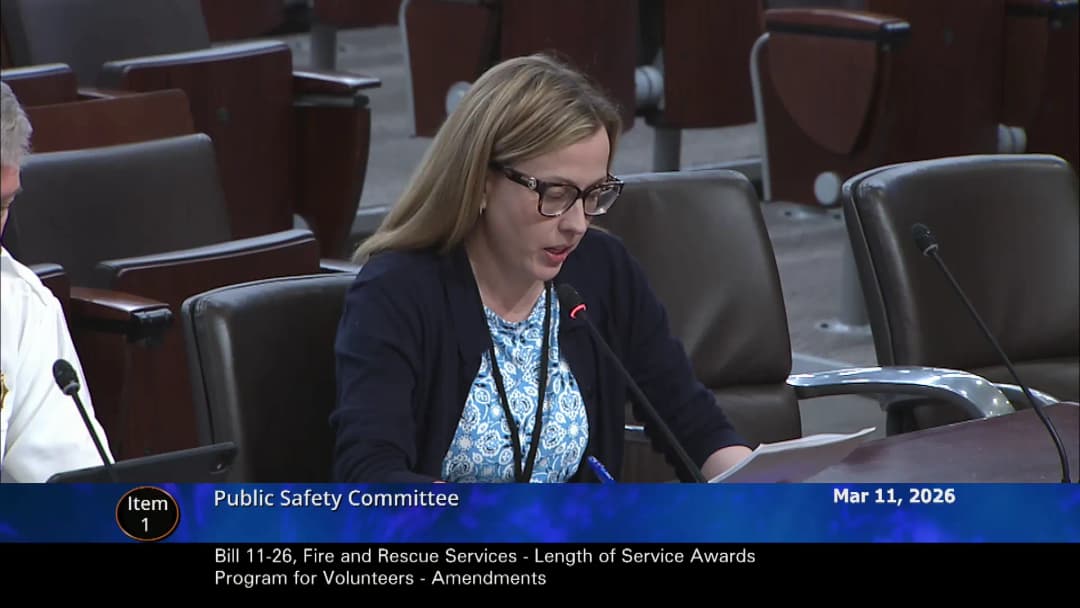
Public Safety Committee Work Session on Bill 11-26, LOSAP Amendments – March 11, 2026

The Montgomery County Public Safety Committee met on March 11, 2026, from 1:00 PM to 1:06 PM to consider Bill 11-26, which implements a negotiated agreement to increase volunteer Length of Service Awards Program (LOSAP) benefits by 4% retroactive to July 1, 2024, and another 4% retroactive to July 1, 2025. The committee unanimously advanced the bill as expedited and recommended its enactment. Discussion Items - Bill 11-26 Overview: Chief Legislative Attorney Christine Wellons explained the bill was introduced at the County Executive's request on February 10, 2026, following a bargained agreement between the Montgomery County Volunteer Fire Rescue Association (MCVFRA) and the County Executive for July 1, 2023 – June 30, 2026. The bill increases LOSAP benefits by 4% from July 1, 2024, and another 4% from July 1, 2025, applied retroactively. - Fiscal Impact: Approximately $110,000 over six years: $25,000 in year one (including retroactive payments) and $17,000 annually ongoing. - Supporting Testimony: Christopher Jennison (MCVFRA) spoke in favor during the March 10 public hearing. Division Chief Michael Kelly (MCFRS) also attended. No public comments were made during the committee work session. - Expedited Status: At staff recommendation, the committee unanimously (3–0) agreed to make the bill expedited, ensuring an earlier effective date. Key Outcomes - Vote to Amend (Expedited): Unanimous (3–0) to amend Bill 11-26 to have an expedited effective date. - Vote to Recommend Enactment: Unanimous (3–0) recommendation to enact Bill 11-26, as amended. - Next Step: Council action tentatively scheduled for March 17, 2026.

FIRE SAFETY 70% · PUBLIC SAFETY 30%
132
MAR 10, 2026 · MONTGOMERY COUNTY, MARYLAND · COUNTY COUNCIL & COMMITTEES
Montgomery County Council Meeting - March 10, 2026

The Montgomery County Council met on Tuesday, March 10, 2026, at 9:05 a.m. in the Council Hearing Room in Rockville, Maryland, with President Natali Fani-González presiding, Vice President Marilyn Balcombe, and all 11 councilmembers present. The meeting included two proclamations, five morning public hearings, a district council session, a semi-annual report from the Maryland-National Capital Park and Planning Commission (M-NCPPC), approval of a consent calendar, and four afternoon public hearings/actions on supplemental appropriations plus two public hearings on landlord-tenant legislation. The meeting adjourned at 2:39 p.m. Consent Calendar - Resolution 20-1056 (Item D): Adopted unanimously (11-0) designating the Montgomery County Collaboration Council for Children, Youth, and Families as the County's Local Management Board, as recommended by the HHS Committee. - Resolutions 20-1057 through 20-1060 (Items E-H): Adopted unanimously confirming County Executive appointments to the Commission on Children and Youth (Brittany Taylor), Racial Equity and Social Justice Advisory Committee (Kathy Guevara, James Stowe), Silver Spring Urban District Advisory Committee (six members), and Wheaton Urban District Advisory Committee (four members). - Items A, B, C: Introduced resolutions supporting the Wheaton Arts and Entertainment District redesignation, the Council of Governments' Local Food Procurement Challenge (Councilmember Friedson noted Montgomery County is the first jurisdiction in the region to support it), and a supplemental appropriation of $400,693 for MCPS's Blueprint Career Advising Program. Public hearings/action scheduled for March 24, 2026. Public Comments & Testimony - Bill 7-26 (Agricultural Buildings): Bob Sissel of Montgomery Agricultural Producers and Link Homing of Fair Access Committee spoke in support; Doug Leckleiter (Montgomery County Farm Bureau) supported; El Sean Ball (controlled environment agriculture farmer) supported with suggested clarifications. All stated the bill would reduce burdens on farms. No opposition. - Expedited Bill 10-26 (Arts and Humanities): Luisa Cardona (Assistant Chief Administrative Officer) testified in support on behalf of the County Executive, noting the need to modernize a 50-year-old governance framework after an internal audit. No other speakers. - Bill 11-26 (Fire/Rescue LOSAP): Christopher Jennison (Montgomery County Volunteer Fire Rescue Association) testified in support, noting the bill implements negotiated terms (two 4% LOSAP adjustments) with a fiscal impact estimated at $110,500 over six years. No opposition. - Bill 12-26 (Developmental Disabilities Providers): No speakers; hearing closed. - Supplemental Appropriation 26-59 (AHCMC): No speakers; hearing closed. - Bill 8-26 (Rent Algorithms): Multiple speakers: - Support: Monique Ashton (Mayor of Rockville), Barry Jackson (Rockville City Councilmember), Cheryl Gannon (Montgomery County Civic Federation), Isola Shaw (Rockville City Councilmember/renter), Martin Michaels (We Are CASA), Matt Losak (Montgomery County Renters Alliance), Ben Winters (Consumer Federation of America), Sergean Yengo (Housing Justice Montgomery), Grant Sams (Rockville Renters United), Ali Ijaz (tenant organizer), Leanne Tobias (retired real estate executive), Janet Frank (Montgomery County Women's Democratic Club). They argued algorithms inflate rents by $70–$112/month, disproportionately harm minorities, and constitute price-fixing. Rockville officials noted eight properties (nearly 2,000 units) in their city are managed by companies named in lawsuits. - Opposition: Brian Anleu (Apartment and Office Building Association) argued the problem is supply, not software, and claimed only one-third of landlords use these tools, accepting recommendations about half the time. Lee Henry raised First Amendment concerns about including public databases. Russell Brazil (Greater Capital Area Association of Realtors) said the bill is overbroad and harms small housing providers. Mike Semko (RealPage senior vice president) stated rents are falling in areas with high RealPage usage due to increased supply, and criticized the bill's ban on public data. - Bill 9-26 (Air Conditioning Standards): - Support: Pascal Lamar (Enclave Tenant Association) and Dick Stoner (property manager) generally supported but asked to keep single-family home exemption (Stoner argued historic homes without AC are affordable and tenants often prefer portable units). The County Executive's Office (Brian Anleu) opposed extending the cooling season to May 15, calling it a comfort issue not a safety one. Discussion Items - District Council Session (9:50 a.m.): - Introduced Remand of Local Map Amendment H-149 (Americana Glenmont, Silver Spring) with additional binding elements regarding building height; action tentatively scheduled for March 24, 2026, with a briefing from the Hearing Examiner. - Introduced Zoning Text Amendment (ZTA) 26-05, Expedited Approval Plan – Job Creation Project, sponsored by Council President Fani-González. It would rename “Signature Business Headquarters” to “Job Creation Project,” lower the required employees from 20,000 to 200, expand eligible zones, and add enforcement provisions. Nine councilmembers requested co-sponsorship. Public hearing scheduled for June 9, 2026. - Introduced and adopted Resolution 20-1055 (11-0) extending the public hearing for ZTA 26-05 to July 28, 2026. Motion by Councilmember Friedson, second by Councilmember Katz. - M-NCPPC Semi-Annual Report (10:05 a.m.): - Planning Board Chair Harris highlighted 44 new plans approved in 2025 (3,100 dwelling units, 600,000 sq ft commercial space), 982 total applications reviewed, and the launch of the Community Planning Academy (463 registered as of the meeting). Director Sartori presented on environmental planning (2,700 trees planted, 17 climate assessments), the new Development Tracker (27,000 units with initial approval, 13,500 with all planning approvals), and ongoing master plans (University Boulevard, Clarksburg Gateway, Eastern Silver Spring, Friendship Heights, Germantown, Wheaton). - Parks Director Figueredo discussed outreach (1,200+ responses to restroom survey), the Black Baseball/Softball project, athletic field policy update (implemented fall 2027), new disc golf course, sign manual, and the facelift program (Porky the Litter Eater restoration). She noted the Potomac Horse Center demolition scheduled for spring 2026. - Councilmember Jawando requested park usage data; Director Figueredo said it's challenging but the 2027 PROS survey will help. Councilmember Katz requested a breakdown of approved units by type; Sartori later stated 80% multifamily, 20% single-family attached/detached. Councilmember Stewart asked about using the Planning Academy model for MCPS boundary studies. Councilmember Sayles raised the need for year-round enclosed spaces in Montgomery Village and the skate park at Centerway Park. Key Outcomes - Votes: All adoptions were unanimous (11-0) unless noted. - Consent Calendar (8 items) approved 11-0. - Resolution 20-1055 (extend ZTA 26-05 hearing date) adopted 11-0. - Supplemental Appropriations (Items 9-12): All adopted 11-0 after public hearings and record closure. - 25-89 (DEP Carbon Reduction/EVSE): $4,011,055 (state grant). - 26-19 (DEP Urban Trees): $719,750 (state grant). - 26-54 (MCPS Literacy Grant): $776,033 (state grant). - 26-55 (MCPS Employee Benefit Plan): $12,000,000 (MCPS fund balance). - Public Hearing Records: All public hearings held; records remain open for written testimony until specified dates (March 10, 12, 16, or 19, 2026, depending on bill). Committee worksessions scheduled for subsequent months. - Referrals: Bill 8-26 and Bill 9-26 referred to the Planning, Housing and Parks (PHP) Committee for a future worksession. Bill 7-26 to ECON (3/23), Expedited Bill 10-26 to GO/EC (3/19), Bill 11-26 to PS (3/11), Bill 12-26 to HHS (TBD), Supplemental 26-59 to GO/EC (3/19).

PARKS AND RECREATION 26% · HOUSING 16% · AFFORDABLE HOUSING 13% · PROCEDURAL 12%
133
MAR 9, 2026 · MONTGOMERY COUNTY, MARYLAND · COUNTY COUNCIL & COMMITTEES
Montgomery County PHP Committee Meeting - March 9, 2026

The Planning, Housing and Parks (PHP) Committee met on March 9, 2026, from 1:46 p.m. to approximately 3:30 p.m. to discuss four agenda items: the FY27-32 Capital Improvements Program (CIP) for Montgomery Parks, Zoning Text Amendment (ZTA) 26-02 regarding regional shopping center overlay zones, ZTA 26-03 on biohealth priority campus eligibility, and ZTA 26-04 on mixed-income housing community eligibility. The committee took votes on all items and set next steps for the parks CIP. Public Comments & Testimony - For the parks CIP, public hearing testimony was overwhelmingly supportive of the park system and its value to residents. - For ZTA 26-02, 26-03, and 26-04, the only registered speaker at each public hearing was a representative from the Montgomery County Planning Board, and no written testimony was received. Discussion Items - Parks CIP (FY27-32): The committee reviewed the Planning Board's requested $11.2 million increase (including $2.4 million in GO bonds for solar, $5 million for Wheaton Regional Park, $3 million for Planned Life-cycle Asset Replacement (PLAR), and $1.8 million for natural surface trails). The County Executive's Affordability Reconciliation PDF proposed reducing GO bonds by $6.4 million and current revenue by $4.8 million. The committee discussed the impact of potential cuts, including loss of federal solar tax credits (30% of $800,000 over two years) and risk to $5.5 million in state grants for Wheaton Action Sports Park. Councilmember Fani-González strongly opposed any cuts to Wheaton Regional Park, while Councilmember Jawando expressed concern over the lack of formal non-recommended reductions from Parks and the need for shared sacrifice across county agencies. - Johnson's Local Park: The committee approved creating a standalone Project Description Form (PDF) for Johnson's Local Park, separating it from the Ballfield Initiatives PDF. The additional funding request of $2.5 million in GO bonds was discussed but not committed, with the committee noting other potential funding sources (current revenue, state aid) and deferring the amount to later budget discussions. - Parkway Improvements PDF: The committee supported the budget-neutral transfer of the Resurfacing Park Roads PDF from the Department of Transportation to Parks, now named Parkway Improvements, following execution of the required MOU. - ZTA 26-02 (Regional Shopping Center Overlay): The committee supported the Planning Board's amendment to remove the 30% gross floor area cap on all housing types and a technical amendment to replace "gross floor area" with "gross leasable area" for consistency. - ZTA 26-03 (Biohealth Priority Campus): The committee supported lowering the square footage threshold for expedited review from 150,000 to 100,000 sq. ft. for new construction and from 50,000 to 25,000 sq. ft. for existing buildings, and adding adaptive reuse of 100,000 sq. ft. as eligible. A technical amendment updated references to the new Expedited Approval Plan section. - ZTA 26-04 (Mixed-Income Housing): The committee supported eliminating the 150,000 sq. ft. requirement and instead requiring at least 50 dwelling units (up from 30) to qualify as a mixed-income housing community. Added 4% Low-Income Housing Tax Credits (LIHTC) to the eligible project types, expected to allow 2-3 additional projects per year. A technical amendment updated cross-references. Key Outcomes - Parks CIP: - Recommended approval of standalone PDF for Johnson's Local Park; funding amount and source to be determined during FY27 Operating Budget review. - Supported the transfer of Parkway Improvements PDF from MCDOT to Parks (budget-neutral). - Supported the Planning Board's recommended changes to Legacy Urban Space acquisition PDF. - Supported consent-level approval for numerous development PDFs with minimal changes (e.g., Advance Land Acquisition Revolving Fund, ADA Compliance, Ballfield Initiatives, Cost Sharing, Energy Conservation, Facility Planning, Minor New Construction, Planned Life-cycle Asset Replacement, Trails, Vision Zero, Warner Circle Special Park, and others). - Expressed preference for full funding of the Parks CIP but requested that Parks provide a detailed summary of operational impacts if reductions are required, including scalable options (e.g., potential loss of solar tax credits if first two years are cut). - Deferred final funding decisions to the March 24 Council worksession, pending further information on current revenue and the operating budget. - ZTA 26-02: Recommended enactment as amended (removing 30% cap and technical correction) by a 3-0 vote. Council action tentatively scheduled for March 24, 2026. - ZTA 26-03: Recommended enactment as amended (lowered thresholds and technical correction) by a 3-0 vote. Council consideration tentatively scheduled for March 17, 2026. - ZTA 26-04: Recommended enactment as amended (adjusted thresholds, added 4% LIHTC, technical correction) by a 3-0 vote. Council action tentatively scheduled for March 17, 2026.

PARKS AND RECREATION 42% · BUDGET EQUITY ANALYSIS 21% · PLANNING AND ZONING 16% · ECONOMIC DEVELOPMENT 12%
134
MAR 9, 2026 · MONTGOMERY COUNTY, MARYLAND · COUNTY COUNCIL & COMMITTEES
Public Safety Committee Meeting - March 9, 2026: EMS Reimbursement Bill and Fire Rescue CIP

The Montgomery County Council's Public Safety Committee met on March 9, 2026, from 1:45 p.m. to 2:21 p.m. to consider two items: Expedited Bill 6-26, which clarifies the use of revenues from the Emergency Medical Services (EMS) insurance reimbursement program, and the FY27-32 Capital Improvements Program (CIP) for the Fire and Rescue Service. The committee unanimously recommended enactment of the bill and approved the CIP as submitted. Expedited Bill 6-26 – Fire and Rescue Services – EMS Insurance Reimbursement Program – Use of Revenues - Background: Since 2013, the county council authorized Fire and Rescue to seek reimbursement for ambulance transports from private insurers, Medicare, and Medicaid. Revenues support equipment, training, and volunteer departments (LFRDs) without additional taxes. A 2025 Inspector General report found the actual disbursement method (via contracts with MCVFRA) inconsistent with the county code as written. This bill corrects the code to match current practice. - Key provisions: The bill allows the annual operating budget to authorize distribution of EMS transport revenues to either MCVFRA or individual LFRDs for specified purposes: apparatus, facilities, training, gear, administrative support, recruitment/retention, and volunteer standby support. The county executive may enter contracts to effectuate distributions. - Public Comment: Russell Hartung, President of the Montgomery County Volunteer Fire Rescue Association (MCVFRA), expressed support for the bill. He initially submitted a suggested wording change but withdrew it after legal counsel advised it would complicate the bill. - Committee Discussion: All three committee members were lead sponsors; all councilmembers were co-sponsors. The bill is described as purely housekeeping—clarifying longstanding practice with no substantive change. Impact statements showed no fiscal or operational impact. - Vote: Unanimous (3-0) recommendation to enact the bill. Council action tentatively scheduled for March 17, 2026. FY27-32 Capital Improvements Program – Public Safety – Fire and Rescue Service - Overview: The recommended CIP includes 10 active projects totaling $157 million over six years, a $23 million (17.2%) increase from the previous amended CIP of $134 million. Increases are primarily due to the new self-contained breathing apparatus replacement project and cost escalations in apparatus replacement, HVAC/electrical upgrades, and the White Flint fire station. Apparatus Replacement Program - Plans include replacing 6 aerials, 40 EMS units, 15 engines, 3 brush/all-wheel-drive vehicles, 3 rescue squad/hazmat units, 3 tankers, and one hazmat support vehicle over six years. Funded with short-term financing and EMS transport revenues. - Adequacy concerns: The department replaces ambulances at a rate of 6 per year, but analysis shows 9 per year are needed to maintain appropriate fleet age. Local fire and rescue departments supplement with their own purchases. Industry consolidation (three manufacturers control 70-80% of market) has led to 2-3 year order backlogs and cost increases (e.g., fire engines from $400k to over $1 million). The committee discussed whether the EMS replacement schedule is adequate and whether alternative apparatus models (e.g., paramedic chase cars) are being considered. Division Chief Bailey confirmed the department is evaluating alternatives but no firm conclusions yet. Committee members expressed interest in revisiting the issue in fall 2026. - Vote: Approved as submitted (3-0). Breathing Air Compressors Replacement - Project to replace compressor systems for self-contained breathing apparatus at multiple stations. Completed at 4 stations in FY25, 2 in FY26; 3 stations scheduled for FY27, 3 for FY28. Total cost remains $1 million, completion expected by FY28. Approved 3-0. Rockville Fire Station 3 Renovation - Station built in 1965. The project, in the CIP since 2001, now includes exploring alternative sites for a new station rather than renovation. Funding ($4.35 million total) pushed to FY28 due to ongoing delays in site selection by Rockville Volunteer Fire Department (RVFD). A potential former MCPS site was mentioned but not available. The county continues to maintain the station: a $397,000 HVAC replacement is in design, and roof replacement is scheduled for FY27. Director Dise noted that even if a site is found, construction would take 7-10 years, so maintaining the existing building is essential. Committee member Katz observed the need for a decision to either renovate or commit to a new site. The project remains in the CIP with no recommendation to change. - Vote: Approved as submitted (3-0) with acknowledgment of the ongoing challenge. Self-Contained Breathing Apparatus Replacement (New Project) - Acquisition of approximately 2,000 face pieces (443 with radio interface, 1,500 without), 1,000 air packs and cylinders. Current face pieces purchased in 2014 exceed 10-year warranty; warranty expires December 2026, after which maintenance costs could exceed $500,000 per year. All costs programmed in FY27. Approved 3-0. White Flint Fire Station - New five-bay station in the Rockville/White Flint area, including associated apparatus. Total project cost $52 million, up $2.7 million due to land acquisition for affordable housing and construction escalation. Design began October 2023, expected completion winter 2026; construction FY27-FY29. Approved 3-0. Level of Effort Projects (All Approved 3-0) - Locker/Shower/Restroom Upgrades: Work completed at Station 8; Silver Spring Station 16 planned for FY30. Cost decrease due to transfer of savings to Sixth District Police Station. - Fire Station Life Safety Systems: Fire alarm system replacements at Kensington Station 21, Hillendale 12, Silver Spring 16. Cost increase from adding FY31-32. - HVAC and Electrical Replacement: Upgrades at Hillendale 24, Travilla 32, Rockville 23 (HVAC design ongoing, construction March 2027); Bethesda 20 construction complete June 2026. Total $3.34 million for Bethesda. - Resurfacing: Bethesda 26 and Laytonsville 17 in FY27; Damascus 13 and Silver Spring 16 in FY28. Costs increased to add FY31-32. - Roof Replacement: Gaithersburg 8 spring 2026; Bethesda 26 FY27; Hyattstown 9, Rockville 3, Silver Spring 16 FY28. Costs increased for FY31-32. Key Outcomes - Expedited Bill 6-26: Unanimous committee recommendation to enact as introduced. Final council action tentatively scheduled for March 17, 2026. - FY27-32 Fire Rescue CIP: Unanimous committee recommendation to approve as submitted by the County Executive. - Ongoing oversight: The committee plans to revisit the adequacy of the EMS apparatus replacement schedule and broader fleet resilience in fall 2026, considering industry backlogs and cost pressures.

PUBLIC SAFETY 60% · FIRE SAFETY 37% · HVAC 3%
135
MAR 9, 2026 · MONTGOMERY COUNTY, MARYLAND · COUNTY COUNCIL & COMMITTEES
Montgomery County Council State Legislative Program Worksession – March 9, 2026

The Montgomery County Council convened at 12:30 p.m. on Monday, March 9, 2026, in the Council Hearing Room, Stella B. Werner Council Office Building, Rockville, Maryland, for a worksession/action on the State Legislative Program. Council President Natali Fani-González chaired; ten councilmembers were present (Councilmember Evan Glass was absent). Staff from the Office of Intergovernmental Relations and the Department of Environmental Protection presented pending state legislation, and the Council determined positions to support, support with amendments, hold, or take no position. Discussion Items - HB 1595/SB 427 – Property Taxes – Data Centers: Garrett Fitzgerald (Department of Environmental Protection) explained the bill would enable counties to create a property tax subclass for qualified data centers and set a special personal property tax rate, allowing rates to be increased or decreased. The County Executive supported the bill; the Council agreed to support it. - SB 992 – Public Utilities – Large Load Customers – Registration and Demand Response Program: Mr. Fitzgerald described a registration process for data centers, financial commitments, disclosure requirements, a voluntary demand response program, and ratepayer protections. Councilmember Jawando opposed providing tax exemptions to data centers; Councilmember Mink asked about fiscal impact and legal authority; Councilmember Sayles and Vice President Balcombe objected to tax incentives; Councilmember Stewart highlighted ratepayer protections. The Council agreed to send a letter supporting the bill generally but opposing the data center tax exemption. - HB 1620/SB 991 – Public Information Act – Inspectors General – Access to Public Records: Staff explained the bill would require custodians to allow inspectors general access to public records. Council staff recommended a clarifying amendment regarding court-sealed records. Councilmembers Friedson and Luedtke strongly urged support, citing recent transparency issues. The Council supported the bill with the clarifying amendment. - HB 506/SB 455 – Transformational Project Financing Program and HB 1580 – Enhanced Tax Increment Financing (TIF) Districts: Staff presented two TIF bills enabling state participation in local projects. Councilmember Mink asked whether HB 506 applies to the Viva White Oak Development District; staff believed it does. Councilmember Stewart requested that HB 1580 be broadened to include transit routes (e.g., bus rapid transit) to benefit Clarksburg and North Bethesda. The Council supported HB 506/SB 455 and held HB 1580 pending verification of Viva White Oak applicability. - HB 565 – County Boards of Education – District Voting: Staff explained the bill would require district board of education members in six counties, including Montgomery, to be elected by voters in their district rather than countywide. Councilmember Evans opposed, stating district-focused members could disadvantage the entire school system; Councilmember Luedtke also expressed concern. Councilmember Sayles suggested no position. The Council took no position. Key Outcomes - Supported: HB 1595/SB 427 (data center property tax subclass); HB 506/SB 455 (transformational project financing). - Supported with Amendments: HB 1620/SB 991 (inspectors general access; add clarifying amendment for court-sealed records). - Supported Conditionally: SB 992 (general support except data center tax exemption; staff to draft letter). - Hold with Intention of Support: HB 1580 (enhanced TIF districts), pending confirmation it applies to Viva White Oak. - Took No Position: HB 565 (school board district voting). The meeting adjourned at 1:16 p.m.

DATA CENTER REGULATION 39% · ECONOMIC DEVELOPMENT 14% · PUBLIC SAFETY 8% · PUBLIC INFORMATION ACT 8%
136
MAR 9, 2026 · MONTGOMERY COUNTY, MARYLAND · COUNTY COUNCIL & COMMITTEES
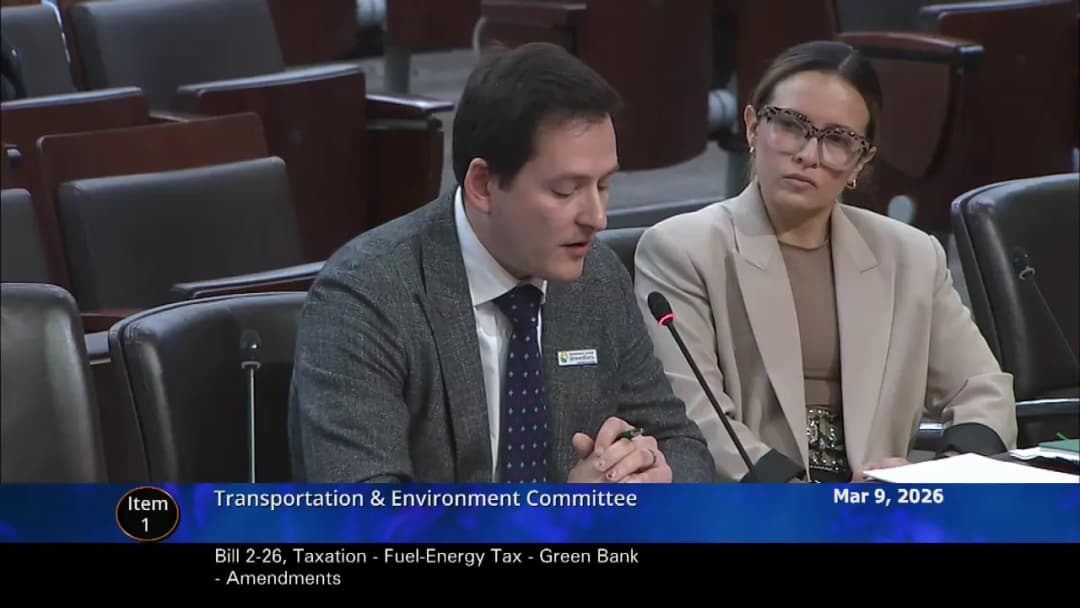
Transportation and Environment Committee Meeting on Bill 2-26 – March 9, 2026

The Montgomery County Council's Transportation and Environment Committee met on March 9, 2026, from 10:00 a.m. to 10:13 a.m. to consider Bill 2-26, Taxation - Fuel-Energy Tax - Green Bank - Amendments. The committee unanimously recommended enactment of the bill, which would allow the Montgomery County Green Bank (MCGB) to use fuel-energy tax revenue for climate resilience activities, in addition to its current uses of promoting investment and financing clean energy technologies. Public Comments & Testimony - At the prior public hearing, testimony was largely in favor of the bill, though not numerous. - The Sierra Club questioned the cost-benefit analyses that might flow from the legislation. - Councilmember Luedtke noted that some testimony suggested the bill should only support one type of project, but she emphasized that both resilience and green energy projects must move forward simultaneously. Discussion Items - Councilmember Dawn Luedtke, lead sponsor, described the bill as a continuation of the work establishing the Green Bank and its fund, enabling projects such as replacing cooling equipment, adding battery backups, installing flood mitigation, rain gardens, green roofs, and permeable pavement. She noted existing MCGB partnerships with multifamily buildings, faith institutions, and Habitat for Humanity. - Legislative Attorney Ogorzalek summarized the staff report: the bill removes a statutory restriction on fuel-energy tax revenue use, allowing it for resilience activities. The fiscal impact is none because the county appropriation to MCGB is unaffected; the climate assessment is net positive; the racial equity and social justice statement is indeterminate; and the economic impact is likely neutral in the short term with potential net positive long-term impact. - MCGB CEO Mr. Morel described the Green Bank's "Protecting the Path to Net Zero" resilience and adaptation strategy, which includes physical and energy resilience tracks and four implementation pathways: packaging solutions, piloting programs, organizing frameworks, and long-term implementation channels. He cited examples such as high-performance new construction, condo retrofits (sewer lines, exterior hardening, EV readiness, cooling towers, new HVAC, flood mitigation, battery backup), and a climate-smart agriculture pilot. He also highlighted a resilience dedicated fund for affordable multifamily housing using an innovative corporate line-of-credit structure. - Chair Evan Glass noted the importance of local action given diminished federal leadership on green infrastructure, stating "our climate resilience is in our own hands these days." - Councilmember Marilyn Balcombe expressed appreciation for the agricultural projects she saw on a bus tour, saying the bill would allow that work to move forward in a bigger way. Key Outcomes - The committee voted unanimously to recommend enactment of Bill 2-26 as introduced. - The bill will proceed to full Council action, tentatively scheduled for March 17, 2026.

CLIMATE CHANGE PLANNING 70% · ENERGY MANAGEMENT 23% · AGRICULTURAL MARKETS 7%
137
MAR 9, 2026 · MONTGOMERY COUNTY, MARYLAND · COUNTY COUNCIL & COMMITTEES
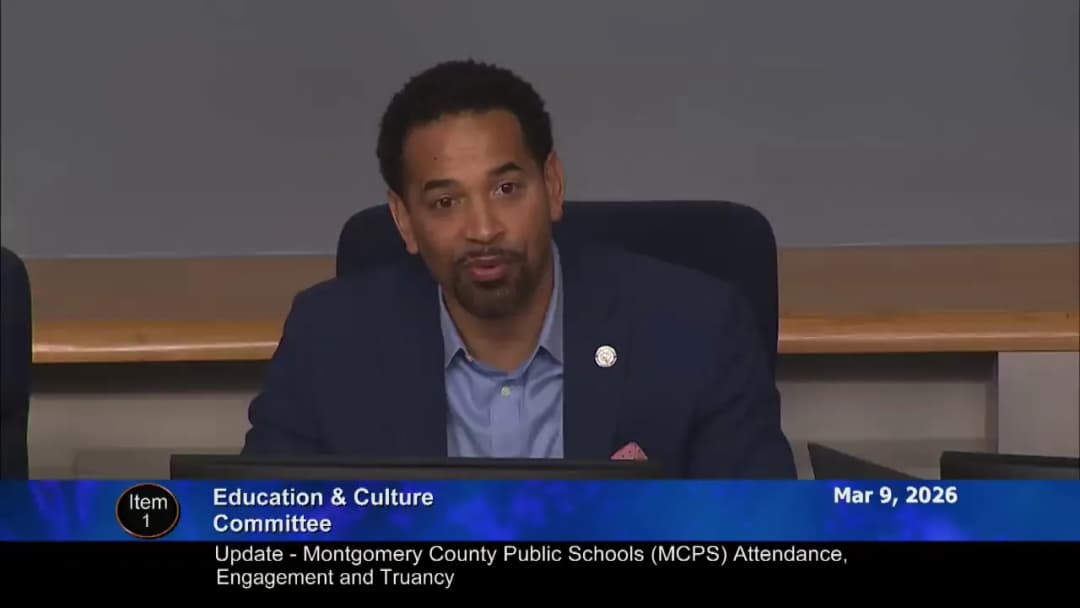
Education & Culture Committee Meeting - March 9, 2026

The Education & Culture Committee met on March 9, 2026 from 9:40 a.m. to 11:29 a.m. to discuss two agenda items: the FY27-32 Capital Improvements Program (CIP) for Montgomery College, and an update on Montgomery County Public Schools (MCPS) attendance, engagement, and truancy. Discussion Items 1. Montgomery College FY27-32 CIP - The committee reviewed the MC CIP request of $499.7 million over six years and the County Executive's recommendation of $445.3 million ($54.4 million reduction). - MC provided a Non-Recommended Reductions (NRR) list: elimination of capital asset management system ($2 million), reduction in IT funding ($2 million per year), and deferral of Germantown Student Affairs Building renovation to prioritize Rockville Theater Arts Renovation. - Committee members expressed support for accepting the NRR, noting the tight budget constraints and importance of the Theater Arts Building for workforce development. Councilmember Jawando, Evans, and Mink all agreed to accept the NRR. 2. MCPS Attendance, Engagement, and Truancy Update - MCPS staff (Dr. Moran, Mr. Neff) presented attendance data and strategies. Overall chronic absenteeism declined by over 2.25% through February 2026, but disparities persist for Hispanic/Latino students, FARMS participants, and at high school level. - Preschool chronic absenteeism improved significantly due to messaging that pre-K is not optional. High school rates remained flat. - Discussion included root causes: health, socioeconomic challenges, disengagement, family circumstances, and recent barriers such as ICE fears and the government shutdown. - Councilmember Mink requested attendance rate data (not just chronic absenteeism) and data disaggregated by cluster and subgroups. She also questioned MCPS policies on excusing absences due to ICE activity, tardiness data, and interventions for partial-day skipping. - Councilmember Evans highlighted positive examples at Einstein High School and Gaithersburg Middle School, and asked about community partner involvement and the Office of Appeals' role. - The committee requested year-over-year attendance data by cluster and subgroup, confirmation of decline in chronic absenteeism for specific clusters, and data on absences due to illness. Key Outcomes - MC CIP Vote: The committee voted 3-0 (Jawando, Evans, Mink) to approve the MC CIP incorporating the NRR list, sending it to full council for consideration. - Data Requests: MCPS to provide: (1) attendance rate data from November 20, 2026 report; (2) year-over-year attendance rates by cluster and subgroups; (3) data driving disparities analysis for FARMS and Hispanic/Latino students; (4) confirmation of chronic absenteeism decline in Einstein and Gaithersburg clusters; (5) data linking programs to attendance impact; (6) percent of absences due to illness. - Next Steps: Continue discussions during Operating Budget worksessions and follow up in fall 2026. Note: The agenda also listed a possible consent calendar, but none was addressed in the meeting.

PUBLIC EDUCATION 76% · IMMIGRATION POLICY 8% · RACIAL EQUITY 3% · PUBLIC ENGAGEMENT 3%
138
MAR 9, 2026 · MONTGOMERY COUNTY, MARYLAND · COUNTY COUNCIL & COMMITTEES
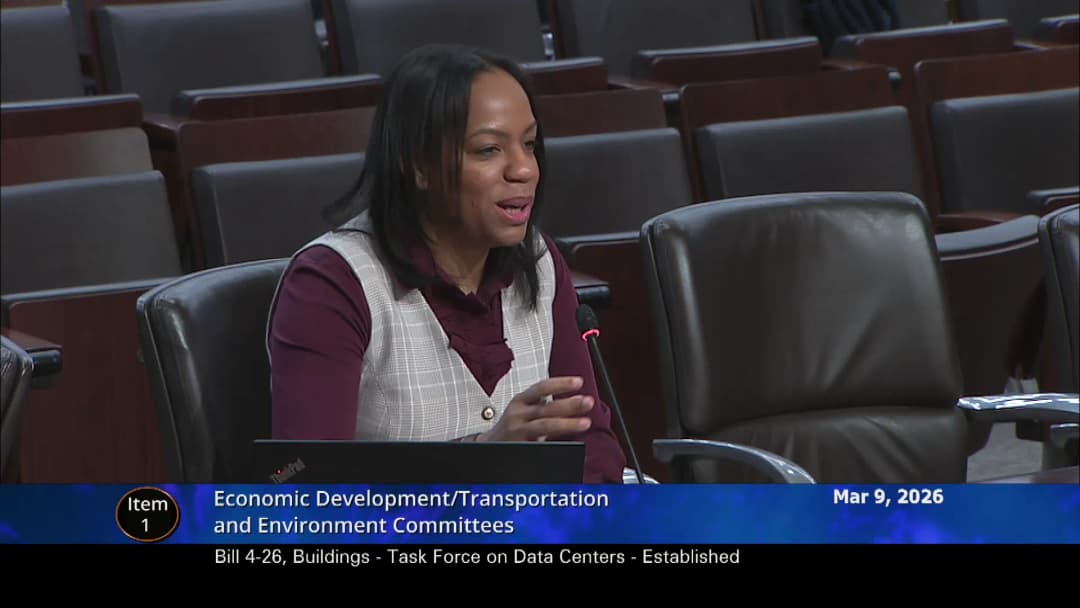
Joint ECON/TE Committee Meeting on Bill 4-26 (Data Center Task Force) – March 9, 2026

This joint meeting of the Economic Development and Transportation & Environment Committees considered Bill 4-26, which would establish a task force to study data center development in Montgomery County. The meeting ran from 9:30 a.m. to 10:46 a.m. in the 3rd Floor Council Hearing Room. After extensive debate and several amendments, the committee voted 3-2 against recommending enactment of the bill. A separate motion for a temporary moratorium on data center approvals was also defeated. Discussion Items - Bill 4-26 – Buildings – Task Force on Data Centers – Established (introduced by Councilmember Glass): The proposed 15-member task force would have studied economic, environmental, and community impacts of data centers, with a report due in one year. Chair Glass later shortened the timeline to six months during discussion. - Amendments Adopted (all without objection): - Glass Amendment 1: Expanded the task force from 15 to 16 voting members by adding the Montgomery County Public Health Officer (or designee) and clarified that civic association and environmental group members must be Montgomery County residents. - Glass Amendment 2 (modified): Required the task force report to consider recommendations from the Maryland Department of Legislative Services’ data center impact analysis – but added the phrase “if feasible” to avoid delaying the task force’s work. Also required the report to include an analysis of and policy recommendations on climate goals (removing the specific quantitative assessment subcomponent after concerns about feasibility). - Stewart Amendment: Explicitly added noise as a required part of the environmental impact study and directed the task force to review emerging technological advancements that mitigate noise, water, air, and energy impacts. - Sayles Amendment: Required that one task force member have expertise in racial equity and social justice. - Technical Amendment: Clarified that the task force must propose a definition of “data center” specific to the county; if the definition differs from the bill’s placeholder, the task force must provide a rationale. (Councilmember Luedtke suggested adding “proposed” before “definition,” which was accepted.) - Moratorium Motion (Defeated): Chair Glass moved to impose a temporary pause (six-month moratorium) on data center approvals while the task force worked. Councilmember Fani-González declined to second, stating the matter should come as a separate bill with a public hearing. The motion died for lack of a second. - Positions on Bill 4-26: - Chair Glass (TE) and Councilmember Stewart (TE) supported the task force, arguing it would ensure transparent, fact-based policy and protect climate goals. - Council Vice President Balcombe (ECON) opposed, noting that extensive stakeholder engagement and analysis were already underway via ZTA 2601, an OLO report, and state legislation; she called the task force redundant and potentially delaying. - Council President Fani-González (ECON) and Councilmember Sayles (ECON) opposed, emphasizing that the ZTA was the appropriate vehicle and that a task force would duplicate existing work. - Councilmember Luedtke (present but not a voting member) offered procedural suggestions but did not vote. Key Outcomes - All four amendments were approved unanimously (without objection). - The motion for a temporary moratorium was defeated (no second). - Bill 4-26 was defeated on a 3-2 vote (in favor: Glass, Stewart; opposed: Balcombe, Fani-González, Sayles). The committee did not recommend enactment to the full Council. - The meeting adjourned at 10:46 a.m.

DATA CENTER REGULATION 72% · CLIMATE CHANGE PLANNING 14% · PUBLIC HEALTH 6% · ENVIRONMENTAL PROTECTION 5%
139
MAR 5, 2026 · MONTGOMERY COUNTY, MARYLAND · COUNTY COUNCIL & COMMITTEES
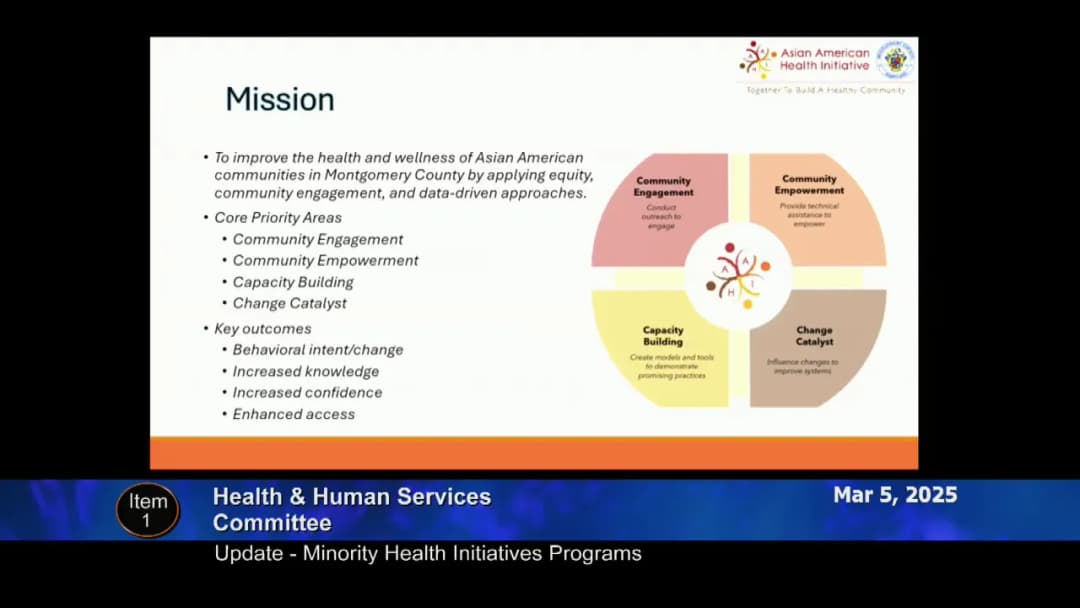
HHS Committee Update on Minority Health Initiatives Programs - March 5, 2026

The Health and Human Services Committee met on March 5, 2026, from 1:05 p.m. to 2:52 p.m. to receive an update on the Minority Health Initiatives Programs (MHIPs), including the African American Health Program (AAHP), Latino Health Initiative (LHI), and Asian American Health Initiative (AAHI). Committee members discussed programmatic achievements, challenges, data evaluation, and future budget priorities. Discussion Items - Presentation Overview: Dr. Davis, Health Officer, provided opening remarks, highlighting that the three initiatives have been in place for over 20 years and were critical during COVID-19 for reaching diverse communities. She noted that Montgomery County is one of the most diverse counties in the nation, with no single racial or ethnic group making up a majority. - Latino Health Initiative (LHI): Senior Manager Mariana Serrani presented LHI's mission, six priority areas, and 14 programs. She highlighted the Welcome Back Center training international healthcare providers, the Parents in Action program (now focusing on elementary school parents after starting in high school), and the climate and health initiative. LHI reported 850–900 community events per year and a digital newsletter with 1,800 subscribers. Budget: $6.2 million appropriated for FY26. Remaining budget: 50–60% expended; on track to spend all funds by June 30. - African American Health Program (AAHP): Program Manager Wine Dixon described AAHP's focus on eliminating health disparities affecting Black residents. Key programs include the SMILE maternal infant health program (home visiting), diabetes prevention (CDC Gold Star designation), remote patient monitoring, and sickle cell awareness. AAHP reported 6% average weight reduction in programs, more than 3,000 community referrals in FY25, and expanded services to French, Haitian Creole, and other diaspora communities. Budget: $4.3 million for FY26. Remaining contract budget: 41%. - Asian American Health Initiative (AAHI): Program Manager Mohammed Hasan presented AAHI's two-pronged approach: direct outreach to residents and capacity building for community organizations. He emphasized the model minority myth and the need for disaggregated data. AAHI highlighted the Asian American Center of Excellence (ACE) microgrants ($101,000 pool, up to $15,000 per organization) and the Healthy Communities Fund ($4 million requested by 37 applicants, 16 awarded). Budget: $3.7 million for FY26. Remaining funding: 90% committed through grants; 10% unallocated. - Committee Feedback: Chair Sayles and Councilmembers Friedson and Luedtke stressed the need for better performance metrics beyond simplistic data collection. Councilmember Friedson urged developing disaggregated, program-specific metrics with clear performance targets, comparing county trends to national trends to evaluate impact. Chair Sayles emphasized the importance of qualitative impacts and kinship relationships among program participants (e.g., multiple household members in different programs). Councilmember Luedtke raised concerns about immigration fears reducing engagement, particularly for home visiting programs like SMILE, and asked about adaptive strategies (e.g., virtual visits, word-of-mouth promotion, avoiding publicizing event locations). - Challenges Identified: Immigration fears are causing reduced in-person participation and a shift to telephone/SMS communication. Barriers to virtual services (telehealth, digital literacy) remain significant. The committee noted that mental health stigma is decreasing but demand is rising. The upcoming expiration of LHI's 10-year blueprint (end of 2026) requires a new needs assessment. Key Outcomes - Committee members recommended that DHHS develop a standardized but program-specific performance evaluation framework with clear metrics, disaggregated data, and comparative analysis (e.g., national trends) to better assess impact and guide budget decisions. - Dr. Davis committed to working collectively across the three initiatives to align data collection and evaluation, leveraging the new structural connection to the health officer and access to epidemiologists. - The committee acknowledged the programs' strengths: cultural competency, community trust, and innovative responses to emerging needs (e.g., mental health, climate health, substance use prevention). - No formal votes were taken; the update was informational. The next discussion on MHIPs will occur during the FY27 budget review after the county executive's budget release on March 13 (or 15), 2026. - Staff were encouraged to continue collaborating with the Office of Community Partnerships and other county agencies to address immigration-related barriers and maintain community trust.

MINORITY HEALTH 39% · PUBLIC HEALTH 33% · MENTAL HEALTH AWARENESS 14% · COMMUNITY ENGAGEMENT 4%
← PREVIOUS
01…1314
OPENPUBLICA · PUBLIC MEETING INDEXUPDATED DAILY · openpublica.com