The Historical Review and Design Commission (HRDC) met on August 19, 2026, at 3:00 PM with a quorum present. Chair Maris Gibbs presided. The commission considered several certificates of appropriateness, a historic designation evaluation, and other agenda items. Key discussions included the Silver Line bus rapid transit project, a historic designation request for 507 West Craig Place, and multiple residential alteration proposals. Consent Calendar - Routine approvals were granted for items 1, 2, 3, 5, 6, and 8, as recommended by staff, with no public testimony. These included addresses: 1970 Pepper Farms, 310 Broadway, 229 Madison Street (pulled), 415 Wiks, 16- era Buena Vista, and 115 Queen's Screens. Public Comments & Testimony - Item 11 (507 West Craig Place): Multiple residents spoke in favor of historic designation for the property. Jennifer Cushman, representing the Alta Vista Neighborhood Association, argued the house is historically significant and fits the scale of the neighborhood. Cecilia Mendoza, an architect and property owner, emphasized the house's integrity and urged preservation. Henry Krauss, a Beacon Hill resident, warned against demolition by neglect and stressed the importance of maintaining historic fabric. The property owners, Ernie and Yosenia Spee, and their architect, Scott Carpenter, opposed the designation, stating the house has undergone extensive modifications and is structurally unsound, making rehabilitation infeasible. They expressed desire to build a new home that respects the neighborhood's character. Discussion Items - Item 4: Silver Line Bus Rapid Transit Stations (229 Madison, 542 Hammond) – Kristin Viña of VIA Metropolitan Transit presented updated station designs, including consolidation of validator and ticket vending machines, reduced height of equipment boxes, and color changes. Staff recommended approval with stipulations including archaeological reporting and landscaping. Commissioners questioned the placement of validator machines, station design in historic districts, and the lack of distinctive architectural elements for historic neighborhoods. The commission approved the project as presented with staff stipulations, with a 10-1 vote (Commissioner Fetzer dissenting on the lack of historic sensitivity). - Item 7: 1554 Germanos (Porch Modification) – The applicant, Michael Angelo Valdez, requested a certificate of appropriateness to replace a small section of porch flooring and decking due to drainage issues. The commission debated the use of composite vs. pressure-treated wood. The motion to approve as a repair with the stipulation that the new material be composite (Tannen Group) to improve longevity was approved (9-2, with Commissioners Fetzer and Gibbs dissenting? Actually the vote was: Nehemen yes, Sabino yes, Velázquez yes, Galloway yes, Mazuca yes, Guevara yes, Grook no, Travieso yes, Holland yes, Fetzer no, Gibbs yes. So 10-1? Fetzer no, others yes. So approved 10-1.) - Item 9: 219 Refugio Street (Window, Addition, Fencing) – Applicant Kenny Rogers proposed a rear addition with corrugated metal siding, a front window, and metal fencing. Staff recommended approval with conditions to match window design, limit fence heights, and use natural colors. The commission debated the appropriateness of metal vs. wood siding and fence materials. The final motion approved the project with modifications: the front window must match existing design, the rear addition may use metal siding but must be painted natural tones, the front fence limited to 4 feet in height with wood posts, and the side fence limited to 4 feet until past the front of the house. The motion passed (10-1, with Commissioner Fetzer dissenting on the metal siding). - Item 11: 507 West Craig Place (Historic Designation Evaluation) – The Alta Vista Neighborhood Association requested evaluation of the property for individual historic landmark designation. Staff presented criteria: the house was built in 1929 and has undergone significant alterations, including a 1970s porch addition, replaced windows, and interior modifications. The commission discussed eligibility under criteria 3, 5, 11, and 13 (identification with significant persons, embodiment of architectural style, cultural heritage, and collection of properties). A motion to find the property historically significant failed (5-6). A subsequent motion to deny historic designation passed (4-6? Actually the vote was: Nehemen no, Sabino no, Velázquez no, Galloway yes, Mazuca no, Guevara yes, Grook no, Travieso yes, Holland yes, Fetzer no. That's 4 yes, 6 no? The motion passed, so the commission recommended against designation. The matter will be forwarded to City Council for final decision.) - Item 12: 7303 O'Connor Road (Duplex, River Improvement Overlay) – Applicant Jaime Jiménez presented a duplex project. Staff recommended approval with stipulations including prototypical design, front door orientation, and archaeological review. The commission mandated that at least 66% of front doors face the public street (O'Connor Road) to improve community interaction. The project was approved with this condition (10-1, with Commissioner Grug dissenting). - Item 14: 206 La Vaca Street (Caliche Block House Restoration) – Applicant Connie (representing owner) proposed widening the front entrance, modifying the porch roof, and removing stamped stucco to expose original caliche block. The commission debated the appropriateness of a single wide door versus double doors, the porch roof design, and the exposure of caliche. The motion approved the project with stipulations: the entrance width must be reduced to retain historic proportions, the porch roof must maintain its current shape with tongue-and-groove ceiling, and the caliche must be treated with hydraulic lime wash. The motion passed unanimously (11-0). - Item 13: Postponed – The applicant was not present; the item was postponed to the September 2, 2026 meeting. Key Outcomes - Consent Calendar: Approved for routine items. - Silver Line: Approved with staff stipulations (10-1). - Porch repair (1554 Germanos): Approved as repair with composite material requirement (10-1). - Refugio Street project: Approved with modified conditions (10-1). - Historic Designation (507 West Craig Place): The commission voted (4-6? Actually the motion to deny passed, so the commission recommends against historic designation. The matter will go to City Council. - Duplex on O'Connor Road: Approved with condition that ≥66% of front doors face the street (10-1). - La Vaca Street restoration: Approved with stipulations (11-0). - Item 13: Postponed to September 2, 2026.
Public Meetings - San Antonio, Texas
Public Meetings - San Antonio, TexasOn Wednesday, August 19, 2026, at 2:03 PM, the San Antonio City Council convened a budget work session to discuss two alternative scenarios for balancing the FY27 proposed budget. The session was called to order by the Mayor and included roll call of council members. City Manager Eric and Budget Director Freddie Martinez presented two options: additional spending cuts to avoid any property tax increase, or moving the previously planned FY28 property tax capacity into FY27, which would raise the tax rate more in one year but restore many proposed reductions. Discussion Items - Scenario 1 (No property tax increase): This would require an additional $75 million in cuts over two years (total $164.6 million), eliminating 171 positions (154 filled). Cuts include elimination of quality assurance team, animal care trainer program, half of discretionary delegate agency funding, downtown event activation, neighborhood enhancement team, senior services, parks programming (dance, music, arts, summer youth, volunteer services), library adult services and interlibrary loan, minor home repair program, and several outside contracts (Biomed, Dream Voice, LISC, etc.). Also includes elimination of the World Heritage Office and consolidation of Transportation into Public Works. - Scenario 2 (Move FY28 property tax capacity to FY27): This would increase the property tax rate by 8.7% in one year (vs. 8.3% over two years in the original proposal). It provides $127.4 million in revenue, reduces required cuts from $89.6 million to $57.6 million, and restores $26.3 million in reductions including hiring freeze, rescue partner initiative, neighborhood enforcement team, downtown event funding, fire explorer program, tuition reimbursement, SAEP scholarships, botanical garden funding, police special initiatives, street maintenance, delegate agency funding, and World Heritage Office programs. - Property Tax Impact: The original proposal showed an average monthly increase of $2.95 per homestead (avg value $231,356). Under Scenario 2, the increase would be higher, with some districts seeing larger monthly impacts due to differing appraisal growth. Budget Director noted that Scenario 2 would result in an 8.7% tax rate increase, not simply the sum of the two-year percentages. - Councilmember Positions: Multiple councilmembers expressed strong opposition to Scenario 1. Councilmember Via Gran said he would not support losing 171 jobs and wanted to know the names and districts of affected employees. Councilmember Mungia supported Scenario B (scenario 2) and stressed the need for transparency about cuts. Councilmember Galvan was opposed to Scenario 1 and supported the original proposal with possible tweaks. Councilmember Castillo argued austerity leads to unemployment and criticized cuts to police and fire overtime. Councilmember White opposed any tax increase, advocated for deep internal cuts, and questioned the long-term deficit (projected $135M in five years even with tax increase). Councilmember Corps supported the original proposal as a pacing strategy and noted multiple other impending cost increases. Councilmember Aldrate-Gavito wanted more internal administrative cuts rather than resident-facing services. Councilmember McKee Rodriguez rejected Scenario 1, emphasized that district 2 residents need services and cannot afford cuts, and asked for more analysis on tax impacts per district. Councilmember Mesa-Gonzalez expressed discomfort with Scenario 1 and supported the original proposal with additional exploration of internal cuts. Councilmember Spears was against any tax increase and wanted focus on essential services and zero-based budgeting. Councilmember White also proposed cutting police pay raises as a way to reduce the deficit. - Additional Proposals: Councilmember McKee Rodriguez suggested scrutinizing the police collective bargaining agreement (102M increase) as a potential source of savings. Several members requested more detailed breakdowns of cuts by district, resident usage data, and impact on city employees. The Mayor asked for a better format to explain tax impacts to residents. Key Outcomes - No formal vote was taken, but the City Manager asked for clear direction on which path to pursue. A majority of council members expressed support for Scenario 2 (moving tax capacity to FY27) or the original proposed budget, with some members wanting further tweaks to prioritize certain programs (e.g., libraries, parks, senior services). - Staff will provide additional analysis: breakdown of tax impacts by property value ranges, information on the 171 positions (vacant vs. filled), and a comparative analysis of how San Antonio’s administrative costs compare to other Texas cities. - The council agreed to continue using the original proposed budget as a planning basis while staff works on amendments based on council feedback. - The budget process will proceed with further work sessions and a budget town hall scheduled for August 24 (District 5) and other districts. A final budget adoption is expected by September 2026. - Staff will also explore additional non-property tax revenue options (e.g., increased developer fees, barge fees for non-residents, potential use of TIRZ funds) and evaluate the ROI of various contract agencies before the final vote.
The San Antonio City Council held a budget work session on Thursday, August 19, 2026, to discuss two alternative scenarios for the proposed FY2027 budget. City Manager Eric and Assistant City Manager Freddy Martinez presented two scenarios requested by the council: Scenario A, which avoids any property tax increase by implementing $75 million in additional spending cuts beyond the already proposed $89.6 million in cuts, and Scenario B, which uses the full property tax increase capacity (8.7% in one year instead of the original 8.3% over two years) to restore most cuts. The meeting featured extensive debate among council members about the trade-offs between tax increases and service reductions, including the potential elimination of 171 positions in Scenario A. No final decision was made; staff was directed to provide additional data and impact analyses before the next budget hearing. Discussion Items - Presentation of Two Budget Scenarios: City Manager Eric and Assistant City Manager Freddy Martinez presented the two scenarios. Scenario A requires an additional $75 million in cuts to keep the property tax rate flat, including eliminating 171 positions (132 in FY27 and 39 in FY28), closing community centers, reducing library hours, ending programs like Café College, adult services, and sports programs, and consolidating departments. Scenario B uses the proposed 8.7% tax increase (moved from FY28 to FY27) to restore most cuts, preserving those programs and jobs. The original proposed budget had an 8.3% increase over two years. Staff noted that even with the tax increase, the five-year forecast still shows a $135 million deficit. - Council Member Positions: Multiple council members expressed concerns about the deep cuts in Scenario A, particularly the loss of jobs and services for vulnerable residents. Council Member Galván stated she could not support further cuts beyond the original proposal and emphasized the importance of transparency. Council Member Munguía asked for more context on the number of residents affected by each cut. Council Member Castillo worried about public safety impacts from cuts to overtime for first responders and to animal services. Council Member Villagran stressed that losing 171 jobs would harm families and supported Scenario B to preserve services. Council Member White argued for Scenario A, insisting that the city cannot keep raising taxes and must make tough decisions now, pointing to the persistent deficit. Council Member Core requested better communication tools to show residents the actual property tax impact per home. Council Member Mesa González asked for a breakdown of which positions are vacant versus filled. Council Member Spears expressed strong opposition to any tax increase and wanted a line-by-line review of all contracts and agency funding. Council Member Alderete Gavito suggested exploring internal administrative cuts before cutting resident services. Council Member Maquir Rodríguez criticized the lack of willingness to increase revenue and noted the police department's $102 million increase in the budget. - Staff Responses: Staff agreed to provide additional data, including the number of residents using specific programs (e.g., 40,000 adults use library senior services annually, 62,000 attend library classes), the district-by-district impact of the tax increase with home value ranges, a breakdown of positions, and a comparison of San Antonio's administrative costs to other Texas cities. Staff also noted that the city spends very little on administration and that internal cuts alone cannot solve the deficit. Key Outcomes - No formal vote was taken. The council members indicated a split between those leaning toward Scenario A (no tax increase, deep cuts) and those supporting Scenario B (8.7% tax increase to maintain services). The majority of speakers seemed to favor Scenario B or the original proposed budget with minor adjustments, but a clear consensus was not reached. - Staff was directed to produce detailed impact analyses for each district, including the number of residents affected by each proposed cut, the monthly dollar impact per home value range under Scenario B, a breakdown of the 171 positions (filled vs. vacant, part-time), and a historical comparison of property tax rate changes in other Texas cities. - The council will continue budget discussions in the coming weeks, with the next work session scheduled for September 3, 2026 (later moved to a later date due to time constraints). The meeting adjourned at 4:19 PM.
The Historic and Design Review Commission (HDRC) met on Wednesday, August 19, 2026, at 3:00 p.m. The meeting was called to order by Chairman Jay Maurice Gibbs with a quorum present. The commission considered consent agenda items, several individual cases, and a historic significance review. The meeting adjourned at 6:22 p.m. Consent Calendar - Items 1, 2, 3, 5, 6, and 8 were approved unanimously with staff stipulations. (Items 4, 7, and 9 were pulled for individual discussion.) - Approved addresses: 1979 Pape Farms, 3101 Broadway, 229 Madison, 415 Wix, 1601 Buena Vista, and 515 Queen's Crescent. Public Comments & Testimony - Item 11 (507 West Craig Place): Three speakers supported a finding of historic significance: - Jennifer Koshpin, representing the Alta Vista Neighborhood Association, argued the home meets criteria 3, 5/12, and 11, emphasizing its economic heritage and working-class roots. - Celia Mendoza, architect and property owner in Alta Vista, presented Zillow photos and suggested the house may be from 1911, using salvaged materials typical of the era. She noted prior landmark designations without owner consent in 2019. - Henry Krauss, from Beacon Hill Neighborhood Association, warned of demolition by neglect and speculation, stating this is a well-maintained property and not a hardship case. Discussion Items - Item 4 – VIA Silver Line Bus Stations: VIA Metropolitan Transit presented plans for new stations, agreeing to consolidate elements, reduce communication box heights, and change colors. Discussion focused on the placement of ticket vending machines and validators, and whether a custom housing could incorporate both units. Commissioners noted aesthetic concerns, especially in historic districts, and suggested holistic design approaches. The item was approved with staff stipulations (unanimous). - Item 7 – 544 Hammond Avenue (Porch Reconstruction): Applicant Michelangelo Valdez requested standard weatherized decking rather than tongue-and-groove to allow drainage, citing budget constraints. Staff recommended tongue-and-groove per porch guidelines. After discussion, the commission approved replacing in-kind (matching existing materials) subject to submission of detailed railing/balustrade drawings. Vote: 10-1 (Commissioner Savino opposed because of drainage concerns with wood). - Item 9 – 219 Refugio Street (Multiple Modifications): Applicant Candid Rogers proposed a carport with corrugated metal siding, metal fencing, and rear addition. Debate centered on the fencing material (metal vs. wood) and rear addition siding. Commissioner Group moved to approve with amendments: allow metal fencing for front/side yards but keep wood siding requirement for rear addition. The motion passed 9-2 (Commissioners Savino and Velasquez opposed). The front window size and design remain under staff stipulations. - Item 11 – 507 West Craig Place (Historic Significance Review): The Alta Vista Neighborhood Association requested a finding of historic significance to prevent demolition. OHP staff recommended denial due to lack of integrity. After extensive testimony and debate, a motion to approve historic significance failed (4 ayes, 6 nays). An alternate motion to deny historic significance passed 7-3 (Commissioners Savino, Mazuka, Group, Fetzer voted no). The property will not be referred to City Council for landmark designation. - Item 12 – 7303 Old Corpus Christi Road (Multifamily Residential): The applicant agreed to use a modified prototype with front doors facing Old Corpus Christi Road for the two easternmost lots. Commissioner Fetzer raised concerns about neighborhood interaction. A motion to approve with staff stipulations and requiring 66% of units to have front-facing doors passed 9-1 (Commissioner Group opposed, citing design concerns). - Item 13 – 207 Lavaca Street: Continued to the September 2, 2026 meeting as the applicant was not present. - Item 14 – 206 Lavaca Street (Caliche Block Home Modifications): The applicant proposed widening the front entry, modifying the porch roof, and exposing caliche block. Commissioner Group moved to deny widening (item 1), approve porch modifications with stipulations 2.2/2.3 (shed roof, standing seam metal, tongue-and-groove decking), and approve removal of faux stucco with requirement to apply hydraulic lime plaster on the sides and around the corner to protect caliche. Motion passed unanimously. Key Outcomes - Approvals with staff stipulations: Consent agenda items; VIA Silver Line stations; 544 Hammond porch (repaired in-kind); 219 Refugio Street modifications (with amendments on fencing and siding); 7303 Old Corpus Christi Road multifamily (with 66% front-facing doors requirement). - Denial: 507 West Craig Place – no finding of historic significance. - Partial approval: 206 Lavaca Street – front entry widening denied; porch and stucco removal approved with conditions. - Continued: Item 13 (207 Lavaca Street) to September 2, 2026. - Next meeting: The annual Home Repair Fair announced for September 12, 2026.
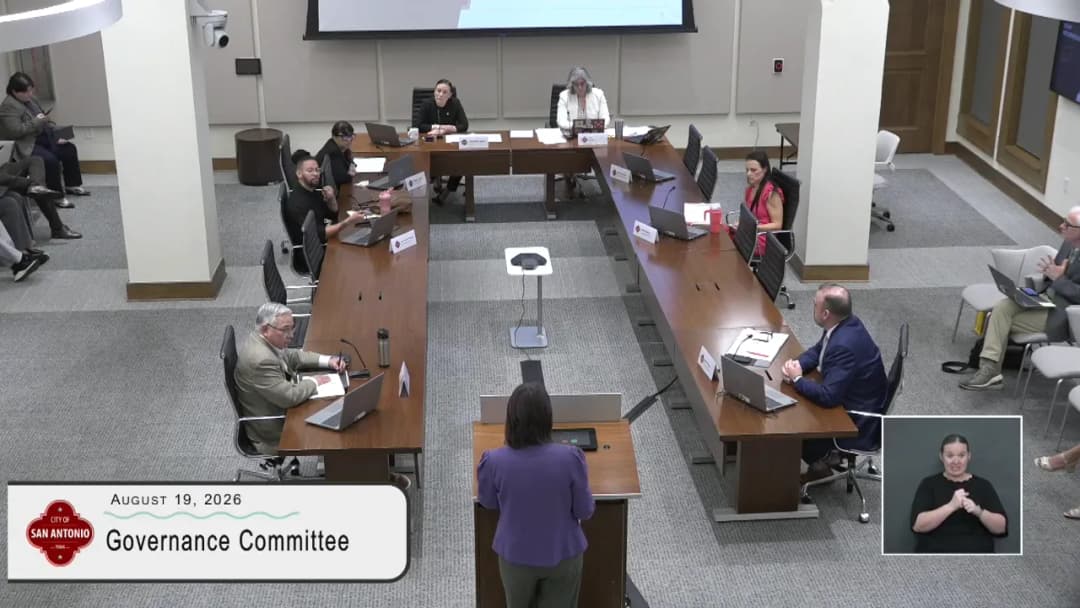
The Governance Committee of the San Antonio City Council met on Wednesday, August 19, 2026, at 10:04 AM. The meeting covered approval of previous minutes, an update on establishing a regular review cycle for city boards and commissions, and a council consideration request (CCR) for an east side corridor economic development master plan. The committee voted to advance both items. Consent Calendar - Approval of Minutes: The minutes from the previous month were approved unanimously by voice vote. No corrections were noted. Public Comments & Testimony - No members of the public spoke. Discussion Items - Item 2 – Ad Hoc Committee on Boards (CCR by Councilmember Mark White, District 10): City Clerk Debbie Rocka Sitter presented the ad hoc committee’s proposal to create a structured, cyclical review of all city boards and commissions, replacing the current “periodic” review with a set two‑year cycle (even‑numbered years beginning in 2026). The committee approved a board evaluation worksheet to be completed by each board with its liaison. Proposed code amendments would require the Mayor to appoint a three‑member ad hoc committee in January of even‑numbered years and mandate that board members complete training within 90 days (reduced from one year). Committee members discussed concerns about evaluation criteria (e.g., quorum, alignment with council priorities), ensuring individual board member voices are heard, and the potential need for a supplemental survey. Councilmember McKee Rodriguez suggested a short, anonymous survey for all board members to provide independent feedback; the clerk agreed to develop one for ad hoc committee review. - Item 3 – East Side Corridor Economic Development Master Plan (CCR by Councilmember McKee Rodriguez, District 2): Staff presented a CCR requesting a comprehensive revitalization and master development plan for a major commercial corridor on the east side. The proposal includes corridor infrastructure improvements, targeted small business investments, strategic land acquisition, public‑private partnerships, anti‑displacement protections, and a financial strategy leveraging federal, state, county, and potential Spurs community benefits funds. Staff recommended referring the item to the Economic and Workforce Development Committee (EWDC) to evaluate implementation options, funding sources, and a timeline. Councilmember McKee Rodriguez expressed strong support, noting resident interest in corridors like South WWY and citing the need for creative financing (e.g., Inner City Capital Fund). The motion to refer passed. Key Outcomes - Item 2 (Board Review Cycle): Motion to approve the staff recommendation (send code amendments to a session) passed unanimously by voice vote. The motion also included an amendment to change the required board member training timeline from one year to 90 days. The clerk will develop a survey for individual board members and coordinate with the ad hoc committee for its release before October 2026. - Item 3 (East Side Corridor Plan): Motion to approve staff’s recommendation to refer the CCR to the Economic and Workforce Development Committee passed unanimously by voice vote. - Meeting adjourned at 10:54 AM.
The Governance Committee met on August 19, 2026, to discuss updates to city code regarding board and commission review cycles and to consider a request for a master economic development plan for District 2. The committee approved the minutes of the previous meeting and moved forward with recommendations on both agenda items. Consent Calendar - Approval of meeting minutes: Motion approved unanimously. Discussion Items - Board and Commission Review Process (CCR Article 2): City Secretary David Rockasierles presented an update on implementing a periodic review of all city boards and commissions. An ad hoc committee consisting of Councilmembers Makin Rodríguez (Chair), Mesa González, and Mark White held its first meeting on August 3 to establish a biennial review cycle. Proposed code updates include shifting the review to a triennial cycle, with the mayor establishing the committee in January of even years. The evaluation tool will be a standardized worksheet, but the secretary recommended it be added to the code only as a reference point. Discussion centered on evaluation criteria, the role of city staff versus the committee, and ensuring boards are effective. Concerns were raised about quorum issues and member training. Councilmember Spears emphasized the need for a structured evaluation process and suggested a survey of board members to capture their experiences. The committee agreed to refine the evaluation tool and return to the ad hoc committee in October. - Training Requirement Change: The committee discussed a proposal to reduce the required training period for new board members from one year to 90 days. The city secretary reported that the current code states one year, but online guidance says 90 days. The committee voted to recommend changing the code to require training within 90 days, and to include a survey of board members. - Master Economic Development Plan for District 2: Councilmember Makin Rodríguez presented a request for staff to develop a comprehensive economic development master plan for District 2, including infrastructure improvements, small business investments, strategic land acquisition, public-private partnerships, long-term protections against displacement, and a financing strategy. Staff noted that internal efforts and external collaborations are already underway. Councilmember Rodríguez expressed a desire to see a coordinated plan that prioritizes corridors and neighborhoods. The committee voted to approve the request and refer it to the Economic and Workforce Development Committee for further evaluation of options, timelines, and resources. Key Outcomes - Motion to approve code amendments: A motion was made and seconded to change city code sections to require board member training within 90 days instead of one year. The motion passed unanimously. - Motion to approve the economic development plan request: A motion to approve Councilmember Rodríguez's request for a District 2 master economic development plan was made, seconded, and passed (with one vote recorded as 1054, likely a roll call number). - The committee will reconvene in October to review evaluation results from the ad hoc committee.
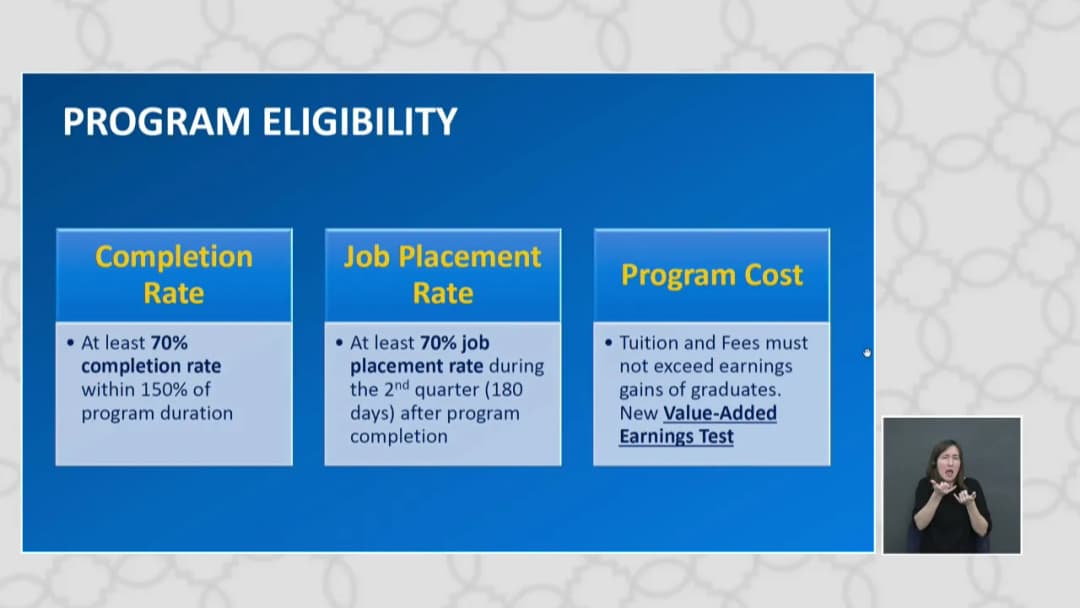
El Comité de Oportunidades Educacionales (Educational Opportunities Committee) se reunió el 18 de agosto de 2026 a las 10:15 a.m. para revisar dos presentaciones principales: una herramienta de visualización de datos geoespaciales para alinear programas de la ciudad con poblaciones de oportunidad juvenil, y una actualización sobre el programa Workforce Pell (PEL) de Alamo Colleges. Los miembros del comité discutieron métricas de resultados, brechas de datos y próximos pasos para mejorar la rendición de cuentas y la toma de decisiones basada en evidencia. Approval of Minutes - Se aprobó la minuta de la última reunión de forma unánime. Discussion Items - Herramienta de Visualización de Datos (GIS): El personal presentó un prototipo de mapa que muestra la ubicación de jóvenes de oportunidad (16 a 24 años, desconectados del trabajo y la educación) y cómo los programas de la ciudad (Servicios Humanos, Cortes Municipales, Desarrollo Laboral, etc.) se alinean geográficamente con estas poblaciones. Se destacó que la mayoría de las concentraciones están en el Distrito 4. El personal demostró que el mapa puede desglosarse por programa y ubicación de servicios. - Posiciones de los concejales: - Concejal Record expresó apoyo por la herramienta, pero solicitó ver métricas de cambio a lo largo del tiempo (p. ej., tasas de graduación, resultados de exámenes) para evaluar el impacto real de los programas. - Concejal Rodriguez enfatizó la necesidad de incluir resultados históricos (2020-2025) y otras variables como salud, seguridad alimentaria, y acceso a seguros para medir mejor las brechas en el sur, este y oeste de la ciudad. - Se discutió la posibilidad de añadir capas de infraestructura comunitaria (parques, centros de salud, iluminación) para enriquecer el análisis. - Decisión: El comité acordó continuar explorando la herramienta, enfocándose primero en la preparación para kinder (Kinder Readiness) y llevar el tema a la próxima reunión con indicadores de resultados claros. - Programa Workforce Pell (PEL): Priscila Camacho, Jefa de Relaciones Externas e Industria de Alamo Colleges, presentó los requisitos del nuevo programa federal de ayuda financiera para programas de capacitación a corto plazo (8-14 semanas, 150-599 horas). Explicó que los programas deben estar alineados con ocupaciones en demanda, tener un 70% de tasa de finalización y colocación laboral, y cumplir con criterios de salario mínimo. Se mencionaron desafíos como la rigidez de la duración del programa (8 semanas) y la exclusión de ocupaciones de bajo salario pero alto valor social (ej. educación infantil temprana). - Posiciones de los concejales: - Se preguntó sobre el impacto en estudiantes de CDL (licencia de conducir comercial) y la compatibilidad con el programa Ready to Work. Priscila confirmó que están trabajando para que el programa CDL sea elegible. - Se discutió la necesidad de incluir más ocupaciones de alto valor comunitario y mejorar la comunicación con los estudiantes sobre la disponibilidad de recursos. - Próximos pasos: Alamo Colleges continuará abogando por ajustes federales y estatales, y se comprometió a trabajar con la ciudad para alinear la elegibilidad con las necesidades locales. Key Outcomes - El comité solicitó que la herramienta GIS se refine para incluir datos históricos y resultados de programas (ej. tasas de graduación, colocación laboral) antes de la próxima reunión. - Se acordó que la discusión sobre el Workforce Pell se trasladará al comité de presupuesto y finanzas para evaluar el impacto financiero. - La reunión se levantó a las 11:28 a.m., con la instrucción de que el equipo técnico presente una versión mejorada del mapa y una propuesta de métricas de resultados en la próxima sesión.
August 18, 2026, from 10:15 a.m. to 11:28 a.m. The Education Opportunities Committee convened with quorum. The minutes of the previous meeting were approved unanimously. Public Comments & Testimony - Jillian Jordan, representing City Education Partners, announced the launch of the San Antonio School Quality Explorer, an interactive tool that aggregates Texas A-F accountability data to help stakeholders understand school performance over time and across districts. She expressed hope that the tool would support the committee's work on opportunity youth and education outcomes. Discussion Items - Opportunity Youth Visualization Prototype: Alice Lupin presented a mapping tool that overlays the geographic distribution of opportunity youth (ages 16-24 disconnected from work and school) with data from city programs serving this population. Key statistics: 36,000 opportunity youth in Bexar County; 2,411 individuals were served across six programs (Teen Club, Next Level, Healy Murphy, YWCA, municipal courts re-enrollment, Ready to Work), though duplication may exist. Councilmembers discussed the need for outcome tracking over time, finer geographic resolution (census tracts), and integration with other city investments (e.g., parks, public safety, delegate agencies). The committee decided to pivot to a kinder readiness visualization next, with a preliminary meeting to define desired outcomes before presenting data. - Workforce Pell Overview: Priscilla Camacho, Chief Legislative Officer for Alamo Colleges, explained the new Workforce Pell Grant program, a component of federal Pell Grants for short-term workforce programs (8-14 weeks, 150-599 clock hours). Eligibility requires programs to be stackable, aligned with high-wage/in-demand occupations, and have 70% completion and job placement rates. Alamo Colleges submitted a Commercial Driver's License (CDL) program for approval, which is awaiting Department of Education designation. Camacho noted challenges: restrictive program duration, exclusion of low-wage but high-societal-value fields (e.g., early childhood education), and antiquated state data systems. Councilmembers expressed interest in leveraging Workforce Pell to supplement Ready to Work funding and advocated for federal and state policy changes. Key Outcomes - Approved the minutes of the previous meeting. - Directed staff to prepare a framework for desired outcomes for the kinder readiness visualization before the next committee meeting. - Staff will continue refining the opportunity youth visualization tool, including exploring additional layers such as public amenities and delegate agency data. - The committee will coordinate with the Intergovernmental Relations (IGR) team and other entities to advocate for adjustments to Workforce Pell eligibility criteria, including reducing the minimum program duration and expanding lifetime Pell eligibility limits.
This was a City Council work session focused on the proposed budget cuts and revenue adjustments for the Fiscal Year 2027 budget. Budget Director Freddy Martinez presented an overview of $89.6 million in reductions and $14 million in new/ increased fees for FY 2027, with additional projections for FY 2028. Councilmembers discussed the impacts on services, employees, and residents, particularly in libraries, public health, police overtime, and community programs. No public comments were heard, and no formal votes were taken; the session was preparatory for further deliberations scheduled for the following day. Discussion Items - Budget Cuts Overview: Martinez categorized $89.6 million in cuts into three buckets: $27 million in efficiencies (30%), $23.4 million in transfers to other funding sources (26%), and $39.3 million in reductions with impact (44%). Examples included transferring street maintenance to capital budgets, reducing positions in libraries (39 positions), police overtime reductions ($1.5 million), and health program cuts. - Revenue Proposals: The city proposed $14 million in new revenue for FY 2027 through fee increases, including a $20 annual library card fee for non-residents, increased tow fees, higher fire inspection fees, and a $0.25 increase in the environmental fee on utility bills (from $2.00 to $2.25). For FY 2028, projected $16 million in additional revenue. - Library Staff Cuts: The reduction of 39 library positions (20 currently vacant, 19 to be eliminated) drew significant debate. Councilmembers Castillo, Munguía, and Viagrán expressed concern about the impact on after-school programs, digital access, and safety, especially in libraries near schools. Staff argued that physical circulation has declined 40% since 2019, but council members noted libraries serve as community hubs for homework, cooling, and youth activities. - Health Program Reductions: The proposed cut of $1.9 million from Metro Health, including termination of the maternal mortality pilot program and reductions in nutrition and chronic disease programs, was questioned by Councilmember Viagrán, who highlighted the 20-year life expectancy gap in southern San Antonio. Dr. Jacob noted the pilot was part of a broader collaborative effort but acknowledged the loss would impact service delivery. - Police Overtime and Traffic Enforcement: A $4.0 million reduction in police overtime was discussed, partially offset by new revenue from towing fees and speed cameras. Councilmembers Alderete Gavito and González supported increasing fines for speeding and vacant lot violations to disincentivize negative behavior and generate funds. - Fee Increases vs. Property Tax: Several council members, including Spears and Castillo, argued that raising fees (e.g., the environmental fee) disproportionately burden lower-income residents and advocated for a property tax increase as a more equitable alternative. The mayor noted that if the council rejects the fee increases, a $2+ million deficit would need to be closed. - Vacant Positions and Hiring Freeze: The city has a partial hiring freeze, reviewed weekly. Martinez stated that critical positions (e.g., police officers, operators) are exempt, but non-critical vacancies remain frozen to achieve savings. Councilmember Viagrán requested a list of positions actually filled versus eliminated, and the impact on unemployment. - Tuition Reimbursement and Scholarships: The proposed cut of $2.2 million from tuition reimbursement and $400,000 from the San Antonio Partnership scholarships was challenged by Councilmember González and others, who emphasized the importance for employees and students. The mayor suggested exploring whether the Partnership could leverage other funding. - Code Enforcement and Historic Preservation: Reductions in code enforcement positions and suspension of historic district designation reviews were noted. Councilmembers expressed concern that fewer proactive inspections would lead to more nuisance properties. - Park Fee and Maintenance Cuts: Parks saw $2.4 million in reductions, including raising the environmental fee, cutting three positions, and reducing response time for maintenance from 82% to 75% within seven days. Councilmember Karr questioned if the fee increase would deter park usage. Key Outcomes - Request for Comparative Data: Council directed staff to provide a comparison of development and regulatory fees with peer cities (Austin, Houston, Dallas, Fort Worth, El Paso) to assess competitiveness. - Detailed Vacancy and Impact Analysis: Staff was asked to produce a breakdown of which positions are vacant, which will be eliminated, and how employee transfers will be handled, including potential demotions or lateral moves. - Continued Deliberation: The council will reconvene on August 19, 2026, to discuss the property tax rate and other budget items. The mayor emphasized that final budget decisions are expected by mid-September. - Expressed Support for Alternative Cuts: Several councilmembers suggested redirecting funds from the UT San Antonio contribution (the final $2 million of a $10 million commitment) and the Botanic Gardens ($1 million) to preserve critical programs like maternal health and library staffing. - No Final Vote: As a work session, no formal votes were taken. The meeting adjourned at 3:28 PM.
The San Antonio Zoning Commission met at 1:00 PM on August 18, 2026, chaired by John Bustamante. A quorum was present. The commission considered a consent agenda of six items and one individual hearing item, and approved minutes from the previous meeting. All votes were unanimous. Consent Calendar - Item 1: Approved a zoning change from C1 to C1S with a Specific Use Authorization for a medical clinic, physician, and/or dentist at 16719 Hubner Road. - Item 2: Approved as amended to IDZ1 with one unit and C1 commercial uses at La Chappelle Street (originally a request from FBZ and MI1 to MI1). - Item 4: Approved a zoning change from FBZ and MI1 to MI1 at 11608 South Sars of Morris Street (13 notices mailed, none in favor or opposed). - Item 5: Approved a zoning change from R6 to IDZ2 with uses permitted in C2 commercial and MF40 multifamily districts at 211 McLean Street (21 notices mailed, 7 in favor, 1 opposed). - Item 6: Approved a zoning change from C3NA to IDZ3 with uses permitted in C2 commercial and 185 units per acre at 1928 North St. Mary's Street (27 notices mailed, 1 in favor, none opposed). Public Comments & Testimony - Cynthia Spielman (speaking for Beacon Hill Area Neighborhood Association) thanked the applicant for working with the neighborhood. She stated that the neighborhood voted unanimously against the original MF25 proposal but unanimously supported allowing one additional unit (RM4). She noted the original proposal would have demolished a building in good shape. Discussion Items - Item 3 (1108 West Woodlawn Avenue): Request to rezone from R6 CD (conditional use for three dwelling units) to MF25 (low-density multifamily), which would allow up to six units. Staff recommended denial, noting that MF25 would double density and be out of character with the surrounding duplexes, triplexes, and quadplexes. Staff offered an alternative recommendation of RM4 (up to four units) or R4 CD. The applicant, Jonathan Vasquez, amended the request to RM4. Commissioner Kellum (District 1) praised the applicant's cooperation with the neighborhood and moved to approve RM4. The motion was seconded and passed unanimously. Key Outcomes - Consent agenda items 1, 2 (as amended), 4, 5, and 6 were approved unanimously via roll call vote. - Item 3 was approved as amended to RM4 (unanimous). - The minutes of the August 4, 2026 Zoning Commission meeting were approved by acclamation. - No director's report was given. The meeting adjourned at 1:14 PM.