Browse by city
Date range
Search help

Search titles, summaries, topics and stored transcripts together. Keywords may match separately; put the whole query in double quotes for a phrase. Matching follows word analysis, so punctuation is not exact. Both dates are included. Documents are not searched.

SHOWING 311–320 ENTRIES
311
MAY 4, 2026 · SAN ANTONIO, TEXAS · COUNCIL COMMITTEES
San Antonio Economic and Workforce Development Committee Meeting - May 4, 2026

The Economic and Workforce Development Committee met on May 4, 2026, from approximately 10:35 AM to 11:55 AM. The meeting included approval of minutes, interviews for the Ready to Work Advisory Committee, a presentation on the Supply USA procurement initiative, and a presentation on a second-chance hiring workforce initiative. Consent Calendar - The minutes from the previous meeting were approved unanimously by voice vote. Public Comments & Testimony - No members of the public registered to speak. Discussion Items Ready to Work Advisory Committee Interviews - The committee interviewed three candidates for the high-barrier organization seat: Barbara Costa, Patricia Cantú, and Angelique Olivera, and one candidate for the trades seat: Michael Peña. - Each candidate gave a two-minute opening statement and answered questions from council members. Key topics included barriers to employment (transportation, criminal records, disabilities), the need for second-chance employers, and the importance of personal connections. - Michael Peña emphasized his experience in the electrical trades and union organizing, and his ability to attend all meetings. - Barbara Costa highlighted her work with youth and individuals impacted by incarceration, and the need for employers to offer genuine second chances. - Patricia Cantú, a former Ready to Work participant, stressed the importance of assigned coaches and in-person communication to address barriers. - Angelique Olivera, from Goodwill San Antonio, discussed transportation and transitional needs for individuals re-entering society. Supply USA Procurement Initiative Presentation - Melody (last name not provided), representing Supply SA, presented on the procurement initiative. Key statistics: over 4,000 certifications approved in 2025, 1,600 applications processed, 1,300 small businesses assisted, cycle time reduced to 14–33 days, 50 community events, 400+ veterans trained, and $5 million in local contracts awarded. - The initiative focuses on certification, technical assistance, and agency alignment. Future plans include expanding virtual services, exploring bond and insurance support, and increasing sustainability through corporate partners and legislation. - Council members discussed the need for better navigation across 14 agencies, tracking certifications by district, and involving school districts. Second-Chance Hiring Workforce Initiative - Staff presented a collaboration with Bexar County to reduce barriers for individuals with criminal records. Statistics: 459 individuals found employment through Ready to Work with a median salary of $44,000; 315 hired; 145 used the program to expunge criminal records. - The presentation reviewed best practices from Los Angeles and Philadelphia, and recommended finalizing an interlocal agreement with the county, updating the economic development strategic plan, continuing ban-the-box policies, and advocating for legislation. - Council members expressed strong support and emphasized the need for employer engagement, avoiding duplication of efforts, and involving chambers of commerce. Key Outcomes - Approval of minutes. - Recommendation to City Council to appoint Michael Peña (trades category) and Barbara Costa (high-barrier category) to the Ready to Work Advisory Committee, serving through May 31, 2029. - The committee received the Supply SA presentation and requested a follow-up update on public agency participation and certification data. - The committee received the second-chance hiring initiative presentation and directed staff to continue coordination with the county and to prepare for legislative advocacy, including a potential trip to Austin.
WORKFORCE DEVELOPMENT 69% · PROCUREMENT AND CONTRACTING 21% · DISABILITY RIGHTS 2% · ECONOMIC DEVELOPMENT 2%
312
MAY 4, 2026 · SAN ANTONIO, TEXAS · BOARDS & COMMISSIONS
San Antonio Board of Adjustment Meeting - May 4, 2026

The San Antonio Board of Adjustment met on May 4, 2026, beginning at 1:00 PM and adjourning at 4:56 PM, with all 12 commissioners present. The board heard requests for special exceptions and variances for short-term rentals, fences, setbacks, buffer zones, and lot sizes. Several items were postponed or withdrawn. Consent Calendar - Item 4 (439 Calumet — solid fence and visibility variance) and Item 13 (607 McOvin — unspecified request) were postponed to May 18, 2026. - Item 15 was withdrawn. Public Comments & Testimony - For Item 1 (122 Rialto Vista): 21 notices sent; 0 in favor, 1 in opposition. The Richview neighborhood association opposed. - For Item 2 (1722 N. Olive): 34 notices sent; 0 in favor, 1 opposition (voicemail). No response from the association. - For Item 3 (247 Princeton): 21 notices sent; 0 responses. - For Item 5 (503 Old Pearson Road): 10 notices sent; 1 in favor, 0 opposition. - For Item 7 (720 N. West 24th): 31 notices; 5 in favor, 1 opposition. Prosper Hill neighborhood association opposed. - For Item 8 (1419 W. Malone): 41 notices; 0 responses. - For Item 9 (1023 N. Pine): 55 notices; 1 in favor, 0 opposition. - For Item 10 (103 Connelly): no specific notice tally provided. - For Item 11 (1910 Montezuma): 37 notices; 0 responses. - For Item 12 (3239 Highway Dr.): 31 notices; 0 responses. - For Item 14 (4260 Mickey Road): 15 notices; 0 responses. Discussion Items - Item 1 — Special exception for Type 2 short-term rental (STR) at 122 Rialto Vista Applicant Enrique Leavittman requested a special exception to renew a lapsed STR permit. The property is a single-family home in a multi-family area. Staff recommended denial because approval would push the block’s STR density to 18.1%, exceeding the 12.5% cap. The applicant cited a three-year history without complaints, a 4.95 average guest rating, and recent code-compliance improvements. The board voted 2–3 against the motion, denying the request. - Item 2 — Special exception for Type 2 STR at 1722 N. Olive Applicant Sonia Nieto sought a permit for a single-family home on a block with only three units. Staff recommended denial; the block already had one STR at 66% density, and adding this would exceed 10% limit. The applicant argued the property is her part-time residence and she needs flexibility. The motion failed 5–6, denying the request. - Item 3 — Special exception for Type 2 STR at 247 Princeton Applicant Elvis Treviño requested a permit for a unit previously operated under a prior owner. Staff recommended denial due to density. The applicant noted prior compliance and offered to obtain written neighborhood support. The board postponed the item to May 18, 2026, to allow time to gather support. - Item 5 (BOA-103073) — Buffer zone variances at 503 Old Pearson Road Applicant Taylor Ericsson sought to eliminate a 30-foot buffer along the rear property line and reduce a 15-foot buffer to 10 feet along Medina Base Road. The lot is small and oddly shaped, limiting development. Staff recommended denial because the reduction would remove 90% of the required buffer. After discussion, the board approved a motion with an amendment providing a 5-foot buffer along the rear (instead of elimination) and a 10-foot buffer along the street. The vote was unanimous. - Item 7 (BOA-26103076) — Variances for a food truck establishment at 720 N. West 24th Applicant Juan Vargas requested a 12-foot rear setback reduction (from 30 feet) and elimination of a buffer along the street to accommodate a pavilion for his food truck business. Staff recommended denial, citing sufficient space. The board approved a motion granting an 18-foot reduction to allow a 12-foot setback, a 3-foot reduction of the rear buffer, and elimination of the street buffer. The vote was unanimous. - Item (BOA-26103065) — ADU setback variance at 33 Mission Street Applicant Michael Pérez sought to convert an existing garage into an accessory dwelling unit (ADU) that is 11 inches from the side property line. The property is in the King William Historic District. After discussion about parking and a separate STR on the lot, the board approved the variance with a vote of 9 in favor, 1 opposed, and 1 abstention. - Item 8 (BOA-103031) — Fence height and clear vision variances at 1419 W. Malone The applicant requested a special exception for a 4-foot-1-inch solid front fence (3-foot maximum) and an 18-foot clear vision area variance (required 20 feet). The fence had existed for over 11 years. Staff recommended approval for the clear vision variance but denial for the solid fence. The board approved both: the solid fence as built (due to hardship and long existence) and the clear vision area reduction based on the one-way traffic pattern and parking conditions. Both motions passed unanimously (11-0). - Item 9 (BOA-26103069) — Fence height special exception at 1023 N. Pine The city, as applicant, sought to replace existing chain-link fencing with an 8-foot-6-inch wrought-iron fence on the side and a 6-foot-6-inch fence in front. The property is a future community center in a historic district. Staff recommended approval because the open design maintains visibility and security. The board approved unanimously. - Item 10 (BOA-103070) — Corrugated metal fence variance at 103 Connelly Applicant Jarvis Moore requested approval for an existing corrugated metal fence, which is not an allowed material. The property is used for industrial storage. The applicant argued the fence is necessary for security and that similar fences exist in the area. Staff recommended denial. The board granted the variance, noting the material is appropriate for the area and the fence has been in place since before 2016. Vote was unanimous. - Item 11 (BOA-103071) — Rear setback variance at 1910 Montezuma Applicant Alfonso García sought to reduce the required 20-foot rear setback to 5 feet for a small lot (24 ft wide, 74.8 ft deep). The lot is non-conforming. Staff recommended denial due to fire safety and density concerns. The board approved a compromise of 7.5 feet (a 12.5-foot variance) to maintain separation while allowing development. Vote was unanimous. - Item 12 (BOA-103072) — Side setback variance at 3239 Highway Dr. Applicant Adam Velasco requested an 11-inch variance to the side setback to rebuild a fire-damaged home on its original foundation (existing 4 ft 1 in from property line vs. required 5 ft). Staff recommended approval as restoration of a non-conforming structure. The board approved unanimously. - Item 14 (BOA-103078) — Lot size variance at 4260 Mickey Road Applicant Abraham Sánchez requested a variance from the 25-acre minimum lot size to allow a single-family home on a 12.67-acre lot. The lot resulted from a subdivision of a larger parcel. Staff recommended approval to preserve the rural character. The board approved unanimously. Key Outcomes - Item 1 — Denied (2–3 vote). - Item 2 — Denied (5–6 vote). - Item 3 — Postponed to May 18, 2026. - Item 4 & 13 — Postponed to May 18, 2026. - Item 5 — Approved with amendment (10–0). - Item 7 — Approved (11–0). - ADU at 33 Mission — Approved (9–1–1). - Item 8 — Both variances approved (11–0). - Item 9 — Approved (unanimous). - Item 10 — Approved (unanimous). - Item 11 — Approved with 7.5-foot setback (unanimous). - Item 12 — Approved (unanimous). - Item 14 — Approved (unanimous). - Minutes — Approved. - The board noted the continued vacancies on the Board of Adjustment and asked staff to follow up with the city council. Meeting adjourned at 4:56 PM.

ZONING AND LAND USE 89% · PROCEDURAL 5% · HOUSING 3% · CODE ENFORCEMENT 2%
313
MAY 4, 2026 · SAN ANTONIO, TEXAS · COUNCIL COMMITTEES
Economic and Workforce Development Committee Meeting - May 4, 2026

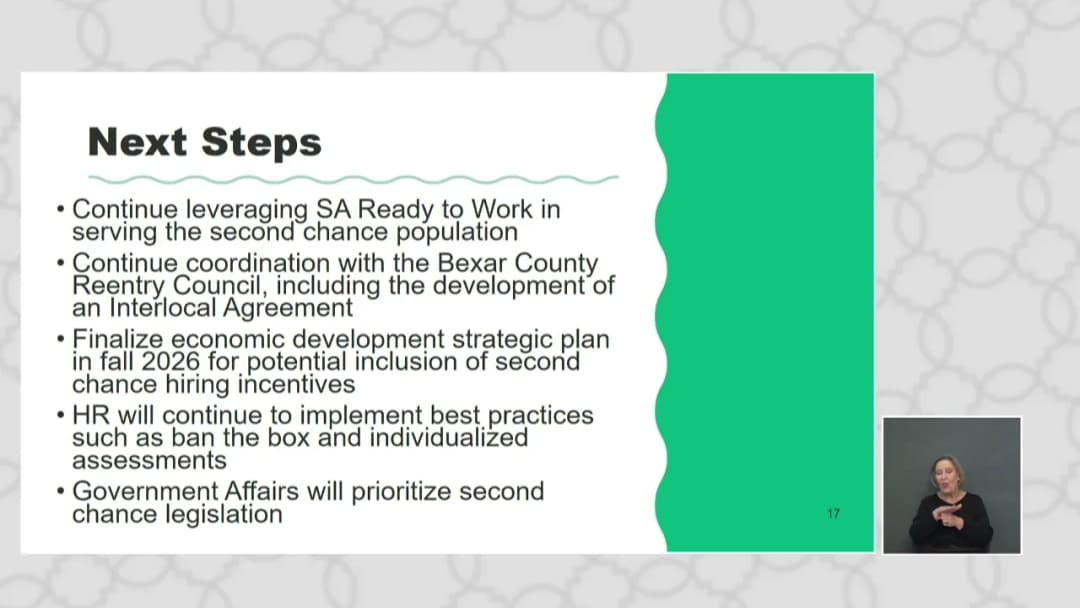
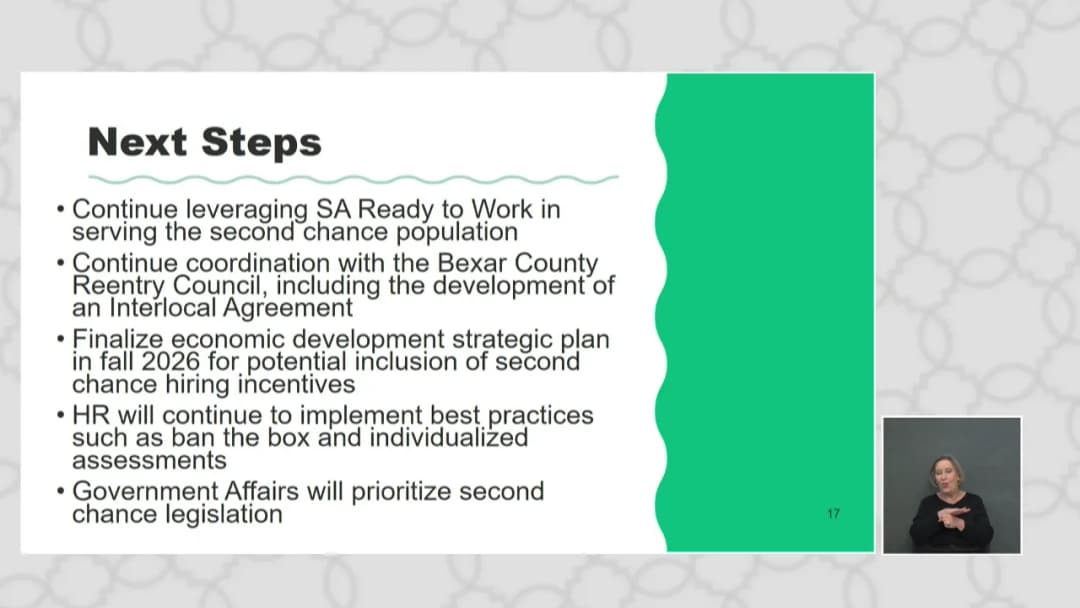
The Economic and Workforce Development Committee met on May 4, 2026, at 10 a.m. The committee approved the previous meeting's minutes, interviewed and recommended two applicants for the San Antonio Ready to Work Advisory Board, and received briefings on the Supply SA small business procurement initiative and the Second Chance Workforce Initiative. Consent Calendar - Approval of Minutes: The minutes from the previous meeting were approved unanimously by voice vote. Public Comments & Testimony - No members of the public signed up to speak. Discussion Items Ready to Work Advisory Board Applicant Interviews (Item 2) The committee interviewed six shortlisted candidates for two board seats: one for trade/labor and one for an organization serving persons with high barriers to employment. The ad hoc committee (comprising Councilmembers from Districts 5 and 8) reviewed 12 eligible applications from 15 received and selected six for interviews. - Michael Pena (Trade/Labor candidate): A 16-year member of IBEW Local 60, Pena emphasized the need to expand apprenticeship programs and noted a "wildly understaffed" outlook in trades. He expressed commitment to attending meetings (every third Thursday, 1-3 p.m.) and forging relationships beyond IBEW. He stated his goal to promote equity for minorities and underrepresented workers. - Barbara Acosta (Organization serving persons with high barriers): Representing Big Homies Street Mentoring, Acosta highlighted barriers such as lack of real second-chance opportunities for formerly incarcerated individuals. She stressed the need for employer incentives and for employers to give genuine second chances. - Patricia Cantu: A 20-year workforce development professional and Ready to Work participant, Cantu advocated for in-person orientation and intake to identify barriers like daycare, finances, and interview attire. She noted that employers often cannot see past a disability (e.g., deafness). - Angelique De Oliveira: Chief Workforce Development Officer at Goodwill Industries of San Antonio, she described barriers such as transportation, employer unwillingness to hire individuals with criminal backgrounds or disabilities, and the need for wraparound support. She called for balancing outcome metrics with serving harder-to-place populations. Supply SA Small Business Procurement Initiative (Item 3) Staff presented updates on Supply SA, a partnership of 14 public agencies aimed at building local procurement partnerships for small, local, and veteran-owned businesses. Key highlights: - Over 4,000 certifications approved last year, 1,600 applications processed, and 1,300 businesses supported. - Certification processing time improved to 14–33 days; backlog eliminated in December 2025. - Engaged over 100 veteran-owned small businesses. Future plans include exploring a bonding program, expanding on-demand training, and working with corporate partners and potential legislation. - The committee requested follow-up data by district and better engagement with school districts and charter schools. Committee members expressed support and asked about differences in procurement processes among agencies. Second Chance Workforce Initiative (Item 4) Staff presented a briefing on the initiative, stemming from a Council Consideration Request by Councilmember Castillo. The initiative aims to reduce employment barriers for justice-involved individuals through an interlocal agreement with Bexar County, federal incentives, and city practices. - Ready to Work data: 787 justice-involved participants completed training; 459 found jobs (average salary $44,000, a 483% increase over pre-program income). 145 participants used wraparound support for expungement. - Employer engagement: 53 employers attended a re-entry lunch and learn; 58 employers and 717 job seekers attended a second chance hiring fair. - City practices: Ban the box implemented in 2016; background checks only after conditional offer. Staff identified legal constraints from state preemption but noted opportunities for discretionary contracts. - National best practices: Los Angeles requires 10% of project hours from formerly incarcerated individuals on contracts over $500,000; Philadelphia requires a 10-business-day dispute period before adverse action. - Next steps: Develop an interlocal agreement with Bexar County, finalize economic development strategic plan by fall 2026, continue HR best practices, and prioritize second chance legislation in the city's legislative agenda. Councilmembers emphasized the need to market the benefits to employers, involve chambers of commerce, and avoid duplication with county efforts. - Testimony: Deborah Carter (Bexar County) noted 23% of Texas Fast Track alumni have justice-involved backgrounds with an 86% placement rate. Aida Negron (Bexar County Reentry Center) expressed gratitude and called for reducing stigma. Leslie Cantu (Toyotetsu Texas) offered to serve as a resource to other employers. Key Outcomes - Motion to Recommend Appointments: The committee unanimously voted (voice vote) to forward Michael Pena (trade/labor) and Barbara Acosta (organization serving persons with high barriers) for appointment to the San Antonio Ready to Work Advisory Board by the full City Council. Terms run through May 31, 2029. - Briefings Received: The Supply SA and Second Chance Workforce Initiative items were for briefing only; no formal action was taken. Staff will follow up with district-level data on certified businesses and continue developing the interlocal agreement with Bexar County.

WORKFORCE DEVELOPMENT 59% · ECONOMIC DEVELOPMENT 18% · PROCUREMENT AND CONTRACTING 11% · PROCEDURAL 6%
314
APR 30, 2026 · SAN ANTONIO, TEXAS · CITY COUNCIL
San Antonio City Council Meeting – April 30, 2026

Meeting called to order at 9:10 AM on April 30, 2026, by Mayor Pro Tem Jalen McKee Rodriguez, with roll call and quorum. Invocation was delivered by Reverend Carrie Geta of St. Francis's Episcopal Church. The meeting included proclamations, points of personal privilege, a city manager's report, approval of the consent agenda, and an executive session. The council reconvened in open session at 12:49 PM, with no official action taken during executive session. Proclamations - Transgender History Week (May 4–10, 2026): Proclamation recognizing transgender history and contributions. Speakers included Sophia Sopova (Equality Texas), who noted historical figures such as Dr. James Berry (transgender man who perfected the C-section) and Dr. Alan Hart (pioneer in tuberculosis testing). Leo Castellon Guiano (Thrive Youth Center) and Chris Chun (Fiesta Youth) spoke on the importance of visibility and healthcare access. Rain (founder of the March of Us) called for continued support beyond photo ops. Lindsay Andrews (San Antonio Arts Commission) highlighted trans joy and creativity. Council members expressed support, with Councilmember Karr announcing a future CCR for a memorial way honoring Erica Andrews. Councilmember Mesa Gonzalez shared personal stories about trans youth suicide attempts, emphasizing the need for safety. - National Missing and Murdered Indigenous Women and Peoples Awareness Day (May 5, 2026): Proclamation recognizing the crisis. Ramon D. Vasquez (Tepilam Kualitecan nation) announced the San Antonio Missing and Murdered Indigenous Women and People Coalition. Jordan Galvan (AITSCM) provided statistics: 10,248 missing indigenous peoples reported in 2024 (5,614 women, 4,628 men), most under 18, and Texas as the second-largest state for these cases. She noted a $1.3 million SAPD forensic genealogy program targeting 366 unsolved homicides and 49 sexual assaults. Stacey Kawakeolani (board member) stood in solidarity. Council members pledged action, including working with SAPD and noting the anniversary of Jonathan Joss's killing. Points of Personal Privilege - Councilmember Mesa Gonzalez recognized the 19th anniversary of the Bob Ross Senior Center. Steve Ross, son of the late Councilman Bob Ross, spoke about his father's vision and thanked the council for naming the center after him. City Manager's Report - Eric Deverra highlighted Walter Barrett, a solid waste manager who received the 2026 Legacy Award from the Baptist Ministers Union. A video showcased Barrett's work managing safety training, including a simulator for truck drivers. Barrett serves on the Black and African American Employee Affinity Group Steering Committee. Consent Agenda - Items 5 through 27 were approved as a group. Highlights included: - Item 5: New parking structure at San Antonio International Airport (450 additional spaces) funded from interim financing airport improvement contingency. - Item 6: Capital improvements for the Central Fire Department burn building (District 6). - Item 9: Grant application for Motor Vehicle Crime Prevention Authority ($1.5 million) for a regional task force. - Item 10: Grant for Advanced Law Enforcement Rapid Response Training ($6,000) from the Office of the Governor. - Item 11: Reappointment of Jolyn LeBlanc Jamison and Mary Lou Reyna to the San Antonio Water System board. - Item 14: Appointment of Valerie Martinez (Our Lady of the Lake University professor) to the CC's Commission. - Item 15: Appointment of Suzanne Scott to the Stormwater Committee. - Item 17: Appointment of Justin Johnson to the Small Business Advisory Commission. - Item 18: Appointment of Councilmember Viagran to the Texas Municipal League Board of Directors. - Item 21: Large area rezoning from industrial to residential to allow home rehabilitation. Executive Session - Council met in executive session from 10:22 AM to 12:49 PM to discuss economic development negotiations (Section 551.087), real property (Section 551.072), and legal issues including litigation, emergency preparedness, and collective bargaining (Section 551.071). No official action was taken. Key Outcomes - Consent agenda approved unanimously. - No other votes or formal decisions were made during open session.

COMMUNITY ENGAGEMENT 34% · PROCEDURAL 25% · PUBLIC ENGAGEMENT 13% · PUBLIC SAFETY 12%
315
APR 30, 2026 · SAN ANTONIO, TEXAS · CITY COUNCIL
San Antonio City Council Meeting – April 30, 2026

The San Antonio City Council convened on April 30, 2026, at 9:10 AM under Interim Mayor Mickey Rodriguez. A quorum was present (Councilmembers Corps, Villagrán, Mungía, Castillo, Galván, Alderete Gavito, Mesa González, Spears, White, and the Interim Mayor). The meeting included an invocation by Reverend Karen Guerra, the pledge of allegiance, approval of minutes (agenda item 13), proclamations for Transgender History Week and Missing and Murdered Indigenous Women (MMIW) Week, recognition of the Barbara Adult Center anniversary and Solid Waste employee Walter Show, and approval of the consent agenda. The council then moved into executive session at 10:22 AM, reconvened at 12:49 PM, and adjourned with no further business. Consent Calendar - Approval of Minutes (Item 13) – Motion passed unanimously. - Appointments – Multiple appointments approved: Justin Johnson to an advisory commission (District 7); Jillian Jameson and Reina to a health‑access committee; Valerie Martínez to the San Antonio Commission 16; and an appointment related to water services (Item 15). - Zoning Adjustment (District 4) – A rezoning item was approved to allow a constituent to improve their home. - Fire Training Facility Improvements (District 6) – Funding approved for upgrades to the fire training facility. - Vehicle Theft Prevention Grant (Item 9) – Ordinance accepting $1.5 million for a regional program to prevent motor vehicle theft. - Officer Training (Item 10) – Ordinance accepting grant funds for high‑risk response training for police officers. - Airport Parking Structure (Item 5) – Ordinance authorizing $7.4 million to expand parking at San Antonio International Airport, adding a floor to minimize future costs. Public Comments & Testimony - Transgender History Week Proclamation – Multiple community members spoke in support: Sofía (Director of Transgender Advocacy), Joe Castillo Anguiano (first openly transgender council member), Chris Chan (father of transgender children), Nico (Executive Director of Black Food Jesus), Rey (founder of Sin Filtro), and Lindsay Andrew (first openly transgender radio personality and commission member). All expressed appreciation for the city’s recognition and emphasized the importance of visibility and safety for transgender residents. - MMIW Week Proclamation – Speakers included Ramon D. Vázquez (tribal member and coalition administrator), Jordi Galban (coalition coordinator), and Jay Cole (Colonial Missions Council). They highlighted statistics (248,000+ indigenous persons reported missing in 2024 nationally; Texas has one of the highest rates of missing indigenous people), the need for data and resources, and the one‑year anniversary of the murder of Jonathan Jones in San Antonio. - Barbara Adult Center – Family members shared the history of the center, named after the speaker’s father, and thanked the council. - Walter Show Recognition – Walter Show, a Solid Waste Management employee, was honored for receiving the 2026 Baptist Union Legacy Award. A video highlighted his 18‑year career and mentorship role. Discussion Items - Transgender History Week Proclamation – Interim Mayor Rodriguez read a proclamation designating May 4, 2026, as Transgender Day of Visibility and the surrounding week as Transgender History Week. Council members expressed strong support, noting personal connections (e.g., Councilmember Galván had transgender family members; Councilmember Mungía was raised by a gay uncle and a transgender woman). Councilmember Mesa González emphasized the need to protect transgender youth and noted that six of her former students had attempted suicide during the pandemic. - MMIW Week Proclamation – The proclamation recognized May 2026 as MMIW Day and the week of May 5–9 as a week of action. Councilmembers discussed the need for improved data collection, collaboration with police, and community‑led solutions. Councilmember Spears noted the intersection with human trafficking on I‑35 in their district. - Barbara Adult Center 19‑Year Anniversary – The center, which opened 19 years ago, was celebrated as a model for senior services. Councilmember Mesa González highlighted the need for continued investment. - Executive Session – The council entered closed session at 10:22 AM to discuss economic development negotiations (Section 551.087), property transactions (Section 551.072), and legal matters (Section 551.071). They reconvened at 12:49 PM with no further public business. Key Outcomes - Consent Agenda Approved – All items on the consent calendar, including appointments, funding ordinances, and zoning adjustments, passed unanimously. - Proclamations Adopted – Both the Transgender History Week and MMIW Week proclamations were officially adopted by the council. - Executive Session Held – The council discussed economic development, property, and legal matters in closed session. No votes were taken publicly after the session. - Meeting Adjourned – No further business; the council adjourned at 12:49 PM.

COMMUNITY ENGAGEMENT 39% · PUBLIC SAFETY 18% · PUBLIC ENGAGEMENT 11% · PROCEDURAL 10%
316
APR 29, 2026 · SAN ANTONIO, TEXAS · CITY COUNCIL
San Antonio City Council Meeting - April 29, 2026: Social Services Funding and Tourism Partnership

This meeting of the San Antonio City Council B Session, held on April 29, 2026, focused on two major presentations: an update on the Consolidated Funding Process for social service agencies and a report on the tourism economy and the partnership with Visit San Antonio (formerly Business San Antonio). Council members discussed funding challenges, performance metrics, and future strategies. No formal votes were taken; staff will bring back recommendations for approval in May. Discussion: Social Services & Consolidated Funding Melody Woolsley, Director of Social Services, presented an update on the competitive grant process for fiscal years 2026-2027. Key points: - The city received 125 proposals from 72 agencies, requesting $55.6 million — nearly three times the available funding. - The total consolidated funding pool is $24.5 million, including $20 million from the General Fund and $4.5 million from federal/state grants (primarily for homelessness services). - After designated 12-month grants of $10.28 million and other allocations, $14.2 million remains for competitive grants for 16-month terms (June 1, 2026 to September 30, 2027). - $6.5 million is recommended for children and youth programs (serving nearly 14,000 kids), $1.8 million for family strengthening (serving 13,000 households), $3.1 million for senior independence (serving 13 programs), and $6.7 million for homelessness services (serving 11,000 individuals). - The evaluation used nine panels, 60% external reviewers, and a 100-point scoring system including 10 bonus points for local preference. - 26 new programs are recommended; 13 previously funded programs were not recommended (7 did not reapply). Council members expressed strong support for the work of nonprofit agencies, but also raised concerns about budget constraints, effectiveness metrics, and the need to prioritize core city services. Several council members emphasized that the $24.5 million represents less than 1% of the city's $4 billion budget, arguing that such a small investment yields high returns for the community. Others called for clearer tracking of outcomes and urged exploration of partnerships with private funders to reduce duplication and administrative costs. Discussion: Tourism & Visit San Antonio Mario Bass, President of Visit San Antonio, and Patricia Musquiz Santora, Director of the Department of Installation, presented the tourism update. Key points: - Over the last year, Visit San Antonio generated $7.6 billion in total economic impact, a 25:1 return on investment. - San Antonio remains the most visited riverwalk in the U.S., and the city saw record spring break visitation, with 79% of visitors from Texas or neighboring states. - The hotel occupancy tax collections have recovered post-pandemic, but short-term rental growth has shifted how visitors stay, reducing hotel occupancy rates. Still, overall visitation continues to rise. - The convention center is operating at maximum capacity, and without expansion, San Antonio will lose business to cities like Austin and Dallas that are expanding. A feasibility study will be presented in September 2026. - The TPID (Tourism Public Improvement District) generates funds through a 1.5% assessment on hotel bills; a proposed increase to 2% would provide an additional $6 million annually for marketing and incentives, and requires 60% hotel owner approval. Council members praised Visit San Antonio's work and acknowledged the critical role of tourism in the local economy. They questioned how to better distribute tourism benefits across all districts, how to support local artists (avoiding AI-generated imagery), and how to ensure the convention center expansion is a priority. The need for air connectivity and collaboration with the airport was also highlighted. Key Outcomes - No formal votes were taken; both presentations were for discussion and feedback. - Staff will return in May 2026 with a final recommendation for the social services contracts for council approval. - The convention center expansion feasibility study will be presented in September 2026. - The TPID reauthorization process will be initiated with a petition and collection phase, with a new contract for Visit San Antonio expected in September 2026. - Council members requested additional data on program outcomes, per-district service numbers, and a map of TPID-funded incentives.

TOURISM 34% · PROCUREMENT AND CONTRACTING 19% · COMMUNITY ENGAGEMENT 11% · BUDGET EQUITY ANALYSIS 10%
317
APR 29, 2026 · SAN ANTONIO, TEXAS · CITY COUNCIL
San Antonio City Council B Session: Delegate Agency Funding & Visit SA Contract Briefings – April 29, 2026

The City Council B session on April 29, 2026, featured two major briefings: a post-solicitation update on the consolidated funding process for human and homeless services delegate agencies, and a presentation on Visit San Antonio’s economic impact and the proposed renewal of the Tourism Public Improvement District (TPID). No formal votes were taken; the session was informational with direction given for follow-up. Discussion Items – Human & Homeless Services Consolidated Funding - Process Overview: The city received 125 proposals from 72 agencies requesting over $55 million. Staff recommended $19.1 million in 16-month awards (June 1, 2026 – September 30, 2027) for 81 programs (55 currently funded, 26 new). Key categories: Children & Youth ($6.5M for 39 programs), Strengthening Families ($1.8M for 14 programs), Senior Independence ($3.1M for 13 programs), and Ending Homelessness ($6.73M for multiple agencies). - Council Feedback: Councilmembers expressed a range of views. Mayor Pro Tem McKee Rodriguez highlighted the importance of preserving nonprofit funding, warning that cuts would lead to increased crime and homelessness. Councilmember Bia Gran (District 2) raised equity concerns, noting that only 10% of proposed clients were from her district despite high need. Councilmember Aldrate Cavito (District 7) argued for prioritizing core city services (sidewalks, public safety) and suggested sunsetting nonprofit funding gradually. Councilmember White questioned whether $20 million from the general fund was too much and urged more resources for economic development. Councilmember Spears emphasized core services and the need for efficiency. Councilmember Castillo and Galvan strongly supported continued investment, noting it is less than 1% of the total city budget. Councilmember Corr requested follow-up on specific agency scores and rationale for funding decisions. - Outsourcing Exploration: Staff presented the option of outsourcing discretionary contracts to an external funder (e.g., United Way) starting in FY 2029-30. Councilmembers had mixed views; some supported exploring it while others expressed concerns about loss of city control. - Next Steps: Staff indicated they would provide follow-up data (by district, performance metrics, and explanations for skipped higher-scoring proposals) and aim to bring the funding recommendations to full council in the second week of May (pushed back from the originally planned first week). Discussion Items – Visit San Antonio & TPID Renewal - Economic Impact: Mario Bass (President/CEO of Visit San Antonio) reported that since 2016, Visit SA has generated $7.6 billion in cumulative economic impact (a 25:1 ROI). Tourism supports 1 in 8 jobs in San Antonio and offsets over $1,000 in annual taxes per household. Key drivers: convention sales, leisure marketing, and public relations. - Competitive Landscape: Patricia Mousquish Cantor (Convention Center Director) highlighted that competing Texas cities (Austin, Dallas, Houston) are investing over $7 billion in convention center expansions. San Antonio’s center is at maximum capacity, and without expansion, the city risks losing group business after 2030. A feasibility study update is expected in September. - TPID Increase: Visit SA proposed raising the Tourism Public Improvement District assessment from 1.25% to 2% on hotel room rates (about $0.50 per $200 room night) to align with other major Texas cities. The increase would generate an estimated additional $6 million annually for sales and marketing. The petition requires 60% approval from participating hotels; collection is planned for May with a contract vote in September. - Short-Term Rentals: Data showed short-term rental demand grew from 400,000 room nights in 2019 to 1.1 million in 2025, directly impacting hotel occupancy. Staff noted that group business remains critical to filling hotel rooms. - Council Feedback: Councilmembers voiced support for Visit SA’s mission and the need for convention center expansion. Councilmember White requested clearer attribution of Visit SA’s direct impact. Councilmember McKee Rodriguez encouraged expanding marketing to untapped demographics (Black, LGBTQ+ tourists) and building regional partnerships. Councilmember Galvan asked about hotel-level distribution of TPID incentives. Councilmember Corr emphasized accessibility of tourism events (e.g., volleyball championship) and cautioned against AI-generated promotional materials. Councilmember Castillo highlighted the importance of short-term rental regulation to protect long-term housing. Key Outcomes - Delegate Agency Funding: Staff will delay the funding vote by one week to incorporate council follow-up requests (performance data, district-level breakdown, reasons for skipped proposals). Contracts begin June 1, 2026, pending council approval. - Visit San Antonio Contract & TPID: No formal action taken. The TPID petition process begins in May; city council will consider the full contract package in September. The convention center expansion feasibility study is due in September. - Executive Session: Cancelled for the day; rescheduled for April 30. Public Comments & Testimony - No public comments were transcribed during the meeting. The session adjourned before the scheduled 5:00 p.m. public comment period, with notice that an executive session would be moved to the following day.

ECONOMIC DEVELOPMENT 40% · COMMUNITY ENGAGEMENT 19% · YOUTH PROGRAMS 11% · HOMELESSNESS 10%
318
APR 28, 2026 · SAN ANTONIO, TEXAS · COUNCIL COMMITTEES
PCDC Committee Meeting on Veteran Housing Voucher Protections – April 28, 2026

The Planning and Community Development Committee (PCDC) met on April 28, 2026, from 10:01 a.m. to 12:29 p.m. The meeting focused on expanding housing access for veterans using vouchers, including a new city-run voucher incentive program and a proposed ordinance banning source-of-income discrimination against veterans. The committee also discussed amending the Unified Development Code (UDC) for data centers. Consent Calendar - Approval of minutes – Unanimously approved by voice vote. - Consent agenda – Adopted without objection after a councilmember noted an item listed as a briefing could not be passed on consent; after brief discussion, the agenda was approved without a briefing. Public Comments & Testimony - Anita Kegley – Supported expanding housing access for voucher holders but argued the policy places disproportionate financial burden on property owners. Urged incentives (tax credits, risk mitigation funds, faster payments) rather than mandates. - Martha Spinks (Lt. Col., U.S. Army, retired) – Stated that stable housing is critical for veterans. Cited research that fixing housing minimizes social problems. Estimated 800 veterans potentially impacted and noted only 1% of rentals are involved. Urged the committee to advance the ordinance. - Tony Fuentes (Executive Director, San Antonio Coalition for Veterans and Families) – Reported helping nearly 300 veterans in 16 months, with 500 in the last year, half of whom were female veterans sleeping in cars. Supported the ordinance to ban voucher discrimination. Noted the HUD-VASH process is too long. - Ute Hall (Retired VA social worker) – Described a revolving door of unhoused veterans with mental health issues. Explained that 2024 rule changes allowing disability payments to be excluded from income calculations improved voucher eligibility. Encouraged landlords to accept VASH vouchers. - Martin Gutierrez (VP, San Antonio Board of Realtors – SABOR) – Stated that locally 95% of VASH vouchers and 93% of housing choice vouchers are accepted. Recommended targeted solutions (e.g., a dedicated staff member at the Department of Military and Veteran Affairs, incentive-based programs). Opposed a one-size-fits-all ordinance. - Brendan Rodriguez (Secretary, American GI Forum of Bexar County; active-duty military training instructor) – Reported that DOD now discusses HUD-VASH in separation briefings. Asked why Military City USA would not align with DOD efforts to combat veteran homelessness. Urged passage of the ordinance. - Teresa Brown (Property manager) – Stated she manages 158 properties, three-fourths owned by active-duty or veterans. Said some owners refuse Section 8 due to stigma and payment delays. Warned the ordinance could hurt veterans if not paired with fixes to the voucher system. - Lawrence Romo (LULAC National VP for Veterans; former national commander of American GI Forum) – Cited Fort Worth’s successful ordinance. Argued that 100% acceptance should be the goal in Military City USA. Criticized SABOR’s PAC contributions to council members. Called for a tri‑partite partnership among SABOR, the Apartment Association, and the city. - Larissa Martinez (Founder/ED, Circle of Arms; U.S. Air Force veteran) – Stated housing is a basic need and that many veterans are denied housing despite having vouchers. Emphasized landlords can still screen for credit/background. Called for fixing the voucher system instead of denying veterans. - Harry Robinson (Veteran) – Noted that 13 American service members have been killed in Operation Epic Fury. Stated the ordinance has no budget impact and strong public support. Questioned why the ordinance has not been brought to a vote. Urged passage. - Cynthia Garcia – Noted the ordinance has been in development for 2.5 years. Cited support from State Representative Ray Lopez and Senator Josie Garcia. Argued it costs nothing and does not infringe on landlord rights beyond barring voucher-based denials. - Johnny Garcia (Lifelong public servant) – Supported the ordinance. Cited the 20-year life expectancy gap in San Antonio and argued limiting where veterans can live reinforces inequity. Noted rising costs. Urged passage. - Myra Carrier – Stated there are 250,000+ rental units and fewer than 800 veterans relying on vouchers. Argued the ordinance impacts a small part of the market but creates life‑changing access. Urged action. - Robert Mahara (Army officer, West Point graduate) – Argued the community must decide if veterans should bear voucher program burdens alone. Urged shared sacrifice and recommended moving forward with source-of-income protections. - Irene White (Community health worker, Empower House SA) – Supported protections. Noted veterans are overrepresented among homeless populations. Said clear policy creates predictable expectations. Asked for education and support for landlords. - Wayne (Property manager) – Represented 55% of homes managed owned by active-duty military. Cited 60–90 day payment delays and secondary inspection costs. Asked for program administration fixes. - Marty Hutchinson (Property manager) – Cited inspection timelines exceeding 30 days, lack of rent guarantees, and administrative burdens. Recommended enforcement of inspection timelines (3–5 business days), rent protections, and streamlined communication. - Albert Acevedo (spoke for a veteran with PTSD) – Said the veteran was turned away 8 times before finding housing in Canyon Lake, not San Antonio. Urged passage so the veteran can return. - Aaron Hunter (Texas Housers) – Presented data: only 8% of available listings indicate voucher acceptance; over 70% of veterans using VASH are in high social vulnerability areas; 84% live in multifamily housing. Supported source-of-income protections. - Crispin Pettis (Retired Army combat vet) – Described finding a homeless veteran family in a wooded area on Thanksgiving 2023. Stated the city needs to do more. Supported the ordinance. - Jason Bridgman (Broker/owner, True Asset Management; veteran) – Said his company never denies based on voucher; many property management companies are veteran-owned. Suggested the city connect the Department of Military and Veteran Affairs with property managers to help the 5–7% of veterans not being served. - Pete Brunell – Stated administrative concerns are not justification for denying housing. Urged passing the ordinance now and fixing details later. Cited 25 veteran suicides in San Antonio last year. - Antonio Roman (Vietnam veteran, Purple Heart recipient) – Urged the council to live up to the name Military City USA and pass the ordinance. Discussion Items - Item 4: COSA Vouchers (Council Consideration Request from Councilmember Castillo) – Staff presented a proposed city-run voucher incentive program. Key elements: $500 incentive for landlords who sign a 12-month lease with a voucher holder (targeting about 900 households); use of existing rental assistance funds starting FY2027; focus on new landlords and prioritizing VASH and then Section 8. Councilmember Castillo emphasized tracking metrics (new landlords, units preserved, demographics). Councilmember Courts requested adding funds (not just reallocating) and focusing on veterans. Councilmember Gonzalez supported targeting VASH holders. The committee approved the motion to implement the program as recommended, with feedback to refine the focus. - Item 5: Source of Income Protections for Veterans – Staff presented a proposed ordinance prohibiting landlords from denying qualified veterans solely based on lawful source of income (e.g., vouchers). Ordinance would be complaint‑based, with enforcement first through mandatory training, then escalating fees (modeled after the housing choice voucher program). Applicability discussion: Councilmember Courts moved to apply to housing providers with five or more residential units, include an escalating fee structure (no fine on first violation, education), and reassess in six months. Councilmember Mesa-Gonzalez supported but expressed concern about leaving out smaller landlords. Councilmember Castillo supported, noting potential for unintended effects on active-duty military homeowners. After legal clarification, the motion passed unanimously to recommend the ordinance to full council with the specified amendments. - Item 6: UDC Amendments for Data Centers – Staff presented options for amending the Unified Development Code (UDC) regarding data centers, either during the normal five‑year cycle (starting 2027) or out-of-cycle. Topics discussed: special use authorization, fencing, landscape buffers, noise mitigation, fire code coordination. Councilmember Galvan supported out-of-cycle process; stakeholder meeting scheduled May 8. Councilmember Courts questioned the five-year cycle but acknowledged the urgency for data centers. Council consensus directed staff to proceed out-of-cycle and bring proposed amendments to council. Key Outcomes - Item 4 (COSA Vouchers): Approved unanimously. Staff will refine the incentive program focusing on new landlords and prioritizing VASH and Section 8 vouchers, funded from existing rental assistance starting FY2027. Tracking metrics will be developed. - Item 5 (Source of Income Protections): Recommended to full city council with amendments: applies to housing providers with 5+ residential units; escalating enforcement (education first, then fees); reassessment in six months. The vote was unanimous. - Item 6 (UDC for Data Centers): Direction given to proceed with out-of-cycle amendments; stakeholder meetings begin May 8; proposed amendments to be brought to council for consideration.

HOUSING 58% · VETERAN AFFAIRS 27% · ZONING AND LAND USE 9% · PROCEDURAL 3%
319
APR 28, 2026 · SAN ANTONIO, TEXAS · COUNCIL COMMITTEES
San Antonio Development Committee Meeting – April 28, 2026

The San Antonio Development Committee met on April 28, 2026, at 10:01 a.m. to discuss three major items: a proposed incentive program for housing vouchers, a proposed ordinance to prohibit source-of-income discrimination for veterans, and a timeline for amending the Unified Development Code (UDC) regarding data centers. The meeting featured extensive public testimony from veterans, property managers, advocates, and industry representatives. Consent Calendar - Approval of Minutes: The committee approved the minutes of the previous meeting by unanimous voice vote. A brief discussion clarified that an informational item under the consent agenda could not be passed as such; the consent agenda was approved after removing that item. Public Comments & Testimony - Anita Creckling expressed support for expanded housing access but argued that the proposed policy disproportionately burdens property owners and could reduce high-rent units, which she said San Antonio opposes. - Marta Springs (retired government official) emphasized that stable housing is critical for veterans. She noted that 800,000 veterans in San Antonio deserve dignity and urged passage of the ordinance. - Tony Fuentes (Executive Director, Coalition for Veteran Families) shared that his organization assisted nearly 300 veterans in 16 months and that 500 veterans served in three years, half being women living in cars with children. He called the voucher process too slow and urged approval. - UT (name not given) , a retired social worker at the VA, described the cycle of hospitalization and homelessness for veterans with severe mental illness. She noted that 2024 rule changes now allow disability payments to be excluded from voucher income calculations, improving financial stability for veterans. - Martín Gutiérrez (Vice President, Federal Affairs, San Antonio Board of Realtors) stated that 95% of vouchers and 93% of housing vouchers are already accepted by providers. He advocated for solutions like hiring dedicated staff to navigate the system and expanding the proposed incentive program, rather than a blanket ordinance. - Brenda Rodríguez (Secretary, GI Forum America; active-duty Navy instructor) testified that he never heard of vouchers in his career and that many servicemembers face homelessness. He urged passage to protect past and present members, invoking “One Team, One Fight.” - Vanessa Brown (property manager; daughter and sister of veterans) said she is not against vouchers but noted that owners often reject Section 8 due to stigma and slow payments. She asked the committee to address the broader Section 8 system rather than single out veterans, warning that the ordinance as drafted could harm veterans. - Lawren Zumann (veteran of 21 years; former vice president of veterans) called for simplicity and argued that 93% acceptance should be 100% for a “Military City.” He referenced a “trifecta” package and alleged that some councilmembers received campaign contributions from real estate interests. - Luisa Martínez (Executive Director of a nonprofit; spouse of a veteran) stated that housing is a basic necessity and that veterans with vouchers are often denied despite meeting all criteria. She called for fixing payment delays and inspections, not penalizing veterans. - Harry Robinson urged the committee to pass the ordinance, noting that 13 active-duty members were killed in Operation Fury. He asked why the ordinance had not been brought to a vote and thanked those supporting it. - Cintia García (advocate) said she has worked on the ordinance for over two and a half years. She argued that the ordinance costs nothing, does not remove property owners’ rights, and would allow veterans to live near medical facilities. She presented letters of support from Representatives Brian López and José García. - Johnny García (lifelong public servant for veterans) supported the ordinance, stating that too many veterans are told they are not welcome because of how they pay. He noted that 800 veterans use vouchers and that cities like Dallas and Fort Worth have already acted. He called it a matter of dignity and justice. - María Mayra Curry (10-year veteran; recently appointed to Veterans Commission) reported that veterans she spoke with have difficulty finding housing even when they meet all requirements. She emphasized the need to align city policies with the military city designation. - Robert Mahara (retired officer; advocate for children) spoke on item 5. He argued that asking veterans to bear the cost of housing alone is unfair and urged the commission to recommend protections. - Irene White (Air Force veteran’s spouse; social worker) supported adding source-of-income protections, noting that veterans with vouchers or disability pensions are still denied housing. She called for aligning investments with outcomes. - Wayne Mirna (property manager) stated that 55% of his 158 managed properties house active-duty military. He highlighted a 69-day average payment delay and additional inspection costs as barriers. - Mary Hutchinson (housing administration professional) said the proposal does not address program inefficiencies; delays of 30 days or more in inspections create financial burdens for small landlords. She urged faster inspections and rent protections during delays. - Albert Acevedo (speaking for a veteran under his care) reported that the veteran was rejected eight times before finding housing in Canyon Lake, not in San Antonio. He urged passage so the veteran can return to the city. - Erin Khan (Texas housing agency) cited MLS data showing only 8% of rental listings in San Antonio indicate acceptance of vouchers. She noted that 70% of veterans using BASP vouchers are concentrated in vulnerable areas and that 84% live in multifamily housing, limiting their choices. - Chris Pérez (combat medic; retired federal employee) described visiting a homeless veteran community near Highway 35 and 410 on Thanksgiving 2023. He questioned why the “Military City USA” allows veterans to live under bridges. - Jason Bridgman (property manager; veteran) said his company never denies anyone because of a voucher. He estimated that only about 5% of veterans are not served and suggested connecting those veterans directly to property managers. - Pete Burnell (apartment association representative) cited inspection delays from 10 to 60 days. He argued that the real issue is the people being denied, and urged passage without relying solely on short-term incentives. - Antonio Romanes (Marine Corps veteran) stated that the ordinance is simple: landlords should not deny housing because someone is a veteran. He noted the ordinance was passed two years ago and urged moving it forward. Discussion Items - Item 4: Voucher Incentive Program (CCR from Councilwoman Castillo) – Verónica González (Deputy Director, Housing Services) presented options to create a $500 landlord incentive for signing 12-month leases with voucher holders, funded by existing rental assistance allocations. The program would target new landlords and could support up to 900 families. Council discussion focused on ensuring funds are additive, tracking retention, and prioritizing veterans with BASP vouchers. Councilwoman Castillo proposed the incentive be part of the city budget. - Item 5: Source of Income Protection for Veterans Ordinance – Verónica González outlined the proposed ordinance that would prohibit rental housing operators from denying a prospective tenant solely because they use a voucher (including BASP, Section 8, etc.). Enforcement would be complaint-based, with possible training and fees (not criminal penalties). Council debated applicability: should it apply to all multifamily properties or exempt small landlords (1–4 units). Councilwoman Socorro proposed a motion to recommend an ordinance applying to owners of five or more rental units, with no criminal penalties, and to return for full council review after further public input. The motion was seconded and passed. - Item 6: UDC Amendment Timeline for Data Centers (CCR from Councilman Galván) – A presentation outlined the normal five-year UDC amendment cycle (next update 2027). Councilman Galván requested an off-cycle amendment process for data center regulations. After discussion, the committee agreed to convene stakeholder meetings in May and June 2026, develop proposed amendments, and bring them to the planning commission and full council for adoption on an accelerated timeline. Key Outcomes - Consent Agenda: Approved unanimously. - Item 4: Motion to approve the creation of the voucher incentive program (focusing on new landlords and veterans) passed unanimously. - Item 5: Motion to recommend a source-of-income protection ordinance for full council consideration, applying to landlords with five or more rental units, with a complaint-based enforcement system and no criminal penalties, passed unanimously. - Item 6: Decision to proceed with an off-cycle UDC amendment process for data center regulations, with stakeholder meetings in May–June 2026 and a target for council adoption by late 2026. The meeting adjourned at 12:29 p.m.

HOUSING 48% · VETERAN AFFAIRS 35% · ZONING AND LAND USE 8% · AFFORDABLE HOUSING 6%
320
APR 28, 2026 · SAN ANTONIO, TEXAS · BOARDS & COMMISSIONS
Southern Edwards Plateau HCP Committee Meeting - April 28, 2026

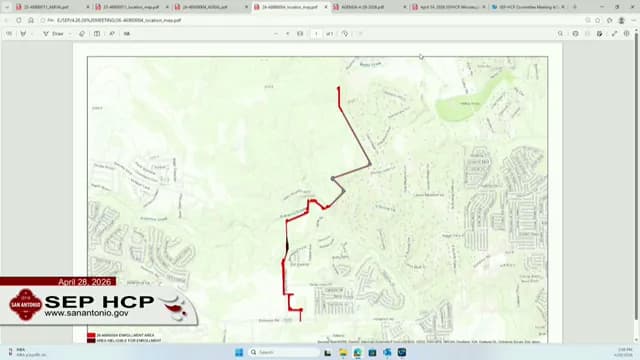
The South Edwards Southern Edwards Plateau Habitat Conservation Plan (SCP HCP) Coordinating Committee met on April 28, 2026, at 3:00 PM. Chair Sparrow presided with committee members Ninial, Garcia, Jordan, McGlammery, and Stimper present, constituting a quorum. No public comments were received. The committee discussed and unanimously approved two SCP HCP enrollment applications and the minutes from the previous meeting. The meeting adjourned at 3:08 PM. Discussion Items - Hartman Gordon Family Foundation SCP HCP Enrollment (3.022 acres at 2711 & 2727 TPC Parkway, Council District 10): Senior planner Bally Rodriguez presented the application for enrollment to mitigate impacts from development. The project area contains zero acres of golden-cheeked warbler (GCW) habitat, with 3.36 acres of GCW habitat within 300 feet. The site lies in CAR Zone 1 and is not within any critical habitat unit or within 750 feet of an occupied feature. Required mitigation fees: $16,000 for GCW conservation credits, $3,020 for CAR Zone 1 & 2 participation, and $1,902 plan administration fee, totaling $20,922. The applicant has paid the $2,500 application fee and must pay the full mitigation fee before enrollment. Staff recommended approval. - Second SCP HCP Enrollment (7.29 acres in CAR Zone 1 and 2.95 acres in CAR Zone 3B): Staff member Decker presented a separate application. The project area is not within any critical habitat unit or within 750 feet of an occupied feature. Required fees: $7,290 for CAR Zone 1 & 2 participation, $2,950 for CAR Zone 3 & 4 participation, and $1,024 plan administration fee, totaling $11,264. The applicant has paid the $2,500 application fee and must pay the full mitigation fee before enrollment. Staff recommended approval. The transcript does not identify the project owner or consultant for this second application. Key Outcomes - Hartman Gordon Family Foundation Enrollment: Motion by committee member McGlammery, seconded; passed unanimously by voice vote. - Second SCP HCP Enrollment: Motion to approve, seconded; passed unanimously by voice vote. - Approval of Minutes: Motion to accept the minutes from the previous meeting, seconded; passed unanimously. - Adjournment: The meeting adjourned at 3:08 PM.

ENVIRONMENTAL PROTECTION 86% · PROCEDURAL 14%
OPENPUBLICA · PUBLIC MEETING INDEXUPDATED DAILY · openpublica.com