Browse by city
Date range
Search help

Search titles, summaries, topics and stored transcripts together. Keywords may match separately; put the whole query in double quotes for a phrase. Matching follows word analysis, so punctuation is not exact. Both dates are included. Documents are not searched.

SHOWING 321–330 ENTRIES
321
APR 23, 2026 · SAN ANTONIO, TEXAS · COUNCIL COMMITTEES
San Antonio Health Committee Meeting – April 23, 2026

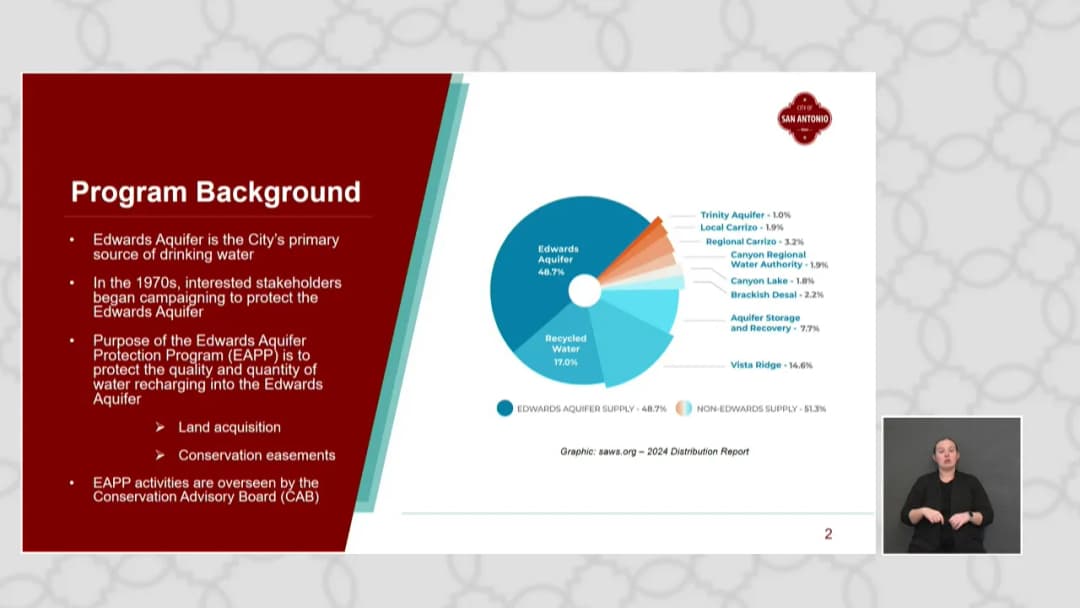
The Health Committee met on April 23, 2026, at 10:32 AM. Present were Councilmembers Castillo, Alderete Gabito, Mesa González, White, and President Galván. Quorum was established. The committee received updates on the Heat Resilience and Sustainability Action Plan, the SA Kids Breathe asthma program, and the Edwards Aquifer Protection Program. No public comments were made. Consent Calendar - Approval of minutes from the previous meeting was moved, seconded, and passed unanimously without discussion or opposition. Discussion Items Heat Resilience and Sustainability Action Plan Update Laura Patiño, Director of the Department of Resilience and Sustainability, presented the update, following a council request from April 16, 2025, to prevent heat-related deaths. Key points: - San Antonio has experienced record extreme heat days and increases in heat-related illnesses. From 2022 through 2025, nearly 2,400 heat-related illnesses were reported, characterized by dehydration and heat stroke. - The city developed its first Resilience Catalog with 52 actions (new, existing, and enhanced), over 80% of which are already ongoing. All city departments are involved. - Goals include: increasing public awareness of cooling resources, expanding partnerships for cooling centers, providing shade and tree planting (400 street trees, 600 park trees, 250 in vulnerable neighborhoods), and working with VIA on bus stop shade structures. - A pilot project of 20 miles of cool pavement technology is underway with UTSA evaluation. - Reflective (white) roofs are being installed on city facilities as roofs are replaced. - For summer 2026, the city will activate extreme heat communications, distribute resources through community centers, and continue coordination with the Office of Emergency Management and DHS. Councilmember Alderete Gabito expressed strong support and requested: - Confirmation of coordination with DHS during extreme heat events. - Expanded focus on colonias inside Loop 410 for cooling resources. - A progress report on bus stop shade structures at a future Transportation Committee meeting. - Increased tree planting from 450 to 800 trees to help cool neighborhoods and slow traffic. Councilmember White asked: - Whether the new heat‑related illness dashboard can display data by census tract to pinpoint areas of need. Staff responded that state confidentiality rules may suppress small counts, but they will begin reporting provisional death data this month based on resident addresses. - Whether VIA’s bus stop shade locations correlate with high ridership. Staff noted this needs further exploration. Councilmember Mesa González asked about: - Incorporating heat‑resilient building codes (e.g., reflective roofs). Staff said they are reviewing best practices and working with Development Services. - Potential for solar‑powered fans at bus stops, as piloted by Houston Metro. Staff indicated they are piloting shade designs but not fans. - Engaging churches and other faith‑based organizations as cooling centers. Staff confirmed an existing network of nonprofits and businesses that can be expanded. SA Kids Breathe Asthma Program Update Mother White, Assistant Director of Metro Health, presented the update. Key points: - SA Kids Breathe is a chronic disease management program for children with asthma. It began in 2018 after three local asthma‑related deaths. - Annual budget is $827,700 (16% of chronic disease portfolio). Program services are free to participants. - Eligibility: children aged 3–17 living in Bexar County with one of five criteria (e.g., recent hospitalization, two ER visits, or missing 10% of school days). - 85% of referrals come from clinical sources; 15% from schools. In 2025, the program served 1 child; as of April 22, 2026, 16 children have been served this year. - The program provides home visits by community health workers, education on inhaler technique (80% of users use inhalers incorrectly), and connections to social services. - Outcomes: Asthma Control Test (ACT) scores improved from a baseline of 15.7 (poor control) at enrollment to 24.2 at 12 months, with 80–90% of participants achieving good control. - Hospitalization rates for asthma in Bexar County remain nearly double the state average (14.7 per 100,000 vs. state). - Next steps: hire a full‑time position, expand tobacco cessation referrals, and continue partnerships with South Texas Asthma Coalition, UT Health, University Health, and others. - A success story was shared of a teen girl whose ACT score rose from 10 to 24–25 after two years in the program; she now sings in choir and attends school regularly. Councilmember Alderete Gabito emphasized the importance of addressing root causes and ensuring access to medications and healthy homes. Edwards Aquifer Protection Program Update Grand Dallason, Natural Resources Manager for Parks and Recreation, presented the update. Key points: - The program began in 2000 with a $25 million bond (Proposition 3), later expanded to $90 million (2010, 2015), and most recently $100 million over 10 years from sales tax revenue (approved by council in 2025). - The Edwards Aquifer supplies 50% of San Antonio’s drinking water. It is a karst aquifer that recharges quickly after rain (water levels rose 10 feet in the past four weeks). - Protection focuses on the recharge zone in Bexar, Medina, and Uvalde counties. Water flows west to east. - Total protected acreage: 188,900 acres, mostly through conservation easements. The program has been nationally and internationally recognized. - Land acquisition is based on scientific criteria (e.g., adjacency to protected land, geological evaluation). The process involves the Conservation Advisory Board and final City Council approval. - $10 million of the $100 million was set aside for water quality improvement projects in partnership with the San Antonio River Authority. - Councilmember White expressed strong support, calling it a generational investment in the community’s health and water security. - Councilmember Mesa González asked about the funding timeline (the $100 million was approved only a year ago). She also inquired about focusing on Bexar County, where land is more expensive; staff confirmed they continuously evaluate properties there. Key Outcomes - Committee unanimously approved the minutes. - All three presentations were informational; no formal votes were taken on the updates. - Councilmembers directed staff to: - Provide a progress report on VIA bus stop shade structures at the Transportation Committee. - Explore expanding the tree‑planting target to 800 trees. - Continue refining the heat‑related illness dashboard for geographic analysis. - Report back on cost estimates for adding shade structures across all districts. - Include more details on cool roof implementation and church partnerships in future updates. - Strong support was voiced for continuing the Edwards Aquifer Protection Program and expanding its reach.
ENVIRONMENTAL PROTECTION 38% · PUBLIC HEALTH 24% · WATER AND WASTEWATER MANAGEMENT 17% · INFRASTRUCTURE 4%
322
APR 23, 2026 · SAN ANTONIO, TEXAS · COUNCIL COMMITTEES
Community Health Committee Meeting: Heat Resilience, Asthma, and Aquifer Updates - April 23, 2026

The Community Health Committee of the San Antonio City Council met on April 23, 2026, from 10:32 AM to 11:58 AM. The meeting included updates on the San Antonio Heat Resilience Playbook, the SA Kids Breathe asthma program, and the Edwards Aquifer Protection Program. All agenda items were informational, with no formal votes taken beyond the approval of minutes. Consent Calendar - Unanimous approval of the previous meeting's minutes. Discussion Items Update on San Antonio's Heat Resilience Playbook - Laura Patiño, Director of Resilience and Sustainability, presented the city's first Heat Resilience Playbook, a roadmap with 52 actions (over 80% ongoing) to address extreme heat. Key statistics: nearly 2,400 heat-related illnesses reported since 2022, 28 miles of cool pavement installed, over 600 cool roofs completed citywide since 2022, and over 11,000 new trees funded or committed for FY2026. The playbook focuses on awareness and outreach, heat relief, built environment, and parks/green spaces. - Councilmember Castillo (absent) sent a letter expressing full support for the direction and requesting expansion of the Cool Neighborhoods program to include extreme cold weather and integration of weatherization into city programs. - Councilmember Alvarete Gavito asked about partnership with DHS for unhoused outreach, efforts inside Loop 410, collaboration with VIA on bus shade structures, and tree planting for traffic calming. He expressed strong support for the program and urged a "bullish" approach to tree planting. - Councilmember White asked about tracking heat-related illnesses by location (zip code, job site). Metro Health responded that cases are assigned by residence, not incident location, and that they are in dialogue with other jurisdictions to improve methods. - Councilmember Mesa Gonzalez asked about design standards (cool roofs, reflective roofing), VIA bus stop pilot programs (solar fans), and partnerships with faith-based institutions. She requested a link on the city website listing city actions. The Climate Ready Neighborhood Network includes 18 members, with faith-based organizations invited to join. - Chair Galvan requested VIA provide council with capital needs for bus stops and requested dollar amounts for weatherization and retrofitting of city buildings. He also asked about the deconstruction program (answered offline). Update on SA Kids Breathe Asthma Program - Marjorie White, Assistant Director for Community Health and Safety at Metro Health, presented the children's asthma program (SA Kids Breathe). The program has an annual budget of $827,702 and a staff of eight. In FY2025, 181 children were served; in FY2026 to date, 116 have been served. The program provides home visits, education, asthma action plans, and trigger reduction kits. Asthma Control Test (ACT) scores improved 37% from enrollment (16.6) to 12-month follow-up (22.8), with 89% of graduates well-controlled. - Council members expressed strong support for the program, with Chair Galvan noting its importance as a chronic asthmatic. No questions were raised during the limited time. Update on Aquifer Protection Program - Grant Ellis, Natural Resources Manager for Parks and Recreation, presented the Edwards Aquifer Protection Program, which began in 2000. To date, 188,900 acres have been protected (over 95% via conservation easements). The program is funded by a 1/8-cent sales tax and currently $100 million over 10 years from the San Antonio Municipal Facilities Corporation (three years in). The program has leveraged over $34 million in partner funds. The Conservation Advisory Board, with nine members, oversees science-based property selection. - Councilmember Alvarete Gavito expressed strong support for the program, calling it a "generational investment." - Councilmember Mesa Gonzalez asked about the timeline of the current funding (halfway point in five years) and whether the city is looking at renewing. She also asked about efforts in Bexar County – staff noted that property values are higher there, so focus is on Medina and Uvalde counties for more cost-effective acquisitions, but Bexar County properties are always evaluated. - Chair Galvan asked for a map showing acquisitions over time, which was provided. Key Outcomes - No formal votes were taken on the agenda items. Council members directed staff to continue work on the Heat Resilience Playbook, including improved coordination with VIA and development of capital needs information. Support was reaffirmed for the SA Kids Breathe asthma program and the Edwards Aquifer Protection Program. Staff will follow up on specific requests (e.g., VIA bus stop capital needs, faith-based outreach expansion, and tree planting coordination).

ENVIRONMENTAL PROTECTION 48% · PUBLIC HEALTH 32% · ENGINEERING AND INFRASTRUCTURE 8% · COMMUNITY ENGAGEMENT 4%
323
APR 22, 2026 · SAN ANTONIO, TEXAS · BOARDS & COMMISSIONS
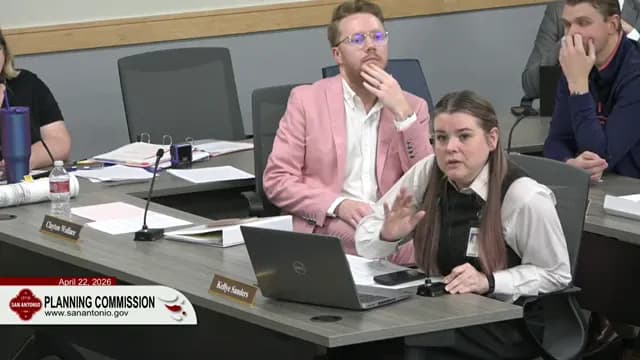
San Antonio Planning Commission Meeting - April 22, 2026

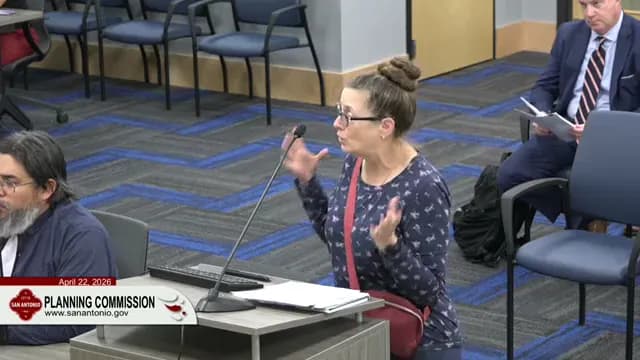
The San Antonio Planning Commission convened on Wednesday, April 22, 2026, to consider planning and zoning matters. The meeting began with roll call, a quorum present, and an honor for outgoing Commissioner Michael Garcia. The commission approved a consent agenda, granted continuances for two items, and deliberated on two plan amendment requests. The meeting adjourned at 2:26 PM. Consent Calendar - The consent agenda (items one through eight) was approved unanimously on a roll call vote, with Commissioner Bustamante recusing due to conflicts on items two, five, six, and seven. Public Comments & Testimony - Item 12 (3730 White Child Road): Gwen Vanderpool, representing the Paloma Park subdivision HOA, spoke in opposition. She cited concerns about noise, light pollution, traffic, and the lack of a buffer between the proposed commercial development and residential backyards. She suggested uses like a community park or garden center. The applicant, Trey Jacobson of Momentum Advisory Services, presented in favor, arguing the change to community commercial is less intense than the existing regional commercial designation and will serve the developing area. Discussion Items - Item 9 (1139 New Laredo Highway): Granted a three-week continuance to the May 13, 2026 meeting (unanimous). - Item 10 (3200 block of South Foster Road): Granted a three-week continuance to the May 13, 2026 meeting (unanimous). - Item 11 (1904 Nogalitos): Request for plan amendment from neighborhood commercial to regional commercial to allow a tobacco/vape shop near a school. Staff and Zoning Commission recommended denial due to inconsistency with surrounding properties and conflict with UDC Section 35-398.02 (prohibition of tobacco/vape shops within 1,000 feet of a school). Applicant was not present. Commission moved to deny. Vote: unanimous in favor of denial. - Item 12 (3730 White Child Road): Request for plan amendment from regional commercial and low density residential to community commercial to facilitate a C2 zoning for a 5.7-acre tract near I-10 and 1604. Staff recommended approval, noting consistency with surrounding properties and a transition between intense uses and single-family neighborhoods. Commissioner questions addressed buffers (15-foot landscape buffer and 6-foot fence required by code), setbacks (30-foot rear), and the presence of a 50-foot natural gas pipeline easement. The motion to approve passed unanimously. Key Outcomes - Continuances granted for Items 9 and 10 to May 13, 2026. - Item 11 denied. - Item 12 approved. - The consent agenda approved. - Commissioner Michael Garcia honored for 13 years of service.

ZONING AND LAND USE 70% · PROCEDURAL 27% · COMMUNITY ENGAGEMENT 3%
324
APR 22, 2026 · SAN ANTONIO, TEXAS · BOARDS & COMMISSIONS
San Antonio Planning Commission Meeting - April 22, 2026

The San Antonio Planning Commission met on April 22, 2026, at 2:01 PM. The meeting began by honoring former Commissioner Michael García for his 13 years of service. The agenda was combined, with items 1–8 placed on the consent calendar and approved unanimously. Items 9 and 10 were postponed to May 13, 2026, while items 11 and 12 were individually discussed and voted upon. Commissioner Bustamante recused himself from the consent agenda (items 2, 5, 6, and 7) due to a conflict of interest and left the dais at 2:05 PM, returning before the vote on item 9. Consent Calendar - Items 1–8 were approved unanimously by voice vote after a motion by Commissioner Seagal, seconded by Commissioner Sánchez. No additional discussion. - Item 9 (located at 1 3 Laredo Highway) and Item 10 (located at the 32 block of South Foster Road) were postponed to May 13, 2026, via separate motions. Both motions passed unanimously. Public Comments & Testimony - Item 12 – Gwen Vanderpool, a resident of the Palm Heights neighborhood, voiced opposition to the proposed rezoning from regional commercial and low-density residential to community commercial. She expressed concerns about insufficient buffers, increased traffic, noise, light pollution, and the potential impact on property taxes. She suggested alternative uses such as a community park or plant nursery. The applicant’s representative, Trey Jacobson, responded that the request only affected a 5.5-acre parcel and that development standards require a 15-foot buffer with landscaping and a 6-foot solid fence. Discussion Items - Item 11 – Nogalito Sur San Zamora Community Plan Amendment: Staff planner Samantha Benaldíez presented a proposal to rezone a lot to C3 (regional commercial) with specific restrictions for tobacco retail sales at 1.6 miles from a protected location. She noted 47 notifications were sent, one opposition was received, and the homeowners association did not respond. Staff recommended denial because the proposal was inconsistent with surrounding land uses, conflicted with city code (Chapter 35-397) regarding tobacco sales, and the lot did not meet the typical 28-acre minimum for such changes. The applicant was not present despite being informed. The commission denied the request. - Item 12 – East Corridor Plan Amendment: Trey Jacobson, representing the developer, requested approval to rezone a 5,706-square-foot (approximately 0.13 acre) parcel from regional commercial and low-density residential to community commercial (C2). The property is near I-10 and Loop 1604. Jacobson argued the change would reduce intensity compared to the existing regional commercial designation and provide a transition from high-intensity uses. Commissioner questioning clarified that community commercial allows uses like retail, while regional commercial permits bars, auto sales, and mechanical shops—more intense uses. The commission expressed support for the less intensive community commercial designation. Key Outcomes - Item 11 (Denial): Motion by Commissioner Seagal, seconded by Commissioner Sánchez, to deny the request. All commissioners present voted in favor (7-0). The application was denied. - Item 12 (Approval): Motion to approve the rezoning to community commercial. The motion passed with a vote of 7-0. The agenda item for the corresponding zoning case was not before the commission that day. - The meeting adjourned at 2:26 PM.

ZONING AND LAND USE 62% · PROCEDURAL 31% · COMMUNITY ENGAGEMENT 7%
325
APR 21, 2026 · SAN ANTONIO, TEXAS · COUNCIL COMMITTEES
San Antonio Public Safety Committee Meeting - April 21, 2026

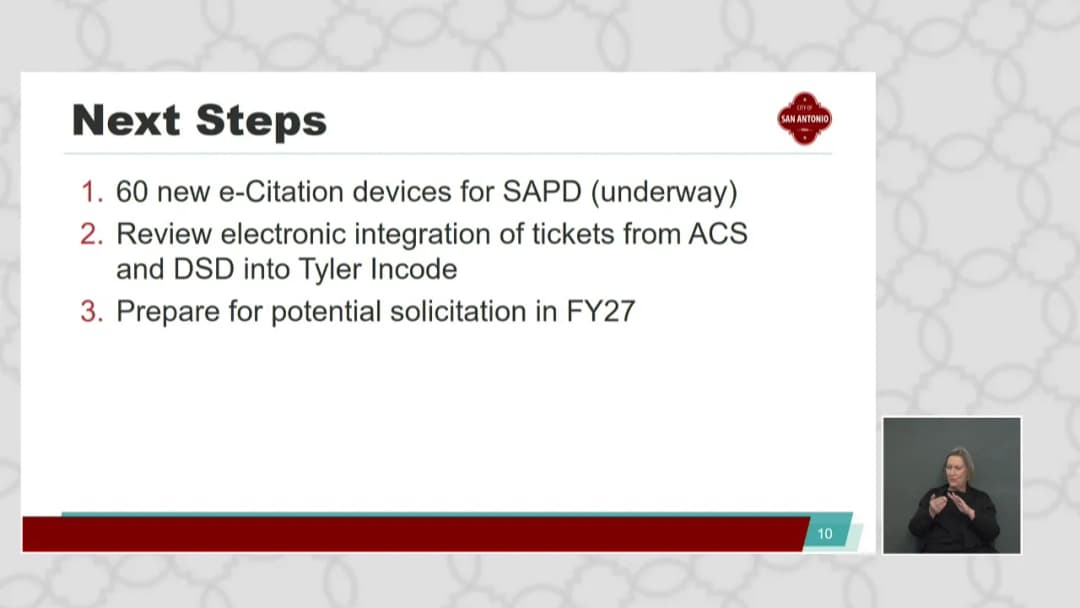
The Public Safety Committee of the San Antonio City Council met on April 21, 2026, to discuss fire department performance indicators, a Bitcoin ATM fraud ordinance, electronic citation processes, and a crime statistics update. Council members Macky Rodríguez, Castillo, Spears, and White were present, along with city staff and external partners. Consent Calendar - Approval of Minutes: The minutes from March 17, 2026 were approved unanimously. A motion was made, seconded, and passed with no opposition. Discussion Items - Fire Department Performance & Dashboard: Fire Chief María Vargas and Mr. García presented key performance indicators and a public-facing dashboard for fire response. The dashboard categorizes incidents (medical, fire, rescues) and tracks response times. Medical calls account for approximately 75% of incidents, with the most common being sick persons with breathing problems. The MIH (Mobile Integrated Health) program has grown contact volumes since 2024, aiming to reduce repeat 911 calls. Response times have remained relatively stable, with the national standard of 8–9 minutes; San Antonio tracks below that. The department added squad units and plans to request more. Councilmember White asked about the relationship between response times and outcomes; the chief stated that seconds matter. Councilmember Castillo noted the high percentage of uninsured patients (8.8%) and suggested exploring Medicare/Medicaid expansion to reduce medical calls. Councilmember Spears inquired about structural fire risks from vacant buildings and the need for code enforcement. The dashboard will be made public through social media and news coverage. - Bitcoin ATM Fraud Ordinance: Assistant Chief Javier Salazar and ARP Director Lisa Rodríguez presented a proposal for an ordinance to protect consumers from Bitcoin ATM scams. In 2025, San Antonio saw 600+ reported cases with losses of $33 million (80% of victims were 60+; 88% had income under $50,000). The ordinance would require warnings on ATMs (in English and Spanish) and enable police to intervene. A two-track approach was outlined: a public safety ordinance for immediate police response, and a code enforcement ordinance for administrative citations against non-compliant owners. The goal is to reduce financial losses; Omaha saw an 80% reduction after a similar ordinance. Councilmember Castillo expressed strong support, noting collaboration across agencies. Councilmember Ay (White) also supported. The committee voted to advance the ordinance to the full council for the May session. The motion passed. - Electronic Citation Process: City staff presented a study on transitioning from paper citations to electronic ones. In FY2025, out of 181,000 citations, 97,300 were electronic and 84,465 paper. Paper citations take an average of 73 days to enter the system versus 36 days for electronic; electronic citations also have a higher payment rate (36% vs. lower for paper). The potential annual savings from converting 22,000 paper citations is $300,000–$500,000. The long-term plan (expected completion October 2027) involves a formal solicitation for vendors to create a fully digital system. Councilmember White supported moving forward, noting the cost of 60 additional devices ($600,000) would be recouped quickly. Councilmember Rodríguez emphasized the need for accessibility and local vendors. Councilmember Castillo stressed data privacy and alignment with the Bexar County system. The committee did not vote but expressed general support. - Crime Statistics Update: The committee reviewed a crime statistics report showing overall crime down 2.4% for 2026. Councilmember Spears raised concerns about a spike in burglaries in the Stone Oak area, saying citizen fear did not match the reported numbers. Chief Salomon noted that property crime detectives are assigned to address it. Councilmember White highlighted that more officers are on the street (60% patrol vs. 40% earlier, up from 50/50), contributing to the decline. Councilmember Castillo asked for a breakdown of obscene material/pornography crimes, which increased from 152 to 165 to 265 cases (including child pornography), and suggested public education. The chief agreed to provide more detail. Key Outcomes - Approved the March 17, 2026 minutes unanimously. - Voted to send the Bitcoin ATM fraud ordinance to the full council with a recommendation for approval. The motion passed; no opposition noted. - Directed staff to proceed with procurement of additional electronic citation devices and to begin the formal solicitation process for a long-term digital citation solution, with implementation expected by October 2027. - The crime statistics report was accepted. The committee requested further breakdowns on sexual/pornography offenses and burglary trends, and agreed to continue the discussion at the next meeting in May.

PUBLIC SAFETY 62% · TECHNOLOGY AND INNOVATION 20% · CODE ENFORCEMENT 4% · BUDGET EQUITY ANALYSIS 3%
326
APR 21, 2026 · SAN ANTONIO, TEXAS · COUNCIL COMMITTEES
San Antonio Public Safety Committee Meeting - April 21, 2026

The Public Safety Committee met on April 21, 2026, from 1:43 PM to 3:31 PM to discuss fire department performance metrics, a new public safety dashboard, a proposed cryptocurrency kiosk ordinance, an electronic citation process study, and crime statistics. The committee approved minutes from the March 17, 2026 meeting and voted to advance the cryptocurrency ordinance to a full council session in May. Consent Calendar - Approval of Minutes: The committee unanimously approved the minutes from the March 17, 2026 meeting (motion by Councilmember McKee Rodriguez, second by Councilmember Castillo). Discussion Items Fire Department Key Performance Metrics & Fire Dashboard - Chief Ross presented data showing medical calls (sick person, falls, breathing problems) drive 78% of calls citywide, with call volumes 15–20% above pre-COVID levels. The system is operating under sustained demand, and a needs assessment RFP has closed with a vendor recommendation expected in May for council consideration in May 2026. - Maria Vargas, Director of Integrated Community Safety, introduced the new public safety dashboard (fire response) hosted on SA.gov, featuring incident data from January 1, 2024, with monthly updates. The dashboard includes fire, medical, arson, and fire prevention inspection data. - Council discussion focused on response times (currently averaging 8:37, within the eight-to-nine-minute national standard), the need to reduce call volume through programs like MIH and clinical dispatch, and the importance of the needs assessment for the FY27 budget and bond program. Councilmember White noted that call volume may outpace resources if not addressed, and Councilmember Castillo highlighted the connection between vacant structures and firefighter risk. - Councilmember McKee Rodriguez requested data on how response time improvements affect patient outcomes; Chief Ross agreed to investigate. - Councilmember Spears asked about the timeline for the needs assessment: staffing recommendations expected by July 2026 for budget consideration, facilities assessment expected later. Cryptocurrency Kiosk Ordinance - Assistant Chief Jesse Salome and Sheriff Salazar presented a draft ordinance requiring warning signs at all cryptocurrency kiosks, with enforcement by code enforcement rather than police. The ordinance aims to reduce fraud, which has caused $39 million in losses from January 2024 to April 2026 (660 reports, 38% of victims age 66+). - Proposed legislative priorities include requiring electronic messaging on kiosks, limiting first-time user transaction amounts, and 14-day holds for first-time users. - The committee voted unanimously to move the draft ordinance to an A session in May 2026. - Councilmember Castillo noted that a similar ordinance in Omaha led to an 80% reduction in losses. AARP representatives expressed support and offered resources. Electronic and Paper Citation Process - Kate Kinerson, Chief Innovation Officer, presented a study showing that 54% of citations are currently electronic. Converting the remaining 22,000 paper tickets (from SAPD) to electronic could save 736 officer hours annually and $51,000 in officer time, plus 1,746 court clerk hours ($60,800) and potential revenue increase of $300,000–$500,000 due to higher payment rates (63% electronic vs. 38% paper). - The committee discussed a short-term purchase of 60 e-citation devices ($227,000, already budgeted) and a long-term solicitation for an enterprise-wide solution projected for implementation by October 2027. - Council members expressed support for the approach and emphasized the need for a pilot program and options for residents without smartphones. Councilmember Spears noted a local vendor (Trusted Driver) in her district. Crime Statistics Update - Staff presented the monthly crime statistics memo, showing overall crime down 10.2% for calendar year 2026. Crimes against people and property are down; crimes against society are up due to proactive enforcement (drug/narcotics). - Councilmember Spears raised concerns about recent burglaries in the Stone Oak area; Chief confirmed detectives are assigned. Councilmember Castillo requested a breakdown of pornography/obscene material cases (191 in 2026, up from 152 in 2024) and public education options. - Councilmember McKee Rodriguez noted a mathematical discrepancy on page four of the memo, which staff said they would correct. Key Outcomes - Vote: Approved consent calendar (minutes of March 17, 2026) unanimously. - Vote: Approved motion to advance the cryptocurrency kiosk ordinance to an A session in May 2026 (motion and second, voice vote unanimous). - Directive: Staff to investigate the relationship between response time reductions and patient outcomes, and provide a breakdown of pornography-related cases and potential public education. - Next Steps: The needs assessment vendor recommendation will be presented to council in May 2026. The e-citation device purchase will proceed; a solicitation for an enterprise-wide solution is planned for FY27. The committee will hold a full discussion on crime statistics at the May 2026 meeting.

PUBLIC SAFETY 67% · TECHNOLOGY AND INNOVATION 21% · ENGINEERING AND INFRASTRUCTURE 4% · PROCEDURAL 2%
327
APR 21, 2026 · SAN ANTONIO, TEXAS · BOARDS & COMMISSIONS
San Antonio Zoning Commission Meeting – April 21, 2026

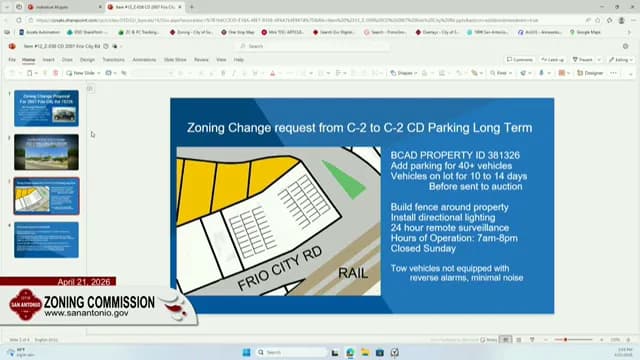
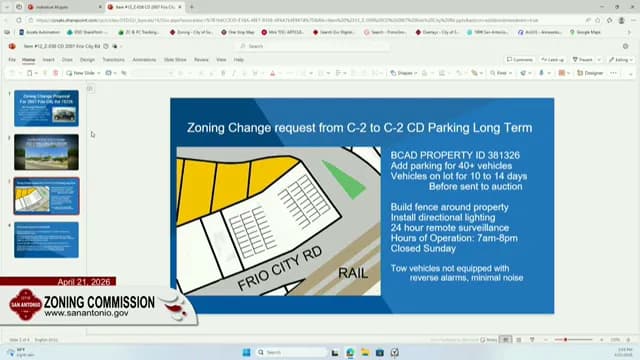
The San Antonio Zoning Commission met on April 21, 2026, at 1:00 PM under the chairmanship of Joan Bustamante. The meeting began with preliminaries (roll call, pledge, and format explanation) and then considered a consent calendar, several postponements, and individual rezoning cases. Key actions included approval of multiple consent items, postponement of several contested cases, denial of a tobacco store near a school, and approval of a historically existing gas station. Consent Calendar The commission unanimously approved the following consent agenda items (presented without public comment): - Item 10: Rezone from BP to LS (outdoor storage) at 36 Pinway. No neighborhood association response. - Item 13: Rezone from C‑2 to C‑2 CD (conditional storage and office) at 6 N Hwy 10 (amended location). No registered neighborhood association within 200 ft. - Item 14: Rezone at 37 Castro Rossi / Castro Bill Road. 52 notices sent; zero opposed, zero in favor; neighborhood association in support. - Item 15: Rezone from R‑6 to RMC at 1435‐1439. No neighborhood association within 200 ft. - Item 16: Rezone to R‑16 (designs unchanged). Community Quintana in favor; 1 opposed, 0 in favor outside 200 ft. - Item 17: Permit tobacco sales in an IDC‑1 zone at 4031 Saddle Street. Designs unchanged; 25 notices sent, 0 opposed, 0 in favor; no association response. - Item 19: Rezone from RCA‑1 to IDC‑2 with C‑2 permitted uses and a tavern at 1103‐1107 Quincy St and 2126 McLean St. Designs unchanged; 30 notices sent, 0 opposed, 0 in favor; Tobin Hill Community and Downtown San Antonio Association did not respond. Public Comments & Testimony - Jane Schaefer (spoke on postponed Items 8 & 11) expressed strong opposition to rezoning a residential area to commercial/industrial. She described the site as a classic “spot zoning” that would increase traffic, noise, and decrease property values. She noted the property owner had already cleared the land, placed large trucks, and received a UDC violation that remains pending. She stated the applicant continues to use the property illegally (installing a fence) and is essentially seeking retroactive approval. She concluded that approving the request would reward non‑compliance and urged denial. Discussion Items Item 2 — Located at 1139 Cerca del Ourero Hwy. Staff recommended denial because expanding C‑3 would allow incompatible uses. The district commissioner (Pete Rodriguez) moved for postponement to May 5; motion carried unanimously. No public comment. Item 3 — (519 B St.) Request to rezone to R‑6 (residential). Staff noted 23 notices sent, 2 in favor, 0 opposed within 200 ft; two registered neighborhood associations supported. The applicant (Mr. Peters) described modifications (removing carports, reducing impervious cover) after speaking with nearby residents. Commissioners discussed density (four units on a quarter‑acre), contacts with neighbors, and the complexity of multiple neighborhood associations. The motion to deny failed for lack of a second; then a motion to approve was made by Commissioner Hinojosa, seconded by Pete Rodriguez. After discussion, the motion passed 10‑1 (Commissioner Panam opposed). Item 5 — (2412 El Paso St.) Request to rezone from C‑1 to IDC (limited intensity) with uses permitted in C‑1 for a small office/coffee shop. Staff recommended denial as an inappropriate commercial intrusion. Applicant Josue Zapata stated he had support from the historic association and neighboring properties and would operate 6 AM–7 PM Monday–Saturday. Commissioners noted the low intensity and community support. Motion to approve (by Chair Bustamante, seconded by Commissioner Duval) passed unanimously. Item 6 — (13517 Sadwell @ 410) Request for C‑2 CD conditional use for long‑term parking and storage. Staff initially recommended denial, citing incompatibility. Applicant Mark Elizondo said they owned 50 acres and planned to convert the frontage into a commercial park with a 50‑foot buffer. They had reached agreement with the adjacent Methodist Hospital. After discussion, motion to approve as amended (by Pete Rodriguez, seconded by Hinojosa) carried 9‑2 (Commissioners Saibes and Bustamante opposed). Item 7 — (1005 N Zarzamora St.) Request to rezone from R‑6 to IDZ‑3 (high‑intensity) for a lumber and building materials store. Staff detailed numerous code violations (unpermitted construction, fencing, occupancy, floodplain issues). Applicant Emily White stated the business had operated for four years and that they needed the zoning to obtain retroactive permits. Code Enforcement Officer Michelle Velázquez confirmed five active violations, including unpermitted expansions and prohibited corrugated metal fencing with barbed wire. After extensive discussion, a motion to approve (by Chair Bustamante, seconded by Kellam) failed (5‑4‑? vote: yes: Bustamante, Kellam, Hinojosa, Duval, Witset; no: Pete Rodriguez, Saibes, Kelly, Pana). A motion for reconsideration (by Pete Rodriguez, seconded by Panam) passed, followed by a motion to postpone to May 19 (by Bustamante, seconded by Duval) which passed unanimously. Item 9 — (1904 Nogalitos) Request for IDC‑3 (general commercial) with conditional use for a tobacco store/vape lounge within 1,000 ft of Collins Garden School. Staff recommended denial because the use is prohibited near schools. No applicant appeared. Motion to deny (by Chair Bustamante, seconded by Hinojosa) passed unanimously. Item 12 — (2007 Frio City Rd.) Request for C‑2 CD with conditional use for long‑term parking/storage (40+ vehicles). Applicant Janie Herrera described cleaning up the site and providing 24‑hour security. A speaker from the Esperanza neighborhood opposed, preferring less industrial uses. Commissioners noted the existing C‑2 already allows many auto‑related uses and that the site had prior code violations (8‑ft fence issue). Motion to postpone to May 19 (by Commissioner Duval, seconded by Kellam) passed unanimously. Item 18 — (6543 Callahan Rd.) Request to rezone to C‑2 S (specific use) for a gas station with 50,000‑gallon tanks within 100 ft of residences. Staff recommended denial due to fire risk. Applicant Patrick Christensen explained the property was a former gas station until 2019; the new owner had restored pumps and obtained several permits before being told the zoning was incorrect. Commissioners noted the history of the gas station and that the use had coexisted with nearby homes for decades. Motion to approve (by Commissioner Saibes, seconded by Hinojosa) passed unanimously. Key Outcomes - Consent Calendar (Items 10, 13, 14, 15, 16, 17, 19): Approved unanimously. - Postponements: - Items 8 & 11: Postponed to May 5, 2026. - Item 1: Postponed to May 19, 2026. - Item 2: Postponed to May 5, 2026. - Item 7: Postponed to May 19, 2026 (after failed approval and successful reconsideration). - Item 12: Postponed to May 19, 2026. - Item 3 (519 B St., R‑6 rezone): Approved 10‑1. - Item 5 (2412 El Paso St., IDC rezone): Approved unanimously. - Item 6 (13517 Sadwell, C‑2 CD rezone): Approved as amended 9‑2. - Item 9 (1904 Nogalitos, tobacco store): Denied unanimously. - Item 18 (6543 Callahan, gas station): Approved unanimously. - Minutes of April 7, 2026 approved with amendment (combining last two paragraphs). The meeting was adjourned at 3:36 PM.

ZONING AND LAND USE 78% · CODE ENFORCEMENT 11% · PROCEDURAL 6% · COMMUNITY ENGAGEMENT 5%
328
APR 21, 2026 · SAN ANTONIO, TEXAS · COUNCIL COMMITTEES
San Antonio City Council Meeting April 21, 2026: Youth Mental Health and Juvenile Justice Initiatives

This meeting of the San Antonio City Council, held on Tuesday, April 21, 2026, at 9:00 AM, focused on two major presentations: the Bexar County Continuum of Care project for juvenile justice reform and the city's youth mental health initiatives. Council members also reviewed a new data visualization dashboard and approved the previous meeting's minutes. Public comment was heard from a representative of a school-based mental health support organization. Consent Calendar - Approval of Minutes: The council unanimously approved the minutes from the previous meeting. No corrections were offered. All members present voted in favor, with no opposition or abstentions. Public Comments & Testimony - Speaker from "Calibre de las Escuelas" (school-based support organization): The speaker expressed deep gratitude for the opportunity to address the council and highlighted the importance of accessible mental health support for families. They shared a story of a family of six who had lost all belongings and were living in a single room with one bed; through community resources, the organization provided beds so children could sleep in their own beds for the first time, restoring dignity and routine. The speaker emphasized that strong schools lead to a strong community and that the city's work is inseparable from school quality. They noted that 99 students are currently completing case management. Discussion Items Bexar County Continuum of Care Project (Item 2) - Presenter: Erika Ferry, from the Institute for Policy Impact, presented a strategic planning process funded by OJJDC (Office of Juvenile Justice and Delinquency Prevention). The goal is to promote a continuum of care for youth at risk of entering the justice system, using quantitative and qualitative data. - Key data shared: School discipline disparities were shown, with Black students disproportionately affected. Suspension rates, both in-school and out-of-school, were mapped by zip code, revealing higher rates in southern areas with fewer resources. The presentation also covered risk factors such as academic failure, low socioeconomic status, and special education services. - Priority Action Areas: Three of seven priorities were highlighted: (1) Expanding school-based restorative practices and mental health services; (2) Reducing punitive penalties for behavior by developing scalable alternatives (e.g., Southwest ISD program); (3) Investing in workforce development and training, including mentorship programs and community training. - Councilmember Munguía asked about the Southwest ISD diversion program and noted that a change in state law from misdemeanor to grave offense had increased consequences. He inquired about resource gaps in specific zip codes (particularly 7209 and 72091) and the need for mobile services. He also questioned why priority 2 was not discussed; the presenter offered to share all seven priorities in the full report. - Councilmember Mickey Rodríguez expressed concern about racial bias in school discipline, stating that Black students are often perceived as more aggressive and disciplined more harshly than white students. She asked what steps are being taken to address cultural bias among teachers and administrators. The presenter replied that a multi-layered systemic change approach is needed, including trauma-informed care and changing professional mindsets. The presenter also noted that school districts Southwest ISD, Northside ISD, and Central ISD are participating, and that Jacobs (a councilmember from another entity?) is a partner. - Councilmember Core requested that the backup data for discipline slides (specifically how disproportionality was determined) be shared. She cautioned that school discipline data can be subjective, as some schools may over- or under-report incidents, and urged careful interpretation. She also asked about coordination with the city's violent crime plan (Phase 3) and the integrated community safety office. The presenter welcomed additional collaboration and noted that action committees are volunteer-based. - Councilmember Castillo asked about zip codes in District 5 (Harnall ISD) and requested data on how many youth have incarcerated parents. He emphasized the need to support families with incarcerated parents and asked about diversion processes from both juvenile and adult jails. He also raised the issue of federal executive orders potentially limiting race-based approaches, but the presenter noted that systemic changes can still address disparities. Youth Mental Health Initiatives (Item 3) - Presenter: Jessica Weaver, Metro Health. She reviewed the history of youth mental health efforts since 2021, including community sessions that led to 20 two-year contracts totaling $15.5 million. Over 6,000 children have received individual or group therapy. Fifty-two percent of services were provided in schools. Contracts cover areas such as East North Side, South, and school districts. - Upcoming events: The third annual Mental Health Summit will be held on October 30, 2026, focused on school safety and integrating psychological and physical security. A youth mental health survey is open until May 10, 2026. Metro Health is also monitoring the impact of new state legislation (SB12 and HB11) and tracking hospitalizations and ER visits. - Councilmember Mickey Rodríguez thanked staff and requested high-resolution flyers for council offices. - Councilmember Munguía thanked Jessica and noted a new committee on school safety (chaired by the president) to ensure focus on student well-being. - Councilmember Castillo praised the work and noted that Rebecca Flores is leading youth commission conversations. He emphasized the need to align resources with high-impact schools and coordinate mobile services. - Councilmember Core asked about the TeCA program (state telehealth for psychiatry and counseling), which is expanding post-COVID. She noted that state funding could help as local grants expire. She also stressed that city dollars have power to support school-based services and urged advocacy at the state level for more school funding. She asked Jessica to identify the biggest barrier: Jessica responded that having full-time clinical staff in schools is effective but requires significant funding, and school districts are facing budget cuts, making it the top barrier. - Council President noted that mental health impacts attendance and learning, and asked how services address social determinants like housing and food security. Jessica replied that contracted partners handle those referrals and that families receive case management. She confirmed they track referrals to partners for housing, utilities, or food. Data Visualization Dashboard (Item 4) - Presenter: Alejandra López (and Bethany) from the city's analytics team presented a prototype dashboard based on committee feedback. It includes three indicators: Kindergarten readiness, third-grade reading proficiency, and youth opportunity (workforce participation via Ready to Work). - Maps shown: Kindergarten readiness data (number of participants at library events by zip code, with some exclusions noted); third-grade reading proficiency comparing to Metro Health data (2025); youth opportunity map showing participants in Ready to Work. - Councilmember Core commented that the maps are impactful, particularly the stark north-south difference in kindergarten readiness. She noted that third-grade reading maps show more homogeneity, indicating school district efforts. She asked about data collection methods (library events have no barriers; attendance is simply counted). She suggested overlaying mental health crisis maps with poverty data to see correlations. - Councilmember Munguía liked the prototype and asked for the ability to click on specific events to see weekly activities at libraries or parks. He noted that libraries in his district (e.g., Lyndon) are popular, so attendance reflects demand rather than need. He suggested using the data to recruit families in underserved areas to attend programs. - Councilmember Castillo echoed interest in overlaying demographic data and understanding where demand exists versus where services happen. He asked about granularity and suggested collecting parent/student information to help target outreach. - Presenter response: They acknowledged the feedback and will continue refining the dashboard with additional layers and data sources. Key Outcomes - Minutes approved unanimously. - No formal votes were taken on the presentations. Council members expressed support for the initiatives and requested follow-up information: - Councilmember Core requested the backup data for discipline slides. - Councilmember Mickey Rodríguez requested high-resolution flyers for mental health summit information. - Councilmember Munguía and others requested a meeting to connect city funding (e.g., general fund grants) with school mental health programs and the Bexar County Continuum of Care. - Council President noted the need to track how many students involved in municipal court or truancy programs are also receiving mental health services, and asked Metro Health to explore ways to capture that data. - Adjournment: The meeting adjourned at 11:47 AM.

YOUTH PROGRAMS 54% · MENTAL HEALTH AWARENESS 22% · RACIAL EQUITY 9% · PROCEDURAL 3%
329
APR 21, 2026 · SAN ANTONIO, TEXAS · BOARDS & COMMISSIONS
San Antonio Zoning Commission Meeting – April 21, 2026

The San Antonio Zoning Commission met on April 21, 2026, at 1:00 PM, chaired by John Bustamante. The commission reviewed a consent calendar, several continuance requests, and individual zoning cases. Key decisions included approval of a consent calendar, denial of a vape shop near a school, and a split vote on a controversial commercial rezoning involving past permitting violations. Multiple items were continued to May 2026. Consent Calendar - Items 10, 13, 14, 15, 16, 17, 19 were approved unanimously. These included rezonings for office/warehouse, commercial, residential, and mixed-use districts, with no public opposition and neighborhood association support or no response. Public Comments & Testimony - Jane Schaefer (address 505 Costano Avenue) spoke against item 8 (125 Stonewall Avenue, withdrawn from this meeting but discussed as a continuance). She argued that the proposed change from residential to commercial/industrial constitutes spot zoning, increases traffic and noise, and the applicant has ongoing UDC violations. She urged denial of both the zoning and the continuance. - Trisha Fayad (Vilas Esperanza neighborhood) opposed item 12 (2007 Frio City Road), stating that another industrial use at the entrance of her neighborhood would harm beautification efforts and that she would prefer a restaurant or office space. Discussion Items - Item 8 (125 Stonewall Avenue) – withdrawn; the process will restart. - Continuance to May 5, 2026 – Items 8 and 11 were continued despite public comment. The commission noted that a continuance would not risk granting non‑conforming use rights. Motion passed 8‑2 (Commissioners Sipes and Wetzett opposed). - Item 1 – Continued to May 19, 2026, without opposition. - Item 2 (6603 N IH‑35) – No applicant present; continued to May 5, 2026, at Commissioner Pete Rodriguez’s request. - Item 3 (519 B Street, R6 to R6 CD for four dwelling units) – Heated debate. Commissioner Pana raised concerns about insufficient outreach (only two residents contacted). Applicant Alvin Peters described modifications made after meeting with a community organization (no rentals). Two registered neighborhood associations supported; a third organization opposed. Motion for denial failed for lack of a second. Motion for approval passed 8‑1 (Commissioner Pana opposed). - Item 5 (2408 El Paso Street, R4 to IDZ1 with C1 uses) – Applicant Joshua Zapata proposed a small office and coffee cart. Staff recommended denial due to commercial encroachment, but the commission approved unanimously, noting support from neighbors and the neighborhood association. - Item 6 (13527 SW Loop 410, MF‑25 to C2‑CD for long‑term parking/storage) – Applicant Mark Elisondo described a 55‑acre site with a 50‑foot buffer for Methodist Hospital. Staff recommended denial. Motion for approval as amended passed 8‑2 (Commissioners Sipes and Chair Bustamante opposed). - Item 7 (1005 N Sauston Mortar, R6 to IDZ3 for lumber yard/building materials) – Complex case with multiple unpermitted structures, floodplain issues, and code violations. Staff recommended denial. Motion for approval failed on a 5‑4 vote (Chair Bustamante, Kellum, Inohosa, Duval, Wetzett in favor; Pete Rodriguez, Sipes, Kelly, Pana against). A subsequent motion for reconsideration passed 8‑1, then the item was continued to May 19, 2026, with the expectation that the applicant would remove razor wire and show good faith. - Item 9 (1904 Nogalito Street, C3R to C3RS for vape shop within 1,000 ft of a school) – Staff recommended denial. Motion for denial passed unanimously. - Item 12 (2007 Frio City Road, C2 to C2‑CD for vehicle storage) – Applicant Janie Aretta sought to continue a tow‑company operation. Neighbor Trisha Fayad opposed. Commissioner Duval noted that the current C2 zoning already permits auto‑related uses. The chair moved for a four‑week continuance to May 19, 2026, to allow further discussion. Motion passed unanimously. - Item 18 (6543 Callahan Road, C2 to C2‑S for gas station) – Applicant Patrick Christensen explained that the property had been a gas station until 2019, and permits were issued before a zoning issue was discovered. Staff recommended denial due to proximity to multifamily residences. The commission approved the request 8‑0, noting the historical use and coexistence. Key Outcomes - Consent calendar (items 10, 13, 14, 15, 16, 17, 19) – Approved unanimously. - Item 8 and 11 – Continued to May 5, 2026 (8‑2). - Item 1 – Continued to May 19, 2026 (unanimous). - Item 2 – Continued to May 5, 2026 (unanimous). - Item 3 – Approved as amended (8‑1). - Item 5 – Approved unanimously. - Item 6 – Approved as amended (8‑2). - Item 7 – Motion for approval failed (5‑4); reconsideration granted (8‑1); continued to May 19, 2026 (unanimous). - Item 9 – Denied unanimously. - Item 12 – Continued to May 19, 2026 (unanimous). - Item 18 – Approved unanimously. - Minutes of April 7, 2026 – Approved as amended (by combining two paragraphs under Logan Sparrow’s presentation). The meeting adjourned at 3:36 PM.

ZONING AND LAND USE 81% · CODE ENFORCEMENT 8% · PROCEDURAL 6% · COMMUNITY ENGAGEMENT 3%
330
APR 21, 2026 · SAN ANTONIO, TEXAS · COUNCIL COMMITTEES
Educational Opportunities Committee Meeting – April 21, 2026

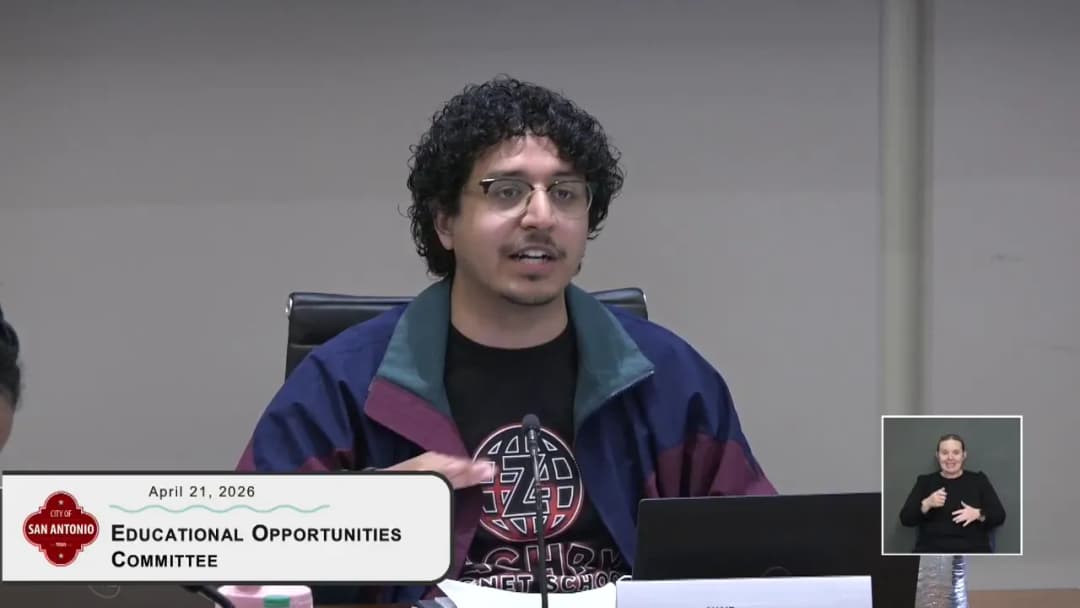
The Educational Opportunities Committee of the San Antonio City Council met on April 21, 2026, at 10:09 a.m. to receive briefings on the Bear County Continuum of Care Project, youth mental health initiatives, and a prototype for visualizing educational outcomes data. The meeting included public testimony and discussion among council members. No votes were taken aside from approving the minutes of the previous meeting. Consent Calendar - Approval of Minutes: The minutes from the last meeting were approved unanimously by a voice vote. No corrections were noted. Public Comments & Testimony - Jessica Weaver, Communities and Schools: Spoke in strong support of the city's continued investment in youth mental health. She reported that through its partnership with the city, the organization has supported 92 students this school year, completing more than 1,000 clinical sessions and providing comprehensive case management for 425 family members. She shared a story of a mother of five fleeing a 12-year abusive relationship to illustrate the impact of school-based services, stating “there is no separation between the work of the city and the quality of our schools.” Discussion Items - Item 2: Bear County Continuum of Care Project (Erica Crawford, Meadows Mental Health Policy Institute) : Crawford presented an 18-month planning process funded by an OJJDP grant aimed at reducing justice involvement for youth. Key data showed that Black youth, especially Black males, are referred, arrested, and detained at higher rates than their peers; top referral offenses are assault with bodily injury, family violence, and vaping; and school districts are the highest source of referrals to juvenile probation. The community-driven plan identified seven priorities, including expanding school-based supports, reducing penalties for adolescent behavior, and investing in workforce development. A comprehensive report will be released in late summer or early fall after OJJDP approval. Committee members asked about root causes of racial disparities, potential data overlays, and how to leverage city funds for implementation. - Item 3: Overview Update on Youth Mental Health Initiatives (Jessica Higgins, Chief Mental Health Officer) : Higgins provided a timeline of mental health efforts since 2021. City ARPA-funded youth mental health contracts totaling $15.75 million (20 contracts) ended in 2025, serving more than 6,000 youth; of those with four or more sessions, 52% saw decreased symptoms and 44% saw increased well-being. Current general fund contracts with Communities and Schools and the Mobile Mental Health Collaborative serve 100 youth and 550 students, staff, and families respectively. The second annual Bexar Area School Safety and Mental Health Summit was held in November 2025 with over 150 attendees, and the third summit is scheduled for October 30, 2026. Higgins also discussed the impact of Senate Bill 12 (effective September 1, 2025) on school-based mental health services, noting decreased utilization and increased hospitalizations. The city is working on a school funding blueprint and continues legislative advocacy. Committee members asked about data on service overlaps, the T-Chat program, and funding barriers for school districts. - Item 4: Debriefing Educational Outcomes Data Visualization Prototypes (Alex, Office of the City Manager) : Staff presented prototype interactive maps for three milestones—kindergarten readiness, third grade reading proficiency, and opportunity youth—by overlaying city program data (library story times, Ready to Work, Next Level Center) onto base maps. The maps highlighted geographic disparities in service access and outcomes. Committee members praised the work and suggested adding school district boundaries, refining data collection, and using the tool to inform resource allocation. The prototype is intended to be further refined based on committee feedback. Key Outcomes - No formal votes or motions were taken except the approval of the minutes. - The committee directed staff to continue refining the data visualization prototype with additional layers and to coordinate with departments for more granular data. - The third annual Teen Mental Health Survey is open until May 10, 2026, and all council offices will promote the flyer. - Staff will explore opportunities to align city funding (e.g., delegate agency process, hotspot policing phase three) with priorities from the Continuum of Care plan and mental health initiatives. - The committee expressed support for advocacy at the state level for school mental health funding and for the Raise Your Hand Texas campaign to access the Rainy Day Fund. - Chair Galvan requested future briefings on pre-arrest diversion for youth and service density maps to better understand resource gaps.

YOUTH PROGRAMS 56% · MENTAL HEALTH AWARENESS 12% · PUBLIC EDUCATION 9% · PROCEDURAL 5%
OPENPUBLICA · PUBLIC MEETING INDEXUPDATED DAILY · openpublica.com