The San Diego City Audit Committee met on October 19, 2016, with a quorum present. Committee members Tom Hebrink, Alan Spencer, and Ricardo Valdivia participated; the chair was expected to join shortly. Staff present included Deputy City Attorney Mara Elliott, Mayor's office representative Rolando Sharvel, Independent Budget Analyst Lisa Byrne, City Auditor Eduardo Luna, and committee consultant Riley Webb. The committee approved the previous meeting's record, received the City Auditor's monthly activity report, accepted the Central Stores inventory report, reviewed the semi-annual audit recommendation follow-up, accepted the Q1 FY2017 fraud hotline report, and appointed a member to the Disclosure Practices Working Group. Consent Calendar - The record of action from the September 21, 2016 meeting was approved by unanimous consent; no item was pulled for discussion. Public Comments & Testimony - No non-agenda public comment was offered at the start of the meeting. - During the fraud hotline item, Robert McNamara (District 3) asked whether recommendations from fraud hotline investigations could be tracked through the audit recommendation follow-up process or in a separate progress report. The City Auditor's office responded that recommendations from public fraud hotline reports are already tracked with other audit recommendations, while government code privacy protections limit reporting on personnel-related cases. Discussion Items City Auditor Monthly Activity Report - City Auditor Eduardo Luna reported that since the last meeting the office had issued three audit products, all on the day's agenda: the FY2016 Central Stores Inventory Audit, the recommendation follow-up report ending June 30, 2016, and the Q1 FY2017 fraud hotline report. - The Development Services Department Expedite Permitting Audit was in report writing and was expected to be issued within three to four weeks, in time for the next committee meeting. - Audits in field work included two IT audits (Excel implementation and SAP user access), a street light maintenance audit, and the San Diego Convention Center audit. The Convention Center audit's budgeted hours were increased from 1,400 to 2,000 hours, an additional 600 hours, due to staffing changes, the need to coordinate with multiple entities, and significant data entry requirements. - Audits in preliminary review included Environmental Services Department Street Light Utility Billing and the Capital Improvement Program (CIP) audit. The CIP audit was to be broken into two audits: one on quality assurance for streets and one on the lifeguard tower at Children's Pool. - This item was informational; no vote was taken. Central Stores Inventory Audit (MGO) - Kevin Starkey, partner with MGO, presented the fourth annual agreed-upon-procedures inventory count conducted for the City Auditor's Office under Municipal Code requirements. - MGO sampled 257 individual stock items across Store 1 and Store 2. The estimated difference at the dollar level was a 1.10 percent error rate. Committee members noted some unit-level sample discrepancies were higher, such as 30 out of 144 items and 5 out of 10 items. - New attachments summarized discrepancies by item. MGO observed some obsolete or damaged inventory that had not been set aside for disposal as required by administrative policy. - Matthew Helm, Deputy Director for Purchasing and Contracting, said the department had implemented training, rolling counts, physical controls, and segregation of duties, and described a zero discrepancy rate as an aspirational goal. He also noted recent staffing changes and the need to improve communication with departments about writing off obsolete inventory. - The committee accepted the report on a motion by Mr. Hebrink, seconded by Mr. Valdivia, passed unanimously. Audit Recommendation Follow-Up (as of June 30, 2016) - Assistant City Auditor Kyle Elser and Deputy City Auditor Danielle Knighton presented. As of June 30, 2016, there were 137 open recommendations across 42 audit reports. Of those, 38 were implemented or no longer applicable, leaving 98 to carry forward. - Of the 137 open recommendations, 31 in-process recommendations were over two years old, 32 were one to two years old, 32 were under one year old, and one not-implemented recommendation was under one year old. Among the 31 over-two-year-old recommendations still in process, five were past due as of June 30, 2016; six were scheduled within six months; six within one year; ten within 24 months; one over two years; and three had no target date. - The City Auditor's office highlighted one recommendation as no longer applicable: Development Services decided not to implement a late penalty fee after consulting the City Attorney, although streamlined deposit accounts met the intent of another recommendation. - The office thanked Park and Recreation for completing all playground maintenance recommendations, moving a target date from 2021 to the current reporting period. - Three reports were brought forward as significantly past due or with multiple target-date changes: - Industrial Wastewater Control Program: original target January 2014, moved to June 2018. Public Utilities staff said a cost-of-service study and Prop 218 process were needed; no fee changes had been made since 1984, but no rate increase was currently projected. - Waste Reduction and Recycling Program: original target March 2016, moved to November 2017. An RFP was issued in September and results were expected at the end of October; legislative recess and the 2015 Zero Waste Plan timeline contributed to delays. - Fleet Services fraud risk assessment: priority-one recommendations originally scheduled for spring 2015, with dates moved to May 2016, June 2017, and February 2018. Fleet Operations staff described a 24-month Fleet Focus upgrade project and hiring of supplemental limited positions. - Committee members expressed concern that roughly 70 percent of recommendations remained in process and that target dates were repeatedly pushed out. Mr. Hebrink asked for a complete history of target dates so the committee could see how often dates changed. Mr. Spencer suggested the audit office develop a measurable goal to flip the ratio of implemented to in-process recommendations. He also noted the office's roughly $4 million budget and said the value of audits is realized through implementation. - Administration and audit staff responded that 183 recommendations had been implemented over the prior two and a half years while 161 new recommendations were issued, approximately 63 percent completion, and that the strong-mayor form of government limits the auditor's ability to compel implementation. Stacey Lamedico said departments take recommendations seriously and noted training of department directors and creation of department liaisons. - The committee accepted the report and agreed to drop the no-longer-applicable recommendation on a motion, seconded by Mr. Valdivia, passed unanimously. Quarterly Fraud Hotline Report (Q1 FY2017) - Fraud investigator Andy Jarita reported 44 fraud hotline complaints received in the first quarter of fiscal year 2017, more than in any of the previous 16 quarters. Ten were assigned to the City Auditor to investigate, 20 to departments, and 14 were outside the hotline's purview or did not involve city operations. - There were 24 open city-related complaints on July 1, 2016; 30 were added for a total of 54 active complaints, the highest ever. Twenty-five were closed, leaving 29 open cases. - Six complaints were substantiated: - Hiring-process abuse at Public Utilities Department: eight recommendations, all agreed to; public report issued August 4, 2016. - Employees enrolling children and grandchildren in Park and Recreation activities without paying required fees: two recommendations, both agreed to; public report issued August 18, 2016. - Unauthorized fee waivers: substantiated; confidential report provided because the employee did not personally benefit and the dollar amount was relatively small. - Contract awarded in violation of state law, creating a conflict of interest prohibited by Government Code Section 1090; contract was void and would be awarded to a different firm. - Criminal activity using a city vehicle: substantiated; San Diego Police Department was informed and corrective action taken. - Personal use of city equipment: substantiated; corrective action taken. - Six additional complaints resulted in corrective actions, including verbal reminders, an administrative warning, refresher training, and reminders about acceptable use of city resources. One substance-abuse allegation was not substantiated but prompted refresher training. - The committee accepted the report on a motion by Mr. Hebrink, seconded by Mr. Spencer, passed unanimously. Appointment to Disclosure Practices Working Group - Rolando Sharvel explained that the Disclosure Practices Working Group reviews city disclosures related to investors, bond documents, preliminary official statements, and the comprehensive annual financial report. Chief Financial Officer Mary Lewis clarified that the committee member's participation would be for the CAFA review and not for bond offerings. - Alan Spencer volunteered to serve. The committee appointed him on a motion by Mr. Valdivia, seconded by Mr. Hebrink, passed unanimously, for a one-year term. Key Outcomes - Approved the September 21, 2016 record of action by unanimous consent. - Received the City Auditor's monthly activity report as an information item. - Accepted the Central Stores Inventory Audit report unanimously. - Accepted the June 30, 2016 audit recommendation follow-up report and removed the no-longer-applicable DSD late penalty fee recommendation unanimously. - Accepted the Q1 FY2017 fraud hotline report unanimously. - Appointed Alan Spencer to the Disclosure Practices Working Group for a one-year term unanimously. - The next audit committee meeting was scheduled for December 7 at 9 a.m.
Public Meetings - San Diego, California
Public Meetings - San Diego, CaliforniaThe Environment Committee of the San Diego City Council met on October 12, 2016, at 5:00 PM to address a range of environmental and infrastructure issues. Key actions included certifying the Pure Water Program's Environmental Impact Report (EIR), receiving updates on stormwater maintenance and winter preparation, discussing the feasibility of expanding polystyrene recycling, and directing the Independent Budget Analyst (IBA) to explore hiring an independent water rate consultant. The committee also approved several consent agenda items and heard public testimony on multiple projects.
The Budget and Government Efficiency Committee met on October 7, 2016, to review the fiscal year 2016 year-end financial performance, approve the FY 2018 budget development calendar, extend a fuel contract, receive updates on fleet operations and IT accomplishments, and discuss the zero-based budgeting pilot. All items were approved unanimously.
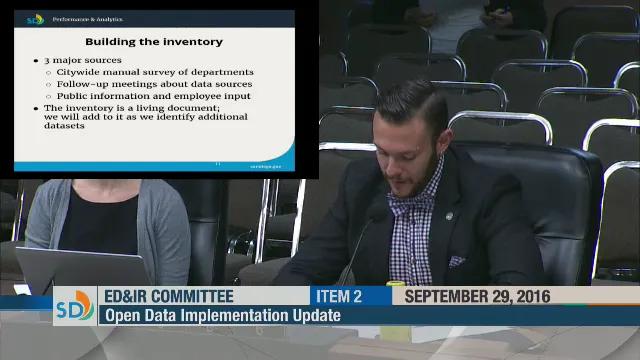
The Economic Development and Intergovernmental Relations Committee met on September 29, 2016, at 2:00 PM. Chair Cole presided, with Vice Chair Kercy and Councilmember Alvarez present. The committee approved minutes from July 14, 2016, received updates on the San Diego Convention Center, the Open Data Portal, and a new business portal (Open Counter), and took action on reinvesting former Enterprise Zone funds and the 2017-2019 Economic Development Strategy. Consent Calendar - The committee record of action from July 14, 2016, was approved unanimously without discussion. Public Comments & Testimony - Martha Welch spoke about MTS budget concerns, questioning where funds were spent, citing lack of connectivity between rapid buses and trolleys, and inadequate restroom facilities. She also advocated using the old central library as a homeless resource, criticizing the city's approach to homelessness, and praised San Francisco's model of housing homeless individuals. Discussion Items San Diego Convention Center & Tourism Authority FY2016 Update - Stephen Cushman (Convention Center Board) stressed that two conferences (Lightfair and Specialty Graphic Imaging Association) were lost because they outgrew the facility, representing $70 million and $17 million in regional impact, respectively. - Rip Rippeteau (President/CEO, Convention Center) reported 158 events, 824,276 attendees, $1.1 billion regional impact, 737,155 room nights, and $23.9 million in hotel/sales tax revenue—the highest since 2008. The center had 66% building occupancy (above 49-50% national average), trending to 70% in FY17. - Joe Tursey (President/CEO, San Diego Tourism Authority) noted the center booked over 1.1 million room nights, a new record. Lost business reasons: 67% due to lack of preferred dates/space; only 14% lost to competitors. The building is effectively full, with many conventions booking 10+ years out. - Committee members (Alvarez, Kercy, Cole) requested more detailed data on lost business, cumulative booking snapshots, and occupancy potential. Staff agreed to provide a deeper analysis. Open Data Portal Update - Alma Udris, Maxim Pachursky, and Andrew Bauer (Performance & Analytics) reported the launch of data.sandiego.gov on July 1, 2016, with 44 datasets (121 files) from all city departments. The portal had over 24,000 page views and 13,000 downloads as of August 31. - Top downloaded datasets: police calls for service, indicator bacteria/drinking water test results, and community planning boundaries. - City staff prioritized datasets based on public demand (via voting), PRA requests, and automation feasibility. All data is auto-updated to eliminate manual processes. - The city moved from 67th to top 10 in the Sunlight Foundation's open data census. Future plans include a data help desk, city data day, and expanding analytics. - Committee members (Kercy, Alvarez) asked about tracking data usage by district and the timeline for publishing the budget data as open data. Maxim stated the budget data is targeted for this fiscal year. Open Counter Business Portal - Christina Vincent (Economic Development) and Peter Coate (Open Counter co-founder) presented a new online business portal (sandiego.opencounter.com) to help entrepreneurs navigate permits, fees, and codes. The tool mimics TurboTax, using a question-and-answer format to identify required permits based on business type, location, and operations. It automatically populates application forms and estimates fees. - Open Counter is live in 41 California cities and 16 states. San Diego's setup cost $56,000 with a $150,000 annual service contract. - The portal currently covers commercial activities but can be expanded. Spanish language and ADA compliance are included. - Committee members (Alvarez, Kercy) praised the tool for simplifying city permitting and reducing staff time. Kercy suggested integrating county and state permits in the future. Enterprise Zone Fund Reinvestment - Kevin Sullivan (Economic Development) explained that the California Enterprise Zone program ended in 2013, but the San Diego Regional Enterprise Zone accumulated a $3.5 million surplus from processing 23,000 voucher applications in the final 18 months. The funds must be spent in the former zone on economic development activities. - Eric Caldwell (Economic Development) proposed disbursing 27% ($945,000) to Chula Vista and National City (based on their share of applications). The city's remaining $2.5 million would fund eight initiatives: - Water/sewer capacity bank ($750,000) – revolving fund to buy/sell capacity. - Fee payment incentive ($240,000) – covers difference between express and expedite fees for job-creating businesses. - Code for America portal (ongoing support) – one-stop shop for incentives/programs. - Connector Careers ($300,000 over 3 years) – youth workforce development. - Revolving loan fund study ($100,000) – improve utilization from 50% to 90%. - Placemaking loan fund ($500,000) – revolving for temporary land activation. - Activation grants ($250,000) – grants for city permit fees for community projects. - Capacity building initiative ($300,000) – grants up to $20,000 to non-profits new to city funding. - Committee members (Alvarez, Kercy) raised questions about metrics, sustainability, and community input. The motion to approve passed unanimously. 2017-2019 Economic Development Strategy Update - Lydia Moreno and Christina Benson (Economic Development) presented updates since the March 10, 2016 committee review. Changes include more precise metrics, completion statuses, acknowledgment of new initiatives (e.g., Connector Careers, reinvestment funds), and inclusion of Civic San Diego's work plan. - Councilmember Alvarez requested stronger emphasis on housing as a key economic development factor. The committee approved the strategy with direction to integrate housing metrics before final council consideration. The motion passed unanimously. Key Outcomes - Open Data Portal: Informational report received; no motion required. Staff will continue expanding datasets and community engagement. - Open Counter: Informational report received; portal is live and will be formally unveiled at the end of October 2016. - Enterprise Zone Funds: Motion to authorize disbursement to Chula Vista and National City and to authorize the CFO to expend the city's share on the eight programs passed unanimously. - Economic Development Strategy: Motion to forward to council with direction to include housing metrics passed unanimously.
The Rules Committee convened on September 28, 2016, at 9 a.m. to discuss five agenda items: an update on the city's boards and commissions, revisions to municipal code for the redistricting commission, establishing a permanent bicycle advisory committee, improving the effectiveness of boards and commissions, and ordinances addressing high-occupancy single-family dwellings (mini-dorms) in the College Area. The committee heard extensive public testimony and voted on several items. Consent Calendar - The committee record of actions for the August 3, 2016, Rules Committee meeting was approved by unanimous consent without discussion. Public Comments & Testimony - David Modi (Chair of the Community Planners Committee, speaking as an individual) commented on the boards and commissions matrix, advocating for streamlining, terminating inactive boards, reducing membership sizes, and addressing term expiration issues. He noted that many boards have quorum problems and that continuing members after term expiration is widely seen as a way to influence decisions. - Robert McNamara (District 3 resident) suggested starting the appointment process three to four months earlier, standardizing board terms, and having boards choose their own reporting format (annual work plan, annual report, or regular committee report). He also recommended a survey of all 43A boards. - On item 5 (mini-dorm ordinances), many speakers testified. In favor: Rhea Kuhlman (27-year College Area resident) argued the ordinance would preserve single-family character and cited statistics: 82% of high-occupancy homes required city involvement, and nearly half had multiple violations. She presented data showing 34 houses adding bedrooms in the first six months of 2016, compared to 21 in neighboring Navajo and 2 in Kensington-Talmadge. Other supporters included Gary Campbell (president of College View Estates Association) and Ann Catrol (50-year resident). Opposition: Chris Wood (College Area Renters and Landlord Association) argued the ordinance would reduce affordability, push students further from campus, and was not supported by city staff or advisory committees. Dylan Callflower (SDSU student) noted that 10% of CSU students experience homelessness and that high fines ($10,000 per person) could cripple students. Keith Henderson (landlord) stated that rental properties are 30% cheaper than on-campus housing. The Community Planners Committee voted 19-2 to support the ordinance, while the Technical Advisory Committee and Code Monitoring Task Force voted against key provisions. Discussion Items Item 1: Update on Boards and Commissions - City Clerk Liz Maland presented a matrix of 54 active and 31 inactive boards/commissions. The matrix is updated quarterly and includes links to code sections, appointment processes, conflict of interest codes, and term expiration data. She noted that the online version lists only 46 active boards (excluding those with restricted membership). Council President Pro Tem Emerald expressed concern about the unwieldy number of boards and supported streamlining. Item 2: Redistricting Commission Municipal Code Revisions - City Clerk Liz Maland explained required updates to align with Proposition A charter amendments, including increasing commission membership from 7 to 9, adding two alternates, extending the nomination period from 30 to 60 days, and shifting random selection duties from the city manager to the city clerk. She requested feedback on: vetting retired judges, alternate selection process, use of Council Policy 000-13, earlier publication flexibility, application content (e.g., removing college transcript requirements and social security numbers), and department support. Committee members discussed conflict of interest codes, district-based alternates, and budget provisions. Council President Leitner emphasized the need for adequate funding and independence from political influence. Item 3: Bicycle Advisory Committee (BAC) Codification - Kyle Heskla (Council President's office) and Andy Henshaw (BAC Chair) presented. The BAC was established in 2014 by resolution under Charter Section 43B (temporary), with objectives including a five-year bicycle strategic plan and ongoing advisory roles. Given the long-term need (Climate Action Plan goals: 6% bike mode share by 2020, 18% by 2035) and recent SANDAG $200 million early action program, they recommended codifying the BAC as a permanent committee under Charter Section 43A. The committee directed the City Attorney to draft an ordinance with duties referencing the BAC’s original objectives, the Climate Action Plan, and Vision Zero, and to bring it to City Council. Item 4: Boards and Commissions Effectiveness - Council President Leitner introduced a memo seeking feedback on improving appointment processes, standardizing staff support and training, requesting annual work plans, and reviewing boards/commissions for continued relevance. Francis Barraza (Mayor's Office Director of Appointments) outlined the current appointment process, which includes background checks, council nominations, and coordination with departmental staff. Public comment included David Modi’s calls for smaller board sizes and better tracking. Councilmember Cole suggested automatically sunsetting inactive boards after five years and requiring quarterly or semi-annual reports from boards. The committee directed the Mayor's Office to return with recommendations for improvements. Item 5: High-Occupancy Single Dwelling Units and Increased Penalties - Tim Taylor (Council District 9) presented two ordinances. The first ordinance applies mostly in the College Area (around SDSU) and includes: citywide definition of bedroom to include rooms designed to have a door; no more than 5 bedrooms on lots <10,000 sq ft and 6 on lots ≥10,000 sq ft in the College Area; no more than 6 surface parking spaces citywide on lots ≥10,000 sq ft; no parking within 30 feet of front lot line; and a 60% cap on gross square footage for bedrooms. The second ordinance increases maximum civil penalties for code enforcement violations citywide from $2,500 to $10,000 per violation (cumulative per person per day). Supporters argued that mini-dorms degrade neighborhoods and drain city resources (e.g., 214 of 277 party house caps in the College Area). Opponents claimed the ordinance would reduce affordable student housing and push students further from campus. The committee voted to recommend approval of both ordinances to full council, with direction to staff to study expansion of the first ordinance’s boundaries (including eastern areas) and to research penalty levels in other jurisdictions. Key Outcomes - Item 2 (Redistricting Code): Motion to direct the City Attorney to consider committee feedback and return on October 26, 2016, passed unanimously. - Item 3 (Bicycle Advisory Committee): Motion to direct the City Attorney to draft an ordinance establishing the BAC as a permanent committee under Charter Section 43A, with duties including implementation of the Bicycle Master Plan, Climate Action Plan, and Vision Zero, and to bring it to City Council, passed unanimously. - Item 4 (Boards and Commissions): Motion to request the Mayor’s Office to consider committee feedback and return with recommendations for improving appointment processes, staff support, training, and reporting, passed unanimously. - Item 5 (Mini-Dorm Ordinances): Motion to recommend approval of both ordinances to the full City Council, with directions to staff to evaluate expansion of the first ordinance’s boundaries to include eastern areas and to research penalty maximums in other jurisdictions, passed unanimously. The committee also asked to explore carport loopholes and clarify the 30-foot parking setback from curb line.
The Infrastructure Committee convened on September 22, 2016, chaired by Councilmember Kersey, with Vice Chair Cole and Councilmember Zap present. The meeting covered consent and action agenda items including street repair progress reporting, impact fee studies for multiple communities, and CIP budget revisions. The meeting also included a non-agenda public comment period on rent control. Consent Calendar - Items 2 and 3 were approved unanimously after Item 1 was pulled for separate discussion. - Item 1 (Avenida de la Playa emergency repair): Approved after staff presentation and public testimony. The action transferred $5 million from three projects (SR94 Euclid, University Avenue Mobility Plan, Torrey Pines Phase II) to fund a complete infrastructure replacement. Staff and mayoral representative assured that funds would be returned via RTIP amendment and FY18 budget process. Motion passed unanimously. Public Comments & Testimony - On Item 1: Ken Marlborough (Chair, Encanto Neighborhood Planning Group) and Emily Cox (advocacy coordinator, MAAC – an affordable housing developer) both supported the repair but stressed the importance of returning transferred funds to the SR94 Euclid project for community safety and access. - On Item 10 (San Isidro Impact Fee Study): Mike Friedman (Chair, San Isidro Community Planning Group) and Steve Otto (Vice Chair, San Isidro CPG and chair of infrastructure subcommittee) spoke in favor, emphasizing the community's need for infrastructure and urging approval. - On Item 11 (North Park Impact Fee Study): Tom Mullaney (resident) spoke in opposition, questioning why the proposed fee was lower than Uptown's despite similar needs. He argued the fee was too low to fund adequate parks. - Non‑agenda public comment (rent control): Multiple speakers (Raphael Bautista, Charles Oakey, Alex Keeney, Desi Cervantes, Francisco Olive, Denise Roberts, Jose Caballero) advocated for rent control, citing rising rents, housing unaffordability, and the need for tenant protections. They presented petitions and shared personal stories of displacement. Discussion Items - Item 4 – 2015‑16 Pavement Condition Report: Presented by Christy Reeser (Deputy Director, Street Division) and Almas Udris (Director of Performance and Analytics). The report showed the city's overall condition index improved from 59 (fair) in 2011 to 72 (good) in 2016, with 60% of streets now rated good. A new public map (streets.sandiego.gov) was demonstrated. Vice Chair Cole requested a future discussion on setting a minimum street condition standard. Councilmember Zap asked about slurry vs. asphalt impacts and specific streets in her district. The report was forwarded to full council unanimously. - Item 5 – Del Mar Mesa Public Facilities Financing Plan Update: Staff presented no increase to the current DIF rate, with a 3% annual inflationary factor. Approved unanimously. - Item 6 – Market Street Complete Street Project: $4 million state grant plus $700,000 city funds for bicycle, pedestrian, and median improvements from 47th Street to Euclid Avenue. Jacobs Center for Neighborhood Innovation contributed land valued at $600,000. Approved unanimously. - Item 7 – Electronic Bid Openings Municipal Code Amendment: Clarified that electronic bids are allowed if posted online and results are publicly available without registration. Approved unanimously. - Item 8 – Real Property Acquisition Streamlining for CIP Projects: Delegated authority to the mayor for property acquisitions under $250,000 or related to council‑approved CIP projects, saving an estimated 3 months and $8,000 per action. Condemnations still require council approval. Approved unanimously. - Item 9 – Budget Revisions to Various CIP Projects: Appropriated savings from completed/ delayed projects ($600,000 from San Diego River Dredging, $321,000 from Laurel Street Bridge, $56,000 from Cherokee St, plus antenna lease revenue) to four projects: Streamview Drive ($677,000), North Torrey Pines Road Bridge ($150,000), Linda Vista Road at Genesee ($150,000), and University Village Park Totlot ($150,000). Approved unanimously. - Item 10 – San Isidro Impact Fee Study FY17: Proposed fee of $10,208 per dwelling unit (a $100 decrease from the prior rate). Key projects include Bayer Park and San Isidro Branch Library (construction to start FY17, completion FY19). Community planning group approved unanimously. Forwarded to council. - Item 11 – North Park Impact Fee Study FY17: Proposed fee increase from $4,661 to $6,634 per residential unit. Park component largest; uses Balboa Park equivalencies for 67 acres. Planning group approved August 2016. Approved to council with motion to be heard concurrently with the community plan update. - Item 12 – Golden Hill Impact Fee Study FY17: Fee increase from $9,276 to $12,049 per residential unit. Key projects include Balboa Park golf course drive, bike/pedestrian facilities, F Street Linear Park. Planning group approved August 2016. Councilmember Zap noted concerns about burden on development and discussed potential gradation by unit size. Approved to council. Key Outcomes - All action items (Items 1–3, 5–12) were approved unanimously and forwarded to the full City Council. - Item 4 (pavement condition report) was forwarded to council as an informational item. - The committee received non‑agenda public comments on rent control; no formal action was taken, but the Chair noted the issue would likely be discussed at a future committee or council meeting. - Next meeting scheduled for October 27, 2016.
The Audit Committee of the City of San Diego met to discuss the monthly activity report of the City Auditor, follow-up on the street preservation ordinance audit, a performance audit of pedestrian safety programs, and a performance audit of the San Diego Housing Commission. All items were approved and forwarded to the City Council. The meeting also included a closed session to evaluate the City Auditor's performance. Monthly Activity Report - City Auditor Mr. Luna presented the monthly report, noting two audit reports issued since the last meeting: one on the Housing Commission and one on pedestrian safety. He also reported one audit in report writing (Central Stores Inventory Audit for FY2016) and several audits in progress, including IT audits (Excel implementation, SAP user access), San Diego Convention Center, Development Services Department (Expedite Permitting Program), street light maintenance, and the Capital Improvement Program. A new IT auditor, Jenny Song, was introduced. Follow-Up to Street Preservation Ordinance Audit - Hassan Youssef (Deputy Director, Transportation & Stormwater Department) presented the update. Of 13 total audit recommendations and committee requests, 10 were completed, and 3 remain in progress. Completed: establishment of quality assessment process for street crews, PUD waiver procedure, centralized SharePoint site, enhanced training, process for monitoring street damage fees, and procedures for assessing fees. In progress: expediting street pavement equipment (expected by February 2017) and hiring (11 of 12 positions filled; one code compliance position being interviewed). The committee requested a written update in January 2017. No formal vote was needed; the committee thanked staff. Performance Audit of Pedestrian Safety Programs - Andy Hanao (Supervising Senior Performance Auditor) and Danielle Novikowski presented the audit. Key findings: From 2001-2015, over 8,000 pedestrians were injured and 270 killed; 66 pedestrians were killed from 2013-2015, the highest in any three-year period since 2001. Economic costs estimated at $134 million over three years (excluding pain/suffering). The audit made 18 recommendations, all accepted by management. Recommendations include: using data to target high-collision intersections, enforcing driver violations that cause most pedestrian injuries (e.g., failing to yield - only 0.34% of citations), making targeted enforcement highly visible, developing a citywide pedestrian safety campaign, creating a Vision Zero website, and establishing performance measures. - Public Comments & Testimony: - Kim Heinley (Bayside Community Center) urged implementation of recommendations, highlighted a recent fatal hit-and-run in Linda Vista. - Tootie Thomas (El Cajon Boulevard BIA) requested action at high-danger intersections, noting a recent fatality. - Kathleen Ferrier (Circulate San Diego) supported the audit, emphasized prioritizing high-risk intersections and equity in low-income areas. - Anastasia Brewster (City Heights CDC) stressed proactive data-driven improvements before tragedies, urged inclusion of equity in prioritization, and recommended diversion programs for enforcement. - Discussion included responses from Stacey Lumetico (Assistant COO), Captain Ramos (SDPD), Linda Moravian (Transportation Engineering), and Katie Keach (Communications). The motion to accept the report and forward to City Council passed unanimously. Performance Audit of San Diego Housing Commission - Chris Kaim (Supervising Auditor) presented the audit, which focused on affordable housing production and cost-effectiveness. Findings: The Housing Commission produced approximately 3,300 affordable units over six years but lacks overall production targets and does not compare costs effectively. Recommendations included setting targets, benchmarking unit costs, and improving loan monitoring. All five recommendations were agreed to. - Debbie Rouane (Housing Commission) thanked auditors and clarified that residual receipt loans do not involve interest payments due; unpaid amounts accrue and are collected at refinance or sale. The article in the Union Tribune was criticized as misleading. The motion to accept the report and forward to City Council passed unanimously. Key Outcomes - Monthly activity report: accepted by unanimous consent. - Street preservation audit follow-up: noted progress; no formal vote needed. - Pedestrian safety audit: motion to accept and forward to City Council passed unanimously. - Housing Commission audit: motion to accept and forward to City Council passed unanimously. - The committee then moved to closed session to evaluate the City Auditor's performance, with no public report of actions taken.
The Environment Committee met on September 15, 2016, to consider four items: approval of the previous meeting's record, a design contract for the Pure Water Marina Pump Station, a CIP project for Miramar landfill improvements, and participation in two new PACE programs. Councilmembers Kate and Sherman were present; Councilmember Gloria was absent. All items were approved unanimously. Public Comments & Testimony - Martha Welch spoke on non-agenda items, expressing concerns about a sewer pump failure that released six million gallons of sewage, lack of performance reporting, high water bills, and SDG&E rates being higher than elsewhere in the state. She urged better maintenance and transparency. Consent Calendar - Approval of the record of action items from July 21, 2016, was approved by unanimous consent. Councilmember Kate asked about mitigation credits for the project, and staff confirmed approximately 54 credit acres would be generated, with 8.5 acres available for existing channel work and the remainder for future use. Discussion Items - Item 2: Agreement with AECOM for Marina Pump Station and Conveyance System Design – Staff presented a $15,875,255 contract for design engineering services, funded by Metro ($9 million) and Water ($7 million), as part of the North City Pure Water Phase 1 program. The project will collect wastewater and convey it to the North City Water Reclamation Plant, supporting 30 million gallons per day. Construction is expected to begin in 2019 and finish in 2021. Councilmember Kate expressed support and asked about community outreach; staff confirmed ongoing outreach efforts. Councilmember Sherman asked about the service area boundaries. The item was approved unanimously. - Item 3: CIP Project for Miramar Landfill Facility Improvements – Darren Greenholm presented the creation of an L-project to combine multiple Miramar projects, starting with a Resource Recovery Center (needed to divert an additional 80,000 tons of material and achieve 75% diversion by 2020) and an Organics Processing Facility (to address future food waste diversion under AB 1826, expected to be operational by 2021). Discussion included private hauler plans, interim capacity (currently taking 10,000 tons of food waste, expandable to 20,000), and the timeline for evaluating market needs. Councilmember Kate moved approval; seconded by Sherman. Approved unanimously. - Item 4: City Participation in Spruce and Clean Fund PACE Programs – Staff recommended authorizing two new PACE providers (Clean Fund Commercial and Spruce) to increase competition for energy efficiency, water, renewable, and EV charging loans. The programs use the same underwriting criteria as existing AB 811 programs. Councilmember Kate moved approval; seconded by the chair. Approved unanimously. Key Outcomes - Approval of the consent calendar (unanimous). - Approval of the AECOM contract for Marina Pump Station design (unanimous). - Approval of the Miramar CIP L-project and fund transfers (unanimous). - Approval of Spruce and Clean Fund PACE program participation (unanimous). - Next meeting scheduled for October 12, 2016, at 9:00 a.m. to discuss Pure Water and storm channel maintenance.
The Budget and Government Efficiency Committee met on September 14, 2016, at 9 a.m. to consider three information technology and public works contracts. The committee approved a $2.7 million GIS software agreement, a $2.79 million Microsoft licensing amendment, and a $1.227 million per year copier contract extension. All votes were unanimous. Councilmember Cole also urged the mayor's office to fill vacancies on the Citizens EOC Commission. Committee Member Comments - Councilmember Cole noted that the Citizens EOC Commission is unable to meet due to a lack of a quorum and urged the mayor's office to fill vacancies as soon as possible. The chair offered to assist with recommendations. Discussion Items ESRI Enterprise License Agreement - The IT department requested authorization to execute a three-year agreement with ESRI (Environmental Systems Research Institute) for geospatial software, not to exceed $2.7 million. The first year expenditure is $600,000, with the remaining $300,000 shifted to the third year to fit the FY17 budget. The agreement provides unlimited licensing and support for mapping and GIS used by public safety, public utilities, and other services. The city has had a 20-year relationship with ESRI, and the software is considered a standard in local government. The contract was sole-sourced due to the city's deep integration. The chair noted that staff is pursuing strategies to reduce costs for a future contract. Councilmember Sherman moved approval, seconded by Councilmember Cole. The motion passed unanimously. Microsoft Enterprise Agreement Amendment - The IT department requested approval of the first amendment to the Microsoft Enterprise Agreement, adding $2.79 million in spending authority through FY17. The original 2012 agreement was for $8.67 million (including a 6% contingency). The new funds cover increased FTEs (27% growth over original projection), desktop/laptop licenses, technology modernization for business applications ($1.3 million), migration of the Police Department email to the cloud ($250,000), and a small contingency ($250,000). The total cost increase is attributed to growth in city headcount and modernization efforts. The amendment does not require new funding; the amounts are budgeted in FY17. Councilmember Kate asked about the timeline for SharePoint and Skype for Business rollouts, and about record retention for instant messaging. The IT director noted that instant messaging is not currently retained and that policies should be reviewed. Councilmember Kate moved approval, seconded by Councilmember Cole. The motion passed unanimously. Sharp Business Systems Contract Extension - The Public Works Department requested a two-year contract extension (second amendment) with Sharp Business Systems for rental and maintenance of multifunction copiers, not to exceed $1.227 million per year (FY17 and FY18). The current contract expires November 2016. The extension will allow the city to study the program and develop new specifications that integrate with IT technical standards and security. The city plans to issue a request for information (RFI) to explore combining the copier program with desktop print support under one contract, potentially achieving cost savings through economies of scale. The city can terminate the contract early for convenience. Councilmember Sherman asked about the length of the RFI process and was told it will not take two years, but the extension provides time to transition management to IT. Councilmember Kate asked about the possibility of further extensions; the department said it is not anticipated. The chair noted that while total print volume has increased due to consolidation, the industry trend is toward digitalization. The motion was made by Councilmember Sherman and seconded by Councilmember Kate. It passed unanimously. Key Outcomes - Approved the ESRI Enterprise License Agreement (three-year, $2.7 million) unanimously. - Approved the first amendment to the Microsoft Enterprise Agreement (additional $2.79 million) unanimously. - Approved the two-year contract extension with Sharp Business Systems (up to $1.227 million per year) unanimously. - The committee will next meet on Wednesday, October 5, 2016, at 9 a.m.
The San Diego City Council's Rules Committee met on August 3, 2016, to discuss proposed revisions to the city's campaign finance laws and consider the city's response to a grand jury report on campaign law enforcement and training. The committee also heard public comment on a Brown Act concern and took action on several items. Consent Calendar - The committee record of actions for the June 20, 2016 rules committee meeting was approved by unanimous consent with no discussion. Public Comments & Testimony - Kevin Swanson, a Paradise Hills resident who has lived in San Diego since 1958, spoke during non-agenda public comment. He reported that at the June 7th Balboa Park Committee meeting, he submitted speaker slips on two agenda items but the committee chair chose not to hear public comment, which he alleged was a violation of the Brown Act. He requested the rules committee take action to ensure committee chairs enforce Brown Act rules and asked what recourse the public has when violations occur. - Later, during the grand jury report discussion, Mr. Swanson commented on ethics commission representation, stating that voters with no party preference are not represented on the ethics commission and that the commission should include more non-partisan members. Discussion Items 1. Report from the San Diego Ethics Commission on Proposed Revisions to the Election Campaign Control Ordinance - Executive Director Stacey Fulhorst, joined by Commissioners Bill Baber and Sid Vorakara, presented a package of changes developed over five subcommittee meetings, a public hearing, and outreach to community organizations. Key recommendations included: - Eliminating the requirement to alphabetize contributors on campaign statements, now obsolete due to electronic filing. - Extending vendor credit payment deadlines from 180 days after receiving goods/services to 180 days after the election, aligning with the post-election fundraising period. - Allowing campaign committees to deposit contributions immediately and obtain contributor information within 60 days or by the next campaign statement filing, whichever is earlier. - Changing the pre-election fundraising start date from one year before the primary to January 1 of odd-numbered years (previously a three-week window before June 30 caused a rush and errors). - Removing the requirement for printed campaign materials to include a notification about reimbursement prohibitions, as it was difficult to draft clearly and caused confusion. - Eliminating the third pre-election filing requirement for independent committees, since they already file 24-hour reports for contributions over $1,000 and typically have no additional activity to disclose. - Additional cleanup items: adding a 48-hour filing period for non-monetary contributions during petition signature gathering, updating identification disclosure requirements on campaign mail and website ads to match state law, and updating requirements for yard signs. - Councilmember Myrtle Cole expressed concern that the January 1 start date would extend the fundraising period to 18 months, which she said could favor incumbents and place more emphasis on money. She noted she would not support that specific part but would vote for the overall package. The motion to approve the proposed revisions passed 5-0. 2. Review Report from the Independent Budget Analyst (IBA) on the Proposed Response to the Grand Jury Report "Campaign Law Enforcement and Training" - IBA analyst Lisa Byrne presented the proposed joint Mayor-Council response to five findings and recommendations from the grand jury report. The proposed responses were: - Finding 1 (appointment process): Disagree – the current process is consistent with other city boards, includes public confirmation and diversity requirements. - Finding 2 (charter amendment to remove council authority over ethics commission): Agree that the recommendation (establishing the commission as a permanent body via charter) requires further analysis, referencing prior charter review committee action and noting the next available election is 2018. - Finding 3 (lengthen commissioner terms): Disagree – the grand jury's recommended six-year term would reduce current potential service by two years, and there is no evidence of retaliation denying reappointment. - Finding 4 (rename the ethics commission): Agree – the recommendation (rename to City of San Diego Fair Political Practices Commission) requires further analysis, referencing prior charter review committee action and a 2018 ballot timeline. - Finding 5 (expand subpoena power for witnesses): Disagree – the commission has a proven track record, and the benefit of subpoena power is not compelling enough to warrant change. - Councilmember Chris Kate moved to approve the proposed response and direct the ethics commission to develop a process to review any further recommendations that may be warranted. The motion passed unanimously. Key Outcomes - Approved the minutes of the June 20, 2016 rules committee meeting by unanimous consent. - Approved (5-0) the proposed revisions to the Election Campaign Control Ordinance, with Councilmember Cole voting yes but noting concerns about the January 1 fundraising start date. The changes will take effect for the next election cycle. - Approved (unanimously) the proposed response to the grand jury report and directed the ethics commission to develop a process for reviewing additional potential changes to campaign law enforcement and training. The city's response is due October 28, 2016.