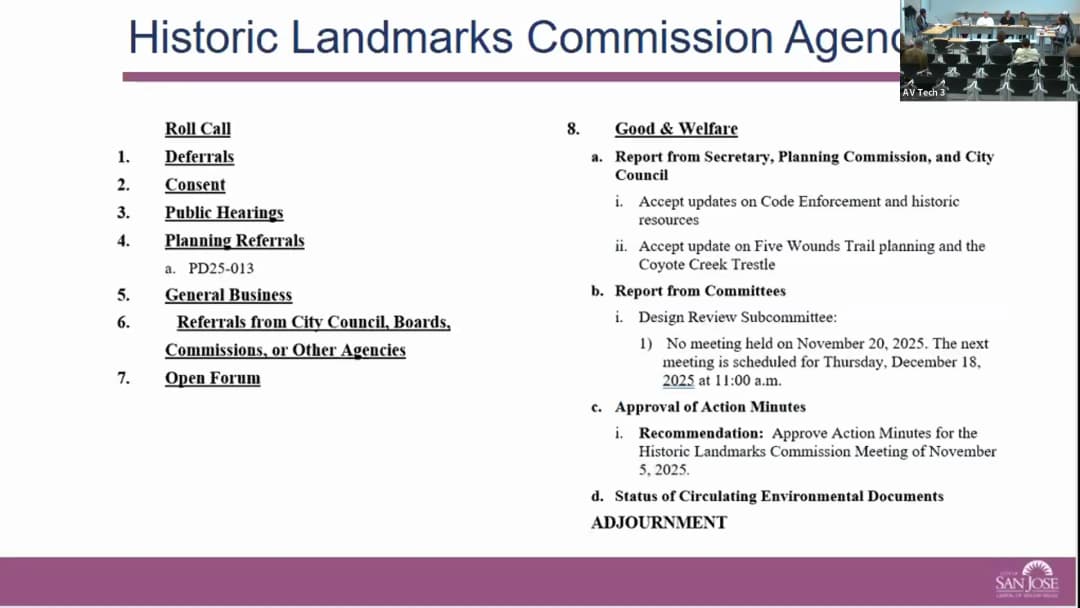
The Historic Landmarks Commission (HLC) held a regular meeting on December 9, 2025, at 11:00 AM. The meeting was called to order by Chair Royer, with commissioners present: Cohen, Camuso, Bainawal, Arnold, Kogora (newly sworn in), and Chair Royer. Commissioner Galandari was absent. The primary agenda item was a planning referral for the Valley Title Project (PD25-013), a large mixed-use development at 300 South 1st Street and 345 South 2nd Street, seeking HLC comments on historic adjacency design standards. The commission also received updates on code enforcement, the historic preservation ordinance, and the Five Wounds Trail/Coyote Creek trestle. Public Comments & Testimony - Mike (representing PACSJ) : Spoke during the public hearing for the Valley Title Project. He reminded the commission of a prior agreement (from Option A) to surgically remove the existing facade of the Valley Title building (formerly Hale's Department Store) to salvage any remaining historic fabric. He urged that the design guidelines for historic adjacency be respected, particularly regarding massing and setbacks, and noted ongoing dialogue with the applicant. - Mike Sadagrin (open forum) : Offered encouragement regarding the recent city council amendments to the Historic Preservation Ordinance, noting that despite the commission's concerns not being fully adopted, the council members are honorable and that public engagement on preservation is critical. - Larry Ames (open forum, Five Wounds Trail advocate) : Stated that the Coyote Creek trestle has been placed on the State Register of Historic Resources and argued that the trail connection can be achieved without demolishing the trestle. He circulated a petition and urged the commission to vote to save it when the matter comes before them. Discussion Items - Valley Title Project (PD25-013) : - Staff Report : Dana Peake, Historic Preservation Officer, presented the project, which includes two options. Option A (previously approved in 2021) involves two 20-story office towers (300 ft). Option B, the current proposal, includes three 30-story residential towers (300 ft high, 1,167 units), a seven-story data center (up to 200 ft, 49 megawatts), and ground-floor retail. The site is across from four city landmarks (St. Clair, Dorman, California Theatre, West Prussia). Staff requested comments on design standards for historic adjacency (height/width transition, massing, facade treatment, ground floor design). - Applicant Presentation : Hunter (West Bank) and Ernie Yamane (Steinberg Hart) presented Option B, emphasizing net-zero energy via waste heat from the data center heating residential units, a large public plaza (orchard concept), and activation of the SOFA district. They noted the demolition process for the existing building and willingness to salvage historic elements. - Commissioner Questions & Comments : - Commissioners asked about pedestrian connectivity, retail plans, the data center's impact on energy costs and the grid, protection of nearby historic businesses (Nirvana Soul, Jackie's Place), and parking (approx. 300 spaces for 1,167 units – no parking requirement but low ratio noted). - Concerns raised about the data center being an industrial use in downtown, a blank wall along 2nd Street and San Salvador (lack of pedestrian activation), and the need for better ground-floor articulation and setbacks to respect historic resources. - Commissioner Arnold questioned the financial viability of the project given high vacancy rates downtown and lack of parking. Commissioner Kogora asked about energy cost impacts on residents and protection of local Black-owned businesses. - Commissioner Camuso asked about salvaging the original facade and the data center design. Commissioner Bainawal focused on connectivity to the California Theatre. Commissioner Cohen noted the design standards and requested additional views showing the relationship to historic buildings. - Staff clarified that data centers are not typically allowed downtown but the project qualifies under the Innovative Project Pathways program for its energy efficiency and public benefits. Key Outcomes - No formal action was taken on the Valley Title Project ; the HLC's comments will be forwarded to the decision-making body (likely City Council) as part of the development permit staff report. Continued dialogue with PACSJ and staff was acknowledged. - Motion to approve the action minutes of the November 5, 2025 meeting passed unanimously (6-0). - Updates from Staff: - Code enforcement: New higher fines (up to $20,000/day and $500,000 total) and a dedicated phone number (408-535-7770) for reporting violations. The Abandoned/Vacant Buildings Ordinance was reviewed; staffing constraints noted (one staff for downtown, one for rest of city). - Five Wounds Trail/Coyote Creek trestle: Tentative schedule – Parks Commission Feb 4, 2026; HLC March 2026; EIR scoping April 2026. The project description currently includes removal of the trestle, but public comment urged preservation. - Next meeting: No meeting in January 2026; next meeting is February 2026.
Public Meetings - San Jose, California
Public Meetings - San Jose, CaliforniaThe Planning Director hearing of December 9, 2025, was called to order by Hearing Officer Ruth Gueto, acting on behalf of the Director of Planning, Building and Code Enforcement. The agenda included a consent calendar with four routine items and two public hearing items: a builder's remedy mixed-use project at 940 Willow Street and a warehouse/industrial project at 2334 Lundy Place. After staff presentations, public testimony, and applicant remarks, the hearing officer approved both projects. Consent Calendar - Item 3A (H25-025/ER25-145): Site development permit for a 428-square-foot addition to a duplex at 2920-2922 Union Avenue. CEQA exempt. Approved. - Item 3B (SP23-035/ER23-165): Special use permit for an outdoor dining area at 855 North 13th Street. CEQA exempt. Approved. - Item 3C (SPA 20-019-04/ER25-219): Amendment to special use permit for construction hours on Saturdays and exterior material change at 498 West San Carlos Street. CEQA addendum. Approved. - Item 3D (T25-021/ER25-208): Vesting tentative map for six residential condominiums at 967 North Capitol Avenue. CEQA exempt. Approved. Public Comments & Testimony Item 4A – 940 Willow Street (Builder's Remedy Mixed-Use) - Several speakers expressed support: Kate Weber (neighbor) cited increased foot traffic and safety, and the need for housing. Emmanuel (nearby resident) supported repurposing the underutilized liquor store into multifamily housing, noting Willow Glen's obligation to provide fair share of housing. Fred Weber called for infrastructure upgrades. - Many speakers opposed: Maren Sederquist (adjacent resident) mentioned a petition with over 1,600 signatures and raised concerns about parking, traffic, property values, and quality of life. She requested egress to Willow Street and cited non-compliance with design standards. Larry Kubo (42-year resident) questioned sewer capacity (62 houses on Cotenberg vs. 126 new units) and parking shortfall (100 cars on street). Lori (954 Willow Street) asked about affordability thresholds and sewage study. Neer Ali (Settle Ave) raised sewer, storm drain, and grid capacity concerns. Michelle Balasco (40-year resident on Cotenberg) argued the building is too large (three to four stories would be appropriate) and cited pre-existing sewer issues. Brady Mass (Cotenberg) and others noted narrow streets and traffic. Lillian objected to removal of ordinance-size trees, criticizing city's Tree City USA claim. - Several opponents also cited fire safety and inadequate street capacity for emergency vehicles. Item 4B – 2334 Lundy Place (Warehouse/Industrial) - Supportive speakers included: Rico Gallardo and Jaime Vasquez (Carpenters Union Local 405) praised Overton Moore's commitment to living wages, healthcare, and apprenticeships. Armando Gomez (former Milpitas council member) noted the site's blight and importance of industrial jobs coexisting with residential. Bernadette, Noreen, Vince, Allison, and Larry Suradella (Milpitas residents/former planning commissioner) supported job creation and revitalization. - Numerous residents from the adjacent Parkside at Tarob Court community spoke in strong opposition, citing: safety risks for children and families, narrow road (Lundy Place) unable to handle large trucks, 24/7 operations causing noise, light, and diesel pollution, impact on property values, and proximity to two elementary schools. Swati called the project "morally reprehensible" and noted it replaces innovation with pollution. Others (Shan Wang, Jungdi, Shunyi, Margaret, Gene, Shubhi, Jessie, Joe, Dan Son, Claire, Xi Yan, Manali, Richard, XT, Arsha, Banu Priya, Jisoo, Sean) echoed concerns about traffic congestion, environmental health, and the incompatibility of heavy industrial use with a residential area. Richard pointed out that the CEQA analysis was immature and that a data center would be less impactful. Discussion Items Item 4A – 940 Willow Street (H23-030/ER23-233) Staff (Alec Atienza) presented the project: a seven-story, 126-unit mixed-use building with 1,626 sq ft commercial, 15% very low-income and 15% moderate-income units, submitted under the Housing Accountability Act Builder's Remedy. The site is zoned CN (neighborhood commercial) and does not allow housing unless 100% affordable, but the Builder's Remedy exempts the project from local zoning standards. The project includes a 97% density bonus and three incentives/concessions/waivers for front setback, FAR, and height. CEQA is statutorily exempt under AB 130 (Public Resources Code Section 21080.66). Staff found no specific health and safety impacts. The applicant (Mikhail Williams, Studio Current) presented design features, community benefits (wider sidewalks, park fees, retail). Following public comment, hearing officer noted that under the Housing Accountability Act, the city cannot deny unless there is a specific adverse impact on public health and safety based on objective standards, and none were found. She approved the site development permit and the CEQA exemption. Item 4B – 2334 Lundy Place (H24-057/ER24-254) Staff (Reena Shah, Charlotte Ewan) presented: a 132,419 sq ft concrete tilt-up industrial building (10,000 sq ft office) on 6.4 acres, replacing a vacant data center. Demolition of 130,300 sq ft building and removal of 152 trees (95 ordinance-size, 57 non-ordinance) with 200 new trees planted. The site is in LI (Light Industrial) district and complies with all development standards. CEQA: Initial Study/Mitigated Negative Declaration (ISMND) with mitigation for biological resources, tribal cultural resources, hazards, and noise. Construction noise limited to 7am-7pm weekdays, Saturdays allowed with mitigation. Public comment period: 3 letters received; additional late letter cited noise, traffic, land use, air quality – staff responded in a formal document. Applicant (Jennifer Friedman, Overton Moore) described features: 8-foot sound wall, orientation to shield residences, truck ingress/egress from Trade Zone Blvd, sustainability measures (40% EV chargers, solar-ready roof), intersection upgrades. After public testimony, hearing officer found that the mitigations (sound wall, access design, TDM plan) would address concerns. She noted the project is consistent with Major Strategy 4 (Innovation and Regional Employment Center) and industrial preservation goals. She approved the ISMND and the site development permit. Key Outcomes - Item 4A: Approved the statutory exemption under Public Resources Code Section 21080.66 (AB 130) and the Site Development Permit H23-030 for 940 Willow Street. - Item 4B: Adopted the Initial Study/Mitigated Negative Declaration and approved the Site Development Permit H24-057 for 2334 Lundy Place. - All consent calendar items were approved without separate discussion.
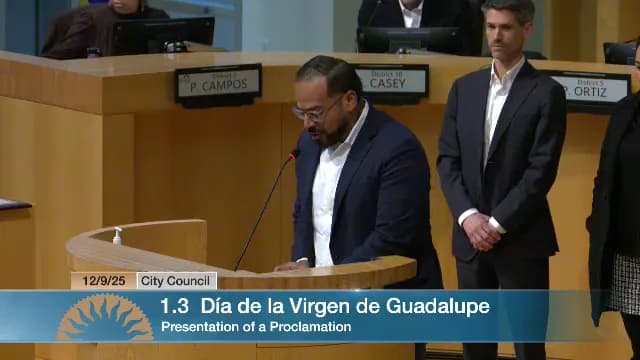
The San Jose City Council convened on December 9, 2025, at approximately 9:45 AM for a regular meeting. The session began with an invocation by Father Justin Lay of Our Lady of Lavang Parish, followed by the Pledge of Allegiance. The council recognized three ceremonial proclamations: Holiday Children's Book Drive Week (December 8–14), the Trash Punks and Sabori's Well for their Project Pickup initiative in Kenya, and Día de la Virgen de Guadalupe (December 12). The consent calendar was approved unanimously after two items were pulled for discussion. The regular agenda included acceptance of the annual financial reports, debt report, technology contracts, appointments, and a substantial discussion on the homelessness prevention system funding agreement with Santa Clara County. All votes were unanimous. Consent Calendar - Item 2.9 (Business Improvement District fee collections): Councilmember Mulcahy queried Finance Director Maria Oberg on improving collection rates. Discussion noted that older BIDs (Japantown, Downtown) achieve 90% collection, while newer BIDs are around 60%. Staff committed to outreach improvements and a new billing system. - Item 2.10 (Park naming): Councilmember Campos championed naming Serenade and Center Pocket Park as "Tsugiyo T. Fujimoto Park" in honor of a former city employee. Public speakers included the nephew (Wes Kashiwagi) and former colleagues, highlighting Mr. Fujimoto's 30 years of service, military intelligence work during WWII, and horticultural legacy. - All remaining consent items were approved without discussion. Public Comments & Testimony - Consent calendar: Wes Kashiwagi, Gary, and other former colleagues spoke in support of the Fujimoto park naming, sharing personal stories and gratitude. Brian spoke on the audits, commending the city for four consecutive clean audits. - Open Forum: Two speakers. One described an unreported burglary ring in his neighborhood and urged police investigation. The second advocated for volunteer efforts to remove invasive largemouth bass from local rivers to restore native fish populations. Discussion Items - Items 3.3, 3.4, 9.1 (Annual Comprehensive Financial Report, Auditor's Report, Successor Agency Audit): Finance Director Maria Oberg, Deputy Director Victor Lowe, and external auditor Benjamin Lau presented. Key points: the city received an unqualified (clean) audit opinion for the fourth consecutive year with no findings. Net position increased by $85 million, restated down by $75 million due to GASB 101 implementation for compensated absences, resulting in a net $10 million increase. The Successor Agency (SARA) reported a net position deficit of $856 million, improving by $111 million. City Manager Jennifer Maguire praised the accounting team. - Item 3.5 (Comprehensive Annual Debt Report): Presented by Maria Oberg and Chen Yu Sun. Outstanding debt portfolio as of June 30, 2025, was $3.4 billion (excluding conduit debt of $834 million). The city maintains high credit ratings: AA1 (Moody's), AA+ (S&P), AAA (Fitch). - Items 3.6 and 3.7: Approved without discussion. 3.6 amended a master service agreement with Intergraph Corporation for the computer-aided dispatch system. 3.7 authorized tenant improvements at the 911 Call Center funded by Measure T. - Item 3.8 (Appeals Hearing Board Appointments): Three vacancies with three applicants. Council interviewed two present candidates (Jenny Altwer and Martin Nguyen) and accepted a written statement from absent applicant Ronald. All three were appointed unanimously. - Item 6.1 (Franchise Agreements): Approved unanimously (10-0, with Councilmember Ortiz absent). - Item 8.1 (Homelessness Prevention System Funding): Extended discussion led by Councilmember Campos, Ortiz, and Dillion. The agreement with Santa Clara County's Office of Supportive Housing provides approximately $8,000 per household in direct assistance and $5,200 in case management. Over 90% of households served do not require further assistance within two years. The system served 1,800 households last fiscal year (69% in San Jose). Councilmembers questioned program efficiency, waitlists, and data tracking. A group memo requesting enhanced reporting and a follow-up briefing with county staff was included in the motion. The item passed unanimously. Key Outcomes - All votes were unanimous, including: - Approval of consent calendar (including items 2.9 and 2.10 after discussion). - Acceptance of annual financial reports (3.3, 3.4, 9.1). - Acceptance of the debt report (3.5). - Approval of 3.6, 3.7, 3.8 (appointments), 6.1, and 8.1. - Council directed staff to coordinate with the county for more detailed reporting on the homelessness prevention program, including turnover, waitlist trends, and long-term outcomes. - The meeting adjourned after open forum.
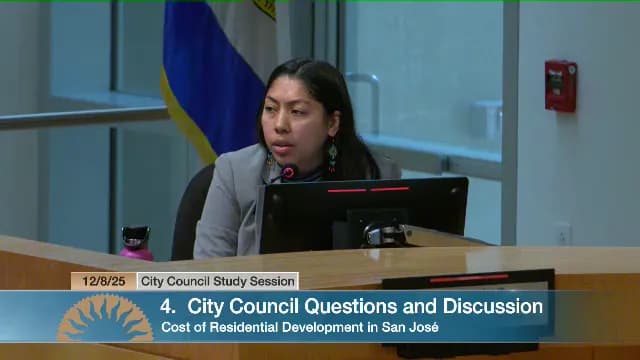
On December 8, 2025, the San Jose City Council held a study session to examine the cost of residential development, focusing on both market-rate and affordable housing. Staff from the Housing Department, along with consultants from EPS and CSG Advisors, presented detailed analyses of development costs, feasibility, and policy levers. The session also featured perspectives from market-rate and affordable housing developers. No formal votes were taken, but the discussion laid groundwork for upcoming policy decisions, including updates to the Inclusionary Housing Ordinance and incentive programs in January 2026. Public Comments & Testimony - Hadia Fane (Life Services Alternatives): Thanked the council for the study and highlighted the need for housing for adults with developmental disabilities, noting LSA's work since 2002. - Alison Singalani (SV at Home): Urged the city to base policy decisions on transparent data and robust analysis, particularly regarding inclusionary housing feasibility, and called for a holistic approach to interconnected policies. - Allie Saberman (Housing Action Coalition): Supported maximizing fees that are financially feasible for development, mentioned work on condo defect liability and a state housing bond, and emphasized the importance of streamlining approvals to reduce costs. - Alex Szwak (property owner, District 2): Described challenges on a 72-home plus ADU project, including delays in receiving a CEQA exemption determination, and requested a city liaison to help mediate issues. - Keira Kazanzas (Silicon Valley Council of Nonprofits): Noted San José's success in building affordable units at low cost to the city, questioned future funding sources without Measure E/A or IHO fees, and supported Councilmember Campos' memo for deeper analysis. - Rigo Gallardo (NorCal Carpenters Union, Local 405): Supported fee waivers and streamlined entitlements but insisted these benefits be paired with fair wages, apprenticeship opportunities, and safe working conditions for the workforce. - Dan Mount Sear (small builder): Echoed concerns about small infill sites, noting that only 13 building permits were pulled out of 110 entitled projects this year, and urged the city to address the cost and process barriers for these sites. - Harvey McCown (NorCal Carpenters Union): Thanked staff for stakeholder engagement, supported fee waivers but not at workers' expense, and cited recent labor compliance findings of potential exploitation on housing construction sites. - Julian Lake (Bay Area Council): Cited a RAND study showing California costs 2.3 times more to build apartments than Texas, attributed to high impact fees, expensive entitlement processes, and bespoke building codes, and urged reducing impact fees for multifamily housing to stabilize rents. Discussion Items Market Rate Housing Analysis (Jason Moody, EPS): The study evaluated five building types (townhomes, stacked flats, podium, wrap, tower) across four growth areas using 2024-2025 market data. Key findings: - For-sale townhomes and stacked flats are feasible under current conditions. - Rental podium, wrap, and tower projects are infeasible; fee waivers could make some podium and wrap projects feasible in higher-rent areas. - Towers require a 10%–35% improvement in rents/costs to become feasible. - San Jose's impact fees and taxes (6–10% of total costs) are competitive with neighboring cities, but lower rents in San Jose (e.g., 20–30% less than neighbors) constrain feasibility. - Hard costs represent 65–70% of total costs; labor is 30–35% of hard costs. - Office-to-residential conversions are case-specific and may be aided by fee waivers, parking reductions, and streamlined approvals. JLL Market Insights (presented by Eric Sullivan): Using a different data set, JLL projected that with 3% annual rent inflation, wrap projects could become feasible in about 2 years, podiums in 9–10 years, and towers require much longer or more significant market changes. Affordable Housing Analysis (Nicole Graham, CSG Advisors): Analyzed 194 proposed affordable projects statewide (20% from Santa Clara County) from 2023–2025. Key findings: - San Jose's cost per net square foot ($1,050) is in the middle of the Bay Area range ($840–$1,440). - Per unit cost ($675,000) is lower than the Bay Area average ($770,000), driven by larger project sizes (173 units per project vs. 112 average). - Smaller unit sizes (66% studios/1-bedrooms) raise cost per square foot but reflect a focus on special needs and homeless housing. - Across project types, San Jose costs are lower than the Bay Area average for each category. - The city's costs align with other Bay Area counties and are not outliers. Panelist Perspectives: - Josh Burrows (Urban Catalyst): Noted that San Jose produces less housing per capita than neighbors (5–10 times less); cited soft market with foreclosures and flat rents. Property taxes constitute nearly half of operating expenses. Recommended fee deferral to certificate of occupancy. Highlighted Washington state's successful tax abatement program that spurred 50,000 units. - Xii Li (Alpha X Capital): Emphasized that small infill sites (0.14–0.46 acres) face different cost structures than the study's 2-acre assumption. Per-unit fees disproportionately burden starter homes. Requested a scaled fee framework for sites under 0.5 acres to enable gentle density and missing middle housing. - Nevada Merriman (MidPen Housing): Confirmed study findings; noted that fee waivers (e.g., park fees) act as loans and enhance competitiveness for state/federal funds. Urged aligning city funding cycles with state tax credit and bond programs. Every $1 of city investment leverages $6 in external capital. Highlighted the need for predictability to avoid cost escalations from delays. - Andrea Osgood (Eden Housing): Shared success story of East Santa Clara Avenue project (68 senior units) receiving 9% tax credits. City provided $7.8 million (14% of capital stack). Recommends syncing city NOFA with state cycles to avoid timing gaps that cause delays and cost increases. Council Discussion & Questions: - Mayor Mahan noted that of 22,000 entitled multifamily units (2020–2024), fewer than 7,000 pulled permits, indicating feasibility gaps. He thanked colleagues for the Multifamily Housing Incentive that enabled 2,000 units to break ground. - Councilmember Campos asked whether the study analyzed the impact of constructing on-site inclusionary units (not just in-lieu fees). Staff confirmed the study did not analyze specific programmatic impacts. - Councilmember Tordillos asked about differences between podium and wrap typologies, why townhomes are not being built more despite feasibility, and whether design standards or off-site improvement costs are significant. Staff noted ongoing work on fee structures; Josh Burrows cited off-site improvement uncertainty as a major cost. - Vice Mayor Foley and Councilmembers Casey, Mulcahy, and others discussed the role of building more market-rate housing to relieve pressure on affordable stock, the impact of tech job locations, and the importance of addressing the full housing continuum. - Mayor Mahan raised the idea of property tax abatement as a bold lever. Panelists confirmed that property taxes are a large operating expense and that even short-term abatement could dramatically improve returns, especially for towers. Councilmember Tordillos noted Washington state's abatement models for multifamily and inclusionary units. Key Outcomes - No formal decisions or votes were taken; the session was informational. - Staff will bring forward policy updates in January 2026, including revisions to the Inclusionary Housing Ordinance (IHO), the Multifamily Housing Incentive program, and a Downtown High-Rise Incentive program. - The Building More Housing focus area continues to work on land-use policy, development services improvements, and linking capital with land. - Councilmember Campos' memo will be resubmitted to the Rules Committee for further consideration, including requests for analysis of inclusionary housing feasibility, small infill economics, and parking/design impacts. - Several speakers and councilmembers emphasized the need for comprehensive data, transparent analysis, and engagement with community and labor partners to ensure equitable outcomes.
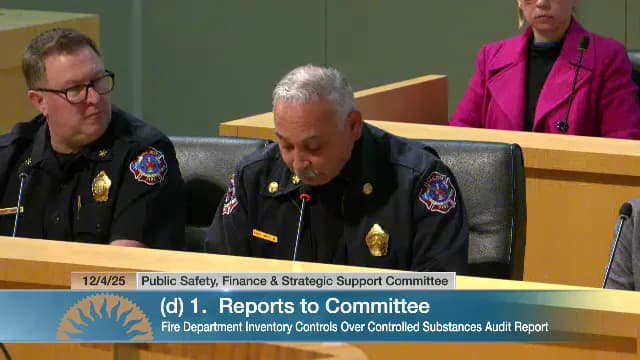
The Public Safety, Finance, and Strategic Support Committee met on December 4, 2025, to review two major items: an audit of the Fire Department's inventory controls over controlled substances and a status report on the Increasing Community Safety focus area. The committee also heard public comments during open forum. Consent Calendar - The committee unanimously approved two consent items (no specifics provided) without public comment or discussion. Public Comments & Testimony - Blair Beekman expressed concern about potential changes to the Bay Area Urban Areas Security Initiative (BAUASI) federal agency and urged local governments to seek clarification and input on future directions. - A second speaker (unnamed) noted that the city is being sued by the Electronic Frontier Foundation over surveillance technology use, arguing the police department has too easy access to surveillance and questioning the need for extensive technology. The speaker advocated for less tech reliance for public safety. Discussion Items Fire Department Inventory Control over Controlled Substances Audit (Item D1) - City Auditor Joe Royce, along with Allison Pauli and Maria Valle, presented the audit conducted after a fire captain was arrested for tampering with controlled substance containers. The audit reviewed inventory controls at 17 fire stations and the central supply in summer 2025, finding no evidence of theft or tampering. - Two findings: (1) Policies for securing controlled substances on fire apparatus should be clarified to reflect current practices, including daily verification, witness requirements, and plans for biometric safes. (2) Central supply management duties are too concentrated in one position (Controlled Substances Program Manager); duties should be separated for better security. - Seven recommendations were made, all accepted by Fire Chief Robert Sapien, who reported that most are being implemented quickly, with the longest timeline for procuring biometric safes. Interim hardened safes are already in place. - Committee members asked about timeline (no fixed date) and ongoing internal auditing. Chief Sapien noted daily and for-cause audits currently, with future frequency to be evaluated. - Motion to accept the report and refer it to the December 16 City Council meeting passed unanimously. Increasing Community Safety Focus Area Status Report - Deputy City Manager Jennifer Schembri presented the report on the City Council's focus area 2.0, which uses logic models to align strategies with problems. The presentation covered indicators, goals, and lessons learned across four problem areas: emergency response, crisis response, crime reduction, and traffic safety. - Key data: Resident safety perception up 9% year over year; police priority one response compliance up 2% with an 8% call volume decrease; fire response compliance up 2% with 10% call volume decrease. Crimes against persons down 12%, property down 8%. Traffic fatalities down 29% year over year. - Notable successes: 911-988 call transfers to TRUST greatly exceeded the goal of 75 per month (193 and 178 in September/October 2025). Red light camera operations launched with high violation volumes (e.g., 400+ at one intersection in first month). - Challenges: Police recruitment found it difficult to meet the 40-recruit class size goal (31 hired, including 8 women). Speed camera program delayed due to federal administration actions. Negotiations with county for Mission Street Recovery Station referrals took longer than expected but are back on track. - Future plans: Incorporate focus area learnings into the FY 26-27 budget process with a timeline for priority setting, mayor's March budget message, and a budget study session in May. - Committee members expressed appreciation for the framework and the team's work. Questions covered recruitment efforts (military and local recruitment, redistricting to improve response times), automated speed camera grant funding (awaiting resolution), and the Olive Program for oversized lived-in vehicles (new inventory and permanent tow-away signage locations to be brought to council in early 2026). - Motion to accept the status report passed unanimously. Key Outcomes - The committee unanimously voted to accept the Fire Department controlled substances audit report and refer it to the City Council meeting on December 16, 2025. - The committee unanimously voted to accept the Increasing Community Safety focus area status report.
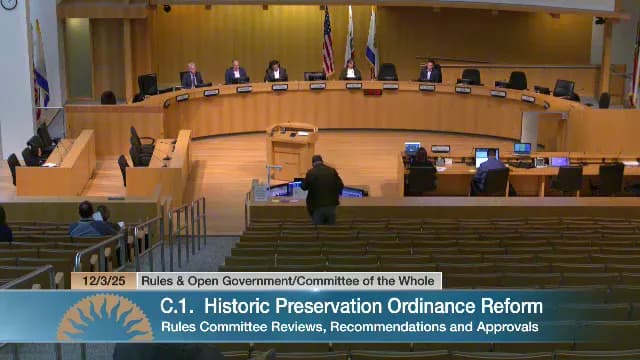
The San José City Council Rules Committee met on December 3, 2025, to review upcoming agendas for December 9 and 16, approve consent calendar items, and discuss a historic preservation ordinance reform request. The meeting began with roll call (Councilmembers Candelas, Duan, Foley present – quorum) and a reminder of the code of conduct. Consent Calendar - The committee approved the consent calendar for the December 9 regular council meeting (items on pages 5–9) and for the December 16 meeting (items on pages 4–17, including an audit, fire department amendment, gaming control, digital empowerment, abandoned shopping cart pilot program, and business district items). Both approvals were unanimous without items pulled. Public Comments & Testimony - Ben Leach, representing the Preservation Action Council, spoke on the historic preservation ordinance reform. He agreed the matter is complicated and appropriately recognized as needing careful consideration, and reiterated the organization's offer to assist independent of the city and to involve other stakeholders. Discussion Items - Historic Preservation Ordinance Reform: Staff (Lee) presented a memo and recommended a "yellow light" for the reform, given existing priorities and state mandates. The item will be considered during the council's priority setting session in the new year as part of the budget process. The committee accepted the staff recommendation. Key Outcomes - The committee unanimously approved the December 9 and December 16 agendas as presented. - The committee voted to accept the staff recommendation (yellow light) for historic preservation ordinance reform, moving it to the priority setting session. - No other motions or public comments were made.
The San Jose City Council met on December 2, 2025, to address a range of items including ceremonial recognitions, updates on winter storm preparedness, a major bond financing for clean energy, the annual retirement investment fee report, acceptance of park projects, merit increases for appointed officials, the semi-annual Climate Smart San Jose update, a heat pump contractor incentive pilot, customer bill credits from San Jose Clean Energy, and a highly debated amendment to the Historic Preservation Ordinance (Title 13). The meeting included numerous public comments, particularly on the historic preservation ordinance, which was approved on a 9–2 vote. Consent Calendar - Deferred item 4.1 (amendment to title 16 gaming control) unanimously. - Approved the remaining consent calendar as a whole (unanimous, Ortiz absent). - Approved land use consent items 10.1A and 10.1B (unanimous, Ortiz absent). Public Comments & Testimony - Item 3.1 (City Manager's Report on Winter Storm Preparedness): No public comments. - Item 3.3 (Green Bonds): No public comments. - Item 3.4 (Retirement Fee Reports): No public comments. - Item 3.5 (Park Bundle): No public comments. - Item 3.6 (Merit Increases): No public comments. - Item 6.1 (Climate Smart San Jose Update): Two speakers: Lena Ein from Santa Clara Valley Open Space Authority expressed support for incorporating natural and working lands, and noted that sprawl contradicts growth policies and increases emissions. Lyndon Shea (retired ESD, now CNPS) urged greater emphasis on native plant restoration and pollinator corridors in city parks and residential landscapes. - Item 6.2 (Clean Energy Pilot Programs): Two speakers: Linda Hutchins-Knowles (Mothers Out Front Silicon Valley) strongly supported the contractor heat pump incentive and urged considering reach code updates for single-family homes. Blair Beekman asked whether the pilot fits into community energy infrastructure concepts. - Item 6.3 (Customer Bill Credits): Linda Hutchins-Knowles spoke again, suggesting that high-income residents could voluntarily donate their $40 credit to a resilience fund for heat pumps, though she acknowledged the impracticality of immediate change. - Item 10.2 (Historic Preservation Ordinance Amendment): 27 speakers (in-person and via cards). Many speakers from the Friends of Levitt Pavilion San Jose (e.g., Laura Wolford, Sally Schroeder, Michael McDermott, Thomas Aguilar, Michelle Drayband) urged approval of the staff recommendation, arguing it clarifies existing authority and will allow the Levitt Pavilion project to move forward, activating St. James Park and bringing economic benefits ($14 million annual spending) and free concerts. Opponents, including Susan Brandt-Hawley, Sean Atkinson, Mark Biagini, and Mike Sodergren (Preservation Action Council San Jose), argued the amendment reduces historic protections, could allow demolition of landmarks, lacks adequate environmental review (need for a supplemental EIR), and that the process was rushed and flawed. Some speakers (e.g., Maria Peterson, resident near St. James Park) expressed concerns about noise, trash, and quality of life. Others like Camille Chihate and Steve Paulson supported the amendment for downtown vibrancy. Councilmember Kamei offered a substitute memo to require a "compelling public interest" finding for overrides, supported by PACSJ. Discussion Items - Item 3.1 – City Manager's Report: Jennifer Maguire reported on winter storm preparations: 35,000 storm inlets cleaned, 31 pump stations inspected, portable pumps staged, overnight warming centers at Evergreen Branch Library and Roosevelt Community Center, and multi-lingual emergency alerts. - Item 3.3 – Green Bonds (CCCFA Clean Energy Project): Staff presented a complex prepaid energy transaction involving up to $1.25 billion in tax-exempt bonds (30-year, remarketed every 6–9 years). The city assigns partial rights under power purchase agreements (PPAs) to Morgan Stanley, who prepays for 30 years of energy; the city buys back energy at a discount (minimum 8% annual savings first term, $5/MWh thereafter). Risks include volumetric, market, and counterparty risks – mitigated by partial assignment, substitution rights, and termination provisions that return city to original PPAs. The bonds are not city obligations. Council approved after clarifying questions. - Item 3.4 – Retirement Fee Reports: Jay Kwan (ORS) reported that total expense ratio (management fees + operating expenses) was 98 basis points; internal monitoring cost 6 basis points. Management fees have declined by almost 0.25% over a decade, saving $17 million in 2024. Council accepted the reports. - Item 3.5 – Park Bundle (10,400, 9,111, 9,102): Councilmember Tordios commented on the two remaining parks in the series. Staff recommendation approved. - Item 3.6 – Merit Increases for Council Appointees: Approved 2.5% merit increase and additional 40 hours of executive leave for City Manager, City Clerk, City Auditor, and Independent Police Auditor, retroactive to July 1, 2025. - Item 6.1 – Climate Smart San Jose Update: Staff presented the 2023 community greenhouse gas inventory (approx. 500 million metric tons CO2e, 16% lower than 2017 baseline but slight uptick since 2021). Transportation accounts for 51%, building natural gas 21%. The 2025 administrative plan update was presented, incorporating carbon neutrality by 2030 goal, natural/working lands, streamlined metrics, and annual departmental work plans. Councilmember Cohen noted the flattening progress and urged continued push on transportation electrification and building electrification. Report accepted. - Item 6.2 – Clean Energy Pilot Programs: Staff evaluated two pilots: (1) Incentive for commercial electric leaf blowers (not recommended due to low GHG impact, high cost, and staff time) and (2) Contractor incentive for heat pump installations ($1,000 per first six installations, up to 15 contractors, $100,000 total). Council approved the contractor incentive pilot and a companion memo directing further assessment of EcoHome improvements and potential reach code updates. - Item 6.3 – Clean Energy Customer Bill Credits: Council approved the distribution of approximately $25 million in bill credits to San Jose Clean Energy customers. - Item 10.2 – Historic Preservation Ordinance Amendment: Following extensive public comment, Councilmember Tordios made a substitute motion to approve the staff recommendation (amending Chapter 13.48 to add an override provision mirroring CEQA, allowing Council to approve projects that cause detrimental impacts if social, economic, or other benefits outweigh harm). Councilmember Kamei offered a substitute memo requiring a "compelling public interest" finding, but it was not adopted. After debate (Mayor Mahan and Tordios argued the staff version provides clarity and retains Council discretion; Kamei argued for a higher standard to protect landmarks), the staff recommendation passed 9–2, with Councilmembers Kamei and Casey voting no. Key Outcomes - Item 4.1 deferred unanimously. - Item 3.3 approved: Resolution authorizing up to $1.25 billion in CCCFA Clean Energy Project revenue bonds; city manager authorized to execute related documents. - Item 3.4 accepted: Retirement plans' comprehensive annual investment fee reports for 2024. - Item 3.5 approved: Park bundle for Elizabeth P. Boyer Park, City Gardens Park, and others. - Item 3.6 approved: Merit increases and executive leave for council appointees. - Item 6.1 accepted: Semi-annual Climate Smart update and 2025 plan update; transition to annual updates. - Item 6.2 approved: Contractor incentive pilot program (not to exceed $100,000) and staff direction to report back in spring 2026. - Item 6.3 approved: Customer bill credits distribution. - Item 10.2 approved (9-2): Ordinance amending Chapter 13.48 of the San Jose Municipal Code to add an override provision for historic preservation permits. Open Forum Three speakers addressed non-agenda items: Bob Palacio requested removal of an unhoused vehicle encampment at 985 Timothy Drive (District 3), citing safety issues; Blair Beekman urged more public input on Bay Area emergency planning and technology accountability; Susan Bassey reported mistreatment by a police officer during a records request and raised concerns about CLET restraining order enforcement.
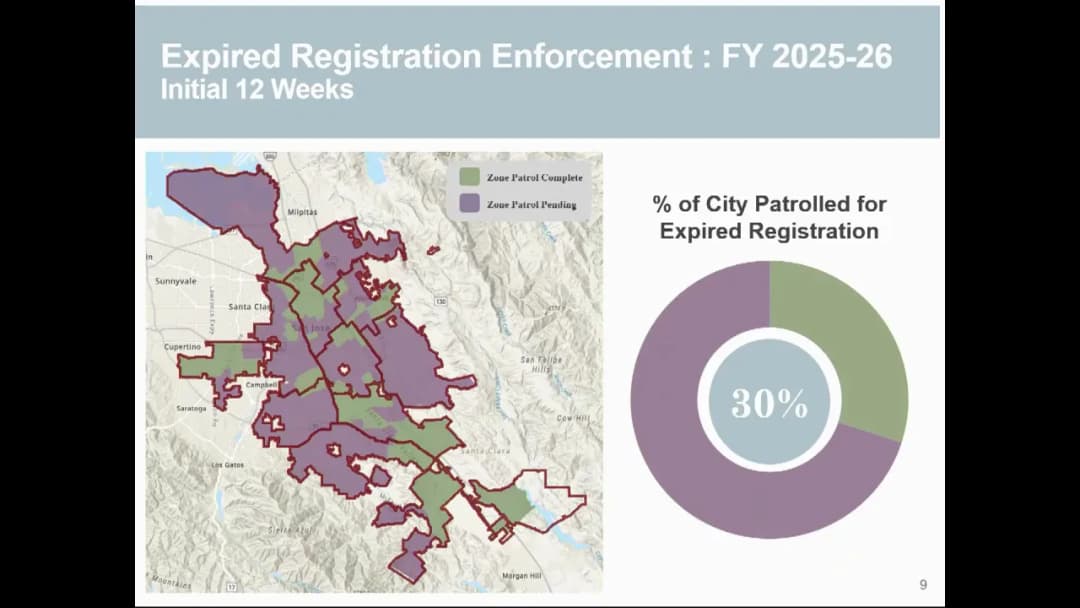
The Transportation and Environment Committee met on December 1, 2025, from 1:30 PM to 4:23 PM, chaired by Councilmember Cohen. The agenda included four major items: a parking enforcement status report, an airport asset preservation and expansion update, a regional transportation activities report (VTA Eastridge to BART connector), and a street sweeping performance status report. The committee heard public testimony on each item and voted to accept all reports. Public Comments & Testimony - Jordan Mouldau (District 3) spoke on multiple items. On parking enforcement, he asked for data on the impact of increased fines for bike lane parking, encouraged focusing on repeat business offenders, and criticized the difficulty of using the SJ311 app. He opposed the Olive program, calling it a poor use of funds that erodes trust. On the airport, he expressed concern about reliance on parking revenue and urged better transit connections. On street sweeping, he requested more granular citation data and supported expanding signage. Discussion Items Parking Enforcement Status Report - Staff presented a comprehensive update on DOT's Parking Compliance Unit (PCU). Key statistics for FY 2024-25: 217,000 citations issued (60,000 street sweeping, 50,000 meter, 50,000 no parking/red curb, 40,000 miscellaneous), 3,200 tows, 7,400 proactive abatement investigations, 32,000 311 vehicle reports closed, 34 Olive temporary tow-away zones. Staffing increased from 48.5 to 55.5 FTE, but San Jose operates at 0.31 officers per square mile versus 1.25-7.32 in peer cities. - New programs: Expired Registration Enforcement (launched July 2025) – in first 12 weeks, 527 tows and 552 citations, with 94% of tows being personal vehicles. Olive Supplemental Enforcement Program (OSEP) launching January 2026 will address lower-priority sites. A pilot temporary tow-away program for two street sweeping locations is planned for Q3/Q4. - Councilmember Ortiz raised concerns about blighted vehicles in District 5, noting many neighborhoods have 10+ vehicles per week. He expressed frustration with the towing process and optimism about new strategies. Councilmember Campos asked about customer service improvements and the vehicle buyback program used at Columbus Park (69 vehicles purchased). Chair Cohen queried fee collection ($12 million to general fund), proactive patrol cadence (every 14 days), and the difficulty of reporting via SJ311. Vice Mayor Foley asked about fine collection (DMV hold, franchise tax board). The motion to accept the report carried 5-0. Airport Asset Preservation and Expansion Status Report - Director of Aviation Mookie Patel and Deputy Director Fai Ali presented. The airport’s master plan includes eventual expansion to 42 gates, but passenger growth has slowed from a budgeted 11.9 million to a projected 10.5 million in FY25, with further softening to 9.9 million. The focus has shifted to asset preservation: $30 million over five years for critical infrastructure (sanitary drainage, boarding bridges, electrical systems). A $1.8 billion Terminal C expansion is deferred until sustained passenger demand reaches 14 million per year. - Completed enabling projects: interim six-gate facility (2019, $58M), new ARF fire station, facilities campus, and PD air support hangar. The cargo facility and hotel are postponed. The FAA is replacing the air traffic control tower (construction start 2026). - Vice Mayor Foley asked about funding (enterprise fund, airline revenue sharing) and the passenger decline. Chair Cohen inquired about international service (ZipAir to Japan), the hotel analysis (would target 4.5-star market, not cannibalizing existing hotels), and the status of parking garage billboards (RFP selection complete, memo coming to council January 2026). The motion to accept carried 5-0. Regional Transportation Activities (VTA Eastridge to BART Connector) - VTA staff presented the 2.4-mile light rail extension from Alum Rock to Eastridge. Construction is 50% complete, with major bridge work at Ocala, Cunningham, and Story intersections. The project is on schedule for completion end of 2027, revenue service early 2028. Budget: $652.9 million. Art installations are planned at Eastridge and Story stations. - Councilmember Ortiz strongly criticized the impact on District 5 small businesses, reporting 40-50% loss of clientele. He noted a $500,000 board referral for business/home support but said it is insufficient and called for more accountability. VTA staff said a plan will be brought to the board in February 2026. The motion to accept carried 5-0. Street Sweeping Performance Status Report - DOT and contractor hybrid model: in-house sweeps arterials (46% curb miles), contractor (Green Waste, 15-year contract starting 2020) sweeps residential streets monthly. Route completion 91% in FY23-24 and FY24-25. 66,000 street sweeping citations in FY24-25; 90% of cited vehicles received 1-2 citations. 72% of citations in equity areas 8-10. - Barriers: parked cars (greatest impediment), large debris piles, low-hanging tree branches. Enhanced sweeps: 19 completed last year. Cost to add signage for 100 miles: $1 million one-time, $1 million annual ongoing. - Vice Mayor Foley raised yard waste set-out timing and reported a sweeper speeding (geotab alerts used for in-house fleet; contractor speeds not systematically tracked). Councilmember Campos asked about customer satisfaction data and links to stormwater programs. Councilmember Ortiz said District 5 residents are unsatisfied and questioned contract quality. Chair Cohen suggested breaking signage costs by block for council office budget requests and emphasized that signs alone (without enforcement) could improve compliance. The motion to accept carried 4-0 (one absent). Key Outcomes - All four items were accepted by unanimous vote: Parking enforcement report (5-0), Airport report (5-0), VTA regional transportation report (5-0), Street sweeping report (4-0 with one absent). - No new ordinances or referrals were made, but several directives and requests emerged: - DOT will provide data on citation revenue trends and bike lane fine collection rates (Chair Cohen, Vice Mayor Foley). - DOT will evaluate adding signage for street sweeping and develop a per-block cost estimate (Chair Cohen). - DOT will work with ESD to price yard waste bins for residents (Vice Mayor Foley). - VTA will bring a business/home support plan to its board in February 2026 (Councilmember Ortiz). - Airport will bring the parking garage billboard RFP selection to council in January 2026 (Chair Cohen). Open Forum - Jordan Mouldau expressed support for a clean energy pilot (item 6.2 on council agenda) and cited textile waste at events as an example of needed policy changes.
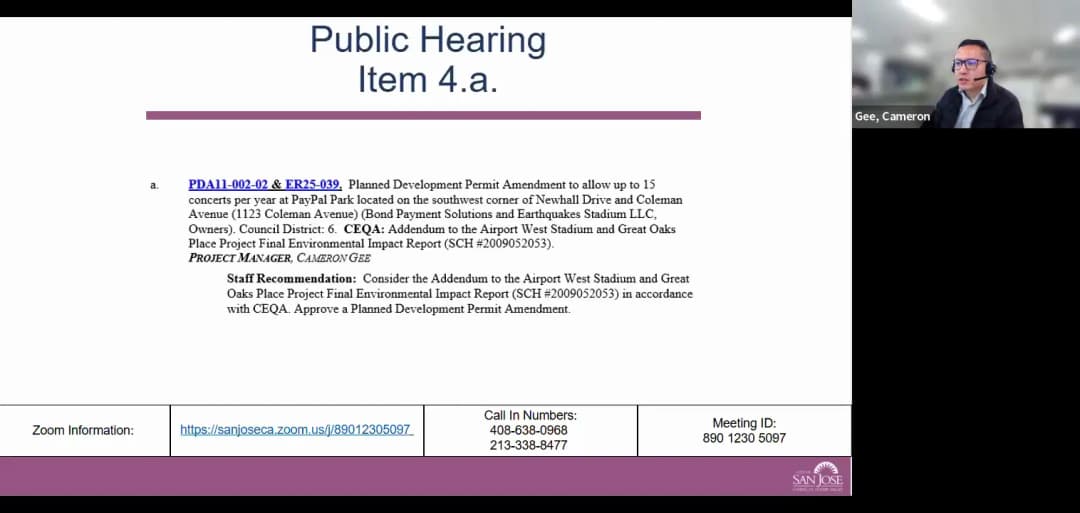
The November 21, 2025 Planning Director Hearing (delegated by Director Christopher Burton, presided by Hearing Officer Ruth Gueto) addressed three consent calendar items and one public hearing item. The main item was a planned development permit amendment to allow up to 15 concerts per year at PayPal Park. After staff presentations, applicant remarks, and public testimony from both supporters and opponents, the hearing officer approved the amendment with conditions. Consent Calendar - Item 3A (SP24-041/ER24-274) – Special use permit for an aircraft hangar addition at 1210 Aviation Avenue: Dropped to be renoticed for mid-January due to fee payment issues. - Item 3B (T25-018/ER25-134) – Vesting tentative map to subdivide one lot into two condominiums at 365 Nature Court: Approved. - Item 3C (V25-001/ER25-102) – Development variance for setbacks at 0 Willow Glen Way: Approved. Public Comments & Testimony - Supporters: John Poach (San Jose Sports Authority), Dan Orloff (San Jose resident and event producer), Rob Lindo (San Jose Chamber of Commerce Board Chair), Frank Guerrero (San Jose resident), Kat Angelov (San Jose Chamber of Commerce), and Matthew Martinucci (Visit San Jose) spoke in favor, citing economic benefits, community visibility, and alignment with major events like the FIFA World Cup. - Opponents/Concerned: Matthew Bright (Newhall neighborhood) argued the noise study is flawed, proposed mitigation is insufficient, and lacks ongoing monitoring (only first two concerts validated, 0% of subsequent events monitored). John Urban (Newhall Neighborhood Association, 30-year resident) requested monitoring for every event, noting Levi’s Stadium has such a process. Bob Edmonds (Newhall neighborhood) asked to defer the decision for better mitigation measures. Discussion Items - Item 4A (PDA 11-002-02/ER25-039) – Proposed amendment to allow up to 15 concerts per year at PayPal Park (1123 Coleman Avenue). Staff (Cameron Gee, Court Hitchens) presented the project, noting the CEQA addendum, a noise study by Illingsworth & Rodkin, a September 15 community meeting, and outreach. They stated that the 2010 EIR had already accepted potential significant unavoidable noise from concerts, and the proposed mitigation would keep noise at or below ambient levels (60 dB), lower than previously approved. Applicant representative Eric Schenauer emphasized economic development, thoroughness of the noise study (including simulations with multiple music genres), and conditions for validation studies for the first two concerts facing the neighborhood. He noted that staff recommended an annual noise report for all concerts and quarterly community meetings. In response to a question from the hearing officer, the applicant agreed to share the annual noise report with the neighborhood at the quarterly meetings. Key Outcomes - Consent Calendar: Item 3A dropped for renoticing; Items 3B and 3C approved. - Public Hearing Item 4A: Approved. The hearing officer acknowledged neighborhood concerns but found them adequately addressed by staff’s analysis, the noise assessment, and conditions of approval. She cited the city’s economic development goals and the 2010 City Council’s statement of overriding considerations as supporting the decision.
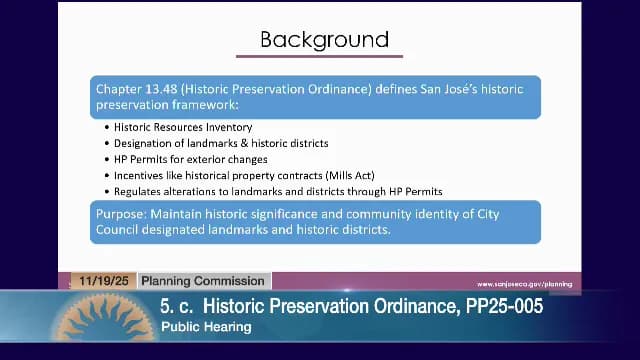
Date: November 19, 2025 Time: Started at approximately 2:45 PM (14:45) and adjourned at 10:06 PM. The San Jose Planning Commission convened for a regular meeting covering multiple land-use and zoning items. The meeting included public comment, consent calendar approvals, and four major public hearings: a conditional use permit for extended hours at a bar, adoption of Eichler neighborhood design standards, amendments to the Historic Preservation Ordinance, and a comprehensive zoning code update. All votes were unanimous (9-0) unless noted. Consent Calendar - Approval of Minutes: The Commission unanimously approved the minutes of previous meetings as presented (motion by Commissioner Oliverio, second by Vice Chair Bickford, roll call 9-0). Public Comments & Testimony - Non-Agendized Public Comment: Elizabeth, a half-black, half-Latina resident, urged the Commission to intentionally preserve the Black and African-American population in Silicon Valley, emphasizing the need to prevent displacement and maintain affordability in all planning decisions. Discussion Items - Conditional Use Permit – After Bar and Grill (CP 24-036): - Staff (Zachary Johnson) presented a request for a CUP to allow late-night use until 2:00 a.m. Friday through Sunday at 1692 Story Road. Staff recommended denial due to multiple violations (failure to serve food with alcohol, unpermitted entertainment, operating past midnight, noise citations) and opposition from the San Jose Police Department. The Police Department (Sergeant Pham) detailed three incidents in 2023-2024, including brandishing a weapon and underage patrons. The applicant (Elmer Oriana) and representative (Jerry Stranges) argued they had corrected violations, offered a six-month compliance hearing, and pledged enhanced security. Commissioners questioned the applicant's track record; Commissioner Young noted the poor history and moved to deny. After discussion (including a withdrawn substitute motion to defer), the Commission voted 9-0 to deny the permit and support staff’s recommendation. - Eichler Neighborhood Design Standards (PP 24-012): - Staff (Dana Peek) presented design standards for Eichler homes listed on the Historic Resources Inventory (currently only Fair Glen Editions). The standards provide clear, objective guidance for exterior changes, additions, and new construction while preserving mid-century modern character. The process was community-driven with extensive outreach. Public comment from Sally Zarnovitz (Fair Glen Preservation Committee) supported the standards. Commissioner Oliverio moved to approve; the Commission voted 9-0 to recommend adoption to City Council. - Historic Preservation Ordinance Amendments (PP 25-005): - Staff and the City Attorney explained that amendments respond to a Court of Appeal ruling (St. Clair vs. City) requiring a clear override provision for projects with detrimental effects on historic resources. Proposed changes add definitions (detrimental, historic integrity, substantial alteration) and allow City Council to override detrimental effects if economic, legal, technical, or other benefits outweigh impacts. The Historic Landmarks Commission recommended narrower language (e.g., limiting override to public projects). Public comment was split: supporters (Friends of Levitt Pavilion, arts organizations, downtown residents) urged approval to enable the Levitt Pavilion in St. James Park; opponents (Preservation Action Council, St. Clair Foundation) warned of weakened protections. After debate, Commissioner Young moved to approve staff’s recommendation (no distinction between public/private). The Commission voted 9-0 to recommend adoption, with Commissioner Cantrell urging judicious use of the override. - Zoning Code Update (PP 25-001): - Staff (Rina Jorie, Brent Carvalho) presented a comprehensive update to Titles 19 and 20 to comply with state laws (SB 9, SB 450, SB 684, SB 1123, SB 1211, etc.), Housing Element actions, and Council direction. Key changes include revised SB 9 design standards (increased height, reduced driveway width, higher FAR with lot coverage), expansion to R2 zones and historic districts, streamlined ADU rules, removal of group home caps, hydrogen fuel station allowances, heat pump setback exemptions, and cleanup of density bonus chapters. Public comment: Glenn Garfunkel (Climate Advisory Commission) supported heat pump changes; Alex Siwak thanked staff for clarifying ADU condoization. Commissioner Oliverio moved to approve; Commission voted 9-0 to recommend to City Council. Key Outcomes - After Bar and Grill: CUP denied (9-0). Applicant may reapply in the future. - Eichler Design Standards: Approved (9-0) to forward to City Council for December 2 meeting. - Historic Preservation Ordinance Amendments: Approved (9-0) with staff’s recommendation; to be heard by City Council on December 2. - Zoning Code Update: Approved (9-0) for recommendation to City Council. - Other: City Attorney reported that the cost of development study will be presented to City Council on December 8; email issues for commissioners are expected to be resolved soon.