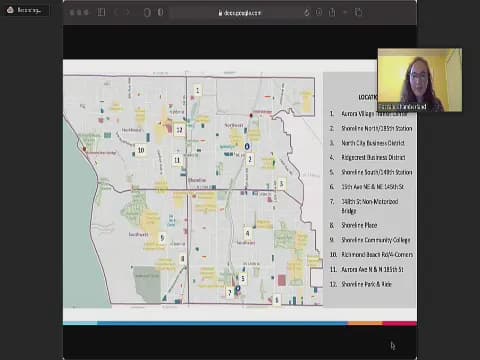
The Shoreline Planning Commission met on June 3, 2021, at 3:00 PM. The main agenda item was a study session on shared use mobility and mobility hubs, presented by the University of Washington Evans School Consulting Lab. No public comments were received, and routine items were approved without changes. Consent Calendar - Roll call was taken: Commissioners Callahan, Belissa, Tam, Wana Sonday, and Malik (absent with notice) were present. - The agenda was approved without changes. - The minutes from the previous meeting were approved without changes. Public Comments & Testimony - No members of the public signed up for general public comment. Discussion Items - Study Item: Shared Use Mobility and Mobility Hubs - Nora Daly Kang, Senior Transportation Planner, introduced the presentation, referencing her 2019 fellowship studying Helsinki's mobility ecosystem and the city's engagement with the UW Evans School Consulting Lab. - Graduate students Dale Markey Crimp, Pascal Chandeline, and Dorian Pacheco presented their report "Making Better Connections: A Study of Shared Use Mobility in Shoreline." - The presentation covered: the evolution of shared mobility devices (e.g., e-bikes, e-scooters, adaptive devices), criteria for siting mobility hubs (proximity to transit, walkability, bikeability, destinations, residential density, and equitable distribution), and a typology of hubs: regional, central, and neighborhood. - The team analyzed 12 potential hub locations, categorizing three as regional (two upcoming light rail stations and Aurora Village Transit Center), four as central, and five as neighborhood. - Key recommendations: prioritize pedestrian and bike infrastructure, partner with community organizations, develop land use code for mobility hubs, and use an adjustable matrix for future siting. - Commissioner Questions - Commissioner Gulska asked about parking at hubs; the team noted a balance is needed, citing examples from Bellevue and challenges with oversized lots. - Commissioner Kelly inquired about car sharing affordability; the team discussed membership models, subsidies, and the importance of reliable availability, citing examples from Lyon, France. - Commissioner Lynn asked about cross-jurisdiction analysis (e.g., Ballinger neighborhood bordering Mountlake Terrace and Lake Forest Park); the team acknowledged this was not explored but noted the matrix could be expanded. - Commissioner Jenny asked about curb space allocation for kiss-and-ride zones and design criteria for sidewalks and bike lanes. Senior Transportation Planner Nora Daly Kang responded that sidewalk minimums are 6 feet (single-family) or 8 feet (other), and bike facility design depends on road speed/volume. - Commissioner Moore inquired about integrating payment across modes (e.g., ORCA card); the team noted data-sharing barriers with private companies and referenced Helsinki's app-based integration. Nora Daly Kang added that a shared data policy is a key hurdle in the U.S. Key Outcomes - The commission received the presentation and report with appreciation. No formal votes or decisions were taken. - The next meeting is scheduled for June 17, 2021, featuring a public hearing on the subdivision vacation ordinance.
Public Meetings - Shoreline, Washington
Public Meetings - Shoreline, WashingtonThe Shoreline Planning Commission met on May 20, 2021, to discuss proposed subdivision vacation regulations as a study item and received an update on the Missing Middle Housing Choice plan presented to the City Council. The meeting included roll call, agenda approval, and commissioner announcements. Consent Calendar - Agenda approved without changes. - Minutes approved without discussion. - No general public comments were submitted. Discussion Items - Subdivision Vacation Development Code Amendments: Associate Planner Kate Lee presented proposed amendments to create a subdivision vacation process in the city code. The process would allow a developer who owns all lots in a subdivision to extinguish easements and restrictions that no longer serve a function, particularly in redevelopment scenarios (e.g., assembling single-family parcels in an MUR-70 zone for multifamily). The proposal follows state RCW requirements, requiring all property owners' permission to apply. It would be a Type C action decided by the Hearing Examiner, with pre-application and neighborhood meetings, notice to property owners within 500 feet, a public hearing, and possible appeal to Superior Court. - Commissioner questions focused on: whether the process requires unanimous ownership (yes), treatment of unrecorded subdivisions (staff to clarify with city attorney), how permanent easements are handled (extinguished unless they benefit a non-subdivision entity or serve a public benefit, as determined by the Hearing Examiner), and the possibility of partial vacation (staff indicated early consultation would determine the best tool—plat alteration vs. vacation). The example given was a 2-lot plat from 2007 with only drainage and access easements that would no longer be needed after redevelopment. - Next steps: A public hearing before the Planning Commission on June 17, 2021, followed by a recommendation to City Council in July/August. - Missing Middle Housing Choice Plan Update: Andrew Bauer reported that the City Council discussed the Housing Action Plan at their March 22 meeting. Council members appreciated the work and clarified that adopting the plan does not commit the city to any specific housing strategy but will inform future housing element updates and work plan items. Council showed interest in advancing a cottage housing ordinance. Staff made minor preamble revisions, and the plan is on the consent calendar for council adoption on May 24, 2021 (the following Monday). Key Outcomes - No formal votes were taken at this meeting. - The subdivision vacation code amendments will be brought back for a public hearing on June 17, 2021. - The Missing Middle Housing Choice Plan is expected to be adopted by City Council on May 24, 2021. - Commissioner Malik reported no updates on the King County appeal and noted the process is lengthy. - The next Planning Commission meeting (date not specified) will feature a presentation from the UW School on mobility hubs. - Commissioner Beliska noted Seattle's planning for 130th and 145th light rail stations and inquired about collaboration; staff responded they are following Seattle's work and waiting for Sound Transit Board decisions on advancing the 130th station.
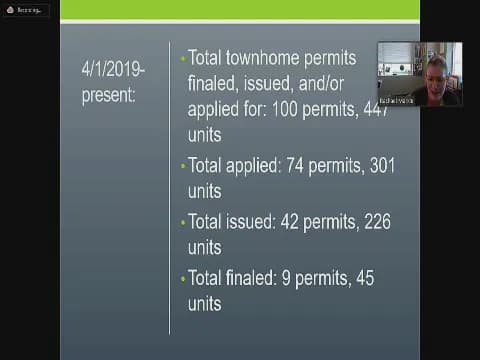
The Shoreline Planning Commission met on May 6, 2021, to receive a comprehensive update on development activity since 2019, including multifamily, townhome, and commercial projects, as well as pre-application trends and policy initiatives. The meeting also included discussion of the commission's upcoming retreat. Consent Calendar - No consent calendar items were noted. The meeting proceeded with roll call, agenda approval, and minutes approval without objection. Public Comments & Testimony - No members of the public signed up to speak during the general public comment period. Discussion Items - Local Development and Long Range Planning Projects Update – Director Mark presented a slide-heavy overview of permitting and development since 2019. Key points included: - In 2020, the city received about 2,600 permit applications valued at nearly $250 million, issued 2,300 permits, generated $6.8 million in revenue, and completed 4,719 inspections (handled by two inspectors due to COVID). This was approximately 700 fewer applications and $3 million less revenue than in 2019, but revenue still exceeded budget. - Since April 2019, 923 multifamily units have been permitted (230 affordable), all outside station areas. Station-area MUR-70 developments are still in pre-application. - 226 townhome units approved since 2019, 45 completed, with 447 total expected in two years. Many early townhome projects predate updated design standards; new standards require 40% of units to face the street and address landscaping and utility exposure. - Commercial projects covered include storage facilities, fire stations, a church, the North City Water District facility, Shoreline Community College additions, and remodels (e.g., Washington State Health Lab, WSDOT office, Black Coffee, Jersey's relocation). - Pre-application meetings indicate strong future development: 2 multifamily projects (288 units) for the 185th Street station area, and 6 multifamily projects (1,142 units) plus a 72-unit townhome for the 148th Street station area. - Environmental progress: mandatory Built Green 4-Star/Passive House standards have resulted in 370 certified units in 2020, up from zero in 2014, saving 4+ million gallons of water and 783 megawatts of energy. - Staff discussed upcoming work: MUR-70 regulation updates, sign design guidelines for Shoreline Place, tree code amendments, and the Housing Action Plan. - Commissioners asked about the impact of new development on open space per capita, property tax revenue, and business sales tax thresholds. Staff noted a revenue/cost model is under development and expected by July 2021. - New Business – Planning Commission Retreat – Staff proposed a retreat to discuss topics such as diversity and inclusion in land use, tree regulations, the 148th Street non-motorized bridge, parks planning, and other city projects. Commissioners agreed to generate topic lists and schedule a retreat of 1–2 hours. Key Outcomes - No formal votes were taken. The commission received the development update and will revisit retreat planning at the next meeting. - Staff will prepare a list of retreat topics and share with commissioners for input. - The appeal of the Point Wells decision was noted as continuing at King County Superior Court.
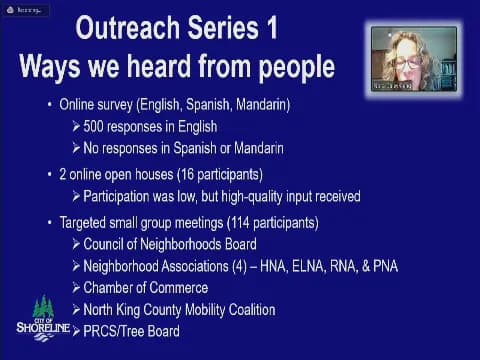
The Shoreline Planning Commission met on April 15, 2021, to receive an update on the Transportation Master Plan (TMP) update from city staff. The meeting included approval of the agenda and minutes, a detailed presentation by Senior Transportation Planner Laura Gary Kang, and discussion among commissioners on topics such as emergency lifelines, equity in outreach, multimodal level of service, neighborhood paths, parking, and specific corridor projects. Consent Calendar - The agenda was approved without changes. - The minutes from April 1, 2021, were approved without changes. Public Comments & Testimony - No members of the public signed up for general public comment. Discussion Items - Transportation Master Plan Update (Study Item): Laura Gary Kang presented an overview of the TMP update, a two-year process required by 2023 to align with the comprehensive plan and maintain grant eligibility. Key highlights included: - The plan supports all modes of travel and focuses on a realistic, financially sustainable roadmap over the next 10 years. - Outreach Series One (February 2021) included an online survey (500 respondents, in English, Spanish, and Mandarin), two virtual open houses (about 8 attendees each), and 10 stakeholder meetings (engaging 130 people total). - Top community priorities identified were safety, proximity, connectivity, travel time, and equity. - Pre- and post-COVID travel surveys showed expected reductions in drive-alone commuting and increases in walking and biking. - Major projects discussed include the Sidewalk Transportation Plan (75 miles of sidewalk, 12 funded projects over 10 years), 185th Street Multimodal Corridor, 145th Street corridor, light rail stations opening in 2024 with BRT connections, Trail on the Rail bike/ped path, and mobility hubs for first/last mile connections. - Commissioner questions and comments: - Commissioner Wanasol (recorded as "Walmart George" in transcript) asked about identifying emergency lifelines for the city and ensuring equitable outreach, especially to those without digital access. Staff acknowledged the need to address both issues and mentioned the upcoming community bridge liaison program. - Commissioner Iusa raised concurrency concerns given growth near light rail stations and limited I-5 crossings. Staff replied that the TMP will reframe level of service to a multimodal standard and that current modeling is being updated. - Commissioner Malik noted that the Richmond Beach neighborhood had been deferred due to the Point Wells development (currently in appeal) and suggested it be reviewed before 2023. - Commissioner Callian emphasized the importance of parking as a holistic issue across plans, noting the 185th Street project is unfunded. - Commissioner Malay (absent) did not participate. - Commissioner Gallian asked about formalizing neighborhood paths (informal trails on city rights-of-way) and noted residents enjoy walking on quieter streets; staff explained these are being tracked by neighborhood associations. Key Outcomes - No formal votes were taken on the TMP update; it remains a study item for future action. - The next meeting will include a development update by Director Markle and a discussion on the upcoming commission retreat. - Staff encouraged commissioners to provide additional ideas for outreach and to contact them directly. - The TMP project timeline continues with Outreach Series Two planned for summer 2021, including potential in-person events and additional surveys.
[Introductory paragraph summarizing the overall meeting.] The Shoreline Planning Commission held a public hearing on the first batch of 2021 Development Code amendments, covering 14 items ranging from definition updates to parking and density regulations. The commission unanimously recommended all amendments to the City Council, with a correction to the definition of adult family home. Following the hearing, the commission elected Chair Mark and Vice Chair Zager (Sager) for the upcoming year. Updates were provided on the 192nd Street rezone and the Point Wells appeal. Consent Calendar - Roll call: Commissioners Callahan, Vice Chair Malik, Chair Mark, Commissioner Mana Sunday, Commissioner Singer, Commissioner Clear Scott, and Commissioner Lynn Hatson (with notice) were present. - Minutes from the previous meeting were approved without changes. Public Comments & Testimony - No members of the public signed up for general comment or testified during the public hearing. Discussion Items Staff Presentation on 2021 Development Code Amendments (Batch 1) - Mr. Sapron presented a staff report recommending approval of all amendments. He noted a correction to Amendment 1 (adult family home definition): the original language allowing eight adults only with state approval was clarified to read that the home provides services for up to six adults, but may serve up to eight with state approval under RCW 70.128.066. - Amendments included: updating definition of best available science (Amendment 2); allowing public agencies to apply for permits without property owner signature during acquisition (Amendment 3); clarifying single-family attached developments eligible for design departures including landscaping (Amendment 4); adding parking areas to land use table to prohibit standalone paid parking (Amendment 5); indexing criteria for parking areas (Amendment 6); rounding density calculations for multi-zoned sites (Amendment 7); zero-foot front yard setback in NR 70 zone (Amendment 8); director to determine parking for unlisted uses based on expert analysis (Amendment 10); 25% parking reduction near light rail before operation (Amendment 11); removing assigned parking spot requirement for residential units (Amendment 12); adding administrative design review reference for landscaping (Amendment 13); revising deep green incentive program to reserve expedited permit review for tiers 1-3 (Amendment 14). - Commissioner Callahan raised questions about parking management plans, the light rail sub-area parking study (last updated October 2018/2019), and the need for parking enforcement and restricted parking zones. Staff stated that parking management plans must cover the gap before light rail operations (scheduled mid-2024) and would be vetted by the city's traffic department. - Commissioner Mana Sunday referenced negative parking impacts from The Polaris on 12th, emphasizing the importance of parking regulations. - Commissioner Malik expressed appreciation for the amendments, especially the NR 70 design changes. - Chair Mark inquired about the non-motorized bridge and kiss-and-drop at 147th and First; staff indicated funding is not fully secured but a bank account has been started. Election of Chair and Vice Chair - Following the rules of procedure, nominations were taken. Commissioner Mana Sunday nominated Chair Mark to continue as chair; Commissioner Malik nominated himself. Chair Mark was re-elected with affirmative votes from an unnamed commissioner (identified as "Tim Work" in transcript), Commissioner Callahan, Commissioner Mana Sunday, and Commissioner Sager. The clerk declared a majority. - For vice chair, Commissioner Callahan nominated Commissioner Sager; Commissioner Malik nominated Commissioner Mana Sunday. Commissioner Sager received affirmative votes from "Tim Work", Commissioner Callahan, and Commissioner Sager, and was elected Vice Chair. Reports and Updates - Commissioner Callahan requested an update on the 192nd Street rezone. Staff reported that at the March 29 City Council meeting, a private amendment to change the comprehensive plan from public facility to high-density residential (rezoning from R-18 to R-48) was not added to the docket due to significant public opposition. However, a request by King County Metro to rezone a park-and-ride lot at 192nd and Aurora from mixed-use one to mixed business and from R-18 to mixed business for transit-oriented development was added to the docket. - Julie Teller reported on the Point Wells appeal: Snohomish County Council unanimously affirmed the hearing examiner's denial of BSRE's resubmittal application. BSRE may appeal to King County Superior Court, and potentially further to the Court of Appeals or Supreme Court, though such escalation is unlikely. - Commissioner Mana Sunday thanked Vice Chair Malik for his leadership. Upcoming Meeting - The April 15th meeting will feature an update from Nora Daily Payne on the city's Transportation Master Plan update, including the comprehensive plan update and transportation element. Key Outcomes - Public Hearing Vote: The commission unanimously voted to recommend all 14 Development Code amendments to the City Council, with the correction to Amendment 1 (adult family home definition) as presented by staff. The vote was by roll call: Chair Mark (yes), Commissioner Callahan (yes), Commissioner Mana Sunday (yes), Commissioner Sager (yes), and Commissioner Singer (yes). - Election: Chair Mark was re-elected Chair for the upcoming year. Commissioner Sager was elected Vice Chair. - Rezoning: The City Council did not add a private rezone at 192nd Street to the docket but did add King County Metro's request to rezone the park-and-ride lot for transit-oriented development. - Point Wells: Snohomish County Council affirmed denial of BSRE's application; further appeals are possible but uncertain. - Staff will provide updates requested by commissioners, including the light rail sub-area parking study and information on tier four projects outside light rail areas.
On March 18, 2021, the Shoreline Planning Commission held a regular meeting via Zoom. The meeting included a study item on Proposition 1, a parks bond measure for the April 27, 2021 special election, and a public hearing on a proposed zoning code amendment defining “enhanced shelter” and permitting it as an outright use in the Mixed Business (MB) zone. The commission voted to recommend adoption of the code amendment to the City Council, with a note to consider including the Community Business (CB) zone and the 15th Avenue corridor. Consent Calendar - The agenda was approved as presented. - The minutes from March 4, 2021 were approved with no changes. Study Item: Proposition 1 – Park Improvements and Parkland Acquisition - Sarah Lane, Administrative Services Director, and Christina Arsene, Management Analyst, presented a pre-recorded overview of Proposition 1. The measure authorizes $38.5 million in general obligation bonds over 20 years to fund improvements at eight parks and acquisition of new parkland. The owner of a median-valued home ($517,000 in 2020) would pay an estimated $112 per year ($9 per month) in property tax, a $36 per year increase over the expiring 2006 park bond. - Key improvements include new play areas, splash pads, picnic shelters, restrooms, and trails at Brugger’s Bog, Hillwood, Richmond Highlands, Briarcrest (part of Hamlin East), and James Keel Park. Other parks (Kruckeberg Botanic Garden, Ridgecrest, Shoreview) would receive targeted upgrades. The bond requires 60% approval and a minimum 40% voter turnout from the November 2020 general election. - Commissioner Questions: - Commissioner requested clarification on the removal of a baseball field at one park. Staff responded that overall field capacity is sufficient given declining participation in baseball/softball and increasing demand for other sports. A dirt field at Shoreview Park would be converted to grass. - Commissioner asked about connectivity to light rail stations; staff noted that trails are designed for internal park access, with broader trail connectivity a longer-term vision. - Commissioner inquired about the high validation threshold for special elections. Staff explained that state law uses the previous general election turnout to ensure adequate representation for property tax increases. - Public Comment (Nancy File): - Nancy File, a 40-year resident of the Hillwood area, expressed concerns about: the inclusion of a basketball court when one already exists nearby; the reduction of soccer field space; the removal of a used baseball diamond while an unused one remains; the proximity of an enhanced shelter to Hillwood Park and potential drug activity under covered areas; and whether the design for Harris Park (donated land) complies with donation restrictions. Staff noted her comments for the record. - Commissioner Reflection: Commissioner (Vice Chair Alki) noted that the bond cost is reasonable compared to gym memberships and other services, and that the public will decide. Public Hearing: Enhanced Shelter Definition & Zoning Code Amendment - Nora Garloff, Planning Manager, presented the proposed code change. The amendment adds a definition of “enhanced shelter” to the zoning code and permits it in the MB zone with index criteria. Enhanced shelters are low-barrier, 24/7 facilities where residents are assigned rooms for the duration of their stay. The proposal follows an interim ordinance adopted in October 2020 for the “Oaks” site (163rd and Aurora), which is concurrently being rezoned from R-48 to MB. The permanent regulations include a 1-mile spacing requirement (no additional enhanced shelters within that radius while the Oaks operates), a maximum of 100 residents, a six-foot fence adjacent to residential zones, and a required memorandum of agreement with the city covering staffing, reporting, and a good neighbor plan. - Clarifying Questions: - Commissioner asked about expanding to the CB zone and 15th Avenue corridor. Staff noted that would require a separate process and consideration of transit requirements. - Public Testimony: - Renee Down expressed concerns about screening for violent behavior, the length of stay for residents, and the need for strong metrics and management to prevent nuisance. He did not support the definition as written without further study. - Jackie called for more specificity in reporting requirements (e.g., frequency) and raised concerns about the shelter’s proximity to child-oriented sites. She supported considering the 15th Avenue corridor as a more suitable location. - Nancy File argued that the interim ordinance could be renewed rather than making permanent changes. She stated that the index criteria were based on grant requirements (e.g., no screening for sex offenders), not on empirical research. She recommended limiting residents to 40 to start and waiting to see how the interim shelter performs before committing to a permanent code. - Commissioner Deliberation: - Commissioner Gallagher supported the code but wanted additional metrics on volunteers and donations, and clarity on food service operations (noting the kitchen may remain but food would be catered). - Vice Chairman Alki moved to recommend adoption of the code amendments as presented in Attachment A, with a second by Commissioner Callahan. He suggested adding a note to the City Council to consider including the CB zone and the 15th Avenue corridor. - Commissioner (Ms. Hines) cautioned that expanding to other zones had not been publicly noticed and could be addressed in a future recommendation letter rather than as an amendment. - Commissioner Seger expressed excitement for the Oaks site and thanked staff for their work. - Vote: The motion to recommend adoption of the code amendments (Attachment A) passed unanimously (Commissioners Present: Callahan, Dalista, Seger, Vice Chairman Alki, Ramashani; Commissioner Lynn absent, Chair Mark absent). The commission agreed to include a note in their recommendation letter about future consideration of other zones (CB and 15th Avenue). Key Outcomes - Proposition 1: The commission received the informational presentation. No action was taken. - Enhanced Shelter Zoning: The commission voted 5-0 to recommend that the City Council adopt the proposed code amendments (Attachment A) defining “enhanced shelter” and permitting it in the MB zone. The recommendation includes a note to explore allowing enhanced shelters in the CB zone and along the 15th Avenue corridor where high-frequency transit is available. - Commissioner Departure: Commissioner Callahan announced that this was his last meeting as he is leaving to become Community Development Director for the City of Tucker. He received thanks from the commission. - Recognition of Anti-Asian Violence: Commissioner Ramashani requested that the commission recognize and stand against the recent violence against Asian Americans, expressing empathy and solidarity with the Asian community. The commission concurred. - Public Comment Handout: Commissioner suggested creating a handout with tips for public comment for the planning commission website, modeled after the City Council’s guide. Staff will consider the request. - Next Meeting: The next meeting is scheduled for April 1, 2021, and will include a public hearing on the first round of development code amendments ("fast patch") and elections for chair and vice chair.
The Planning Commission held a public hearing on the Housing Action Plan (HAP), which included staff presentation, public testimony, and commission deliberation, followed by a discussion on proposed development code amendments. The commission voted to recommend the HAP to the City Council with amendments related to missing middle housing, weatherization, tree preservation, and short-term rental data. Public Comments & Testimony - Ryan Donahue (Advocacy City Policy Director, Congregate Seattle King County) expressed support for the HAP but urged using the term "permanently affordable homeownership" instead of "community land trusts" to include more organizations serving the 60-80% AMI population. He also recommended elevating missing middle zoning as a priority and including homeownership in the multifamily tax exemption (MFTE) program, and raising funding caps to 80% AMI. - Gary Hyde (Shoreline resident) supported the proposed density bonus for large single-family lots and advocated for a standard size restriction on ADUs (e.g., 1,000 sq ft) to address inequitable impact fees. - Mallory Van Alstine (Shoreline resident and Policy/Advocacy Manager, Housing Development Consortium) expressed pride in the city's work, supported all recommended tools, but urged going further by prioritizing missing middle zoning (Action 1.1). She also advocated for using city-owned surplus properties for affordable housing and highlighted the need for revenue tools (e.g., linkage fees, real estate excise tax) to fund affordable housing. Discussion Items - Housing Action Plan (HAP) Review and Amendments: Staff presented the HAP, which was developed over the past year and includes a housing needs assessment, community outreach (online open house), and a toolkit of actions. Key statistics: Shoreline is about two-thirds single-family homeowners (higher income) and one-third lower-income renters; of the units built in the last three years, two-thirds are studio/one-bedroom rentals; 75% of renters surveyed reported always/sometimes struggling to pay for housing. Prioritized actions include updating the deep green incentive program, creating cottage housing regulations, and developing standards for small-lot single-family. Commissioner amendments included increasing the priority of missing middle housing (Action 1.1), adding weatherization and tree preservation services to the homeowner stability program (Action 4.1), and acknowledging the unknown magnitude of the short-term rental market (Action 4.3). Discussion also focused on the difference between community land trusts and permanently affordable homeownership, ensuring no exclusion of organizations like Habitat for Humanity, and the need for socioeconomic integration to avoid creating isolated low-income areas. - 2021 Development Code Amendment Batch 1 (Part 1): Staff presented 14 proposed amendments including housekeeping updates, allowing public agencies to apply for permits before property acquisition, reducing front yard setbacks in MUR-70 zones, clarifying parking area uses, and updating deep green incentive expedited permit fees. Discussion centered on parking reductions near light rail stations (Amendment 11) and flexibility for landscaping alternatives (Amendment 4). Commissioners expressed interest in making parking reduction automatic rather than discretionary and ensuring landscaping quality. No vote was taken; staff will bring back recommendations at the public hearing. Key Outcomes - The commission approved a main motion to forward the Housing Action Plan to the City Council with the following amendments by roll call vote (all present in favor): - Amendment 1: Increase the priority of missing middle housing (Action 1.1) by adding it to the list of highest priority items, addressing zoning integration and neighborhood compatibility. - Amendment 2: Modify Action 4.1 (Homeowner Stability Program / Home Rehabilitation Assistance) to include weatherization and tree preservation services after "critical repairs." - Amendment 3: Modify Action 4.3 (Short-term Rental Regulations) to add the sentence: "The magnitude of the short-term rental market in Shoreline is currently unknown" at the end of the first paragraph. - The final vote on the main motion (HAP as amended) was unanimous, with all commissioners voting aye. - The commission discussed but took no action on the development code amendments; staff will return with proposed language and recommendations for the public hearing.
The Shoreline Planning Commission held a study session on February 18, 2021, to review proposed zoning code amendments to allow enhanced homeless shelters in the Neighborhood Business (NB) zone. The meeting included a presentation by Planning Manager Nora Gurloff, public testimony, and commissioner discussion on the definition and criteria for enhanced shelters. No formal action was taken; the commission provided feedback for staff to refine the proposal ahead of a public hearing scheduled for March 18, 2021. Public Comments & Testimony - Renee Billing expressed concerns about the lack of transition or buffer between the proposed shelter site and adjacent residential properties, noting that the site is currently zoned R-48 and R-18, not mixed business. - Nancy Seale (representing an unnamed neighborhood group) argued that the presentation was incomplete. She stated that residents are not required to seek help, that the shelter operator (Catholic Community Services) has no experience running a 24/7 shelter, and that the building lacks a functioning kitchen and is in poor condition. She also warned that King County Housing Authority intends to convert the property into permanent supportive housing after the grant funding expires in 2023, citing the Morrison Hotel as an example of such a facility with high rates of police calls. - Jennifer (unable to read her full comment due to hearing difficulties) submitted a written objection to the project. - Stacey Siles (owner of a nearby business) described existing problems with people using drugs and leaving needles in the area, arguing that an enhanced shelter would worsen conditions for neighbors. Discussion Items - Nora Gurloff presented the enhanced shelter definition and proposed index criteria: operation by a government or nonprofit with capacity; life safety inspections; prohibition of criminal activity and drug/alcohol use on site; location on a principal arterial with frequent transit; minimum one-mile spacing between shelters; maximum 100 residents; six-foot fence along property lines adjacent to residential zones; a parking plan; and a three-party memorandum of agreement between the city, county, and operator covering staffing plans, regular reports, police coordination, a good neighbor plan, performance metrics, and provisions for discontinuing the use. - Commissioner Callahan requested more detailed metrics and reporting requirements, including both program success indicators and community impact measures (e.g., police calls, complaints). - Commissioner Malik emphasized the need for proactive neighborhood outreach, possibly including weekly briefings for residents within a quarter-mile of a shelter, building on existing public notice practices. - Commissioner Wanasande supported transparency through neighborhood briefings and suggested that allowing neighbors to see the facility could reduce biases. - Commissioner Minn questioned whether a working kitchen should be a required amenity, noting that the current building lacks one. - Commissioner Gallian (likely Commissioner Callahan) asked about other jurisdictions' approaches and whether the criteria would limit shelters only to Aurora. - Commissioner (unidentified) raised concerns about the selection process for shelter operators and insurance requirements. - Staff clarified that the proposal is limited to the NB zone initially but could be expanded later, and that specific operational details like kitchen facilities are left to performance standards rather than prescriptive requirements. Key Outcomes - No motions or votes were taken. The commission directed staff to incorporate feedback on metrics, neighborhood notification, operator experience, and operational capacity into the enhanced shelter criteria before the public hearing. - The next meeting on March 18, 2021, will include a public hearing on the proposed code amendments and the Housing Action Plan. The commission will then make a recommendation to the City Council.
The Shoreline Planning Commission met on February 4, 2021, at 3:00 PM UTC (7:00 PM local). The meeting included a briefing from the Washington State Department of Commerce on the Growth Management Act (GMA) and a discussion on the 2021 Comprehensive Plan Amendment Docket, which contained a single proposal to re-designate a parcel from Public Facility to High Density Residential and rezone from R-18 to R-48. Public comments were heard, and the commission voted to recommend adding the amendment to the docket for further study. Consent Calendar - The agenda was approved as presented without changes. - The minutes from the January 21, 2021, meeting were approved without changes. Public Comments & Testimony - John Halton (resident at 19004 Furling Way) stated he purchased his home assuming the adjacent parcel would remain undeveloped (R-18 zoning) and expressed strong opposition to the proposed R-48 upzone and townhome development, citing loss of tree buffer, increased traffic, and lack of notice. - Dan (resident at 18840, south of the property) spoke in opposition, noting the importance of trees and green space as a buffer from Aurora Avenue, and stated that the community is already experiencing significant construction nearby. He urged the commission to consider the cumulative impact. - Janet Way (Shoreline Preservation Society) submitted a written letter and spoke in opposition. She argued that the proposal fails the comprehensive plan rezone criteria because it threatens health, safety, and welfare due to removal of significant trees that buffer nearby homes from pollution and noise. She noted the property contains a steep slope and critical area (erosion hazard), and criticized the lack of early public outreach, stating neighbors only learned of the proposal two days prior. - Jodi Dixit echoed previous comments, emphasizing the misrepresentation of tree coverage in staff photos and the lack of public notice. Discussion Items GMA Briefing (Krista Larson, Washington State Department of Commerce) - Krista Larson presented an overview of comprehensive planning under the GMA, covering goals, required elements, countywide planning policies, urban growth areas, buildable lands program, and the 2024 periodic update. She emphasized public outreach, consistency, and the role of planning commissioners as advisory to elected officials. The presentation included information on the short course on local planning and resources from MRSC. Commissioners asked clarifying questions about online training and open public meetings training requirements. 2021 Comprehensive Plan Amendment Docket (Staff Presentation by Steve Saffron) - Staff presented the single amendment request: change the land use designation of one parcel (fronting 192nd Street) from Public Facility to High Density Residential, with a concurrent rezone from R-18 to R-48. The parcel (approximately 0.38 acres) is undeveloped, previously owned by King County Metro, and was sold to a private developer in 2014. The applicant provided preliminary townhome sketches (17 units), but staff noted any development allowed under R-48 could be different (e.g., apartments). Under current R-18, up to 10 units could be built; under R-48, up to 26 units. - Staff recommended the commission forward the amendment to the docket for study. Commissioners asked about tree retention standards (same under both zones), lot coverage differences (85% vs 90% impervious), and the separate processes for the comprehensive plan amendment (through planning commission and council) and the rezone (through hearing examiner and council). Commissioner Mallet noted the potential for transit-oriented development given the site's proximity to the park-and-ride and Aurora Avenue. - Commissioners discussed the importance of trees, critical areas, and public outreach. The commission voted to recommend including the amendment on the docket for study. Key Outcomes - Comprehensive Plan Amendment Docket: The commission voted 5-0 (with one member absent) to recommend that the City Council add the proposed amendment (change land use designation from Public Facility to High Density Residential for the parcel at 192nd Street) to the 2021 docket for further study. The recommendation included an emphasis on tree preservation and transparent public outreach in subsequent proceedings. - Point Wells Update: Commissioner Mallet reported that the hearing examiner denied Blue Square Real Estate's development plans, ruling that the applicant had not used a once-in-a-lifetime mulligan to resubmit compliant plans. Parties of record have until February 8 to support or challenge; the developer has until February 12 to appeal to Snohomish County Council. - Upcoming Meetings: The next meeting (February 18) will include a neighborhood meeting on the rezone of the Oaks site (R-48 to NB) and a discussion on a permanent enhanced shelter code amendment. The Housing Action Plan is expected in March. - Training Reminder: Commissioners were reminded to complete open public meetings training; Krista Larson's presentation slides will be shared.
The Shoreline Planning Commission met on January 21, 2021, to review and prioritize actions from the city’s Housing Action Plan toolkit. The meeting included a presentation from consultant Elliot Weiss, extensive discussion among commissioners on housing needs, regulatory barriers, and affordability, followed by a structured prioritization vote. The commission identified a set of high-priority toolkit items to recommend to the City Council. Consent Calendar - Approval of minutes from November 18, 2020 and December 17, 2020 meetings was moved forward with no changes. - No other consent items. Public Comments & Testimony - No public comments were made. Darren Hyde had signed up but was not present. Discussion Items - Housing Action Plan Overview: Laura (staff) presented the plan’s components: a housing needs assessment, toolkit of policy actions, and alignment with the comprehensive plan. The consultant Elliot Weiss reviewed 25 toolkit options grouped as existing tools (e.g., ADU regulations, density bonuses, multifamily tax exemption), new zoning/regulatory tools (e.g., missing middle zoning, cottage housing), funding tools (local levy, real estate excise tax), and displacement minimization tools (down payment assistance, homeowner stability, partnership with affordable housing providers, community land trusts). - Commissioner Positions: - Vice Chair Mellon expressed skepticism about the effectiveness of the multifamily tax exemption given lengthy permitting timelines and rising costs; he urged focus on zoning and regulatory reforms to reduce developer uncertainty. - Commissioner Callahan raised interest in surplus city land for affordable housing, noting the city’s limited inventory but potential synergy with other projects (e.g., Kennedy Recreation Center). She also proposed including car-sharing incentives in parking reduction regulations. - Commissioner Sager emphasized minimizing displacement and supporting pathways to homeownership, particularly through community land trusts and education about ADUs and land subdivision. - Commissioner Malik (spoke extensively) highlighted that 92% of middle-class net worth is in home equity, arguing that homeownership is critical to breaking poverty cycles. He noted that 50% tariffs on lumber and permitting delays are driving up costs, squeezing small builders, and pushing townhome projects to neighboring Mountlake Terrace. He called for metrics on ownership vs. rental and on who is building in Shoreline. - Commissioner Garuska asked about distinguishing between missing middle zoning and small-lot single-family; Elliot Weiss explained the former includes duplexes/triplexes and requires deeper code audit, while the latter focuses on detached homes. - Commissioner Wama Sanjay proposed encouraging existing property owners to build ADUs or secondary units on their land as a way to increase housing supply without requiring new land. - Commissioner “Ma” (likely Commissioner Malik) stressed the importance of deep green incentives being integral to any affordable housing development. - Commissioner Claw questioned whether individual incentives can be evaluated in isolation; staff responded that incentives are finite and must be prioritized to avoid diluting their effect. - Commissioner Lynn suggested removing items that are clearly low priority to simplify the list. Key Outcomes - Prioritization Exercise: Each commissioner selected their top six actions. First-round results (items with 4+ votes): - Deep Green Incentive Program (item 2) - Cottage Housing Regulations (item 13) - Down Payment Assistance (item 21) - Homeowner Stability Program (item 22) - Partner with Affordable Housing Providers (item 23) - Support Community Land Trusts (item 24) - Second-round from remaining items (with 2–3 votes each): Top three were: - Identify surplus city property for affordable housing (item 12) – 5 votes - Update residential zone density bonus regulations (item 3) – 5 votes - Density bonus for additional houses on single-family lots (item 14) – 4 votes - Additional Considerations: - Commissioners emphasized the importance of tracking metrics (e.g., ownership vs. rental, who builds) and integrating deep green and community land trust concepts into broader policies. - A motion to remove the real estate excise tax and the local housing levy from consideration was supported by some members; the final list will be presented to Council with a note that these were discussed but not prioritized. - Next Steps: Staff will package the prioritized actions into a final Housing Action Plan document and bring a recommendation to the City Council by June 2021. The comprehensive plan housing element update will follow separately, aligned with countywide planning policies expected in 2022–2024. - Director’s Report: Ken Read noted that permit revenue recovered in 2020 despite COVID, with townhome permits generating the most revenue. The Point Wells Hearing Examiner decision is due January 29, 2021.