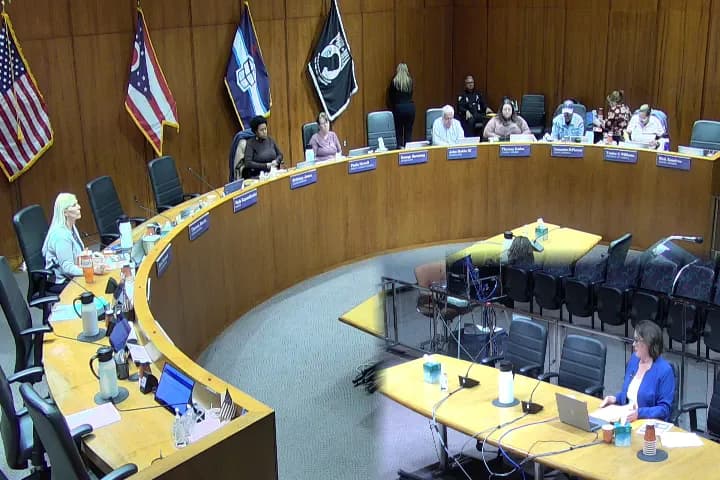
This meeting convened on February 26, 2026, at 4:00 PM in Toledo City Council Chambers to discuss the impacts of federal funding cuts to HUD's Notice of Funding Opportunity (NOFO) on supportive housing programs. The committee heard a detailed presentation from Julie Imbri, who outlined a 12-month destabilization timeline, direct and indirect community impacts, and financial consequences. Discussions emphasized the interconnectedness of homelessness, housing stability, local businesses, and public systems. No formal votes were taken; the committee committed to further planning, data sharing, and advocacy. Presentation & Report - Julie Imbri presented on the current scale of funding jeopardy: 750 households (approximately 1,200 individuals, 30% children) are stabilized by this funding; over 50 landlords and businesses would be directly impacted; 30+ program-specific employees face layoffs; 128 participants whose employment relies on supportive services are at risk. - At least $3.1 million in total funding is jeopardized, including over $2 million in rental revenue to landlords. - A 12-month timeline was detailed: within 30 days, all PSH placements would halt; within 30-60 days, shelters (currently at 588 beds full, with 465 individuals waiting) would see increased demand; after 90 days, program reductions and closures would begin, leading to workforce layoffs and permanent loss of housing stock. - Current systemic pressures: 250 people served in warming centers (duplicated) with 60-90 nightly; 36 individuals in warming centers have psychiatric needs beyond shelter capacity; an estimated 50-60 additional individuals with similar needs are not in shelters. - Financial impacts already felt: agencies have fronted $150,000 in unreimbursed funds, escalating to $500,000/month by June/July. - Legal environment: Congress appropriated funds for about 10% of projects; majority of COC funding renews in Q3 and remains in jeopardy; HUD has yet to provide clarity. Public Comments & Testimony - Sandra Desteno, Director of 211, described the rising complexity of calls: individuals with disabilities, older adults, single mothers facing high childcare costs ($55/day to work, earning $40/day), and nursing home discharges to homelessness. She noted the loss of prevention dollars and lack of rental assistance post-ARPA. - Pastor Leo Cunningham, St. Paul’s United Methodist Church, stated that while congregations are exploring partnerships (e.g., with Uptown Business Association, Vistoula neighborhood), existing church buildings cannot accommodate beds/cots due to fire suppression system requirements; he urged a "both-and" approach of federal/state pressure and local inspiration. - Emily Matthews, Program Manager for 211, thanked the committee for support with warming centers and stated that Toledo's model is being emulated across Northwest Ohio. She encouraged council members to visit the warming centers. Discussion Items - Councilmember Gaddis requested a heat map of landlord locations and data on housing types (single-family vs. apartments) and landlord characteristics (local vs. out-of-town). Ms. Imbri agreed to generate that data. - Councilmember Gaddis also asked about best practices for public restrooms and trash management; Ms. Imbri cited a Detroit-based “Throne” trailer model and noted existing stress on Metro Parks restrooms. - Councilmember Gaddis expressed interest in using district funds for solar charging tables and requested a meeting to discuss Uptown issues. - Councilmember McPherson emphasized the need for community-wide solutions, thanked churches for hosting warming centers, and suggested thinking creatively (e.g., Cincinnati converting a closed school into a shelter for students). - Councilmember Saranto asked about approaching closed churches for overnight shelter; Ms. Imbri responded that the priority should be stabilizing existing shelters before expanding, highlighting that St. Paul’s winter crisis shelter will close March 8 (one week early) due to funding cuts. - Councilmember Williams urged the council to pressure federal representatives to restore funding, noting that cuts are hurting the poor while millionaires are prioritized. She also raised the concept of a Tent City, though funding and location remain challenges. - Councilmember Craig noted that state cuts have reduced library hours, pushing more unsheltered individuals to TARDA hubs. She linked the $600 million stadium levy to misplaced priorities. - Sergeant Kelly Russell of TPD shared her experience as a CIT coordinator, noting a 30% increase in mental health calls over four years. She emphasized the need for more alternatives to jail for unhoused individuals and described successful one-at-a-time interventions. - Building official Jim Hough briefly commented on code barriers: churches lack sprinkler systems required for housing; warming centers are permitted as long as no sleeping occurs. - Ms. Imbri noted that restrictive zoning codes hinder creative solutions (e.g., tiny homes, tent cities) and suggested reforming zoning to ease development. Key Outcomes - The committee requested a heat map of PSH landlord locations, data on housing types and landlord residency, and cost projections for public restroom solutions. - Ms. Imbri will continue working with the Mental Health Recovery Services Board to assess provider reserves and landlord willingness. - Council agreed to send letters urging federal and state representatives to restore housing funding. - Future meetings will address zoning code alterations to reduce homelessness and explore alternative housing models (e.g., tiny homes, tent cities) subject to regulatory feasibility. - The committee affirmed the need for continued collaboration among city, county, mental health board, TPD, TARDA, schools, faith communities, and business associations.
Public Meetings - Toledo, Ohio
Public Meetings - Toledo, OhioA special meeting of the City of Toledo Plan Commission was held on February 25, 2026, to consider a major site plan review for a new industrial building at the former Northtown Mall site and a request to vacate a portion of an alley in East Toledo. Both cases received unanimous approval. Consent Calendar - Final Plat (S 26003): The replat of Northtown Square (zero Newtown Square Drive) received final clearances and was approved unanimously. Commissioner Ball abstained. This item required no discussion. Discussion Items - SPR 26003 – Major Site Plan Review (Toledo Trade Center): Brett Sioka (development manager, North Point Development) presented a proposal to modify the site plan at the former Northtown Mall site (zero Newtown Square Drive). The original approval showed three single-load industrial Class A buildings; the amendment consolidates the final two buildings into one cross-dock building of approximately 48,000 square feet. Sioka stated a tenant is in tow, which he believes will bring a better opportunity for job creation. He noted existing utilities will be reutilized. Construction is expected to start within the next month, pending permits. Staff recommended approval with 43 conditions. The applicant confirmed review of the conditions with no concerns. The commission approved the site plan unanimously. - V 524–25 – Alley Vacation (St. Stephen's Catholic Church, 2014 Consaul): Rob Keelahan (representing the Diocese) explained the request is to tidy up title records for an alley that was effectively vacated 90 years ago but resurfaces in current surveys. No utilities are believed to be present; the alley is part of the church campus and exists only on paper. The Toledo Fire Department requested that an existing gate and fence be retained as alternate access; the applicant had no objection. Keelahan noted the city would retain an easement for access if needed. Staff recommended approval with four conditions. The case will proceed to the Zoning and Planning Committee on March 18, 2026, at 4:00 p.m., and then to the Board of Revision. Key Outcomes - SPR 26003: Approved unanimously. The applicant may proceed with construction once permits are obtained. - V 524–25: Approved unanimously. The vacation will be finalized after city council and the Board of Revision act on it. - The meeting adjourned after the two cases, with the chair thanking staff for preparing the cases.
This was a regularly scheduled meeting of the Lucas County Planning Commission, held on February 25, 2026. The commission addressed one major case: a text amendment to the Jerusalem Township zoning resolution. Action included approving minutes and a recommendation to the township. Discussion Items - Case Z28 C154 - Text Amendment for Jerusalem Township Zoning Resolution: Jacob Barnes (4029 Secluded Ravine Court, Maumee, Ohio) appeared as the applicant for the proposed amendment to multiple sections (4, 5, 6, 7, 9, 10, 11, 12, and 16) of the Jerusalem Township zoning resolution. Staff recommended approval as modified in Exhibit B. A key point of debate was the minimum lot size in agricultural districts: the applicant and township initially requested 2 acres to maintain rural character, while staff recommended 1 acre to ensure conformity with existing approved lot splits. Staff noted that recent lot splits had been approved at 1.5 acres under current zoning, and increasing to 2 acres would render those non-conforming. Commissioner Molly clarified that Exhibit B specified 1 acre, and the commission did not recommend the 2-acre modification but understood the township could adjust further. A discussion of traffic impact studies was also noted—uses generating more than 50 trips per day will require consultation with the county office, which could result in a study. No public comments were received. Key Outcomes - Minutes Approved: The minutes from November 19, 2025, and January 28, 2026, were approved unanimously by voice vote. - Case Z28 C154: A motion to approve the staff recommendation as modified (1-acre minimum lots) was made, seconded, and carried unanimously. The recommendation will be forwarded to Jerusalem Township for final action. - Other Business: No further business was conducted, and the meeting was adjourned.
The meeting was called to order by Chairman Surround with roll call (Hobbs, Jones, Martinez present). The committee reviewed January 2026 revenue and expenditures, received updates on ARPA-funded projects, and heard public testimony. Discussion Items - January Financial Report: Director of Finance Melanie Campbell reported that general fund revenue collections are at 2% of budget (8.3% through the year), with no major concerns. Tax Commissioner John Zavisha updated that 2025 income tax collections are projected at $236.6 million, with withholding up 3.4% and business taxes down 19.8%. The city is working with the Ohio Attorney General on delinquent tax collections, expecting $5–6 million in referrals with a 30–40% collection rate. - ARPA Project Updates: - Healthy Food Incentive Program (Stephanie Baltes, Toledo-Lucas County Health Department): $350,000 ARPA funding supported five corner stores; $133,000 remains to be spent. The program has leveraged external funds (e.g., Produce Perks Midwest) and is onboarding a sixth store. Sustainability planning is underway. - Food Systems Hub (Director Sellhorst): $500,000 allocated for a food hub at Erie Street Market, but the partner ECDI withdrew due to federal funding cuts. $144,703 was spent on architectural drawings; remaining funds may be redirected to support small business equipment through CIFT or similar partners. - Supermarket Construction Incentive (Chief Clemens): $150,000 allocated; none spent. The city is working with Red & White Market in Englewood for pre-development, with a plan B if the project falls through. - Land Bank (David Mann): $12.5 million allocated for brownfield cleanup, demolition, and community center redevelopment. $6 million expended; 13 of 27 brownfield projects completed. All funds are under contract and expected to be fully spent by year-end. - Wayman Palmer YMCA (Eric Williams): Membership grew from 533 to 2,900. Over 100 children taught to swim, 4,500 individuals served via food pantry, and 75 seniors participate in daily activities. Approximately 8,000–9,000 visitors in late 2025. - Community & Senior Center Improvements (Commissioner Aikman): $2.1 million remaining for projects including parking lot replacements, HVAC upgrades, window/door replacements, and gym floor replacement at various centers. All projects expected to be completed by end of 2026. - Mental Health Recovery Services (Scott Silak): $2 million ARPA funding; all but $17,200 spent. Programs include community wellness grants (48 agencies), trauma/grief support, mental wellness rapid response team, Latinx prevention services, and hospital access collaboration. Over 6,000 Toledo residents served. - Parks & Recreation (Director Fosnod): $13.5 million initially awarded; $149,105 remains. Funds will be used for a supplemental water line at Jamie Farr splash pad and additional amenities (windscreens, benches, landscaping) at completed projects. All funds expected to be spent by mid-year. - Metro Parks – Glass City Metro Park (Matt Clayland): $500,000 for classroom space (nearly complete); $2 million for riverwalk (million-dollar purchase order issued for Water Street work, remainder for planning). Funds will be fully expended by end of 2026. - Affordable Housing Development (Chief Clemens): $10 million allocated; $300,000 held in retainage for Collingwood Green 5 (75 senior units). Completed projects include 20 Grand townhouses (April 2026 delivery), 50 workforce housing units at The Glen, and first phase of YWCA domestic violence shelter (12 units). - Medical Debt Relief (letter from Undue Medical Debt): $800,000 ARPA investment abolished $81.8 million in medical debt for nearly 40,000 residents. $662,323 expended; $123,560 remains. Two final files expected in Q2-Q3 2026. - City Auditor's Report: Auditor released investments review (no exceptions) and is conducting a grass-cutting audit, expected by end of March 2026. Public Comments & Testimony - Karen Mayfield (Toledo resident): Expressed concern about the Bayview wastewater treatment plant upgrade costs, noting sewer rates increased 3.75% annually through 2028 and water rates rising 40% by 2027. She stated Toledo's water rates are 29.2% higher than the state average and urged the committee to review alternative, less costly plans. - Steve Capser (Monroe, MI, former Toledo resident): Argued the proposed plant footprint is disproportionately large (63.6 acres vs. comparable cities averaging 57.2 acres). He highlighted 12 risks from the Blue Ribbon Panel report, claimed 13 pages were missing from the council's copy, and urged consideration of cost-saving alternatives including using existing parking lots and reducing land acquisition. Key Outcomes - The committee will request detailed breakdowns of ARPA project categories and expenditures by sub-project (referred by Councilwoman Dr. Jones). - Vice Chairman Driscoll requested a follow-up meeting in June 2026 to monitor ARPA spending progress and ensure full expenditure by December 31, 2026. - Several projects have clear spend-down plans and are on track; some (e.g., Red & White Market, Food Systems Hub) require contingency planning and will be updated at future meetings. - The committee acknowledged the need for continued oversight to avoid unspent funds at the end of the ARPA deadline.
This meeting served as the Agenda Review for the March 3, 2026 Toledo City Council meeting. The council reviewed and discussed numerous ordinances, resolutions, and appointments, making recommendations for first reading, suspension of the rules (SCP/SEP), or deferral. Key discussions focused on housing and homelessness funding, utility customer assistance, healthcare contracts, and infrastructure projects. Consent Calendar - Resolutions and appointments were reviewed without opposition, including R-053-26 recognizing Zack Aubrey and Anthony Mitchell for exceptional bravery, appointments to the Toledo-Lucas County Commission on Disabilities, and appointments/reappointments to the Home Improvement & Home Remodeling Board of Control. Public Comments & Testimony - No public comments were made during this agenda review meeting. Discussion Items HOME-ARP Substantial Amendment (O-057-26) - Rosalind Clemens (Chief of Housing and Neighborhood Sustainability) and Colleen Alley (Deputy Director, DHCD) presented an ordinance to amend the HOME-ARP Allocation Plan to establish a preference for supportive services funding for homeless individuals (Qualifying Population 1). The city received $7.9 million in HOME-ARP funds, with $3 million allocated for supportive services. The amendment responds to increased homelessness and shelter system strain. The preference will not affect other qualifying populations for rental housing projects. The public comment period ran January 26–February 9, 2026, with a public hearing on February 11, 2026. Councilmembers questioned the timeline (30–60 days for HUD approval after council passage), the number of individuals served (estimated 60), and coordination with agencies like Pathways Inc. and Health Council of Northwest Ohio. The council recommended SEP (suspension of rules for immediate passage). Department of Public Utilities Items (O-058-26 to O-061-26) - O-058-26 (Autoclave Replacement): Authorizes $100,000 for a new bacteria lab autoclave at Collins Park Water Treatment Plant. The autoclave saves $7,500/month in testing and reduces boil advisory time by 24–48 hours. Recommended SCP. - O-059-26 (Buckeye Pumps Contract): Authorizes a $40,000/year contract for repair services on the spent lime dewatering pre-fill tank mixer. The mixer processes about 250,000 gallons/day, increasing solids content from 4–5% to 45–50%. Recommended SCP. - O-060-26 (Customer Assistance Grant Program): Authorizes $100,000 for utility bill assistance grants ($250 per eligible customer, once every two years). Councilmembers expressed frustration that only 12 people applied in 2025 and none received funds due to eligibility issues. The council directed the administration to improve promotion, consider adjusting income thresholds, and provide monthly reporting. The item was held for first reading, with a request for a revised rollout plan. - O-061-26 (State Regulatory Fees): Authorizes $75,000 for Ohio EPA annual permit fees, a 5% increase from 2025. Recommended SCP. Department of Human Resources Items (O-062-26, O-063-26) - O-062-26 (Anthem TPA Services): Authorizes a three-year contract (with two optional one-year renewals) for medical claims administration. Anthem was selected via RFP over Medical Mutual and United Healthcare. Estimated administrative cost: $1 million/year. Recommended SCP. - O-063-26 (Carelon PBM Services): Authorizes a three-year contract (with two optional one-year renewals) for pharmacy benefit management. Carelon (Anthem subsidiary) was selected over incumbent Optum Rx. The integration with Anthem is expected to reduce prior authorization delays. Cost: $190,000/year. Recommended SCP. Department of Development Items (O-064-26, O-065-26) - O-064-26 (Expedited Building Appeals): Amends TMC 1315 to add an expedited appeal process (5 business days) for building code appeals, aligning with state law SB 6. Establishes fees: $250 standard, $500 expedited. The building appeals board comprises five professionals. Recommended SCP. - O-065-26 (Shovel Ready Sites Fund): Authorizes an $18.7 million loan to the Toledo Community Improvement Corporation (TCIC) to create a revolving fund for site assembly, remediation, and preparation. The loan will be repaid from JEDZ revenues. Council requested monthly updates to all council members. Recommended first reading. Department of Finance Items (O-066-26 to O-070-26) - O-066-26 (NTR Bonds – $18.7M): Companion to O-065-26, for economic development. First reading recommended. - O-067-26 (RAISE Grant Match Bonds – $19.8M): For infrastructure improvements including street reconstruction, mobility hub, and multiuse path. First reading. - O-068-26 (Streets & Bridges Bonds – $12.21M): For street and bridge improvements. First reading. - O-069-26 (Refunding Bonds – $7.49M): To refund 2015 bonds, with projected savings of $184,000. First reading. - O-070-26 (Fire Apparatus Bonds – $1.1M): For fire equipment. First reading. Department of Transportation Items (O-071-26 to O-074-26) - O-071-26 (2026 Sidewalk Program): Authorizes $3.5 million (CIP, special assessment, and tree assessment funds) for sidewalk repairs. The program will save 150 trees by using flexible asphalt around roots. Council debated whether the $500,000 CIP appropriation is permissible before the 2026 budget passes. Recommended first reading. - O-072-26 (ODOT Multi‑Use Path – Parkside Blvd): Accepts $1,016,495 in grant funds (80% federal, 20% city match). First reading recommended due to budget uncertainty. - O-073-26 (OPWC Grant Amendment – Sylvania Ave): Converts $125,906 from loan to grant for the Sylvania Avenue resurfacing project. First reading recommended. - O-074-26 (Safe Routes to School – Washington Local Schools): Authorizes application for ODOT grants for infrastructure improvements near Shoreland Elementary School (estimated $816,834, 100% grant funded). Recommended SCP. Clerk Reports and Zoning Items - R-075-26 (Jefferson Avenue Vacation): Declares intent to vacate a portion of Jefferson Avenue between Water Street and the Maumee River. Noted. - O-076-26 to O-081-26: Zoning items including a zone change at 1839 Tremainsville Road, special use permit amendment for Christ the King Church (4757 Monroe Street), Vistula neighborhood map amendment (188 parcels), text amendments for storage facility special use permits, density bonus site plan review, and legacy zone changes. All were noted as coming from the Zoning & Planning Committee. Second Reading Items - O-034-26 (Toledo Edison Lease – Detwiler Park): Authorizes a one-year lease (with a possible month-to-month extension) for a parking lot as a temporary storage yard for electrical upgrades. The city negotiated $1,000/month rent and a screened fence. Councilmembers expressed concerns about precedent for private company use of parks and visibility of storage. Council President Williams supported the project, noting the impoverished neighborhood. Councilwoman Morris opposed, citing slippery slope. The item was held for further information on alternative sites. The council will vote on March 3, 2026. - O-051-26 (Municipal Code Amendments – Non‑Union Employees): Repeals and enacts sections of Chapter 2101 (non‑union employee code). Second reading, no significant discussion. Key Outcomes - Recommendations for Passage: Most items received recommendations for SCP or first reading, as noted above. The customer assistance program (O-060-26) was held for first reading pending improved outreach and possible policy changes. The Detwiler Park lease (O-034-26) was held for additional information. - Directives and Referrals: - The administration was directed to improve promotion of the Customer Assistance Grant Program, provide monthly usage reports, and consider adjusting income eligibility thresholds. - The Department of Public Utilities was asked to provide a breakdown of HOME-ARP funding percentages and details on outreach for the homeless population. - The Department of Transportation was asked to provide addresses of locations where flexible asphalt was used around trees, and to ensure resident communication for sidewalk and Safe Routes projects. - The Department of Finance was asked to clarify whether CIP appropriations are permissible before the 2026 budget is passed. - Next Steps: The full council will consider these items at the March 3, 2026 meeting. The council’s Finance Committee will meet February 25, 2026 to discuss budget-related issues.
The Administrative Board of Zoning Appeals held a hearing on February 23, 2026, to consider a single variance request. The meeting began with roll call establishing a quorum, followed by the swearing in of staff. No public opposition was present, and the Planning Commission had recommended approval. Consent Calendar - Approval of minutes from the last meeting was moved, seconded, and unanimously approved by all members present. Discussion Items - Case: Matt Hittle Rudolph Libby, 1620 Oakdale Avenue (IG Zoning) – The applicant sought a variance to reduce a proposed 8-foot fence to a 6-foot fence to match existing conditions. The representative clarified that the 8-foot specification was a typographical error. With no opposition and Planning Commission support, the board discussed briefly and voted. Key Outcomes - Variance Approved – The board voted unanimously (Denise Williams, Jill Randalls, Craig, and Chris in favor) to grant the variance for a 6-foot fence at 1620 Oakdale Avenue. - Minutes Approved – The minutes from the previous meeting were approved without changes.
Date: Thursday, February 19, 2026, 1:00 PM Location: City Council Chambers, One Government Center, Toledo, OH Committee Members Present: Sam Melden (Chair), Mac Driscoll, Brittany Jones, Nick Komives, Adam Martinez, George Sarantou (6 present). Absent: Cerssandra McPherson, John Hobbs III, Theresa Morris (3 absent). The committee convened to discuss a proposed $18.7 million bond issuance to fund a Shovel Ready Sites Loan Agreement with the Toledo Community Improvement Corporation (TCIC). The presentation, led by Chief Growth Officer Brandon Sellhorst and General Counsel Paul Searing, framed this as a proactive strategy to address Toledo's population decline and $52 million budget deficit by stimulating economic growth and creating new housing opportunities. Discussion Items - Context and Need: Sellhorst explained that over 63% of city revenue comes from income tax, but expenses are outpacing growth. Toledo faces a $52 million budget deficit this year and continues to lose population (over 113,000 residents lost since 1970). He argued that the most sustainable solution is growth, requiring proactive redevelopment of sites to attract new jobs and residents. - Return on Investment Analysis: Sellhorst presented data on the number of new jobs or residents needed to generate $1 million in new income tax revenue: approximately 1,560 jobs at $12.43/hour, 770 jobs at $25/hour, or 400 jobs at $100,000/year. He emphasized that proactive site preparation is essential to attract these opportunities. - Case Studies of Past Success: Sellhorst highlighted successful city-led redevelopment projects, including the Overland Industrial Park (Willie's Overland Jeep plant: 2,600+ jobs), the Gulf Oil Refinery site (Cleveland-Cliffs: 212 jobs, $130,000 average salary, $1 billion+ investment), Textile Leather and Medcourt properties (Vehicle Customization Facility: 300 UAW jobs), Southwick Mall (Amazon delivery station: 410 jobs), and Northtown Mall (Toledo Trade Center: 185 jobs at MOBIS, with a new 400,000 sq ft building planned). These projects collectively created over 3,700 jobs, $115 million in annual payroll, $3 million in new annual income tax revenue, and $1.3 billion in capital investment. - Competitive Disadvantage: Sellhorst noted that most established industrial parks in Toledo (e.g., Overland, Toledo Trade Center) are now full, leaving few shovel-ready sites for new business. He cited state data: in 2024, Toledo could only submit 30 responses to 88 statewide site searches, with 13 of those submissions being the same site (Toledo Trade Center). Over 60% of site searches requested an existing building (spec buildings), and 40% required over 100 acres. He warned that without new sites, the city will be unable to compete for new job-creating projects, especially with a new vehicle being built at the Jeep plant. - Funding Mechanism: The proposed $18.7 million bond would be issued by the city as non-tax revenue debt and loaned to the TCIC. The loan is coterminous with the bond (matures 2056). Annual debt service is estimated at $1 million. Critically, repayment would come not from the city's general fund but from income tax revenue the TCIC receives from the 1992 Toledo-Rossford Joint Economic Development Zone (JEDZ). Finance Director Melanie Campbell confirmed this dedicated revenue source means the debt would not count against the city's internal debt limit. - TCIC Structure and Governance: The Toledo Community Improvement Corporation was established in 2014 but has been dormant. It is a 501c3 entity governed by a board of four ex-officio members (including the mayor and council president) and four non-city appointments (recommended by mayor, confirmed by council). Board meetings are public and subject to Ohio Sunshine Laws. The new fund would create a dedicated, flexible capital source for site readiness (acquisition, remediation, demolition, and preparation). - Strategic Prioritization: Councilmembers questioned how sites would be prioritized (housing vs. jobs, specific geographies). Sellhorst said the TCIC board has discussed focusing on both jobs and housing, considering community needs (as identified by the Forward Toledo plan and comprehensive housing study) and market data (e.g., industrial companies seek proximity to I-75, rail, port). He proposed thinking like a developer to identify sites with the best return on investment (not just sale proceeds, but long-term tax revenue, permits, and construction jobs). Councilmember Martinez emphasized the need to avoid concentrating poverty and to work with the state on affordable housing tax credit placement. - Infrastructure and Tools: Sellhorst acknowledged that all successful past projects required city investment in infrastructure (e.g., roads, water/sewer). The city's Capital Improvement Fund (CIP) would need to be coordinated. He also mentioned tools like TIFs and a new state tool, the New Community Authority, to create dedicated long-term revenue streams to revolve the fund. Councilmember Driscoll suggested the TCIC could potentially loan money at low interest to the city for infrastructure, with payments going back into the revolving fund. - Council Questions and Concerns: - Councilman Driscoll: Requested an amortization schedule (Finance Director Campbell agreed to provide it). Clarified that the debt is the city's debt but because repayment is from a dedicated source, it does not affect the internal debt limit. - Councilman Sarantou: Inquired about the Dana site (now Overland Industrial Park) and the potential for housing at Franklin Park Mall and Westgate. Sellhorst noted the city does not own Franklin Park Mall land, limiting its ability to dictate use. A key takeaway: owning land gives the city control over its destiny. - Councilman Martinez: Asked about target industries (advanced manufacturing, automotive, food processing, logistics) and the importance of focusing on small to medium-sized businesses. He emphasized the need to retain homegrown manufacturers who leave due to a lack of available land. He also raised concerns about concentrated poverty in affordable housing tax credit projects, urging coordination with the state. - Councilman Melden (Chair): Praised the 501c3 structure for potential access to research and grant opportunities. Drew a distinction between wanting development (e.g., housing at Westgate) and making it possible (owning the land allows the city to set the terms). - Councilman Sarantou: Noted Wall Street would view the fund positively as a sign of proactive economic development, improving bond rating discussions. Key Outcomes - No formal vote was taken. This was a committee hearing for discussion and information. - The two ordinances authorizing the bond and loan agreement will be placed on the next City Council agenda for Tuesday, February 25, 2026. - Councilman Driscoll requested additional financial detail (amortization schedule), and the administration committed to provide it. - Councilmember Martinez requested further information on the placement of affordable housing tax credits (deferred to Rosalind Clemens). - The committee expressed strong support for the initiative, with Chair Melden stating it was a "no-brainer" and Councilman Sarantou calling it "enormously important."
The Zoning & Planning Committee met on Wednesday, February 18, 2026, at 4:00 PM in City Council Chambers to discuss seven agenda items, including zone changes, special use permits, text amendments, and a neighborhood study. The meeting began without a quorum (5 present out of 9 members), but a quorum was later established, allowing formal recommendations. Chairperson Vanice Williams presided. Public Comments & Testimony - Deborah Sue Pearson (investor and nonprofit executive in the Vistula area) spoke in support of the Vistula zoning study and map amendment, stating it encourages investment and has been awaited for years. - Valerie Garforth (investor and former board president of Beach House) also supported the Vistula rezoning, citing her family’s renovation of two historic properties in the neighborhood and the goal of attracting residents and taxpayers. - Travis Truesdale (local business owner) addressed the storage unit text amendment, asking how he can proceed with a self-storage and contractor suite project at 3823 Sylvania Avenue given the pending moratorium. Director Lisa Cottrell responded that after the moratorium ends, a special use permit would be required, but noted the site is surrounded by industrial zoning and might be favorable. - Mr. Arnold (no organization stated) requested that the “Community Recreation Active” zoning category be studied with input from human services agencies and the public, as he believes it is used for a wide range of facilities and is misleading. Discussion Items - 1 – 3360 Monroe vacation (V-435-25): Request to vacate a 15-foot alley. The applicant was not present. Planning Commission recommended disapproval because vacating would leave a stub alley without a turnaround. Director Cottrell noted the applicant is aware and is working on a zone change instead. The committee could not make a formal recommendation until a quorum was present; later Chairperson Williams recommended sending to the Board of Revisions as disapproved. - 2 – 1839 Tremainsville zone change (Z25-0037): Request to downzone from CO (office commercial) to RD6 (duplex residential). The applicant was ill and not present. The downzoning was described as non-controversial and needed for refinancing the existing single-family home. Committee members supported it, and Chairperson Williams recommended sending to City Council as approved. - 3 – 4757 Monroe SUP amendment (SCP-25-0042): Amendment to a special use permit for Christ the King Church and school expansion. Attorney Jerry Parker and church representative Brian Smith presented. They accepted all 24 planning commission conditions except requested deferral on a sign waiver (the sign would remain blank until the city reviews the sign code). The committee agreed to defer the sign issue and recommend the rest to City Council as approved, with a condition that the sign remain blank for one year or until the special use permit is re-reviewed. - 4 – Vistula Study & Map amendment (M-9-25): Comprehensive rezoning of the Vistula neighborhood to align with the Forward Toledo plan and Vistula Master Plan. Planner Alex presented the study, which replaces outdated industrial and auto-oriented commercial zoning with mixed-use and appropriate residential/commercial zones. Two neighborhood meetings were held; changes were made based on community input. Councilman Driscoll strongly supported the downzoning as a tool to combat land speculation, and Council President Williams emphasized the community-driven nature of the plan. Chairperson Williams recommended sending to City Council as approved. - 5 – TA Storage Units (M-21-25): Text amendment to add a special use permit requirement for storage units in the zoning code. Director Cottrell explained this allows council to review the highest and best use of sites. Councilman Driscoll noted economic development data shows Toledo may be short on storage, increasing the need for careful placement. Chairperson Williams supported it, citing the risk of a storage unit on Summit Street in the Vistula area. Recommendation: to City Council as approved. - 6 – TA Density Bonuses requirements (M-22-25): Text amendment to remove the major site plan requirement and replace with administrative review for density bonuses in CM and CD districts. Director Cottrell stated this reduces a regulatory barrier for housing (e.g., Hill Crest Hotel, Four Corners). No public comment. Recommendation: to City Council as approved. - 7 – TA Legacy Zone Changes (M-13-25): Text amendment to remove outdated zone changes tied to plats from before 2004, since modern site plan review tools exist. Director Cottrell noted these legacy changes can cloud titles and surprise neighbors. Recommendation: to City Council as approved. - 8 – Review of Outstanding Studies: Director Cottrell listed upcoming studies: healthy food overlay, certificate of appropriateness revocation, zoning code rewrite (bids being scored), native plant study, heritage tree/tree preservation study, and demolition by neglect text amendment (in committee). - 9 – Review of Expiring Moratoriums: Storage units and historic demolition moratoria are nearing expiration; a second historic study for public buildings is nearly complete. Key Outcomes - 1 – 3360 Monroe vacation: Committee directed staff to send a recommendation of disapproval to the Board of Revisions (informal, as proper recommendation required full council action). - 2 – 1839 Tremainsville zone change: Recommended to City Council as approved. Will be read on March 3, 2026. - 3 – 4757 Monroe SUP amendment: Recommended to City Council as approved, with the sign condition: sign shall remain blank until one-year re-review or sign code amendment. Will be read on March 3, 2026. - 4 – Vistula Study & Map amendment: Recommended to City Council as approved. Will be read on March 3, 2026. - 5 – TA Storage Units: Recommended to City Council as approved. Will be read on March 3, 2026. - 6 – TA Density Bonuses: Recommended to City Council as approved. Will be read on March 3, 2026. - 7 – TA Legacy Zone Changes: Recommended to City Council as approved. Will be read on March 3, 2026. - General: The committee acknowledged Mr. Arnold’s request and staff indicated the “Community Recreation Active” category will be studied as part of the zoning code rewrite, with possible interim amendments and public input.
On Tuesday, February 17, 2026, at 4:00 PM, the Toledo City Council convened in Council Chambers at One Government Center. The meeting began with a traditional dance performance by the Chinese Association of Greater Toledo in celebration of the Lunar New Year, followed by the Pledge of Allegiance and the singing of the Black National Anthem. All 12 council members were present. Resolutions in Attendance - R-045-26: Honoring Ken Hayes, Sr. and the Grand Lodge Food Pantry for serving 6,500–7,200 people and providing up to 28,000 meals annually. Passed unanimously (12-0). - R-046-26: Recognizing Natasha Howard, professional basketball player and Toledo native, during Black History Month. Passed unanimously (12-0). Second Reading Items - O-034-26: Authorizing a lease with Toledo Edison for a parking lot at Detwiler Park as a temporary storage lot. Councilmember Morris requested information on whether other property owners were consulted. An amendment was proposed. The item was deferred for two weeks until March 3, 2026 (12-0 to defer). - O-038-26: Authorizing a contract with HomeServe USA Corp. for marketing water/sewer line repair plans and leak adjustment insurance to DPU customers, waiving competitive bidding. Declared an emergency. Passed 11-1 (Morris opposed). - O-040-26: Authorizing expenditure of up to $99,000 from the General Fund and Utility Administrative Services Fund for procurement strategy implementation, waiving competitive bidding. Declared an emergency and passed unanimously (12-0). New Items from Council - R-048-26: Declaring the intent to become a “Store It Safe” community in partnership with the American Academy of Pediatrics. Passed unanimously (12-0). - R-049-26: Reaffirming the City of Toledo as a welcoming and inclusive community. Passed unanimously (12-0). New Items from Administration - O-050-26: Accepting a $158,655.63 grant from the State of Ohio for police officer training; authorizing deposit, appropriation, and contracts. Declared an emergency and passed unanimously (12-0). - O-051-26: Amending Toledo Municipal Code by repealing and enacting new sections of Chapter 2101 and repealing outdated chapters. Placed on first reading (12-0). - O-052-26: Adopting a Cybersecurity Program in accordance with Ohio Revised Code Section 9.64. Declared an emergency and passed unanimously (12-0). Council Comments Councilmembers made statements thanking the Chinese delegation, emphasizing the importance of the welcoming community and Store It Safe resolutions, reporting on water main repairs, noting Black History Month events, and offering condolences for the loss of Reverend Jesse Jackson. Councilmember Driscoll humorously cited studies on the attractiveness of shaved heads. The meeting adjourned after final remarks.
On Friday, February 13, 2026, the Toledo Water Quality Committee met to discuss Ordinance 038-26, which authorizes the Mayor to enter into a contract with HomeServe USA Corp. to market water and sewer line repair plans and leak adjustment insurance to Department of Public Utilities (DPU) customers. The meeting, held at 1:00 PM in City Council Chambers, included presentations, questions, and public testimony. Attendance - Present: Adam Martinez (Chair), Nick Komives, Erin Kramer - Absent: Theresa Morris, Vanice Williams (Council President, but submitted questions read into the record) Presentation by HomeServe - Cindy Geronimo, Commissioner of Utilities Administration from DPU, introduced the main presenter, Mike Chambers, National Director for Business Solutions for NLC Service Line Warranty Program by HomeServe. - Chambers explained that HomeServe partners with about 1,500 communities nationwide and has about 5 million enrolled customers. He emphasized that the program is educational, turnkey, and free for the city, with HomeServe handling all marketing, billing, customer service, and claims. The city receives a portion of the revenue generated, which can be directed toward community programs, such as assisting low-income families. - Three products were described: - External water line coverage: $4.99/month, covers from home to city responsibility (curb stop or main), includes leaks, breaks, slow-running lines, with no deductible or service fees. - External sewer line coverage: $8.99/month, covers from home to main, including full replacement, concrete repairs if needed, tree roots, clogs, and backups, with no deductible or service fees. - In-home plumbing and drainage: $11.99/month, covers indoor pipes, sink/toilet backups, and other indoor issues, with no deductible or service fees. - A 10% bundle discount is offered if residents take both water and sewer coverage. - HomeServe uses only local licensed contractors, has a 24/7 call center (Chattanooga, Tennessee), and reports a 4.8 out of 5-star customer satisfaction rating from claims surveys. - Direct mail letters are sent to homeowners; the city must approve all marketing materials before mailing. HomeServe does not sell or share customer data. Committee Questions and Discussion - Councilmember Komives asked about cancellation policies: HomeServe stated there is no contract; residents can cancel at any time with a pro-rated refund if paid in advance. Payment options include monthly, quarterly, or yearly via credit/debit card or automatic withdrawal, but not through the water bill—kept separate to avoid confusion about responsibility. - Councilmember Kramer asked about concrete repair coverage: HomeServe confirmed that if a sidewalk is disrupted during a sewer line repair, it is covered. - Councilmember Sorrantu asked about common occurrences: HomeServe identified tree roots infiltrating sewer lines as the most common issue, followed by water line breaks due to freeze-thaw cycles in spring. Mailings are timed for spring to address these seasonal problems. - Council President Williams’s questions (read by Chair Martinez): - On data privacy: HomeServe confirmed they do not sell data; they use a secure share file for data transfer and can purchase their own list if needed. - On underwriting: HomeServe self-underwrites the policies. - On customer service location: HomeServe’s call center is in Chattanooga, Tennessee (stateside). - Councilmember Sorrantu asked about HomeServe’s experience in Ohio: HomeServe has worked with Dayton since 2012, Akron since 2015, Cleveland since 2014, and Columbus starting in October 2025. Public Comments No members of the public spoke during the public comment period. Key Outcomes - The committee heard the presentation and discussion but took no formal vote during this meeting. The item (Ordinance 038-26) is expected to proceed to the full City Council for consideration. - The committee effectively advanced the proposal by addressing questions and gathering information, setting the stage for a council vote.