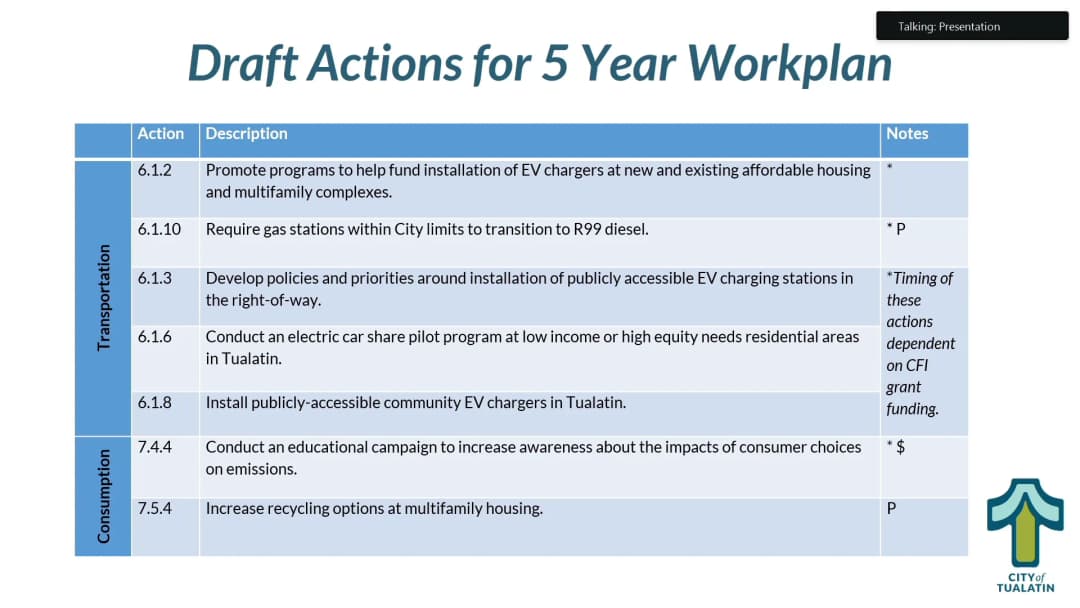
The Tualatin City Council held a work session on October 26, 2026. Staff presented the draft five-year Climate Action Plan work plan, outlined a proposed eviction prevention grant program, reviewed the upcoming council agenda, and heard council roundtable updates. No agenda or minutes were included with the transcript; the regular council meeting was scheduled to follow the work session. Climate Action Plan Five-Year Work Plan - Amanda Watson, climate action program manager, said the Climate Action Plan includes more than 100 actions to prepare for climate impacts and reach net zero carbon emissions by 2050. The draft work plan covers 2026-2031 and was developed with a cross-departmental staff group, advisory committees, and earlier council feedback. - Actions were scored in two rounds. Round 1 considered climate impact, co-benefits, alignment with council goals and adopted plans, and opportuneness. Round 2 considered feasibility, staff capacity, community support, funding, rough implementation cost, and long-term cost savings. - The draft list balances adaptation and mitigation, all major hazards (heat, flooding, wildfire smoke) and emission sources, ongoing versus new work, and short-term versus longer-term efforts, while leaving room for emerging opportunities. - Highlighted draft actions include: heat-focused communications and tree canopy efforts, Emerald Ash Borer response under the Tualatin River watershed action, wildfire preparedness and air filtration outreach, flood reduction and stormwater work tied to downtown and Nyberg Creek, building energy efficiency incentives, home energy scores, EV charging and R99 renewable diesel policies, consumer choice and multifamily recycling initiatives, and a facilities master plan that integrates climate goals. - Councilors offered suggestions: Councilor Brooks asked about measuring emissions and suggested public-friendly projections; Councilor Gonzalez asked to emphasize reduce/reuse before recycling, explore cool/white roofs, and support dry-season walkability; Councilor Sacco asked about partnerships with the IDEA Committee and the Grand Ronde Tribe and multilingual emergency preparedness resources; Council President Pratt asked for housing variety/ADU connections, confirmed extreme weather shelters are in place, and asked about CERT evacuation workshops and heat-resource maps. - Watson said the next GHG inventory update will measure community-wide progress, some individual actions can be quantified while education actions are indirect, and staff could investigate cool roofs, reuse partnerships, and community walking/carpooling events. Eviction Prevention Grant Program - Robin Doty, interim deputy city manager, introduced the item and Megan Cohen, homelessness liaison, presented the proposal. The program would use supportive housing services funds to prevent homelessness before eviction, focusing on Tualatin renters with one-time arrears caused by short-term job loss, medical emergencies, or similar situations. - The proposed partner is Family Promise of Tualatin Valley, which operates a 70-bed family shelter and already has dedicated eviction prevention staff. They would handle household income verification, light-touch case management, direct payments to landlords, and coordination with other agencies. The program would target renters, not homeowners. - Funding would be $35,000 per year beginning in FY 2026-27, using roughly $105,000 in homeless liaison intergovernmental agreement funds to cover three years: $30,000 for direct assistance and $5,000 for administration. Family Promise would report twice a year and present outcomes to the council. - Complementary programming includes Community Action utility assistance for Tualatin water bills at multifamily properties, a Community Action staff liaison at the Tualatin library one day a week and at the Tigard library one day a week, possible on-the-spot utility assistance and navigation, and advocacy during the 2027 legislative session. - Megan Cohen noted Washington County Supportive Housing Services ended the fiscal year with roughly $14 million in unspent funds; the county commission was expected to vote in mid-November on allocating those funds, with additional eviction prevention recommended and largely managed by Community Action. - Councilor Brooks asked about supports for people on disability and benefits renewals. Megan cited SSI/SSDI navigation gaps, mentioned the Assist organization, and said the library liaison could generally refer people but not provide full casework. Council President Pratt asked Megan to repeat the organization name. Another councilor said it was reassuring that eviction help would be available in Tualatin after hearing many Tualatin residents seek help in other cities. The mayor called it good news but acknowledged it was not enough, while noting it would help several families over three years. Agenda Review and Council Roundtable - Council reviewed the regular meeting agenda, including the pledge, a Native American Heritage Month proclamation with IDEA Committee members, and a consent calendar item adopting the City of Tualatin Investment Policy. Councilor Brooks raised a transparency question, but staff clarified the policy must be approved annually by state law and no changes were recommended this year, so the item remained on consent. - City Manager Lombos reported a national website award, a record-breaking city booth at the Pumpkin Regatta with at least 1,000 items given out, an initial Pumpkin Regatta attendance estimate of about 27,000, a winning pumpkin at Pints and Pumpkins weighing 1,563 pounds, winter program registration opening November 9, the lowest lead and copper sampling results since testing began, two new grant-funded electric city vehicles, and an asset management day with 40-50 participants. - Council roundtable updates included attendance at League of Oregon Cities and ICMA conferences, Councilor Sacco's re-election to the women's caucus board, an LOC exceptional service award for Sherilyn, a Willamette River Water Coalition update that 82% of Oregon is in drought and the Willamette basin snow water equivalent was at 4%, IDEA Committee and community events, and Council President Pratt noting the housing forum highlighted that only 1% of people who reach out for help actually receive it. Key Outcomes - No formal votes were taken during the work session. - Climate Action Plan staff will incorporate council feedback, finalize the draft action list, create rough fiscal-year timelines, develop performance measures, and report annually; staff said a final plan would likely return before the end of the year. - The eviction prevention grant program received broadly supportive feedback. Staff will continue developing the Family Promise partnership, utility assistance, library liaison, and related wraparound services, with more details to come.
Public Meetings - Tualatin, Oregon
Public Meetings - Tualatin, OregonThe Tualatin City Council met on October 26, 2026, for a regular meeting. The meeting opened with the Pledge of Allegiance led by veterans and included a Native American Heritage Month proclamation, public comments, a unanimous consent agenda, reports from Washington County Commissioner Jason Snyder and the Family Peace Center, a downtown revitalization project update, advisory appointments, and council communications. No agenda or minutes were available; this summary is based solely on the transcript. Consent Calendar - Council unanimously approved the consent agenda as read, including: (1) minutes of the October 12, 2026 work session and regular meeting; (2) Resolution 6003-26 adopting the City of Tualatin investment policy; and (3) Resolution 6004-26 awarding FY 2026-27 outside agency grant funds for services to the Tualatin community. Public Comments & Testimony - Dale Potts, joined by veterans Lynn Schauberg and Rocky Bixby, promoted the Veterans Recognition Breakfast scheduled for November 10 from 9:00 to 10:30 a.m. at the Poll Center. Veterans attend free, guests are $12, and about 100-125 people typically attend. They encouraged registration by calling the Poll Center and asked attendees to park away from accessible spaces for disabled veterans. - A Zoom commenter asked the council to consider installing more protective bus stop shelters with walls that block wind, similar to Washington Square Mall, and adding outdoor water stations with maps and purifiers, noting the region has more rain than sunshine. Proclamations & Special Recognitions - Councilor Sacco read a proclamation declaring November 2026 as Native American Heritage Month in Tualatin. The proclamation recognized the Atfalati/Kalapuya (Tualatin) people, Oregon's nine federally recognized tribal nations, and the city's commitment to tribal engagement and equity. - Councilor Sacco also noted the 43rd anniversary of the Grand Ronde Restoration Act on November 22, commemorating the 1983 restoration of federal recognition, and mentioned 1988 legislation restoring over 9,000 acres to the Grand Ronde. - Mayor Bubenick read a mayoral proclamation marking the 100th anniversary of the removal of the Black Exclusion Clause from the Oregon Constitution on November 2, 1926, noting the 62.52% vote in favor of repeal and the case of Jacob Vanderpool. Special Report: Washington County Commissioner Jason Snyder - Commissioner Snyder provided updates: he is now the primary commissioner on the Metro Supportive Housing Services Regional Policy and Oversight Committee; the county passed a vehicle registration fee with a slower ramp-up; budget priority discussions are beginning; and jail and community corrections facility planning and courthouse replacement work are underway. He stated the two facilities should be on the same campus or directly connected for operational efficiency. - Councilor Brooks raised concerns about potential loss of housing for about 4,000 people if state funding and disability benefit requirements change, urging prevention funding. Commissioner Snyder acknowledged federal and state funding challenges. - Councilor Reyes asked about filling the vacant commission chair seat; Snyder explained the chair election in November and that a short vacancy would not be filled. - Council President Pratt asked about creative county revenue solutions and the county budget deficit, noting a prior $20.5 million deficit. Snyder said the final forecast is coming soon and assessed values are lower than average in some areas. Pratt also asked about the county's nearly $6 million purchase of the Cameron Jewett property near North Plains; Snyder defended it as a good purchase for maintaining the transportation system. - Council members expressed concerns about WCCLS library oversight, including the executive committee being city managers rather than elected officials and uncertainty about centralized collections. Snyder said there has been willingness to discuss more elected engagement after the November election, and he personally supports elected representation. City Manager Lombos said he had no opinion on the structure but acknowledged elected-to-elected communication is important. Special Report: Family Peace Center Annual Report - Board President Judy Willie and Executive Director Rachel Schultz presented the annual report. Willie noted the center opened a new 60,000-square-foot, three-level building that is already full, with 22 agencies under one roof. She thanked Tualatin for 10 years of support and announced she will step off the board in January. - Schultz reported that the Family Peace Center opened January 20, 2026, and is seeing a 34% increase in physical access over the former Family Justice Center, with 28-32 people walking in daily. On a first visit, survivors meet an average of 7-10 organizations, with a record of 17. Services accessed increased 16%. Through August, the center served 3,479 survivors and provided 6,754 services, with 99% positive survivor outcome indicators. - Tualatin-specific numbers: 73 Tualatin survivors were served in 2026 versus 54 in 2025, about a 35% increase, while services accessed were 166 in 2026 versus 175 in 2025, about a 5% decrease. Overall, 76% of survivors come from urban Washington County cities. - Schultz described the service menu and navigator model, transportation partnerships including Ride Connection, Ride to Care, and a free Uber grant, and police departments' willingness to transport survivors. Walk-in hours are Monday through Friday, 8:30 to 4, and the phone line operates 24 hours. - Councilor Brooks praised the model and asked about duplicating it for housing insecurity; Schultz agreed the model is transferable. Councilor Gonzalo asked how people can help; Schultz mentioned donations, clothing and food contributions, fabric recycling bins, Denim and Diamonds, and the upcoming Run for Hope 5K. Discussion Items - Downtown Revitalization Project Update: Quinn Brunner introduced Ken Peary and Mike Zylas of Walker Macy, the consultant team leading phase three. They described the project team, community engagement at the Regatta reaching 350 people, and five CAC evaluation criteria. The study area includes a roughly 300-acre overall area and a 60-acre core downtown area. They noted only about 17% of downtown building frontages are currently active and identified wayfinding, connections to the lake and riverfront, and adaptive reuse as key challenges. The schedule includes an existing conditions presentation in December, draft urban design frameworks in March and June, draft standards in September, final standards in late October, and adoption in early 2028. - Councilor Brooks asked about the Regatta feedback dots and about entryways, river integration, and sustainable modernization; Ken Peary said the dots were fairly even, with the magnetic and fun identity value receiving fewer dots possibly due to wording, and that wayfinding and building adaptation would be priorities. Councilor Reyes expressed excitement about making the lake area visible and attracting foot traffic and businesses. - Council Committee on Advisory Appointments: Councilor Reyes reported the committee met October 6 and recommended five nominees. The council unanimously appointed Ralph Galantine to the Core Area Parking District Board; Ashley Payne and Emmy Lowanzon to the Library Advisory Committee; and Tay Washington and Lexi Washington to the IDEA Committee. Key Outcomes - Consent agenda approved unanimously. - Five advisory board and committee appointments approved unanimously. - Proclamations issued for Native American Heritage Month and the Black Exclusion Clause anniversary. - Downtown revitalization project update received; next council touchpoint scheduled for December with existing conditions findings. - No items were removed from the consent agenda for separate hearing. Council Communications - Council President Pratt reminded the public of a micro-mobility listening session on e-bikes and e-scooters at 6:00 p.m. tomorrow at Hazelbrook Middle School, with Spanish translation available. - Councilor Brooks invited the community to the third annual Trades and Manufacturing Forum on Thursday and the League of Minority Voters' State of Civil Rights and candidate forum that evening.
The October 12, 2026 work session covered two main agenda items: an update on the Tualatin-Sherwood Road rail crossing study and a discussion on allocating city funds to outside agencies for fiscal year 2026-2027. The meeting concluded with council and city manager round table reports. Discussion Items Tualatin-Sherwood Road Rail Crossing Study Update - Presenters from Kittleson & Associates (Mark Bitork, Amy Griffiths) and city staff (Mike McCarthy, Abby) presented the final alternatives from a six-month study. Three primary build alternatives were considered: roadway over (south alignment), roadway under (south alignment), and at-grade widening. A no-build option was also discussed. - Public feedback from a virtual open house (September 14-27, 108 responses) showed 29% preferred no-build, citing cost. The project advisory committee ranked road-under highest; the planning commission ranked at-grade improvements highest. Both groups requested additional details on pedestrian/bicycle facilities, safety benefits, and travel times. - Council members raised concerns about federal funding (RCE and BUILD grants), local match requirements, visual impacts, business disruption, and safety improvements. Staff noted grade separation eliminates two signals and the rail crossing, significantly improving safety and travel reliability, while at-grade widening only provides about half the needed 20-year capacity. - Cost estimates: roadway over $135-250 million; roadway under higher (pumping and utility relocation); at-grade widening $25-60 million; minor at-grade $6-12 million. Federal grants could cover up to 90-95% of grade separation costs, but competition is high. - Council requested additional information: breakdown of survey respondents (business vs. resident), travel time and accident data by time of day, visual renderings of grade separation options, and clarity on the 4,000-5,000 annual hours of delay caused by freight trains. Allocation of Funds to Outside Agencies for Fiscal Year 2026-2027 - Council reviewed proposed allocations to 22 agencies. Councilor Hilliard recused himself due to a conflict of interest (his agency applied for funding). - Councilor Reyes proposed starting allocations totaling $50,000, with zeros for agencies not aligned with city goals (e.g., Abuse Recovery Ministry, Cascade Amateur Sports). Councilor Brooks suggested adjustments: redirect $500 from Byron Elementary to the food pantry, and split $1,000 from Family Peace Center equally between Domestic Violence Resource Center and Sexual Assault Resource Center to give them more direct control. - After brief discussion, council reached consensus on the revised allocation. Specific amounts included: Byron Elementary $1,500, Domestic Violence Resource Center $4,000, Family Peace Center $4,500, Food Pantry $5,500, etc. The process was noted as efficient after eight years of practice. Key Outcomes - Rail Crossing Study: No final decision was made. Council directed staff to provide additional analysis on funding options, survey demographics, travel time data, and visual concepts. Next steps include coordinating with downtown redevelopment and riverfront park consultants. - Funding Allocation: Council reached consensus on the distribution of $50,000 in outside agency funding for FY 2026-2027, pending formal approval at a future regular meeting. Round Table Reports - City Manager reported on all-employee meetings, Washington County managers gathering, upcoming events (pumpkin regatta, housing forum, playground construction at Community Park, Riverfront Park community engagement), and a $300,000 grant for Fality Park restroom replacement. - Council members reported on committee meetings (CCA, R1 Act, downtown advisory), conferences (LOC, Future 50 Vision Summit), and community events (Mitch Fox trot, Good Neighbor Center tour, industrial readiness forum).
The Tualatin City Council met on October 12, 2026, in a regular meeting that included a youth substance-use prevention presentation, the introduction of the new library director, public comment on non-agenda items, approval of a routine consent calendar, and a decision on the Lamb Research land-use appeal. No written agenda or minutes were available for this summary; it is based solely on the raw transcript. Pledge of Allegiance and LEAP Youth Alliance Presentation - Council President Pratt led the Pledge of Allegiance. - Representatives from Tualatin High School’s LEAP Youth Alliance, including seniors Cozy Slider and Kaylin Castro, presented the group’s 2026–2027 goals: grow membership, strengthen awareness of LEAP, and raise community awareness about youth choices around alcohol and other substances. - LEAP described Red Ribbon Week activities at the high school on October 19–21, 2026, including tabling, red ribbon distribution, interactive lunchtime activities, and a prevention parade at Tualatin’s football game on October 30 in partnership with Tigard High School. - LEAP highlighted its Positive Community Norms campaign, which focuses on correcting misconceptions and promoting the healthy choices young people are already making. The group trained with the Montana Institute and plans to test and launch a community-wide campaign. - LEAP is fundraising through donations and a greenery fundraiser to attend CADCA’s National Leadership Forum near Washington, D.C., in February. - With 30 active members, LEAP plans to participate in community events including the Pumpkin Regatta, Winona Grange Harvest Festival, and Tualatin Elementary’s Trunk Retreat. - Mayor Bubenick read a proclamation designating October 23–31, 2026, as Red Ribbon Week in Tualatin and encouraging participation in drug-prevention education activities. New Employee Introduction - City Manager Sherilyn Lombos introduced Magdi Anami Careo Sotomayor as Tualatin’s new library director; her first day was October 12, 2026. - Sotomayor previously served as Shute Park Library manager in Hillsboro and previously worked for WCCLS, as well as in Florida, New York, and Puerto Rico. She said she has dedicated 24 years to libraries and believes libraries can save people’s lives. - Mayor Bubenick welcomed her and noted the library’s importance to the community, especially with upcoming changes related to the library levy and collections. Public Comments & Testimony - Jared Ray, a local McDonald’s owner with his wife Randy and 15 area restaurants, said all 150 Oregon McDonald’s restaurants are family-owned. He asked the council to keep small family businesses in mind as it considers a major road project and said he learned about the project from a Dutch Bros. owner rather than from direct city outreach. - Randy Ray said the local Tualatin McDonald’s employs more than 60 people and described the company’s community support, including more than $1 million in grants to Oregon schools, a work-exchange program with Victory Academy, food donation programs, and Ronald McDonald House fundraising. She asked the council to conduct a business impact study so family businesses can remain community pillars. - Bert Hamilton urged the council to prioritize the residents of Tualatin over out-of-state corporations and their shareholders. - Victoria, who said she advocates for community building in Tualatin, spoke against the city-ordered closure of her community share shed and little free pantry. She read a comment written on the closure sign: “This is so sad. I would feed my sisters from here.” She described the space as a meaningful, safe place for teens and neighbors and asked why the city does not protect community builders and instead threatens them. - Chloe Eve asked why no permanent plan exists for Tualatin-Sherwood Road and the railroad crossing, called the temporary approach a waste of money, and requested transparency about businesses having to move. She also commented that the words “under God” were added to the Pledge of Allegiance during the Eisenhower era and that children of atheists could be forced to recite a religious statement. - No additional in-person or Zoom public comments were offered. Consent Calendar - The council unanimously adopted the consent agenda by one motion with no items removed. It included: - Approval of the September 28, 2026 work session and regular meeting minutes. - Resolutions 5999-26, 6000-26, and 6001-26 accepting Oregon Department of Transportation grant funds for traffic safety enforcement. - Resolution 6002-26 awarding a contract to Consort North America Inc. for engineering and construction management services for the Seismic Valve Improvement Project. Discussion Items: Lamb Research Appeal (AR 26-0002) - The council resumed consideration of two appeals of a Type II architectural review staff decision for AR 26-0002, approved June 17, 2026, with conditions. The project is an approximately 3,900-square-foot addition to Building B at 11259 SW Leventon Drive, submitted by McKenzie on behalf of Lamb Research Corporation. - The public hearing was held September 14, 2026. The record was reopened for additional written submissions and then closed; the additional material was filed as Exhibits I and J, and no further participant evidence was allowed. - Council members disclosed ex parte contacts and declared they could be unbiased. Councilor Hillier confirmed she had participated in the September 14 hearing. - The central question was whether TDC 63 environmental regulations are mandatory approval standards at the time of architectural review or performance standards that apply once the project is operating. Council and staff noted earlier council findings treated them as performance standards, so topics such as operational noise, chemical storage, and hazardous materials are outside architectural review criteria for this application. - Councilor Sacco moved to deny the appeal and affirm the June 17, 2026 staff decision, directing staff to bring a proposed resolution with findings to the November 9, 2026 council meeting. Councilor Sacco also noted that upholding the appeal would require specific findings and could lead to an appeal to LUBA. - After a roll-call vote, the council unanimously denied the appeals. Post-Decision Discussion - Councilor Brooks said her vote was not about this application but raised broader concerns about code enforcement consistency, noise complaints, and livability. She asked how noise violations are investigated and how code enforcement priorities are set. - Mayor Bubenick said noise complaints are investigated by code enforcement officers and can proceed through the civil infraction process in municipal court if there is evidence. City staff also explained that code enforcement is currently complaint-based rather than proactive because of staff resources. - Councilors Brooks, Hillier, and Reyes expressed interest in a future work session with Tualatin Valley Fire & Rescue, TTSD, and other partners on hazardous materials, emergency preparedness, chemical releases, and community notification. No formal vote was taken on that work session. Key Outcomes - The council unanimously denied the appeals and affirmed the June 17, 2026 staff decision approving AR 26-0002 with conditions. - Staff was directed to prepare a resolution with findings for the November 9, 2026 council meeting. The staff memoranda identified as attachments B and B1 control where they differ from findings proposed by Lamb Research. - The consent agenda was adopted unanimously. - Red Ribbon Week was proclaimed for October 23–31, 2026. - The council discussed, but did not formally vote on, a future informational work session with TVF&R about hazardous materials and emergency response. Councilor Brooks also requested more information about code enforcement objectivity and resources. Council Communications and Adjournment - Councilor Sacco announced a Tualatin Housing Forum on Wednesday at 6 p.m., describing it as a state requirement and an opportunity for residents to share housing stories. - Mayor Bubenick encouraged attendance at the Pumpkin Regatta and community events during the fall season. - A motion to adjourn was made, seconded, and passed unanimously.
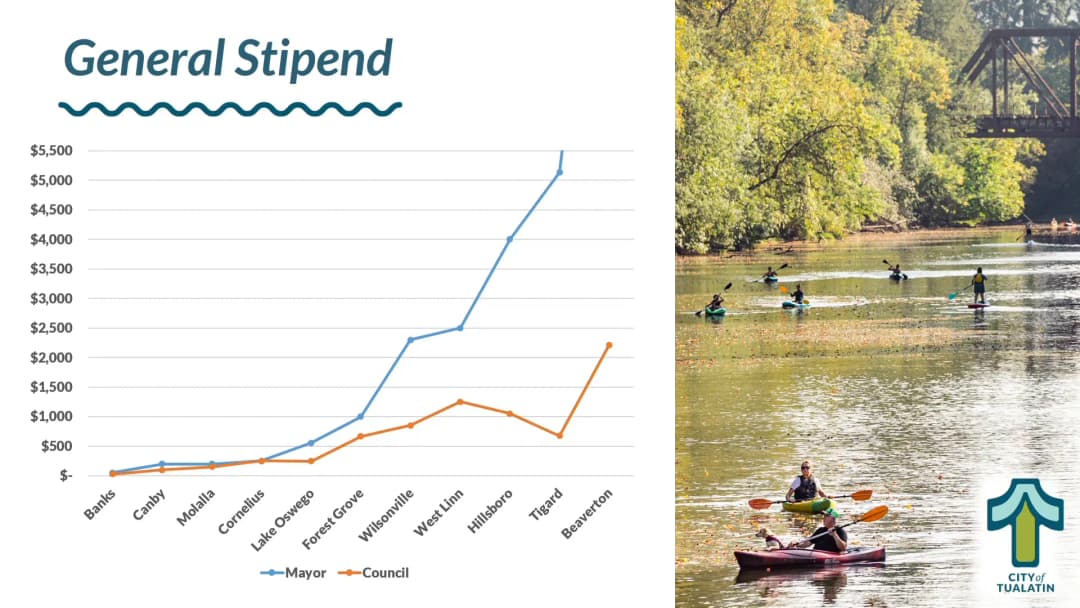
The Tualatin City Council held a work session on the evening of September 28, 2026, before the regular council meeting. Staff and consultants presented a transportation project prioritization framework, an update on the Washington County Cooperative Library System (WCCLS) memorandum of understanding, and a review of council compensation. No formal ordinances were adopted during the work session, but council gave informal direction on compensation items for staff to bring back later. Discussion Items Transportation Project Prioritization Overview - City Engineer Mike McCarthy, joined by consultants Ashavila and Brianna Calhoun from Fair and Pears, presented a technical evaluation process to prioritize transportation projects from the Transportation System Plan (TSP) for the city's five-year Capital Improvement Program (CIP). - The process is designed to be objective and repeatable. About 100 projects were divided into three roughly equal tiers rather than a strict ranked list, allowing projects to be matched to available funding opportunities without implying a fixed order of construction. - Evaluation categories included: - Network completion: active transportation and non-auto connections, sidewalk gaps, bike lane enhancements, ADA ramp retrofits, connections to schools and key destinations such as affordable housing, parks, the library, and grocery stores, new street connections, and reducing pedestrian barriers such as the Tualatin River, Tualatin-Sherwood Road, and I-5. - Congestion and emissions reductions: vehicle bottleneck relief, efficiency measures such as adaptive signal systems, and alignment with the city's Climate Action Plan. - Safety: five-year ODOT crash data, crash modification factors, speeding history, pedestrian and bicycle level of traffic stress, and crossing improvements. - Critical infrastructure: new or enhanced transportation infrastructure serving developing areas, primarily Basalt Creek and Cora. - Councilor Brooks asked whether building materials and shade structures were factored into environmental impacts; staff said they were not currently factored. She also asked about the lack of measured speed data; staff explained citywide speed data is not available, but speed measurements are collected after resident complaints, and projects typically need observed speeds more than five miles per hour over the limit for a significant share of traffic to earn points. - Staff discussed ODOT funding opportunities, including the ARTS (All Roads Transportation Safety) program and technical assistance grants. When asked how staff would choose among similarly funded Tier One projects, staff said they would consider readiness, project scores, and council input through the CIP process. - Next steps: finalize the prioritization work product and use named projects in the CIP development around December or January. WCCLS Memorandum of Understanding Update - The library director, Sarah, presented the MOU between the city and the Washington County Cooperative Library System for a centralized collection project. The MOU is a working agreement rather than the formal, enforceable IGA, and it describes how WCCLS and partner libraries will collaborate. - The initial MOU draft went to the executive board in May, the library leadership group in June, with two additional meetings in July, and the current draft went to the executive board earlier this month. - The MOU language emphasizes preserving each library's community identity, including local purchasing supplements, staff expertise, and qualitative measures of success in addition to quantitative metrics such as hold times. - WCCLS has issued an RFP for materials vendors; nine vendors applied, and a scoring panel will meet next month. Tualatin's Ingram discount, about 40%, was highlighted as an important local interest. Centralized purchasing is expected to begin with English and Spanish materials, with Chinese added later. - Tualatin is grouped with Sherwood, Forest Grove, and Cornelius for project steering committee representation; Tualatin's representative is Adrian Domain Calkins from Sherwood. - Council members asked about hold metrics, vendor selection, local collection supplements, collection profiles, foot traffic versus online use, and community advocacy. Sarah noted foot traffic is nearing pre-pandemic levels, while programming and social connection remain central to the library's role. - Several council members raised concerns about MOU language, including the use of 'will' versus 'must' or 'shall,' WCCLS's final decision authority over local collections, the unmet August deadline for scope and format definitions, and the one-sided nature of good-faith communication language. It was noted that the IGA remains the enforceable agreement and provides a process for enforcing county obligations. - No formal council action was taken on the MOU; the working agreement process continues. Council Compensation Discussion - Assistant City Manager and Finance Director Don Hudson presented current council compensation: - $750 technology stipend at the start of a term, grossed up for taxes, adopted in 2013. - Health and dental insurance with a 90/10 cost share: the mayor is eligible for coverage up to family, currently about $2,800 per month, and council members are eligible for single coverage, just under $1,000 per month. Council members who opt out receive a $100 per month stipend. - $20 monthly utility bill credit that was in place before 1986; a 1996 resolution designated it as per diem and stated council positions are non-lucrative. - The FY 2026-27 council compensation budget is about $67,000, with potential exposure of about $114,000 if all council members took insurance. - A survey of 18 neighboring cities in Washington and Clackamas Counties found that eight offer technology-related benefits, only three offer health benefits, and eleven offer monetary stipends. Beaverton's mayor is full-time and receives about $11,000 per month; most surveyed cities pay $500 or less per month to mayors and $250 or less to council members. - Council discussion included: - Councilor Brooks: preferred cost-of-living and inflation adjustments over renegotiating individual benefits, and cautioned against mixing compensation with a broader equity study. - Councilor Sacco: expressed concern that modest compensation increases would not meaningfully expand who can afford to serve and could simply pay people who would already run. - Councilor Reyes: described council service as a sacrifice and supported updating the technology stipend and utility bill credit, noting the $750 technology stipend is outdated. - Councilor Gonzalez: emphasized equity and barriers such as child care and work flexibility, and urged an honest look at what would help more diverse candidates serve. - Council President Pratt: suggested the IDEA advisory committee study barriers to running for office; Councilor Reyes preferred the budget committee or staff with HR/budget expertise for compensation questions. - By informal show of hands, council directed staff to bring back options to adjust the technology stipend and the $20 utility bill stipend for inflation. Health insurance changes and broader compensation redesign were not advanced at this meeting. Key Outcomes - Transportation prioritization: no formal decisions; staff will finalize the scoring framework and use it in the upcoming CIP process. - WCCLS MOU: no formal action; council received the update and raised legal language and transparency concerns for continued work. - Council compensation: council gave informal direction to staff to return with inflation-adjusted options for the technology stipend and utility bill per diem; health insurance and any broader compensation changes were deferred.
The Tualatin City Council met on September 28, 2026, for a regular meeting that included proclamations, public comment, special reports, and action on several ordinances and resolutions. Key topics included a water transmission line emergency debrief, adoption of food cart pod regulations, and adjustments to building fees. Consent Calendar - Approved minutes of the September 14, 2026 work session and regular meeting. - Approved a new liquor license application for Game Show Battle Rooms. - Adopted Resolution No. 5998‑26 authorizing a reinstatement agreement with the Oregon Department of Energy for grant funds to purchase electric vehicles. Public Comments & Testimony - Victoria (Tualatin Community Gather) expressed concern that city policies and complaint systems are being used to dismantle community efforts. She urged the council to ensure policies support residents and community connections, rather than allowing a complaints‑based system to disproportionately influence public spaces. Special Report: Water Transmission Line Leak Debrief - Rachel Sykes (Public Works Director) and Terrence Leahy (Water Division Manager) presented an after‑action report on a major leak discovered August 24, 2026, at 6:30 a.m. on 72nd Avenue. - The leak involved a 12‑inch transmission line at 150‑175 PSI; a manhole cover was blown off due to pressure. Repair took approximately 48 hours and required draining over 300,000 gallons of water. The leak occurred at 11 feet depth, complicating repairs. - Key takeaways: - Regional partnerships were critical; neighboring agencies (Tualatin Valley Water District, Sherwood, Tigard, Hillsboro, River Grove) provided equipment, expertise, and 3 million gallons of water via interties. - Communications need improvement; the city lacked a mass notification tool and could not email water customers. Staff will work on a better toolkit. - Backup water supply vulnerability: Tualatin relies on a single transmission line from Portland. The 2023 Water Master Plan identified the need for a seismically resilient backup supply. Council discussed the urgency of pursuing this project. - Councilors thanked staff for transparency and highlighted the importance of backup water supply, noting that the city was at risk of a severe water emergency. Discussion Items Building Division Fee Schedule (Ordinance 1459‑26) - Staff explained that the fee increase is needed to meet state and city reserve policy requirements; current fees are low compared to neighboring cities. - Councilor Gonzalez opposed, arguing the city should look inward to cut costs rather than increase fees during a tough economic time. Councilor Reyes also voted no. - Councilors Sacco, Brooks, and Pratt supported, noting the fees are necessary for fiscal responsibility and that the city has waited too long to adjust. - Vote: 3‑2 (Sacco, Brooks, Pratt aye; Gonzalez, Reyes no). Ordinance adopted. Cable Franchise Agreement (Ordinance 1460‑26) - Nick Westendorf (Deputy Public Works Director) presented a 10‑year non‑exclusive cable franchise renewal with Comcast. The agreement retains a 5% revenue fee, expands HD channels for public programming, and includes modest enforcement tools. - Approved unanimously (first, second readings and adoption). Sub‑Regional Transit Study (Resolution 5997‑26) - Mike McCarthy (City Engineer) presented an intergovernmental agreement with Lake Oswego, Sherwood, and West Linn to share costs ($160,000 total, $40,000 each) for a transit service study. Consultant Nelson Nygaard will conduct a nine‑month study exploring better transit options for these communities, with TriMet cooperation. - Councilor Brooks noted the importance of transit for the city’s job center. - Approved unanimously. Food Cart Pod Regulations (Ordinance 1461‑26) - Aaron Angman (Senior Planner) and Planning Commission Chair Thompson presented the proposed code amendments to allow food cart pods as eating/drinking establishments in commercial zones (downtown, Bridgeport, etc.). Requirements include plumbed restrooms, covered seating (permanent structure), connection to city utilities, and grease interceptors. Larger pods (20+ carts) require conditional use permit. - Public testimony: Robert Kellogg supported the ordinance but argued a “missing middle” tier (2‑4 carts with fewer amenities) is needed to make small pods feasible. He noted the high cost of permanent restrooms ($100k+) and covered structures ($750k) would likely stifle development; smaller pods could test demand. - Council deliberated: Councilor Gonzalez and Councilor Brooks favored the destination‑pod approach but wanted more study on smaller pods. Councilor Sacco raised concerns about sanitation and enforcement. Mayor Pratt noted that if a small pod fails, it proves market demand; the big pod may never happen without proof of concept. - Council voted unanimously to adopt the ordinance as presented (first, second readings and adoption). Additionally, they directed staff to bring back a work session to explore a smaller‑tier (“missing middle”) food cart pod option. Push Cart Regulations (Ordinance 1462‑26) - Code cleanup, moving individual food cart regulations from municipal code to development code. Unanimously approved. Key Outcomes - Ordinance 1459‑26 (Building Division Fee Schedule) adopted 3‑2. - Ordinance 1460‑26 (Cable Franchise) adopted unanimously. - Resolution 5997‑26 (Transit Study IGA) adopted unanimously. - Ordinance 1461‑26 (Food Cart Pod Regulations) adopted unanimously; council directed staff to return with a work session on a smaller‑tier pod option. - Ordinance 1462‑26 (Push Cart Regulations) adopted unanimously. - Future work sessions: smaller food cart pod tier to be discussed.
The Tualatin City Council met on September 14, 2026, to address routine items, hear public comment, conduct a public hearing on two appeals of an architectural review decision for a LAM Research building addition, and consider ordinances on community involvement organization boundaries and building inspection fee adjustments. The council adopted consent agenda items, passed two ordinances, appointed a Parks Advisory Committee member, and left the record open for the LAM Research appeal until a continued hearing on October 12, 2026. Consent Calendar - Unanimously adopted three items: approval of the August 24, 2026 work session/regular meeting minutes; Resolution 5994-26 awarding a contract with Walker Macy for the Downtown Tualatin Urban Design Framework and Design Standards Project; and Resolution 5995-26 awarding the contract for the design of Riverfront Park. Public Comments & Testimony - Terence Dyson Curran (resident) commented on communication during recent water main breaks and railroad crossing closures, suggesting the city use rolling billboards to alert residents not on social media. The mayor acknowledged the feedback. - A community member (name not clearly stated) raised concerns about the city's complaints-based code enforcement system, arguing it allows repeated, retaliatory complaints to direct disproportionate government attention, leading to inequitable enforcement. The speaker cited a Portland Ombudsman report and noted that subjective language (e.g., “rubbish”) and lack of mediation create unfair outcomes. Discussion Items - Proclamations and Employee Introductions – The council recognized Hispanic Heritage Month (Sept. 15–Oct. 15, 2026) and Constitution Week (Sept. 17–23, 2026). New employees were introduced: Recreation Supervisor Erica Baylor, Deputy Parks and Recreation Director Kira Haggart, and Police Services Tech Kayla Goodwin. - Public Hearing – LAM Research Building B Addition (AR26-0002) – The council considered two appeals (by Brett Hamilton and Deborah Anderson) of a staff decision approving a 3,900-square-foot addition to an existing research laboratory. The appellants raised issues of noise, hazardous chemical storage, fugitive dust, light trespass, and reduced property values. Staff and LAM representatives argued that the architectural review criteria are limited to development standards (e.g., landscaping, building design) and that operational concerns (noise, chemical handling) are governed by other codes and enforced post-construction. The appellants presented a noise expert who criticized LAM’s predictive model for not accounting for worst-case weather conditions. LAM noted that noise is a performance standard, not an architectural review criterion. The council heard testimony from supporters and opponents, including a resident concerned about potential chemical incidents. After testimony, the council granted a request to leave the record open for seven calendar days (until Sept. 21, 2026) and continued the hearing to October 12, 2026, for final deliberation. - Ordinance 1458-26 – Community Involvement Organization (CIO) Boundary Update – The council reviewed and adopted an ordinance updating the CIO boundary map for the first time since 2011, extending the Byrom CIO, creating a new downtown CIO, and making other adjustments. Code cleanup changes included renaming “Citizen Involvement Organization” to “Community Involvement Organization,” removing the citizen involvement coordinating committee (never formed), and reducing minimum general meetings from two to one per year. The ordinance passed unanimously after first and second readings. - Ordinance 1459-26 – Building Inspection Fee Adjustment – The council adopted a 15% fee increase with a 5% annual escalator to cover rising costs, as recommended by staff. The ordinance passed 5-2 after first and second readings (Councilors Reyes and Gonzalez voted no on adoption). - Advisory Appointment – The council appointed Johanna Horner to the Parks Advisory Committee for a term expiring February 28, 2029, based on the council committee’s recommendation. Key Outcomes - Consent agenda adopted unanimously. - Public hearing for LAM Research appeal left open; record open until September 21, 2026; hearing continued to October 12, 2026. - Ordinance 1458-26 (CIO boundary map update) adopted unanimously. - Ordinance 1459-26 (building inspection fee adjustment) adopted 5-2. - Johanna Horner appointed to Parks Advisory Committee unanimously. - Council communications noted no further items; meeting adjourned.
The Tualatin City Council held a work session on September 14, 2026, beginning at approximately 6:15 PM. The session featured two major presentations: a deep dive into the Contextualized Housing Needs Analysis (CHN) and a joint update on the Riverfront Park and Downtown Revitalization projects. No formal votes were taken, but councilors asked clarifying questions and provided direction for upcoming engagement. The meeting concluded with a city manager’s report and council roundtable. Discussion Items Contextualized Housing Needs Analysis (CHN) Update - Senior Planner Aaron Ingman and consultant Matt Craigie (Echo Northwest) presented quantitative data on housing supply and demand in Tualatin. Key statistics included: - Area Median Income (AMI) for the Portland region: $130,000/year. - Median rent in Tualatin: $1,800/month; median home sale price: $640,000. - 35% of all Tualatin households are cost‑burdened (spend 30% of income on housing), with 51% of renters cost‑burdened and 27% of renters severely so (50% of income). - Household income has risen since 2010, but housing costs have risen faster; Tualatin’s home‑value‑to‑income ratio reached about 6 in 2024 (a “healthy” ratio is 3–4). - Demographics: 23% of the community identifies as Hispanic/Latino (up from 16% in 2010); about 80% of Hispanic households are renters versus 34% for white non‑Hispanic households. - 10% of the population has one or more disabilities; cost burden is higher for these households (12% higher than the general population). - The aging population (60+) grew from 11% to 21% of the community; seniors on fixed incomes face particular challenges, including a lack of accessible, single‑level housing options. - Councilor Brooks asked about cross‑tabulation of race/ethnicity, disability, and age. She also suggested engaging St. Anthony’s faith‑based organization for outreach to the Spanish‑speaking community. - Councilor Gonzalez noted the desire for 55+ developments, similar to what exists in Tigard. - Councilor Hillier questioned whether disability data captured all types of disabilities (not just aging‑related) and how senior‑living facilities affect the statistics. Staff confirmed the data covers all disabilities. - Council President Pratt observed that the data align with their understanding of housing challenges; she asked whether $1,800 rent leaves room for savings. Craigie replied that quantitative data show renters are more cost‑burdened, and focus groups help capture lived experiences. - Mayor Abnik noted that the median rent of $1,800 is still expensive for many residents, who often have multiple roommates. - Next steps: The CHN analysis will be followed by a Buildable Lands Inventory (BLI) presented to the Planning Commission in mid‑October and to the City Council in early November 2026. The Housing Production Strategy (HPS) will follow in 2027, focusing on policy actions. Riverfront Park & Downtown Revitalization Project Coordination - Kira Hein (Parks and Recreation) and Quinn Bruner (Downtown Revitalization) provided a joint update on these linked projects. - The Riverfront Park, funded by the 2022 $25 million parks and trails bond, is moving into the design phase. The consent agenda for the regular council meeting included approval of Burger Partnership (Seattle) as the landscape architect firm. Their portfolio includes Spokane Riverfront Park and Olympia Waterfront. - The Downtown Revitalization Project (Phase 3) will create an urban design framework and updated design standards. Walker Macy (Portland) has been selected as the lead design firm. Their resume includes Downtown Bend, Pioneer Courthouse Square, and the original Tualatin Commons. - The two consultant teams will hold a joint workshop to align on engagement, materials, and connection points such as Boons Ferry Road frontage and the Tualatin River Greenway Trail. Community outreach will be unified, including a shared booth at the Pumpkin Regatta and a “Two Projects, One Vision” tailgate at the Tualatin vs. Tigard high school football game on October 30. - The Tualatin‑Sherwood Railroad Crossing Study will also be coordinated with these projects. - Councilors expressed strong support for the collaborative approach and emphasized the importance of inclusive community engagement. Councilor Brooks requested easily shareable social‑media content to help promote involvement. City Manager’s Report (Sherilyn) - Emergency preparedness fair on Saturday, September 12 drew about 200 attendees. - Tualatin Cup model sailboat regatta on Saturday, September 19 from 1–4 PM at the Commons. - ODOT is working with the railroad to correct the Boons Ferry Road crossing; no full closure expected. - The National Community Survey closed with 303 responses; results will be presented October 26. - Ribbon cutting for the micro‑turbine in‑pipe project on October 12 at 4:30 PM, with Congresswoman Andrea Salinas attending. - Pumpkin Regatta set for October 18, preceded by “Pumpkins and Pints” on October 17. - The Tualatin‑Sherwood Road Rail Study virtual open house is open through September 27. - Metro is renewing a 9‑cent levy and hosting a vision summit on October 8. Council Roundtable Highlights - Councilors reported on various committee meetings and events: - CAC meeting: focused on the railroad crossing study; encouragement for public to attend the virtual open house. - MAC meeting: approved an IGA for a Comcast cable TV franchise agreement; will come before council. - Architecture Review Board: approved a 452,795 sq ft industrial building near the former golf course, noted for thoughtful design and topography consideration. - LOC Women’s Caucus: openings for leadership applications; legislative priority discussions. - Tualatin Historical Society fundraiser: successful paddle raise meeting grant match. - Mayor Abnik provided updates from the Aging Task Force focus group: seniors express strong desire for single‑floor, accessible housing to remain in Tualatin, but such units are lacking. - Mayor also reported on Washington County transportation and jail expansion meetings: a new jail could be 7 years away (if approved); the enhanced sheriff patrol levy for unincorporated areas may go to the May 2027 ballot. Key Outcomes - No formal decisions or votes were taken during the work session. - Staff will incorporate council feedback into ongoing housing analysis and project engagement. - The consent agenda for the regular meeting (including approval of Burger Partnership for Riverfront Park design) was not acted upon in the work session but is expected to be approved later that evening. - Upcoming milestones: BLI presentation to Planning Commission (mid‑October), BLI to Council (early November), and Housing Production Strategy (2027).
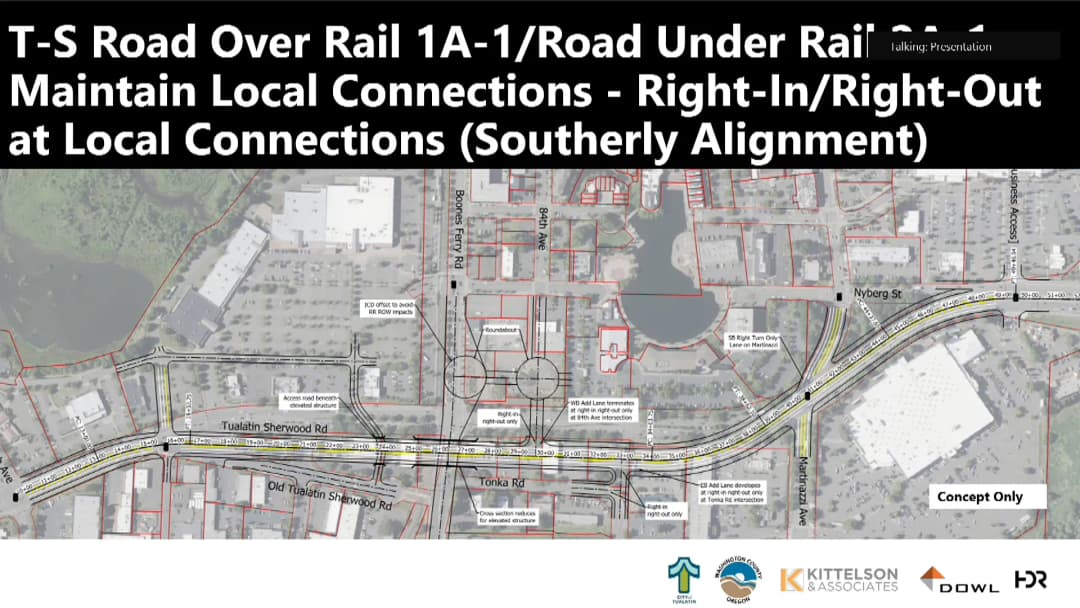
The City Council met on August 24, 2026, starting at 7:00 PM, for a work session focused on the 12th and Sherwood Rail Crossing Study, an update on the Neighborhood Transportation Safety Program (NTSP), and two proclamation requests. The meeting also included council communications and a brief water emergency update. Discussion Items 12th and Sherwood Rail Crossing Study - City Engineer Mike McCarthy, Engineering Associate Abby McFechard, and project manager Mark Bitoric (Kittleson & Associates) presented the results of the study, which evaluated 17 alternatives to address safety, congestion, and multimodal connectivity at the Boone's Ferry and Tualatin-Sherwood Road intersection, a regional bottleneck. - The study identified six goals: improve safety, livability, multimodal connectivity, travel time reliability, community development, and feasibility. Key safety issues include three intersections (89th & Tualatin-Sherwood, Boone's Ferry & Tualatin-Sherwood, Boone's Ferry & Warm Springs) on the county's top 10% crash list (SPIS list). Perceived safety concerns also deter pedestrians and bicyclists. - After screening, three promising alternatives were detailed, each with sub-scenarios: - Alternative 1A1 (Road over rail): Construct an overpass for Tualatin-Sherwood over the rail line and Boone's Ferry, with right-in/right-out connections and two roundabouts. Estimated cost: $135–250 million (south alignment) or $100–200 million (existing alignment, but construction would require 18 months of single-lane traffic, deemed infeasible). Displaces 6–7 businesses (Taco Bell, McDonald's, bank, auto parts, etc.). Would eliminate two signals and the at-grade rail crossing, improving travel time reliability. - Alternative 2A1 (Road under rail): Similar to overpass but with road under the rail, requiring a temporary rail closure of 3–4 days. Higher cost ($170–320 million) and flooding concerns. - Alternative 5A (At-grade widening): Widen Tualatin-Sherwood from Fred Meyer to 90th Avenue to six lanes (three each direction), with safety improvements at the rail crossing (four-quadrant gates). Cost: $20–45 million. Does not grade-separate the rail crossing, leaving some safety and capacity issues. 20-year model shows this option would shift the bottleneck to 90th Avenue. - Councilor Brooks asked about the long-term cost of incremental widening, noting that once built, a future grade separation would be more expensive. Mark Bitoric advised that if the city chooses the widening option, it should not be considered a step toward grade separation; it would be a standalone solution. - Councilor Hillier inquired about travel time impacts for industrial areas (e.g., TVF&R) and school access. The presentation indicated that the overpass would add about 10–15 seconds for some industrial traffic but improve overall flow by removing signals. The fire station at 90th Avenue would retain signal preemption. - Councilor Brooks highlighted that community development (a top goal from the charrette) is not fully met by any alternative, as the overpass removes businesses and the widening does not improve livability. Mark Bitoric noted that the overpass could open up redevelopment of the old alignment and provide visual access to the lake area. - Councilor Hillier asked about the safety data; staff noted that while there have been no recent train crashes, there have been incidents of vehicles ending up on the tracks. The crash history at Boone's Ferry intersection was previously in the county's top 10 worst locations, though recent data shows slight improvement. - Councilor Brooks emphasized the need to discuss potential mitigation (e.g., noise, aesthetics, linear parks) with the community, especially if the grade-separated option moves forward. Staff agreed that those details would be part of future design. - Next steps: Advisory committee meeting on September 8, virtual open house in late September, then feedback to council in late September with a recommendation to adopt the preferred alternative into the Transportation System Plan (TSP). Neighborhood Transportation Safety Program (NTSP) Update - Abby McFechard presented the status of the NTSP, an annual program funded by gas tax ($150,000 per fiscal year). Completed projects include the IBOC & Columbia Crosswalk, Boone's Ferry & Ibach signal improvements, Nyberg & 65th signal improvements, and the Hazelbrook Crosswalk (completed most recently, providing safer crossing under Highway 99 and reducing speeds). - Ongoing projects: Blake Street traffic calming and pedestrian improvements (still under evaluation) and Joshua & 55th crosswalk improvements (likely upgraded crosswalks and ramps). - The 2026–2027 cycle opens for submissions in September 2026 (next week). The survey is open year-round, but submissions received by the end of September will be considered for the next cycle. Last year, 31 new submissions were received; the total backlog is about 200–300 suggestions. - Councilor Brooks requested a direct link to the survey; staff will provide it. Councilor Gonzalez noted a resident request for speed bumps in Fox Hills; staff directed to use the online survey or email for accessibility. Proclamations - Week Without Driving (October 3–9, 2026): Requested by the Westside Transportation Alliance. Councilors expressed support, with Councilor Brooks noting the challenges faced by non-drivers, Councilor Pratt noting alignment with Walk & Roll to School Day, and Councilor Shucka mentioning potential awareness for underserved communities. Unanimous support. - Constitution Week (September 17–23, 2026): Requested by the National Society Daughters of the American Revolution. Councilors supported it as a means to raise awareness of constitutional rights. Unanimous support. Key Outcomes - The council did not make a final decision on the rail crossing study; staff will return with public feedback and a recommended alternative in late September. The council will then decide whether to proceed with adoption into the TSP. - The NTSP 2026–2027 cycle will open for public submissions in September 2026. The council will receive an update on ongoing projects later this fall. - Both proclamations (Week Without Driving and Constitution Week) were approved by unanimous consent. - Council communications included updates on a water main leak (repaired by midnight, with conservation urged through the night), slurry seal completion, community survey results expected in October, and upcoming events (Regatta, Las Casitas cleanup, etc.). Water Emergency Update - Public Works Director Rachel Sykes reported an active leak on a 36-inch water transmission line (owned by the city) on 72nd Avenue in Tigard, discovered during a Tigard overlay project. The leak worsened, requiring shutdown of a 3,000-foot section. Crews repaired an air relief valve; water was expected to be restored by midnight. The city asked residents and businesses to curtail non-essential water use for 24–48 hours. Major industrial users (e.g., Lamb) were affected. The council thanked staff for their response.
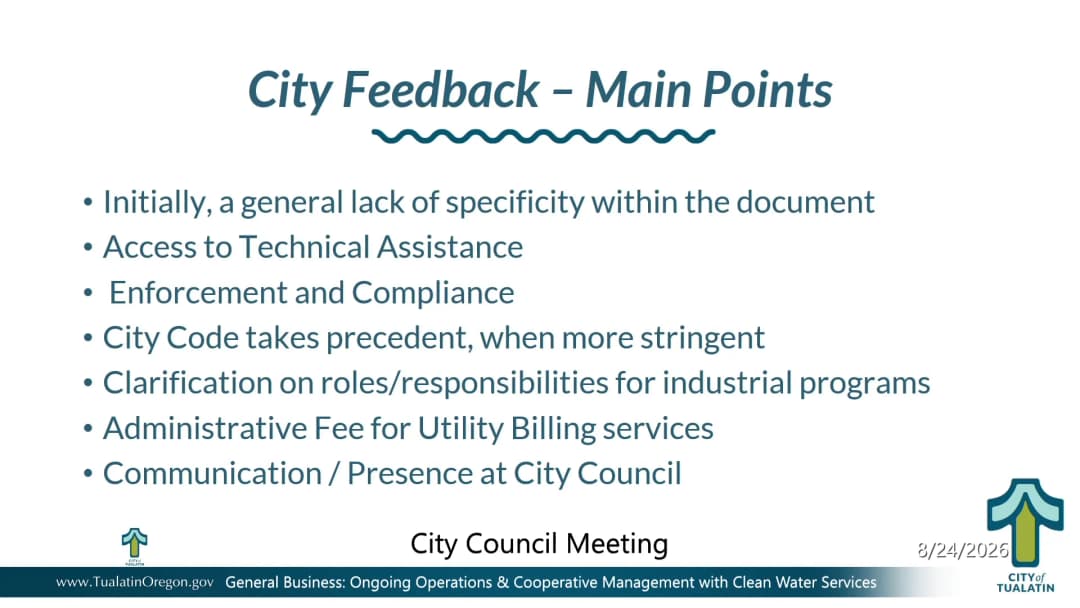
The Tualatin City Council met on August 24, 2026, at 7:00 PM (UTC). The meeting included the Pledge of Allegiance, proclamations, introductions of new employees, a consent agenda, an annual report from the Tualatin Community Emergency Response Team (CERT), a public hearing on a corrective land use ordinance, and approval of a new intergovernmental agreement with Clean Water Services. All votes were unanimous. Proclamations and Announcements - Councilor Sacco read a proclamation declaring September 11, 2026, as September 11th Remembrance Day in Tualatin, marking the 25th anniversary of the 2001 terrorist attacks. - Councilor Brooks read a proclamation declaring September 2026 as National Preparedness Month, encouraging residents to participate in emergency preparedness, including the CERT program. - Council President Pratt reminded attendees of the upcoming CERT Emergency Preparedness Fair on September 12, 2026, at the library from 11 AM to 2 PM. New Employee and Promotion Introductions - Police Officer Matthew Thomason – hired July 13, 2026; previously with Beaverton Police Department; graduated from the Oregon Police Academy; fluent in Romanian; currently in field training on night shift. - Captain Eric French – promoted to Captain and Patrol Commander; with Tualatin PD since June 2005; previously served in Yuma County, Arizona, and the U.S. Marine Corps; held roles including school resource officer, detective, canine handler, patrol sergeant, and community service officer. He served as interim captain since April 2026 while Captain Rankin was on medical leave. - Joel Valdez – new court clerk for the Municipal Court; came from Beaverton with 19 years of court clerk experience; started August 3, 2026. - Robin Doty – interim Deputy City Manager while Megan George is on maternity leave until mid-January; previously served as Library and Administrative Services Director and interim City Administrator in North Plains; oversees homelessness initiatives, community involvement organizations (CIOs), government relations, and the Thorne Run contract. Consent Calendar - Approved the work session and regular meeting minutes of August 10, 2026. - Approved a new liquor license application for TEN's Kitchen LLC dba Lee's Kitchen. - Both items were adopted unanimously via a single motion. Public Comments & Testimony - No members of the public addressed the council during the public comment period. Tualatin CERT Annual Report - Alan Perricini, CERT President, presented the 2025–2026 annual report. CERT celebrated its 10th anniversary; Cathy Holland had served as president for 10 years and was succeeded by Perricini in February 2026. - Key statistics: - 212 total CERT members; 143 active, 69 inactive. - 87 volunteers hold FCC ham radio licenses; 67 hold GMRS licenses. - 21 classes have graduated since 2016; enrollment dipped during COVID but is recovering. Next class begins September 15, 2026, with 6 recruits. - Annual city appropriation: $14,000 (received on the meeting day); additional state and federal grants historically received, though FEMA funding was noted as tenuous. - CERT conducted a countywide major exercise in October 2025 with Tigard, Beaverton, and Hillsboro teams, focusing on disaster scene evaluation and search and rescue. - Mobilizations at events like Blender Dash, Viva Tualatin, Pumpkin Regatta, and Big Truck Day serve as training opportunities. - A 2025 grant funded a mobile communications unit (MCU), a solar-equipped trailer for ham, GMRS, and FRS radio networking. - A new program, Tualatin Neighborhood Ready, led by Mary Silva, trains residents and businesses on disaster preparedness (e.g., turning off gas meters, water storage, family plans, go bags). - Plans include a 30-member rapid response team for lesser emergencies (expected later 2026 or 2027) and emergency supply kits stationed at each CIO. - Council members expressed gratitude for CERT's efforts and asked about supply locations (kits at each CIO) and future needs (more radio equipment; grant application in progress). Public Hearing: Ordinance No. 1457-26 - A legislative land use hearing was held for Ordinance 1457-26, a corrective amendment to Ordinance 1499-25 regarding the annexation of approximately 54.79 acres at Tonkin Loop west of Grahams Ferry Road and north of Basalt Creek Parkway. - The amendment clarifies that the annexed property is also included within the Clean Water Services (CWS) boundary pursuant to ORS 199.510(2)(c), as required by law. - Staff (Planner Madeline Nelson) explained the original ordinance incorrectly stated the property was within CWS; this is a typographical fix with no change to boundaries, zoning, or conditions of approval. - No public testimony was offered. - Council held a first reading (by title only) and a second reading, then voted to adopt Ordinance 1457-26. The roll call was unanimous (all ayes). General Business: Resolution No. 5993-26 - Public Works Director Rachel Sykes presented a request to authorize the City Manager to execute a new Intergovernmental Agreement (IGA) with Clean Water Services for ongoing operations and cooperative management. - The IGA replaces the 2005 agreement (with amendments from 2008 and 2017) and updates roles for EPA and DEQ regulatory compliance, watershed-based management, financial provisions, asset ownership, and dispute resolution. - Key features include: - Environmental Protection Agency (EPA) and Oregon Department of Environmental Quality (DEQ) permit compliance. - Rate-setting and collection of sewer/stormwater utility fees and system development charges (SDCs). Tualatin remits most sewer SDCs to CWS for capital projects. - Authority for Tualatin to charge CWS an administrative fee for billing services (regional negotiation led by Don Hudson; fee amount to be set separately). - Clarification of asset ownership and maintenance responsibilities (CWS maintains pump stations, force mains, and pipes 24 inches; no shifts from current practice). - More stringent code applies when city and CWS codes differ. - Joint code enforcement process, especially for larger technical violations. - Annual presentation by CWS to City Council and provisions for annual review. - Five-year term with renewal options. - CWS representatives Joe Gall (Chief Utility Relations Officer) and Megan Comer (Principal Planner) were present. - Councilor Brooks asked about enforcement records and PFAS monitoring. Staff noted no public database for citations, but DEQ publishes a monthly enforcement newsletter; CWS will follow up on PFAS data and river management questions. - Councilor Hillier thanked everyone for the collaborative process. - Resolution 5993-26 was approved unanimously by roll call vote. Adjournment - Councilor Pratt moved to adjourn; seconded and passed unanimously. Key Outcomes - Adopted the consent agenda (minutes and liquor license) unanimously. - Approved Ordinance 1457-26 (corrective annexation into Clean Water Services) unanimously. - Approved Resolution 5993-26 (authorizing IGA with Clean Water Services) unanimously. - Recognized September 11th Remembrance Day and National Preparedness Month via proclamations. - Welcomed four new/promoted employees and one interim deputy city manager.