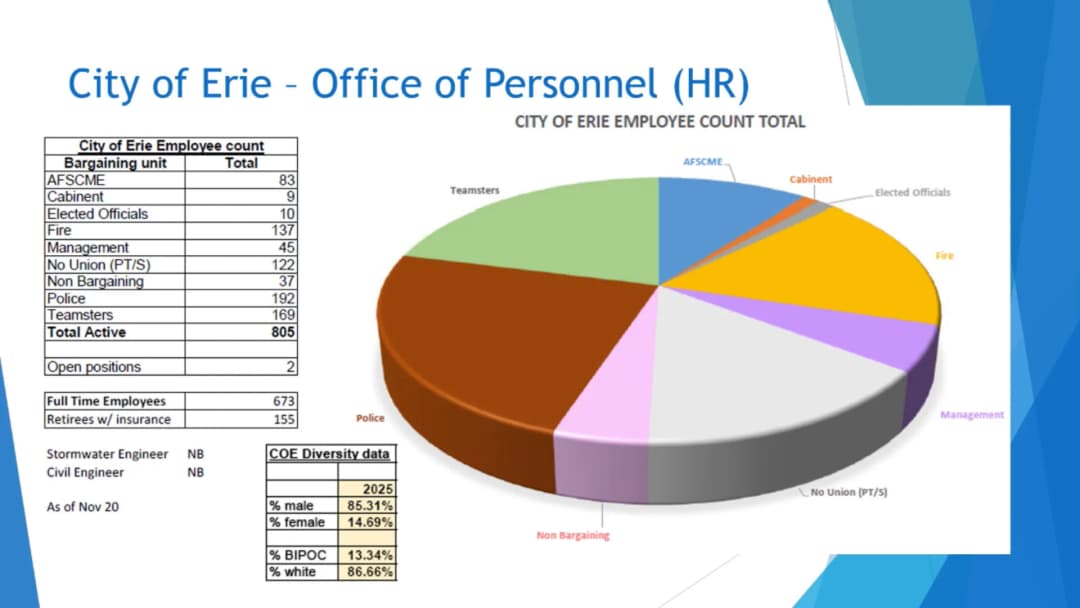
The City Council convened on November 21, 2025, to review and deliberate on the proposed municipal budget. The meeting focused on the Community Development, Planning, Human Resources, Risk Management, and General Fund Revenue departments. Key discussions included the restructuring of community development staffing following the expiration of a DOJ burn grant, the status of the newly formed Planning Department as a standalone entity, updates on employee health insurance costs, and revenue projections influenced by legal challenges to amusement taxes and declining cable franchise revenues. Consent Calendar - No specific consent calendar items were explicitly listed as a separate category in the transcript; routine approvals were discussed within departmental presentations. Public Comments & Testimony - While the transcript contains questions from council members regarding data access and staffing, no public testimony from external community members is recorded in this session. Discussion Items Community Development Budget - Grant Status and Staffing Changes: The council discussed the expiration of the Department of Justice (DOJ) "Burn Grant" on September 30, 2025, which previously funded the Project Coordinator salary. The council confirmed this position is now vacant and will be eliminated from the general budget, though funding for a similar role may be sourced from other grants (e.g., the $1 million "Encouraging Innovation" grant). - Salary Adjustments: A staff member proposed raising the Community Development Specialist salary from $55,000 to $57,000 to ensure equity with the current Assistant Grant Administrator, who has been in the role for 1.5 years. The council agreed to keep the $55,000 position in the budget as a placeholder, noting it is a vacant position that does not currently incur an expense, and that future funding for the role would come from grant match requirements. - Funding Sources: Council members inquired about the source of funding for the Community Development Specialist. It was clarified that while the specific grant has expired, the department holds grants requiring implementation project management (property acquisition, asbestos remediation), which are expected to cover the position costs via matching funds. Planning Department Budget - Departmental Status: The Planning Department confirmed it is operating as a distinct department with seven full-time staff, though they noted the ordinance formally separating it from Code Enforcement has not yet been passed. - GIS and Data Access: A council member raised concerns regarding the lack of public-facing data dashboards despite the investment in GIS. Department staff explained that while internal mapping is active, public dashboards are not yet live due to data availability and integration issues with the CityWorks system. It was noted that the GIS Administrator performs citywide duties for Public Works and other departments. - Unfilled Positions: The Data Analyst position remains unfilled. The department opted to hire a third-party change management specialist from Timmins to manage the CityWorks transition rather than filling the vacant Data Analyst role immediately. Human Resources and Civil Service - Staffing Levels: HR reported 805 active employees with only two open positions, describing the staffing level as high. A new HR Assistant was noted to start in December. - Contract Negotiations: The council confirmed negotiations for the AFSCME contract are ongoing and expected to conclude by year's end. Firefighters and Teamsters contracts do not expire until 2027. - Civil Service: The Civil Service budget was updated to reflect an increase in firefighter application fees from $50 to $80, which is projected to cover a significant portion of the budget. Risk Management - Health Insurance Strategy: Risk Management presented a significant increase in health insurance costs. A proposal was made to launch an educational project involving unions to improve cost management and reduce claims, though this will not be discussed until after current contracts are settled. - Pharmacy Changes: Staff noted that a 2023 switch to a new pharmacy benefit manager (True Rx) generated $1.2 million in rebates, though some employee groups experienced friction due to prior authorization processes. - Stop-Loss Mitigation: The department highlighted a successful negotiation with an insurance broker that reduced a projected 60% stop-loss cost increase to 28% by adjusting coverage limits and switching carriers. - Liability Coverage: The budget includes coverage for various liabilities, including a specific liquor license policy for the city's golf course and claims related to vehicle damage and lawsuits. General Fund Revenues - Tax and Revenue Projections: The council reviewed revenue sources, noting that taxes constitute 78% of the fund. Property tax collections are stable, while income tax revenues follow a quarterly cycle. - Amusement Tax Uncertainty: Revenue projections for amusement licenses (skill games) were reduced due to an ongoing Pennsylvania Supreme Court hearing regarding whether these constitute gambling. If they are deemed illegal, revenue streams could cease entirely. - Declining Income Sources: A significant drop in Cable TV franchise revenue was attributed to the shift toward streaming services. Conversely, plumbing inspection fees are projected to rise due to lead pipe replacement initiatives. - Parking Fines: Parking fine revenue is projected to drop, a trend attributed to the removal of meters on State Street and users adapting to the payment app, with council members noting increased app usage. - Grant Reimbursements: The council discussed the reliance on grant reimbursements ($2.5 million from ARP for police, plus DECD and CDBG reimbursements). Staff emphasized that these funds are tied to specific hired staff hours, and federal funding sustainability remains a concern for future budgeting cycles. Key Outcomes - Budget Amendments: The community development budget will be amended to remove the Project Coordinator salary line (previously funded by the expired DOJ Burn Grant) and retain the Community Development Specialist line as a vacant placeholder ($55,000) pending grant funding allocation. - Departmental Recognition: The council acknowledged the operational separation of the Planning Department, though a formal ordinance amendment remains pending. - Risk Management Action: Council members expressed strong support for the proposed educational project to manage health insurance costs and praised the department's success in mitigating stop-loss rate increases. - Revenue Caution: Council members noted the uncertainty surrounding amusement tax revenue and the long-term trend of declining cable franchise fees, requiring careful monitoring of the general fund balance. - No Immediate Votes: The transcript indicates the meeting concluded with general appreciation and no formal roll-call votes on the budget items discussed, suggesting the budget is moving forward for further refinement or a future vote.
Public Meetings - Erie, Pennsylvania
Public Meetings - Erie, PennsylvaniaThe City Council convened to review and discuss the 2026 proposed budget for Public Works, General Fund, and Enterprise funds. Presenters provided detailed breakdowns of line items, explaining adjustments driven by contractual obligations, bond repayments, inflation, and strategic staffing changes. A significant portion of the discussion focused on justifying increases in the Parks and Recreation division based on consultant studies and addressing community concerns regarding refuse rate hikes. Consent Calendar - No routine consent calendar items were presented or voted upon during this session. Public Comments & Testimony - Council Member (unnamed in transcript): Expressed concern regarding the impact of refuse rate increases on single-person households and senior citizens who may struggle with the rising costs. Asked if a "pay-per-bag" system could be considered. - City Official (Refuse Department): Stated that transitioning to a per-bag pricing system would likely result in increased illegal dumping and litter, citing that many other municipalities that have implemented such systems have faced this exact issue. Clarified that flat-rate billing ensures revenue stability for comprehensive services. - Council Member (unnamed in transcript): Noted the difficulty of comparing Erie's costs to smaller neighboring communities (e.g., Fairview, Millcreek), acknowledging that residents of those areas often moved out of Erie. Discussion Items - Wastewater Treatment & Sewer (Department 771/772): - Project Description: The department presented a five-year capital plan projected to cost $34 to $35 million for improvements at the wastewater treatment plant. To fund the associated bond issue, a five-year revenue ordinance was passed the prior year to adjust rates. - Speaker Position: The department confirmed the necessity of the rate structure to cover increased debt service and maintenance. It was noted that the tiering system (offering discounts for high usage of over 10,000 CCFs) was discontinued the previous year, which effectively cut the rate increase in half and smoothed rates for residents. - Comparison: The sewer rate of $13.50 per CCF was compared to neighboring cities, with one neighbor (Leslie) noted at $9.85. - General Fund - Traffic Engineering (Department 709): - Project Description: Repairs and maintenance costs doubled from $20,000 in 2024 to $40,000 in 2026. - Speaker Position: Councilor Nelson and the department confirmed this increase is due to the repair of traffic signals and city-owned lighting, noting an increase in the number of lights. - Project Description: Casual labor includes a part-time engineer working 25 hours/week with no benefits. Total FTE is 70.5. - General Fund - Bureau of Streets: - Project Description: "Other services and charges" budget included $318 in 2024 attributed to leftover Snow Mageddon bills. - Speaker Position: The Council noted that the city typically does not budget for extreme snowstorms and relies on transfers from other funds or the contingency fund when such events occur. - Discussion: A question was raised regarding the maintenance of police-installed cameras. It was clarified that a 10-year contract covers maintenance for body cams, tasers, and digital storage cameras, but no specific funds were allocated in the Public Works budget for additional camera maintenance if the contract does not cover them. - Municipal Garage (Department 727): - Project Description: Towage rates for the 250-pound tier have remained stagnant at $125 since 2013, while the 100-pound tier remains at $100. - Speaker Position: Council members noted that 2013 rates in the book appeared to be $1.25 or similar, suggesting a possible typo if the rates haven't changed since 2013. They expressed support for reviewing and potentially increasing these rates to reflect inflation. - Bureau of Parks and Recreation: - Project Description: The department is requesting an increase of 3 FTEs, moving from 12 to 15. A consultant study (Ballard King) determined the city's FTE equivalent should be 13.9 based on comparisons with cities of similar population (50,000–100,000), which aligns with the median national service standard (70th-74th percentile). - Speaker Position (Department): Argued that the current staff of 7 full-time teamsters (plus seasonal) has been "cannibalized" and cut drastically since 2004, leading to a need to shore up the park system for the implementation of a new Recreational Parks and Open Spaces (RPBS) plan expected in early 2026. - Speaker Position (Council): Expressed skepticism about out-of-town consultants recommending hiring based on limited city knowledge. However, the Council acknowledged the department's plan to hire staff now to be ready for the 2026 implementation. - Specific Projects: Discussions regarding Roger Young Park revealed no specific project plans yet, but the park is included in the study. Council members suggested including the Erie Housing Authority (residents of Franklin Terrace) in planning to ensure activities meet the needs of those living within walking distance. Data from previous surveys involving West Bay Friends and middle schools is expected to be integrated. - Clarification: It was confirmed that new park employees will not be tasked with mowing yards related to "quality of life" tickets; this remains a function of the Redevelopment Authority. - Stormwater Fund: - Project Description: The fund is in its fourth year of the stormwater fee (passed late 2022). A $400,000 line item for a street sweeper in 2025 was a one-time purchase, causing a drop in the 2026 budget projection for equipment. - Speaker Position: The department explained the need to balance line items based on actual spending data over previous years. They highlighted the need for consultant services to manage MS4 permit compliance (National Pollutant Discharge Elimination System) and sediment reduction goals (PRP) for streams like Mill Creek and Garrison Run. - Refuse and Recycling: - Project Description: Refuse rates are proposed to increase from $80.73 to $93.05 per quarter for 2026. Compactor replacement costs increased by approximately $25,000 per unit, totaling a $50,000 increase in the budget. - Speaker Position: The department argued that the increase is necessary to cover rising expenses and contractual staffing increases. They defended against the suggestion of a per-bag fee, noting it could lead to illegal dumping and that current rates include recycling, compost, and large item pickup. - Speaker Position: Council members expressed empathy for residents on fixed incomes but were informed that a study would be extensive and that flat-rate billing prevents waste dumping. - Golf Course: - Project Description: The 2026 budget remains unchanged from the previous year pending the finalization of a contract with the Zoo, which appears to involve a lease-back arrangement where the city continues to run the course. - Speaker Position: A Council member noted the lack of final drawings regarding the hole configurations (specifically holes 4 and 5) and suggested the study on the course's future may not yet exist, warranting budget caution. Key Outcomes - Budget Review Continued: The session served as a review/dissemination of budget details rather than a final vote on individual line items, except for the approval of the overall budget agenda. - Towing Rate Review Authorized: Council instructed staff to look into increasing municipal garage towing fees, which have been stagnant since 2013. - Stormwater Budget Clarified: It was confirmed that the $400,000 expense for the street sweeper was a one-time 2025 event and not a recurring 2026 line item; staff were directed to verify specific year-to-date spending figures. - Parks Staffing Justification Accepted (In Principle): The department's plan to hire 3 FTEs to align with consultant recommendations and prepare for the 2026 RPBS implementation was discussed and noted, with Council expressing mixed views on the consultant methodology but accepting the operational need. - Refuse Pricing Strategy Confirmed: The City Council maintained its policy of flat-rate refuse pricing to prevent illegal dumping, despite community concerns over the cost increase for low-volume users.
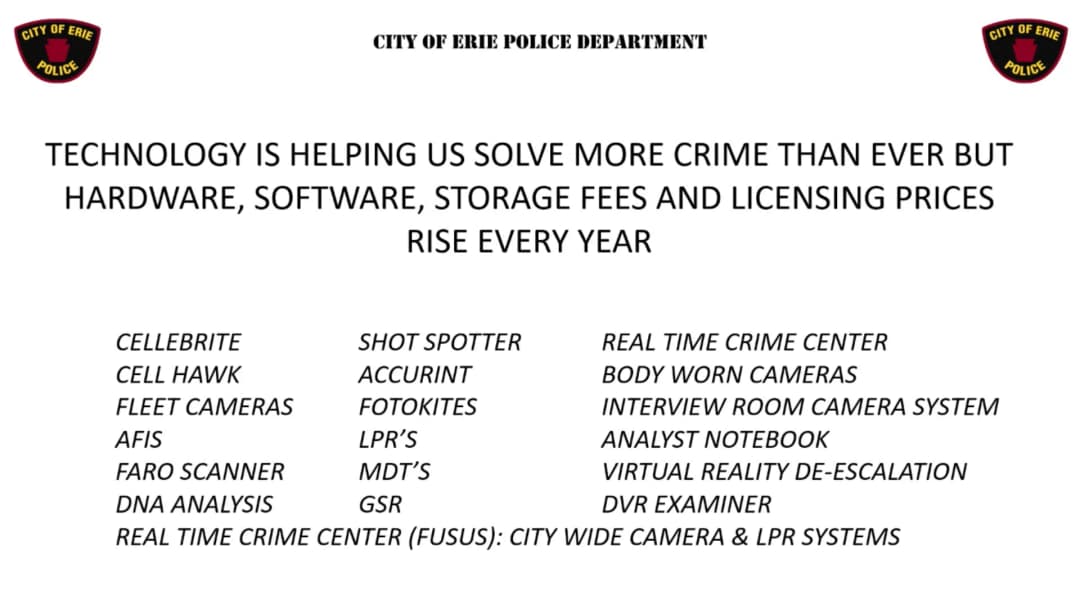
This meeting featured detailed reports from the Police and Fire Departments regarding the 2025 operational year, crime statistics, financial budget status, and capital projects. Councilmembers expressed satisfaction with the Police Department's ability to maintain the budget under 40% and highlighted the success of gang violence reduction and grant acquisitions. The Fire Department reported on fleet modernization challenges due to supply chain delays and increased call volumes post-pandemic. Consent Calendar - No specific consent calendar items were explicitly identified, heard, or voted upon as a distinct section in the provided transcript. Public Comments & Testimony - No public comments or testimony from citizens, advocacy groups, or members of the public were recorded or spoken during this session. Discussion Items - Police Department Financials and Budget: Chief reported the Police Department budget constitutes 39.5% of the total city budget, staying under the 40% goal. Councilman Nelson praised this performance, noting his first year was 44%. The Chief attributed the lower percentage to significant grant funding ($1.8 million in reimbursements/grants this year vs. $1.2 million last year). - Crime Statistics and Gang Violence: Chief presented data showing homicide clearance rates in Erie are approximately 90% over the last four years, far exceeding the national average of 52%. Gang-related homicides were reported as zero for 2024 and 2025. However, sex offenses increased by 61 incidents (mostly indecent touching), and fraud cases rose by 138 (including porch piracy and phone scams targeting the elderly). - Canine Unit and Vehicle Accidents: The re-established canine unit (Bo, Atlas, Deacon) seized $18,000 in narcotics and multiple contraband items. Regarding four new vehicles acquired via grants, three were involved in recent accidents: one major collision attributed to the department (driver's fault), one major collision not the department's fault, and one minor collision. All officers recovered. - Technology and Real-Time Crime Center: The department implemented a network of 200-350 cameras and license plate readers, partnering with the Port Authority. The system allows officers to view live feeds and backtrack video footage for investigations. Costs per camera have dropped from $10,000-$12,000 to $2,000-$3,000 due to existing infrastructure. Council asked about coverage at specific locations (e.g., 26th and Parade), and the Chief confirmed cameras are present but not monitored 24/7 by dedicated officers. - Internal Affairs and Citizen Complaints: There are 29 citizen complaints under investigation or concluded. Of these, five are sustained, one incomplete, two unfounded, one referred, and 20 exonerated. Complaint rate is approximately 1 per 10,000 calls. Notably, there were zero "use of force" complaints in 2025, compared to eight in 2024 (all exonerated). - Juvenile and Crisis Intervention Units: Juvenile charges show a slow downward trend, with 40% of youth qualified for diversionary programs. The Crisis Intervention Unit added a co-responder program with two civilian mental health experts to better target mental health calls beyond immediate de-escalation. - Police Athletic League (PAL): PAL has reached 2,000 registered kids across all school district buildings and four community centers, hosting field trips to various major cities. - Department Remodel: The Police Department central operations remodel has begun to address outdated infrastructure, described historically as "spaghetti" wiring, which requires asbestos mitigation. The project aims to modernize working conditions for civilians and officers. - Fire Department Fleet and Operations: Fire Chief noted a steady increase in calls since 2002, rising from 5,000 to 9,000 annually post-pandemic. Fleet replacement is ongoing; Engine 13 is a 2019, Engine 12 is a 2003 (due for reserve/backline), and a new Engine 12 is expected in September. Future trucks cost significantly more (up to $2.8 million) and feature complex electronics. Chief expressed concern about the need for electronic technicians as trucks become more computerized. Extended warranties are deemed too expensive. - Fire Department Overtime: Overtime is currently under budget, largely due to the "Snowmageddon" event in 2024 consuming previous reserves, though the Chief cautioned that late-year winter storms could impact the remaining budget. Key Outcomes - Budget Approval: The Police Department budget was confirmed to be under 40% (39.5%), with Councilman Nelson commending the leadership for maintaining this percentage while expanding operations. - Funding Sustainability: Councilman Nelson noted that while the department is funded for 194 positions through 2029 via current grants, future retention of staffing levels beyond 2029 depends on securing additional grant funding. - Fleet Replacement Strategy: The Fire Department committed to a rotation strategy to avoid buying multiple trucks simultaneously, though delivery delays (up to 4.5 years) have extended this process. - Operational Directives: No formal votes with tallies were recorded in the text; the meeting concluded with the Chief presenting reports and a brief Q&A, ending with a statement that the study session was concluded and the meeting adjourned.
The council convened to review and approve the 2026 budget proposals for various city departments. The meeting featured presentations from department heads covering the Solicitor, Clerk, Mayor's Office, Communications, Treasurer, Development/Finance, and Code Enforcement. Key discussions included salary adjustments to retain staff, budget corrections regarding Council compensation, and strategic shifts in Code Enforcement revenue generation through penalty fees rather than standard ticketing. Consent Calendar - The Solicitor's budget was approved with minimal changes, primarily consisting of a $3,000 increase for the Deputy Solicitor and a one-time increase for a combined Paralegal/Legal Secretary role. - A clerical correction to the City Council's budget was approved to correct a $2,000 discrepancy in the President's honorarium, adjusting the line items from $14,000/$2,000 to $12,000/$14,000. - The Mayor's, Communications, and Treasury department budgets were approved, noting the hiring of a necessary Treasurer's assistant and a $5,000 increase in the Treasurer's postage budget (from $55,000 to $60,000). - The Development and Code Enforcement budgets were approved, with the elimination of the Assistant Code Manager position and a shift toward a consulting arrangement for the former holder of that role. Public Comments & Testimony - Public Comment (Unidentified Speaker): Expressed concern regarding the lack of digital access to the Times newspaper for council members, noting the cost of personal subscriptions and the delay in free library access. The speaker suggested the city contract for access rather than departments doing so individually. - Council Member (Position regarding Stormwater Fee): Expressed support for maintaining the stormwater fee as a method of funding, arguing that it is preferable to a tax levy that would only affect property taxpayers. The speaker noted that while the collection rate dropped from 80% to 78%, the fee structure helps ensure broad contribution compared to a tax that only hits taxpayers. - Council Member (Position regarding Dog Licenses): Expressed opposition to the city continuing to collect dog licenses, suggesting the function should be transferred to the county as a redundancy. The Council Member stated they have no feelings about this decision if it is passed to the county. - Council Member (Position regarding Contractor Regulation): Emphasized the need for stricter enforcement and higher fines against unlicensed contractors, specifically those who sell their licenses to apprentices or work on illegal sites without a journeyman or master present. The speaker stated current $100 fines do not deter bad operators. - Council Member (Position regarding Senior Citizen Protection): Proposed an additional $1,000 fine for contractors who take advantage of senior citizens, though the group noted potential legal difficulties with establishing a specific tier for seniors. Discussion Items - Solicitor's Office: Discussed the consolidation of Paralegal and Legal Secretary roles into one competitive position for Ms. Ways, with a one-time pay increase to reflect the dual responsibilities. Concerns were raised regarding the retention of Mr. Visheco (Casual Labor/Part-time Solicitor), who plans to retire, creating a potential vacancy for 2026. - Clerk's Office: Addressed the need for increased advertising funds ($7,500 to $10,000) due to the uncertainty of requirements from the Home Rule Charter Committee. The office also received a $2,000 increase for overtime and a $2,000 increase for office supplies (from $3,000 to $5,000) to cover shortfalls. - Treasurer's Office: Discussed the successful manual processing of 37,000 tax bills during a postal service disruption in 2025, thanking Finance and Mayor's Office staff for assistance. The Council noted the problematic salary trajectory for the City Controller and Treasurer, confirming the need for an election in two years to reset the position. - Code Enforcement: Detailed the shift from a $100 fine to a proposed $1,000 fine for quality-of-life violations involving unlicensed work, aiming to deter illegal contractors rather than generate revenue. The Council discussed the "abatement fee" strategy, where landlords are billed for cleanup via their water bills, noting it effectively reduced junk and debris complaints after a few hundred notices were issued. - Development/Finance: Confirmed that the Development department remains profitable, generating approximately $750,000 in program income which funds salaries and supports community initiatives like the Flag Erie Fund. Key Outcomes - Budget Approval: The 2026 budgets for all departments (Solicitor, Clerk, Mayor, Communications, Treasury, Development, Code Enforcement) were approved. - Hiring Decisions: The Council confirmed the hiring of a new Treasurer's assistant, described as a "definitely needed" position. - Position Changes: The Solicitor's office combined the Paralegal and Legal Secretary roles into one position. The Code Enforcement department eliminated the Assistant Manager position, transitioning the former holder to a consultant role. - Regulatory Directives: The Council directed the Solicitor's office to draft language for a $1,000 fine for unlicensed contracting work, specifically targeting contractors who allow apprentices to work without a master on-site or sell their licenses. A follow-up is expected in January. - Future Actions: The Treasurer's office is tasked with explaining the stormwater fee to the public to clarify it is not a one-time levy. The Clerk's office is to monitor the Home Rule Charter Committee requirements for advertising. - Adjournment: The meeting was adjourned after open discussion.
The Erie City Council convened on November 5, 2025, to honor community policing efforts with an award presentation, receive the 2026 preliminary budget proposal involving potential property tax increases, and address public concerns regarding sewage backups and the police review board before proceeding with routine ordinance adoptions and committee reports. Consent Calendar - Approved minutes from the October 15, 2025 City Council meeting and bills for payment on November 7th and 14th. - Passed Ordinance 75-2025 (Council File 16565) appropriating $25,000 from DCNR grant funds, 7-0. - Adopted Council File Ordinances 1656, 16567, 16568, 16573 on first reading (appropriating funds for housing rehab, McDonald's 911 fundraiser, Irish Wolfhound Association donations, and canine training respectively), all passed 7-0. Public Comments & Testimony - Kenneth Bounds expressed frustration and request for action regarding sewage flooding in his basement on South Shore Drive. He requested an engineering report on the backup causes and requested the city coordinate improvements with Milk Creek Township to prevent recurrence. The administration responded that the sewer department has been investigating the area actively since the incident. - Deontay Coley expressed gratitude for the recognition of police officers in the community but raised concern regarding the lack of a citizen police review board. He stated that residents with credentials, including retired trooper Brian Harrington and retired principal Cleet Collins, are interested in serving on such a board. He criticized Mayor Joe Schember for allegedly focusing on candy crush or texting during his speech, stating this behavior is rude and indicative of a disconnect from community engagement. - Robert Tacus expressed urgency and concern regarding three issues: requested the installation of a stop sign at 16th and Myrtle for safety; expressed indignation regarding being pulled over in a wheelchair due to broken sidewalks while criticizing the city for collecting taxes without maintaining walkability; requested immediate help from the council regarding the "Justice for Tricello" case, stating the delay in the District Attorney's actions is ridiculous given the family's suffering. Discussion Items - Jason Belton Award Presentation: Chief Russo presented the award to Patrolman Matthew Velud for exemplifying Officer Belton's legacy. Velud expressed honor, stated he is striving to live up to Belton's standard of care, and emphasized that community policing is a mindset rather than just a program. - 2026 Budget Proposal: Finance Director Lisa Gomersal presented a preliminary budget of $110,112,599, representing a 2.4% increase. She outlined three scenarios for balancing the budget: 1. Recommended scenario: Increase property taxes by 1 mil (approx. $100 per $100k home value) in 2026. 2. Alternative scenario: No tax increase in 2026, but requiring a nearly 3-mill increase in 2027. 3. Local Service Tax (LST) scenario: Increasing LST from $52 to $156 annually to shift burden from residents, enabling property tax increases to remain under one mill per year. She noted that the city has held property tax steady for six years and detailed the usage of the water lease prepayment fund. - Committee Reports: Councilmembers discussed incoming personnel (Marilyn Pohl, Andre Horton), the Erie Zoo land transfer status, the Port Authority's ship project, and the need for transparency from the District Attorney regarding the Tricello investigation. Dr. Titus stated that a draft ordinance for a police and community committee is under review to ensure legal soundness. Key Outcomes - Appointment: Passed a resolution to appoint Carl Anderson to the Erie Planning Commission (term ending Dec 31, 2028) and the Land Bank. Vote: 5 Yes, 2 Nays. - Bond Authorizations: Adopted Council File Ordinances 16571 and 16572 on first reading to authorize lease rental debt ($12 million and $3.32 million respectively) for water distribution facility improvements. Vote: 7-0. - Budget Sessions: Scheduled public budget sessions for November 6, 11, 13, and 20, with a final hearing anticipated after the December 3rd City Council meeting. - Historic Review Commission: Open call for applications to fill three vacancies on the seven-member commission for residents with backgrounds in preservation, history, architecture, or art history.
On November 5, 2025, the Erie City Council reviewed a proposal by East Side Renaissance and Multicultural Health Evaluation Delivery System (MEDS) to establish a new healthcare facility on the Parade Street corridor. The presentation detailed a $4.8 million capital improvement project designed to address the area's status as a healthcare desert, aiming to provide primary care, mental health services, dental care, and an in-house pharmacy. Council members expressed strong support for the initiative, citing the critical need for local health access, particularly for residents in the 16503 zip code, while noting the project's reliance on pending state and federal funding sources. Consent Calendar - No specific items from the consent calendar were discussed or listed in the provided transcript. Public Comments & Testimony - Olivia Hybox (CEO, MEDS): Expressed full support for the project, stating it is critically important to invest in the Parade Street corridor and build neighborhoods of the future. She highlighted that the organization sees patients regardless of their ability to pay, often charging a nominal $20 fee or waiving it entirely. - Matt Harris (VP, East Side Renaissance): Expressed strong support for the project as a key component of economic development and health equity. He emphasized that the 16503 zip code is a healthcare desert where 56% of residents make less than $19,000 a year. He noted that driving just 10 minutes from the city to a wealthier area results in a 10-year difference in life expectancy. - Council Member: Supported the project as a response to decades of disinvestment, calling it a vital investment for the community's well-being and tax base. Discussion Items - Project Scope and Services: MEDS outlined plans for a facility at 908-912 Parade Street (demolishing a non-salvageable portion at 908 and renovating 910-912). The facility will house primary care, ophthalmology, speech pathology, mental health, physical therapy (PT), occupational therapy (OT), and a dental office. An in-house pharmacy and a community conference room were also planned. - Workforce and Demographics: Olivia Hybox reported that 86% of MEDS staff speak a language other than English as their first language, addressing the 90% of patients who are served in a non-English language. The project is projected to create approximately 50 new jobs and hire locally. - Financials and Capital Stack: The project cost was stated as $4.8 million. The capital stack includes pending funding from the state budget, the Federal CRIS program (for infrastructure/demolition), and a request for a $1 million low-interest loan from the City of Erie (via the Chris Grohner program) intended for 2026. - Accessibility and Infrastructure: Bosworth Design presented architectural plans to install an elevator and stair tower to ensure accessibility. Danielle Mina noted the need for roughly five parking spaces within a 500-foot radius and discussed potential collaborations for street trees and lighting. - Healthcare Impact: Council members questioned the impact on ER and ambulance utilization. MEDS confirmed that increased primary care access reduces ER visits, though specific data on ambulance usage reduction was not currently tracked by the organization. Key Outcomes - No Formal Vote Recorded: The transcript indicates the council members offered verbal support and
The meeting on September 3, 2025, focused on two major topics: an update on the Phase One Public Safety Complex (fire department service garage) and a proposed bond issuance to fund the Miller Brothers project. Council members debated the scope, cost, and financing structure, ultimately reaching an informal agreement to limit project funds to $30 million while proceeding with the existing ordinance. Discussion Items Public Safety Complex Phase One (Fire Department Service Garage) - Presenters: Rob Mars (project representative) and Adam Trott (schedule coordinator). - The project began in March 2025; the roof was bid separately to allow work to continue through winter. - Roof bids: Low bid was $684,000 (A1 Construction and Painting), significantly under the engineer's estimate of $1.4 million. Other bids were around $1.1 million. The low bidder was vetted and found to be a family-owned business with public works experience in New York State. - Phase one (total 8.4M estimate) includes the fire department service garage, chief mechanic, equipment cleaning, evidence room, and dog suite. It will enable all fire department garage functions under one roof, with improved ventilation and energy efficiency. - Remaining bids for the rest of phase one are due October 2, 2025, with a pre-bid meeting on September 11, 2025. Roof construction is expected to finish by late December 2025, and the overall phase one by late August 2026. - Council members expressed support for the project, emphasizing the need for safe working conditions and cost savings. Bond Financing for Miller Brothers Project - Presenter: Alicia Henry (PNC Capital Markets) and Tim Wacter (Knox Law Firm). - The city is considering issuing tax-exempt general obligation bonds (Series 2025) to fund renovations to the Miller Brothers building (three phases: fire garage, emergency operations center, police/public works). - Existing city debt: $53.57 million outstanding. The proposed bond has a not-to-exceed amount of $52.35 million (which includes room for structuring). - Three options were presented: 1. No capitalized interest: $1.575M annual debt service starting in FY2026. 2. Partial capitalized interest: FY2026 zero impact, FY2027 $860,000, FY2028 $160,000. 3. Full capitalized interest (two years): FY2026 & FY2027 zero impact, FY2028 $1.77M total impact. - Council members raised concerns about the total project cost ($30M) and the affordability of balloon payments in 2033-2039 (existing debt over $9M annually). Some advocated only for phase one ($10M), others for phases one and two ($20M), and a few for all three phases ($30M). - The mayor noted that the city has not raised taxes in six years and has relied on lease prepayment and ARP funds, which are nearly exhausted. - After extensive debate, council informally agreed to proceed with the existing ordinance ($52.35M not-to-exceed) but to add a provision limiting project funds to $30 million (covering phases one and two, with phase three to be funded later). The bond issuance will likely close in late October 2025. Key Outcomes - Public Safety Complex: The roof contract is awarded and construction has begun. Progress updates will continue as bids for the remainder of phase one open on October 2, 2025. - Bond Vote: Council will vote on the ordinance (with the $30M project fund limitation) at the next regular meeting on September 17, 2025 (second reading). The sewer authority resolution will be handled separately. - Council directed the administration to work with PNC to structure the bond with no capitalized interest and to provide a clear project cap in the ordinance.
The Erie City Council held a study session on August 28, 2025, featuring a presentation by Dr. Christa Genebis, Director of the Erie County Human Relations Commission (HRC). Dr. Genebis provided an update on the HRC's operations, challenges, and community impact. The session highlighted the HRC's role in investigating discrimination claims in employment, housing, and public accommodations, as well as its outreach and educational efforts. Council members discussed budget constraints, vacancies on the commission, and ways to support the HRC's mission. Presentation by Dr. Christa Genebis - Dr. Genebis started as full-time director in June 2025 and reported that the HRC handles discrimination claims under 14 protected classes, including criminal history, sexual orientation, gender identity, and use of a guide or support animal — protections not fully covered by state law. - The HRC investigates complaints in three areas: employment, housing, and public accommodations. Mediation is prioritized, but cases can proceed to hearings (which are public) or trials if necessary. - Current intake statistics (since June 2025): 9 housing complaints, 4 employment, 4 public accommodations; 24 active investigations, 5 on hold with other agencies, 6 closed (settled or administratively closed). Housing complaints often involve service animals, evictions, harassment, or landlord issues. - The HRC has experienced repeat respondents, which may indicate patterns or clients referring others. - Outreach efforts include the "Being Black in Erie" panel series (next event October 1, 2025, focusing on the younger generation), a disability rights training offering CE credits for social workers and attorneys, and workplace discrimination trainings. - Dr. Genebis noted the HRC office recently moved to the ground floor of the Masonic Temple in the city, with visible window space for events. Budget and Vacancy Challenges - The county executive (current officeholder) has removed the HRC from the county budget each year; city council has historically overridden the veto but with increasing difficulty. The 2024 budget was $260,000; the current 2025 budget is $150,000. The city contributes $15,000 annually. - The HRC has two commissioner vacancies: one from the county executive (who has not appointed) and one from Councilman Charlie Bale. Only 7 of 9 commissioners are seated, making it difficult to form hearing panels due to scheduling and conflict-of-interest rules. The advisory board has 11 members; the city has 4 appointments, and those are currently filled with active participants including Edison Nicholson and Alex Vaughn. - Dr. Genebis is the only staff member, working 50+ hours per week; she hopes to hire part-time help. Council Discussion - Council members expressed strong support for the HRC's mission, acknowledging its importance as a local resource vs. state/federal agencies which are slower and less accessible (closest PHRC office is in Pittsburgh). - Council asked about ways to fill the commissioner vacancy from Councilman Bale's district; it was noted the current system requires the district representative to recommend an appointment, though an ordinance could allow override by majority vote. - Council members discussed the importance of local elections (November 4, 2025) in determining future support for the HRC. - Suggestions were made to increase outreach by tabling at community festivals (e.g., Hispanic Fest, Irish Fest) to raise awareness. - No other municipalities contribute to the HRC budget. Key Outcomes - Council received information for budget season, which is upcoming. No formal votes were taken. - Council members committed to promoting HRC events and referring potential discrimination complainants. - The session served as an educational update for council on the HRC's operations and needs.
Brad Wortell, Chief Operating Officer of Velocy Network (VNet Fiber), provided an update on the company's fiber optic expansion in the city of Erie. He presented a map showing areas currently served (orange) and planned expansions (purple/blue). The company has grown from serving about 10% of households to an estimated 30-40% coverage, with 6,400 subscribers in the Erie area and 20,000 households passed. Key challenges include aging utility poles, high costs for pole attachments and replacements, and changing regulations from First Energy and Verizon. The company is working to fill in gaps in the network, focusing on areas where backbone infrastructure already exists. Discussion Items - Progress and Coverage: VNet has expanded from Pittsburgh Avenue to West Grandview Boulevard, covering areas such as Southwest Erie, Mount Calvary, and along 29th Street. The backbone network has been leveraged to feed residential areas. The company has seen a high take rate (over 25%) in some areas but lower (12-13%) in others like Southeast Erie. - Challenges with Utility Poles: The primary obstacle is the cost and complexity of attaching to older utility poles. Replacement costs can be $15,000 per pole, and in some areas, make-ready fees have increased fourfold. The company is working with First Energy and Verizon to find solutions, including coordinating with pole replacement schedules. - Tree Trimming and Underground Issues: Tree trimming has caused occasional fiber cuts, but residents have been accommodating. Underground installation is more expensive and problematic in winter, so the company prefers aerial deployment where possible. - Future Plans: Two imminent areas (purple on map) are near West Erie Plaza and along Bird Drive/Fairmont Parkway. The company aims to fill in gaps in the network, particularly in the East Bayfront and West Bayfront areas, pending pole access and cost reductions. - Competition and Pricing: VNet offers upload speeds of 1,000 to 2,000 Mbps, far exceeding the FCC standard of 25/3 Mbps. The company has reduced prices and is seeing strong interest from residents switching from Spectrum. The city has provided revolving loans totaling $22.8 million to support expansion. - Council Questions and Feedback: Council members expressed support for expanding fiber to more residential neighborhoods, especially on the east side. They discussed the importance of coordination with city permitting and infrastructure projects. Council member Chuck noted that citywide fiber could add a quarter billion dollars in home equity. Key Outcomes - No formal votes were taken. - VNet will continue to work with First Energy and Verizon to reduce pole attachment costs and coordinate with pole replacement schedules. - Council members will reach out to VNet to identify specific areas needing service and to explore ways to streamline permitting and coordination. - The city will continue its revolving loan program to support VNet's expansion. - Residents are encouraged to sign up on VNet's website to show demand, which helps prioritize areas for deployment.