The Houston City Council convened on June 16, 2026, under Mayor Pro Tem. The meeting featured multiple proclamations, a weather update from the Office of Emergency Management, public testimony on the proposed closure of Memorial City Ice Rink and a drainage dispute, and approval of several ordinances including an expansion of the water aid fund. The council also recognized interns and announced upcoming Juneteenth events. Proclamations - Miss Juneteenth Pageant: Councilmember Evans Shabazz presented a proclamation recognizing the 19th annual Mildred Johnson Mr. and Miss Juneteenth Pageant, held on June 6, 2026, at the Third Ward Multi-Service Center. Winners included Seven Watson (Teen Miss Juneteenth), Jillian Ridley (Miss Juneteenth), and Hanisha Stewart (first runner-up). Mayor Whitmire proclaimed June 16, 2026, as the winners’ day. - Ross Shaw Sterling Senior High School Bicentennial Class of 1976: Councilmember Davis and Councilmember Evans Shabazz honored the class on its 50th anniversary. The school, founded in 1965, now hosts the HISD Aviation Science Magnet Program. Mayor Whitmire proclaimed June 16, 2026, as Ross Shaw Sterling Senior High School Bicentennial Class of 1976 Day. - Houston’s Dementia Friendly Church: Councilmember Huffman recognized the ministry at The Landing at Augusta Woods, established in 2023. Over 500,000 Texans live with dementia. Mayor Whitmire proclaimed June 24, 2026, as Houston Dementia-Friendly Church Day. - Baha’i Prayer: Nadia Jolly, vice chair of IM Houston, delivered a prayer for America on behalf of the Baha’i faith, which has about 1,000 adherents in Houston. Weather Update - Brian from the Office of Emergency Management reported that the city had been tracking a potential rain event for 4–5 days. Lake Houston was lowered by one foot, barricades deployed, and dump trucks converted into high-water rescue vehicles. A potential tropical cyclone (likely Tropical Storm Arthur) was forecast to pass east of Galveston, placing Houston on the “clean side” with minimal impacts. FanFest for the World Cup was expected to open at 6:30 p.m. for the Argentina match. Residents were urged to monitor trusted sources and avoid driving into standing water. Public Comments & Testimony - Memorial City Ice Rink: Multiple speakers (Amy Good, Aliska Good, McKenzie Knoll, Charlotte Knoll) urged the council to prevent the demolition of the rink, owned by Metro National, which is set to close in 44 days. They noted the rink serves 1,500 regular skaters and 1,000 occasional skaters weekly, and that Houston has only five regulation-sized ice rinks compared to Dallas’s 23. They requested the city deny any permits that would destroy the asset and partner with the newly formed Houston Ice Sports Coalition to develop a new centrally located rink. Councilmember Huffman and Councilmember Salinas expressed interest in following up. - Darnell Fennell (Reverend): Complained about lack of communication from Councilmember Evans Shabazz’s office regarding a street closure issue. Councilmember Shabazz responded that her office had engaged and that the issue was resolved. The exchange highlighted tensions over public versus private communication. - Jessica LeBayer (District H resident): Described a drainage hazard at 839 East 27th Street, where a property owner filled a public drainage ditch with gravel to create an unpermitted parking pad in a high-risk AE 100-year floodplain. Despite three red-tag violations over nearly a year, the city had not remediated. She requested an emergency right-of-way abatement. Councilmember Castillo acknowledged the frustration and said her team would continue working with Public Works. - Other speakers: Topics included the Day of the African Child (book donations to libraries), a request to rename the Hispanic History Research Center to include “Chicano,” a complaint about a council member’s staff hire, and personal appeals for vehicle recovery and civil rights. Discussion Items - UT Health Houston Academic Health Department Partnership: Mayor Whitmire introduced a collaboration between the Houston Health Department and all seven institutions under UT Health Houston—the first such academic health department in the nation. Dr. Teresa Tran (Health Department director), Dr. Melina Kibbe (UT Health Houston president), and Dr. Eric Borwinkel (Dean of School of Public Health) spoke. The partnership aims to improve workforce development, research, and evidence-based programs for Houston’s 2.3 million residents. Councilmembers expressed strong support. - Consent Calendar and Ordinances: The council approved numerous items, including: - Item 10: Ordinance amending the water aid to elderly residents fund to include administrative fees for solid waste relief. Councilmember Salinas thanked the administration for expediting this. Passed unanimously. - Item 22: Interlocal agreement with Harris County for neighborhood traffic management (speed cushions) in District H. Councilmember Castillo noted some projects had been in queue for four years. Passed. - Item 23: Public improvement development agreement for a hike-and-bike bridge over Buffalo Bayou connecting Memorial Park to Uptown. Councilmember Panzarella highlighted connectivity benefits. Passed. - Item 15: Appropriation for material handler equipment replacement for urban forestry. Councilmember Flickinger thanked colleagues for support. Passed. - Several items were tagged for additional information (Items 1, 20, 29). - Speed Cushion Costs: Councilmember Mayor Pro Tem Tatum raised concerns about the tripling of speed cushion costs, noting that the $1 million in CDSF funds cannot cover 40 cushions in one neighborhood. Councilmember Panzarella suggested street redesign alternatives. Mayor Whitmire indicated the backlog would be cleared by year-end. Key Outcomes - Proclamations issued for Juneteenth pageant winners, Sterling High School class of 1976, and Dementia Friendly Church (future date). - Weather preparedness actions confirmed: lowered lake, staged rescue vehicles, and barricades. - Public comments on the ice rink and drainage were referred to council members for follow-up. - Consent calendar approved with items 2, 5, 6–8, and most ordinances passed; items 1, 20, and 29 tagged. - Item 10 (water aid fund) passed unanimously, expanding relief for low-income residents facing the new solid waste fee. - Item 22 (speed cushions partnership) passed, with council members noting cost challenges. - Item 23 (hike-and-bike bridge) passed. - Public hearing dates set: July 8, 2026, for amendments to Chapter 42 (parks) and for nominations to the Houston Municipal Employees Pension System Board of Trustees (positions 10 and 11). - Council announcements: Juneteenth events on June 19, summer safety initiatives, intern recognitions, and a call for artists for Buffalo Speedway gateways (applications due June 30).
Public Meetings - Houston, Texas
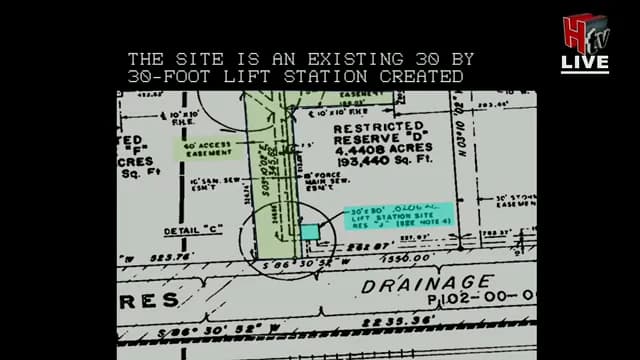
Public Meetings - Houston, TexasThe Houston Planning Commission met on Thursday, June 11, 2026, at 2:32 PM in the City Hall Annex, 900 Bagby. Vice Chair Sunny Garza chaired the meeting due to Chair Lisa Clark's absence. The commission considered 64 consent and replat items, several public hearing plats, variance requests, special exceptions, and a development plat. Multiple items were deferred or withdrawn, and no public comments were submitted. Consent Calendar - Items 1-64 (Sections A & B): The commission approved all staff recommendations for consent and replat items not requiring notification, with the exception of items 7, 20, 28, 29, 30, and 60, which were pulled for separate consideration and approved individually. No speakers were present. Director's Report - Director Von Tran reported on the 2026 Major Thoroughfare and Freeway Plan Amendment virtual open house held the previous evening, which had several dozen attendees. The next step is a public hearing before the Planning Commission on July 23, 2026, at 1 PM. Discussion Items - Item 65 - Charlotte Mont Place: Approved to create three single-family residential lots. No variances requested; staff recommendation approved. - Item 66 - Culver Residences: Deferred to allow the applicant to provide a letter of support from an adjoining lot. The public hearing was continued. - Item 67 - Davenport Manor: Approved to create two single-family residential lots. No variances requested. - Item 68 - FMU Kwood Collection: Deferred for two weeks per applicant request to coordinate with legal on deed restrictions. Public hearing continued. - Item 71 - Madero Village: Deferred because the item packet was missing from the full agenda packet; deferred for two weeks. - Item 72 - Royal Plaza: Approved to create one unrestricted reserve. - Item 73 - Woodland Acres Part 2, Replat 5: Approved to create two single-family residential lots after the applicant revised the plat to meet a 25-foot front building line restriction. - Items 75 & 76 - Grand Mason General Plan and Detention Reserve A: Deferred for two weeks (item 75) and a 30-day extension was granted (item 76) per applicant request to coordinate with Harris County Engineering on right-of-way status. - Item 77 - Houston Office Build-Out: Approved with a variance to allow an unrestricted reserve to take access via an access easement instead of public street frontage. - Item 78 - Market Street Lift Station 2: Approved with a variance to allow access via an existing access easement for a lift station expansion. - Item 79 - Mountain View Terrace: Approved with variances to allow a 40-foot right-of-way (instead of 50 feet) and reduced intersection spacing. The property is in the Acres Home Mobility Study area; a compromise was made to secure a street connection. - Item 80 - North Houston Commerce Park GP: Approved with variances to exceed maximum local intersection spacing along multiple boundaries. The site is proposed for industrial use and adjacent to an elementary school and other constraints. - Item 81 - Poundbury Section 2: Deferred to give the applicant time to provide revised materials and new drawings. - Item 82 - Salinas Estates at Sharon Street: Approved with variances for reduced building lines (12 feet along major thoroughfare, zero feet on local street) and no visibility triangle. The site was reconfigured due to historical platting and street widening. - Item 83 - Wildcat Industrial: Deferred at the request of Mayor Pro Tem Martha Castex Tatum's office to address constituent concerns regarding a sunset property adjacent to the site. - Item 84 - Dunham Point GP: Approved with a special exception to exceed intersection spacing by not providing an east-west public street, justified by a 2024 amendment removing a major thoroughfare segment across Cypress Creek. Commissioner Pierce recused. - Item 86 - Solara: Approved with a variance to exceed intersection spacing by not extending a stub street or terminating it in a cul-de-sac. - Item 87 - Windward Falls GP: Approved with a variance to allow minimum intersection spacing of 301 feet instead of the required 600 feet, due to an adjacent recently recorded subdivision and a school turning zone. - Sections G, H, I, J (Items 88-102): Approved all staff recommendations as a group, including extensions of approval and certifications of compliance. Commissioner Matis recused on item 89. - Item 104 - 4210 Fulton Street: Deferred per applicant request. A member of the public spoke asking about the deferral; staff clarified the item will return in two weeks. - Item 105 - 726 Lawrence Street: Approved with a variance to allow a 5-foot building line for the second floor along Lawrence Street instead of the required 10 feet. The lot is at the end of the street adjacent to a park. A commissioner noted potential utility clearance issues but no deferral was needed. Key Outcomes - Approved: Items 1-64 (with pulled items individually approved), 65, 67, 72, 73, 77, 78, 79, 80, 82, 84, 86, 87, 88-102, and 105. - Deferred: Items 66, 68, 71, 75, 81, 83, and 104. Item 76 received a 30-day extension. - Withdrawn: Items 69, 70, 85, and 103. - Public Hearings: Set for July 9, 2026, for multiple plats (Alkenbury Residents, Bayou Woods Section 2 Rep. 3, Brays Park Estate, Hamlet Residence, High Line Enclave Rep. 1, Kirk and Doll Village Section 1 Rep. 1, Rhine Retreat, Torres Venture Rep. 1, and Vale View Homes). - Next Steps: The commission will meet next on June 25, 2026 (two weeks from this meeting) for deferred items. The public hearing on the Major Thoroughfare and Freeway Plan amendments is scheduled for July 23, 2026. Public Comments & Testimony - No speakers signed up for public comment; no members of the public addressed the commission at the end of the meeting. - One speaker addressed the commission regarding item 104 (4210 Fulton Street) after it was deferred, asking about implications; staff provided clarification.
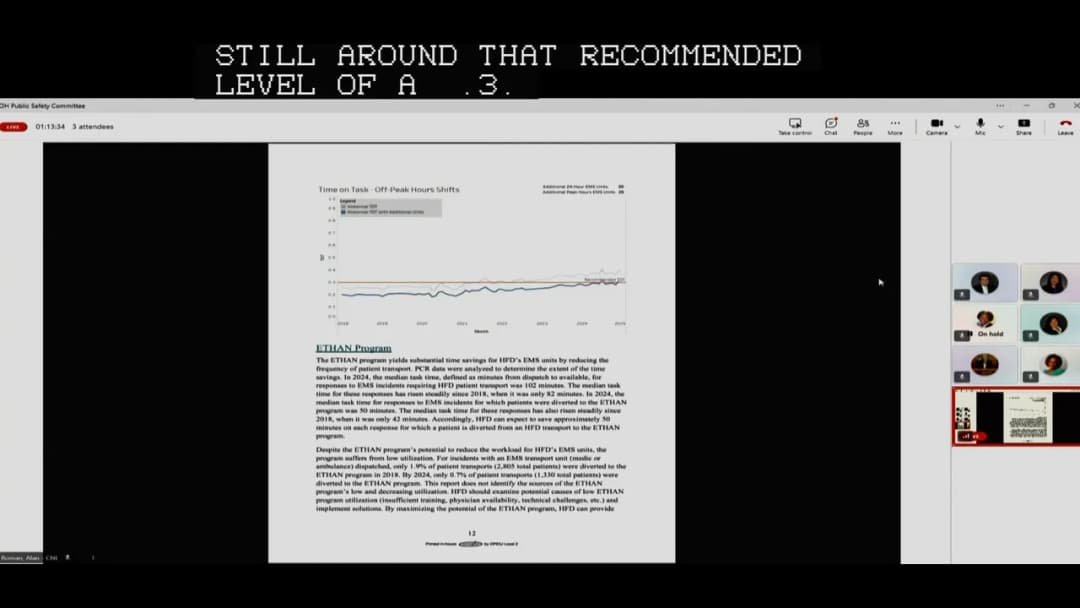
The Houston City Council Public Safety Committee, chaired by Council Member Amy Peck, met on June 9, 2026, to receive a presentation from the Houston Professional Firefighters Association (HPFFA) on a comprehensive work demand analysis of the Houston Fire Department (HFD). The study, conducted by International Association of Firefighters data analysts over a year at no cost to the city, examined seven years of CAD data (2018–2024) to assess resource needs and service delivery. Key findings included a 34% increase in fire incidents per day and a 21% increase in EMS incidents per day over the study period, with call volume growth outpacing resource additions. The analysis recommended adding 65 EMS units (30 24-hour and 35 peak-hour ambulances) and constructing 10 new fire stations to improve response times and reduce system strain. Public Comments & Testimony - Doug Smith: Expressed support for increasing ambulance availability and noted the importance of the Ethan program (low-acuity transport alternative), expressing concern about its low utilization (0.7% of transports). Asked for clarification on definitions of EMS unit types (medics vs. squads) and sought data on airport-reimbursed overtime for fire department personnel. Also noted a discrepancy in incident counts between pages 10 and 13 of the report. Discussion Items - Presentation by Marty Langton (HPFFA President), Jeremy Berman (IAFF data analyst), and Marshall Cloud (EMS data specialist): - Overview: The study was a collaborative, data-driven analysis of HFD operations from 2018–2024, including all CAD, PCR, and out-of-service data, with interactive tools for each council district. It aimed to identify systemic issues and efficiency opportunities. - Call Volume Trends: Fire incidents per day increased 34%; EMS incidents per day increased 21%. Population growth (estimated 300,000 new residents since 2010) is a primary driver, but aging infrastructure and development patterns also contribute. - Time on Task (Utilization): The industry-recommended utilization target is 0.3 (30% of unit hours spent on direct patient care). In 2018, 31% of EMS units exceeded this during off-peak hours; by 2024, 86% exceeded it. During peak hours, 86% exceeded the target in 2018 and 96% in 2024. Over the last 200 days of the study, 56% of medic units and 65% of ambulances were busy or out of service during the median incident, leading to 211 incidents where all medics were unavailable and 63 where all ambulances were unavailable. - Recommended Additions: To return to 2018 workload levels, the report recommends 65 additional ambulances (30 24-hour, 35 peak-hour). This would bring peak-hour time on task from 0.6 to below 0.4. Ten new fire stations were recommended based on a value-added analysis (at least three additional incidents per day expected to receive a four-minute response). - Dispatch Options: Changing ALS dispatch to send only one medic and a fire apparatus could reduce overall workload but would increase medic unit workload, already a constrained resource. - Travel Time: Current engines meet the four-minute travel time standard for only 29% of incidents within their own response area; the new stations target high-impact areas. - Ethan Program: In 2024, only 0.7% of patient transports used Ethan (low-acuity alternative transport). HPFFA supports the program and believes education and consistency will improve utilization, potentially saving an average of 50 minutes per transport. - Staffing: HFD has added paramedic classes (previously under 25, now up to 150 in training) thanks to council funding. The department achieved a net gain of 100 firefighters in eight months, overcoming prior attrition trends. Full paramedic staffing will take time due to the nine-month training requirement. - Cost Estimates: Initial ambulance cost $325,000, with annual operating cost $1 million per unit (net $700,000–$800,000 after cost recovery). - Council Member Questions and Comments: - Council Member Alcorn: Asked about the 34% fire incident increase, attributing it to growth; clarified time on task calculation and value-added station metric. Noted the contrast with the 2016 Facets study recommendation (70 ambulances) vs. only 5 added. - Council Member Martinez: Inquired about breakdown of fire vs. EMS calls, noting 87% EMS incidents. Discussed prioritizing ambulance addition over apparatus, and learned that adding ambulances reduces fire truck usage for medical calls, lowering overall system strain. Also asked about paramedic count (400+ currently) and Ethan program low utilization. - Council Member Huffman: Raised traffic impediments at specific intersections (e.g., Woodway/Chimney Rock) and suggested PSAs to improve public awareness of yielding to emergency vehicles. HPFFA agreed to model specific locations and supported re-education efforts. - Council Member Ramirez: Questioned population growth assumptions, citing data from Bill King showing domestic outmigration and slower future growth. Discussed staffing models—HPFFA stated cross-training paramedics as firefighters is required by Texas law and integral to system efficiency. Also inquired about stationing ambulances without full fire stations; HPFFA explained that 24-hour units require infrastructure for crew rest, and co-location is most cost-effective. - Council Member Davis: Asked about transport times to hospitals and the impact of hospital bed availability on unit out-of-service time. HPFFA noted no standard governs transport times but data can be modeled. Also discussed workload distribution by unit and district. - Council Member Flickinger: Noted population growth from 2018–2024 was only 2.7% (65,000), implying other factors drive call volume increases. Asked about ambulance-only stations; HPFFA stated such stations are being considered but co-location remains most efficient. Also asked about mutual aid (e.g., Kingwood) and confirmed incidents data includes mutual aid calls. Expressed support for PSAs and increasing ambulance fleet, sharing a personal anecdote about a fire truck response without transport capability. - Staff from Council Member Panzarella's Office: Clarified reasons for fire trucks responding to medical calls (shortages of ambulances and need for multiple personnel). Asked about paramedic training pipeline (from 25 to 150 trainees) and steps to improve Ethan utilization; HPFFA emphasized collaboration with city leadership and dispatch protocol adjustments. - Staff from Mayor Pro Tem Castatum's Office: Asked about hospital selection criteria (closest appropriate facility based on trauma level) and crew assignment consistency (affected by previous staffing shortages, now improving). HPFFA noted hodgepodge assignments are being addressed. Key Outcomes - No formal votes were taken; the meeting was informational. - The committee will request an update from HFD on the Ethan program within the next few months. - HPFFA will provide follow-up data on specific questions raised (e.g., average travel times, airport overtime reimbursement, breakdown of mutual aid, discrepancy in incident counts, and details on squad vs. medic units). - Council members expressed support for increasing ambulance capacity and exploring public education campaigns on yielding to emergency vehicles. - The next Public Safety Committee meeting is scheduled for July 14, 2026.
The Houston City Council met on June 9, 2026, to adopt the Fiscal Year 2027 budget, consider multiple proclamations, hear public testimony, and vote on a series of budget amendments. The meeting began with proclamations honoring Memorial Assistance Ministries, The Women's Hospital of Texas (50 years), the Greater Houston LGBTQ+ Chamber of Commerce (10 years), and two first responders (Captain Andy Roseborough and Dr. Joyeth Lagesity). After public comments and discussion, the council approved the budget (15-1) and numerous related items. Consent Calendar - Adopted minutes of May 27, June 2, and June 3, 2026. - Approved routine items including appointments, contracts, and spending authorities on the consent agenda, with several items pulled for separate consideration. Public Comments & Testimony - Multiple speakers urged increased funding for BARC (animal shelter), noting that Houston allocates only $6.75 per person compared to $14 in Dallas and San Antonio. Speakers from Barrio Dogs, East End Kitties, and other groups called for free spay/neuter services, public education, and an end to "pet rent." - Residents from Northeast Houston (e.g., Mirtala Tristan, Vernon Bruce Hart, David Espinoza) supported budget amendments 4.01 (illegal dumping) and 4.02 (public works hiring), describing chronic flooding, clogged ditches, and dangerous tree limbs. - Lucy Moreno complained about solid waste service, including a broken recycling bin and a staff member damaging her property; council members promised follow-up. - Cheryl Chandler requested an honorary street marker for Reverend Bird Lacey Jr. in Fifth Ward; council expressed support. - Several speakers advocated for the "People's Budget," opposing a regressive trash fee and calling for more transparency on tax abatements (amendment 1.05). - Four pastors (Elmo Johnson, F.N. Williams, Reverend Castanõ, T. Leon Preston) spoke in favor of the $5 administrative fee, describing it as a small sacrifice for improved services. - Additional testimony addressed women's health, youth programs, Juneteenth, and other community concerns. Discussion Items - Public Hearing – Chimney Rock Park Utility Corridor: Houston Public Works and Parks & Recreation presented a proposal to use a portion of Chimney Rock Park for a new 42-inch sanitary sewer line (trenchless construction). The existing 1958 line has reached its end of life. Alternatives were analyzed, and the preferred route avoids major disruptions. The hearing was closed with no opposition. - Budget Amendments and Voting: Over two dozen amendments were considered. Key outcomes: - 1.01 (Ramirez): $216,000 for Crisis Call Diversion Center (passed). - 1.02 (Ramirez): $115,000 for a licensed therapist on a CERT team (passed). - 1.03 (Ramirez): Quarterly overtime reporting – referred to committee. - 1.04 (Ramirez): TIRF affordable housing expenditure report – referred to housing committee. - 1.05 (Ramirez): Tax abatement accountability report – referred to economic development committee. - 4.01 (Salinas): $3 million for illegal dumping prevention and cleanup (passed). - 4.02 (Salinas): $500,000 for public works hiring – withdrawn after commitment to fill 95 inspector vacancies. - 6.01 (Peck): Analysis required before any increase in the solid waste administrative fee (passed). - 6.03 (Peck): Sunset of container lease fee at end of FY27 unless council votes to continue (passed 10-6). - 13.01 (Castillo): $75,000 for LGBTQ+ economic empowerment coordinator (passed). - 13.02 (Castillo): $500,000 for BARC kennel cleaning and operations (passed). - 16.02 (Castex-Tatum): $250,000 for recycling education and outreach (passed). - Other amendments were withdrawn, referred, or voted down. - Floor Amendment (Salinas): Incorporation of the administrative fee into the city's Water Fund (donation-based) for low-income relief – committed to be brought back for formal vote within two weeks. - Item 61 – FY2027 Budget Adoption: After extensive debate, the budget was approved 15-1 (Councilmember Pollard voted no). The budget includes a $5 monthly solid waste administrative fee, reorganization of solid waste under Public Works, and funding for water infrastructure, public safety, and illegal dumping. Key Outcomes - FY2027 Budget Passed (15-1) with a $5 administrative fee for solid waste, remaining at $5 for FY27 and FY28 with a cap of $25. The budget uses $200 million from the Combined Utility System (CUS) reserves for right-of-way and solid waste integration, with assurances that water and wastewater projects will not be delayed. - Container lease fee sunset (6.03) unless council votes to continue after FY27. - $3 million dedicated to illegal dumping (4.01) with quarterly reporting. - $500,000 added to BARC (13.02) for kennel cleaning and operations. - $75,000 for LGBTQ+ business coordinator (13.01). - Commitments to fill 95 public works inspector vacancies and to provide ongoing committee reports on overtime, TIRF spending, tax abatements, and container lease fund performance. - Planned amendments to allow low-income relief for the administrative fee via the Water Fund within two weeks. - Proclamations declared June 9, 2026 as "Memorial Assistance Ministries Day," "The Woman's Hospital of Texas Day," "Greater Houston LGBTQ+ Chamber of Commerce Day," and "Captain Andy Roseborough and Dr. Joyeth Lagesity Day." - Honorary street marker for Reverend Bird Lacey Jr. to be voted on at a future meeting.
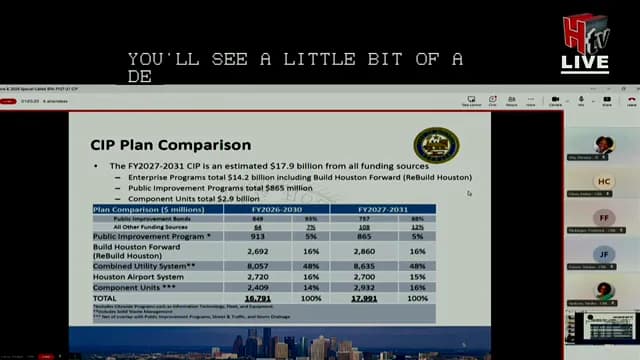
The Budget and Fiscal Affairs Committee, chaired by Sally Alcorn, met on June 8, 2026, to review the proposed Capital Improvement Plan (CIP) for fiscal years 2027 through 2031. The meeting included presentations from Finance Director Melissa Dubowski and Deputy Director Alma Tamborello, covering the $17.9 billion five-year plan across four major areas: Public Improvement Program, Build Houston Forward, Enterprise Funds, and Component Units. Councilmembers discussed bond capacity, sidewalk funding, drainage programs, fleet spending, and solid waste reporting. Discussion Items - Overview of the CIP: Finance staff presented the $17.9 billion proposed plan, a decrease in the Public Improvement section due to solid waste moving to Combined Utility System, and increases in Build Houston Forward and Combined Utility System. The plan is a rolling, five-year document subject to change. - Funding Sources: Public Improvement is supported by general fund debt; Build Houston Forward by DDSRF (drainage utility charge and developer impact fees) plus grants; Enterprise Funds by rates, charges, and grants; Component Units by tax increment, zoo revenue, and Houston First revenues. - Public Improvement Program Highlights: $185 million for municipal courts, fire station renovations, fleet commitment of $292 million (up from $246 million), and technology upgrades including CAD system replacement ($10 million) and SAP S4 HANA ($12.8 million). - Build Houston Forward: Street and traffic control: $1.58 billion, with $790 million for citywide rehabilitation and $513 million for thoroughfares/collectors. Council district service fund: $27.5 million. Safe sidewalk program increased to $28 million (from $16.5 million). Storm drainage: $1.3 billion, with neighborhood drainage $775 million, SWOT program $128 million, local drainage $97 million, and ditch reestablishment $125 million. An additional $25 million for ditch reestablishment is in the FY27 operating budget (stormwater fund). - Debt Payoff: Since 2012, $2 billion in street and drainage debt paid off; $367 million still owed. As debt is paid, more funds become available for pay-as-you-go projects. - Combined Utility System: Wastewater treatment facilities $3.8 billion, including neighborhood sewer renewal ($731 million). Water system $4.3 billion, driven by East Water Purification Plant. Need to expand commercial paper capacity for implementation. - Houston Airport System: Five-year CIP totals $2.7 billion, with $2 billion at IAH focusing on taxiway and runway improvements. - Bond Election Discussion: Vice Mayor Pro Tem Peck asked about timing for a future bond election. Staff indicated elections are held every 4-6 years; the last was in 2022, so another is likely in the next year or so. Councilmember Panzarella clarified that bond authorization is like a credit limit and does not necessarily mean tax increases; the city plans to stay within revenue caps. - Fleet Spending: Councilmember Panzarella asked about fleet details. Staff explained that fleet spending is broken out by department, with specific unit counts only for the first year due to cost volatility in later years. - Solid Waste Reporting: Councilmember Panzarella requested better separation of solid waste capital costs from the combined utility system. Staff noted that solid waste facilities are in a separate chapter but funding source is now Combined Utility System. A council district summary of projects will be provided. - Amendment Process: Councilmember amendments are due by the end of the week (June 12). Finance will compile them into a matrix for organized discussion. Key Outcomes - The CIP will be brought to City Council on June 17, 2026, with a potential vote on June 24, 2026. - Council members were directed to submit CIP questions through the SharePoint system under the appropriate department. - A council district summary of projects will be made available. - No formal votes were taken at this committee meeting.
The Super Neighborhood Alliance held its monthly meeting on June 8, 2026, via video conference. The meeting featured presentations on disaster recovery housing funds from the City of Houston Housing and Community Development Department and an update from the Texas Department of Transportation (TxDOT) on World Cup preparations. Other business included a budget and finance committee report, approval of minutes, and a decision to take July and August off. Public Comments & Testimony - Several super neighborhood representatives asked questions of Latasha Smith (HCD) about the disaster recovery program, including eligibility, taxable status of grants, floodplain requirements, and requests for presentations in their neighborhoods. Tamaro Bell expressed appreciation for TxDOT engagement. Vicky from Super Neighborhood 49/50 reported a lighting issue on 610 and a missing sign, and Glenn Albert committed to follow up. Lindsay Williams requested a meeting about the I-45 realignment project. Dexter asked about better communication on construction closures. Doug reported a victory against a proposed gas station on Southmore. Discussion Items - Disaster Recovery Funds (HCD Presentation): Latasha Smith presented on the Disaster Recovery Program for the 2024 storms (DeRico May 16–17 and Hurricane Beryl July 5–9). The program provides up to $100,000 for home rehabilitation and up to $300,000 for full reconstruction. Eligibility: owner-occupied primary residence in Houston city limits, outside floodway, income at or below 80% area median income, sustained damage from the named storms. Homeowners must be current on mortgage/property taxes. Temporary housing is provided during reconstruction. Applications are expected to open at the end of summer; advance preparation of documents is encouraged. Smith noted that application workshops will be held at community centers to assist. - TxDOT World Cup & Cleanliness Update: Glenn Albert, Houston District Engineer for TxDOT, reported on efforts to beautify corridors in preparation for the FIFA World Cup. Over 5,500 trees planted, 17 million sq ft of concrete power washed, 13 million sq ft power washed and repainted, 2,800 large green signs replaced, and 1,200 high-mast lights upgraded to LED. Maintenance has increased: interstate sweeping from twice monthly to weekly, mowing from 4 to 8 times per year, and doubled litter pickup. During World Cup, contractors will continue work behind existing barriers but no new lane closures or temporary closures on game days; only the downtown NHIP drainage project will be paused. - Budget and Finance Committee Report: Jack provided an overview of the city's budget situation. The city faces a $200 million shortfall in a $7.5 billion budget. Proposed solutions include transferring $200 million from the water fund and adding a $5 monthly household fee for trash service. Jack expressed concerns about sustainability and noted that the health department may be shortchanged. Controller Hollins approved the mayor's budget proposal, but overtime spending remains a concern. The budget must be approved by July 1. Key Outcomes - Approval of Off Months: A motion to cancel meetings in July and August was approved unanimously. - Minutes Approval: The April and May meeting minutes were approved. The February minutes remain unresolved; Letitia directed Greg to meet with Cheryl within 14 days to resolve concerns, after which a virtual vote will be conducted. This directive was challenged by Greg but the meeting ended without further action. - Next Steps: HCD will schedule presentations at individual super neighborhood meetings. TxDOT committed to better communication and will provide a map of state-maintained roads. A meeting on I-45 realignment will be arranged.
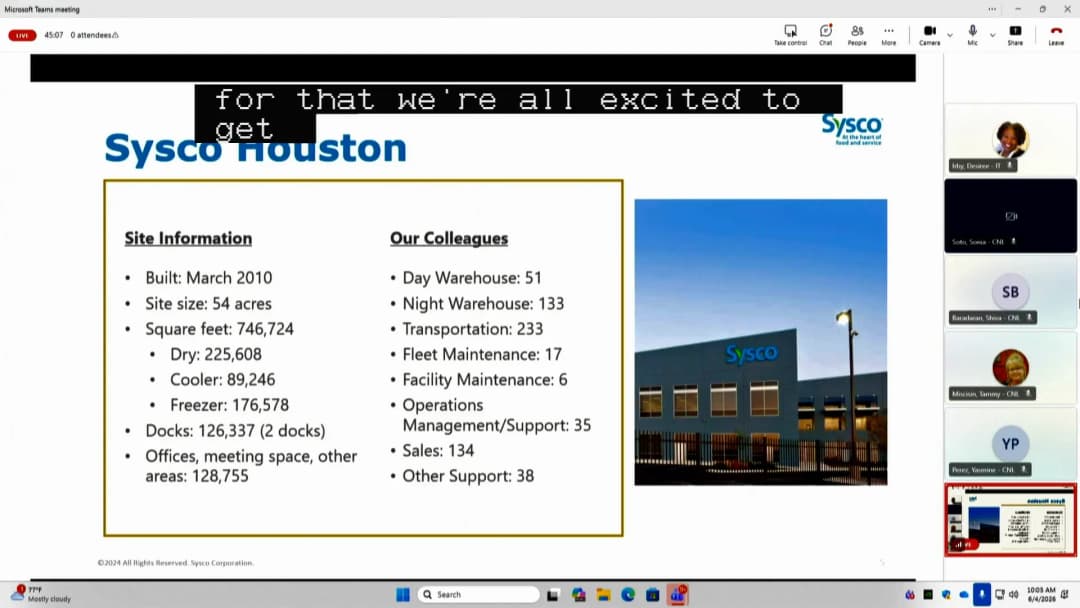
On June 4, 2026, the City of Houston's Resilience Committee, chaired by Councilmember Twilight Carter, convened at 10:01 AM. The committee heard a presentation from Cisco (Sysco) on its business continuity and disaster support operations. Representatives Vendetta Blau (VP of Enterprise Risk Management) and Ryan Forth (South Texas Region President) detailed Cisco's Houston presence, resilience strategies, and recommendations for city-private sector coordination. Councilmembers present included Carter, Panzarella, Thomas, Martinez, Tatum, and Ramirez, along with staff from multiple council offices. Presentation Overview - Cisco operates 337 distribution points across 13 countries, with over 75,000 employees supporting 730,000 customers in restaurants, hospitals, schools, and government. - Its Houston headquarters (built 2008, LEED Gold) houses about 1,200 employees, and a broadline distribution center on the north side employs roughly 600. Two cash-and-carry locations (Cisco To Go) recently opened. - The company's resilience program includes annual readiness training, generator backups, fleet inspections, and simulation scenarios. It prioritizes deliveries to hospitals, nursing homes, and first responders during disasters. - Through the Greater Houston Partnership, Cisco secured passage letters for drivers to access disaster areas. It also donated 23,000 bottles of water, 8,000 bags of chips, 10,000 pieces of fruit, and 6,000 servings of juice to West Gray and Southwest multi-service centers after Hurricane Barrel. Discussion & Q&A - Councilmember Panzarella asked how multi-service center locations (West Gray and Southwest) were selected for past distributions; Cisco responded that locations were based on need and accessibility, and it is open to prioritizing centers designated by the city. - A question from Councilmember Peck's office inquired whether district offices could request disaster relief directly from Cisco. Cisco confirmed it is possible, subject to bandwidth after ensuring employee safety and facility power, and offered to follow up with a formal plan for such requests. - Councilmember Carter noted Cisco's large fleet (third-largest in the U.S.) and emphasized the value of its resources. No other questions were raised. Key Outcomes - No formal votes or decisions were taken. The committee received information and recommendations for strengthening Houston's resilience. - Cisco offered to provide a follow-up plan outlining how council districts can request disaster relief support. - The next Resilience Committee meeting is scheduled for August 10, 2026, at 10:00 AM.
Chair Sally Alcorn convened the Budget and Fiscal Affairs Committee meeting on June 2, 2026, at 9:00 AM. Members present included Mayor Pro Tem Martha Castax Tatum, Vice Mayor Pro Tem Amy Peck, Councilmembers Joaquin Martinez, Twilight Carter, Mario Castillo (Vice Chair), Joe Panzarella, Julian Ramirez, and staff from Councilmembers Tarsha Jackson, Mary Nana Huffman, Tiffany Thomas, and Pollard. Councilmember Willie Davis was also in attendance. The meeting covered the monthly financial report, upcoming financial transactions, community budget survey results, the annual Kinder Houston Area Survey, and proposed amendments to the open space ordinance. Monthly Financial Report - Controller's Office (Will Jones and Melissa Dubowski, Finance Director) projected a general fund ending balance of $276.5 million (10.4% of expenditures, less debt service and pay-as-you-go) for FY26, which is $23.5 million lower than the finance department's projection. The difference was attributed to lower revenue projections, primarily $16 million from the TURS municipal service charge recalculation (moving from 2017 to 2021 property values). - Finance Department projected an ending fund balance of $300 million (11.3% of expenditures), noting a small increase of $100,000 from higher-than-anticipated land sales. Sales tax receipts for March were $89.2 million, 4.47% higher than the same period last year and $7.9 million above budget. The department maintained a conservative sales tax estimate of $920 million, noting remaining periods need to come in about 3% below prior year. - Councilmember Julian Ramirez noted the $23.5 million discrepancy between the two projections and inquired about the municipal service fee recalculation. Director Dubowski explained that the fee, previously based on 2017 values, is being brought up to tax year 2021 values, and the revenue impact is now being reflected in the general fund. Councilmember Ramirez suggested a deeper dive into the municipal services fee calculation. - Public speaker Doug Smith expressed difficulty understanding the late-fiscal-year projection gap and questioned the practice of holding large unspent balances in the DDSRF. He also pointed out a discrepancy in hotel occupancy tax bond refunding figures ($1.3 billion in refunding bonds vs. $516 million outstanding the prior year). Upcoming Financial Transactions - Melissa Dubowski presented two upcoming transactions: 1. Tax and Revenue Anticipation Notes (TRANS) Series 2026: An annual short-term borrowing to manage working capital due to timing differences between property tax collections (peaking Dec-Feb) and even expenditures. A competitive sale will be conducted in August, with terms presented to council in July. Closing is planned before the fiscal year-end. 2. Combined Utility System Commercial Paper Expansion: To fund the capital improvement plan (including East Plant and consent decree projects), the finance working group recommends adding $500 million in capacity. Morgan Stanley was selected as the provider after a request for term sheets. An RCA will be brought to council in July. - Chair Alcorn asked whether the new administrative trash fee (expected to generate $20 million) could be used as collateral for borrowing. Director Dubowski confirmed it becomes revenue of the combined utility system and can back revenue bonds. - Public speaker Dominic Mazat urged more public engagement on the budget, including evening hearings, earlier budget process start (e.g., February), and greater transparency. He supported the Kinder Institute survey but noted the budget process felt "irrational." Councilmember Ramirez agreed with starting public engagement earlier. Two Cents Budget Survey (Kinder Institute) - Presented by Dan Potter (Director, Houston Population Research Center) and research analyst Dylan Simberger. The survey was conducted April 14 – May 27, 2026, with 920 responses via an open-access, convenience sample distributed through meetings, social media, and word-of-mouth. Responses came from all 11 council districts, though participation varied (e.g., District C had high turnout). - Key Findings: - Top priority for increased spending: Infrastructure (roads, drainage, water pipes, electric grid) – 80% of respondents wanted more spending; 96% opposed cuts. - Other high priorities for more spending: Solid waste management and programs addressing homelessness (60% each). - For decreased spending: 25% supported less spending on Houston Police Department; 20% supported less on Houston Fire Department, economic/workforce development, and housing programs. - When forced to choose (if budget cuts were necessary): Most respondents were okay with cuts to economic/workforce development (70% okay), but infrastructure was off-limits (only 10% okay with cuts). Parks and recreation had a 50-50 split. - Public safety spending (if more must be spent): Top choices were mental health/homelessness programs (70% support more, with 30% wanting "a lot more"), followed by police investigations and patrols (60% support more). - Willingness to pay fees: Only a garbage fee had majority support (two-thirds of respondents). The sweet spot for monthly fee was $5 (half of supporters chose this amount). Other fees (parks, public safety, libraries) did not reach majority support. - Councilmember Alcorn noted the survey is a convenience sample, not scientific, but still instructive. Councilmember Thomas highlighted alignment with the Consolidated Annual Action Plan (CDBG). Councilmembers Martinez and others discussed the need to increase fees across departments and to leverage state/federal partners. Councilmember Peck and Flickinger thanked for the data. Councilmember Davis asked about district distribution; Chair Alcorn said the appendix breaks down by district. - Public speaker Laura Gallier suggested breaking down infrastructure preferences similarly to public safety (e.g., bike trails vs. health clinics) and criticized the framing of public safety spending as a forced increase. She also noted resistance to the survey from some residents. - Public speaker Sarah Raymond criticized the low response rates (29 per district in some cases) and asked about FIFA reimbursement funds used for police special services. Chair Alcorn said they could check. Kinder Houston Area Survey (45th Annual) - Presented by Dan Potter. Survey conducted via the Greater Houston Community Panel with almost 9,000 residents from Fort Bend, Harris, and Montgomery counties (representative sample using incentives). The report focused on economy, environment, and social connections. - Economy: Job optimism saw the largest single-year drop ever in Fort Bend and Montgomery counties, and the second-largest in Harris County (behind only 1982-83 oil crisis) – a 29 percentage point decrease. The Houston area added fewer than 20,000 jobs in 2025, well below projected 70,000. The economy was identified as the biggest problem by about 25% of residents, up significantly. Crime/safety, housing cost, and traffic were other top concerns. - Environment: Despite a relatively calm 2025 for natural disasters, concern remained high across all income levels for flooding, wind/hail, freeze, and extreme heat. Concerns about contaminants (aging pipes, lead, illegal dumping, clean drinking water) were high, with significant income disparities but still majority concern even among high earners. 70% of residents are moderately to extremely concerned about the environment's effect on their health. - Social Connections: The survey explored the benefits of knowing one another, personal/professional networks, and social cohesion. Key example: 91% of Republicans and 97% of Democrats support universal background checks for gun sales (a unifying issue, not divisive as often perceived). Social connections were strongly correlated with greater economic mobility (85% control over finances if connected vs. 36% if not), better physical health (60% good health if high social cohesion vs. 41% if low, comparable to income gaps), and greater perceived safety (83% feel safe walking alone at night if high social cohesion vs. 58% if low). Income did not significantly affect sense of safety after accounting for social cohesion and general feelings of safety. - Councilmembers Carter, Alcorn, and others thanked the presenters. No public comments on this item beyond the general public comments already addressed. Open Space Ordinance Amendments - Presented by Planning Director Von Tran and Parks Director Kenneth Allen. The amendments bring the ordinance into compliance with Chapter 212 of the Texas Local Government Code (effective Jan 1, 2024). Key changes: - Adopt a lower fee cap (not greater than 2% of median household income). - Transition multifamily to fee-only; collect fees at certificate of occupancy; establish an appeal process. - Allow up to 30% of fees collected in a sector to be used in other sectors (previously had to stay in the same sector). - Extend obligation timeline from 3 to 5 years; transfer fund management authority from Parks Board to Parks Director. - The ordinance was approved unanimously by the Planning Commission on May 28, 2026, after a public hearing period with 13 comments – none objecting to the text, but six recommended increasing the fee-in-lieu ($700, unchanged since 2007). Chair Alcorn stated she intends to bring a separate amendment to raise the fee later this summer, after stakeholder engagement. She noted CPI suggests $1,113 and appraised values $1,400, but state law caps at $1,260. - Councilmember Ramirez asked about coordination with TIRS districts. Director Allen explained all expenditures require council appropriation and are tracked centrally. The 30% cross-sector flexibility mirrors the sidewalk fee-in-lieu practice. Mayor Pro Tem Castax Tatum confirmed the origin of the 30% figure. - Councilmember Martinez supported the changes and raised concern about park maintenance funding (suggested average maintenance per park is $1,200). Director Allen noted the fund cannot be used for general maintenance, only new improvements or major replacements. Martinez noted parks like Walter Jones lack programming due to poor facilities. - Public speakers: - Doug Smith supported but asked for detailed reporting on expenditures; Chair Alcorn noted a report is on her website. - Vanessa DeLeon Diaz (Friends of Columbia Tap) highlighted inequities: Sector 14 (Memorial Park) collected over $21 million in developer fees, while east-side sectors with higher poverty collected a fraction. Private conservancy revenue is also skewed: 73% goes to wealthy areas. She urged council to interrupt this cycle. - Taylor Valley Presley (Coalition for Environment, Equity, and Resilience) supported the amendments but urged prompt action on raising the $700 fee, unchanged since 2007. - Karina Espinosa (Friends of Fonde Park) noted lack of management district in her area and requested a covered area and community center. Councilmember Martinez confirmed Brookline Park is on the list for improvements. Key Outcomes - The committee voted unanimously to advance the open space ordinance amendments favorably to full council. (Motion by Mayor Pro Tem Castax Tatum, voice vote, no dissent.) - Chair Alcorn announced a special called meeting on Monday, June 8, 2026, at 10:00 AM to review the proposed FY27-31 Capital Improvement Plan (CIP). - No other formal votes were taken; the reports and presentations were informational. - The next regular BFA meeting is to be rescheduled due to the July break.
The Houston City Council convened on June 2, 2026, for a full agenda that included three proclamations, public comments on city services and the proposed Fiscal Year 2027 budget, a public hearing on the budget, detailed budget presentations from the City Controller and Finance Director, and voting on numerous agenda items. The meeting highlighted significant community engagement on the proposed solid waste administrative fee, illegal dumping, ditch maintenance, and police spending. No final vote was taken on the FY 2027 budget; that will occur at a later meeting. Consent Calendar - Minutes from May 19 and 20, 2026 were adopted unanimously. - Items 2 through 13 (under miscellaneous, accept work, and purchase categories) were approved en bloc. Item 9 was pulled. Item 41 was pulled. - Items 15, 16, 17, 18, 19, 24, 25, 26, 27, 33, 35, and 36 were removed from the consent calendar for separate consideration. Public Comments & Testimony Numerous residents and organizational representatives spoke during two public comment periods and the budget public hearing. Many speakers focused on the proposed $5 monthly solid waste administrative fee, the ditch reestablishment program, police spending, tax abatements, and animal services. - Solid Waste Fee & Budget Equity: A majority of speakers opposed the flat $5 fee, calling it regressive. Several speakers, including Rita Robles, Lindsay Williams, and Alfredo Dominguez, proposed a progressive alternative: a $1 monthly fee combined with a one-cent property tax increase. Speakers from the Texas Gulf Coast AFL-CIO, United Here Local 23, and HOPE Local 123 expressed support for the budget, stating it protects city services and workers. - Ditch Reestablishment: Multiple residents from Districts B, D, and H, including Becky Sell (West Street Recovery), Dana Jones, Betty Gregory, and Brenda T. Arena, presented evidence of standing water and contamination in ditches despite the city's program claiming completion. They urged council to increase funding for ditch reestablishment to $45 million and improve transparency and oversight. Councilmember Tarsha Jackson noted she is working with Public Works on the program. - Illegal Dumping: Councilmember Salinas highlighted a proposed $3 million budget amendment to combat illegal dumping, referencing the Burns & McDonnell study. Joe B. Allen was recognized earlier for organizing a cleanup that collected 511 tons of illegal dumping in two months. - Police Overspending: Several speakers, including Alfredo Dominguez, Terry Chen, and Andrea Segovia, criticized the police budget, citing $113 million in overtime in FY25 and the disproportionate growth of police funding relative to other services. They urged council to reduce overtime and increase accountability. - Animal Services (BARC): Sophia Proler, Jessica Flores, and Gloria Zenteno advocated for increased funding for BARC beyond the new adoption facility, emphasizing the need for proactive programs to keep pets with families and improve shelter operations. - Tax Abatements: Speakers such as Sarah Riemann and Perla Garcia called for greater transparency and accountability regarding the $93 million in tax abatements (IDAs) granted to corporations, urging council to ensure companies meet hiring and investment promises. - Other Topics: Speakers also addressed the need for affordable housing, support for the immigrant community, and requests for mental health crisis response funding. Discussion Items Proclamations & Recognitions: - Mayor Whitmire proclaimed June 2, 2026 as "Joe B. Allen Day" for his decades of public service and leadership of a citywide illegal dumping cleanup that collected 511 tons of trash. - Councilmember Davis recognized Bob Nowak, City Webmaster, on his retirement after 32 years, noting 18 years of perfect attendance and service to 77 council members. - Mayor Pro Tem Castañeda-Tatum presented a proclamation for the National Forum for Black Public Administrators (NFBPA) Greater Houston Chapter on its 40th anniversary. Budget Public Hearing and Fiscal Report: - The public hearing on the FY 2027 budget (Item 1) was held. Speakers reiterated concerns about the solid waste fee, ditch funding, police spending, and BARC. - City Controller Chris Hollins presented the April 2026 monthly financial report, projecting an ending fund balance of $276.5 million (10.4% of expenditures) for FY 2026, $23.5 million less than the administration's projection. He outlined four "realities": 1) The budget repeats past mistakes (FY 2026 deficit of $180 million), 2) It drains the Combined Utility System (CUS) below sustainable levels—diverting over $200 million in year one for non-water uses, 3) The proposed fee structure hides true costs (a solid waste study indicates $31 per household now, rising to $46 by year five), and 4) The flat $5 fee is regressive, hitting lower-income households hardest. Hollins emphasized the need for honest communication and warned that bondholder approvals for the right-of-way fee are uncertain. - Finance Director Melissa Dubowski presented the administration's view, stating that the budget addresses structural challenges without a property tax rate increase. She noted that the CUS has $1.5 billion in reserves and that a right-of-way fee is standard among peer cities. She confirmed that the proposed budget includes an additional $20 million for ditch reestablishment (total $50.5 million) and highlighted efforts to control costs. - Councilmembers engaged in a vigorous exchange with the Controller and Finance Director, particularly on the long-term cost of solid waste service and the feasibility of keeping the fee at $5. Amendments and Separate Items: - Councilmember Salinas proposed three amendments: (1) $3 million from management consultants for illegal dumping, (2) $500,000 for temporary workers to accelerate hiring at Public Works (HPW), and (3) a floor amendment to allow the administrative fee to be covered by the Water Fund for low-income assistance. All were noted for further discussion. - Items 35 and 36 (interlocal agreements for law enforcement overtime to address homelessness) were discussed extensively. Councilmembers Castillo, Thomas, Martinez, and Pollard spoke in favor, noting the recent soft opening of the 419 Emancipation facility (80 individuals served, 3 moved to permanent housing) and the importance of phased occupancy and community engagement. The items passed. - Item 27 (new BARC adoption facility) was supported as a positive step, with Councilmember Castillo urging continued collaboration with Harris County. - Item 19 (expansion of CUS to include solid waste) was part of the budget package and was tagged for next week. Procedural Motions: - Numerous motions to suspend rules to add speakers to the public hearing list were approved. Key Outcomes - Consent Agenda: Adopted with no objections. - Proclamations: Approved and presented. - Items 15, 24, 26, 27, 35, 36: Passed after separate vote. - Item 15 (continuation of appropriations) passed. - Item 24 ($250,000 for Walter Rasmus Park Heritage House) passed. - Item 26 ($500,000 for Tranquility Park) passed. - Item 27 ($31.8 million for contract with Lindbeck Group, including BARC adoption facility) passed. - Item 35 (interlocal with Harris County for homeless services) passed. - Item 36 (interlocal with METRO for homeless services) passed. - Items 25 and 33: Tagged by Councilmember Castillo and Pollard respectively, to be considered later. - Items 14, 16, 17, 18, 19: Tagged for separate consideration after the public hearing; final action scheduled for a later meeting. - Public Hearing: Closed after all speakers, with the budget discussion to continue. - Monthly Financial Report: Accepted unanimously. - Budget Amendments: Councilmembers Salinas, Ramirez, Peck, and others announced proposed amendments to be discussed further. No amendments were voted on at this meeting.
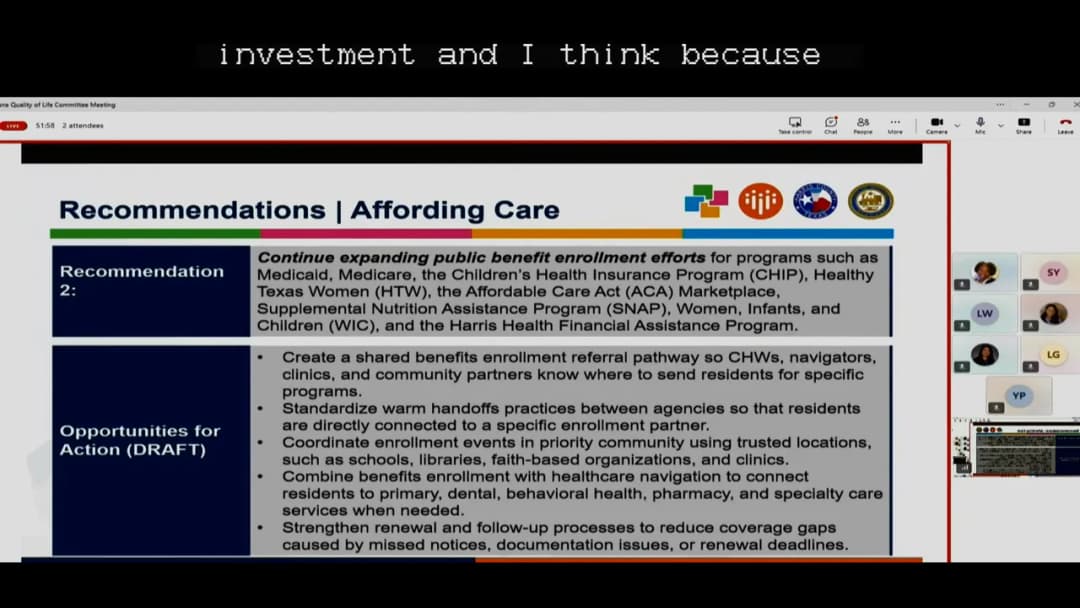
The City of Houston Quality of Life Committee, chaired by At-Large Position 1, met on June 1, 2026, to hear a presentation from the City of Houston Health Department and Harris County Public Health on a collaborative Access to Care Assessment and Report. The presentation covered key findings, recommendations, and next steps to improve health care affordability, accessibility, and quality for residents. No public comments were offered. Discussion Items - Presentation Overview: Dr. Melissa Shelton (City of Houston Health Department) and Brandon Maddox (Harris County Public Health) presented the joint Access to Care Assessment and Report, developed over the past year (starting June 2025) as part of both departments' accreditation requirements. The report focused on three main barriers: affording care, finding care, and receiving care (the "three C's"). - Key Findings and Statistics: - Cost was the most common reason for delaying care in the past 12 months (based on a 2024 community health survey). - About one in five people lack health insurance, and one in six experience poverty in Harris County/Houston. - One in four Texans lacks a primary care provider. - Approximately 9% of households lack internet access, limiting telehealth options. - Nearly three in 10 immigrant adults reported skipping or postponing health care in the past 12 months, an increase over previous data. About one in five Harris County community members are non-citizens. - Recommendations for Affording Care: 1. Develop a coordinated affordable care policy encompassing community health workers, health care navigators, and food-for-medicine models. 2. Continue expanding public health benefits enrollment efforts (Medicare, CHIP, Texas Women, etc.), with standardized warm handoff practices between agencies. - Recommendations for Finding Care: 3. Expand efforts to embed community health workers or resource navigators within partner organizations to address non-medical drivers. 4. Enhance infrastructure to help residents locate accessible care, including development of a web-based interactive safety net facility tool. 5. Improve community health worker workforce development and sustainability. - Recommendations for Receiving Care: 6. Implement culturally responsive engagement strategies and policies addressing historical trauma and mistrust, using trusted messengers like community health workers. 7. Test flexible clinic hours, expand school-based clinics and telehealth, and partner with public libraries, faith-based organizations, and community centers. - Committee Questions: Councilmember Alcorn asked about community health worker training and certification (state of Texas provides training, with contractors also offering certification), whether the city and county collaborate effectively (yes, e.g., mobile unit coordination), and the number of community health centers (no immediate count available). She noted the importance of optimizing existing resources and inquired about progress on a community health improvement plan—both departments are working together on the next community health assessment and improvement plan, focusing on access to care. Key Outcomes - The presentation was received by the committee; no formal vote was taken. - The web-based interactive safety net facility tool is expected to launch in a first iteration (including City of Houston, Harris County Public Health, Harris Health, and Harris Center clinics) in July–August 2026, with plans to add FQHCs and other community health centers later. - The joint community health assessment will begin in fall 2026, involving the city and county health departments along with Harris Health System, to guide future priorities and reduce duplication.