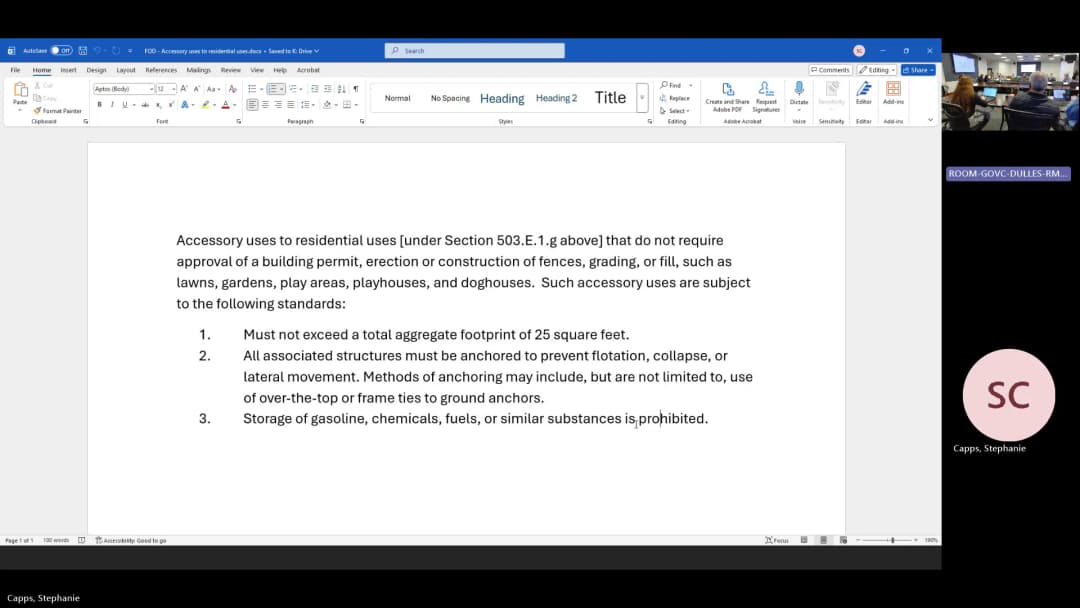
The Zoning Ordinance Committee (ZOC) met on November 5, 2025, from 9:00 AM to 11:00 AM in the Dulles Room. The meeting covered updates on the Floodplain Ordinance, Data Center Standards Phase 2, Zoning Ordinance Rewrite Adjustments, and the Western Loudoun Rural Uses and Standards (WLRUS) project. Public input focused on proposed restrictions for agritourism and agricultural processing. Key decisions included tabling a residential accessory use footprint limit and directing staff to study agricultural fencing in floodplains. Consent Calendar - Approved the Action Report for October 1, 2025 (unanimous, with one abstention). Public Comments & Testimony - Harriet Wegmeyer (Wegmeyer Farms, pick-your-own strawberry and pumpkin farm) expressed strong opposition to proposed car and visitor limits in agritourism language, stating that the caps (e.g., 150 cars / 100 guests) are nonsensical and would threaten the viability of her business. She noted that during peak strawberry season, her farm can exceed 64 reservations per hour (typically one car per family) and that the 100-guest limit is inconsistent with a 150-car allowance. She urged the committee to reconsider the limits. - Kate Zerschmead (Great Country Farms, 31 years of school tours) called the proposed language “draconian” and noted that a key stakeholder consensus at the TLUC meeting—requiring 51% of product from within 50 miles for ag processing—was not reflected in the draft. She stated that the 100-guest cap would crush school programs (some Loudoun schools have more students in one grade than 100) and urged striking car and guest count caps entirely. Discussion Items - Floodplain Ordinance Update (Accessory Uses to Residential) The committee reviewed a staff proposal to allow small accessory structures (e.g., playhouses, sheds, gardens) in floodplains without engineering analysis if they do not require a building permit, erection/construction of fences, grading, or fill, and if the footprint does not exceed 25 square feet (aggregate). - Some members argued 25 sq ft is too small (e.g., typical Costco playhouse is 50 sq ft) and that the limit should be based on real-world sizes. Staff explained that 25 sq ft was chosen to avoid needing a no-rise certification; anything larger would require engineering analysis. - Others questioned whether “footprint” is defined and whether the limit applies to structures like raised garden beds (aggregate across all structures). - A motion to table the item to allow members to submit alternative square footage suggestions (by November 19) and for staff to clarify language (structure vs. use) was approved. - A separate motion was passed to direct staff to study agricultural fencing (non-exclusionary) in floodplains, e.g., dividing fields for rotational grazing, and report back on whether such fencing can be permitted and what path forward would be. - Staff confirmed that exclusion fencing (for creeks) is already permitted in floodplain through a zoning permit, independent of soil & water conservation approval. - Data Center Standards & Locations, Phase 2 Project managers reported that internal language review is ongoing, with draft standards targeted for completion by December 23, 2025. The Planning Commission work session is scheduled for January 8, 2026, and the item is expected to return to ZOC in February 2026. - Zoning Ordinance Rewrite Adjustments 1 Staff corrected the timeline: the draft text will be presented to the Board of Supervisors in June 2026 (not January 2026 as listed in the agenda). The project has been reassigned to Josh Elkins. - Western Loudoun Rural Uses and Standards (WLRUS) – Agritourism and Process Staff presented draft language for agritourism (Section 4.08.16) including vehicle limits (based on lot area, carried over from existing cultural tourism standards) and maximum occupancy of structures (scaled by operation size) with possible increases if certain safety criteria (e.g., fire marshal compliance, water supply) are met. - Several members expressed concern that the occupancy limits (e.g., 20 people in structures for small scale, 100 for large) are inappropriate for agritourism (e.g., classes with 50–100 people, school tours with thousands). The fire marshal’s 2023 letter to agritourism businesses only requires portable fire extinguishers, an emergency plan, and a posted exemption sign; full building code compliance would be economically prohibitive. - A procedural debate arose: some members argued that ZOC should not vote on WLRUS items until TLUC provides formal direction/recommendation. Others noted that for earlier items (equestrian uses), staff had brought forward language based on TLUC stakeholder consensus without formal votes. Committee members requested that future WLRUS items come to ZOC only after TLUC gives clear direction. - The committee agreed to prioritize the equine (equestrian) text at the next meeting and hold off on agritourism and definitions until TLUC provides a recommendation. Key Outcomes - Floodplain: Accessory residential uses – Tabled to December meeting; members to submit comments on square footage by November 19. - Floodplain: Agricultural fencing – Staff directed to study and report back on permitting non-exclusionary fencing in floodplains, with a path to allow it if currently not allowed. - WLRUS Process – The committee will not discuss agritourism or definitions further until TLUC provides formal direction. Next ZOC meeting (December 3, 2025) will focus on equestrian text only. - Meeting Schedule for 2026 – Approved draft schedule (9 AM–11 AM, first Wednesday except April (second Wednesday) and July (second Wednesday due to holiday)). Invitations to be sent by Stephanie. - Next ZOC meeting – December 3, 2025, 9:00–11:00 AM, Dulles Conference Room.
Public Meetings - Loudoun County, Virginia
Public Meetings - Loudoun County, VirginiaThe Transportation and Land Use Committee (TLUC) held a special meeting on November 5, 2025, from approximately 5:00 PM to after 6:30 PM, to receive stakeholder input and discuss proposed amendments (CPAM-2024-0002 & ZOAM-2024-0002) concerning food service, food trucks, farm wineries, limited breweries, and limited distilleries in Western Loudoun County. The meeting focused on four main issues: accessory events, hours of operation and noise, setbacks and parking, and accessory food sales/food trucks, as well as the rural restaurant use. No formal votes were taken; the committee will use the input to develop proposed ordinance text in future directional meetings. Public Comments & Testimony - Tolga Baki (Hillsborough Winery/Brewery, Loudoun County Brewers Association): Expressed support for the industry, noting only 19 noise complaints and 8 citations over five years, less than 2% of all complaints. He argued that events are usual and customary and that the industry generates nearly $50 million in annual visitor spending and 85% of employees are Loudoun residents. - Lacey Hubert (Virginia Wineries Association, Stone Tower Winery): Stated that events and weddings are usual and customary for farm wineries and that food service is vital for viability. She urged enforcement of existing rules rather than new regulations. - Kate Schrumpf (Great Country Farms, Bluemont Vineyard, Dirt Farm Brewing): Supported food trucks as an interim step for food service and asked for standardization across agricultural uses. - Rich Rasmus (Agricultural/Conservation): Raised concerns about noise, traffic, and enforcement difficulties; called for uniform standards across facilities. - Avis Renshaw (Lost Corner Farm, Mom's Apple Pie): Proposed a tiered system based on property size and use intensity, and urged that limited breweries be required to use local Loudoun agricultural products. - Eugene Galand (Agricultural/Conservation): Argued for a "farm first" principle, stating that events and food trucks should not be divorced from agricultural production; he opposed making events accessory uses without on-site farming. - Scott Hamburger (Residential): Emphasized the success of agritourism in preserving rural land and advocated for enforcement over new regulations for outlier behavior. - Chris Suarez (Residential, former brewery owner): Shared positive enforcement experiences and urged prioritizing enforcement over expansion of regulations. - Doug Smith (Residential): Noted that some food trucks are effectively permanent, violating the current ordinance requiring daily removal; he stressed the need for clear rules and enforcement. - Robyn Eve Jasper (Planning Commission): Called for greater clarity on standards, especially for events, and highlighted the friction between promoting agricultural businesses and protecting public safety. - Mark Miller (Planning Commission): Warned that economic development is a choice of something vs. something else, and overly restrictive regulations could lead to subdivision and loss of rural character. Discussion Items - Accessory Events: Staff explained that weddings and special events have historically not been considered usual and customary for wineries and breweries, but the question now is whether they should be. Stakeholders were divided: industry representatives argued events are integral to sales and have been common for decades, while conservation and residential representatives stressed the "farm first" principle and the need for separate permits due to safety (building codes, septic, traffic). Chair TeKrony noted that many event venues were built under agricultural exemptions, sparking concerns about building and fire safety. - Hours of Operation and Noise: Discussion centered on whether hours should be uniform across all ABC uses. Industry speakers said they typically end events by 11 PM per the noise ordinance; some residential speakers preferred 10 PM on weekdays. Staff noted that current noise enforcement is complaint-based and often hampered by weekend staffing. The committee leaned toward consistency, potentially aligning with the existing 11 PM noise ordinance. - Setbacks, Landscaping, and Parking: Staff asked whether separate setbacks and parking standards should apply to outdoor event areas. Industry argued that farming operations (e.g., grapevines) should not be hindered by large setbacks. Residential and conservation speakers favored larger setbacks (e.g., 200 feet for outdoor areas) and argued that parking calculations should include outdoor licensed areas. The committee acknowledged the need to consider intensity of use. - Accessory Food Sales and Food Trucks: Staff inquired about expanding food service beyond VDAX (pre-packaged) to allow health-department-approved food trucks. Industry supported food trucks as a cost-effective way to serve food, with health department oversight. Some residential speakers worried about permanent food trucks becoming de facto restaurants and straining septic/water systems. Staff clarified that health department regulations require food trucks to be mobile and have off-site waste disposal. Supervisor Kirchner suggested allowing food trucks to remain on-site if they are movable but not permanently affixed. - Rural Restaurant Flexibility: Staff noted that the current rural restaurant use (light meals, 51% on-site sourcing) is rarely used. Industry and conservation speakers agreed the 51% requirement is too high; many suggested lowering the percentage or sourcing from Virginia. Vice Chair Turner proposed removing the "light meals" restriction. Others noted the need to support local agriculture while making the use feasible. Key Outcomes - Staff will summarize the discussions and present them at the next regular TLUC meeting. - Three TLUC directional meetings are scheduled: December 17, 2025; January 2026; and a third after the final stakeholder input session. - No formal recommendations were made; the committee provided informal direction on several points: - Interest in standardizing hours of operation across ABC uses (likely 11 PM, with potential weekday/weekend differentiation). - Support for allowing food trucks as an accessory use with health department oversight, potentially removing the daily removal requirement for mobile vendors, but with limits to prevent permanent installations. - Preference for relaxing the rural restaurant sourcing requirement and clarifying "light meals" or removing that restriction. - Consideration of a tiered approach for setbacks and parking based on property size and event intensity. - Emphasis on proactive enforcement as a priority over new regulations. - The committee also discussed forming a technical advisory committee with state experts (VDACS) to review proposed language on usual and customary uses.
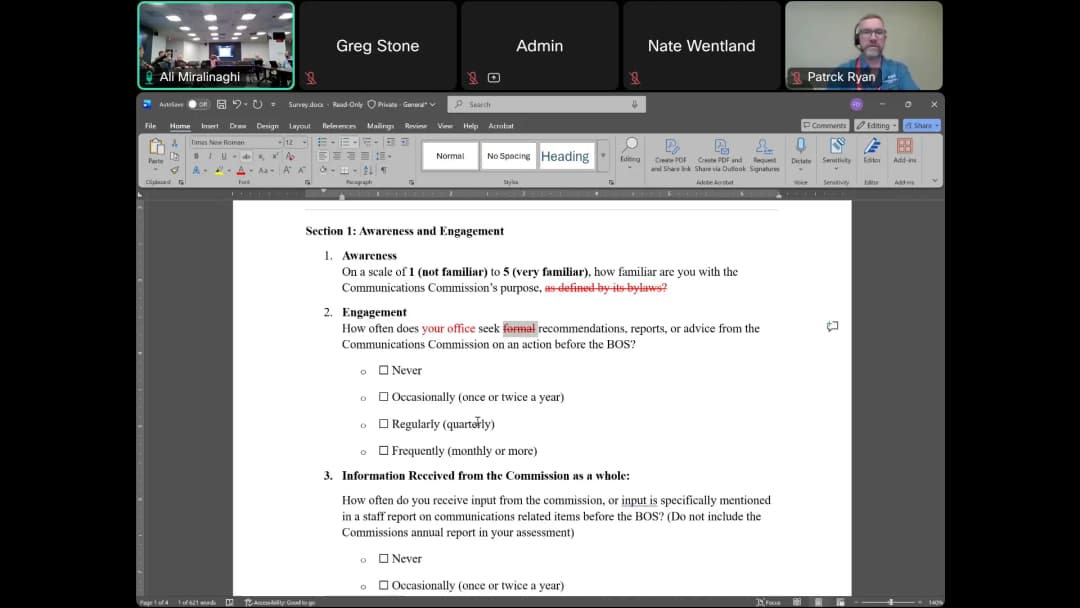
The Loudoun County Communications Commission met at the Dulles Room in the Loudoun County Government Center. The agenda and transcript list the meeting as October 27, 2025, but the supplied timestamp is 2025-11-03, so this summary uses the required date. The commission approved its agenda and prior minutes, heard no public comment, discussed franchisee attendance, finalized a survey for the Board of Supervisors, closed action items, and scheduled its next meeting. Consent Calendar - The agenda was approved as presented with a voice vote and recorded abstentions. - The September 22, 2025 meeting minutes were approved; four abstentions were recorded, but the ayes constituted a majority. Public Comments & Testimony - No members of the public registered to speak. - Commissioner Ryan asked how the public could participate if the meeting was not published on the county calendar. Staff indicated the only public notice was in the previous agenda; the chair said staff had been reminded of the obligation to post meetings. Discussion Items Franchisee Topics - Neither Comcast nor Verizon attended. Comcast notified the commission in advance; Verizon has a practice of not attending. - Commissioners noted Verizon previously decided it was not legally obligated to attend and had reduced its state government representation. County staff confirmed there is no legal expectation of franchisee attendance. Comcast sends monthly updates and remains available for specific questions. Board of Supervisors Survey - The chair presented a draft survey for the nine county supervisors, with roughly 13 questions covering awareness and engagement, review value, strategic impact and efficiency, and future options. The chair noted surveys should take about five to ten minutes. - During the review, the commission edited the draft, including: removing a question comparing the commission's technical expertise with county staff and consultants; moving the annual-report qualifier to the beginning of one question; adjusting an engagement question to ask about the supervisor's office rather than requiring supervisors to answer for their staff; removing the "don't know" option from one scale for consistency; and rewording a policy-guidance question to ask for an issue where the commission provided valuable input or made a policy recommendation. - A commissioner expressed frustration that the commission currently does little except use staff time, making the final question about maintaining, reforming, or sunsetting the commission the most important. - Some commissioners wanted a free-text field attached to the "reform" option. The chair and others opposed an open-text field at this stage, arguing the survey should first determine whether the commission should exist and that open-ended follow-up could come later. - During the discussion, a participant noted the county is spending $253,000 on a communications study, compared with the commission's free input. - The commission voted to ratify the finalized survey for distribution to Board of Supervisors members and, by friendly amendment, to close action item 266. Action Items - The commission voted to close action items 259 (franchise status of Loudoun towns), 260 (third-party records tool), 264 (bylaw discussions with supervisors), and 265 (new bylaw proposal). The motion passed without opposition. New Business and Commissioner Comments - No proposed new business items were introduced. - A commissioner noted the FCC removed e-rate reimbursement for hotspots and bus Wi-Fi, so the county will continue providing bus Wi-Fi and student hotspots while adjusting to the loss of that reimbursement. - A commissioner said he would not attend the December 8 meeting because of a conference. Key Outcomes - Agenda and September 22, 2025 meeting minutes approved. - Finalized Board of Supervisors survey ratified; action item 266 closed as part of that motion. - Action items 259, 260, 264, and 265 closed. - The chair said he would follow up with Supervisor DeCrony or county staff to host the survey in SurveyMonkey or Mentimeter, and Ron would send the survey to supervisors with a cover letter. - Next meeting scheduled for December 8, 2025; no November meeting is scheduled. - The commission adjourned by voice vote.
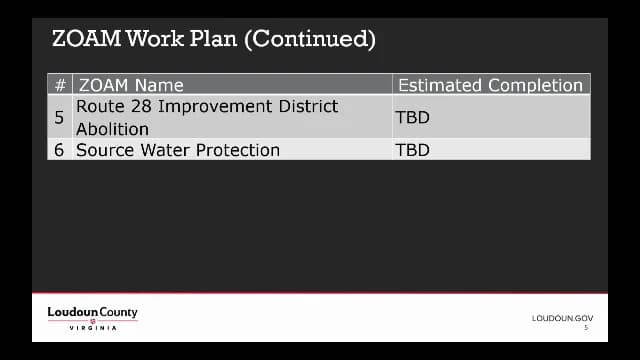
The Loudoun County Planning Commission held a public hearing on October 28, 2025, to consider CPAM-2024-0005, an Electrical Infrastructure Comprehensive Plan Amendment. The amendment proposes map and policy updates to the 2019 General Plan to guide the siting, design, and aesthetics of high-voltage transmission corridors and electric infrastructure. The commission voted 8-0-1 to recommend approval to the Board of Supervisors. Consent Calendar - The minutes from the September 23, 2025, public hearing were approved by a vote of 7-0-2, with Commissioners Jasper and Motoretti absent. Public Comments & Testimony - Emily Johnson, representing the Piedmont Environmental Council, expressed support for the staff effort but offered several recommendations. She requested that the existing 2-mile underground 230 kV line between Percival and Leesburg be included on the high-voltage transmission map, and that environmental protection actions be strengthened under the strategies. She also called for including utility-scale generation in Action 6.4E, broader encouragement of easement oversight, adding community concerns to Action 6.3A, and prioritizing Phase 2 of the CPAM to avoid being outpaced by utility plans. Discussion Items - Staff Presentation: Pat Giglio (Department of Planning and Zoning), Teresa Stein (Community Planning), and Paul Vernon (Kimley Horn) presented the CPAM. They explained Phase 1 focuses on strengthening policies for high-voltage transmission corridors and creating an electrical infrastructure map. Phase 2 (planned for spring 2026) will address long-term planning for new corridors. The presentation covered the roles of FERC, PJM, the SCC, and Dominion Energy; the limited authority of counties in Virginia; and the importance of co-location, undergrounding (noting 500 kV underground is rare and expensive), reconductoring, and visual impact mitigation. The draft policies support efficiency, compatibility with land uses, minimizing impacts, and public outreach. - Commissioner Questions: Commissioner Motoretti asked about the binding nature of the plan on the SCC and the omission of public health impacts. Staff clarified that the plan is not binding but improves the county's advocacy position, and that health effects are not conclusively proven and thus not considered in SCC decisions. Commissioner Miller inquired about the feasibility of undergrounding 500 kV lines, co-location, and PJM's role. Staff confirmed that undergrounding is used only for short strategic distances and that the county is part of the PJM interconnection. Commissioner Myers praised the staff report and asked for better map labels and clarity on undergrounding construction. He also raised the idea of including a disclosure about power availability for approved developments. Staff noted that topic may be addressed in the data center phase 2. Commissioner Barnes questioned whether the SCC ever changes routes, citing the Aspen to Golden route where the county's input led to avoiding a floodplain. Commissioner Combs asked about substation design standards, which staff said will be addressed in a separate upcoming CPAM. The Chair asked about ongoing efforts to upgrade existing lines; staff confirmed Dominion is undertaking rebuild projects to increase capacity. Key Outcomes - The commission voted 8-0-1 (Commissioner Jasper absent) to approve a motion recommending approval of CPAM-2024-0005 to the Board of Supervisors. The motion was made by Commissioner Myers and seconded by Commissioner Miller. - The December 11 work session was canceled; the next public hearing is scheduled for December 18, 2025, with two items. - Administrative items: Brian announced an updated Planning and Zoning work plan, including a project to dissolve the Route 28 taxing district (expected to start in FY2027). Commissioner Myers requested that correspondence regarding the Happy Pappy Paul application be shared with zoning enforcement staff ahead of the December public hearing. - The commission adjourned.
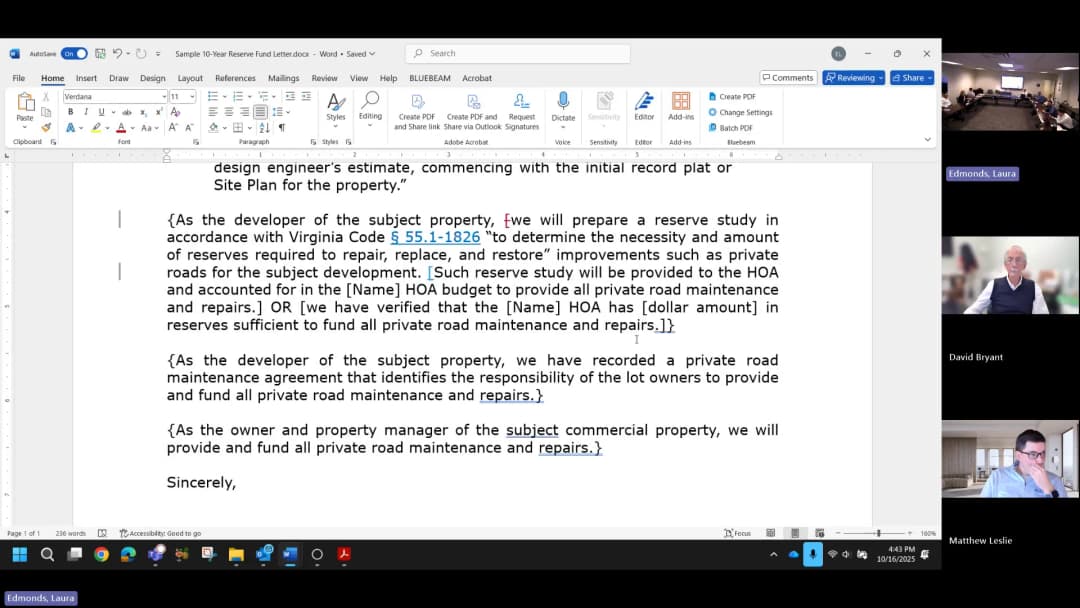
The Loudoun County Facility Standards Manual Public Review Committee (FSM PRC) met on October 27, 2025, to review floodplain amendments and a draft private road reserve fund letter. Note: the supplied meeting date is October 27, 2025, while the agenda and transcript reference October 16, 2025. The meeting included scheduled 3:15 p.m. floodplain discussions and a 4:30 p.m. reserve fund update. Administrative Items - The October 2, 2025 minutes were approved as edited, including clarifying changes and the official committee name change to “FSM PRC.” - Dave Bryant and Matt Leslie participated remotely from Reston and Roundfield, Virginia. Floodway Background Discussion - Staff explained that FEMA’s 1985 flood maps designated floodways, but after the 2001 remapping, county staff treated all major floodplain as floodway and FEMA removed designated floodways. A 2015 FEMA letter reiterated this arrangement. - Floodplain is a cumulative term for floodway plus flood fringe; the floodway must remain clear to preserve flood capacity. Since no mapped floodways remain, all major floodplain is treated as regulatory floodway, generally requiring no rise. - Members discussed FEMA regulations (44 CFR 65.6/65.7), LOMAs/CLOMRs, and when engineering analyses are required. The chair suggested deferring some detailed CFR questions until the Chapter 5 text review. FSM Chapter 8 Review - Staff presented cross-reference changes that consolidate repeated floodplain language into a new Section 8.101, applied across plats, site plans, CPAPs, grading permits, easement plats, dedication plats, and division plats. - Floodplain and source-of-floodplain notes were added to additional plat types; reforestation plans and demolition/removal of existing improvements were added to existing conditions plan requirements. - The committee completed Chapter 8 review: “Eight is done.” FSM Chapter 5 – Floodplain Alteration Types - The discussion centered on making no-rise certification a Type 1 floodplain alteration and removing the separate “declaration of no impact” process. - Staff said the change improves tracking and aligns with guidance requiring computations/data; some members expressed concern that minor utility or underground work would require a separate application and fee. - Committee members and staff debated options including Landmark sub-records, re-creating option one/option two/option three under Type 1, fee tiers, and when Chapter 8 submittal requirements apply. - Staff was asked to explore: (1) tracking no-rise certifications on CPAPs/site plans without a separate application; (2) creating suboptions under Type 1 based on analysis complexity; (3) clarifying Type 1 vs Type 2 Chapter 8 requirements; and (4) determining when a floodplain study or corrective effective analysis is needed with a no-rise certification. 10-Year Private Road Reserve Fund Update - Staff presented a draft standard letter for developers/property owners to satisfy the private road reserve fund requirement, covering four scenarios: new HOA, annexation into an existing HOA, private road maintenance agreement, and commercial self-maintenance. - Suggestions included adding state code references, changing “we will prepare” to “will be prepared” to account for future phases, and adding HOA acknowledgement for annexation. - Staff requested comments by October 31, 2025, and will draft a tech memo explaining the temporary requirement. Next Meetings - Tentative: Thursday, November 6, 2025, and Thursday, November 20, 2025, in the Dulles Room. Key Outcomes - Minutes approved as edited. - FSM Chapter 8 floodplain-related edits completed. - No final decisions made on Chapter 5 floodplain alteration types; staff will return with options and clarifications. - Private road reserve fund letter comments due October 31, 2025; staff will incorporate feedback, coordinate with the county attorney, and draft a tech memo.
The Loudoun County Board of Zoning Appeals (BZA) convened on October 23, 2025 at 6:00 PM to hear Appeal APPL-2025-0004, challenging a temporary special event permit issued for 39483 Charles Town Pike in Hamilton, Virginia. The board addressed preliminary matters regarding late-filed submissions, debated the appellants' standing, heard public testimony, and ultimately voted to grant the appeal and reverse the permit. Consent Calendar - Preliminary Matter 1: Landowner's counsel (Randy Minshew and Anna Ritter) requested leave to accept a supplemental filing submitted on October 9, 2025, which was less than 20 days before the hearing. The board voted 3-0 to accept this filing. - Preliminary Matter 2: Appellants' counsel (Stephen Price) requested leave to accept a filing dated October 21, 2025, containing revised permit documents from September and October 2025. The board voted 2-2 to reject this filing (motion failed due to lack of majority; members expressed concerns about insufficient time to review the materials). Public Comments & Testimony - Appellants (Thomas Giddings and Stephanie Van Pries, property owners adjoining the subject property): Argued that the permit was improper, citing increased traffic over a shared easement, noise, dust, light pollution, and a loss of privacy. They noted the permit was originally signed by an unauthorized official and that the use—a baseball training facility—did not meet the definition of a "special event" under the zoning ordinance. They also claimed the permit allowed a months-long operation without proper public process. - Landowner/Property Owner (RD Baseball, represented by Randy Minshew, Anna Ritter, and co-owner Daniel Olds): Defended the permit as a lawful temporary measure to allow baseball instruction (a by-right use) while a minor special exception for the building’s setback was pending. They emphasized that the temporary event permit was limited in duration (90 days, later extended 90 days) and that adverse impacts were evaluated. They cited good neighbor efforts (road widening, mailbox replacement, tree planting) and denied significant traffic or noise issues. - Neighbors in Support (David Maloney, Kathy Lazarus, Joseph Carodi, Mitch): Reported positive experiences: RD Baseball was accommodating, improved road safety, reduced dust and noise compared to prior conditions, and contributed to the community. They disputed claims of excessive noise or traffic disruptions. - Neighbor in Opposition (Denise Roll, Stephen Giddings): Expressed concerns about increased traffic on a single-lane private road, headlight glare, noise from indoor training, and the intensity of use compared to the prior livery (which had a 20-vehicle limit). They argued the permit bypassed the normal application process for a minor special exception, denying neighbors a voice. - Public Comment (John Benedict, Western Loudoun resident): Argued the permit set a troubling precedent, allowing an intensive commercial use in a rural area without proper review. He called the permit an abuse of process. - Additional Public Comment (unidentified speaker): Raised issues about unpermitted parking lot construction, lack of fire marshal approval, and inability to contact county supervisors. Discussion Items - Standing (Preliminary Issue): Landowner’s counsel moved to dismiss the appeal for lack of standing, arguing that the appellants had not demonstrated particularized harm distinct from the general public (e.g., traffic shared by other users of the private lane). Appellants countered that their property uniquely hosts the easement traversed by all event traffic. After debate, the board voted (3-0) to find standing, concluding that the appellants had identified a concrete injury (traffic over their property) different from that suffered by the public. - Merits of the Appeal: - Staff Presentation: Zoning Administrator Teresa Miller and Senior Planner Andy Londos presented the permit history: originally issued July 10, 2025 for a baseball training camp (classified as a "personal instruction service," a by-right use), later extended and corrected for a signature error and parking capacity (from 4 to 40 spaces, though max attendance per session is 30). Staff argued the permit complied with Sections 304E and 1004 of the zoning ordinance, which allow temporary special events for up to 90 days plus extensions. They maintained that adverse impacts were considered and found not significant. - Board Questions: Board members probed the basis for the permit, the definition of "special event," and whether the ordinance truly covered a months-long business operation. Chairman Gray expressed concern that the permit was used to bypass normal process, effectively allowed six months of commercial use without the public hearing required for a minor special exception. Others questioned whether staff properly evaluated off-site impacts (traffic, noise, dust) as required by ordinance. - Appellants' Argument (Stephen Price): Contended that the "event" did not meet the ordinance definition—it was not a noteworthy happening but a routine business. He argued the permit was an abuse of process, allowing the landowner to start operations while seeking a special exception, and that staff failed to make a required finding of no significant adverse impact before the extension. - Landowner's Rebuttal (Anna Ritter): Distinguished the temporary event use from the proposed small business use (which would require permanent improvements). She stated that staff did evaluate adverse impacts for the extension and that the zoning administrator’s decision is presumed correct under state law. She further argued the permit was properly issued under the ordinance. Key Outcomes - Standing Ruling: The board determined (3-0) that the appellants have standing to bring the appeal. - Final Decision: The board voted (3-0) to grant the appeal, reversing the July 10, 2025 issuance of temporary special event permit EVENT-2025-028987 and its October 10, 2025 reissuance. The board found the permit did not comply with the Loudoun County Zoning Ordinance, specifically because the use did not qualify as a "special event" under the ordinance’s definition, and the approval mechanism was improperly applied. - Consequences: The temporary permit is void. The property (RD Baseball) may not operate the baseball training activities under that permit. The property owner may continue to pursue the separate minor special exception application with the Board of Supervisors for the building setback, but the by-right outdoor use would require a standard zoning permit. - Next Steps: The board discussed upcoming business – a November training session on the new zoning ordinance (scheduled for November 20, 2025) and a December public hearing for a sign variance and a possible appeal of a zoning permit denial.
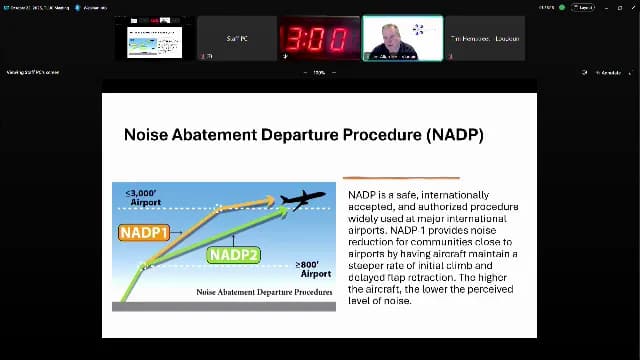
The Transportation and Land Use Committee (TLUC) of the Loudoun County Board of Supervisors met on October 22, 2025, to discuss and act on several items including an update on the Environment and Energy Work Plan, a proposed expedited review pilot for 100% attainable housing, and a community‑driven noise mitigation project for Runway 30 at Washington Dulles International Airport. The committee received public comments, deliberated, and voted unanimously on all action items. Public Comments & Testimony - Charles Lamb (resident) questioned the lack of quantifiable data supporting the Runway 30 noise mitigation recommendations, noting that similar measures have been implemented at other airports. He stated he was not criticizing the process but wanted to see data on noise reduction. - Mark Glickman (Enterprise Community Partners) expressed full support for making the expedited review pilot for attainable housing permanent. He highlighted that predictable timelines are critical for affordable housing financing and urged the county to codify the program and expand it to include mixed‑income projects. - Thomas Durlot (retired airline pilot, Brambleton resident) described severe noise from departing aircraft and proposed a simple solution: have aircraft fly a westerly heading for 4–5 miles before turning north, which would reduce noise over residential areas without affecting safety or efficiency. - Scott Emory (Sterling resident, personal behalf) encouraged the county to continue energy leadership and suggested engaging former DOE loan program director Jigger Shaw to help address data center energy challenges. - Robbie Belaram (Brambleton Community Association) thanked the board and staff for prioritizing the noise mitigation project. He emphasized that the design group reached consensus on three recommendations, prioritizing safety, efficiency, and reducing flights over schools, places of worship, and residential areas. - Kim Hart (attainable housing builder) spoke in support of the expedited review pilot, noting that a previous pilot project (Atlantic Boulevard) went from rezoning to building permits in 18 months. He called the one‑year pilot a great next step. - Rosemary Linder (Birchwood Community Association at Brambleton) expressed support for the noise mitigation recommendations and encouraged the committee to forward them to the full board. Discussion Items Environment and Energy Work Plan Quarterly Update - Staff presented the quarterly update, highlighting progress on the invasive plant species management program (20 projects approved, nearly 100 acres), a trip to Germany to study waste heat district energy from data centers, and ongoing environmental justice outreach. - Supervisor TeKrony introduced a motion to hold an Energy Innovation Forum in spring 2026, bringing together experts (including NREL and regional partners) to discuss best practices for data center energy technologies. The motion passed 4‑0‑1. Expedited Process for Legislative Attainable Housing Applications - Dan Galindo (Planning and Zoning) presented a proposed 12‑month pilot program for up to three applications that are 100% affordable. Key features include an 8‑month target timeline from acceptance to board decision, mandatory proffer statement at first submission, individualized review schedules, and a supervisor/commissioner briefing early in the process. - Discussion included staffing capacity (currently fully staffed), concerns about early board engagement (staff will be present), and the exclusion of 50% affordable projects from this pilot. The committee voted unanimously to recommend the pilot to the Board of Supervisors. Runway 30 Aviation Noise Mitigation Project - Josh Peters (project manager) and Jim Allardyce (Vionair) presented three recommendations from the community design group: 1. NADP1 (Noise Abatement Departure Procedure 1) – steeper climb to reduce noise near the airport. 2. Nighttime Noise Track (11 p.m. – 7 a.m.) – aircraft to fly runway heading until reaching 3,000 feet before turning. 3. Long‑term flight path changes – concentrate departures over commercial/industrial areas using two new RNAV routes. - The design group reached consensus on these recommendations, which are supported by the community. Staff noted that the FAA will need to review the long‑term changes, while the first two could be implemented within months to a year. - Chair Randall requested data on noise reduction levels; staff confirmed that detailed noise modeling (using FAA’s AEDT) is available and will be shared with the FAA. Key Outcomes - Energy Innovation Forum: Motion passed 4‑0‑1 (Supervisor Kershner off dais). Staff directed to coordinate with NREL, NVRC, and other partners to hold a forum in spring 2026. - Expedited Attainable Housing Pilot: Motion passed 4‑0‑1. The Board of Supervisors will consider the recommendation to create a 12‑month pilot program effective January 1, 2026. - Runway 30 Noise Mitigation: Motion passed 4‑0‑1. The committee endorsed the design group’s three recommendations and will forward them to the full Board of Supervisors for approval.
This special meeting of the Transportation and Land Use Committee (TLUC) focused on the Western Loudoun Rural Uses and Standards CPAM/ZOAM, specifically lodging uses (bed and breakfast homestays, inns, country inns, rural resorts), day and boarding camps, and campgrounds. The meeting was a listening session with invited stakeholders and a committee of the whole discussion. No formal votes were taken; staff will use the input to prepare draft language for future TLUC direction meetings. Public Comments & Testimony - Business Sector: Laura Emmelman (Scarlet Springs Farm) expressed that B&Bs are homes and farms, and the flexibility to host private parties is essential for financial sustainability. She urged that concerns be directed at permitted B&Bs, not short-term rentals. Manisha Shah (Stone Manor Boutique Inn) recommended keeping existing regulations that work and focusing on enforcement of current rules. Sherry Shields (Hidden View B&B, President of Loudoun County Bed and Breakfast Guild) warned that proposed changes could make her non-compliant, and that licensed B&Bs are being squeezed out by unregulated short-term rentals, comparing it to taxis vs. Uber. - Agricultural/Conservation Sector: Kelly Fultman (homestay B&B owner) opposed a minimum of two guest rooms, stating it would eliminate her operation. She advocated closing the loophole that allows lodging uses to be a pretext for event venues and called for enforcement. Sarah Brown (Oakland Green Farm) supported addressing the intensity of uses (e.g., ingress/egress, parking) and noted that enforcement by complaint is problematic because complaints are often not verified in real time. Avis Renshaw (Lost Corner Farm) described negative impacts from events: loud music past 11 PM, lighting, and traffic. She advocated for a 9 PM noise curfew on weeknights for rural venues, emphasizing that rural neighbors deserve quiet. - Residential Sector: Casey Chapman urged against overregulation, citing the 2019 General Plan's vision for rural tourism and entrepreneurship. Jean Galland stated that lodging uses are often a pretext for event centers, leading to traffic, noise, and light impacts. He called for a maximum cap on attendees and maintained records to prove lodging use. Donnie Walker (B&B owner) supported traditional B&Bs and opposed changes that would harm compliant operators; he emphasized the need for enforcement and noted that the current licensing process is challenging. - Planning Commission Representatives: Rob and Eve Jasper highlighted issues of enforcement, consistency across uses, and the cumbersome approval process that encourages loopholes. Mark Miller argued that outdoor music should be regulated consistently regardless of the number of attendees, because music is music. Discussion Items - Setbacks: The committee discussed maintaining existing setback requirements for lodging structures to avoid creating non-conforming uses. There was interest in potentially creating new setback requirements for structures built solely for event space. Staff noted that country inns require a 200-foot setback from lot lines (or 100 feet from commercial uses), while B&B homestays and inns rely on zoning district setbacks. The landscape buffer for outdoor private parties includes a 50-foot setback and a six-foot fence/berm. - Noise: The discussion centered on outdoor music cutoff times. Consensus emerged for a consistent standard across lodging uses: 10 PM on Sunday–Thursday and 11 PM on Friday and Saturday. Staff noted that the zoning ordinance sets a 55-decibel limit at the property line, while the codified ordinance prohibits sound audible inside a neighbor’s home with windows closed. Enforcement was a key concern, with suggestions for proactive enforcement and penalties for repeated violations. - Private Party Attendees: The committee considered increasing the number of times per year that maximum daily attendees may be exceeded (from 20 to 25) and implementing a sliding scale based on property size. There was concern that the current table (Table 5) has no maximum for the number of attendees when exceeding the daily limit, allowing potentially large events. The annual private party permit process was noted as lacking enforcement. Some speakers supported a sliding scale tied to property size and parking capacity. - Number of Guest Rooms and Proof of Operation: The committee discussed requiring a minimum number of guest rooms to prevent lodging uses from being a pretext for events. Most stakeholders opposed a minimum, arguing it would harm existing B&Bs with historic small structures. Instead, the focus was on requiring proof of operation (e.g., through Transient Occupancy Tax records) before hosting private parties. There was discussion about closing loopholes where operators have few or no occupied rooms but still hold events. The idea of requiring a minimum number of rooms rented by private party attendees was not supported. - Day Camps, Boarding Camps, and Campgrounds: Staff asked whether these uses should have similar requirements (e.g., setbacks based on intensity). The committee noted that there are currently no known campgrounds in Loudoun County (except Algonkian Park, operated by NVRPA). Speakers expressed interest in promoting campgrounds, especially glamping, but identified barriers such as land cost, infrastructure (septic, water), and natural resource restrictions. The committee did not recommend specific changes but encouraged staff to explore opportunities. The definition of “seasonal” for day camps was questioned, and staff committed to clarifying it. Key Outcomes - No formal decisions were made; the meeting was a listening session to gather stakeholder input. - Staff will prepare draft language for future TLUC direction meetings scheduled for December (food service, MOD, signage), January (farm wineries, limited breweries, limited distilleries, B&Bs), and a third meeting after the eighth stakeholder session. - The committee expressed general support for: - Maintaining existing setback requirements for lodging structures, but considering new setbacks for event-only structures. - Consistent outdoor music cutoff times: 10 PM weekdays, 11 PM weekends. - Increasing the number of times per year that daily attendee limits may be exceeded (from 20 to 25), with a possible sliding scale based on property size. - Requiring proof of operation (e.g., TOT records) as a condition for hosting private parties, rather than imposing minimum room numbers. - Strengthening enforcement, including potential proactive enforcement and penalties for repeated violations. - The committee acknowledged the need to address water availability (drinking water) in Western Loudoun when considering future development. - Staff will continue to evaluate campground and day camp regulations, with attention to health and safety and potential for new campground opportunities.
The Loudoun County Board of Supervisors held a business meeting on October 21, 2025, chaired by Chair Randall. The meeting included consent agenda approvals, public comments, discussion on multiple action items, and ceremonial resolutions. Key topics included affordable housing loans, broadband implementation, a dog kennel special exception, transportation studies, and the Department of Planning and Zoning work plan. Consent Calendar - Proclamations and Resolutions (R-1 through R-4): Recognized Domestic Violence Awareness Month, Disability Employment Awareness Month (with FAIME Awards), the Global Telangana Association, and the 30th pastoral anniversary of Bishop and Co-Pastor Patterson of First Baptist Church of Sterling. - Contract Awards/Renewals: Items 1A–1D (sidewalk/trail design, site civil/parks design, capital projects program management, roadway/transportation design for federal projects). - Bylaw Amendments: Advisory Commission on Youth (Item 1E) and Parks, Recreation, and Open Space Board (Item 1F). - Design Endorsements: Courts Complex Phase IV (Item 1J). - Affordable Housing Loan Applications: Moorefield Station Apartments (Item 1K), Stone Ridge Towns (Item 1L), Overlook at Broadlands Apartments (Item 1M) – approved; Clear Springs Apartments (Item 1N) – removed from consent (see Discussion Items). - Space Strategy Update: Leesburg Government Center (Item 1P). - Appointments/Administrative Items: Confirmations (Item 2A) and Administrative Items Report (Item 3). - Traffic Calming: Proposed measures in Sterling Park (Item 7). - Response to Board Member Initiative: East Beech Road corridor safety study (Item 10). - Speed Management Study: St. Louis Road (Item 8) – added to consent at request of Little River supervisor. - Staffing for Adequate Fire and Emergency Response (SAFER) Grant (Item 4): Tabled indefinitely by Supervisor Bricksman after closed session. Public Comments & Testimony - Sharon Buchanan (33-year real estate agent) opposed the "Dog Home Away From Home" kennel application, citing missing information on well/septic, untreated wastewater, and inconsistent zoning requirements. She stated the application was rushed. - James Russell addressed the conflict in Gaza, criticizing the board for not taking action, and mentioned federal workforce impacts. He noted campaign contributions from AIPAC to local representatives. - Sarah Hussain Bazaar (via phone) connected local data centers to military AI technologies used abroad, called for divestment from companies complicit in Palestinian oppression, and detailed violence against Palestinians. - Robert Griffin attributed government shutdown to Democrats, blamed them for foreign wars, and praised President Trump's efforts in Gaza. He also criticized local school board policies on gender issues. Discussion Items - Affordable Multi-family Housing Loan Program – Clear Springs Apartments (Item 1N): Staff recommended denial due to inadequate leverage ratio (1:0.72 vs. minimum 1:5 for old program, 1:3 for new). The application scored 86.86 (above 75 threshold) but was far below financial requirements. Finance committee recommended directing staff to waive the application deadline for the new attainable housing loan program, allowing the applicant to resubmit. After debate, the motion passed 7-2 (Dulles and Leesburg districts opposed). - Village of St. Louis Deferred Forgivable Loan Program (Item 1O): Authorized staff to develop a program for whole-house water treatment systems funded with local non-federal funds. The motion included a provision for a three-year maintenance plan by the installing contractor. Passed 9-0. - LEGI-2024-0014, Dog Home Away From Home (Item 5): Approved subject to conditions. Supervisor Kirshner (Catoctin) supported, noting the applicant had operated without complaints, limited to 15 dogs, and provided screening and fencing. Opponent Sharon Buchanan raised wastewater and waste disposal concerns. Staff confirmed conditions address discharge and waste handling. Passed 9-0. - Broadband Implementation Plan Update (Item I-2): Staff reported that Dominion Energy completed middle-mile construction. All Points Broadband has built 65 miles in Loudoun 2, with 20 customers active (18-20% take rate). An eight-month extension to June 2026 was granted. VDOT permitting is the primary risk. St. Louis (Loudoun 3) expected active by February 2026. - Department of Planning and Zoning Work Plan (Item 6): Approved with two additional motions: (1) direct staff to develop high-level policy guidance for alternative development around Loudoun Gateway Metro Station (amended from "transit-oriented development" to "diversified development" per Supervisor Laterno); (2) direct staff to draft zoning text requiring a 500-foot minimum separation between new utility substations and existing residential. Passed 9-0. - Algonkian Parkway Multimodal Feasibility Study (Item 9): Staff presented four concepts (A–D). Supervisor Bricksman moved to endorse further evaluation of Concepts C and D and incorporate $7.92M in safety improvements into the CIP. Motion was split: first part (further evaluation) was sent to TLUC by motion from Bricksman (passed 5-4? Clarify: Vote on sending to TLUC was 8-1? Actually transcript says "aye" then "no" – Chair Randall voted no, but motion passed with aye majority. Need to extract correctly: The chair asked "all in favor" and said aye, then "opposed" and said no. The motion passed. So first part sent to TLUC. Second part (safety improvements) was approved directly 7-2. Key Outcomes - Consent Agenda: Approved 9-0. - Clear Springs Loan: Not approved; applicant allowed to reapply under new program. Motion passed 7-2. - St. Louis Water Treatment Loan Program: Approved 9-0. - Dog Kennel Special Exception: Approved 9-0. - DPZ Work Plan: Approved 9-0 with two additional directives. - Algonkian Parkway Study: First part (further evaluation) sent to TLUC; second part ($7.92M safety improvements) approved for future CIP consideration, 7-2. - SAFER Grant: Tabled indefinitely (motion passed, no vote count given, but assumed 9-0). - Closed Sessions: Held three closed sessions (property acquisition, legal consultation on collective bargaining, impact of federal action on grants; courthouse litigation). No formal action taken; certification passed. - Appointments/Confirmations: No nominations this evening; many boards are near full capacity; more applicants needed. - Other: Proclamations read and presented; Youth in Government Day observed with 60 students; Chair Randall provided regional updates including COG tool for displaced federal workers, MVTA letter on I-495 South Side Express Lanes deferred to April 2026, and her remarks at NOVA breakfast defending local land use authority. Note: The motion to table the SAFER grant was made and seconded without discussion and passed; vote count not specified but assumed unanimous.
The Loudoun County Board of Supervisors held a public hearing on October 15, 2025, at 11:00 AM. Two items were considered on the consolidated agenda: an eminent domain resolution for traffic signal improvements at Algonkian Parkway and a request to withdraw approximately 1200 acres of Oak Hill Farm from the New Oak Hill Agricultural and Forestal District. Item 3 (Concorde Industrial Park) was deferred to a future hearing. The board approved both items by a vote of 7-0-2 (with Supervisors Leterno and Sainz absent). Consent Calendar - The board adopted the consolidated agenda as presented, with the applicant for Item 2 having waived its time requirement. A public speaker was registered for Item 2; therefore, the item remained on the consolidated agenda for public comment. Public Comments & Testimony - Delegate Gary Higgins spoke on Item 2 (Oak Hill Farm withdrawal). He expressed strong support, calling it a critical step to facilitate the transfer of almost 1240 acres from the DeLashmutt family to the Conservation Fund, ultimately intended for a state park. He announced that Governor Youngkin will include the Oak Hill State Park plan in his final budget proposal to the General Assembly for the 2026 session (submitted in December, with legislative action expected in January). He thanked the board for their commitment and funding. Discussion Items - Item 1: Algonkian Parkway Intersection Improvement – Eminent Domain Resolution - Staff and Supervisor Brixman (speaking remotely, in whose district the project lies) explained the project: acquiring approximately 4,100 square feet in three parcels via quick-take eminent domain to construct a traffic signal at a Rank 5 intersection. The cost is about $25,000. The project was initiated by former Supervisor Sainz and is being carried forward in cooperation with the HOA to improve safety. - No public speakers were present. - Supervisor Brixman moved approval of the resolution; Supervisor Glass seconded. - Item 2: Oak Hill Farm – Withdrawal from the New Oak Hill Agricultural and Forestal District - Staff (Rachael Iwanczuk) summarized: the request to withdraw approximately 1200 acres (Delegate Higgins later said “almost 1240”) from the AFD, which would otherwise expire on April 14, 2026. The withdrawal is for tax and gifting purposes to enable the transfer to the Conservation Fund. - Delegate Higgins’s testimony (see Public Comments) highlighted the state park goal and the governor’s budget announcement. - Supervisors expressed strong support. Supervisor DeCroni made the motion, seconded by Supervisor Crane. During discussion, Supervisor Kershner asked about implications if the state fails to approve the park; staff clarified that withdrawal removes the extra procedural protections of the AFD but does not change the property’s agricultural use or land use tax assessment. Supervisor Crane noted the DeLashmutt family’s commitment to conservation and that the land will be preserved in perpetuity regardless. Key Outcomes - Item 1: Algonkian Parkway Eminent Domain – Approved 7-0-2 (Supervisors Leterno and Sainz absent). - Item 2: Oak Hill Farm AFD Withdrawal – Approved 7-0-2. The withdrawal allows the DeLashmutt family to transfer the property to the Conservation Fund, advancing efforts to establish a state park at James Monroe’s historic Oak Hill estate. - The board noted that Item 3 (Concorde Industrial Park) was deferred and will be heard at a future public hearing.