The New York City Council Subcommittee on Zoning and Franchises, chaired by Farah N. Louis, met on September 22, 2026, at 11:30 AM in Committee Room at City Hall to consider a single land use item: LU 0141-2026, a revocable consent application for a sidewalk café at 45-18 104th Street in Corona, Queens. The applicant, represented by Christian Zuluaga of Tiro de Esquina NYC Corp (doing business as Cali Tajadas Bakery & Restaurant), seeks to place four tables with attached bench seating outside the restaurant. The item was heard and then laid over by the subcommittee with no vote taken. Discussion Items - Sidewalk Café Application (LU 0141-2026): Christian Zuluaga testified on behalf of the applicant, explaining that the business began as Cali Tajadas Corp and later changed its corporate name to Tiro de Esquina NYC Corp, changing the concept to a sports bar. The outdoor seating would feature soccer-themed tables with built-in mini soccer fields for children. Hours of operation are Tuesday through Sunday from noon to midnight, closed Mondays. Councilmember Shanel Thomas-Henry, in whose district the restaurant is located, questioned the applicant about the entity structure, hours, and anticipated use of the outdoor space. The applicant confirmed that the outdoor seating would remain open-air and be removed in winter. Councilmember Thomas-Henry noted noise complaints from the local precinct; the applicant attributed noise to occasional events on the second floor (e.g., a Zumba class) and stated they had offered to soundproof windows. He also noted that a separate bar, Sophia's Bar, operates in the same building but is unrelated and often confuses neighbors. No security guard is stationed outside. No other members of the public testified. Key Outcomes - Action: The subcommittee held a hearing on the application but did not vote. The item was laid over, meaning it will be considered at a future subcommittee meeting. No decision was reached on the revocable consent for the sidewalk café.
Public Meetings - New York City, New York
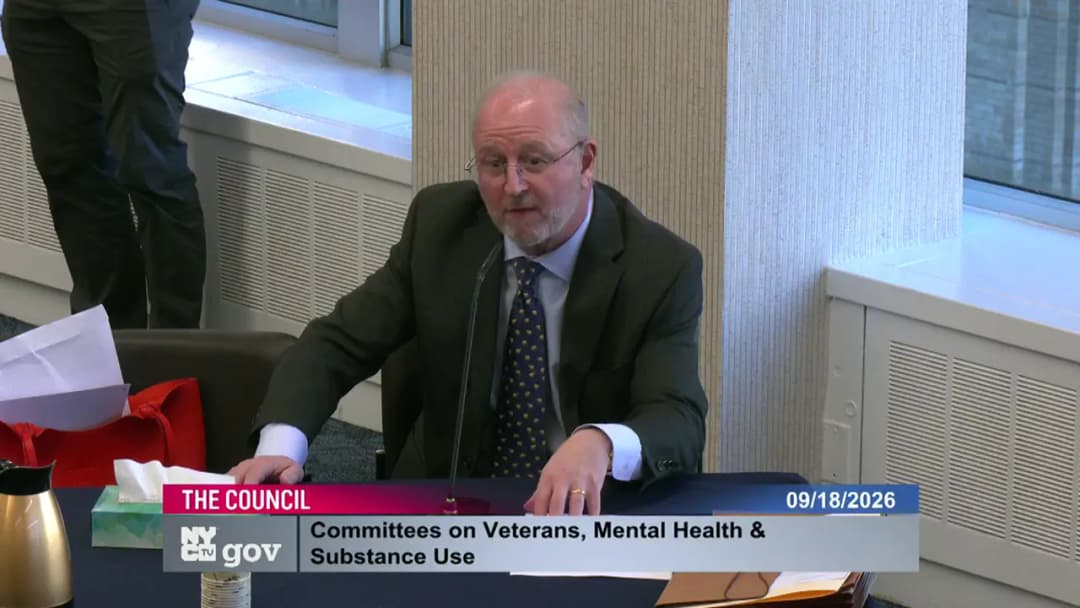
Public Meetings - New York City, New YorkThis joint oversight hearing of the Committees on Mental Health and Substance Use and Veterans, chaired by Councilmembers Tiffany Cabán and Frank Morano, examined mental health services for New York City's approximately 122,700 veterans and their families. The hearing also considered Resolution 0493-2026 to declare April 7 as White Star Family Day. The committee heard from the Department of Veteran Services (DVS) Commissioner Yesenia Mata and her team, followed by public testimony from advocates, a Legal Aid attorney, and a suicide prevention organization. Key topics included barriers to care, data collection, compliance with local laws, suicide prevention, and the needs of White Star, Silver Star, and Gold Star families. Public Comments & Testimony - Dr. Mecca Nelson (Gold Star spouse, advocate): Emphasized the need for recognition of White Star families (families who lost a service member or veteran to suicide) and Silver Star families (families of living veterans). Called for a roundtable with White Star families, highlighted the plight of a Gold Star mother unable to leave home due to lack of mobility equipment, and urged stronger accountability for organizations serving military families. She also advocated for a military-connected family business certification. - Anthony Pissarro (father of a veteran who died by suicide): Shared his son Adam's story, noting the difficulty of accessing effective mental health care despite therapy. He praised the White Star resolution and the support he received from Dr. Nelson and the Dwyer program. - David Kapner (Legal Aid Society attorney): Testified on Veterans Treatment Courts, noting they help veterans with trauma and addiction but have limited spots and exclude many due to felony charges or lack of discharge paperwork (DD 214). He recommended expanding program capacity and streamlining intake. - Fiadhna O'Grady (Samaritans of New York): Stressed the need for multiple pathways to suicide prevention, including anonymous hotlines like Samaritans'. She cited Air Force studies showing coordinated community-wide programs reduce suicide and violence. She offered to collaborate with DVS. - Ryan Graham (VFW, member of Veterans Advisory Board): Spoke on the importance of peer support, the Dwyer program, and the need for expanded case management. He praised DVS for the recent Remembrance Ruck event. Discussion Items - Oversight of Mental Health Services: Councilmembers questioned Commissioner Mata on barriers to care (stigma, navigation, family eligibility), the VetConnect NYC portal (Comptroller audit found gaps), the Dwyer program (31 organizations in first cycle, 23 pre-qualified for next), Mission VetCheck (27,544 calls placed, 1,739 meaningful conversations), and compliance with Local Laws 37 and 39 (only seven agencies reported quantitative data for FY 2025). DVS acknowledged areas for improvement and noted new data and aftercare initiatives. - Suicide Prevention and White Star Resolution: Commissioner Mata expressed support for Resolution 493, citing veteran suicide rates twice the civilian rate (2012–2022), with highest rates among younger veterans (18–34 age group at 47.9 per 100,000). DVS described efforts to strengthen social connection and early intervention. - LGBTQ+ Veterans: DVS noted challenges with self-identification and stigma, and is working with community partners and a LGBTQ+ liaison. - Incarcerated Veterans: Councilmembers raised concerns about identification in jails and continuity of care. DVS reported a veteran liaison at DOC and collaboration with Veterans Treatment Courts. - Housing: DVS housed 209 veterans in FY 2026, the highest number since the agency's creation. The aftercare model includes follow-ups at 24 hours, 2 weeks, 3 months, and 6 months. Key Outcomes - The oversight hearing was filed by committee. - Resolution 0493-2026 (White Star Family Day) was laid over (no vote taken). - DVS committed to providing written responses on: borough-by-borough Dwyer program data, implementation schedule for Comptroller's VetConnect recommendations, breakdown of Vallone Initiative usage by council district, and data on veterans in custody and mental health needs. - Councilmember Morano pledged to convene a roundtable with White Star families, and to follow up on the Gold Star mother's access needs. - DVS is developing a data department to track veteran service outcomes and intends to improve interagency collaboration on Local Law 37 compliance by December 2026.
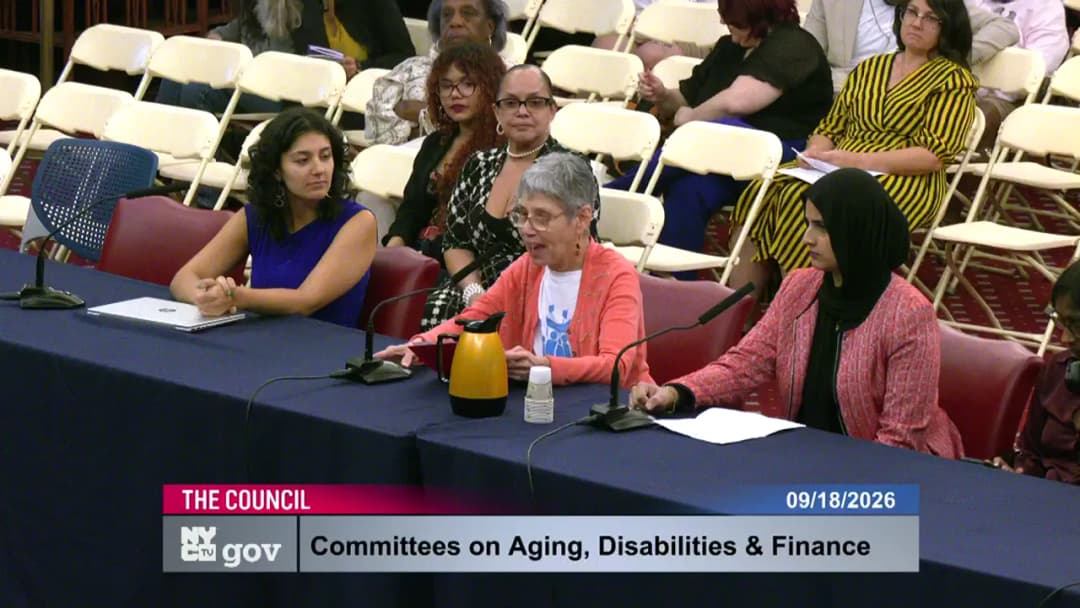
The New York City Council Committees on Finance, Aging, and Disabilities held a joint oversight hearing on the Senior Citizen Rent Increase Exemption (SCRIE) and Disability Rent Increase Exemption (DRIE) programs, along with several proposed local laws and resolutions. The hearing, chaired by Councilmembers Susan Zhuang (Aging), Linda Lee (Finance), and Shahana Hanif (Disabilities), took place on September 18, 2026, from 11:00 AM to approximately 4:00 PM in Council Chambers. The hearing included testimony from city agencies (DOF, NYC Aging, HPD, MOPD) and over two dozen public witnesses. Key topics included expanding income eligibility to $75,000, creating a universal application system, improving outreach and enrollment, and addressing disparities in enrollment rates. Discussion Items - Income Eligibility Increase (Int 0978-2026-A): Councilmember Farrah Lewis's bill would raise the maximum household income for SCRIE and DRIE from $50,000 to $75,000, retroactive to July 1, 2026, aligning with state authorization. DOF supported the bill, projecting a 9% enrollment increase (about 5,000 households) with fiscal impacts of $4.5M (year 1), $8.6M (year 2), and $13M (year 3). The bill was amended and laid over. - Universal Application System (Int 0307-2026): Councilmember Christopher Marte's bill would require DOF and HPD to create a single online application and recertification system for SCRIE and DRIE. DOF expressed support for the goal but noted technical and operational challenges. The bill was laid over. - Other Local Laws: Int 0934 (homeowner exemption increase), Int 1010 (senior/disabled homeowner exemption increase), Int 1011 (eviction notifications), Int 1033 (discretionary notice requirements), and preconsidered items T2026-2458 (dissemination of rent freeze info and training) and T2026-2546 (informational toolkit for older adults) were heard and laid over. - Resolutions: Res 0055-A (automatic enrollment), Res 0431 (property tax incentives for owners dedicating 20% housing to seniors/homeless), Res 0470 (expanding DRIE eligibility to other household members), Res 0471 (shifting income verification to state), Res 0512 (continuation of benefits after temporary income increase), and Res 0610-A (full property tax exemption for seniors on Social Security only) were heard, with some amended and laid over. - Outreach and Enrollment Gaps: Chair Hanif highlighted that DRIE enrollment peaked at 12,215 in 2019 and declined to 11,012 in 2024. DOF estimated 158,000 households eligible in 2023, with only 42% enrolled. Specific disparities were noted in the Bronx (Morrisania and East Tremont under 25% enrollment). Agencies discussed outreach efforts, including 220+ annual events by DOF, work with community-based organizations, and partnerships with the Public Engagement Unit. Concerns about language access, digital divide, and disability-specific outreach were raised. - Mitchell-Lama and HDFC Cooperatives: Public testimony highlighted unique challenges for Mitchell-Lama and HDFC residents, including paper-only applications at HPD, delays, and consolidation of application processing. Public Comments & Testimony - Numerous advocates, legal service providers, and community organizations testified in strong support of the legislative package, emphasizing the need for expanded eligibility, simplified applications, and robust outreach. Speakers included representatives from ARP New York, JASA, NYSAFAH, UHAB, Legal Services NYC, BronxWorks, Legal Aid Society, Volunteers of Legal Service, Access Justice Brooklyn, Encore Community Services, SPOP, BCID, CNYC, and Mitchell-Lama Residents Coalition. Personal stories were shared illustrating how the $50,000 cap forces seniors and people with disabilities to choose between rent, food, and medicine. - Several EMS workers from FDNY and private agencies testified about the impact of low staffing and pay on response times for older adults and people with disabilities, urging the council to address the EMS crisis. Their testimony was noted as outside the hearing's primary topic but received acknowledgment from committee members. Key Outcomes - Hearings Held: All agenda items had hearings held by the committee. - Amendments: Int 0978-2026-A, Res 0055-2026-A, and Res 0610-2026-A were amended by the committee. - Laid Over: All items were laid over in committee, meaning no final votes were taken. The bills and resolutions remain pending for future committee action. - Agency Commitments: DOF agreed to follow up on data requests regarding outreach metrics, staffing levels, and borough-specific eligibility estimates. MOPD committed to enhancing DRIE outreach, especially to working-age disabled adults. NYC Aging agreed to explore expanded media outreach and partnerships. - Next Steps: Written testimony can be submitted for 72 hours after the hearing. The committees will consider the legislation at a future meeting.
The New York City Council Committees on Aging, Disabilities, and Finance met jointly at 11:00 AM on Friday, September 18, 2026, in Council Chambers at City Hall for an oversight hearing on the Senior Citizen Rent Increase Exemption (SCRIE) and Disability Rent Increase Exemption (DRIE). Councilmember Susan Zhuang chaired alongside co-chairs Councilmember Shahana Hanif (Disabilities) and Councilmember Linda Lee (Finance). Committee members Hanif, Cabán, Epstein, and Joseph were present; Nurse was absent. The hearing lasted approximately five hours and covered underenrollment, administrative barriers, outreach gaps, and multiple pending local laws and state resolutions. No final votes were taken; all agenda items were laid over after hearings, with amendments made to Intro 978-A, Res 55-A, and Res 610-A. Public Comments & Testimony - Clement Seo, representing the Metropolitan Asian Deaf Association, said deaf seniors face systemic barriers to DRIE: inaccessible notices, phone-dependent 311 processes, video relay call problems, and late recertification mailings. He urged proactive DRIE notices whenever landlords raise rents for tenants receiving disability benefits, ASL video appointments and dedicated email support at DOF, and funding for community-based DRIE navigation. - Legal Services NYC and Brooklyn Legal Services stated they assisted nearly 1,200 families, totaling more than 1,700 people, with obtaining SCRIE/DRIE benefits from 2023 through 2025 and more than 300 households in 2026. They supported Intro 978-A, giving client examples of households above the $50,000 cap who were at risk of eviction. - BronxWorks, Legal Aid Society, Volunteers of Legal Service, ARP New York, JASA, NYSAFAA, UHAB, Access Justice Brooklyn, APNA, Goddard Riverside, Woodside on the Move, Project Guardianship, Encore, SPOP, CNYC, and other groups testified in support of the legislative package, including raising income limits, universal applications, automatic enrollment, and stronger outreach. - UHAB said HDFC and Mitchell-Lama shareholders still must use HPD paper applications; it described a senior who applied for SCRIE in February 2026 with no approval and reported that one HPD person is approving HDFC applications. - Manhattan Borough President Brad Hoylman-Siegel supported Intro 978-A and state automatic-enrollment legislation, noting Manhattan's average rent reached $6,650 in August 2026 and the $50,000 income cap has been frozen since 2014, while shelter costs rose about 46% in that period. - Several Mitchell-Lama residents and Mitchell-Lama Residents Coalition officers, including Millicent Reddick, Barbara Jones, Katie Bordnero, and Michelle Hall, urged passage of Intro 978. They cited fixed incomes, fear of displacement, maintenance increases such as Rochdale Village's 31.2% increase, and a case where a resident lost SCRIE after a management company change. - Multiple EMTs and paramedics from FDNY, private, and hospital-based 911 systems testified about understaffing, low pay, long response times, and impacts on older and disabled New Yorkers. The chairs acknowledged the seriousness of the EMS issues, noted the testimony was outside the SCRIE/DRIE agenda, and offered follow-up meetings. - Individual tenants and residents testified about eviction, application delays, and housing instability; several asked for legal assistance or follow-up. One witness testified about monetary policy and banking, which was not directly related to the agenda. Discussion Items - In opening statements, Chair Zhuang said SCRIE/DRIE are critical for older adults on fixed incomes but underutilized; Chair Lee highlighted language and cultural barriers; Chair Hanif said DRIE enrollment peaked at 12,215 households in 2019 and fell to 11,012 by 2024, a decline of nearly 10%, while DOF estimated roughly 158,000 households were eligible in 2023 with about 42% enrolled, down from 56% four years earlier. - Hanif also said among DRIE recipients in 2024, median household income was $16,671 and the median tenant paid 62% of income toward frozen rent; she called freezing rent at an unaffordable level insufficient. She noted the Bronx was the only borough where DRE enrollment fell and that fewer than a quarter of eligible households were enrolled in Morrisania and East Tremont. - Councilmember Marte said Intro 307 would create a universal online SCRIE application portal; he described Mitchell-Lama tenants using HPD paper applications and faxing documents in 2026. Councilmember Cabán supported the automatic-enrollment resolution. Councilmember Banks described his bill requiring annual DOF training for agencies serving older adults and people with disabilities. Councilmember Lewis said Intro 978-A would raise the SCRIE/DRIE income limit from $50,000 to $75,000 retroactive to July 1, 2026. - DOF First Deputy Commissioner Jeffrey Scheer testified that DOF supports Intro 978-A, projecting enrollment would rise about 9%, or about 5,000 households, with estimated fiscal impacts of $4.5 million in the first year, $8.6 million in the second, and $13 million in the third. - DOF said it supports the objective of Intro 307 but a universal application and online system for all households would require substantial technical and operational upgrades and coordination with HPD; DOF offered to work with the council on the underlying goal. - DOF reported FY26 SCHE grants of 50,912 exemptions with $1.1 billion in exempt assessed value and an estimated tax expenditure of $190.9 million, plus 2,500 DHE exemptions with an estimated $8.5 million tax expenditure. DOF was generally supportive of increasing SCHE income caps but deferred positions on Intro 934 and the benefit-level increase in Intro 1010 pending FY28 budget clarity. - DOF reported a 95% SCRIE/DRIE renewal rate over the past three years, with 70% of the 3,204 non-renewed benefits due to late or missed deadlines (2,237 cases); 967 were not renewed because households no longer met eligibility requirements. DOF also reported combined SCRIE/DRIE tax expenditures of $178 million in FY26, projected $214 million in FY27 and $243 million in FY28. - NYC Aging Deputy Commissioner Ryan Murray described outreach through 308 older adult centers, case management agencies serving more than 30,000 homebound older adults, and Aging Connect, but acknowledged gaps in reaching ethnic media platforms such as WeChat and KK Talk. MOPD's commissioner described DRIE referrals, tabling, town halls, and constituent calls, and said MOPD wants to expand outreach to working-age people with disabilities. - Councilmembers pressed agencies on outreach to deaf, limited-English-proficient, immigrant, and homebound communities; asked for borough-level eligibility and enrollment data; questioned staffing levels; and asked about automatic renewals, joint applications, and budget resources. DOF said many data requests would be provided as follow-up. Key Outcomes - No final votes were taken. The committee held hearings on the oversight item and all listed introductions/resolutions and laid them over by committee. - Intro 978-2026-A was amended by committee; Proposed Res. 55-A and Proposed Res. 610-A were also amended by committee. All remained laid over. - The oversight item T2026-2313 was heard and filed. - DOF, NYC Aging, HPD, and MOPD committed to follow-up data and answers, including borough breakdowns, outreach event lists, staffing counts, application/referral data, translation and media-use information, and eligibility estimates. - Written testimony may be submitted within 72 hours after the hearing to testimony@council.nyc.gov. Note on Discrepancies - The supplied agenda does not list Int 1072-2026 or Int 1088-2026, but the meeting minutes reflect that both introductions were heard and laid over by committee. The minutes also list the proposed preconsidered local laws under T2026-2458 and T2026-2546, while the transcript refers to related bills and resolutions by number. This summary relies on the minutes for committee actions and notes the discrepancy rather than choosing one version silently.
The New York City Council Committees on Aging, Disabilities, and Finance held a joint oversight hearing on the Senior Citizen Rent Increase Exemption (SCRIE) and Disability Rent Increase Exemption (DRIE) programs. The hearing began at 11:00 AM in Council Chambers, City Hall. Councilmembers heard opening statements from chairs Susan Zhuang (Aging), Linda Lee (Finance), and Shahana Hanif (Disabilities), along with remarks from other members. The administration testified through representatives from the Department of Finance (DOF), Department for the Aging (DFTA), Department of Housing Preservation and Development (HPD), and the Mayor’s Office for People with Disabilities (MOPD). Multiple bills and resolutions were discussed, all were laid over or amended pending further action. Public Comments & Testimony - Numerous advocates and service providers testified in strong support of expanding income eligibility and streamlining applications. Speakers included representatives from ARP New York, JASA, NYSAFAH, UHAB, Legal Services NYC, BronxWorks, Legal Aid Society, Volunteers of Legal Service, Access Justice Brooklyn, Project Guardianship, SNAP, and others. They emphasized that the current $50,000 income cap (unchanged since 2014) excludes many rent-burdened seniors and people with disabilities, and that outreach and enrollment remain critically low. - Tenant and resident advocates (e.g., from Mitchell-Lama buildings, Rochdale Village, and Bronx cooperatives) urged passage of Intro 978-A to raise the income limit to $75,000. They shared personal stories of struggling with maintenance increases and fear of displacement. - The Metropolitan Asian Deaf Association (MATA) testified about barriers for deaf seniors, including lack of ASL materials and phone-based systems. - Several frontline EMS workers and paramedics spoke about the EMS staffing crisis, linking it to the vulnerability of older adults and disabled New Yorkers. They called for an independent EMS department and pay parity. (This testimony was noted as off-topic but accepted.) - Written testimony was accepted for 72 hours after the hearing. Discussion Items - Opening Statements: Chairs Zhuang, Lee, and Hanif outlined the purpose of the hearing: to understand barriers to SCRIE/DRIE enrollment and consider legislation. Councilmember Christopher Marte introduced his bills Int. 0307-2026 (universal application portal) and Int. 1010-2026 (increasing homeowner exemption income limits). Councilmember Farrah Lewis presented Int. 0978-2026-A (raising income ceiling to $75,000). Councilmember Tiffany Cabán introduced Res. 0055-2026 (automatic enrollment). Councilmember Banks spoke on preconsidered Int. T2026-2458 (training for city agencies). - Agency Testimony (DOF, DFTA, HPD, MOPD): - DOF Deputy Commissioner Jeffrey Scheer reported that SCRIE/DRIE enrollment increased 0.8% in 2024 (first annual increase since 2019), but estimated only 42% of eligible households were enrolled (down from 56% four years earlier). DOF supports Int. 0978-A (raising income cap to $75,000), projecting a 9% enrollment increase (5,000 households) with fiscal impacts of $4.5M (FY27) to $13M (FY29). DOF expressed willingness to work on universal applications but noted technical challenges. - DFTA’s Ryan Murray stated that 1,752 seniors are enrolled via older adult centers and 2,340 via case management. He described outreach through 308 senior centers, social media, and partnerships. Councilmembers pressed for more targeted outreach to ethnic media (e.g., WeChat, Korean platforms) and homebound seniors. - HPD’s Alika Ampri-Samuel and Julie Walpert discussed Mitchell-Lama SCRIE/DRIE enrollment (6,187 households) and outreach efforts during maintenance increases. - MOPD Commissioner Nisha Agarwal noted that MOPD refers constituents to DOF but lacks data on DRE-specific outreach. She highlighted plans for enhanced engagement. - Q&A Highlights: - Councilmembers asked about renewal rates (95% over three years, with 70% of non-renewals due to late/missed deadlines). DOF provided breakdowns by borough and reasons for benefit loss. - Discussion of the Bronx low enrollment (only 25% in some neighborhoods). DOF attributed declines to pandemic deaths and moves. - Councilmember Brewer raised the issue of forgetfulness among older adults and the need for automatic renewals; DOF noted state law changes would be needed. - Councilmember Lee questioned about cross-agency data sharing and joint applications; DOF expressed openness. - Councilmember Zhuang highlighted the lack of outreach via WeChat and other community-specific platforms. Key Outcomes - All legislative items were laid over after hearings, with no final votes taken: - Int. 0307-2026 (universal application) – hearing held, laid over. - Int. 0934-2026 (additional income categories for homeowner exemption) – hearing held, laid over. - Int. 0978-2026-A (raising income ceiling to $75,000) – hearing held, laid over. - Int. 1010-2026 (increasing homeowner exemption income cap) – hearing held, laid over. - Int. 1011-2026 (eviction protections for older tenants) – hearing held, laid over. - Int. 1033-2026 (discretionary informational requirements) – hearing held, laid over. - T2026-2458 (training for participating agencies) – preconsidered item, hearing held, laid over. - T2026-2546 (informational toolkit) – preconsidered item, hearing held, laid over. - Res. 0055-2026 (automatic enrollment) – hearing held, laid over. - Res. 0431-2026 (tax incentives for senior housing) – hearing held, laid over. - Res. 0470-2026 (household member qualification for DRIE) – hearing held, laid over. - Res. 0471-2026 (shift income verification to state) – hearing held, laid over. - Res. 0512-2026 (continuation after temporary income increase) – hearing held, laid over. - Res. 0610-2026-A (full exemption for Social Security-only homeowners) – amendment proposed and adopted by committee, then laid over. - Key data points: - As of 2023, DOF estimated 158,000 eligible households, with only 67,677 enrolled. - Median DRIE recipient income in 2024 was $16,671, paying 62% of income toward frozen rent. - DOF reported $178 million in tax expenditures for SCRIE/DRIE in FY26, projected to rise to $243 million by FY28. - The state-authorized income cap increase to $75,000 is retroactive to July 1, 2026. - Administration commitments: DOF and DFTA agreed to improve outreach to immigrant and disabled communities, explore automatic renewals, and provide follow-up data on staffing and event calendars. MOPD committed to enhanced DRE outreach for working-age disabled tenants.
The New York City Council Committee on Veterans, chaired by Councilmember Frank Morano, met jointly with the Committee on Mental Health and Substance Use on Friday, September 18, 2026, at 1:00 PM in Hearing Room 1, 250 Broadway, New York, NY. The hearing addressed oversight of mental health and substance use services for veterans and military families (Oversight Item T2026-2423) and Resolution 0493-2026, introduced by Councilmember Ariola on June 11, 2026, which would declare April 7 as White Star Family Day in New York City. Veterans Committee roll call showed Councilmembers Morano and Wong present and Councilmembers De La Rosa, Gennaro, and Paladino absent; Councilmember Caban, Chair of the Committee on Mental Health and Substance Use, participated in the joint hearing. Note on record discrepancies: The committee's name appears inconsistently in the record as "Committee on Mental Health and Substance" (agenda and minutes, apparently truncated), "Committee on Mental Health and Substance Use" (Caban's self-identification in the transcript), and "Committee on Mental Health and Substance Abuse" (used by Morano when acknowledging Caban). The Veterans Committee minutes list only Morano and Wong as present, yet Caban spoke at length, indicating the joint committee's attendance was not fully captured in the roll call. Public Comments & Testimony - A speaker who previously testified on September 22, 2025, spoke as a member of the White Star family community. She described the designation's obscurity, recounting that "no one knew a word about what it was" until she raised it publicly, and that a family member told her, "I didn't know I was a white star." She urged that support for families "must continue." - The speaker described a woman with mobility challenges who faces paying more than $100 for help navigating the steps to leave her home, and questioned how the city can ensure the support she needs is accessible and affordable. - The speaker expressed concern that reporting systems are not truly anonymous, stating that "they'll still find out who you are like when you call 911," and called for protections ensuring reporting organizations never learn the reporter's identity, citing fear of retaliation. - The speaker reported personally witnessing disrespect within organizations involving Gold Star, White Star, and Silver Star family members and military children, and urged that veterans and military families be treated as a protected demographic, asserting that "dignity should never depend on someone's personal preference." - The speaker noted that a roundtable or meeting with White Star families would have been a meaningful opportunity to hear their concerns directly, and highlighted that White Star, Gold Star, Silver Star, and Blue Star family members, military spouses, and family caregivers own businesses and contribute to the community. - Councilmember Morano encouraged veterans to submit written testimony, attend future hearings, or participate via Zoom, and pledged, "I will read every word of your testimony personally." Discussion Items - Hearing purpose: Morano noted the hearing drew on administration testimony, committee reports, and "dynamic testimony from the public, including the public, by the way, who is occasionally critical." He acknowledged Councilmember Caban for partnering on the oversight hearing and Councilmember Paladino for prior contributions, noting Paladino could not attend due to a family situation. - Veteran population and family impact: Caban stated New York City is home to more than 170,000 veterans and hundreds of thousands more family members and caregivers. She described substance use as "often a form of self-medication for untreated trauma" that disproportionately affects veterans and compounds housing instability, family breakdown, and mental health decline, and noted caregivers frequently sacrifice their own economic security and mental health without adequate support or recognition. - Outreach and engagement: An administration witness reported that two days after the 25th anniversary of September 11, more than 1,200 members of the military and veteran-affiliated community attended the city's inaugural remembrance ruck, and that more than 1,000 calls were made to New York City veterans connecting them with DVS resources including mental health, housing, food, employment, and benefits. - Barriers to care: The administration cited difficulties accessing and navigating the online portal, reaching agency staff and caseworkers, and a lack of follow-up after seeking services as contributing to delayed access, including to mental health care. - Wait times and clinical role: DVS stated it does not provide clinical mental health counseling and instead works with community partners to ensure consistency. Morano pressed on whether a system exists allowing veterans to seek outside services rather than wait two or three months for care. - Funding: DVS cited Council discretionary funding through the Vallone initiative, which enables veterans to file for benefits related to mental health struggles. - Suicide data: The 18-to-34 age group (post-9/11 veterans) was cited as experiencing the highest suicide rate at 47.9 per 100,000 people. - Employment and residency: DVS worked with the state so veterans with a disability rating do not need additional documentation to open an Access VR case and qualify for 55A. A proposal was accepted ensuring New Yorkers who could not prove residency within the two-year window because of deployment retain their residency points. - Crisis response and tracking: DVS described a buddy system in which a housing team responds to veterans in crisis, with calls entered into the Vet Connect system including case notes and next steps, to ensure services are never interrupted. - Mental health and housing: Morano noted the clear link between mental health and housing and the connection to veteran homelessness. - Suicide prevention recommendation: Morano relayed a Veterans Advisory Board member's recommendation for an expanded case management system within DVS as a suggested change to the city's veteran suicide prevention strategy. - Implementation schedule: Morano requested a written implementation schedule identifying each recommendation, the person responsible, and the expected completion date. - Resolution 0493-2026: The administration stated its support for declaring April 7 as White Star Family Day, describing it as a meaningful step toward bringing greater awareness to veteran suicide and ensuring affected families know their loss has not been forgotten. Key Outcomes - The administration expressed support for Resolution 0493-2026 declaring April 7 as White Star Family Day in New York City. Councilmember Morano, a sponsor of the resolution, voiced strong support, stating, "I certainly think we should" advance it. - The committee requested a written implementation schedule for recommendations; DVS indicated it ensures follow-up with veterans whose screeners indicate risk, connecting them to additional services, while noting DVS is not a clinical provider. - DVS described its Vet Connect system for logging outreach calls, case notes, and next steps as the mechanism for tracking outreach to veterans and ensuring continuity of services. - Public testimony, written submissions, and committee staff analysis will be compiled into the official hearing report, with Morano pledging to personally read all written testimony.
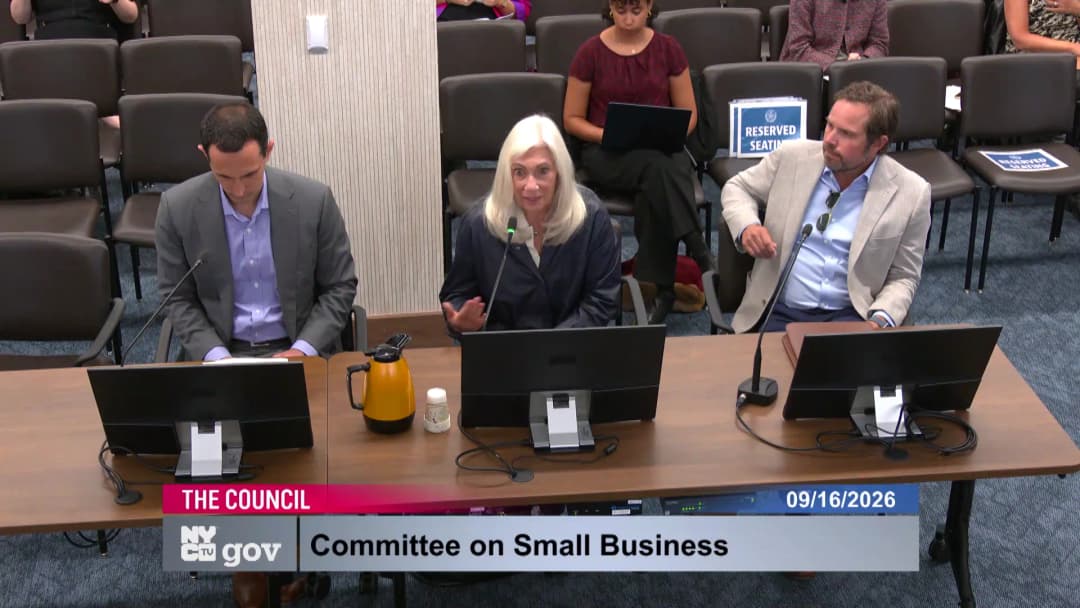
The New York City Council Committee on Small Business convened on Wednesday, September 16, 2026, at 1:00 PM in Hearing Room 3 at 250 Broadway, chaired by Councilmember Shanel Thomas-Henry. Members present were Councilmembers Brooks-Powers, Hanif, Maloney, Morano, Salaam, and Santosuosso. The committee received testimony on four bills: Int 0090-2026 (written lease requirements for storefront tenancies longer than one year); Int 0408-2026 (a pilot program matching small businesses with social media content creators for marketing assistance); Int 0578-2026 (reforming the Industrial Business Zone (IBZ) Boundary Commission); and Int 0874-2026 (establishing a legacy business registry). No final votes are reflected in the record. Public Comments & Testimony - A representative of Brooklyn Borough President Antonio Reynoso testified in support of Int 0578, stating the bill would protect industrial businesses by adding commission members appointed by the Speaker and Public Advocate and by requiring additional considerations to inform proposed boundary changes. The representative said that the past three administrations' promise not to rezone industrial business zones for residential use has been "the single most important factor" in stabilizing New York City's industrial real estate. - A separate speaker urged the council to support reform of the IBZ Boundary Commission, describing expanded membership, transparency, and reaffirmed comprehensive criteria as "paramount" to preserving the industrial sector and ensuring New York City "retains industrial businesses and fosters future growth." - A speaker submitted testimony in support of Int 0408, the pilot program to match small businesses with social media content creators. - One testifier expressed support for lease provisions including clear written leases, reasonable advance notice, accessible model documents, access to legal advice, and clear disclosures of property history, but cautioned that if owners cannot rely on agreed lease expiration dates, they will have more reason to prioritize established, well-capitalized tenants over new restaurants, retailers, and first-time entrepreneurs. - A BID-based practitioner described working at a neighborhood scale beyond any BID's jurisdiction and noted that many businesses lack access to additional funding, support, and the "hand-holding" that BIDs provide. Councilmembers echoed that many businesses, legacy or not, operate with no lease at all. - The Chair reminded the public that attendees must remain silent at all times, may not present audio or video recordings as testimony, and may submit written testimony up to 72 hours after the hearing. Agency Testimony: Department of Small Business Services (SBS) - SBS thanked the Council and cited the 16 proposed reforms in Mayor Mamdani's "Open for Small Business" package that require Council support. - On Int 0090 (lease agreements): SBS described its commercial lease assistance program, noting that no one is turned away for a new lease, renewal, or landlord-tenant disputes that do not rise to litigation. SBS acknowledged it only obtains lease-related data from businesses that work with the program and cannot access lease data otherwise. - On Int 0408 (social media pilot): SBS stated it already provides digital marketing and social media supports, including a social media marketing webinar on September 30, a panel on the content-creation economy at its Small Business Month expo in Manhattan on May 29 (attended by over 2,000 small businesses), and Link Local — a program with LinkNYC providing neighborhood-based advertising on kiosks. SBS said it looks forward to working with the sponsor on parameters that are "workable and beneficial." - On Int 0578 (IBZ Boundary Commission): SBS stated that City Hall leads overall economic development policy, including the citywide economic growth agenda being developed by Mayor Mamdani and Deputy Mayor Su, and that this agenda should inform further discussions of the IBZ commission. SBS noted that prior administrations did not pursue IBZ boundary amendments over the past decade. - On Int 0874 (legacy business registry): SBS said it looks forward to working with sponsor Councilmember Maloney to mitigate operational challenges, including the limitation that a registry would not show whether ownership had shifted even when the business remained the same. Discussion Items - Councilmembers questioned SBS about lease data, with one councilmember requesting that figures not available that day be provided to the committee within a day or two. SBS acknowledged the program's report shows Manhattan has the highest storefront vacancy rate in the city and that Manhattan businesses were the largest group served by the commercial lease assistance program. - In the context of Int 0408, councilmembers asked how SBS would determine whether the pilot generates additional customers and revenue rather than merely producing impressive social media statistics, distinguishing "between a successful marketing campaign and a viral video." SBS responded that it prefers to enable businesses to make their own marketplace decisions. - Councilmember Maloney discussed her sponsorship of Int 0874, which would provide $500 per full-time employee to legacy businesses, and described visiting the Luncheon Net in her district with Chair Thomas-Henry, praising its revitalization after the owner became more involved in social media marketing. - A councilmember noted that the identity of the mayoral appointee expected to represent the industrial and manufacturing community on the IBZ Boundary Commission was reportedly unknown, raising concerns about commission composition and transparency. Key Outcomes - No votes were taken; the bills remain in committee for further negotiation and amendment. - SBS committed to providing requested lease-related data to the committee within the next day or two. - SBS agreed to continue working with sponsors on the parameters of Int 0408, the operational challenges of Int 0874, and any IBZ commission changes informed by the administration's economic growth agenda. - Written testimony will be accepted into the record for up to 72 hours after the hearing.
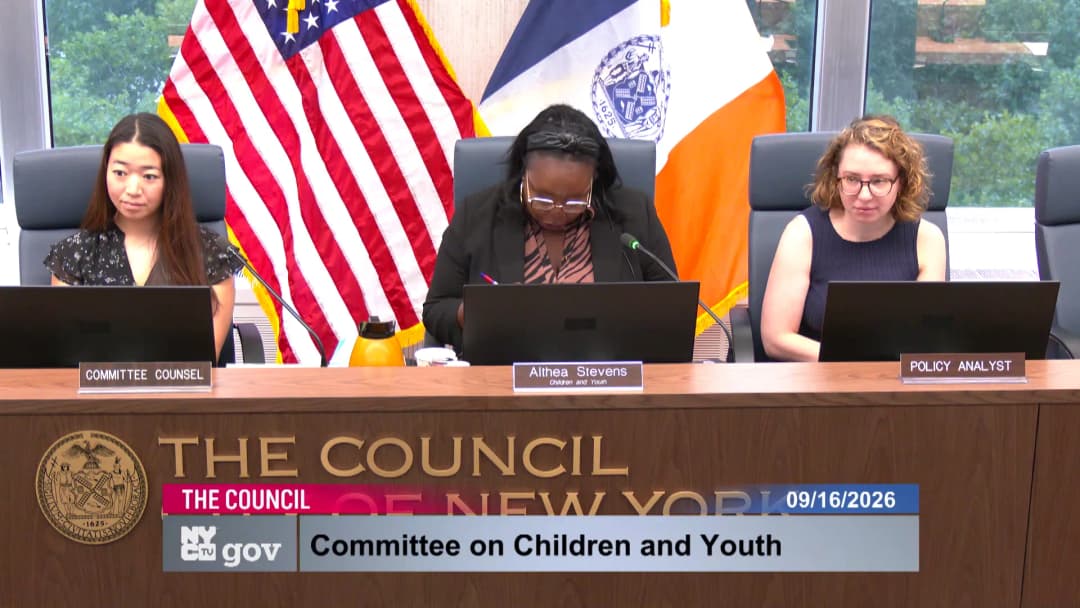
The New York City Council Committee on Children and Youth, chaired by Council Member Althea V. Stevens, held an oversight hearing on Wednesday, September 16, 2026, to evaluate the city's Runaway and Homeless Youth (RHY) shelter system. Key topics included contract and procurement delays, capacity challenges, per‑bed reimbursement rates, street outreach staffing, federal funding reductions, and housing voucher access. The hearing featured testimony from the NYC Department of Youth and Community Development (DYCD) and a panel of public witnesses including providers and youth with lived experience. Public Comments & Testimony - Sebastian Vonte (Safe Horizon): Stated that the per‑bed reimbursement rate has not increased for years while costs for rent, food, security, and health insurance have risen. Urged the city to raise the rate to $80,000 per bed and to release a new RFP for RHY services. Also asked for youth and provider input in housing voucher design. - Reagan Robinson (Covenant House New York): Called for reinstating $3 million in city funding for guaranteed income programs (Cash with Care), noting that 60% of participating youth secured an apartment or reunited with family in the first nine months. Also supported the $80,000 bed rate and inclusion of RHY youth in housing voucher rollout. - Dylan (Covenant House youth): Shared personal story of seeking shelter and asked for increased bed rates, youth voice in voucher design, and restored guaranteed income funding. - Samiha Kano Oishi (Covenant House youth): Described barriers to shelter due to lack of documentation; expressed gratitude for Covenant House support that helped her gain employment, immigration status, and housing. Advocated for raising the bed rate to $80,000. - Nigel Williams (Covenant House youth): Shared experience of being kicked out of home; graduated high school in top 8% with Covenant House support. Asked for bed rate increase and youth inclusion in voucher programs. - Maria Jesus (Housing Solutions of New York): Emphasized that success should be measured by permanent housing outcomes, not just bed utilization. Called for better coordination across systems and early housing planning. - Dr. Henry Love (Point Source Youth): Advocated for prevention and rapid rehousing programs, noting that $3,700 can place a youth in stable housing within 48 hours with a 92% retention rate. Supported bed rate increase. - Nadia Swanson (Ali Forney Center): Reported a waitlist of over 400 youth, with 40 young people staying in their drop‑in center nightly because they prefer it over DHS shelters. Called for faster inspections to open new beds and for LGBTQ+ immigrant legal services funding. - Cornelius Wiggins (Mikä's Light): Shared lived experience as a homeless LGBTQ+ youth. Recommended a comprehensive citywide needs assessment with youth involvement, better LGBTQ+ training, and expanded housing voucher eligibility. - Mary Astrid Nussbaumer (Anthos Home): Advocated for housing voucher access for all RHY youth, funding for housing navigation, and stability services for one year post‑placement (98% remained housed after one year). Discussion Items - Contract and RFP Status: DYCD has not issued a new RFP for RHY services since 2018, relying on contract amendments and extensions through June 2027. Commissioner Escamilla Davies acknowledged the need for a new RFP and stated DYCD is conducting a needs and cost analysis, with a timeline of about one year. The chair expressed urgency and called for continuous evaluation rather than periodic crises. - Per‑Bed Reimbursement Rates: Current rates range from $47,000 to $55,000 per bed. Providers and youth advocates testified that this is insufficient, with Safe Horizon and Covenant House calling for $80,000. DYCD agreed that rates need to be reconsidered and are conducting a cost analysis. - Capacity and Turn‑aways: Between January and June 2026, 319 young people seeking shelter were turned away. DYCD officials noted a recent decline (316 in the latest quarter vs. 599 the previous quarter) but Chair Stevens stressed that “still 290 something kids” is a problem. Officials stated that 16‑ and 17‑year‑olds are not turned away without being worked with, but acknowledged gaps in the shelter access report. - Minors and ACS Reporting: Providers expressed confusion about when to call the State Central Register (SCR) for minors (under 16) seeking RHY services. DYCD said they are working with ACS to train providers on mandated reporting and to reduce unnecessary reports. - Streamlined DHS Referral Process: DYCD described a streamlined process allowing youth in RHY programs to skip DHS intake and go directly to a DHS shelter bed within up to 20 days. Providers testified that in practice it often takes 30 days and that youth may be left without overnight shelter during the wait. Chair Stevens called the policy “sounds good on paper” but not working in reality. - Street Outreach Teams: DYCD funds only two street outreach teams (total about eight staff) for all five boroughs. Chair Stevens called this “ridiculous” and said each borough should have its own team. DYCD did not commit to expanding but agreed more funding is needed. - Federal Funding Cuts: Witness Laura Pennington (Pinnacle Community Services, upstate NY) reported that five upstate shelters lost primary federal Basic Center funding and warned that upstate closures could increase demand in NYC. DYCD said they communicate with upstate providers and have not yet seen an influx. - Housing Vouchers (CityFHEPS/City HAP): The new City Housing Assistance Program (City HAP) will be administered by HPD, but DYCD admitted they have not yet met with HPD. Providers urged that RHY youth must be included in program design and outreach. Chair Stevens insisted DYCD be at the table. - Guaranteed Income Pilot: Covenant House’s Cash with Care program showed promising outcomes (60% secured housing) but operated for only one year. Providers asked the Council to restore $3 million citywide for continued funding. - Drop‑in Center Sleeping Ban: Nadia Swanson noted she is working on state and local legislation to change building codes to allow drop‑in centers to provide overnight cots (currently not permitted). Key Outcomes - No votes were taken; the hearing was an oversight session for information gathering and discussion. - Chair Stevens committed to following up on several issues: (1) DYCD to share its minor placement policy; (2) DYCD to provide a timeline for the new RFP; (3) DYCD to meet with HPD to ensure RHY access to City HAP vouchers; (4) Council staff to work on legislation to address drop‑in center sleeping restrictions; (5) Council to explore funding for guaranteed income programs and increased street outreach teams. - DYCD agreed to: (a) conduct a comprehensive needs and cost analysis over the next year; (b) follow up on any minors turned away per the shelter access report; (c) continue training with ACS on mandated reporting for minors; (d) activate an Interagency Coordinated Council to align goals for youth. - Providers and advocates requested the Council include $80,000 per bed in the upcoming budget, release a new RFP before the June 2027 extension expires, and ensure youth and provider input in all housing voucher policy design. - The hearing record remained open for 72 hours for written testimony.
The New York City Council Committee on Public Safety, chaired by Oswald J. Feliz, held an oversight hearing on September 16, 2026, to examine NYPD crime statistics. The hearing focused on areas of progress, such as historic lows in shootings and murders, and persistent challenges, including a sharp rise in felony assaults and grand larceny auto compared to pre-pandemic levels. NYPD representatives Inspector William Howard and Deputy Commissioner Michael Gerber testified, and the committee heard from multiple public witnesses. Public Comments & Testimony - Matthew, representing community organizations like SOS (Save Our Streets) and the Taylor Murphy Foundation, emphasized the effectiveness of the Crisis Management System (CMS) in preventing violence through credible messengers and 24/7 support, arguing for investment in youth and community resources rather than over-policing. - Gina Mitchell, Attorney in Charge of Law Reform and Policy at Brooklyn Defender Services, criticized over-reliance on NYPD and broken-windows policing, citing persistent unconstitutional stops by specialized units and NYPD's failure to comply with the Police STAT law regarding deaths in custody. She highlighted that many low-level arrests (e.g., for taking up two subway seats) involve unhoused individuals and those with mental health needs. - Y Jennings described a 20-year stalking ordeal, stating NYPD officers failed to take incident reports and stood by while she was harassed. She urged Chair Feliz for a meeting. - Glenn Bolofsky, disability advocate with the 504 Dems, connected public safety issues to the Department of Finance's stipulated fine program, which allows companies like Amazon and UPS to reduce double-parking fines, endangering pedestrians and blocking access for people with disabilities. He noted that 30% of NYC schoolchildren are homeless, partly due to domestic violence, and called for restoring funding for victims via Intro 1141. - Brooke Bolofsky reiterated safety concerns for the disability community due to double-parked vehicles, urging action on Intro 1141. - Former Councilmember Bob Holden testified that he no longer trusts NYPD crime statistics, citing whistleblower claims of pressure on commanders to lower complaint numbers and audits finding up to 70% of reports either under-classified or not taken. He called for the council to subpoena the audits. Discussion Items - NYPD Testimony on Crime Trends: Inspector Howard reported that year-to-date (through August 2026) murders, shooting incidents, and shooting victims are at historic lows (173 murders, down 24.1% from last year; 442 shooting incidents; 538 shooting victims). Summer 2026 was the safest for gun violence in recorded history, with 195 shooting incidents, 249 shooting victims, and 66 murders from June to August. Major crime citywide is down 6.2%, with 5,000 fewer index crimes. However, felony assaults are up slightly and have risen significantly since pre-pandemic: 21,500 year-to-date vs 15,000 in 2019. Grand larceny auto has more than doubled compared to 2019 (8,524 vs 3,623), though down 12.8% year-over-year. - Felony Assaults and Recidivism: Deputy Commissioner Gerber noted that approximately 40% of felony assaults are domestic violence, and assaults on public service employees increased over 50%. The NYPD makes arrests in nearly 80% of felony assault cases, but 263 individuals have been arrested three or more times for felony assault this year, a 205% increase over 2018. About 20% of felony assaults involve repeat offenders. Councilmembers expressed frustration with the criminal justice system's inability to prevent recidivism. - Precision Policing and Resource Allocation: The NYPD described summer violence zones, crew takedowns, and data-driven deployment. In the Bronx, where 40% of shootings and murders occur, the creation of two patrol boroughs (North and South) has led to a 11.9% overall crime decline, leading the city. Mobile field forces and specialty units are surged to areas with spikes in violence. Councilmembers questioned whether enough resources go to the Bronx relative to its crime burden. - Transit Crime: Inspector Howard reported zero murders, zero rapes, zero shootings, and zero shooting victims in the subway for August 2026. Year-to-date, transit felony assaults are up 27% (435 vs 397) and robberies up 18%. 79% of riders feel safe on their last trip. The strategy involves placing officers on platforms and trains where 75% of transit crime occurs. - Data Integrity and Audits: Deputy Commissioner Gerber outlined multiple layers of auditing (Data Integrity Unit, Crime Audit Team, ICAT audits) that review crime classifications and report-taking. Mistakes and occasional misconduct are disciplined. Councilmember Wong requested audit reports for Transit District 20, where a captain was transferred for allegedly encouraging falsification of crime reports (a pending disciplinary matter). Former Councilmember Holden alleged that pressure from above leads to underreporting, and audits showing high error rates are kept from the public. - Hate Crimes: Over 50% of confirmed hate crimes are anti-Jewish, a trend persisting for several years. - Police Practices: Public Advocate Williams and Councilmember Nurse raised concerns about unconstitutional stops by specialized units, with a federal monitor finding persistent violations 13 years after the stop-and-frisk ruling. The NYPD acknowledged that violations occur but discipline is applied; no officers have been fired for unconstitutional stops, but discipline is issued. Councilmember Caban questioned why NYPD does not advocate for other agency investments (housing, mental health) to address root causes of crime. Key Outcomes - The oversight hearing was held and filed by the committee, with no specific votes taken. - Committee members committed to continued oversight, requesting additional data on recidivism, transit crime breakdowns, discipline for report-falsification, and audit findings. - The NYPD agreed to provide data on police response times, the number of incidents where complainants leave before arrival, and a breakdown of grand larceny auto by vehicle type. - Councilmembers signaled future hearings, including a joint hearing on street safety with DOT on September 30, 2026. - Public testimony highlighted the need for investment in community-based violence prevention, the Crisis Management System, and transparency in crime statistics.
The Committees on Education and Oversight and Investigations held a joint oversight hearing on September 15, 2026, to examine screen time and the use of digital devices in New York City public schools. The hearing featured opening statements from chairs and members, testimony from the Department of Education (DOE), and public testimony from educators, parents, advocates, students, and unions. Key topics included the DOE's newly announced AI and screen time policy, concerns about excessive screen exposure, data privacy, vendor accountability, and the need for stronger mandates and parental consent. Public Comments & Testimony - Educators and parent advocates (including Dr. Khaledi Salas, Araceli Luceto, David Monahan, and Navid Hassan) expressed alarm at the negative impacts of ed tech on learning, mental health, and equity. They called for a full audit of ed tech platforms, a moratorium on AI and gamified apps, and greater transparency and parental involvement. - Parents (such as Celeste Elias, Kate Mulvaney, and Crystal Cleveland) shared firsthand accounts of young children accessing inappropriate content on school devices (e.g., YouTube, violent games, weapons-making instructions) and the difficulty of opting out of screen-based assessments and homework. Multiple parents reported that school administrators ignored requests for paper alternatives. - Students (Alma Addi, Sika Agbokov, and Ariana Ahmed Misha) testified that AI tools like Gemini remain accessible on school devices despite the moratorium, and that students lack consent or awareness when their schools sign up for AI pilot programs. They urged the council to prioritize data privacy, transparency, and student input. - State Senator Andrew Gernardis introduced the "Fostering Optimal Classroom Use of Screens (FOCUS) Act," which would set statutory age-appropriate screen limits, create a right to analog learning, and require vendors to register and prove efficacy. He called on the city to codify its policy in local law. - Assemblymember Joanne Simon emphasized the importance of assistive technology (AT) for students with disabilities and cautioned against lumping AT with general ed tech. She noted that many students who need AT are not evaluated, and that teacher training on AT is insufficient. - Union representatives (Mary Vicaro, UFT) supported the policy but called for stronger vendor safeguards, including adopting the AFT's AI guardrails and the Microsoft agreement. - Advocacy groups (Fair Play, NYCLU, Center for Independence of the Disabled, etc.) raised concerns about data mining, the lack of independent research on ed tech, and the exclusion of vulnerable populations from protections. Discussion Items - DOE's new policy: First Deputy Chancellor Danielle Junta and other officials presented the September 2, 2026 policy, which bans individual device use for grades 2K–2, recommends 30 minutes/day for grades 3–5, and 45 minutes/day for grades 6–8. High school use is course-dependent. The policy also imposes a one-year moratorium on student-facing generative AI for K–8, with limited pilots for high school (five pilots, three tool types). Exceptions include assistive technology, assessments, diagnostics, and approved instructional programs. - Recommendations vs. mandates: Councilmembers pressed the DOE on why screen time limits are “recommended” rather than mandated. Deputy Chancellor Junta stated the limits are “non-negotiable” but schools need flexibility in implementation; the DOE will use feedback loops and school visits to enforce compliance. - YouTube and content filtering: The DOE announced that as of Wednesday, September 16 (the day after the hearing), YouTube had been blocked on all student devices at the network and device level. Councilmembers noted that students still have access to other gamified apps and AI tools like Gemini, and urged the DOE to block those as well. - Data privacy and vendor accountability: Councilmembers questioned the DOE’s vendor vetting process (IRMA), noting it does not include algorithmic bias checks, does not require parental consent, and that no audits of vendor data practices had been conducted in the 2025-26 school year. The DOE’s Chief Privacy Officer acknowledged the gap and promised to provide audit data. - Assessments and homework: Digital assessments (screeners, state tests) are exempt from screen time limits. Councilmembers argued this creates a loophole and asked for paper alternatives. The DOE said it is asking schools to transition to paper versions where possible, but no opt-out policy exists. - Pilot programs and evidence: The DOE outlined its high school AI pilots, which will begin in November 2026. Councilmembers and advocates criticized the lack of independent research on the selected tools, the absence of a public rubric, and the inability of students to consent to participation. The DOE committed to sharing the pilot framework and metrics within a month. - Technology and Schools Coalition: The DOE will form a coalition to evaluate the policy over the coming year, but members questioned who would be included and whether parents and teachers would have meaningful representation. Key Outcomes - The oversight hearing concluded with the committee filing the oversight report (as noted in the minutes). No formal votes were taken. - DOE commitments: By the end of the hearing, the DOE stated it would: - Provide the council with a list of 38 previously allowed programs whose AI components are being disabled. - Share all research citations used to justify the screen time limits. - Release the framework, rubric, and metrics for the high school AI pilots before their launch. - Continue engagement with the Technology and Schools Coalition and report findings. - Consider stronger language (mandates) for screen time limits and explore paper alternatives for assessments. - Legislative calls: Councilmembers and Senator Gernardis urged the city to codify the screen time and AI policy in local law, require independent vendor evaluations, and guarantee parental notification and opt-out rights for digital assignments and assessments. - Next steps: The committees will follow up on open items, including audits of vendor data practices, the status of AI blocking on student devices, and the composition of the Technology and Schools Coalition. Continued oversight hearings are expected.