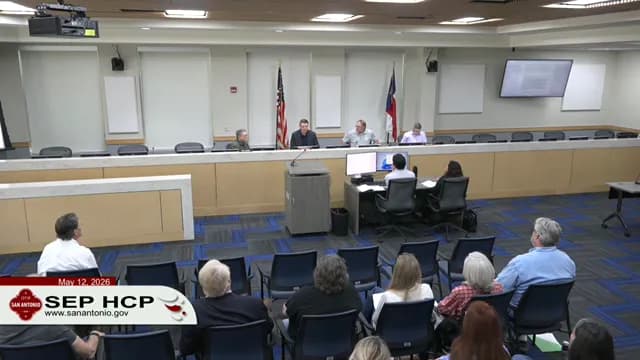
The Southern Edwards Plateau Habitat Conservation Plan (SCPHCP) Coordinating Committee met on May 12, 2026, to discuss three agenda items and hear public testimony. The meeting lasted from 3:00 PM to 3:50 PM. Key actions included approval of a transmission project, a four-week continuance of a controversial residential development application, and approval of the annual report. Public Comments & Testimony - Eleven members of the public spoke, all on Agenda Item 2 (Lenar Homes of Texas / Guajalote Ranch). Speakers included representatives from the Scenic Loop Holotus Creek Alliance and neighboring landowners. - Catherine Feist (Scenic Loop Holotus Creek Alliance) described staged land clearing as a tactic to evade environmental review, fragmenting golden-cheeked warbler habitat and undermining the SCPHCP. - Lisa Puck (landowner with conservation easement) argued that the biological survey for the property was conducted outside the warbler season and omitted known karst features. She requested neighbor notification and greater community involvement. - Emory Bloom (president, Scenic Loop Holotus Creek Alliance) formally opposed any public assistance for Guajalote Ranch, citing ten categories of material inconsistencies and omissions. He requested a formal delay and a stakeholders' meeting. - Lynette Munson (neighboring landowner) displayed a photo of golden-cheeked warblers on her property and questioned the survey's accuracy. She reported observing displaced bats after clearing began and expressed concerns about map inaccuracies and lack of compliance inspections. - Austin Browning (treasurer, Scenic Loop Holotus Creek Alliance) noted that the 300-foot warbler buffer extends onto adjacent properties not owned by the applicant, raising due process and federal take issues. - Michael Schlick (neighbor) accused the committee of favoring the developer over endangered species, calling approval of a previous phase a "mission failure." - Phil Manna (president, Alma Farmsteads Babcock Road Neighborhood Association) criticized Lenar's environmental record in Florida and questioned the habitat acreage determination for the development. - Ricky (speaker) read a poem about perception and truth. Discussion Items Item 1: WTG Bear Transmission (Application 5-2026) – Senior planner Carly Bosa presented an 8.83-acre project with zero acres of golden-cheeked warbler habitat. Staff recommended approval. The committee voted unanimously to approve. Item 2: Lenar Homes of Texas / Guajalote Ranch – Senior planner Valerie Rodriguez presented a 15.994-acre enrollment request requiring 69 GCW conservation credits and total fees of $612,458. Staff recommended approval, noting 19 opposition emails. Committee members expressed concerns about lack of a master plan, impacts on flooding, cleared land, and allegations of improper surveys. Biologist Jennifer Blair clarified that the SCPHCP went through a 10-year federal approval process, is independently reviewed, and that surveys are not required for mitigation determination. She verified the accuracy of the mitigation determination. Committee member McGlamory moved to table the item for four weeks; the motion passed unanimously. Item 3: 2024–2025 SCPHCP Annual Report – Nicole Salinas summarized the report covering October 1, 2024–September 30, 2025, which included 11 enrolled properties. The committee approved the report unanimously. Key Outcomes - Item 1 approved – Unanimous vote (4-0). - Item 2 tabled – Unanimous vote to continue for four weeks (to allow further review of concerns). - Item 3 approved – Unanimous vote. - Minutes from April 28 meeting approved – Unanimous voice vote.
Public Meetings - San Antonio, Texas
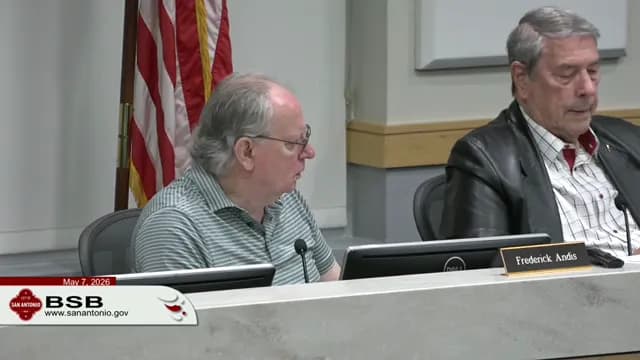
Public Meetings - San Antonio, TexasThe San Antonio Building Standards Board met on Thursday, May 7, 2026, at 9:05 a.m. under Chair Dwayne Nelson. The board heard three dangerous-building cases (resets from February 5, 2026), received a staff report on emergency demolitions, and welcomed new members. The meeting recessed from 10:38 a.m. to 10:47 a.m. and adjourned at 11:07 a.m. Consent Calendar - Minutes of April 2, 2026: The board approved the minutes as drafted by a unanimous vote (motion by Robert Benke, second by Fred Andes). Staff Report - Emergency Demolitions (read into the record): - 102 Sullivan Drive (main structure) – demolished April 1, 2026, due to fire on March 26, 2026. No further board action required. - (Address unclear from transcript – likely a second property) – demolished April 9, 2026, due to fire on March 24, 2026. No further board action required. - 510 Nolan Street (main structure) – demolished April 23, 2026, due to fire on April 17, 2026. No further board action required. - Removals from Agenda: Agenda items 5 (144 Dean Street) and 7 (DP case 131 Spats) were pulled to be rescheduled. Attorney Sabita Rye informed the board she may need to recess if her backup does not arrive due to a scheduling conflict with city council. - Administrative Updates: Judy Kroom announced that Dr. Fazal Hussein (observing this meeting) fills the veteran category on Panel A, and Jamie Little was appointed to the BSB on April 30, 2026, joining Panel B. The BSB now has full membership. The full board meeting is scheduled for May 28, 2026, at 9:00 a.m. Discussion Items Case 1: 1447/1449 Arangus Avenue (reset from February 5, 2026) - Presentation: Dangerous Premise Officer Ryan Garza recommended demolition for a single-story residential structure damaged by fire. Owner Don Juan Gilberto was not present. Notices were properly issued; Office of Historic Preservation confirmed no historic designation. The structure had extensive fire, smoke, and water damage, charred members, roof holes, and was deemed a walking hazard. SAPD Officer Robert Dupe testified to multiple calls for service, drug activity, and dangerous interior conditions. - Public Testimony: None (owner absent). - Outcome: The board found the property a public nuisance, not feasible to repair, in violation of City Code Chapter 6, Article 8, Section 6-156, subsections 1,2,5,7,8,11,12,15,17,18. Motion by Fred Andes, seconded by Robert Benke, to order demolition within 30 days, vacate, and secure the property. Vote: 4-0-1 (Dr. Hussein abstained). Case 2: 206 Cato Street (reset from February 5, 2026) - Presentation: Dangerous Premise Officer Stephanie Sanchez recommended repair for the main structure and demolition for accessory structures. Owner Jaime Flores was present. The main structure and two accessory structures (a garage and a shed/garage) were in disrepair. The owner provided a scope of work and financial letter. A conference with the owner had been held. The office of Historic Preservation confirmed no historic designation. - Public Testimony: Annette (representing the owner and financing company) stated they invested $60,000 with potential up to $80,000 for full renovation, requested 4–6 months to complete repairs. She acknowledged missing engineer letter and itemized costs. The board discussed feasibility of repair for all structures. - Outcome: After debate, the board adopted a revised motion (by Robert Benke, seconded by Paul Hernandez) to find the entire property a public nuisance feasible to repair. All structures (main, accessory one, accessory two) to be repaired within 90 days. Conditions: engineer letter, 15-day progress reports to code officer, all permits pulled, and an itemized scope of work. Vote: 4-0-1 (Dr. Hussein abstained). The original motion (demolition of accessories) was set aside. Case 3: 5246 Village Crest (reset from February 5, 2026) - Presentation: Dangerous Premise Officer Cynthia Santana recommended demolition. Owner Carrie Semang was incarcerated; notices had been sent to an incorrect facility. The property suffered a fire on November 18, 2025, with significant structural damage, collapsed roof, charred framing, and unsecured openings. No scope of work, engineer report, or permits had been filed. - Public Testimony: Elizabeth Rogers (holder of a signed power of attorney from the owner) argued the structure could be repaired for $40,000 or less, citing an incorrect bank balance of over $60,000, a contractor bid of 8 weeks, and willingness to obtain an engineer. She explained the owner had been unaware of the hearings due to misdirected mail and that she had secured the property with plastic sheeting and a camera. - Outcome: Motion by Fred Andes, seconded by Paul Hernandez, to find the property a public nuisance feasible to repair. Repair order within 90 days. Conditions: property must be secured with a perimeter fence (chain‑link or similar) around the structure, 20-day progress reports to code officer, engineer letter, all permits required. Vote: 4-0-1 (Dr. Hussein abstained). Key Outcomes - 1447/1449 Arangus Avenue: Demolition ordered within 30 days (vacate and secure). Vote 4-0-1. - 206 Cato Street: All structures (main and two accessories) to be repaired within 90 days with conditions (engineer letter, 15-day check-ins, permits, itemized scope). Vote 4-0-1. - 5246 Village Crest: Repair within 90 days with conditions (security fence, 20-day reports, engineer letter, permits). Vote 4-0-1. - New Members: Dr. Fazal Hussein (observer, Panel A) and Jamie Little (Panel B) joined the BSB.
This special session of the San Antonio City Council, held on May 7, 2026, at 4:57 PM, focused on the San Antonio Water System (SAWS) proposed rate adjustment for the period 2026–2029. SAWS President Robert Puente and Board Chair presented a four-year capital plan requiring rate increases to address aging infrastructure, state and federal mandates, water loss, and drought resilience. Council members discussed affordability, infrastructure risks, water loss reduction, executive compensation, and the need for community trust. No vote was taken; the session was informational ahead of a scheduled vote on June 11, 2026. Discussion Items - Presentation of Capital Plan and Rate Proposal: Robert Puente outlined a $150+ million capital improvement program (CIP) for 2026–2029, including upgrades to the Steven M. Claus water recycling center, Salado Creek sewer main replacement, Leon Creek plant expansion, and Mitchell Lake wetlands. The proposed rate increase would average 7.9% annually, resulting in an additional $19 per month for residential customers over four years (from $7,610 to about $9,290 annually for 6,000 gallons). Puente emphasized that delaying projects would lead to higher costs and regulatory violations, citing the risk of system failure within six months for some facilities. - Council Member Concerns and Questions: - Council Member (CM) Galván expressed concern about water loss (21 million gallons lost in 2023) and questioned the timing of rate increases amid rising costs for gas, property taxes, and electricity. She noted that executive bonuses could undermine public trust and stated she would need confidence in leadership to support the increase. - CM Alde Gavito asked about the impact on different districts, the affordability program (Uplift), and requested a breakdown of costs by usage category. She emphasized the need for transparent communication with residents. - CM Spears highlighted the improvement in leak response time (from 14 days in 2023 to 2 days in 2025) and asked about the efficiency study. She also inquired about the sustainability of additional staff after capital projects. - CM White criticized the cumulative cost of $228 per year for a family of four and compared it to other cities. He called for an operational efficiency audit similar to CPS's. - CM Mesa González requested a breakdown of projects by state mandates and wanted to understand how the rate increase would affect businesses. - CM Mackay Rodríguez expressed gratitude for the seriousness of the presentation but voiced concerns about the timing of the rate increase alongside other city fee increases. He questioned the public perception of executive bonuses and the need for a paradigm shift in communication. - CM Viagran recalled the 2022 rate reduction and urged prioritization of infrastructure, noting that water from the north flows to the south. She asked for information on septic tank impacts and the Salado Creek odor project. - CM Mungue asked for a map of the 77 miles of pipe to be replaced and inquired about the financial impact on schools. He also raised concerns about the quality of street repairs after SAWS projects. - CM Castillo appreciated the team's efforts and emphasized the importance of water quality, Uplift program expansion, and connecting residents still on septic tanks to the sewer system. - CM [District 1] expressed emotional concern about rising costs and asked for clear information on where SAWS would cut costs or improve efficiency. She requested data on the number of households eligible for Uplift and how to better target assistance. - SAWS Response: Puente and other SAWS officials clarified that the four-year plan provides the lowest cumulative impact compared to shorter-term increases. They noted that the Uplift program eligibility would expand from 125% to 150% of the federal poverty level, potentially tripling the number of households served. They also stated that the efficiency study is ongoing and will be presented before the June vote. Regarding executive bonuses, Puente explained that the board sets performance goals and that the CEO's evaluation is based on annual metrics, but he acknowledged the need to better communicate this to the public. Key Outcomes - No formal vote was taken during this session. The next steps include: - A further discussion and recommendation by the SAWS Board on May 19, 2026. - Staff recommendations to the City Council on May 20, 2026. - City Council vote on the proposed rate increase scheduled for June 11, 2026. - Council members requested additional information, including a breakdown of projects by state mandate, a map of pipe replacements, data on the impact of the rate increase on different customer classes, and details on how the efficiency study could reduce costs. - SAWS committed to providing this information and to participating in community meetings prior to the vote.
The San Antonio Board of Standards (BSB) convened on May 7, 2026, at 9:05 AM with Chair David Nelson presiding. The meeting addressed several property cases under Chapter 6 of the city code, including demolitions and rehabilitation orders. Emergency demolitions were reported, and three contested cases were heard: 1447/1449 Aransas Avenue (demolition), 206 Kado (rehabilitation of principal and accessory structures), and 5246 Village Crest (rehabilitation). The board also approved previous meeting minutes and noted the assignment of a new member. Consent Calendar - Approval of Minutes: The board unanimously approved the minutes from the April 2, 2026 meeting. Motion by Robert Bank, seconded by Luis Fernández. Emergency Demolitions (Reported by Jenny Ramírez) - 120 (District 1): No action needed. - 358 East Harding (accessory structure): Demolished as emergency on April 9, 2026 due to extensive fire from March 24, 2026. No action needed. - 510 Nolan Street (principal structure): Demolished as emergency. No action needed. Discussion Items Case 1447/1449 Aransas Avenue (Demolition) - Property: 1447 (also known as 1449) Aransas Avenue, owned by Don Juan Roberto. Second hearing. - Presentation: Officer Brian Garza testified that the structure is a one-story residence with severe fire and water damage, collapsing roof, failed foundations, and open access. It is a public safety hazard with reports of drug activity and trespassing. The historical preservation officer confirmed no historic designation. The structure violates code sections 1,2,5,7,8,11,12,15,17,18. The city recommended demolition. - Owner/Representative: The owner was not present. No one spoke on their behalf. - Board Action: Motion by Robert Bank to declare the property a public nuisance, not feasible to repair, and order demolition within 30 days with evacuation and securing. Passed 4-0-1 (Chair Nelson, Cole Hernández, Robert Bank, Frank Andes in favor; Dr. Hussein abstained). Case 206 Kado (Rehabilitation of All Structures) - Property: 206 Kado, owned by Jaime Alfredo Flores (present via representative Vienet). Second hearing. - Presentation: Officer Sánchez testified that the property includes a principal structure and two accessory structures (formerly connected by a terrace, now separated). The principal structure had ongoing work without permits. Code violations for principal: 1,2,5,8,11,12,15; for accessory structures: 1,2,5,8,11,12,15. City recommended demolition of accessory structures and repair of principal structure. - Representative: Vienet spoke on behalf of the owner and a company (MP Profit/LCA Remodeling) that would finance repairs up to $60,000-$80,000. They proposed full renovation with permits, timeline of 4-6 months. They provided a scope of work and financial capacity letter but no bank statement or detailed cost breakdown. - Board Discussion: Initial motion (by Robert Bank) was to repair principal in 90 days and demolish accessory structures in 30 days. After debate, board member Paul Hernández suggested repairing all structures. The initial motion was tabled. A revised motion was made to repair all structures (principal and both accessory) within 90 days, require engineer letters, progress reports every 15 days with code officer, and a point-by-point work list. - Board Action: Motion passed 4-0-1 (Dr. Hussein abstained). Case 5246 Village Crest (Rehabilitation) - Property: 5246 Village Crest, owned by Semin Carrie A. Represented by Elizabeth Rogers (by power of attorney from the incarcerated owner). Rehearing. - Presentation: Officer Cynthia Santana testified that the property is a one-story residence with significant fire damage from November 18, 2025. Code violations: 1,2,5,7,8,11,12,15,17,18. The city recommended demolition. No engineer letter or financial capacity had been provided earlier. - Representative: Elizabeth Rogers appeared with a power of attorney and financial documents. She stated the owner has $64,000 in a bank account and intends to repair the property with estimated costs of $40,000-$42,000. She proposed a timeline of 48 weeks. The board noted the lack of an engineer report and current cost estimates. - Board Discussion: The board considered repair feasibility. Motion by Robert Bank to declare the property a public nuisance but feasible to repair within 90 days, require securing the property with a fence or barrier around the structure, progress reports every 20 days, engineer letter, and all permits. - Board Action: Motion passed 4-0-1 (Dr. Hussein abstained). Key Outcomes - Case 1447/1449 Aransas: Demolition ordered within 30 days. (Vote: 4-0-1) - Case 206 Kado: All structures (principal and two accessory) to be repaired within 90 days, with engineer reports every 15 days, permits, and work list. (Vote: 4-0-1) - Case 5246 Village Crest: Repair within 90 days, property secured with fence/barrier, progress reports every 20 days, engineer letter, and all permits. (Vote: 4-0-1) - Emergency demolitions: Recorded; no board action needed. - Next meeting: Scheduled for May 28, 2026 at 9:00 AM. Note: Dr. Hussein abstained from all three votes.
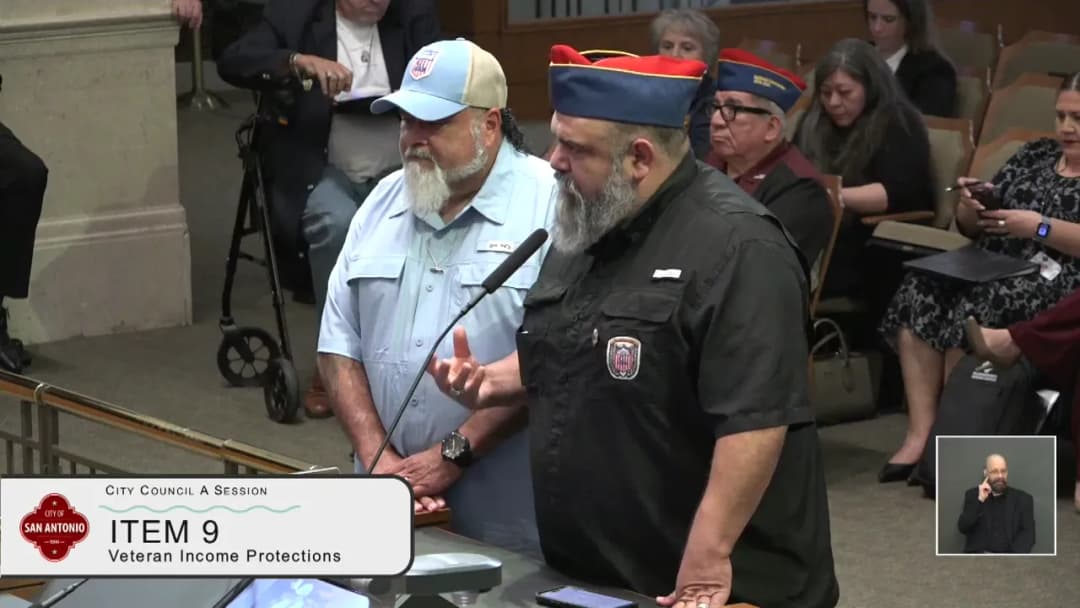
The San Antonio City Council convened at 9:14 AM on May 7, 2026, under Mayor Gina Ortiz Jones. The meeting opened with roll call (all members present), an invocation by Pastor Rick Godwin for the National Day of Prayer, and the Pledge of Allegiance. The council then adopted proclamations for Municipal Clerks Week (May 3–9), Asian American, Native Hawaiian, and Pacific Islander Heritage Month, and Jewish American Heritage Month. Points of personal privilege recognized Miss United States Texas 2026 Portland Tidwell and honored the late Kendra Meadows for her neighborhood advocacy. The meeting lasted approximately seven hours, adjourning at 4:16 PM. Consent Calendar - Items 5–16 were considered as a group after items 9, 10, and 16 were pulled for individual discussion. The remaining consent items were approved unanimously. - Highlights from the consent agenda: Item 7 (Ceiling Drainage Phase 4 project in Donaldson Terrace), Item 12 (appointment of Art Velis to the Ethics Review Board), and Item 14 (MOA with Velocity Texas for military medical innovation) were noted by council members. Public Comments & Testimony - Items 5 & 6 (Sports District Contracts): Jessica Palacios (San Antonio Hispanic Chamber of Commerce) urged strengthening small business participation goals (14% SBE) and veteran-owned business preferences. Antonio Diaz and Diana Uriegas Flores criticized the transparency of the process, arguing the public had not been adequately informed. Diaz expressed concern that the district would not benefit residents and would raise property taxes. - Item 9 (Veterans VASH Voucher Ordinance): Over 30 speakers testified, with the majority supporting the original ordinance without exemptions. Veterans, their families, and advocates (including Irene White, Brandon Tryon, Sebastian Gallegos, Charlene Hernandez, Robert Trevino, and others) described discrimination, the difficulty of using vouchers, and the concentration of voucher holders in high-vulnerability areas. Several noted that 70% of VASH holders live in high-social-vulnerability census tracts and only 8% of rental listings accept vouchers. The San Antonio Apartment Association (Alan Ross) opposed the ordinance, arguing that the system works and that the industry was not consulted, instead supporting a council consideration request for further study. Small landlord Karen Fisher (a veteran) opposed the mandate, citing payment delays and financial hardship. - Item 10 (Crypto Kiosk Signage): Lisa Rodriguez and Usman Arana (AARP) spoke in favor, noting that 60+ adults lost $333 million to kiosk fraud in 2025 and that signage acts as a critical intervention. - Item 16 (Ready-to-Work Budget): Jack Finger criticized the program's placement rate (33% of applicants placed) and suggested letting voters decide on a tax cut. Discussion Items - Item 4 – Downtown Sports & Entertainment District Briefing: A motion to delay the briefing to a June B session passed 10–1 (Mayor Jones dissenting), after debate about timing and transparency. Councilmember McKee Rodriguez summarized the status of the project (ITC property acquisition, Spurs arena terms, convention center study, etc.). The brief was ultimately postponed. - Items 5 & 6 – District Study (Municap) and Executive Program Manager (Accenture): City Manager Eric Walsh presented both contracts. Item 5: a $350,000 study with Municap (10-week project) to model cost of services, revenue forecasting, and new revenue opportunities. Item 6: a phase-one contract with Accenture for up to $6 million through March 2027, with a five-year base and five one-year renewals, for program management, governance, dashboards, and coordination with the Spurs. Council members expressed support, noting Accenture’s high score (73 points) and experience. Councilmember McKee Rodriguez raised concerns about the lack of local competition if Accenture were terminated. Both items passed unanimously. - Item 9 – Source of Income Protections for Veterans: The PCDC committee had recommended amendments exempting owners of four or fewer units and imposing escalating penalties. Mayor Jones moved to strike those amendments. After a roll call vote, the amendment failed (3–8). The council then approved the original PCDC version, which applies to housing providers renting five or more units, with penalties: first offense (written warning), second (mandatory training), third ($500 fine and referral to city attorney). The ordinance will be reviewed after six months. Councilmembers noted enforcement challenges in tracking ownership but pledged to investigate complaints on a case-by-case basis. - Item 10 – Virtual Currency Kiosk Signage: Unanimously approved. An amendment to replace “customer” with “user” was accepted. The ordinance requires fraud prevention signage in direct line of sight at all kiosks. - Item 16 – SA Ready-to-Work FY2027 Budget: Approved. The $42.8 million budget includes 6,730 new applicants, 3,825 training completions, and 2,410 job placements. Staff discussed efforts to align with employer needs, integrate AI pathways, and improve marketing to construction trades. The mayor requested an ROI analysis comparing Ready-to-Work with Pre-K 4 SA. Key Outcomes - Item 4 – Delayed to June B session (10–1). - Item 5 – Approved (unanimous). Contract with Municap Inc. for $350,000 (base $316,350 + $33,650 contingency) for district study. - Item 6 – Approved (unanimous). Contract with Accenture Infrastructure and Capital Projects LLC for up to $6 million (phase one) for executive program management. - Item 9 – Approved (majority, no roll call needed). Ordinance creating source of income protections for veterans using VASH vouchers, applying to owners of five or more units, with escalating penalties. Effective immediately; to be reviewed in six months. - Item 10 – Approved (unanimous). Ordinance requiring fraud prevention signage at all virtual currency kiosks, with “user” substituted for “customer.” - Item 16 – Approved (unanimous). FY2027 budget for SA Ready-to-Work ($42,797,898) and amendment to increase funding for Restore Education intake/case management from $5.3M to $11.6M.
The San Antonio City Council held a special session on May 7, 2026, to receive a briefing from the San Antonio Water System (SAWS) on its proposed four-year rate adjustment for fiscal years 2026 through 2029. The meeting, which began at 4:57 PM and adjourned at 6:58 PM, was the first of three sessions before a council vote scheduled for June 11, 2026. SAWS President and CEO Robert Puente and board chair Jelynne Burley presented the capital program, emphasizing the need to invest in aging infrastructure, meet regulatory mandates, and improve water loss management. Discussion Items SAWS Presentation Highlights - Capital Program: SAWS outlined a $3.2 billion, five-year capital improvement plan (CIP) to address aging wastewater treatment plants (e.g., Stephen M. Klaus plant from 1987, Leon Creek from 1965), replace water mains, expand the Aquifer Storage and Recovery (ASR) facility from 30 to 60 million gallons per day, and comply with state and federal mandates. - Rate Impact: The average residential customer (using 6,705 gallons water, 5,052 gallons wastewater) would see a $4.47/month increase in 2026 (7.9%). Over the four years, the cumulative increase would be about $19/month. 70% of residential customers use less than the average and would experience a lower impact. - Affordability: The proposed rate adjustment includes expanding the Uplift assistance program eligibility from 125% to 150% of the federal poverty level, potentially doubling the number of eligible families. Additional funding for programs like Project Aguila, Plumbers to People, and Laterals to People was also included (e.g., Project Aguila from $400,000 to $600,000). Uplift customers would not see a rate increase. - Water Loss: SAWS reported 7,400 breaks and leaks in 2023, costing an estimated $70 million in lost revenue. Response times have improved from 14 days (2023) to 2 days (2025) through increased staffing (37 new positions, including leak detection teams). The leak detection team grew from 6 to 16 staff, and 60% of time is now spent on proactive leak detection. Non-revenue water targets aim for a 50% reduction by 2035. - Historical Context: SAWS noted they deferred rate increases since 2019, absorbed costs from COVID-19, Winter Storm Uri ($340 million mandate), and new EPA Lead and Copper rules, all while implementing a $200 million Connect H2O meter program and delivering an 11.8% rate decrease in 2022. The current request is the first since then. Council Member Positions and Comments - Mayor Jones: Emphasized the risk of infrastructure failure and noted that the four-year plan is the most cost-effective approach, as spreading the costs reduces the annual burden. He also highlighted the need for interagency data sharing with CPS Energy to target vulnerable residents. - Councilmember Aldrete y Vito (District 7): Expressed strong concern about water loss (21 billion gallons in 2023, costing $70 million) and questioned the timing given other cost pressures. He requested a two-year rate plan option and announced a SAWS town hall on May 18. He also noted the CEO bonus announcement as a public trust issue. - Councilmember Galvan (District 6): Asked for detailed affordability data, including tier breakdowns for low-usage customers, and sought to understand how the Uplift program could be made automatic enrollment. She appreciated SAWS' community outreach. - Councilmember Spears (District 9): Asked about staffing sustainability and whether the efficiency study could lead to lower rates. She requested data on incentive programs for water conservation. - Councilmember White (District 9): Expressed concern about the total $19/month increase, comparing it to a week's worth of groceries. He requested the percentage of household income spent on water (SAWS responded: currently 1.1%, rising to 1.18% with the increase). He also asked about uncollected revenues (outstanding delinquencies of $27 million) and a two-year plan, but SAWS argued a four-year plan provides rate stability and avoids larger future increases. - Councilmember Mesa Gonzalez (District 8): Emphasized the need for transparency and protecting low-income residents. She asked about mandate-related CIP projects and requested information on general customer (business) rate impacts by size. - Councilmember McKee Rodriguez (District 2): Voiced concerns about trust and timing, citing the CEO bonus and unresolved issues like Grayson Heights. He acknowledged SAWS' fair rate structure (no incentive for high water use) and the Uplift program, but said he needed more confidence before supporting the increase. - Councilmember Castillo (District 5): Expressed support for the investment, noting the need to avoid "kicking the can down the road." He praised SAWS' community engagement and the expansion of Uplift. He also highlighted the importance of safe, quality water for over 2 million residents. - Councilmember Corr (District 1): Requested more details on SAWS' internal efficiency cuts, and asked for data on customers not enrolled in Uplift but eligible (approximately 40% of eligible are enrolled). She also raised coordination issues between SAWS and city public works projects. - Councilmember Viagran (District 3): Strongly supported the rate adjustment, arguing that neglected infrastructure disproportionately impacts the South Side. She highlighted benefits like reducing odors from Salado Creek and addressing septic tank issues. She advocated for communication on conservation programs. Key Outcomes - No vote was taken; this was a briefing session. The scheduled next steps are: SAWS board vote on the rate plan on May 19, 2026; city staff recommendation to council on May 20, 2026; and council vote on the rate plan on June 11, 2026. - Council members requested additional data: tier breakdowns for residential and general customers, geographic maps of priority pipe replacements (77 miles), heat maps of septic tank areas, impact on school districts, and analysis of the impact on residents at various income levels. - SAWS committed to sharing the efficiency study (draft received, final expected before June 11) and to providing requested information. The newly established Capital Projects Committee, chaired by Ed Belmarez, will review the capital delivery program. - The mayor's office and SAWS will work on a data-sharing agreement with CPS Energy to cross-reference vulnerable customer data for targeted outreach. This summary is based on the transcript of the May 7, 2026 city council special session. No agenda or minutes were available.
The San Antonio Zoning Commission met on May 7, 2026, at 4:31 PM, acting mayor Mecke Rodríguez presiding. The meeting addressed multiple zoning requests, including postponements, a consent agenda, and individual items concerning tobacco/vape shops, a boutique parking restriction, and a rezoning for commercial use. Several speakers, including resident Jack Finger, provided public comment. Key decisions included denials of three tobacco/vape shop proposals near schools and approval of a zoning change for a commercial development. Consent Calendar - Items 3, 4, 5, 9, 14, 15, 16, 17, 20, and 22 were approved unanimously by consent. Item 11 (a tattoo shop) was part of the consent agenda; Jack Finger expressed opposition to the tattoo shop, arguing against another such establishment on the east side. The motion to approve the consent agenda was made by Councilor Cor and seconded by Councilor Munguía, and passed unanimously. Public Comments & Testimony - Jack Finger (resident) spoke on multiple items: - For items 1, 6, and 7 (postponed): He argued that the proposals (related to residential units near the airport) would invite commercial invasion and destabilize the area. He also opposed item 1, a variance to allow alcohol sales within 300 feet of UT Boulevard educational institution. - For items 8, 18, and 19: He opposed tobacco/vape shops near schools, citing risks to children and community health. He noted that for item 8, over 20% of notified residents within 300 feet responded in opposition. - For item 11 (consent): He opposed a tattoo shop, stating the city does not need another one and highlighting the difficulties of tattoo removal for youth. Discussion Items - Item 2 (2520 Macaula Avenue): A request to change parking restrictions for a boutique called Rise Up. Councilor Cor (District 1) stated the boutique would no longer open, so the change only affects parking and does not alter the business. 84 notifications were sent: 2 in favor, 2 opposed, plus 5 opposed from outside 200 feet. Montevista Association opposed; Texas Colonists Association neutral. Motion to approve passed. - Item 8 (3109 N. St. Mary Street): Rezoning from C3U4 C4 to C1 C D S U 4 to allow a tobacco shop, smoking area, and vape store. Located within 1,000 feet of Mark Twain Academy. Staff and the zoning commission recommended denial. 13 notifications: 2 in favor, 0 opposed. No response from Toby Hill or District 1 associations. Councilor Cor moved to deny; seconded by Councilor Munguía. Motion passed. - Item 18 (1739 Babcock Road): Rezoning from C2 to C2S with specific use for a tobacco/vape shop, located within 1,000 feet of an international school. 9 notifications: 1 in favor, 2 opposed. No response from O Hills association. Councilor Gavito (District 107?) moved to deny, citing exposure of fifth‑grade students to vape marketing. Seconded by Councilor White. Motion passed. - Item 19 (6430 Callahan Road): Rezoning from C3 to C2S for same tobacco/vape use, within 1,000 feet of a vocational school. 11 notifications: 1 in favor (outside 200 ft), 1 opposed. No homeowners association registered. Councilor Gavito moved to deny, citing same concerns as item 18; seconded by Councilor White. Motion passed. - Item 21 (12,710 Spectrum Drive): Rezoning from C3R and M R1 to C3. Staff and zoning commission recommended approval. 24 notifications: 1 in favor, 5 opposed. Requires supermajority. Councilor Mesa González (District 8) noted the current industrial zoning is inappropriate near residential areas, and residents had concerns about alcohol sales. The applicants are long‑time local merchants. Motion to approve made by Councilor Mesa González, seconded by Councilor Villagrán. Motion passed. Key Outcomes - Postponed items: Items 1, 6, and 7 were postponed via motion (maker and seconder not specified). Item 1’s motion passed separately. - Consent agenda: Approved unanimously. - Item 2: Approved (motion by Councilor Cor, seconded; no vote tally given). - Item 8: Denied (motion by Councilor Cor, seconded; passed). - Item 18: Denied (motion by Councilor Gavito, seconded; passed). - Item 19: Denied (motion by Councilor Gavito, seconded by Councilor White; passed). - Item 21: Approved (motion by Councilor Mesa González, seconded by Councilor Villagrán; passed). - The meeting adjourned at 4:50 PM. A birthday celebration was held for Councilor Gavito.
The San Antonio City Council held a zoning and land use session on Thursday, May 7, 2026, beginning at 4:31 PM and adjourning at 4:51 PM. The meeting included items continued to future dates, a consent agenda, and individual zoning items. Councilmembers voted on several rezoning requests, with multiple denials for proposed vape and hookah shops near schools. Consent Calendar - Items 3, 4, 5, 9, 10, 11, 12, 13, 14, 15, 16, 17, 20, and 22 were approved unanimously under the consent agenda. Councilmember Corr motioned, Councilmember Mungia seconded. One resident, Jack Finger, spoke on item 11, opposing the addition of a tattoo parlor at a Coca-Cola Place location, stating he believes there are already too many tattoo parlors in the city. Councilmember Spears expressed support for tattoo studios. Discussion Items - Items 6 and 7 (Continued to May 21, 2026): These identical items sought to amend zoning district boundaries to allow two dwelling units in residential areas with potential commercial encroachment. Jack Finger spoke against them, citing zoning staff concerns that the changes would destabilize the neighborhoods. The council continued both items unanimously. - Item 1 (Continued to June 18, 2026): This item requested an alcohol variance for a property within 300 feet of the University of Texas at UT Boulevard. Jack Finger argued against mixing education and alcohol so close together. The council continued the item unanimously. - Item 2 (2520 McCullough Avenue): Change of zoning from C2 to IDZ-1 with uses permitted in C1 Light Commercial District, originally intended for a wine boutique. 84 notices were mailed: 2 in favor, 12 opposed (22.64% of land area within 200 feet), requiring a supermajority. The Mona Vista Neighborhood Association opposed; Tobin Hill Community Neighborhood Association was neutral. Councilmember Corr noted the applicant dropped the wine boutique request, leaving only a parking restriction change, making opponents more comfortable. Motion to approve by Councilmember Corr, seconded by Councilmember Viegran, passed. - Item 8 (3109 North St. Mary's Street): Change of zoning from C3 to C1 CDS to permit a tobacco store, hookah lounge, vape shop, or consumable hemp retailer within 1,000 feet of Mark Twain Academy. Staff and Zoning Commission recommended denial. 13 notices mailed: 2 in favor (outside 200-foot boundary), no response from Tobin Hill or District 1 associations. Jack Finger spoke against, noting the proximity to a school and the recommendations of staff and commission. Motion to deny by Councilmember Corr, seconded by Councilmember Viegran, passed. A yes vote was to deny. - Item 18 (1739 Babcock Road): Change of zoning from C2 to C2S for the same uses as item 8, located within 1,000 feet of the International School of San Antonio. Staff and Zoning Commission recommended denial. 9 notices mailed: 0 in favor, 2 opposed; no response from Oak Hills Citizens' Neighborhood Association. Councilmember Alarcón Gabito cited a formal letter of opposition from the school, expressed concern about visible marketing of vape/hemp products to fifth graders, and referenced the city's recent breath ordinance. Motion to deny by Councilmember Alarcón Gabito, seconded by Councilmember White, passed. - Item 19 (Callahan Road): Change of zoning for a similar vape shop use within 1,000 feet of the School of Health Care Professions. Councilmember Alarcón Gabito restated concerns about proximity to schools. Motion to deny by Councilmember Alarcón Gabito, seconded by Councilmember White, passed. - Item 21 (12719 Spectrum Drive): Change of zoning from C3R and I-1 to C3R, adjacent to single-family homes in District 8. Staff and Zoning Commission recommended approval. 24 notices mailed: 0 in favor, 5 opposed (30.45% opposition), requiring a supermajority. Councilmember Mesa Gonzalez thanked Hart Ranch residents and the applicant (Gazer family), noting that the applicant amended the application to restrict on-premise alcohol consumption. Motion to approve by Councilmember Mesa Gonzalez, seconded by Councilmember Viegran, passed. Key Outcomes - Items 6, 7, and 1 were continued to May 21 and June 18, 2026, respectively. - The consent agenda (items 3, 4, 5, 9, 10, 11, 12, 13, 14, 15, 16, 17, 20, 22) was approved unanimously. - Item 2 was approved. - Items 8, 18, and 19 (vape/hookah shops near schools) were unanimously denied. - Item 21 was approved with a restriction on on-premise alcohol consumption. - The meeting ended with Councilmember White leading a happy birthday song for an unnamed council member.
The San Antonio City Council met on May 7, 2026, from 9:14 AM to 4:16 PM to consider proclamations, consent agenda items, updates on the proposed Sports and Entertainment District, contracts for consulting services, a cryptocurrency fraud prevention ordinance, source of income protections for veterans, and the FY 2026-2027 budget for the Ready to Work program. The meeting included extensive public testimony and several votes. Consent Calendar - Approved items 5-16 as a block, with items 9, 10, and 16 pulled for individual consideration. - Item 12 (approval of appointment to Ethics Review Board) was remarked by Councilwoman Villagrán. - Item 7 (NASA contract for construction in District 7) was remarked by Councilwoman Alderete Gavito. - Item 13 (contract with River Aid San Antonio for debris removal) was remarked by Councilwoman Spears. - Public speakers on consent: Antonio Díaz (for items 7 & 8, but corrected to drainage projects), René Domínguez (CEO of Velocity Texas, supporting item 13 MOU), and Jack Finger (opposed to Pre-K SA budget, item 15, citing flawed long-term projections). Public Comments & Testimony - On Items 5 & 6 (Sports District Contracts): Jessica Palacios, Director of Government Affairs for the San Antonio Hispanic Chamber of Commerce, urged the council to strengthen local business participation goals and metrics. Diana Uriegas Flores opposed the contracts, citing lack of transparency and arguing the district would not benefit nearby residents. - On Item 10 (Cryptocurrency Fraud Signs): Lisa Rodríguez (AARP) and Ismael Herrera (AARP Texas) supported the ordinance, noting that over $300 million was lost to kiosk fraud in 2025, primarily targeting seniors. They urged immediate action. - On Item 9 (Veterans Income Protection): Numerous veterans and advocates spoke in favor, including Irene Wade (community worker), Brendan Terrent, Sebastian Gallegos, Shirlene Hernández (veteran and post commander), José Arzola (veteran and GI Forum leader), Rose Penner González, Donna Hicks, Alan Ross (San Antonio Apartment Association representative), Fred Alvarado, Harry Robinson, Mary Ellen, Keyla Miranda, Felix Rodríguez (Texas state commander, American GI Forum), Cynthia García (GI Forum president), Ace Acevedo, Gabriela Ibarra Noriega, Dr. Gwendolyn Godlack, Gabriel Rosales, Leo Castillo Anguiano, Marinel Murillo, Martha Sphinx (retired Army colonel), Ute Hall, Johnny García, Rubén Arteaga, Steven Price, Madeleine Mellet, Antonio Díaz, Diana Uriegas Flores, Silvia Soto, and Karli Guevara. They argued that veterans using HUD-VASH vouchers face widespread discrimination, forcing them to live in substandard or distant housing, and called for a strong ordinance without exceptions. - Opposing speakers on Item 9: Jack Finger argued the problem is small (100 out of 90,000 veterans seeking housing) and that payment delays are the real issue. Karen Fisher (veteran and small landlord) stated that forcing voucher acceptance would hurt small property owners. Robert Mahara (veteran) and others said the ordinance should be fixed at the state level. - On Item 16 (Ready to Work Budget): Jack Finger criticized the program’s performance, noting only about 2,000 of 6,000 participants secured good jobs, and suggested a tax cut instead. Discussion Items - Sports and Entertainment District Update (Agenda Item 4): Councilman White moved to postpone the update to a future session B in June to allow the working group to report. The motion passed 10-1 (Mayor Jones opposed). - Item 5 (Ordinance for Multicap Study Contract): Approved. The $350,000 contract (base $316,350 plus 10% contingency) will provide impact projections, revenue forecasts, and new income opportunities for the proposed district. Funding from HOT capital fund. - Item 6 (Ordinance for Accenture Program Manager Contract): Approved. The contract, up to $6 million for Phase I (through March 2027), with a term through 2031 and five one-year renewal options, will provide executive program management for the district. Council discussion focused on local preference points (Accenture had 73 points vs. runner-up Project Control’s 52) and implementation of a public dashboard. - Item 10 (Cryptocurrency Kiosk Fraud Prevention Signs): Approved. The ordinance requires fraud prevention signage on all virtual currency kiosks. An amendment to change “consumer” to “user” was accepted. Council members praised swift action. - Item 9 (Veterans Source of Income Protection Ordinance): Extensive debate. The original version prohibited discrimination based on lawful source of income (including vouchers) for all rental housing. The Planning and Community Development Committee (PCDC) recommended an amendment applying only to landlords with 5+ units, with a three-step enforcement (warning, training, then $500 fine for third offense) and a six-month review. A council vote on the amendment failed. The council then approved the original PCDC version (applying to landlords with more than 4 units) by a majority. Council members noted the need to monitor impacts and work at the state level. - Item 16 (Ready to Work FY 2026-2027 Budget): Approved. The $42.797 million budget begins July 1, 2026. Council discussion included concerns about low placement rates, use of GI Bill funds by veterans, and the need to focus on high-growth fields like AI. Staff reported a recent ROI analysis showing $11.8 billion in total benefits to date. Key Outcomes - Item 4 (Sports District Update): Postponed to a future session B in June 2026 (vote 10-1). - Item 5 (Multicap Study Contract): Approved unanimously. - Item 6 (Accenture Program Manager Contract): Approved unanimously. - Item 10 (Cryptocurrency Kiosk Signs): Approved unanimously. - Item 9 (Veterans Income Protection): Approved with PCDC amendments (applies to landlords with more than 4 units; three-step enforcement; six-month review). Vote tally not explicitly stated, but the motion passed. - Item 16 (Ready to Work Budget): Approved. - The meeting adjourned at 4:16 PM.
[The San Antonio City Council received a comprehensive financial update from Budget Director Freddy Martinez covering the FY2026 second-quarter report, five-year forecast, and ongoing challenges. The presentation highlighted slowing revenue growth, a structural deficit, rising healthcare costs, and the need for significant budget reductions. Council members engaged in a wide-ranging discussion about priorities, potential tax increases, service cuts, and collaboration with other entities.] Discussion Items - Economic and Revenue Overview: Martinez reported moderate economic growth locally and nationally, with slower sales tax growth, declining hotel occupancy tax revenue, and a projected 23.5% drop in residential permits. The city’s unemployment rate rose slightly to 4%. Revenue for the General Fund is projected to be $2 million below budget. - Healthcare Cost Pressures: The city faces a $45 million projected overspend in healthcare benefits for FY2026, with $19 million already recorded in the first six months. Martinez noted that 4 of 51 stand-alone emergency rooms account for over half of claims. The administration plans to target providers and educate employees to curb costs. - Five-Year Forecast and Structural Deficit: The five-year forecast shows a structural imbalance, with revenue growth (assumed at 3.5% for property tax and 2% average for sales tax) not keeping pace with expenses. The forecast projects a cumulative deficit of $264 million through FY2031 unless corrective actions are taken. Two scenarios were presented: Scenario 1 requires $130 million in cuts over two years; Scenario 2 involves using state revenue growth (32.9%) to reduce the need to $7 million in cuts over two years, implying a potential property tax rate increase. - Council Member Positions: - Mayor Jones emphasized the need for significant action, noting the deficit grew from $225 million to $264 million in one year, and urged targeting healthcare costs through employee education and provider negotiations. - Councilmember White argued the problem is spending, not revenue, and called for cuts to non-essential programs, opposing any tax increase. He stressed focusing on core services (public safety, infrastructure). - Councilmember Spears opposed layoffs and tax increases, arguing the city has a revenue problem from tax breaks for businesses and luxury housing. She called for increasing revenue through fees and reducing incentives. - Councilmember Galván warned against cutting libraries, parks, and human services, stating that such cuts would harm vulnerable residents and make the city less attractive for business. He urged honesty with the public about service reductions. - Councilmember Castillo suggested exploring fee increases for building permits, code enforcement, and short-term rentals to hold bad actors accountable and generate revenue. - Councilmember Macky Rodríguez advocated for regional collaboration with suburbs and the county to eliminate redundancies, and for creative thinking during tough times. - Councilmember Core requested detailed breakdowns of non-mandatory services and completed project percentages, and noted the importance of sustainable economic development. - Councilmember (unnamed in transcript but speaking) supported Scenario 2 (tax increase) to avoid deep cuts to services like pre-K and sidewalk repairs, arguing that underfunding now leads to greater costs later. - Comprehensive Budget Review: The city has reinstated a comprehensive budget review process started in FY2025, with results expected for the FY2028 budget. Council members also discussed the need to review all subsidies and outstanding debts, and to consider using hotel occupancy tax funds or other restricted funds for General Fund relief. Key Outcomes - No formal votes were taken; the meeting was informational and set the stage for upcoming budget decisions. - Next Steps: The council will consider FY2026 budget adjustments and revenue/expense alignments based on the six-plus-six report at a mid-May meeting. A full budget forecast for FY2027 will be presented on June 17, 2026, incorporating additional data and reduction plans. The proposed budget for FY2027 will be considered on August 13, 2026. - Directives: Staff will explore fee increases, code enforcement, and vacant property ordinances as discussed. The administration will continue targeted efforts on healthcare cost containment. Collaboration with Bexar County and neighboring cities will be pursued to identify efficiency savings. A comprehensive analysis of all city subsidies and outstanding receivables will be prepared for future discussion.