Browse by city
Date range
Search help

Search titles, summaries, topics and stored transcripts together. Keywords may match separately; put the whole query in double quotes for a phrase. Matching follows word analysis, so punctuation is not exact. Both dates are included. Documents are not searched.

SHOWING 441–450 ENTRIES
441
FEB 19, 2026 · SAN ANTONIO, TEXAS · CITY COUNCIL
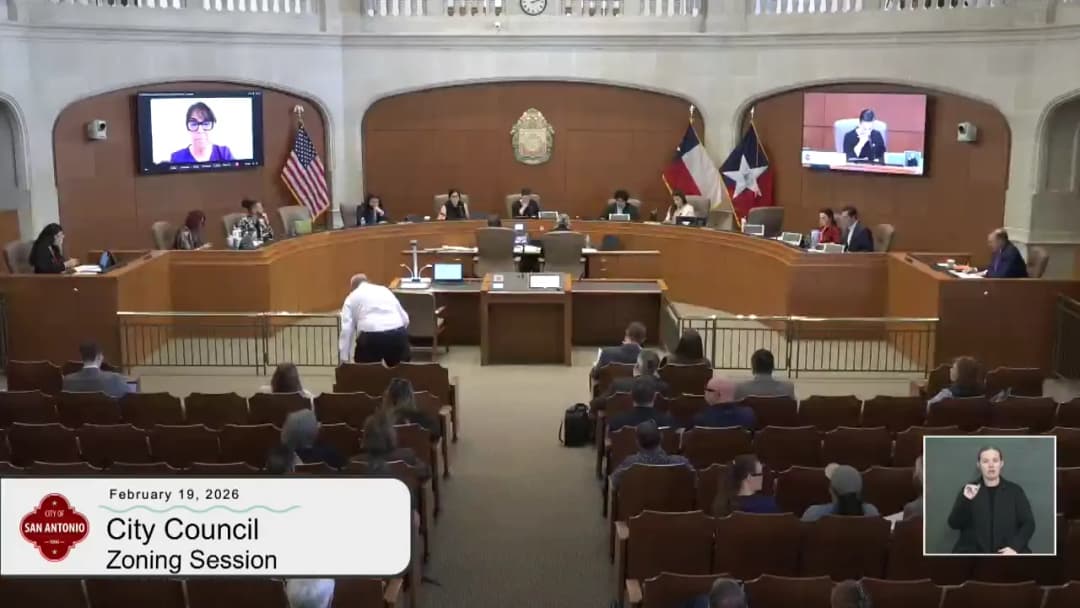
San Antonio Zoning and Land Use Meeting – February 19, 2026

The City of San Antonio Zoning and Land Use Session was called to order at 2:08 PM on Thursday, February 19, 2026, with Mayor Ron Jones presiding and all 10 council members present. The meeting addressed continuances of several items, approved a consent agenda of 20 zoning changes, and voted on four individual zoning items. The session adjourned at 2:31 PM. Continuances - Items 1 and 5 were continued to March 5, 2026. Jack Finger spoke in opposition, urging Councilwoman Gavito to deny an alcohol variance near Woodlawn Hills Elementary School. - Item 23 (District 5, Castillo) was continued to March 19, 2026. Finger supported staff’s recommendation to downzone from a higher density to MF‑18 for a bed‑and‑breakfast, citing traffic concerns on a dead‑end street. - Item 8 was continued to April 16, 2026, with no public comment. Consent Calendar All remaining consent items (2, 3, 4, 6, 7, 9, 12, 13, 14, 15, 16, 17, 18, 19, 20, 21, 24, 25, 26, 27) were approved en bloc. Public Comments on Consent Agenda: - Marcus Nurndorm spoke in favor of an unspecified zoning change, clarifying that a flood‑prone area would be preserved as green space. - Jack Finger opposed item 16 (a bar on East Sabayo Street) and questioned a wine boutique on East Fest Street, urging Councilwoman Castillo to deny additional alcohol sales on the west side. He also raised floodplain concerns for item 13 (District 4, Mungia) and item 28 (District 10, White), warning that future flooding could result in liability for the city. - Cotton Estes declined to speak. Council Highlights: - Councilwoman (District 4) highlighted items 26 and 27, thanking Wild Farm for revitalizing a property on East Cheryl and activating the space with community events. - Councilwoman Castillo (District 5) highlighted item 16, noting the applicant’s commitment to sound mitigation (barriers and vegetation), and expressed excitement for two rezonings in the Lone Star Arts District. - Councilman Galvan (District 3) highlighted item 25, thanking the Mountain View Acres Neighborhood Association and the applicant for working toward a better land‑use outcome after long‑standing code and TCEQ concerns. Discussion Items (Heard Individually) Items 10 & 11 – 322 Tarasco Drive (District 4, Mungia) A plan amendment (west‑southwest sector plan, suburban tier to mixed‑use center) and zoning change (C3R to C3 C‑D, conditional use for manufactured homes/oversized vehicle storage). Staff, Planning Commission, and Zoning Commission recommended approval with conditions: a 15‑foot Type B landscape buffer along the northern property line and no vehicular access on Tarasco Drive. The applicant later amended the request to C3R C‑D. Of 24 notices mailed, two were returned in favor, zero opposed; the Rainbow Hills Area Neighborhood Association supported the change. Council approved with conditions as read (motion carried). Item 22 – 2601 Guadalupe Street (District 5, Castillo) A zoning change from R4 to C2P NA. Staff recommended denial, noting the site was recently down‑zoned to preserve residential character; Zoning Commission recommended approval. Of 67 notices mailed, zero were returned in favor or opposed; no neighborhood association responded. Jack Finger urged denial, citing staff’s concerns about intrusion into a stable neighborhood and precedent for commercial encroachment. Councilwoman Castillo moved to approve, citing an agreement with the Historic West Side Residence Association to prohibit a liquor store, indoor gaming facility, pet cemetery, gas station, vaping, and smoke shop on the property. Council approved (motion carried). Item 28 – 13526 Nacogdoches Road (District 10, White) A zoning change from C2 to C2 C‑D with a conditional use for a construction trades contractor facility. Staff recommended approval with a 15‑foot Type B landscape buffer along the rear property line; Zoning Commission recommended approval without that condition. Of 43 notices mailed, two were returned in favor, zero opposed; no neighborhood association responded. Councilman White moved to approve with no conditions, noting the site is a concrete parking lot that would require tearing up to install the buffer, and the zoning commission had approved without it. Council approved (motion carried). Key Outcomes - Continuances: Items 1 and 5 continued to March 5, 2026; Item 23 to March 19, 2026; Item 8 to April 16, 2026. All motions carried. - Consent Agenda: Approved (20 items) with no roll‑call vote recorded but motion carried. - Items 10 & 11: Approved with conditions (landscape buffer, restricted access). - Item 22: Approved with conditions (prohibited uses as listed). - Item 28: Approved with no conditions. - Meeting adjourned at 2:31 PM.
ZONING AND LAND USE 78% · PROCEDURAL 15% · PUBLIC SAFETY 7%
442
FEB 19, 2026 · SAN ANTONIO, TEXAS · CITY COUNCIL
San Antonio Zoning and Land Use Session - February 19, 2026

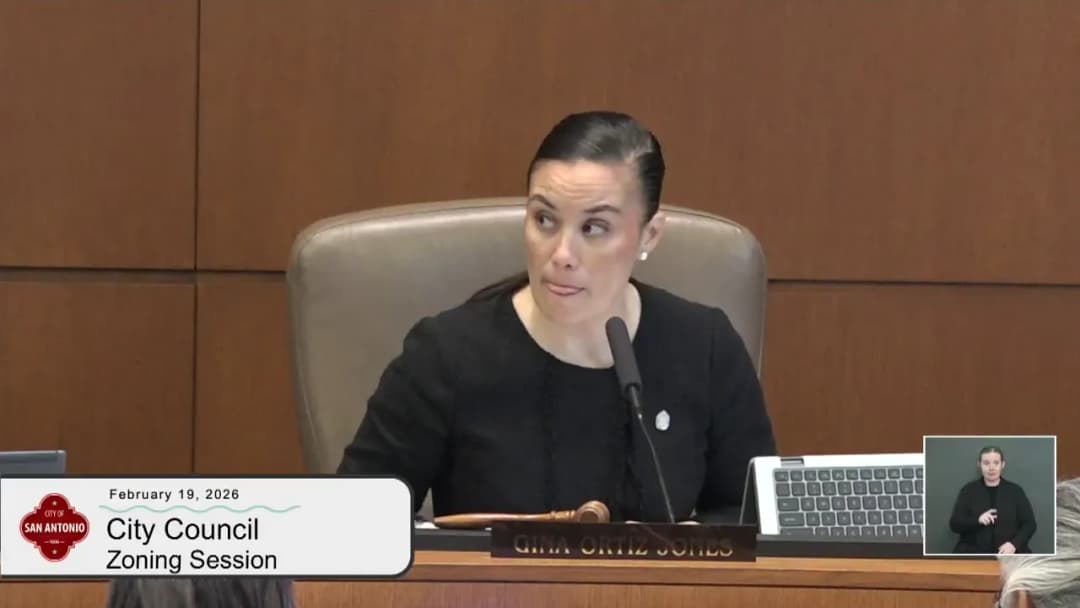
The San Antonio City Council held a Zoning and Land Use session on February 19, 2026. With a quorum present, the council addressed a range of rezoning requests, plan amendments, and conditional use permits. The meeting involved multiple postponements, a consent calendar of routine items, and individual hearings on four contested proposals. Public testimony highlighted concerns about alcohol sales near schools, traffic impacts, and development in floodplains. The session began at 2:08 PM and adjourned at 2:31 PM. Consent Calendar - The council approved the consent agenda, which included 19 items (Items 2, 3, 4, 6, 7, 9, 12, 13, 14, 15, 16, 17, 18, 19, 20, 21, 24, 26, and 27). Councilmember Castillo highlighted a revitalization project for community events in District 5. Councilmember Galván noted the collaborative efforts on a long-awaited property reuse plan in District 6. Public Comments & Testimony - Jack Finger delivered comments on several items. On postponed items, he opposed an alcohol variance on Bandera Road near Woodlawn Hills Elementary School (Items 1 & 5) and argued against a rental development proposal on a residential cul-de-sac, recommending a multifamily designation instead (Item 23). On the consent agenda, he opposed a proposed bar/tavern in the Ceballos area (Item 16) and raised concerns about authorizing commercial developments in flood-prone areas (Items 13 and 28). - Marcus Nuren Dormis spoke in support of a zoning change, clarifying that a flood-prone area on the property in question would be preserved as a green and wooded space. - Rainbow Hills Neighborhood Association formally expressed support for Items 10 and 11. Discussion Items - Items 10 & 11 (District 4): An amendment to the Southwest Sector Plan and a rezoning for 322 Tarasco Drive to allow manufactured homes and large vehicle sales. The Planning Commission and city staff recommended approval with conditions, including a landscaping buffer and restrictions on access points. The applicant agreed to these conditions. With support from the neighborhood association, Councilmember Munguía moved to approve with conditions. The motion passed. - Item 22 (District 5): A request to rezone 2601 Guadalupe Street from R-4 to C-2P NA. City staff recommended denial, stating the property had recently been rezoned to R-4 to preserve the area's residential character. The Zoning Commission recommended approval. Public speaker Jack Finger opposed the change, arguing the commercial intensity would burden the established neighborhood. Councilmember Castillo moved to approve the rezoning with a condition prohibiting a liquor store, pet cemetery, and smoke shop. The motion passed. - Item 28 (District 10): A request to rezone a property at 3013 526 Nacarotus Road from C-2 to C-12D with a conditional use permit (river overlay). Staff recommended approval with a condition requiring a setback from the residential property line. The Zoning Commission recommended approval without that condition. No community members offered testimony. The councilmember for District 10 made a motion to approve without conditions, citing the applicant's willingness to provide the necessary separation. The motion passed. Key Outcomes - Postponements: Items 1 and 5 were postponed to March 5, 2026. Item 23 was postponed to March 19, 2026. Item 8 was postponed to March 16, 2026. - Consent Agenda Approved: 19 rezoning and related items were approved unanimously. - Items 10 & 11 Approved: The rezoning and plan amendment for 322 Tarasco Drive were approved with staff conditions. - Item 22 Approved: The rezoning for 2601 Guadalupe Street was approved against the staff recommendation, with an added use restriction. - Item 28 Approved: The rezoning and conditional use permit for Nacarotus Road were approved without the full staff-recommended property line setback. - Meeting Adjourned: The session officially ended at 2:31 PM.

ZONING AND LAND USE 70% · PROCEDURAL 13% · PUBLIC SAFETY 9% · PUBLIC ENGAGEMENT 8%
443
FEB 18, 2026 · SAN ANTONIO, TEXAS · COUNCIL COMMITTEES
San Antonio Government Committee Meeting: February 18, 2026 – Missing Middle Housing Program Discussion

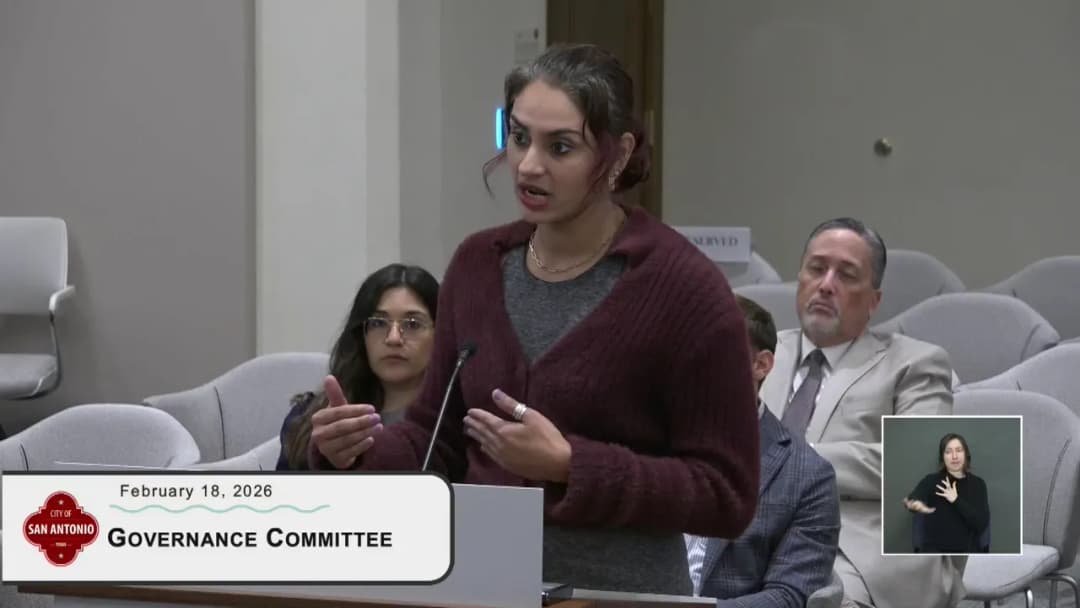
Introductory Paragraph The San Antonio Government Committee met on February 18, 2026, to discuss and approve a Council Consideration Request (CCR) to create an incentive and development program for missing middle housing for low- and moderate-income residents. The meeting included a presentation from the Director of the Department of Neighborhood and Housing Services, discussion among council members, and a vote to approve staff recommendations for further study and program development. Consent Calendar - Minutes: The minutes from the previous month's meeting were approved without correction via a motion from Councilmember Villagrán, seconded by another member, and passed unanimously. Discussion Items Missing Middle Housing Program (CCR from District 1 Councilmember Core) Presentation by Veronica García, Director of the Department of Neighborhood and Housing Services: - The CCR was submitted by Councilmember Core on January 27, and co-sponsored by council members from Districts 2, 4, 5, and 6. - The proposal seeks to create a program that provides pre-development assistance (e.g., land identification, density, zoning, and planning), a single point of contact within the city for logistics and process assistance, pre-approved designs with city incentives, including impact fee elimination, and property tax abatement from the county and city. - Missing middle housing includes duplexes, triplexes, fourplexes, townhomes, and small cottages, designed to provide more affordable housing options in walkable neighborhoods with transit access. - Staff is currently working with a consultant to identify barriers to missing middle housing development, aligned with the Unified Development Code amendments beginning in 2027. - Existing incentives include gap financing and fee waivers, but developers face financial challenges such as high costs per unit, difficulty accessing financing, and long repayment periods. - The recommendation is to evaluate costs and consider the program as part of the strategic plan renewal. Councilmember Core (District 1, lead sponsor): - Expressed that the program has been in development since the previous year, working closely with the housing department to address the housing gap. - Emphasized the need for creative housing options near the city center, especially since many lots are underutilized. - Presented a map showing current investment in single-family homes through the Housing Trust Fund, noting that missing middle housing has not yet been incentivized. - Stated that developers find it difficult and expensive to build multiplexes (e.g., four-unit buildings), and that barriers include lot size constraints and parking requirements. - Highlighted the need for technical assistance to help local residents (including women and underrepresented groups) participate in development. Councilmember (Alcalde/Member) – Question on density and location: - Asked whether duplexes and triplexes provide enough density for future needs (e.g., 2050 projections). - Noted that the city's financial update would show significant property tax revenue, and cautioned that incentives could impact the general fund. - Inquired about recent state legislation changes affecting construction. Veronica García's Response: - Explained that missing middle housing is low-density, and other cities have used it as a starting point to gradually increase density via zoning changes. - Noted that recent state legislation made construction easier, especially on commercially zoned lots not currently used for housing. - Said that the program could be beneficial for smaller commercial lots, while larger lots might still be suited for higher-density projects. Councilmember (Maki Rodríguez): - Raised concerns about allocating limited resources and ensuring incentives are used effectively to address the greatest needs. - Stated that reducing taxes should be carefully considered and that conversations should continue to identify successful outcomes. Councilmember (Villagrán): - Noted that missing middle housing is most suitable for areas outside the downtown core (the "doughnut") and in specific corridors, not for suburban subdivisions like those in District 4. - Suggested it could serve workforce populations, young professionals, retirees, and people with disabilities. - Expressed hope that the program would continue to be refined. Councilmember (Additional comment on aesthetics and quality): - Emphasized that missing middle housing should not be built with poor quality (e.g., non-central air conditioning) or poor aesthetics, as that would deter renters and buyers. - Referenced examples in Alamo Heights and Jefferson where poorly constructed units remained vacant. - Asked for quality standards to be included in program requirements. Veronica García's Final Comments: - Noted that many existing missing middle projects are rentals, and that consultants are reviewing best practices from other cities, which often include density bonuses and streamlined permitting. - Mentioned that the high success of a recent property tax exemption program (referenced from a prior day's dialogue) could impact general fund revenues if more housing is built. - Stated that missing middle housing could be strategically located near workforce corridors and could be built by-right on lots already zoned for higher density, without needing rezoning. Key Outcomes - Motion to approve staff recommendations was made by Councilmember Villagrán, seconded, and passed by a voice vote (all in favor, none opposed). - The approval includes additional questions and direction to staff for further analysis, including cost evaluation, potential location strategies, and consideration of quality and aesthetic standards. - The meeting adjourned at 10:28 AM.

AFFORDABLE HOUSING 72% · ZONING AND LAND USE 15% · PROCEDURAL 13%
444
FEB 18, 2026 · SAN ANTONIO, TEXAS · CITY COUNCIL
San Antonio City Council B Session: FY2022 Financial Update & Federal Funding Impact – February 18, 2026

The San Antonio City Council convened on Wednesday, February 18, 2026, at 1:04 PM for a B session. The meeting focused on the first quarter financial report for fiscal year 2022 (3+9), the taxpayer impact statement, and a tabletop exercise simulating federal funding cuts. Council members discussed budget trends, infrastructure needs, and strategies to mitigate risks to vulnerable populations. The meeting adjourned at 3:31 PM. Public Comments & Testimony - No public comments were presented during the meeting. Discussion Items - Financial Report (Q1 FY2022 – 3+9): Freddy Martinez, City Budget Director, presented the preliminary, unaudited results for October–December 2025. The total city budget adopted was $4.6 billion, comprising $1.6 billion in restricted funds, $1.6 billion in the General Fund, and $1.16 billion for other funds. General Fund revenues exceeded projections by $8.6 million in the first quarter, largely due to warmer weather boosting CPS Energy payments. Sales tax receipts were slightly below projections, with a $4.1 million shortfall noted for January 2026. Hotel occupancy tax revenues were 1% below plan because of lower occupancy and daily rates. The Alamo Dome and Convention Center revenues were on track but slightly below expectations. Overall, the city projects a year-end General Fund surplus of $6.9 million above plan but noted a $1.1 million downward revision for CPS revenue. - Employee Benefits Fund: Rising claims (civilian claims up 12%, police/fire up 11%) caused a projected $14.5 million overrun. The city will continue monitoring and report back in the 6+6 update. - Taxpayer Impact Statement: Councilman White proposed publishing the impact statement in newspapers and online, including not only city property taxes and fees (water, sanitation) but also CPS Energy and SAWS charges. He supported making this a city ordinance. Council members expressed support for transparency. The item was slated for a vote on May 14, 2026. - Infrastructure Performance: Of the 1,558 planned pavement preservation projects, 668 were completed in Q1; 127 of 353 rehabilitation projects were done. Sidewalk program: 3.8 miles of 22.5 miles were constructed, with 1.78 of 10.5 miles repaired. Pavement marking: 133 of planned units completed. Council members noted that only 22% of city streets are in poor or failing condition, but goals to reach 80 percent rating remain unmet. Concerns were raised about the need for better coordination with SAWS to avoid overlapping work. - Low-Barrier Shelter: The shelter has $4.8 million in annual funding from the General Fund (previously ARP). To date, 183 individuals have been served; 20% moved to stable housing. Councilman White calculated an annual cost of $109,000 per person. Several members questioned cost-effectiveness and requested clearer success metrics. - Federal Funding Tabletop Exercise: Justina Tate, Assistant City Manager, described a 5-hour simulation held in December 2025 with multiple agencies. Two scenarios were examined: a 50% reduction in federal grants and impacts from reconciliation bills on Medicaid, CHIP, SNAP, and WIC. Key findings included significant disruptions to health, housing, and food systems; the need for a unified public message; and recommendations to create a cross-sector working group, share resources, and explore philanthropic partnerships. Council members expressed interest in including larger nonprofits and foundation partners. Councilwoman Spears asked about impacts on public safety and parks, which were not covered in the exercise. - Presidential Budget Process: Councilwoman Mesa noted that on February 3, 2026, the Administration signed four key appropriations bills providing funding through September 30, 2026, which included increases for WIC, Head Start, and other programs. The administration also sent a memorandum detailing federal funding flows. - TIRS (Tax Increment Reinvestment Zones): Mayor Jones proposed a strategic review of TIRS, which contain $48 million in city funds, to identify potential savings for infrastructure. Council members divided on the issue: some supported using TIRS to bridge gaps, while others warned against dissolving these tools, citing their role in community investment. Councilman Cory expressed opposition to any moves that would remove TIRS funding from neighborhoods. - Budget Calendar: The proposed FY2027 budget calendar includes a 5-year forecast in May, a council retreat on May 22, proposed budget release on June 17, work sessions on August 13, and adoption on September 17. Several council members requested extending the community feedback period from two weeks to a full month (April) to allow more input. - Council Member Input on Services and Equity: Council members stressed the need for a definition of city services and non-core services, with a full-day discussion scheduled in May. Councilwoman Munguía called for a multi-year planning horizon (3–5 years) and greater equity in infrastructure investments, particularly inside Loop 410. Councilman Cor suggested moving from a geography-based allocation to a need-based formula for street and sidewalk projects. Key Outcomes - No formal votes taken during this B session. The meeting served as a discussion and review of financial status and upcoming steps. - Directive to Staff: The mayor instructed Eric to produce a process to review TIRS for potential reallocation, and to prepare a strategic discussion on street performance metrics and sidewalk programs before budget talks. - Next Financial Update: The 6+6 report will be presented in May 2026, including a five-year financial forecast and updated employee benefits fund status. - Taxpayer Impact Statement: Council member White intends to bring a separate item to the May 14, 2026 meeting to require citywide publication of the impact statement in newspapers and online, including CPS and SAWS charges. The timeline will align with property tax assessment assumptions. - Federal Funding Exercise: Staff will reconvene the cross-sector group and may expand participation to larger nonprofits. The city will also reach out to philanthropic organizations to explore alternative funding. - Council Priorities: The council will hold a full-day session in May to define core vs. non-core services, with input from PFM on a new budget model expected in April.

BUDGET 58% · PUBLIC HEALTH 10% · PUBLIC SAFETY 6% · HOMELESSNESS 4%
445
FEB 18, 2026 · SAN ANTONIO, TEXAS · COUNCIL COMMITTEES
San Antonio Governance Committee Meeting: Missing Middle Housing Program - February 18, 2026

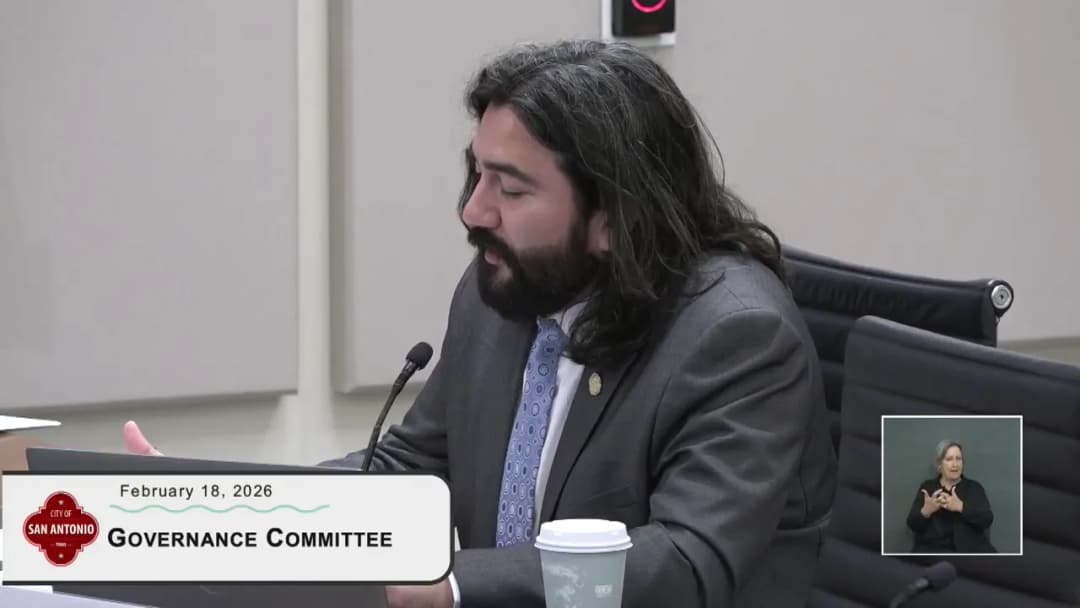
The Governance Committee met on Wednesday, February 18, 2026, at 10:06 AM to discuss a council consideration request (CCR) to create a program supporting and incentivizing missing middle housing development. The meeting included a staff presentation, sponsor remarks, and council discussion, culminating in approval of the staff's recommendation with additional considerations. Consent Calendar - The minutes from the previous month's meeting were approved unanimously without corrections. Discussion Items - Item 2: Council Consideration Request for Missing Middle Housing Program - Veronica Garcia, Director of Neighborhood and Housing Services Department (NHSD), presented the CCR submitted by Councilwoman Core (District 1) on January 27, 2026, also supported by Districts 2, 4, 5, and 6. The request includes: pre-development assistance (identifying land), a single point of contact for technical assistance, permit-ready designs compliant with historic/conservation districts, additional fee waivers and incentives (SAWS Impact Fee waivers, city/county property tax abatements, grant funds or low-interest loans), and an annual training cohort for small-scale developers. - Missing middle housing was defined as multi-unit housing types between single-family and large apartment complexes (duplexes, fourplexes, townhomes, bungalow courts, casitas). - NHSD is working with a consultant to analyze barriers in the Unified Development Code (UDC) and coordinate with the Housing Commission's removing barriers subcommittee for the 2027 UDC amendment cycle. - Councilwoman Core explained that missing middle housing addresses the gap between single-family homes and mid-rise projects, noting that families are moving out of the urban core due to limited housing options. She highlighted barriers such as form-based codes, inconsistent answers from Development Services Department (DSD), and the need for community education. - Mayor expressed philosophical questions about resource allocation, noting the city foregoes significant property tax revenue and emphasizing the need for the right mix of housing types and locations to meet density goals for projected growth (city the size of Austin by 2050). He asked about state legislative changes; staff noted no single-family-specific changes but highlighted commercial-to-residential conversion possibilities. - Councilmember McKee Rodriguez emphasized prioritizing deeply affordable housing but supported exploring incentives and technical assistance. - Councilmember Mungia suggested targeting the program to the "donut" area inside Loop 410, noting it suits older neighborhoods but not newer subdivisions. He also raised the potential to serve special populations (people with disabilities, young professionals, LGBTQ community). - Garcia noted most other cities did not create separate financial incentives but began with zoning updates and streamlining permits; they are exploring density bonuses for deeper affordability. - The mayor asked about rental vs. homeownership mix, quality of construction, and aesthetic standards, citing examples of poorly built missing middle housing that remained vacant. Key Outcomes - The committee approved the staff recommendation (motion and second) with additional tasks, including studying barriers, developing recommendations, and presenting to the Planning Community Development Committee at a future meeting. The motion passed unanimously (all ayes, no opposed). - The next steps include continued analysis of UDC barriers, coordination with the SHIP refresh, and consideration of incentives, with a focus on by-right development, targeted geographic areas, and quality standards.

AFFORDABLE HOUSING 67% · HOUSING 26% · PROCEDURAL 7%
446
FEB 18, 2026 · SAN ANTONIO, TEXAS · BOARDS & COMMISSIONS
San Antonio Historic and Design Review Commission Meeting - February 18, 2026

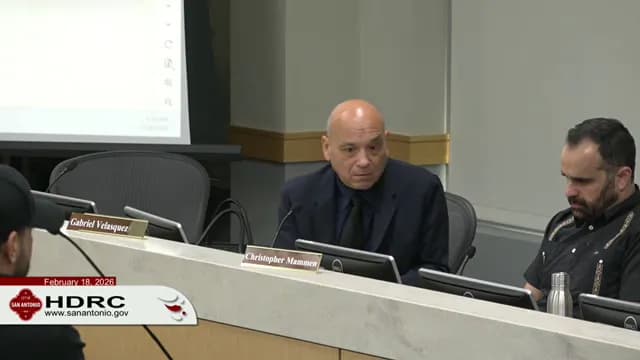
The Historic and Design Review Commission (HDRC) held a regular meeting on February 18, 2026, at 3 p.m. Chairman J. Maurice Gibbs and Vice Chair Jeffrey Fetzer presided. The commission addressed three consent items and three regular agenda items, including a waiver request, a final material selection for new construction, and a rear accessory structure. Public testimony was received on one item. The meeting concluded with approvals and a concept approval requiring a return appearance. Consent Calendar - Items 1 and 2 were approved unanimously with staff stipulations. (Specific project details not provided in the transcript.) - Item 3 (418 V E, Mexican restaurant) was pulled from the consent calendar for individual consideration. Public Comments & Testimony - Item 5 (418 East Locust): Frederica Kushner, on behalf of the Tobin Hill Community Association, expressed the committee's ongoing concern with the use of any metal siding (including the proposed standing seam or board-and-batten metal) and with the massing and lot coverage. She acknowledged being impressed with changes made to meet OHP/HDRC guidelines and thanked staff for their work. She also asked the applicant why metal was chosen over wood or fiber cement. Discussion Items - Item 3 – 418 V E (Mexican restaurant): Architect Mark Navarro presented. Commissioner Garcia asked whether the north elevation windows had been made more proportionate (confirmed), and inquired about the service door material (a flush metal door). Following no further questions, the commission voted to approve the application as submitted with staff stipulations. - Item 4 – 525 Mission Street (carport): Staff presented a request for a waiver (UDC 35-608G) to accept a revised application, and a certificate of appropriateness for a 720-square-foot detached carport with all-wood construction and a standing seam metal roof. The applicant was not present. Commissioner Fetzer asked about roof pitch and crimp details; staff clarified no requirement for forward slope. The King William Association submitted a letter supporting the recommendation. The commission first approved the waiver (unanimous roll call) and then approved the carport as recommended by staff (unanimous roll call). - Item 5 – 418 East Locust (final material selection): Architect Joseph Smith and property owners Priya and Jochton presented a proposal to use metal board-and-batten siding instead of wood or fiber cement, citing durability, longer panel lengths (up to 30 feet), and a cleaner appearance. Smith showed photographs of completed similar projects and argued that the material replicates historic board-and-batten better than cement board. Commissioner Fetzer noted he had requested photos of similar metal projects and reviewed provided images. Commissioner Velasquez voiced concern that the dark color and tall battens made the building look “a bit of a warehouse” but still supported the motion. Commissioner Holland supported no seam on a 30-foot wall. The motion to approve with only staff stipulation 2 (setback) was amended by Commissioner Galloway to add that the siding match the dimensions presented. The motion carried unanimously on roll call. - Item 6 – 307 Delaware (rear accessory structure): Applicant Alberto Rodriguez Cerveda and property owner Roberto Lizondo proposed a 294-square-foot, one-story casita with a shed roof, metal siding, and a mix of vertical slit windows and sliding glass doors. The structure would not be visible from the street. The applicant pointed to approved similar casitas nearby (e.g., 511 Mission Street) as precedent for a shed roof. Commissioner Group and others questioned windows on the front elevation. Commissioner Garcia expressed concern about setting precedent for non-traditional windows. After debate, Vice Chair Fetzer made an amended motion for concept approval with staff stipulations 1 (board dimensions) and 2 (siding finish), and stipulation 4 (traditional one-over-one windows on the front elevation, with proportion details to be worked out). The motion was seconded and then further amended to require the applicant to return to the commission after studying the front facade. The final motion (conceptual approval with stipulations 1, 2, and 4, with a requirement to return for final approval) passed unanimously. Key Outcomes - Consent Items 1 & 2: Approved with staff stipulations. - Item 3 (418 V E): Approved with staff stipulations. - Item 4 (525 Mission Street): Waiver and certificate of appropriateness approved as recommended. - Item 5 (418 East Locust): Final material selection approved, with the metal board-and-batten siding to match dimensions presented, and staff stipulation 2 (setback compliance) included. - Item 6 (307 Delaware): Concept approval granted, subject to staff stipulations 1, 2, and 4 (board dimensions, smooth finish on composite siding if used, and traditional one-over-one windows on front elevation) and a requirement for the applicant to return to the commission with a revised front facade design. The meeting adjourned after the final case.

HISTORIC PRESERVATION 51% · ZONING AND LAND USE 34% · PROCEDURAL 7% · ENGINEERING AND INFRASTRUCTURE 6%
447
FEB 18, 2026 · SAN ANTONIO, TEXAS · CITY COUNCIL
San Antonio City Budget Update and Federal Grants Tabletop Exercise - February 18, 2026

On February 18, 2026, the San Antonio City Council received a first-quarter financial status update for FY26, a recommended FY27 budget calendar, a taxpayer impact statement proposal, and findings from a federal grants tabletop exercise. The meeting highlighted a general fund on track despite sales tax headwinds, emerging challenges in employee healthcare costs, and preparations for potential federal funding reductions. Consent Calendar - [No consent calendar items were discussed.] Public Comments & Testimony - [No public comments were made.] Discussion Items FY26 First Quarter Financial Report - General Fund: Overall results for the first quarter (October–December) are in line with the adopted budget. Total resources were $1.69 billion; expenses were $1.7 billion. Revenues exceeded the plan by $8.6 million (collected $510 million vs. anticipated $502 million), driven by higher CPS Energy revenues (warmer weather and off-system sales). Sales tax is $700,000 below plan through December, and through January the shortfall widened to $2.6 million. CPS revenue is $9.1 million over plan. The fund is projected to be 1.1% ahead of budget for the year. Expenses are $1.7 million below plan. - Hotel Occupancy Tax (HOT): Revenues are $1.9 million below plan in Q1 due to lower occupancy (1% lower) and average daily rate ($3 lower). The year-end projection is a $3 million shortfall. - Airport Fund: Revenues are $200,000 over plan; airport is performing within budget. - Development Services Fund: Revenues and expenses are on track; a $1.4 million variance is attributed to permit fees from the airport terminal development program. - Solid Waste Fund: Revenues are $1.4 million below plan due to lower recycling prices ($20/ton less), offset by lower expenses in disposal and collection. - Employee Benefits Fund: Claims activity was $7.4 million over plan in Q1, with a projected year-end overage of $4.5 million. Uniform claims are 9% over FY26 budget and 11% above FY25; civilian claims are 5% over budget and 12% above FY25. January claims were at budget, so the trend is being monitored. Budget Initiative Highlights - Low Barrier Shelter: $4.8 million budgeted. Goal: serve 450 unduplicated clients with 55% positive exit outcomes. Through January, 110 clients served (goal was 125) and 21 exited to stable housing. Staff noted Strach (hospital systems) is using part of the facility, which may affect bed availability. - Minor Home Repair (Under One Roof): $8 million total budget; assisted 93 households in Q1 (on track). - Rental Assistance: $5.7 million budget; assisted 785 eligible individuals in Q1 (on track). - Street Maintenance: $122.4 million budget; completed 668 of 1,558 pavement preservation projects and 127 of 353 rehabilitation projects (ahead of schedule). - Sidewalk Program: $17 million budget; completed 3.4 miles of 22.5 miles of new sidewalk construction and 1.9 miles of 10.5 miles of repair (ahead of schedule). - Fire Enhanced Squad: Added 12 positions ($1.3 million); cadets started class in January, expected to graduate in July. - Police Officers: Added 40 positions ($2.2 million); cadets to begin classes in September. FY27 Budget Calendar - The recommended calendar includes: May 6 – six-plus-six/five-year forecast; May 14 – mid-year ordinance; community survey mid-April to early May; May 22 – goal setting session (with core vs. non-core program analysis); June 17 – trial budget presentation; August 13 – proposed budget release; September 17 – budget adoption. Council feedback on the calendar is due by February 25. Taxpayer Impact Statement (CCR from Councilman White) - Staff proposed publishing an annual statement showing comparisons of property tax rates and fees (solid waste, environmental, parks, stormwater) with the prior year. For a median home valued at $157,000 (FY25) vs. $160,000 (FY26), the property tax increase is $17. Other fees: solid waste fee unchanged, environmental fee unchanged, parks environmental fee increased $6/year, stormwater fee unchanged. Total impact: 1.7% increase ($23.27 per year). The statement would be included in the budget document, published in newspapers (Express News, La Prensa), and posted on the city website. Councilman White requested it be codified by ordinance. Several council members supported adding broader context (rates, other revenue sources, other taxing entities) and ensuring broad dissemination. Federal Grants Tabletop Exercise - Conducted December 2025 with 34 outside agencies (healthcare, housing, food access, utilities, nonprofits, county, city departments). The city's budget includes $153 million in federal grants, funding 663 positions. The exercise focused on health, housing, homeless, and human services grants totaling $85.7 million (436 positions, 66% of federally funded positions). - Scenario 1: 50% reduction in city-administered federal grants. - Scenario 2: 50% reduction in community-wide grants plus impacts of federal reconciliation bill on Medicaid, Medicare, CHIP, SNAP, and ACA. - Key findings: (1) Funding reductions would create significant disruption to health, housing, food access, and education systems. (2) Existing service networks operate at high capacity and cannot absorb large-scale increases in need. (3) Need for consistent public messaging to reduce community confusion and fear. (4) Support for improved cross-sector coordination, shared data tools, and unified resource/referral systems. (5) Recommendation to form a cross-sector federal funding impact working group. - Staff noted that while most federal appropriations are funded through September 2026, the implementation of policy changes (e.g., work requirements) may affect access and increase need. - Mayor Jones emphasized that the city's public health professionals have recommended using general fund dollars to maintain critical services (e.g., TB testing) if federal funds are cut, as no alternate providers exist. Key Outcomes - No formal votes were taken; the meeting was a discussion and information session. - Next financial update: The six-plus-six report and five-year forecast will be presented in May 2026, with a mid-year budget adjustment ordinance on May 14. - FY27 Budget Calendar: Council feedback is requested by February 25 to finalize the calendar. - Taxpayer Impact Statement: Council expressed broad support for adoption by ordinance; staff will bring a draft ordinance for the May 14 mid-year meeting. - Federal Grants Working Group: Staff will form a cross-sector working group and may involve philanthropic partners (e.g., Area Foundation, Cronky Group) as recommended by the Mayor. - Reevaluation of Street IMP: A consultant is being contracted to revamp the street pavement management program, with results expected by summer 2026. - Core vs. Non-Core Program Analysis: To be presented at the May 22 goal setting session, facilitated by PFM. - Employee Benefits Fund: Staff will continue monitoring claims and provide an update in May. - Lost Medicaid 1115 Waiver (estimated $8 million): Not yet accounted for in the $142 million gap closure; Mayor noted that closing the gap as currently proposed does not offset this loss, and the council may need to identify additional options.

BUDGET 51% · PUBLIC HEALTH 14% · FEDERAL ADVOCACY 8% · PUBLIC SAFETY 5%
448
FEB 18, 2026 · SAN ANTONIO, TEXAS · BOARDS & COMMISSIONS
San Antonio Historic Design Review Commission Meeting – February 18, 2026

The Historic Design Review Commission (HDRC) of San Antonio met on February 18, 2026, to consider several items related to historic district properties. Commissioners present included García, Velázquez, Galloway, Guevara, Krupp, Holland, Fetzer, Gibbs, and Cervantes. The meeting began with approval of minutes from February 4, 2026, and then moved to the consent calendar. Consent Calendar - Two items (Case numbers unspecified) were approved unanimously with staff stipulations. Case number 3 was removed from consent for separate discussion. Public Comments - Case 5 (New residence in Tobin Hill): Several neighbors spoke in favor of the proposed owner-occupied home. A representative from the Tobin Hill Community Association expressed support for the project but aligned with the staff recommendation on cladding material. Discussion Items Case 3 – Restaurant Renovation Applicant Mark Navarro requested approval for modifications to a restaurant, including adjustments to north elevation windows and restoration of west doors. The commission approved the project with staff stipulations. The applicant noted a temporary fabric fence would be used until a future adjacent restaurant is built. Case 4 – Portico Addition (King William District) Staff recommended approval for a 720-square-foot portico with a metal roof at the rear of the property, subject to conditions on materials (wood columns, metal panels) and an inspection prior to roofing. The applicant was not present. The commission approved a permit to review the revised design and then approved the final permit with staff stipulations. Case 5 – New Single-Family Residence (418 S Lock, Tobin Hill) Architect Joseph Mindaki and owner Jan Patel presented plans for a new home. The applicant proposed metal siding over fiber cement, citing durability and aesthetics. Staff recommended the exterior cladding match the historic district character. After debate, the commission approved with staff stipulation number 2 regarding cladding. Some commissioners raised concerns about the dark color but voted in favor; the motion passed unanimously. Case 6 – Accessory Structure (307 Lower Street, King William District) Applicant Alberto Rodríguez, on behalf of owner Roberto Lizondo, sought approval for a 294-square-foot accessory dwelling unit with a contemporary design. Staff recommended approval with stipulations on siding, roof pitch, and window style. Commissioners discussed the appropriateness of sliding doors and vertical windows. An amended motion passed to approve the project conceptually with stipulations 1, 2, and 4, and to require the applicant to return with a revised front elevation. Key Outcomes - Consent items (Cases 1 and 2): Approved unanimously. - Case 3 (Restaurant): Approved with staff stipulations. - Case 4 (Portico): Approved after permit review. - Case 5 (Residence): Approved with cladding stipulation. - Case 6 (Accessory structure): Approved conceptually, pending revised front elevation. All votes were unanimous. The chair commended the collaborative process on the final case.

HISTORIC PRESERVATION 64% · ZONING AND LAND USE 22% · COMMUNITY ENGAGEMENT 9% · PROCEDURAL 5%
449
FEB 17, 2026 · SAN ANTONIO, TEXAS · COUNCIL COMMITTEES
San Antonio City Council Education Committee Meeting - February 17, 2026

This meeting focused on the state of public education funding in Texas, the financial challenges facing local school districts, and potential areas for city-school district collaboration. Presentations were given by representatives from the Bexar County Education Coalition, superintendents from San Antonio ISD, and city officials. Consent Calendar - Approval of previous meeting minutes. Motion passed unanimously. Public Comments & Testimony - No public comments were recorded. Discussion Items - Presentation on School Finance: Julia (Bexar County Education Coalition) presented an overview of Texas school funding, highlighting that the basic allotment is $6,215 per student, leaving Texas ranked 10th lowest nationally. She noted that despite $33 billion in surplus in 2023 and $32 billion in 2024, the basic allotment has not kept pace with inflation, and that only a $55 increase was provided in the last session. - Enrichment and Copper vs. Gold Pennies: Julia explained that "copper pennies" are recaptured by the state to equalize funding, while "gold pennies" allow wealthier districts to keep more revenue, creating inequities. Superintendents noted that most districts now use enrichment dollars just to cover special education funding gaps. - Facilities and School Closures: Dr. Kino (SAISD) reported that the district has held 40 community meetings regarding potential school closures. He stated that the average age of school buildings is 68 years, far exceeding the intended 50-year lifespan, and that deferred maintenance could cost three-quarters of a billion dollars if not addressed within three years. Dr. Kino mentioned the district is now considering selling some properties to fund maintenance, despite earlier promises not to sell. - Bond and Local Funding Options: Dr. Kino noted that a bond could only fund capital improvements, not preventative maintenance, and that a blue ribbon committee would be formed for the next bond package. He emphasized that increasing local funding through golden pennies would require voter approval. - Public Safety and Radio Fees: Chief Craig Hubins (SAPD) and Assistant Chief Robert Land discussed a $22/month per radio fee for the city-county radio system, which schools are required to use. Council members questioned whether CPS Energy or the city could subsidize this cost for school districts, and the chief agreed to provide the total cost per school by the March meeting. - Accountability System: Julia presented the state's A-F accountability system, criticizing its reliance on a single test day and the lack of data for two years due to litigation. She argued that these ratings do not reflect the depth of student needs, especially poverty and trauma. - Student and Community Stressors: Dr. Cor (SAISD) highlighted that many students face food insecurity, housing instability, and trauma, and that teachers often lack stable housing. She urged the council to consider the impact of city policies and spending on schools. Key Outcomes - The committee agreed to request a detailed cost analysis from SAPD on radio fees and security personnel requirements for schools, with a report expected by the March meeting. - Council members directed staff to explore creating a centralized dashboard showing investments (e.g., sidewalks, health metrics) around schools and to improve cross-departmental communication between the city and school districts. - Council members expressed support for working with SAISD on redeveloping surplus school properties for mixed-use or multifamily housing, and for exploring public transit partnerships to address transportation gaps. - The committee committed to prioritizing public education funding in the upcoming 90th legislative session, including advocating for increased basic allotment and opposing voucher programs.

PUBLIC EDUCATION 63% · BUDGET 14% · PUBLIC SAFETY 12% · COMMUNITY ENGAGEMENT 3%
450
FEB 17, 2026 · SAN ANTONIO, TEXAS · COUNCIL COMMITTEES
San Antonio Public Safety Committee Meeting - February 17, 2026

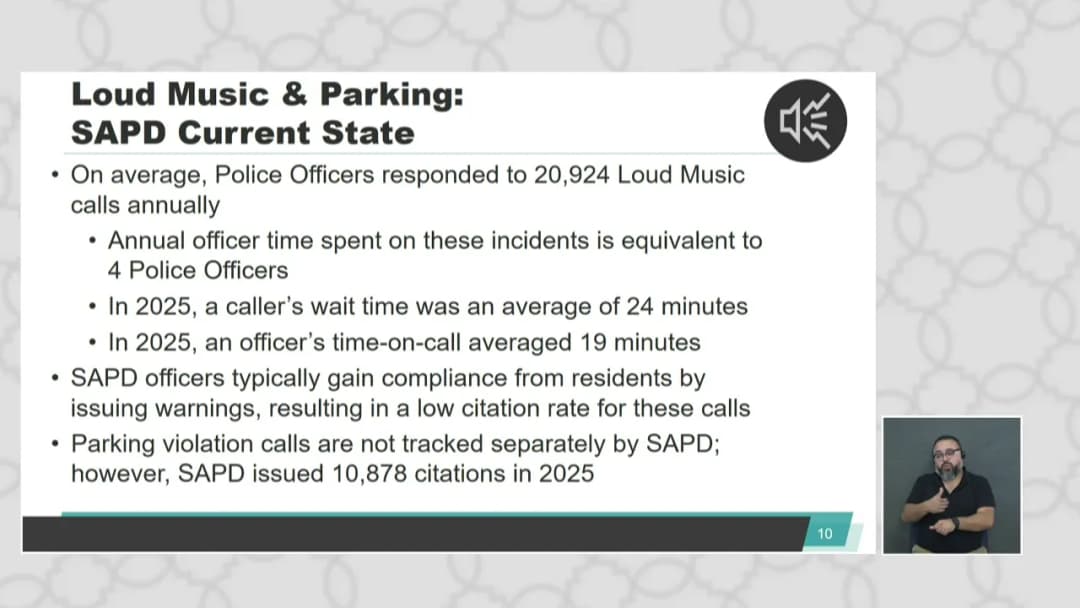
The Public Safety Committee met on February 17, 2026, to discuss animal care services metrics, senior protection strategies, alternative response options for quality-of-life calls, and an update on drug and narcotics crime. The meeting was called to order at 2:24 PM and adjourned at 4:00 PM. Consent Calendar - The committee unanimously approved the minutes from the January 20, 2026, Public Safety Committee meeting (motion carried 3-0). Public Comments & Testimony - Vicki Steerman (on ACS item): Shared the case of a dog named Chico that was surrendered to ACS a year ago. She argued that nothing of consequence has been achieved in holding the former owner accountable and that the city is not implementing the 2023 ACS Strategic Plan. She called for timely investigations, review of the process, and acknowledgment of the problem. - Joanne Tobias Molina (Joint Commission on Elderly Affairs): Expressed support for the senior protection CCR, noting that elder abuse often goes unreported and that self-neglect is a major issue. Highlighted the needs of "solo agers." - Barbara Whitt Howell (AARP): Expressed support for enhanced protections for older adults, especially against abuse and fraud. - Fernanda Gardenas (Gonzaba Foundation, Joint Commission on Elderly Affairs): Expressed strong support for the CCR, emphasizing the need for expanded legal assistance, education, and coordination with financial institutions. - Darrell Greer (OATS / South Texas APS): Expressed support, noting the underreporting of fraud and abuse, and urged proactive measures like the Do Not Call registry and mobile phone guides. Discussion Items - Animal Care Services (ACS) Metrics (Item 5): Staff presented quarterly data. Councilmember Castillo asked about vacancies in the dangerous dog investigations team (2 of 4 roles filled, but caseload doubled to 600 affidavits). Councilmember Castillo also praised increases in live release rate and adoptions. Chair Cors noted personnel challenges and requested a future deep dive on recruitment and retention strategies. Public comment followed. - Enhancing Senior Protection Strategies (Item 4 – CCR by Councilwoman Castillo): Jessica Dovalino (Human Services) presented demographic data (17.5 APS investigations per 1,000 older adults in Bexar County, 92% self-neglect) and outlined existing programs and planned enhancements. The status of older adults report is expected in August 2026; resource guides and public service announcements are in development. Councilmember Castillo highlighted the urgency due to rising fraud cases and requested updates. Chair Cors and Councilmember McKee Rodriguez supported the effort and asked for community feedback opportunities. - Enhanced Response to Quality of Life Concerns (Item 2 – CCR by Councilmember Cors): Justina Tate (Interim Assistant City Manager) presented analysis of 177,000 eligible calls annually (minor traffic accidents, lost/stolen property, loud music, parking, found property). Staff identified 69,000 calls potentially eligible for alternate response. Options included retired SAPD officers, contractors, civilians, online reporting, code enforcement, and virtual officers. Councilmember Cors requested an RFI to gauge costs and interest. Councilmembers Castillo and Spears raised concerns about privatization, liability, and the need for police authority to issue citations. The committee decided to discuss the matter with full council before proceeding with an RFI. - SAPD Drug and Narcotics Crime Update (Item 3): Assistant Chief Jesse Salome presented an overview, noting San Antonio’s proximity to the border as a hub for trafficking. Drug and narcotic offenses increased 21.9% in 2025 due to proactive enforcement. The covert response units (HIDA, TAG) seized over 1.5 tons of narcotics, with methamphetamine comprising 73%. Fentanyl remains a high-danger substance. The committee was urged to use anonymous tip systems (TIP 411). Councilmember Spears praised the collaborative efforts. Councilmember Cors noted the importance of cross-communication between units and sufficient staffing for patrol to feed specialized units. Key Outcomes - Consent calendar approved. - ACS update: Received; future deep dive on personnel challenges scheduled. - Senior Protection CCR: Staff to continue developing resource guides (by May 2026) and return with updates. Committee to receive the status of older adults report in August 2026. The no-solicitation ordinance review is expected by September 2026. - Quality of Life CCR: Committee will discuss whether to proceed with an RFI with full council before staff takes action. No vote taken. - Drug/Narcotics Update: Received; no formal action taken.

PUBLIC SAFETY 56% · SENIOR SERVICES 15% · ANIMAL WELFARE 11% · COMMUNITY ENGAGEMENT 7%
OPENPUBLICA · PUBLIC MEETING INDEXUPDATED DAILY · openpublica.com