Browse by city
Date range
Search help

Search titles, summaries, topics and stored transcripts together. Keywords may match separately; put the whole query in double quotes for a phrase. Matching follows word analysis, so punctuation is not exact. Both dates are included. Documents are not searched.

SHOWING 461–470 ENTRIES
461
FEB 11, 2026 · SAN ANTONIO, TEXAS · CITY COUNCIL
San Antonio City Council Meeting: VIA Transit Update and Mental Health Diversion Center – February 11, 2026

The San Antonio City Council met on February 11, 2026, at 1:13 PM. The meeting covered two major items: an update on VIA Transit's transformation progress and a proposal to establish a centralized mental health diversion center in partnership with the county. Both items featured detailed presentations, extensive council discussion, and actionable outcomes. VIA Transit Transformation Update Laura Cabanilla, VIA's board president, and John Gary Barrera, VIA president, presented a progress report on the transit agency's service improvements and capital projects. Key statistics included: a 22% increase in ridership on improved routes since August 2025, a million total passenger trips in the past year, a 50% increase in Park and Ride usage, and 65% of the Better Bus plan implemented three years ahead of schedule. Customer satisfaction stands at over 90%. The presentation also detailed the Green Line (10.3 miles, 25 stations, 10-minute frequency, $1.2 billion in federal funding) and the Silver Line (7.3 miles, 18 stations, 10-minute frequency, $150 million in federal funding). Construction on the Green Line is set to begin in March 2026, with the Silver Line construction expected in 2027 and completion in 2030. Council members discussed a range of issues. Councilwoman Villagran emphasized the need for affordable passes that work for event-goers and residents. Councilwoman Castillo raised concerns about shelter conditions and the missing Route 54. Councilman Galvan praised the system and asked for better connectivity in his district. Councilman Munguia asked about Via Link's 35% growth. Councilman Spears asked about Stone Oak Park and Ride utilization. Councilman Mesa Gonzalez requested per-capita comparisons with other Texas agencies. Councilman Rodriguez advocated for free fares and telecom tax funding; he proposed a pilot program for free fares on the top five routes. Councilman White asked about revenue sources and efficiency metrics. Overall, council members expressed strong support for VIA's work while seeking continued improvements in connectivity, affordability, and service to underserved areas. Mental Health Diversion Center Proposal Councilwoman Castillo introduced a recommendation from the Public Safety Ad Hoc Committee to create a centralized diversion and recovery center for individuals with mental illness or substance use disorders. Eric Welsh (Center for Healthcare Services, CHCS) and Maria (CHCS Director of Diversion) presented the proposal. Key data: 550 inmates currently receiving mental health treatment in the Bexar County jail; 152 awaiting a psychiatric bed; 300 deemed incompetent to stand trial; 80-100 people with mental health or substance issues are arrested daily. The cost per day in jail is $1,750, compared to an estimated $510 per day in a diversion center. Data from Harris County shows that 77% of diverted individuals are homeless, and 89% are charged with Class B misdemeanors. After diversion, individuals were 5.45 times less likely to be rearrested. For every dollar spent on diversion, $5.45 is saved in criminal justice costs. The recommendation is to fund a feasibility study by Dr. Alejandro Testa (UTHealth Houston) at a cost of $100,000, with the city contributing $30,000. The study will assess population needs, operational model, and governance structure. Additionally, an ad hoc joint city-county committee will be formed to guide the project. Council members overwhelmingly supported the proposal. Councilwoman Villagran supported the committee but stressed the need for elected city representation. Councilman Munguia supported, referencing the 46% of admissions who are homeless. Councilwoman Mesa Gonzalez supported, noting the opportunity with new police chief. Councilwoman Spears supported and suggested including a bondsman. Councilman Rodriguez requested black representation on the committee. Multiple council members volunteered to serve on the ad hoc committee, including Castillo, Villagran, Munguia, Mesa, Spears, and others. The mayor confirmed the city's $30,000 contribution and the formation of the committee. Key Outcomes - VIA Transit: Councilman Rodriguez requested a memorandum by March 11, 2026, detailing the implications of a free-fare pilot for the top five routes (affecting 34% of riders), including cost, mitigation strategies, and potential telecom tax revenue. The mayor and council expressed support for this analysis. No formal vote was taken on VIA’s presentation; it was received as information. - Mental Health Diversion Center: The council approved the city’s participation in the $100,000 feasibility study with a $30,000 contribution. An ad hoc joint committee will be formed, initially including council members Castillo, Villagran, Munguia, Mesa, Spears, and possibly others, to oversee the study and future implementation. The study will be conducted by Dr. Alejandro Testa and his team from UTHealth Houston. The meeting adjourned at 5:14 PM.
PUBLIC TRANSPORTATION 45% · PUBLIC SAFETY 18% · MENTAL HEALTH AWARENESS 10% · TRANSPORTATION SAFETY 6%
462
FEB 11, 2026 · SAN ANTONIO, TEXAS · CITY COUNCIL
San Antonio City Council B Session: VIA Transit Update and Diversion/Recovery Center Discussion - February 11, 2026

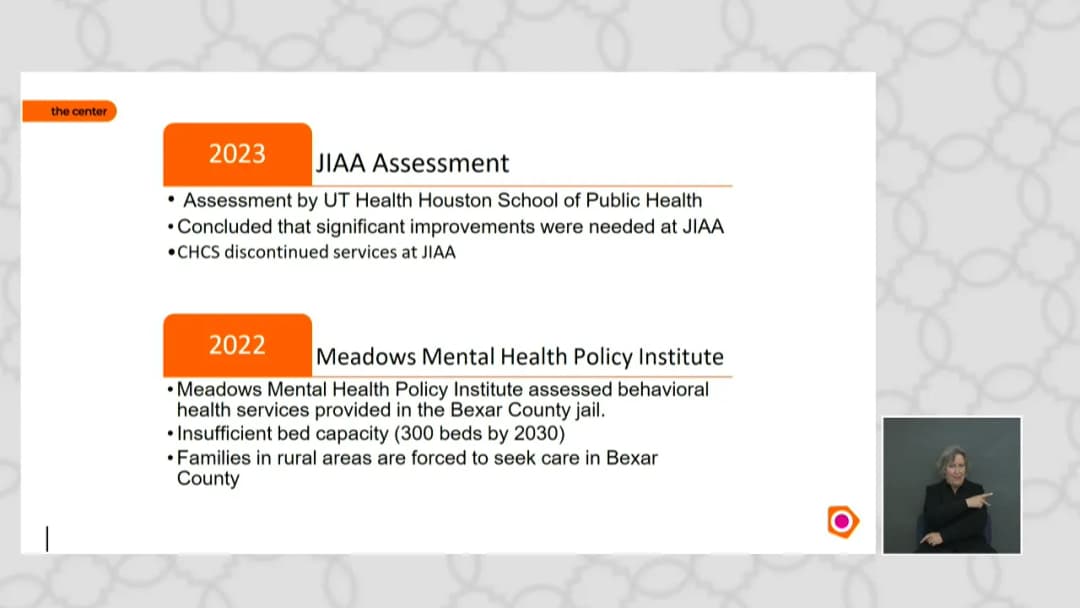
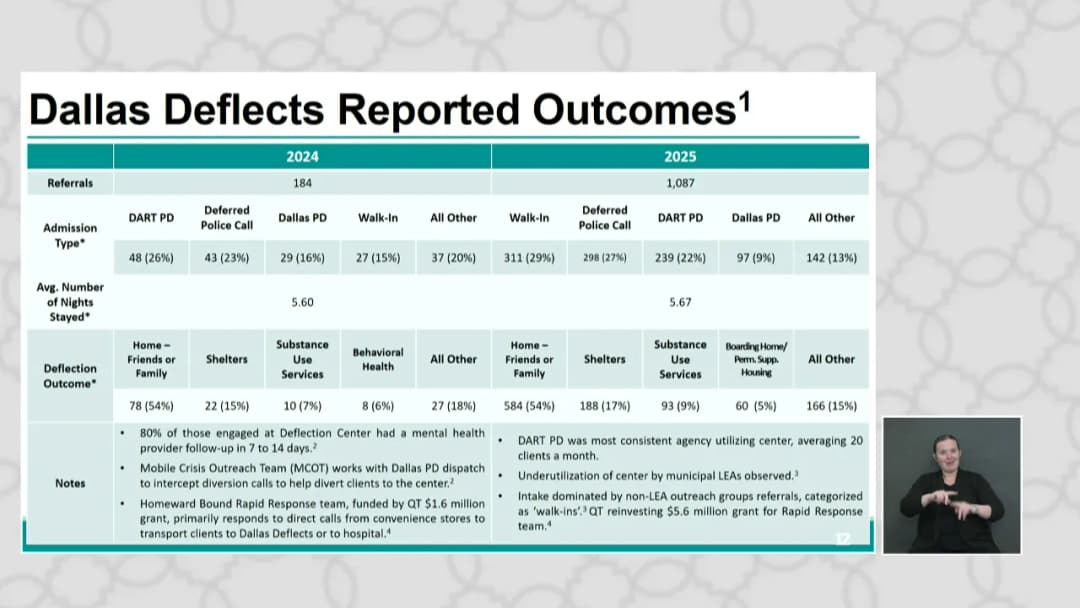
The City of San Antonio held a B session on February 11, 2026, from 1:13 PM to 5:14 PM, featuring two major agenda items: an update from VIA Metropolitan Transit on the Keep San Antonio Moving Plan and Advanced Rapid Transit (ART) projects, and a presentation on a proposed joint city-county diversion/recovery center for individuals with mental health, substance use, or intellectual/developmental disabilities. VIA Transit Update - VIA Board Chair Laura Cabanilla, CEO John Gary Herrera, and Rod Sanchez presented the agency's progress. VIA reported 31.6 million passenger trips in 2025, a 28% increase in ridership, and a 98% customer satisfaction rating. The agency hired 107 new full-time bus operators in 2025, reaching an all-time high of 907 operators. - The Better Bus Plan, a frequency-focused network redesign, is 65% implemented (two to three years ahead of schedule). As a result, 72% of the system now operates at 30-minute intervals or better, up from 30% a year ago. The goal is no route worse than 30 minutes. - VIA Link on-demand service grew by 35% and now provides 1 million rides annually. Park-and-ride ridership increased by 50%. - The ART Green Line (10.3 miles, $480 million budget, $268 million federal) will run from Isom to Steves with 10-minute frequency, 25 new stations, and 17 articulated buses. Construction began in early 2026 with utility work; heavy construction starts in March 2026. - The ART Silver Line (7.3 miles, 10-minute frequency) will run from General McMullen to the Frost Bank Center, with 18 stations and 14 articulated buses. Construction is expected to begin in 2027 and be complete by January 2030. - Council members raised several concerns and requests. Mayor Ron Nirenberg asked about the telecom tax (currently not collected by VIA, estimated at $6–8 million annually) and requested a memo by March 11, 2026, detailing a six-month fare-free pilot on the top five routes (covering 24% of riders). The memo should include options to offset the cost (5% of operating budget or 3% if telecom tax is collected) and outline mitigation strategies for safety and operations. - Councilman McKee Rodriguez requested data on ridership growth per route and cost per rider. Councilman White asked about revenue sources and efficiency metrics. Councilwoman Castillo requested a list of new bus shelters and asked about the return of Route 54. Councilman Galvan requested a deeper analysis of free fare, and Councilman Mesa Gonzalez asked about shade structures and benches. - VIA acknowledged that the agency is the most underfunded major transit agency in Texas, with only one-eighth cent sales tax compared to a full cent for peers like Houston Metro. Fare box revenue accounts for only 5% of operating budget ($18 million). Diversion & Recovery Center - Maria Vargas (Director of Integrated Community Safety), Eric Epley (STRAC), and Jalen Jameson (CEO of Center for Health Care Services) presented on a Council Consideration Request (CCR) by Councilwoman Castillo to establish a centralized diversion and recovery center as an alternative to jail for individuals with mental health, substance use, or IDD needs. - The presentation reviewed pre-arrest diversion models in Harris, Dallas, Tarrant, and Travis counties. Harris County reported that for every $1 spent on jail diversion, $5.54 is avoided in criminal justice costs. The Dallas Deflects program saw referrals increase from 184 in 2024 to 1,087 in 2025. - Currently, 80–100 individuals are booked daily in Bexar County for low-level misdemeanors with behavioral health needs. The jail costs $1,750 per day per inmate; a diversion center costs approximately $500 per day. The proposed center would offer short-term residential treatment (up to 14 days), stabilization, and 90-day aftercare, with a focus on connecting individuals to housing and social services. - The Center for Health Care Services released an RFP for a feasibility study, awarded to Dr. Alexander Testa. The city will contribute $30,000 toward the $100,000 study. The study will validate need, determine workflows, and assess financial justification. - Councilwoman Castillo proposed a city-county ad hoc committee to oversee the effort, with membership including Sheriff Salazar, Chief McManus, District Attorney, judges, University Health, ACOG, and housing representatives. Council members expressed strong support. Councilman McKee Rodriguez noted the lack of Black representation on the proposed committee and asked for inclusion. Councilwoman Mesa Gonzalez and Castillo volunteered to serve on the committee. - Council members emphasized the importance of wraparound services, including permanent supportive housing and transitional housing, and noted the impact of recent federal policy changes (e.g., executive order on homelessness and potential Medicaid cuts) on the urgency of this initiative. Key Outcomes - VIA: The Mayor directed VIA to provide a written memo by March 11, 2026, outlining a six-month fare-free pilot on the top five routes (24% of riders), including financial analysis on offsetting costs via the telecom tax or budget adjustments, and mitigation ideas for safety and operational concerns. The memo will be agendized by the Transportation Committee. - Diversion Center: The Public Safety Committee approved the city's participation in the feasibility study ($30,000 contribution) and the creation of a joint city-county ad hoc committee to establish a centralized diversion and recovery center. The committee will be formed with stakeholders including the city, county, law enforcement, health authorities, and housing providers. Councilwoman Castillo and Councilwoman Mesa Gonzalez will serve on the committee.

PUBLIC TRANSPORTATION 44% · MENTAL HEALTH AWARENESS 20% · PUBLIC SAFETY 10% · TECHNOLOGY AND INNOVATION 4%
463
FEB 11, 2026 · SAN ANTONIO, TEXAS · BOARDS & COMMISSIONS
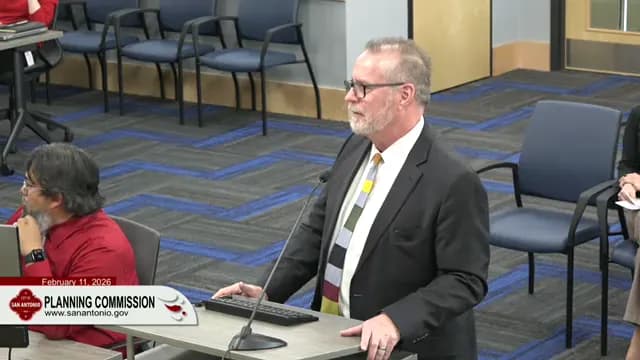
February 11, 2026 San Antonio Planning Commission Meeting

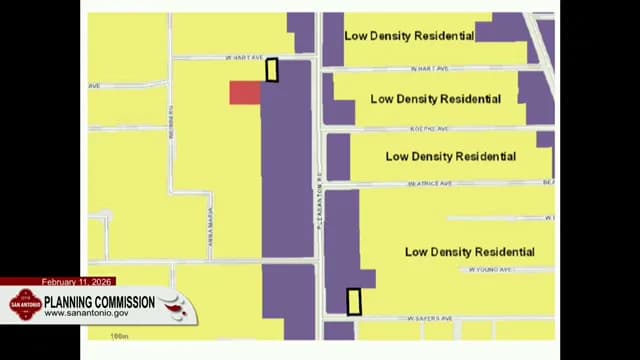
The San Antonio Planning Commission met on February 11, 2026, at 2:00 PM. All nine commissioners were present, establishing a quorum. The meeting included a consent calendar and two individual hearing items regarding amendments to the South Central San Antonio Community Plan. Consent Calendar - All items except 7 and 8 on the consent agenda were approved unanimously with no discussion. Discussion Items Item 7: 206 West Heart Avenue – Plan Amendment from Low Density Residential to Community Commercial - Staff Recommendation: Denial, citing inconsistency with surrounding residential uses and potential commercial encroachment. 22 notices were mailed; 0 in favor, 0 opposed within 200 feet; St. Leo's Neighborhood Association gave no response. - Applicant Testimony: Patrick Christensen, representing Gonzaba Medical Group, requested approval to allow a one-story medical clinic expansion with an ambulance turnaround. He stated the council office had indicated no further expansion beyond these properties. Mr. Christensen offered to accept a Neighborhood Commercial designation instead of Community Commercial. - Commission Discussion: Commissioners asked about access, buffers, and the nature of the medical use (outpatient clinic, not a hospital). The applicant clarified there would be no access from West Heart Avenue and that the building would be at the rear of the lot with appropriate setbacks and landscaping. - Motion and Vote: A motion to approve as amended to Neighborhood Commercial passed. The roll call vote was: 8 commissioners voted Yes (Profit, Siegel, Sanchez, De Succi, Lopez, Milam, Orion, Peck). Commissioner Bustamante responded "All right" (interpreted as approval). Item 8: 347 West Sayers Avenue – Plan Amendment from Low Density Residential to Community Commercial - Staff Recommendation: Denial, similar rationale as Item 7. 27 notices were mailed; 0 in favor, 1 opposed within 200 feet; St. Leo's Neighborhood Association gave no response. - Applicant Testimony: Patrick Christensen again represented Gonzaba Medical Group. The property, currently vacant after demolition of a single-family home, is owned by Gonzaba and would be replatted for a medical clinic. The applicant agreed to amend the request to Neighborhood Commercial (C1S for medical clinic). - Commission Discussion: Commissioners noted the neighboring uses (multifamily and commercial) and supported the lower-intensity designation. The applicant confirmed there would be no vehicular access on West Sayers Avenue. - Motion and Vote: A motion to approve as amended to Neighborhood Commercial passed. The roll call vote was: 8 commissioners voted Yes (Profit, Sanchez, De Succi, Lopez, Milam, Orion, Siegel, Peck). Commissioner Bustamante responded "I" (interpreted as abstention). Director's Report - Effective April 1, 2026, the Planning Commission will no longer accept voicemail as a method for public participation in meetings. - In response to a commissioner's inquiry, staff noted they would investigate the status of commissioner reappointments and report back. Key Outcomes - Consent agenda approved. - Both land use plan amendments (Items 7 & 8) were approved, but modified from Community Commercial to Neighborhood Commercial (C1S) designations. - The Planning Commission announced a change to public participation procedures (ending voicemail submissions as of April 1, 2026). - Staff to follow up on the status of Planning Commission member reappointments.

ZONING AND LAND USE 74% · HEALTHCARE FACILITIES 16% · PROCEDURAL 10%
464
FEB 11, 2026 · SAN ANTONIO, TEXAS · BOARDS & COMMISSIONS
San Antonio Planning Commission Meeting - February 11, 2026

The San Antonio Planning Commission held a regular meeting on February 11, 2026, at 12:00 PM. All commissioners were present. The meeting included a consent calendar for routine approvals and two individual hearings (Items 7 and 8) concerning amendments to the South Central Community Plan for properties owned by the Gonzaba Medical Group. Both items were approved as amended despite staff recommendations for denial. Consent Calendar - The consent calendar (items 1–6 and others excluding 7 and 8) was approved unanimously by roll call vote. No public comments were registered for this agenda. Discussion Items - Item 7 – Resolution amending the South Central Community Plan for property at 206 West Hart Avenue from residential to neighborhood commercial. The petitioner, representing Gonzaba, explained the property would be used for an ambulance turn-around and part of a future medical building expansion. Staff recommended denial due to encroachment into a residential area. The petitioner noted discussions with council offices that this would be the final expansion. The commission voted to approve as amended to "vecindario comercial" (neighborhood commercial). - Item 8 – Resolution amending the South Central Community Plan for property at 4347 Sayers Avenue from residential to neighborhood commercial. This adjacent parcel is also owned by Gonzaba and intended for a future medical office. Staff again recommended denial because the change would eliminate residential potential and is incompatible with surrounding single-family homes. The petitioner stated they would need to proceed with a rezoning to C-1 and a Community Impact Statement (CIS). The commission approved as amended to "vecindario comercial." Key Outcomes - Consent Calendar: Passed unanimously. - Item 7: Approved as amended (neighborhood commercial) by roll call vote: 8 ayes (Commissioners Profit, Maylam, Sánchez, de Suki, López, Oren, Bustamantes, President Peck). - Item 8: Approved as amended (neighborhood commercial) by roll call vote: 8 ayes (Commissioners Profit, Sánchez, de Suki, López, Maylam, Oren, Bustamantes, Sigo, President Peck). Note: one commissioner (López) appears to have abstained in the roll call transcript, but the motion passed. - The commission announced that effective April 1, 2026, it will no longer accept voicemail as a method for public participation; other methods remain available. - The meeting adjourned at 2:16 PM.

ZONING AND LAND USE 67% · PROCEDURAL 19% · PUBLIC HEALTH 14%
465
FEB 10, 2026 · SAN ANTONIO, TEXAS · BOARDS & COMMISSIONS
Fire and Construction Codes Advisory and Appeals Board Meeting - February 10, 2026

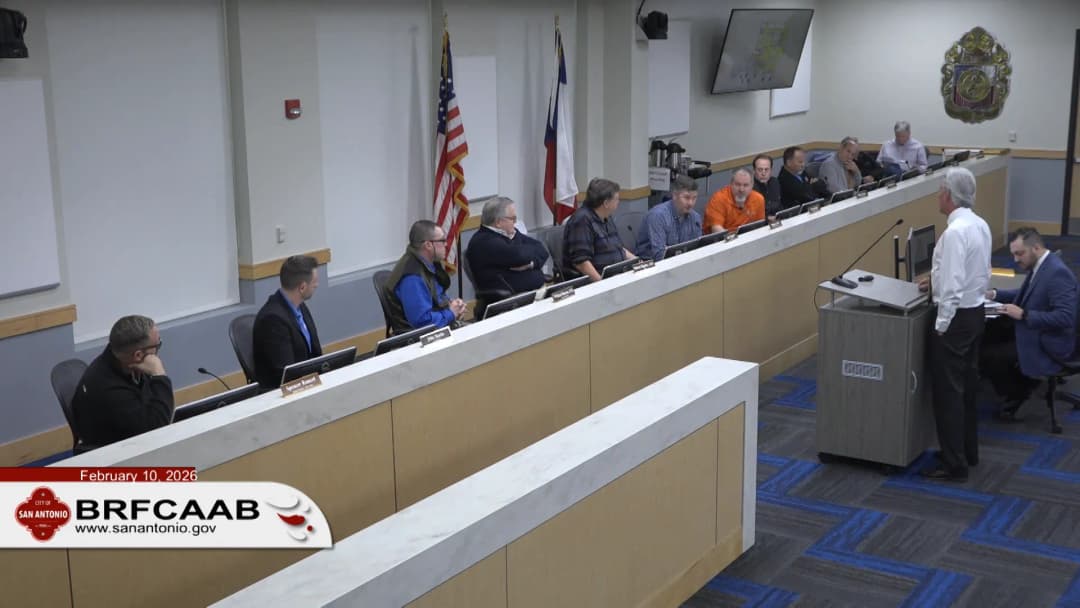
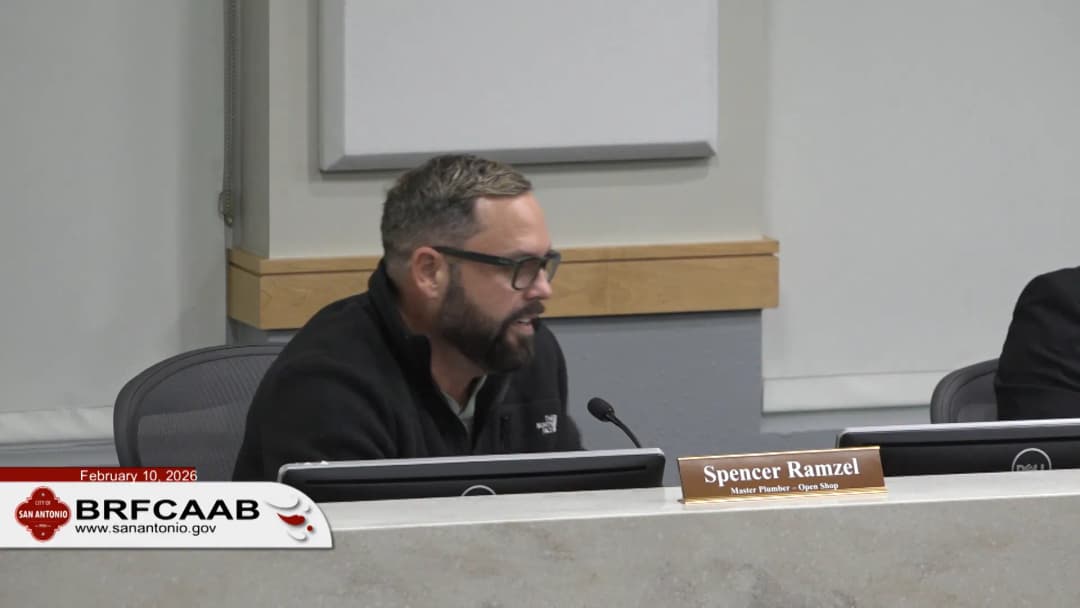
This meeting of the San Antonio Fire and Construction Codes Advisory and Appeals Board began at 9:09 AM on February 10, 2026, with a quorum present. The primary agenda item was an appeal by Octavio Viramontes regarding a denial of an exception to the fire sprinkler requirement for a nightclub/bar at 9518 Consol, ultimately resulting in a board vote to deny the appeal. Consent Calendar - Approved the minutes from the meeting of July 2, 2025, by unanimous voice vote. Discussion Items - Appeal – Octavio Viramontes (nightclub/bar at 9518 Consol): The appellant requested a reduction in calculated occupant load from 468 to 299 to avoid installing a fire sprinkler system. City staff from Development Services and the Fire Department presented the case. Staff argued that the applicant's calculations improperly excluded circulation areas (corridors, standing zones) from the occupant load, violating Section 1004.6. The applicant's alternate proposal to divide the space with a fire barrier was considered but rejected due to impact on business operations. The appellant noted the $225,000 cost of sprinkler installation and claimed actual occupancy never exceeds 250. The board discussed options: redesign to meet code without sprinklers (requiring professional design) or install sprinklers. The appellant expressed a preference for the occupancy cap. Key Outcomes - Denial of Appeal: The board voted to deny the appeal, requiring the business to either comply with the sprinkler requirement or redesign to meet the 299 occupant load without subtracting non-eligible areas. Motion by Brian Smith, seconded by John Martin, passed unanimously (voice vote: all in favor, none opposed). - Code Adoption Update: Staff noted that the next ICC code cycle will begin internal discussions in 2026, with formal adoption in 2027. The board requested a timeline and cost analysis for providing online code access. A separate discussion item on permit process improvements was proposed for a future meeting. - Adjournment: The meeting was adjourned at 10:02 AM.

FIRE SAFETY 68% · CODE ENFORCEMENT 18% · PROCEDURAL 14%
466
FEB 10, 2026 · SAN ANTONIO, TEXAS · BOARDS & COMMISSIONS
Building Related Fire Codes Appeals Advisory Board Meeting - February 10, 2026

The Building Related Fire Codes Appeals Advisory Board met on February 10, 2026, at 9:09 AM to hear an appeal from the owner of I-10 Ice House, an existing bar/nightclub, regarding the denial of a code modification request to avoid installing a fire sprinkler system. The board voted to deny the appeal, upholding the city's requirement for sprinklers due to the occupant load exceeding 300. Consent Calendar - Approved the minutes from the July 2, 2025, meeting by unanimous voice vote. Discussion Items - Appeal of Denial of Code Modification Request (I-10 Ice House, 9518 Console Road): The applicant, Octavio Viramontes (owner Tim Etson), appealed the city's denial of a request to reduce the occupant load to under 300 without sprinklers. The proposed reduction relied on excluding yellow-highlighted areas (walkways, circulation spaces) from occupant load calculations, claiming the bar's typical attendance never exceeds 299 (highest recorded: 267). Staff argued these areas cannot be excluded per code, and the calculated occupant load remains 469. The applicant offered to cap occupancy at 299 and add exits and fire barriers. The fire department and development services recommended denial, stating the proposal would waive code requirements. The board discussed alternative designs (e.g., fire barriers) and costs ($220,000 for sprinkler system, $74,000 for water connection). The applicant had signed an agreement allowing a temporary TCO for 299 occupancy for six months if the appeal was denied. - Director's Report: Effective April 1, 2026, all boards and commissions will stop accepting phone/voicemail testimony. - Future Code Adoption Process: Staff noted the 2024 I-Codes are under review, and formal discussions will begin in 2026 with adoption in 2027. Key Outcomes - Motion to Deny Appeal: Carried by voice vote (all in favor). The board denied the appeal, requiring the applicant to either install a fire sprinkler system or redesign the space (e.g., via fire barriers) to achieve an occupant load under 300. - Next Steps: The applicant may apply for a temporary TCO for 299 occupant load within 72 hours and has six months to install sprinklers. The city agreed to expedite permit reviews.

FIRE SAFETY 71% · PROCEDURAL 13% · MUNICIPAL REGULATIONS 6% · PUBLIC SAFETY 5%
467
FEB 9, 2026 · SAN ANTONIO, TEXAS · BOARDS & COMMISSIONS
San Antonio Zoning Board of Adjustment Meeting – February 9, 2026

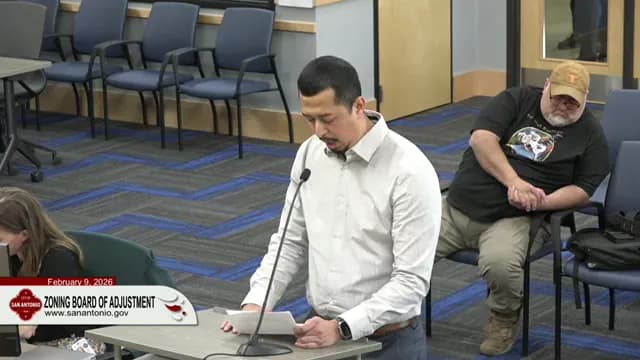
The San Antonio Zoning Board of Adjustment held a meeting on February 9, 2026, to consider variance requests, special exceptions, and other zoning matters. The board heard eleven agenda items, including requests for variances on lot size, setback, fence height, parking, and visibility, as well as a special exception for a fence. Considerable discussion also took place regarding public comment procedures and a future workshop on the Unified Development Code (UDC). Consent Calendar - No designated consent calendar was presented; all items were considered individually. Public Comments & Testimony - Bianca Maldonado (Monticello Neighborhood Association) requested a postponement of case BOA-25-10300-255 (February 23 or March 9) to allow community meetings with the applicant. Expressed concern that voice messages left for the board were not being received or considered in a timely manner. She asked that the board consider a general public comment period at future meetings. - Debbie Johnson (4030 Colonial Sun Drive) opposed the variance for a carport at 4028 Colonial Sun Drive, citing concerns about drainage from the proposed roof, obstruction of her view, and impacts on her property. She stated that the property has a zero-lot-line and that the carport would be built within the maintenance easement. She also noted that the proposed carport would interfere with her view and that previous drainage issues had caused water to flow onto her property. - Stanley Francois (201.473.3.38) left a voice message supporting the same variance for the carport at 4028 Colonial Sun Drive. He stated he is an active member of the Sunrise neighborhood association and lives within 200 feet of the property. Discussion Items - Item 1 – Nominations & Reorganization The board elected Donald Oren as President, Andrew Osuna as Vice President, and Commissioner Bergman as Interim President Pro Tempore. All elections were unanimous by voice vote. - Item 2 – Continuances / Scheduling Bianca Maldonado (Monticello POA) requested a postponement of case BOA-25-10300-255 from February 23 to March 9, 2026, to allow time for community meetings with the applicant. The board voted unanimously to continue the case to March 9, 2026. Case BOA-25-13027 was also continued to March 9, 2026, by unanimous vote. - Item 3 – BOA-25-10300-7 (118 Parkview Drive) Applicant: Analisa Alvarado — Requested variances for a minimum lot width of 45 ft (seeking 37 ft) and minimum lot size of 5,000 sq ft (seeking 3,200 sq ft) to allow construction of a new single-family home. Staff recommended approval. The property is 25 ft wide and 130 ft deep. No public comments were received in favor or opposition; the neighborhood association (Roosevelt) previously supported a similar project. Commissioner Stevens made a motion, seconded by Commissioner Osuna, listing six findings: (1) strict application of the code would result in unnecessary hardship due to the property's physical character; (2) special conditions make literal enforcement difficult; (3) the variance would permit reasonable construction consistent with the area; (4) the applicant intends to comply with all other R-5-4 district requirements; (5) the lot size and width are reasonable for the proposed construction; and (6) the hardship is due to unique existing circumstances. The motion passed unanimously 11-0. - Item 4 – BOA-25-10300-828 (371 Everest Avenue) Applicant: Mark Artemis Moore — Requested a variance of 6 ft for the rear setback (from 20 ft to 14 ft) to build a primary bedroom addition over the garage. Staff recommended denial based on reduced rear setback and fire spread concerns. No public comments in favor or opposition were received; the neighborhood association did not respond. Commissioner Bonilla made a motion, seconded, granting the variance with six findings: (1) strict enforcement would cause unnecessary hardship due to the reverse lot configuration; (2) special conditions (limited lot depth) directly contribute to the inability to meet the minimum setback; (3) the variance would uphold the spirit of the ordinance with a minimal reduction; (4) no other uses would be authorized; (5) sufficient separation exists to avoid substantial damage to adjacent property; and (6) the hardship is unique, not self-created or financial. During discussion, the applicant clarified that the drainage and a rear door would be maintained. The motion passed unanimously 11-0. - Item 5 – BOA-26-10300-1 (4028 Colonial Sun Drive) Applicant: Peter von Pritzka — Requested a variance of 4 ft-6 in from the minimum 5 ft side setback (to 6 in) and a variance of 6 ft from the minimum 10 ft front setback for a carport. Staff recommended denial, citing drainage falling on adjacent property and right-of-way. Three opposition letters were submitted by a single property owner (who owns three adjacent lots); two support letters from neighbors (4032 and 4027) were also received. The neighborhood association (Sunrise) was not registered with the city. During testimony, a neighbor (Debbie Johnson) raised concerns about drainage, view obstruction, and impacts on her property. The applicant proposed a sloped roof to direct water to the front, and the board amended the motion to limit the carport length to 20 ft (down from 23 ft). Commissioner Mena made a motion, seconded by Commissioner Bonilla, granting the variance with the modifications: (1) the variance is not contrary to public interest; (2) the special condition arises from the location of the existing house and driveway; (3) the reduction is minimal and does not cause significant hardship; (4) no other uses are authorized; (5) adequate separation and access remain; (6) the hardship is unique, not created by the owner, and not financial. The motion passed unanimously 11-0. - Item 6 – BOA-26-10300-2 (5703 McDonald Street) Applicant: Raúl García — First, the board heard a procedural request to waive the 12-month limitation (having been previously denied in November 2025 on a different variance, not parking). The board voted unanimously to waive the limitation and hear the case. The applicant then requested a 50% variance of the minimum 4 off-street parking spaces to allow 2 off-street spaces for a 4-unit duplex development. Staff recommended denial, citing congestion, traffic safety, and neighborhood impacts. Zero letters were received in favor, zero in opposition; the Tierra Linda neighborhood association opposed. Commissioner Bonilla made a motion, seconded, granting the variance, arguing the lot is at a cul-de-sac and that street parking would serve only residents. Commissioner Mena opposed, stating that the community had previously said no and that allowing construction without providing adequate parking is not good practice. The motion failed with 7 in favor, 3 opposed, and 1 abstention (Commissioner Dean abstained). The board did not reconsider, and the applicant was advised to consult staff on options. - Item 7 – BOA-26-10300-4 (9218 Echo Port Drive) Applicant: Erasmo González — Requested a special exception for an 8 ft tall fence (maximum allowed is 5 ft) and a variance for a clear view (seeking 10 ft-4 in vs. 15 ft minimum) at the driveway entrance. The fence is an open decorative fence. Staff recommended approval of the clear view variance but denial of the fence height due to impact on the visual openness of the front yard. Two opposition letters were received; no neighborhood association opposed. During the hearing, the applicant cited safety concerns and provided photographs. The board approved the clear view variance unanimously (11-0). On the fence height, Commissioner Mena made a motion for 6 ft height, allowed administrative increments of 6 in up to 6 ft-6 in. The motion passed with 10 in favor, 0 opposed, and 1 abstention (Commissioner Dean abstained). - Item 8 – BOA-26-10300-5 (510 Belmont) Applicant: Rafael Moreno César — Requested a variance of 3 ft from the minimum 5 ft side setback to 2 ft, plus a 4 ft-6 in setback for an eave (to 6 in) for a carport. The property had been remodeled, and the carport was built without permits. Staff recommended denial, finding no unnecessary hardship because the work was voluntary and without permits. Zero letters were received in favor or opposition; the Jefferson neighborhood association did not respond. Commissioner Stevens made a motion, seconded, granting the variance with an amendment to limit the structures to the existing design. The motion passed unanimously 11-0. - Item 9 – BOA-26-10300-6 (7830 Louis Pasteur Drive) Applicant: Edward Díaz — Requested a special exception for a 6 ft high fence (maximum allowed is 5 ft) in a C-2 commercial district. Staff recommended denial, citing inconsistency with surrounding commercial properties. Twelve notices were sent; none in favor, none in opposition. The applicant stated the fence is needed to deter vagrancy and drug activity. Commissioner Mena made a motion to grant the special exception, finding that the modest height increase would enhance security without compromising safety. The motion passed unanimously 11-0. Key Outcomes - President: Donald Oren elected; Vice President: Andrew Osuna elected; Interim President Pro Tempore: Commissioner Bergman elected. - Postponements: Cases BOA-25-10300-255 and BOA-25-13027 were continued to March 9, 2026. - Variances Approved: - 118 Parkview Drive – Unanimously approved. - 371 Everest Avenue – Unanimously approved. - 4028 Colonial Sun Drive – Unanimously approved, with carport length amended to 20 ft and roof slope requirement. - 9218 Echo Port Drive – Clear-view variance unanimously approved; fence height variance approved (10-0-1), allowing 6 ft height with administrative increments. - 510 Belmont – Unanimously approved, with structures limited to existing design. - 7830 Louis Pasteur Drive – Unanimously approved for a 6 ft fence. - Variance Denied: 5703 McDonald Street – Motion to grant failed (7-3-1). The applicant was advised to meet with staff to discuss options. - Procedural: The 12-month limitation was waived for the 5703 McDonald Street case, allowing the hearing. - Administrative: The board voted unanimously to approve the meeting minutes. - Future Actions: - The board will hold a workshop on the Unified Development Code (UDC) at a date to be determined, scheduled for the next meeting. - Public comment periods will be evaluated, with a potential policy allowing recorded public comments every two months, starting April 1, 2026. - The next regular meeting will have 17 cases; the chair requested members to review the agenda in advance. Director's Report - The phone-in voice message system will be discontinued after April 1, 2026, per the city manager's office and mayor's office. - The board will vote at the next meeting to schedule a workshop on UDC amendments.

ZONING AND LAND USE 73% · PROCEDURAL 8% · PUBLIC ENGAGEMENT 7% · TRANSPORTATION INFRASTRUCTURE 5%
468
FEB 9, 2026 · SAN ANTONIO, TEXAS · BOARDS & COMMISSIONS
San Antonio Board of Adjustments Meeting Summary – February 9, 2026

The San Antonio Board of Adjustments convened on February 9, 2026, at 1:00 PM with all 11 members present. The meeting included a vote on leadership positions, continuances, several variance and special exception requests, and a discussion on public comment procedures. The board also received a director's report noting that voicemail comments will be discontinued as of April 1, 2026. Consent Calendar - Minutes from the previous meeting were approved by voice vote. Leadership Elections - Chair: Donald Orion nominated by Commissioner Cruz and seconded by Commissioner Benavides. Approved by voice vote. - Vice Chair: Andrew Olduna nominated by Commissioner Cruz and seconded by Commissioner Ozuna. Approved by voice vote. - Pro Tem: Commissioner Bragman nominated by Commissioner Cruz and seconded by Commissioner Benavides. Approved by voice vote. Discussion Items - Item 3 (BOA 25103025) – 154 Babcock: Request for a 15-foot rear setback variance for a barbed wire fence. Staff recommended denial. Bianca Maldonado from the Monticello Park Neighborhood Association spoke, requesting a continuance to March 9, 2026, due to communication issues with the new case manager. She expressed concern that the city plans to stop accepting voicemail comments (effective April 1), which she considers an important engagement tool. The board voted to continue the case to March 9, 2026 (unanimous). - Item 4 (BOA 2501030276) – 1038 Sherman Street: Requested a 12-foot variance for a 13-foot corner clear vision and a 9-foot fence entrance. Staff recommended approval for the clear vision and denial for the special exception. A continuance to March 9, 2026, was requested and approved (unanimous). - Item 2 (BOA 25103007) – 118 Park View Drive: Variance for development on a 2,680 sq ft lot (required 5,000 sq ft) and 37-foot lot width (required 45 ft). Staff recommended approval, noting 27 notices sent with no responses. The applicant, Analisa Alvarado, described a new construction project. The board granted the requested variances with a unanimous 11–0 vote, citing consistency with neighborhood character. - Item 5 (BOA 25-103-00282) – 371 Everest Avenue: Request for a 14-foot rear setback variance (to allow 6 feet) for an addition. Staff recommended approval. The applicant, Artemis Moore, described an addition to the rear of the home. The board granted the variance unanimously (11–0), noting the lot's reverse configuration. - Item 6 (BOA 26-10301) – 4028 Colonial Sun Drive: Request for a 4-foot 6-inch side setback variance (to 6 inches) and a 6-foot front setback variance (to 4 feet) for a carport. Staff recommended denial. The applicant, Peter von Perdzek, sought to protect vehicles from hail and sun. Neighbor Debbie Johnson expressed concerns about drainage and visual obstruction. The board amended the request to limit the carport to a maximum 20-foot length (from 23 feet) and to require a continuously sloped roof to the front, and granted the variances (11–0). - Items 7 & 8 (BOA 26-10302) – 5703 MacDonald Street: The applicant, Raul Garcia, first requested a waiver of the 12-month time limitation to re-file for a parking variance (from 4 to 2 spaces) for a four-unit duplex development. The board waived the limitation (majority vote). The variance request was debated; the board ultimately denied it (7–3, with 1 abstention), with some members favoring a three-space alternative or suggesting the applicant explore on-street parking. The motion to grant the 50% parking variance failed. - Item 9 (BOA 26-103-0004) – 9218 Echo Port Drive: Request for a fence height special exception (to allow 8-foot gates and 6-foot fence) and a 4-foot 8-inch driveway clear vision variance. The applicant cited security concerns with police reports. The board granted the clear vision variance unanimously. For the fence height, an initial motion for 6-foot height passed (10–0, 1 abstention), after an amendment to 7 feet failed (6–5). The applicant was advised that an additional 6 inches might be possible via an administrative variance. - Item 10 (BOA 26-103-0005) – 510 Belmont: Request for a 3-foot side setback variance (to 2 feet) for the primary structure and a 4-foot 6-inch side setback variance (to 6 inches) for an existing carport. Staff recommended denial. The applicant explained the house (built 1920) required extensive framing replacement. The board granted the variances (11–0), limiting the structures to their current footprint and placement. - Item 11 (BOA 26-10306) – 7830 Louis Pasteur Drive: Request for a 1-foot special exception (to allow 6-foot fence) for a commercial property. Staff recommended denial. The applicant cited security concerns due to homeless activity. The board granted the exception (11–0) for a predominantly open fence. Key Outcomes - Leadership: Donald Orion (Chair), Andrew Olduna (Vice Chair), and Commissioner Bragman (Pro Tem) were elected for the coming term. - Workshop: The board will schedule a workshop to discuss potential UDC amendments; a motion to set a date was approved. Commissioners were asked to submit suggested topics to staff. - Voicemails: Staff announced that voicemail comments will no longer be accepted or played as of April 1, 2026, per direction from the City Clerk's and City Manager's offices. Several commissioners expressed concern about the impact on public engagement. - Variances Approved: Items 2, 5, 6, 9 (clear vision and fence height for 6-foot), 10, and 11 were approved. - Variances Denied: Item 8 (50% parking variance) was denied. - Cases Continued: Items 3 and 4 were continued to March 9, 2026. - Time Waived: Item 7 (12-month re-filing limitation) was waived for the parking variance request.

ZONING AND LAND USE 68% · PROCEDURAL 13% · PUBLIC SAFETY 5% · PUBLIC ENGAGEMENT 4%
469
FEB 6, 2026 · SAN ANTONIO, TEXAS · COUNCIL COMMITTEES
San Antonio City Council Committee Meeting on Youth Programs - February 6, 2026

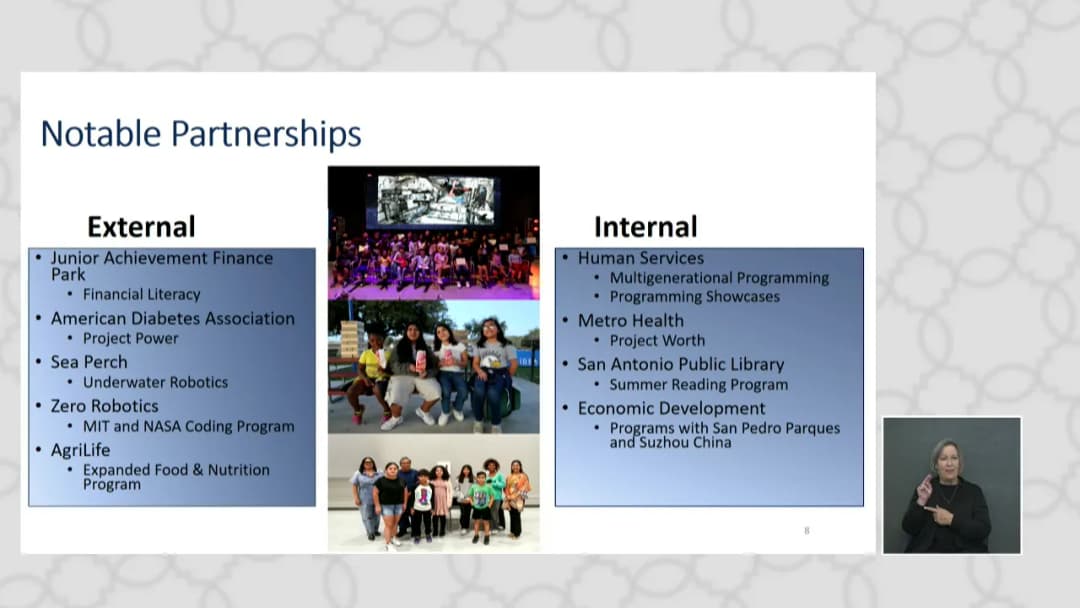
The City Council committee convened on February 6, 2026, to receive presentations and discuss the city's portfolio of youth programs, including Opportunity Youth initiatives, municipal court services, parks and recreation youth offerings, and workforce development. Council members emphasized the need for coordinated data tracking, geographic equity, and increased investment in prevention and summer programming. Consent Calendar - Approved the minutes from the previous meeting of December 10, 2026, by unanimous voice vote (no abstentions). Discussion Items Opportunity Youth (Next Level) – Department of Human Services - Rebecca Flores, representing the Human Services Department, presented on the Next Level program serving opportunity youth (ages 16–24, not in school or working). - San Antonio has an estimated 30% opportunity youth rate, and Texas has the highest disconnection rate nationally. The city’s average is above 13%, with some areas reaching 20%. - Next Level opened in 2019 in District 4. In FY25, the program served 425 youth (down from prior years due to the end of a grant from Northside ISD). - 60% of participants live in households earning under $10,000; 15% have been involved in the judicial system; 13% are experiencing homelessness or unstable housing; 16% are or were in the foster care system. - More than half of participants lack a high school credential; nearly a quarter left school before 9th grade. - The program provides free medical and mental health support, transportation passes, and assistance with re-enrollment or employment. - Flores shared a model: outreach to 100 people yields 50 enrollments, of which 25 enter school or employment. - Outcomes: participants achieve basic needs, re-enroll in high school or vocational training, and earn diplomas or join the military. - The city also funds programs at Healy Murphy, Seton Home, and the YMCA. Two pandemic grants established the San Antonio Collaboration, working with United Way to align metrics across agencies. - Next Level received national recognition, including the 2024 Visionary Champion of Youth award and the All-America City award. - Next steps include consolidating funds, working with United Way and community partners, and expanding through external sources. Youth Services & Juvenile Programs – Municipal Court - Keri Kepler, Manager of Municipal Court, presented on two areas: juvenile court and prevention/intervention programs. - The juvenile court diversion program (started January 2025) allows youth accused of certain violations to participate in a program where cases are dismissed upon completion; 79% of closed cases were successful. - The Teen Court program, staffed by youth volunteers, handled cases with community service and fees; 77% of closed cases were successful. - Prevention programs target truancy across multiple school districts, working with students as young as pre-K and up to age 21. In the current year, over 900 truant students were invited to court, and 209 have re-enrolled in educational programs. - Programs address substance abuse, mental health, and attendance. Partnerships include AIT (American Indigenous Texas) and UTSA counseling. - A grant request for under $300,000 will be submitted for the truancy program’s 10th year, including a supervisor position. - Kepler shared success stories of students who graduated with staff support. Youth Programs – Parks and Recreation Department - The Parks and Recreation manager presented an overview of youth offerings. - The department operates 30 community centers (20 full-service), with extended hours (10 a.m. open). Over 352,000 youth and teen visits annually. - Summer camp programs at 45 locations: $260 for first child, $160 for second, but 73% of children receive a reduced fee of $25–53. School-break camps (spring, Thanksgiving) cost $3 per day, include meals, for ages 6–14. - Specialty programs: Sea Perch (underwater robotics), AIM to Float (kayaking and archery), STEM activities including robotics with MIT and NASA (Zero Robotics). - Art programs include 12-week sessions with gallery showings. - Athletic offerings: over 910 tennis participants, basketball leagues, boxing club, fitness classes. - Aquatics: Garcia Atanasio Swim Center had 50,000+ visits, 571 swim lesson participants, 265,000 total visitors. Lifeguard training for ages 16+ with incentives; 58 participants ages 16–24 last year. - Natural areas: over 22,600 participants at nature programs; 620 nature connection opportunities. - Employment opportunities for youth: lifeguards, sports officials, youth advisors. The department partners with Next Level to hire youth for first jobs. - A two-year master plan for youth services was developed, recommending technology upgrades, program expansion to underserved areas, and better community communication. - The Parks department collaborates with Metro Health, libraries, and other city departments on multigenerational programs and resource fairs. Ready to Work – Office of Workforce Development - Michael Sennon presented on workforce development for ages 18–24. - Participants: 25% of the Ready to Work cohort are ages 18–24. Completion rate: 64%. - Demographics: 63% female, 60% Latina, 18% African American, 2% Asian. - Top industry interest: healthcare (56%), transportation (12%). Top occupations: medical assistants, nursing assistants. - Outreach efforts include collaboration with municipal court’s truancy summit, school district fairs, and a pilot program with SA Works targeting five high schools for 300 youth paid internships. - A Department of Labor grant will fund earn-as-you-learn training starting June 2026. - The office partners with UTS and JC (apprenticeship) programs: 238 participants ages 18–24 in training; 17 training programs with UTS, JR Plumbing, Office of Historic Preservation. - Demographics for apprenticeship: 78% male, 20% female, 65% Latino, 20% Black. - Expanding through Alamo Academies and P-TECH programs at several high schools. Council Discussion & Additional Comments - Council members praised the interconnected agenda and stressed the importance of addressing “leaks” in the youth pipeline. - Councilor Munguía highlighted the need to expand Next Level, improve mapping of services, and invest in parks and pools, especially in underserved areas (e.g., outside Loop 1604). He noted that healthcare is the top career interest among youth, yet there is a gap in medical access in south and west San Antonio, and suggested aligning workforce training with community needs. - Councilor Castillo emphasized public safety prevention, noting that youth employment programs in cities like Atlanta and Milwaukee reduced crime. She supports expanding work opportunities to ages 14–16 and will work with Judge Crush on juvenile cases. - Councilor Galván asked for better data collection by zip code and school district to identify where participants come from and overlap between programs. - Discussion on funding: Next Level currently lacks sufficient funding and faces barriers because many foundations do not fund government entities. The city is exploring options. - Council members suggested inviting school district superintendents to future meetings to align programs and facilities. - The president noted the need to compile data across departments and use it to target investments in high-need areas. Key Outcomes - Unanimous approval of previous meeting minutes. - Council expressed strong support for continued and expanded funding of Next Level, municipal court youth services, parks programs, and workforce development. - Requests for cross-departmental data sharing by zip code and school district to improve targeting of resources. - Will explore expanding Ready to Work eligibility to younger youth and to include more internships with city departments (e.g., Office of Historic Preservation, Solid Waste). - Plans to host a larger community event or summit to connect families with youth programs. - Next steps: staff will provide additional data on program participation, waitlists, and geographic distribution at a future meeting. - The meeting was adjourned at 11:42 a.m.

YOUTH PROGRAMS 38% · PARKS AND RECREATION 25% · PUBLIC EDUCATION 12% · WORKFORCE DEVELOPMENT 7%
470
FEB 6, 2026 · SAN ANTONIO, TEXAS · COUNCIL COMMITTEES
Education Opportunities Committee Meeting on Opportunity Youth Programs - February 6, 2026

The Education Opportunities Committee met on February 6, 2026, from 10:03 a.m. to 11:42 a.m. to hear briefings from the Department of Human Services, Municipal Courts, Parks and Recreation, and the Ready to Work program on their respective efforts to support opportunity youth (ages 16–24 who are not working and not in school). The committee discussed program outcomes, data collection, collaboration, and potential budget priorities. Consent Calendar - The committee approved the minutes from the previous meeting without corrections. Discussion Items Opportunity Youth Programs by DHS (Rebecca Flores) - Rebecca Flores, overseeing the Children and Youth Success Team, presented on the city's investments in opportunity youth. She defined an opportunity youth as someone aged 16–24 who is not working and not in school, noting the term was changed from "disengaged youth" to emphasize potential. - San Antonio has approximately 36,000 opportunity youth (about 13% of those aged 16–24), with some zip codes having disconnection rates in the low 20%. - The Next Level Youth Opportunity Center opened in 2019 in Council District 1, serving youth with high barriers: more than half lack a high school credential, almost a quarter dropped out before 9th grade, about 15% have been justice-involved, 13% are experiencing homelessness, and 16% are or were in foster care. - In FY25, Next Level served about 555 youth. Success metrics include re-enrolling in high school, obtaining a high school equivalency, entering post-secondary/vocational training, or entering the military. The program's outcomes exceed national averages for re-engagement centers. - The city also funds three delegate agency programs (Healy Murphy, Seton Home, YWCA) and leads the San Antonio Opportunity Youth Collaborative with 40 nonprofits, developing shared performance metrics for delegate agency funding. - Flores noted that foundations often do not fund city government directly, limiting expansion options. The city is exploring pass-through arrangements with nonprofits. Juvenile Services by Municipal Courts (Katie Kepler) - Katie Kepler, court manager over the juvenile section, described the court's juvenile services, including the youth diversion program (started January 2025) and teen court. - The youth diversion program allows cases to be dismissed upon agreement; 79% of closed cases have been completed successfully. Teen court had a 77% successful completion rate for closed cases in the previous year. - The Truancy Prevention and Intervention Program has 11 case managers working with 11 public ISDs and 5 charter schools, serving students from pre-K through age 19 (and up to age 21 for dropouts). - A re-engagement docket focuses on students who have dropped out. This year, about 900 students were invited to court; 209 have been confirmed re-enrolled in an educational program. - Kepler shared that the court lacks additional funding for its programs and relies on an adopted budget and a truancy grant from the Office of the Governor (approx. $355,000). Parks and Recreation Youth Programs (Sarah Sharp) - Sarah Sharp, recreation manager, presented on Parks and Recreation's youth services. The department recently developed a Youth Services Master Plan after community engagement. - Parks has 30 community centers (20 full-service), now open at 10 a.m. instead of 2 p.m., with over 352,000 youth and teen visits last fiscal year. The centers are concentrated in central San Antonio, leaving gaps on the outskirts. - Programming includes STEM (CPurch underwater robotics, Zero Robotics with MIT/NASA), arts (The Gallery art show), outdoor adventure (Aim to Float kayaking/archery), and sports. Out-of-school camps cost $3/day; summer youth program fees are on a sliding scale, with 73% of participants qualifying for a reduced fee of $25 for the first child for 8 weeks. - Parks hires lifeguards starting at age 16; last year 255 of 285 lifeguards were aged 16–24. Parks is partnering with Next Level to recruit youth for these jobs. - Sharp highlighted internal collaboration with DHS, the Library, and Metro Health (the "Big Four") for multi-generational programming. Ready to Work Program (Michael Sindon) - Michael Sindon, administrator with the Workforce Development Office, briefed on Ready to Work's efforts for young adults (18–24). Participants must be 18+, a San Antonio resident, and have income less than 250% of federal poverty guidelines. - Young adults (18–24) make up 25% of all intake/enrollment/training completers and 24% of quality job placements. Their training completion rate is 64% and job placement rate is 58%. - Top industries of interest for this age group are health care (56%), transportation, and IT/cyber. Top training occupations are medical assistant and nursing assistant. - Outreach efforts include the City Senior Summit (collaboration with Municipal Court), resource fairs at high schools, and a new pilot with SAWORKS targeting five low-socioeconomic-status high schools. - The Apprenticeship Building America grant ($2.9 million, sunsetting June 2026) supports pre-apprenticeship and registered apprenticeship programs. To date, 238 young adults have gone through pre-apprenticeship training, with 78% male and top occupations in IT/cyber (61%), construction trades, and utilities. - Registered apprenticeship programs have been created with 17 local employers, including UTSA College of Education, JR Plumbing, and the Office of Historic Preservation. Public Comments & Testimony - No members of the public signed up to speak. Key Outcomes - Committee members expressed strong support for the programs, with Councilmember McKee Rodriguez emphasizing the importance of investing in opportunity youth as a preventive measure. - Councilmember Castillo noted that public safety improvements start with these programs and expressed interest in expanding Next Level and park services in his district (District 4), which lacks a community center. - Councilmember Mungia highlighted the need for better data collection and mapping of program participants by zip code to ensure resources target the highest-need areas. - Councilmember Kaur requested data on participants' school districts and waitlists for Parks programming, and asked about re-engagement docket outcomes by grade level. - Councilmember Galvan (Chair) proposed inviting school district superintendents to a future meeting to better align city services with school needs and to coordinate data sharing. - No official action was taken; the briefings were for discussion only.

PUBLIC EDUCATION 39% · PARKS AND RECREATION 15% · YOUTH PROGRAMS 14% · WORKFORCE DEVELOPMENT 9%
OPENPUBLICA · PUBLIC MEETING INDEXUPDATED DAILY · openpublica.com