Browse by city
Date range
Search help

Search titles, summaries, topics and stored transcripts together. Keywords may match separately; put the whole query in double quotes for a phrase. Matching follows word analysis, so punctuation is not exact. Both dates are included. Documents are not searched.

SHOWING 471–480 ENTRIES
471
FEB 5, 2026 · SAN ANTONIO, TEXAS · CITY COUNCIL
San Antonio City Council Meeting, February 5, 2026: Denies Guajolote Ranch MUD, Approves Proclamations

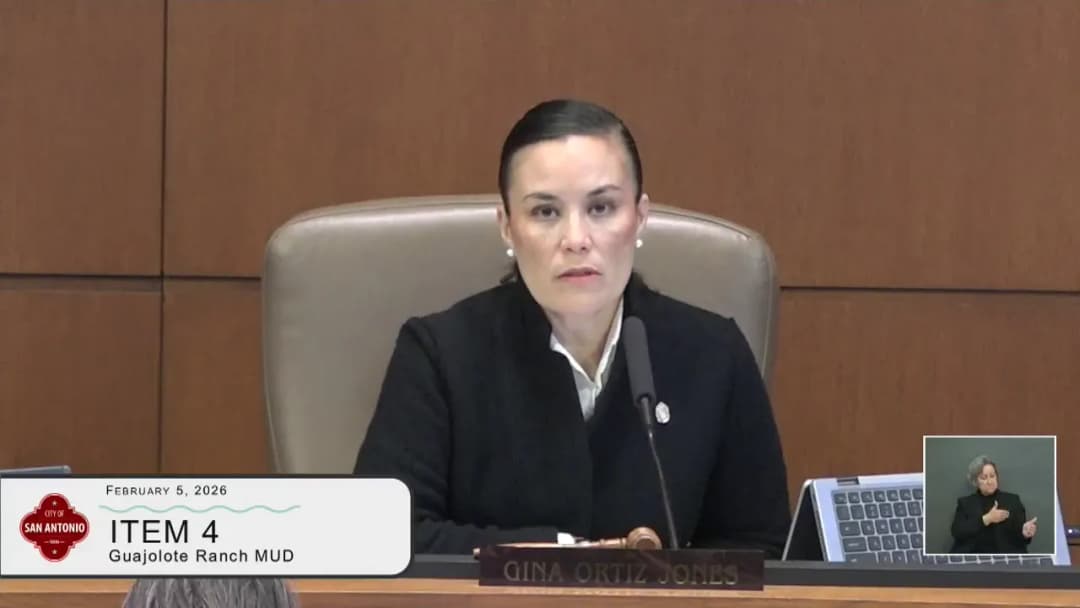
The San Antonio City Council convened at 9:02 AM on February 5, 2026, to consider a consent agenda, multiple proclamations, and a controversial proposal to create a Municipal Utility District (MUD) for the Guajolote Ranch development. After over two hours of public testimony and council deliberation, the council unanimously denied both the MUD creation and the associated development agreement. The meeting also featured proclamations for Rodeo season and Black History Month. Consent Calendar - The council approved the minutes from January 21–22 and the entire consent agenda en bloc, which included routine approvals, contracts, and appointments. - Councilmembers highlighted specific items: No. 12 (appointment of Logan Martinez to the Council of High School); No. 9 (grant for truancy prevention); No. 7 (construction contract for Babcock Road improvements, a 2022 bond project). - During public comment on the consent agenda, Jack Finger spoke against items 11 (appointment of Eric Alba to the Ethics Review Council) and 13 (settlement of a police-involved accident). Finger criticized Alba's sexual orientation and expressed concerns about officer accountability. Councilmember McKee Rodriguez responded, defending Alba and condemning Finger's remarks as prejudiced. The consent agenda was approved with no items pulled. Public Comments & Testimony (Items 4 & 5 – Guajolote Ranch MUD) - Over 20 registered speakers testified, nearly all in opposition to the MUD. Speakers included adjacent landowners, hydrologists, geologists, and community alliance representatives. - Jane Sam, whose family has owned adjacent land for 104 years, demonstrated the karst geology and rapid water infiltration, arguing that treated wastewater would directly contaminate the Edwards Aquifer. She stated, "The science predicts that one complete death se queda ahí." - State Representative Mark Doracio (District 122) opposed the MUD, stating, "Nothing in my district quiere este MUD" and warned that taxpayers countywide would subsidize the development. - Stuart Burnham, a geology professor, cited letters from Dr. Ronald Green and Dr. George Venner showing hydraulic connection between the Trinity and Edwards aquifers, contradicting San Antonio Water System (SAWS) claims. He called the MUD "a dangerous and costly risk." - Brandy Newman (Lords Creek Alliance) urged denial, citing pending litigation against the TCEQ permit and arguing that the MUD would create an independent taxing entity with an unelected board. He said, "This is not about need, but about private profit." - Dr. Ron Green, a hydrogeologist who led the 2020 Southwest Research Institute study, stated that the nine negotiated conditions would not significantly mitigate contamination risk. He emphasized that the scientific consensus is that such discharges degrade water quality. - Several speakers, including Luis Vedder (San Antonio Conservation Society) and Jack Finger, echoed concerns about irreversible harm to the drinking water supply for 2.5 million people. Discussion Items (Items 4 & 5 – MUD Creation and Development Agreement) - Staff from the city's development services department presented the proposal for MUD No. 2 on 1,159 acres near Babcock Road and Loop 1604. The developer, Lenar Homes, planned 3,000 single-family homes with a wastewater treatment plant discharging up to 4 million gallons per day into the Helotes Creek watershed, a contributing zone to the Edwards Aquifer. The developer had not signed the city's development agreement. - Councilmembers questioned the adequacy of water protections. Councilwoman White asked about the additional conditions that would be lost without the development agreement. Staff explained that without approval, the city would retain only two of the 17 protective conditions. - Councilwoman Villagran distinguished between contributing and recharge zones, noting that the area is a contributing zone where surface water flows onto the recharge zone. She stressed the need for broader dialogue on water reuse and PFAS. - Several councilmembers (Alderete-Gavito, Mungia, Castillo, Spears, White, McKee Rodriguez, Corr, Galvan) stated their opposition to the MUD, citing threats to water quality, the MUD's structure as an unelected taxing entity, and the lack of infrastructure. - Councilwoman Spears noted that the MUD creates a separate government with its own board and taxes, leaving future homeowners uncertain about costs. Key Outcomes - Item 4 (Consent to create MUD No. 2): Motion to deny passed (vote tally not explicitly stated but appeared unanimous based on council comments; no opposition recorded). - Item 5 (Development Agreement): Motion to deny passed (same). The council effectively rejected the Guajolote Ranch MUD proposal. - Item 6 (Fire sprinkler extension): The council voted to postpone consideration to February 12, 2026, at the request of Councilmembers Castillo and McKee Rodriguez. - Proclamations: Approved Rodeo season (Feb 12 – Mar 1) with a call for western dress on Feb 12, and Black History Month (February 2026), with councilmembers highlighting local African American heritage. - The meeting recessed into executive session at 12:47 PM for economic development and legal matters; no action was taken in open session after.
WATER AND WASTEWATER MANAGEMENT 35% · ENVIRONMENTAL PROTECTION 25% · COMMUNITY ENGAGEMENT 8% · PROCEDURAL 7%
472
FEB 5, 2026 · SAN ANTONIO, TEXAS · BOARDS & COMMISSIONS
San Antonio Building Standards Board Meeting - February 5, 2026

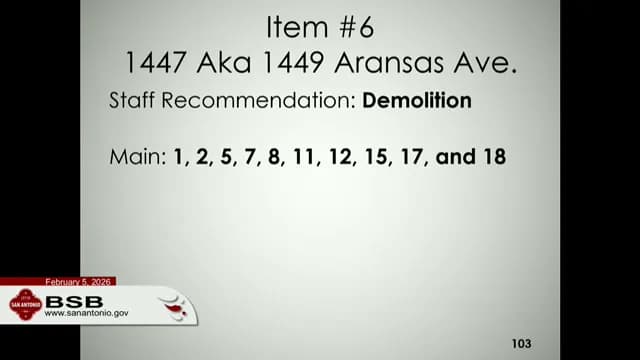
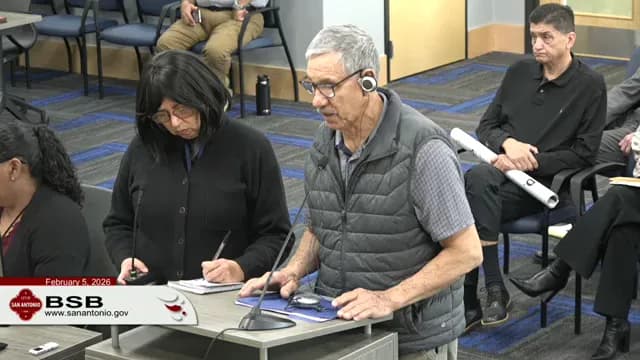
This meeting of the Building Standards Board of the City of San Antonio, held on February 5, 2026, addressed multiple properties cited for substandard and dangerous conditions. The board heard cases involving demolition and repair recommendations, with public testimony from property owners, code enforcement officers, and a police officer. Key actions included orders for demolition, property repair with timelines, and case continuances. Consent Calendar - The board unanimously approved the minutes from the previous meeting held on November 6, 2025. - Fred Andes was nominated and unanimously elected as Vice President of the Board. Discussion Items - 1400 Block of Gorman Street (Emergency Demolition): Code compliance manager Alex Guajara reported that a structure at 1411 Gorman was demolished on January 9, 2026, following a fire on January 5, 2026. No further board action was required. - 827 West Formosa Boulevard (Emergency Demolition): A structure was demolished on January 16, 2026, after a fire on January 9, 2026. No further board action was required. - 4223 Tropical Drive (Emergency Demolition): A structure was demolished on January 23, 2026, as an emergency due to a fire on January 16, 2026. No further board action was required. - 807 Elvira Street (First Hearing, Demolition Recommended): Code enforcement officer Crystal Town presented the case of a two-story residential structure with four units. The property was found unsecured, with broken windows, roof damage, exposed electrical, holes in floors, and evidence of drug use. Police Officer Gonzalez testified that the area is known for narcotics activity and prostitution, and the property is within 1,000 feet of Zavala Elementary School. The owner, Pablo Solís T., did not appear. The board found the property to be a public nuisance under Code Section 8-6-157, citing violations of subsections 1, 2, 8, 11, 12, 15, 17, and 18. A motion was passed unanimously (6-0) to evacuate, secure, disconnect utilities, and demolish the property within 30 days. - 206 Caddo Street (First Hearing, Repair Recommended for Main Structure, Demolition for Accessory Structure): Code enforcement officer Daphne Sánchez presented the case. The property owner, Leonardo Martínez, was represented by Jaime Flores, who stated he had owned the property for only one week and requested six months to complete repairs. The board noted that the owner had not provided a detailed scope of work or financial documentation. The case was continued to the next available meeting date to allow the owner time to submit required documents. - 1027 Alameda Street (First Hearing, Demolition Recommended): Code enforcement officer Alexandre Hazawi presented the case. The property owner, Paul Sessions of 1027 Alameda LLC, expressed agreement with the demolition recommendation. Sessions stated the property had been vacant for 30 years and that the cost of repair exceeded their resources. The board found the property to be a public nuisance under Code Section 8-6-157, citing violations of subsections 1, 2, 5, 7, 8, 11, 12, 15, 17, and 18. A motion was passed unanimously to demolish the property within 30 days. - 1447 Orancess Avenue (also known as 1449) (First Hearing, Demolition Recommended): Code enforcement officer Ryan Garces presented the case. The owner, Don Juan Gualberto, stated that he had been ill and only recently learned of the hearing. He expressed a desire to repair the property and indicated he had access to financing. The board continued the case to the next available meeting date to allow the owner to submit required documentation. - 350 Southwest 41st Street (Second Hearing, Repair Recommended): Code enforcement officer Stephanie Sánchez presented the case. Owner Adela Segovia provided a scope of work totaling $75,550 and proof of financial capacity ($160,000 in bank accounts). The property had suffered arson and had structural damage, primarily in the accessory structure. The board found the property to be a public nuisance but repairable, citing violations of Code Section 8-6-156 (subsections 1, 2, 5, 11, 12, 15, 17, and 18 for the main structure; subsections 1, 2, 5, 8, 11, 12, and 15 for the accessory). A motion passed unanimously to require repair within 180 days, with progress reports to the code officer every 30 days, an engineering report due within 30 days, and the property to be secured with a front fence. Administrative Items - Judy Crum reported that the city's legal department is reviewing three applications received for a general vacancy on the board. Appointments and reappointments will be scheduled once approved. - The board discussed and clarified their adherence to Robert's Rules of Order in the conduct of motions.

CODE ENFORCEMENT 71% · PROCEDURAL 11% · PUBLIC SAFETY 5% · BUDGET 4%
473
FEB 5, 2026 · SAN ANTONIO, TEXAS · CITY COUNCIL
San Antonio City Council Meeting – February 5, 2026

The San Antonio City Council convened on February 5, 2026 at 9:02 AM and adjourned at 2:37 PM. The meeting included proclamations, approval of the consent agenda, and extensive public comment and council deliberation on two related items concerning a proposed Municipal Utility District (MUD) for the Guajalote Ranch development. Both items were voted down. A subsequent item was postponed. Proclamations - Official Rodeo Season (Feb 12 – Mar 1, 2026): The council proclaimed February 12 – March 1 as official rodeo season, with February 12 as Western Day. The San Antonio Stock Show & Rodeo, with over 7,000 volunteers, has committed over $279 million to youth since inception and generated a $330 million economic impact in 2025. Representatives highlighted the event's volunteerism, scholarship programs, and regional significance. - Black History Month (February 2026): The council recognized February as Black History Month with the theme "A Century of Black History Commemorations," marking 100 years since Carter G. Woodson launched Negro History Week. Councilmember McKee Rodriguez led remarks emphasizing the need to include Black history in daily life and acknowledged ongoing work toward equity. Several councilmembers noted local Black history sites and the importance of continued support. Consent Calendar - Items 7 through 15 were approved as a group. Highlights included: - Item 7: Construction contract for Babcock Road widening and safety improvements (2022 bond project in District 8). - Item 9: Grant for truancy prevention in youth, providing four caseworkers and a supervisor. - Item 12: Appointment of Logan Martinez to the Higher Education Student Advisory Board. - Councilmember McKee Rodriguez also addressed public speaker Jack Finger, condemning his hateful remarks against appointee Eric Alva (a Marine veteran and LGBTQ+ advocate appointed to the Ethics Review Board) and affirming support for the appointment. Public Comments & Testimony (Items 4 & 5) Over two dozen residents, scientists, and elected officials spoke in opposition to the creation of Bear County MUD No. 2 and the associated development agreement for the Guajalote Ranch project (1,160 acres, 3,000 single-family homes, $150 million infrastructure). Key positions: - Water quality & karst environment: Multiple speakers, including hydrogeologists Dr. Stuart Birnbaum, Dr. Ronald Green, and Gary Schindel, testified that the proposed on-site wastewater treatment plant would discharge effluent into the highly fractured karst limestone of the Holotus Creek watershed, threatening the Edwards and Trinity aquifers. They cited a 2020 Southwest Research Institute study concluding that any wastewater discharge would significantly degrade water quality, and noted that peer-reviewed dye tracer studies show direct hydrologic connection between the aquifers. Private well owners from adjacent properties described seeing water rapidly infiltrate karst rock and feared contamination. - Legal & regulatory issues: Representative Mark DeRazio (HD 122) stated that no one in his district wants the MUD and that the project would raise county property taxes for roads, emergency services, etc. The Greater Edwards Aquifer Alliance and Conservation Society argued that the developer's track record (a $175,000 penalty for Clean Water Act violations at a prior subdivision) indicates non-compliance risk. The wastewater permit is under judicial appeal in Travis County for 10 alleged errors. - Developer's position: The developer (Lenar Homes) has not signed the proposed development agreement and indicated they would not do so. Staff noted that without the development agreement, the city would lose additional protections such as SAWS review of construction plans, right to inspect the plant, road access standards, a bond debt cap, voluntary annexation provisions, and a third-party conservation easement. Discussion Items (Items 4 & 5) - Item 4: Resolution consenting to creation of Bear County MUD No. 2 by TCEQ. - Item 5: Ordinance approving a development agreement between the city and the landowners. - Council deliberation: Councilmembers discussed the water quality risks, the lack of developer cooperation, and the MUD's financial structure (unelected board, permanent tax burden on future homeowners, potential debt obligation if annexed). Many expressed that the science is clear and the risk to drinking water for 2.5 million people is unacceptable. The mayor noted that regardless of the vote, 17 water quality protections (from SAWS and a settlement agreement) remain, but 6 development protections (including annexation terms and SAWS oversight of the plant) would be lost without the agreement. - Votes: Both items were voted on separately. The motion to approve Item 4 failed. The motion to approve Item 5 also failed. Councilmembers Aldrete Gavito, Mesa Gonzalez, Spears, Castillo, Mungia, White, McKee Rodriguez, Corr, Galvan, and Via Gran all indicated they would vote no or did so based on their statements. No councilmember spoke in favor of the items. Postponed Item - Item 6: A resolution providing bars an extension to February 1, 2027 to comply with retrofit requirements for automatic fire sprinkler systems. The item was postponed to February 12, 2026 by a motion that carried. Key Outcomes - Denied: The council denied consent to the creation of Bear County MUD No. 2 (Item 4) and rejected the development agreement for Guajalote Ranch (Item 5). No final vote tally was recorded, but the motions to approve both items failed, indicating a majority opposed. - Postponed: Item 6 was postponed to the February 12, 2026 meeting. - Executive Sessions: The council met in executive session (not open to the public) to discuss economic development, real property, litigation, and collective bargaining. No official action was taken in executive session.

WATER AND WASTEWATER MANAGEMENT 46% · PROCEDURAL 12% · ENVIRONMENTAL PROTECTION 10% · RACIAL EQUITY 6%
474
FEB 5, 2026 · SAN ANTONIO, TEXAS · BOARDS & COMMISSIONS
San Antonio Building Standards Board Meeting - February 5, 2026

The San Antonio Building Standards Board met on February 5, 2026, at 1901 South Alamos Street, chaired by Dwayne Nelson. The board heard five cases concerning dilapidated structures, took administrative actions, and received reports on emergency demolitions. Quorum was present. Administrative Matters - Approval of Minutes: The minutes of the previous meeting were approved unanimously. - Election of Vice Chair: Fred Andes was elected Vice Chair of Panel A by acclamation, with a unanimous vote. - Staff Report on Emergency Demolitions: Development Services Manager Alice Guardo reported three emergency demolitions conducted in January 2026 due to extensive fires (1411 Gorman demolished Jan 9; 827 West Formosa Boulevard accessory demolished Jan 16; 4223 Tropical Drive demolished Jan 23). No further board action required. Case Hearings - 807 Elvira Street (First Hearing): Staff recommended demolition for the two-story residential structure (subdivided into four units) with multiple violations (subsections 1,2,8,11,12,15,17,18). The owner was not present. SAPD Officer Gonzalez testified that the property is a hub for drug activity and violence, located near two elementary schools. The board voted unanimously to declare the property a public nuisance, order it vacated, utilities cut, and demolished within 30 days. - 206 Cato Street (First Hearing): Staff recommended repair for the main structure and demolition for the accessory structure, citing violations including water damage, missing siding, and deteriorated decking. The new owner, Jaime Flores (representing Leonardo Martinez), requested six months to repair both structures, stating he had $35,000 available and intended to do much of the work himself. The board expressed concerns about the insufficient financial scope and lack of detailed plan, contractors, and permits. A motion to reset the case to the next available date passed 6-1 (Chair Nelson opposed), allowing the owner to provide required documentation. - 1027 Elamido Street (First Hearing): Staff recommended demolition for the severely deteriorated single-story structure (violations 1,2,5,7,8,11,12,15,17,18). Owners Paul and Jane Sanchez concurred with demolition, stating they plan to rebuild with financing contingent on a building permit. The board voted unanimously to order demolition within 30 days, utilities already cut. - 1447/1449 Aranzus Avenue (First Hearing): Staff recommended demolition for a fire-ravaged structure (violations 1,2,5,7,8,11,12,15,17,18). Owner Gualberto Don Juan stated he only received the hearing notice the day before, had been ill with COVID, and intends to repair or rebuild. The board voted 6-1 (Chair Nelson opposed) to reset the case to the next available date to allow the owner time to submit required financial and scope documents. - 350 Southwest 41st Street (Second Hearing): Staff recommended demolition for both the main and accessory structures (main violations 1,2,5,11,12,15,17,18; accessory 1,2,5,8,11,12,15). Owners Adela Segovia and lienholder Eddie Bravinek presented a scope of work ($75,475) and proof of available funds ($160,000) for repairs, intending to convert the property to a group home for individuals with intellectual disabilities. An engineer's report was not yet obtained. The board voted unanimously to order repairs within 180 days, requiring the engineer's report within 30 days, monthly progress reports to code enforcement, and property securing including a front fence. Key Outcomes - 807 Elvira Street: Unanimous vote to demolish within 30 days, vacate, and cut utilities. - 206 Cato Street: Motion to reset (6-1) to next available date for further documentation. - 1027 Elamido Street: Unanimous vote to demolish within 30 days. - 1447/1449 Aranzus Avenue: Motion to reset (6-1) to next available date. - 350 Southwest 41st Street: Unanimous vote to repair within 180 days, with engineer's report due in 30 days and monthly follow-ups. - Administrative: Minutes approved; Fred Andes elected Vice Chair; emergency demolitions confirmed.

CODE ENFORCEMENT 58% · ENGINEERING AND INFRASTRUCTURE 12% · ZONING AND LAND USE 8% · PROCEDURAL 7%
475
FEB 4, 2026 · SAN ANTONIO, TEXAS · COUNCIL COMMITTEES
San Antonio Audit Committee Meeting - February 4, 2026

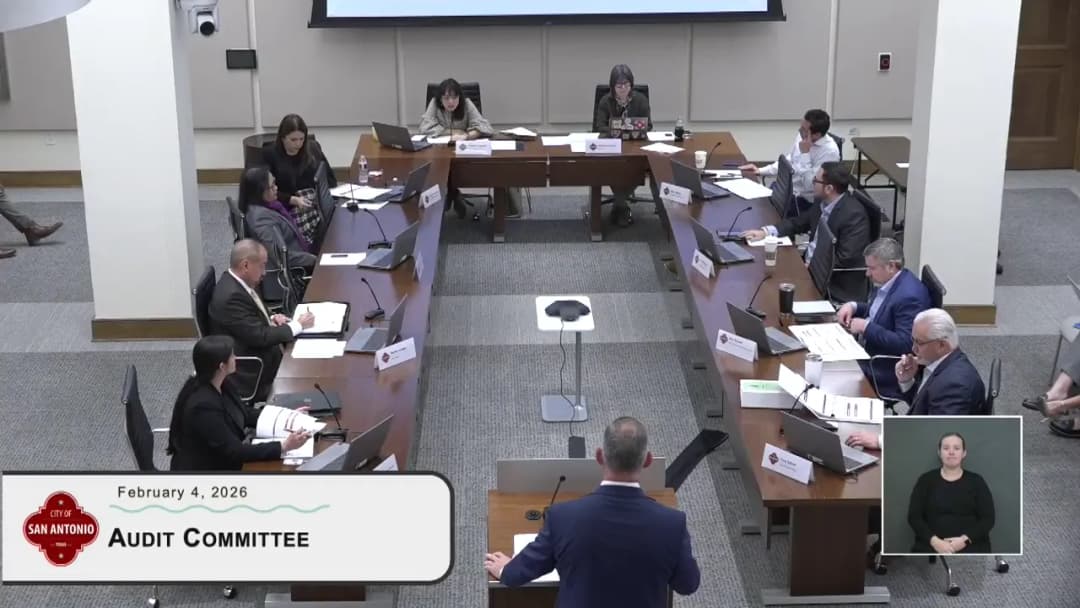
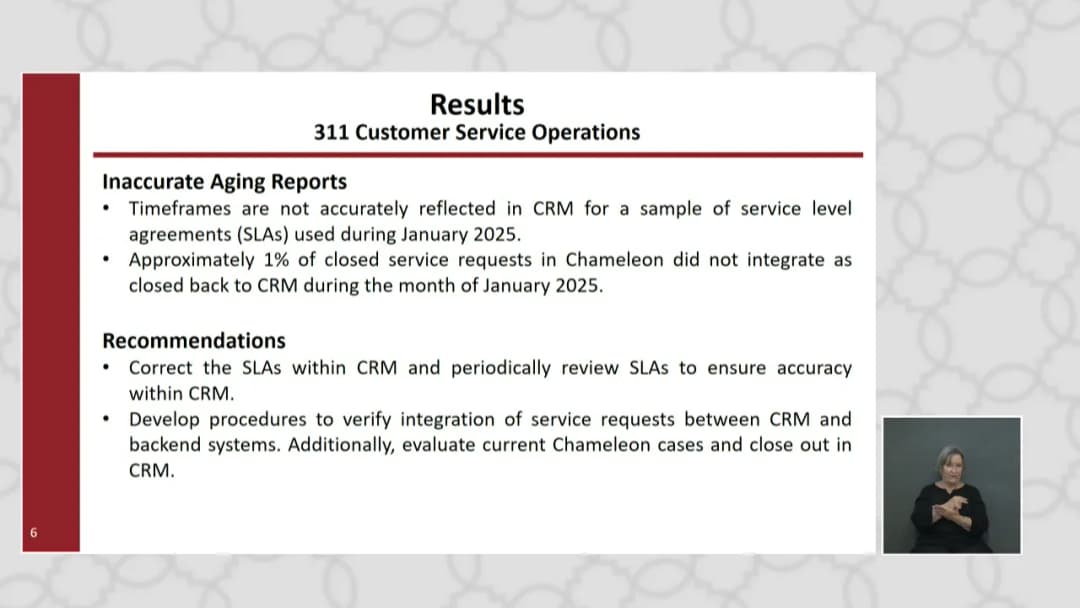
The Audit Committee of the San Antonio City Council met on February 4, 2026, at 10:00 AM. Chair Villagrán presided with a quorum present. The meeting covered the approval of minutes, a public comment letter, a consent calendar, four presolicitation reports, one post-solicitation award recommendation, and an audit report on 311 customer service operations. The meeting adjourned at 11:37 AM. Consent Calendar - Approval of Minutes: The minutes from the previous meeting were approved by voice vote without corrections. - Public Comment Letter: A letter from Ray Cárdenas was received and noted for the record; the author was not present. - Consent Agenda: The consent agenda item (a final internal report) was approved by voice vote unanimously. Discussion Items: Presolicitation Reports - Item 3 – Event Licenses for Convention Facilities (Sports Facilities Dept.): Presolicitation for event licenses at the Convention Center, Rivi González, and Alamo Dome. Estimated total $9.5 million over three years, with two one-year renewal options. Annual value $1.9 million. Funded by hotel/motel tax. Chair Villagrán asked that questions about IBW union labor and Ready to Work participation be included in the solicitation. Councilmember White requested data on the percentage of local vs. out‑of‑town contractors. Staff will provide that information at the post-solicitation stage. - Item 4 – Legislative Consulting Services (Government Affairs Dept.): Presolicitation for up to five firms to represent San Antonio in Austin. Total $1.6 million over two years with two one-year renewal options; each firm capped at $400,000/year. Councilmember White expressed concern about using taxpayer funds to lobby against legislation such as the business personal property tax exemption, which he supported. He asked for clearer communication on the city’s policy positions before contracting lobbyists. Director Sally Bazurto and Jeff O'Celly explained the process for developing the legislative agenda and noted that a transparency portal will provide past lobbying records. Chair Villagrán stressed the need for a strategic approach given upcoming changes in the Texas Senate. Councilmember Mesa González asked about the firms' specializations and evaluation criteria. - Item 5 – Toxicology Lab Services (Police Dept.): Presolicitation for a single‐vendor contract to provide blood testing for DWI and related cases. Estimated $5.6 million over three years with two one-year renewal options. The current contract expires September 30, 2026. Councilmember White asked why a single vendor was chosen; staff explained the District Attorney's preference for consistency in expert testimony. Councilmember Pacheco asked about the origin (domestic vs. foreign) of testing supplies; staff will follow up with UT Health regarding potential tariff impacts. - Item 6 – Design Services for Culebra Road (Capital Delivery Dept.): Presolicitation for design services for the Culebra Road corridor from Loop 410 to General McMullen, covering five miles in Districts 5, 6, and 7. Estimated $9 million for design, funded by the 2022 GO bond and a federal grant. Construction is expected to cost over $100 million. Councilmember White asked about on‑time delivery history. Councilmember Mesa González requested coordination with utility companies to avoid delays; staff confirmed a memorandum of understanding with utility partners. Key Outcomes: Post-Solicitation Award and Audit Acceptance - Item 7 – Design and Environmental Services for Rittiman Road Grade Separation (Capital Delivery Dept.): Post-solicitation report recommending award to Vendor B for $6,300,299.39. The project will separate the railroad crossing on Rittiman Road in District 2, funded by $4 million in federal grants. Ten proposals were received; three were shortlisted and interviewed. The committee unanimously voted to forward the recommendation to the City Council. - Item 8 – Audit Report AU 25-001: 311 Customer Service Operations: Audit Manager Abigail Esteves presented findings. Overall, 311 call center controls were effective, but several issues were identified: - Inconsistent training for call representatives. - Inaccurate CRM reporting metrics; for example, in January 2025, a percentage of service requests were not fully integrated from the CRM to subsystems like Chameleon. - Delays in reclassifying incorrectly routed service requests. - Inappropriate system access: four former employees (retired or transferred) still had access to Calabrio and CRM. - Recommendation to improve training, data accuracy, integration procedures, and access controls. 311 Director Paula Stocken acknowledged the findings and outlined corrective actions. Councilmembers White and Mesa González highlighted resident frustration when cases are closed without resolution. Chair Villagrán suggested focusing on the two departments with the most complaints (Animal Care Services and Code Compliance) and requested a follow‑up report. The committee voted unanimously to accept the audit.

PROCUREMENT AND CONTRACTING 33% · AUDIT 19% · LEGISLATIVE ADVOCACY 17% · TRANSPORTATION INFRASTRUCTURE 7%
476
FEB 4, 2026 · SAN ANTONIO, TEXAS · CITY COUNCIL
San Antonio City Council Meeting on SAS Water and Wastewater Rate Proposals – February 4, 2026

On Wednesday, February 4, 2026, the San Antonio City Council held a B-session meeting to discuss the San Antonio Water System (SAS) rate proposals, capital improvement plan, and financial outlook. The meeting included presentations from SAS leadership, extensive council member questioning, and public comment. No formal votes were taken; the session was intended to gather feedback before a final rate decision. Public Comments & Testimony - Seven individuals were scheduled for public comment, but their remarks were not included in the transcript. The council acknowledged the importance of community input. Discussion Items - Rate Increase Necessity: SAS CFO Doug Evanson presented a historical overview, noting that rates have not been increased since 2020. A cost-of-service study by Raftelis (referred to as "Corolla") recommended a 30% increase in water rates and a 35%+ increase in wastewater rates over five years to maintain financial health and bond ratings. The study was based on SAS's projected revenue requirements, including capital needs. - Capital Improvement Plan (CIP): Andrea Beiner (or Donna) presented a $3.2 billion five-year CIP, focusing on replacing aging water mains (8,000 miles of pipe, with 1,700 miles over 50 years old) and wastewater collection pipes (6,000 miles, 19% over 50 years). Key projects included treatment plant upgrades (Leon Creek, Steven M. Cloud), compliance with SB3 generator mandates ($340 million), and water loss reduction goals (targeting a 50% reduction in water loss over 10 years). - Water Loss and Infrastructure: Council members, especially Councilmember Gavito, expressed frustration over visible water leaks and slow repairs. In 2024, there were 2,500 main breaks, with 1,749 occurring on the worst 10% of pipes. SAS responded that average repair time has improved from 14 days to 2 days, but council members demanded more proactive maintenance and clearer accountability. - Rate Structure and Equity: Councilmembers Spears, Viagrán, and others questioned the fairness of the current rate structure, particularly the Uplift program for low-income customers. They noted that 45% of residential bills are for usage under 4,000 gallons, but some Uplift customers use over 10,000 gallons. There was strong support for increasing rates for high-volume users (e.g., 18,000+ gallons) and ensuring commercial and industrial users pay their fair share. Councilmember Viagrán specifically called for higher rates on residential customers using more than 10,000 gallons. - Affordability and Vulnerable Populations: Councilmembers emphasized the need to protect low-income residents from rate shocks. They requested more detailed examples of how different customer types would be affected, and asked for better integration of conservation programs with rate structures. - Comparison with Other Utilities: The presentation showed that since 2020, combined water/wastewater rates in Austin increased 26%, Dallas 14%, Fort Worth 3.4%, and Houston 71%. San Antonio's rates have remained flat, but the study argued that significant increases are now needed to catch up. - Contractual Services and Employee Costs: Doug Evanson noted that salaries and benefits account for less than 40% of operating costs, with contractual services making up over 52%. Employee salaries have grown 12.3% over three years, and insurance costs rose 6.1%. Some council members requested more transparency on executive compensation. - Data Centers and Future Demand: Councilmembers asked about the impact of data centers on water demand. SAS indicated that most new large users are expected to use recycled water, but the current system lacks excess capacity to sell water, unlike CPS Energy's model. Key Outcomes - No formal votes were taken. The council directed SAS staff to provide additional information, including: - A detailed breakdown of the 30% rate increase by customer class and examples of typical bills. - A list of the top 25 commercial water users and their consumption. - Data on the number of customers using conservation programs and the impact of smart meters on leak detection. - A clearer separation of "needs" vs. "wants" in the capital plan, particularly regarding proactive vs. reactive maintenance. - Information on how future rate increases will be phased and what the long-term plan is for infrastructure beyond 2030. - The council expressed strong interest in revising the rate structure to incentivize conservation and ensure that high-volume users pay more, while protecting low-income households. - The next steps include a public hearing and final council consideration of the rate proposal, with a target date for implementation in 2026.

WATER AND WASTEWATER MANAGEMENT 64% · BUDGET 15% · INFRASTRUCTURE 12% · PUBLIC ENGAGEMENT 6%
477
FEB 4, 2026 · SAN ANTONIO, TEXAS · CITY COUNCIL
San Antonio City Council B Session with SAWS on 2026 Budget and Rate Increases - February 4, 2026

On Wednesday, February 4, 2026, from 2:05 PM to 5:07 PM, the San Antonio City Council held a B session to discuss the San Antonio Water System (SAWS) 2026 budget amendment and potential rate increases. SAWS leadership presented historical rate context, operational challenges, a five-year $3.2 billion capital improvement plan, and the findings of a cost-of-service study recommending cumulative rate increases of approximately 30% for water and 35% for wastewater over five years. Council members expressed cautious support for necessary infrastructure investments while raising concerns about affordability, water loss, aging infrastructure, equity among customer classes, and the need for transparent project prioritization. No formal vote was taken; the council requested additional details before SAWS returns with a final recommendation. Public Comments & Testimony - No public comments were transcribed in the meeting record. The meeting adjourned with a note that 47 individuals had signed up for public comment, but no such comments were presented in the transcript. Discussion Items - SAWS Presentation: Chair Jolene Jameson opened with an overview of board accountability, benchmarking, and the CEO scorecard. CFO Doug Evanson detailed rate history, the impact of inflation (CPI up 25% since 2020, construction costs up 43%), Winter Storm Uri ($340 million), federal mandates (lead and copper rules), and a $200 million water loss reduction initiative. The cost-of-service study by Corollo Engineers recommended increasing potable water rate revenue by 30% and wastewater by 35% cumulatively from 2026-2030, with a 7.9% residential increase in 2026. COO Andrea Beamer presented the capital program, emphasizing replacement of aging water and sewer mains (56 miles of water mains over 4 years), wastewater treatment plant upgrades (many original plants from 1987 or earlier), compliance with SB3 generator mandates, and other major projects. - Council Concerns and Questions: - Mayor Jones and multiple council members stressed the need to minimize rate impacts on vulnerable residents given economic pressures from proposed federal cuts (One Big Beautiful Bill, Medicare, Medicaid, SNAP). - Councilwoman Alderete Gavito highlighted water loss as a major issue, noting that in 2024 SAWS lost nearly 20 billion gallons of water, contributing to street damage and resident frustration. She asked for quantification of the cost of water loss to the system. SAWS responded that water loss has decreased 10% from 2023 levels and that the goal is to cut losses in half within 10 years. - Councilman White questioned the Corollo study, arguing it validates SAWS’s self-reported needs rather than independently evaluating the necessity of projects. He requested a clear breakdown of “must-do” vs. “nice-to-do” projects. He also noted that Vista Ridge water costs $100 million annually but all water is used, and asked about potential revenue from selling water. SAWS responded that during drought there is no excess water. - Councilman McKee Rodriguez cited recent conflicts with SAWS leadership, including water shutoffs at apartment complexes and coordination issues on bond projects, and stated that support for a rate increase would require a change in leadership philosophy. - Councilman Via Gran asked about connecting customers still on septic tanks, and recommended a rate restructuring that incentivizes conservation, especially for high-use residential and commercial customers. - Councilman Spears requested specific project maps, timelines, and contractor information. She also noted constituent complaints about smart meters causing higher bills; SAWS explained that new meters detect usage more accurately and can alert customers to leaks. - Councilman Galvan questioned the general class rate structure, arguing that large commercial users should pay higher rates, not lower, given their high water use. SAWS clarified that the base-excess rate structure charges peak users more, and that general class customers are charged a cost-of-service rate that covers their system burden. - Councilman Castillo emphasized the importance of the Plumbers to People pilot program (approved by SAWS board the previous day) and asked about the impact of not approving a rate increase on planned water management improvements. SAWS noted that without rate increases, key initiatives like additional leak response crews and water main replacement could be jeopardized. - Councilman Mungia asked about the cumulative impact of past rate increases (approximately 30% from 2016-2020) and the current need for additional increases. He requested a list of the top 25 commercial water users and expressed concern about the cost of connecting new homes to water lines. - Councilwoman Koor asked for example bills for different customer types to contextualize the impact, and questioned why water system O&M costs are higher than wastewater. SAWS explained that water systems require many pump stations and are energy-intensive, while wastewater uses gravity flow. Key Outcomes - No formal vote was taken. The meeting was a discussion session for council input. - SAWS will provide additional information requested by council, including: - A prioritized list of projects with maps, timelines, and cost estimates, differentiating between mandatory and deferred maintenance. - A breakdown of rate impacts by customer class, including example bills. - Data on the top 25 commercial water users. - Analysis of the water loss reduction program’s cost per mile and expected savings. - Information on state and federal mandates (e.g., lead and copper rule, SB3) and their impact on capital needs. - Planning assumptions for the Uplift assistance program given potential federal changes. - SAWS will incorporate council feedback into a revised rate proposal and return to the council for further consideration. The SAWS board is expected to make a final recommendation in the coming months.

WATER AND WASTEWATER MANAGEMENT 67% · INFRASTRUCTURE 13% · BUDGET 10% · PUBLIC ENGAGEMENT 6%
478
FEB 4, 2026 · SAN ANTONIO, TEXAS · COUNCIL COMMITTEES
San Antonio Audit Committee Meeting - February 4, 2026

The Audit Committee of the San Antonio City Council met on February 4, 2026, at 10 a.m. The meeting included approval of minutes, routine consent, several pre-solicitation briefings for upcoming contracts, a post-solicitation briefing for a design contract, and acceptance of an audit report on 311 customer service operations. A written public comment from Mr. Ray Cardinus regarding 311 was entered into the record. Key discussions included workforce development, local preference, performance metrics, and customer satisfaction. Consent Calendar - Approved minutes from previous meeting (motion carried unanimously). - Accepted one final internal audit report on the consent agenda (motion carried unanimously). Public Comments & Testimony - Written comment from Mr. Ray Cardinus concerning 311 customer service operations was distributed to the committee and entered into the record. No members of the public spoke in person. Briefing Items (Pre-Solicitation) - Item 3: Temporary Electrical and Plumbing Services for Events Patricia Musquis Gantor, Director of Convention and Sports Facilities, presented a pre-solicitation briefing for an RFQ for multiple contractors to provide temporary electrical and plumbing services at the Henry B. Gonzalez Convention Center and the Alamo Dome. Estimated total value: $9.5 million over three years with two one-year renewal options. The evaluation committee includes multiple city officials and an Encore representative. Councilmember Via Gran asked about including questions on apprenticeships and journeymen to support workforce development. Councilmember White inquired about documenting percentages of local versus out-of-town businesses. Councilmember Mesa Gonzalez confirmed it is an on-call, multi-contractor model. The item was for briefing only. - Item 4: State Legislative Consultant Services Sally Basurto, Director for Government Affairs, presented a pre-solicitation briefing for an RFQ to contract up to five firms for state legislative consulting services, with a maximum value of $400,000 per year (total $1.6 million over two years with one two-year renewal option). Evaluation criteria include 75 points for experience, qualifications, and background. Councilmember Via Gran emphasized the need for strategic outreach to smaller jurisdictions and understanding the changing political landscape post-November elections. Councilmember White expressed concerns about taxpayer-funded lobbying, citing a past example of opposing a business personal property tax exemption. He requested better communication and a B-session with the full council to discuss legislative policy. Other members asked about return on investment, methodology for forecasting, and experience of evaluators. Director Basurto noted that the city does not register as a lobbyist but has transparent processes including a bills tracker dashboard. The item was for briefing only. - Item 5: Toxicology Laboratory Services for SAPD Rick Riley, Assistant Director of SAPD, presented a pre-solicitation briefing for a single-contractor RFP for toxicology lab services (DWI, DUI cases) to replace a DPS contract. Estimated value: $1.1 million annually, $5.6 million over five years. A single vendor is required for chain of custody. Councilmember Mesa Gonzalez asked about separating this from employee drug testing (it is separate due to court testimony requirements). Councilmember White asked why single vendor (DA preference for chain of custody). Councilmember Pacheco asked about evaluating the proposed plan and about vetting for chain of custody. There was also a question about medical device sourcing (made in US). The item was for briefing only. - Item 6: Planning and Schematic Design Services for Culebra Road Mike Shannon, Director of Capital Delivery, presented an RFQ for design services for Culebra Road from Loop 410 to General McMullen (districts 5,6,7). Estimated value: $9 million, funded by 2022 bond and a federal RAISE grant. Evaluation criteria include 45 points for experience, 35 points for management plan, and 20 points for past performance. Councilmember Mesa Gonzalez emphasized utility coordination and accountability for on-time performance. Shannon noted milestones and incentive/penalty clauses. Councilmember Via Gran supported using contractors with on-time history. The item was for briefing only. Post-Solicitation Briefing - Item 7: Rittiman Road Grade Separation Project Post-solicitation briefing for design and environmental services. 10 vendors responded; 3 shortlisted; after interviews, Vendor B was selected. Estimated value: $6,300,299.39. Councilmember approved proceeding to city council consideration (motion carried unanimously). Councilmember Via Gran praised the in-person interview process. Discussion Item: Audit of 311 Customer Service Operations - Item 8: Audit Report AU 25-001 Abigail Esteves, Audit Manager, presented results of an audit of 311 customer service operations. The audit found effective controls for call handling, training, knowledge base updates, and backup. However, recommendations were made in four areas: CSR coaching (inconsistent for those with unmet metrics), aging reports (SLAs in CRM not accurate), reclassified service requests (not addressed in a timely manner), and system access (inappropriate access for former employees). Paula Stalk, Director of 311, accepted the findings and noted ongoing improvements. Councilmember Pacheco raised concerns about the lack of customer satisfaction (CSAT) scores and issue resolution metrics, noting that tickets are often closed without resolution. Councilmember White echoed residents' frustrations about closed cases without satisfactory resolution. Discussion included communication gaps between departments and residents, particularly with Animal Care Services and Code Compliance. Jeff Coyle (City Manager's Office) noted the 311 survey shows 91% satisfaction, but acknowledged room for improvement in communicating closure reasons. Councilmember Via Gran suggested piloting CSAT scores with ACS and Code Compliance, and forming a subcommittee to address the issue. The audit was accepted (motion carried unanimously). The meeting adjourned at 11:37 a.m. Key Outcomes - Consent Calendar: Approved unanimously. - Pre-solicitation briefings (Items 3-6): Noted as briefings; no votes. Staff will incorporate committee feedback. - Post-solicitation (Item 7): Approved to proceed to City Council for contract award (motion carried unanimously). - Audit (Item 8): Accepted unanimously. Chair Via Gran will send a memo to follow up on CSAT scores and consider a subcommittee for 311/ACS/Code issues. - Next steps: Post-solicitation briefings for pre-solicitation items scheduled for August 5, 2026. State legislative consultant contracts will be negotiated June-July, with a post-solicitation briefing in August. (Note: The meeting date is February 4, 2026, as instructed.)

PROCUREMENT AND CONTRACTING 28% · AUDIT 22% · LEGISLATIVE ADVOCACY 20% · PUBLIC ENGAGEMENT 7%
479
FEB 4, 2026 · SAN ANTONIO, TEXAS · BOARDS & COMMISSIONS
San Antonio Historic and Design Committee Meeting – February 4, 2026

The Historic and Design Committee of San Antonio met on February 4, 2026, to review several development proposals and certificate of appropriateness applications. Commissioners present: Velázquez, Galloway, Bazuca, Guevara, Cervantes, Holland, Fetzer, and Gibbs (with some joining virtually). The committee addressed consent calendar items, public comments, and nine agenda items, including bus shelter designs, commercial construction, signage, and alterations in historic districts. Consent Calendar - Approved minutes from the January 21 board meeting (unanimous vote). - Approved a block of consent agenda items for addresses including 319 Houston, Wisach, and others, with no discussion or objections. All consent items passed unanimously. Public Comments & Testimony - Item 7 (148 Florida St.): Chris Colby, a direct neighbor, expressed full support for the proposed commercial development, praising its design and tree preservation. Emily Gaukey, another neighbor, voiced excitement and requested taller plants along the west side as a buffer. Melissa Pendle, representing La Vaca Neighborhood Association, supported the project and staff recommendations, asking for careful signage placement and improved screening for dumpsters. - Item 8 (14?? Usaya Venía): Ms. Foster spoke on behalf of the Montichal Neighborhood Association, supporting staff’s recommendation to deny the proposed aluminum porte-cochère, citing inconsistency with traditional neighborhood materials. Discussion Items - Item 1 – Bus Shelters (Villa Area): Art Herrera, VIA project director, presented four design revisions based prior committee and neighborhood feedback: darker green color, neighborhood logos, artist acknowledgment plaques, reuse of salvaged stone on a wall, and potential digital messaging with QR codes. Commissioner Galloway and Gibbs voted against, citing insufficient design changes; motion passed. - Item 3 (175 E. Francisco?): Commissioner Petser raised concerns about the roof mechanical equipment visibility and the need to adjust the St. Mary’s panel articulation. Staff recommended no action on part of the item (passenger drop-off location still under evaluation). Motion to approve with conditions passed unanimously. - Item 7 – Commercial Structure at 148 Florida St. (La Vaca Historic District): Applicant PJ Architects and Engineers accepted staff stipulations including future elevation drawings, window treatments, landscaping, and fence preservation. The committee granted conceptual approval, encouraging further detailing on the east and west facades. Motion passed. - Item 8 – Aluminum Porte-Cochère: Applicant not present. Staff recommended denial due to material incompatibility with historic district guidelines. The committee voted to deny, with Commissioners Velázquez and Cervantes dissenting. Motion passed. - Item 9 – Insomnia Cookies Signage (Case 2025-351): Greg Packer (Apex Sign Group) requested an illuminated sign, three LED neon signs at entrance, and window graphics. Staff recommended approval for the illuminated sign and window graphics, but found neon inappropriate for the historic context. Committee debated scale and neon impact; motion passed to approve items 1 and 3, and deny item 2 (neon). Commissioners Velázquez and others suggested further corporate dialogue to refine design. Key Outcomes - Consent calendar and Item 3 approved unanimously. - Item 1 approved (4 in favor, 2 opposed: Galloway and Gibbs). - Item 7 approved conceptually (unanimous on voice vote, though some abstentions noted? Final roll call: all yes). - Item 8 denied (vote: Sabino yes, Velázquez no, Galloway yes, Mazuca yes, Guevara yes, Gru yes, Cervantes no, Holland yes, Fetzer yes, Gibbs yes). - Item 9 approved in part: Item 1 (illuminated sign) and Item 3 (window graphics) approved; Item 2 (neon) denied; motion passed (roll call: all yes except no explicit dissents recorded in transcript, but discussion indicated some disagreement). - Meeting adjourned after Item 9; Item 10 was listed but not discussed.

HISTORIC PRESERVATION 32% · COMMUNITY ENGAGEMENT 17% · ZONING AND LAND USE 17% · SIGNAGE REGULATIONS 17%
480
FEB 4, 2026 · SAN ANTONIO, TEXAS · BOARDS & COMMISSIONS
San Antonio Historic and Design Review Commission Meeting - February 4, 2026

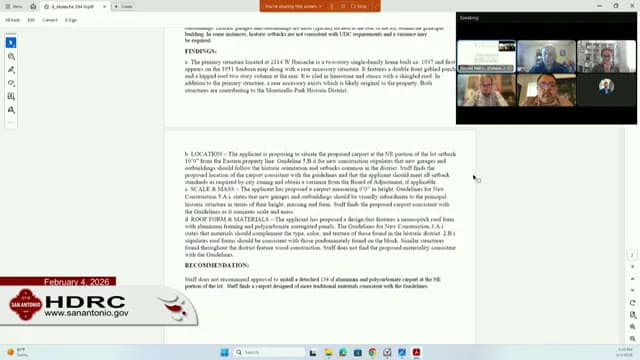
The Historic and Design Review Commission (HDRC) met on Wednesday, February 4, 2026, at 3 p.m. to consider several agenda items, including bus shelter designs, commercial developments, signage, and a carport. Chair J. Maurice Gibbs presided, with Vice Chair Jeffrey Fetzer. The meeting included a consent agenda, public voicemail comments, and votes on each item. Consent Calendar - Items 2, 4, 5, and 6 (addresses: 219 East Houston, 340 East Wee Setch, 110 Lexington, and 710 North Doll) were approved unanimously with staff stipulations after items 1 and 3 were pulled for discussion. Public Comments & Testimony - Item 7 – 418 Florida/319 East Carolina (Lavaca Historic District): Three voicemails were received. Chris Golke, Emily Golke (both neighbors at 410 Florida Street), and Melissa Stendhal (representing the Lavaca Neighborhood Association) expressed support for the proposed commercial development, provided the applicant incorporates all staff recommendations and addresses concerns about buffering, fencing, and landscaping. The neighborhood association requested enhanced dumpster screening and architectural detailing on the west and south elevations. - Item 8 – 214 West We Satch (Monticello Park Historic District): A voicemail from Robin Foster on behalf of the Monticello Park Neighborhood Association supported staff's recommendation for denial, citing the carport's industrial polycarbonate materials as incongruent with the historic district. Discussion Items - Item 1 – VIA Bus Shelters: Art Herrera, director of special projects at VIA, presented design changes based on prior feedback: a darker green color for shelters in King William and Monte Vista neighborhoods, inclusion of neighborhood logos on signage panels, an artist recognition plaque on windscreens, and a salvaged rock veneer on a concrete wall at Roosevelt. VIA is also exploring digital messaging for neighborhood events and QR codes. Commissioner Cervantes pulled the item to discuss the changes. Some commissioners expressed concerns about the bulky, square design. The motion to approve as presented with staff stipulations passed 8-1 (Commissioner Cervantes voted no). - Item 3 – 175 East Houston Street: Vice Chair Fetzer pulled the item to reiterate staff concerns about screening rooftop mechanical equipment and the need for articulation on a dark recessed panel on St. Mary's. The applicant agreed to study both issues. A motion for conceptual approval of items 1 and 2 (with no action on item 3) was amended to remove a specific five-foot parapet height, requiring screening adequate to fully conceal equipment. The motion passed 10-0. - Item 7 – 418 Florida/319 East Carolina (Lavaca Historic District): Applicants Lorena and Miles from Villa Park/KPNJ presented a proposed commercial building on a vacant lot. They agreed to all staff stipulations, including a setback greater than adjacent structures, transom windows, landscaping, and enhanced fencing. They also met with the Lavaca Neighborhood Association, agreed to rename the project “Shops at Lavaca,” and added a mural on the I-37 elevation. Commissioner Velasquez raised concerns about the stark east facade and encouraged stronger design articulation. The commission voted 10-0 for conceptual approval with staff stipulations. - Item 8 – 214 West We Satch (Monticello Park Historic District): The applicant did not appear. Staff recommended denial for a 154-square-foot aluminum and polycarbonate carport, finding it incongruent with the historic district. Commissioners debated whether a temporary, breakaway structure could be allowed; staff clarified that even breakaway footings constitute permanent construction. A motion to deny per staff recommendation passed 7-2 (Commissioners Velasquez and Cervantes voted no). - Item 9 – 122 East Houston (Insomnia Cookies Signage): Greg Burkett of Apex Signs requested approval of a 136-square-foot face-lit channel letter sign, three LED faux neon window signs, and vinyl graphics. Staff recommended approval contingent on reverse-lit channel letters, denial of the neon signs, and approval of vinyl graphics not exceeding 30% window coverage. The applicant argued that face-lit letters and faux neon are critical to the brand. Commissioner Savino moved to approve item 1 (reverse-lit), deny item 2, and approve item 3 per staff stipulations. The motion passed 10-0. - Item 10 – Postponed: The final item was postponed and not discussed. Key Outcomes - Item 1 (VIA Bus Shelters): Approved 8-1 with staff stipulations and applicant’s design changes. - Item 3 (175 East Houston): Conceptual approval of building elements 1 and 2 with amended mechanical screening requirement; no action on item 3. Passed 10-0. - Item 7 (418 Florida/319 East Carolina): Conceptual approval with staff stipulations. Passed 10-0. - Item 8 (Carport at 214 West We Satch): Denied per staff recommendation. Passed 7-2. - Item 9 (Insomnia Cookies Signage): Approved with stipulations: reverse-lit channel letters, no LED neon, window vinyl ≤30%. Passed 10-0. - The meeting adjourned after Item 9. Certificates of appropriateness will be emailed within 10 days for approved items.

HISTORIC PRESERVATION 39% · ZONING AND LAND USE 23% · PROCEDURAL 14% · MUNICIPAL REGULATIONS 12%
OPENPUBLICA · PUBLIC MEETING INDEXUPDATED DAILY · openpublica.com