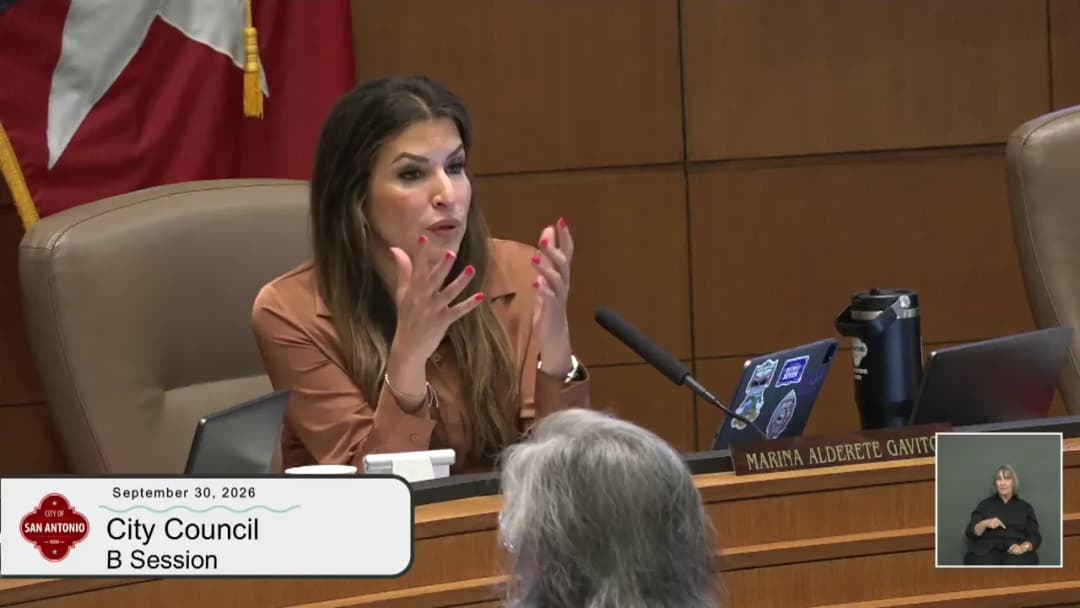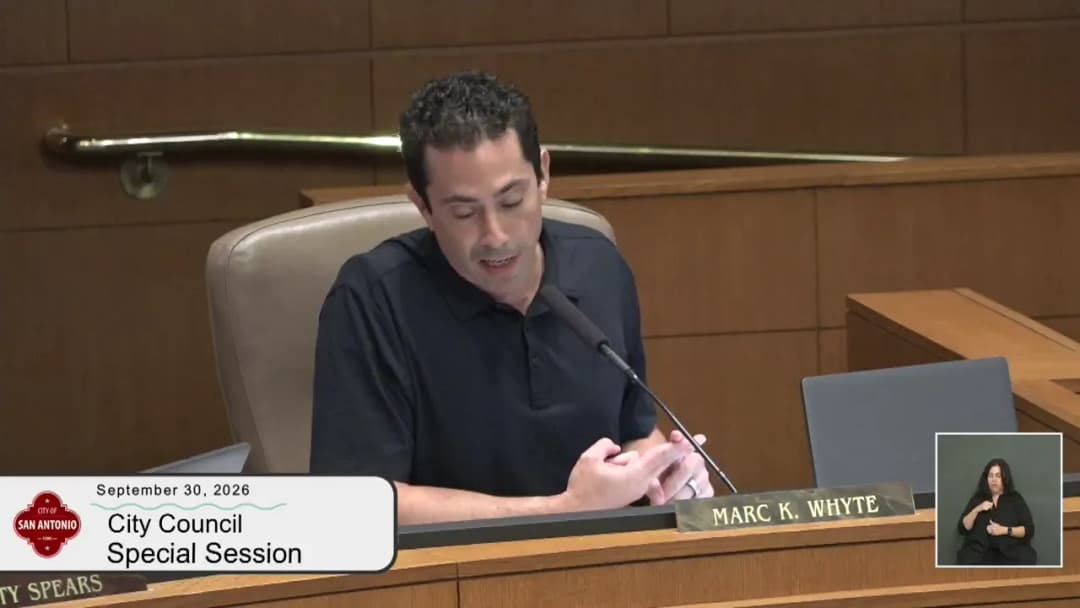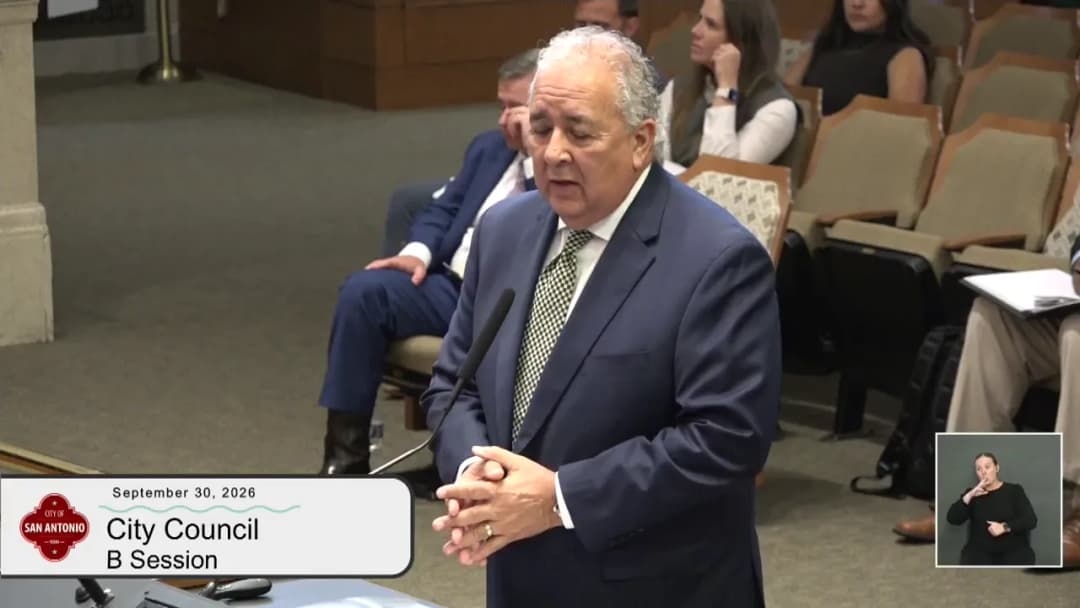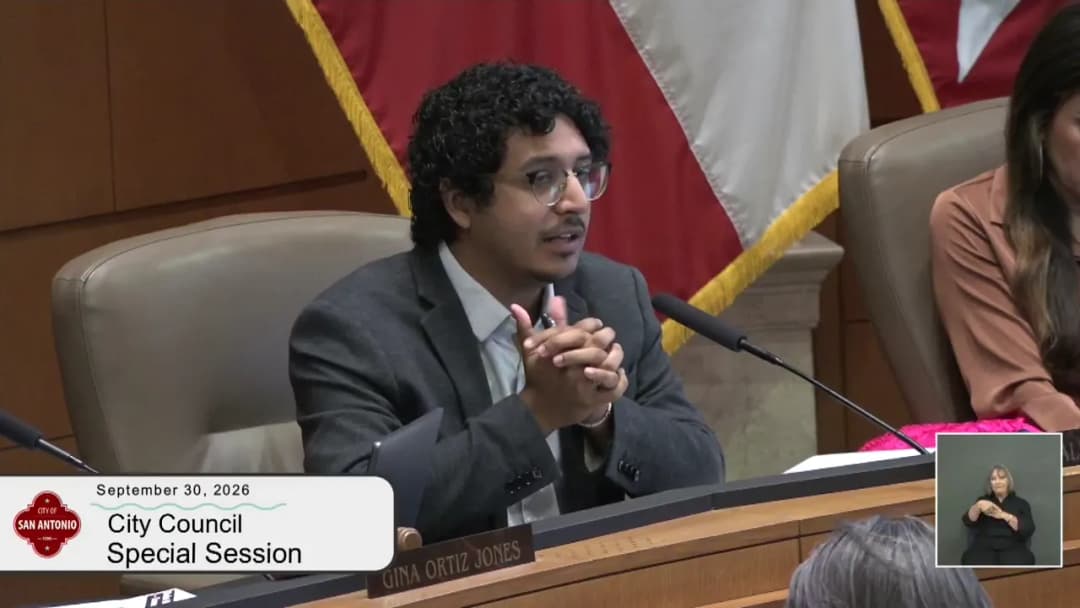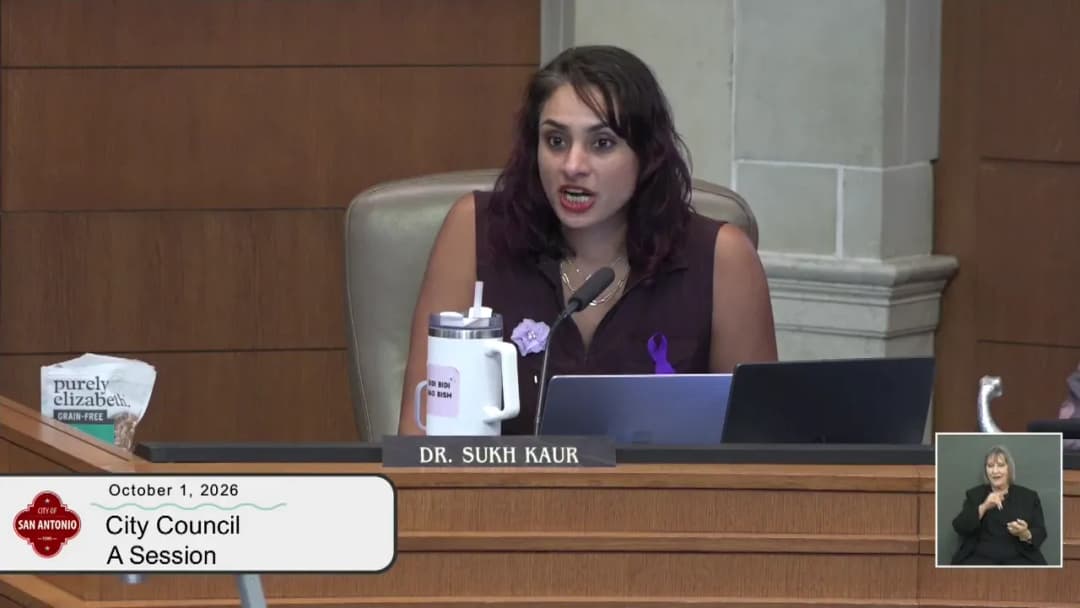
The San Antonio City Council met on October 1, 2026, at 9:10 AM, with Mayor Gina Ortiz Jones presiding and all council members present. The meeting included three proclamations (San Antonio Neighbors Together Night, Domestic Violence Awareness and Prevention Month, and Manufacturing Month), points of privilege recognizing community organizations and achievements, approval of the consent agenda (with item 8 pulled for individual consideration), public testimony, and a unanimous vote to authorize eminent domain for a SAWS sewer project. The council recessed into executive session at 10:40 AM and reconvened at 12:57 PM, taking no further action before adjourning. Proclamations - San Antonio Neighbors Together (SANT) Night – October 6, 2026: Proclaimed by the mayor. Chief Salome reported 349 neighborhoods signed up and recognized community engagement supervisor Yolanda Ambrose. Multiple councilmembers praised the initiative for fostering police-community trust. - Domestic Violence Awareness and Prevention Month – October: Proclaimed by the mayor. Maria (Metro Health) and Judge Monique Diaz (CCDV co-chair) spoke, noting that last year the community saw nearly seven family violence-related 911 calls every hour and 28 deaths (including five children). Councilmembers emphasized the importance of collaboration, prevention, and continued funding for Metro Health and delegate agencies. - Manufacturing Month – October: Proclaimed by the mayor. Francisco Garcia (new VP of Manufacturing, Toyota Texas) announced Toyota’s $3.6 billion investment, doubling the plant size and adding 2,000 jobs by 2030. Councilmembers highlighted the regional economic impact and partnerships with local school districts and workforce programs. Points of Privilege - Mariachi Connection 30th Anniversary: Josie Benavidez was recognized for growing a business from selling strings out of her car into the nation’s largest supplier of mariachi and ballet folclórico equipment, now funding scholarships through SAISD Foundation. - South San ISD Recognition: Superintendent Dr. Saul Inoja and Deputy Superintendent Dr. Jennifer Gutierrez were recognized for a 10-point increase in TEA accountability rating, the largest in Bexar County, moving the district up a full letter grade. - SA Digital Connects Closing: Councilmember Aldrete Gavito and Executive Director Rhea Pape recognized the organization’s work connecting over 25,000 homes to the internet and announced a legacy fund to continue digital opportunity efforts. Consent Calendar Items 5–17 were on the consent agenda. Item 13 was withdrawn by the applicant. Item 8 was pulled by Councilmember Viagran for individual consideration. The remaining items were approved by unanimous vote. Notable consent items included: - Item 15: Ordinance designating a portion of North Main Avenue as Erica Andrews Memorial Way (funded by District 1 funds, $5,000). - Item 16: Ordinance renaming Splash Town Drive to Willie Mitchell Place. Public Comments & Testimony - Luis Vasquez (Executive Director, San Antonio LGBTQ Chamber of Commerce) expressed support for Item 15, stating that Erica Andrews was a trailblazing trans performer and that the designation honors LGBT history and supports economic revitalization of the North Main corridor. - Jack Finger opposed Item 15, arguing that Erica Andrews (born Eddie Salazar) was a drag queen performer, not a public leader or figure as required by city code, and that no documented civic leadership or community benefit had been presented. He urged the council not to approve the designation. - Jacqueline Ali (United Homeowners Improvement Association) supported Item 16, honoring Willie Mitchell—a San Antonio native, NFL Super Bowl champion, and founder of San Antonio Fighting Back—stating that elders should be honored while alive. Discussion Items - Item 8 – SAWS Salado Creek Sewer Main Replacement Project: Councilmember Viagran moved to authorize the use of eminent domain to acquire four temporary construction easements on private property in Council District 3 for a public sewer project. The motion was seconded and approved without further discussion. - Item 15 Highlight: Councilmember Corps recognized Erica Andrews’ family and supporters, noting that the Office of Historic Preservation identified Andrews as a leader in the Pride Cultural Heritage District. Family members and community advocates spoke about Andrews’ impact as a performer, mentor, and advocate for the LGBTQ+ community. - Item 16 Highlight: Councilmember Micky Rodriguez noted that Splash Town closed in 2021, and after community input, the street is being renamed to honor Willie Mitchell, who played in Super Bowl I, won Super Bowl IV, and returned to San Antonio to lead community organizations. Attendees gave Mr. Mitchell a standing ovation. Key Outcomes - The consent agenda (minus item 8) was approved by unanimous vote, including the street designations for Erica Andrews Memorial Way and Willie Mitchell Place. - Item 8 was approved, authorizing SAWS to acquire temporary construction easements through negotiation or condemnation for the Salado Creek Sewer Main Replacement Project. - All three proclamations were adopted. - No official action was taken during executive session. - The meeting adjourned at 12:57 PM.
Public Meetings - San Antonio, Texas
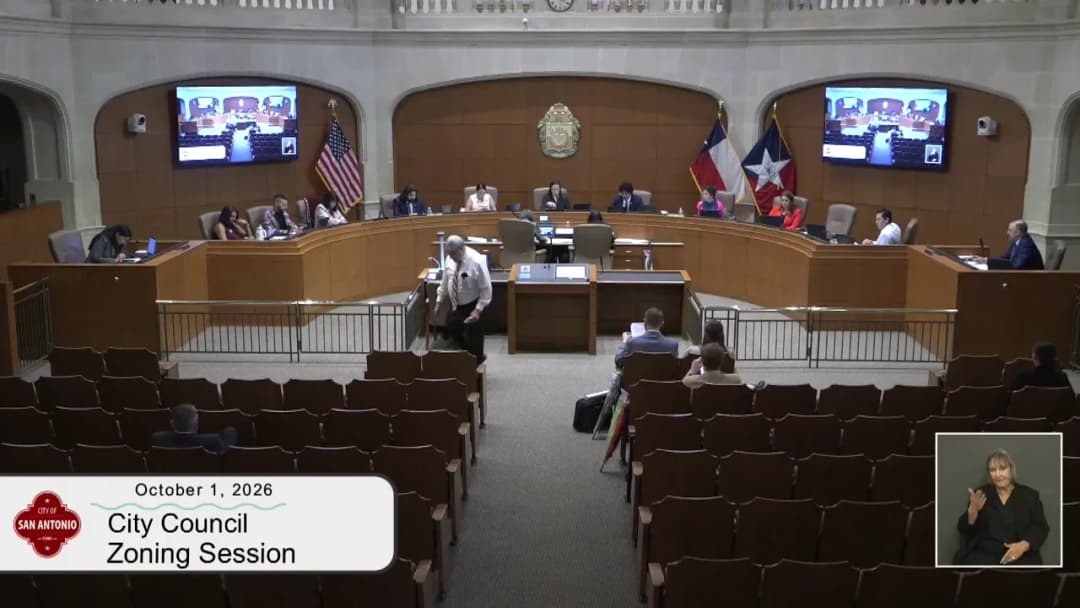
Public Meetings - San Antonio, TexasThe City of San Antonio Zoning and Land Use Session convened at 2:03 p.m. on Thursday, October 1, 2026, with Mayor Jones presiding and a quorum present. The meeting adjourned at 2:25 p.m. No agenda or minutes were available; this summary relies on the raw transcript. Item one was postponed, several cases were continued, and the council took final action on items 9 and 12. Procedural Actions - Item one was postponed and not considered. - Items 13 and 14 were continued to the October 15, 2026 meeting by voice vote. Councilmembers Spears and Mesa Gonzalez were absent. - Item seven was continued to the November 5, 2026 meeting by voice vote. Councilmember Spears was absent. A council member initially moved to approve item seven, then corrected the motion to continue; the final vote was to continue. Consent Calendar - Items 9 and 12 were announced for individual consideration; no council member pulled any other item. - The consent agenda, consisting of items 2, 3, 4, 5, 6, 8, 10, and 11, was approved by voice vote. Public Comments & Testimony - Jack Finger spoke against continuing items 13 and 14, saying the proposed auto body shop on Jones Maltsberger Road had no buffers, would emit hazardous emissions, and was opposed by planning and zoning staff and commissions. He cited 19 homes near the site with six opposed (about 30 percent), and urged the council to deny the case rather than continue it. - Jack Finger also commented on consent agenda items 2 through 6, calling them alcohol variances. He asserted that some were in districts represented by council members with driving while intoxicated convictions and that three were within 300 feet of UTSA, and he opposed their approval. - Don Rios, president of the Calebra Park Neighborhood Association (identified as Calibra Park in his remarks), opposed item 9. He said the proposed split of a narrow, compact lot into two single-family homes was unreasonable, conflicted with neighborhood character, and would add congestion. He described residents' objections since December 2025, formal oppositions in March and August 2026, and the September 1, 2026 staff denial recommendation. He said no neighbor spoke in favor and called the zoning commission's approval mysterious. He argued that a single-family home with an ADU would be more appropriate. - Jack Finger opposed item 9, saying staff thought it would disrupt neighborhood character, cited the neighborhood association's opposition and the three opposing notices out of 34 mailed (almost 9 percent), and urged Councilmember Alderete Gabito to vote no. - Jack Finger opposed item 12, saying the plan amendment set a tone for future zoning, that staff thought the added density misaligned with the current plan, and that he questioned whether the proposed assisted living would serve elderly residents or former offenders. He asked Councilmember Mesa Gonzalez to vote no. Discussion Items Agenda Item 9 - Zoning Change from R5 to R3, 5050 Hemp Hill Drive - Staff recommended denial; the Zoning Commission recommended approval. A total of 34 notices were mailed; zero were returned in favor and three in opposition, and the Calebra Park Neighborhood Association opposed. - Councilmember Alderete Gabito (District 7) moved to approve, citing the need for additional single-family housing on an overlooked empty lot, the lot's history of illegal dumping, planned 2022 bond-funded sidewalks, the proposal's consistency with existing single-family homes, and the applicant's site plan changes made after neighbor feedback. - The motion was seconded and passed by voice vote. Agenda Item 12 - Plan Amendment at 26410 TP Lane (Camp Bullis ETJ MPA) - The amendment sought to change the Camp Bullis extraterritorial jurisdiction military protection area from residential estate to urban low density residential. Staff recommended denial; the Planning Commission recommended approval. Fourteen notices were mailed; one was returned in favor and one opposed, with no registered neighborhood association within 200 feet. - Councilmember Mesa Gonzalez (District 8) moved to approve; the motion was seconded and passed by voice vote. Key Outcomes - Items 13 and 14 were continued to the October 15, 2026 meeting. - Item seven was continued to the November 5, 2026 meeting. - The consent agenda (items 2, 3, 4, 5, 6, 8, 10, and 11) was approved. - Item 9 was approved despite staff denial and neighborhood opposition. - Item 12 was approved despite staff denial. - The meeting adjourned at 2:25 p.m.
The San Antonio City Council held a B Session on September 30, 2026, to discuss two major items: a proposed four-year rate adjustment plan for the San Antonio Water System (SOS) and a request from Timberwood Villas for an impact fee exemption to connect to SOS sewer service. No formal votes were taken; the rate plan will be considered by the SOS Board on October 6 and the City Council on October 8. The Timberwood Villas matter remained unresolved, with multiple options discussed. Public Comments & Testimony - No public speakers were recorded during the session; the public comment period was opened but not detailed in the transcript. Discussion Items SOS Rate Adjustment Proposal (2027–2030) - Robert Puente, SOS President, and Cecilia, CFO, presented an updated rate plan following Council feedback from June 2026. Key changes included: - $11 million in expense reductions, elimination of 20 vacant positions, and $1.2 million in service cuts. - Reduction of the five-year capital program from $3.2 billion to $2.6 billion (a $600 million reduction) while restoring 77 water main replacement miles. - Proposed rate increases starting January 2027: 6.9% in 2027, 6.5% in 2028, then minimums of 4.5% in 2029 and 4% in 2030, leading to a cumulative residential bill increase of 23.7% over four years (from $56.68/month to $70.13/month for average use of 6,625 gallons). - Enhanced affordability programs: no rate increase for customers enrolled in assistance programs, $550,000 annually for customer programs, automatic enrollment pilot in Districts 1, 2, and 5, and expansion to more districts. - Troy, city financial officer, affirmed the plan is reasonable and manages risk within the proposed ranges. - Council members (Alderete Gavito, Mesa González, Mungía, Galván, Cor, and others) expressed appreciation for the collaborative process and cost reductions but stressed the need for the lowest possible rates. Councilmember Cor requested a list of projects with contractor compliance issues, and Councilmember Galván sought data on residential vs. commercial water use and conservation goals. Councilmember Mungía raised concerns about long-term affordability and data center water use. Timberwood Villas Impact Fee Exemption - The council considered a request from Timberwood Villas, a 75-home subdivision with a failing communal septic system located in the Edwards Aquifer recharge zone. The homeowners association requested an exemption from SOS impact fees totaling $415,575 to connect to SOS wastewater service. The county had allocated $2 million in federal ARPA funds toward the total project cost of $2 million, but the impact fee remained uncovered. - SOS offered a five-year, interest-free payment plan for the fees, but the homeowners sought full exemption, citing public health risks and potential aquifer contamination. - Council member Spears strongly supported the exemption, arguing the failing system threatens the aquifer and that the city has a history of granting such exemptions. Other council members (Villagran, Mungía, Cor, Castillo, and White) expressed reluctance, noting that the county (not the city) should bear the cost, that the homes are outside city limits, and that granting the exemption could set a precedent for other unserved areas. Council member Villagran argued the county should pay, while Council member White suggested early annexation as a possible condition for support. - SOS representatives clarified that the impact fee is required by state law (Chapter 395) and that any exemption beyond the city's existing program (which has limits) would require council action. Options discussed included early annexation (possible by petition), a payment plan, or the council using its authority to waive the fees either now or after a policy review. Impact Fee Policy Review - SOS announced plans to begin a comprehensive impact fee study in 2027, with a committee formed in 2028 to update fee structures every five years. Some council members requested that new criteria for exemptions be considered for small subdivisions in environmentally sensitive areas, including Timberwood-like cases. Key Outcomes - No votes were taken during the B Session. The SOS rate plan will proceed to a public hearing and vote on October 6 (SOS Board) and October 8 (City Council). - The Timberwood Villas impact fee exemption request was left unresolved. Council directed staff to explore early annexation options for the subdivision and to report back. SOS reiterated the availability of a five-year payment plan. - Council members indicated that any future impact fee policy changes should address affordability and public health concerns, with a focus on unserved communities near the aquifer.
The San Antonio City Council held a special work session on September 30, 2026, to receive a briefing on the proposed 2027 Bond Program. City staff recommended a $442 million bond program based on a moderately conservative financial forecast. The council was deeply divided on the bond's size, priorities, and fiscal risk, with strong debate between pursuing a $1+ billion program to address deferred infrastructure needs and sticking with the safer $442 million recommendation to avoid a property tax increase. Discussion Items - Bond Capacity & Fiscal Risk: Staff presented the $442M recommendation as fiscally prudent, maintaining the tax rate. A backup scenario for a $1 billion bond was presented, which would require either a $0.21 debt service tax rate increase or sustained growth in property values. City Manager Eric cautioned against overextending given the uncertain economy and obligations to existing bondholders. - Priorities, Equity, and Project Allocation: A major focus was addressing inequities in infrastructure, particularly failing streets (nearly 9% citywide, estimated $744M to fix completely) and drainage in older districts. Councilmembers from Districts 1-5 advocated heavily for greater investment in their areas, citing historical underfunding compared to the north side. The definition of "citywide" projects was debated, with some arguing it dilutes resources for neighborhoods. - Stormwater Fee Increase: Staff proposed increasing the stormwater fee to generate $175M for drainage projects (approximately a $10/year increase on the average residential bill over time). Supporters like Councilman McKee Rodriguez saw it as a clear way to fund drainage debt; opponents like Councilman Viagran and Councilwoman Vito worried about compounding utility costs for residents. - Sports & Entertainment District Projects: The city's ask for this area was significantly reduced from an initial $220-250M to $35M, leveraging an 80/20 match from TxDOT for projects like Durango Street improvements. Councilmembers debated whether this should be a separate proposition or if PFC/TIRZ funds could cover it. - Affordable Housing: A $150 million housing bond was proposed to align with SHIP goals. Councilwoman Corr asked staff to explore alternative mechanisms to achieve housing goals outside the bond program. - Community Input Process & Timeline: Staff sought feedback on the bond committee format versus town hall meetings. The consensus leaned heavily towards a May 2027 election date. Councilmember Positions - Support for $1 Billion+ Program: Councilmembers Viagran (D3), Mungia (D4), Galvan (D6), Castillo (D5), and Mesa Gonzalez (D9) advocated for a $1B+ bond. They argued it was necessary to address a $5.8B need, avoid further deferring critical projects in underserved areas, and maintain the city's competitive momentum. They expressed trust in the voters to approve a larger package. - Support for $442 Million Program: Councilmembers White (D10) and Vito (D7) strongly supported the staff recommendation. They emphasized the burden placed on residents by recent property tax and utility increases, the risk of a failed bond election, and the need for fiscal restraint. Councilwoman Corr (D1) was open to a higher number but required concrete "worst case" tax impact numbers to make a decision. - Conditional and Compromise Positions: Councilman McKee Rodriguez (D2) laid out specific options including using a stormwater fee increase and creating a targeted "F Street" bond. Mayor Jones facilitated the discussion, urging staff to provide detailed financial risk analysis and clear definitions of funding mechanisms ahead of the next session. Key Outcomes - No formal vote was taken. The session served to provide direction to staff. - Next Work Session: Staff will return with detailed analysis and options on October 14, 2026. - Staff to Deliver Updated Analysis: - Updated project list with staff recommendations. - "Worst case" tax impact analysis for bond programs at $442M, $750M, and $1B levels. - Identification of projects eligible for funding via PFCs or TIRZs. - A refined definition of "citywide" vs. "regional" vs. "district" projects. - Analysis of potential savings from ending the Midtown and Inner City TIRZs early. - Historical bond funding allocation by council district. - Operations & Maintenance (O&M) cost projections for proposed new facilities. - Timeline Direction: The target for the public bond vote is May 2027.
This briefing covered two major items: the San Antonio Water System's (SAWS) proposed four-year rate adjustment plan and a request to waive wastewater impact fees for the Villas at Timberwood, a 75-home neighborhood in Bexar County. Council members heard presentations from SAWS and city staff, discussed affordability, capital investments, and public health concerns, and provided feedback ahead of an October 8 vote. Discussion Items SAWS Rate Adjustment Proposal - SAWS presented a revised rate plan for 2027–2030, shifting implementation to January 1, 2027, and reducing the minimum cumulative four-year residential impact from 26.1% to 23.7%. The average monthly residential bill would increase from $56.68 to $70.13 at the minimum adjustments. - Key changes from the June proposal: lowered minimum adjustments in 2029 and 2030 by 1% each; maintained 77 miles of water main replacement (restored after an initial reduction to 40 miles); expanded the Uplift affordability program eligibility from 125% to 150% of the federal poverty level, with a goal of 29% enrollment increase by 2030; added $550,000 annually for direct customer assistance programs; and launched an auto-enrollment pilot in Districts 1, 2, and 5. - The five-year capital program was reduced from $3.2 billion to $2.6 billion, with wastewater treatment as the top priority. SAWS also commissioned an independent capital efficiency study (Phase 1 completed), which found strong performance but identified opportunities in governance, communication, and stakeholder engagement. - City CFO Troy Elliott confirmed that staff reviewed the proposal and recommends approval, noting that the reduced minimums introduce more risk but are achievable. Any rate above the minimums in 2029–2030 would require additional council review. - Council members expressed general support for the revised plan but pushed for further affordability measures. Several members praised improved transparency and the restored water main funding. Councilwoman Alarete Gavito asked for even lower rates, citing cumulative burdens from other entities. Councilwoman Corr requested detailed bill impact data (e.g., 25th/75th percentiles) and stressed better communication on capital projects like the Hildebrand closure. Villas at Timberwood Impact Fee Waiver - The Villas at Timberwood is a 75-home HOA in the ETJ (to be annexed in 2032) with a failing communal septic system over the Edwards Aquifer contributing zone. Bexar County has committed $2 million in ARPA funds for a new wastewater main to connect to SAWS. The remaining $415,575 in wastewater impact fees ($5,541 per EDU) would be waived if council approves. - SAWS and city staff explained that the current fee waiver program does not cover this project because it is outside city limits, but council has the authority to issue waivers. SAWS also offered a five-year payment plan (approx. $92/month per home). - Councilwoman Spears (District 9) strongly supported the waiver, citing public health risks to the aquifer, the urgency of spending ARPA funds by year-end, and the residents' financial burden. She noted similar waivers were granted in December 2025. - Councilwoman Alarete Gavito opposed, arguing the county should pay the full cost and that city residents face similar issues. Councilman Mungia raised concerns about unknowns (settlement amount, history). Councilman Castillo emphasized the need for a broader policy to address unconnected properties within city limits. - Mayor Jones stated he does not support the waiver, suggesting the county cover the fees or council members use carry-forward funds. He expressed interest in exploring early annexation or a payment plan. - SAWS board chair noted that a policy review on impact fee waivers for health/safety and aquifer protection is underway, with a timeline for board action by December. Key Outcomes - No formal vote was taken on either item. The rate plan will be considered by the SAWS board on October 6 and then by city council on October 8. The impact fee waiver remains pending; council members expressed divergent views, and further discussion is expected before any decision. - SAWS and city staff committed to providing additional data requested by council members, including district-level bill impact analyses and a plan for improved community engagement on capital projects. - Councilwoman Corr requested a list of projects where contractors had to redo work; SAWS agreed to provide that information.
The San Antonio City Council held a meeting on September 30, 2026, at 10:05 a.m. to discuss the process for the 2027 bond program. City Manager Eric Walsh and Director of Capital Improvement Mike Shannon presented an overview of the bond capacity, community needs inventory, and financing options. The council debated the size of the bond package, with some members advocating for a $1 billion bond and others supporting the staff recommendation of $442 million to avoid property tax increases. The meeting concluded with a directive to staff to provide further details for the next session on October 14, 2026. Discussion Items - 2027 Bond Program Overview – City Manager Eric Walsh introduced the bond process, emphasizing the goal of following a program of over $200 million in property tax cuts. The total community needs inventory identified $5.8 billion in potential projects across 304 projects, but the estimated bond capacity is only $442 million. Walsh stressed that community input will be critical. - Capacity and Financing Scenarios – Mike Shannon reviewed the bond capacity, noting that the current conservative estimate allows for $442 million. He presented two possible bond sizes: $1 billion (which would require a property tax rate increase) and a continuation of the $442 million plan. Two financial scenarios were shown: one assuming a flat assessment growth (0% in 2028) requiring a 21-cent tax rate increase in 2028, and another with optimistic growth that could avoid the tax hike. Shannon explained that the $1 billion option would be outside the city’s moderately conservative approach. - Council Member Positions – Several council members expressed clear positions: - Councilwoman Viagran: Strongly supported a $1 billion bond, stating, “I don’t want less than $1 billion for the bonds.” She argued that the city should take the opportunity to invest and that voters would support it. - Councilman Munguia: Also advocated for a $1 billion bond, emphasizing that the need is massive and delaying projects only increases costs. He highlighted the inequitable distribution of past bond funds. - Councilman White: Opposed any increase beyond $442 million, warning against putting citizens at risk of a significant tax hike. He said, “We need to live within our means.” - Councilman Rodriguez (Micki): Supported $442 million initially but floated three options: a $442 million bond, a $744 million bond focused on streets and sidewalks, or a $1 billion bond. He expressed openness to negotiation. - Councilwoman Galván: Supported increasing the stormwater fee and a larger bond, calling it a transformational generational investment. She requested more detail on the combined impact of a larger bond and fee increase. - Councilwoman Alderete Gavito: Agreed with the staff’s $442 million recommendation, stating it is not time to raise taxes. She expressed concerns about a potential bond failure. - Councilwoman Castillo: Emphasized that underinvestment in historic districts is a choice and that bond funds must address equity in Districts 1-5. - Councilwoman Mesa González: Favored a $1 billion bond and supported the May 2027 election date. She requested a breakdown of projects by council district. - Councilman Corps: Noted the inequity in past bond allocations, citing District 1’s 7% share versus District 10’s 12% in the 2022 bond. He wanted to see the worst-case scenario for a $1 billion bond. Key Outcomes - Decision on Bond Size Deferred – The council did not reach a consensus on the bond amount. Staff will return on October 14, 2026, with more detailed recommendations, including project lists, potential impacts of a $1 billion bond on residents, and an equity analysis. - Election Date – The council’s current timeline aims for a May 2027 ballot, as preferred by most members. Staff will continue to refine the schedule. - Housing Bond – Staff, led by Veronica, will provide an analysis of how $150 million or $75 million in housing bond money would meet the city’s affordable housing goals. This will be presented at the October 14 meeting. - Stormwater Fee – Several council members expressed interest in increasing the stormwater fee to fund drainage projects. Staff will assess the feasibility and impact. - Community Engagement – The city will hold further town hall meetings, with the next one in the district of one council member scheduled for October 2026. - Project List Refinement – Staff will remove projects already completed or no longer viable from the potential list, and will clearly mark which projects from the 2022 bond are still pending.
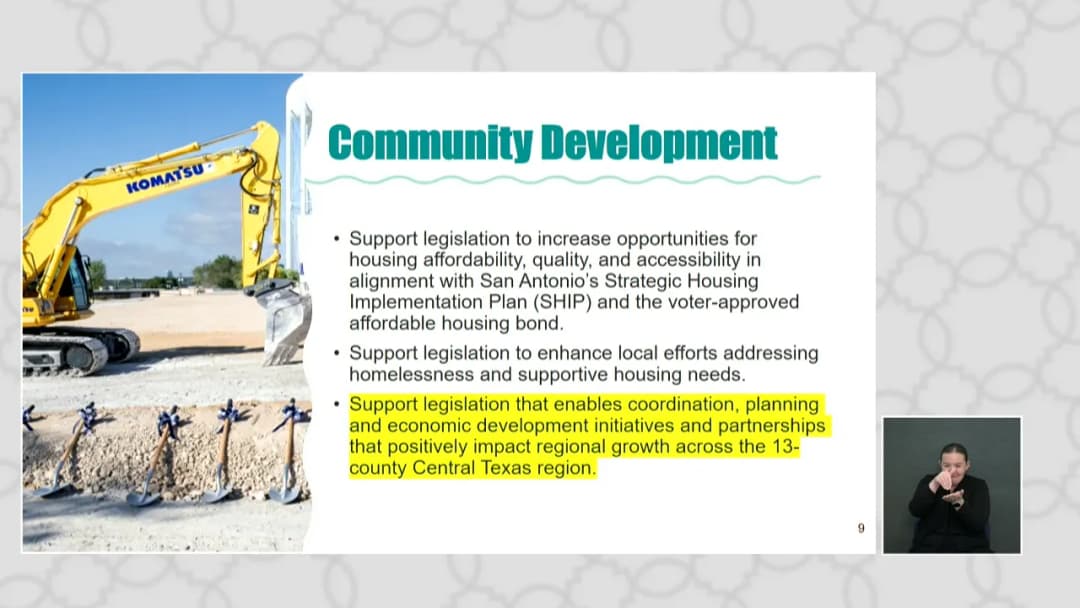
The San Antonio Intergovernmental Relations Committee convened at 2:08 PM with Chair Maquí Rodríguez presiding. Members present included Munguía, Alderete Gavito, Mesa González, and Spears, establishing a quorum. The meeting focused on a resolution regarding the potential impact of a new Level II trauma center designation, the draft 2026-2027 State Legislative Program, and guest presentations on transportation and education funding. Routine Approvals and Consent Calendar - The committee unanimously approved the minutes from the August 4, 2026 meeting. Trauma Center System Resolution - Assistant Division Director Scott Jackson and Deputy Assistant Director Jeff Coyle presented a resolution initiated by Councilwoman Spears concerning Methodist Healthcare’s intent to seek a Level II trauma center designation. - Background Context: The region currently has two Level I trauma centers (BAMC/BAMSI and University Health). Methodist Healthcare announced its intent to elevate its facility to Level II, sparking concerns that surfaced publicly in late August 2026. - Methodist’s Stated Position: Methodist indicated they are not seeking Level I status and do not wish to compete with BAMC. They argued the current model forces patient transfers out of their system or out of the region (to Austin or Houston) when BAMC or University Health is at capacity. They emphasized operating similar models in 52 other markets through HCA. - Military and Regional Concerns: The primary worry expressed by military partners and committee members was that adding Level II capacity without a corresponding increase in trauma volume would dilute the patient load. This directly threatens BAMC’s ability to maintain its Level I certification and conduct essential medical readiness training for the Department of Defense. It was noted that approximately 13,000 trauma patients are treated annually, with around 1,167 (slightly less than 10%) transferred out of the system. - Council Deliberation: - Councilwoman Spears emphasized protecting BAMC’s mission as a national security priority and expressed hope for a collaborative task force. - Councilwoman Alderete Gavito sought balance between protecting military training and allowing for business decision-making. She expressed frustration over the lack of specific data on patient volume trends and questioned whether blocking the designation was appropriate if it meant patients are sent out of town. - Councilman Mesa González (representing the medical district) called for more comprehensive data and earlier communication with the council before such urgent discussions arise. - Councilwoman Munguía warned that diluting BAMC’s volume over a ten-year horizon could risk the military moving its mission and economic investment elsewhere. - Outcome: The committee agreed to bring all stakeholders—Strack, Methodist, and BAMC—to the table for further study. Although Methodist’s application process begins October 1, the certification takes a full year, allowing time for policy coordination. The goal is to report recommendations to the full council for a Session A deadline. 2026-2027 State Legislative Program - Director of Government Affairs Sally Basurto presented the draft legislative program, incorporating feedback from previous committee meetings and individual council briefings. - Key Priorities Presented: Protecting CPS Energy’s single-ownership model, securing funds for flood mitigation and the South Texas Parkway, enhancing public safety measures (cryptocurrency fraud, organized retail theft), and investing in public education and workforce development. - Council Member Additions to the Program: - Alderete Gavito proposed adding support for expanding hospital capacity, particularly in South San Antonio, and including childcare facilities in the 300-foot alcohol buffer zone requirement currently applied to schools and churches. - Munguía requested exploring an extension of the Project Financing Zone (PFC) for the Alamodome and Convention Center from 30 to 60 years to help fund downtown infrastructure. - Mesa González emphasized preserving local decision-making authority (especially regarding CPS Energy) and supported the childcare center buffer addition. - Next Steps: The program will be presented to the full City Council for approval on October 7, 2026, and formally adopted on October 29, 2026. Guest Presentation: SAMCO Transportation Funding Update - SAMCO Executive Director Beck Foyer provided an overview of regional transportation successes and future legislative needs. - Current Status: The region has over $6 billion in transportation projects underway. A major success was the coalition formed to secure railroad grade separation funding. - Challenges: The Metropolitan Planning Organization (MPO) identifies a need of $50 billion but has only $12–14 billion identified for the 2025 plan. TxDOT faces funding volatility due to reliance on oil and gas taxes (Proposition 1) and a gas tax that has not been raised in four decades. A 60% increase in construction costs was cited. - Legislative Goals: Support continuation of the railroad separation program, back Proposition 7 (vehicle sales tax adjustments), and monitor efforts by other regions to restructure TxDOT formulas that could disadvantage San Antonio. Guest Presentation: Bexar County Education Coalition - Julia Cassar, Executive Director of the Bexar County Education Coalition, presented the community’s legislative priorities for public education. - Core Issue: Texas ranks in the bottom 10% nationally for per-student spending. Average teacher pay is approximately $6,000 below the national average. - Special Education Funding Gap: The federal government mandates a certain funding level, but the state faces a $2 billion gap relative to those requirements. The last session only offered an additional $250 million. - Affordable Housing Impact: Lower school enrollment is often linked not to population decline, but to a lack of affordable housing pushing families out of district boundaries. - Advocacy Campaign: The “Bexar Builds” campaign was recently launched, drawing 300 attendees. A 26-point legislative agenda was distributed. - Council Feedback: Councilwoman Alderete Gavito noted that the state imposes unfunded mandates such as requiring armed officers on campus; districts spend an average of $100 per student on safety while receiving approximately $20 from the state. Key Outcomes - Committee Alignment / Resolution: The committee supports bringing all trauma system stakeholders together to develop a coordinated solution that protects BAMC’s military mission while allowing Methodist to pursue its designation. A formal resolution draft will incorporate this collaborative approach. - State Legislative Program Finalized: The committee approved the additions requested by members (hospital capacity, childcare buffer zones, PFC exploration). - Action Items for Staff: - Schedule a meeting with Methodist, Strack, and BAMC to evaluate volume impact. - Investigate state-level mechanisms or incentives for hospital construction in underserved areas. - Review the feasibility of extending the PFC term. - Next Meetings: - Full City Council review of the Legislative Program: October 7, 2026. - Committee report back on trauma center collaboration study: targeted before the October 29, 2026 Session A deadline.
The Intergovernmental Relations Committee of the San Antonio City Council met on September 29, 2026, at 2:08 PM. The meeting was called to order by Chair McKee Rodriguez with a quorum present (Councilmembers Mukia, Alareth, Mesa Gonzalez, Spears, and Chair). The meeting adjourned at 4:16 PM. Consent Calendar - Unanimously approved the minutes of the August 4, 2026, IGR committee meeting via motion and second. Discussion Items 1. Resolution Supporting Brooke Army Medical Center (BAMC) Amid Methodist Trauma Center Plans - Assistant City Manager Jeff Coyle and new Military Affairs Director Scott Jackson presented a proposed resolution reaffirming the city’s 2017 commitment to BAMC, the only Level 1 trauma facility within the Department of Defense (DoD). - Jackson explained that BAMC’s unique mission includes training, sustaining deployable forces, and receiving all combat casualties. Maintaining its Level 1 certification requires a minimum volume of trauma patients (currently 13,000 annually between BAMC and University Health). - Methodist Healthcare announced intentions to upgrade its Level 3 trauma center to Level 2, effective October 1, 2026, with a year‑long certification process. Methodist stated the move is about patient choice: they want to keep patients within their system rather than transferring them to Austin or Houston. They noted they have 52 other markets where they operate Level 1 facilities. Methodist agreed not to pursue Level 1, only Level 2. - Jackson reported that Methodist currently transfers about 1,167 patients per year to Level 1 facilities (out of 13,000 total trauma patients). The addition of a Level 2 center without increased demand could reduce volume at BAMC and University Health, threatening BAMC’s readiness. - The draft resolution requests: reaffirmation of support for BAMC, an objective demand study, convening of STRAC (Southwest Texas Regional Advisory Council) to coordinate a collaborative agreement ensuring BAMC’s patient volume, and establishing BAMC and University Health as the region’s primary Level 1 facilities. - Councilmember Alderetic expressed concerns about blocking Methodist’s business decision, asking for more data on trauma capacity and patient transfers. She noted the chart lacked concrete numbers and questioned the “protect the status quo” framing. - Councilmember Spears strongly supported the resolution, stating BAMC’s military readiness is a national security priority and that Methodist’s decision could invite further competition. She thanked staff for their work. - Councilmember Mungia requested mapping of Level 1 trauma centers and long‑term growth projections, noting health care gaps on the south and east sides. She cautioned against saying “status quo” as it implies rejecting needed health care expansion. - Councilmember Masekon’s office criticized the short notice, wanting earlier communication and more data on impacts to both Methodist and BAMC. - Chair McKee Rodriguez noted the October 1 deadline had already passed and suggested bringing partners back for more information. The committee consensus was to defer action, gather more data (including capacity, volume, out‑of‑town transport data), and bring the resolution back to a future IGR meeting with enhanced briefings for all council members. 2. 90th State Legislative Program Update - Sally Basur, Director of Government Affairs, presented the updated legislative program incorporating feedback from prior meetings. The four funding priorities remain: South Texas Parkway, downtown sports/entertainment district, flood infrastructure, and protecting CPS Energy’s municipal model. - Key additions include: support for public/higher education (via Bear County Education Coalition), prevention of encroachment on military bases, funding for rail grade separations, and protecting local zoning authority. - Chair McKee Rodriguez proposed extending the Project Marvel PFZ (Sports and Entertainment District) from 30 to 60 years to cover the Spurs Arena, convention center, and Alamo Dome. Jeff Coyle cautioned that doubling the state’s revenue-giveback period would be a “tall ask,” but the committee agreed to explore it. - Councilmember Mungia asked to include language supporting expansion of health care capacity (hospitals) on the south/east sides. Councilmember Alderetic supported this, and staff will research state mechanisms. - Councilmember Mesa Gonzalez requested support for protecting CPS Energy, maintaining local control, and adding “daycare/child care facilities” to the 300‑foot alcohol buffer zone exemption (Chapter 4 of Local Government Code). Staff agreed to explore. - Councilmember Spears requested specific bill tracking and flood mitigation project lists; staff will provide regular updates. - Councilmember Alderetic pushed for stronger state and federal grant pursuit, and staff confirmed a grants training session is planned. - The committee voted to approve the legislative program for full council consideration on October 7, 2026. The motion carried. 3. Presentations from Community Partners - Vic Boyer, President/CEO of SAMCO, briefed on transportation funding: $14 billion secured over 25 years; $6 billion in projects under construction; future needs estimated at $50‑55 billion by 2050. He highlighted rail grade separation grants and the need to protect highway funds from diversion. SAMCO will support gradual increase of Prop 7 and reauthorization of the Texas Mobility Fund. - Julia Grizzard, Executive Director of Bear County Education Coalition, presented the “Bear Builds” campaign focusing on four legislative priorities: school operations funding, special education funding, school safety/mental health, and early childhood education. She noted school districts are spending $100/student on safety but receiving only $20/student from the state. The committee expressed support for the coalition’s efforts and noted overlap with the city’s education goals. Key Outcomes - BAMC Resolution: Committee deferred action to gather additional data (demand trends, out‑of‑town transport numbers, long‑term projections). Staff to bring back more information and brief all council members before a future vote. The committee’s direction is to send the item to A‑session rather than B‑session for faster action. - 90th Legislative Program: Approved by committee vote to advance to full council on October 7, 2026. Several amendments were discussed and will be explored prior to full council: extending the PFZ period (Chair McKee Rodriguez), adding hospital capacity language (Councilmember Mungia), including child care facilities in alcohol buffer zones (Councilmember Mesa Gonzalez), and continued focus on grants and local control. - Next Steps: Staff will provide individual briefings to council members not on IGR, prepare the legislative program for full council on October 7, and continue bill tracking as the 90th session approaches. The next IGR meeting will include updated information on the BAMC issue.
The San Antonio Board of Adjustments (BOA) convened on September 28, 2026. The board heard eight variance and special exception cases, deliberating on residential, commercial, and industrial property requests. Meeting minutes were approved and two cases were continued to October 12 due to a loss of quorum. Public Comments & Testimony - Margaret Benavides spoke on item 6 (506 Topekabou) requesting clarification on the structure's location and fire barriers. The applicant addressed her concerns. - Daniel Hillshard (Hilsure) registered opposition to item 4 (2045 South Forest Road) regarding light spillage onto adjacent properties. - On item 1 (1224 West French Place), Alicia Moreno (neighbor) supported the variance subject to gutter installation. Cynthia Walker and Henry Cropps (Beacon Hill HOA) detailed the HOA's conditional support, opposing the original front yard location. Cynthia Spinman also expressed concerns regarding runoff and neighborhood character. - Olga Castillo and Tyler Pennington spoke in opposition to item 5 (pending; 343 Mosher) citing traffic, aesthetic, and safety concerns related to a commercial carport in a residential area. Discussion Items - Item 6 - 506 Topekabou Drive (Aredo): Variance of 1 ft from the minimum side setback. The existing structure encroaches 2 ft onto the property line. Demolition will remove the overhang, but a 4 ft clearance requires a 1 ft variance. The motion passed with the chair initially stating a 9-0 vote before correcting to 8 votes in favor. - Item 7 - 500 Madero Street (Hernandez): Variance to build a 750 sq. ft. home on a 3,240 sq. ft. lot (4,000 sq. ft. minimum). Commissioner Mana raised concerns about substandard lots and suggested proactive city rezoning. Commissioner Cruz noted the home is a 1-bedroom, 1-bath design. The motion passed 9-1, with Commissioner Vazquez dissenting. - Item 9 - 144 Hibner Road (Travel Communications): Special exception for a 6 ft fence height. The applicant cited security breaches and encampments at the communications terminal. Staff confirmed the fence is predominantly open. The motion passed 9-0. - Item 11 - 1839 Mel Drive (Alvarado): Variance for an 11 ft rear parking setback reduction for an 18-lot subdivision. Concerns were raised regarding on-street parking width (31 ft pavement). The case was initially postponed, then returned after discussion. The motion passed 10-0. - Item 2 - 1514 Risby Avenue: Multiple variances (setbacks, buffers) for a non-conforming building. The owner purchased the property in January 2025. Staff recommended denial of specific items. Following testimony from the applicant, the board approved the variances 10-0. - Item 4 - 2045 South Forest Road (HB Installation): Variance for 73 light poles to be 50 ft high. The applicant demonstrated that 30 ft poles create unsafe dark zones for trailers and employees working at night. No adverse impact on nearby properties was found. Military overlay compliance is handled by Development Services. The motion passed 9-0. - Item 1 - 1224 West French Place (Morales Ramos): Multiple variances for an existing metal carport built without permits. The applicant presented a medical hardship (shade for physical therapy). The HOA conditionally supported variances for materials and a limited setback. The motion was amended to limit the carport projection to 8 ft beyond the main wall and required gutters. The motion passed 10-0. - Item 3 - 36 Blanco Road (Novalo/Gonzalez): Variances for buffer and setback requirements to allow repairs of a non-conforming structure inherited by the applicants. Staff recommended approval of the rear setback variance but denial of the east side buffer. The board approved the full request 9-0. Key Outcomes - Votes: The board passed 8 of the 9 items heard. Item 7 saw a dissenting vote from Commissioner Vazquez. Items 5 and 10 were continued without a vote. - Future Meeting: Cases 5 and 10 are scheduled for the next BOA meeting on October 12, 2026. - Directives: Applicants for approved variances were reminded to comply with all standard permitting processes, including building permits, fire barriers, drainage, and gutter requirements as applicable.
The San Antonio Board of Adjustment met on September 28, 2026, with a quorum of nine members. The board heard and decided nine appeals for variances and special exceptions from the Unified Development Code, with all votes being unanimous. Several cases were continued to October 12, 2026 due to loss of quorum. Consent Calendar - No formal consent calendar was used; all items were discussed individually. Public Comments & Testimony - Item 6 (506 Topeka Blvd): Margaret Benavides expressed initial confusion about the project scope, but after clarification, stated she was okay with the proposed variance. - Item 4 (2045 South Foster Road): Daniel Hillshire, a nearby resident, initially opposed but withdrew his opposition after discussions with the applicant. - Item 1 (1224 West French Place): Multiple speakers addressed the board: - Alicia Moreno, neighbor, supported the carport and had no issues. - Cynthia Walker, reading a statement from Beacon Hill Neighborhood Association, explained the association's split vote: they supported variances for materials (item 2) and side setback (item 4) but opposed the large square footage (item 1), carport location in front/side yard (item 3), and front setback (item 5). She noted the structure was built without a permit. - Cynthia Spillman, also from the association, emphasized the main concern was the carport protruding beyond the front facade. The association was willing to compromise if the carport was pulled back. - Henry Krause, from the association's zoning committee, reiterated the importance of the NCD standards and the desire for a compromise, specifically that the carport not jut into the front setback beyond 10 feet. - Item 7 (343 Schmelzer Lane) [continued]: Two neighbors spoke in opposition: - Laura Castile, a 30-year resident, opposed the large commercial-looking carport used for a limousine business, stating it hurt neighborhood character and property values. - Tyler Pennington, a nearby homeowner, opposed the carport size, citing traffic safety concerns and the commercial use on a residential lane. He submitted that the business generated undue traffic. Discussion Items - Item 6 – 506 Topeka Blvd (BOA-26-1030172): Applicant requested a one-foot variance from the five-foot side setback (to four feet) for a primary structure. Staff recommended approval. After public comment, the board approved unanimously (9-0). - Item 8 – 350 Madero St (BOA-26-1030174): Applicant requested a 760-sq-ft lot size variance (from 4,000 to 3,240 sq ft) for a new residential dwelling. Staff recommended approval. The board discussed that the lot was platted and should have qualified as a substandard lot. Motion passed 9-0. - Item 9 – 14440 Hubner Road (BOA-26-1030175): Charter Communications sought a one-foot special exception to allow a six-foot front yard fence (with later barbed wire addition). Staff recommended approval. Motion passed 9-0. - Item 11 – Mel Mel Drive (BOA-26-1030177): Applicant requested an 11-foot variance from the 20-foot garage setback to allow a 9-foot setback for 18 townhome lots in a PUD. Staff recommended approval. Discussion centered on road width and on-street parking. The applicant noted a 30-foot paved road and HOA restrictions. Motion passed 10-0. - Item 4 – 2045 South Foster Road (BOA-26-1030166): HEB requested a 20-foot variance from the maximum 30-foot light source height to allow 50-foot light poles at a warehouse. Staff recommended approval. The chair recused due to a conflict; Vice Chair Ozuna presided. After a second presentation and public comment, the board approved 9-0. - Item 2 – 1514 Rigsby Ave (BOA-26-1030153): Applicant sought multiple variances and buffer eliminations to allow a used car lot building and paved parking (five items, excluding a fence height request that was withdrawn). Staff recommended denial for most items. The board heard testimony about the existing building, prior rezoning, and neighbor support. The motion to grant all variances (except the withdrawn fence) passed 10-0 after a roll call. - Item 1 – 1224 West French Place (BOA-26-1030129): Applicant requested five variances from NCD-5 standards and setback requirements for a carport built without a permit. Staff recommended denial. After extensive public comment and negotiation, the board approved a modified motion: materials variance (item 2), side setback variance (item 4), and a location variance (item 3) allowing the carport in the side/front yard but not protruding more than 8 feet from the front wall of the primary structure. The front setback variance (item 5) was effectively addressed by the location restriction. The motion also required installation of gutters. Passed 10-0. - Item 3 – 1306 Blanco Road (BOA-26-1030171): Applicant requested a rear setback variance (27 ft 6 in), elimination of buffers on west and east sides, with an 8-foot fence on the east. Staff recommended approval for the rear setback and east buffer, but denial for the west buffer. The board granted all requested variances, noting the city's prior taking of right-of-way as a hardship. Passed 9-0. Key Outcomes - Votes: All decisions were unanimous. (Item 6,8,9,11,4,2,1,3 passed with no dissenting votes; item 6 had a minor counting discrepancy but confirmed 9-0.) - Continuances: Items 5 (BOA-26-1030169), 7 (BOA-26-1030171), and 10 (BOA-26-1030176) were continued to October 12, 2026 due to loss of quorum. - Director's Report: The Governance Committee approved seven alternate members for the board, to be voted on by City Council on October 8, 2026, to prevent future quorum issues. - Minutes: The minutes from the previous meeting were approved. - Next Meeting: Scheduled for October 12, 2026, where continued cases will be heard first.