Browse by city
Date range
Search help

Search titles, summaries, topics and stored transcripts together. Keywords may match separately; put the whole query in double quotes for a phrase. Matching follows word analysis, so punctuation is not exact. Both dates are included. Documents are not searched.

SHOWING 271–280 ENTRIES
271
MAY 21, 2026 · SAN ANTONIO, TEXAS · CITY COUNCIL
San Antonio Zoning and Land Use Session – May 21, 2026

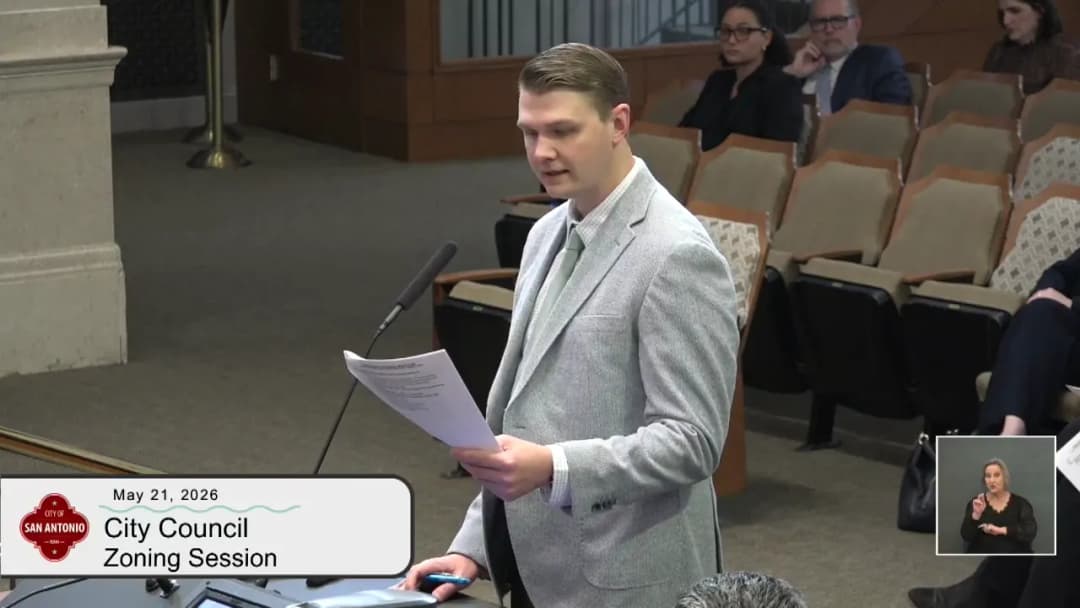
The City of San Antonio Zoning and Land Use Session was called to order at 2:03 PM on Thursday, May 21, 2026, with a quorum present. The meeting covered the consent agenda and 11 individual zoning and land use items. The meeting adjourned at 2:20 PM. Consent Calendar - Items 3, 4, 5, 6, 7, 8, and 14 were approved on the consent agenda. One individual signed up to speak on consent (item 4) but no detailed position was recorded. Public Comments & Testimony - Item 18 (Camp Bullis ETJ Land Use Plan Amendment): Three individuals signed up to speak: - Ashley Fairmound (Killing Griffin and Fairmont) spoke in favor on behalf of applicant Schneider Steele, noting that Joint Base San Antonio (JBSA) did not object and that the use (a rebar facility) would be compatible across from Camp Stanley. - Clifton Lewis (Lost Creek HOA board) spoke in opposition, citing concerns about noise, traffic, ground pollution, wildlife impact, and increased crime. He requested a noise reduction wall and pollution controls if the project were to proceed. - Brandon Gwynne was called but no statement was recorded. Discussion Items - Items 1 and 2 (Rezonings in District 1): Both items requested change from R6 to IDZ1 with NC uses and two dwelling units. Staff recommended denial; Zoning Commission recommended approval. Councilmember Corr moved to approve both items, and they passed without further discussion. - Item 9 (Rezoning in District 4): Request to rezone from BP to L with specific use authorization for outdoor storage (excluding sand). Staff and Zoning Commission recommended approval with a condition of no outdoor sand storage. Councilmember Mungia moved to approve with conditions; motion carried. - Item 10 (Rezoning in District 4): Request to change from MF-25 to C-2 CD with conditional use for long-term parking/storage. Staff recommended denial with an alternate recommendation; Zoning Commission recommended approval. Councilmember Mungia moved to approve the applicant’s request; motion carried. - Items 11 and 12 (Plan Amendment and Rezoning in District 5): Request to amend the Nogalitos/South Zarzamora Community Plan and rezone for a tobacco store/hookah lounge. Staff, Planning Commission, and Zoning Commission all recommended denial. Councilmember Castillo moved to deny; motion carried. - Item 13 (Rezoning in District 5): Request to change from R4 to IDZ1 with C1 uses. Staff recommended denial; Zoning Commission recommended approval. The Historic Westside Residence Neighborhood Association supported the change. Councilmember Castillo moved to approve; motion carried. - Items 15 and 16 (Plan Amendment and Rezoning in District 5): Request to amend the Kelly/South San Pueblo Community Plan and rezone for a community health facility (Chess). Staff, Planning Commission, and Zoning Commission recommended approval. Councilmember Castillo thanked Councilwoman Dr. Rocha Garcia for leadership, and Councilmember Viagran recused himself. Councilmember Castillo moved to approve; motion carried. - Item 17 (Rezoning in District 7): Request for specific use authorization for a gasoline filling station. Staff recommended denial; Zoning Commission recommended approval. Councilmember Mungia (on behalf of the absent district councilmember) moved to approve; motion carried. - Item 18 (Plan Amendment in District 8): Request to amend the Camp Bullis ETJ Military Protection Area Land Use Plan from Agricultural to Light Industrial. Staff recommended denial; Planning Commission recommended approval. Councilmember Mesa Gonzalez moved to approve after city staff confirmed JBSA had no objection and the operation would be inside a contained structure. Motion carried. Key Outcomes - Approved (unanimous votes): Items 1, 2, 9 (with conditions), 10, 13, 15-16, 17, 18. - Denied: Items 11 and 12. - All votes were unanimous with no recorded dissents. Councilmember Viagran recused on items 15 and 16.
ZONING AND LAND USE 94% · PROCEDURAL 6%
272
MAY 20, 2026 · SAN ANTONIO, TEXAS · COUNCIL COMMITTEES
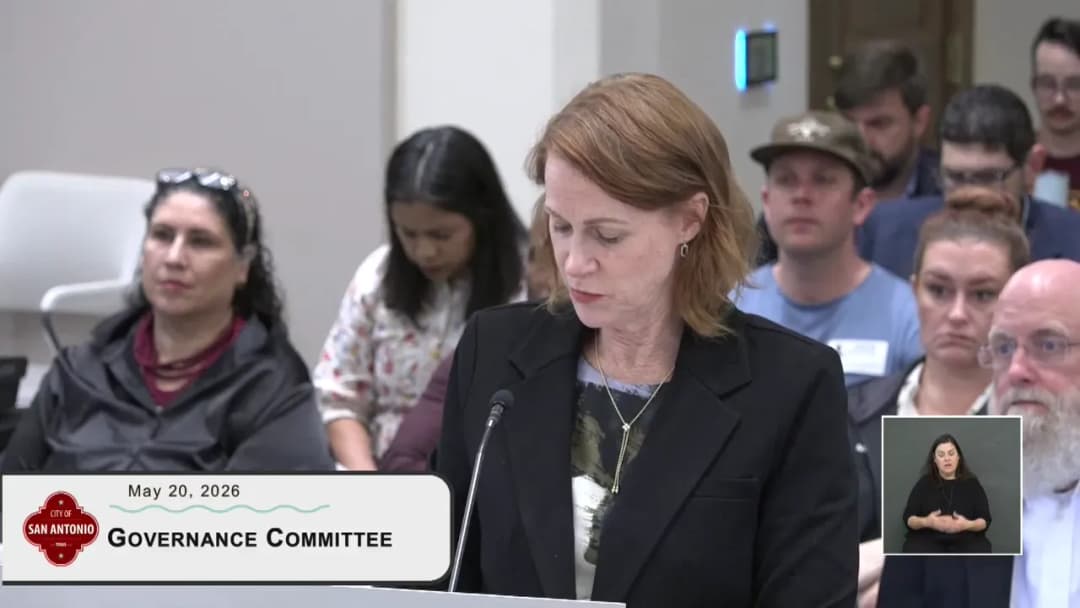
San Antonio Governance Committee Meeting - May 20, 2026: Nine CCRs Reviewed

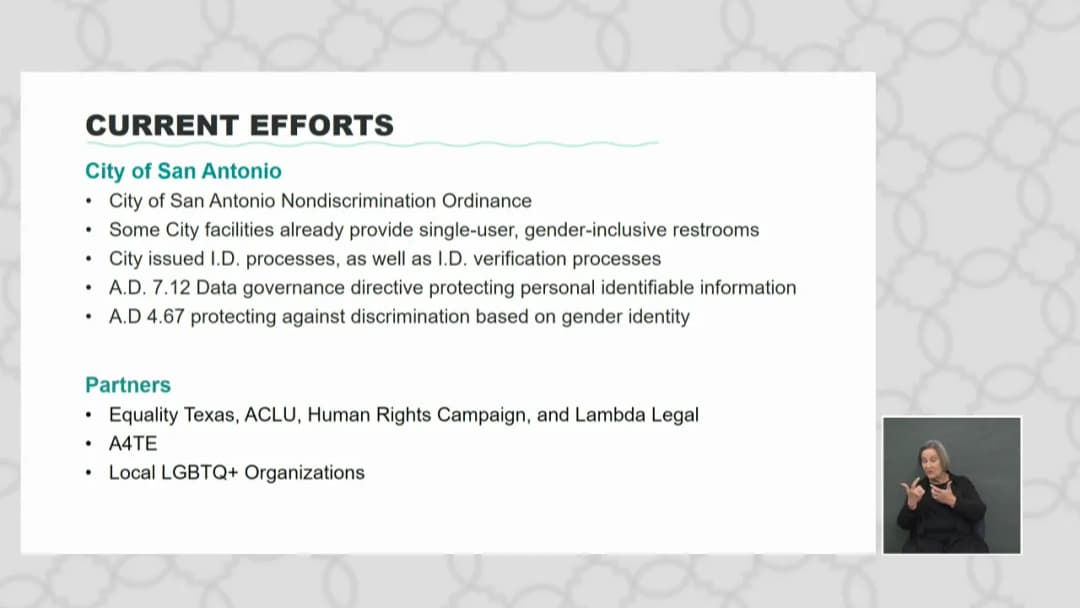
The Governance Committee met on May 20, 2026, at 10:03 a.m. to consider nine Council Consideration Requests (CCRs) covering a wide range of topics, including street name changes, board review cycles, quick-build transportation projects, floodplain tree planting, senior transportation, CAFE College review, annexation policy, and protections for transgender and non-binary residents. All items were presented back-to-back by city staff, followed by public comment and council discussion. The meeting adjourned at 11:06 a.m. Consent Calendar - Item 1: Approval of minutes from the April 15, 2026 meeting was approved unanimously by voice vote. Public Comments & Testimony - Yamani Karandika (District 1 resident, Strongtown San Antonio chapter lead): Expressed support for the interdepartmental quick-build team for street safety, urging the city to embrace incremental improvements and faster safety solutions. - Austin Kelm (District 1 resident, Strongtown San Antonio Safe and Productive Streets Initiative lead): Expressed strong support for the quick-build CCR, describing personal experiences with unsafe infrastructure and the delay in building a single crosswalk (expected to take nearly two years). He cited examples from other cities where quick-build projects reduced speeding and improved safety. - Joey Polic (Executive Director, ActivateSA): Expressed support for the quick-build CCR, noting their organization completed one of the first quick-build projects in San Antonio and highlighting the need for clearer city processes to speed implementation. - Councilmember Mesa Gonzalez (author of CCR on CAFE College and Annexation policy): Stated that CAFE College helps thousands but should be aligned with new career pathways. Noted that roughly one in three SAISD graduates did not enroll in higher education in fall 2023, and that the CCR seeks to expand CAFE College to meet current needs, aligning with partners like SA Works and Alamo Colleges. She also requested a review of special district standards for the ETJ to improve environmental and fiscal safeguards. - Councilmember White (via Councilmember Spears, reading a statement): Expressed support for CCR on board/commission review cycle, noting the need for a consistent evaluation mechanism. Also expressed support for the floodplain tree planting program, stating the mitigation funds exist but a coordinated program with clear targets and maintenance is needed. - Councilmember Alderate Gavito (via letter read by Chair): Expressed support for expanding senior center transportation, noting that residents living just outside the 5-mile pickup zone are turned away from programs. The CCR asks staff to explore partnerships and funding to expand access without relying solely on the general fund. - Councilmember McKee Rodriguez (author of CCR on protections for transgender/non-binary residents): Thanked community organizations (Equality Texas, Thrive Youth Center, former councilmember Leo Castillo Anguano) for their work and requested the CCR be sent to Public Safety Committee instead of Community Health. Discussion Items - Item 2 (Cesar Chavez Boulevard name change to Durango Boulevard): Staff presented a CCR from District 5 based on a citywide survey and listening sessions showing majority preference for the change. The segment runs between Southwest 36th Street and South Hackbury Street. Staff recommended beginning the process including technical review, Historic Design and Review Commission, Planning Commission, and final City Council consideration. - Item 3 (Splash Town Drive name change to Willie Mitchell Drive): Staff presented a CCR from District 2 to honor an important community member and reflect area history. The segment runs between IH-35 and Co-Plan Drive. Staff recommended starting the process. - Item 4 (Defined review cycle for boards and commissions): Staff presented a CCR from Councilmember White to amend Chapter 2 of the city code. The City Clerk maintains a list of boards, collects annual reports, and manages vacancies. Section 2-541 already requires a review cycle. No funding required. Staff recommended returning in 60 days. - Item 5 (Quick-build team for transportation safety): Staff presented a CCR from District 1 to establish an interdepartmental quick-build team within Public Works and Transportation, including a dedicated traffic engineer. The goal is faster implementation of temporary safety measures (pop-up bike lanes, traffic calming, crosswalk enhancements). Staff noted vacancies in traffic engineering and a grant to study the issue. Staff recommended referral to the Transportation Committee. - Item 6 (Floodplain tree planting program): Staff (Parks and Recreation Director) presented a CCR from District 10 to authorize use of the tree mitigation fund for planting native floodplain-tolerant species in floodplains and riparian areas. Since fiscal year 2024, over 60% of planted trees on public property are within 500 feet of the floodplain. The tree preservation ordinance requires 80% preservation in floodplains. Staff recommended referral to Transportation and Infrastructure Committee. - Item 7 (Expanding senior center transportation): Staff (Human Services Director) presented a CCR filed May 5 by Councilmember Alderate Gavito to explore expanding transportation at city-operated senior centers through grants, bond funding, partnerships with VIA and Bear County, and collaboration with organizations like the City-County Joint Commission on Elderly Affairs. Currently, curb-to-curb service is provided at 12 comprehensive centers and 4 part-time nutrition sites within a 5-mile radius, with average ride times of 1-1.5 hours each way. Staff recommended referral to Community Health Committee. - Item 8 (Reimagining CAFE College): Staff presented a CCR filed March 17 by Councilmember Mesa Gonzalez to review CAFE College's effectiveness and alignment with other education services. CAFE College was launched in 2010 and is operated by the San Antonio Education Partnership. The FY 2026 budget includes nearly $1 million from the general fund. In FY 2025, it served over 5,700 unduplicated clients. The Commission on Education has issued recommendations for improvement. Staff recommended referral to Educational Opportunities Committee. - Item 9 (Annexation growth management policy review): Staff (Planning Department) presented a CCR from District 8 to review and possibly amend the city's annexation growth management policy, including minimum standards for consent to special districts (e.g., MUDs, PIDs). To date, the city has consented to 31 districts in the ETJ. The CCR asks for stronger environmental accountability, alignment with city goals, and fiscal responsibility. Staff recommended referral to Planning, Community and Development Committee. Councilmember Viagran moved to send to a B session first, but after no second, the motion was to send to IGR. Councilmember Mungia noted the IGR committee had not yet met. The motion to send to IGR passed 2-1. - Item 10 (Protections for transgender, non-binary, and intersex residents): Staff (Director of Compliance, Opportunity and Access) presented a CCR filed April 9 by Councilmember McKee Rodriguez. The CCR seeks to ensure access to public facilities, strengthen protections for personal health and identity information, expand single-user restrooms, and explore self-selected name/gender markers on city IDs. Current protections include the Non-Discrimination Ordinance and AD 7.12 and AD 4.67. Staff noted state laws (HB 229, SB 8) and evolving federal law that may impact implementation. Costs may include facility assessment, restroom conversions, and staff training. Staff recommended referral to Community Health Committee. Councilmember McKee Rodriguez successfully moved to send to Public Safety Committee instead; motion carried. Key Outcomes - Item 2: Approved unanimously to begin the name change process. - Item 3: Approved unanimously to begin the name change process. - Item 4: Approved unanimously to return in 60 days. - Item 5: Approved with a vote of 3-1 (Councilmember Viagran opposed) to send to Transportation Committee. - Item 6: Approved unanimously to send to Transportation and Infrastructure Committee. - Item 7: Approved unanimously to send to Community Health Committee. - Item 8: Approved unanimously to send to Educational Opportunities Committee. - Item 9: Motion to send to IGR passed 2-1 (Councilmember Viagran opposed; Councilmember Viagran had moved to send to B session, but that motion died for lack of a second). The item will go to IGR for discussion. - Item 10: Approved unanimously to send to Public Safety Committee. All items moved forward in the process as determined by the committee.

MISCELLANEOUS 42% · ZONING AND LAND USE 17% · PROCEDURAL 9% · WORKFORCE DEVELOPMENT 8%
273
MAY 20, 2026 · SAN ANTONIO, TEXAS · BOARDS & COMMISSIONS
Historic and Design Review Commission Meeting - May 20, 2026

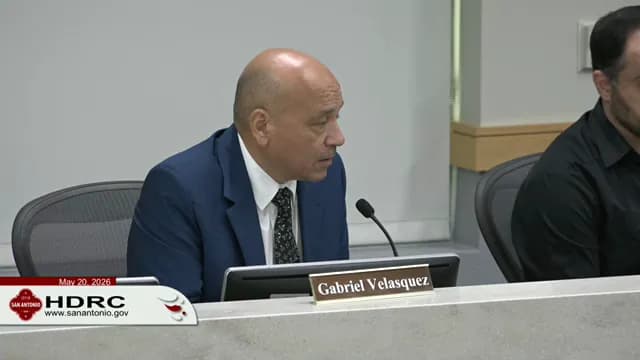
The Historic and Design Review Commission (HDRC) convened on Wednesday, May 20, 2026, at 3:02 PM and adjourned at 5:33 PM. Chair J. Maurice Gibbs presided. A quorum was present. The commission considered consent agenda items and four contested cases: Ella Austin Community Center (1023 North Pine), a residential structure at 433 Madison Street, a new home at 1315 East Pyren, and Joel's Collision (3406 Roosevelt Avenue). Consent Calendar - Approved with staff stipulations: 741 West Ashby, 310 South St. Mary's, 523 Divine, 112 San Arturo, 240 East Summit, 612 Labor, 539 East Weesech, and 415 FERD. - Items 4 (1023 North Pine), 12 (433 Madison), and 13 (1315 East Pyren) were pulled for separate discussion. Public Comments & Testimony - Item 4 – 1023 North Pine (Ella Austin): Darlene Bruceari spoke in support of the Tower Life change. Anthony Verfailey (speaking for Tiffany Holliday) expressed concern about the safety of children and seniors due to a proposed drop-off loop that holds only seven vehicles, forcing parents to stop in the street. Phyllis McNair (Dignity Hill Neighborhood Association president) requested disapproval because the community was not updated on design changes. Beverly Watts Davis (chair emeritus of Ella Austin Board) opposed the design, citing that after four community meetings, the only agreed-upon element retained was the expansion of child care; she argued the site plan makes Ella Austin a negative asset, gutted youth development space, and leaves the senior center unrenovated. She stated “this reminds me of redlining” and noted a $23 million bond allocation. - Item 12 – 433 Madison Street: Several King William neighbors spoke. Rick Casey emphasized process and precedence, noting the structure varied substantially from the approved design and that HDRC rulings appear advisory. Michelangelo Sabatino (Director of School of Architecture and Planning) urged that the street-facing facade be considered, advocating for a landscape plan and cutouts in the wall. Sean Campbell (Chair of King William Architectural Advisory Committee) reported the AAC supports items 1 and 2 but prefers cutouts over a full wall. Margaret Leeds expressed hope that landscaping and wall configuration would fit the neighborhood. - Item 13 – 1315 East Pyren: Jane Henry (Mission San Jose Neighborhood Association president) questioned the design and placement, noting the garage is flush with the front facade, uncharacteristic of the neighborhood. - Item 14 – 3406 Roosevelt (Joel's Collision): Jane Henry again spoke, emphasizing the lack of archaeological study, the unsightly exhaust stacks, and the need for a proper review given the proximity to Mission San Jose. Brady Alexander criticized the lack of communication and described the zoning as a “light industrial business park model” inappropriate for a World Heritage Site. Discussion Items - Item 4 – 1023 North Pine (Ella Austin): The applicant from West East Design Group presented the plan, explaining that the demolition of the Physical Cultures building (approved 2023 subject to site plan approval) was needed to provide amenities like open lawns, food truck staging, and a workout area. The drop-off loop, though limited, allows a variance. The city’s Capital Delivery and Department of Human Services representatives confirmed the project scope, noting the senior center is postponed due to budget constraints but intended to be built later in the same spot. Commissioners questioned the discrepancy between earlier community agreements and the current design. A substitute motion was made to approve building restoration (items 5 and 6) and demolition of the technical arts building, but to continue site work (items 1–4) for further community consultation. This motion carried with a date certain of July 15, 2026. - Item 12 – 433 Madison Street: The homeowner explained the solid wall was built for privacy after realizing the open design allowed too much visibility. The commission discussed that the wall deviated from the approved 2025 certificate of appropriateness. The motion approved items 1 and 2 (modifications to structure and landscape) but denied item 3, requiring the wall to revert to the originally approved design with cutouts flanking the fireplace. A landscape plan is still required. - Item 13 – 1315 East Pyren: The applicant described replacing a dilapidated house with a new home, with a concrete slab for a basketball court. The commission granted conceptual approval with staff stipulations, emphasizing the need for a proper site plan showing setbacks and relationship to neighbors. - Item 14 – 3406 Roosevelt (Joel's Collision): The applicant’s architect presented proposed fencing, exterior modifications, additions, and signage. Staff recommended approval with stipulations, including walls not exceeding 6 feet and a signage package to be brought back. Commissioners discussed the exhaust stacks, lighting, and archaeological requirements. The motion approved with staff stipulations, adding that walls not exceed 6 feet and the applicant pursue further exploration of exhaust system alternatives. Key Outcomes - Item 4 (1023 North Pine): Approved 7–0, with a substitute motion: items 5 and 6 (building restoration) and demolition of the technical arts building approved; items 1–4 (site plan) continued to July 15, 2026 for further community input. - Item 12 (433 Madison): Approved 8–0 (one commissioner absent) – items 1 and 2 approved; item 3 denied, requiring reversion to originally approved wall design. - Item 13 (1315 East Pyren): Approved 9–0 – conceptual approval with staff stipulations, further refinement before final certificate. - Item 14 (3406 Roosevelt): Approved 9–0 – with staff stipulations including walls ≤6 feet, signage package to be submitted, and applicant to explore exhaust system alternatives; archaeological investigation required.

HISTORIC PRESERVATION 44% · MISCELLANEOUS 17% · ENGINEERING AND INFRASTRUCTURE 14% · COMMUNITY ENGAGEMENT 10%
274
MAY 20, 2026 · SAN ANTONIO, TEXAS · BOARDS & COMMISSIONS
Historic and Design Review Commission Meeting - May 20, 2026

The Historic and Design Review Commission (HDRC) met on May 20, 2026, at 3:02 PM, with all 10 commissioners present and a quorum. The meeting was conducted in Spanish and English. The commission approved the consent calendar with exceptions, heard public comments, and debated several agenda items before making decisions on four contested cases. Consent Calendar - The consent calendar was approved unanimously for all items except for agenda items 4 (1023 North Pine Street), 12 (433 Madison Street), and 13 (1315 Espy Street), which were pulled for separate discussion. - Items including 741 Washby, 310 San Mary's, 523 Divan, 112 San Arturo, and 240 Summit Avenue were postponed. Public Comments & Testimony - A speaker for the Saint Mary's building (branding change) expressed full support for the project, calling it one of the most iconic services in the city and praising the visionaries involved. - A speaker for item 4 (1023 North Pine) raised safety concerns for 83 children at Austin Daycare, citing 27 vehicles, dangerous drop-off design, and potential conflicts with a senior center and nearby school. They requested a safer design. - Phyllis McNeil, president of Dignity Hill Neighborhood Association, opposed approval of item 4 because plans were received only Monday and unresolved questions remained. She requested no approval until further community discussion. - Beverly Watts Davis, speaking for 6 minutes on item 4, argued that previous community agreements were ignored, the new design eliminates open space and creates traffic hazards, and the project does not address critical needs like bathroom renovations. She pleaded with the commission to reject the current plan. - Deborah Carrington, speaking on item 12 (433 Madison Street), opposed deviation from the December 2025 approved plan. She specifically objected to a solid wall on Madison Street, asking for the original open design with a chimney. She supported staff stipulations to resubmit plans. - Sean Cambio (spoke on item 12) supported items 1 and 2 of the staff recommendation but opposed item 3 regarding the enclosed fireplace structure. - Margaret Leeds (King William resident) expressed hope that landscaping would mitigate the visual impact of the wall at 433 Madison Street. - Jane Henry, president of Misión San José Neighborhood Association, spoke on item 13 (1315 Espy) and later on item 14 (Roosevelt Avenue). For 13, she raised concerns about a proposed garage in front and inappropriate design for the neighborhood. For 14, she criticized the lack of archaeological study and the unapproved construction of a 2,500 sq ft addition. - Other speakers for item 14 (Roosevelt Avenue) included Alexander (Hot Wells Association), who supported Misión San José and warned against setting a bad precedent for commercial development near the mission. Discussion Items - Item 4 (1023 North Pine Street – Austin Center): Applicant Gonzalo Fraga (Wesley's Design Group) explained that the roundabout was removed to provide more amenities (playgrounds, food truck area) and that the new northern entrance for the daycare was intended to improve safety. City staff (Christal Gonzalez, capital delivery director, and Melanie Rosley, human services director) confirmed the project was driven by community needs and that the city had conducted meetings since 2022. Commissioners expressed concerns about unresolved drop-off safety, community engagement, and cost of delays. After debate, a substitute motion was approved to restore building interior and roof (agenda items 5 and 6) while deferring all site work (items 1-4 and demolition of the Technical Arts building) for up to 6 weeks to allow further community dialogue. Motion passed 7-3. - Item 12 (433 Madison Street – King William District): Applicant William Hernandez argued that the solid wall was needed for privacy and that landscaping would mitigate views. The commission heard from multiple neighbors opposing the wall. A motion was made to approve items 1 and 2 (per staff) and deny item 3 (the wall), reverting to the original approved design (slides 15-16). Motion passed unanimously (9-0, with Group absent). - Item 13 (1315 Espy Street): Applicant Jose Charo sought demolition of a deteriorating structure and construction of a replacement. The staff recommended conceptual approval with stipulations. Commissioners noted consistency with earlier approvals. Motion for conceptual approval with staff conditions passed unanimously. - Item 14 (Roosevelt Avenue – near Mission San José): Applicant Javier Gonzalez presented revised designs after previous community meetings. Key issues included fence height (applicant wanted 8 feet, staff said 6 feet per code), signage (applicant requested over 50 sq ft, staff limited to 15 sq ft), mechanical exhaust vents deemed too visible, and need for archaeological study. The commission approved with staff stipulations: fence height maximum 6 feet, signage to return with correct dimensions, and a request for the applicant to explore alternative exhaust systems. Motion passed 9-1 (Fetzer opposed). Key Outcomes - All agenda items were addressed. The meeting adjourned at 5:33 PM. - Item 4: Substitute motion approved (7-3) to proceed with building restoration and defer site work for 6 weeks for further community input. - Item 12: Approved items 1 and 2, denied item 3 (the wall), reverting to original approved design (unanimous). - Item 13: Conceptual approval granted (unanimous). - Item 14: Approved with staff stipulations including 6 ft fence maximum, 15 sq ft signage, and exploration of better exhaust solutions (9-1).

HISTORIC PRESERVATION 43% · MISCELLANEOUS 27% · PARKS AND RECREATION 20% · COMMUNITY ENGAGEMENT 6%
275
MAY 20, 2026 · SAN ANTONIO, TEXAS · COUNCIL COMMITTEES
San Antonio Government Committee Meeting - May 20, 2026

The San Antonio Government Committee convened on May 20, 2026 at 10:03 AM to consider nine Council Consideration Requests (CCRs) covering street name changes, committee oversight, transportation safety, tree planting, senior transportation, Café College effectiveness, annexation policies, and protections for vulnerable residents. After staff presentations and public comments, the committee voted on referrals and approvals. The meeting adjourned at 11:06 AM. Public Comments - A District 1 resident expressed support for a quick‑build street safety team to provide adaptable, rapidly implemented safety solutions. - Austin Count (District 1) supported safe streets initiatives, citing personal experience and examples from other cities where temporary treatments led to lower speeds and volumes. - Joy Poli, director of a local organization, supported the quick‑build construction team (CCR 5) as a cost‑effective way to deliver traffic‑calming projects faster than traditional methods. Discussion Items and Actions - Item 2 – Street Name Change to César Chávez (District 5): Staff recommended starting technical and design review. Approved unanimously. - Item 3 – Street Name Change from Splash Town Drive to Willie Mitchell Drive (District 2): Approved unanimously. - Item 4 – Amendment to City Code (Councilman White): Would require a review plan for government committees within 60 days. Approved unanimously. - Item 5 – Quick‑Build Transportation Safety (Councilwoman Cor): Would establish a rapid‑implementation team within Public Works. Councilmember Viagrán opposed creating a formal policy or pilot, preferring to send it to a closed executive session (Session B) and objecting that it geographically favored one district. However, the motion to approve the staff recommendation passed; no opposition was recorded. - Item 6 – Tree Planting in Flood Zones (Councilman White): Would develop a program using the tree mitigation fund to plant native species in flood‑prone areas. Viagrán wanted it sent to Session B instead of an infrastructure committee; the motion to approve as recommended passed unanimously. - Item 7 – Expanded Transportation for Seniors (Councilman Alderete Gavito): Would study transit access for seniors within five miles of centers. Approved unanimously. - Item 8 – Café College Effectiveness (Councilwoman Mesa González): Would review the college‑access center’s impact and alignment with workforce initiatives. Approved unanimously. - Item 9 – Annexation and Growth Management Policy (Councilmember District 8): Would review and potentially amend the city’s consent standards for new special districts. Council disagreed on referral: Viagrán moved to send to Session B (no second) and then to the EGR committee; the motion to send to EGR passed with 2 in favor. The item was not approved but referred to the EGR committee. - Item 10 – Protections for Vulnerable Neighbors (Councilmember Castillo): Would expand protections for transgender, non‑binary, and intersex residents, including single‑use restrooms and identity privacy. After discussion (Mesa González raised legal concerns), the committee voted to refer it to the Public Safety Committee. Key Outcomes - Nine CCRs were considered. Items 2, 3, 4, 5, 6, 7, and 8 were approved for further action or implementation as recommended. - Item 9 was referred to the Economic Growth and Regional Development (EGR) Committee instead of the Planning and Development Committee as staff proposed. - Item 10 was referred to the Public Safety Committee. - The meeting minutes from April 15, 2026 were approved unanimously.

MISCELLANEOUS 92% · PROCEDURAL 8%
276
MAY 20, 2026 · SAN ANTONIO, TEXAS · CITY COUNCIL
San Antonio B Session Briefing on Airport Contracts - May 20, 2026

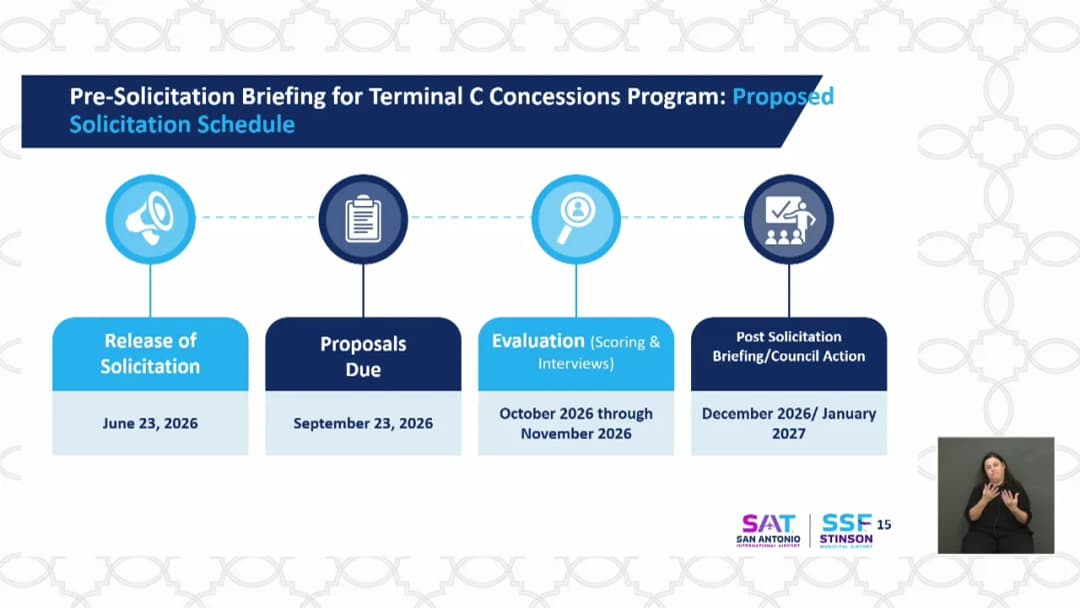
On Wednesday, May 20, 2026, the San Antonio City Council B Session convened at 2:04 PM to receive briefings on three high-profile airport solicitations: the Construction Manager at Risk (CMAR) for Terminal A and B renovations, the common use passenger processing system, and the concessions program for the new Terminal C. The meeting included updates on federal grant awards, airline agreements, and council member priorities for local business participation and passenger experience. Consent Calendar - No consent calendar items were discussed. Public Comments & Testimony - No public comments or testimony were provided. Discussion Items Construction Manager at Risk (CMAR) for Terminal A & B Renovations (Post-Solicitation) - The solicitation used a two-step process (RFQ then RFP). Four respondents submitted qualifications in late 2025; three were shortlisted. After scoring, Manhattan and Joers (joint venture) was recommended as the top firm, followed by Skanska USA and Austin Commercial. - Manhattan Joers scored highest due to their pre-construction plans, phasing approach, strong design coordination with SAT standards, commitment to San Antonio's sense of place, and a clear schedule for delivering the Guaranteed Maximum Price (GMP). - The contract amount is $260 million, funded from aviation capital funds (airport revenues). The total project cost including soft costs is $300 million, per the airline agreement. - Councilmember Aldrete Gavito asked about construction start timing. Staff responded that design work will begin after notice to proceed, with 10% design expected by mid-2027, 90% design by 2028, and construction starting after Terminal C beneficial occupancy (to avoid overlap). - Councilmember Mesa Gonzalez asked about funding sources. Staff noted $200 million for Terminal A and $100 million for Terminal B, totaling $300 million. - Councilmember Kuss asked why Terminal C's CMAR (Hensel Phelps) did not apply. Staff explained that the renovation of A and B (closing gates, moving checkpoints, refurbishing hold rooms) requires different expertise than building on a brownfield. - Mayor clarified there are no local preference points for this federal contract. Common Use Passenger Processing System (Pre-Solicitation) - This system provides non-signatory airlines (and any airline choosing to participate) with passenger check-in kiosks, improving speed of service. - Estimated contract value: $12 million. Term: five years with two one-year options. Funding from O&M account. - Evaluation criteria: 50 points for proposed plan (60-day turnkey operation), 35 points for experience/qualifications, 15 points for pricing. - Evaluation committee includes city staff, ITSD, and a representative from Miami-Dade International Airport. - Schedule: Solicitation release May 29 (subject to council approval), proposals due July, evaluation August-September, post-solicitation briefing October-November. - Councilmember Mesa Gonzalez asked about passenger experience. Staff said kiosks will be strategically placed in renovated A and B to avoid the current 'band-aid' approach. - Councilmember Spears asked if non-signatory airlines will push passengers to use kiosks. Staff said yes, coordinating with carriers and focusing on passenger journey. Terminal C Concessions Program (Pre-Solicitation) - Total concessions footprint: 35,000-36,000 square feet. Four packages: Package 1 – retail (11,000 sq ft), Package 2 – duty free (1,700 sq ft), Packages 3 & 4 – food and beverage (including sit-down dining, coffee, bars, food hall). - Term: 12 years (selected based on industry feedback). First-year minimum annual guarantee: $8.6 million. - Evaluation criteria: experience/qualifications (10 points), design/capital investment, operations/sustainability, concepts/brands, organizational management, financial projections (20 points). - Local participation: 46% target for concept representation. Staff noted strong local interest (over 100 attendees at industry day). Previous packages achieved 70% local participation. - Staff emphasized the city will strive to award multiple contracts to multiple respondents, but reserves the right to award multiple packages to a single respondent (to avoid solicitation delays as happened previously). - Councilmember Aldrete Gavito strongly advocated for local businesses, especially coffee shops (e.g., Oyo, Mila) and retailers. Staff acknowledged the need for balance with national brands. - Councilmember Mungia asked about differences from the previous Terminal C concessions RFP. Staff cited higher revenue per square foot, higher local percentage target, and a separate duty-free package. - Mayor raised concern about contract enforcement (e.g., if a concessionaire underperforms). Staff described monthly revenue and performance reviews, standardized operating standards, and recourse provisions (minimum operating hours, sanctions, default provisions). - Councilmember Viagran referenced other airports' connections and urged continued focus on passenger experience, including price points and vendor reliability. - Councilmember Kuss advocated for a connector behind security between A and B to allow passengers to access all concessions regardless of terminal. - Councilmember Viagran highlighted the need for price points for different travelers (families, business) and noted that global concessionaires must partner with local businesses. Key Outcomes - The council received the post-solicitation briefing for the CMAR (Manhattan Joers joint venture) and pre-solicitation briefings for the common use system and concessions program. No formal votes were taken. - Council members expressed strong support for local business participation (target 46% concept representation) and urged staff to maintain competition among concessionaires. - Staff noted that Terminal C remains on scope, schedule, and budget. The airport was awarded an additional $10 million from the FAA Airport Terminal Program (largest of any medium hub in the country for this round), bringing total federal grants since 2022 to $188 million. Additional grants (e.g., RAISE for roadway loop) are pending. - Staff committed to providing historical documentation of the previous concessions solicitation to council members. - Next steps: The common use system solicitation is expected to be released May 29 (with council approval). The concessions RFP is expected in June, with proposals due in September, evaluation October-November, and post-solicitation briefing late 2026 or early January 2027. Meeting adjourned at 3:21 PM.

INFRASTRUCTURE 40% · PROCUREMENT AND CONTRACTING 35% · ECONOMIC DEVELOPMENT 23% · COMMUNITY ENGAGEMENT 2%
277
MAY 19, 2026 · SAN ANTONIO, TEXAS · COUNCIL COMMITTEES
Education Opportunity Committee Meeting - May 19, 2026: Charter School Expansion and School-Based Health Centers

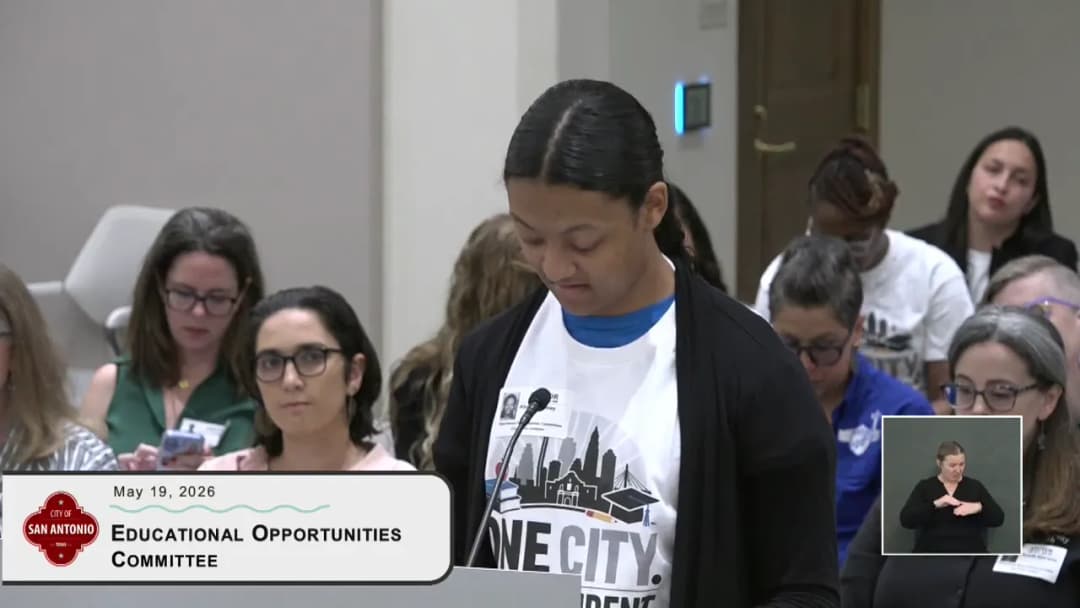
The Education Opportunity Committee of the San Antonio City Council met on May 19, 2026, at 9:59 a.m. to discuss two major agenda items: the impact of charter school expansion on local public education and school-based health centers managed by University Health. The meeting featured extensive public testimony, a presentation from the nonprofit Our Schools Our Democracy, and a presentation from University Health officials. No formal votes were taken, but the committee outlined next steps for legislative advocacy and improved communication with school districts. Consent Calendar - The committee approved the minutes of the previous meeting by unanimous voice vote, with no amendments or opposition. Public Comments & Testimony - Angie Addis Mende (Senior Executive Director, Idea Public Schools San Antonio): Expressed support for charter schools, noting that Idea serves over 17,000 scholars across 30 campuses, with 36% receiving special education services and 82% economically disadvantaged. She urged the committee to engage directly with charter leaders and visit campuses. - Kizzy Thomas (District 2 resident, former educator): Supported a broader definition of public education that includes charter schools, emphasizing that systems do not have to exist in opposition and should be held accountable for results. - Megan Garrison (District Director of Communications, Harmony Public Schools): Highlighted Harmony's STEM focus and outcomes, including 91% college enrollment among graduates, and asked the committee to include charter schools in future discussions and city initiatives. - Melissa Franklin (Policy Advisor, Columbia Laws Center; mother and former educator): Criticized the us-versus-them narrative, arguing that families leave certain schools for valid reasons and that the committee should focus on why families are leaving rather than attacking charter schools. She called for collaboration and accountability. - Alyssa Freeney (Student, UTSA): Shared her personal educational journey through public, charter, and homeschooling, urging the committee to focus on student needs and avoid creating divisions between school types. - Lori Alvedez (District 2 resident, member of SAISD Special Education Parent Advisory Council): Expressed support for charter schools as a lifeline for her children, citing that only 26% of District 2 students are proficient in math while Idea Carver achieves 65% reading proficiency. She asked the committee not to restrict charter access. - Shannon Tolliver Blackman (School Leader, KIPP San Antonio): Noted that KIPP is closing two campuses due to enrollment declines, but highlighted that 97% of its students are economically disadvantaged and that her campus improved from an F to a B rating. She asked the committee to include the nearly 45,000 charter students in city programs. - Erlinda Aguilar (AP Bilingual Educator, Idea Public Schools; parent): Advocated for family choice and access to multiple high-quality options, stating that District 6 has high charter enrollment and that families should not be limited. - Lauren Lewis (Superintendent, Prelude Prep Charter School): Shared her personal story of needing to live with grandparents to access a better public school, and asked the committee to engage with charter superintendents and include them in city initiatives. - Zayana Lambridge (Executive Director, Futuro San Antonio): Cited polling showing 64% of San Antonians want a full ecosystem of public school options. She criticized the committee's decision to learn about charters from an opposition group without inviting charter families or operators, and called for a balanced briefing and publication of yearly grade-level metrics across all school types. - Ray Diorina (Board President, South San ISD): Called for a cross-sector table where all educators can share resources and collaborate, noting that San Antonio has a dynamic educational ecosystem but lacks communication between entities. - Gabby Patton (Principal, Royal Public Schools, District 5): Described the challenges her campus faces, including federal funding cuts and declining enrollment, but stated that her open-enrollment charter absorbed over 200 students from failing schools and brought them to grade level. She asked for partnership, not scapegoating. - Inga Cotton (Founder and Executive Director, School Discovery Network; charter parent): Noted that ISDs like SAISD are also embracing choice and that families move between school types. She urged the committee to focus on the current landscape where parents are well-informed and making choices. - Itzman Morales (Student, KIPP University Prep High School): Shared his positive experience at KIPP, where he received support for undiagnosed ADHD and is now taking AP classes. He stated that charter schools give students opportunities and that families should be able to choose. Discussion Items - Impact of Charter School Expansion (Item 2): Carrie Griffith, Patty Everett, and Maggie Stern of Our Schools Our Democracy presented data on charter school growth, noting a 300% increase in charter students, $500 million in annual revenue loss from ISDs to charters, and that charters serve about one-third fewer special education students. They highlighted that charter expansion via administrative amendments lacks public transparency and recommended an annual education report, formal communication with superintendents, and inclusion of public education in the city's economic development agenda. Council members discussed the need for accountability, transparency, and collaboration. Councilman McKee Rodriguez emphasized tying CTE programs to economic development and inviting ISD superintendents to the table. Councilman Castillo called for transparency from all school types and criticized the state's underfunding of education. Councilman Mungia identified the state as the primary antagonist, urging a focus on legislative advocacy to adequately fund public schools and hold charters to the same standards as ISDs. - School-Based Health Centers (Item 3): Valerie Maldonado, Director of School-Based Health Centers, and Dr. Michelle Rodriguez, Medical Director, presented on University Health's program. The program includes seven clinics in six school districts (Harlandale, Southwest, SAISD, Northside, Judson, Southside), two mobile units, and a health education component. In 2025, the clinics saw nearly 18,000 visits, with the highest payer being Medicaid. Services include primary care, immunizations, well-child checks, sports physicals, and adult care. The mobile units provided over 6,800 services, including flu shots and mammograms. Council members thanked University Health and asked about expansion opportunities and data on health and attendance outcomes. The presenters agreed to follow up with additional data. Key Outcomes - The committee did not take any formal votes on the agenda items. - The chair summarized potential next steps: developing an annual education report that provides context and data on all school types, establishing formal communication channels with public school superintendents, and incorporating public education into the city's economic development and legislative agendas. - Council members expressed interest in convening a cross-sector table to foster collaboration among all educational entities. - The meeting adjourned at 11:57 a.m.

PUBLIC EDUCATION 76% · PUBLIC HEALTH 16% · COMMUNITY ENGAGEMENT 2% · DISABILITY RIGHTS 1%
278
MAY 19, 2026 · SAN ANTONIO, TEXAS · BOARDS & COMMISSIONS
San Antonio Zoning Commission Meeting Summary – May 19, 2026

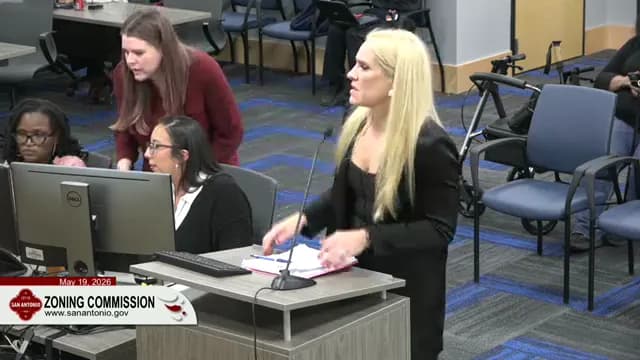
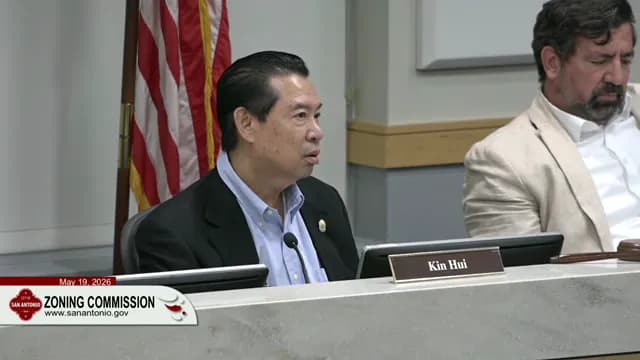
The San Antonio Zoning Commission met on May 19, 2026, at 1:00 PM under Chair John Bustamante. The commission considered a consent agenda, continuance items, and individual hearing requests. Several cases involved public testimony, and multiple continuances were granted to facilitate community outreach or revised plans. Consent Calendar - Items 9, 10, 13, 16, 17, 18, 19 (as amended), 21, 23, 24, 25, 26, 27, and 28 were approved unanimously. - Item 9: R5 to R5 CD for four dwelling units at 8210 McCullough Avenue. 27 notices mailed, zero in favor/opposed. - Item 10: R6 to R6 CD for two dwelling units at 10523 Mount Baker Drive. 19 notices mailed, six in favor, zero opposed. - Item 16: MF-18 to MF-33 (amended to MF-25) at 8210 Pine Brook Drive. 39 notices mailed, zero in favor, nine opposed. - Item 17: I-1 to C2 at 1711 Citadel Plaza. 15 notices mailed, zero in favor/opposed. - Item 18: C2 to R4 at 306 Ward Avenue. 37 notices mailed, one in favor, zero opposed (Riverside Neighborhood Association in favor). - Item 19: C2 CD (theater) to C2 CD (home improvement center) near 24000 block of W Interstate 10. Staff recommended approval with conditions (8-ft fence, 15-ft buffer). - Item 23: R6 to C2 at 7701 Wood Chase Drive. 12 notices mailed, zero in favor/opposed. - Item 24: C1 to C2 at 3939 Medical Drive. 11 notices mailed, two in favor, zero opposed. - Item 25: IDZ1 (3 units) to IDZ1 (NC uses) at 311 E Ashby Place. 39 notices mailed, zero in favor/opposed. - Item 26: C2 to IDZ2 (C2 uses) at 2625 Broadway. 18 notices mailed, zero in favor/opposed (West Ford Alliance in support). - Item 27: C1 to IDZ1 (wine boutique) at 935 S Alamo Street. 44 notices mailed, zero in favor, two opposed (concerns with parking/music). - Item 28: C2S (bingo) to TOD-MX3 at 7142 San Pedro Avenue. 96 notices mailed, zero in favor/opposed; outside 200 ft: four in favor, 13 opposed. - Public comment was heard on item 10 (no details provided). Motion by Commissioner Huey, second by Commissioner Inojosa; all items approved. Public Comments & Testimony - Item 2: No public comment. - Item 3: No public comment. - Item 5: No public comment. - Item 7: No public comment (applicant absent). - Item 11: Residents Rachel Martinez, Ruby Ramos, and Jaime Ramos spoke in opposition, citing concerns about property maintenance, crime, noise, and density. - Item 14: No public comment. - Item 22: Residents Janie Benavides, Adrian Moreto, and Maria Gonzalez spoke in opposition, raising concerns about traffic, noise, lighting, property values, and lack of prior outreach. The applicant’s representative stated they had tried to contact the Misty Oaks neighborhood association since February without response. Discussion Items - Item 2 (Stone Oak Parkway): C2 to C2S for a cultural event center (banquet hall, meeting rooms). Applicant Elisa Chan (Asian Resource Center) presented a 4.2-acre site plan with two entrances, tree preservation, and water filtration. Staff recommended approval. Commissioner Duval questioned the circulation plan and the need for the specific use authorization. The motion for approval passed unanimously. - Item 3 (US 281/Redland): MF-33 to C2 for medical office. Applicant Ashley Fairmon noted the site was previously rezoned from C3 to multifamily (unbuilt). No public comment. Staff recommended approval. Commissioner Duval moved approval; seconded by Commissioner Kellum; passed unanimously. - Item 5 (New Laredo Highway): Originally C3 request; amended to C2 CD with conditional use for motor vehicle sales (full service). Staff recommended denial, citing incompatibility with residential neighbors and the Kelly/South San Pueblo Community Plan (neighborhood commercial designation). Applicant Carlos Aldava presented 31 letters of support from neighbors. Commissioner Pete Rodriguez moved continuance to June 2 to allow work on a buffer and revised site plan; motion passed. - Item 7 (Vera Cruz Street): R5 to IDZ3 for four dwelling units. Applicant absent. Chair Bustamante had met with the applicant earlier and discussed an amended site plan. Continuance to June 2 was moved and passed. - Item 11 (Petaluma Boulevard): R4 to MF-18 for six units (three duplexes). Applicant’s representative Elizabeth Russell requested a 30-day continuance (to June 16) to meet with the neighborhood again after receiving opposition letters. Staff recommended denial with alternate R4 CD for four units. Public comment opposed. Commissioner Inojosa moved continuance to June 16; passed. - Item 14 (Glenwood Court): R4 to R4 CD for four single-family homes. Applicant Patrick Christensen represented his client (Craig Henry, who lives next door). Staff recommended denial with alternate of three units. Community outreach (Riverside Neighborhood Association) supported the request. Commissioner Inojosa moved approval; seconded by Pete Rodriguez; passed. - Item 22 (Heath Road): C1 to C2NA for an indoor pickleball facility. Applicant Ashley Fairmon noted C1 limits building size to 5,000 sq ft per building (15,000 aggregate); C2 would allow larger structures for the proposed 12 courts. Staff recommended denial. Public opposition centered on traffic, noise, lighting, and uncertainty about future uses under C2. Commissioner Huey moved continuance to June 16 to facilitate a community meeting with District 6 staff; seconded by Commissioner Pana; passed. Key Outcomes - Consent Calendar Items (9, 10, 13, 16, 17, 18, 19, 21, 23, 24, 25, 26, 27, 28): Approved unanimously. - Continuances to June 2, 2026: Items 4, 6, 8, 12, 15 (administrative), Item 5 (New Laredo Hwy) and Item 7 (Vera Cruz St). - Continuances to June 16, 2026: Items 11 (Petaluma Blvd) and 22 (Heath Road). - Approved Rezonings: Items 2 (C2 to C2S, Stone Oak Parkway) and 3 (MF-33 to C2, US 281/Redland) passed unanimously. Item 14 (R4 to R4 CD with four units, Glenwood Court) passed unanimously. - Minutes: The May 5, 2026 zoning commission minutes were approved with one abstention (Commissioner Sipes). - Chair’s Note: For item 4 (continued), Chair Bustamante directed that no new enforcement actions be taken in the interim to avoid inequitable treatment. Meeting adjourned at 3:38 PM.

ZONING AND LAND USE 85% · COMMUNITY ENGAGEMENT 8% · PROCEDURAL 5% · ARTS AND CULTURE 1%
279
MAY 19, 2026 · SAN ANTONIO, TEXAS · BOARDS & COMMISSIONS
San Antonio Zoning Board Meeting Summary – May 19, 2026

The San Antonio Zoning Board of Adjustment met on May 19, 2026, at 1:15 PM to consider zoning change requests, continuances, and other agenda items. The board approved the consent calendar, granted continuances, and debated several individual rezoning cases, including a proposed pickleball facility that sparked significant public opposition. Key votes and decisions are detailed below. Consent Calendar - Agenda items 9, 10, 13, 16, 17, 18, 19, 21, 23, 24, 25, 26, 27, and 28 were approved unanimously. Specific items included: - Item 9: Change from R5 to RC5 (two units) at 210 MacAlon Avenue – 27 notifications, no support or opposition. - Item 10: Change from R6 to R6 C D (two units) at 10523 Mount Baker Drive – 19 notifications, 6 in favor, neighborhood association in favor. - Item 13: Change to C2 with IDZ3 at 290 Blanco Road – Bacon Hill in favor. - Item 16: Change from MF-18 to MF-33 at 8210 Pinebrook Drive – amended by applicant to MF-25 (lower density). - Item 17: Change from I1 to C2 at 1711 City Al Place – 17 notifications, no response. - Item 18: Change from C2 to R4 at 306 World Avenue – 27 notifications, 1 in favor, Riverside neighborhood association in favor. - Item 19: Change from C2CD (two-screen theater) to C2CD (home improvement) at 24000 West Interstate – conditions: 8-foot fence and 15-foot setback from residential uses; 45 notifications, 1 in favor. - Item 21: Change from QDS (concrete/asphalt) to C2NA at 5415 Norlup 1604 – 12 notifications, no response. - Item 23: Change from R6 to C2 at 7701 Bucha y Drive – 20 notifications, no response. - Item 24: Change from C1 to C2 at 3939 Medical Drive – 11 notifications, 2 in favor. - Item 25: Change from IDZ1 (four units) to IDC1 (parking) at 311 HB Blade – 39 notifications, no response from Beethoven Hill or Mental Villa Historic associations. - Item 26: Change from C2 to IDZ2 at 6296 Broadway Street – 18 notifications, no response. - Item 27: Change from C1 to IDZ1 (O1) at 937 South Alamo Street – 44 notifications, 2 opposed (parking concerns), King Williams association did not respond. - Item 28: Change from C2S (bingo hall) to TOD MX3 at 7171 San Pedro – 96 notifications, no response from Nording Hill or District 1 associations; outside 200 feet: 4 in favor, 16 opposed. - Public comments were received for Item 10 only (one speaker). Continuances Granted - Agenda items 4, 6, 8, 12, and 15 were continued to June 2, 2026, by a unanimous vote. The chair clarified that no violation fines would accrue on the property for Item 4 during the continuance period. - Item 5 (1139 New Laredo Highway, C2 to C2CD for vehicle sales/repair) was continued to June 2, 2026, to allow the applicant to work with staff on a proposed 6-foot solid fence and 15-foot landscape buffer for the residential adjacency. The applicant had 31 letters of support from neighbors, but staff had recommended denial due to inconsistency with the 2007 comprehensive plan and lack of buffering. - Item 7 (2814 Veracruz Street, high-density infill) was continued to June 2, 2026, because the applicant was not present; staff recommended denial due to lot size non-conformance. - Item 11 (223 Petaluma Boulevard, R4 to R4CD for four units) was continued to June 16, 2026, after public opposition (Rachel Martinez, Ruby Ramos, Jaime Ramos) citing noise, crime, and property maintenance concerns. The applicant requested 30 days to meet with the neighborhood association. - Item 22 (5995 Heat Road, C1 to C2 for pickleball facility) was continued to June 16, 2026, after extensive public comment. Residents Jenny Benavides, Hillary Laredo, Adrian Guerrero, and Maria Gonzalez opposed the change, citing traffic, noise, lighting, emergency access, and the potential for future more intensive uses. The district commissioner offered to facilitate a meeting between the applicant and the neighborhood association. Discussion Items - Item 2 (200 block Stonok Parkway, C2 to C2S for a reception hall/event center) was approved unanimously. The applicant, representing the Asian Community Center, presented plans for a 10,000-square-foot facility with banquet hall, exhibition space, and cultural programs. The site is currently undeveloped (4.7 acres, trees). Staff and SOS (Edwards Aquifer protection) recommended approval with 65% maximum impervious cover. No public comments were received. - Item 3 (19000 block Highway 281 North, MF-33 to C2 for medical office) was approved unanimously. The applicant proposed a two-story medical office building on 3 acres of undeveloped land. The site is adjacent to a church that supported the change. Staff noted the property is zoned commercial and is appropriate for the area. No public comments were received. - Item 5 (1139 New Laredo Highway) – See continuances above. The applicant originally sought C3 for vehicle sales/repair but amended to C2 with conditional use permit for the same. Staff and some commissioners expressed concern about the lack of buffering between the existing use and nearby single-family homes, despite 31 neighbor letters of support. - Item 14 (114 Glenwood Court, R4 to R4CD for four units) was approved unanimously. The applicant plans to build four townhomes on a vacant lot behind his home. The Riverside neighborhood association supported the project. Staff had recommended approval for three units; the applicant accepted but noted engineering costs. - Item 22 (5995 Heat Road) – See continuances above. The applicant proposed converting a former medical office into an indoor pickleball facility with four courts, limited to 5,000 square feet per building and 15,000 square feet total. Staff noted that C2 allows a wider range of uses (e.g., supermarkets, carpet stores) that could be more intense than pickleball. The applicant offered to place deed restrictions limiting future uses, but the city attorney clarified such restrictions are private agreements between the property owner and the neighborhood, not enforceable by the city. Key Outcomes - Approvals: Consent calendar items (9, 10, 13, 16, 17, 18, 19, 21, 23, 24, 25, 26, 27, 28) – all unanimous. Individual items 2, 3, and 14 also approved unanimously. - Continuances granted: Items 4, 5, 6, 7, 8, 11, 12, 15 (to June 2, 2026) and Item 11 and 22 (to June 16, 2026). - Denials: None – all pending items were continued rather than decided. - Next Steps: The next meeting is scheduled for June 2, 2026. Items continued to June 16, 2026, include those requiring additional community engagement. The board will revisit all continued cases at those dates.

ZONING AND LAND USE 90% · PROCEDURAL 5% · COMMUNITY ENGAGEMENT 4% · PUBLIC SAFETY 1%
280
MAY 19, 2026 · SAN ANTONIO, TEXAS · COUNCIL COMMITTEES
San Antonio Education Opportunities Committee Meeting - May 19, 2026

The Education Opportunities Committee of the San Antonio City Council met on Tuesday, May 19, 2026, from 9:59 a.m. to 11:56 a.m., chaired by Councilmember Galván. The meeting focused on the impact of charter school growth on traditional public schools, public testimony from parents, educators, and charter school representatives, and a presentation on school-based health centers by University Health. No formal votes were taken on the substantive discussion items. Consent Calendar - The committee approved the prior meeting's minutes unanimously by voice vote, with no amendments or abstentions. Public Comments & Testimony (Note: The meeting was conducted bilingually in Spanish and English; speakers are summarized based on the transcript.) - Andia Arismendi, senior director from a charter school operator, shared that her organization has opened 17,000 school seats across three campuses, with 100% of families living in San Antonio. She highlighted superior math and reading performance (24 points higher in reading) and noted that 36% of students are English language learners. - Kissy Thomas, a District 2 resident with students in both charter and traditional public schools, expressed that education provides equality and opportunity for disadvantaged communities. She urged the committee to focus on serving children, not protecting systems. - Megan Garza, a charter school representative, described serving a diverse population (80% economically disadvantaged, 45% emerging English learners, 20% Section 504). Her schools aim for college readiness with 91% enrolling in college. She called for collaboration rather than a school-type conflict. - Emotionally Franklin (name likely transcribed inaccurately), a mother and education policy consultant, argued that families leave traditional schools for good reason; the debate should focus on what works for students. She urged the committee to examine why families are leaving and to replicate successful practices. - Elisa Farini, a student who attended traditional public and home schools, said that while she respects educators and leaders, decision-makers often do not understand student experiences. She called for systems that serve students physically and emotionally, not division. - Lori Álvarez, a District 2 resident and special education commission counselor, detailed her daughters' experiences in both traditional and charter schools. She argued that a one-size-fits-all approach fails, citing math proficiency rates (65% at a charter serving low-income families vs. much lower at some traditional schools). She requested collaboration and expanded models to reduce waitlists. - Shannon Tolen Blackman, a public school leader serving Districts 1, 5, and charter schools, expressed pride in serving low-income populations (97% economically disadvantaged, 14% special education). She noted that two of her campuses will close at the end of the school year. She invited councilmembers to visit campuses and warned against passing resolutions that exclude 45,000 charter students from consideration. - Erlinda Águila, a bilingual educator and District 1 resident with children in a charter school, advocated for families seeking high-quality education and urged the committee not to reduce opportunities. She stressed the need to uplift teachers and students at all levels. - Lauren Luis, superintendent of a charter school in District 5, noted that her school serves 90% economically disadvantaged students and achieves grade-level reading for 51% (compared to 30% in the district). She shared her personal story of having to transfer legal guardianship to access a better school. She called for including charter leaders in city education initiatives. - Ayana Lambert, executive director of an organization and former San Antonio ISD teacher, requested balanced metrics and annual performance data on all schools. She said families deserve dignity and choice, not a predetermined agenda. - Mr. Tijerina, a Southside resident and school board president, highlighted San Antonio's dynamic education ecosystem and called for a collaborative table where all schools share resources. He noted that technology and AI are changing education and urged focus on students, not institutions. - Gaby Patten, a District 4 resident, Teach for America alumna, and campus director, described severe impacts from federal funding cuts, a deficit of 200 students at her school, and the absorption of students from closed traditional schools. She asked the committee to work together on literacy and school support. - Inge Cotton, founder of a school network, stated that all schools are now competing for enrollment and that families should have prosperity. She encouraged the committee to focus on student-centered innovation. - Ismail Morales, a district resident, shared his experience with lack of diagnostics in his schooling and how a charter school option opened opportunities for university and master's degrees. - A subsequent speaker (not named in transcript) introduced herself as a 25-year educator, 10 years in ISD, and co-founder of a charter school. She thanked the council for leading critical conversations. She warned that vouchers include unlimited charter expansion and that the legislature creates three parallel school systems with unequal rules (e.g., ISDs require voter-approved bonds for facilities, charters do not). - Another speaker (likely from the same group) noted that since working on these policies in 2012, she found that charter growth is nearly 300% and that many charter schools serve fewer special education students, while some with high ratings may have no SPED students at all. She emphasized the need for transparent, fact-based decision-making regarding charter approvals, which are handled without public notice or school district input. She provided data: Texas needs $1,300 more per student just to reach 2019 funding levels, and ISDs face a $500 million annual gap compared to charters. She recommended public notice for charter expansions and inclusion of educators in decision-making. Discussion Items Agenda Item 2: Impact of Charter School Expansion on Traditional Public Schools Following public testimony, committee members discussed the complex landscape: - The committee chair noted that the dialogue is critical because many issues relate to state policy, and it is important to see the impact on local school districts and student choice. - Councilmember Monguilla (or Mungía) thanked all public speakers. He shared that he served on a school board for seven years and dreamed of an annual assembly where all school types share information. He noted that charter schools were once not required to have certified teachers, but some now do. He called for transparency, especially since ISDs must publish everything while charters have no similar obligation. He stressed that funding formulas are unequal and that school closures can devastate communities. - Councilmember Miki Rodríguez outlined possible next steps (slide 13): the committee can support public schools through a state legislative agenda and identify ways to strengthen them. He expressed frustration that education in Texas has become overly political, citing his own experience as a teacher when 15-20 students were sent back from a charter school because they did not meet expectations. He reiterated that families should not be blamed for choosing options, but that the state is underfunding ISDs while investing in charters, making it hard for traditional schools to succeed. He emphasized that all schools, especially public ones, must be successful because they educate the majority of children. He called for a unified legislative push. - One councilmember (likely a follow-up from the chair) added that she does not blame parents; the system creates different rules, allowing some schools to pick students while others must serve everyone, including those coming from jail or with severe special education needs. She urged that families have choices but that the state should not create escape routes for some while leaving the most difficult-to-educate children behind. Agenda Item 3: School-Based Health Centers – University Health Presentation Valerie Maldonado, director of school-based health centers and mobile clinics, and Dr. Michelle Rodríguez, medical director, presented: - University Health began school-based clinics in 2013 with Harlandale ISD. Clinics serve pediatric and adult patients (students, staff, families) with immunizations, physicals, well-child checks, and chronic disease management. In 2025, there were 18,000 visits. - Seven clinic locations exist in multiple school districts (Harlandale, South San, Southwest, SAISD, North East, Judson, and South San). The map shows clinics concentrated in the west and south, with new clinics in the east seeing patient growth. - Payor mix: mostly Medicaid, then commercial, and a significant portion uninsured (pay out of pocket or attempt CareLink). Staff also use the clinics. - Age distribution: highest for 5–18-year-olds, then under 5, then adults. Immunizations account for 18% of visits. Many visits are for sports physicals and annual checkups. - Mobile clinics (buses) provide immunizations and mammography in communities and workplaces. - Educational partnerships: the program collaborates with nursing schools to educate future health leaders, and with diabetes educators to share knowledge. - Councilmembers thanked the presenters and noted the importance of integrating health services into communities, reaching parents and grandparents. Key Outcomes - The committee agreed to continue the conversation on the impact of charter school growth and public school funding as part of a larger state legislative agenda. - No formal votes were taken on policy or resolutions. Councilmember Rodríguez identified next steps, including developing a legislative agenda to support public schools. - The committee received information but took no action on the school health centers presentation. - The meeting adjourned at 11:56 a.m.

PUBLIC ENGAGEMENT 28% · YOUTH PROGRAMS 24% · PUBLIC HEALTH 13% · LEGISLATIVE ADVOCACY 12%
OPENPUBLICA · PUBLIC MEETING INDEXUPDATED DAILY · openpublica.com