La reunión del Comité de Planeación y Desarrollo Comunitario se llevó a cabo el 26 de mayo de 2026 a las 10:01 a.m., bajo la presidencia de Munguea, con la presencia de los concejales Cor, Castillo, Galván, Mesa González y otros. Se aprobó el acta de la reunión del 28 de abril de 2020 de manera unánime. Se discutieron tres temas principales: mejoras al programa de propiedades vacantes, actualización de procedimientos para denominación de instalaciones municipales, y respuesta a la falta de vivienda. Consent Calendar - Aprobación unánime del acta del 28 de abril de 2020. Public Comments & Testimony - Cintia Cavazos se presentó para hablar en la sección de comentarios públicos, pero no se detalló su exposición. Discussion Items 1. Solicitud de Consideración del Consejo (CCR) sobre mejoras en el programa de propiedades vacantes y molestas - El director de Desarrollo de Servicios de Desarrollo, Amín Tomás, presentó enmiendas al programa de propiedades vacantes. El programa piloto se inició en 2015 y se expandió en 2017 y 2023 (incluyendo un amortiguamiento de 1,000 pies para jardines de niños y propiedades históricas cerca de bases militares y escuelas). Se mencionaron tres categorías: registro e inspección, multas y penalidades, y cumplimiento. Actualmente, hay 4 empleados y más de 1,000 casos activos. Se planea agregar un oficial de cumplimiento de código a partir del 1 de octubre. Se compararon las multas con las de Dallas: en Dallas el registro es gratuito, con multas de $300 por hasta tres violaciones y luego $4,015; en San Antonio, son $400 para viviendas unifamiliares y $900 para otros. Se explorará un acuerdo con el condado (ILA) para que las propiedades que deban impuestos puedan ser clausuradas. También se discutió el programa de administración judicial (capítulo 214 del gobierno local de Texas), que permite que un tercero (receptor) invierta en la propiedad y sea reembolsado después de la venta, más un 10% del costo. Se mencionaron desafíos legales y la necesidad de incentivos, especialmente para propiedades históricas. - La concejal Castillo propuso identificar a los dueños de múltiples propiedades vacantes y explorar acuerdos con el condado para propiedades con exención de impuestos. También sugirió extender el programa a toda la ciudad, no solo a propiedades históricas. - La concejal Cor enfatizó la necesidad de expandir el programa, mejorar la transparencia y comunicación con la comunidad (ej. usando un tablero DHD), y ser sensible con los nuevos propietarios que heredan multas. Preguntó sobre el proceso de administración judicial en casos de bancarrota. - La concejal Mesa González solicitó un mapa de propiedades vacantes y destacó que la administración judicial podría ser una ganancia potencial para la ciudad a través de impuestos a la propiedad. Preguntó sobre las organizaciones sin fines de lucro en Dallas que actúan como receptores. - El concejal Munguea mencionó el ejemplo de una propiedad comercial vacía en Barwack y la posibilidad de convertirla en vivienda. Se acordó que las multas para propiedades comerciales son más altas ($900) que para residenciales ($400), y se pueden poner gravámenes en propiedades comerciales. 2. Solicitud de Consideración del Consejo (CCR) para actualizar los procedimientos de denominación de instalaciones municipales - Jenny Nietzche presentó el CCR enviado por la ex concejal Adriana Rocha García el 13 de febrero de 2025. Se propone aumentar las notificaciones a 500 pies (en lugar de 200 pies) y a asociaciones de colonias dentro de 2 millas, requerir dos audiencias públicas si hay oposición del 50% o más, y que el comité de nombramiento tenga miembros sin conflicto de interés. El personal recomienda expandir la notificación a propietarios dentro de 500 pies. - Debbie Satter (secretaria) aclaró que si se sugiere un nombre diferente durante la audiencia, se debe reiniciar el proceso con nuevas notificaciones. - La concejal Cor preguntó sobre el manejo de múltiples nombres alternativos. Se sugirió que si el 25% de las tarjetas de encuesta apoyan un nombre diferente, se pueda iniciar un nuevo proceso, pero el personal no lo recomienda. - La concejal Castillo destacó que los cambios de nombre deben basarse en el apoyo comunitario genuino y no en conflictos. Apoyó la idea de detener el proceso si hay oposición del 50%. - La concejal Galván apoyó la expansión de la notificación y la posibilidad de que la comunidad exprese sus pensamientos, pero prefirió no permitir cambios de nombre a mitad del proceso sin reiniciar. - La concejal Munguea resumió que las notificaciones se expandirán a 500 pies, y si hay más del 50% de oposición tras la retroalimentación, el proceso se detiene. Sugirió que si hay un apoyo significativo (no un porcentaje fijo) a un nombre diferente, el comité podría considerarlo sin reiniciar el proceso. 3. Presentación sobre la respuesta a la falta de vivienda y servicios complementarios - Mark Armona, director de vivienda y servicios para personas sin hogar, presentó el marco de trabajo que se enfoca en tres áreas: prevención, sacar a las personas de las calles, y proporcionar vivienda estable. Los programas incluyen asistencia a corto plazo (primer mes de renta), vales de vivienda (ayudan a más de 11,000 hogares), trabajo de campo (2,805 personas asistidas), y refugios de emergencia (2,315 personas en 2025). Se mencionaron 13 agencias para refugios, 8 para trabajo de campo, y 7 para vivienda sostenible. Los resultados del año 2025 muestran que el 85% de los aplicantes no cayeron en la falta de vivienda, el 71% salió a destinos positivos (vivienda, cuidado médico, vivienda asistiva), y el 94% de los titulares de vales estuvieron protegidos. Se planea implementar un plan consolidado y el fondo para vivienda asequible. - La concejal Mesa González apoyó el trabajo y sugirió incluir al Hospital UH en la coordinación. Preguntó sobre la centralización de vivienda. - El presidente Munguea pidió estadísticas mensuales sobre la población y asistencia para rentas. - La concejal Galván enfatizó la necesidad de conectar a personas con dificultades (incluyendo ex presidiarios) con servicios. Mencionó que ya se está trabajando con la oficina de reinserción de la concejal Castillo para ayudar a quienes regresan de la cárcel sin vivienda. - La concejal Cor pidió más detalles sobre las agencias que reciben fondos y un mapa de campamentos por distrito para el personal de la ciudad. Preguntó cuántas personas están siendo ayudadas en total (más allá de los 2,315 en refugios) y cómo se alinean los datos. - La concejal Castillo valoró el trabajo y mencionó que los fondos de reubicación son útiles. Sugirió que los concejales visiten los sitios para entender mejor las necesidades de presupuesto. Preguntó si el promedio de asistencia es de 15 o 30 personas, y si se necesita más apoyo. Key Outcomes - Propiedades vacantes: Se acordó continuar explorando un acuerdo con el condado (ILA) y la administración judicial. Se considerará expandir el programa a toda la ciudad. Se solicitará un mapa de propiedades vacantes y un análisis de costos-beneficios. - Denominación de instalaciones: Se decidió expandir las notificaciones a 500 pies. Si hay oposición del 50% o más, el proceso se detiene. Si hay apoyo significativo a un nombre alternativo (sin porcentaje fijo), el comité podría considerarlo, pero no se estableció una cifra exacta. Se agendará una reunión de seguimiento para cerrar los detalles. - Respuesta a la falta de vivienda: Se continuará con la implementación del marco de trabajo y el plan consolidado. Se compartirán estadísticas mensuales con los concejales. Se incluirá a hospitales y a la oficina de reinserción en la coordinación. Se proporcionará un mapa de campamentos por distrito para uso interno del personal de la ciudad.
Public Meetings - San Antonio, Texas
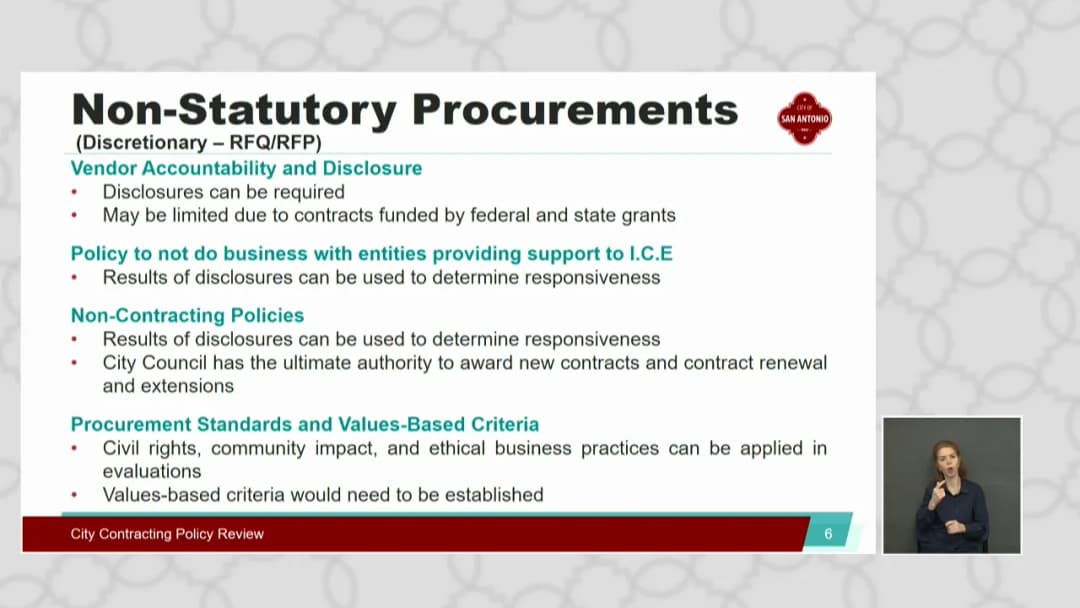
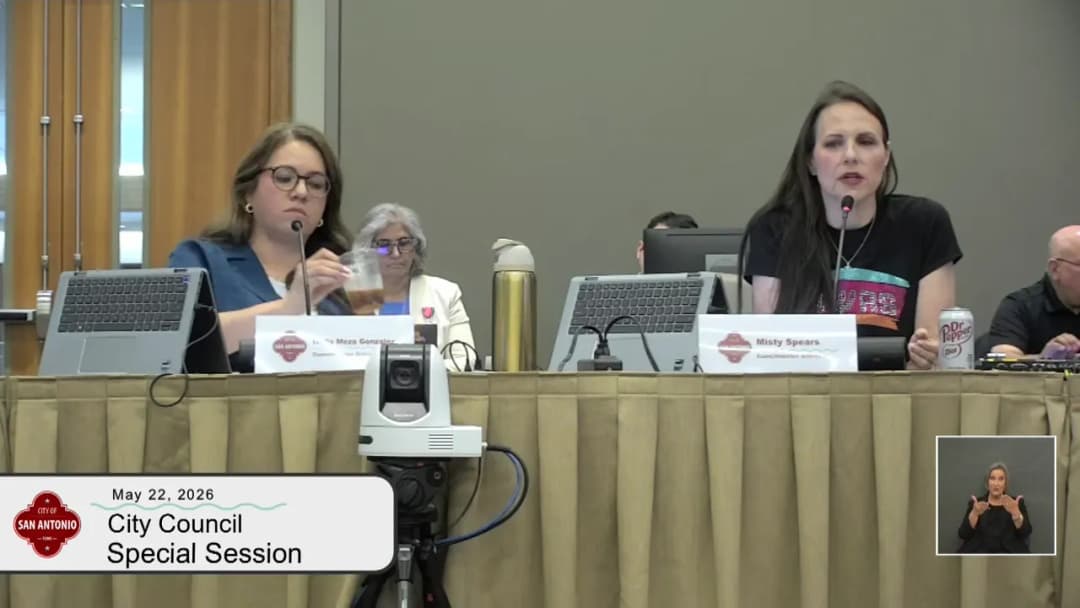
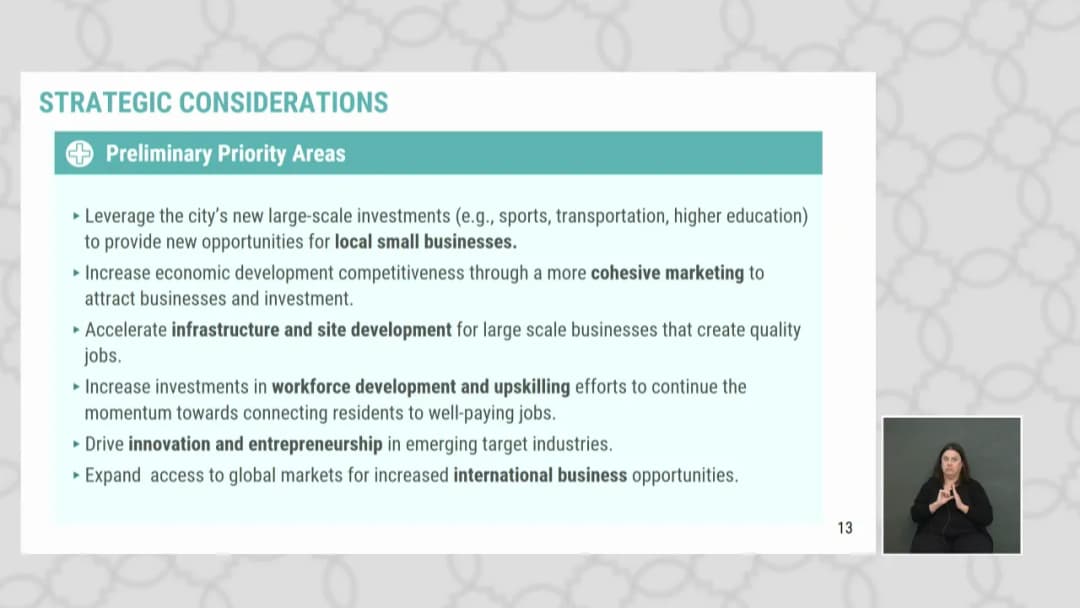
Public Meetings - San Antonio, TexasThe Economic Workforce Development Committee met on May 26, 2026, to receive briefings on the update to the city's economic development strategic framework, recommendations for federal Opportunity Zones 2.0, and procurement policy options related to ICE detention support. No public comment was offered. Consent Calendar - The committee unanimously approved the minutes of the previous meeting with no corrections. Discussion Items - Economic Development Strategic Framework Update – TIP Strategies (John Karas, Tom Stelman, Alexis Angelo) presented an update on the refresh of the 2022 framework. Highlights included: a 50-member advisory committee, 20 stakeholder roundtables, a data-driven competitive analysis, and preliminary themes. Top themes included: underperformance vs. peer cities, opportunities in emerging sectors (e.g., automotive, aerospace, defense, cybersecurity, biosciences), need for cohesive marketing, workforce retention, infrastructure and site readiness, and accountability in implementation. Council members provided input: Councilwoman Castillo urged focus on succession planning for small businesses, district-level economic profiles, and linking workforce training (e.g., Ready to Work) to resident opportunity; Councilman Spears emphasized competitive marketing and flexibility in wage incentives; Councilman Galvan stressed multimodal transportation, density, and community benefits; Councilman Mesa Gonzalez asked how the framework will translate into specific policy actions; Chair Viagran called for accountability metrics and subcommittees to advance identified priorities. Staff confirmed the framework will inform incentive updates and an implementation matrix. - Recommendations for Federal Opportunity Zones 2.0 – Anna Bradshaw (Assistant Director, Economic Development) presented staff's data-informed model recommending 69 of Bexar County's 146 eligible census tracts for nomination to the state by June 26, 2026. The model used four buckets: economic drivers, public/private investment, geographic attributes, and community demographics. Stakeholder input included the Small Business Advisory Commission, TIP Strategies roundtables, and coordination with Bexar County. Council members asked for detailed maps, list of stakeholders, and explanation of scoring methodology. Councilman Galvan requested inclusion of an adjacent tract. Councilman Spears sought clarity on how zoning and resident impact will be addressed. Councilman Mesa Gonzalez stressed outreach to small businesses in designated areas. Councilwoman Castillo voiced concerns about potential gentrification based on past Opportunity Zone studies and asked for coordination with the county and alignment with school closures and New Markets Tax Credit eligibility. Chair Viagran emphasized explaining the designation to residents and ensuring the program delivers community benefits like infrastructure, affordable housing, and services. - Briefing on Procurement Policies Related to ICE – Troy (Finance Department) presented a follow-up to the February 12 council resolution, outlining legal constraints for five proposed strategies on non-contracting, vendor accountability, and value-based criteria. He distinguished between statutory procurements (IFB, RCSP, RFQ) where inquiry is possible but cannot influence award, and non-statutory procurements (RFP, some RFQs) where disclosure can be required and used to determine non-responsiveness. Insurance liability and reputational risk were deemed difficult to quantify. Councilman Galvan and Councilwoman Castillo expressed support for using disclosures on discretionary contracts. Councilman Spears voiced concern about potential negative impact on economic development and public safety cooperation, preferring not to proceed. Chair Viagran suggested bringing an example disclosure form for committee review after the summer break and asked for a memo on timeline. Staff will research other cities' implementation and consider a floor for small business impact. Key Outcomes - No formal votes or binding decisions were made on the discussion items. - Staff (Economic Development) will return to a City Council B session in two weeks with preliminary findings on the strategic framework and will continue refining the Opportunity Zones recommendation with additional stakeholder input and data, meeting the June 26 state deadline. - The committee directed staff to gather examples of disclosure mechanisms from other cities, develop a proposed disclosure form for discretionary contracts, and brief the committee after the summer break on procurement policy options. - The committee expressed intent to consider forming subcommittees to drive specific policy development for the strategic framework and Opportunity Zones.
The Committee on Labor and Economic Development, chaired by Viagran and attended by Galván, Mesa González, Spears, and Castillo, met on May 26, 2026, to discuss the strategic framework for economic development, the nomination of opportunity zones, and a resolution regarding procurement policies related to ICE. The meeting featured presentations from city staff and consultants, followed by extended councilmember discussion. Consent Calendar - Approval of minutes from previous meeting was moved, seconded, and passed unanimously. Public Comments & Testimony - No members of the public were registered to speak. Discussion Items - Strategic Framework Update (2026): John Kerr (Estrategias) and Tom Stolden presented an update on the strategic economic framework, building upon the 2022 version. Key points included: economic context changes (trade policies, automation, reshoring); five target industries (mobility, IT, cybersecurity, biosciences, manufacturing, corporate services); 20+ stakeholder meetings; a 50-member advisory committee; a data dashboard comparing San Antonio to 7 peer cities on 23 variables; net talent inflow from major metro areas and South Texas; and increased outside investment (over $1 billion annually since 2024). Priorities identified by stakeholders: retain/expand existing businesses, job/wage growth, education improvement, and new industrial/commercial spaces. Councilmembers raised concerns about marketing cohesion, infrastructure readiness, small business succession plans, workforce pipelines, transportation, housing affordability, and the need for specific, measurable accountability (e.g., subcommittees, district profiles). President Viagran noted the importance of a cohesive marketing message and urged aggressive focus on San Antonio’s competitive advantages. - Opportunity Zones Nomination: City staff (Ana) presented the process for nominating up to 69 census tracts as qualified opportunity zones, with a June 26 submission deadline to the state. The recommendation was based on a model using poverty rates (≤70% of area median income), existing infrastructure, and input from 50 stakeholders. Councilmembers requested details on the methodology, the list of participants (particularly from colonias), how to avoid gentrification, and how small businesses and housing could benefit. Concerns were raised about transparency, reporting of investments, and potential displacement. The committee asked staff to provide the full list of proposed tracts and a clearer explanation of eligibility criteria before finalizing the nomination. - Procurement Resolution Regarding ICE Interactions: Troy presented a resolution from the February 12 council meeting that explores the city’s ability to consider a company’s business with ICE in procurement decisions. He outlined statutory constraints: under Texas Local Government Code Chapters 252 and 271, for lowest-bid contracts (e.g., office supplies, auto parts, construction materials) the city cannot use ICE-related questions as a minimum qualification. For RFQs and RFPs with multiple criteria (e.g., engineering, consulting), the city may ask but cannot penalize non-response. More discretion exists for discretionary contracts (e.g., concessions, professional services). The presentation also noted potential risk exposure and insurance costs. Councilmembers differed: some (Castillo, Galván, González) supported exploring policies that favor “good neighbor” businesses, while Spears cautioned about barriers to economic development, small business impacts, and public safety (e.g., cooperation with law enforcement). President Viagran proposed developing a “five-star” or “gold star” list of community-friendly contractors and bringing a refined declaration back to the committee after summer break, aiming for full council consideration in the fall. Key Outcomes - The committee directed staff to return with additional details on the 69 proposed opportunity zone tracts, including participant lists, methodology, and a plan to prevent gentrification. - President Viagran announced the formation of subcommittees to delve deeper into strategic framework priorities, such as workforce, infrastructure, and small business support. - For the ICE procurement resolution, the committee asked staff to research policies in other cities (e.g., Chicago, San Francisco, Los Angeles) and to draft a proposed declaration that balances community values with legal constraints. The revised policy is expected to come back to the committee before going to the full council, possibly in the fall. - No formal votes were taken on the above discussion items; they were informational and directional.
The San Antonio City Council convened on May 22, 2026, for a budget workshop to review the city's financial forecast, discuss the fiscal year 2027 budget challenges, and consider options for balancing the budget, including potential property tax increases, fee adjustments, and service reductions. The meeting featured presentations from City Manager Eric (last name not provided) and consultant Daniel Parker of PFM, followed by extensive council discussion. Discussion Items - Financial Forecast & Property Tax Overview: Eric presented the five-year financial outlook, noting that mandatory services (police, fire, federal/state obligations) are growing faster than revenues. He explained the state's SB2 property tax cap limiting annual growth to 3.5% and the city's ability to use unused increment (banked capacity) accumulated over three years. A 3.5% tax increase would raise about $1.9 million in the first year, while an additional 1.6 cents per $100 valuation from unused increment would yield about $3.49 million. Combined, the recommendation would increase property taxes approximately $87 per year for an average homeowner, with exemptions for seniors and disabled residents (including a tax freeze and a $50,000 exemption for those 65+). - Deficit Projections: The city faces a structural deficit projected to grow from $27 million in FY2027 to $136 million over two years (FY2027-2028). Without action, the deficit could reach $264 million over five years. The recommended package includes using unused increment, a 3.5% rate increase, and adjusting fees (emergency transport, fire prevention, environmental parks) to avoid deeper cuts to public safety. - Mandatory vs. Priority Services: Daniel Parker of PFM presented a framework categorizing city services as mandatory (required by law), priority (discretionary but vital), and other city functions. He emphasized that understanding these categories helps guide budget decisions under resource constraints. - Council Positions: - Councilman White: Strongly opposed any property tax increase, arguing the city must cut spending by consolidating departments and programs, noting 68.5% of the budget is personnel costs. He stated, "Pedir a los ciudadanos que paguen más no es aceptable." - Councilman Munguía: Supported the recommendation, emphasizing the need to fund police and fire contracts (CBA mandates) and avoid layoffs. He said cuts to other departments would be necessary if taxes are not raised. - Councilman Viagran: Urged a balanced approach, supporting the recommendation as a way to maintain public safety and infrastructure, but called for transparency and accountability in identifying where cuts would occur. - Councilman Castillo: Supported the recommendation, stressing that city employees also face rising costs and that maintaining jobs and services is a priority. - Councilman González: Expressed reluctance to raise taxes now given inflation and other cost increases, but asked for better communication with residents about the impact. - Councilman Rodriguez: Sought clarification on whether the increase would solely fund police/fire; Eric confirmed that other departments would remain flat, while police and fire budgets must grow due to CBAs. - Councilman Cor: Wanted to see the consequences of not raising taxes (i.e., what significant cuts would look like) before deciding. - Councilwoman Mesa González: Called for clearer presentation of the tax increase impact, including how it translates to resident bills. - Other Proposals: Council members suggested exploring partnerships with Bexar County to reduce duplication of services, using digital twin technology for efficiency, and revisiting fee structures (e.g., permitting, parking tickets). Some opposed cuts to sister cities programs ($300,000) and cultural exchanges, while others demanded ROI metrics. - Community Survey Results: A total of 9,505 responses were collected via phone (8,035) and paper (1,199). Top priorities included homeless services, affordable housing, fire/emergency services, police, and streets. Key Outcomes - No formal votes were taken; the workshop was a preparatory discussion. - The council directed staff to return on June 18, 2026, with a detailed budget proposal incorporating the recommended tax increase and fee adjustments, along with specific reduction options and their impacts. - City Manager Eric committed to providing a transparent breakdown of how the tax increase would be allocated to public safety and to showing the consequences of not adopting the increase (e.g., which programs would be cut). - Staff will also explore financial policies regarding the use of unused increment, a five-year spending growth cap, and improved communication strategies for residents. - The next budget town halls and council meetings will aim to better explain the trade-offs to the public.
The Compliance and Technical Advisory Board (CTAB) convened on Friday, May 22, 2026, at 9:00 AM (presumed) under Vice Chair Jason Vosquez. The board considered three cases for certificates of appropriateness in historic districts. One case was approved with stipulations, one was tabled for further staff review, and one was denied per staff recommendation. No public comments were received. Discussion Items Case 1: CTAB 2026-128 – 136 Gorman (Front Yard Fence) - Request: Install a 4‑foot‑tall wrought‑iron front yard fence with a pedestrian gate and two sliding gates. - Staff Position: Recommended approval subject to stipulations: fence height not to exceed 4 feet and installation of only one driveway gate on the northeast side. - Applicant Position: Represented by Edward (staff). The applicant had already agreed to both stipulations and submitted a revised site plan showing only one driveway gate. - Board Action: Approved unanimously (8‑1, with one abstention) accepting staff’s recommendation. Case 2: CTAB 2026-108 – 626 Nolan Street (Front Door & Columns) - Request: Replace the existing non‑original front door and replace non‑original Corinthian columns/pilasters with Tuscan‑style columns/pilasters. - Staff Position: Did not recommend approval. Recommended maintaining and repairing existing elements in kind, finding the proposed changes inconsistent with the historic character. - Applicant Position: Homeowner Billy Tellas stated the existing door is deteriorating (installed 2005) and inefficient; the columns are plastic and not original. He provided photographs of similar doors and columns in the neighborhood and argued the changes would restore the house to its earlier Doric‑style appearance. - Board Discussion: Commissioners noted the columns are not original and the Corinthian style is inappropriate for the house’s architecture. Staff offered to research historic photos and work with the applicant on an appropriate design. - Board Action: Moved to table the case to continue to the June 26, 2026 hearing, allowing staff to collaborate with the applicant on a design consistent with the historic district guidelines. The applicant agreed to extend the 60‑day review period. Passed unanimously (8‑1 abstention). Case 3: CTAB 2026-109 – 435 Donaldson Avenue (Retaining Wall) - Request: Install a 14‑inch‑high retaining wall along the front yard. - Staff Position: Did not recommend approval; recommended using landscaping for dirt retention instead. The existing berm was noted as a character‑defining feature of the Monticello Park Historic District. - Applicant Position: The applicant was not present and had been unresponsive to staff communications. - Board Action: Moved to approve staff’s recommendation (denial). Passed unanimously. Key Outcomes - Case 128 Approved: Motion carried 8‑1 (one abstention). - Case 108 Tabled: Continued to June 26, 2026, with staff to work with applicant. - Case 109 Denied: Motion carried unanimously. - Minutes Approved: Minutes from the April 17, 2026 meeting approved with one abstention. - Schedule Note: The next regular CTAB meeting (third Friday of June) falls on Juneteenth (June 19, 2026, a city holiday); the meeting has been rescheduled to the fourth Friday, June 26, 2026.
The Historic Design and Compliance Advisory Board (HDRC) convened on Friday, May 22, 2026. Chair Juanita Sepúlveda presided. The board approved the minutes from the April 17, 2026 meeting, heard three cases, and deferred one case to the next meeting due to a 60-day review period. The board also reminded members of the June meeting date change because of the Juneteenth holiday. Consent Calendar - Minutes Approval: The board approved the minutes from the April 17, 2026 meeting. Voting: Davis aye, García aye, Regard abstained, Spiller aye, Fullerton aye (joined after vote started), Pollock aye, Spitz aye, Vázquez aye. Motion passed. Discussion Items Case CTC 2026-128-136 Gorman Street The applicant requested a certificate of appropriateness to construct a fence with a sliding gate and two additional sliding doors. Staff recommended approval with stipulations: the fence height must not exceed four feet, and the gate access should be installed on the northeast side of the property. The applicant agreed to these conditions. The board approved the staff recommendation. Vote: Davis aye, García aye, Regard aye, Spiller aye, Fullerton abstained, Pollock aye, Spitz aye, Vázquez aye. Motion passed. Case HDRC 2026-626 Nolan Street (Deferred) The applicant, Billy Tellis (owner at 626 Nolan Street), sought to replace the non-original front door and existing fiberglass porch columns. Staff recommended denial, finding that replacement would change the architectural appearance and not be appropriate. The applicant argued the existing columns (installed circa 2005 by a non-profit) were plastic and not original, and the door (21 years old) was deteriorating. The board discussed whether restoration to pre-2005 appearance was possible. Staff offered to work with the applicant administratively to find historically appropriate designs. The board voted to defer the case to the next meeting on June 22, 2026 (to stay within the 60-day review window). The applicant agreed to work with staff in the interim. Vote: All present voted to defer. Motion passed. Case HDRC 2026-109 (Retaining Wall) The applicant requested approval for a retaining wall. Staff recommended approval with conditions to mitigate any issues. The applicant did not respond during the meeting, but the board proceeded because the application was complete. The board approved the staff recommendation. Vote: García aye, Regard aye, Spiller aye, Fullerton aye, Pollock aye, Spitz aye, Vázquez aye. Motion passed. Key Outcomes - The board approved the fence/gate for 136 Gorman Street with stipulated conditions. - The board deferred the Nolan Street case to June 22, 2026, for further staff-applicant collaboration on appropriate design. - The board approved the retaining wall for case 109. - Next meeting: The regular meeting on the third Friday of June (June 19) falls on Juneteenth, a city holiday. The meeting will be rescheduled to June 22, 2026. Members were advised to update their calendars accordingly.
The City of San Antonio held a budget goal setting session on May 22, 2026 from 9:07 a.m. to 2:47 p.m. The meeting focused on the FY2027-2028 budget outlook, financial policies, property tax options, community survey results, and a new framework for evaluating city services. Staff presented a recommendation to use unused increment and the state‑allowed 3.5% revenue growth to raise the property tax rate by about 3.5 cents, generating $53.8 million in additional revenue, primarily to cover rising public safety costs. Council members expressed a range of views, with several supporting the recommendation and others staunchly opposing any tax rate increase. The meeting also reviewed the community budget priority survey and a new mandated/priority/city service lens for evaluating expenditures. Consent Calendar - No consent calendar items were discussed. The meeting was a working session with no routine approvals. Public Comments & Testimony - No public comments were taken; the session was a council and staff working session. Discussion Items 1. Financial Policies & Property Tax Overview - Troy Elliott (CFO) reviewed the city’s financial policies, including maintaining a 15% general fund ending balance and the impact of the state’s 3.5% property tax revenue cap (SB2, 2019). He noted the city has never rescinded homestead exemptions and has instead increased relief, including a tax freeze for seniors/disabled residents. Estimated property tax relief (foregone revenue) for 2026 is $149 million – $73M homestead exemption, $50M over‑65 exemption, $23M tax freeze. - HB9 (effective 2027) will exempt $125,000 of tangible personal property, reducing general fund revenue by $5.6 million and debt service by $3.6 million (total $9.2M). - Elliott presented options: current property tax rate would lose $8.2 million in FY27. Using $29.1 million in unused increment (from tax years 2024‑25) plus moving to the 3.5% state‑allowed growth would raise the M&O rate by 3.49 cents (to about $0.36), generating $53.8 million. For the average homestead ($233,000 value), this means $6.75 per month increase; for the median homestead ($198,000), $5.84 per month. About 117,000 of 254,000 homesteads have a frozen tax bill (over‑65/disabled) and would not be affected. - Eric (City Manager) stated the additional revenue is solely to pay for existing public safety expenses (police/fire CBAs, health care, technology, equipment, fuel, mandated costs) totaling $77.2 million in FY27. The $53.8M would cover a portion; $15.6 million in targeted reductions over two years would still be needed. - Freddie Martinez (Budget Director) showed the five‑year forecast: revenues decline 0.6% in FY27 then grow 2.1% on average; expenses grow 6.3% in FY27 and 3.8% thereafter. The projected deficit in FY28 is $130.7 million, growing to $264 million by FY31. Using the recommended property tax changes reduces the FY28 deficit to zero and the FY31 deficit to $155 million. 2. Council Discussion on Property Tax Increase - Councilmember McKee Rodriguez supported the recommendation and suggested adopting a policy for annually reviewing unused increment to avoid losing it. He asked for evaluation of a formal policy similar to the CPS energy policy. - Councilmember Mungia supported the recommendation, noting that $130M in cuts over two years would be unacceptable. He requested a district‑by‑district breakdown of median/average home values. - Councilmember Alvarete‑Gavito opposed raising property taxes, especially with other cost increases (SAWS, groceries, gas). She urged looking internally first. - Councilmember Mesta Gonzalez supported the recommendation, saying residents understand the need to pay for services like ambulances. She stressed better communication with the public. - Councilmember White strongly opposed, calling the tax increase a “non‑starter.” He argued for cutting spending, citing a “structural problem” with 68.5% personnel costs and $231M in non‑mandated services. He opposed the idea that the increase would only go to public safety, saying money is fungible. - Councilmember Viagran supported the recommendation, insisting on honest conversations about where cuts would fall. She urged colleagues to identify what they would cut instead. She also noted San Antonio has not raised property taxes in 33 years. - Councilmember Galvan supported the recommendation, arguing that austerity alone won’t deliver the services communities deserve. She asked for an estimate of staff reductions if cuts were made. - Councilmember Castillo supported the recommendation, emphasizing the importance of protecting city employees’ jobs and that additional revenue is needed to fund public safety and fair CBAs. - Councilmember Corr was cautious, wanting to understand the full impact of cuts before supporting a tax rate increase. She noted 800 vacancies citywide and suggested some could be eliminated. She also stressed improving service delivery to build public trust. 3. Community Survey Results - Alana Reed (Communications Director) presented FY2027 budget priority survey results: 9,554 responses to the SA Speak Up survey (8,355 online, 1,199 paper) plus a statistically valid survey by ETC Institute (1,104 completed, ±2.9% margin of error). Top priorities: homeless services, affordable housing, police services, streets, fire/EMS, and animal care services. Affordable housing was the 1 first choice. 4. PFM Presentation on Budget Decision‑Making Lens - Danielle Parker (PFM) outlined a new framework categorizing services as mandated (72% of general fund), priority (services council identified as vital but not legally required), and city services (all other). Of mandated services, 40% were also considered priority by council. Staff prepared individual department breakdowns for 21 public‑facing departments. Parker summarized council’s one‑on‑one input: priorities include public safety (response times, speeding, gun violence), infrastructure (streets, sidewalks, mobility), and human services (homelessness, seniors, parks, libraries). She encouraged focusing on outcomes, multi‑year strategies, and partnerships. 5. Afternoon Discussion on Goals, Priorities, and Budget Reductions - Mayor opened with remarks: need to identify new revenue streams, balance budget over two years, and show the public that efficiencies have been maximized. He emphasized digital twin investment, audit recommendations, and linking cuts to service impacts. - Councilmember McKee Rodriguez reviewed the $231.1 million in non‑mandated/priority services, noting that cutting programs like SA CORE, health & wellness, domestic violence, mental health, Head Start, library services, and police mental health units would be harmful. He asked for more granular breakdowns (personnel, commodities, contractual) to identify scaling opportunities. - Councilmember Mungia highlighted recent tragedies (domestic violence, mental health) and argued that cutting prevention programs would make police jobs harder. He asked for incremental tax increase options (1%, 1.5%) and analysis of how cuts affect previously adopted strategic plans (ACS, SA Tomorrow, SHIP). - Councilmember White reiterated that the tax increase only delays the deficit (still $155M in FY31). He advocated for growing revenue through economic development, not taxing residents. He listed several “city services” (e.g., downtown events, sister cities, fair housing analysis) totaling millions that should be scrutinized before raising taxes. - Councilmember Alvarete‑Gavito opposed a tax increase, calling for partnerships with the county to avoid duplication. She stressed cutting before asking residents to pay more. - Councilmember Galvan supported using the property tax revenue, arguing for long‑term investments in education, workforce, and infrastructure to drive economic development. He opposed “technical” abatements that forego revenue. He wanted to preserve prevention programs and quality‑of‑life services in underserved areas. - Councilmember Viagran offered to defer a public works project in her district to help balance the budget. She defended international programs (sister cities) as economic development tools. She suggested increasing permit fees (e.g., for fireworks, garage sales) and enforcing parking ticket collection. - Councilmember Mesta Gonzalez called for better transparency on the $53.8M increase – residents need to understand how it improves their neighborhood and safety. She urged clear communication in town halls. - Councilmember Castillo supported aligning budget with adopted plans (SA Tomorrow, SHIP). She asked for departments to be named when discussing cuts to humanize the impact. She advocated for preserving grant‑funded positions and programs like Pet Care Connect. - Councilmember Corr highlighted that low‑barrier shelter funding (for 190 people) expires this year; she argued it should be a priority to continue. She also pushed for expanding the sidewalk rebate program and for better data on street maintenance history. - Councilmember Spears asked how the deficit “sneaked up” on the city; she wanted to see a model without a tax increase, a list of all grants available, and information on one‑time expenditures. She emphasized cutting luxuries before raising taxes and called for intergovernmental relations to find state/federal funding. Key Outcomes - Staff Recommendation Endorsed by Several Members: The property tax increase (unused increment + 3.5% growth) has support from a majority of council members, but strong opposition from at least two members (White, Alvarete‑Gavito). No formal vote was taken. - Next Milestone – June 18, 2026: Staff will present a Trial Budget that includes specific reduction options, fee adjustments (EMS transport, fire prevention, etc.), and potential revenue from other sources (vacant properties, short‑term rental fees, etc.). The trial budget will be a first draft; the proposed budget will be released in August 2026. - Direction to Staff: - Provide more granular breakdowns of non‑mandated/priority programs (headcount, salaries, vacancies). - Show impact of cuts on service levels, performance measures, and strategic plans (e.g., SA Tomorrow, ACS plan, Vision Zero). - Include a model without a tax increase to illustrate required cuts. - Explore partnerships with county (Animal Care Services, libraries, etc.). - Evaluate options for small tax rate increments (e.g., 1%, 1.5%). - Enhance communication materials explaining how property tax revenue directly supports public safety. - Future Discussions: Economic development framework (B session in June), bond program (debt service tax rate options), and continued intergovernmental relations efforts.
The San Antonio City Council met on May 21, 2026, at 9:06 a.m. at City Hall. The meeting began with an invocation, pledge of allegiance, and approval of minutes. Mayor Gina Ortiz Jones presided. Key actions included a proclamation for YMCA Uniting Generations Month, recognition of National Public Works Week, approval of consent agenda items, and a vote on $19.3 million in consolidated human services funding for delegate agencies. Public Comments & Testimony - Ellen Clark spoke on consent agenda items (topic not specified). No other speakers for the general consent agenda. - On Item 18, multiple speakers supported funding for their organizations: - Kayla Carter (ForHER) described trauma-informed services for women survivors of violence, citing 91% improved mental health and 34% improved economic status among clients. She requested continued funding. - Bethany Anderson read a testimony from May Zarniki, a ForHER client, emphasizing the long-term reliability of services. - John Bustamante (District 5 resident) supported ForHER, noting its high scoring in the city's evaluation. - Stephanie Finleon Cortez and Rachel Sherman (Girl Scouts of Southwest Texas) highlighted the program's impact on youth development and leadership. - Fatima Espinoza (Avance San Antonio) described the parent-child education program, noting 97% family satisfaction and partnerships with school districts. - Jessica Smith Perry (Boys & Girls Clubs of San Antonio) shared stories of children whose lives were transformed, noting a $12 return per dollar invested. - Gabrielle Guzman (Boys & Girls Clubs) spoke as a former club participant now staff member, emphasizing safe spaces and mentorship. - Diana Flores (constituent) urged more funding for homeless services and housing, citing fears among homeless residents. - Jeremy Maginell (SA Youth) discussed re-engaging opportunity youth, noting 36,000 disconnected youth in the city and the economic cost of high school dropouts. Proclamations & Recognitions - YMCA Uniting Generations Month: Mayor Jones proclaimed June 2026 as YMCA Uniting Generations Month, celebrating 150 years of service. Luis Lopez (YMCA CEO) accepted, noting over 3.3 million individuals impacted. Councilmembers thanked the YMCA for its programs and future Gordon Hartman Family YMCA (opening 2027). - National Public Works Week: Councilmember Castillo recognized the Public Works Department for maintaining streets, drainage, and infrastructure. Public Works representatives highlighted the department's 700 employees and their role as first responders. - City Manager’s Report: A video spotlighted two Parks & Recreation maintenance workers, Crystal and Israel, who maintain over 250 city parks. Discussion Items - Consent Agenda: Items 5–18 were approved as a group except Item 18 (pulled for recusal). Councilmember Alderte Gabito highlighted Item 5 (pedestrian improvements on Calibra Road from Bandera to General McMullen, noting its inclusion in the Vision Zero report). Councilmember Castillo highlighted Item 12 (appointment of Cassandra Tyson to Small Business Advisory Commission). - Item 18 – Consolidated Funding for Delegate Agencies: The ordinance authorized up to $19,274,266 in consolidated funding for human services and homeless services delegate agencies for a 16-month term (June 1, 2026 – September 30, 2027) with an option to renew through September 30, 2028. Councilmember Mungia recused himself from voting on funds for Guardian House (a sub-item). - Amendment: Councilmember Alderte Gavito moved to remove the option to extend contracts through fiscal year 2028, requiring a strategy session before FY2028 contracts. The amendment was seconded by Councilmember Mesa Gonzalez. After discussion, the amendment passed unanimously (all present voting yes). Councilmember Viegran requested a timeline for the session; Alderte Gavito indicated a target in fall 2026. - Main Motion (as amended): Approved with Councilmember White voting no, citing budget constraints and the need for cuts across city departments. The motion carried. - Guardian House: A separate motion to approve funding for Guardian House was approved, with Councilmember Mungia recused and White voting no. The motion carried. Key Outcomes - Consent Agenda: Approved (minus Item 18). - Item 18 (Consolidated Funding): Approved as amended – contracts run through FY2027 only; the option to extend to FY2028 is removed. A strategy session on delegate agency funding reform will be held in fall 2026, led by Councilmembers Alderte Gavito and Mesa Gonzalez. - Guardian House: Funding approved separately. - Meeting Adjourned: 10:31 a.m.
The San Antonio City Council convened on May 21, 2026 at 9:06 AM. The meeting included an invocation, approval of minutes, proclamations, recognitions, public comments, and consideration of a consolidated human services funding ordinance. Council members voted on consent agenda items and debated an amendment to remove the renewal option for certain contracts. Consent Calendar - Approved minutes from the May 6–7, 2026 council meetings (unanimous). - Councilmember Castillo highlighted item 12, recognizing Cassandra Tyson for her appointment. - Councilmember Galván highlighted item 5, a construction contract for pedestrian improvements on Culebra Road between General McMullen (Districts 7 and 5), noting it is one of the most dangerous streets in San Antonio and that the improvements are supported by neighborhood associations. - The consent agenda was approved except for item 18 (separate vote). Public Comments & Testimony - Kayla Carter (President and Founder of FOHAR) spoke in support of continued investment in trauma-informed services (yoga, mental health support) for survivors of sexual and domestic violence. She reported that 91% of support groups reported improved mental health and 30% reported improved economic status. - Stephanie Anderson (District 7 resident) testified that FOHAR helped her find a path after sexual assault and urged the council to support the organization, noting the Department of Human Services’ recommendation. - John Bustamante (father of two, District 5) spoke in support of FOHAR, emphasizing the need to address the prevalence of sexual and domestic violence in San Antonio. - Fatima Espinoza (education administrator) spoke in support of the PICEP two-generation program, reporting 97% family satisfaction and 93% of children exceeding developmental benchmarks. She noted that 700 families will graduate from the program in two weeks. - Jessica Smith Perry spoke in support of Boys & Girls Clubs of San Antonio, describing them as preventive investments that give children safe places and opportunities. - Gabriel Guzmán spoke in support of Boys & Girls Clubs, emphasizing that the programs teach confidence and responsibility and provide meals and consistency. - Jeremy Maldonado (Boys & Girls Club member) spoke in support of continued funding, sharing his personal experience and asking that no child be left without a safe after-school space. - A speaker (unidentified) expressed concern about homelessness and indigent people, urging more funding for housing and development for the homeless, and also offered a prayer. - Jerry Maginel (Interim Director of SA Youth) spoke in support of funding for youth programs, stating that since 1984, SA Youth has provided education, workforce, case management, and therapy services to youth in west San Antonio, serving 55 zip codes. He noted that each high school dropout costs society $272,000 over a lifetime, and that investing in programs like SOR strengthens the city’s future. - Additional speakers supported the Girl Scouts of Southwest Texas and other nonprofit organizations. Discussion Items - Item 18 – Consolidated Human Services Funding Ordinance: Proposal to authorize up to $19 million in consolidated funds for human services and homeless services from June 1, 2026 to September 30, 2026, with an option to renew through fiscal year 2028. Councilmember Munguía recused himself from the vote. - Councilmember Alderete Gavito expressed discomfort with the current process, noting that many small contracts ($50,000 each) may address similar issues. She proposed an amendment to remove the renewal option for FY2028 and to require a strategy session before FY2028 to improve coordination, consolidate services, and evaluate financial stability. Councilmember Mesa González seconded the amendment. - Councilmember Villagrán supported the amendment, asking for clarity on the timing of the strategy session (before the July recess). He also noted that three different entities receive funding but serve different populations, and requested a breakdown of programs and client numbers. - Councilmember Corr thanked nonprofits for their work, emphasized the need to support them amid federal cuts, and noted that the city added $150,000 to the budget for Champions Academy thanks to city staff. She stressed the importance of metrics and tracking results. - Councilmember White agreed with the concept and the amendment, noting that the conversation about strategic allocation of funds has been needed. - The amendment was put to a vote and passed. The main motion (with the amendment) was then voted on, with Councilmember Munguía recused. The motion passed. Key Outcomes - Consent agenda approved unanimously (excluding item 18). - Item 18 (consolidated human services funding) was approved with an amendment that removed the option to renew contracts through FY2028. The amendment requires a strategy session to be held before FY2028 to reassess funding allocation, consolidation, and collaboration with philanthropic partners. - Councilmember Munguía recused from voting on item 18. - The meeting adjourned at 10:31 AM.
The San Antonio Zoning Commission held a regular meeting on May 21, 2026, at 2:04 PM, with Councilmembers Kur, Maki Rodríguez, Villagrán, Munguía, Castillo, Galván, Alderete Gavito, Mesa González, Spears, White, and Mayor Jones present. The meeting addressed a consent calendar and individual zoning items. Consent Calendar - Items 3, 4, 5, 6, 7, 8, and 14 were approved unanimously as part of the consent agenda. No objections were raised. Public Comments & Testimony - On Item 18 (Old Freddie's Road): - Ashley Fairman, attorney for applicant Schnitter Steel, expressed support, stating that JBSA had no objection and the use was compatible across the campus. - Clifton Lewis, representing the homeowners association, opposed the project, citing concerns about air pollution from tractors and trucks, and impact on wildlife (coyotes, raccoons). - Brandon Wen was recognized but no statement was recorded. Discussion Items - Item 1 (1115 UCLID Ave): Zoning change from R6A and DZ1 to NC for two units. Staff recommended denial; commission recommended approval. 3 notifications in opposition, no response from neighborhood associations. Motion to approve passed. - Item 2 (760 East Murdo): Zoning change from R6 to IDZ1 for 24 units. Staff denial; commission approval. 8 in favor, 13 opposed out of 55 notifications. Motion to approve passed. - Item 9 (1610 Speedway Run): Zoning from BP to L with use for storage and covered property, no outdoor storage. Staff denial; commission approval. 0 favor, 0 opposed from 16 notifications. Motion to approve with conditions passed. - Item 10 (13005 SW Loop): Zoning change from MF-25 to C-2 for parking and storage. Staff denial; commission approval. 2 favor, 0 opposed; additional 47 notifications returned in favor. Motion to approve passed. - Items 11 & 12 (1904 Nogalitos): Plan amendment and zoning change from neighborhood commercial to regional commercial for tobacco shop and smoking area. Both staff and commission recommended denial. 47 notifications, 0 favor, 12 opposed. Motion to deny passed. - Item 13 (2408 Del Paso Street): Zoning change from R-4 and DZ-1 to C-1 light commercial. Staff denial; commission approval. 2 favor, 0 opposed from 27 notifications. Motion to approve passed. - Items 15 & 16 (400 Avenu, Kelly South San Pueblo): Plan amendment and zoning change from public institution to community commercial. Both staff and commission recommended approval. 28 notifications, no opposition; Quintana Camer association in favor. Motion to approve passed. - Item 17 (District 7): Zoning change with staff denial and commission approval. 2 notifications, 1 favor, 0 opposed. Motion to approve passed. - Item 18 (Old Freddie's Road): Zoning change for storage and manufacturing (inside container structures). Staff denial; commission approval. 71 notifications, 0 in favor, 4 in opposition (outside 200 feet). After testimony, Councilmember Mesa González moved to approve, citing a no-objection letter from the military and work to be done indoors. Motion passed. Key Outcomes - All items except 11-12 were approved. - Items 11 and 12 were denied. - The meeting concluded after the vote on Item 18.