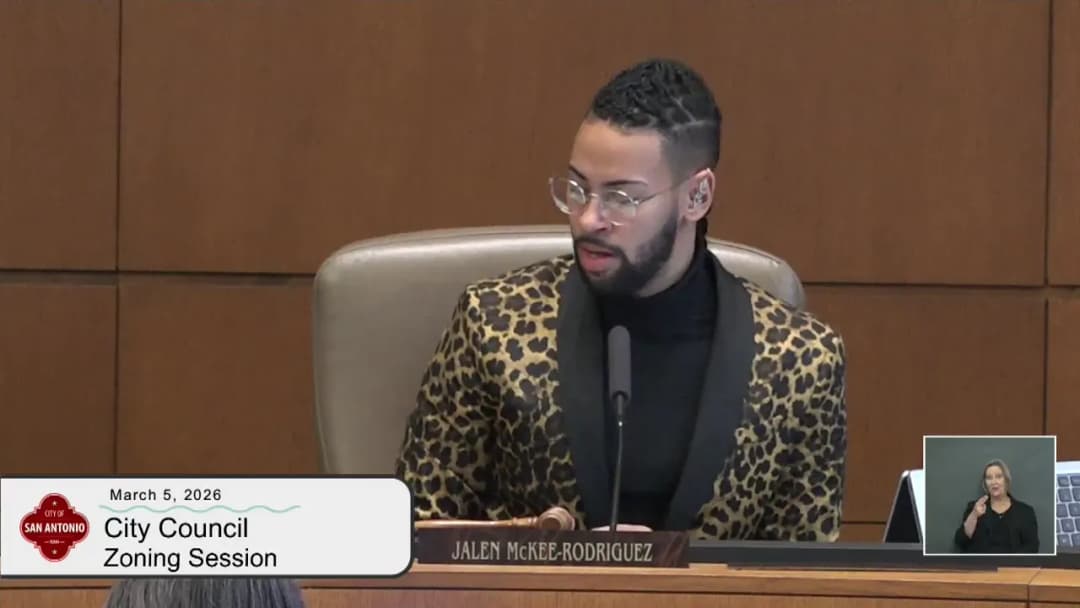
The San Antonio City Council met on March 5, 2026, starting at approximately 9:00 AM. The meeting included proclamations for Women's History Month, National Nutrition Month, and Social Worker Week, as well as a youth mental health survey presentation. The council received a report on the implementation of the immigration resolution passed on February 12, 2026, and debated a resolution to initiate zoning code changes for detention centers. Public comment was heard on multiple items. The council voted to approve the consent calendar (minus two items), a resolution to begin the detention center zoning process (including a moratorium consideration), the Code Enforcement Strategic Plan, and the SATX economic partnership agreement. The meeting went into executive session at 1:58 PM. Consent Calendar - Approved the minutes from February 11, 12, 18, and 19, 2026. - Approved numerous routine items including contracts, appointments, and grant acceptances, with several council members highlighting specific items: Item 14 (I-37 access contract), Item 45 (Eisenhower and Midland intersection project), Item 12 (Culebra Street safety improvements), Item 30 (appointment of Dr. Rocha Garcia to Housing Trust), Item 22 (Mike Vazquez to Veterans Advisory Commission), Item 41 (Goodwill San Antonio building), Item 46 (Women's Center for Recovery funding), Item 13 (additional funding for public outreach and grant project), Item 23 (appointment of Cheyenne Rendon), Item 43 (opioid crisis response funding), Item 20 (anti-gang program funding), Item 21 (appointment of Daniel Mesa to Small Business Advisory Commission), and Item 28 (appointment of Adrian Berumen to Commission 16). Public Comments & Testimony - Antonio Díaz (on consent item 14) and Jack Finger (on consent item 33) spoke; Finger objected to the appointment of a LGBTQ+ council member, citing religious beliefs. - Herschel Boyd urged the council to change meeting times to allow public participation. - Priscila Olivares and Hilda Santiago gave emotional testimony against ICE detention centers; Hilda described her husband's detention and the family's financial and emotional toll. - Pedro Ruiz raised concerns about parking and warned of civil unrest if detention centers are built. - Ricardo Jiménez Reyes, a pastor and psychologist, urged the council to reject detention centers, citing trauma to families. - Antonio Díaz (second appearance) called for a moratorium and stronger intergovernmental agreements. - Diana Flores Uriegas and Diana López spoke against detention centers, invoking history and the Pledge of Allegiance. - Thomas Robinson (name only, no speech recorded). - Don Balmonte and Montgomery Howard spoke in support of the Code Enforcement Strategic Plan, praising improved communication and proactive enforcement. Discussion Items Proclamations and Recognitions - Women's History Month – The council recognized former councilmember María Antonieta de Zavala, the first Latina elected to the San Antonio City Council (1991). Several council members thanked her for paving the way. The proclamation declared March 8, 2026 as International Women's Day and March as Women's History Month. - National Nutrition Month – Councilmember Villagrán highlighted food deserts in the South Side, the Viva S initiative (started in 2019 with $50,000), and challenged colleagues to promote farmers markets. Representatives from Metro Health, San Antonio Food Bank, and Texas Academy of Nutrition spoke about the importance of healthy food access. - Social Worker Week – Council recognized social workers in schools; Irma Hess spoke about their role in addressing mental health, poverty, and trauma. - Youth Mental Health Survey – Youth representatives Natalie Salcedo (District 6) and Erin Logan (District 8) presented results: 36% of youth felt hopeless in 2024 (down from 49% in 2022), but LGBTQ+ youth still face higher rates. They requested $70,000 for mental health support. Several council members pledged $2,000 each from their district funds. City Manager Report on Immigration Resolution Implementation - City Manager Maria Villagomez presented an update on the resolution passed February 12, 2026. Actions completed: continuation of legal status referrals, "Know Your Rights" training by American Gateways, economic impact report on migrants (available on city website), identification of city resources, intergovernmental coordination, and tracking of ICE assistance requests (none as of Feb 12). Actions in progress: staff training on protocols, a public dashboard of ICE activity (to launch March 6), and a third-party mechanism for reporting rights violations (expected by end of March). Items needing additional evaluation: procurement policies, detention facility codes, environmental review, and a justice fund for victims (estimated completion April 15). Council discussed the need for a moratorium and asked for clarification on points 20 and 21 (insurance/risk and training). Councilmember Makki Rodríguez proposed exploring a moratorium alongside the zoning changes. Agenda Item 5 – Resolution to Initiate Zoning Code Changes for Detention Centers - Assistant City Manager Andy Tomás presented two options: a standard 3-month process or an accelerated 1-month process. He noted a moratorium would be limited to 180 days and require lengthy public hearings. Council debated the effectiveness of a moratorium versus a permanent zoning amendment. Councilmember Rodríguez moved to amend the resolution to include a moratorium process. The amendment passed by voice vote. The main motion (as amended) passed with Councilmember White and Spears voting against. The resolution directs staff to begin the zoning code amendment process and simultaneously consider a moratorium. Agenda Item 33 – Code Enforcement Strategic Plan - Councilmember Corr (who pulled the item) expressed concerns about vague metrics. Councilmember Munguía and others supported the plan, noting it was developed with community input. Public comments from Don Balmonte and Montgomery Howard praised the plan and requested evening/weekend enforcement. Councilmember Villagran emphasized the need for performance metrics. The plan was approved unanimously. Agenda Item 34 – SATX Economic Partnership Agreement - The agreement is for one year (up to $759,250) with two renewal options. Councilmember Corr asked about metrics and verification. Director Brenda Hicks explained that verification is based on public announcements and documentation. Several council members expressed support for SATX and its role in economic development. The item was approved unanimously. Key Outcomes - Consent Calendar approved (minus items 33 and 34). - Resolution on Detention Center Zoning (Item 5) – Approved as amended to include a moratorium process. Staff instructed to begin the accelerated zoning amendment process and simultaneously pursue a moratorium ordinance. - Code Enforcement Strategic Plan (Item 33) – Approved unanimously. Staff will report quarterly to the Community Development Committee on metrics, using 2025 as a baseline. - SATX Agreement (Item 34) – Approved. Staff will provide a detailed verification process and consider additional performance metrics. - Executive Session – Held at 1:58 PM under Texas Government Code sections 551.087 (economic development), 551.072 (real property), and 551.071 (attorney consultation). No action taken. - Youth Mental Health Funding – Council members collectively pledged $2,000 each from district funds to support a pilot program, with a report expected in April.
Public Meetings - San Antonio, Texas
Public Meetings - San Antonio, TexasThe San Antonio City Council held a zoning meeting on March 5, 2026, at 2:07 PM, with a quorum present. The meeting addressed several zoning items, including a withdrawn item, postponements, a consent calendar, and two contested zoning cases (Items 5 and 8). Public comments were heard, and both contested items were approved by the council. Postponements - Items 6 and 7: Postponed to March 19, 2026, after a motion and second, with no public speakers. - Items 3 and 4: Postponed to April 2, 2026, after a motion and second, with no public speakers. Consent Calendar - The consent calendar was approved unanimously with no public speakers. Discussion Items - Item 5 – Zoning Change for Vehicle Sales at 5251 Piercer Road (District 4): The application sought to rezone from RM4 AC2 CTD with a conditional use overlay for vehicle sales. Staff recommended denial, while the Zoning Commission recommended approval. Fourteen notices were sent with zero responses for or against. Two members of the public spoke: - Jack Finger opposed the change, citing staff's finding that it would harm the health, safety, and welfare of nearby residents and was inappropriate in a commercial/industrial zone adjacent to single-family housing. - A second speaker (identified as a woman, possibly representing the applicant) argued in support, stating the property had been operating for 30 years, the owner built an on-site residence, and the zoning change would allow the business to continue without code violations, consistent with the area's mixed-use plans. Councilmember Munguía (District 4) moved to approve the item, and the motion carried unanimously. - Item 8 – Zoning Rezoning for a 24-Foot Structure at 601 Pruitt Avenue (District 5): The application sought to rezone from R5 to R5 S with authorization for a 24-foot structure. Staff recommended denial, and the Zoning Commission recommendation was pending. Sixteen notices were sent with zero responses for or against; one additional notice was sent outside the 200-meter radius. Public comments: - Jack Finger opposed the project, describing the proposed structure as a "monstrosity" or cell tower that would create a commercial intrusion into a residential neighborhood. - Ken Brown (from Cambrian) stated he was present only for technical questions. Councilmember Castillo (District 5) spoke in support, noting the applicant had invested over $30,000 in property improvements, preserved an existing affordable housing unit, and aligned with the city's equitable housing plan. She moved to approve, and the motion carried unanimously. Key Outcomes - Item 5 (Vehicle Sales): Approved on a motion by Councilmember Munguía, seconded, with all council members voting in favor. No opposition. - Item 8 (24-Foot Structure): Approved on a motion by Councilmember Castillo, seconded, with all council members voting in favor. No opposition. - Item 1: Withdrawn before the meeting. - Postponements: Items 6 and 7 moved to March 19, 2026; Items 3 and 4 moved to April 2, 2026; all passed unanimously. - The meeting adjourned at 2:21 PM.
The City of San Antonio Zoning and Land Use Session was called to order at 2:07 PM on Thursday, March 5, 2026, and adjourned at 2:21 PM. The session included withdrawals, continuances, consent agenda, and two contested zoning items. Quorum was present with Mayor Pro Tem presiding. Consent Calendar - The consent zoning items were approved unanimously by voice vote with no registered speakers. Continuances - Items 6 and 7 were continued to March 19, 2026. One speaker (Marvin Hasanaya) spoke in favor of continuance; Dennis Driyard was not present. - Items 3 and 4 were continued to April 2, 2026, without public comment. Public Comments & Testimony - Item 5 (5251 Old Pearsall Road): Jack Finger spoke in opposition, citing planning staff's concern that the change would isolate a single-family dwelling within commercial/industrial zones and be detrimental to residents. Ryan Plaggins (applicant representative) spoke in support, noting the owner has lived and operated a truck service on the property for 30 years without realizing it was zoned RM4, and the proposed C2 CD zoning complies with the Port San Antonio plan. Councilmember Mungia stated the first speaker was mistaken and that the use has existed for over three decades, before the property was in city limits. - Item 8 (601 Pruitt Avenue): Vincent Hubinger (co-representative) was present for technical questions. Jack Finger spoke in opposition, calling the proposed 120-foot cell tower a monstrosity and citing planning staff's concern about commercial encroachment. Councilmember Castillo spoke in support, noting the applicant agreed to preserve the existing home, invest $30,000 in improvements, and maintain affordable housing in alignment with the SA Tomorrow plan. The Collins Garden Neighborhood Association was in favor. Discussion Items - Item 5 – Change of Zoning from RM4 to C2 CD with Conditional Use (Manufactured Homes/Oversized Vehicle Sales/Service/Storage): Located at 5251 Old Pearsall Road. Staff recommended denial; Zoning Commission recommended approval. Staff mailed 14 notices; zero returned in favor or opposition; no response from the Southwest Community Neighborhood Association. Councilmember Mungia motioned to approve, citing the long-standing existing use and compliance with the Port San Antonio plan. The motion carried. - Item 8 – Rezoning from R5 to R5S with Specific Use Authorization for a Wireless Communication System (Reduced Setback of 24 feet): Located at 601 Pruitt Avenue. Staff recommended denial; Zoning Commission recommended approval. Staff mailed 16 notices; zero returned in favor or opposition; Collins Garden Neighborhood Association in favor; one additional notice in favor outside the 200-foot boundary. Councilmember Castillo motioned to approve after noting the applicant's agreement to preserve the existing residential structure and provide $30,000 in improvements. The motion carried. Key Outcomes - Item 1 was withdrawn. - Items 6 and 7 continued to March 19, 2026. - Items 3 and 4 continued to April 2, 2026. - Consent zoning items approved unanimously. - Item 5 (5251 Old Pearsall Road) approved (motion by Councilmember Mungia). - Item 8 (601 Pruitt Avenue) approved (motion by Councilmember Castillo). - Meeting adjourned at 2:21 PM.
The Building Standards Committee (Comité de Normas de Construcción) of the City of San Antonio met on March 5, 2026, at 9:00 AM. The meeting was conducted bilingually, with interpretation services provided. The committee addressed six properties deemed dangerous structures, with votes on demolition, continuance, and other orders. The meeting concluded at 11:18 AM. Consent Calendar - The minutes from the February 5, 2026 meeting were approved unanimously. Staff Report - Emergency demolitions were reported for 2418 San Luis Street (District 5, demolished on an unspecified date), and 2023 South Trinity Street (demolished on February 3, 2026, due to a February 4, 2026 fire). No council action was required. - Personnel changes: Jenny Ramirez (Code Implementation Manager) announced promotions of Denny Liguez to Assistant Director and Melissa Ramirez to oversee structural inspections. A vacancy was created by a move to Public Works. Discussion Items 214 Brook Street (District 2) - Staff Presentation: Cynthia Santana (Dangerous Structures Officer) presented photos showing a 1930s single-story residence with fire damage from August 2024, missing windows, charred roof, exposed subfloor, and lack of utilities. The structure was deemed unsafe and uninhabitable, violating City Code Chapter 6-156 subsections 1,2,5,7,8,11,12,15,17,18. An electrical permit had expired; no fire damage assessment was obtained. A notice to vacate was posted July 8, 2025, but the owner's son continued living there. - Owner Testimony: James Delagarza stated he is the beneficial owner (legal transfer from his sister pending), has $60,000 in savings, and has hired electrician, plumber, and roofer. He claimed difficulty obtaining permits due to ownership documents and requested time to repair. - Safety Officer Testimony: Officer Richie Robledo (District 2) confirmed reports of trespassing, gunfire, and fires set inside the structure, posing a risk to adjacent homes. - Committee Discussion: Members questioned the owner about progress, financial capacity, and lack of permits. The owner acknowledged not securing a required fire damage assessment or engineer's report. - Motion and Vote: Anne Weiner moved that the property be declared a public nuisance, not reasonably repairable, and ordered demolition within 30 days, with cleanup and utility disconnection. An amendment to include eviction was accepted. The motion passed 5-2 (Weiner yes, Hernandez no, Solis yes, Benke yes, Andes yes, Baldwin yes; the transcript states "5-2" but the roll call indicates 5 yes and 1 no, possibly due to an absent member or miscount). 5246 Village Crest (District 2) - Staff Presentation: Cynthia Santana presented a 1967 single-story residence with fire damage from 2025, charred walls, large holes in the roof, missing garage door, and evidence of homelessness. No permits, no contact with owner. Recommended demolition. - Representative Testimony: Elizabeth Rogers spoke on behalf of the owner, Sumen Carrie A, who is incarcerated. She stated the owner has $63,000 in savings and a contractor estimate of $39,060 for repairs (including demolishing the garage). She requested a continuance to obtain proper documentation. - Legal Issue: The representative lacked a power of attorney or written authorization. The committee allowed her to speak but noted that without proper documentation, her testimony could not be fully considered. - Motion and Vote: The committee moved to continue the case to the next available date, no later than 90 days, with conditions: secure the main structure (excluding the garage) with a perimeter fence, and require the representative to provide a power of attorney, a full scope of work, and a timeline. The motion passed 6-1 (as stated in the transcript; roll call shows all 6 present members voting yes, so the single no vote may be from a seventh member not listed). 267 North San Gabriel (District 5) - Staff Presentation: Crystal Town (Dangerous Structures Officer) presented a property with a dilapidated main structure and accessory building, both with rotted wood, exposed foundations, and evidence of auto theft and drug activity. No permits, no owner contact. Recommended demolition. - Safety Officer Testimony: Officer Peña (SAFE Unit) reported multiple police calls, a stolen car found on the property, and arrests for narcotics. - Motion and Vote: Robert Benke moved to declare the property a public nuisance, not repairable, and order demolition within 30 days, with cleanup and eviction. Amendment for eviction accepted. Motion passed unanimously. 165 Stribling (District 5) - Staff Presentation: Jerry Collins (Dangerous Structures Officer) presented a single-family residence with rotted wood, missing siding, deteriorating foundation, cluttered interior, and two accessory structures in similar condition. No permits, no owner contact. Recommended demolition. - Motion and Vote: Robert Benke moved to declare the property a public nuisance, not repairable, and order demolition within 30 days, with cleanup and debris removal. Motion passed unanimously. 711 West Gerald Avenue (District 3) - Staff Presentation: Sergeant Quintanilla (Dangerous Structures Officer) presented a fire-damaged property where the main structure had already burned down. The remaining accessory structure had a collapsed roof, rotted foundation, and evidence of animals. No permits, no owner contact. - Motion and Vote: Ryan Bowen moved to declare the accessory structure a public nuisance, not repairable, and order demolition within 30 days, with cleanup and securing. Motion passed unanimously. 256 Briggs Street (District 4) - Staff Presentation: Stephanie Sánchez (Dangerous Structures Officer) presented a single-story wood-frame residence with a sagging roof, exposed foundation, interior damage, and evidence of drug use. No permits. The owner's nephew, Edward Almador, was staying there but claimed not to be living there. - Motion and Vote: Robert Benke moved to declare the property a public nuisance, not repairable, and order demolition within 30 days, with cleanup, debris removal, and a declaration of vacancy. Motion passed unanimously. Key Outcomes - Demolition orders (30 days) for: 214 Brook Street (5-2), 267 North San Gabriel (unanimous), 165 Stribling (unanimous), 711 West Gerald Avenue (unanimous), and 256 Briggs Street (unanimous). - Continuance granted for: 5246 Village Crest (6-1) to next available date within 90 days, with conditions to secure the property and provide documentation. - Consent calendar: Minutes approved unanimously. - Action items: Owners or representatives for these properties are to work with Code Enforcement to obtain permits, provide financial proof, and address safety hazards. The committee will hear the continued case for 5246 Village Crest at its next meeting.
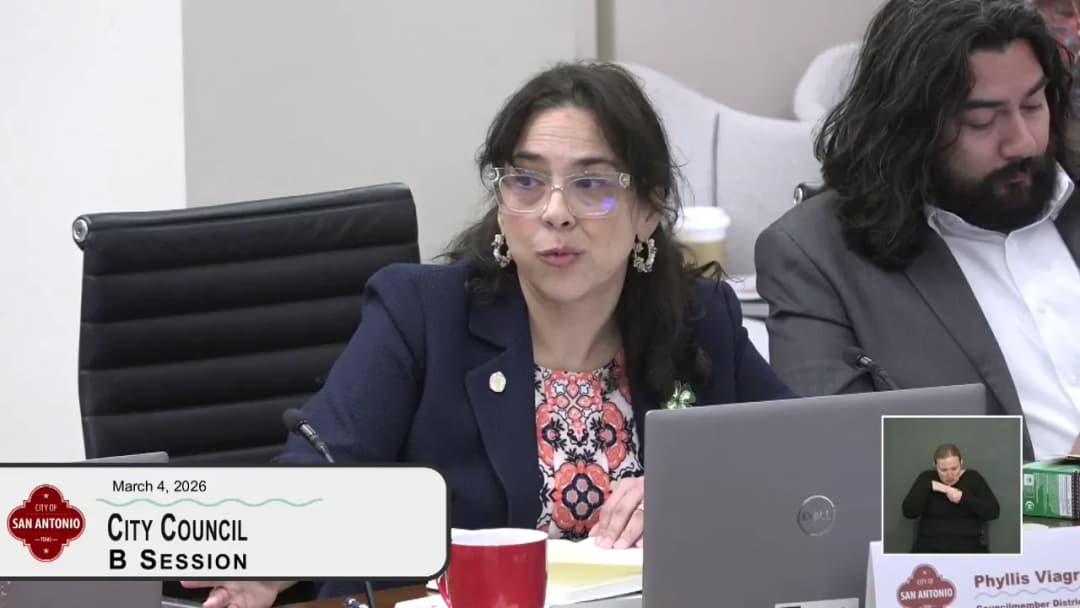
The San Antonio City Council held a B session on Wednesday, March 4, 2026, from 2:05 PM to 6:27 PM. The meeting featured two major agenda items: a briefing from CPS Energy on its fiscal year 2027 proposed budget (the largest in the utility's history, both in capital and O&M, and assuming a rate increase) and a joint update from CPS Energy, SAWS, and the City's Development Services Department on the state of data centers and large-load growth. Councilmembers extensively discussed the impacts on reliability, affordability, water resources, and future rate structures. CPS Energy FY27 Budget Briefing - CPS Energy presented a proposed $1.7 billion capital budget and $1.1 billion operations and maintenance budget for FY27. The budget includes a $50 million revenue gap, which CPS leadership stated would be a placeholder for a potential rate increase, pending a cost-of-service study and summer revenue outcomes. Mayor Jones noted this is the largest CPS budget ever. - Key capital categories: $700 million for reliability (60% for transmission work), $290 million for customer growth (28,000 new electric and 5,000 new gas customers), and technology/security investments. O&M includes $1.1 billion with 45% for labor. - CPS highlighted financial guardrails: debt-to-capitalization ratio under 70%, debt service coverage ratio of 1.5x, and 150 days cash on hand (or 200 days liquidity). - Councilmembers raised questions about efficiency savings (e.g., 40% reduction in non-emergency overtime, fleet savings of $8.75M), the timeline for a tiered rate structure (tied to multi-year ERP project), and the impact of the budget on the city's climate action and adaptation plan (CAP) goals. Elena Ball confirmed the budget aligns with the approved generation plan and that CPS is proceeding with RFPs for wind, solar, and storage despite federal uncertainty. - Several councilmembers, including Councilmembers Mungia, Castillo, and McKee Rodriguez, requested more detailed information on cost reductions, technology upgrades, and the potential for a professional consumer advocate. Councilmember Kaur asked for a graph of historical rate increases and revenue. Data Centers & Large Load Growth - CPS Energy Presentation (Elena Ball): CPS identified 59 large load projects (≥40 MW) in various stages, including 335 MW under contract, 1,400 MW in contracting, and feasibility studies. The projected demand is significant but not all projects will materialize. For every 100 MW of large load, CPS estimates $29 million in non-fuel revenue annually and $8 million in city payments. Commercial customers (11% of meters) pay over 50% of revenue. CPS is developing a pilot tariff for behind-the-meter generation, limited to 15 customers over two years. - SAWS Presentation (Donovan): SAWS reported 23 existing data centers using about 0.1% of potable water and 1.25% of recycled water. Prospective projects could increase potable usage to 0.3% and recycled water usage to 12% of available capacity. SAWS has about 20,000 acre-feet of recycled water demand currently, with 10,000 acre-feet additional capacity in the existing system. Policy considerations include maximizing recycled water use, improving system redundancy, and modifying rate structures. SAWS does not have an expansion of the recycled water system in its current budget. - Development Services (Tomas): The Unified Development Code lacks a specific definition for data centers; current zoning uses
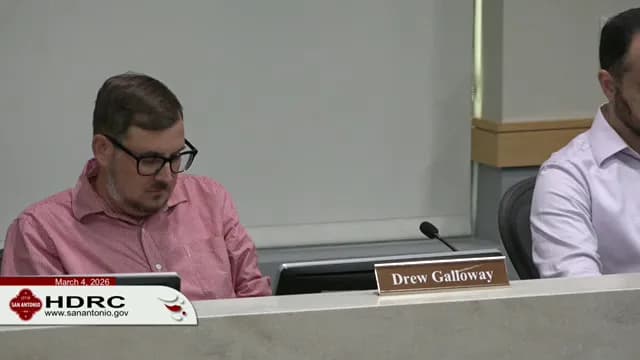
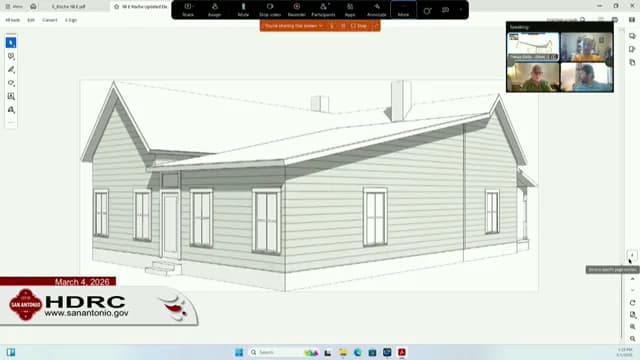
The Historic and Design Review Commission (HDRC) of San Antonio met on Wednesday, March 4, 2026, at 3:00 PM. The meeting included approval of minutes, a consent agenda, and several contested cases involving signage, a gate, and a rear addition in historic districts. Key decisions included approval of a gate at St. John's Lutheran Church with modifications and referral of a rear addition design to the Design Review Committee. Consent Calendar - Six consent agenda items were approved with staff stipulations (items 1, 3, 4, 5, and 6) after item 2 was pulled for discussion. Properties approved: 307 Delaware, 9800 Airport, 423 Blue Star, 801 North Olive Street, and 222 Mary Louise. Discussion Items - Item 2 – 307 Delaware (St. John's Lutheran Church): Applicant pastor Reverend Burke requested approval for a wrought iron gate at the church porch to address homelessness and security (defecation, urination, damage to doors). Staff found the gate reversible and not overwhelming due to building scale. Concerns were raised about obscuring original Gothic Revival features (leaded glass, eagle of St. John). Two design options were presented: one with grapevines on the arch and one simpler version. The commission approved the simpler design (7-2 vote; Commissioners Savino and Holland dissenting). Vice Chair Fetzer noted the gate would be placed at the front of the step for better anchoring to concrete columns. - Item 7 – 3428 Roosevelt (Mustang Sally's): Applicant Isaac Ortiz and owner Rudy Lopez sought approval for a 123-square-foot internally illuminated cabinet sign for the bar. Staff recommended denial, proposing a sign no larger than 50 square feet with indirect/halo illumination and metal faces. The applicant argued the sign was needed for safety, citing 10 pages of prior crime (burglaries, shots fired, theft). Owner stated the sign (installed without approval) improved safety, but admitting it was a violation case. Staff noted other signage on the building (window vinyl, north side box) had not been reviewed. The commission voted 7-1 (Commissioner Galloway dissenting) to uphold staff recommendation and deny the current sign, directing the applicant to re-submit within guidelines. - Item 8 – Garage Construction: Applicant Adrian Zamudio requested approval for a 375-square-foot detached garage with a 288-square-foot covered porch at a rear property. Staff recommended conceptual approval with stipulations requiring detailed drawings, window specifications (2-inch inset, no white, traditional trim), and compliance with setback standards. Chairman Gibbs noted conflicting submittals (vinyl vs. clad wood windows, smooth vs. wood-grain siding). The commission approved conceptual approval with all staff stipulations (unanimous vote) with a reminder to include elevations and site plan. - Item 9 – Rear Addition: Applicant Chris Coker proposed a 500-square-foot rear addition to a house in the King William area. Staff recommended approval with stipulations to extend the existing gabled roof form, eliminate a proposed dormer, and add a vertical trim piece to demarcate old and new construction. Coker presented two designs: one with a shed roof and dormer, and a revised version extending the gable full-length. The King William Association submitted a letter supporting staff stipulations. Commissioners Savino and Fetzer raised concerns about roof form collisions and legibility of the addition over time. The commission voted unanimously to refer the case to the Design Review Committee (next available meeting) for further discussion on roof forms, with a time certainty for the next HDRC agenda. Key Outcomes - Approved consent agenda (items 1, 3, 4, 5, 6). - Approved simpler gate design at 307 Delaware (7-2). - Denied internally illuminated sign at 3428 Roosevelt; directed applicant to re-submit within 50 sq. ft., indirect/halo illumination (7-1). - Granted conceptual approval for garage project (unanimous) with stipulations for detailed drawings. - Referred rear addition case to DRC for roof form resolution (unanimous). - Next HDRC meeting scheduled for March 18, 2026. Public Comments & Testimony - No public comments or voicemails were submitted for any agenda items.
The meeting, held on March 4, 2026, at 2:05 PM, included two main agenda items: a presentation from CPS Energy on its fiscal year 2027 budget and financial health, and a joint update from CPS Energy, SAWS, and the Development Services Department on the growth and regulation of data centers (centros de información) in San Antonio. Council members asked detailed questions about affordability, infrastructure, environmental impacts, and community benefits. No formal votes were taken; the discussions were informational and set the stage for future policy decisions. Discussion Items CPS Energy Budget and Financial Health - CPS Energy presented its FY2027 budget, highlighting a $1.7 billion capital budget, with 80% funded by debt and 20% by cash. The budget assumes a rate increase to cover a $50 million deficit, though CPS emphasized efforts to minimize increases through operational efficiencies (e.g., AI, drone inspections, cloud optimization) and a 40% reduction in non-emergency overtime. - Key financial metrics: capitalization rate below 70%, debt service coverage ratio, and liquidity of at least 150 days. The utility serves 28,000 new customers (2,600 electric) and projects $200 million in revenue growth from residential, industrial, and wholesale segments. - Council members expressed strong support for CPS’s transparency and long-term planning but raised concerns about potential rate increases and their impact on vulnerable residents. Councilor Maki Rodríguez asked about the timeline for the Integrated Resource Plan (IRP) and technology investments, noting that a 5-6 year implementation seemed lengthy. Councilor Castillo requested detailed cost breakdowns for each technology item and a strategic plan for properties. Councilor Galván questioned transmission project timelines and carbon intensity (currently 800-900 lbs/MWh, with expected reductions). Councilor Mungía emphasized the need for rate restructuring that protects low-income customers and asked for more frequent community engagement. Councilor Core praised the presentation but called for a simplified version for residents. - CPS leadership (Corey, Rudy) committed to returning with more detailed reports on technology costs, the cost-of-service study, and a five-year rate plan. They noted that the $50 million deficit is manageable and that rate discussions will occur after summer 2026. Data Centers (Centros de Información) - CPS Energy (Elena) reported 59 data center projects in the pipeline: 335 MW under contract (high probability) and 1,700 MW in feasibility stages. For every 100 MW of load, the city receives $8 million in economic benefits. Currently, 21 data centers operate in San Antonio, and the utility is implementing pre-construction deposits ($7,500–$150,000) and long-term agreements to protect smaller customers. - SAWS (Donovan) detailed water usage: current data centers use 0.1% of potable water and 1.25% of recycled water. The recycled water system has 35,000 acre-feet capacity, with 20,000 currently used. The remaining 15,000 acre-feet can serve near-term growth, but expansion (e.g., Leon Creek plant connection) is needed by 2030. SAWS recommended policies to maximize recycled water use, require backup water storage, and implement impact fees. - Development Services (Amin Tomás) proposed zoning amendments to limit data centers to industrial zones (C-1, I-1) and add buffers (e.g., 500 feet from residential areas). The current UDC allows data centers in all zones except residential, which has led to land-use conflicts. - Council members broadly supported the need for data center growth but insisted on safeguards. Councilor Galván (District 6) noted a high concentration of projects and requested community benefits, workforce local hiring, and mitigation of noise, traffic, and light pollution. Councilor Viagran emphasized protecting neighborhoods and ensuring infrastructure investments are equitable. Councilor White highlighted economic benefits (high-paying jobs, property tax revenue) and urged caution not to over-regulate. Councilor Spears asked about water usage and technology options (e.g., liquid cooling). Councilor Maki Rodríguez questioned the impact on schools, parks, and wildlife, and requested proximity buffers. Councilor Castillo asked about the pilot program for behind-the-meter generation (using natural gas, diesel, or batteries) and whether it would accelerate data center arrival. CPS clarified that the pilot would allow up to 15 customers to test self-generation, but it is not the only path for development. - Councilor Core asked about incentives: only one data center (Microsoft, 2013) received a partial rebate; no other tax incentives have been given. Councilor González sought protections for CPS if large loads later reduce operations or close, noting that 10-year agreements and collateral are in place. - Councilor Mungía called for a transparent process and minimizing NDAs. Councilor Aldrete de Gabito supported UDC amendments but stressed inclusive public engagement. Councilor Castillo supported the I-1 zoning recommendation and landscape requirements. Key Outcomes - Council directed staff to begin the UDC amendment process, with a focus on limiting data centers to industrial zones, adding buffers, and addressing land-use concerns. The timeline will be discussed at the next PCDC (Planning Commission) meeting. - Council expressed support for continuing collaborative work with CPS Energy and SAWS to develop a comprehensive data center policy, including water use requirements, community benefits agreements, and infrastructure planning. - CPS Energy will return with a detailed cost-of-service study and an update on the technology investment plan after summer 2026. SAWS will develop a master plan for recycled water expansion by 2030. - The council requested that CPS and SAWS provide simplified public-facing materials on data center impacts and benefits. - No formal votes were taken; all actions are informational and preparatory for future ordinances.
The Historical and Design Review Commission (HDRC) met on March 4, 2026, at 3:00 PM in San Antonio. Chair J. Maurice Gibbs presided; Vice Chair Jeffrey Fetzer and commissioners Sabino, Galloway, Mezuka, Guevara, Travieso, Holland, and Nehemiah were present (some attended virtually). The commission approved minutes from February 18, 2026, and handled consent, discussion, and voting on four agenda items. Staff announced that Shannon Miller has transitioned to a new role as head of the San Antonio City Centre and the Office of Historic Preservation. Consent Calendar - Items 1, 3, 4, and 5 were approved unanimously with staff stipulations. Item 2 was pulled for discussion. The approved items concerned properties at 800 Airport Blvd, 220 Mary Luz, and others; certificates of appropriateness will be issued within ten days. Discussion Items - Item 2 – Wrought‑Iron Gate at St. John’s Church (800 Airport Blvd area) Applicant Robert Burkett (pastor) and an architect proposed a wrought‑iron gate to prevent homeless people from congregating on the front porch, where they had been defecating and urinating on the doors. The gate was intended to extend the perimeter but would be set forward of the main entrance. Staff recommended approval with a simplified design; they had previously found the original ornate gate too overwhelming in scale. Commissioner Sabino expressed concern that even a simplified gate would obscure the building’s Gothic Revival features (ornate doors, stained glass, art glass). After discussion, a motion to approve the simplified concept passed 7‑2 (commissioners Sabino and Fetzer dissented). - Item 7 – Signage at 2428 Roosevelt (HDRC2025‑351) The applicant (Ice Cortiz, with owner Rudy López) sought a certificate of appropriateness for a 123‑sq‑ft internally illuminated cabinet sign on a bar/restaurant. The sign had already been installed without approval (code violation). Staff recommended denial, proposing a sign no larger than 50 sq ft with indirect (halo) lighting. The owner argued the sign was necessary for security, citing high crime in the area (seven pages of police reports, three recent pedestrian fatalities on the block) and noting that they had already invested in CPS‑provided high‑lumen streetlights. Commissioners noted other illuminated signs in the district but stressed that the guidelines require non‑illuminated or halo‑lit signs. A motion to support staff’s recommendation passed (with commissioner Galloway voting no). The applicant was encouraged to revise the design per the guidelines and return. - Item 8 – Carport and Covered Porch (case not numbered in transcript) Applicant Adrian Samudio requested a certificate of appropriateness for a new 375‑sq‑ft open carport and a 288‑sq‑ft covered porch at a rear property. Staff recommended conceptual approval subject to detailed drawings (elevations, window specifications, material colors, and setbacks). The applicant agreed to provide all required information. A motion to approve the conceptual design with staff stipulations passed unanimously. - Item 9 – Addition to Principal Structure (HDRC2026‑048) Applicant Chris Coker proposed a 500‑sq‑ft addition to a 6,000‑sq‑ft house in the King William Historic District. Staff recommended approval conditional on: (1) a roof form that does not alter the original roofline, (2) a clear division between old and new, (3) detailed drawings, (4) reuse of salvaged wood siding, (5) standing‑seam metal roof panels with 1–2 in ribs, (6) wood windows meeting specific dimensions, and (7) compliance with zoning and any required variances. Coker presented two design iterations; commissioners felt the roof form needed refinement to avoid looking too flat and to better distinguish the addition from the original structure. A motion to refer the case back to the Design Review Committee (DRC) for further discussion of the roof form was passed unanimously. The next DRC meeting is scheduled for March 18, 2026. Key Outcomes - Item 2: Approved (7‑2) with a simplified gate design. - Item 7: Motion to deny the sign as installed and recommend compliance with staff guidelines passed; applicant may resubmit a revised design. - Item 8: Conceptual approval granted, subject to full documentation. - Item 9: Referred to the DRC for further refinement of the roof configuration; the applicant is expected to present a revised design at the March 18, 2026 DRC meeting. - All approved items will receive certificates of appropriateness within ten days after permit issuance.
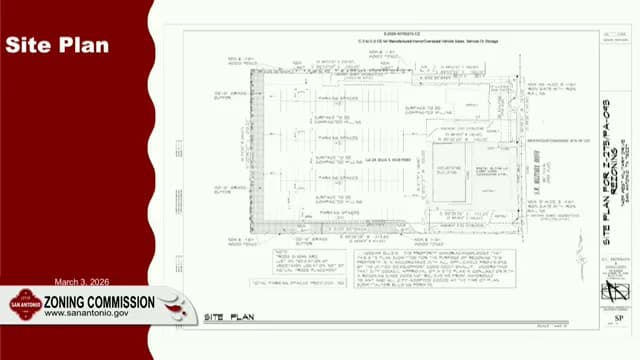
This is a meeting of the San Antonio Zoning Commission held on March 3, 2026, at 1:00 PM, presided over by President John Bustamante. Commissioners from all 10 districts were present (quorum achieved). The meeting covered consent agenda items, individual zoning cases, public comments (including voicemails), and postponed items. The meeting adjourned at 4:14 PM. Consent Calendar - Items approved on consent (4, 6, 8, 12, 13, 15, 16, 18, 21) were all routine rezonings with no opposition or with neighborhood association support. Item 6 (1516 Rita Ave, C2 to C2 CD for auto sales/services) and Item 14 (East Myrtle St) were initially on consent but had public comment; Item 14 was pulled to individual discussion. The consent motion passed unanimously. Public Comments & Testimony - Item 6 (Rita Ave): Jim Platt (1128 East Euclid) opposed the project directly across from his complex (SoJo Crossing, 27 units). He cited traffic congestion on Euclid/Myrtle, lack of parking, and proposed a restaurant/bar/offices too close to residences. - Item 14 (Myrtle St): Jim Platt also testified against the IDZ1 to NC rezoning, citing existing parking and traffic issues, especially on Euclid Street, and potential harm to the residential character. - Item 19 (Broadway condo): Over a dozen voicemails from Chateau Dijon residents (Elaine Begin, Jerry Rain, Gloria Kaufman, Jeff McCentric, Kim Such, Leslie Deoutshow, Linda Cornwell, Maria Teresa Martinez, Marie Dodge Graham, Norma Nickel Walker, Sarah Benavides, Tina Turn, Elena Caber, Ayn Schneider, Barbara Allen, Barbara Elkson, Chris Lee, Dolores Mullish) all strongly opposed the 4-story, 50-unit condo at Broadway and Nottinghill. Concerns: loss of privacy, natural light, construction noise/dust, increased traffic, safety for elderly/disabled pedestrians, impact on community pool and tennis courts, and inconsistency with the neighborhood scale. - Item 3 (Rowan Bluff duplex): Neighbors Antonio Domingue, Jimmy Holder, Nicholas Brown, Vicky Mangald (on behalf of Cabala Creek HOA), and Nate Mangle spoke against the rezoning to allow a duplex (three units). They argued it would set a precedent, increase density, worsen traffic on a single-access road, lack sidewalks, and that the applicant misrepresented the scope to the HOA. - Item 10 (B Street): Merlen Hawkins (Government Hill Community Association) opposed, stating the project of four units was inconsistent with the East Side Community Plan calling for low-density residential. Discussion Items - Item 2 (Huebner Rd – Laundry): Request to rezone C2 to C2S for a self-service laundry in an existing shopping center. No public comment. Staff recommended approval. Commissioners noted it was an existing building with no adverse impacts. Vote: unanimous approval. - Item 3 (Rowan Bluff – Duplex): Request from R6 to PUD R6 CD for three units (existing house plus two ADUs) for family care. Strong neighborhood opposition. Commissioner Duval moved to recommend denial after noting the HOA’s lack of support and concerns about density and precedent. Motion passed 8-3 (Duval, P. Rodriguez, Kellum, Hinojosa, Huey, Saibes, Kelly, Witset in favor; Lopez, Pana, Bustamante opposed). Recommendation to City Council: deny. - Item 5 (Portline Ave – Commercial): Request from MF33 with C2 to NC (neighborhood commercial) for a small office. Applicant amended from earlier truck service. Staff recommended approval after amendment. Vote: unanimous. - Item 7 (ProBand & Broadway): Request from IDZ1 to R6 and C2 for a small store and two rentals. Applicant amended to remove one parcel. Staff recommended approval. Vote: unanimous. - Item 10 (B Street – Four Units): Request for R6 CD with conditional use for four duplex units. Two neighborhood associations had conflicting positions (Government Hill Alliance supported, Government Hill Tomorrow opposed). Commissioner Kellum moved to postpone to March 17 for further neighborhood outreach. Vote: unanimous. - Item 14 (Myrtle St – NC): Request from IDZ1 to NC for small retail/offices near the Pearl. Tobin Hill Association supported. One neighbor opposed citing traffic and parking. Staff recommended approval. Vote: unanimous. - Item 17 (Wireless Communications): Request for R5 CD to allow a wireless communications system in a residential area near Collins Garden HOA. This was a revised plan after previous deferrals. No opposition. Vote: unanimous. - Item 20 (Cerebes St – Auto Body Paint): Request from C3 to C3S for auto body painting and repairs in the Brooks area. Applicant had engaged with Brooks and neighbors. Staff recommended approval. Vote: unanimous. - Postponed Items: Item 19 (Broadway condo) was postponed to March 17, 2026, after extensive voicemail opposition. Item 11 was also postponed to April 7, 2026. Key Outcomes - Approved on consent: Items 4, 6, 8, 12, 13, 15, 16, 18, 21 (all routine rezonings). - Approved individually: Item 2 (laundry), Item 5 (office), Item 7 (store/rentals as amended), Item 14 (NC), Item 17 (wireless), Item 20 (auto body paint). - Denied recommendation: Item 3 (rowan Bluff duplex) – 8-3 vote to recommend denial to City Council. - Postponed: Item 10 (B Street four units) to March 17, 2026; Item 11 to April 7, 2026; Item 19 (Broadway condo) to March 17, 2026. - Minutes approved: With one abstention (Commissioner Duval). - Procedural note: Starting April 1, 2026, the commission will no longer accept voicemail public comments.
- Councilmember Mungia: Agreed that the two-stretch requirement is antiquated and supported changing to a luxury vehicle service model. He favored grandfathering existing operators and increasing insurance to $1M. For horse carriages, he requested more information and a separate briefing to understand the transition options. - Councilmember Corr: Advocated for a comprehensive review of Chapter 33, including pedicabs and electric vehicles. She opposed the insurance increase to $1M, citing it as a barrier for small businesses. She supported a luxury vehicle standard with a defined list of acceptable vehicles. For horse carriages, she suggested opening EV permits to the community in addition to providing one-for-one exchanges for current operators, and proposed a pilot program with temporary permits. - Councilmember Spears: Opposed any changes to limousine requirements, deferring to the TAB vote and concerns of current owners. She raised concerns about the cost of increased insurance and the impact on drivers. On horse carriages, she highlighted the ongoing care costs for animals after the phase-out, requested financial analysis of EV carriage business models, and asked for a way to revert if the pilot fails. She also urged the city to make whole the lost income from the holiday season. - Councilmember Alderete Gavito: Noted that few complaints have been received about the current limousine code. She opposed changing requirements, citing the TAB's recommendation. For horse carriages, she supported the existing phase-out timeline and asked about the impact if all owners transition at once. Key Outcomes - No formal votes were taken. The committee provided direction to staff to: - Develop a pilot program for electric carriages, with temporary permits to operate from fall 2026 through spring 2027 (covering peak holiday seasons) to gather metrics on ridership, revenue, and operator satisfaction. - Explore options for limousine permit requirements, including a potential luxury vehicle service category, and consider comprehensive review of Chapter 33 (including pedicabs and electric vehicles). - Address the horse carriage owners' concerns about lost holiday season revenue and ensure signage for loading zones is in place for future peak seasons. - Research the cost and availability of electric carriages and share information with current horse carriage operators. - Staff will return to the committee with a proposed ordinance for the electric carriage pilot program.